Categories
Companies

WH Smith got the business because they were better at it than their competitors

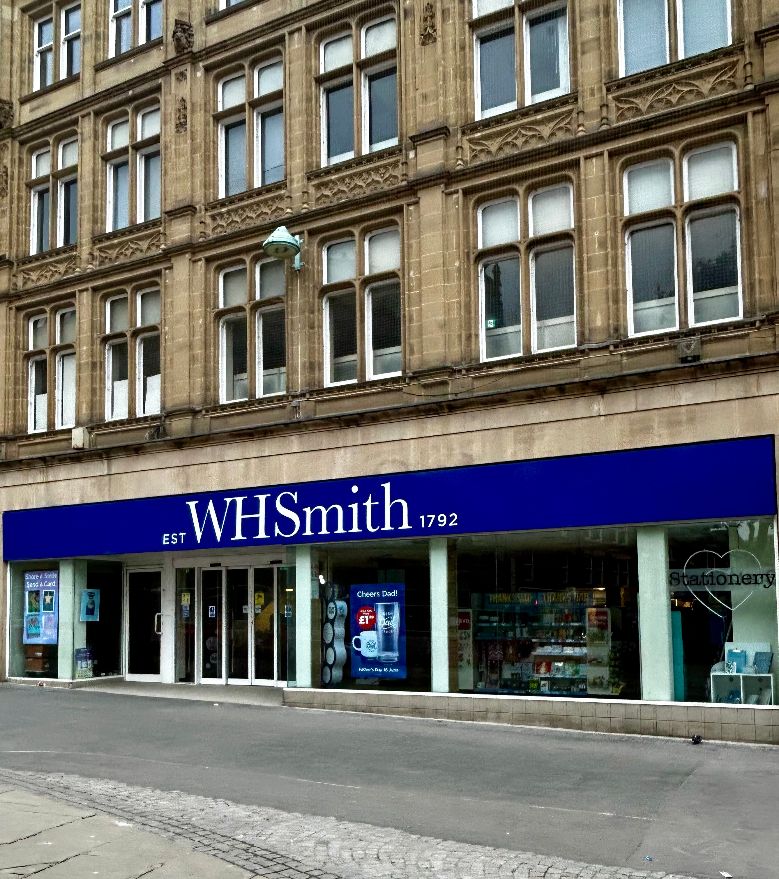
Fargate is in a bit of a mess as it moves away from traditional retail space towards a leisure and social hub. If we’re being honest, we all expect Marks & Spencer to announce the closure of its store at some stage, and what a devastating blow that will be. But there is another retailer that might have a wobbly time ahead. I’m referring to WH Smith whose city centre store opened in the 1970s and is only the second retailer to have occupied 38-40 Fargate. It was, of course, built for provisions merchant Alfred Davy in 1881-1882 by Sheffield architect John Dodsley Webster. Look closely at the exterior and you can still see the carved stone heads of a sheep, cow, pig, and ox.

All is not well at WH Smith, and its High Street stores are struggling to cope with life in the twenty first century. Last month, WH Smith reported another year-on-year dip in sales at its large stores. This contrasts with an eight per cent rise in revenue at its travel stores, those situated in airports and railway stations across the world. “The transformation of the business to a one-stop-shop for travel essentials is delivering strong results, increasing average transaction values and returns,” says the company.

It is a case of things going full circle as I shall explain in a moment, but the question remains. How long will it be before WH Smith calls time on its High Street operation? Sales of newspapers, magazines, books, and stationary, have been eroded by the internet, resulting in a watered-down offer. Instead, we’re left with too many phone chargers and fridges full of chilled drinks. The result is a store lacking atmosphere and too few staff to make the shops look as nice as they used to.

The WH Smith archive is held at the University of Reading but the exact date when it was founded is uncertain. The best guess is sometime between 1787 and 1792 but we do know that its roots were in the newspaper distribution business.

Records show that Henry Walton Smith (1738-1792) to be owner of a Mayfair ‘paper round’ in 1792, delivering expensive newspapers to rich London clients. This was also the year of his death, and the year of William Henry Smith’s birth. Anna Easthaugh, Henry Walton’s widow, ran the business until her death in 1816.

It was her second son, William Henry (1792-1865), who turned it into ‘a house… without its equal in the world’, as The Bookseller described it in its obituary. He had exploited the market for London papers that existed outside the capital, using the newly developed network of seven hundred daytime stagecoaches to get newspapers to the provinces  many hours before traditional carriers, the night-time mail coaches. There was little profit in the operation, and it took him thirty years to realise that he needed help, and a successor.

His son, William Henry II (1825-1891), had wanted to be a clergyman, but his father demanded that he join the business instead. It was a shrewd move, because William Henry II capitalised on the new railway network as a speedier alternative to the coach, and then he started bookstalls, and developed the more familiar role that the company became famous for. By the end of the century, there was a WHS bookstall on almost every station (in 1902, there were 1,242 of them).

Writing about the history of WH Smith in 1985, Michael Pountney said that “expansion seemed unstoppable. Extension of the railway network meant more stations. Elimination of stamp duty on newspapers meant lower prices and more sales. Better education meant more readers. Unstoppable, but not inevitable: Smith’s got the business because they were better at it than their competitors, more reliable, more efficient, better able than their less scrupulous rivals to do good business without offending against the stern moral values of the age.”

Things were about to change.

Before the end of the nineteenth century, railway expansion slowed almost to a halt, the Victorian boom slowed, and William Henry had become an MP that took him away from the business. He died in 1891, leaving the business floundering.

The merger of two of the biggest railway companies, GWR and the LNWR, in 1905, resulted in WHS losing 250 bookstalls at its stations, but it responded by opening 144 shops in towns where they had lost a stall. The man credited for this entrepreneurial genius was CH St J Hornby, friend of WHS’s new proprietor, William Frederick Danvers Smith (later second Viscount Hambleden).

Opening shops was a retaliatory measure against the loss of the bookstall contracts, but its move onto the High Street was a success, with rapid extension across most of the country in the twentieth century, matched by a reduction in the importance of bookstalls. Only with the full development of the shops did the stationary, book and record departments come to rival the supremacy of news and periodicals.

WH Smith went public in 1949 but continued to be run by the Smith family until 1972 when David Smith stepped down as chairman, and then Julian Smith’s retirement in 1992 marked the end of family involvement in executive management.

In 1966, WH Smith created a standard book number consisting of a nine-digit code, which was adopted in 1970 as the international standard number and finally became the International Book Number (ISBN) in 1974.

Let us not forget the other enterprises that WH Smith were once involved with. WH Smith Travel operated from 1973 to 1991, and in 1979 it acquired the Do It All chain of DIY stores, later merging with Payless DIY (owned by Boots). It went on to purchase 75 per cent of share in Our Price music stores and even held a minority stake in ITV. Between 1989 to 1998, the company was a major stakeholder in the Waterstones bookshops, resulting in WHS own bookshop brand Sherratt and Hughes (which had already subsumed Bowes & Bowes) being merged into Waterstones. WHS eventually pulled out of all its external interests.

And so, we come that full circle. The High Street shops are struggling, victim of changing shopping trends, and the future of the company appears most likely to be catering to the needs of travellers, over 640 stores in thirty countries outside the UK, much like those Victorian bookstalls did.
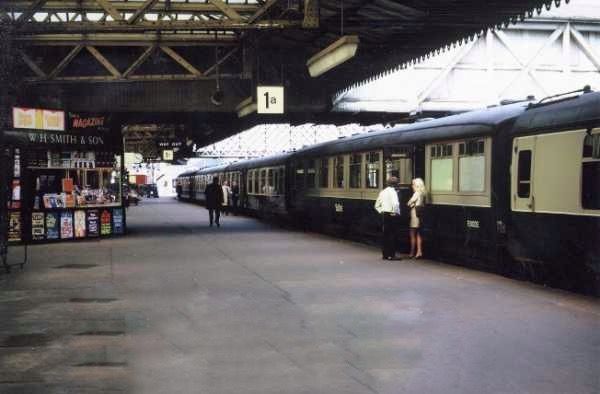
Platform 1, Sheffield Midland railway station showing (left) WH Smith and Son, newspaper stall. WH Smith also had a newspaper stall Sheffield’s Victoria Station. Image: Picture Sheffield

© 2024 David Poole. All Rights Reserved.
Categories
Buildings

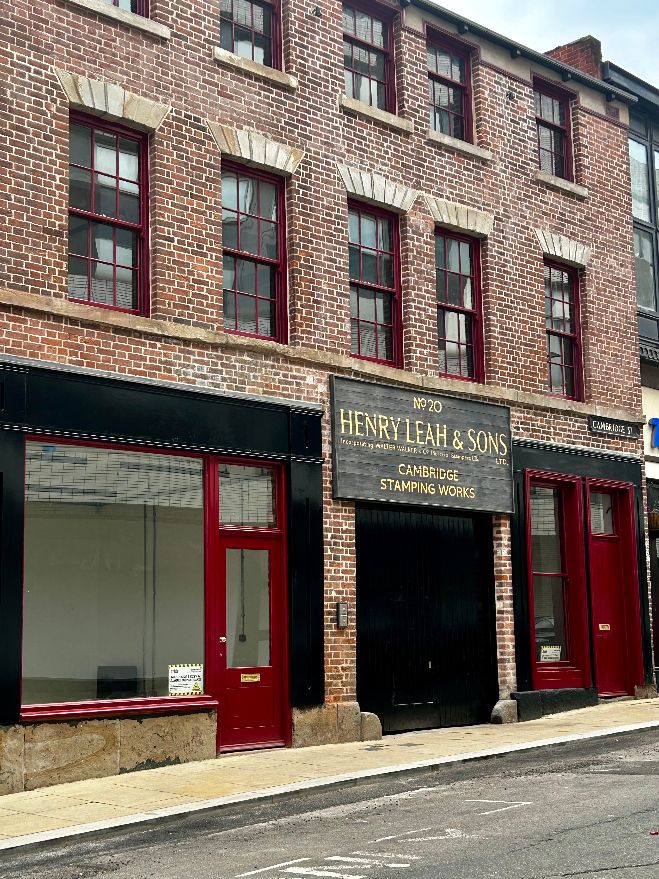
Leah’s Yard: The ghosts of our ancestors are eager to see what has become of their old workshops

The ghosts of our ancestors, the ‘little mesters’ of yesteryear, are circling over Leah’s Yard, eager to see what has become of their old workshops. Soon, the gates be thrown open again, and, finally, this important part of Sheffield’s history, will have been reborn. The latest stage of the Heart of the City redevelopment is scheduled to open as a new creative and retail hub later this summer.

Gosling’s map of 1736 shows a rural scene, with Coalpit Lane, sometimes referred to as Cowpit Lane (later Cambridge Street), having views across open country to the east towards Alsop Fields and west over Sheffield Moor. Fifty years later, the land on the opposite side of the lane had been developed with the addition of Burgess Street and Cross Burgess Street.

Industrial development gathered pace in the middle of the nineteenth century and was known for its traditional fine metal and cutlery making. The oldest buildings in Leah’s Yard date from the early part of that century when George Linley created a small shear and tool manufacturing workshop in 1825. The houses in front were converted to offices and shops, and the complex grew with piecemeal additions.

James Morton, a horn dealer, became the sole occupier about 1842, and later maps identify the site as the Coalpit Lane Horn Works. By 1890, the site had extended into an L-shape behind the Sportsman Inn.

The arrangement of Leah’s Yard, with workshops around a central courtyard, was typical of the industry and in particular small craft workshops. The courtyard was accessed through a central cart entrance from the converted houses.

From the 1890s, the site was occupied by Henry Leah and Sons, a manufacturer of die stamps for silverware, later joined by other ‘little mesters’ all connected with the cutlery trade.

Henry Leah, originally from Chesterfield, died in April 1893, leaving the business to his two sons, Harry Wilson Leah (died 1939) and Louis Thomas Leah (died 1942). The Leah family remained in part of the complex until the 1970s when it was absorbed into Spear and Jackson and the site was sold  in the 1990s.

Although the frontage was occupied for a time by small shops, Leah’s Yard was abandoned and fell into disrepair, the frontage subsequently propped up by scaffolding for years and obliterating much of Cambridge Street.

It has been completely restored and a source tells me that most units have been taken up. Already confirmed are the artist, Pete McKee; Hop Hideout beer and tasting room; Gravel Pit plant, art, and gift shop; the Chocolate Bar café; Mesters’ Market, selling locally produced food and drink; The Yard Gallery, highlighting the city’s artistic talent; La Biblioteka book shop; Ferrio automation; and Sheffield Hospitals Charity.

© 2024 David Poole. All Rights Reserved.
Categories
Buildings

“The last house in Sheffield, where the weary traveller could refresh themselves.”

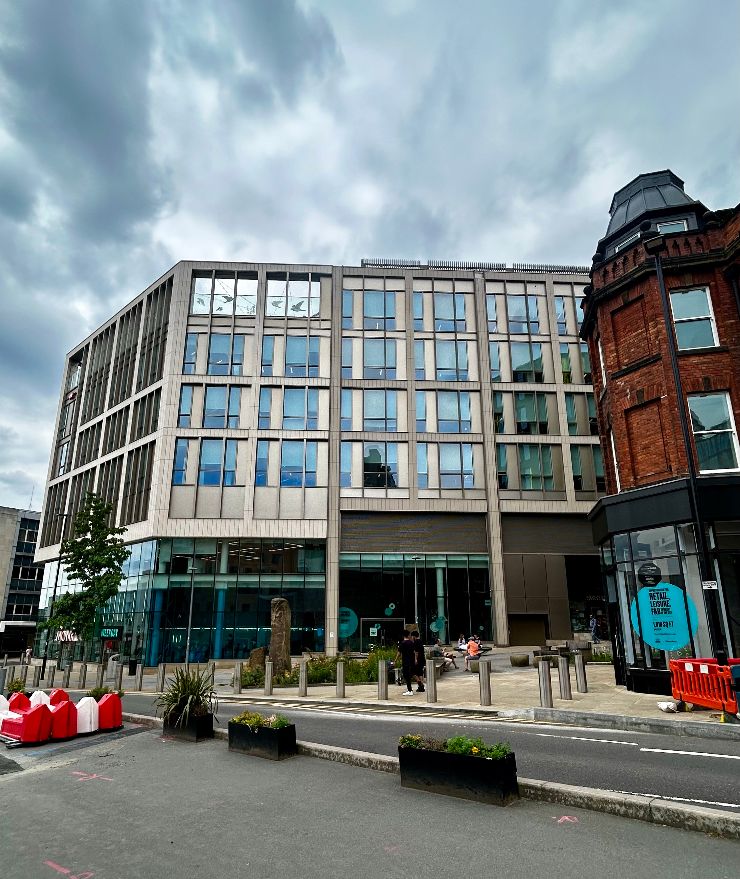
Grosvenor House, at the corner of Pinstone Street and the bottom of Cambridge Street, Sheffield. Image: DJP

Grosvenor House, home to HSBC, one of the first buildings to be completed in Sheffield’s Heart of the City 2 development. Prior to this, the site was occupied by a 1960s concrete block, topped by the Grosvenor House Hotel.

But let’s imagine that we can peel back time, to when this would have been wild moorland. The year was 1682 and a small house was built here. For whom, we shall never know, but it was extended over the next hundred years, and marked the edge of Sheffield town. Beyond the house was Sheffield Moor, a barren stretch of land, reputedly dangerous to cross, that stretched from the town boundary until it reached a small hamlet called Little Sheffield.

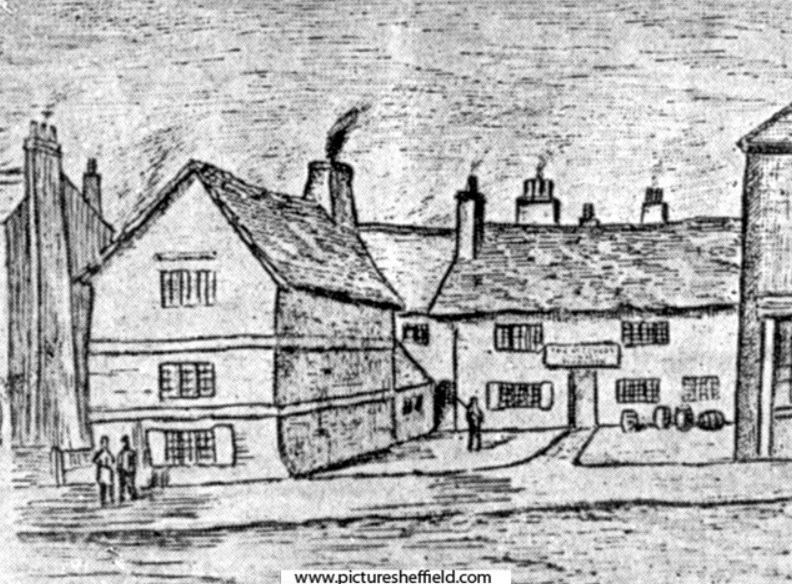
The likelihood is that somebody saw a business opportunity because by the early 1800s the house had been converted into an inn and stood on Coalpit Lane (renamed Cambridge Street in the 1860s).

Chequers Inn, Coalpit Lane. Image: Picture Sheffield

“It was originally the last house in Sheffield, where the weary traveller, journeying between London and the immediate towns, could refresh themselves in the ‘qualifying flagon’ of home-brewed ale.”

In front of the inn stood two posts that held stocks in which evildoers were fastened and exposed to the jeers of passers-by. It was a frequent sentence inflicted on anyone found tippling during the hours of Divine service on Sundays or playing pitch-and-toss. The victims in the stocks were seated, and their ankles held fast.

Sheffield was well supplied with stocks. At one time, stocks and a pillory stood by the Town Hall which at that time was situated where the entrance to East Parade is now. There were also stocks at Attercliffe, Bridgehouses, and Fulwood.

It was a puzzle as to why there were stocks outside the Chequers Inn, especially as it was so close to the Sheffield stocks. This side of Coalpit Lane was actually outside the town boundary and the start of Ecclesall, and it was likely that the Sheffield constable (to save the rates) handed over a vagabond to the Ecclesall constable, and this was the ideal spot for him to be placed until released by the Ecclesall official and then he would be transferred from one place to another until his birthplace was found, and who would be compelled to keep him.

The Chequers Inn, also briefly known as the Old Cow, was in the Alsop and Barker family generation after generation, when it was purchased by James Padley, whose sons (one was the Borough Accountant) sold the property to Daniel Henry Quigley Coupe.

D.H. Coupe came from Worksop as a young man and had many ‘irons in the fire’, starting out as a labouring carter before buying the business of his employer Mr Milner. He grew the business until he owned 82 horses and carts before branching out into the coal trade at Midland Station. After he sold his coal business, he moved into the brewing industry and was sole partner in D.H. Coupe and Co, of the Albion Brewery, Ecclesall Road. He was the largest cottage property owner in Sheffield and paid more rates than any other man in the town.

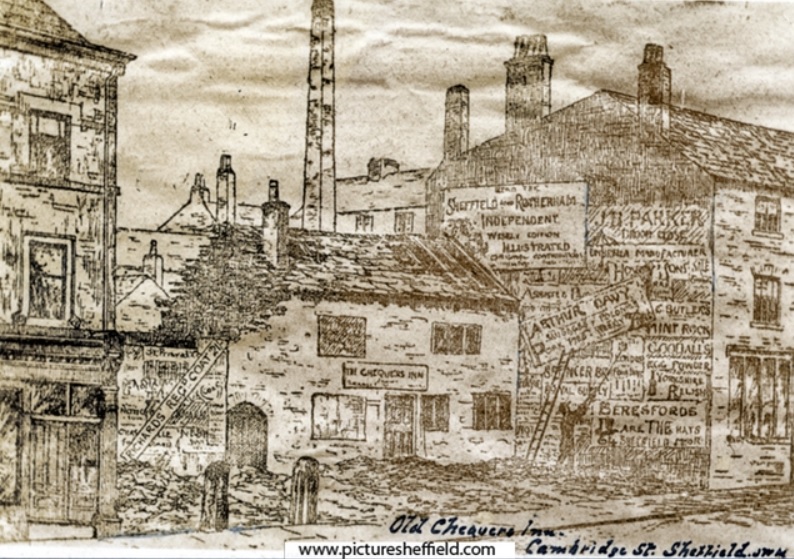
By the time he bought the Chequers Inn, Sheffield had rapidly expanded, and it no longer backed onto the countryside. Not only that, but the inn was in a poor state of repair. In 1860, slates and stone slabs had fallen off the roof, followed directly by the roof itself. Chequers Yard, behind the inn, was a coal yard, and contained notorious lodging houses, home to vagrants in a hopeless state of destitution and disease.

D. H. Coupe’s plans for the Chequers Inn was to demolish it and erect a new hotel on its site while retaining its old sign, one of its quarterings being the coat of arms of the old Lord of the Manor. However, he died in 1883 and the executors did not see their way to carry out the project, hence it remained in dilapidated condition.

Last days of the Chequers Inn, Cambridge Street. Image: Picture Sheffield

The area bordering old Sheffield Moor had become known as Moorhead, and when the town started its street improvements programme, the Chequers Inn owed its survival because it stood just above the point where New Pinstone Street cut through Coalpit Lane (Cambridge Street). The demolition of properties around it brought the Chequers into daylight again and a ‘somewhat out-at-elbows appearance’, and the inrush of light had proved so dazzling that the windows were boarded up and accentuated the poor condition of the public house. The uninhabited appearance meant that its days were numbered, and a report from this time stated that one of the old stock stones had fallen. It was a far cry from the days when writers had referred to the smart Chequers Inn with its grass plot facing the street, but in its last days that grassy plot had been used as a skittle alley.

T and J Roberts, milliners, had built a grand new shop at the corner of Cambridge Street and New Pinstone Street in 1882 and they purchased the Chequers Inn to construct a Cambridge Street extension in 1888.

Workmen who demolished the Chequers Inn came upon a stone lintel which bore coloured checks – blue, red, etc. – bright as the day it was painted. The sign had been papered over and above the lintel was the name of ‘Alsop’. Other stones laid bare had the date ‘1682’ carved into them. There is some mystery as to what happened to the old stones that had supported the stocks. Charlesworth Brothers, who built Roberts extension, stated that they had been used intact in the foundations of it, but a letter to the Sheffield Daily Telegraph claimed that a passer-by had bought them with the intention of presenting them to Sheffield for display in one of its parks.

Alas, the Chequers Inn disappeared and was quickly forgotten. T and J Roberts closed its shop in 1937 and the building survived until replaced by the 1960s concrete construction that was in turn demolished as part of the recent Heart of the City redevelopment.

T and J Roberts, Moorhead, with Cambridge Street to the right. 1885. Image: Picture Sheffield

© 2024 David Poole. All Rights Reserved.
Categories
Buildings Companies

That ‘German’ company’: The rise and fall of Wilson Peck

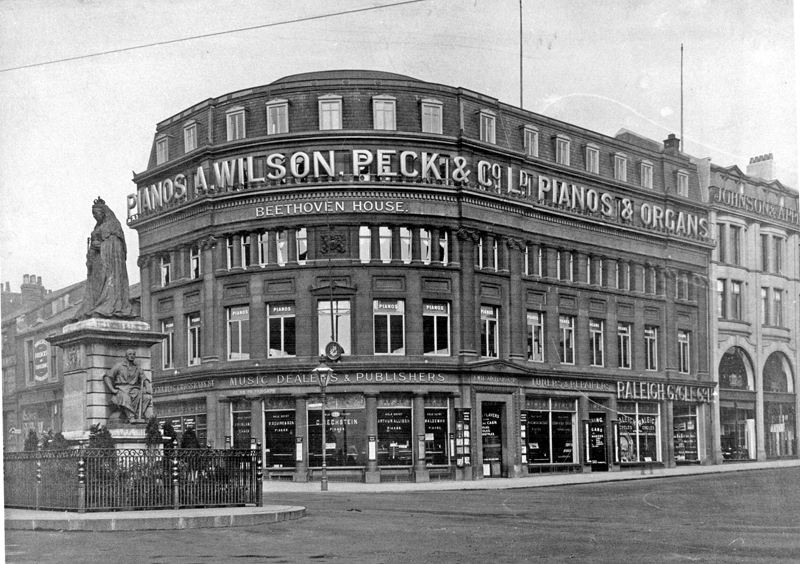
Wilson Peck Ltd., Beethoven House, Music Warehouse, Nos, 66, 68 and 70, Leopold Street, from Town Hall Square. Image: Picture Sheffield

The year is 1917 and Maximilian Lindlar is feeling annoyed. He had decided to sue Herbert Sinclair, editor of The Piano Maker, and its printers, King and Jarrott, for damages for an alleged libel contained in an issue of the paper.

Lindlar, born in Dusseldorf, left Germany at an early age, and had lived in Britain for forty years. A naturalised Englishman, denaturalised in Germany, he was a freeman of the City of London and between 1884 and 1912 he had been in the service of Edwin Bechstein, of Johanns Strasse, piano makers of Berlin.

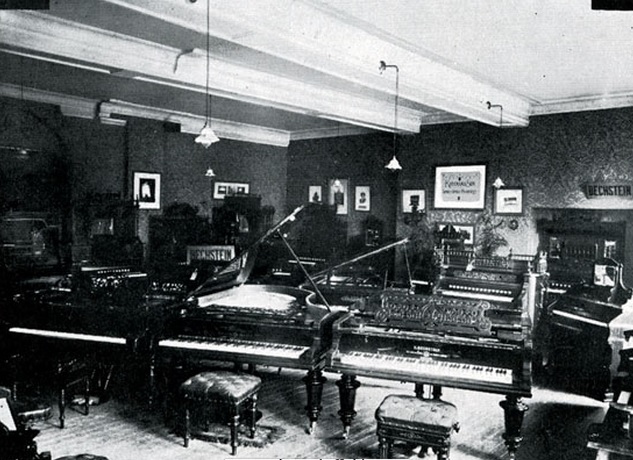
The Bechstein business was founded in Berlin in 1853, developing a full range of pianos that met the requirements of professional pianists, musical institutions, and private music lovers alike. In London, its distribution was centred at Bechstein Hall in Wigmore Street, with upwards of one thousand grand and upright pianos displayed in different showrooms, with over one hundred musicians engaged for teaching purposes, and over four hundred concerts held every year.

While under the employment of Bechstein, Lindlar became involved with two British companies, Arthur Wilson and Peck Ltd of Sheffield, and Hopkinson Successors Ltd of Leeds, two retailers with monopolies for selling pianos in their respective cities.

In 1915, the total capital of Arthur Wilson and Peck was £20,000; Edwin Bechstein holding £10,250 of shares and Max Lindlar possessing £1,500. Lindlar’s brother, William Ludwig, a director, was the second highest shareholder with £2,562.

When war against Germany broke out in 1914, Bechstein’s holdings had allegedly been transferred to British shareholders, but this turned out not to be the case.

Lindlar had taken offence that Sinclair had published a scathing article and had dragged up comments made by him in preceding years.

“It is a national impossibility for an Englishman to produce a piano with each note perfectly balanced in tone. He has no true ear. His piano sounds all right to him, he does not know.”

Sinclair also published comments that Lindlar had made about the war.

“I do not think that England will be able to hold out financially to the end as Germany is very strong and well organised.”

What irked Lindlar most was a story in a newspaper that claimed he was attempting to drive British officers out of London’s German Athenaeum Club.

Such was the controversy over Arthur Wilson Peck and Co’s German influence that it was discussed in Parliament and subject to investigation by the Board of Trade in 1916.

Lindlar won his case and was awarded one farthing in damages, but Arthur Wilson Peck and Co suffered, its name  ‘MUD in large letters’ according to one journal while others continued to call it a ‘German’ company. Soon afterwards, Edwin Bechstein’s shares were sold to a British businessman and the Lindlar brothers held a dinner at Sheffield’s Grand Hotel to announce that their interests had also been sold and were retiring from the business.

Afterwards, it was business as usual for Arthur Wilson and Peck Ltd, a Sheffield company that grew out of Victorian enthusiasm for the piano.

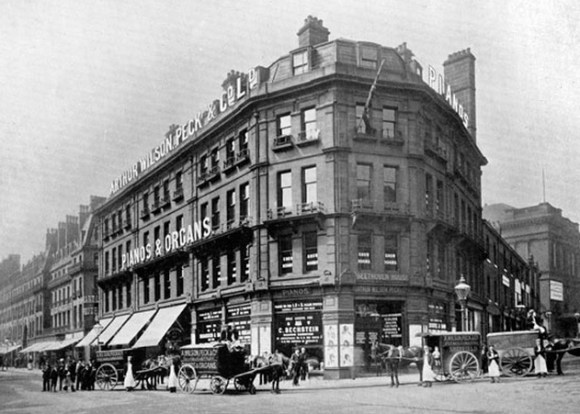
The first shop. Arthur Wilson, Peck and Co., Ltd., pianoforte, organ, and musical instrument dealers, Beethoven House, Pinstone Street. 1897. Image: Picture Sheffield

The company was created after Max Lindlar had masterminded the merger of two successful Sheffield piano sellers, Arthur Wilson, and John Peck, in 1892.

Arthur Wilson had started out as a piano shop at the corner of York Street before moving to Fargate and West Street, while John Peck, a piano tuner, had a business at the County Piano Saloon on Church Street (situated in the Gladstone Building).

The story behind Arthur Wilson is a strange one because the name was a pseudonym created to disguise the identity of the shop’s real owner.

He was Henry Charles Brooklyn Mushet (1845-1923) from Belgrove House, Cheltenham, the son of Robert Forester Mushet, the inventor of ‘Mushet’ steel, a self-hardening steel, who came to Sheffield with his brother Edward in 1871 to supervise the manufacture of ‘Mushet’ steel at Samuel Osborne and Co, Clyde Steel Works, on The Wicker. A music lover, he set up Arthur Wilson as a side line in 1878 and became an agency for Bechstein Pianos, where he met Max Lindlar.

John Peck (1841-1922) was born in Blyth, near Worksop, and was also regarded as the “father of the city’s fiddlers,’ his skills as a violinist surpassing those of the ‘stars’ who visited Sheffield and a man who went on to become a successful conductor.

With Max Lindlar’s connection to Bechstein Pianos it was decided to form Arthur Wilson, Peck and Co Ltd in 1892. With capital worth £20,000, Lindlar became chairman and John Peck joined as a director, but Mushet decided to step down from the business. Other notable appointments were William Cole, another piano dealer, who served as Managing Director for the first year and C.D. Leng, son of newspaper publisher William Christopher Leng, and a partner in the Sheffield Telegraph.

The first task for the new company was to close its three shops on West Street, Fargate, and Church Street, and consolidate its business in premises vacated by Hepworth Tailor’s at the corner of Pinstone Street and Barker’s Pool. It had cost £470 to set up the company and convert the building into ‘Beethoven House’.

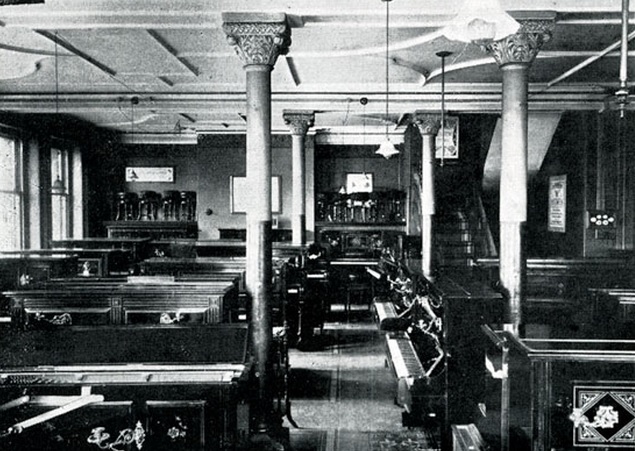
Arthur Wilson, Peck and Co., Ltd., pianoforte, organ and musical instrument dealers, Beethoven House, Pinstone Street – 1897. Portion of Show-Room for High-class Upright Grands. Image: Picture Sheffield
Arthur Wilson, Peck and Co., Ltd., pianoforte, organ and musical instrument dealers, Beethoven House, Pinstone Street – 1897. A Corner of the Show-Room for Grands. Image: Picture Sheffield
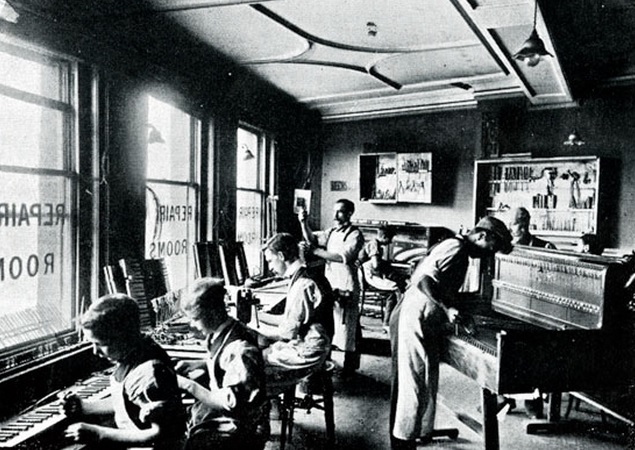
Arthur Wilson, Peck and Co., Ltd., pianoforte, organ and musical instrument dealers, Beethoven House, Pinstone Street – 1897. Repairing Room No.14. Image: Picture Sheffield
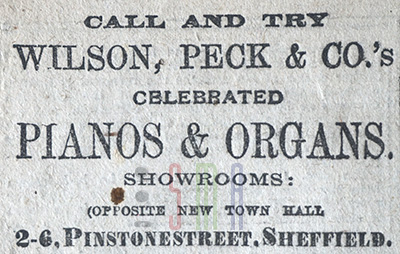
Newspaper advertisement. 1890s. Image: British Newspaper Archive

Within months, Max had been joined by his brother, William Ludwig Lindlar, who had intended to follow in the footsteps of their father, the landscape painter J.W. Lindlar. Instead, he assumed musical and commercial work, and would eventually become vice-president of the Music Trades Association of Great Britain. He became managing director in 1894 and was responsible for organising important concerts in Sheffield and Nottingham, where the company had established a second store.

They were described as pianoforte, harmonium and American organ merchants, tuners, and repairers, as well as sole agents for Bechstein pianos. Within the Pinstone Street building it also had a concert hall used for concerts and recitals.

In 1905, Wilson Peck moved to the opposite corner of Barker’s Pool in the former premises of Appleyards and Johnson, cabinet makers. It was described as ‘the best equipped premises outside London’ and the replacement Beethoven House is the building that most of us still remember.

Wilson Peck were famous for selling musical instruments, sheet music, hosting concerts, and selling ‘new’ phonographic records. On its upper floors it had rooms that could be used for tutors to teach music. In later years it developed a thriving business selling concert tickets for the City Hall and other venues across the country. Wilson Peck ended up with Sheffield’s oldest record department (memorable for its soundproofed listening booths) with sales of records accounting for a sizeable proportion of its business.

Shares in the business changed hands following the departure of the Lindlar brothers and at one stage its chairman was B. J. Readman, who also happened to be chairman of John Brinsmead & Sons, one of England’s premier piano makers. Additional branches soon followed on London Road and Ecclesall Road.

A 1956 advert claims the shop to be ‘the place to go for everything musical: Pianos, Television, Radio, Radiograms, Records, Concert Tickets, etc.’

Wilson Peck was held in high esteem, and it is hard to determine when its decline began. Two World Wars didn’t help a niche market, and the Victorian ideal of making music at home, when pianos were a common sight, had disappeared by the early twentieth century, having a devastating effect on sales of musical instruments and sheet music.

By the 1970s, the directors at Wilson Peck had diversified into property investment culminating in several subsidiary companies and ownership of buildings across the UK. Originally known as the Wilson Peck Group, it changed its name in the 1980s to Sheafbank Properrty Trust, subsequently becoming UK Estates.

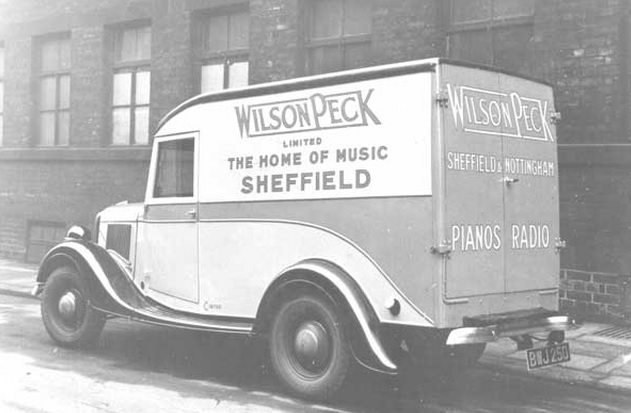
Delivery van, Wilson Peck Ltd. Image: Picture Sheffield

The retailing demise came in the 1980s when Sheffield City Hall decided to take its ticket sales in-house, and the emergence of national record chains (HMV, Virgin Records, Our Price etc.) eroded into Wilson Peck’s earnings.

In 1988, the company vacated Beethoven House, and H.L. Brown, jewellers, moved in. Wilson and Peck downsized to premises on Rockingham Gate but that proved short lived. I’m led to believe that Wilson Peck ended up in ‘an end-of-terrace’ corner shop on Abbeydale Road that closed in 2001.

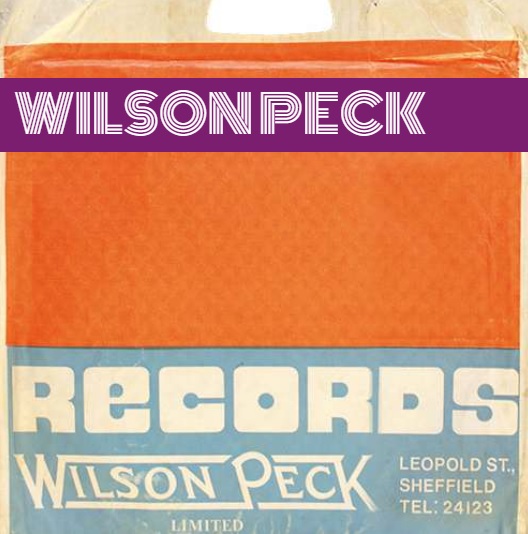
Retro bag for Wilson Peck. Image: British Record Shop Archive

NOTE: –
During the Parliamentary discussion about Arthur Wilson, Peck and Co in 1916, it was said that they also owned a business called Hilton and Company. There is no trace of this business, not helped because Wilson and Peck didn’t retain its archives.

However, there is a post from 2015 on the UK Piano Page whereby somebody said that they had bought an old upright piano: –

“The piano has ‘Hilton & Co’ written in gold writing in the centre of the key cover, also it has ‘Wilson Peck, Fargate, Sheffield’ written on it on the right hand side of the key cover.”

There was a Yorkshire piano company called Hilton and Hilton, but this piano appears not to have been manufactured by them.

Was Hilton and Co a brief attempt by Arthur Wilson, Peck and Co to sell its own manufactured pianos? Somebody, somewhere, might have the answer.

© 2024 David Poole. All Rights Reserved.
Categories
Buildings

Town Hall Chambers: I bet you didn’t know what it was intended to be

This post was planned as a tribute to one of Sheffield’s most famous shops, Wilson Peck, but research into its origins have proved to be rather complex. That post is imminent, but during the investigation some fascinating facts emerged about one of the buildings that it once occupied.

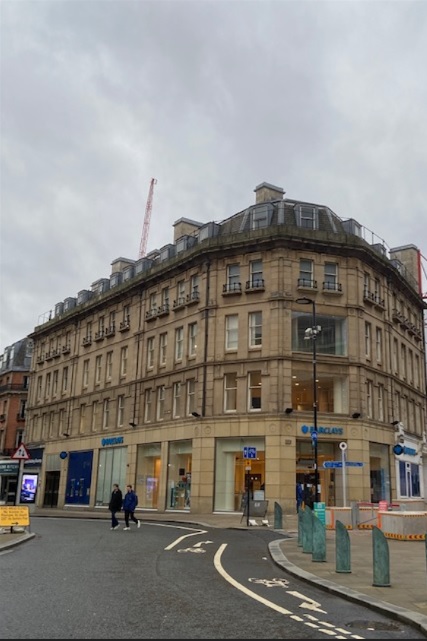
I’m talking about Town Hall Chambers that sits at the corner of Pinstone Street and Barker’s Pool, and now home to the city centre’s last surviving Barclays Bank.

According to Pevsner, it is a ‘worthy, but slightly dull five-storey block of shops and offices’, and like nearby Yorkshire House (another home of Wilson Peck), it has never been listed by Historic England.

The building was designed by Sheffield architect John Brightmore Mitchell-Withers in 1882-85 as part of the street improvement scheme that reinvented Pinstone Lane, a salubrious and narrow thoroughfare, into Pinstone Street, long recognised as one of the city’s most prominent streets.

The site had been an old hostelry called the Norfolk Hotel that was demolished in 1881 as part of the street widening programme. Evidence suggests that J.B. Mitchell-Withers bought the plot of land to build upon, and now I’ve discovered that it was built as a hotel.

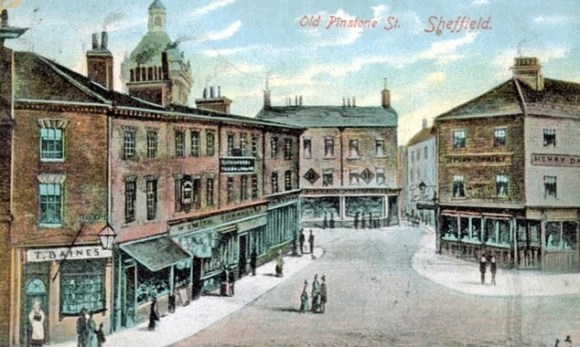
Pinstone Street from Orchard Street, No. 73 Fargate, T. Baines, hairdresser, left, No. 79 Barker’s Pool, Norfolk Hotel (landlord-Henry Darley), right, premises on Pinstone Street include No. 3 Wm Smith, hatter, Nos. 5 – 7 John Richardson, tailor. 1879. Image: Picture Sheffield

In 1884, newspapers advertised that the New Scarborough Hotel was available to let, containing a dining room, commercial room, smoke room, billiard room, refreshments bar and forty bedrooms. It also boasted the best modern appliances for cooking, hydraulic and other lifts, and electric bells.

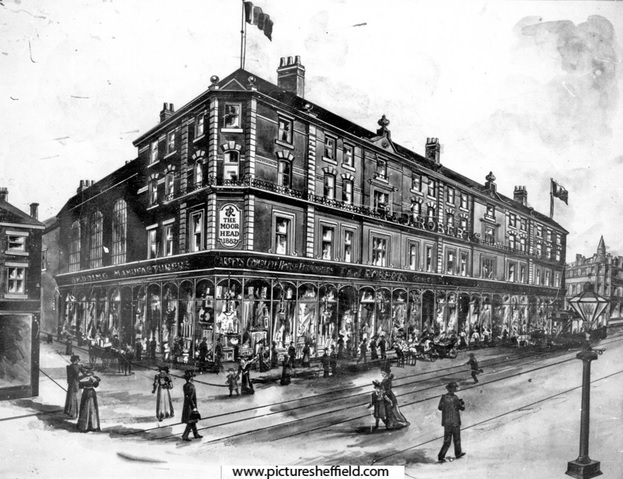
The following year, it was announced that Lewis’s had ‘acquired the important block of buildings at the corner of Pinstone Street and Barker’s Pool, known as the Scarborough Hotel, and shops below,’ suggesting that the hotel never opened after failing to attract any interested parties.

The name of Lewis’s is famous in the history of UK department stores and the fact that it once had a branch in Sheffield comes as a bit of a surprise.

The first Lewis’s store was opened in 1856 in Liverpool by entrepreneur David Lewis, as a men’s and boys’ clothing store, mostly manufacturing his own stock. In 1864, Lewis’s branched out into women’s clothing, later expanding all its departments, and his motto was ‘Friends of the People’.

The first Lewis’s outside Liverpool opened in Manchester in 1877 followed by Birmingham in 1885. However, it was the Manchester store that it was best known for and later included a full scale ballroom on the fifth floor, which was also used for exhibitions. Its fourth store was in Sheffield, but with stiff local competition from John Atkinson and Cole Brothers, it proved unprofitable, and closed in 1888.

Negotiations quickly took place between the trustees of David Lewis and Joseph Hepworth and Son, a suit manufacturer that had rapidly expanded with over sixty shops across the country.

The premises underwent extensive alterations to accommodate its ready-made clothing, hats, and outfitting departments. The entire building was redecorated and lit with electric lamps, and when plans were submitted for Sheffield Town Hall in 1890, it was proudly referenced as the Hepworth’s Building.

Hepworth’s stay lasted four years, and in 1892 Arthur Wilson, Peck and Co, announced that they were vacating their three premises in Church Street, West Street, and Fargate, and consolidating business in the Hepworth’s Building.

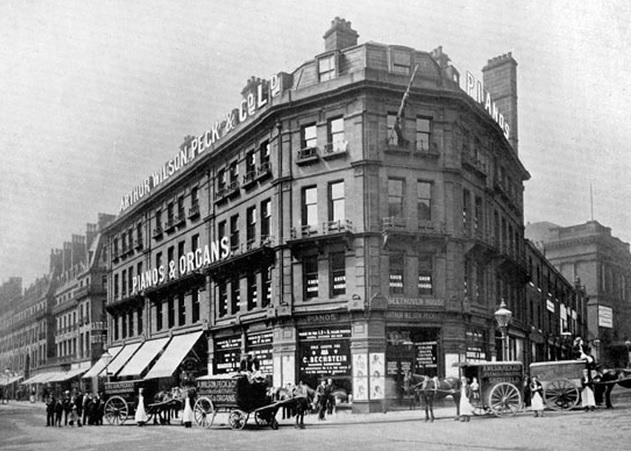
It became known as Beethoven House and lasted until 1905 when it moved to the opposite corner in premises vacated by cabinet makers Appleyards and Johnson, and now known as Yorkshire House.

Arthur Wilson, Peck and Co., Ltd., pianoforte, organ, and musical instrument dealers, Beethoven House, Pinstone Street. 1897. Image: Picture Sheffield

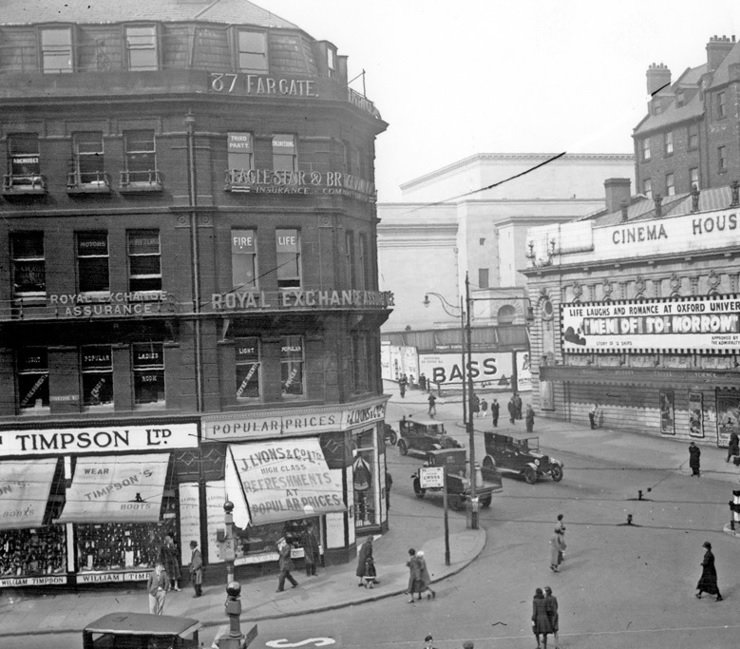
At which point the building became known as Town Hall Chambers is uncertain, but by the 1930s, the ground floor had been subdivided into smaller shops, and the floors above converted into offices for numerous insurance companies.

Our generations will remember it as a centrepiece shoe shop for Timpson’s and as a short-lived branch of Gap, before being reinvented as a futuristic Barclays Bank. I’d be grateful if anyone can name any other businesses that might have been located here.

And so, we’ve discovered that Town Hall Chambers started as an ill-fated hotel. The building itself survived two World Wars and managed to escape Heart of the City redevelopment, but the irony is that neighbouring Victorian buildings further along Pinstone Street, also built as part of the 1880s street widening scheme, will soon become the Radisson Blu Hotel.

Town Hall Square and Barkers Pool, Town Hall Chambers, William Timpson Ltd., Shoe Shop and J. Lyons and Co. Ltd., Dining and Tea Rooms on left, Cinema House on right. 1935. Image: Picture Sheffield

© 2024 David Poole. All Rights Reserved.
Categories
People

People who look down on others don’t end up being looked up to

A long time ago, I read a book containing John Gielgud’s letters and I seemed to remember that he called the people of Sheffield ‘peasants’. After that, I didn’t fancy watching his films anymore. Gielgud (1904-2000) was born in South Kensington, and as an actor and theatre director, he looked down on us poor northerners.

I recently came across a copy of the book in a second-hand bookshop and couldn’t resist flicking through to find that discriminatory paragraph again. It turns out that I did him a disservice, because he didn’t call us peasants after all, but certainly didn’t like Sheffield.

“This is an appalling place and just as I remembered it before – awful slums and poverty everywhere and the audiences sparse and unresponsive.”

He wrote these brusque words in a letter to his mother in October 1927, and even though he was probably right, I’ve never liked John Gielgud since.

The same feeling came across me when I read ‘Skip All That’ – the memoirs of Robert Robinson that was published in 1996. 

Robinson (1927-2011) was an English radio and television presenter, game show host, journalist and author. He presented Ask the Family for many years on the BBC. I was surprised to learn that in his younger days he worked as a journalist on the Weekly Telegraph, a satellite of the Sheffield Telegraph.

But his memoirs show that he regarded his stint on the Telegraph as a low point in his career. At that time, the Sheffield Telegraph was owned by Kemsley Newspapers, which also had The Sunday Times, The Daily Sketch and The Sunday Graphic amongst its titles.

“The Editorial Director explained the Weekly Telegraph was about to be relaunched as a big-time glossy and advertised on the eye-pieces of buses. I was to add my champagne to the editor’s brandy. A combination of which turned out to be more or less Tizer. 

“The woebegone mag was printed on thin blotting paper and sold for threepence to readers I imagined to be comprehensively deprived. Nothing in the Kemsley’s frowzy empire looked capable of anything but lining a cat litter, and shortly after I started forging the (readers’) letters no more was heard about advertising or glossiness. And it wasn’t even Fleet Street, it was only Gray’s Inn Road. Kemsley House was a heap of red brick in the wastes between Clerkenwell and King’s Cross, and had the dejected air of a building site where the money had run out.

“I wondered why they didn’t invite me to write a column for the leader page of the Sunday Times, and what I hacked out on two fingers filled the Weekly Telegraph to overflowing.

“We published in London, but I was allowed an occasional jaunt to Sheffield to see how they printed the thing. Behold, on one such trip I saw a man on the platform who actually held a copy of the magazine in his hand. I approached him: was he, I importantly enquired, a regular subscriber? Not really, he replied. And why was that, I asked, giving him to understand that on matters of policy, a word from me and the thing was done. ‘It’s a bit too instrooctional;.’ he said. I simply thought he’d caught a whiff of the intellectual seasoning I was adding to the mix. ‘Listen,’ I said, ‘we’re trying to get intelligent people like you to come up-market with us.’ ‘Then where are the pictures of scantily-clad women in bathing costumes?’ he asked. ‘And the crossword’s got too many big words.’ It wasn’t the length of the words, it was the necessity of having second sight. The crossword prize was a guinea, and the puzzle was rigged.

“Provincial papers are second division, but the Kemsley lot were second rate as well, the issue on sale any day in Sheffield, Manchester or Newcastle as stale in spirit as if it had been pulled from the musty files in the cuttings library.

“The pilotless hulk went down stern first, and clinging to a spar I was hauled aboard a ghost ship called the Sunday Graphic.”

Founded in 1855 as the Sheffield Daily Telegraph, it became known as the Sheffield Telegraph in 1938, and its sister, The Star, continues as a poor ancestor. 

I must admit that Robinson was an excellent writer, and he did get his wish to write the Atticus column in The Sunday Times, as well as becoming one of the presenters on Radio Four’s Today programme. But when you read his work now, there is that niggling belief that he looked down on those of us who lived and worked outside London, even though he was born in Liverpool. 

And so, as far as I am concerned, Robinson is shunted into the same cupboard as John Gielgud, and his book is on its way to a charity shop.

What would Robinson think about provincial newspapers now?

© 2024 David Poole. All Rights Reserved.
Categories
People

“There was a tremendous explosion as a bomb landed outside the Stage Door.”

Henry Hall performed regularly on BBC Radio during the British dance band era of the 1920s and 1930s

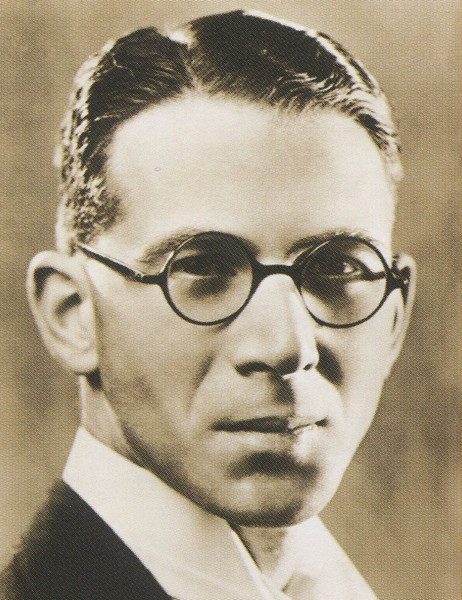
If there had been radio DJs in the 1920s and 1930s, then Henry Hall would have been the equivalent of Terry Wogan, or Ken Bruce. But there were no such things as DJs, and the adoration that existed belonged to bandleaders like Henry Hall, who brought music to the BBC’s infant airwaves.

Henry Hall (1898 – 1989) was born in Peckham, South London, and had no connections with Sheffield. He played from the 1920s to the 1950s, and in 1932 recorded the song Teddy Bear’s Picnic which gained enormous popularity and sold over a million copies.

Hall became bandleader of the BBC Dance Orchestra, and from 5.15 each weekday he gathered a huge following with his signature tune ‘It’s Just the Time for Dancing’ and usually ended with ‘Here’s to the Next Time’.

In 1937, he left the BBC Dance Orchestra to tour with his band, and this brings us nicely to Thursday 12 December 1940. 

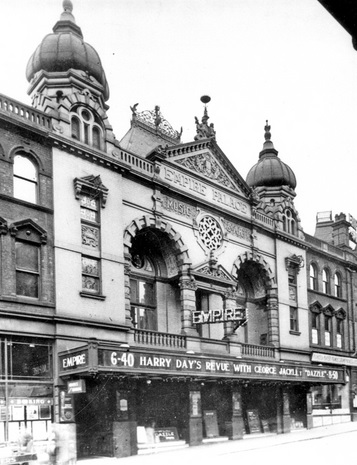
It was the Second World War, and Henry Hall and his Band were in Sheffield to play at the Empire Theatre on Charles Street at its corner with Union Street.

What follows next is an extraordinary account of wartime Sheffield that I stumbled upon while reading Hall’s autobiography – Here’s to the Next Time – that was published in 1955.

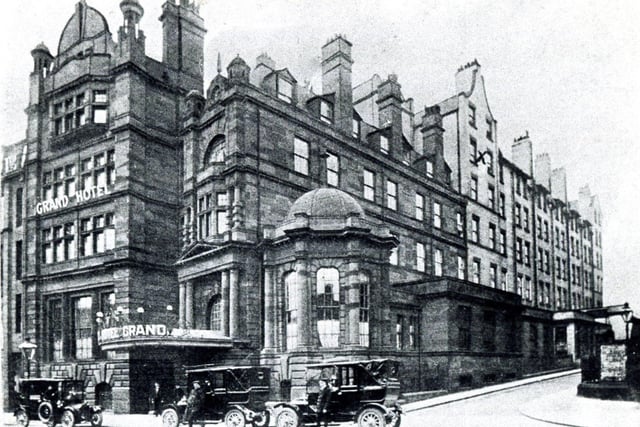
“On Wednesday evening I had supper after the show in the Grand Hotel (now the site of Fountain Precinct) with Jack Buchanan and Fred Emney, who were rehearsing for the forthcoming pantomime. We talked, I remember, of how Sheffield should be quite safe, as it was protected by having a decoy village built some distance outside the town.

“The following evening the warning went, and the German bombers missed the decoy completely and began to bomb the centre of Sheffield!

“One of the first incendiaries landed in front of the Empire just before we were due to appear. The manager, Fred Neate, dashed round and asked me to play one number, then announce that there was a fire and would the audience please leave as quietly as possible. 

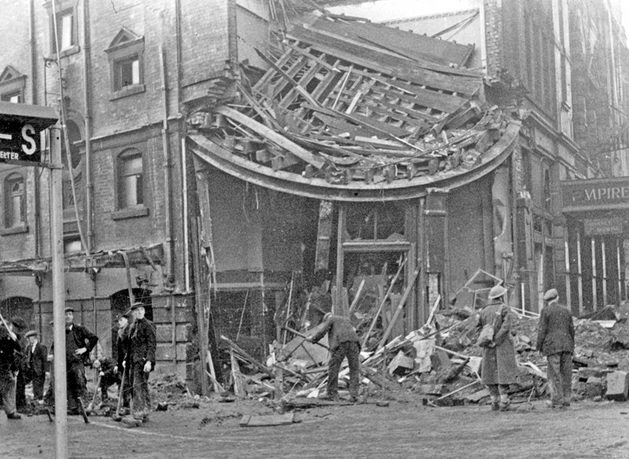
“I walked on to the stage and said, ‘We should like to play you the popular song, Six Lessons from Madame Lazongo,’ and almost before we began there was a tremendous explosion as a bomb landed outside the Stage Door, wrecking the side of the theatre. 

“Luckily the stage itself stayed put, so we finished the number. I made the announcement as requested and we went into one of Freddie Mann’s comedy numbers, The Musical Typist, while the audience left in a hurry. It was a very fast number, but it had never been quite so fast as Freddie played it that night! 

“We stood in the safest looking corridor for some three hours until there was a lull, and then I made a dash for the Grand where I was staying, only a few hundred yards away. 

“Just before I reached the hotel the bombs began to fall again, and I was literally blown through the swing doors to land on the foyer carpet. When I had recovered sufficiently I joined the rest of the guests in the restaurant, which was thought to be directly under the main block of the hotel and consequently the safest place.

“As soon as the all clear sounded, about seven in the morning, I went to the theatre to try to make arrangements. It was out of commission, transport everywhere was disorganised and no trains were running. I left a notice asking all who could to meet outside The Sheffield Daily Telegraph Office at 10.30, when there would be transport to Chesterfield. Then I dashed back to the hotel to try to arrange it. 

“Because of the dislocation of communication, I had to do it by six ‘phone calls. I rang the stage manager on one exchange, he rang a friend, and so on, until someone got through to Chesterfield and brought a coach over. 

“With all my journeys between theatre and hotel, the orchestra had lost all trace of me, and were astounded when I arrived for the coach – my constant disappearances had led to me being ‘posted missing.’ 

“However, we got safely to Chesterfield, caught the midday train to Bristol and arrived at midnight just in time to hear their sirens beginning to blow!”

Empire Theatre, Charles Street. Opened 1895. Closed May 1959 and demolished the following year. Image: Picture Sheffield
Air raid damage at the Empire Theatre. Image: Picture Sheffield

How lucky most of us are to have never witnessed such scenes!

This story leads to one that my dad told me recently,  and would have taken place at the same time that Hall was desperately arranging his transport away from Sheffield.

He was eleven, and the morning after, walked with his Aunty Vera from Milton Street to Grimesthorpe to make sure that her boyfriend Jim’s family had survived. 

“At the top of The Moor, Woolworths was a sheet of fire, and there were bodies laying in the road, and that was a sobering sight. But I realised that they weren’t bodies after all,  but were actually mannequins that had been blown out of the shop.

“Pinstone Street was closed for access, and so we diverted along Union Street but found it blocked by rubble from the Empire Theatre that had collapsed into the road. We climbed up and over the debris before continuing along Norfolk Street, into Fitzalan Square, then down Haymarket and on to the Wicker. Most buildings were ruined and ablaze.

“At Wicker Arches, a bomb had gone straight through the railway line and through the bridge without exploding (the repairs still visible today), but we still managed to get through, and there was a place on Spital Hill that had wooden chairs piled high and had caught fire and were well ablaze.

“We walked all the way to Grimesthorpe and after finding that the Wells family was safe, walked all the way back again.”

Alas, for the Empire Theatre, it lost one of its two turrets which capped the towers on either side of the facade, and buildings on either side of the theatre were destroyed. It closed in May 1959 after being sold to a developer and was demolished two months later. 

The Grand Hotel, which fronted onto Balm Green in the city centre, is seen here in its early days from the Leopold Street side. Image: Charlie Smith
Former site of the Empire Theatre at corner of Union Street/Charles Street

© 2024 David Poole. All Rights Reserved.
Categories
Places

The Lost Cemetery: Enclosed by high walls and the happy hunting ground for adventurous boys

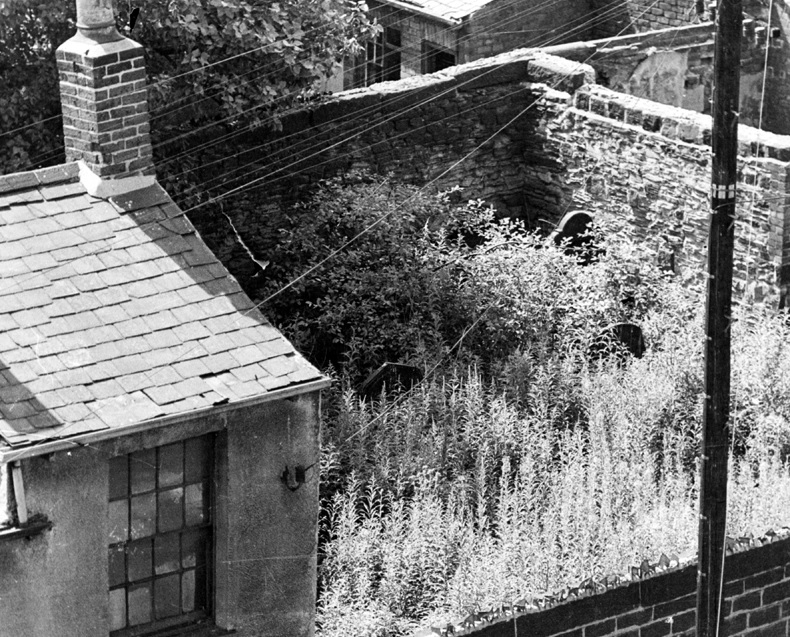
Jewish Burial Ground, Bowdon Street. July 1964. Image: Picture Sheffield

“I saw him in the cells at the Town Hall. he appeared very delirious there: his face was swollen, and his eyes had turned yellow. I’m afraid the wretched cell in which he was placed had turned him delirious: it was a most wretched place. He was innocent of the charge against him; but, of course, it preyed upon his mind, and being in that wretched place would tend to make him delirious. The charge against him weighed heavily on his mind.”

These were the words of Henry Levy in 1862. He was a clothier on the High Street, and he was speaking at the inquest of his friend and neighbour, Benjamin Cohen, a jeweller.

Days before, Mr Cohen, aged fifty-five, had been taken into custody on the charge of having stolen gold and silver watches in his possession. They had been taken in Swansea five years earlier, the crime unsolved, until detective officer Brayshaw in Sheffield received information that watches bearing the victim’s name were in the ownership of Cohen.

Mr Cohen was released on bail, but confined himself to bed, and would not eat.

Henry Jackson, his surgeon, was summoned on the Tuesday morning.

“I found him lying on his right side in bed. The clothes were wrapped around him in a disordered state. His face was pale, his eyes closed, and his skin cold. On turning down the clothes I found his hands bloody. His shirt was saturated in blood. On turning him on his back I found a razor fully open and bloody. On lifting his shirt, I found a large portion of bowels protruding, with a considerable quantity of blood under and about him. I did what was needful in replacing the bowels and relieving him.”

Cohen died from his self-inflicted wounds that night.

“I had been with him all day,” added Mr Levy. “He kept saying ‘position, once, twice; I did it nicely.’ I don’t know what that referred.”

With tradition, Mr Cohen was buried the next day. A hearse and two mourning coaches trotted through the streets of Sheffield until it arrived at Bowdon Street, where there was a small Jewish cemetery. He was interned and became one of the last people to be buried here.

Unbelievably, this sad story became known after a friend made a chance remark in the pub. He’d been working on the conversion of Eyewitness Works on Milton Street into trendy apartments.

“If you look at Google Maps, it shows that there is a cemetery nearby, or at least there was.”

To prove the point, he showed me his mobile phone and zoomed in on the area around Milton Street. Sure enough, on the road that runs parallel to Fitzwilliam Street, between Charter Row and Milton Street (near Corporation), was a red label showing Bowdon Street Cemetery. I’ve since tried this on my own phone and can find no evidence of it.

But my friend is right, because there was a Jewish cemetery on Bowdon Street, but no trace of it remains.

According to Sheffield Archives, the earliest reference of Jews in Sheffield is in the trade directory of 1797. It grew from about sixty people, belonging to ten families, in the 1840s to about 800 in 1900. This was due to immigration, those fleeing from persecution in Eastern Europe, and settling in Sheffield on their way from Hull to Manchester, Liverpool and eventually America. Benjamin Cohen had been born at Posen, then in Prussia, now part of Poland. Most families lived around the Scotland Street and West Bar area, many becoming watchmakers, jewellers, and tailors.

“The Sheffield Hebrew Congregation is about 120 years old,” wrote Rabbi Barnet I. Cohen in 1926, “though there were a few Jewish families here some time before the congregation was formed. One of the first acts was to provide a burial ground.” This turned out to be a small plot on Bowdon Street that was suitable for the handful of Jewish residents at the time.

The land was acquired in 1831 but closed in 1874, although burials took place afterwards where a plot had been reserved.

“The present cemetery is in Blind Lane, Ecclesfield,” reported Rabbi Cohen (who might have been a relative of Benjamin Cohen), “and there is also a cemetery in Walkley belonging to the Central Synagogue on Campo Lane.”

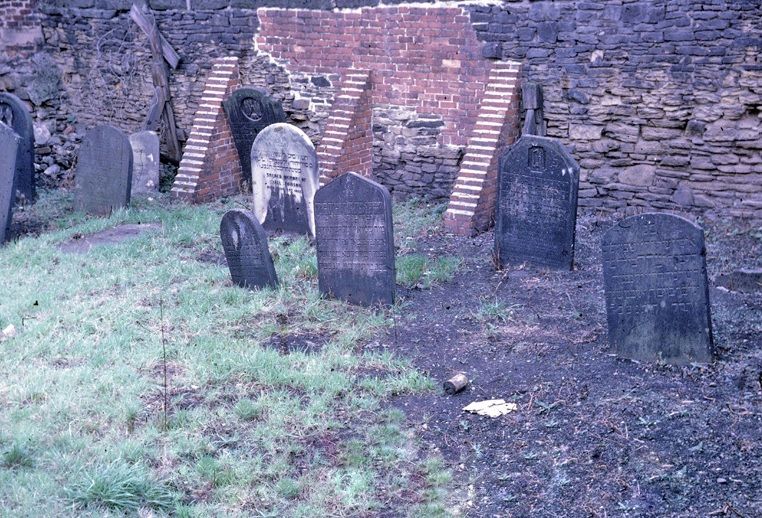
“The congregation has constantly had trouble through the desecration of the graves by urchins, who not content with climbing over the (high) walls, actually found delight in breaking up the tombstones and digging up the graves, and so recently had a stout door erected and pieces of glass placed on top of the walls.”

The graveyard was surrounded by industry, stables, and back-to-back houses, one of which belonged to Percy Richardson in the 1920s.

“A cemetery enclosed by high walls and the happy hunting ground for adventurous boys. The graveyard is spread over with stones and old tin cans.” It was described as the untidiest graveyard in Sheffield.

Jewish Burial Ground, Bowdon Street. Image: Picture Sheffield

I mentioned Bowdon Street Cemetery to my 94-year-old dad, who couldn’t have been one of Rabbi Cohen’s urchins but may or may not have been a wartime urchin and remembers it from the time he lived on Milton Street.

The graveyard survived until 1975 when Sheffield City Council imposed a compulsory purchase order on the site, the ‘mortal remains of 35 grave spaces re-interred in Colley Road, Ecclesfield’.

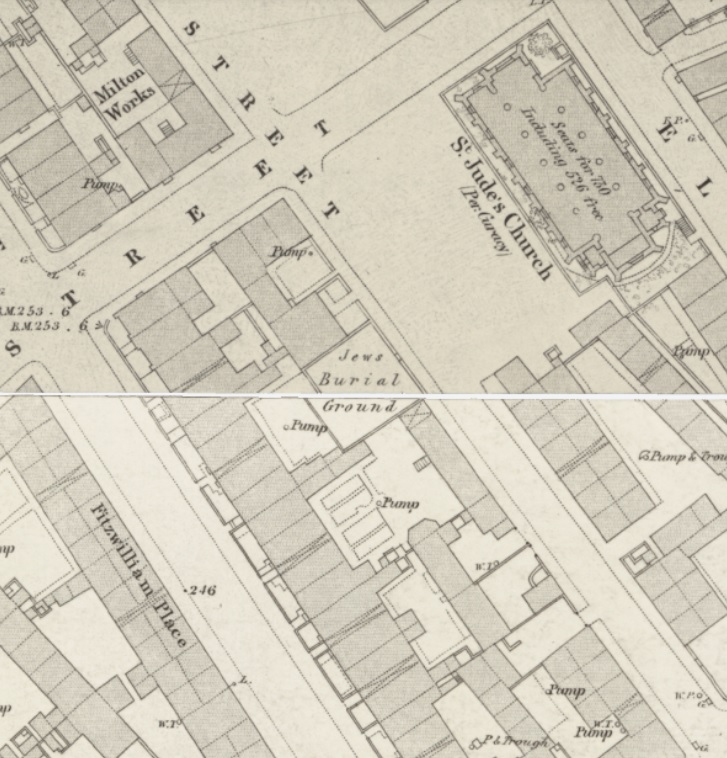
Through an old map I’ve managed to find the exact location of Bowdon Street Cemetery, and on a rainy day this week, I visited the old site.

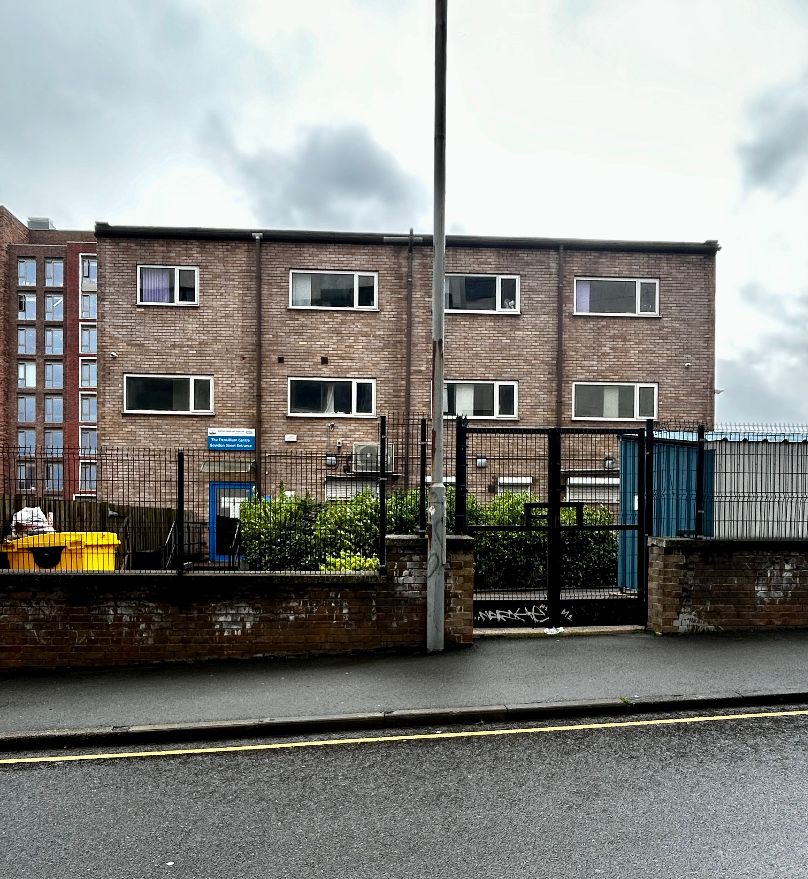
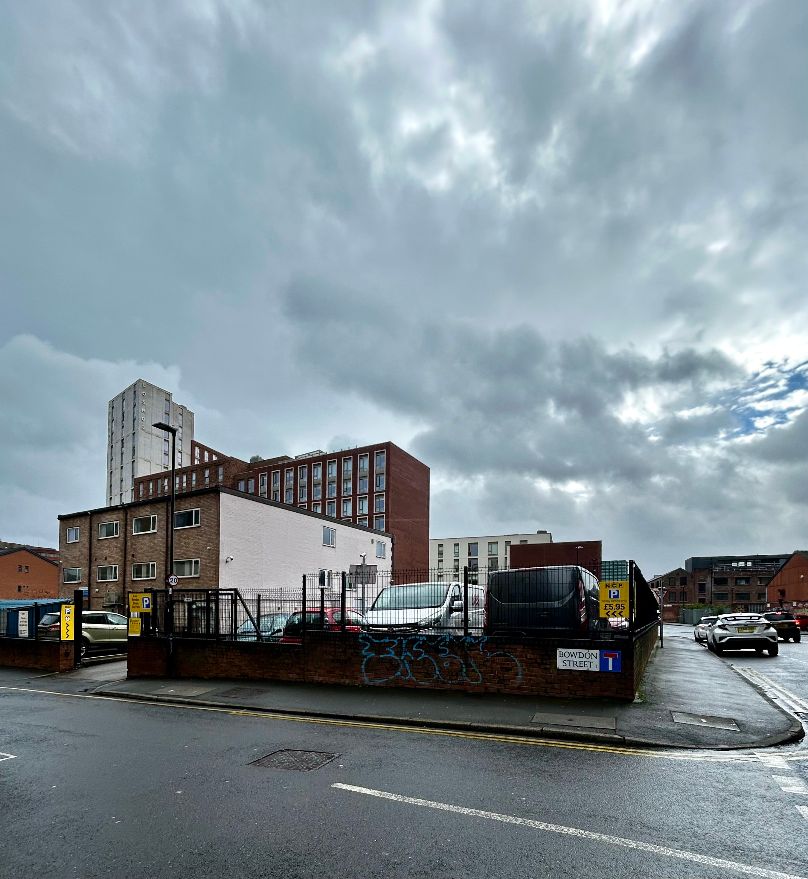
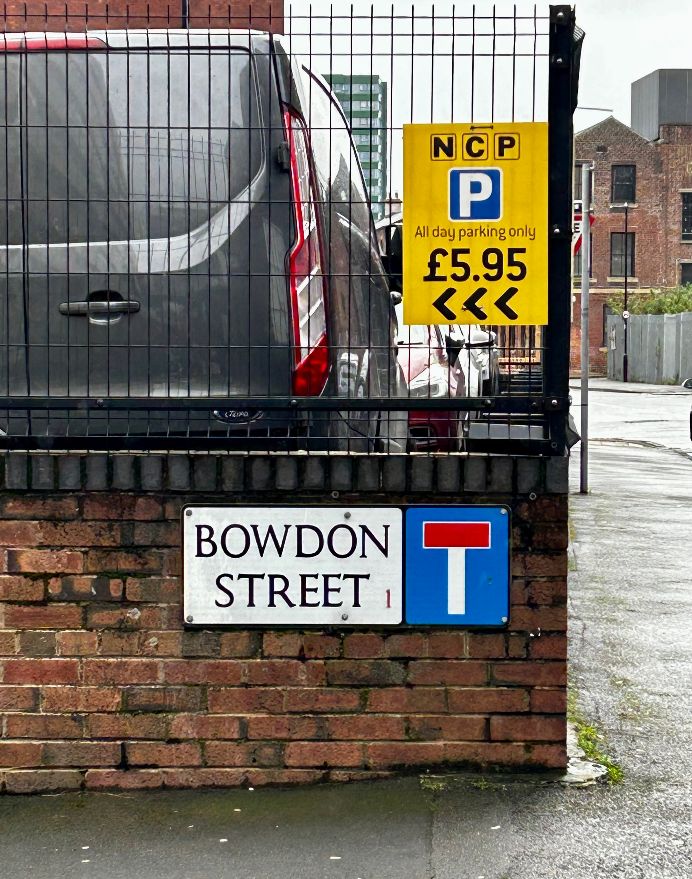
Bowdon Street is at the back of the NHS Substance Misuse building that fronts Fitzwilliam Street. The tiny plot would have run from Bowdon Street, the site partly landscaped, and would have taken up the back end of the Fitzwilliam Centre as it is now.

I thought about the tormented soul of Benjamin Cohen and trust that his remains are at peace in Ecclesfield.

Site of Bowdon Street Cemetery. Image: David Poole
Another view of former Bowdon Street Cemetery site. Image: David Poole

© 2024 David Poole. All Rights Reserved.
Categories
Buildings People

Johnson and Appleyards: “Excessive capital was taken out of the business to fund lavish lifestyles.”

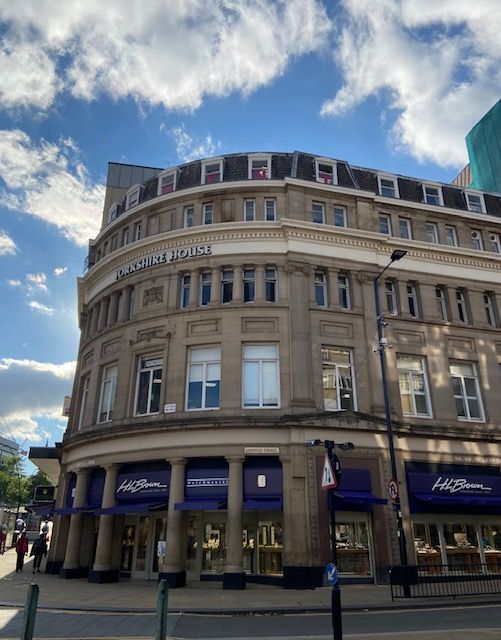
Yorkshire House, Leopold Street, Sheffield. The building has failed to get listing from Historic England. Much of the original interior has been lost in modern redevelopment.

This post is about Johnson and Appleyards, not many people will have heard of it, but that shouldn’t have been the case. Life is full of what ifs. What if things had been done differently? If they had been, then we might have been fondly remembering Johnson and Appleyards as we do Cole Brothers and Walsh’s.

Our story starts on 10 February 1909 when Councillor Walter Appleyard received a cable from Kobe in Japan. It was from his brother, Frank, and informed him that their older brother, Joseph, had died. The fact that it happened in a foreign country was no surprise because Joseph had travelled extensively to Australia, South Africa, and South America, and this latest excursion which started five months previous, had taken in Egypt, India, Burma , and China. The next stop would have been Canada before heading home.

The news might have suggested that this was the first stage of failure for Johnson and Appleyards, cabinet designers and manufacturers, upholsterers, decorators, undertakers, carpet warehousemen, colonial merchants, and exporters, but the decline had already begun, not that anybody had realised it.

Joseph Appleyard (1848-1909)

The three Appleyard brothers, Joseph, Walter, and Frank were the sons of Joseph Appleyard, a Conisborough cabinet maker, who had a business until 1872, when he established J. Appleyard and Sons at Westgate and Main Street in Rotherham which the brothers ran.

In 1879, the brothers took over the Sheffield furniture-making business of William Johnson & Sons, with premises on Fargate, and renamed it Johnson and Appleyards. It was a bold move, but within a few years the business needed bigger premises to display its furniture.

They chose a prime site at the corner of Fargate and Leopold Street and employed architects Flockton and Gibb to design an impressive showroom built in Huddersfield stone with a mixture of giant ionic and stubby doric pilasters on its first and second floors.

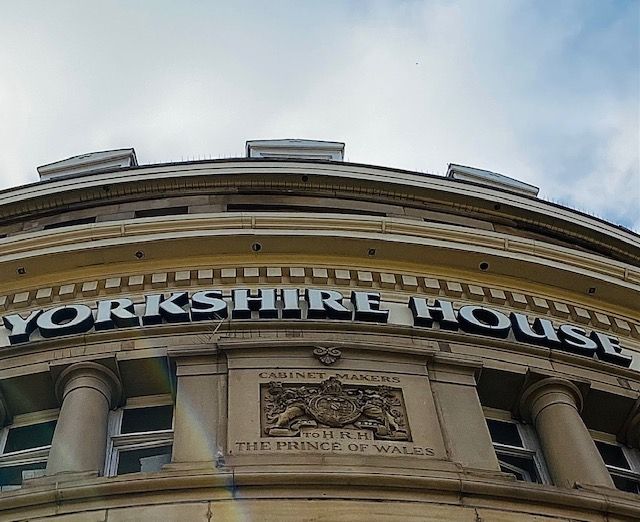
The building was completed in 1883 and survives as Yorkshire House, where Barker’s Pool (then an extension of Fargate) turns the corner into Leopold Street. The only remaining trace of Johnson and Appleyards is a stone plaque, high up, that states ‘Cabinet makers to HRH The Prince of Wales’. For some reason, the building has failed to get listing from Historic England, and we now know it as home to jewellers H.L. Brown.

The only remaining clue that the building was built for Johnson and Appleyards, cabinet makers, in 1883-84. Designed by Flockton & Gibb.

Johnson and Appleyards were the only firm to supply the complete range of domestic furnishings, selling their own furniture as well as famous names like Chippendale, Sheraton, Louis Quatorze, and Louis Quinze. In the basement, were showrooms for carpets, linoleum, bedlinen, and blankets. The ground floor held wallpapers together with general goods, along with the counting house, and stables and carriage/van sheds at the back. The first floor was dedicated to furniture with workshops behind, and on the second floor, further showrooms with draughtsmen’s offices and decorators’ shops to the rear. The third floor housed gilders’ workshops, polishers, upholsterers and bedding makers.

The purpose-built premises of Johnson & Appleyards, Sheffield, showing the additional story that was added in 1892

Johnson and Appleyards became a limited company in 1891, and the following year the building was extended, with an attic story and mansard roof built to create more retail and workshop space. At the same time, manufacturing was moved to a four-storey building on Sidney Street.

Johnson and Appleyards achieved national and international recognition with a ‘Prize medal awarded for Superiority of Design and Workmanship’ (York, 1879) and a gold medal award at the Paris Exhibition (1900).

There is a clue that business at Johnson and Appleyards had dwindled, because in 1906 the firm had moved to smaller premises next door on Leopold Street. While retaining ownership of the showcase corner property, it was leased at a handsome price to A. Wilson Peck & Co, wholesale and retail dealers of pianos, organs, and musical goods. (Wilson Peck – Beethoven House – another fascinating story for another day).

Joseph Appleyard (1848–1909), as senior partner, was the only brother to remain active in the firm, and although he remained a director, Walter had other business interests and would become Lord Mayor, while Frank had left by 1905.

Joseph’s marriage to Sarah Flint Stokes had given him eight children, none of whom had much interest in the business. Only two of his four sons, Joseph (1881-1902) and Harry (1876-1954) showed any enthusiasm. Joseph Jnr was employed by Wallis & Co, linen drapers, in Holborn, but drowned aged twenty-one in a boating accident on the Thames, while Harry, who had trained at Harrods in London and Maple & Co in Paris, joined the firm but left shortly after his father’s death. His other two sons joined the services, to avoid joining the firm and collaborating with their father.

A biography of Joseph Appleyard states that he was a strong conservative but had no desire to enter politics. He was a member of the King Street and Athenaeum Clubs, as well as being an affiliate at the Wentworth Lodge of Freemasons.

Julie Banham’s ‘Johnson & Appleyards Ltd of Sheffield: A Victorian family business’ (2001) hints that Joseph Appleyard was prone to violence and regularly beat his sons, while his wife turned to drink and became an alcoholic.

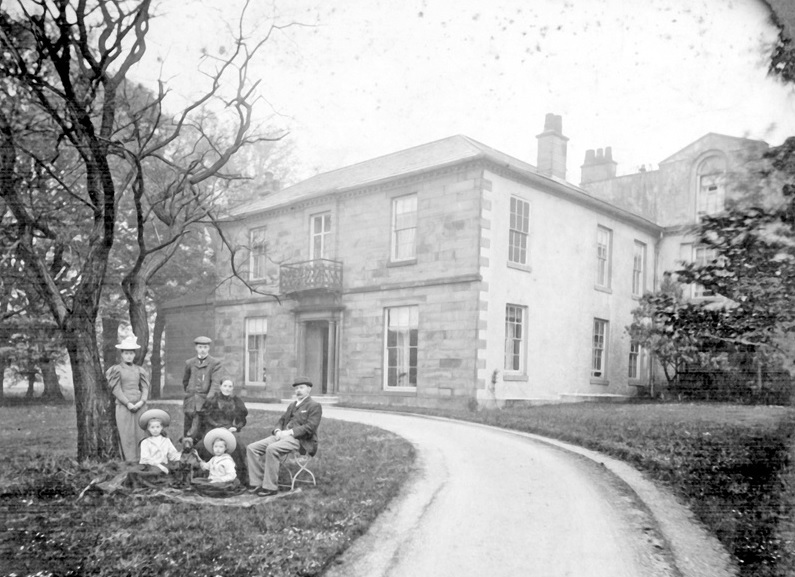
Mr and Mrs Joseph Appleyard (Managing Director of Johnson and Appleyards Ltd.) and children, in the grounds of The Beeches, Park Grange, off Park Grange Road, Norfolk Park (1899). Most historical records refer to the family living at Park Grange, a nearby house. Image: Picture Sheffield
The Drawing Room at The Beeches, home to Joseph Appleyard. Shortly before his death, the family moved to Broombank House, 7 Clarkehouse Road, Sheffield. Image: Picture Sheffield

All these years later, it is difficult to determine the type of person that Joseph might have been. At that time, newspapers filled columns with obituaries of local dignitaries, often shown in positive light, but Joseph’s death had little mention. Is this an indication that there weren’t any kind things to say about him? He was cremated in Japan and his ashes interned at Fulwood Church.

Johnson and Appleyards had built its reputation on Victorian tastes that lingered into the Edwardian period. But the new century meant styles had changed. On hindsight, the firm seemed reluctant to evolve with the times, and while sales dwindled, excessive capital was still taken out of the business to fund lavish lifestyles. After Joseph Appleyard’s death, the management team struggled to find a long-term strategy, and two world wars did nothing to improve its fortunes.

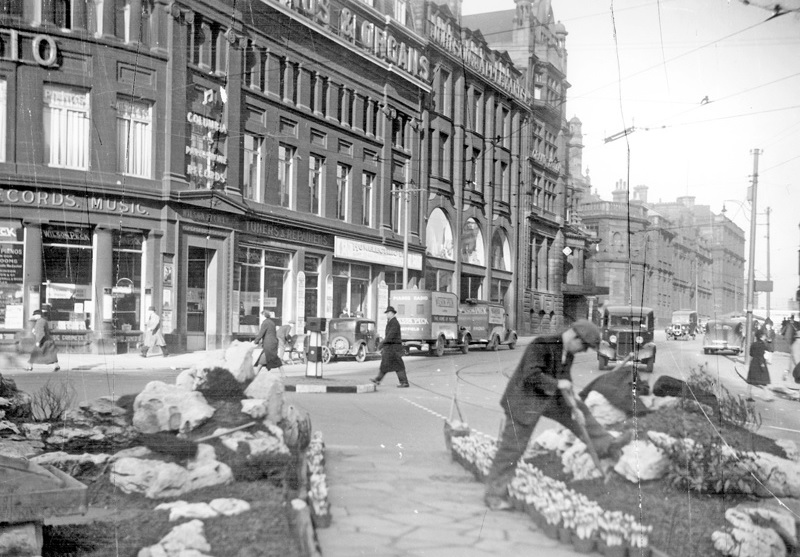
Town Hall Square Rockery and Leopold Street premises in 1938, including Grand Hotel, Johnson and Appleyards in their smaller premises, and Wilson Peck (left) that occupied the cabinet maker’s former premises. The building occupied by Johnson and Appleyards was later demolished and replaced with a new block. It stands approximately where the Bessemer bar is now. Image: Picture Sheffield

The end of Johnson and Appleyards was inadvertently caused by German bombs that rained on Sheffield during 1940. One of them destroyed John Atkinson’s store on The Moor and it was forced to seek alternative premises in the city centre. It bought all the shares in Johnson and Appleyards, if only to secure the Leopold Street building, and would remain until its replacement store was built on The Moor. The old Johnson and Appleyards shop would eventually be swept away, along with the Grand Hotel, to build Fountain Precinct in the 1970s.

Here’s the surprise. Did you know that Johnson and Appleyards still exists, if only in name? Its shares are registered to Atkinsons on The Moor.

First floor showroom at Johnson and Appleyards c.1900
Showroom of Drawing Room furniture c.1900
The Oak Showroom. Johnson and Appleyards c.1900. The company was responsible for furnishing many of Sheffield’s notable buildings, including the Town Hall and Cutlers’ Hall.

© 2024 David Poole. All Rights Reserved.
Categories
Streets

A busker plays La Bamba to no one outside Marks & Spencer

The evening gets off to a bad start. There have been no trams for a week because of a broken track at Manor Top. It sounds absurd in this modern age. Worse still, the bus I go to catch only runs every hour and doesn’t turn up. I run for the tram replacement bus service, and that doesn’t turn up on time either. By the time I get into the city centre, I’ve spent over an hour getting here when normally it would be a twenty minute journey.

High Street 8.00pm

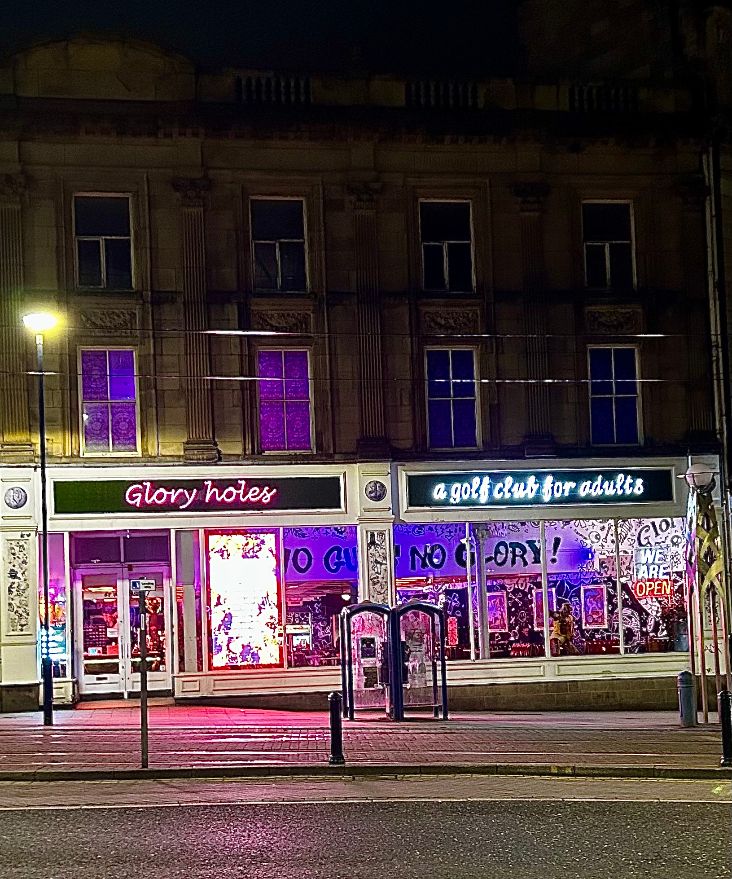
Next door to The Banker’s Draft, there is a handsome old building that houses an indoor golf centre called Glory Holes – a golf club for adults. It is one of four venues operating across the country and is brightly lit. I assume that councillors were blissfully unaware what a ‘glory hole’ was, because had they done so, they would have insisted that they choose another name.

I suspect that the price of its drinks will deter punters from The Banker’s Draft from entering its doors. There is a female sat on the pavement outside. She is probably a lot younger than she looks and is wrapped in a blanket. She looks sad and holds her hand out in the hope that I might give her money.

I cross the road and walk up High Street. I pass a bus shelter where a girl is crying, and a man holds her tightly. He tells her not to worry and looks woefully at a large group of people nearby. Each one of them is holding a bottle of cider or a can of beer, at least four of them have dogs, and they are all shouting words of advice. These people aren’t waiting for a bus because they don’t have anywhere to go. I wonder what the commotion is about and leave them to it.

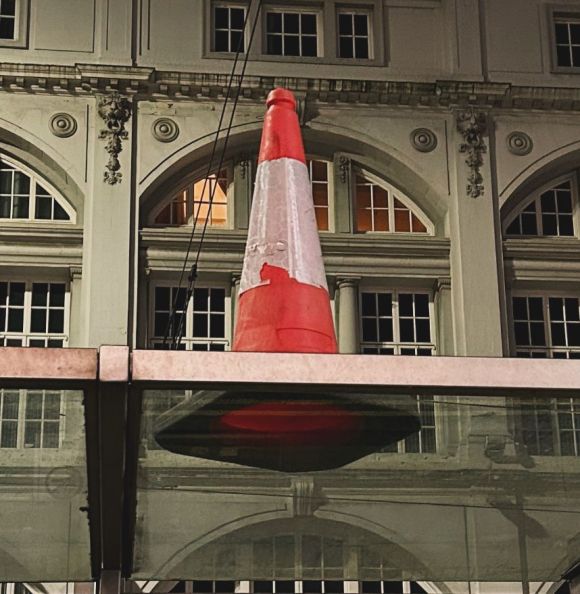
Perched on top of the next bus shelter is a traffic cone and the glass roof makes it look like it is floating in the air. I decide this is a good photo opportunity and take my phone out to snap it. The Telegraph Building forms a backdrop and I’m pleased with the result. Afterwards, a polite voice asks, “Am I okay to pass now?” and I thank him for his patience.

I look at the man as he walks ahead of me because I know what will come next.

He swings around. “I don’t suppose you’ve got any change?”

“I’m sorry,” I say, “all my money is on here now.” I wave my phone to show him that I use Apple Pay. He doesn’t reply and gives me a sour look.

On the ground floor of the old Telegraph Building is a Sainsbury’s Local that opens until eleven. It is next door to German Doner Kebab that is half empty, but the rest of the street is in darkness, including Cavell’s bar that might once have done brisk business on a Sunday night.

In the absence of trams, and the infrequency of buses, the High Street has a despondent look about it.

Gosling’s plan of 1736 is the chief authority for saying that High Street was formerly called Prior Gate; and it is probable that hereabouts was the Priory, and its existence can only be known from old deeds.

That was the general belief, but historians are sceptical that a priory ever existed at all, as they are about King John, who was supposed to have stayed at the White Horse Inn on Prior Gate while passing through Sheffield. I imagine an old Sheffielder telling a tall tale that became rooted in history.

The High Street we know today goes back to the street widening of the 1890s. Prior to this, it was much narrower with quaint and picturesque timbered gables, latticed windows and swinging signboards. Robert Eadon Leader told us that in the eighteenth century there were loads of hay that stuck fast, unable to pass the projecting upper story of Mr John Cooper’s confectionery shop.

The Sheffield Directory of 1787 mentions eight victuallers on this street, quite different from the present day. But it was always a shopping street, and all this was swept away so that the sites of its old buildings could not be located with certainty.

The High Street of the twentieth century was busy with elegant shops lining both sides. Most buildings survive but the lower end was obliterated during the Blitz of 1940.

By now, I’ve reached Wendy’s and McDonald’s, which are the busiest places tonight. People queue for takeaways and the tables are occupied by youngsters who see them as a place of refuge on a chilly night. Outside, where High Street meets Fargate, there are parked cars belonging to drivers collecting burgers and chips and then delivering them to the outreaches of the city centre.

Burger King has opened at the end of Fargate, the last of the big chains to get a foothold here. I’m meeting a friend, and he’s silhouetted against the takeaway’s cheerful interior. As I approach, he lights a cigarette and starts counting.

“One, two, three…”

He counts to seven before an unshaven male accosts him. The man is wearing an odd assortment of clothing, none of it designed for winter, and asks my friend for a ‘spare’ cigarette.

The irony is not lost on me.

This is where our ancestors used to meet for a night on the town. It was referred to as Cole’s Corner, a nod to Cole Brothers that once stood here, immortalised in a song by Sheffield’s Richard Hawley and one that has even found its way into Standing at the Sky’s Edge, the musical that recently moved to London’s West End.

Fargate 8.15pm

If High Street appears bleak, then Fargate surpasses it.

This was once the ‘far gate’ from the Parish Church and became Sheffield’s premier street. It was widened to accommodate traffic, its shoppers spilling from the narrow pavements as they jostled to get into the shops. There is a quote from a 1960s newspaper that called it the ‘Oxford Street of the north.’

Tonight, the scene on Fargate is anything but.

It was pedestrianised in the 1970s, and is now a building site, reinventing itself yet again, this time as a £15.8m social hub, to replace shops with event spaces, hospitality, and eating places. The paving is being changed and there will be flower beds promoting Sheffield’s ‘grey to green’ image.

For now, it is a maze of orange barriers, builders’ hoardings, and signs telling us how great it will be.

A busker plays La Bamba to no one outside Marks & Spencer and I wonder how he expects to earn a living. My friend suggests that he is doing it because he simply likes singing.

The shops are closed, but most are empty anyway. Gone are the big chain stores, replaced with vape stores and pop up shops. The last time that Google’s Streetview came here was in 2018 and it showed full occupancy. Since then, the decline has been rapid, and Fargate has become the classic tale of a street that lost its way.

People say that Meadowhall killed it, and while it didn’t help, we must remember that this was a quarter century ago.

I look at my iphone and realise that this is the reason we’ve fallen out of love with shops. Lockdown altered our habits, and retailers finally realised that we preferred to shop without physically shopping.

Tonight, some of the doorways are occupied by rough sleepers. They may or may not feel safe inside their sleeping bags but are far enough away from the party crowds of Carver Street and West Street to avoid being disturbed.

People walk past them, and I hear snatches of conversation, but cannot understand because they speak in different languages. The demographics say that Sheffield is 84% white, 8% Asian, and 4% Black. On Fargate, they are all speaking Eastern European. These are diligent people that will shape the city’s future, but I speculate as to what could entice them into the city centre tonight.

Towards the top end of Fargate is a recently opened Tesco Express that appears to be the liveliest place on the street. Along with other metros/express/locals opened by the big boys, this provides convenience shopping for daytime workers and shoppers, but on a Sunday, is more likely to service those mysterious folk who have moved into apartments.

A security guard stands in the doorway and keeps an eye on a group of kids riding bikes. They are masked like little ninjas and puffing on sweet-smelling vapes that look like fireworks in their hands. One of them asks me the time and I look at the Town Hall clock and tell him. I realise that they are up to no good but can’t quite determine what they are doing wrong.

At least they are riding proper bicycles, ones that take effort to ride, because every few minutes the silent killers on their electric bikes ride past. Somebody recently joked with me who might kill him first. Would it be Uber Eats or Deliveroo?

While we are walking, I remember an article that I read in Monocle magazine where an expert gave his views on the pedestrianisation of our cities.

“I have nothing against pedestrianisation, but if you’re going to do it, make sure there is something to encourage people to use it. Otherwise, life will be sucked out of the street.”

My friend says that Fargate will look nice when it is completed, and I must agree with him. But I am impatient, and it looks such a long way ahead.

We go to Benjamin Huntsman on Cambridge Street and start our Sunday Night Podcast, one that must never be heard by anybody else, because it is when we drink pints of Guinness, be politically incorrect, and put the world to right.

© 2024 David Poole. All Rights Reserved.