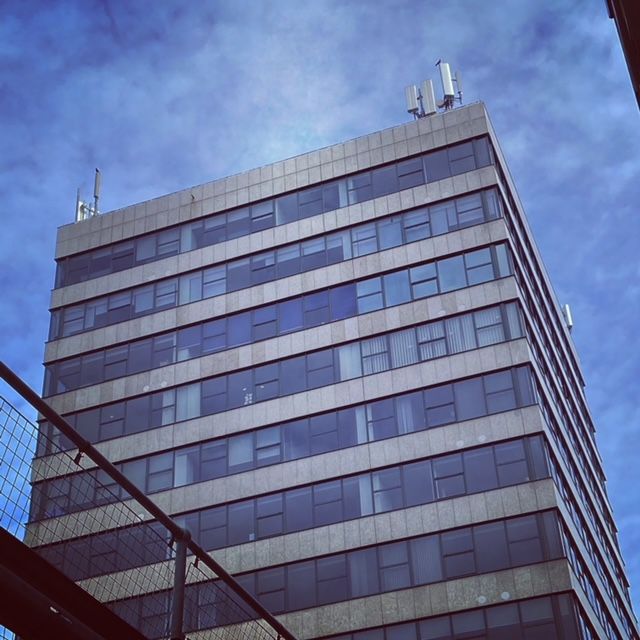
A familiar sight on the city centre skyline. St James House is one of Sheffield’s oldest office blocks, built in the 1960s, and still serving the same purpose today. (DJP/2021)
St James House, on Vicar Lane, may be an unassuming 11-storey office block. However, we shouldn’t forget that this 1960s construction plays an important part in Sheffield’s history.
The miners’ strike of 1984–85 turned out to be one of the bitterest fights in British history. The industrial action was to shut down the British coal industry in an attempt to prevent colliery closures. It was led by Arthur Scargill of the National Union of Mineworkers (NUM) against the National Coal Board (NCB), a government agency. Opposition to the strike was led by Prime Minister, Margaret Thatcher, who wanted to reduce the power of the trade unions.
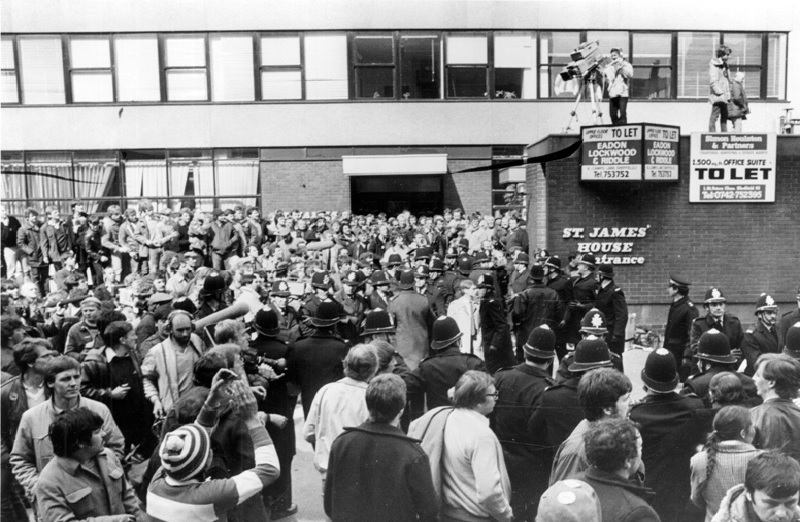
Striking miners lobbying Miners Union leaders (who were meeting to decide strategy) outside St James House in March 1984) (Picture Sheffield)
Long-based in London, Scargill decided to move his headquarters to Sheffield ahead of the strike, and in 1983 chose St James House as temporary accommodation until custom-built offices were built on Holly Street. It had been completely refurbished, and the NUM occupied floors from eight to eleven, and half of the seventh floor for storage. Ironically, these floors had previously been used by the NCB pensions and insurance department.
In ‘Britain’s Civil War over Coal: An Insider’s View’ by David Feickert, he says that Arthur Scargill designed the office layout himself and his managerial views were firmly stamped on the design. “It was an office design straight out of the 1950s, but Arthur defended it rigorously.”
It was here that Scargill fought to the bitter end, and created the biggest news stories of the day. (I don’t need repeat what happened, neither do I need to report on the rights or wrongs. We’re looking at a building, after all).
The NUM vacated St James House in 1988, moving to brand-new offices on Holly Street (designed by Malcolm Lister in 1983, and now home to Grant Thornton, Pitcher & Piano, and Turtle Bay), and stayed four years before relocating to Barnsley.
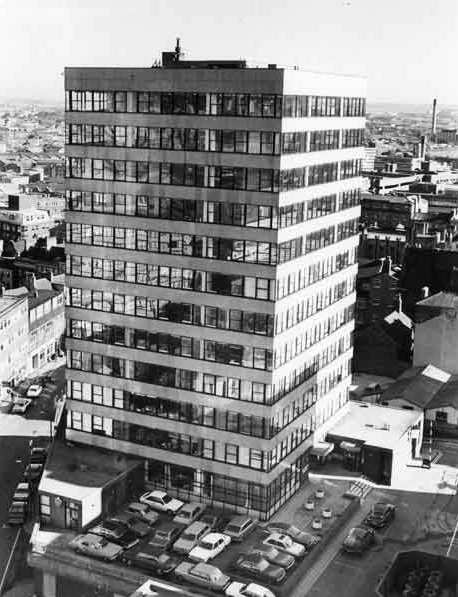
St James House, before the time of the NUM, photographed in October 1981. (PIcture Sheffield)
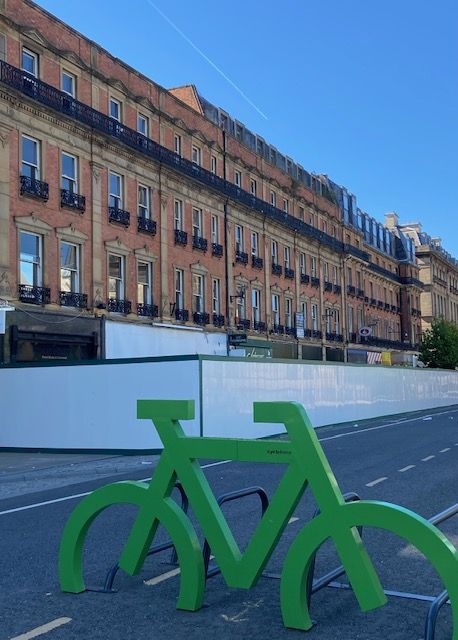
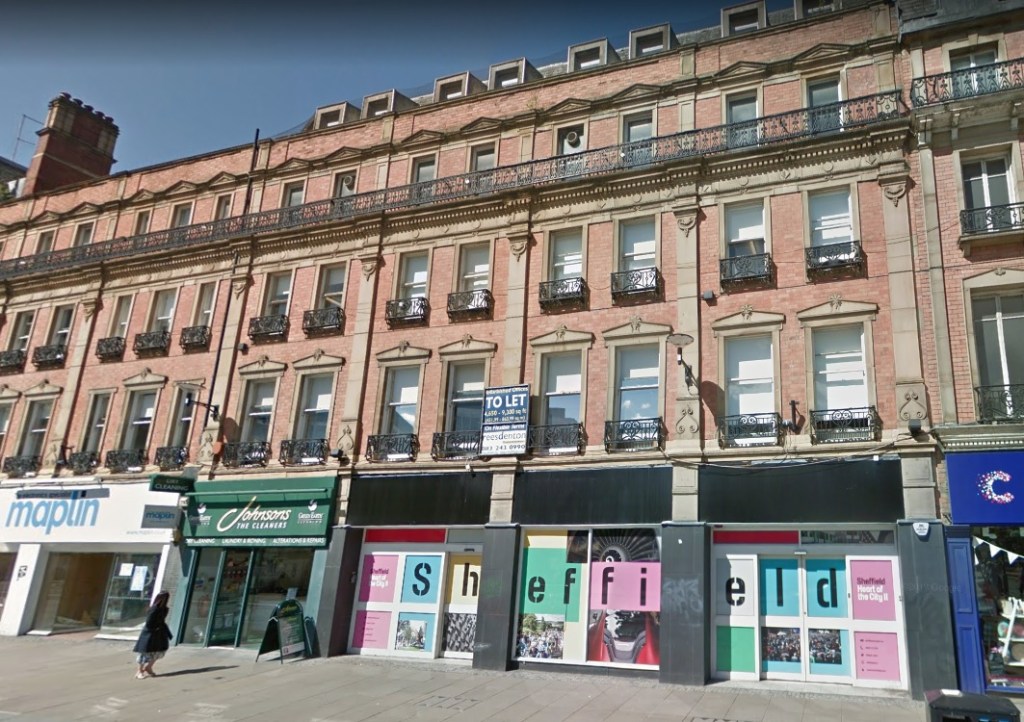
Work is in progress to demolish the interiors of 30-42 Pinstone Street (as well as the adjacent Palatine Chambers) to create a new hotel. (DJP/2021)
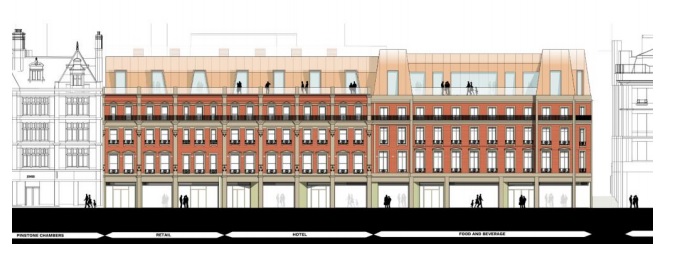
The hoardings are up, contractors are in, and Nos. 30-42 Pinstone Street (as well as Palatine Chambers), are about to be resurrected as part of a Victorian frontage to a brand-new Radisson Blu Hotel. The old facades will remain, but everything behind it, including Barker’s Pool House, on Burgess Street, will be demolished and rebuilt.
Until the 18th century, Pinstone Lane (as it was called) crossed fields and rough grazing land. As Sheffield grew, it became a twisting, close, and sinister-looking passage. In 1875, Sheffield started a street widening programme, and Pinstone Lane was transformed into a 60ft wide thoroughfare to match the magnificence of the proposed new Town Hall.
In 1892, Reuben Thompson, of Glossop Road, an established operator of horse-drawn omnibuses, cabs, and funeral director, gave up his lease on premises at Union Street, and purchased a plot of vacant land opposite St. Paul’s Church (now Peace Gardens) from the Improvement Committee, along with adjoining property at the back towards Burgess Street.
The Salvation Army had already started building its Citadel on Cross Burgess Street as well as three large business premises at its corner with Pinstone Street. Thompson bought the land alongside this, and employed Flockton, Gibbs, and Flockton to design a red brick building, with handsome stone dressings, comprising ground floor shops, and offices and flats above.
An old sketch that shows Reuben Thompson’s City Mews to the left. The sign is visible on top of the building. (PIcture Sheffield)
In 1895, he purchased an additional plot of land to build three additional shops. This extended the length of the original building and incorporated an entrance tunnel from Pinstone Street through to stabling and carriage sheds behind, the carriages lifted from floor to floor by a hoist.
It extended the range to fifteen bays, and across the top of the building ran an enormous sign – ‘Reuben Thompson’s City Mews – and was completed in time for the opening of the new Town Hall.
This is the building we still see, although the advent of the motor car, and high petrol prices during the 1930s, saw Reuben Thompson Ltd vacate a property that had become far too big. It consolidated on Glossop Road and Queen’s Road and focused on its funeral business.
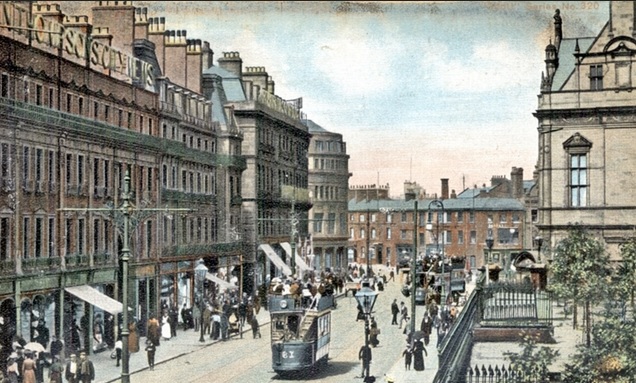
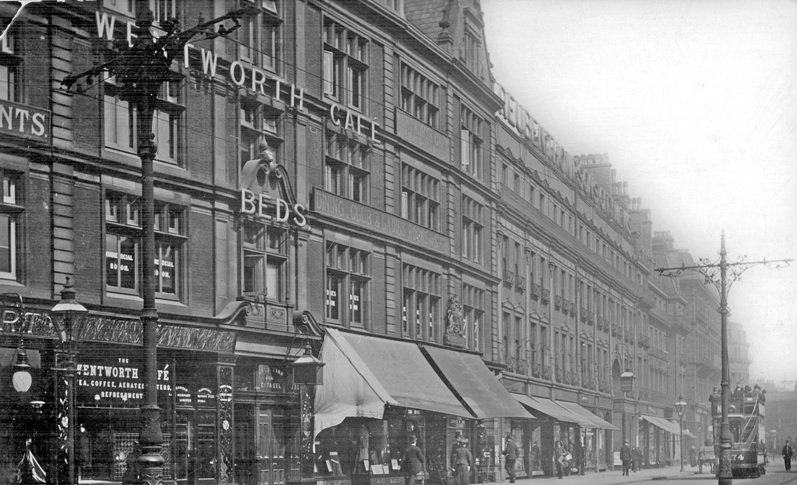
Looking up Pinstone Street. Reuben Thompson’s City Mews are on the right of this old photograph. Once again, the large sign is visible across the top of the building. (Picture Sheffield)
Those of a certain age will be familiar with the shops that have occupied this prime location on one of Sheffield’s most prestigious streets.
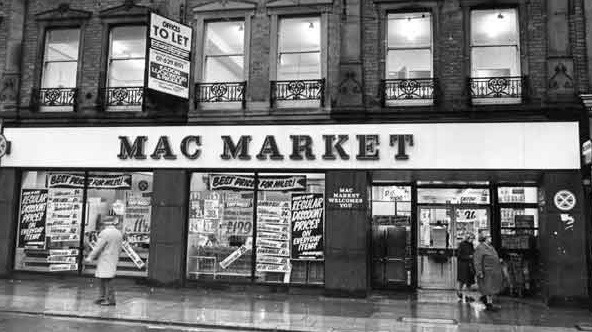
The Pinstone Street entrance to City Mews, where horses and carriages once passed, was filled-in, and later lost in the frontage of Mac Market (later to become International, Gateway, Somerfield, Co-op, Budgens, and finally, as a temporary home for WH Smiths).
The construction of Barker’s Pool House on Burgess Street in 1969-1970 (on the site of the former stabling and carriage-houses) linked both properties and altered much of the original Pinstone Street interiors. These too will be lost in the latest stage of the Heart of the City II redevelopment.
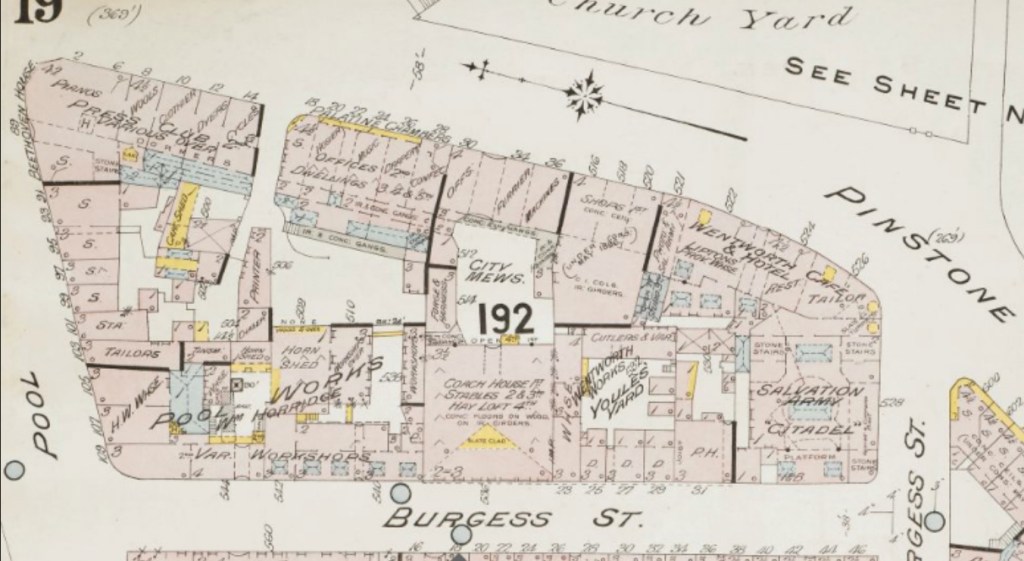
An old building plan shows Reuben Thompson’s City Mews, with stabling and carriage sheds located at the back of the Pinstone Street premises and stretching through to Burgess Street. This would later become the site of Barker’s Pool House, soon to be demolished. (Goad Insurance Plan 1896/British Library))
In the 1970s, Mac Market occupied three of the old shop units on Pinstone Street. The original carriage entrance passed underneath the offices above and was located where the central window is here. It remained a supermarket until fairly recently. (Picture Sheffield)
A recent image of 30-42 Pinstone Street. All the shops frequently changed hands. The former Mac Market was most recently used as a temporary shop for WH Smith. In 1970, Barker’s Pool House was built behind, and shoppers were able to use an alternative entrance on Burgess Street. Useful for Cole Brothers staff before and after work. (Google)
Proposed principal east elevation (Pinstone Street) for the Radisson Blu Hotel. Fifteen bays once formed Reuben Thompson’s City Mews. Palatine Chambers occupies twelve bays to the right. (Montagu-Evans)
Once a rural idyll, along came industry, and Kelham Island became famous for its factories and works. It’s hard to believe that in a remarkably short space of time, the last remnants of industrial heritage are being squeezed out, and Kelham is becoming one of the “coolest places to live in Britain.”
Here’s an extract from Robert Eadon Leader’s ‘Reminiscences of Old Sheffield: Its Streets and Its People’ (1876), in which Richard Leonard remembered the days before industry.
“Beyond Bower Spring, the footpath – Cottonmill Walk – was the continuation of Spring Street. It ran in the direction now taken by Russell Street, across ‘Longcroft,’ as the open space was called in 1771, towards Green Lane. Of course, it took its name from the cotton mill of Mr Middleton.
“An open stream ran from the top of Cornish Street, in front of Green Lane, and emptied itself in the Don, below where Green Lane works now stand. On the other side of the stream were cottage gardens. Middleton’s silk mill – built in 1758, burnt down in 1792, and the cotton mill, re-erected on the same site only in turn to be burnt down in 1810, and again built only to become the Poor-house in 1829 – stood alone in its glory, its nearest neighbour being Kelham Wheel, still there, as it had been at least as long before as in 1674, on the now covered-in ‘Goit’.
“Across the river was the suburb of Bridgehouses, and all around was verdure. Those were the days when ‘the old cherry tree,’ whose name is now perpetuated only by the public-house (on Gibraltar Street) and the yard where it stood, was still young, and when Allen ‘Lane’ and the Bowling Green marked the extremity of the inhabited region of Gibraltar. Beyond the road ran between fields – ‘Moorfields’ (now Shalesmoor) – and on to the distant rural haunts of Philadelphia and Upperthorpe.”
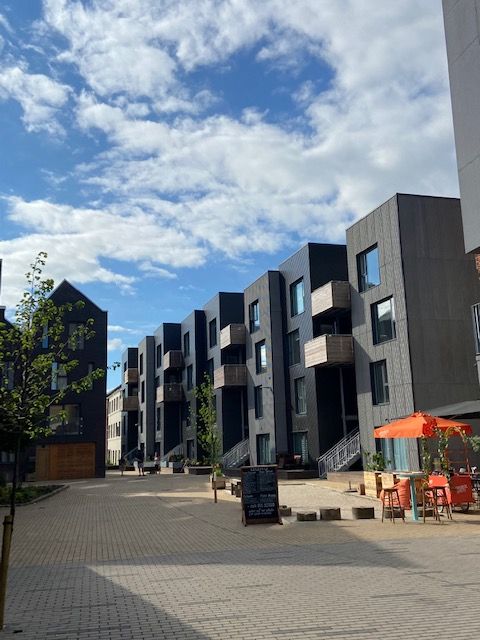
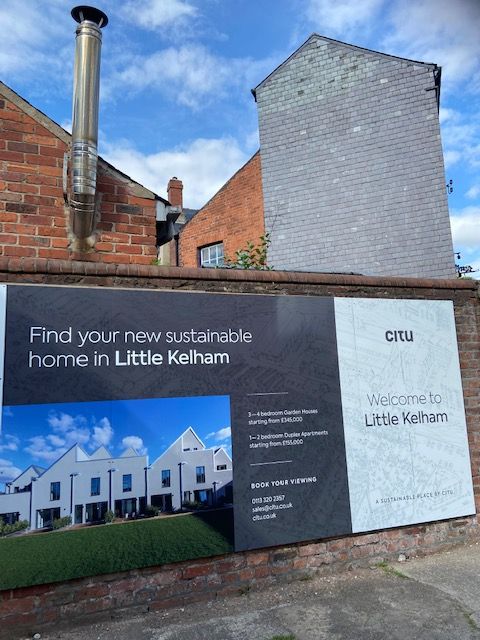
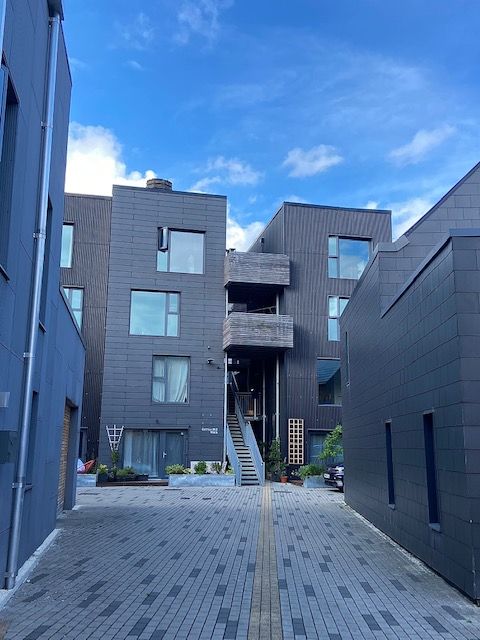
The photographs show Citu’s recent sustainable housing development at Little Kelham (Little Kelham Street).
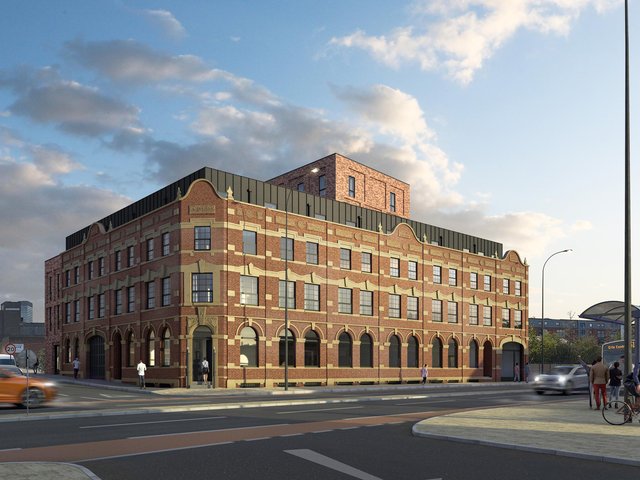
Nichols Building. An artist impression of how the old building might look after conversion into flats and commercial space. (Ashgate)
A £3.25m funding package from Lloyds Bank has been secured to support the redevelopment of a former grocer’s warehouse and coffee roastery in Sheffield’s Kelham Island district into apartments. Developer Ashgate is redeveloping the currently disused Nichols Building, Shalesmoor, to a mixed-use scheme with private residential units and commercial space.
Work is to start this summer, and retain many of the building’s original features, including mosaic tiling, stone, and brickwork.
The Nichols Building is an elegant three-storey range built with iron-hard engineering red bricks, such as Accrington or Noris type, laid in English Garden Wall bond.
Leather’s Plan of Sheffield (1823) shows the site (once known as Moor Fields) to have two buildings. The adjacent road had also been renamed ‘Shalesmoor’ although the smaller streets around it remained unnamed.
The 1853 Ordnance Survey map shows the site to comprise back-to-back housing, and likely small workshops, concentrated around two courtyards.
The Nichols Building appears to have been built in 1914 as indicated by a date sign located within the front gable at the corner between Shalesmoor and Shepherd Street. Cartographic records confirm such a date for the construction of the building as the site was formerly occupied by several terraced buildings with internal courts.
The building includes two signs stating, ‘FOUNDED AD 1854’, referring to the establishment of the company; and an additional one to the north-western end along Shalesmoor which reads ‘REBUILT AD 1914’, which refers to the ‘rebuilding’ of the company on the site.
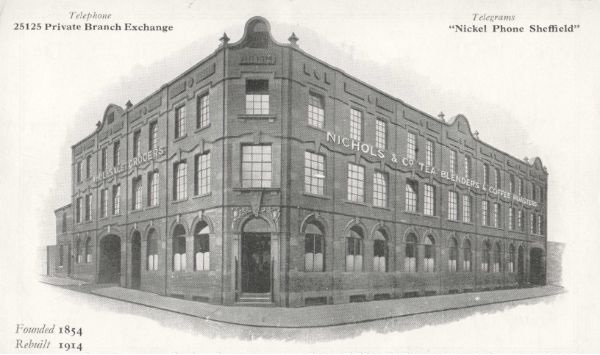
An advertising postcard for Nichols and Co. (Sheffield) Ltd., Shalesmoor (dated between 1900-1919). The back of the postcard reads: “Wholesale grocers. Tea blenders and coffee roasters. Baking powder and self raising flour manufacturers. Dried fruit specialists. Tea packers to the trade. Colonial and foreign produce delivered or sold export. Only goods of reputed quality and of the leading manufacturers sold. Write for quotations.” (Picture Sheffield)
The business Nichols & Co., wholesale grocer, tea merchant and dealer, was established in 1854 by Charles Nichols which originally occupied premises at 231 Gibraltar Street. In 1868, the business held an additional property in Meadow Street and in 1877 in Langsett Road. The 1900 Kelly’s Directory also lists a property in Trinity Street. Once the company moved to the present Nichols Building, no other associated premises are listed, suggesting that the aim of the Nichols Building was to bring the different properties of the company together within a single and purposely-built warehouse.
Nichols and Co. are listed on the site until 1965 when the company is renamed ‘Nichols, Johnson and Bingham’. Following liquidation, various parts of the buildings were sold off with the final reference in the 1973 directory showing ‘Richardson, Arthurs and Son Ltd’ which had purchased part of the former Nichols and Co. business.
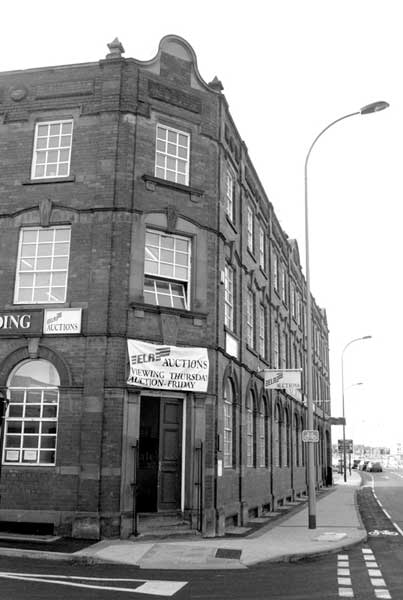
It subsequently became auction rooms for Eadon Lockwood & Riddle, and more recently functioned as an antique centre that closed in 2018.
ELR Auctions Ltd., The Nichols Building, at the junction of Shepherd Street and Shalesmoor in 2006. (Picture Sheffield)
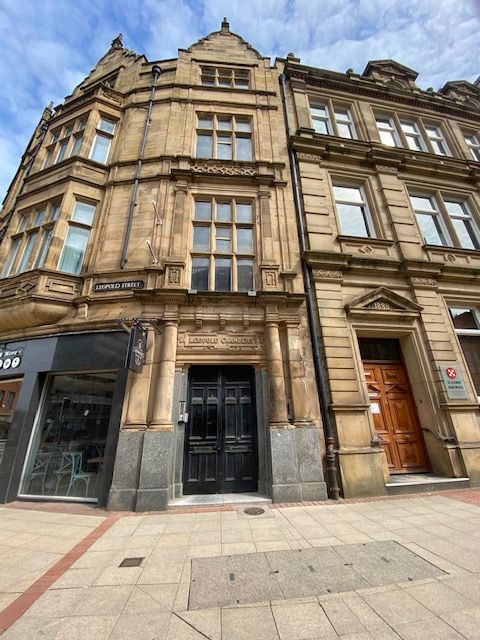
Leopold Chambers. An important, but forgotten, part of Sheffield’s Victorian architecture. (DJP/2021)
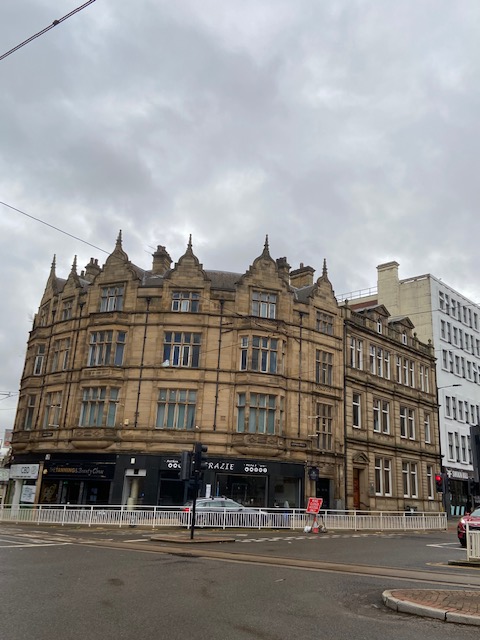
At the corner of Church Street and Leopold Street is a building typical of Sheffield’s Victorian architecture.
Leopold Chambers was built in 1893-1894 as new offices for Webster and Styring, an established firm of solicitors set up by George Edward Webster and Dr Robert Styring. The imposing four-storey Renaissance building, in mellow golden sandstone, provided a handsome rounding to the corner, with four shops built beneath the offices.
The building neatly rounds-off the corner of Church Street and Leopold Street. The latter street had only been constructed a few years before. (DJP/2021)
The architect was Andrew Francis Watson (1856-1932), designer of many well-known buildings in Sheffield, including the Norfolk Market Hall, the old Fitzwilliam Market, Westminster bank, High Street, showrooms for Mappin and Webb, and the offices of Messrs Vickers and William Jessops on Brightside Lane. He was also the architect for the London and Midland Bank in the Sheffield District and responsible for 1-9 High Street that survives as an extension of Lloyds Bank.
A native of Lamport, Northamptonshire, he came to Sheffield in his twenties and eventually went into partnership with Edward Holmes (creating Holmes and Watson, and no apology to Arthur Conan Doyle).
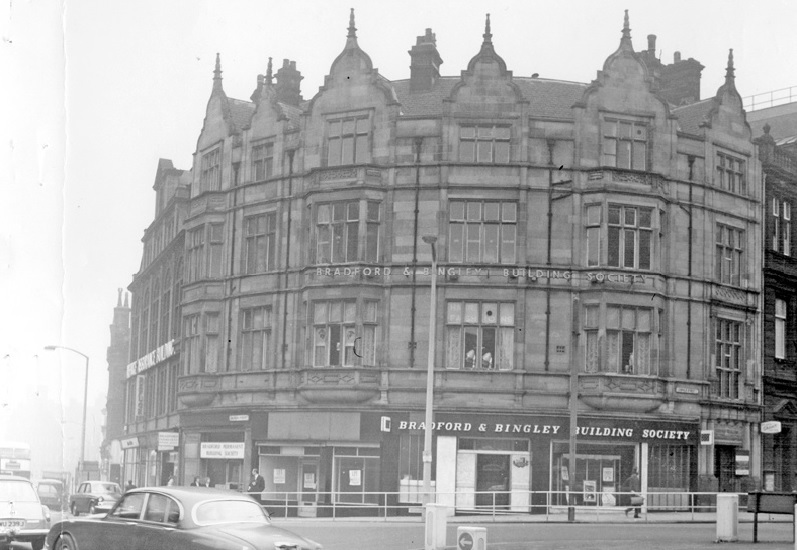
The partnership between Webster and Styring was dissolved after George Webster’s retirement in 1908, and Leopold Chambers (typically blackened by Sheffield’s sooty air) was later taken over by the Bradford Equitable Building Society (later to become Bradford & Bingley).
Following their departure, the offices were sub-divided and more recently converted into student accommodation, with shops at ground level.
Leopold Chambers subsequently became home to the Bradford & Bingley Building Society. Seen here in the 1970s. (Picture Sheffield)
Sheffield’s forgotten street. It is hard to imagine that Orchard Street was once one of the city’s most important thoroughfares. (DJP/2021)
Never did a street fall out of favour as Orchard Street did. This narrow thoroughfare was once the main route between Church Street and Fargate, bustling with commerce, with horse-drawn carriages and carts squeezing past each other.
Neither did the creation of Leopold Street diminish its popularity, although only a small portion of the street retained its name.
It wasn’t until the 1980s, and the creation of Orchard Square, that it was relegated to become the back door to shops, and a place for lads to have a quick wee on a Saturday night.
It is an incredibly old thoroughfare, though the name Orchard Street wasn’t given to it until comparatively late.
Formerly all the land in the triangle between Church Street and Fargate consisted of orchards and gardens, but warehouses, shops, and cutlery works gradually covered the space.
In the early 1700s, it is referred to as Brinceworth’s Orchard, while in Fairbanks’ Plan of 1777 it was known as Brelsforth’s Orchards, and in the 1787 Directory it is described as Brinsworth’s Orchards. A document of 1763 gives the address of a trader as Brinsford Orchard. Both Brinsworth and Brelsford, or Brelsforth, are old Sheffield names, and possibly the various names indicate changes of ownership of the orchards through which the street passed.
Eventually the personal names were dropped, and the thoroughfare simply became Orchard Street.
In 1980, the surviving portion of Orchard Street was still popular with shoppers. Most of these properties were demolished to make way for Orchard Square. (Picture Sheffield)
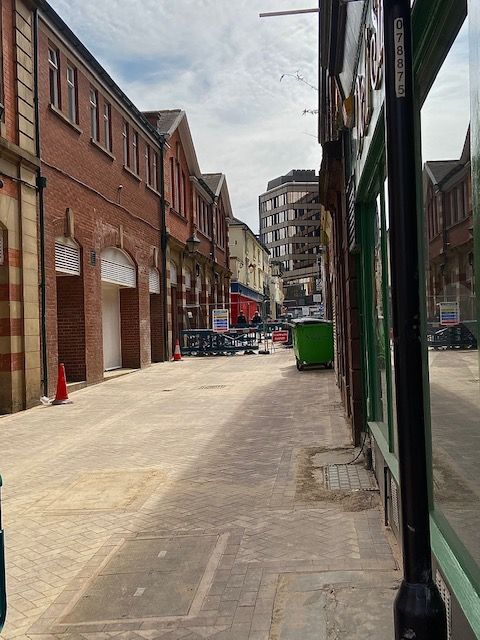
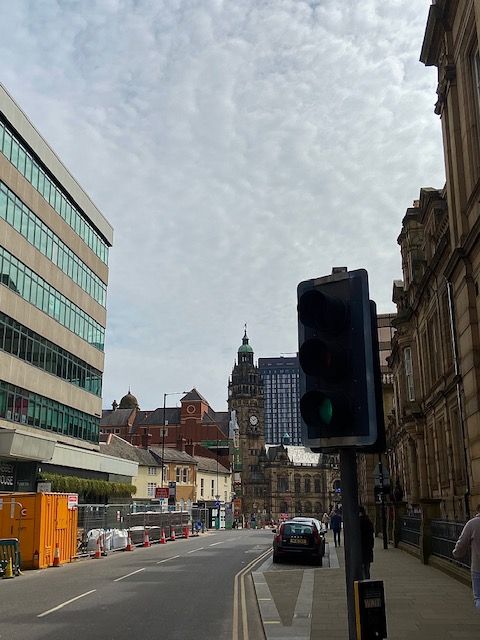
Work in progress. The pedestrianisation of Leopold Street (above), Pinstone Street, and Surrey Street, will create a traffic-free Town Hall Square. (DJP/2021)
Our city centre is at a crossroads. The city is in flux and a street that highlights it most is Leopold Street. Buses no longer run along here, and all traffic is halted mid-way. Sheffield is going car-free, and with it our streets become soulless. Nothing is sadder than a street about to undergo pedestrianisation. It is blocked with traffic cones and concrete barriers and unsure what it wants to be.
As far as Sheffield streets go, Leopold Street is relatively new, a pet-project for town planners in 1873. Back then, access to Fargate and Pinstone Street was via Church Street, along awkwardly narrow Orchard Street, to its junction with Orchard Lane, and dog-legged towards what is now the top of Fargate.
Its making was the result of Sheffield Corporation’s three-street development scheme – the creation of Surrey Street, Fargate improvements, and the construction of ‘modern-day’ Pinstone Street. A new road was needed to link these streets with Bow Street (the road that became the bottom of West Street) and a link between old Sheffield Moor and Shalesmoor.
A long-standing road, South Street, was swept away, the land around it cleared, and the large sloping site bounded by the proposed new road, Orchard Lane, Holly Street and Bow Street (West Street) earmarked for educational purposes. It became the site of Firth College (1879), School Board offices and the Central School (both 1880). Of course, we now know these buildings as the Leopold Hotel and Leopold Square
By May 1880, half its length had been completed, 60-feet wide from Bow Street to Fargate, paved in wooden blocks, and converted to macadam in 1883.
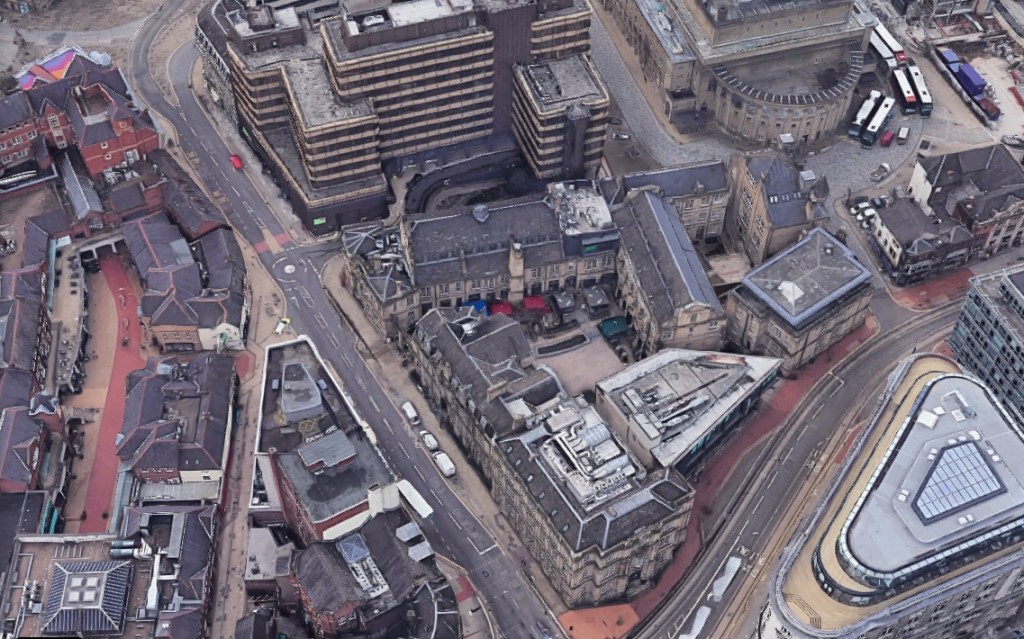
Aerial view of Leopold Street. The Leopold Hotel and Leopold Square are centre. Before 1880, the main route between Church Street and Fargate was along narrow Orchard Street, to the left, which curved at its junction with Orchard Lane (where the mini-roundabout is today). The top-end of Orchard Street (near to Fargate) was absorbed into Leopold Street. (Google)
The Watch Committee recommended that the new street be named after Prince Leopold, Duke of Albany (1853-1884), eighth and youngest son of Queen Victoria, who had opened Firth College in October 1879.
The addition of the Sheffield Medical Institution on the other side of the road in 1888 prompted one expert to say that Leopold Street would become a “street of institutions.”
It never became a street of learning. Firth College and the Medical Institution were the foundation stones for the University of Sheffield and moved away. By the late 1970s, the old education buildings were in decline, mostly unoccupied, but spared the fate that befell the nearby Assay Office and Grand Hotel, both demolished, and replaced with office blocks.
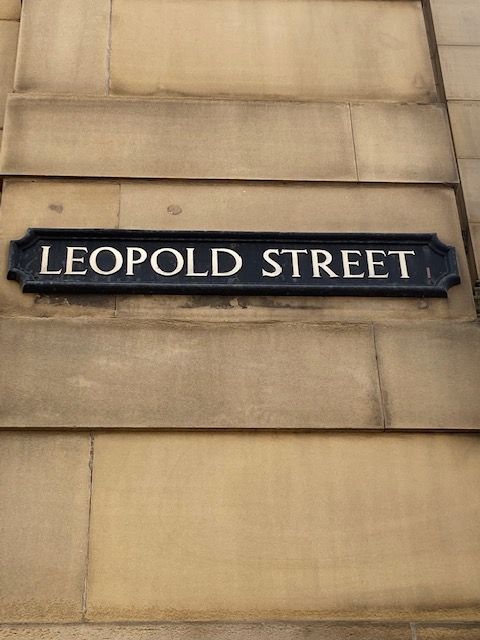
A street sign on the wall of what was once Firth College, at its junction with West Street, and now part of the Leopold Hotel. (DJP/2021)
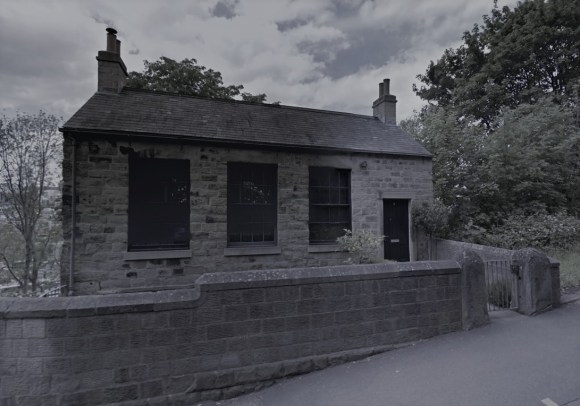
A building familiar to those driving along Shrewsbury Road. It is the only surviving property in what was once a slum area above the Midland Station. (Image: Google)
Some buildings are built to endure. Others are less fortunate.
By rights, No. 19 Shrewsbury Road should not be here… but it is, the sole survivor of what became a 19th century terraced street. It is bordered by Turner Hill, a throwback to sloping cobblestone streets, and Granville Lane running behind.
The latter were probably laid out during the industrial expansion of Sheffield, and only 19 Shrewsbury Road, or the Old Sweet Factory as it became known, still stands.
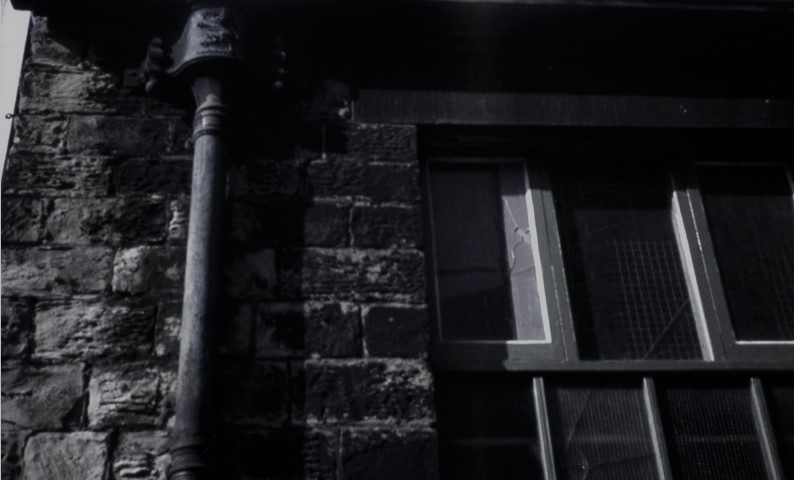
To most people travelling up and down Shrewsbury Road it looks like a single storey building. However, a walk around the back shows it is two storeys high with a 4.4metre difference between the upper level entrance on Shrewsbury Road and the lower level yard entrance serving the rear of the property.
The area between Pond Hill and Shrewsbury Road had once been a wood, and when this building was erected as a Sunday school for a non-conformist chapel in 1836, it probably stood in semi-rural surroundings overlooking the Sheaf Valley.
Industrialisation changed the area, as did the construction of Midland Station down the slope in 1870, and the building was used as a brush factory.
By the mid-1890s the property was occupied by Charles Green, the considerably underrated sculptor and modeller, and subject of a separate post.
It caught fire in 1911 and most of the interior was destroyed, as were priceless works of art, including those by Francis Chantrey, that Green had collected.
Charles Green died in 1916 and it subsequently passed to Alfred Grindrod and Company, heating and ventilation engineers, a firm established in 1899, and which consolidated at its other premises on Charles Street in 1924.
The rear of the property seen from Granville Lane, a street of terraced housing until the late 1930s. These days it is a wide footpath known as Granville Walk with views towards the city centre. (Image: War of Dreams)
By 1940, Samuel H. Walker had set up his sweet manufacturing business here. When he died, the business passed to his son and daughter, Harold, and Gladys. It was worked by Harold and Gladys’ husband, George Frederick Kay, while Gladys sold the sweets from a stall in the Norfolk Market Hall.
Many people will remember it was also a sweet shop, popular with students from nearby Granville College.
The business closed due to a compulsory purchase order in 1984, its fate unknown, but the building probably survived due to its Grade II listing two years later.
Sadly, the abandoned building fell into poor state of repair and a haunt for drug addicts.
In 1998 it was acquired by South Yorkshire Buildings Preservation Trust which embarked on a three year programme to restore the property.
It was let to Manchester Methodists Housing Association and Sheffield City Council before being sold in 2005.
Five years later it sold for £150,000 and was converted to residential use in 2012.
The Old Sweet Factory was Grade II listed in 1986 and converted for residential use in 2012. (Image: Picture Sheffield)
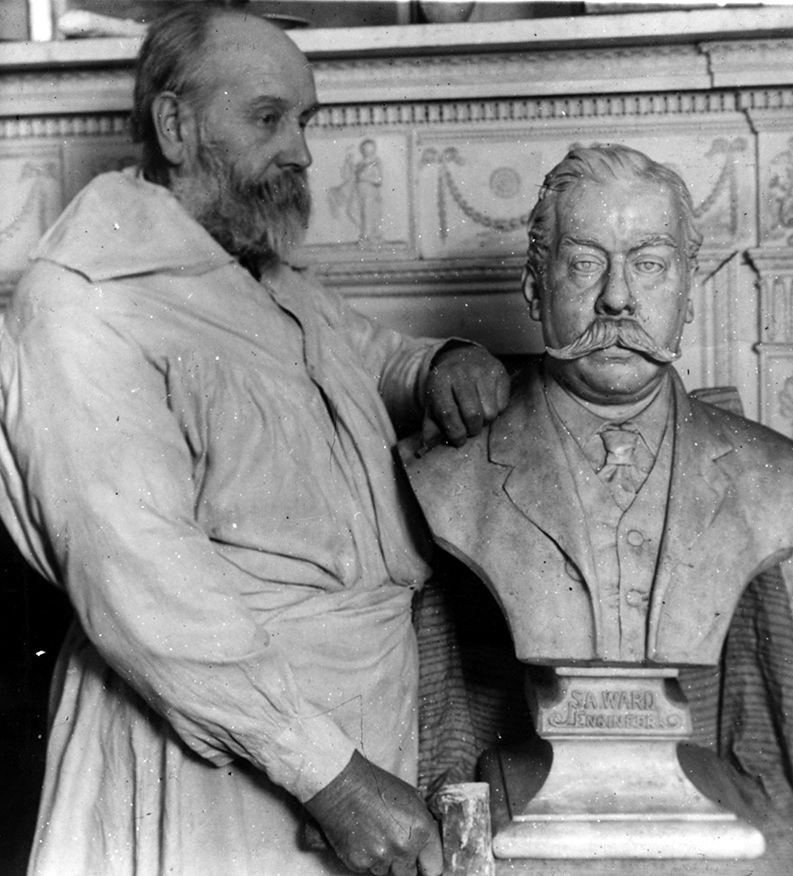
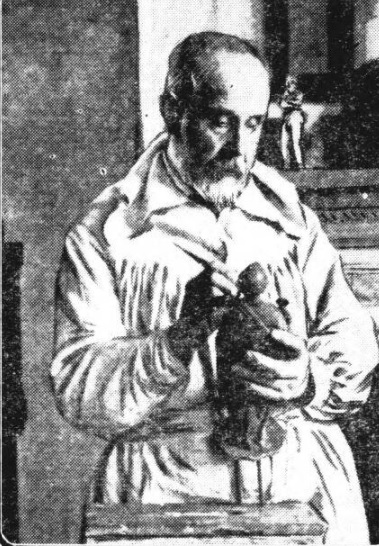
Charles Green loved flowers, animals, and children. “He took scrupulous care in workmanship.” (Image: Picture Sheffield)
Charles Green (1836-1916) had reasonable acquaintance of old Sheffield buildings and landmarks, and his knowledge of Sheffield craftsmen was remarkable. But throughout his life he lamented the fact that they weren’t valued.
“The citizens of Sheffield have little idea of the beautiful works that are now being produced by its native sculptors in other towns, where they have gone for lack of encouragement at home.”
The same could be said for Charles Green, sculptor, modeller, and designer, whose reputation faded after his death.
Today, his name barely registers in the art world, yet his work was patronised by the likes of the Duke of Portland, Baron Rothschild, and Indian Rajahs. After the Boer War he designed and modelled monuments for the battlefields of South Africa.
Charles Green was born at Brampton, Chesterfield, the son of William Green, who became a fender maker at Sheffield’s Green Lane Works. He was educated at St. George’s School, Hallam Street, and showed great aptitude for art with a love of drawing and modelling at the expense of his lessons. He went to Sheffield School of Art aged 11, becoming a pupil of Young Mitchell, and was apprenticed to Edwin Smith, sculptor, and learnt how to model and carve with marble.
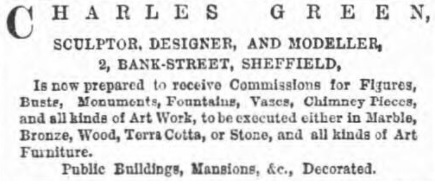
A newspaper advertisement from 1877. Green had moved from his original studio on North Church Street. (Image: British Newspaper Archive)
During his apprenticeship he carved a bust of Rev. Thomas Sutton for Sheffield Parish Church (now Cathedral) and that of Sir Robert Hadfield for the Cutlers’ Hall.
Green set up his own business and drifted away from sculpture, designing, and modelling ornamental cast-iron on a large scale. He designed fountains, gateways, mantelpieces, ceilings, decorative silver, and metalwork.
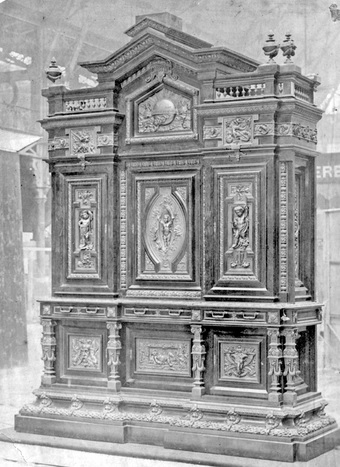
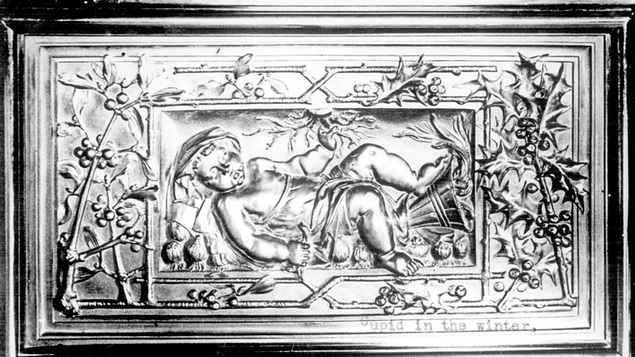
Perhaps his finest work was a cabinet commissioned for the Duke of Portland at a cost of £1,100. It seems the Duke changed his mind, but the ebony and bronze cabinet, representing the four seasons, the four elements, the twelve signs of the zodiac, and the globe, merited exhibition in London and Paris.
“I had the spirit within me to make this cabinet as a monument to my father who was so fond of flowers.”
Charles Green’s ebony and bronze cabinet (top) was exhibited at the Paris Exhibition in 1878. It was later exhibited in Sheffield and Rotherham but its whereabouts is unknown. It would appear that these images from Picture Sheffield are the only in existence, and underlines the incredibly important work of the photo archive. (Image: Picture Sheffield)
His studio was at North Church Street, later relocating to Bank Street, and ending up at 19 Shrewsbury Road, opposite his home at No.18, a listed building that survives. (It subsequently became Samuel Walker’s sweet factory).
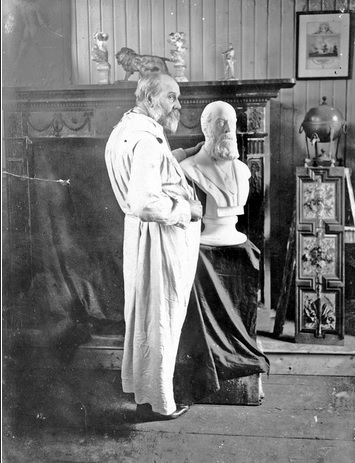
“He was widely read in the classics, his broad outlook mellowed by a sense of humour.” (Image: Picture Sheffield)
Charles Green married the daughter of Dr Wright Wilson, and had four daughters, one of which, Florence, also became an artist, modeller, and designer.
Before the Society of Artists was formed, local artists met at his studio in North Church Street as far back as 1859, he being one of the first members of the society. He was invited by John Ruskin to attend the first meeting of the Ruskin Museum, and the Sheffield Art and Crafts Guild was formed at 18 Shrewsbury Road in 1894, he being the first master.
He also wrote Artist’s Rambles In and Around Sheffield for the Sheffield and Rotherham Independent.
No. 19 Shrewsbury Road. If ever a building experienced highs and lows this is it. Destroyed by fire, rebuilt to become a sweet factory, and then allowed to fall into disrepair and become a crack den. The Grade II listed building was restored by South Yorkshire Buildings Preservation Trust in 2001.
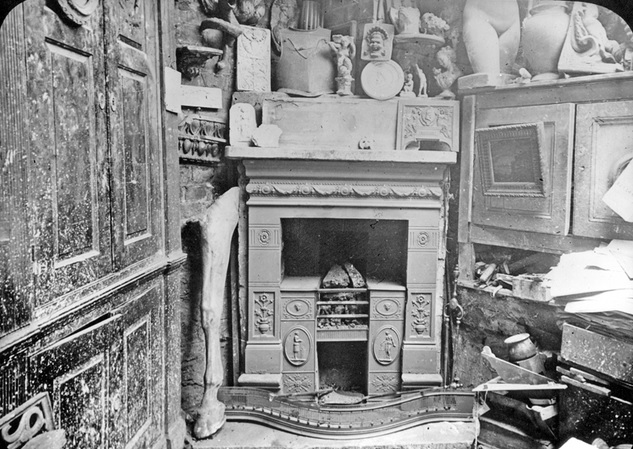
Charles Green was a lifelong collector of works, and at his studio on Shrewsbury Road, he had a large library, priceless antiques, and prints.
Amongst these were two original models by Francis Chantrey, one was a plaster cast of Sir Walter Scott, and the other, an early model of Rob Roy, thought to have been the only one. He also had several masks taken after death of Lord Brougham, Napoleon, Oliver Cromwell, and others.
Sadly, one August evening in 1911, Green was heating wax in his studio, when it boiled over, a sheet of flame enveloping him in fire. He managed to rip off his apron, but flames spread to the whole property.
The Chantrey busts were lost, as were pieces of carved oak, old oak chairs, pencil drawings, and sketches by Thomas Creswick, Alfred Stevens, William Ellis, E. Stirling Howard, and Robert Baden-Powell. Amongst his huge collection of books lost were a first edition of Rhodes’ Peak Scenery and early editions of Ebenezer Elliott, and first editions of James Montgomery.
“The scene after the fire was a particularly distressing one. Near the entrance was a ruined China cheese dish, huge enough to take a stilton cheese, obviously of high value. All around were prints and frames and statues of beautiful design, hopelessly wrecked, whilst the valuable library, too, was utterly destroyed.”
Charles Green was critical of Sheffield Corporation for destroying old artworks. The demolition of Tudor House, in Tudor Square, about 1909, had allowed him to save several relics from the rubbish heap, including this fireplace that was installed at 19 Shrewsbury Road. (Image: Picture Sheffield)
Green died at No. 18, High Bank, Shrewsbury Road, in April 1916.
“The last of the arts craftsmen of the type that won for Sheffield its proud pre-eminence, associated with Alfred Stevens, Godfrey Sykes, Henry Hoyles, Hugh Stannas, William Ellis, James Gamble, Reuben Townroe, and Robert Glassby. He also enjoyed the friendship of Ruskin, Onslow Ford, Tom Taylor, and James Orrock.”
One of Green’s last unfinished works was a bronze bust of conductor Dr Henry Coward, presented to him by the Sheffield Musical Union, and completed by his daughter. He had also made a Florentine bronze tablet for the Hunter Archaeological Society, with various panels with portraits of the Earl of Surrey, Mary Queen of Scots, Cardinal Wolsey, Chaucer, and Joseph Hunter.
Amongst his first successes were the Montgomery Medal, offered by the ladies of Sheffield in honour of the poet, for modelling wild flowers from nature, and awarded by the poet himself. (Image: Picture Sheffield)
Some of Green’s work survives in private collections but an internet search reveals extraordinarily little. However, we can still see some of his work in Sheffield, including the Lord Mayor’s Chain of Office (which he designed aged 21), and some of the ceilings in the Cutlers’ Hall.
But where did that prized ebony and bronze cabinet go?
“The work of a lifetime is practically gone.” The words of Charles Green after the fire at his studio in 1911. (Image: British Newspaper Archive)
Hard times. Built for William Bush and Sons, auctioneers, in 1895. At some point in time a pediment was added to the roofline. (Image: David Poole)
What would our Victorian ancestors think of Sheffield now?
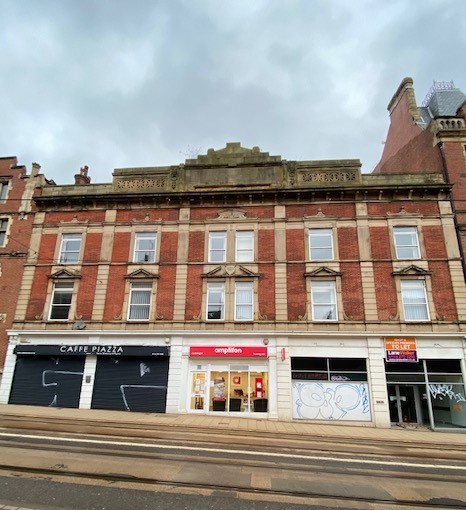
A tree grows out of the roof of this building on Church Street, a sad reminder that over a century since it was built, we’re guilty of turning our backs on impressive architecture.
Times change, and Church Street with its impressive collection of beautiful buildings, has suffered more than most.
In fact, Church Street possesses the finest empty buildings anywhere.
Barely a glance is given to the Sheffield Estate Salesrooms and Auction Mart, built in 1896 for William Bush and Sons.
An artist’s impression of the new William Bush and Sons salesrooms appeared in a Sheffield newspaper in 1895. The Gladstone Building is to the right and Cairn’s Chambers on the left. (Image: British Newspaper Archive)
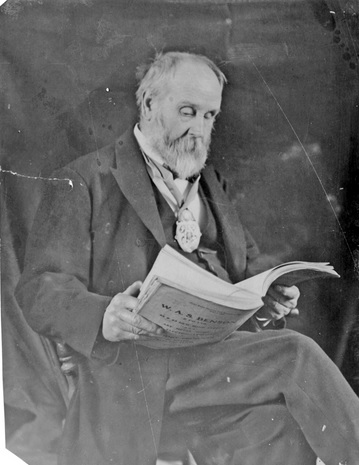
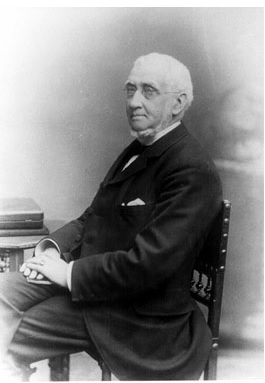
William Bush was an enterprising individual who started his working life with Schofield and Son, a firm of auctioneers, and subsequently bought the company. He later entered partnership with Charles Dixon (Dixon and Bush) and when this dissolved in 1867 he practised alone.
William Bush traded on East Parade and was joined by his eldest son, George Frederick Bush, in 1884, and by another son, Frank Sleigh Bush, in 1895. Never a public figure, he became Sheffield’s oldest auctioneer, as well as a director of William Stones, the Cannon Brewery.
William Bush, auctioneer (1827-1903). (Image: Picture Sheffield)
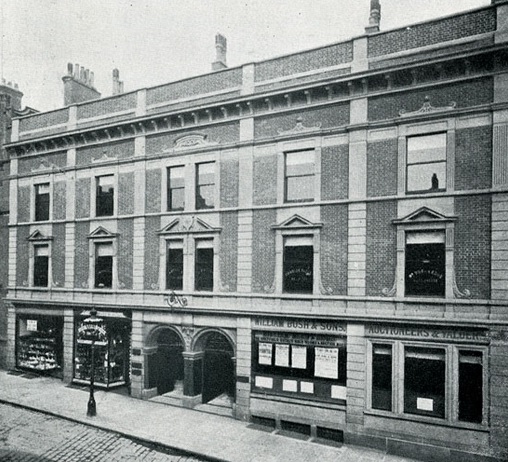
Such was the success of William Bush and Sons that in 1895 he commissioned the architect Thomas Henry Jenkinson to build a new salesroom on Church Street.
Built in Italian style of the 16th century period, the outside walls had a surface of red brick pleasantly relieved with Yorkshire stone dressings.
It was constructed by Ash, Son, and Biggin, a large building, covering 6,400 square ft with a frontage of 80ft on Church Street.
A photograph from 1897. The entrance to the salesrooms was alongside access to offices above. Two shops are shown at ground level. (Image: Picture Sheffield)
When completed in 1896, it was an inspiring if not different approach to Victorian architecture, sandwiched between the more imposing Gladstone Building and Cairn’s Chambers (built at almost the same time). However, the auction house interior was typical of the day.
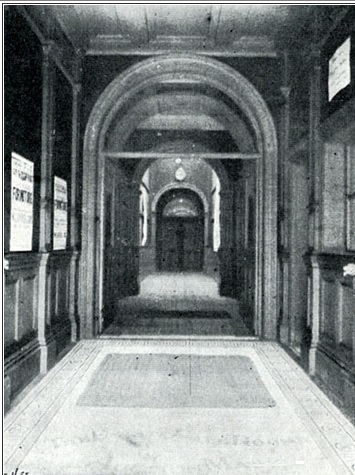
Entering from Church Street through folding oak doors, the visitor found themselves in a bright vestibule with mosaic floor. To the right was the cashier’s office and to the left a telephone room. Through a passage past the cashier’s office were the private rooms of the principals of the firm.
The vestibule reached a well-lit, lofty corridor, constructed to double as a picture gallery, its walls, as in other parts, lined with Austrian wainscot oak installed by Johnson and Appleyard.
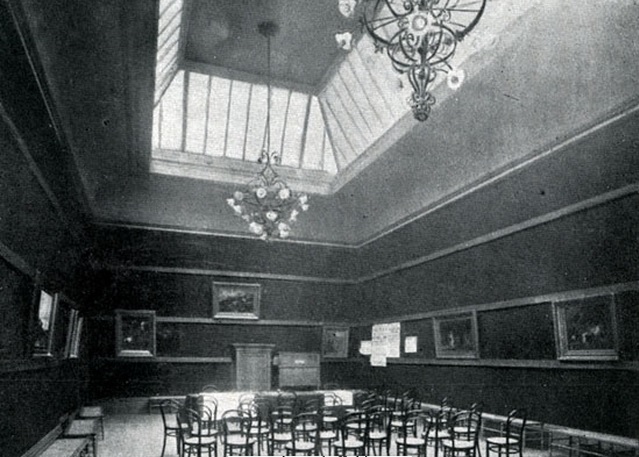
A mosaic floor and Austrian wainscot oak panelling lined the main corridor. The main salesrooms were to the left and right. (Image: Picture Sheffield)
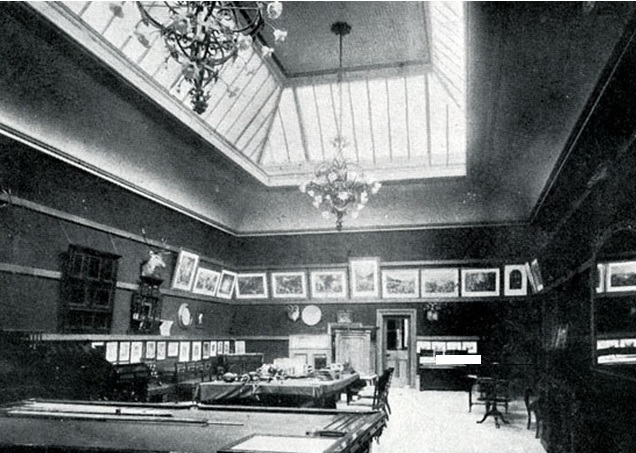
Leading off the corridor on either side were two large salesrooms. The right one was the general salesroom and on the left the estate mart. Both rooms took advantage of the best lighting and acoustics under dome-shaped roofs.
The handles on the doors were Italian bronze, representing a dragon’s head, by Charles Green, the artist and modeller.
At the end of the corridor, running at right angles with it, was another salesroom used for the sale of shrubs, trees, and plants, and used as a warehouse for the reception of goods.
A hydraulic lift took goods from the basement, where there were large storerooms fitted out to be salesrooms if required, and a fireproof strong room.
The sales rooms had natural light from above. At some point the building was redeveloped and the glass atriums replaced. An aerial view of the building today shows a plain flat roof. (Images: Picture Sheffield)
William Bush died in 1903, the business continued by both sons, but the popularity of salesrooms had started to wane in the new century.
George Frederick Bush left the business, and it became Frank Bush and Company, subsequently Bush and Company.
It might be that overheads connected with the building’s construction obliged Frank to look for tenants.
In December 1913, Lloyd’s Bank opened its Church Street branch here, the Bush auctions functioning in the remainder of the building. However, by the 1920s it had been renamed Lloyd’s Bank Chambers, and Bush and Company had relocated to Orchard Place.
Sadly, Frank Sleigh Bush was declared bankrupt in 1927, his reasons being “a change of business premises, slump in trade, illness, and lack of capital.”
The old salesrooms faded into memory, the ground floor sub-divided into shops, but Lloyd’s Bank remained until its recent departure to Parade Chambers on High Street.
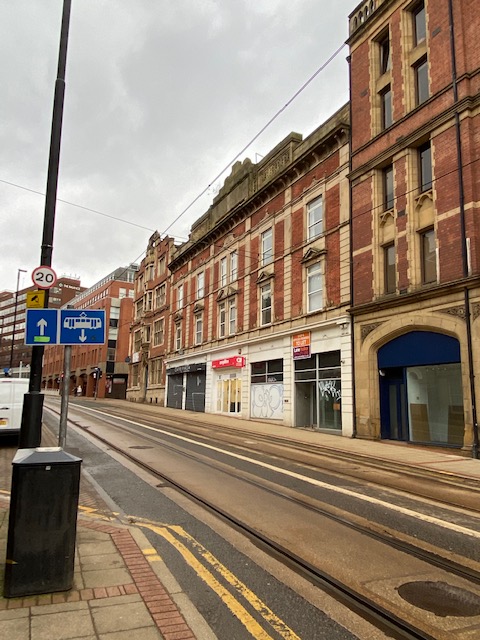
Today, the ground floor units are empty, only Amplifon occupies what was the old vestibule, with little sign of life in the offices above, and with post-pandemic uncertainty, it looks like a long road back to glory.
There is a question that intrigues me more than anything.
How much, if anything at all, remains of the old auction house interiors?
Church Street possesses the finest empty buildings anywhere. (Image: David Poole)
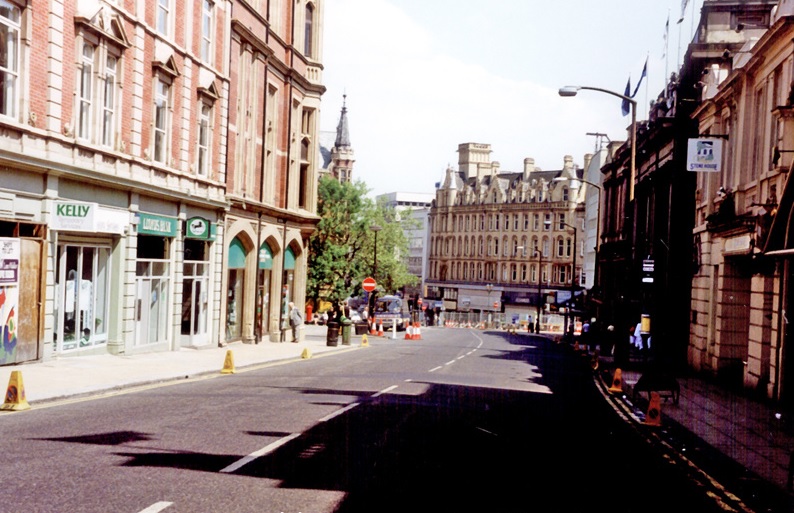
The old auction rooms are to the left of the photograph from 1993. Lloyds Bank was still evident. (Image: Picture Sheffield)


 sheffielder.net