Categories
Buildings

Town Hall Chambers: I bet you didn’t know what it was intended to be

This post was planned as a tribute to one of Sheffield’s most famous shops, Wilson Peck, but research into its origins have proved to be rather complex. That post is imminent, but during the investigation some fascinating facts emerged about one of the buildings that it once occupied.

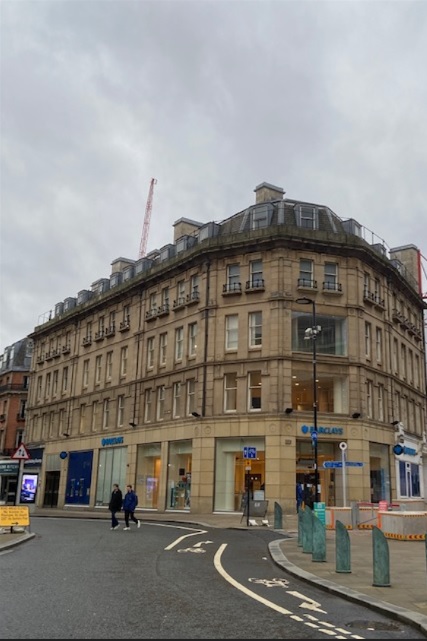
I’m talking about Town Hall Chambers that sits at the corner of Pinstone Street and Barker’s Pool, and now home to the city centre’s last surviving Barclays Bank.

According to Pevsner, it is a ‘worthy, but slightly dull five-storey block of shops and offices’, and like nearby Yorkshire House (another home of Wilson Peck), it has never been listed by Historic England.

The building was designed by Sheffield architect John Brightmore Mitchell-Withers in 1882-85 as part of the street improvement scheme that reinvented Pinstone Lane, a salubrious and narrow thoroughfare, into Pinstone Street, long recognised as one of the city’s most prominent streets.

The site had been an old hostelry called the Norfolk Hotel that was demolished in 1881 as part of the street widening programme. Evidence suggests that J.B. Mitchell-Withers bought the plot of land to build upon, and now I’ve discovered that it was built as a hotel.
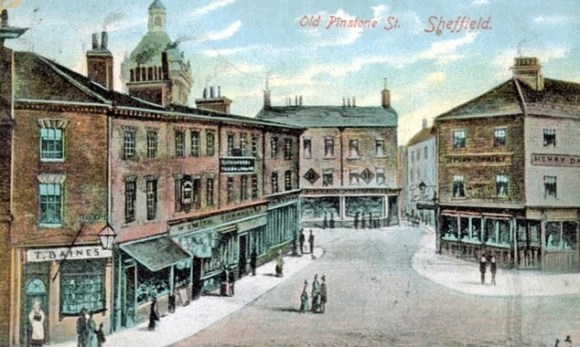
Pinstone Street from Orchard Street, No. 73 Fargate, T. Baines, hairdresser, left, No. 79 Barker’s Pool, Norfolk Hotel (landlord-Henry Darley), right, premises on Pinstone Street include No. 3 Wm Smith, hatter, Nos. 5 – 7 John Richardson, tailor. 1879. Image: Picture Sheffield

In 1884, newspapers advertised that the New Scarborough Hotel was available to let, containing a dining room, commercial room, smoke room, billiard room, refreshments bar and forty bedrooms. It also boasted the best modern appliances for cooking, hydraulic and other lifts, and electric bells.

The following year, it was announced that Lewis’s had ‘acquired the important block of buildings at the corner of Pinstone Street and Barker’s Pool, known as the Scarborough Hotel, and shops below,’ suggesting that the hotel never opened after failing to attract any interested parties.

The name of Lewis’s is famous in the history of UK department stores and the fact that it once had a branch in Sheffield comes as a bit of a surprise.

The first Lewis’s store was opened in 1856 in Liverpool by entrepreneur David Lewis, as a men’s and boys’ clothing store, mostly manufacturing his own stock. In 1864, Lewis’s branched out into women’s clothing, later expanding all its departments, and his motto was ‘Friends of the People’.

The first Lewis’s outside Liverpool opened in Manchester in 1877 followed by Birmingham in 1885. However, it was the Manchester store that it was best known for and later included a full scale ballroom on the fifth floor, which was also used for exhibitions. Its fourth store was in Sheffield, but with stiff local competition from John Atkinson and Cole Brothers, it proved unprofitable, and closed in 1888.

Negotiations quickly took place between the trustees of David Lewis and Joseph Hepworth and Son, a suit manufacturer that had rapidly expanded with over sixty shops across the country.

The premises underwent extensive alterations to accommodate its ready-made clothing, hats, and outfitting departments. The entire building was redecorated and lit with electric lamps, and when plans were submitted for Sheffield Town Hall in 1890, it was proudly referenced as the Hepworth’s Building.

Hepworth’s stay lasted four years, and in 1892 Arthur Wilson, Peck and Co, announced that they were vacating their three premises in Church Street, West Street, and Fargate, and consolidating business in the Hepworth’s Building.

It became known as Beethoven House and lasted until 1905 when it moved to the opposite corner in premises vacated by cabinet makers Appleyards and Johnson, and now known as Yorkshire House.
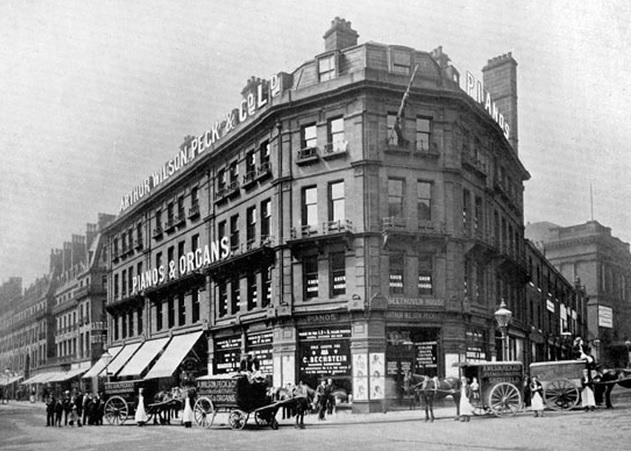
Arthur Wilson, Peck and Co., Ltd., pianoforte, organ, and musical instrument dealers, Beethoven House, Pinstone Street. 1897. Image: Picture Sheffield

At which point the building became known as Town Hall Chambers is uncertain, but by the 1930s, the ground floor had been subdivided into smaller shops, and the floors above converted into offices for numerous insurance companies.

Our generations will remember it as a centrepiece shoe shop for Timpson’s and as a short-lived branch of Gap, before being reinvented as a futuristic Barclays Bank. I’d be grateful if anyone can name any other businesses that might have been located here.

And so, we’ve discovered that Town Hall Chambers started as an ill-fated hotel. The building itself survived two World Wars and managed to escape Heart of the City redevelopment, but the irony is that neighbouring Victorian buildings further along Pinstone Street, also built as part of the 1880s street widening scheme, will soon become the Radisson Blu Hotel.
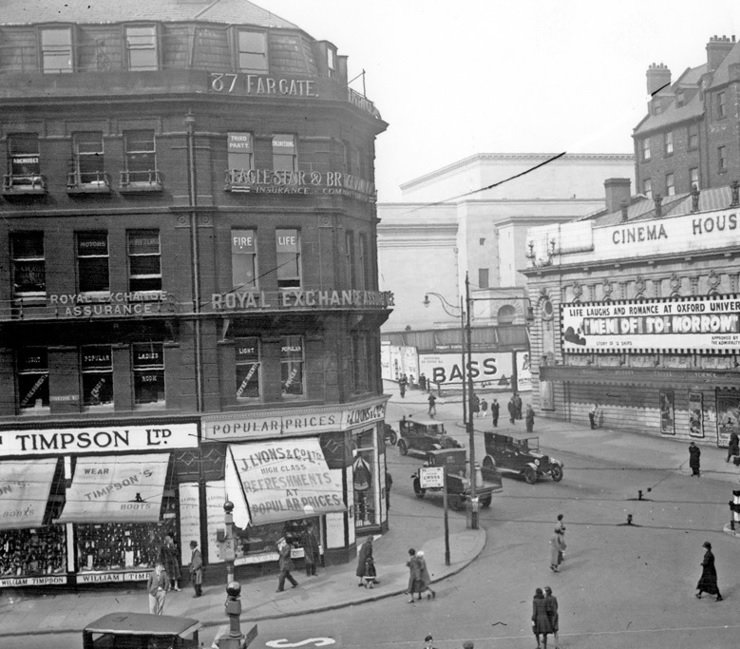
Town Hall Square and Barkers Pool, Town Hall Chambers, William Timpson Ltd., Shoe Shop and J. Lyons and Co. Ltd., Dining and Tea Rooms on left, Cinema House on right. 1935. Image: Picture Sheffield

© 2024 David Poole. All Rights Reserved.
Categories
Buildings

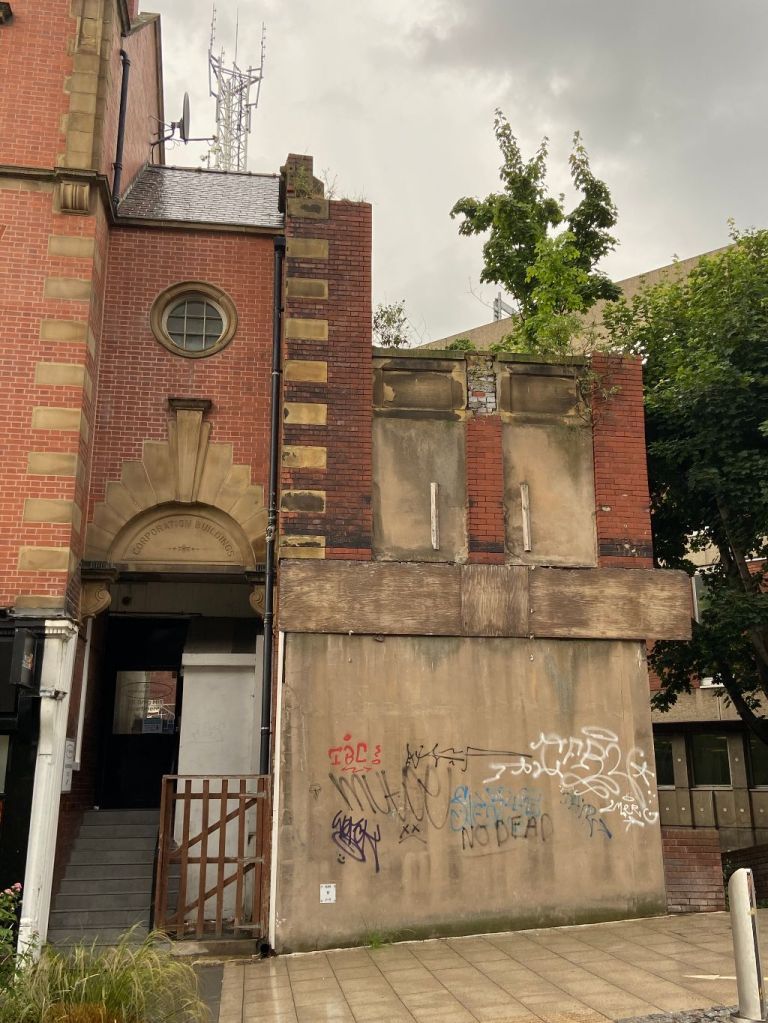
Corporation Buildings – An impressive shadow of its original design

Corporation Buildings, Snig Hill, Sheffield. Image: DJP/2022

I think this building looks quite elegant. Corporation Buildings, at the bottom of Snig Hill, is one of the few survivors of old Sheffield in this forgotten part of the city centre. And its proximity to the grey-to-green project adds to its stylishness.

But this was a troubled building from the start, and what you see today is a fragment of what it once looked like.

Our Victorian and Edwardian forebears had embarked on a plan to improve our streets, and too often we focus on Pinstone Street, Fargate, and High Street, as examples of their enterprise. But there were others, and Snig Hill was one of them.

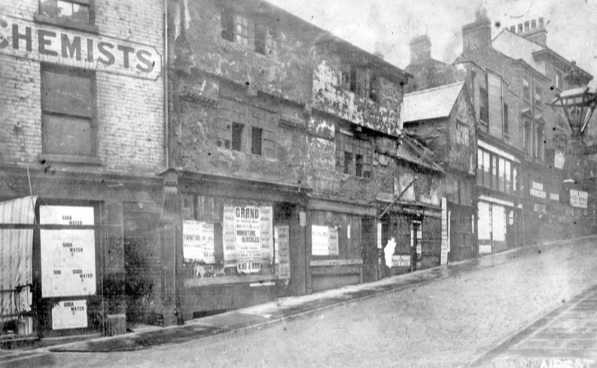
Snig Hill from West Bar, derelict timber framed shops, prior to demolition in 1900. Image: Picture Sheffield

At the turn of the twentieth century, plans were revealed to widen Snig Hill from Angel Street down to Bridge Street. Old buildings were swept away and in 1902 Sheffield Corporation revealed plans to build new Corporation Buildings stretching the whole of the right side going from the centre of town.

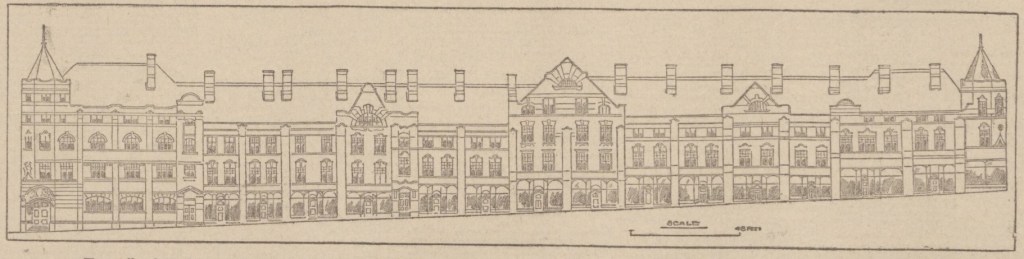
The original plans were drawn up by the city surveyor, Charles. F. Wilke, and showed a four-storey building, with a frontage of 140 yards, including thirteen shops, with showrooms above, and sixty artisan dwellings on top of them. The plans showed that turrets were included at each end, with gables introduced to break the differences in height created by the sloping gradient of the site.

Charles F. Wilke’s rejected 1902 design for Corporation Buildings on Snig Hill. Image: British Newspaper Archive

The problem was that the Improvement Committee had drawn up the plans, but the council had already created an independent committee to deal with surplus land. The project was handed over to them and appears to have disregarded Mr Wilke’s plan.

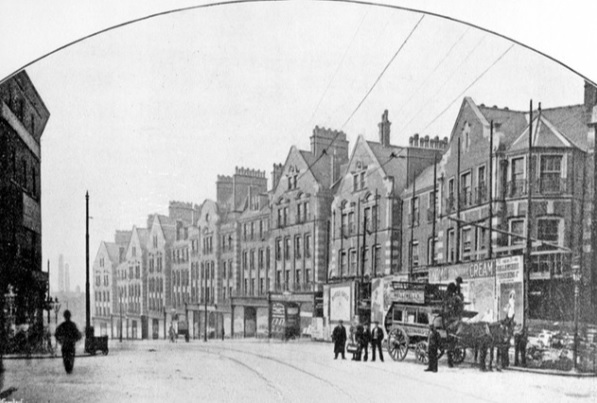
Instead, the committee approached architects Gibbs and Flockton which came up with an alternative, if not dissimilar, plan for the site. Work began in 1903 and cost between £60K and £70K and was completed the following year.

Like all council-backed projects there was criticism about the Corporation Buildings, fuelled by the fact that when it was completed only three of the twenty-one shops had been let, and the rents for the flats appeared too expensive for Sheffield’s working class. One councillor referred to Corporation Buildings as ‘a ghastly array of empty shops.’

Newly constructed Corporation Buildings and shops, Snig Hill, 1905. Image: Picture Sheffield
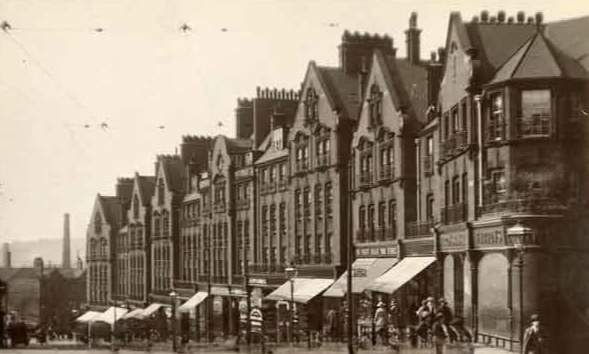
Snig Hill. This image was originally part of the Tim Hale Photographic Collection. Image: Picture Sheffield

The scheme inevitably made a loss in its early years, but once shops and flats were occupied, it brought in steady income.

Nearly 120 years later, we are left with a small portion of the original construction.

What happened to the rest of it?

In World War Two, bombs destroyed much of the upper block at the top of Snig Hill. This had to be demolished and was replaced with ‘temporary’ single storey shops. A further portion was demolished in 1971 to make way for the new headquarters of Sheffield and Rotherham Constabulary, subsequently for South Yorkshire Police, and is now used as the divisional police station covering the city centre.

But at least we have something left, and most of us can only speculate as to how impressive the full block would have looked had it survived.

Demolition of Council flats in 1971 on Snig Hill showing (left to right) Sheffield and Rotherham Constabulary (Criminal Investigation Department); W. H. Godley and Son, gents outfitters (Nos.78-80) and Arthur Davy and Sons Ltd, bakers (No.74). Image: SCC/Picture Sheffield
Corporation Buildings, Snig Hill, Sheffield. Image: DJP/2022

©2022 David Poole. All Rights Reserved.
Categories
Buildings

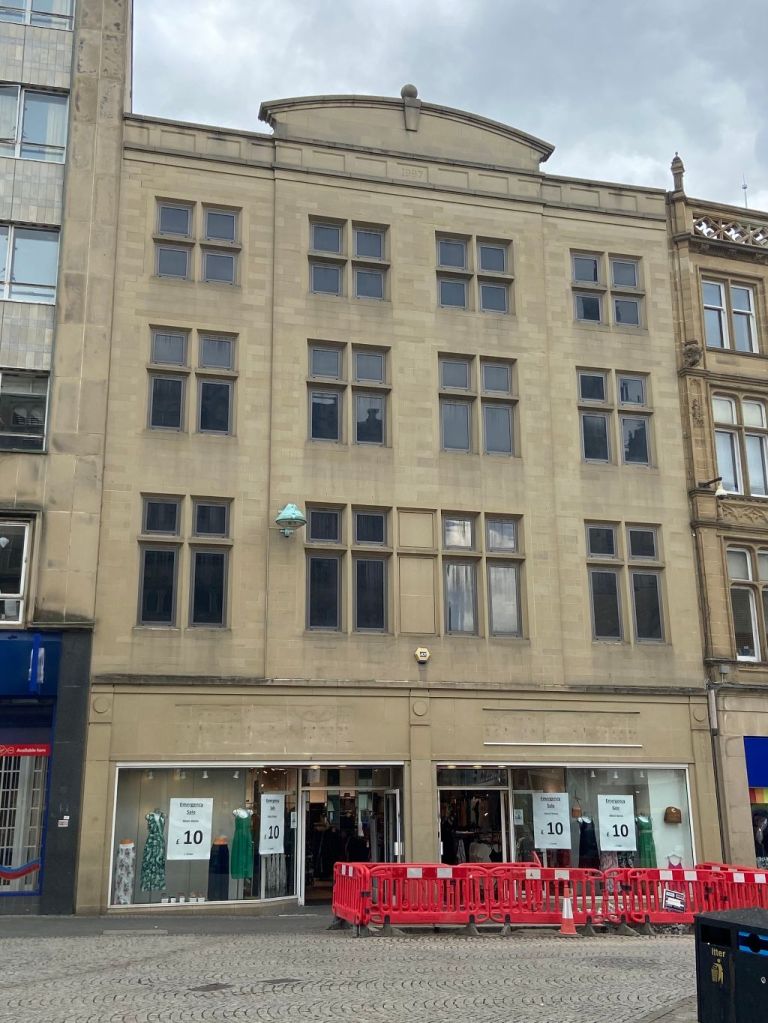
42-46 Fargate – where a Green Dragon once stood

42-46 Fargate. Image: DJP/2022

I have a memory from the 1970s of an old building on Fargate being demolished, and seeing a huge gap, and then the construction of a new one. When looking at 42-46 Fargate, I found I was correct. But the memory also plays tricks. Because I have no recollection of the replacement building also being demolished in the 1990s and substituted with what we see today.

This story starts in 1868 when Robert Henry Ramsden opened a shop in Barker’s Pool as a hat and cap dealer. He had no business experience but established himself  with a reputation for the quality of his goods, and the reasonable prices at which he sold them.

He only allowed cash transactions, and avoided bookkeeping , and by not incurring loss by bad debts, he could afford to sell his goods at a lower rate of profit. He styled himself as ‘The Reasonable Hatter’ and later his advertisements declared that ‘Cash is King.’

He became very successful and opened other shops across Sheffield and Rotherham, and added boots and shoes, and other goods, to his stock.

When important improvements were taking place on Fargate, he purchased a large plot of land, on which was a portion of the old Green Dragon Hotel. Here, he built new shops in which to carry on a portion of his business with a ‘Grand and Sumptuous Hotel.’

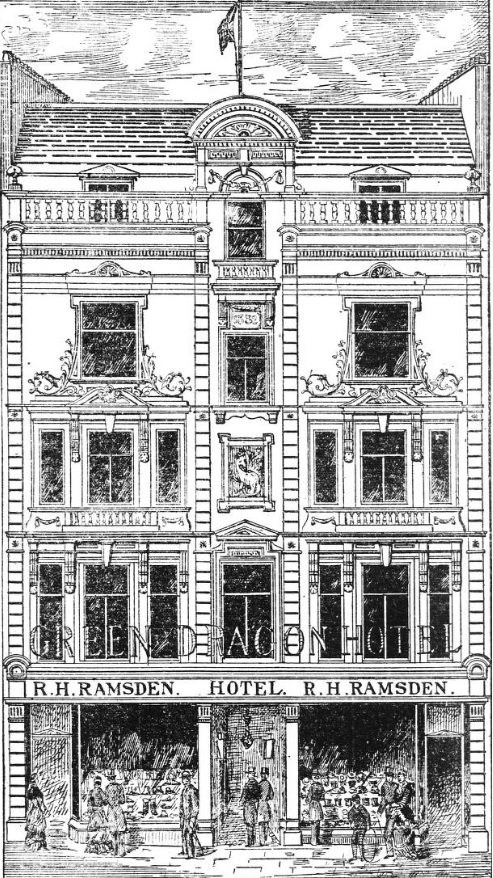
The new Green Dragon Hotel was built in 1884, from designs by Thomas Jenkinson, architect, East Parade. Ramsden held the hotel in his name, but it was managed by his son Samuel.

Green Dragon Hotel. Drawing from 1884. Image: BNA

Mr Ramsden’s hat shop was to the right, and the boot and shoe shop to the left, the windows of which extended some way down the passage in the centre, which led to the hotel.

All the floors were laid with encaustic tiles, at the entrance to the hotel being a dragon rampant, with the words ‘Green Dragon Hotel’ beneath. To the right in the passage was the luncheon bar, and to the left a second-class bar, at the end being the smoke room.

The walls and panelled ceilings of these rooms, as well as the passages, were covered with Lincrusta Waltona, with painted decorations. Around the rooms, mirrors were arranged, the seating being upholstered in maroon velvet and lit with massive brass gas chandeliers and brackets manufactured by John Horton and Sons, Sheffield.

The bar was to the right of the smoke room, and the kitchens beyond.

The billiard room, on the first floor, contained two Cox and Yeaman’s tables. A corridor on each side contained a cloakroom, as well as other rooms, leading to the grand dining hall which was 40ft long and 18ft wide, capable of serving 80 people. It was also lined with Lincrusta Waltona, of a handsome figured design with bronze enrichments, the panelled ceiling being painted and gilded. The fittings were mahogany, ebony, and gold, and the mirrors were lit with two massive 6-light brass chandeliers.

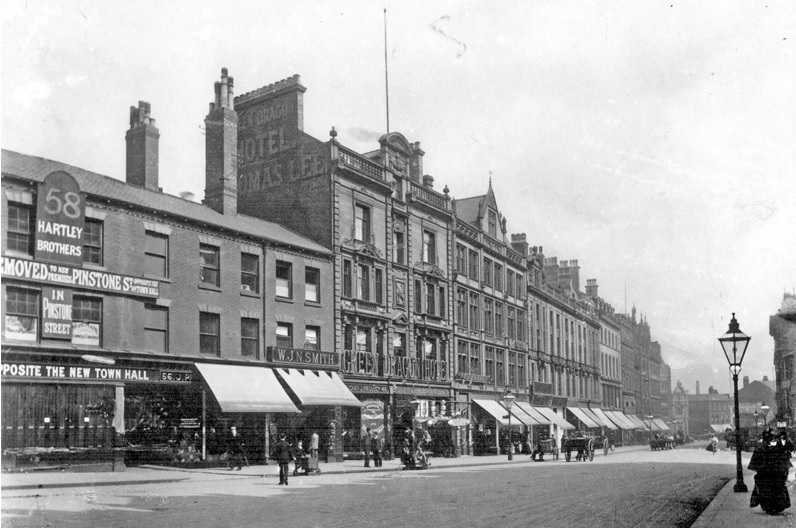
Fargate including No 58, former premises of Hartley Brothers, Exchange Gateway, No 56, J. Preston, Nos 54-46, William John N. Smith, Milliner, No 44, Green Dragon Hotel (later became Winchester House), No 40, Davy’s Buildings. Image: Picture Sheffield

On the floor above were club rooms, sitting rooms, bedrooms, store rooms, bathroom, housemaids’ rooms, and lavatories. In the basement were extensive cellars for the storage of wine and beer. A lift ran from the cellar to the top floor, and each room was equipped with electric bells and speaking tubes.

The walls of the hotel were such a thickness that air shafts ran from top to bottom, allowing ventilation for each room, and to conduct bad air into the drains, instead of being carried from the base of the building to the premises above.

All doors to the principal rooms were panelled with elegant cut plate glass with a dragon rampant device.

The hotel aimed to provide the public with refreshments of every description, from a 3d. sandwich or pie, to an elaborate eight or ten-course dinner; and from a glass of beer or bottle of mineral water, to the most costly wines of the best vintages.

Ramsden adopted the same business principle as his other businesses. This was the cash system, allowing him to offer the best at the lowest possible prices.

He died in 1922, aged 82, at 8 Herbert Road, Nether Edge, but his trustees relinquished the licence, and the building and contents of the hotel were auctioned in July 1925.

It was adapted to become Winchester House, the former hotel rooms becoming offices and studios.

The Winchester Restaurant was operated by the Little Tea Shop Company but failed in 1928. And there were several important names that had offices within, including John J. Jubb, accountants, and the Sheffield College of Voice Training.

They were joined in the 1930s by Yates and Henderson (Photographers), the Christadelphian Room, the Sheffield School of Operatic, Classical, and Ballroom Dancing, but its largest tenant became the Berlitz School of Languages, with its name displayed across the front of the building.

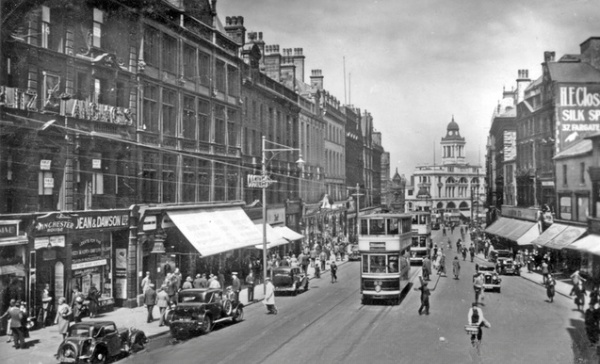
Fargate looking towards High Street and Kemsley House in 1937. Fargate including No 42/46, Winchester House and No 38/40, Arthur Davy and Sons, Provision Dealers, Davy’s Building (now WH Smith), left. Image: Picture Sheffield

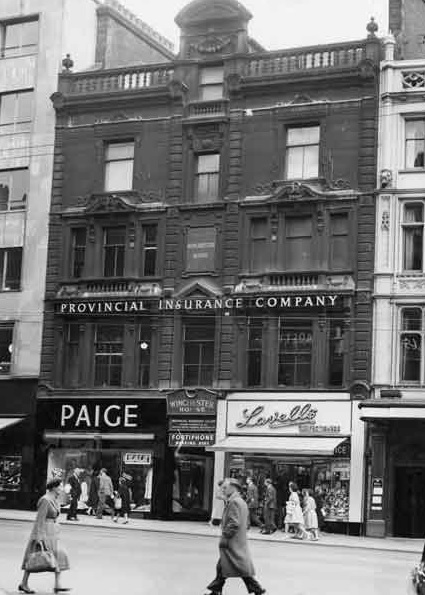
During the 1950s and 1960s, Winchester House became offices for the Provincial Insurance Company, founded by Sir James Scott in Manchester in 1903.

Provincial Insurance Company, Winchester House. c1960. Image: Picture Sheffield

The two shops at the front changed hands several times and some are worth mentioning, including Maison Sonia at No. 46 in the 1930s, later becoming Paige Gowns and Lovell’s Confectioners at No.48.

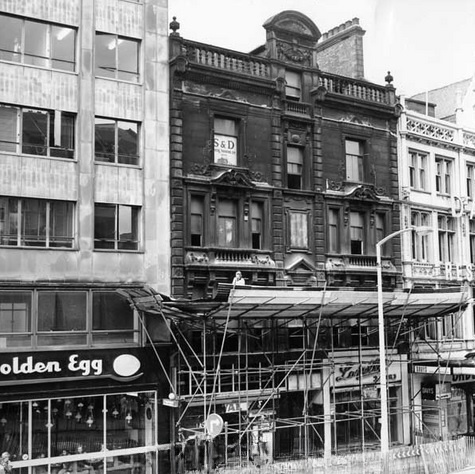
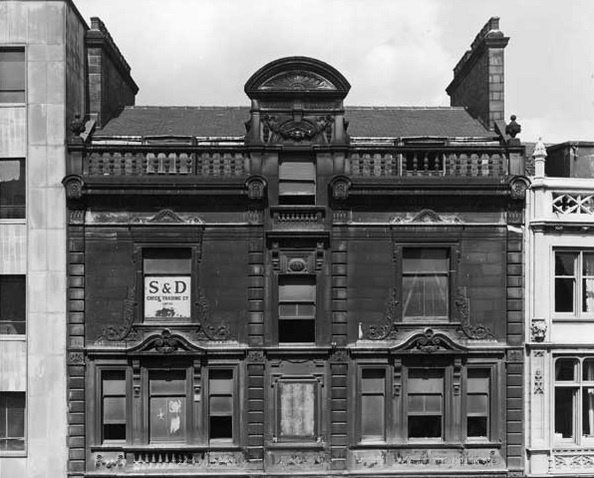
However, by the 1960s the building was in serious decline. Most of the offices were empty, with no inclination to find new tenants. Worst of all, the building had become dangerous, with masonry crumbling from above, and it was boarded up at ground level to prevent serious injury to passers-by.

Fargate, the scaffolding on Winchester House being due to masonry falling off the building. Next door is the Golden Egg cafe and coffee shop, May 1971. Image: Picture Sheffield
Upper levels of Winchester House, 1971. Image: Picture Sheffield

Inevitably, it was demolished and replaced with a standard 1970s design. It contained a large shop at ground level, occupied by Dolcis, with modern offices above.

It never fitted in with adjacent Victorian architecture, and was itself demolished in 1996-97, replaced with the present building, and occupied by New Look until its closure.

Now, like the rest of Fargate, it is in limbo, occupied by a short-term let, but its offices are empty. It is for sale with an asking price of around £800K, with potential to extend the upper parts.

But while it waits the renaissance of Fargate, remember the site’s rich history, and of what came before.

No. 42 Fargate, formerly Dolcis shoe shop awaiting demolition in 1996. Image: Picture Sheffield

©2022 David Poole. All Rights Reserved.

Categories
Buildings

The rise of facadism – new buildings with old fronts

Cambridge Street, Sheffield. Photograph: DJP/2021

Whenever you see an old facade with a new structure behind it, this tells you that a building of distinction once stood there that simply could not be demolished, and the compromise which arose was to keep the front wall. The rise of facadism shows how far the power balance has shifted away from conservation towards redevelopment. Retaining the facade is an unwelcome condition of planning permission when their preference would probably have been complete demolition.

This building, at the bottom of Cambridge Street, Sheffield, shows that the facade is retained while its interior will be replaced with modern concrete and steel. This will apply to almost all the Victorian buildings being redeveloped on Pinstone Street, and planning permission has been granted to do the same to Chubby’s and the Tap and Tankard further up Cambridge Street.

© 2021 David Poole. All Rights Reserved.
Categories
Buildings

Cairn’s Chambers: the renaissance of a forgotten building

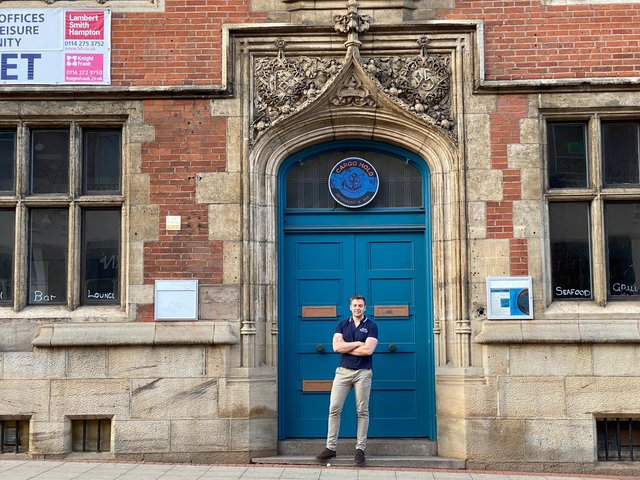
Damon Wiseman pictured outside Cairn’s Chambers on Church Street in Sheffield city centre, which he is planning to turn into luxury apartments with a new restaurant on the ground floor. Photograph: Sheffield Star

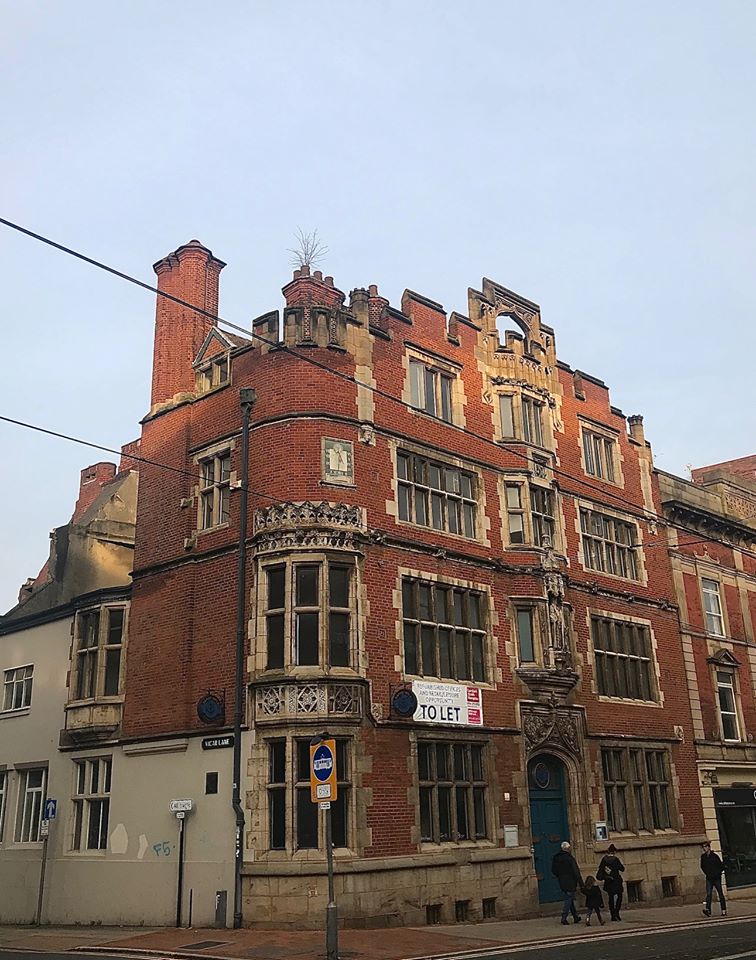
Cairn’s Chambers on Church Street, a building slowly deteriorating these past twenty years or so, has had an offer accepted, and subject to planning permission, will turn it into a restaurant, with up to a dozen luxury apartments on the first, second, and third floor which will be available to rent.

The man behind the scheme is Damon Wiseman who came to the UK in 2016 from Zimbabwe to study real estate and later ended up working for a Russian goldmine company. He lives in Sheffield and has successfully invested in rental properties in Burnley and Manchester.

Wiseman’s offer of £800,000 has been accepted and is understood to have the backing of wealthy overseas investors. He estimates that once completed, the scheme will have cost a total of £1.5m.

Grade II listed Cairn’s Chambers was built between 1894-1896 by Charles Hadfield, of M.E. Hadfield, Son and Garland, for Henry and Alfred Maxfield, solicitors. It was built in scholarly Tudor-style, a favourite of Hadfield’s, featuring decorative stonework by Frank Tory Sr.

The sad decline of Cairn’s Chambers is highlighted by the small tree growing out of a chimney-pot. Image DJP/2020

Henry and Alfred Maxfield occupied a large suite of offices, but it was also built to accommodate other businesses, a common trait of Victorian entrepreneurship.

The offices were used for almost 40 years by Charles Hadfield’s own company, C & C.M. Hadfield, architects, and later by Hadfield and Cawkwell. It was also where John Dodsley Webster, another Sheffield architect, had his office with an entrance at the back, on St James’s Street.

The Hadfield company remained until World War Two, leaving after the building was damaged by a German bomb in 1940. The rear of the property was almost destroyed, but the decorative front survived.

Afterwards, Cairn’s Chambers became a branch of the District Bank, subsequently becoming NatWest until its closure.

Most recently, the ground floor was occupied by Cargo Hold, a seafood restaurant.

The crowning glory of Cairn’s Chambers was the statue of Hugh McCalmont Cairns (1819-1885), 1st Earl Cairns, an Irish statesman, and Lord Chancellor of Great Britain. Photograph: DJP/2021

© 2021 David Poole. All Rights Reserved.
Categories
Buildings

Bank Street and the building that never came to be

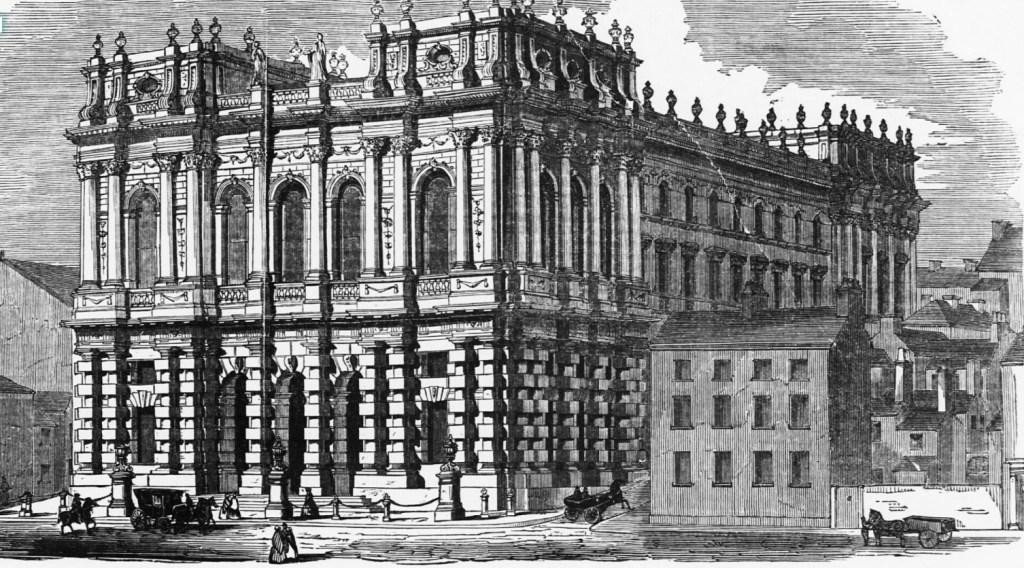
“The architects have embodied and concentrated, in an excellent manner, the scattered ideas that were floating in the minds of many.” – Sheffield and Rotherham Independent (1847). Photograph: British Newspaper Archive.

From the archives. The year is 1847, and there was talk of a new public building in Sheffield. People were excited. The town was without a public building worthy of its name and enviously looked to Liverpool with St. George’s Hall, and Birmingham with its noble Town Hall.

Unexpectedly, the architects, Flockton, Lee, and Flockton, off its own back, came up with a design, and presented it to the Town Council. This would have been an ample hall for public meetings, a large room for public dinners or lectures, permanent places for the Town Council, the Bankruptcy Court, the Small Debts Court, the School of Design, and a large Museum.

The Town Council was shocked, flinched at the cost to build it, and dismissed the proposal.

However, the Sheffield and Rotherham Independent, a supporter of the scheme, had other ideas. The newspaper published a detailed sketch of the building, along with floor plans, and advocated that it should be built.

The public was divided. Some said it had to be done, others said they would like to see it built because Sheffield would then have had a building unequalled by other towns, but the general feeling was that times were hard, and that it could not be allowed to continue.

It wasn’t built, and if it had been, we can only speculate as to what its future fate might have been. Would it still be standing? What condition would it be in? Might it have been destroyed by German bombers?

Most of us will be surprised as to where it was intended to be.

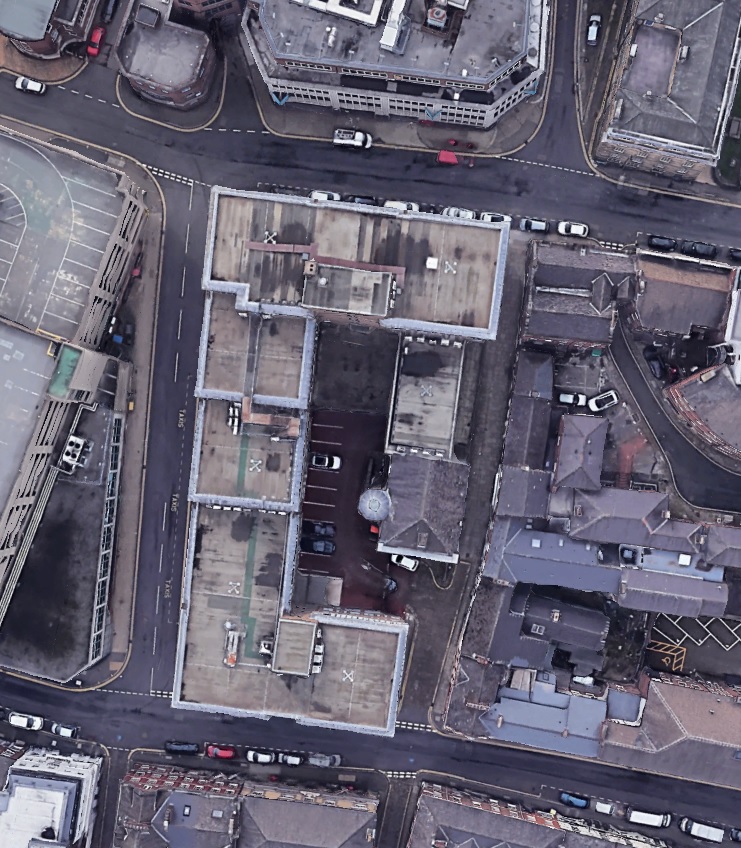
The proposed site comprised nearly 3000 square yards, in an oblong shape, stretching from Bank Street (bottom) to Hartshead (top). “It was occupied by buildings which are of small value.” Photograph: Google.

The site was a plot of sloping land bounded on the north by Bank Street, on the south by Hartshead, on the east by Meetinghouse Lane, and on the west by Figtree Lane. Today, it might seem to have been absurdly in the wrong place, but in the 1840s the area was close to where Sheffield began.

Bank Street wasn’t created until 1792, and was intended to be called Shore Street, named after John Shore, a banker, and this was the name used on leases granted when he cut up his land for building purposes.

In 1793, we find reference to a “new” street in Sheffield called Bank Street, indicating that Shore had just built the town’s first bank here. In effect, the area was a developing financial district, and a public building might not have been so preposterous after all.

“Is the town prepared for so large an undertaking?” asked the Sheffield and Rotherham Independent. “Perhaps not, just now; but there are several considerations that may tend to prepare it.

“In the first place,  if the town is to build, as build it must ere many years have elapsed, it must look beyond the present. A public building is not made like a coat, to fit exactly when made, and be soon worn out. It should be built for two centuries, or more.

The question should not be how little will it serve now? But how can we adequately provide for the present and future, combining at once magnitude of conception, liberality of spirit, and wise economy?

“The expense could not fail to be considerable, but spread over thirty or forty years, it would never be felt as a very heavy burden. This is a wide policy of the Wesleyan body, who, when they build a chapel for the next generation as well as for the present, conceive that the payment should be by those who are to enjoy it hereafter, as well as by themselves.”

What would our ancestors have got for their money?

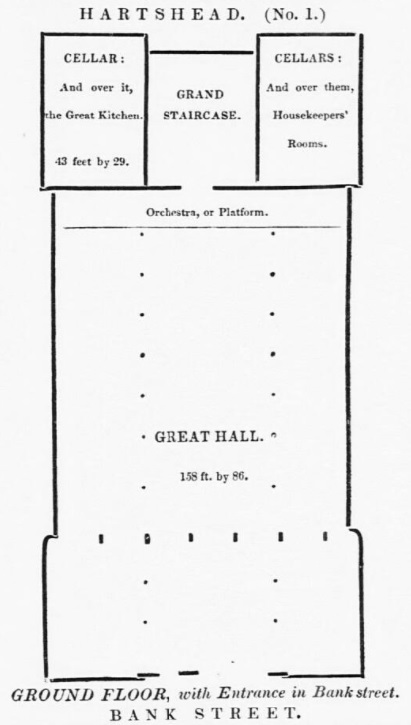
The descent from Hartshead to Bank Street was about 30ft, allowing for two frontages – one to Bank Street, and the other to Hartshead.

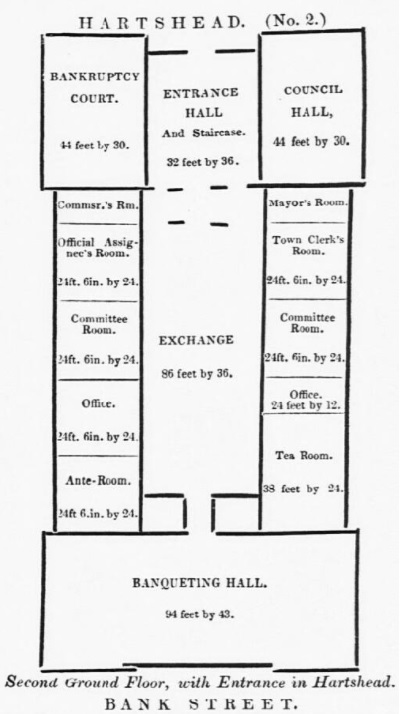
It was proposed to make the Bank Street entrance into a large hall for public meetings, affording standing room for 9000, or sitting room for 3000 persons. This hall would have occupied the whole base of the building with a grand staircase leading up to Hartshead.

The entrance hall at Hartshead would have led to a Bankruptcy Court on one side, and a Council Hall on the other. To these rooms would have been private apartments for the Mayor and the Bankruptcy Commissioner. The entrance hall would have led into an Exchange, covered by a glass dome 50ft above. Alongside would have been offices and committee rooms, with a Banqueting Hall at the Bank Street end.

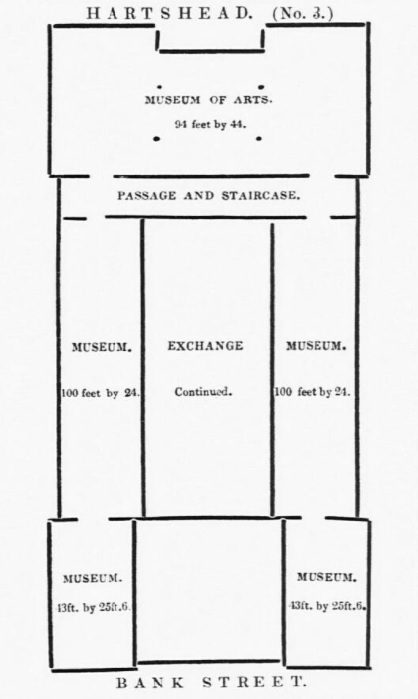
The topmost story would have extended the whole of the building, excepting the Exchange, and would have provided a Museum of Arts, as well as four additional museum spaces.

Simple plans were prepared by the Sheffield and Rotherham Independent that showed the three-floor layout of the public building. Photograph: British Newspaper Archive.

In connection with the plan, it was intended to open a new street from Hartshead to High Street (along the line of what became Aldine Court) and opening the end of Watson’s Walk into Angel Street. Figtree Lane and Meetinghouse Lane would have been made wide enough for carriages.

“We do not suppose that the Town Council will embark hastily in this measure. They will listen for the public voice.”

The newspaper was correct because it was never built, and had it been so, we might not have had a need for Sheffield Town Hall or City Hall.

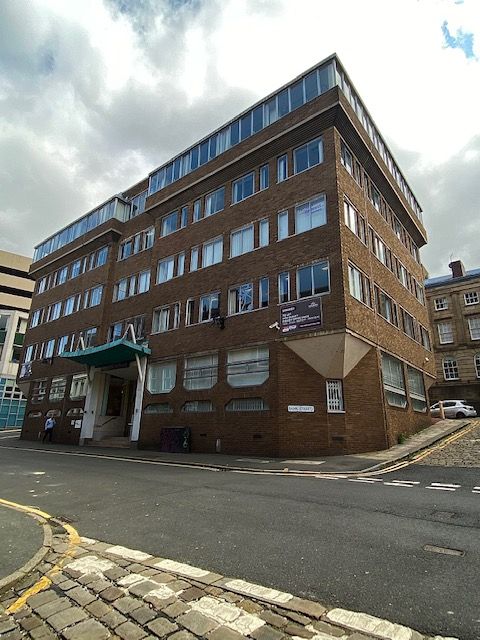
The building that never came to be. This modern-day image shows where the Bank Street entrance would have been had it been built. Photograph: DJP/2021.

© 2021 David Poole. All Rights Reserved.
.

Categories
Buildings

Leopold Chambers: the inevitable change to modern use

The proposals do not result in any change to the scale of the existing building, as no extensions or demolitions to the building are required. Photograph: Sheffield Star.

I recall visiting a sunbed salon at Leopold Chambers in the 1980s and climbing the huge Victorian staircase. I couldn’t help thinking that the old building was past its best. That was 37 years ago, and a lot has changed. The curved four storey building on the corner of Leopold Street and Church Street is home to a cafe, letting agent and tanning and beauty salon at ground floor level, with student accommodation occupying the floors above.

We looked at Leopold Chambers several weeks ago, built in 1893-1894 as new offices for Webster and Styring, an established firm of solicitors set up by George Edward Webster and Dr Robert Styring.

It was designed by Andrew Francis Watson (1856-1932), designer of many well-known buildings in Sheffield, including the Norfolk Market Hall, the old Fitzwilliam Market, Westminster Bank, High Street, showrooms for Mappin and Webb, and the offices of Messrs Vickers and William Jessops on Brightside Lane.

There are now plans by Ashgate Property Developments to convert the first, second and third floors into two studios, three one-bed and three two-bed apartments.

The plans involve reconfiguring the current units with no external works to the ornate Grade II listed facade and the ground floor retail units are unaffected.

“The building was constructed during the Victorian period and has seen various internal and external alterations and modifications over the years to the present day.

“The building has undergone extensive refurbishment and remodelling since its construction and little or no original features can be found other than the staircase which will remain.”

© 2021 David Poole. All Rights Reserved.
Categories
Streets

When the Victorians complained about our roads

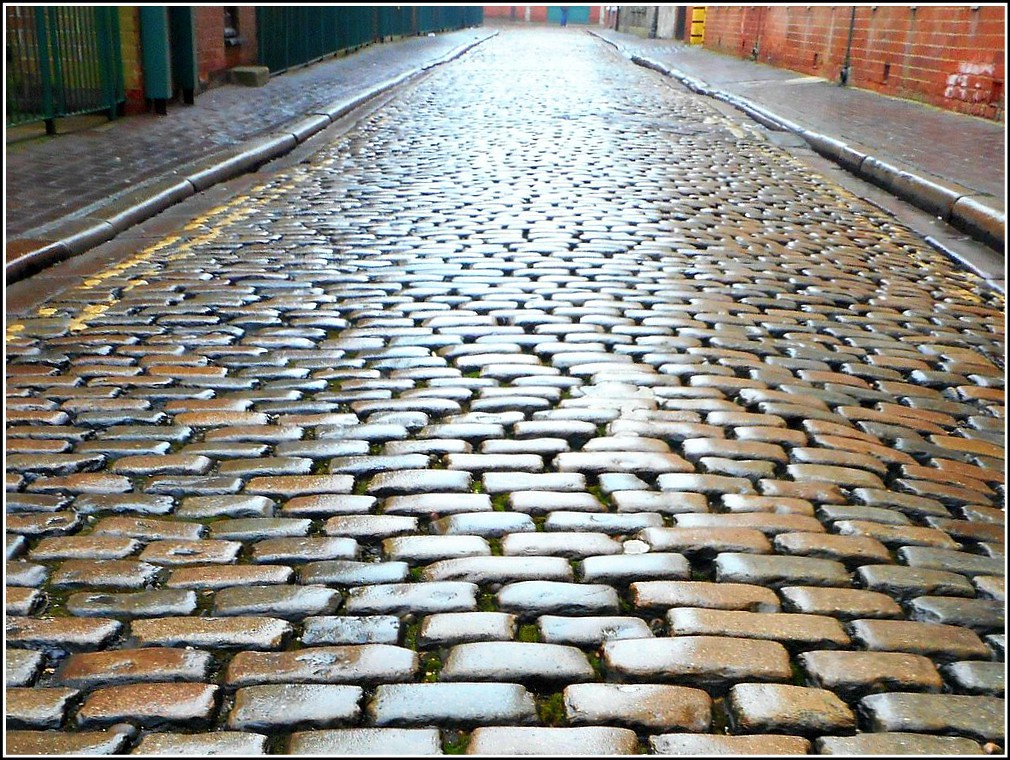
By the 1870s, many Sheffield roads had been laid with macadam but the corporation found it difficult to maintain and keep clean. As such, many roads were ripped up and replaced with granite setts.

Complaints about pot-holes always cause a stir. But you might be surprised to know that our roads have long been the subject of contention. The columns of local newspapers have been filled with grumbles going back to Victorian times.

The grievance was the type of material used to surface our streets. As Sheffield grew, the network of roads expanded, and many of the main streets were overlaid with cobbles (water-rounded stones collected from beaches and rivers), irregular flat-shaped stones, or more commonly, slag macadam.

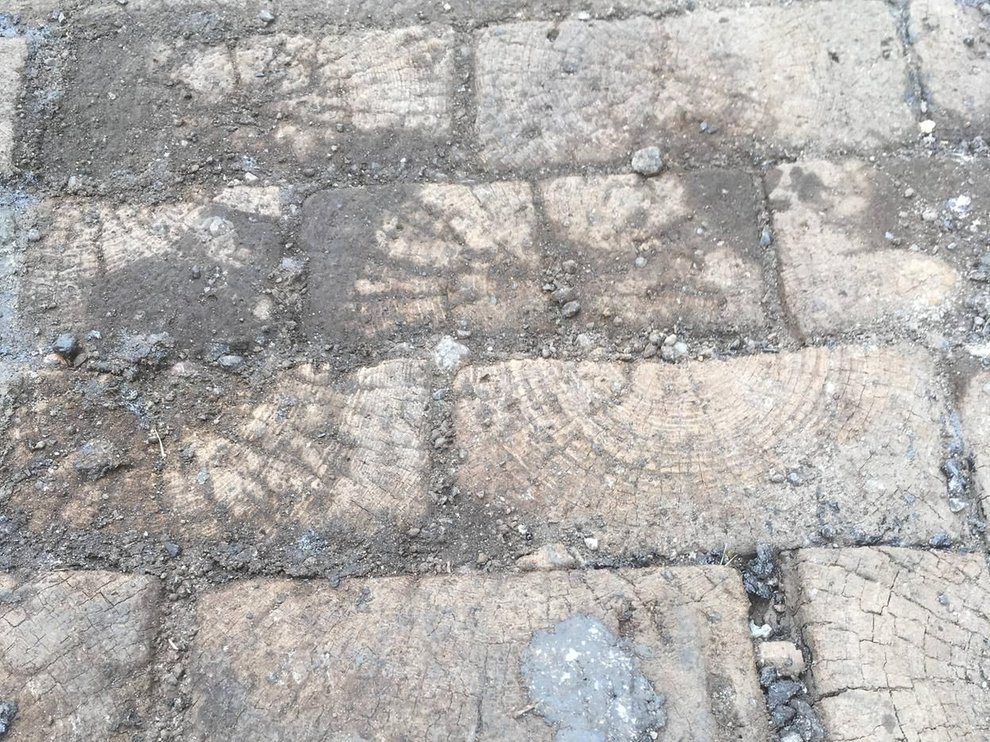
In the 19th century, cobbles were replaced with round or hexagonal wooden setts, probably creosoted Norway pine, that provided a safer surface for horses and wagons. They gave a better grip for horse-shoes and the iron rims on wheels, and reduced the noise of traffic.

Wooden cobbles unearthed on Hodgson Street. Picture: Nigel Humberstone

The wooden setts, although abundant in supply, proved expensive, and granite setts, squared off by hand, were brought to Sheffield from several locations, including Cornwall, the Channel Islands, and then increasingly from Aberdeen.

Once worked, granite setts were capable of much greater precision of laying and could help construct a far smoother street surface. They lasted for 30 years, hardwood for 15 years, and afterwards could be taken up and redressed.

However, the people of Sheffield objected to granite, complaining that noise generated by horse-drawn traffic was too loud. On West Street, wooden setts had been laid to make it quieter around the Royal Hospital, but ratepayers on the other side, on Division Street and Devonshire Street, protested that noise from granite was “nerve-racking,” “a distinct disgrace to the city,” and “enough to send people to the county asylum.”

There was a bigger drawback. Horses tended to slip on granite causing serious injury, sometimes death, to the animals. It was reason enough for Sir John Bingham, head of the firm of Walker and Hall, to campaign against their use in the 1890s.

Bingham had good reason to dislike granite setts. When driving a high dog cart, one of his horses had slipped and fallen, pitching him out onto his head. He started a crusade and gained support from Reuben Thompson and Joseph Tomlinson, proprietors of Sheffield’s two largest horse-drawn cab and omnibus firms.

“I, like many others, have been injured for life upon these granite setts, and I feel most strongly that where they are laid, they should be properly and regularly roughed. About a year ago, accidents happened on the same day to two of our leading steel manufacturers, Colonel Vickers, and Sir Alexander Wilson, one of them having his horse killed, the other being seriously injured, and will bear deep scars on his forehead so long as he lives, and says will never drive again in Sheffield.”

Bingham re-entered the council to enforce his views and was eventually able to stop granite setts being used on Sheffield’s main streets.

In 1895, he discovered that the stringy bark of a Tasmanian tree could be combined with granite to create a safer, quieter, and more durable road surface. He developed Bingham Patent Paving, first used on Norfolk Street, and then across many of the city’s main streets.

However, by the 1920s, the use of asphalt  meant that Sheffield Corporation hadn’t bought any wood or granite setts (or Bingham’s paving) for several years. Asphalt had been created by accident in Kent after tar barrels had fallen onto a road and broken. Ultimately, it was discovered the part of the road covered with tar was found the best, and afterwards the use of tar had spread all over the country.

It resulted in most of Sheffield’s cobbled streets being covered over, a practice that continues to this day using modern techniques.

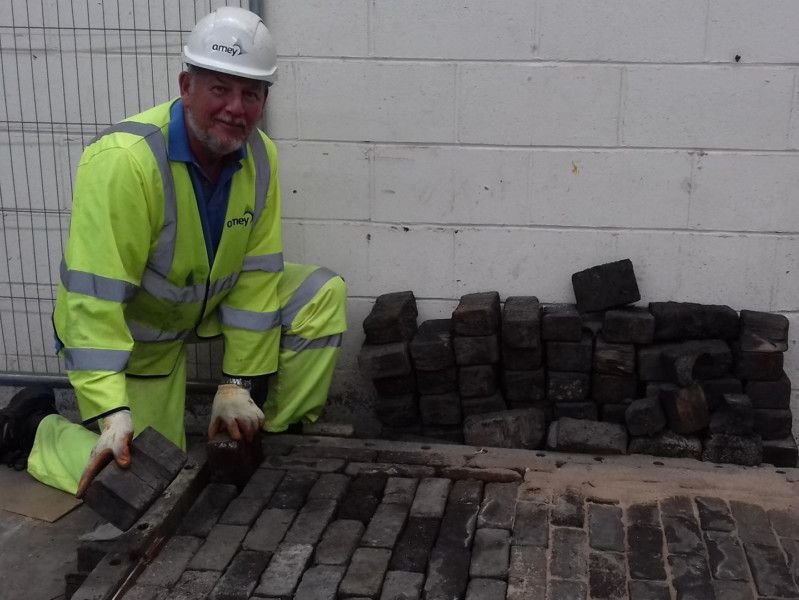
Thankfully, there are still plenty of granite setts in streets across Sheffield, and some of the wooden setts have even resurfaced in recent years, notably on Hodsgon Street, near the Moore Street roundabout, and on Sackville Road, at Crookes.

Highways supervisor Gary Booth examines some of the wooden blocks in 2018 at the Streets Ahead Olive Grove depot. Picture: Sheffield Star

© 2021 David Poole. All Rights Reserved.
Categories
Buildings

Leopold Chambers

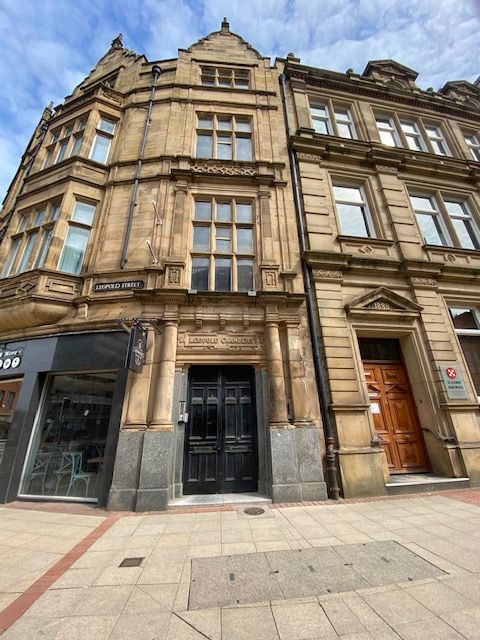
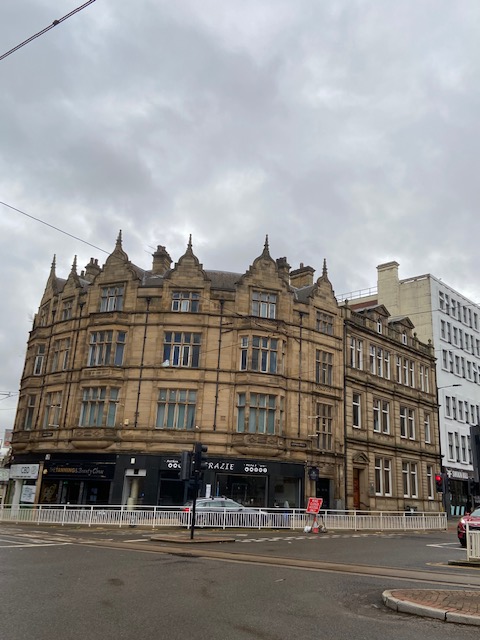
Leopold Chambers. An important, but forgotten, part of Sheffield’s Victorian architecture. (DJP/2021)

At the corner of Church Street and Leopold Street is a building typical of Sheffield’s Victorian architecture.

Leopold Chambers was built in 1893-1894 as new offices for Webster and Styring, an established firm of solicitors set up by George Edward Webster and Dr Robert Styring. The imposing four-storey Renaissance building, in mellow golden sandstone, provided a handsome rounding to the corner, with four shops built beneath the offices.

The building neatly rounds-off the corner of Church Street and Leopold Street. The latter street had only been constructed a few years before. (DJP/2021)

The architect was Andrew Francis Watson (1856-1932), designer of many well-known buildings in Sheffield, including the Norfolk Market Hall, the old Fitzwilliam Market, Westminster bank, High Street, showrooms for Mappin and Webb, and the offices of Messrs Vickers and William Jessops on Brightside Lane. He was also the architect for the London and Midland Bank in the Sheffield District and responsible for 1-9 High Street that survives as an extension of Lloyds Bank.

A native of Lamport, Northamptonshire, he came to Sheffield in his twenties and eventually went into partnership with Edward Holmes (creating Holmes and Watson, and no apology to Arthur Conan Doyle).

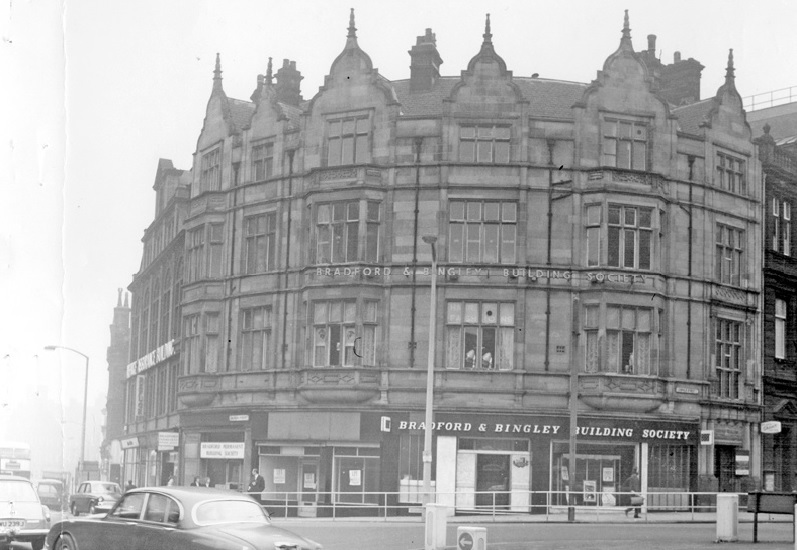
The partnership between Webster and Styring was dissolved after George Webster’s retirement in 1908, and Leopold Chambers (typically blackened by Sheffield’s sooty air) was later taken over by the Bradford Equitable Building Society (later to become Bradford & Bingley).

Following their departure, the offices were sub-divided and more recently converted into student accommodation, with shops at ground level.

Leopold Chambers subsequently became home to the Bradford & Bingley Building Society. Seen here in the 1970s. (Picture Sheffield)

© 2021 David Poole. All Rights Reserved.
Categories
Buildings

No.2 High Street

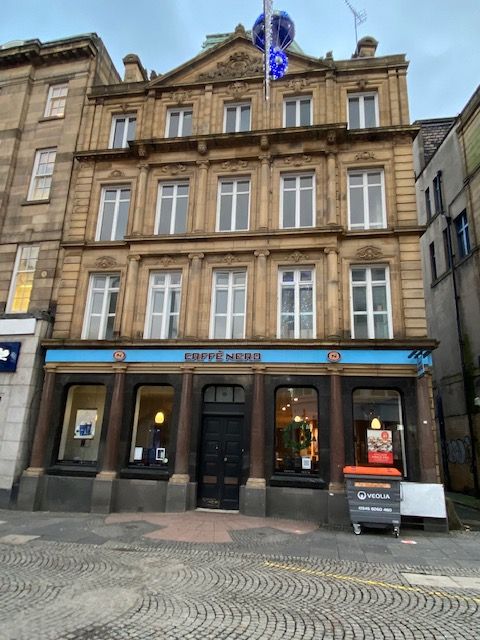
No.2 High Street. One of Sheffield’s few city centre listed buildings. (Image: David Poole)

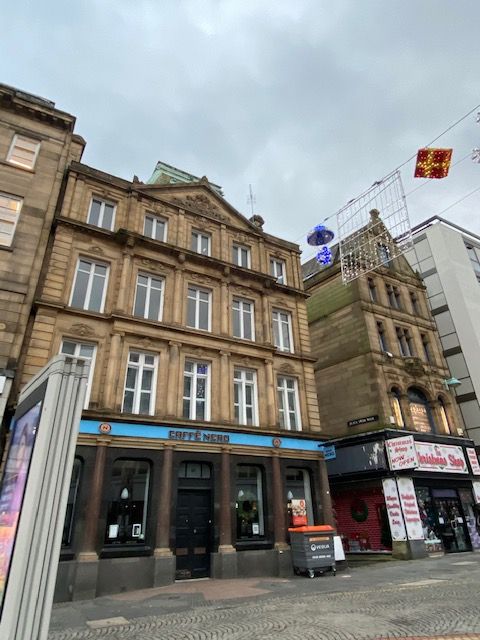
The pandemic has claimed another victim. Caffé Nero, a familiar sight at No.2 High Street, won’t be reopening when lockdown restrictions are eased, the retail unit now up to let.

 Our thirst for coffee and cakes might not have diminished, but poor trading conditions have forced the London-based chain to rethink its future.

While it maintains a presence in Sheffield, the outlook for one of the city’s Grade II-listed buildings is less certain.

No.2 High Street was the result of High Street widening during the 1890s, one of several Victorian buildings built by esteemed architects Flockton, Gibbs & Flockton.

Described in Pevsner as “one of their more exuberant ‘fin de siècle’ essays,” it is characteristic for its high mansard roof.

Many people think it was built as a bank, and Barclays did occupy it from the early 20th century until recent times, but its history is more elaborate.

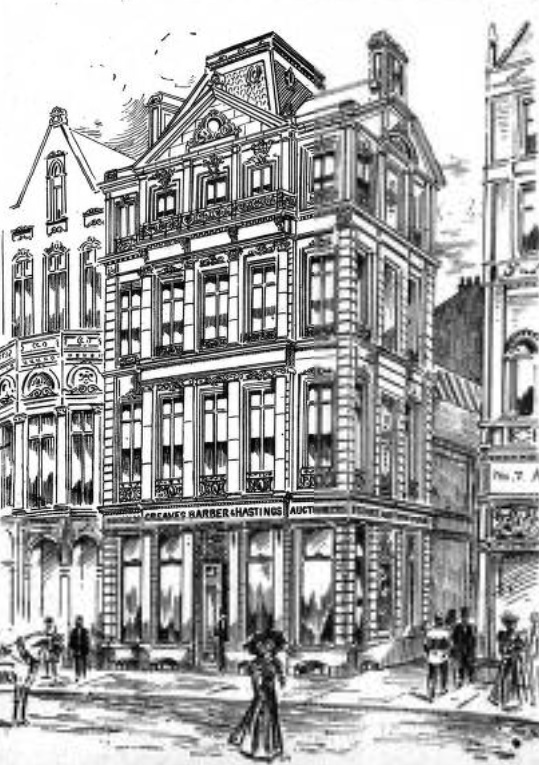
The building featured in an 1896 edition of British Architect with a double-plate spread.
“A massive and imposing appearance, with an elaborate scheme of stone carvings and mouldings. There is a suggestion of the easy and graceful style of French architecture.”
It was built for Nicholson, Greaves, Barber and Hastings, established in 1775, auctioneers, which had conducted property sales at older premises on High Street, as well as holding horse sales at the Horse Repository on Castle Hill.

In August 1896, No.2 High Street was in the process of construction, farther back from the original street line, the auctioneers temporarily transferring business to the Cutlers’ Hall and premises on Fargate.

The firm was Sheffield’s premier auction house, responsible for the sale of important buildings and used by the Duke of Norfolk to dispose of land and property.

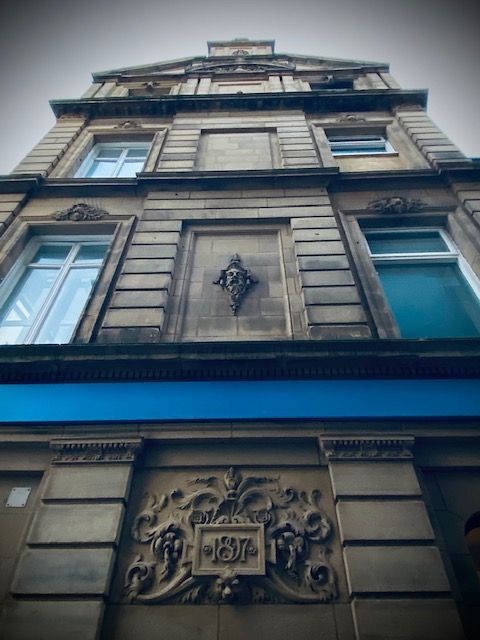
It was completed in 1897, a date stone still evident at the side of the building on Black Swan Walk.

An artist drawing of No.2 High Street from the Sheffield Indpenedent in 1896. (Image: British Newspaper Archive)

There were two large auction rooms and offices on the ground floor, with a large basement for storage, a strong-room for jewellery and plate, and two separate store-rooms for furniture.

The façade was enriched with four stories of superimposed columns, the lower ones of red Labrador granite, standing upon a grey granite base.

The base supported a handsome cornice with a broad frieze of black granite, on which the name of the firm appeared in raised gilt letters.

The upper pillars were of stone with carved and decorated capitals, and a considerable amount of carving. The external effect was enhanced by a balcony of ornamental ironwork.

The upper portion of the block was let as offices, with special care given to effective ventilation and warming of the auction room with a Blackburn heater and fan, driven by an electric motor.

Available to let and empty again. No.2 High Street is awaiting a new tenant. (Image: David Poole)

Nicholson, Greaves, Barber and Hastings was made up of four partners, each with interests elsewhere. In 1917, J.J. Greaves and Sons left the partnership and the firm continued trading as Nicholson, Barber and Hastings until the 1950s.

However, Barclays Bank opened a branch here in 1920 and the Estate Mart became a secondary part of the building before closing altogether.

Not much has changed since construction, except for the removal of the balcony railings and the interior completely refurbished for bank use.

After a period as Caffé Nero it now joins a long list of vacant properties in and around High Street and Fargate.

A side view of the building on Black Swan Walk with a date stone. (Image: David Poole)

© 2021 David Poole. All Rights Reserved.