Categories
Buildings

Planning permission submitted for Leah’s Yard

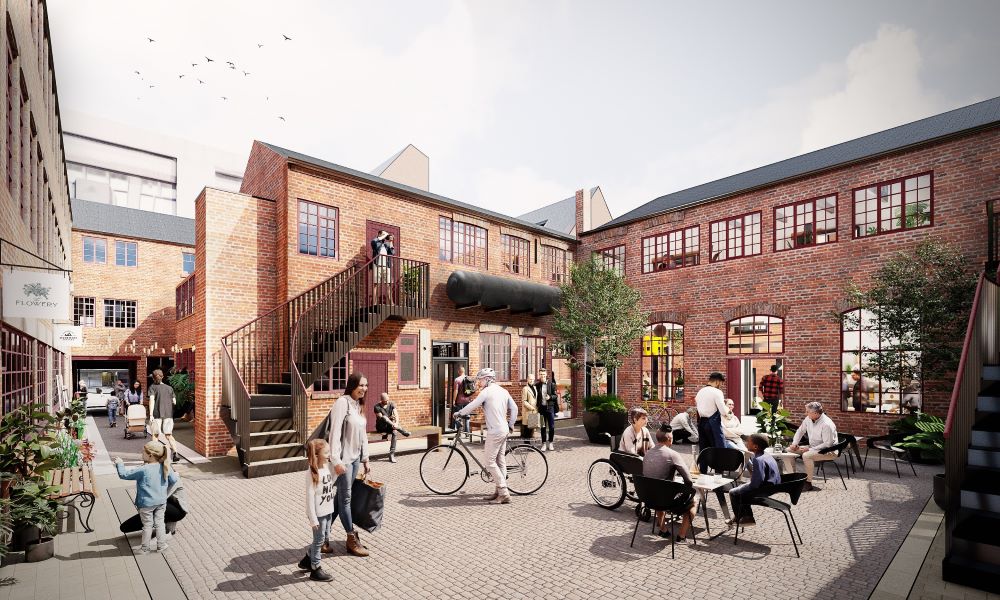
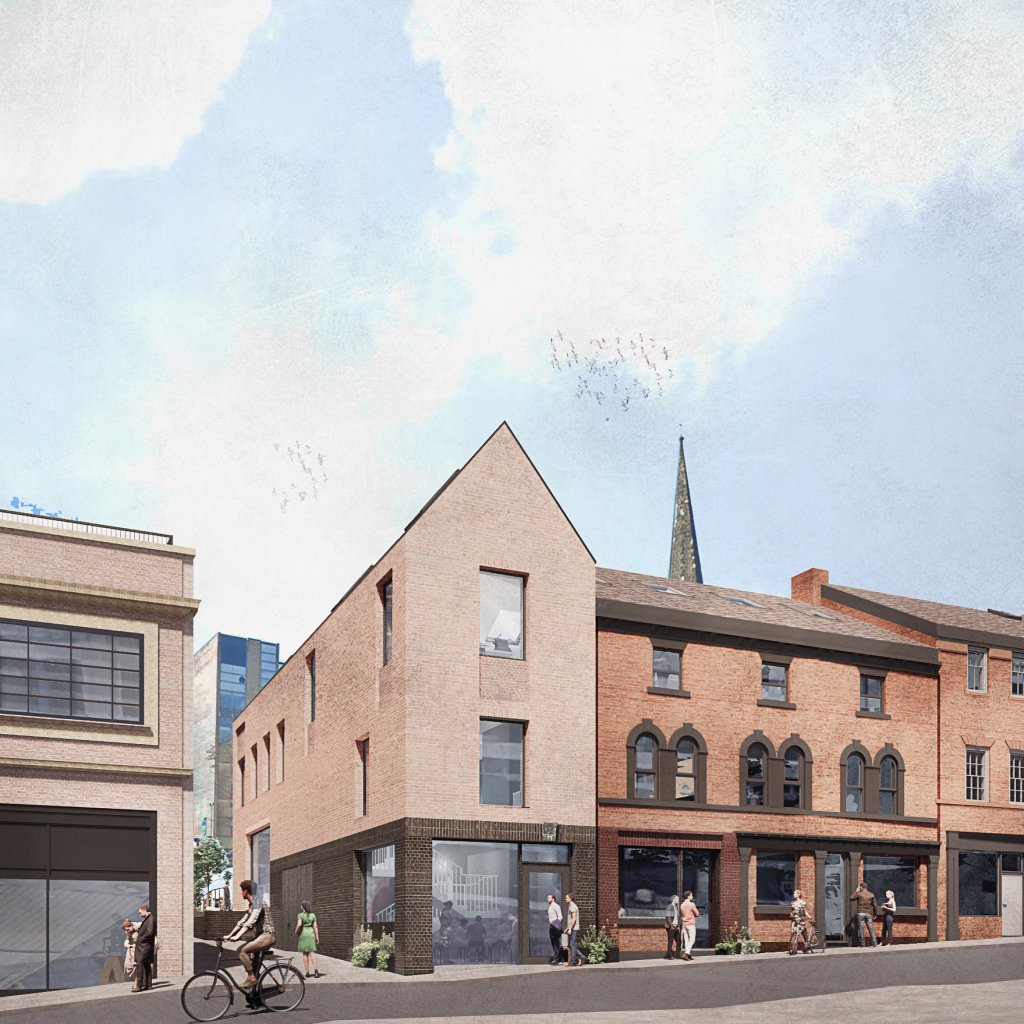
Planning permission has been submitted for Leah’s Yard on Cambridge Street to be transformed into a new creative hub for independent businesses, with a slew of independent stores set to surround a public courtyard.

The venue will be operated by Tom Wolfenden, CEO of SSPCo, and James O’Hara of the Rockingham Group, who were appointed to the project by Sheffield City Council.

If approved, Leah’s Yard will be refurbished true to its current form, with a courtyard surrounded by small boutique shops, with the first and second floors hosting approximately 20 independent working studios.

The oldest buildings on the Leah’s Yard site are the two former houses fronting Cambridge Street that date from the early nineteenth century. The industrial legacy of Leah’s Yard began with George Linley in 1825 as a small shear and tool manufacturing complex during the early nineteenth century. The houses fronting the street were later converted to offices and shops, and the complex as a whole is characterised by piecemeal additions and alterations dating from the nineteenth and twentieth century.
Cambridge Street was known for its horn works, and James Morton, a horn dealer, became the major sole occupier about 1842.

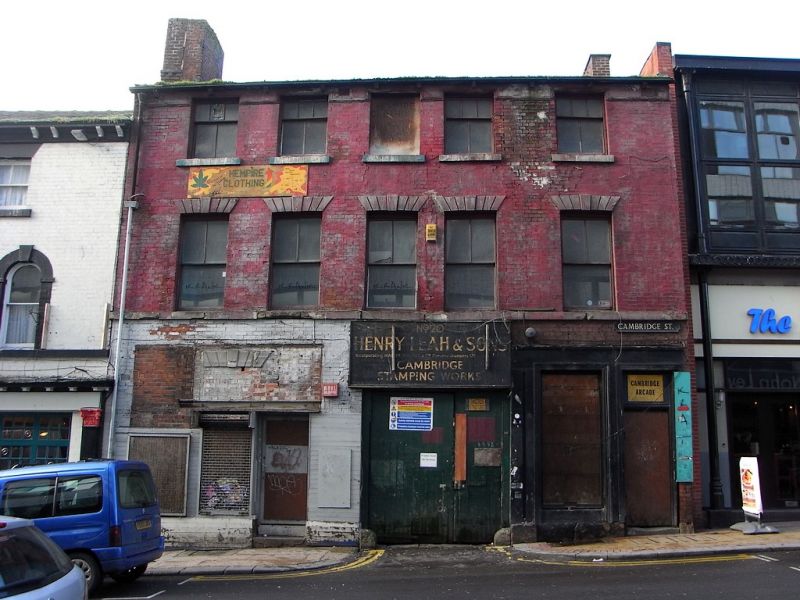
Leah’s Yard was occupied from about 1891-92 by Henry Leah and Sons, a manufacturer of die stamps for silverware. By 1911 there were 23 occupants (little mesters) on site producing slightly different goods, and undertaking different processes yet all contributing to the cutlery trade.

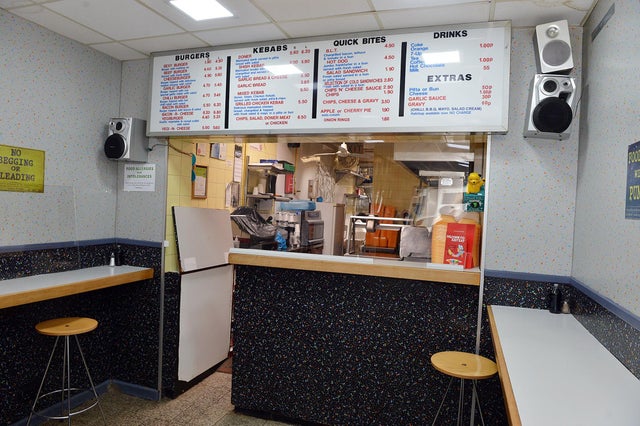
The site was predominantly used for production associated with the metal trades well into the mid to late twentieth century. The Leah family remained in part of the complex until the 1970s when they merged with Spear and Jackson; they sold the site in the 1990s. The Cambridge Street frontage of the complex had been used as shops in its last few years of occupation, and takes into account the former Sportsman public house and Chubby’s recently closed takeaway.

As part of Heart of the City II, Leah’s Yard will sit alongside the upcoming Cambridge Street Collective and Bethel Chapel developments – both currently under construction – that will feature a contemporary food hall, cookery school, fine dining experience and live entertainment spaces.
© 2021 David Poole. All Rights Reserved.
Categories
Buildings

Leah’s Yard

Who says that the Heart of the City II development is just about new buildings?

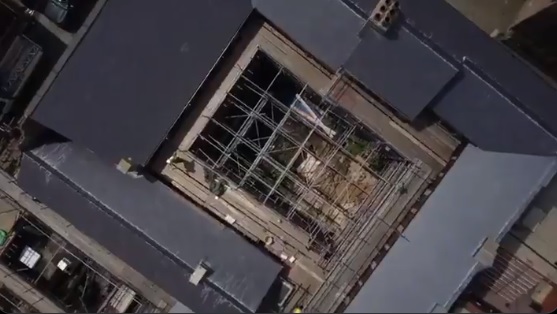
Leah’s Yard is currently undergoing a £6m renovation to breathe life back into the old buildings. Set to open in early 2023, Leah’s Yard will be a destination for independent retail, and showcasing traders, makers and creators from Sheffield.

Throughout the 19th century the yard was used by a horn dealer (who supplied the cutlery handle making trade), Sheffield platers, knife manufacturers and silver stampers. In the 1880s the building was known as the Cambridge Street Horn Works.

In 1892 Henry Leah took over the building as a producer of die stamps for silverware, giving the building the name that it is known by today. Sharing the building at that time was Walter Walker & Co Ltd, who were piercers and stampers; the building was alternatively known as the Cambridge Stamping Works.

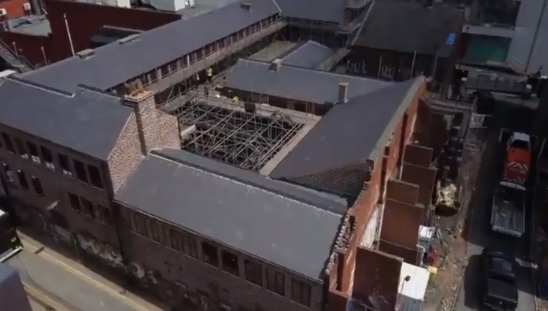
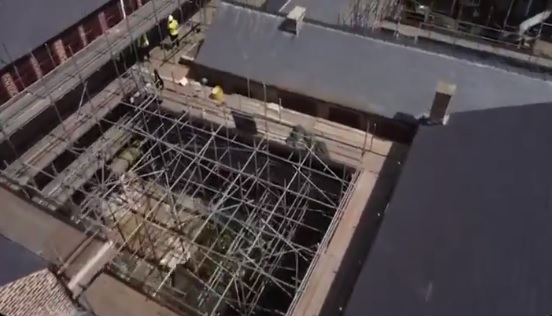
Behind the scaffolding, work is quietly progressing to restore what had become one of the city centre’s most endangered buildings.

Photographs by https://www.pedalophotography.com/

Categories
Buildings

Telephone House: Smartening-up our retro buildings

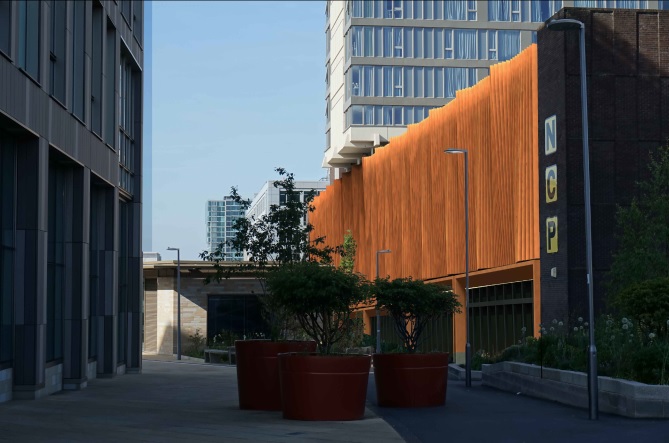
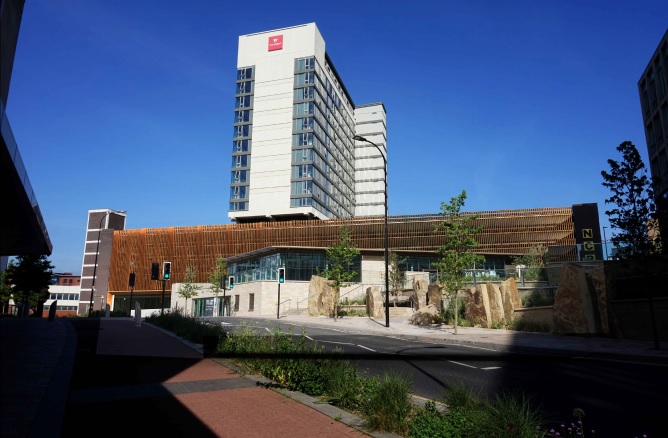
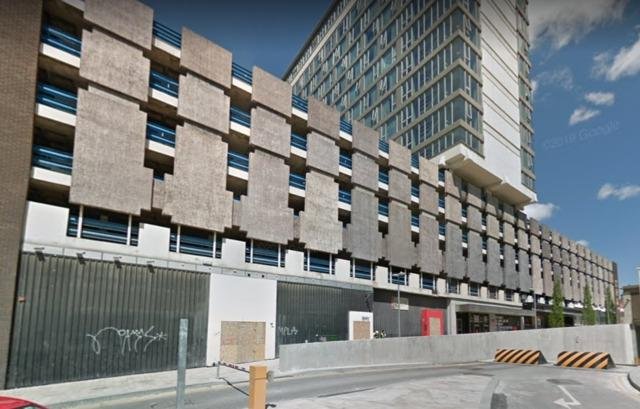
With work progressing on the Heart of the City II development, it’s time to spruce up some our existing buildings. One already completed is the Telephone House NCP car park in Charter Row, achieved by recladding the facade in Corten coloured wave feature cladding and “goal post” feature frames to the ground floor retail units. These improvements addressed issues with the poor appearance of the existing concrete building (see photo) within the context of the new Charter Square development and assist in the future letting of ground floor retail units.

The former British Telecom tower, which is located above the carpark, was recently refurbished by Vita Student in 2016 to provide upmarket student accommodation.

A planning application has now been submitted to erect a new shop frontage to four existing retail units consisting of new aluminium curtain wall façade within existing feature goal post surrounds.

© 2021 David Poole. All Rights Reserved.
Categories
Buildings

Reuben Thompson’s City Mews

Work is in progress to demolish the interiors of 30-42 Pinstone Street (as well as the adjacent Palatine Chambers) to create a new hotel. (DJP/2021)

The hoardings are up, contractors are in, and Nos. 30-42 Pinstone Street (as well as Palatine Chambers), are about to be resurrected as part of a Victorian frontage to a brand-new Radisson Blu Hotel. The old facades will remain, but everything behind it, including Barker’s Pool House, on Burgess Street, will be demolished and rebuilt.

Until the 18th century, Pinstone Lane (as it was called) crossed fields and rough grazing land. As Sheffield grew, it became a twisting, close, and sinister-looking passage. In 1875, Sheffield started a street widening programme, and Pinstone Lane was transformed into a 60ft wide thoroughfare to match the magnificence of the proposed new Town Hall.

In 1892, Reuben Thompson, of Glossop Road, an established operator of horse-drawn omnibuses, cabs, and funeral director, gave up his lease on premises at Union Street, and purchased a plot of vacant land opposite St. Paul’s Church (now Peace Gardens) from the Improvement Committee, along with adjoining property at the back towards Burgess Street.

The Salvation Army had already started building its Citadel on Cross Burgess Street as well as three large business premises at its corner with Pinstone Street. Thompson bought the land alongside this, and employed Flockton, Gibbs, and Flockton to design a red brick building, with handsome stone dressings, comprising ground floor shops, and offices and flats above.

An old sketch that shows Reuben Thompson’s City Mews to the left. The sign is visible on top of the building. (PIcture Sheffield)

In 1895, he purchased an additional plot of land to build three additional shops. This extended the length of the original building and incorporated an entrance tunnel from Pinstone Street through to stabling and carriage sheds behind, the carriages lifted from floor to floor by a hoist.

It extended the range to fifteen bays, and across the top of the building ran an enormous sign – ‘Reuben Thompson’s City Mews – and was completed in time for the opening of the new Town Hall.

This is the building we still see, although the advent of the motor car, and high petrol prices during the 1930s, saw Reuben Thompson Ltd vacate a property that had become far too big. It consolidated on Glossop Road and Queen’s Road and focused on its funeral business.

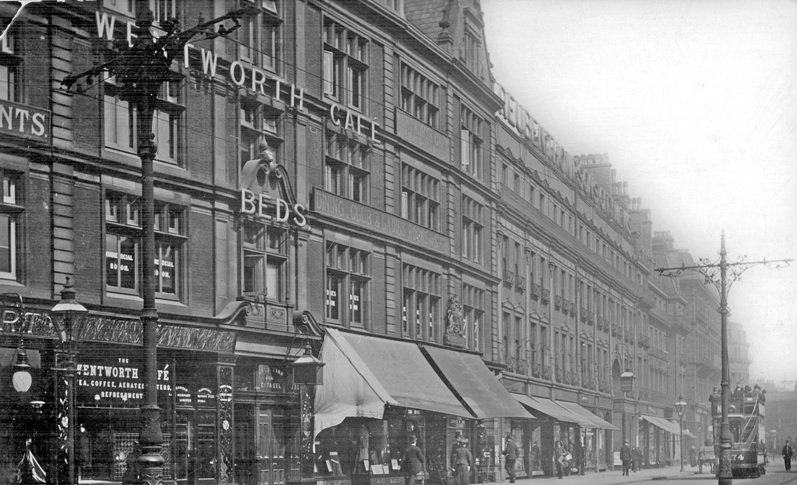
Looking up Pinstone Street. Reuben Thompson’s City Mews are on the right of this old photograph. Once again, the large sign is visible across the top of the building. (Picture Sheffield)

Those of a certain age will be familiar with the shops that have occupied this prime location on one of Sheffield’s most prestigious streets.

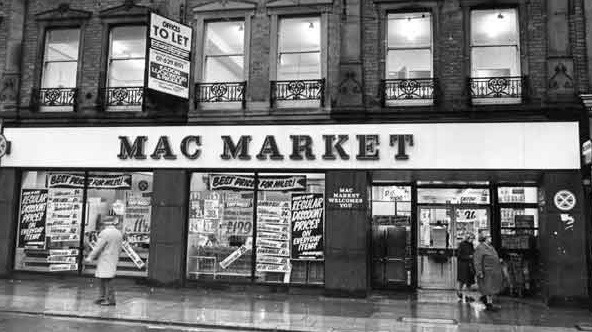
The Pinstone Street entrance to City Mews, where horses and carriages once passed, was filled-in, and later lost in the frontage of Mac Market (later to become International, Gateway, Somerfield, Co-op, Budgens, and finally, as a temporary home for WH Smiths).

The construction of Barker’s Pool House on Burgess Street in 1969-1970 (on the site of the former stabling and carriage-houses) linked both properties and altered much of the original Pinstone Street interiors. These too will be lost in the latest stage of the Heart of the City II redevelopment.

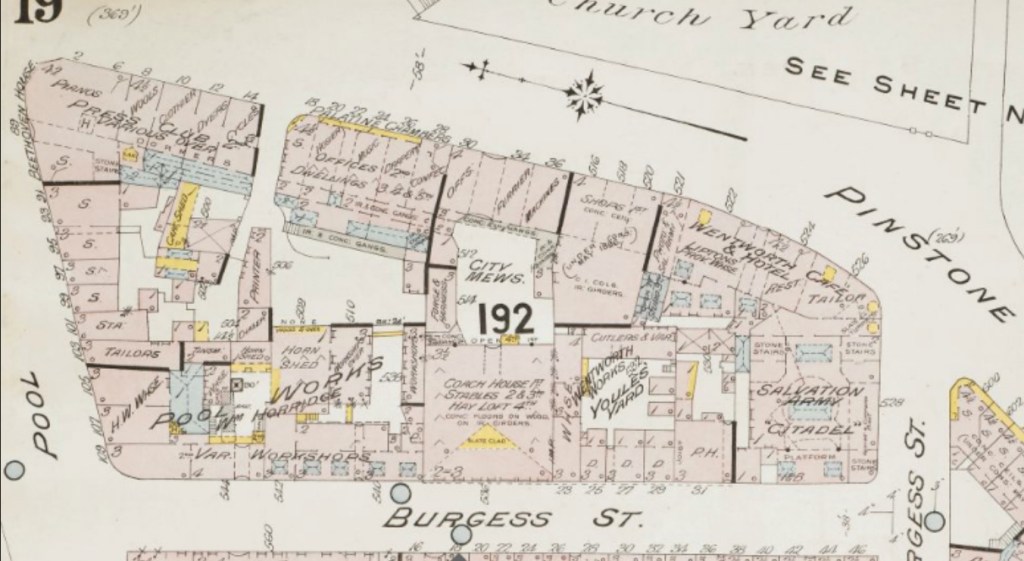
An old building plan shows Reuben Thompson’s City Mews, with stabling and carriage sheds located at the back of the Pinstone Street premises and stretching through to Burgess Street. This would later become the site of Barker’s Pool House, soon to be demolished. (Goad Insurance Plan 1896/British Library))
In the 1970s, Mac Market occupied three of the old shop units on Pinstone Street. The original carriage entrance passed underneath the offices above and was located where the central window is here. It remained a supermarket until fairly recently. (Picture Sheffield)
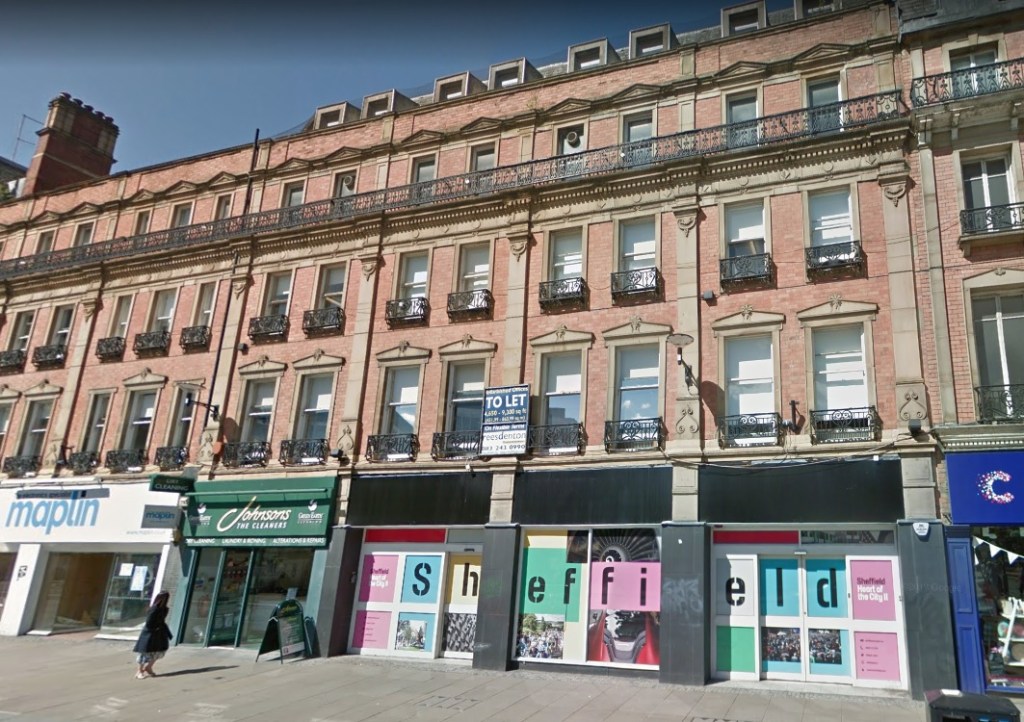
A recent image of 30-42 Pinstone Street. All the shops frequently changed hands. The former Mac Market was most recently used as a temporary shop for WH Smith. In 1970, Barker’s Pool House was built behind, and shoppers were able to use an alternative entrance on Burgess Street. Useful for Cole Brothers staff before and after work. (Google)
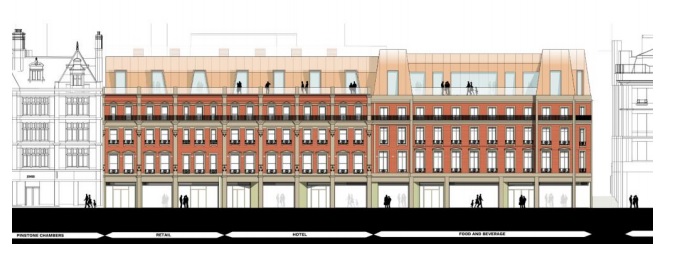
Proposed principal east elevation (Pinstone Street) for the Radisson Blu Hotel. Fifteen bays once formed Reuben Thompson’s City Mews. Palatine Chambers occupies twelve bays to the right. (Montagu-Evans)

© 2021 David Poole. All Rights Reserved.
Categories
Streets

An exciting future for Fargate and High Street

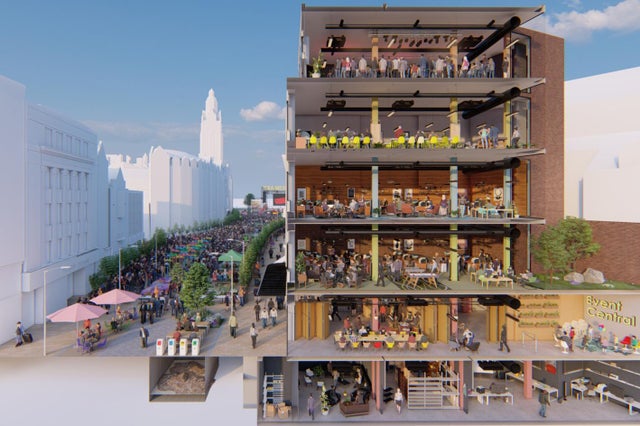
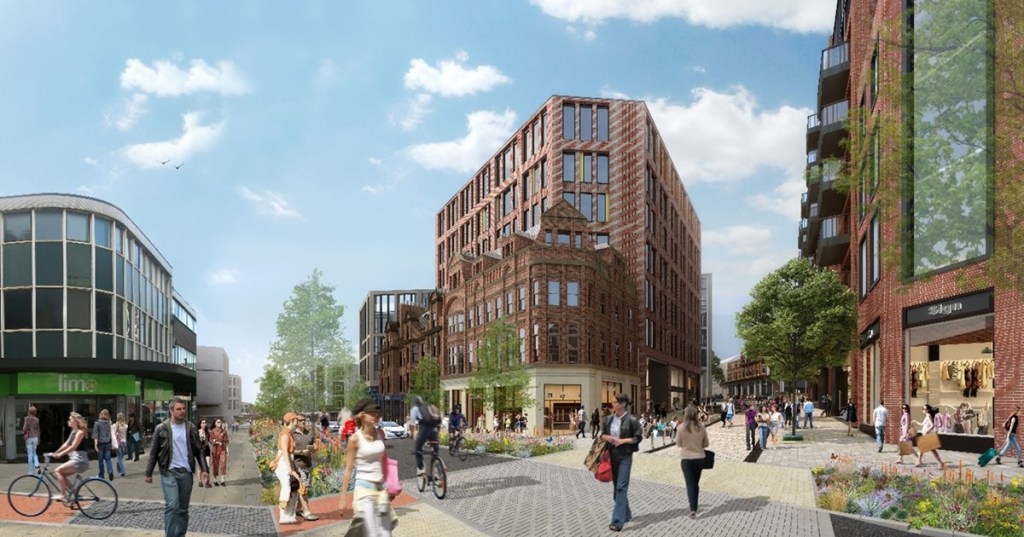
Looking up Fargate. An artist impression of the future. 

Sheffield is one of 15 towns and cities to receive all the money they had bid for, in the Government’s Future High Streets Fund.

Sheffield will receive £15.8m in recognition of the ‘forward-thinking and innovative’ proposals to help progress plans to boost its reputation as an ‘Outdoor City’ with high quality public spaces for the community.

The historic streets of Fargate and High Street will become a high quality place to live, work, and socialise, in plans drawn up by Sheffield City Council and the University of Sheffield.

A radical programme of improvements and modern digital infrastructure will complement well-designed residential and workspace conversions, making the most of unused floorspace. Particular blocks will be redeveloped to increase density by adding height while opening up new green spaces and views.

This transformation will play a major role in completing plans for a ‘Steel Route’ through the city centre, turning a declining shopping area into a mixed-use link between the two distinct regeneration projects already underway in Heart of the City at one end and Castlegate at the other.

The funding has been awarded as part of the Government’s flagship £831 million Future High Streets Fund and will help areas to recover from the pandemic while also driving long term growth.

Categories
Other Streets

Connecting Sheffield

Our city centre may take on a new look if plans to pedestrianise large swathes of it get the go ahead. Sheffield City Council want to make foot and bicycle journeys easier and quicker, while streamlining public transport services.

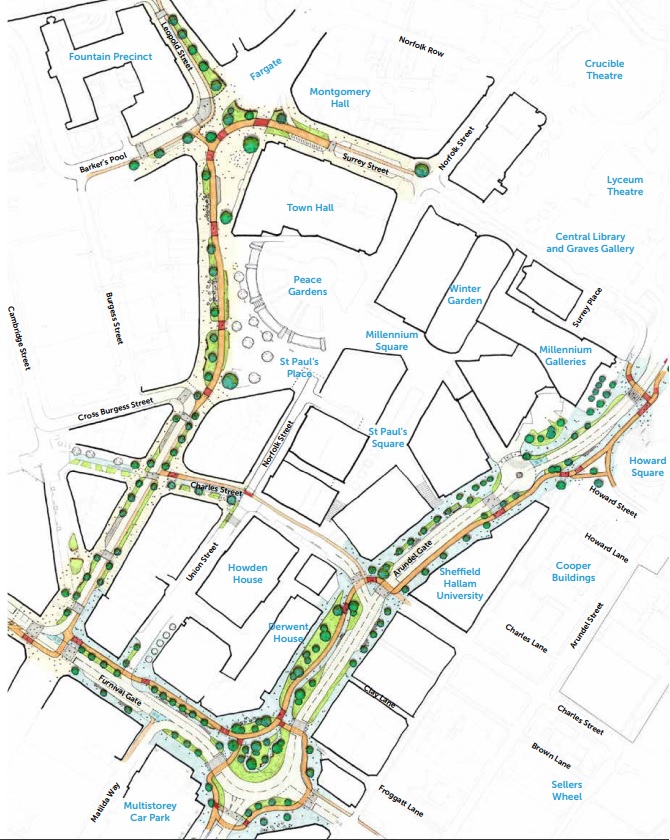
The proposals include pedestrianisation to Pinstone Street and Leopold Street, linking Fargate with the Peace Gardens, as well as Charles Street between Union Street and Pinstone Street. The pedestrianisation of Surrey Street would create a traffic-free Town Hall Square.

Work would include more greenery, replicating the ‘Grey-to-Green’ scheme already seen between Castlegate and West Bar.

Bus gates would be installed in both directions on Furnival Gate, and along Arundel Gate to Norfolk Street

Rockingham Street would get a new bus hub with improvements to pavements, green planting, a pocket park, and bus stops.

The future of our city? Pedestrianisation of Pinstone Street and Charles Street connects with Heart of the City II redevelopment, due for completion in 2021. (Image: Connecting Sheffield)

Of course, there are benefits to the scheme – improved air quality, better accessibility to shops and businesses, a more attractive city centre, and public spaces that create city uniqueness.

Artist impressions paint a bright picture, but there are notes of caution.

Sheffield city centre is at a midpoint in its regeneration, with the pandemic decimating footfall, and placing even more uncertainty on retail, hospitality, and office space requirements.

The city centre is a travesty of its former self, Covid-19 exposing retailers already reeling from Meadowhall and the internet. And, after restrictions are eventually lifted, how many pubs, bars, and restaurants, will have survived?   

Half-hearted attempts to open cycle lanes at the heart of the city, further reducing traffic flow, have met with lukewarm response. With respects to cyclists, our seven hills make four wheels the favoured choice in and out of the city.

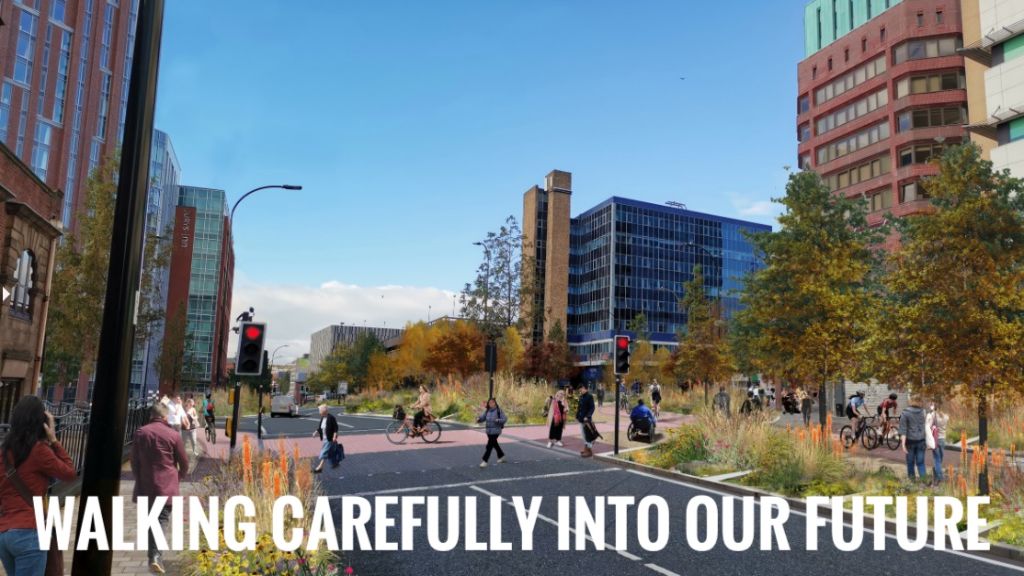
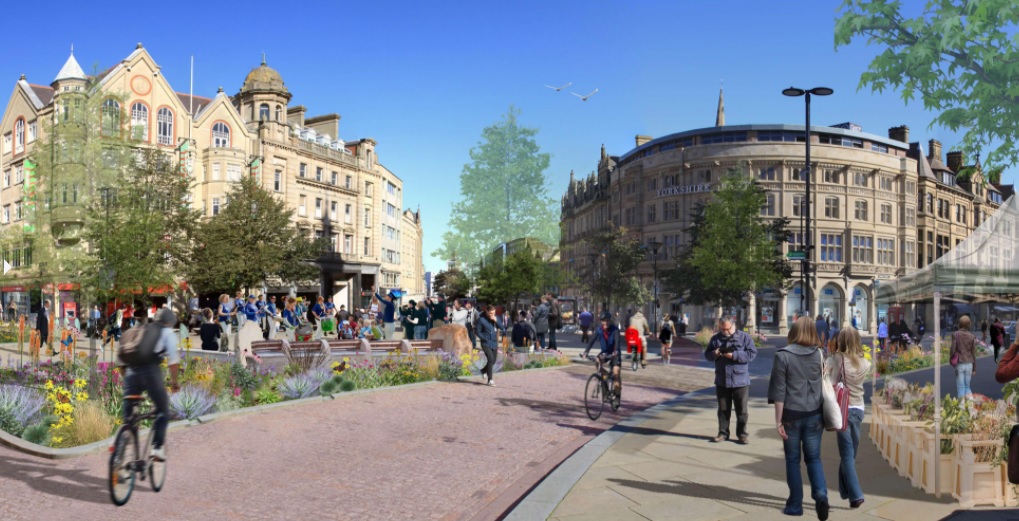
The prospect of a Town Hall Square, with pedestrian access and cycle routes linking Fargate, Leopold Street, Surrey Street, and the Peace Gardens. (Image: Connecting Sheffield).

The key to any redevelopment must take into consideration transport links.

Cars are already deterred from entering due to over-complicated traffic flow and the extortionate cost of parking. Our buses remain empty, not least because nobody knows where they go, or where to catch them anymore. Our elderly citizens must walk a distance to catch a bus, and the question remains whether they will bother anymore?

We must tread carefully, mindful that change must happen if our city centre is to be revitalised.

Any changes must take place before 2023 to qualify for a Government grant, managed by Sheffield City Region, and must be subject of public consultation.  

An overview of the ‘Connecting Sheffield’ proposal, providing a green space around the city centre. (Image: Connecting Sheffield)

Connecting Sheffield

© 2020 David Poole. All Rights Reserved.
Categories
Buildings

The new Isaacs Building takes shape

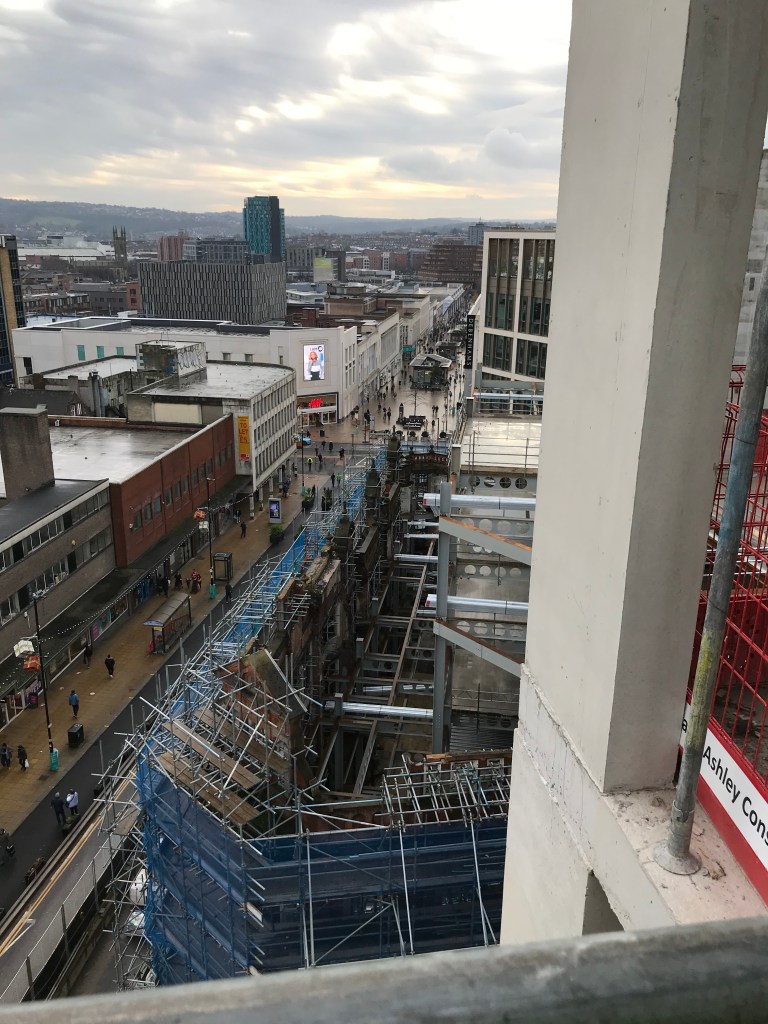
Scaffolding and new steel work support retained Victorian fronts on Pinstone Street. (Image: Heart of the City II)

A photograph that tells a story. The remains of the Victorian facade at the lower end of Pinstone Street in Sheffield city centre. Everything behind has been demolished, and the famous old fronts preserved for posterity.

Block C of the Heart of the City II masterplan is located between Pinstone Street, Cambridge Street and Charles Street.

It incorporates two historic building blocks which form the southern end of the Pinstone streetscape.

The combined façade and its dramatic roofscape is an excellent example of Sheffield brick and terracotta architecture. It occupies a prominent position and is visible from the Peace Gardens through to The Moor.

Block C will be home to 39,000 sq ft of premium Grade A office space, serving 450 employees, plus six premium retail units comprising over 8,000 sq ft.

It will be known as the Isaacs Building, named after Edwardian-era paper-hangings merchant David Isaac, and is scheduled to be completed in 2021.

Categories
Buildings

Old name, new look: the Gaumont Building

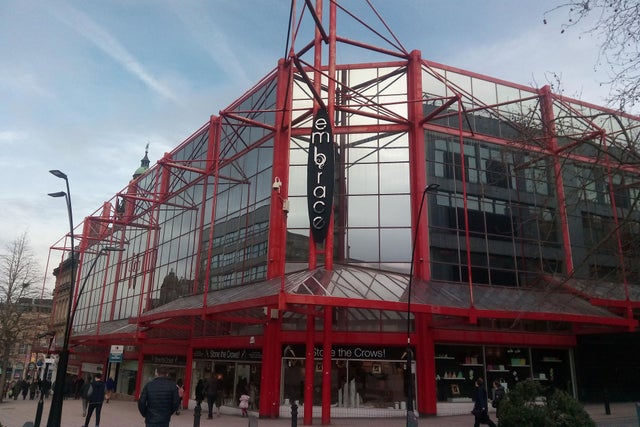
How we’ve loved to hate. The Odeon Building built in 1986-1987.

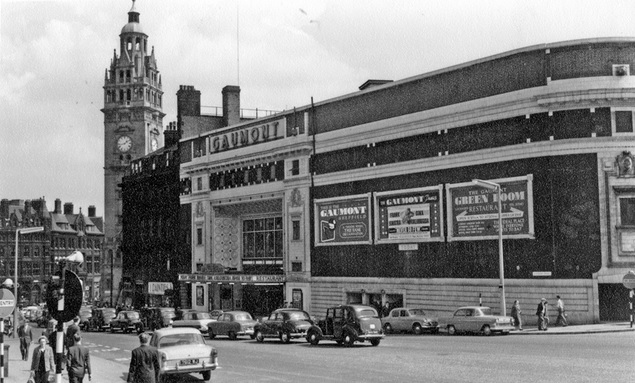
Back in the 1980s it was an important part of Sheffield’s regeneration, but after completion was universally hated. The steel and concrete building in Barker’s Pool opened as the Odeon, replacing the Gaumont Cinema, built in 1927 (as The Regent) for the Provincial Cinematograph Theatres circuit, and demolished in 1985.

A tear or two was shed, but its severe appearance could never keep up with the go-getting eighties.

We enjoyed its bright new replacement, but it didn’t last long, closed in 1994 in favour of Odeon’s multi-screen complex on Arundel Gate. And then came its reincarnation as a nightclub.

The Regent Theatre was built in 1927 for Provincial Cinematograph Theatres and was the first major cinema designed by architect William Edward Trent. Taken over by Gaumont British Theatres in 1929 it retained the Regent name until 1946. (Picture Sheffield)

If memory serves correct, it was vilified by Prince Charles, but fiercest criticism came from Sheffielders. It was considered downright ugly.

Over thirty years later, disapproval never waned, and the once-futuristic appearance looks as much out of place as it did then.

But that might be about to change.

A planning application proposing a significant facelift to the Gaumont building (as it has wistfully been renamed), has been submitted to Sheffield City Council.

The improvement works fall within the wider Heart of the City II development scheme – led by the Council and their Strategic Development Partner, Queensberry. Plans would see the building’s current red steel frame completely removed and replaced with a contemporary design.

The new façade proposals for the building, designed by Sheffield-based HLM Architects, who are also working on the Radisson Blu hotel, take inspiration from the building’s origins as the Regent Theatre (although I see no resemblance whatsoever).

Gone is the glass and steel. An artist’s impression of the new design of the Gaumont Building. (Sheffield City Council)

© 2020 David Poole. All Rights Reserved.
Categories
Buildings

Chubbys: An obvious link with the pub next door

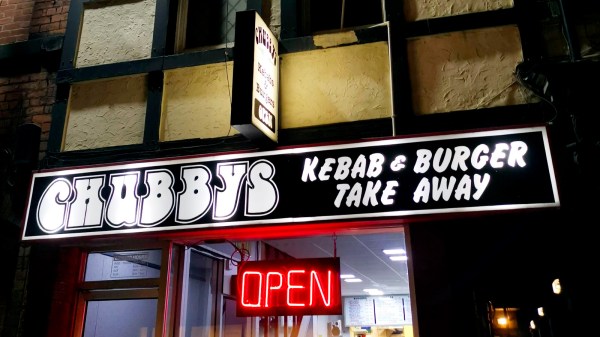
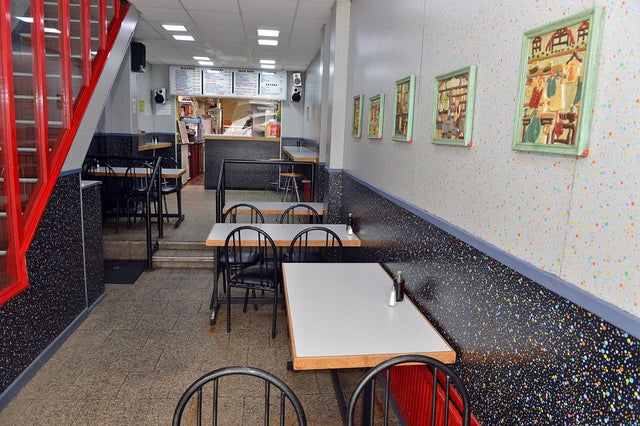
Chubbys, Michelin Three Star cuisine for the inebriated, is to close after 40 years.

The legendary takeaway on Cambridge Street will shut for the last time on Bank Holiday, August 31.

It has been a long journey for Mehran Behizad, Iranian by birth, who first came to Sheffield in 1973, to study industrial design at the polytechnic, but met his Sheffield-born wife and decided to stay and raise a family.

He set up Chubbys in 1980 with a few business partners but eventually became the sole owner. When it opened, it was only one of two late-night takeaways in the city centre, arguably the first place to get a kebab.

However, the staying power of Chubbys means we do not look beyond the familiar sign above the door.

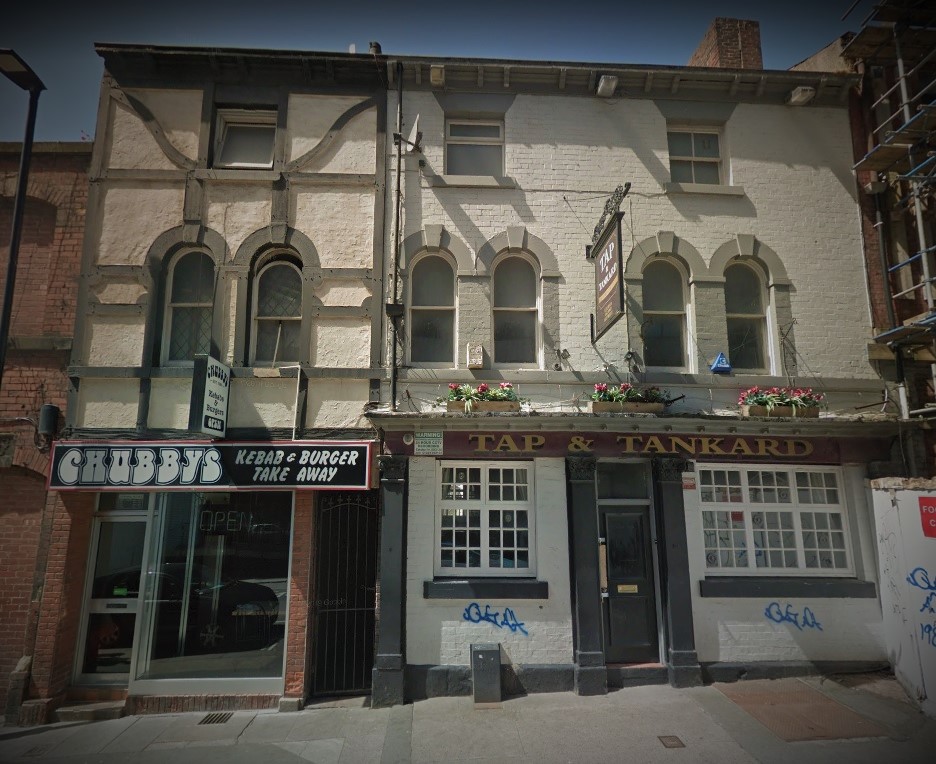
The takeaway shares the same building as the empty Tap & Tankard (formerly The Sportsman) next door. Both ground floor units have two storeys above, with white painted red-brick and mock Tudor detailing, with applied black timber over Chubbys.

The date of construction is unknown, but we can trace The Sportsman’s Inn (later to become The Old Sportsman’s Inn and then The Sportsman) to 1828, which might suggest that the whole building was once used as a public house.

It also suggests that this is one of the oldest buildings on Cambridge Street, tracing its origins back to the days when it was still called Coal Pit Lane.

Before Chubbys, the unit had many uses, but had strong links with food and drink, at one time being a grocery shop, George Alfred Webster’s Dining Rooms, and the Cambridge Coffee House.

It is now subject to a compulsory purchase by Sheffield Council to make way for the ambitious Heart of the City II project and 70-year-old Mehran is using the opportunity of the enforced closure to retire.

The good news is that the building will be incorporated in the adjacent Leah’s Yard restoration, while the bricked-up former works below Chubbys will be demolished and become an open-space linking to the soon-to-be-restored Bethel Chapel.

And there is a suggestion that after the Covid-19 crisis subsides Chubbys might resurrect itself somewhere else in the city centre.

© 2020 David Poole. All Rights Reserved.
Categories
Buildings Sculpture

The William Mitchell abstract relief

(Image: Patrick Crowley)

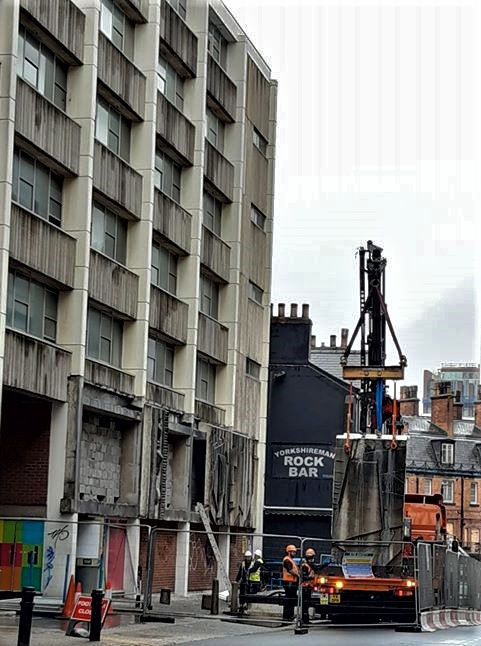
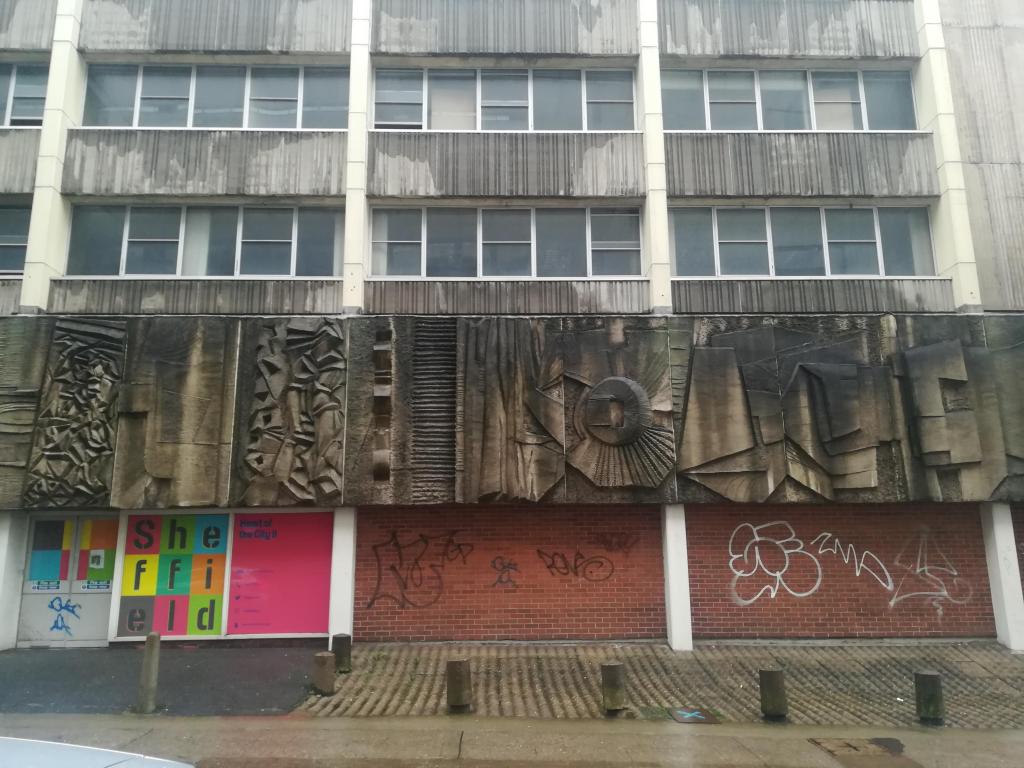
A photograph for posterity by follower Patrick Crowley. The William Mitchell abstract reliefs are today being removed from Barker’s Pool House on Burgess Street.

Installed in May 1972 the ten panels were commissioned as part of the office and supermarket development. They were constructed in the latter period of Mitchell’s first phase of practising in Britain, following his work as design consultant with London County Council.

“A minor example from a cycle of works produced in Faircrete, a new form of concrete developed at the John Laing Research and Development headquarters.”

It has an Egyptian appearance, a characteristic of his work, first evident in an office building entrance mural for London’s Barbican, in the early sixties.

William Mitchell (born 1925) subsequently left Britain, returning in the 1990s to work with Mohammed Al Fayed of Harrods.

Ironically, he died in January with the fate of his Sheffield work still undecided. It will now be restored and incorporated somewhere in the Heart of the City II development.

(Image: Reddit)