Categories
Buildings

No. 9 Fargate

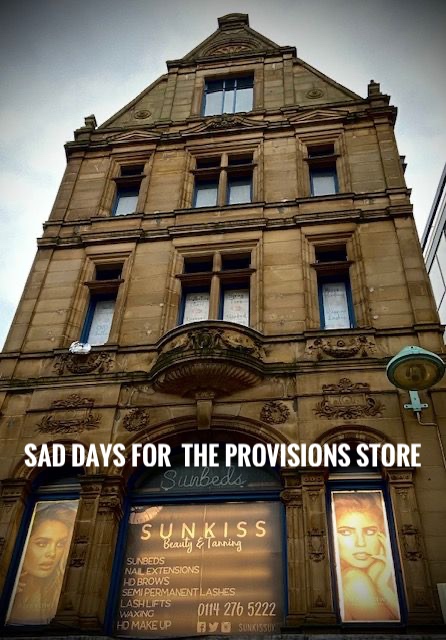
No. 9 has stood at the end of Fargate all our lives. It is the tall, detached building standing between Chapel Walk and Black Swan Walk and is in a sorry state.

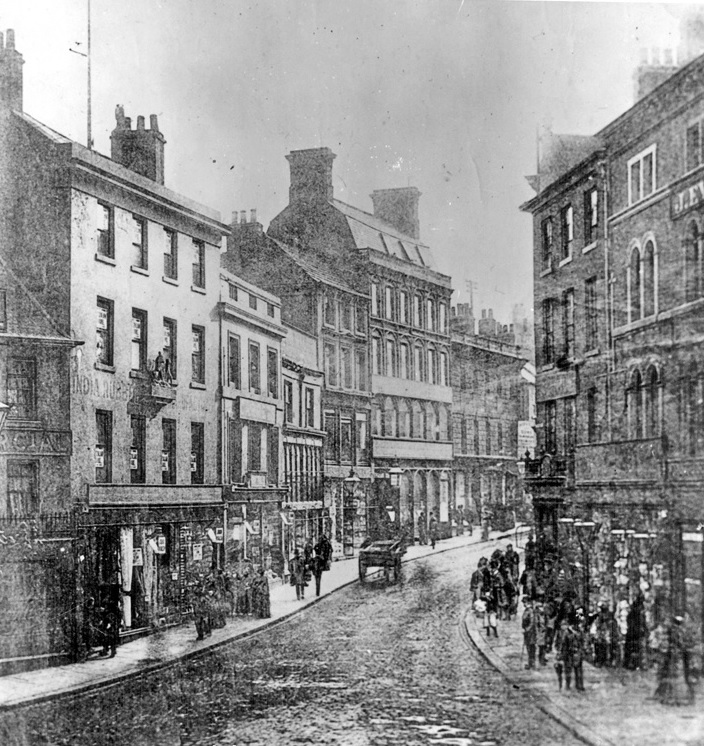
It is hard to imagine that this building was part of the Victorian renaissance of the old town centre, one that marked the widening of Fargate and set the building line for later High Street improvements.

Plans to widen Fargate were proposed in 1875, but it was not until the late 1880s that work started. Old buildings on the east side were flattened extending back from Fargate for distances varying from 60ft to 240ft.
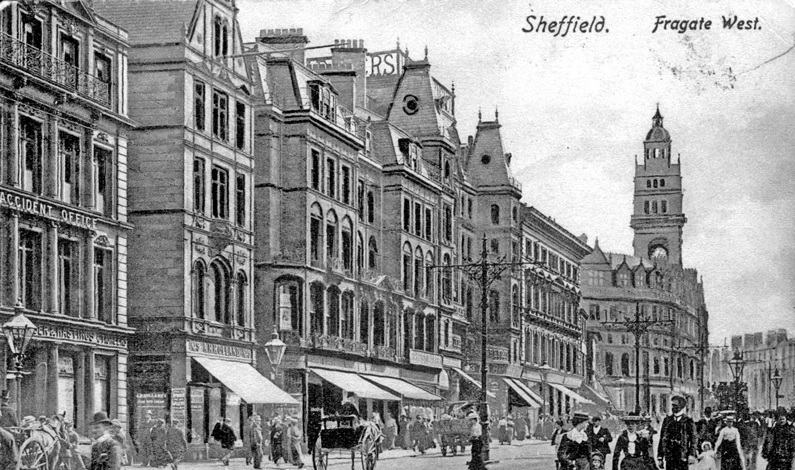
A glamorous view of the widened Fargate (not Fragate as the photograph says) with A.H. Holland on its single plot between Chapel Walk and Black Swan Walk. (Image: Picture Sheffield)

It would appear that Lot 4, a plot of land containing about 150 square yards on the north side of Chapel Walk and south of a foot road (Black Swan Walk), with a frontage of 19ft to Fargate and 72ft to Chapel Walk, had been the site of the Black Swan Public House.

In 1887, Sheffield Corporation paid William Davy, the licensee, £11,160 for the land and demolished the pub.

The freehold was bought in 1888 by A.H. Holland, Provisions Merchant, founded in 1844 by Alwin Hibbard Holland, whose previous shop had been at No. 3 Fargate, one of those flattened for street widening.

Alwin Hibbard Holland had died in 1883, the business continuing through his wife, Eliza, and youngest son, Alwyn Henry Holland. (His eldest son, Kilburn Alwyn Holland, also had a provisions business, but appeared to have played only a small part in the family business).

Eliza Holland played an important role in the success of A.H. Holland, but it was Alwyn (whose story will be covered in a future post) who established the business in new premises at No. 9 Fargate.

Alwyn had been educated at Brampton Schools, Wath upon Dearne, before becoming a pupil, and afterwards, assistant to Sheffield-architect John Dodsley Webster.

After his father’s death, he joined A.H. Holland which he ran with his co-executors, and co-designed the new premises along with Flockton, Gibbs and Flockton.

Thomas James Flockton had negotiated the purchase of the property and acted for Sheffield Corporation in the resale to Alwyn Holland, a fact that did not go unnoticed to sharp-eyed citizens.
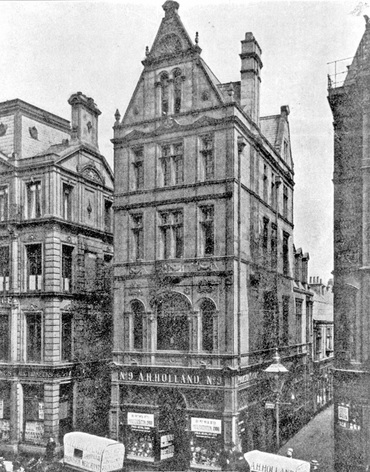
A.H. Holland fronted Fargate and stretched down Chapel Walk. (Image: Picture Sheffield)

Building work started in early 1889, with Sheffield-builder George Longden and Son chosen for the work, but progress was hampered when bricklayers and labourers went on strike demanding more money.

The new shop was eventually completed and opened to an expectant public on 9 November 1889 selling the ‘highest class goods at the lowest possible prices’. As well as the shopfront on Fargate, the premises extended down Chapel Walk occupying Nos. 1 to 15. The firm was awarded prize medals at the London International Exhibition and the International Dairy Show, sufficient for it to become sole agent for Lord Vernon’s Dairy (from Sudbury Hall in Derbyshire).

In 1891, the Rutland Institution occupied rooms overlooking Fargate above the shop. It was named after the Duchess of Rutland, who opened it, and was formed in connection with the Sheffield Gospel Temperance Union.
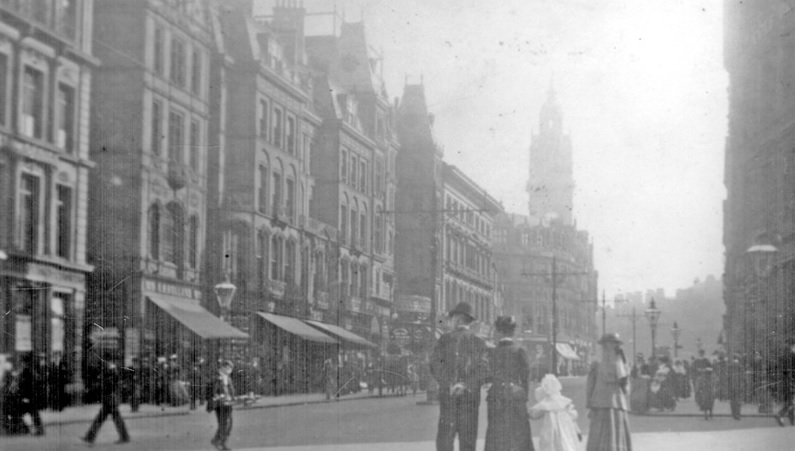
Busy days on Fargate with A.H. Holland’s awning stretching to the road. (Image: Picture Sheffield)

As well as being a shopkeeper, Alwyn Holland was a watercolour artist and his work was displayed inside the shop, ‘displaying marked originality both as an architect and an artist’.

It might have been Holland’s aspirations as an artist that ultimately led to the downfall of A.H. Holland.

With a sizeable income the firm built new property on adjoining Chapel Walk, renting out eight shops at ground level with a large suite of assembly rooms upstairs, including the Howard Gallery, for high-class art exhibitions, and Holland’s Restaurant.

The gallery opened in 1898 but proved a failure, closing its doors in 1904. By this time, the Rutland Institution had moved out, and the entire upper floor was extended into rooms above No. 9 Fargate and remodelled as tea rooms.
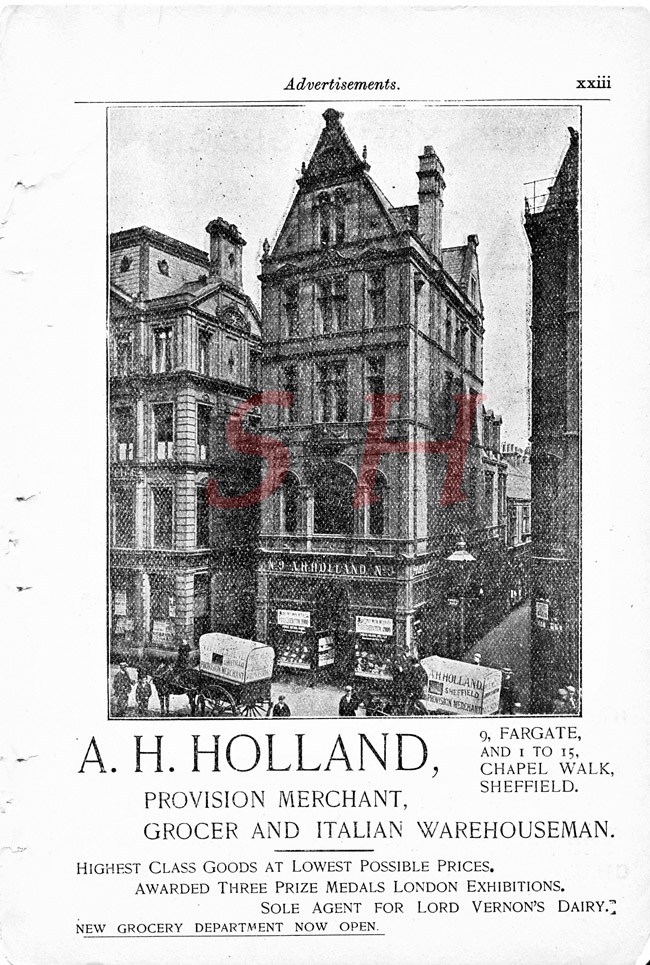
Advertisement for A.H. Holland – ‘The Provisions Store’ – on Fargate and Chapel Walk. (Image: Sheffield History)

In 1906, a new company was created, Hollands Ltd, to take over the business carried on by Eliza Holland and Alwyn Henry Holland at No. 9 Fargate and Nos. 1 to 15 Chapel Walk, as well as the restaurant business carried on by Alwyn at 17-23 Chapel Walk (and also at Sheffield University Rectory).

Joining Eliza and Alwyn as directors were Smith William Belton, a provisions merchant from Market Harborough, William Whiteley, a Sheffield scissor manufacturer, Richard P. Greenland, Liverpool soap manufacturer, Arthur Neal, Sheffield solicitor, and George Shuttleworth Greening, accountant.

A second grocery and provisions business were established on Whitham Road at Broomhilll, but despite new investment things did not go particularly well for A.H. Holland, and in 1909 the business slipped into voluntary liquidation.

Net losses since the formation of the new company amounted to £3,826 and directors attributed poor performance to deficient continuity of management, shortness of working capital, and consequent loss of business due to the depression in Sheffield.
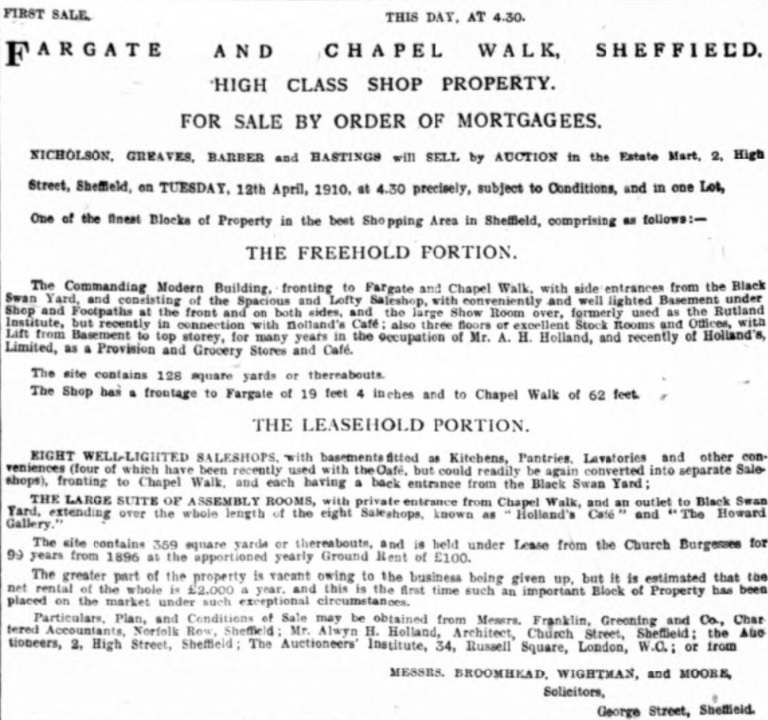
Sad times after the demise of A.H. Holland. No. 9 Fargate and properties on Chapel Walk were sold at auction. (Image: The British Newspaper Archive)

The following year the freehold of No. 9 Fargate was offered at auction, as was the leasehold portion on Chapel Walk, once home to the Howard Gallery and Holland’s Café.

By the end of the year, No. 9 Fargate was used as an auction house by Arnold, Prince, Bradshaw and Company, and the following year fell into the hands of Sykes and Rhodes, costumiers and furriers, which remained until 1924.
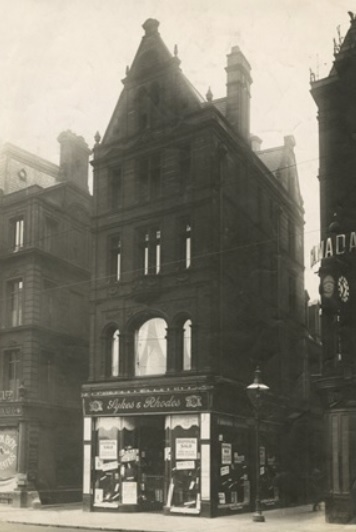
Sykes and Rhodes (Image: RIBA)

By this time, the building had suffered from Sheffield’s age-old problem of black soot, darkening the stone, making it rather ‘dull-looking’.

However, the building was about to be reinvented with the opening of a shop in Sheffield by one of Britain’s leading tailors.

“A cynic has remarked that one of the reasons why Austin Reed Ltd have opened a shop in Fargate is because the male members of the community in Sheffield need attention in sartorial details.”
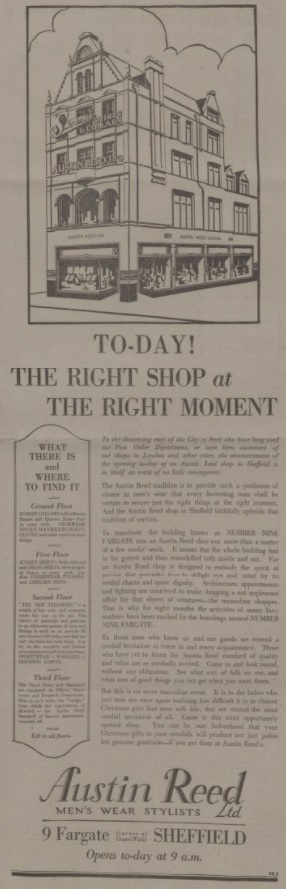
Austin Reed opened in Sheffield in 1924. (Image: The British Newspaper Archive)

The business had been founded by Austin Leonard Reed (great grandfather of Asos founder Nick Robertson) and claimed to be the first menswear store to bring made-to-measure quality to the ready-to-wear market. Its first store was in London’s Fenchurch Street and by 1924 had branches in all the most important towns and cities of England.

“Time is not so long distant when Sheffield relied on its old-established businesses, handed on from father to son, but, with the passing of the war, there came a change, and today, as quickly as premises can be acquired, firms with world-wide reputations are erecting palatial buildings, limited only by the space at their disposal.”
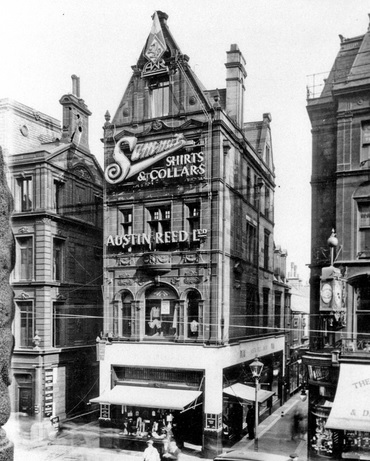
Austin Reed had illuminated signs fitted to the front of the building. (Image: Picture Sheffield)

The company spent a small fortune converting the building, the designs drawn up by P.J. Westwood and Emberton, of Adelphi, London, and involved the original builder, George Longden and Son.

Outside included a beautiful marble front erected by Fenning and Co., Hammersmith, made of Italian Bianco del Mare and Belgian Black Marble. The entrance lobbies contained lines of non-slip carborundum inserted into marble paving.

The building consisted of a basement, three sales floors, and an office situated at the top. They were linked by staircases and the lift, a survivor from A.H. Holland days.

The basement was used for dispatching, the ground floor for the tie, collar, and glove department, the first floor was for hats, shirts, and pyjamas, while the second floor formed the ‘new’ tailoring department.
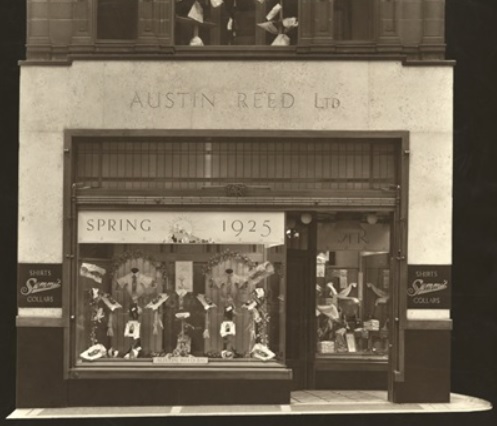
Austin Reed, Fargate, in 1925. (Image: RIBA)

“Inside, everything blends and tones; there is nothing garish to the eye. The ground-work is of oak panelling, staircase, and fittings. On the ground floor, the firm has arranged six windows nicely furnished with parquet beds, the door at the back being glazed with embossed glass to the architect’s design.

“The window lighting – admired by thousands – is worked with x-ray window reflectors, and each window has a special plug for ‘spotlights’ or experimental lighting effects.”

The front of the shop was also illuminated with a ‘Dayanite’ electric sign installed by the Standard Electric Sign Works. This, and the window lighting, was controlled by a revolutionary time switch that allowed them to be switched off on Sundays.
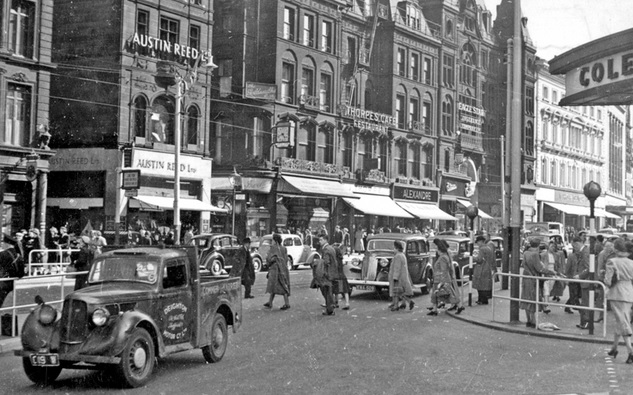
A remarkably different Fargate with Cole Brothers on the opposite corner. (Image: Picture Sheffield)

While the outside was impressive, the interior had the latest shop-fittings made of lightly fumed oak, with polished edged frameless mirrors, supplied by George Parnall of Bristol and London.

The coat cabinets worked on an American principle where doors opened and disappeared into the sides of the cabinet, and a large rack, laden with coats on pegs, was drawn out and slowly revolved.

The counters had small reflectors and low-voltage gas-filled lamps, manufactured by G.C. Cuthbert of London, that provided white light and gave a brilliant effect to the goods.

Another innovation was an electric hat cleaner whereby a visiting customer with a hard felt hat could have it cleaned and renovated in three minutes.
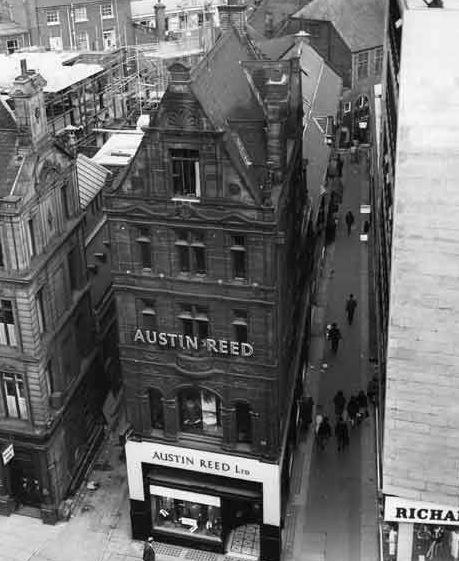
The narrow-gabled front reflects the width of plots preserved from much earlier development on Fargate. (Image: Picture Sheffield)

Customers were most impressed with Austin Reed’s new payment and receipt system.

When an item was purchased the assistant placed the money, bill and duplicate into a cartridge that was inserted into pneumatic tubes, similar to those used in newspaper offices, that within ‘three second’ had reached the top of the building. The office assistant then placed the receipt and change in the cartridge and the procedure reversed.
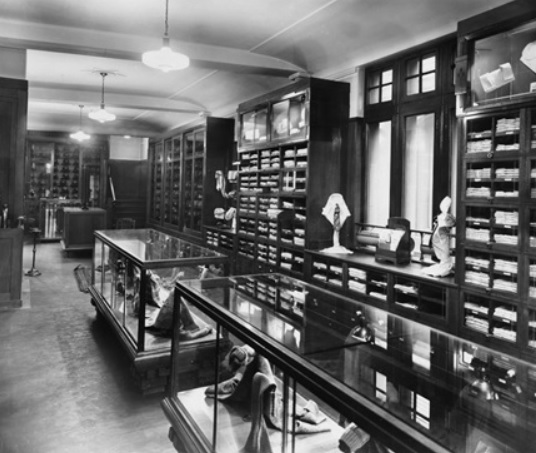
The smart oak interior with bespoke counters at Austin Reed in 1925. (Image: RIBA)

Austin Reed also used several local contractors.

Decoration was completed by F. Naylor, of Abbeydale Road, plumbing by George Simpson and Co., from Broomhall Street, electrics by Marsh Bros., of Fargate, and the structural engineers were W.H. Blake and Co., from Queen’s Road.

Austin Reed remained at No. 9 Fargate the 1970s, the building becoming a Salisburys bag shop and subsequently a victim of the relentless ‘chain store shuffle’, its last incumbent being Virgin Media.

As I write, it is a pop-up Christmas store, in darkness due to Covid-19 restrictions, with a sun-tanning parlour above.
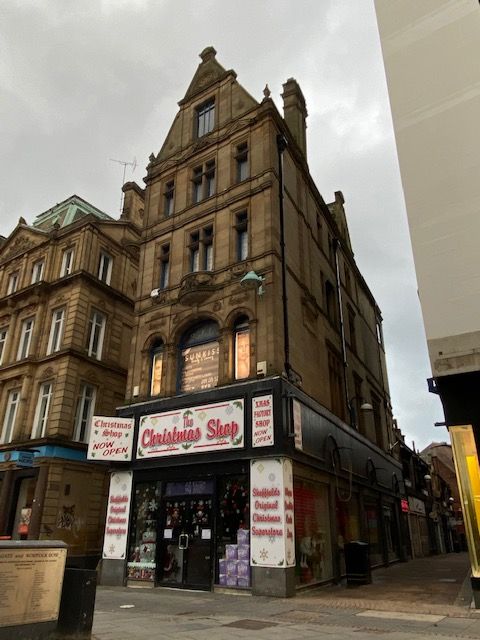
No. 9 Fargate. A pop-up Christmas shop in November 2020. Closed due to Government restrictions. (Image: David Poole)

© 2020 David Poole. All Rights Reserved.
Categories
Streets

Victoria Road: an elegant street

Victoria Road, at Broomhall, is built on land that was once attached to the estate of Broom Hall, the manor house, and belonged to the de Ecclesall family, the Wickersleys, and the Jessops, until the death in 1734 of William, Lord Darcy, after which it passed down the female line to the Rev. Wilkinson, Vicar of Sheffield, in the late 18th century.

He died in 1805 and the Broom Hall estate passed to Philip Gell of Hopton, and from him to John Watson of Shirecliffe Hall, who farmed the land for 20 years, and from 1829 split and leased plots for development.

As Sheffield grew, there was an increasing demand for suburban villas to the west of the town where occupants included manufacturers of steel, cutlery, and edge tools.

Victoria Road, named in honour of our Queen, was laid out in 1855, the road curving from Broomhall Road to join Collegiate Crescent. It was a mix of detached and semi-detached properties, the larger houses built at the top end of the road, close to old Broom Hall, with smaller dwellings at the opposite end.

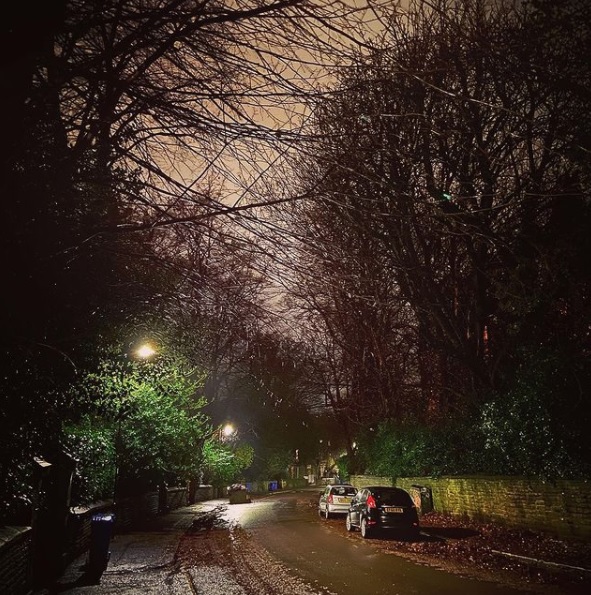
Little has changed since Victorian times, the houses are much the same, except the trees have grown much larger, and the stone walls at the front of each plot still hide what goes on behind.

Back then, this was a road of masters and servants, horse and carriages, gas lamps, grand staircases, busy kitchens, elaborate dining-rooms, lively drawing-rooms, large bedrooms, and fine furniture.

The likes of Daniel Doncaster, William Christopher Leng, and Miss Witham’s Boarding School moved on, to be replaced with new generations of professional people, who lost sons in World War One and witnessed the bombs of World War Two.

But Sheffield continued to grow, Broomhall was at the edge of the encroaching city centre, the affluent people moved farther away, and the area was blighted by nearby dereliction. Prostitutes moved into adjacent streets and the Yorkshire Ripper was caught just up the road.

Nevertheless, Victoria Road maintained its dignity.

And then it all changed for the better.

The Broomhall estate has become one of Sheffield’s hidden secrets, a leafy suburb, with new professionals, and students, and where it is a joy to walk through its streets and marvel at the architecture.

© 2020 David Poole. All Rights Reserved.

Categories
People

Victor Burgin

Victor Burgin. (Image: University of Southampton)

There must be somebody in Sheffield who can provide more information about one of our famous sons. This is a strange one, a man of mystery as far as his birth city is concerned, and worldwide success seems to have separated him from his roots.

Victor Burgin, born at Sheffield in 1941, a distinguished artist and theorist who has made his name with language and photography.

In the sixties he studied at the Royal College of Art and Yale University. While in America he discovered ‘minimal art’, at that time little known in Britain. This raised issues, not only about the form, but the nature of art, and Burgin was one of those artists on both sides of the Atlantic who developed ‘conceptual art’.

He has written numerous books and essays on art theory and criticism, and his chic photo pieces have been exhibited throughout the world.

“Art is not a spectator sport.”

Burgin taught  at Trent Polytechnic, Nottingham, and the Polytechnic of Central London, before moving to San Francisco.

He was nominated for a Turner Prize in 1986, and is Professor Emeritus of History of Consciousness at the University of California, Santa Cruz; and Emeritus Millard Chair of Fine Art at Goldsmiths College, University of London. In 2015 Burgin was a Visiting Professor in the Department of Cinema and Media Studies at the University of Chicago, and in 2016 a Mellon Fellow at the University of Pennsylvania. He is also Professor of Visual Culture at Winchester School of Art.

He holds Honorary Degrees at Sheffield Hallam University, as well as the University of Liège.

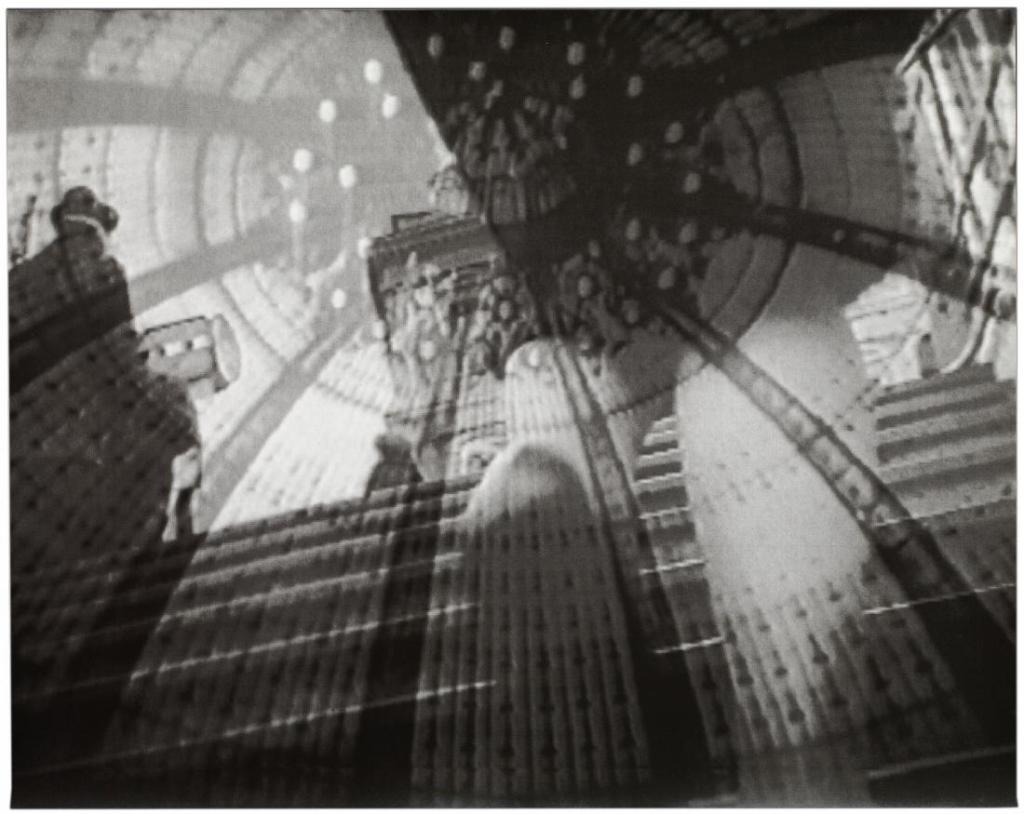
Victor Burgin. Fiction Film, 1991.

Burgin’s work is in public collections that include Los Angeles County Museum of Art, Walker Art Center, Minneapolis, Metropolitan Museum of Art and Museum of Modern Art, New York, the Victoria and Albert Museum and The Tate, London, Museum Ludwig, Cologne, and the Centre Pompidou, in Paris.

“I’ve made it from working class Sheffield to this middle class artistic milieu, and what the f**k am I doing here?”

These days, Burgin appears to split his time between homes in Somerset and Paris.

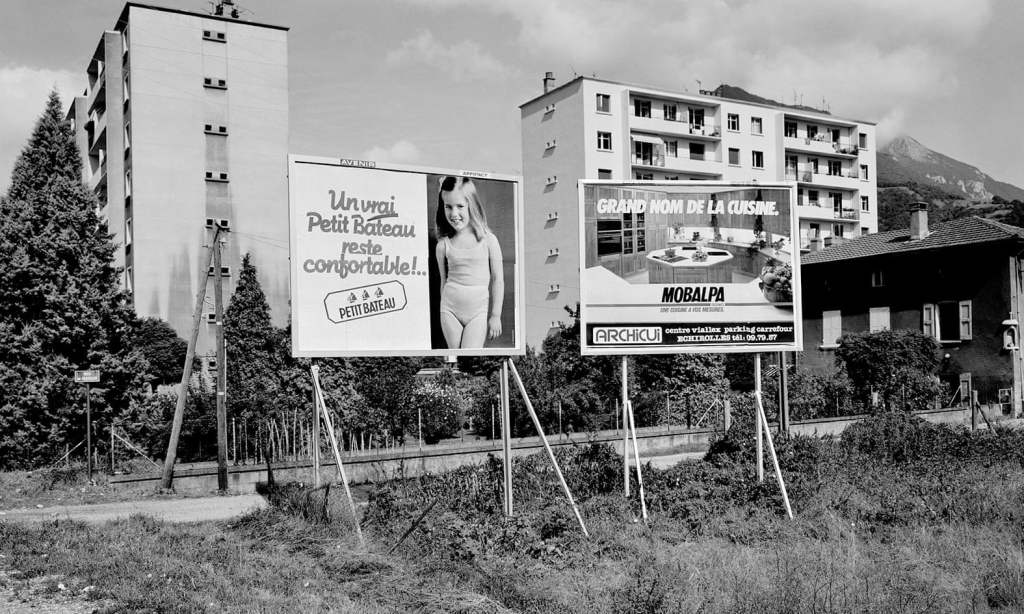
Photograph by Victor Burgin. In Grenoble, 1981.

© 2020 David Poole. All Rights Reserved.
Categories
Places Streets

It’s hard to imagine our former landscape

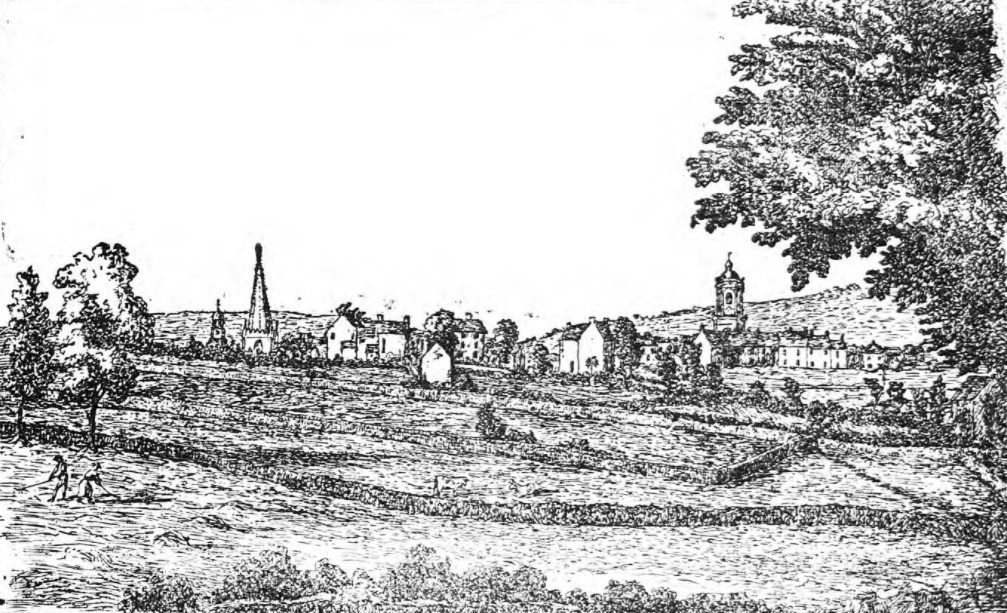
Sheffield in 1791. This reproduction was one of David Martin’s Series of Sheffield Sketches, showing what was the appearance of the town from the north side of Broomhall Spring.

The wood called Broomhall Spring extended to Broomhall Park, full of fine old oak trees, with very little underwood, and soft turf like that of a park. The wood was later cut down, the Government wanting oak timber for ship-building.

The spring itself was later referred to as Spring Garden Well, with the inscription “To the public use, by the Rev. James Wilkinson and Phillip Gell, Esq. Freely take – freely communicate. thank God.”

It was at what is now the corner of Gell Street and Conway Street, and it isn’t without coincidence that the names Broomspring Lane, Wilkinson Street and Gell Street emerged.

To the picture itself, and the fields between Broomhall Spring and the churches – the Parish Church, St. James’s and St. Paul’s – are known to us now as West Street, Division Street, and their adjacent thoroughfares.

© 2020 David Poole. All Rights Reserved.
Categories
Other Streets

Connecting Sheffield

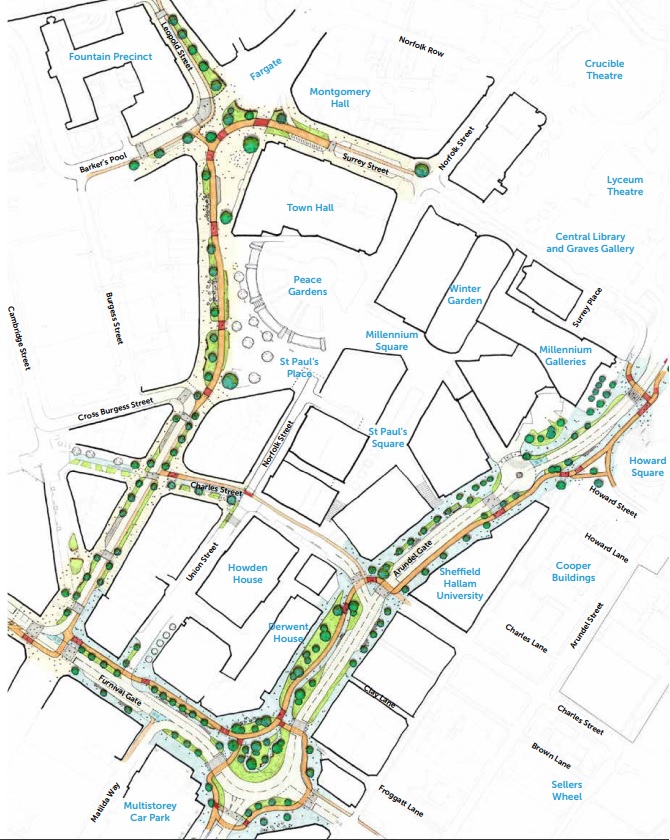
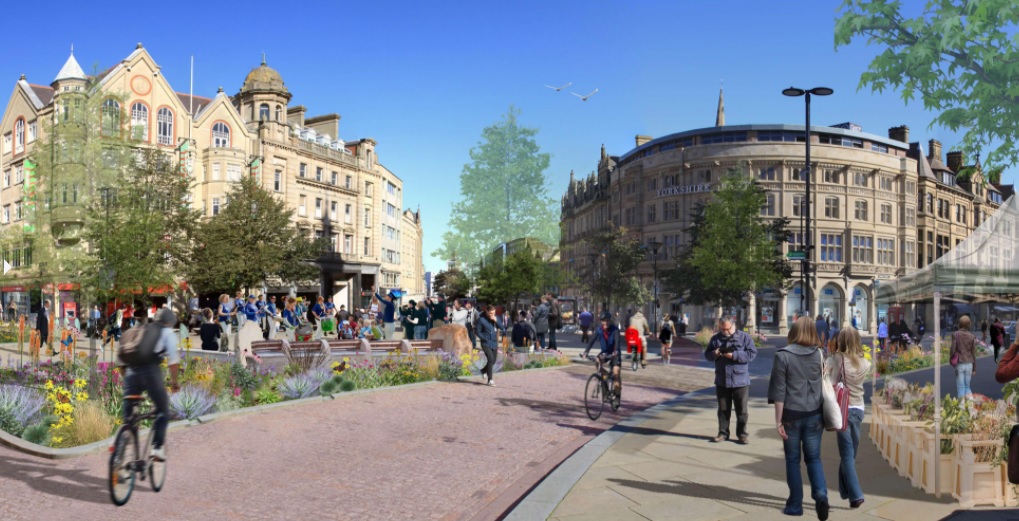
Our city centre may take on a new look if plans to pedestrianise large swathes of it get the go ahead. Sheffield City Council want to make foot and bicycle journeys easier and quicker, while streamlining public transport services.

The proposals include pedestrianisation to Pinstone Street and Leopold Street, linking Fargate with the Peace Gardens, as well as Charles Street between Union Street and Pinstone Street. The pedestrianisation of Surrey Street would create a traffic-free Town Hall Square.

Work would include more greenery, replicating the ‘Grey-to-Green’ scheme already seen between Castlegate and West Bar.

Bus gates would be installed in both directions on Furnival Gate, and along Arundel Gate to Norfolk Street

Rockingham Street would get a new bus hub with improvements to pavements, green planting, a pocket park, and bus stops.

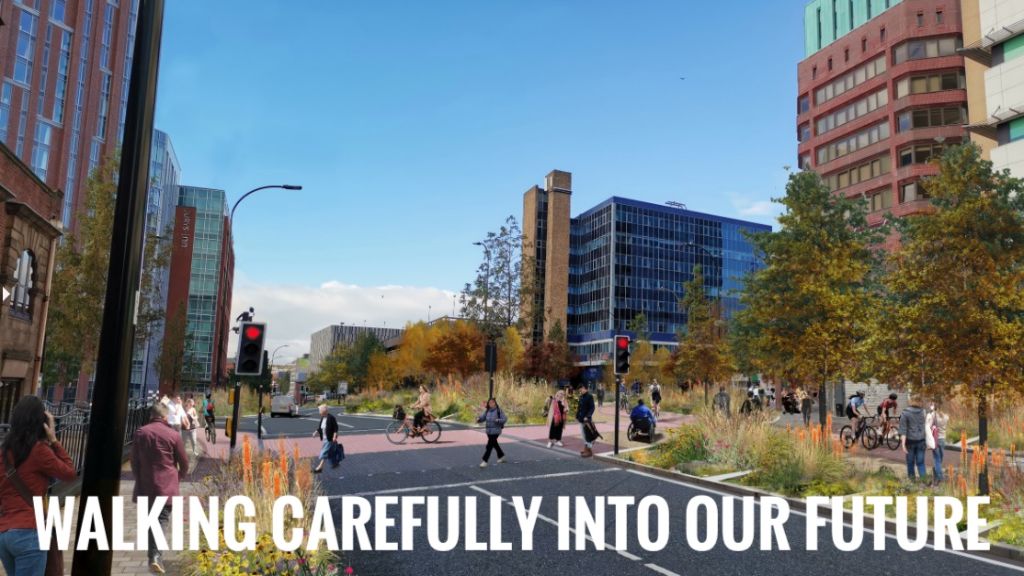
The future of our city? Pedestrianisation of Pinstone Street and Charles Street connects with Heart of the City II redevelopment, due for completion in 2021. (Image: Connecting Sheffield)

Of course, there are benefits to the scheme – improved air quality, better accessibility to shops and businesses, a more attractive city centre, and public spaces that create city uniqueness.

Artist impressions paint a bright picture, but there are notes of caution.

Sheffield city centre is at a midpoint in its regeneration, with the pandemic decimating footfall, and placing even more uncertainty on retail, hospitality, and office space requirements.

The city centre is a travesty of its former self, Covid-19 exposing retailers already reeling from Meadowhall and the internet. And, after restrictions are eventually lifted, how many pubs, bars, and restaurants, will have survived?   

Half-hearted attempts to open cycle lanes at the heart of the city, further reducing traffic flow, have met with lukewarm response. With respects to cyclists, our seven hills make four wheels the favoured choice in and out of the city.

The prospect of a Town Hall Square, with pedestrian access and cycle routes linking Fargate, Leopold Street, Surrey Street, and the Peace Gardens. (Image: Connecting Sheffield).

The key to any redevelopment must take into consideration transport links.

Cars are already deterred from entering due to over-complicated traffic flow and the extortionate cost of parking. Our buses remain empty, not least because nobody knows where they go, or where to catch them anymore. Our elderly citizens must walk a distance to catch a bus, and the question remains whether they will bother anymore?

We must tread carefully, mindful that change must happen if our city centre is to be revitalised.

Any changes must take place before 2023 to qualify for a Government grant, managed by Sheffield City Region, and must be subject of public consultation.  

An overview of the ‘Connecting Sheffield’ proposal, providing a green space around the city centre. (Image: Connecting Sheffield)

Connecting Sheffield

© 2020 David Poole. All Rights Reserved.
Categories
Buildings

The new Isaacs Building takes shape

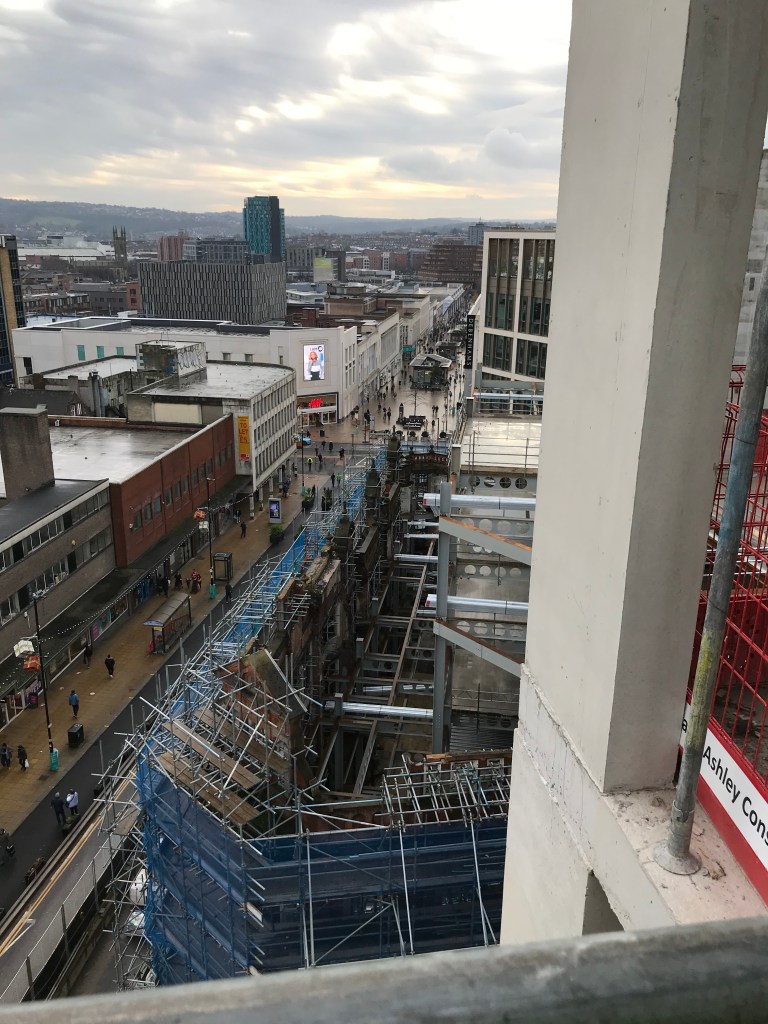
Scaffolding and new steel work support retained Victorian fronts on Pinstone Street. (Image: Heart of the City II)

A photograph that tells a story. The remains of the Victorian facade at the lower end of Pinstone Street in Sheffield city centre. Everything behind has been demolished, and the famous old fronts preserved for posterity.

Block C of the Heart of the City II masterplan is located between Pinstone Street, Cambridge Street and Charles Street.

It incorporates two historic building blocks which form the southern end of the Pinstone streetscape.

The combined façade and its dramatic roofscape is an excellent example of Sheffield brick and terracotta architecture. It occupies a prominent position and is visible from the Peace Gardens through to The Moor.

Block C will be home to 39,000 sq ft of premium Grade A office space, serving 450 employees, plus six premium retail units comprising over 8,000 sq ft.

It will be known as the Isaacs Building, named after Edwardian-era paper-hangings merchant David Isaac, and is scheduled to be completed in 2021.

Categories
Streets

Brownell Street: Forgotten stories

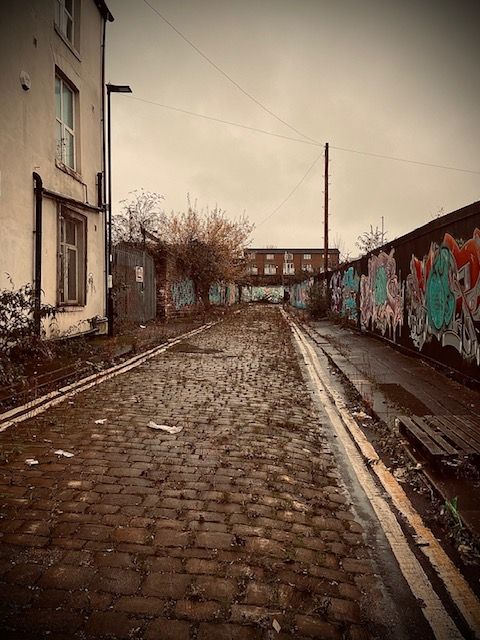
Cobbles glisten in the rain, weeds grow through cracks, but this pitifully empty street is a poignant reminder of our past.

Brownell Street, at Netherthorpe, is in a sorry state and awaits nearby redevelopment.

But if we go back in time, this was one of the poorest streets in Sheffield, a slum at the heart of St. Philips, where families crowded together in dirty back-to-back houses, fought to make ends meet, and fought one another.

Crime was rife, and it was only after the broken-down houses were boarded-up, then demolished, that order was restored.

It is an empty space now, but what stories these cobble stones could tell.

Tales of horse and carts. Damp houses, unfit for human habitation. Tuberculosis, influenza, pneumonia, bronchitis, and infant mortality. Brawls, stabbings, and gun shots. Tales of the unruly Jericho Gang. Gambling. Happiness. Births, weddings, and certain death. Tragedy and despair. And tales of a better life that existed somewhere else.

The houses disappeared in the 1930s and most of the people vanished with them. From the slums came industry, and as history repeats itself, industry has given way to housing again.

The upper end of Brownell Street might have been lost to Netherthorpe Road (and Supertram), but the area is blooming with new-build student accommodation.

Remember these cobbles because next time you look, they’ll probably be gone.

© 2020 David Poole. All Rights Reserved.
Categories
People

William Fox Tibbitts

The story of William Fox Tibbitts is remarkable. A man of extraordinary business acumen but who lived the life of a poor man.

At the time of his death in 1927 he was described as “probably the most eccentric rich man in Sheffield.” He was a mass of contradictions, so bizarre and so unlikely that only personal sight and knowledge of them could make them credible.

Tibbitts was born in 1842, educated at Collegiate School, and was the last in a long line of Sheffield attorneys, a profession he turned his back on to become a shrewd property owner and speculator in stocks and shares.

He lived at Netherthorpe House, built by the Hoyle family in 1750, at what was once the centre of an estate of green fields. By the time he died, the house was in one of the poorest districts of Sheffield, situated at the junction of Meadow Street and Hoyle Street, surrounded by back-to-back houses, mean streets, shops, and the smoke of works.

Tibbitts’ father had married into the Hoyle family, one of noble recognition in Sheffield, and to which Hoyle Street got its name.

William Fox Tibbitts bought block after block of property at Upperthorpe and ultimately almost all that district fell into his hands, and he became known as the ‘Upperthorpe Lawyer’. He also purchased properties in Skegness and London.

Tibbitts was of careful disposition and in his early years said he could not afford to marry, and in later years had no inclination toward marriage.

Notwithstanding his eagerness to amass money, there was a kindly disposition to him and frequently befriended poor people offering them free legal advice.

His motor-car was  a Corporation tram; he was a keen traveller, mountain climber and walker; a wizard of finance who kept personal records of all his shares and transactions in old-fashioned ledgers with a medley of out-of-date newspaper cuttings; a solicitor who sold coal mines; a big landowner who let off a portion of his own house as a surgery and who had titled relatives in the highest rank; a man who might have been Lord Mayor, but never tried to enter public life.

William F. Tibbitts. Image: British Newspaper Archive

Shortly before his death in March 1927 he agreed to an interview with a reporter from the Sheffield Independent: –

“I recently found him at his house. Several minutes of ringing called his housekeeper, and I was ushered into the presence of a well-preserved, very old and venerable man seated before a small fire by a desk poring over a rent book in a sparsely furnished office lit by a single lamp in a common shade. He greeted me with kind courtesy and, with an emphatic embargo on notebooks, he talked almost as a monologue for two hours.

“’My friends tell me that I should take a house in the country,’ he said, ‘but if I did I should never be able to get down here to work every day, and I often take a penny ride on the tramcar for exercise. People will not believe me when I say that I can hardly afford to keep this old house going.’

“He sighed, and I noted the frayed cuffs of his old coat and the worn waistcoat.

“Yet a few minutes later this amazing old man told me that he sold a colliery (he mentioned its name) and believed that he might have got about £50,000 or more if he had pressed.

“’I held a controlling interest in the shares,’ he explained, ‘but they wanted me to put up the money for another 400 houses at over £400 each, and I refused.’

“Politically, he was still back in 1909, and he revealed an astonishing collection of cuttings denouncing Mr Lloyd George’s Budget campaign (all mixed up with denunciations of Arthur James Cook), and then he bemoaned the break-up of the big ducal estates, the approaching flight of capital from this country, and the especial iniquity of death duties. His newspaper cuttings, yellow and creased, were like leaves of Vallombrosa.

“He knew the Sheffield Stock Exchange Daily Price-List almost by heart, and the sight of it on his desk moved him to further sighs of regret concerning the vast interests he had in shares that were not paying a dividend.

“With a great effort he lifted down a ponderous ledger, scanned the index, and turned up entries recording the financial history of big blocks of shares in Sheffield and other companies. ‘I am the biggest shareholder in So-and-So,’ he mentioned quite casually, and the name he mentioned was that of one of the oldest and biggest steel firms in the country.

“Page after page recorded his holding of thousands and tens of thousands of shares, and a sheaf of company reports, fresh from the postman, gave an idea of what his yearly total of such documents must have been.

“Mr Tibbitts took a boyish pride in speaking of his travelling and mountaineering exploits, discontinued since the war on account of the ‘big charges now made at the hotels.’

“A bachelor, he talked of this and that famous person, whose names are national property, and of this and that big industrial organisation and their weaknesses and scandals far too piquant to repeat, until at long last he closed his ledgers and I rose to leave.

“I had gone, by the way, to ask him for his views on ‘success’. ‘It would not do,’ he had said in refusing. ‘I may finish in the Bankruptcy Court.’”

Tibbitts liked to speak tongue-in-cheek, his wealth assured, and following his death Samuel Mather, a close friend and sharebroker, revealed more about Tibbitts’ character: –

“In ordinary justice to his memory, the idea of some of his supposed eccentricities should be removed.

“He had a simple, unassuming, genial nature, making no display either in his mode of life or dress. When, on our walks, we had been asked to help some good cause, it was a surprise to the recipients to get a gold coin instead of a silver one which was all that was expected from a plainly attired wayfarer.

“Most sensible men enjoyed wearing an old comfortable suit but cannot afford to defy convention by doing so except when pottering about the garden.

“Ostentation was an anathema to him. ‘Why,’ he said, ‘should I be troubled with all the cares occasioned by the upkeep of a large establishment.’ His only desire was to be comfortable. His residence was not in a salubrious neighbourhood, but he had grown accustomed to the old home of his family, and so remained there, notwithstanding the change in the character of his surroundings. It was, too, convenient as an office and for his workmen.

“Living as he did, a somewhat self-centred life, it was perhaps inevitable that, as do many others, he should possess the defects of his qualities, but it would be a good thing for our city and country , as well as for themselves personally, if others could be induced to follow in his footsteps.”

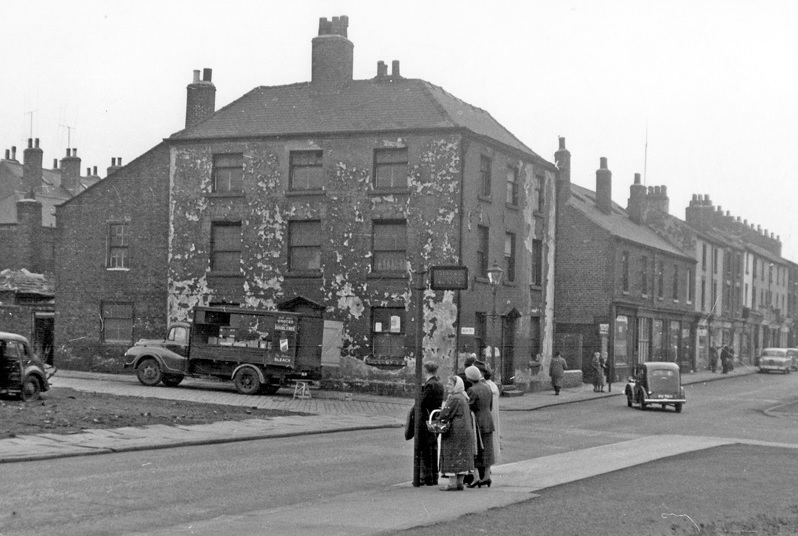
Netherthorpe House in the early 1950s. Image: Picture Sheffield

After his death, press speculation said Tibbitts had left about £2 million to his niece, Sheffield-born Henrietta Sarah Fisher, who lived at Tunbridge Wells, and this prompted her to avoid media attention by fleeing to France.

The actual figure was £1.5 million, and after dispositions and death duties, the amount left to her was £938,000.

In the 1930s she returned to Sheffield and made her home at the Kenwood Hotel before moving to Devon. In her lifetime she gave generous donations to the Royal Hospital as well as providing £2,100 for the purchase of Prior Bank at Nether Edge, a home for rest for the chronically ill, and gave £1,000 for the relief of post-Blitz distress in 1941.

She died in 1950, leaving £1.49 million, but death duties amounted to a staggering £1.14 million, leaving just £350,000 to be distributed as per the terms of her will.

After personal bequests, she left sums of £5 each to be distributed among Sheffield’s oldest tenants and her cars were left to her chauffeur. All her letters were burned and all her apparel, except furs and laces, were given away.

The residue was given to the Cutlers’ Company. The bequest, known as ‘The William Tebbitts Fund’, was for the protection and benefit of the trade of Hallamshire, for charitable and other purposes.

Netherthorpe House succumbed to the bulldozers, its site consumed by Netherthorpe Road’s dual carriageway, but Hoyle Street survives as a reminder of an old Sheffield family.

NOTE:-

The Tibbitts Papers were given by Henrietta Sarah Fisher to Sheffield Reference Library after William Fox Tibbitts’ death. These provided matter relating to the history of Sheffield, particularly Owlerton, including a ‘Court Roll of the Manor’ from 1711. There was a great deal of information about turnpike roads, including minutes of meetings, maps, plans and documents about the keeping and management of toll-bars. Other papers related to the keeping and management of local canals and rivers. Included in the collection were legal records accumulated in the 18th century. These are held by Sheffield City Archives.

© 2020 David Poole. All Rights Reserved.
Categories
Buildings

Old name, new look: the Gaumont Building

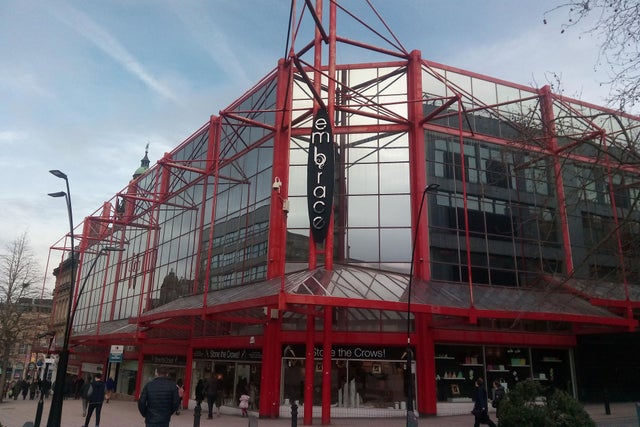
How we’ve loved to hate. The Odeon Building built in 1986-1987.

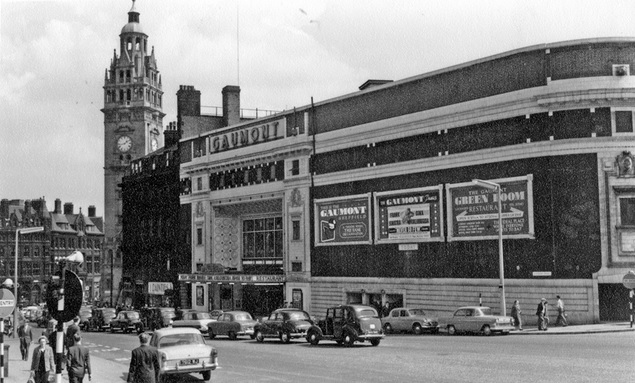
Back in the 1980s it was an important part of Sheffield’s regeneration, but after completion was universally hated. The steel and concrete building in Barker’s Pool opened as the Odeon, replacing the Gaumont Cinema, built in 1927 (as The Regent) for the Provincial Cinematograph Theatres circuit, and demolished in 1985.

A tear or two was shed, but its severe appearance could never keep up with the go-getting eighties.

We enjoyed its bright new replacement, but it didn’t last long, closed in 1994 in favour of Odeon’s multi-screen complex on Arundel Gate. And then came its reincarnation as a nightclub.

The Regent Theatre was built in 1927 for Provincial Cinematograph Theatres and was the first major cinema designed by architect William Edward Trent. Taken over by Gaumont British Theatres in 1929 it retained the Regent name until 1946. (Picture Sheffield)

If memory serves correct, it was vilified by Prince Charles, but fiercest criticism came from Sheffielders. It was considered downright ugly.

Over thirty years later, disapproval never waned, and the once-futuristic appearance looks as much out of place as it did then.

But that might be about to change.

A planning application proposing a significant facelift to the Gaumont building (as it has wistfully been renamed), has been submitted to Sheffield City Council.

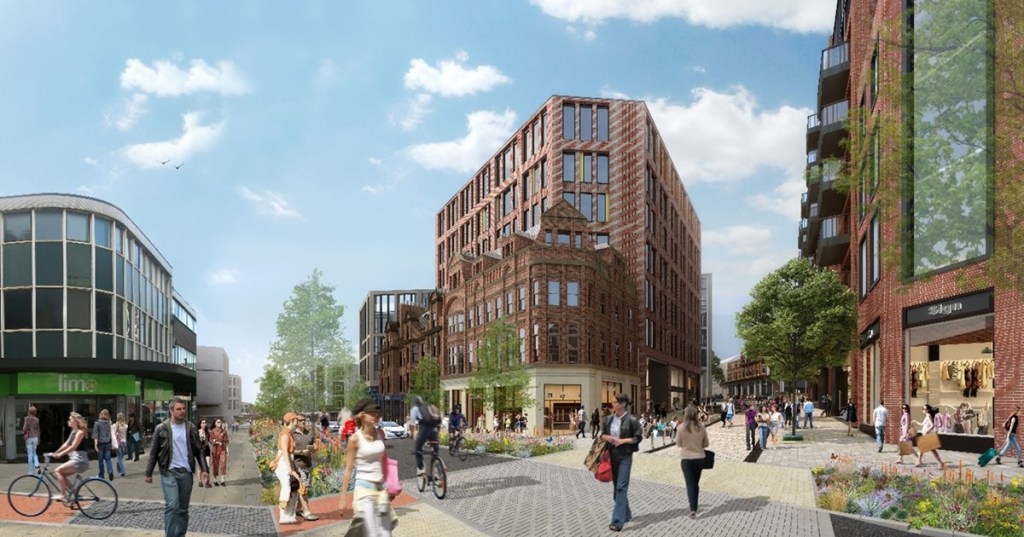
The improvement works fall within the wider Heart of the City II development scheme – led by the Council and their Strategic Development Partner, Queensberry. Plans would see the building’s current red steel frame completely removed and replaced with a contemporary design.

The new façade proposals for the building, designed by Sheffield-based HLM Architects, who are also working on the Radisson Blu hotel, take inspiration from the building’s origins as the Regent Theatre (although I see no resemblance whatsoever).

Gone is the glass and steel. An artist’s impression of the new design of the Gaumont Building. (Sheffield City Council)

© 2020 David Poole. All Rights Reserved.
Categories
Buildings Streets

The widening of High Street

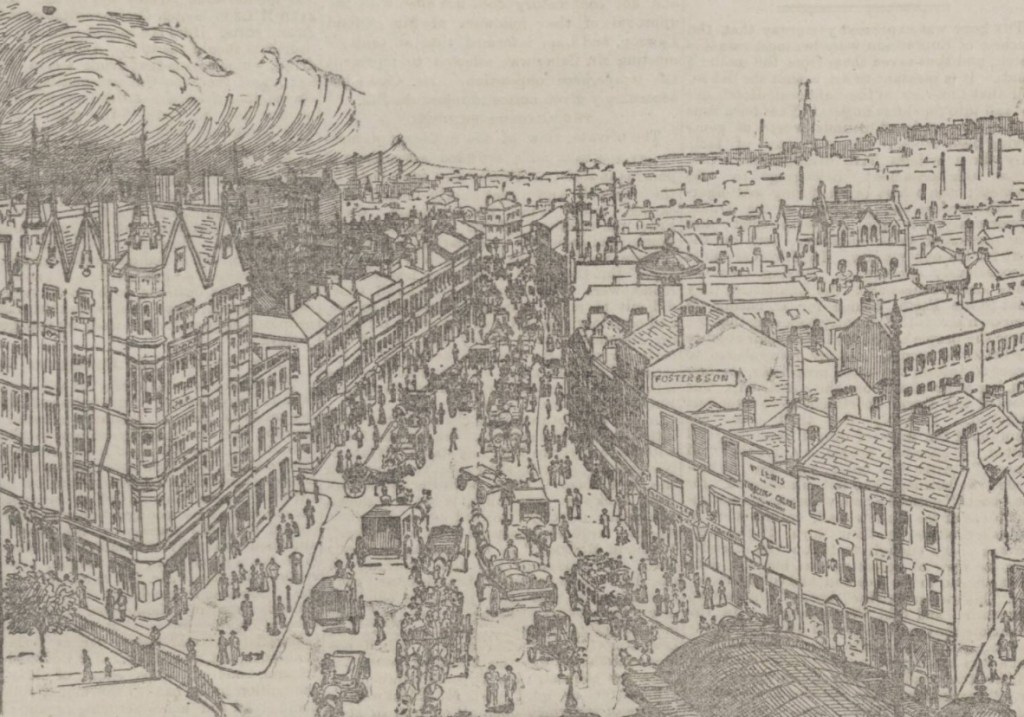
High Street as it was during the 1880s. (British Newspaper Archive)

Back in Victorian times, High Street and its approach was compared to a bottle, of which the approach was the body and the street the neck.

From the Churchgates (Sheffield Cathedral) the road tapered away until constricted at what was known as ‘Grundy’s Corner’ – the bulging portion of which had been an eye-sore for years.

Horse-drawn traffic was the problem, and every year the neck became increasingly congested.

Plans to divert traffic away from High Street were considered impossible, and the Town Council had considered an ambitious widening of the street as far back as 1875.

However, it involved demolishing buildings and prompted objections from shopkeepers concerned about compensation and property boundaries, and it wasn’t until the 1890s that work started.

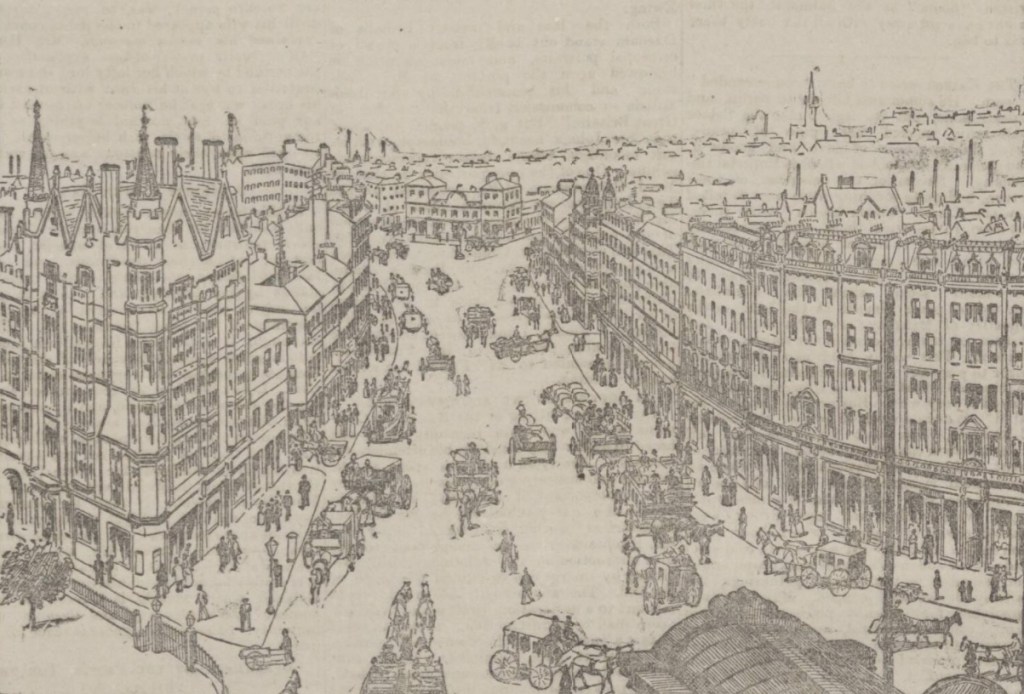
These two illustrations from 1890, both taken from Coles Corner, showed High Street as was, and the proposed widening of the street.

The proposed High Street widening from 1890. (British Newspaper Archive)

It was completed in 1895-1896 and involved demolition of buildings on the south side (to the right), replacing them with elegant Victorian structures, including the Foster’s Building.

Sadly, the Blitz of World War Two destroyed most of the property and we are left with twentieth century replacements including what was once Walsh’s department store, an old Sheffield name that mutated into Rackhams, House of Fraser, eventually handed over to TJ Hughes.

Only one building survives both sketches and is as familiar today as it was then. Parade Chambers, built for Pawson and Brailsford by Charles Hadfield, and constructed by George Longden & Son between 1883-1885.

High Street before the street widening of 1895-1896. (Picture Sheffield)

© 2020 David Poole. All Rights Reserved.