Who says that the Heart of the City II development is just about new buildings?
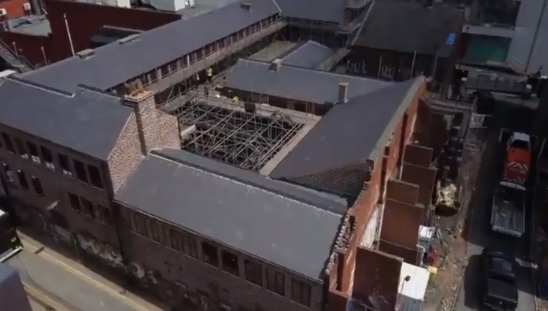
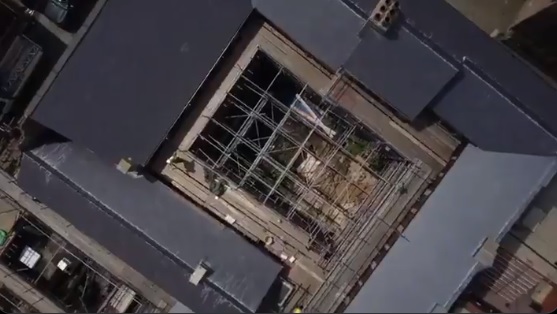
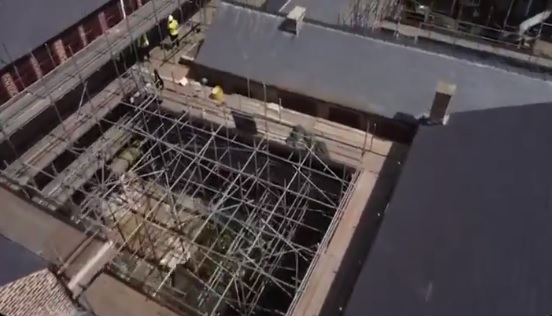
Leah’s Yard is currently undergoing a £6m renovation to breathe life back into the old buildings. Set to open in early 2023, Leah’s Yard will be a destination for independent retail, and showcasing traders, makers and creators from Sheffield.
Throughout the 19th century the yard was used by a horn dealer (who supplied the cutlery handle making trade), Sheffield platers, knife manufacturers and silver stampers. In the 1880s the building was known as the Cambridge Street Horn Works.
In 1892 Henry Leah took over the building as a producer of die stamps for silverware, giving the building the name that it is known by today. Sharing the building at that time was Walter Walker & Co Ltd, who were piercers and stampers; the building was alternatively known as the Cambridge Stamping Works.
Behind the scaffolding, work is quietly progressing to restore what had become one of the city centre’s most endangered buildings.
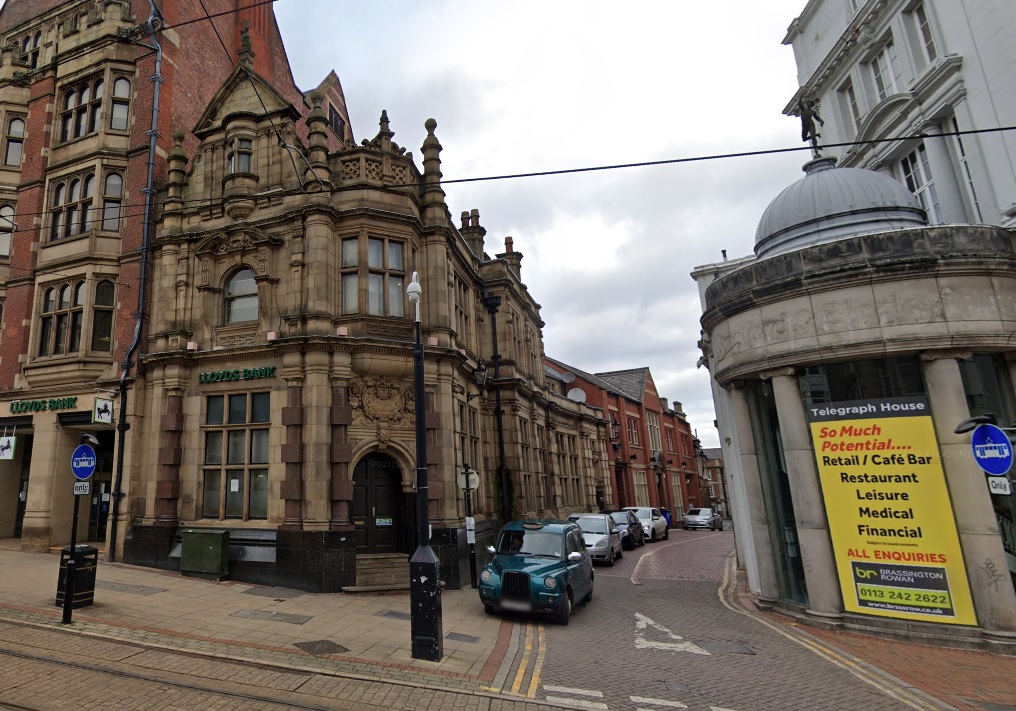
The entrance to York Street from High Street. The Crown Inn once stood where this photograph is taken. Photograph Google.
York Street is just a street to many of us, a shortcut between High Street and Hartshead. Apart from its long, recently ended, association with the Star and Telegraph, it hasn’t played a significant role in the city centre’s history.
However, despite having few buildings of architectural importance, York Street can still tell a story.
In 1565, documents state that the property between the Church Gates (now Sheffield Cathedral) passed into new hands and was bounded by the churchyard to the west, and on the east by lands belonging to John Skynner of London.
York Street didn’t exist, the land changing ownership many times, steadily developed towards its High Street frontage.
We now come across an old tavern, sometimes called Morton’s, and at others as The Crown, often used for public meetings (and drinking) by the Town Trustees and the Cutlers’ Company.
John Morton, landlord, had the honour of being a Master Cutler and a victualler. He occupied the chair in 1709-10, and during his year, the Archbishop of York seems to have been entertained at The Crown. In 1721, when the Duke of Norfolk entertained leading inhabitants, a substantial amount of plate and table requisites were lent from this inn.
The Crown’s location is found in property deeds from adjacent properties in 1711 and 1735, bounded by the lands of John Morton westwards, and putting it where the opening to York Street is now.
In 1744, Morton’s widow, announcing her retirement from business, advertised in the Leeds Mercury her desire to let ‘that very good, accustomed inn, known by the sign of the Crown, near the Church Gates, with stabling for twenty-four horses.’
Soon afterwards, the inn appears to have closed and in 1770, Thomas Vennor, a Warwick man, bought the Crown property from the owners of ‘The Great House at the Church Gates,’ and established himself as a mercer.
In 1772, he had ‘lately’ made ‘a new street called York Street, leading from High Street to Hartshead,’ which ran through the ground ‘whereon stood the house of John Morton, over its yard, and beyond to Hartshead across a piece of vacant land purchased from the Broadbents.’
We can fix 1770 as the date York Street was created, possibly as a nod to the Archbishop of York’s historical visit, and it appears on Fairbank’s map of 1771.
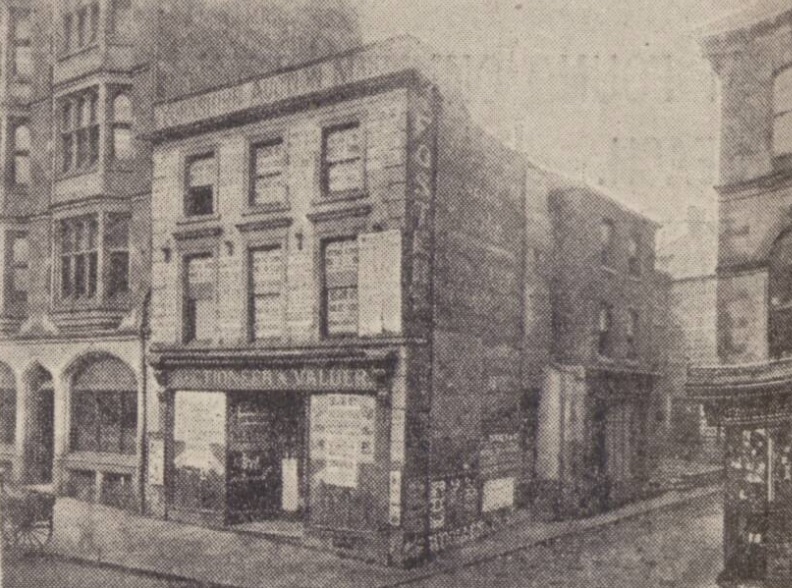
This photograph dates to about 1890. The spot underwent a complete metamorphosis, with the addition of a bank on the left hand corner and the Sheffield Telegraph offices on the right. The shop shown on the right was that of the Goldsmiths’ Company. Photograph: British Newspaper Archive.
Its creation was important because prior to construction pedestrians could only pass from High Street to Hartshead through narrow ‘jennels,’ while wheeled traffic had to negotiate Townhead and travel the full length of Campo Lane to reach it.
In this respect, Robert Eadon Leader, that cherished Sheffield historian, regarded him as a ‘public benefactor,’ something not shared by Vennor’s contemporaries, who failed to support his efforts to become a Town Trustee in 1778.
York Street was a busy thoroughfare, with houses, shops, and offices, lining both sides, but there was a darker characteristic.
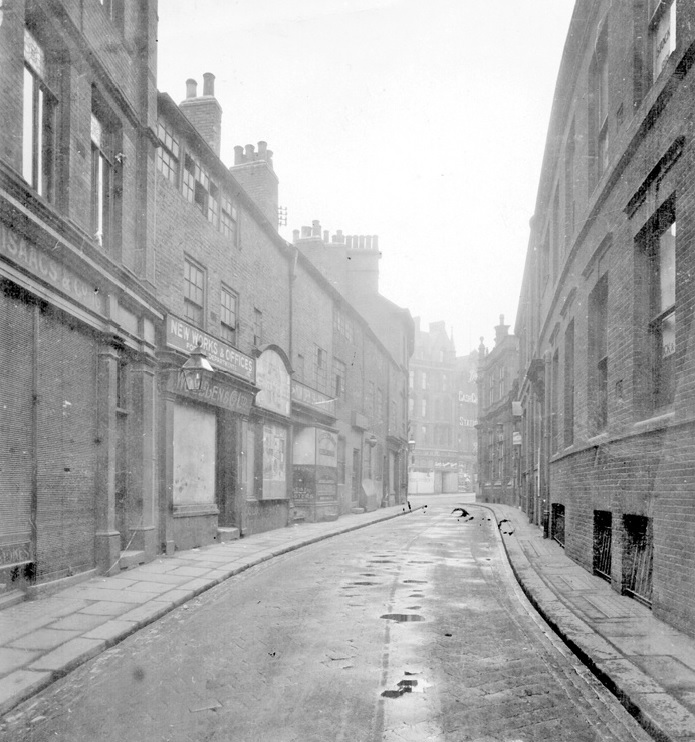
York Street in 1905, looking towards High Street. Photograph: Picture Sheffield.
In 1868, a resident wrote that “the neighbourhood of York Street is infested with night walkers, who won’t let you pass without receiving the grossest insults imaginable.”
The building of respectable Victorian buildings towards High Street improved its reputation, but in 1922 a correspondent to the Sheffield Telegraph said that it was “in a very bad state of repair, and in wet weather large pools of water collect, with the result that not only is property splashed up with dirt (your beautiful white building is an example), but foot passengers have their clothes ruined by every wheeled vehicle that passes up and down. It is the busiest street for motor traffic in the city, and the footpath the narrowest.”
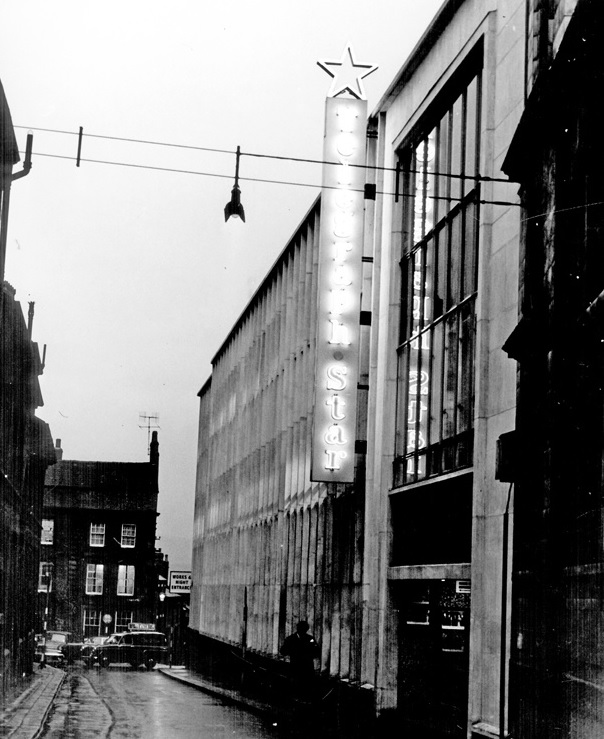
A sight more familar to us. York Street looking towards Hartshead in 1965. The Telegraph and Star Offices are on the right, now apartments. Photograph: Picture Sheffield.
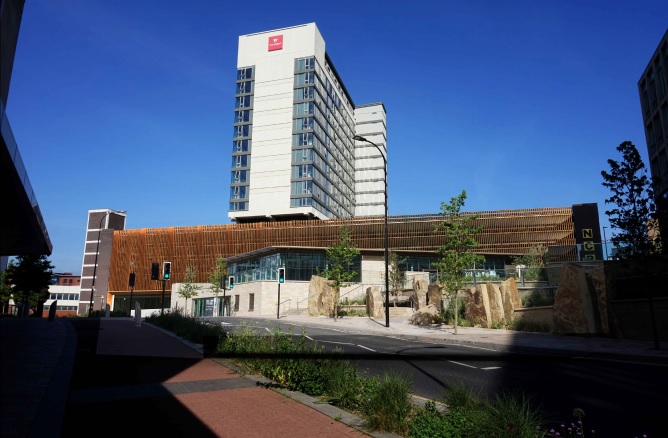
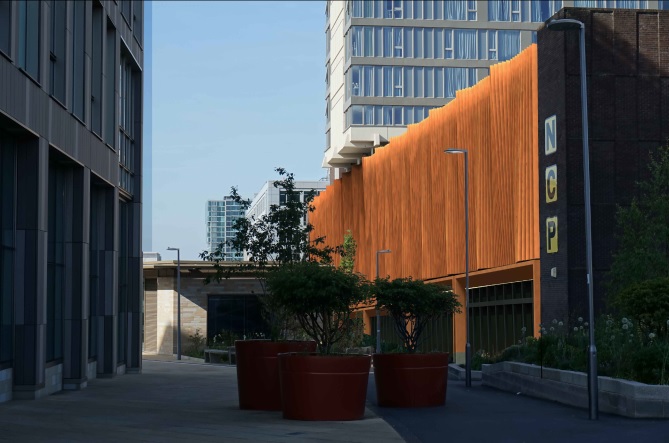
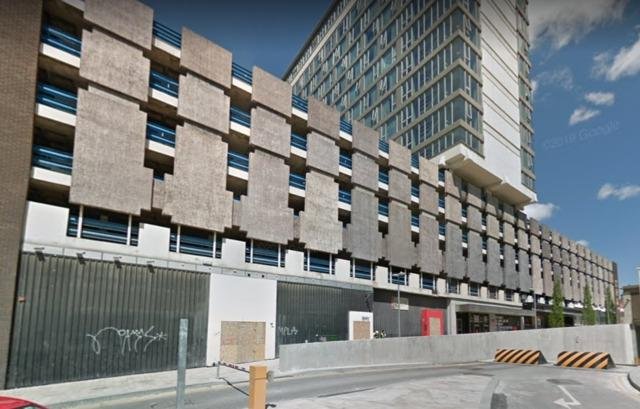
With work progressing on the Heart of the City II development, it’s time to spruce up some our existing buildings. One already completed is the Telephone House NCP car park in Charter Row, achieved by recladding the facade in Corten coloured wave feature cladding and “goal post” feature frames to the ground floor retail units. These improvements addressed issues with the poor appearance of the existing concrete building (see photo) within the context of the new Charter Square development and assist in the future letting of ground floor retail units.
The former British Telecom tower, which is located above the carpark, was recently refurbished by Vita Student in 2016 to provide upmarket student accommodation.
A planning application has now been submitted to erect a new shop frontage to four existing retail units consisting of new aluminium curtain wall façade within existing feature goal post surrounds.
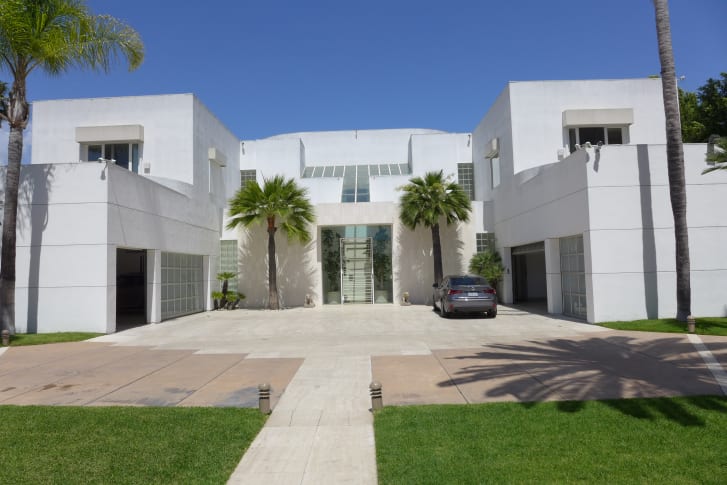
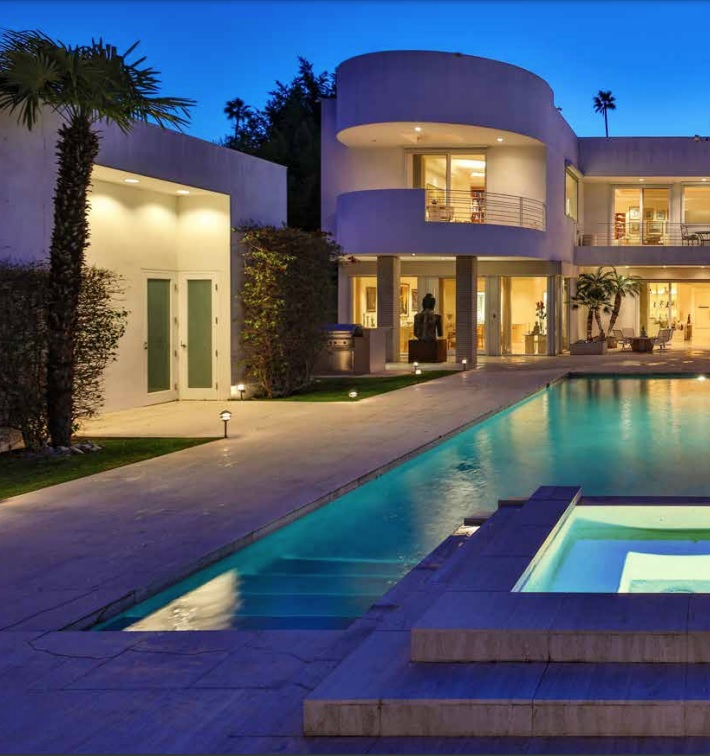
The Bel-Air home owned by late author and romance novelist Jackie Collins was one of four properties she owned. Photograph: CNN Style.
Sometimes you stumble across something quite astonishing. This tale of the unexpected involves local artist Joe Scarborough, famous for bringing to life the everyday scenes of Sheffield, and Jackie Collins, nicknamed the ‘Queen of Trash’ for her 32 novels – featuring the sexual gymnastics of heroines including the mafia princess Lucky Santangelo and the insatiable supermodel Fontaine Khaled – selling more than half a billion copies.
Born in London in 1937, Collins’ first novel, “The World is Full of Married Men” was published in 1968 and established Collins as an author who dared to step where no other female writer had gone before. She followed it year after year with one successful title after another, including “The Stud” and “The Bitch,” both adapted into films in the 1970s starring her actress sister, Joan Collins.
The 1980s saw Jackie Collins finding her stride when she published “Chances,” the first instalment in a sprawling family saga introducing the strong, sexy and powerful Lucky Santangelo. Soon after came the seminal 80s blockbuster, “Hollywood Wives” which was adapted into one of ABCs highest rated mini series.
Joe Scarborough has exhibited at Museums Sheffield and Sheffield Hallam University, and in 2008 was awarded a star on Sheffield’s ‘Walk of Fame’.
Collins settled her family in sunny California in 1980, and had her home designed by architect Ardie Tavangarian, a man inspired by the clean lines of Swiss-French early 20th-century architect Le Corbusier.
The two-story Bel Air home had a guesthouse in the back, connected by a 100-foot-long gallery displaying artworks.
Enter Joe Scarborough, born in Sheffield in 1938 and raised at Pitsmoor, who began scribbling art on the back of reports his steelworker father brought home from work. After years spent working in the coal mines, Joe held his first solo art show at the age of 26, and quickly made a name for himself with his multicoloured paintings, which feature anonymous four-inch figures and scenes inspired by the 1950s and 60s.
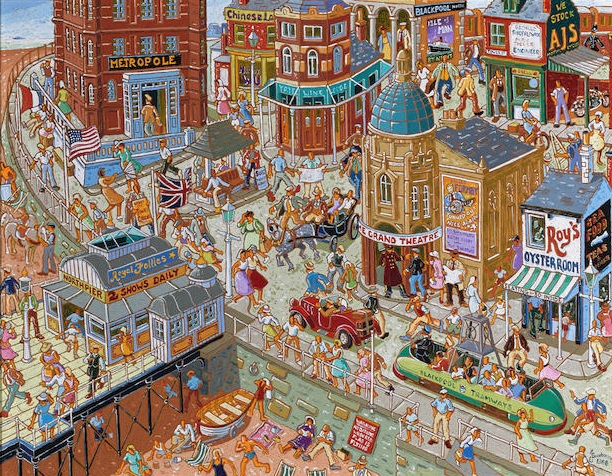
In 1987, looking to add a splash of colour to her new mansion, Collins spotted a painting by Joe Scarborough and commissioned him to paint three pictures. The first of these – a scene of Blackpool – was sent to California in 1988.
Images from Jackie Collins’ mansion taken from auction catalogues in 2017. Photographs: Bonhams.
Jackie Collins died of breast cancer in September 2015 while Joe Scarborough continues to paint on his much loved narrowboat on the canal.
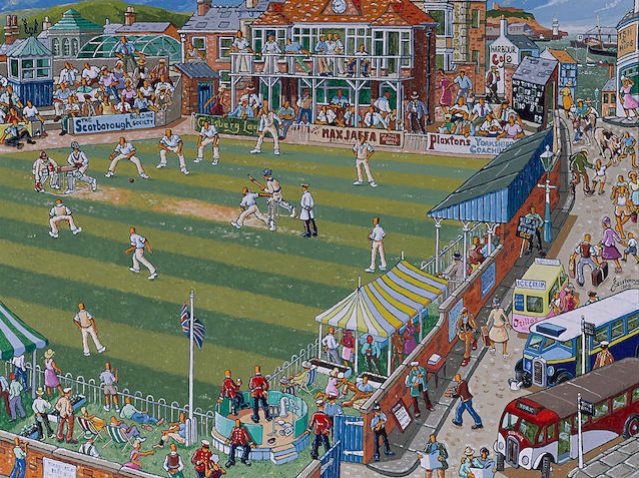
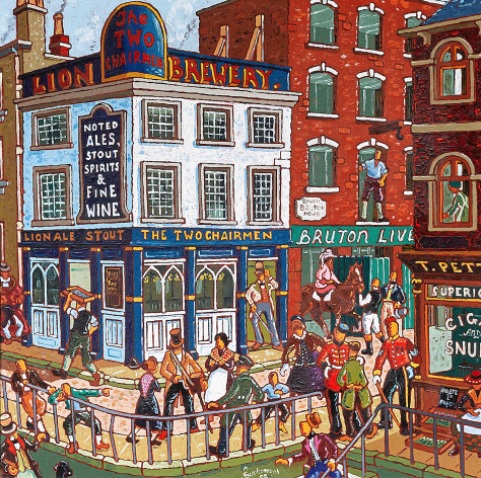
In 2017, the contents of Collins’ mansion were sold at auction by Bonhams in Los Angeles. Sure enough, within the pages of the glossy catalogues were Joe Scarborough’s three masterpieces, although none depicted scenes of Sheffield. Between them, the three paintings – Blackpool, Cricket Match and City Scene – fetched US$6,500 (£4,664).
Blackpool by Joe Scarborough. It sold for US$2,500 (£1,794). Photograph: Bonhams.
Cricket Match by Joe Scarborough. It sold for US$2,000 (£1,435). Photograph: Bonhams.
City Scene (Outside The Two Chairmen Pub) by Joe Scarborough sold for US$2000 (£1,435) in an online auction. Photograph by Bonhams
“Joe Scarborough is self-deprecatingly northern, with a thrifty mindset and a clear-eyed understanding of the magic recipe that led to his colourful cityscapes arriving above every other mantelpiece in Britain’s steel city.” – The Guardian 2019.
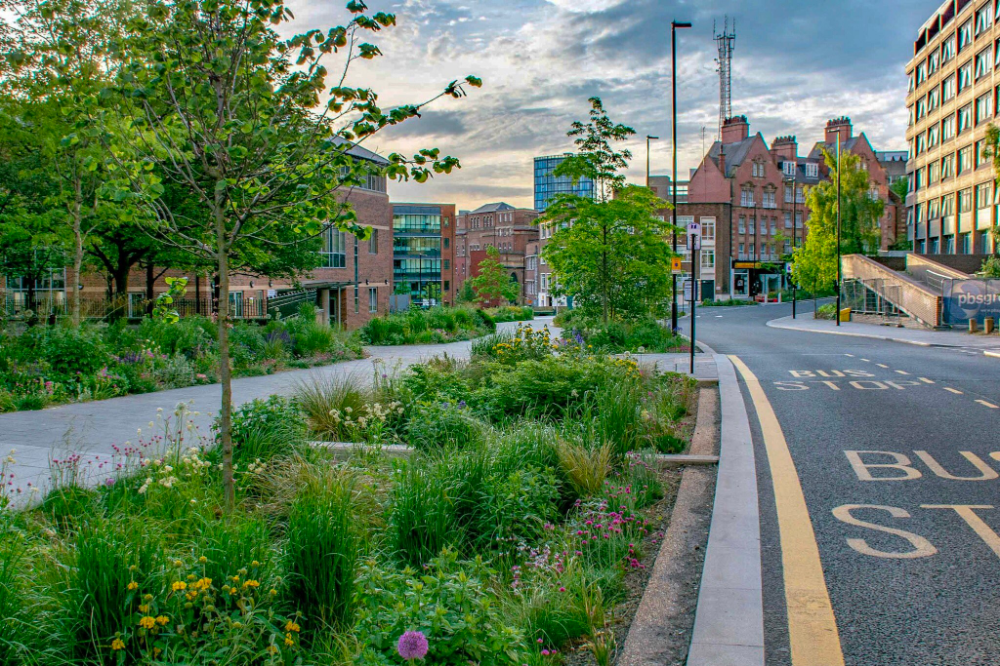
The ‘Grey to Green ’ project is a development from Sheffield City Council to transform redundant carriageway in the city centre into a network of sustainable drainage and rain gardens. The greening of West Bar has already been completed. Photograph: Nigel Dunnett.
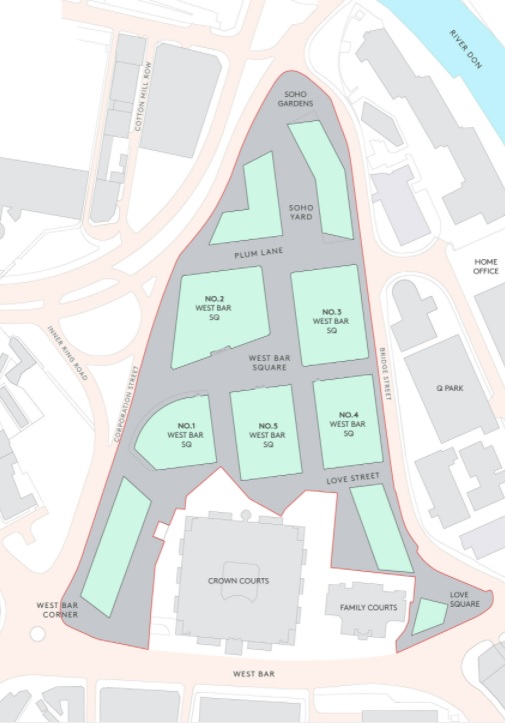
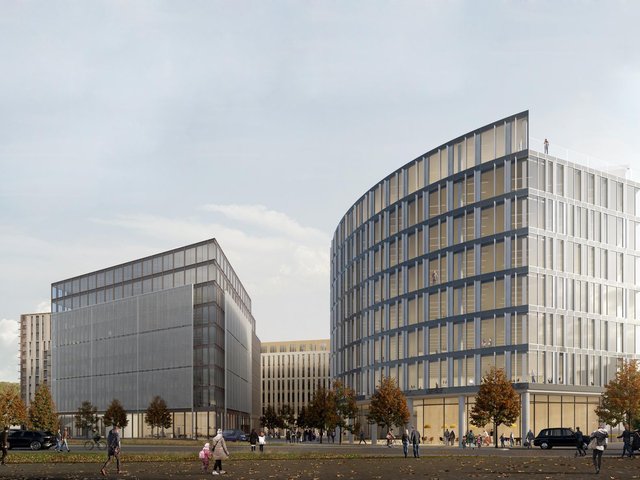
In years to come, West Bar will alter beyond recognition. The triangular area bordering West Bar, Bridge Street, and Corporation Street will be demolished. A £300m regeneration scheme will see old factories and workshops replaced with residential and business units.
According to the masterplan, West Bar Square will be a prestigious new address – a place where people will meet to do business, attracting workers and visitors, day and night. Once completed, the only recognisable buildings remaining will be the Law Courts and adjacent Family Court.
Planned area of development. Photograph: Urbo.
The development is aligned with Sheffield’s £3.6m Grey to Green scheme with wildflowers, grasses and trees already planted at West Bar. Alongside the grey to green development will be Love Square, a pop-up urban nature park designed by staff and students from the University of Sheffield’s Landscape Architecture Department.
While it is sad to see our heritage disappear, the project will go towards greening an area swallowed by the industrial revolution.
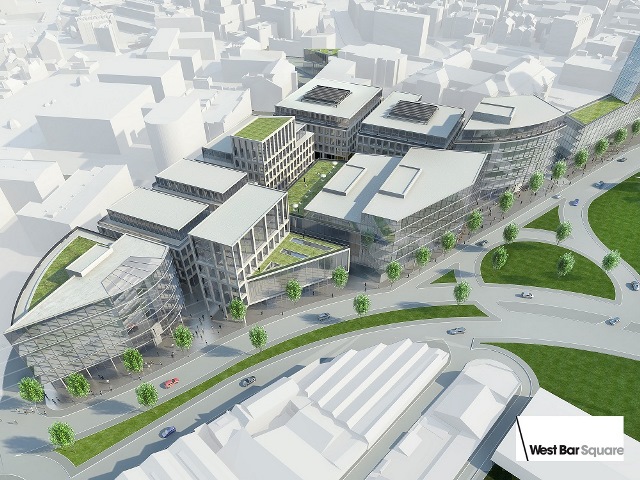
The 1.4m sq West Bar Square city centre scheme will be built next to the city’s inner relief road. Photograph: Urbo.
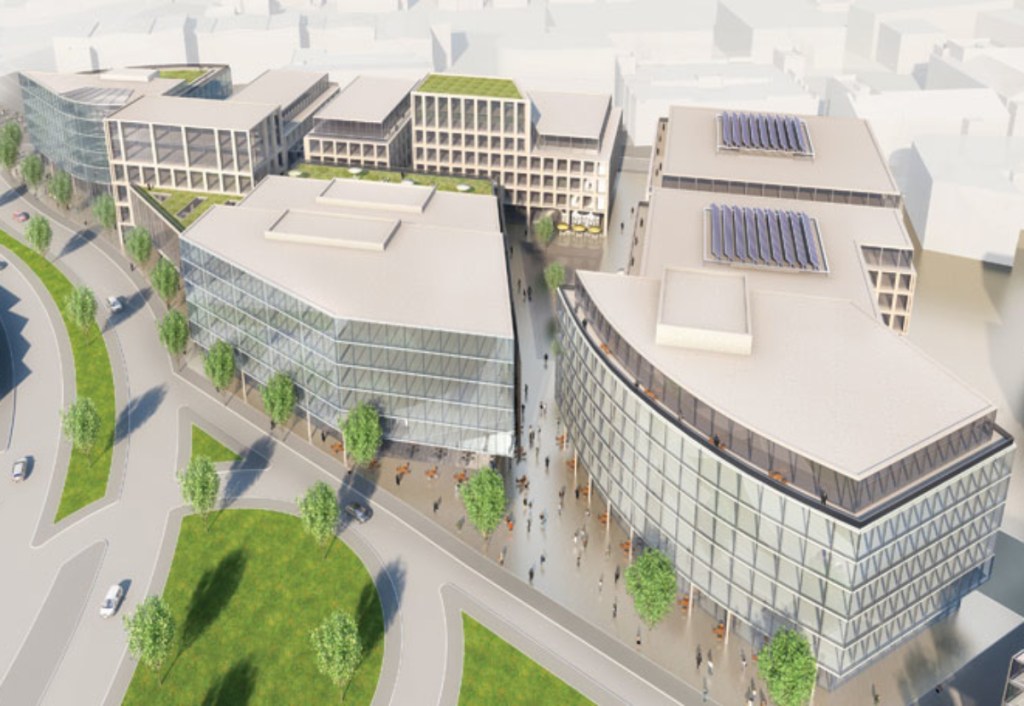
It will involve building 200,000 sq ft of office space, 350 build to rent homes, a multi-storey car park and quality landscaped public spaces. Photograph: Urbo.
West Bar is one of Sheffield’s oldest streets and mentioned in ancient records of the Burgery. There seems to be no explanation available as to the derivation of its name. In bygone times a ‘bar’ was a barrier of posts and chains set up to close the entrance to a town or city, and West Bar is likely to have been the northern limit of old Sheffield.
The development area was included in a survey of the manor of Sheffield in 1637 which described the site as part of Coulston (or Colston) Crofts, previously part of the demesne lands of the lord of the manor. Surviving deeds from 1622 contained wording suggesting the area was originally part of the lord’s game preserve, with all rights of hawking, hunting, fishing, and fowling reserved to the Duke of Norfolk. It was later used for both pasture and arable cultivation.
By 1637, the area had been divided into two large fields, the area on the west leased from the Duke of Norfolk by Robert Bower, and that on the east by Edward Wood. In the 17th century the area was at least partially wooded, confirmed by a description in 1837, which stated that until the late 18th century the area had been “swampy meadows and damp osier [willow] grounds.”
The West Bar area remained on the outskirts of town into the 18th century. The town’s first workhouse was built to the southwest in 1733, now survived by Workhouse Lane to the left of the Law Courts.
The street layout principally dates to the period between 1783 and 1802, although Spring Street and the streets to the south are earlier. West Bar is likely to be medieval in origin, and part of Spring Street was shown in 1736. Workhouse Lane and Paradise Street were shown in 1771.
Corporation Street cut through the estate in 1853, and was altered as part of the Inner Relief Road development in 2006.
West Bar was widened in stages during the late 19th and early 20th centuries. The construction of the Court Houses between 1993-1996 led to the truncation of Spring Street and Love Lane.
No.1 West Bar Square comprises approximately 100,000 sqft of office space, together with ground floor retail/leisure units. Photograph: Urbo.
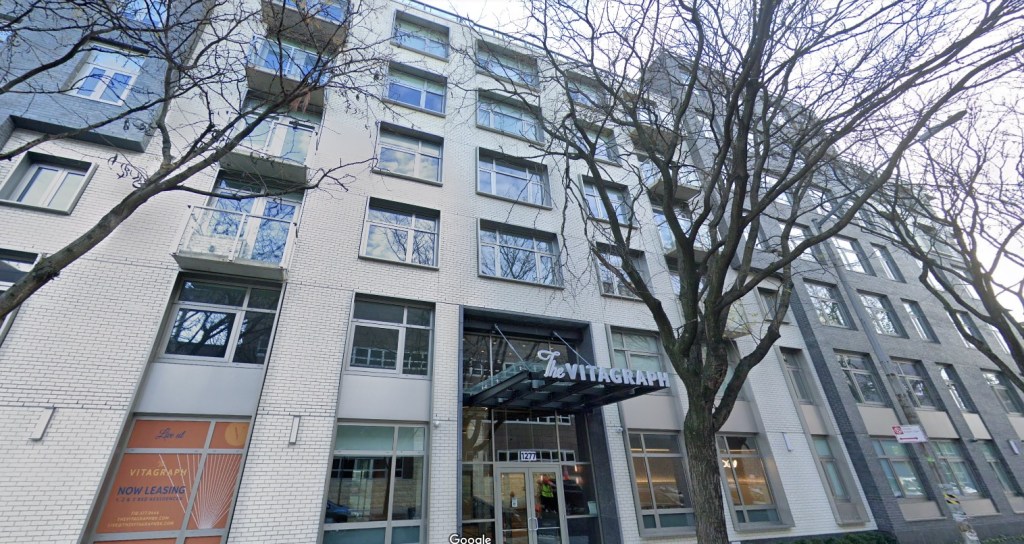
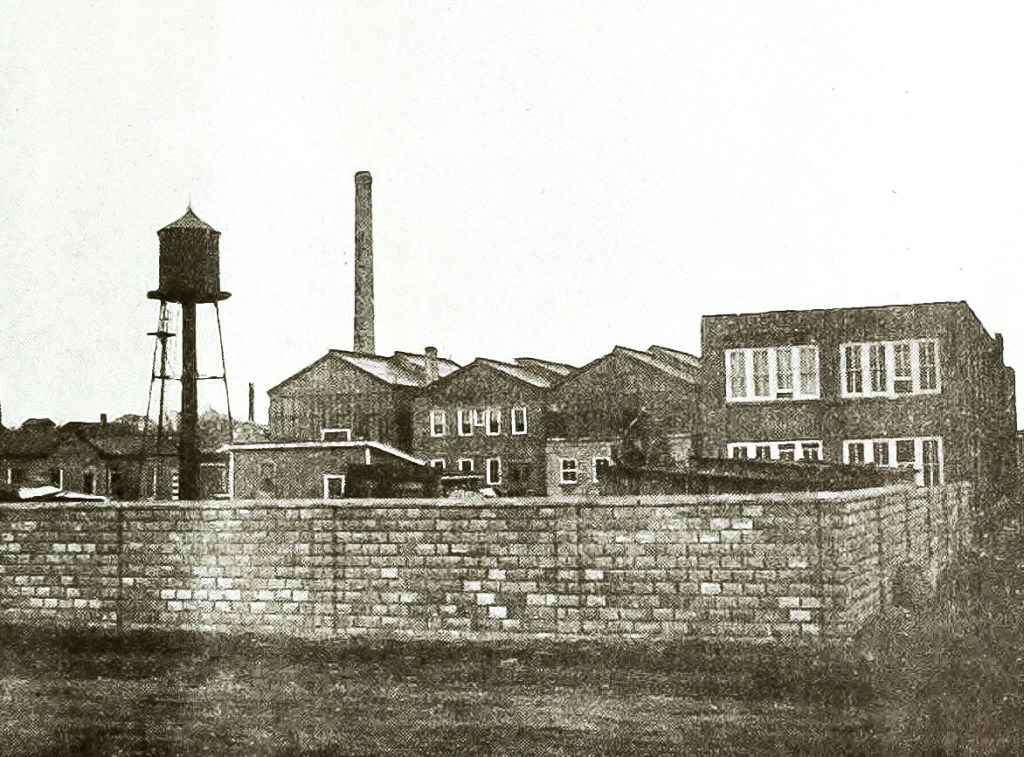
The land on which the Vitagraph Studios were situated can trace its motion picture history back to around 1906, when it served as a studio and backlot. In 2017 the site became an eight-story, 300-unit apartment building. Photograph: Google.
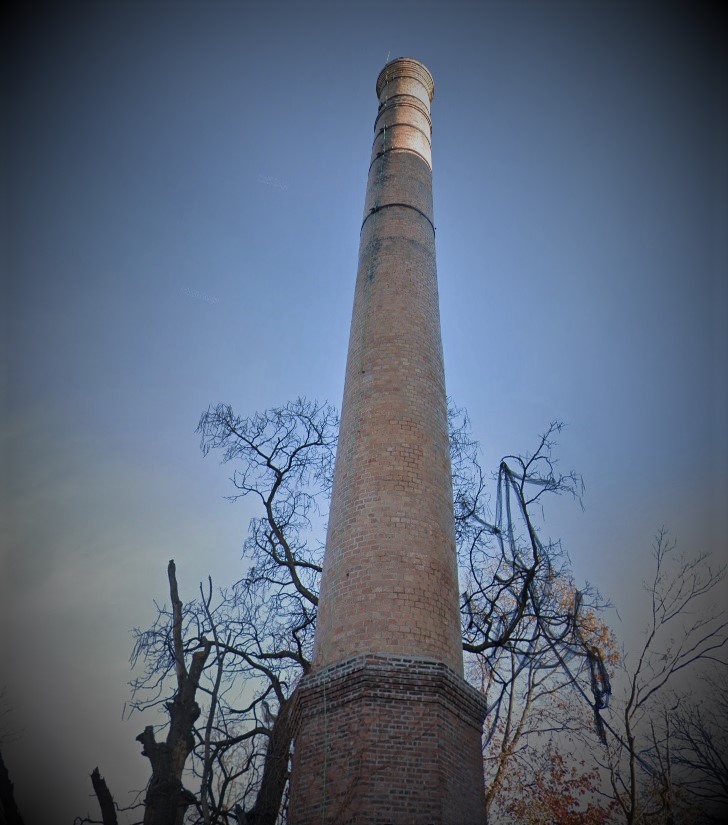
This story starts with an apartment complex in Brooklyn, bounded by East 14th Street, Locust Avenue, Chestnut Avenue, and the Brighton Line of the New York City Subway. The smart new development is called The Vitagraph, built on the site of Vitagraph Studios (1906), the first modern motion picture production company in the U.S.. Apart from the name, the only thing that survives is an adjacent smokestack on which you can still make out the VITAGRAPH name.
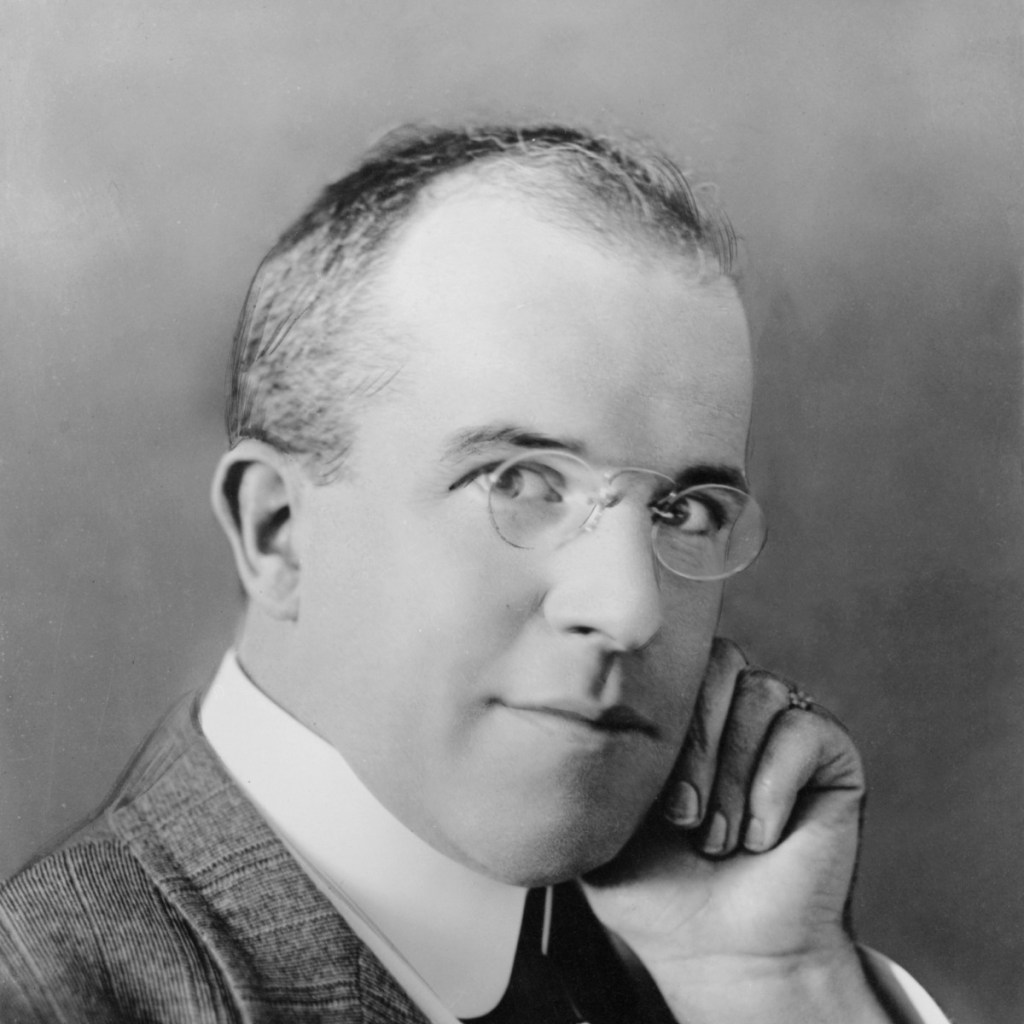
In 1896, James Stuart Blackton, a journalist and illustrator for the New York Evening World interviewed Thomas Edison about his new Vitascope, and the man was impressed enough with Blackton’s drawings to make a cartoon film with him: Blackton the Evening World Cartoonist. This was twenty-eight years before Walt Disney formally introduced us to Mickey Mouse in Steamboat Willie. Blackton bought a Kinetoscope from Edison and went into partnership with Albert E. Smith, and later William T. Rock, to form the Vitagraph Company.
The studio produced films in which they acted themselves. Tearing Down the Spanish Flag (1898), proved popular in recreating an incident from the Spanish-American war and Vitagraph went on to explore all types of filmmaking, including actualities of local events, comedy series (such as The Happy Hooligan) and adaptations of Shakespeare and Dickens.
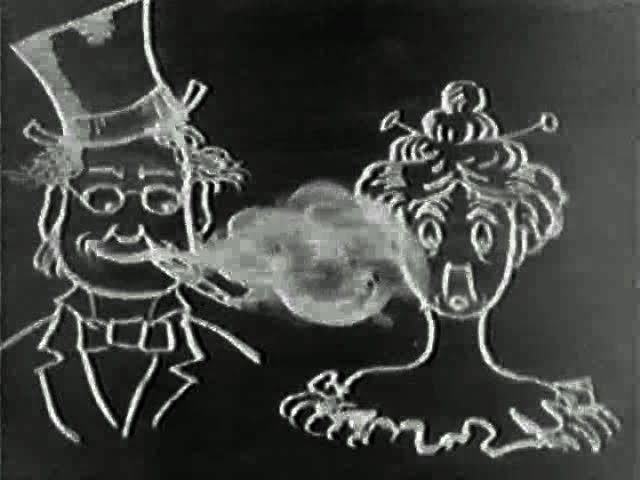
At the Vitagraph Studios, Blackton pioneered stop frame animation and shot one of his most successful films, Humorous Phases of a Funny Face (1906). He was also innovative in editing techniques and camera work and streamlined processes of the studio to supervise several productions at once.
Humorous Phases of Funny Faces is a 1906 short silent animated cartoon directed by James Stuart Blackton and generally regarded by film historians as the first animated film recorded on standard picture film.
This was long before Hollywood established itself as the centre of the movie industry and at its peak, Vitagraph was producing up to eight films a week on the Brooklyn lot, and all because of one enterprising Sheffield lad.
James Stuart Blacktin was born in Sheffield in 1875, the son of Henry Blacktin, a saw-maker, and Jessie Stuart, but weeks after his birth his mother filed for divorce.
“She had been beaten regularly by a drunken Henry Blacktin prior and during her pregnancy, he raped her when she refused sex, denied her food at home if she didn’t put in slave hours at the saw-making shop, was told she would have to become a prostitute if that was the only way he could get back money to pay a loan to her father, threatened her with death if she informed her family of the state of her marriage, and cut her off from all her friends.”
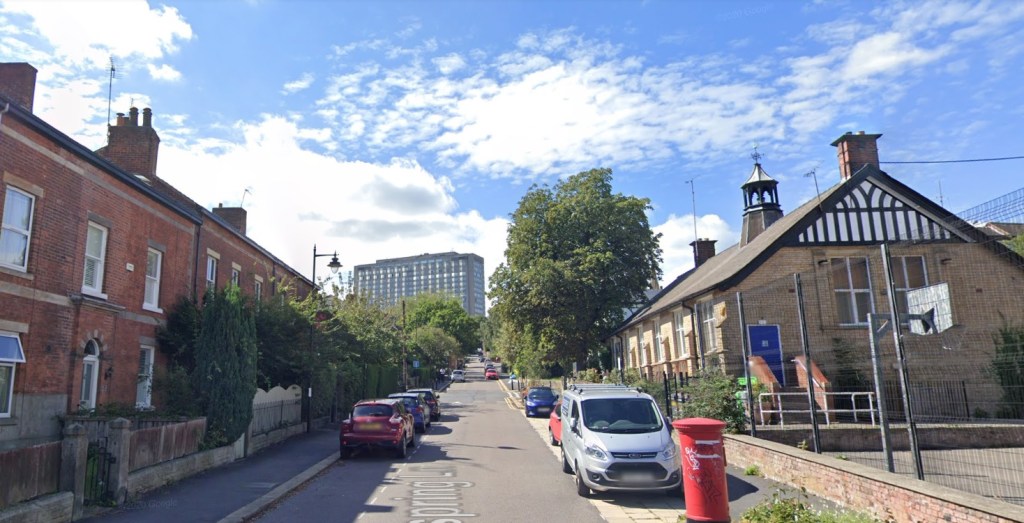
Mother and son moved into her family home at 121 Broomspring Lane, and James attended nearby Eton House Collegiate School. In 1886, when he was aged 11, they travelled from Liverpool to New York aboard the SS Celtic to start afresh. He changed his surname to Blackton and ten years after arriving met up with Thomas Edison.
Broomspring Lane, Sheffield. James Stuart Blacktin lived here with his mother’s family before emigrating to New York and setting up Vitagraph Studios. Photograph: Google.
James Stuart Blackton (1875-1941), the British-born U.S. film director and producer who introduced animation and other important film techniques that helped shape and stimulate the development of cinematic art.
Blackton left Vitagraph in 1917 selling his stock for $1.5million and became an independent producer making four big productions a year that were released through Paramount.
In 1920, Blackton visited Sheffield for the first time in 34 years and presented a private showing of his latest picture Passers-By at the Electra Palace in Fitzalan Square (later to become the Classic).
Accompanied by his beautiful young wife he had been looking around the country with an eye to producing pictures here.
“I think there is a splendid opening, and I expect to be over again by the New Year ready to start work.” he said. “I shall never produce a photo-play that I would not like my wife and children to see. I want all screen plays to reflect the beauty of the home, of motherhood, and of life, and to appeal to clean-minded people.”
In 1921 he came to England, where he directed three lavish costume dramas in ‘Prizmacolor’. The Glorious Adventure (1922) and The Virgin Queen (1923) both starred the society beauty Lady Diana Cooper (billed as Diana Manners); Gypsy Cavalier (1922) starred the world light heavyweight boxing champion, George Carpentier.
Blackton returned to the US in 1923 and directed several more films, including Beloved Brute (1924) starring Victor McLaglen, who he had used in The Glorious Adventure.
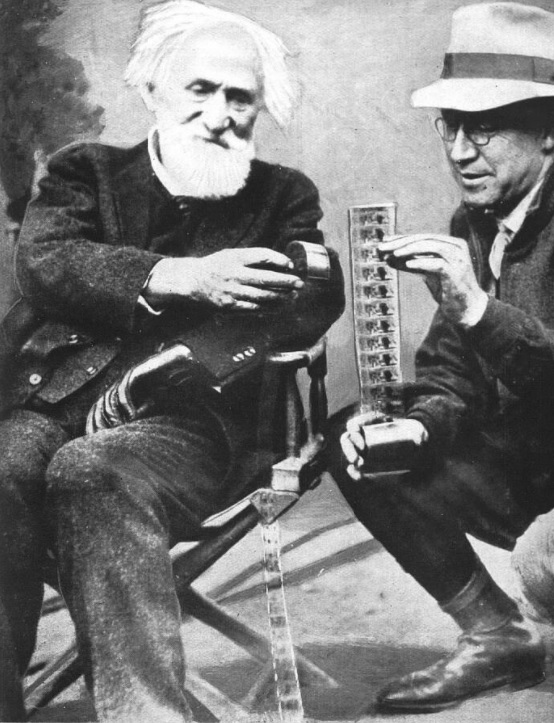
In 1927, Hudson Maxim, the U.S. inventor and chemist, visited his ‘young’ friend James Stuart Blackton, who had invented a stereoscopic film, to examine the latest development in motion-picture technique. He was seen comparing a film of the new ‘natural vision’ negative with an ordinary roll of film. Photograph: British Newspaper Archive.
His world came crashing down after losing his fortune in the Wall Street Crash of 1929. He then made a living from showings of his old films and giving lectures about silent movies.
He ended his days working for the Anglo American Film Company and died in 1941 when he suffered a fractured skull after being hit by a car while crossing the street with his son. He was buried at Glendale, Los Angeles County.
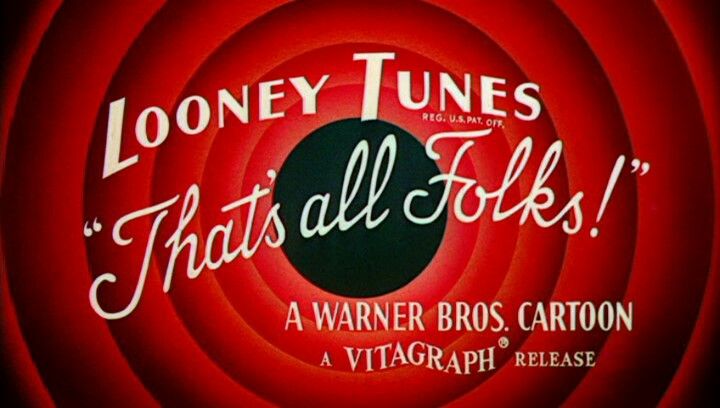
Vitagraph was bought by Warner Brothers in 1925 and the name was briefly resurrected from 1960 to 1969 at the end of Warner Bros’ Looney Tunes and Merrie Melodies cartoons, with the end titles reading “A Warner Bros. Cartoon/A Vitagraph Release”
The Vitagraph Studios were bought by NBC in 1951 and later used to film The Cosby Show, and soap operas Another World and As the World Turns. The famous old studios were demolished in 2015.
The surviving smokestack was part of Vitagraph Studios, which made silent films in Brooklyn, New York, more than a century ago. Actress Norma Talmadge got her start in the movies at Vitagraph’s Midwood facilities. America’s first film versions of William Shakespeare’s plays were shot there.
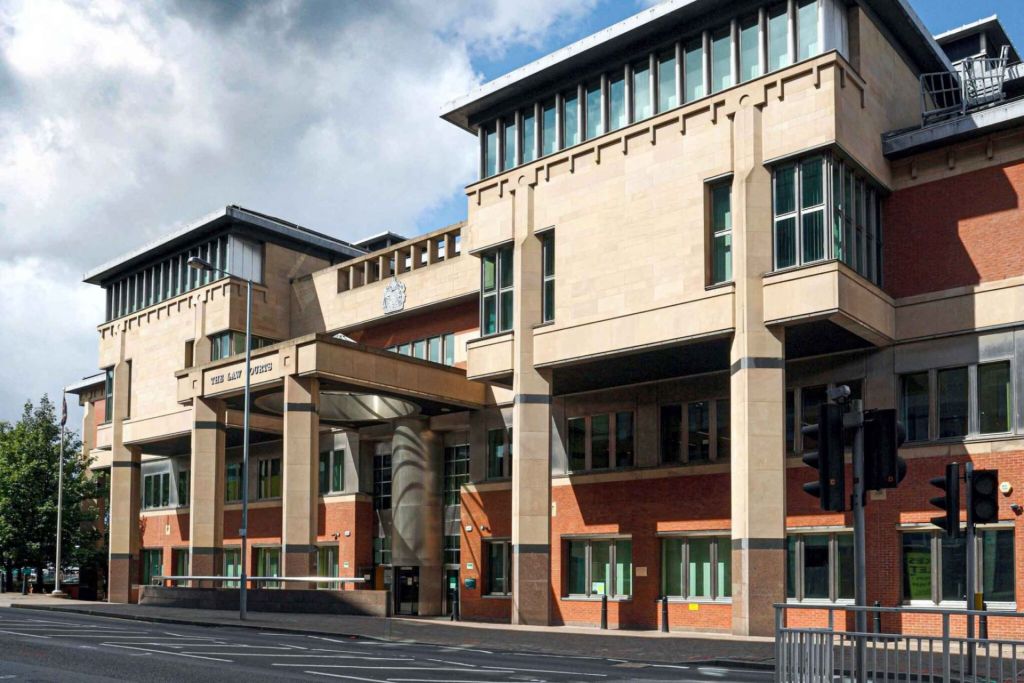
Main entrance. Photograph: The Napper Partnership.
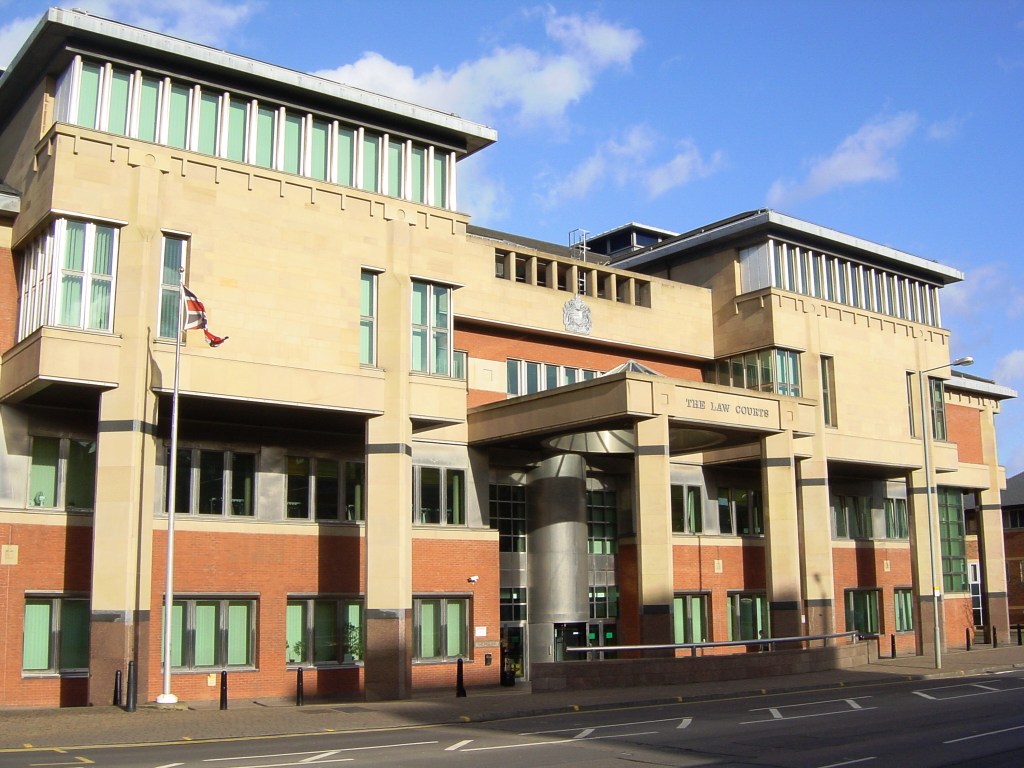
Here’s a Sheffield building that you’ll have seen on TV, but its interiors are seldom seen. The Law Courts, at West Bar, don’t attract much passing traffic and pedestrians rarely have reason to venture here.
However, the building is significant as being an important contribution to Britain’s scales of justice.
The fate of the Old Town Hall at Castle Street, and its latter role as a Crown Court, is well publicised and has stood empty in favour of this purpose-built complex since 1995.
Front elevation. Photograph: The Napper Partnership.
In the 1990s, HM Courts Services accepted that the old Crown Court was unsuitable, and that new facilities were needed.
A slightly sloping site was acquired at West Bar, once a thriving thoroughfare, and which had fallen on hard times. The construction of new Law Courts was seen as ‘an expression of confidence in the rehabilitation of the area’.
The Court Service’s requirement for the new Law Courts was for a building with ten Crown Courts, three County Courts, all ancillary facilities, and the Sheffield Probate Sub-Registry.
An integrated team was created under the management of TBV Consult, comprising the client, design consultants, and contractor.
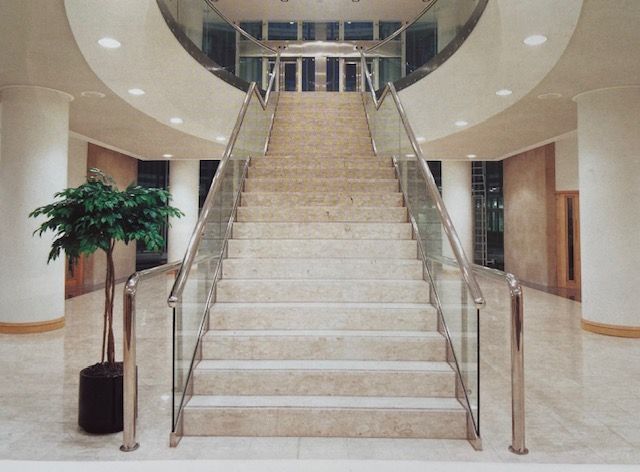
Main stairway. The Napper Partnership.
The building was designed by The Napper Partnership (which also designed law courts at Greater Manchester, Bournemouth, Gloucester, Newcastle, Bradford, and Teesside), and construction undertaken by Laing Yorkshire. It took 30 months to complete, coming in three weeks ahead of schedule, and opened for business on programme on 1 November 1995.
The result was a five-storey rectangular building planned around a central courtyard. At second floor level a broad public concourse looking out into the courtyard gave access to the ten Crown Courts. The building was designed to utilise the sloping site which allowed the custody vehicle lock to be provided at lower ground together with the custody area and staff secure covered parking.
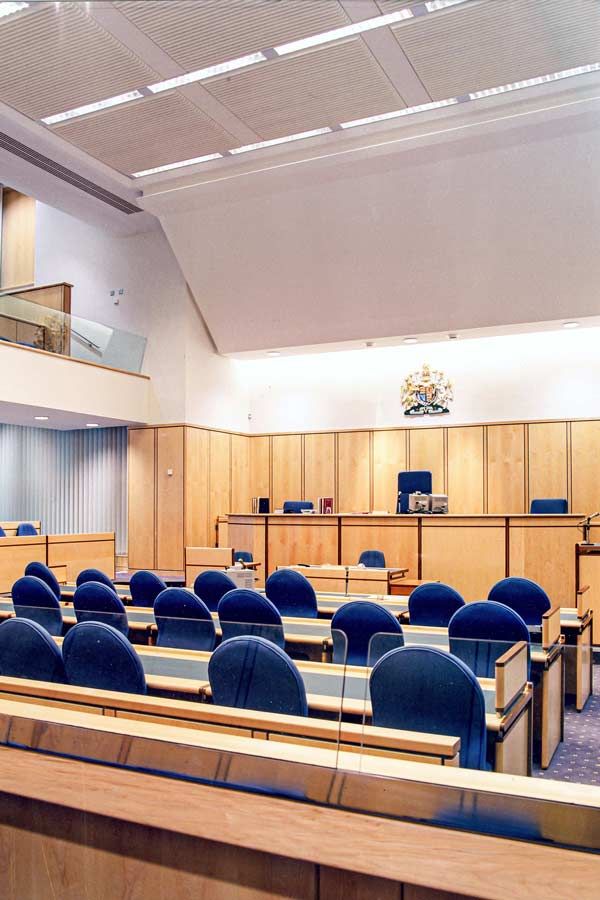
The courts had pale maple joinery, high ceilings and extensive windows, a far cry from the dark court rooms of old.
A Crown Court courtroom. Photograph: The Napper Partnership.
The aim of the design was to establish a tradition by using local materials within an understandable architectural language.
The structure of the building and its organisation in plan and section were clear and distinct, with the column grid forming the basic module for the design of the elevations. The courtrooms situated at second floor level were expressed externally as projecting stone bays supported on robust stone pillars.
Harman and Minnis, in Pevsner’s Architectural Guide, weren’t impressed: –
“A large and forbidding complex built 1993-96, they display a disconcerting mixture of Postmodern elements as though the architects were hedging their bets. The disparate elements simply do not add up, and the result is a building that is as pompous as it is graceless.”
Main entrance. Photograph: The Napper Partnership.
The Law Courts were officially opened by the Right Hon, The Lord Peter Taylor of Gosforth, Lord Chief Justice of England, on 17 May 1996. He was seriously ill at the time and died a few weeks later. Princess Anne made an unannounced visit to the Law Courts in July 2021 to unveil a plaque marking the 25 years since the building was first opened (it had been postponed from 2020 due to the pandemic).
Aerial view of the Law Courts. Photograph: Google.
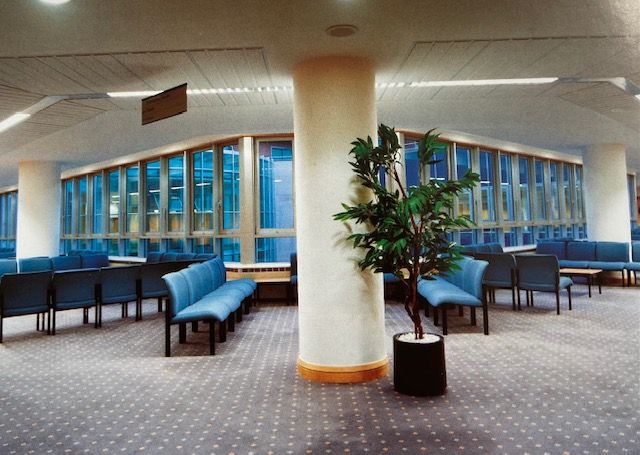
Public concourse. Photograph: The Napper Partnership.
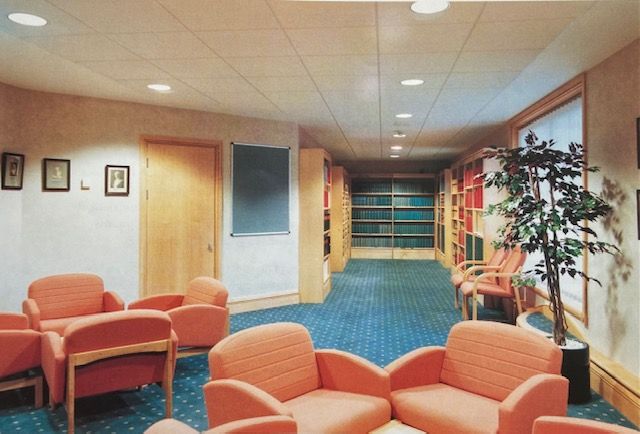
Judges’ lounge. Photograph: The Napper Partnership.
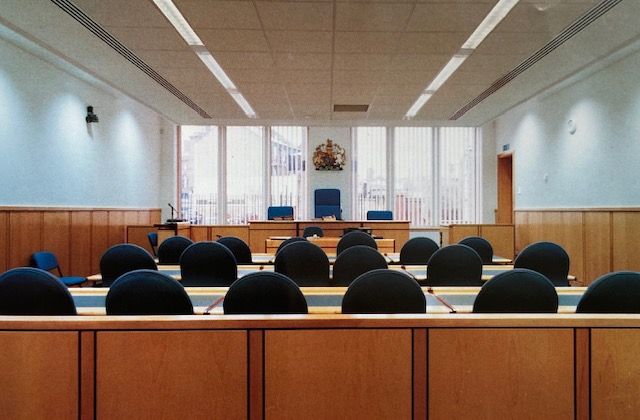
A County Court courtroom. Photograph: The Napper Partnership.
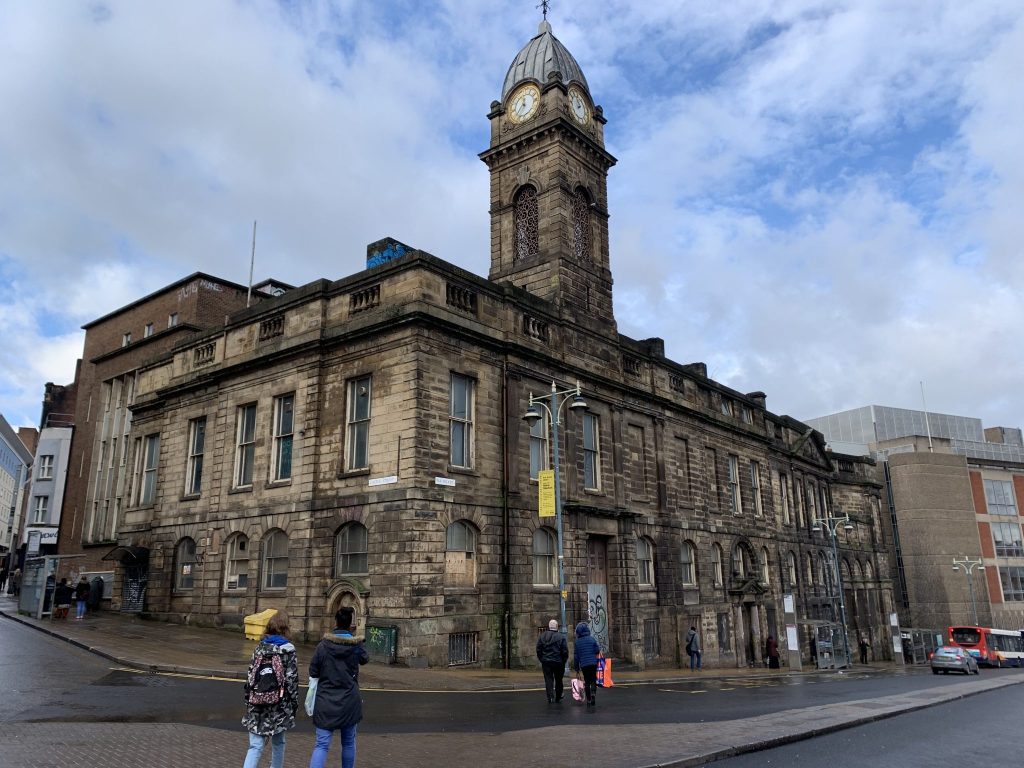
The Old Town Hall and Court House, at the corner of Waingate and Castle Street. It was built in 1808, and enlarged in 1833 and again in 1867. It replaced an older Town Hall and Court House built in 1700 and pulled down in 1808 which stood at the gates of the Parish Church (Cathedral) across open space that became the entrance to East Parade. Adjoining this Town Hall and facing down High Street were the stocks and pillory which were then in active use.
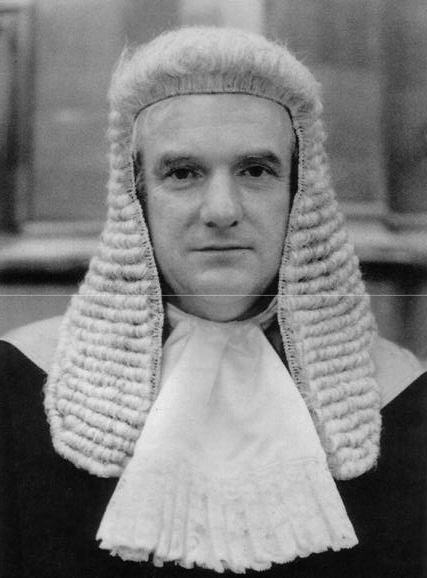
There has perhaps only been one authority on law in Sheffield, and that was Judge David Ronald Bentley Q.C. (1942-2012) who wrote ‘Courts & Court Houses in Sheffield’. The Sheffield-born judge pieced together the city’s judicial history from its days as a manorial court at Sheffield Castle to the opening of the Sheffield Combined Court Centre at West Bar in 1996.
“Sheffield grew up around the castle erected early in the 12th century by William de Lovetot. It was a manor and had its own manorial court. In the 13th century this sat in the castle itself. Unlike the manorial courts of nearby Ecclesall, it was a court leet, possessing both criminal and civil jurisdiction. Minor civil disputes arising within the manor were tried there as was petty crime. Later its place of sitting was moved to Sembly Green (now the Wicker), earning it the nickname of the Court of Sembly Quest.
“By the 17th century criminal jurisdiction had passed to the Justices of the Peace for the West Riding. They sat in the town to try petty offences and to hold preliminary examinations in cases of felony.
“In 1700 a Town Hall was erected at the south-east corner of the Parish (now the Cathedral) Churchyard. This building, which had cells for the detention of prisoners, was for much of the 18th century used by the Justices as a court-house. By 1800, however, they had taken to using a room on the ground floor of the Cutlers’ Hall in Church Street (known locally as Bang Beggars Hall).
“On court days the prisoners waiting to be dealt with would be stood in gangs in the churchyard and then taken across when their cases were called on. Those sentenced to imprisonment or sent for a trial in custody at the West Riding Quarter Sessions were despatched to the Wakefield House of Correction (a journey they made chained together and on foot). Those sent for trial at the Assizes were taken to the county gaol at York. Although having at the beginning of the 19th century a population of 45,000, Sheffield had neither Quarter Sessions nor an Assizes Court.
“The civil jurisdiction of the local manorial courts continued into the 19th century. In 1756, a local Act of Parliament had constituted the Sheffield and Ecclesall courts (Courts of Requests), with jurisdiction to try claims for sums of less than 40/ (later increased to £5). Each had its own debtor’s prison. The Sheffield prison was originally in Pudding Lane (now King Street) but in 1818 was moved to Scotland Street. That for Ecclesall (known as Little Sheffield Jail) stood at the corner of Bishop Street and Tudor Street Moor (later Thomas Street), near Moorfoot. Each court had jurisdiction over claims arising within the area of each other (a provision designed to prevent debtors escaping arrest by moving from one manor to the other).
“In 1808, the Town Trustees demolished the existing Town Hall and built a new one at the corner of Castle Street. From its opening in 1810 this building served as court-house for both the West Riding Magistrates and the Courts of Requests.
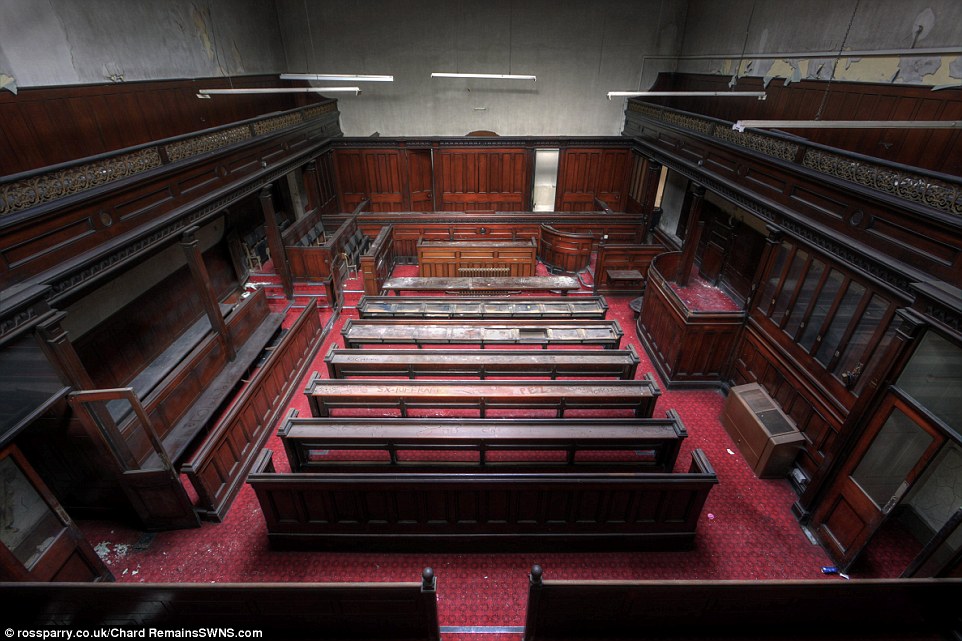
One of the former courtrooms at Castle Street. The building has been empty since 1996 and is in perilous condition. Photograph: Mail Online
“In 1841 a committee of prominent townsmen was formed to petition the Crown for Sheffield (population now 110,000) to be granted a charter incorporating it as a Borough. In 1848 the Borough was granted its own Commission of the Peace. Thenceforth two Magistrates courts sat at Castle Street – a Borough Magistrates’ court trying cases arising within the town and a West Riding court trying cases from the outlying district.
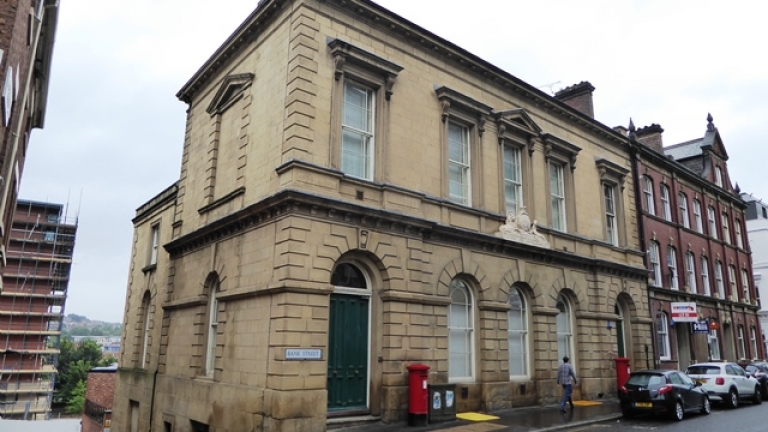
“The incorporation of the town meant that Sheffield acquired its own Borough Coroner. Inquests at this date were commonly held in public houses (in 1876 the inquest into the Banner Cross murder for which Charlie Peace was hanged was held at the Stag Inn, Sharrow Head), and this unsatisfactory practice only ended with the building of a public mortuary and coroner’s court in Plum Street in 1884 (replaced in 1914 by a new building in Nursery Street and in 1977 by the present Medico-Legal Centre). In the meantime, the Small Debts Court Act, 1846 had been passed providing for the establishment of county courts throughout England and Wales. Sheffield got its own court in 1847. At first it sat in Castle Street but in 1854 a County Court Hall was erected in Bank Street. The coming of the County Court meant the end of the Courts of Requests.
Old County Court House, Bank Street. Photograph: Crosthwaite Commercial
“In 1864 both Manchester and Leeds were made Assize towns (belatedly following Liverpool in 1835). The Borough Council promoted a Bill to make Sheffield an Assize town in 1867, planning to erect a new court-house in Castle Street on the site of the existing court-house and the adjacent Black Rock public house. The West Riding was scandalised, particularly Doncaster Borough Council, not wishing to fund a new public building in Sheffield, and the Government made it clear that it would not grant its status.
“In 1880 Sheffield sought and was granted its own Quarter Sessions. Its first Recorder was Alfred Wills Q.C., who fifteen years later, would try and jail Oscar Wilde. Its court-house was the Castle Street building. In 1888 Sheffield became a County Borough and was created a city in 1893, and by the early 20th century, was the most populous city on the North-eastern Circuit with no Assize.
“In the 1930s the Council took up the question asking the Royal Commission on the Despatch of Business at Common Law. In its Third Report (1936) the Commission urged that the city’s claims be given ‘the most sympathetic consideration’, and later the same year the Circuit Towns Committee recommended that Sheffield become an Assize town. The City Council busied itself with plans for a new court-house. Initially the site of the old Albert Hall (Cole Brothers) in Barker’s Pool was considered.
“Eventually, the Council plumped for a site in Eyre Street close to the Central Library. A compulsory purchase order was obtained but WW2 brought the scheme to a halt.
“In 1953, Lord Chief Justice Goddard declared that Castle Street court-house would serve as a temporary home for the Assizes. Alterations to the place were made, and Whirlow Court, which had been acquired as judges’ lodgings, converted to its new purpose (pre-war the Council had contemplated acquiring nearby Parkhead House).
“In 1955 an Order in Council was made creating Sheffield a new Assize Division, and on June 23 the first Assize was held. In 1962 the Sheffield Assize Division was by Act of Parliament made a separate judicial county (Hallamshire) with its own High Sheriff.
“Sheffield’s Assize so long in gestation had only a short life. On January 1, 1972, it was, together with the City Quarter Sessions, swept away and replaced by the Crown Court.
“The Castle Street court-house served as the home for the new court. In 1978 the City Magistrates moved out to a new court-house a few hundred yards away, releasing more court rooms for use by the Crown Court. But even this proved insufficient. In 1984-85 the County Hall Court was provided with cells and courtrooms capable of taking criminal cases as an overflow building for the Crown Court.“
It wasn’t until 1996 that all these were closed and moved to the new Combined Court Centre at West Bar. The Castle Street court-house (more commonly referred to as the Old Town Hall) has remained empty, but never out of the news, ever since.
The new Law Courts at West Bar opened in May 1996.
Judge David Ronald Bentley Q.C. (1942-2012). Photograph: (Image: Old Edwardians)
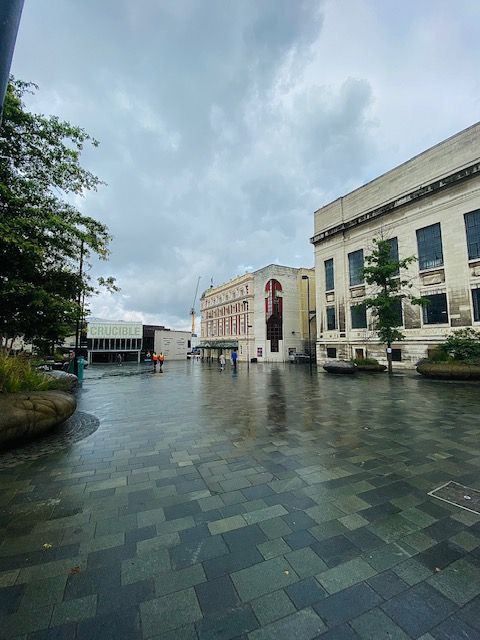
Tudor Square. The gated road on the right, between the Central Library and Lyceum Theatre, is Tudor Place, once the site of Tudor House. Photograph: DJP/2021
Tudor Square, the home of theatres, the library, and the Winter Garden, and created in 1991 to become Sheffield’s cultural centre. But how did it get its name?
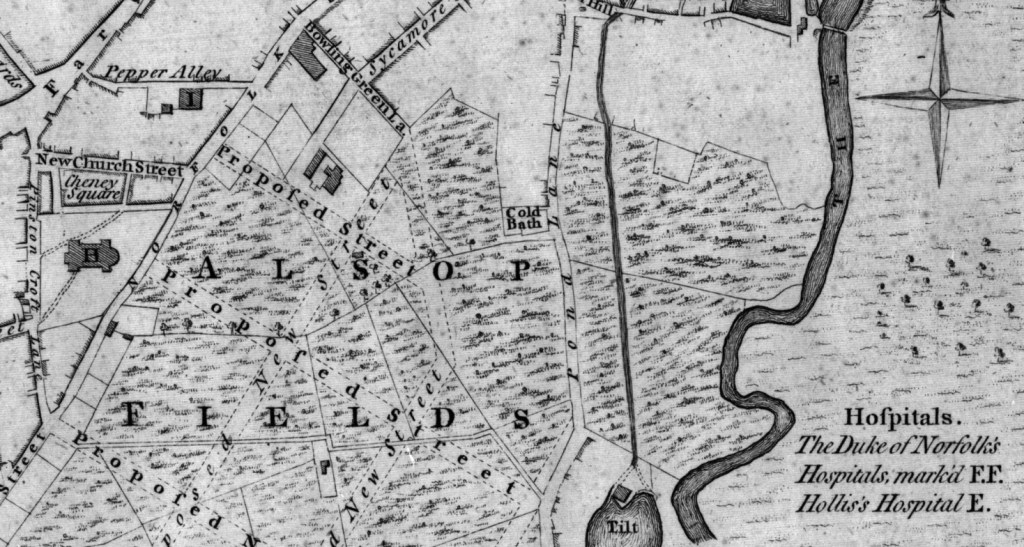
Let us go back to the late 1700s, and we would be standing in the grounds of Tudor House. This Adam house was built in 1770 for Dr Sherburn with commanding country views across Alsop Fields. The gardens extended to the front and right, the land sloping down across what is now Arundel Gate, amid sycamore trees, to the margin of the Sheaf.
Now let us introduce Henry Tudor, a man identified by Dr Sherburn to become head of a firm making the best wrought silver plate. Tudor teamed up with Thomas Leader and the firm of Tudor and Leader was created, eventually building a workshop close to the house. Dr Sherburn showed his appreciation of the efforts of his active partners by bequeathing the bulk of his property to Henry Tudor, with a share in the concern to Thomas Leader.
Henry Tudor moved into what became Tudor House, while Thomas Leader rented a house nearby that the Duke of Norfolk built for his land agent and became known as Leader House.
Fairbank’s Map of Sheffield 1771. Tudor House is shown on the left of the map below Bowling Green Lane (later Arundel Street). The proposed road became Surrey Street. Just above the letter ‘s’ is Leader House. Photograph: Picture Sheffield.
Mr Tudor was for many years a prominent man in the town’s affairs – as a Town Trustee, one of the first Guardians of the Assay Office, and in other offices. He had the reputation of being the proudest man in Sheffield, and this earned him the title of ‘My Lord Harry.’ He was highly indignant at finding another Henry Tudor, a journeyman, and he vainly endeavoured to bribe the man to change his name.
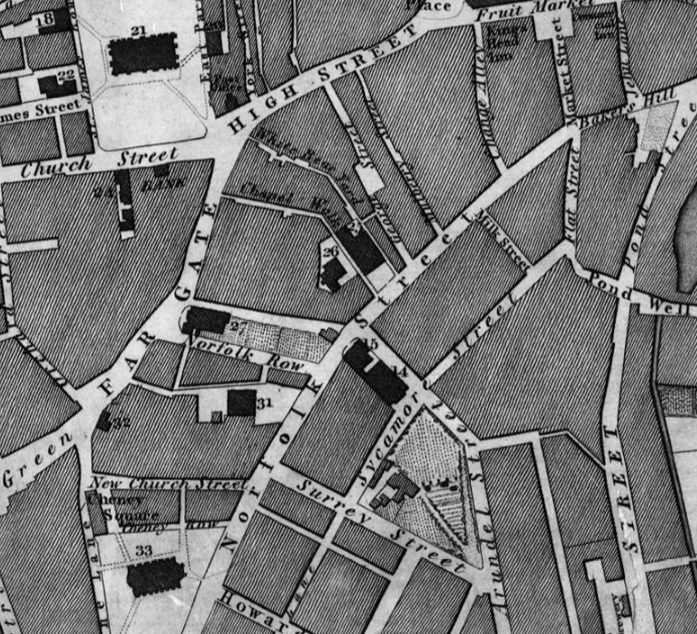
This idyllic retreat, with bright flowers and country air, changed as Sheffield grew. The front garden became a bowling green, and in 1808, the house of the late Henry Tudor, though shorn of its once extensive grounds, retained as garden, the whole of the triangle which with Tudor Street as its base, had its sides along Arundel Street and Surrey Street, and its apex at their junction. Narrow streets (Tudor Street, Tudor Place) had surrounded it, with industry spreading into the Sheaf Valley below. By now, one of the Lucas’s, of the Royd’s Mill Silver Refinery, was the occupant of the house, coach-house, and stables.
Fairbank’s Map of Sheffield 1808. Tudor House had lost much of its land, but still had a garden enclosed by Surrey Street, Arundel Street and Sycamore Street. The portion of Sycamore Street, nearest the house, became Tudor Street. Photograph: Picture Sheffield.
Tudor House stopped being a home, its remaining land sold off, and it became a Dispensary (1832-33), the Tudor Place Institute (a bible society), Medical Officer’s Department, and Offices of the Weights and Measures Department.
In 1872, a letter appeared in the Sheffield and Rotherham Independent.
“Passing through Tudor Place the other day I could not help being struck with the lost and demoralised appearance it presents. Grimy brick walls, whose monotony is increased by tattered shreds of flaring posting bills, stare at the once considerable residence of Henry Tudor, which, with its ancient adornments of wreathed flowers, contemplates with an aspect which is the height of melancholy, the deep puddles, the chaotic boulders, the piles of stones, the layers of timber, and general waste heap look that have invaded the sacred precincts of its once charming garden. The parade ground of the Artillery Volunteers and the other buildings that intervene between Tudor Place and Arundel Street have usurped the place of the flower beds and fruit trees of Henry Tudor, and the sycamores that surrounded his domain have their memory perpetuated in the adjoining street, that breathes a fragrance of anything but bright flowers and green trees.”
The parade ground mentioned was cleared, and a large wooden circus erected. It later became the site of the Lyceum Theatre and Tudor House’s last use was as storage for theatrical scenery.
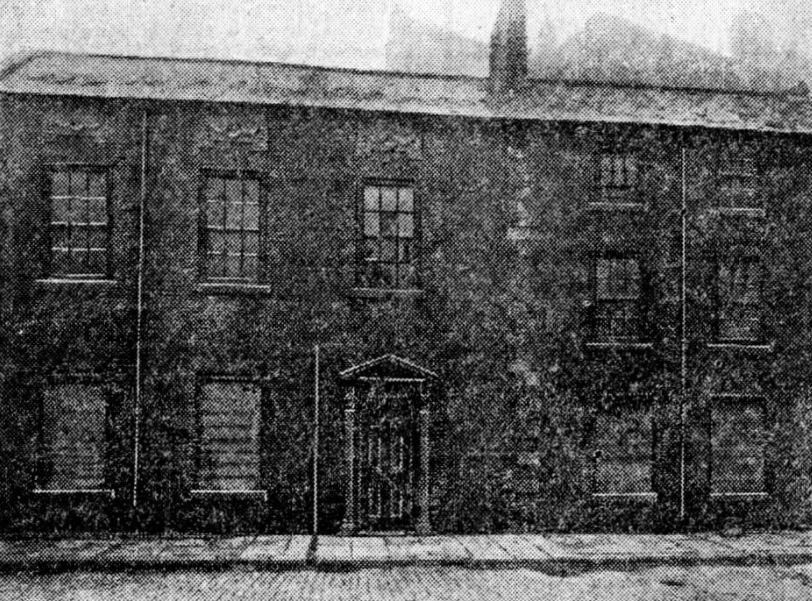
This might be the only photograph in existence of Tudor House. It was taken in 1907 and the house was demolished the following year. Photograph: British Newspaper Archive.
By 1908, Tudor House was doomed.
“It is remarkable that at the moment when a special appeal is being made for funds for the erection of a new Infirmary in the city the home of the oldest of our medical charities, the Sheffield Dispensary, is about to be demolished. The building referred to is in Tudor Place. Its broken windows and deserted appearance give little indication as to the important part it played for many years in the alleviation of suffering humanity. A few days, and the building will be demolished. What is to become of the old operating table which is in the old building? A gruesome relic it would doubtless be, but it is surely worthy of consideration whether something cannot be done with a view to preserving it from the flames.”
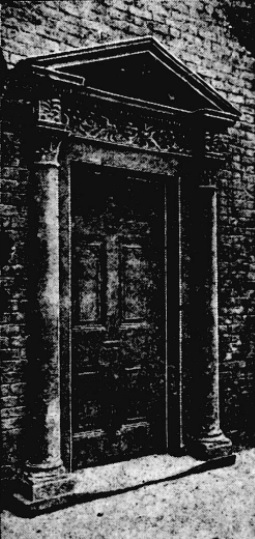
The most striking feature of the building was the door, which, with its surroundings, indicated that in its day the building was considered of some importance.Photograph: British Newspaper Archive.
The house was demolished, the old oak panelling chopped up, and the Adam mantelpieces with one exception (rescued by artist Charles Green), shared a similar fate, with the promise of a few shillings to a workman employed in the destruction, for carting it away.
The site stood empty until the 1930s, and its foundations lie somewhere beneath the Central Library. The old roads – Tudor Street, Tudor Way, Sycamore Street – have long disappeared, and only Tudor Place survives as a private road between the Lyceum and the Library.
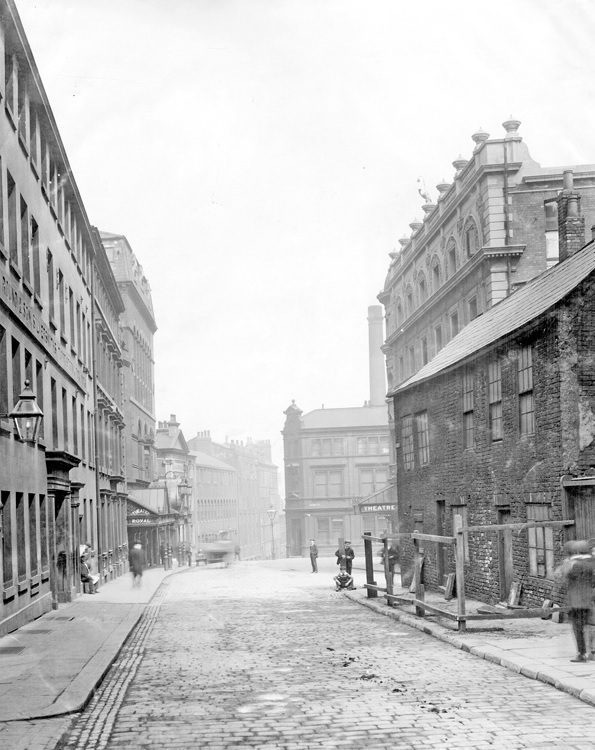
This image is dated between 1900 and 1919 and may possibly show buildings once connected with Tudor House (on the right). This is looking down Tudor Street towards Sycamore Street and Arundel Street. On the left, John Round and Son, silversmiths, built on the site of Tudor and Leader’s old workshops. The Theatre Royal is on the far left (it subsequently burnt down). The only familiar landmark is the Lyceum Theatre on the right, separated from the Tudor House buildings by Tudor Place. Today, this is the exact location for Tudor Square. Photograph: Picture Sheffield.
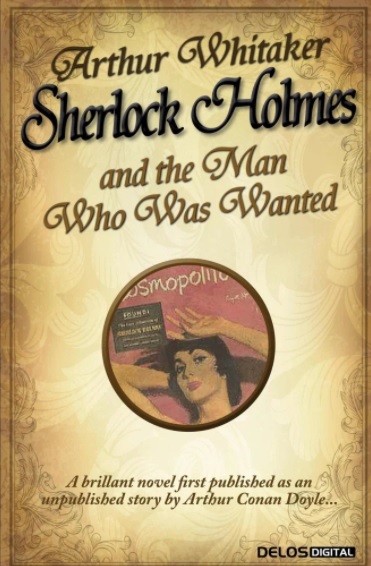
The August 1948 edition of America’s Cosmopolitan Magazine which featured ‘The Last Adventure of Sherlock Holmes – The Man Who Was Wanted.’ Photograph: WorthPoint.
This might have been called ‘Arthur Conan Doyle’s Last Case,’ except it was one which that great writer left to others to solve and involved a story with Sheffield connections.
Arthur Conan Doyle died in 1930 and several documents, unused typescripts, and odd papers, were placed in a deed box by Lady Conan Doyle. Among them were some typewritten pages headed, ‘The Man Who Was Wanted,’ recounting a hitherto unrelated adventure of the great Sherlock Holmes.
Reference was made to it by Hesketh Pearson, a biographer of Conan Doyle, and the revelation caused a literary stir. People clamoured for its publication, American and British editors approached the Conan Doyle family, and tempting prices were mentioned. But the family were unwilling to sell at the time.
Some years later, the American Cosmopolitan magazine acquired the right to print the story in the United States, and in Britain, shortly after Christmas 1948, it was published by the Sunday Dispatch.
It prompted a letter to the Conan Doyle family from Arthur Whitaker, a slim, grey-haired man, who was living in Longridge, near Stroud, and spent his days collecting ornithology reports from bird-watchers in Gloucestershire.
“You know that story called ‘The Man Who Was Wanted,’ which appeared in an American magazine and in the Sunday Dispatch? Well, I wrote it. I don’t want any money or publicity, of course, but I just thought you’d like to know, that’s all.”
It caused upset in the Conan Doyle family and a solicitor began to investigate the claim. He interviewed Whitaker, examined a letter from Arthur Conan Doyle, and saw that he had an exact carbon copy of ‘The Man Who Was Wanted.’
“It is quite simple, really,” said Mr Whitaker. “In 1911 I was a young architect, married, and living in Barnsley. I thought I might earn a little more money by writing detective stories, so I wrote five or six. One was called ‘The Man Who Was Wanted.’ I sent it to Arthur Conan Doyle, asking him whether he ever collaborated in story-writing, and if he would like to collaborate with me.
“He replied that the story was not bad, but that he did not collaborate; he sometimes paid ten guineas, however, for an idea which he later worked up in his own way. He advised me to change the names in the story and get it published myself. However, I accepted the ten guineas, and he retained the typescript. That’s all there is to it, really.”
Because the typescript was unsolicited, the Conan Doyle family had retained it but held back on publication believing it was not up to the great man’s standards. However, Arthur Conan Doyle’s son, Denis, had eventually allowed publication with a note to that effect, and adding that the family had at last yielded to public pressure and had allowed it to be printed.
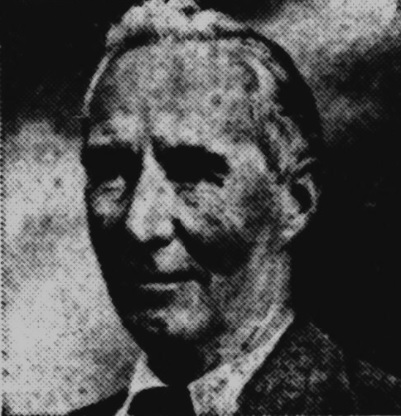
Arthur Whitaker, a ‘simple, frank type of man, living in Barnsley, away back in 1911, when there were hansom cabs, and young men wore luxuriant moustaches and straw boaters.’ Photograph: British Newspaper Archive.
And the Sheffield Connection? I quote from the pages of ‘The Man Who Was Wanted.’
“Holmes picked up a telegram from the table and looked at it thoughtfully. “If only the inquiry this refers to promised to be of anything like the interest of some we have gone into together, nothing would have delighted me more than to have persuaded you to throw your lot in with mine for a time; but really I’m afraid to do so, for it sounds a particularly commonplace affair,” and he crumpled the paper into a ball and tossed it over to me.
“I smoothed it out and read: “To Holmes, 221B Baker Street, London, S.W. Please come to Sheffield at once to inquire into case of forgery. Jervis, Manager British Consolidated Bank.”
“It appears that a gentleman named Mr. Jabez Booth, who resides at Broomhill, Sheffield, and has been an employee since January I88I, at the British Consolidated Bank in Sheffield, yesterday succeeded in cashing quite a number of cleverly forged cheques at twelve of the principal banks in the city and absconding with the proceeds.”
The Conan Doyle family returned the money it received from the Sunday Dispatch and the newspaper forwarded it to Arthur Whitaker to help him support his seriously wife.
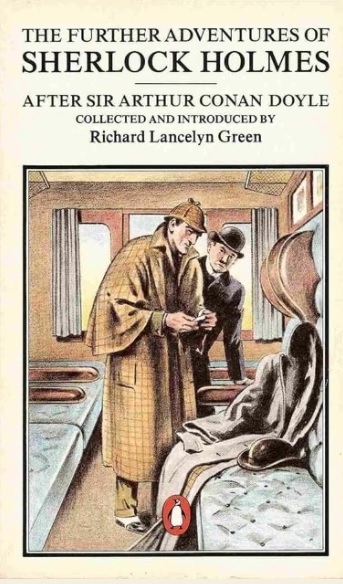
The story itself eventually appeared in ‘The Further Adventures of Sherlock Holmes: After Sir Arthur Conan Doyle.’ It was credited to Arthur Whitaker and retitled ‘The Adventure of the Sheffield Banker.’








 sheffielder.net