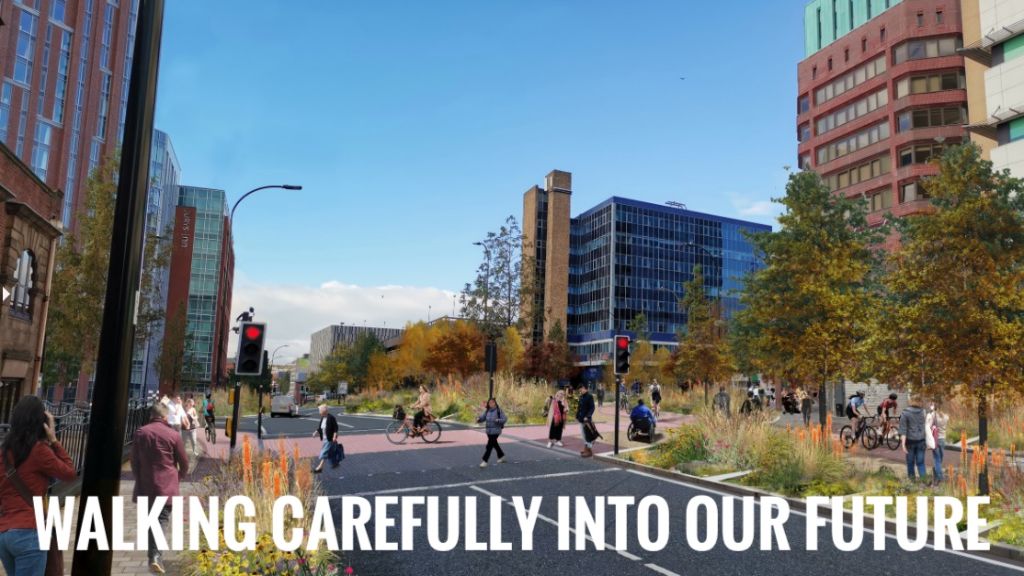
Our city centre may take on a new look if plans to pedestrianise large swathes of it get the go ahead. Sheffield City Council want to make foot and bicycle journeys easier and quicker, while streamlining public transport services.
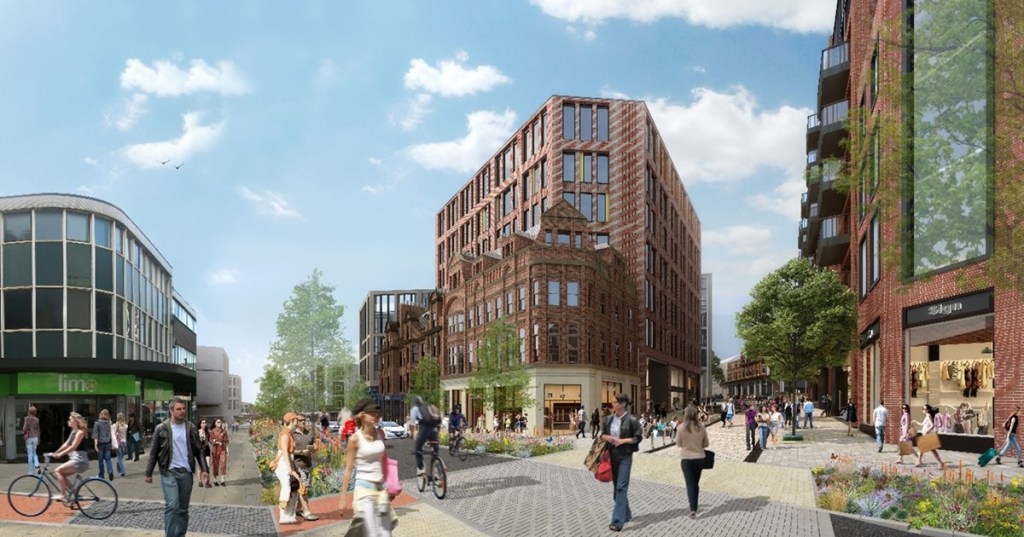
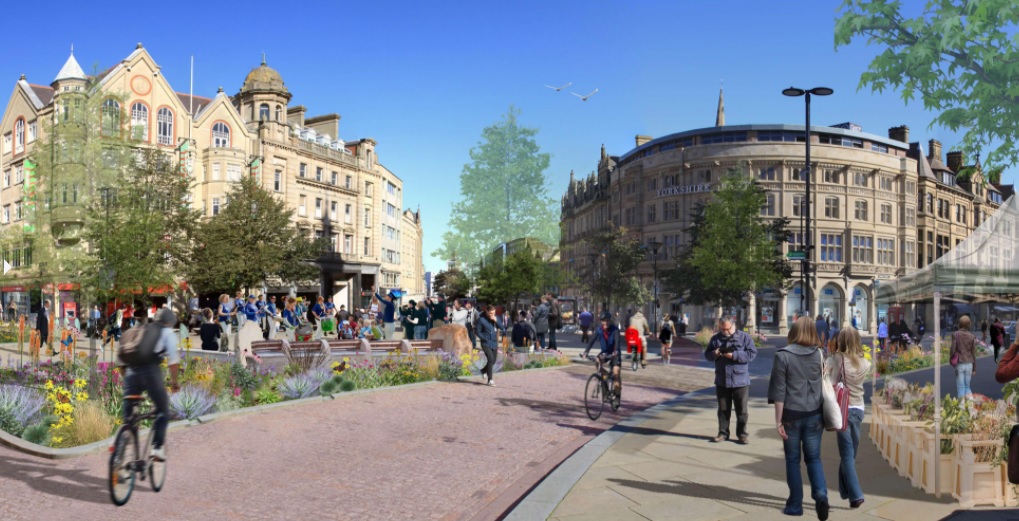
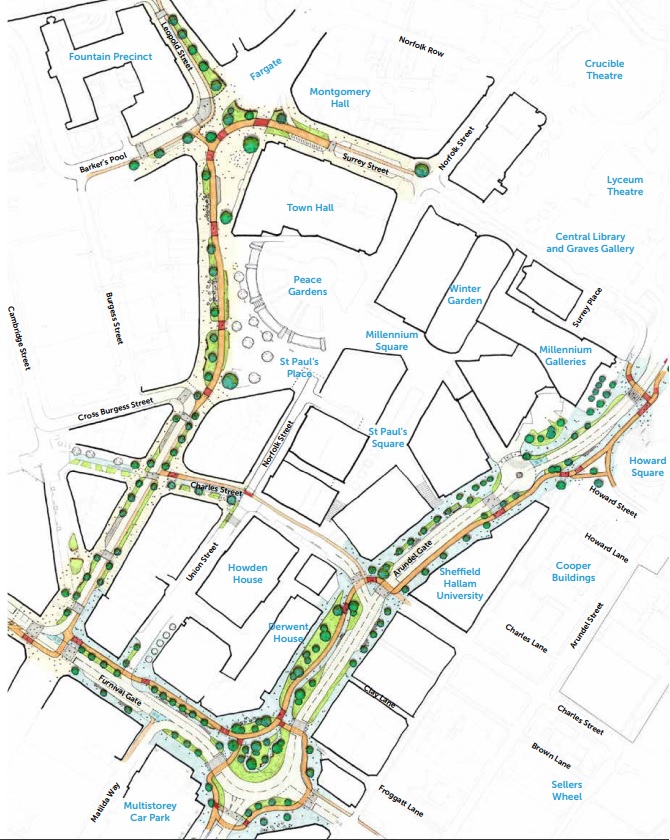
The proposals include pedestrianisation to Pinstone Street and Leopold Street, linking Fargate with the Peace Gardens, as well as Charles Street between Union Street and Pinstone Street. The pedestrianisation of Surrey Street would create a traffic-free Town Hall Square.
Work would include more greenery, replicating the ‘Grey-to-Green’ scheme already seen between Castlegate and West Bar.
Bus gates would be installed in both directions on Furnival Gate, and along Arundel Gate to Norfolk Street
Rockingham Street would get a new bus hub with improvements to pavements, green planting, a pocket park, and bus stops.
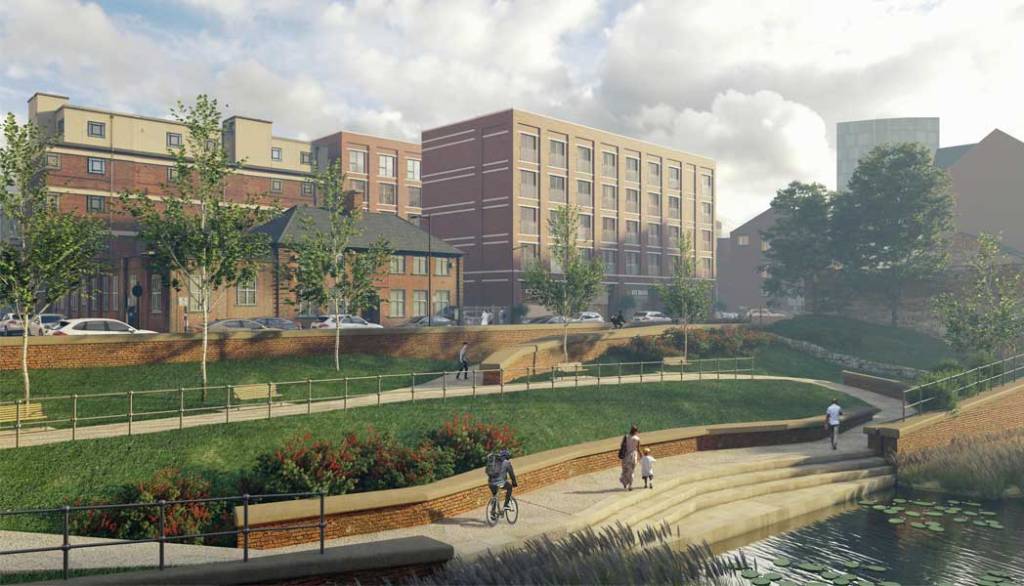
The future of our city? Pedestrianisation of Pinstone Street and Charles Street connects with Heart of the City II redevelopment, due for completion in 2021. (Image: Connecting Sheffield)
Of course, there are benefits to the scheme – improved air quality, better accessibility to shops and businesses, a more attractive city centre, and public spaces that create city uniqueness.
Artist impressions paint a bright picture, but there are notes of caution.
Sheffield city centre is at a midpoint in its regeneration, with the pandemic decimating footfall, and placing even more uncertainty on retail, hospitality, and office space requirements.
The city centre is a travesty of its former self, Covid-19 exposing retailers already reeling from Meadowhall and the internet. And, after restrictions are eventually lifted, how many pubs, bars, and restaurants, will have survived?
Half-hearted attempts to open cycle lanes at the heart of the city, further reducing traffic flow, have met with lukewarm response. With respects to cyclists, our seven hills make four wheels the favoured choice in and out of the city.
The prospect of a Town Hall Square, with pedestrian access and cycle routes linking Fargate, Leopold Street, Surrey Street, and the Peace Gardens. (Image: Connecting Sheffield).
The key to any redevelopment must take into consideration transport links.
Cars are already deterred from entering due to over-complicated traffic flow and the extortionate cost of parking. Our buses remain empty, not least because nobody knows where they go, or where to catch them anymore. Our elderly citizens must walk a distance to catch a bus, and the question remains whether they will bother anymore?
We must tread carefully, mindful that change must happen if our city centre is to be revitalised.
Any changes must take place before 2023 to qualify for a Government grant, managed by Sheffield City Region, and must be subject of public consultation.
An overview of the ‘Connecting Sheffield’ proposal, providing a green space around the city centre. (Image: Connecting Sheffield)
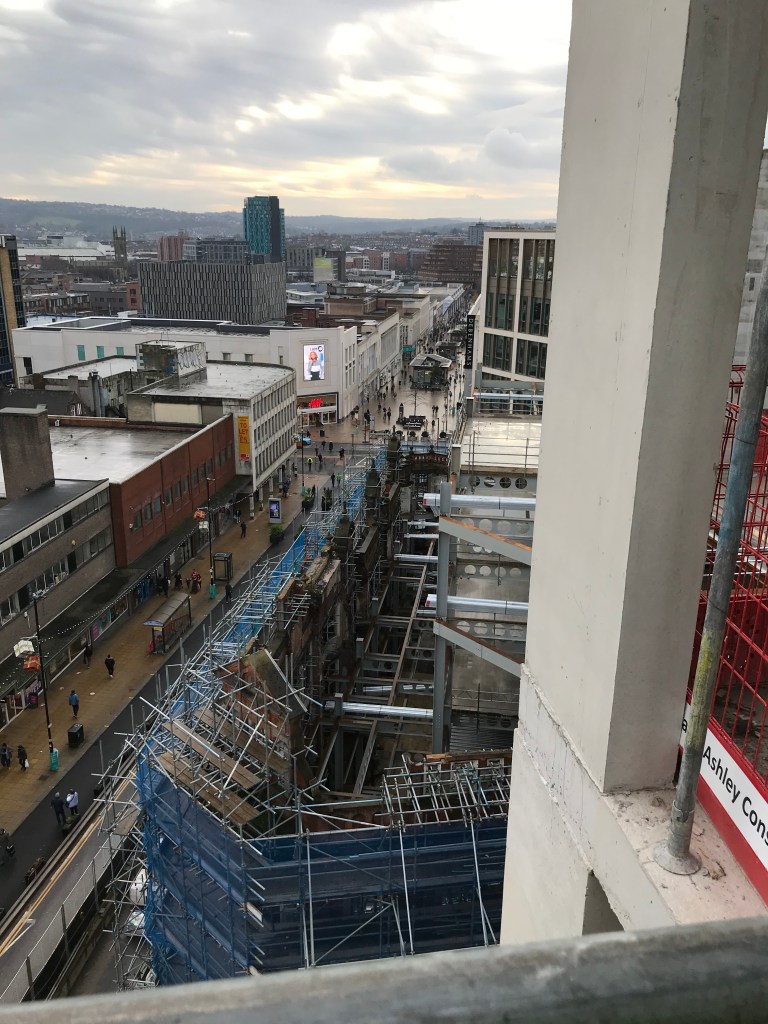
Scaffolding and new steel work support retained Victorian fronts on Pinstone Street. (Image: Heart of the City II)
A photograph that tells a story. The remains of the Victorian facade at the lower end of Pinstone Street in Sheffield city centre. Everything behind has been demolished, and the famous old fronts preserved for posterity.
Block C of the Heart of the City II masterplan is located between Pinstone Street, Cambridge Street and Charles Street.
It incorporates two historic building blocks which form the southern end of the Pinstone streetscape.
The combined façade and its dramatic roofscape is an excellent example of Sheffield brick and terracotta architecture. It occupies a prominent position and is visible from the Peace Gardens through to The Moor.
Block C will be home to 39,000 sq ft of premium Grade A office space, serving 450 employees, plus six premium retail units comprising over 8,000 sq ft.
It will be known as the Isaacs Building, named after Edwardian-era paper-hangings merchant David Isaac, and is scheduled to be completed in 2021.
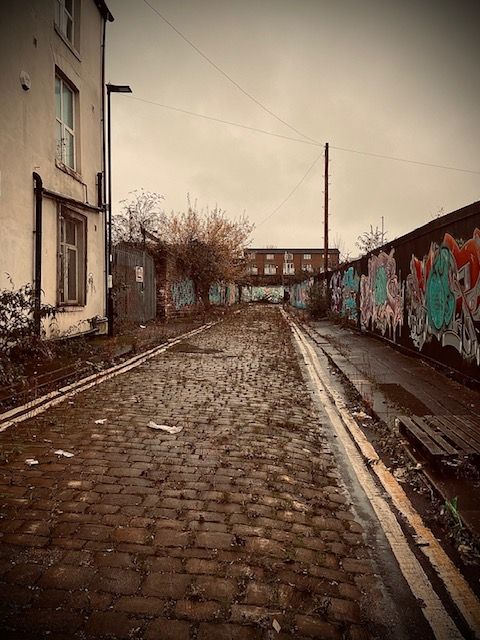
Cobbles glisten in the rain, weeds grow through cracks, but this pitifully empty street is a poignant reminder of our past.
Brownell Street, at Netherthorpe, is in a sorry state and awaits nearby redevelopment.
But if we go back in time, this was one of the poorest streets in Sheffield, a slum at the heart of St. Philips, where families crowded together in dirty back-to-back houses, fought to make ends meet, and fought one another.
Crime was rife, and it was only after the broken-down houses were boarded-up, then demolished, that order was restored.
It is an empty space now, but what stories these cobble stones could tell.
Tales of horse and carts. Damp houses, unfit for human habitation. Tuberculosis, influenza, pneumonia, bronchitis, and infant mortality. Brawls, stabbings, and gun shots. Tales of the unruly Jericho Gang. Gambling. Happiness. Births, weddings, and certain death. Tragedy and despair. And tales of a better life that existed somewhere else.
The houses disappeared in the 1930s and most of the people vanished with them. From the slums came industry, and as history repeats itself, industry has given way to housing again.
The upper end of Brownell Street might have been lost to Netherthorpe Road (and Supertram), but the area is blooming with new-build student accommodation.
Remember these cobbles because next time you look, they’ll probably be gone.
The story of William Fox Tibbitts is remarkable. A man of extraordinary business acumen but who lived the life of a poor man.
At the time of his death in 1927 he was described as “probably the most eccentric rich man in Sheffield.” He was a mass of contradictions, so bizarre and so unlikely that only personal sight and knowledge of them could make them credible.
Tibbitts was born in 1842, educated at Collegiate School, and was the last in a long line of Sheffield attorneys, a profession he turned his back on to become a shrewd property owner and speculator in stocks and shares.
He lived at Netherthorpe House, built by the Hoyle family in 1750, at what was once the centre of an estate of green fields. By the time he died, the house was in one of the poorest districts of Sheffield, situated at the junction of Meadow Street and Hoyle Street, surrounded by back-to-back houses, mean streets, shops, and the smoke of works.
Tibbitts’ father had married into the Hoyle family, one of noble recognition in Sheffield, and to which Hoyle Street got its name.
William Fox Tibbitts bought block after block of property at Upperthorpe and ultimately almost all that district fell into his hands, and he became known as the ‘Upperthorpe Lawyer’. He also purchased properties in Skegness and London.
Tibbitts was of careful disposition and in his early years said he could not afford to marry, and in later years had no inclination toward marriage.
Notwithstanding his eagerness to amass money, there was a kindly disposition to him and frequently befriended poor people offering them free legal advice.
His motor-car was a Corporation tram; he was a keen traveller, mountain climber and walker; a wizard of finance who kept personal records of all his shares and transactions in old-fashioned ledgers with a medley of out-of-date newspaper cuttings; a solicitor who sold coal mines; a big landowner who let off a portion of his own house as a surgery and who had titled relatives in the highest rank; a man who might have been Lord Mayor, but never tried to enter public life.
William F. Tibbitts. Image: British Newspaper Archive
Shortly before his death in March 1927 he agreed to an interview with a reporter from the Sheffield Independent: –
“I recently found him at his house. Several minutes of ringing called his housekeeper, and I was ushered into the presence of a well-preserved, very old and venerable man seated before a small fire by a desk poring over a rent book in a sparsely furnished office lit by a single lamp in a common shade. He greeted me with kind courtesy and, with an emphatic embargo on notebooks, he talked almost as a monologue for two hours.
“’My friends tell me that I should take a house in the country,’ he said, ‘but if I did I should never be able to get down here to work every day, and I often take a penny ride on the tramcar for exercise. People will not believe me when I say that I can hardly afford to keep this old house going.’
“He sighed, and I noted the frayed cuffs of his old coat and the worn waistcoat.
“Yet a few minutes later this amazing old man told me that he sold a colliery (he mentioned its name) and believed that he might have got about £50,000 or more if he had pressed.
“’I held a controlling interest in the shares,’ he explained, ‘but they wanted me to put up the money for another 400 houses at over £400 each, and I refused.’
“Politically, he was still back in 1909, and he revealed an astonishing collection of cuttings denouncing Mr Lloyd George’s Budget campaign (all mixed up with denunciations of Arthur James Cook), and then he bemoaned the break-up of the big ducal estates, the approaching flight of capital from this country, and the especial iniquity of death duties. His newspaper cuttings, yellow and creased, were like leaves of Vallombrosa.
“He knew the Sheffield Stock Exchange Daily Price-List almost by heart, and the sight of it on his desk moved him to further sighs of regret concerning the vast interests he had in shares that were not paying a dividend.
“With a great effort he lifted down a ponderous ledger, scanned the index, and turned up entries recording the financial history of big blocks of shares in Sheffield and other companies. ‘I am the biggest shareholder in So-and-So,’ he mentioned quite casually, and the name he mentioned was that of one of the oldest and biggest steel firms in the country.
“Page after page recorded his holding of thousands and tens of thousands of shares, and a sheaf of company reports, fresh from the postman, gave an idea of what his yearly total of such documents must have been.
“Mr Tibbitts took a boyish pride in speaking of his travelling and mountaineering exploits, discontinued since the war on account of the ‘big charges now made at the hotels.’
“A bachelor, he talked of this and that famous person, whose names are national property, and of this and that big industrial organisation and their weaknesses and scandals far too piquant to repeat, until at long last he closed his ledgers and I rose to leave.
“I had gone, by the way, to ask him for his views on ‘success’. ‘It would not do,’ he had said in refusing. ‘I may finish in the Bankruptcy Court.’”
Tibbitts liked to speak tongue-in-cheek, his wealth assured, and following his death Samuel Mather, a close friend and sharebroker, revealed more about Tibbitts’ character: –
“In ordinary justice to his memory, the idea of some of his supposed eccentricities should be removed.
“He had a simple, unassuming, genial nature, making no display either in his mode of life or dress. When, on our walks, we had been asked to help some good cause, it was a surprise to the recipients to get a gold coin instead of a silver one which was all that was expected from a plainly attired wayfarer.
“Most sensible men enjoyed wearing an old comfortable suit but cannot afford to defy convention by doing so except when pottering about the garden.
“Ostentation was an anathema to him. ‘Why,’ he said, ‘should I be troubled with all the cares occasioned by the upkeep of a large establishment.’ His only desire was to be comfortable. His residence was not in a salubrious neighbourhood, but he had grown accustomed to the old home of his family, and so remained there, notwithstanding the change in the character of his surroundings. It was, too, convenient as an office and for his workmen.
“Living as he did, a somewhat self-centred life, it was perhaps inevitable that, as do many others, he should possess the defects of his qualities, but it would be a good thing for our city and country , as well as for themselves personally, if others could be induced to follow in his footsteps.”
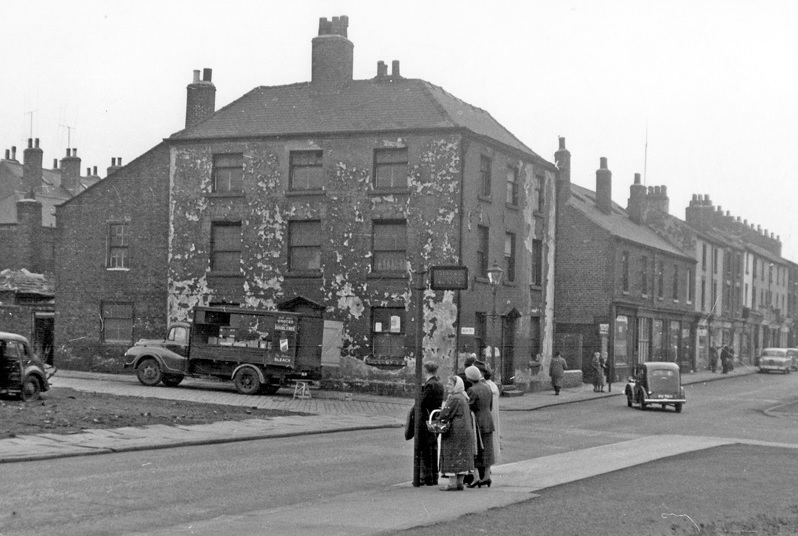
Netherthorpe House in the early 1950s. Image: Picture Sheffield
After his death, press speculation said Tibbitts had left about £2 million to his niece, Sheffield-born Henrietta Sarah Fisher, who lived at Tunbridge Wells, and this prompted her to avoid media attention by fleeing to France.
The actual figure was £1.5 million, and after dispositions and death duties, the amount left to her was £938,000.
In the 1930s she returned to Sheffield and made her home at the Kenwood Hotel before moving to Devon. In her lifetime she gave generous donations to the Royal Hospital as well as providing £2,100 for the purchase of Prior Bank at Nether Edge, a home for rest for the chronically ill, and gave £1,000 for the relief of post-Blitz distress in 1941.
She died in 1950, leaving £1.49 million, but death duties amounted to a staggering £1.14 million, leaving just £350,000 to be distributed as per the terms of her will.
After personal bequests, she left sums of £5 each to be distributed among Sheffield’s oldest tenants and her cars were left to her chauffeur. All her letters were burned and all her apparel, except furs and laces, were given away.
The residue was given to the Cutlers’ Company. The bequest, known as ‘The William Tebbitts Fund’, was for the protection and benefit of the trade of Hallamshire, for charitable and other purposes.
Netherthorpe House succumbed to the bulldozers, its site consumed by Netherthorpe Road’s dual carriageway, but Hoyle Street survives as a reminder of an old Sheffield family.
NOTE:-
The Tibbitts Papers were given by Henrietta Sarah Fisher to Sheffield Reference Library after William Fox Tibbitts’ death. These provided matter relating to the history of Sheffield, particularly Owlerton, including a ‘Court Roll of the Manor’ from 1711. There was a great deal of information about turnpike roads, including minutes of meetings, maps, plans and documents about the keeping and management of toll-bars. Other papers related to the keeping and management of local canals and rivers. Included in the collection were legal records accumulated in the 18th century. These are held by Sheffield City Archives.
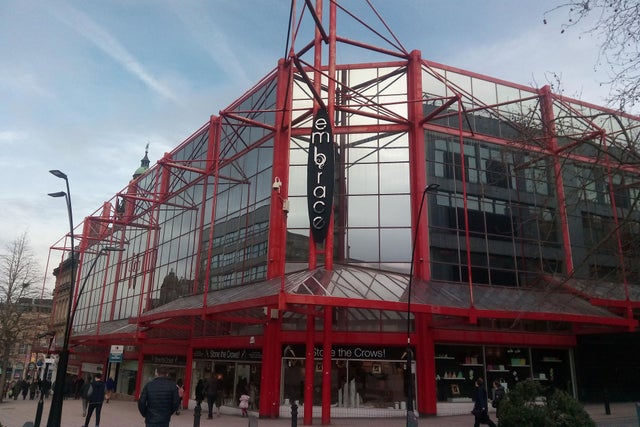
How we’ve loved to hate. The Odeon Building built in 1986-1987.
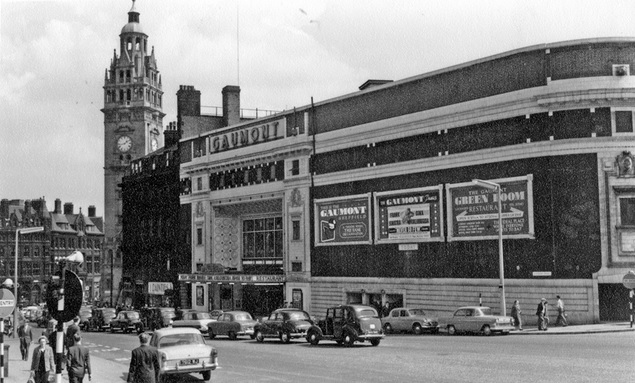
Back in the 1980s it was an important part of Sheffield’s regeneration, but after completion was universally hated. The steel and concrete building in Barker’s Pool opened as the Odeon, replacing the Gaumont Cinema, built in 1927 (as The Regent) for the Provincial Cinematograph Theatres circuit, and demolished in 1985.
A tear or two was shed, but its severe appearance could never keep up with the go-getting eighties.
We enjoyed its bright new replacement, but it didn’t last long, closed in 1994 in favour of Odeon’s multi-screen complex on Arundel Gate. And then came its reincarnation as a nightclub.
The Regent Theatre was built in 1927 for Provincial Cinematograph Theatres and was the first major cinema designed by architect William Edward Trent. Taken over by Gaumont British Theatres in 1929 it retained the Regent name until 1946. (Picture Sheffield)
If memory serves correct, it was vilified by Prince Charles, but fiercest criticism came from Sheffielders. It was considered downright ugly.
Over thirty years later, disapproval never waned, and the once-futuristic appearance looks as much out of place as it did then.
But that might be about to change.
A planning application proposing a significant facelift to the Gaumont building (as it has wistfully been renamed), has been submitted to Sheffield City Council.
The improvement works fall within the wider Heart of the City II development scheme – led by the Council and their Strategic Development Partner, Queensberry. Plans would see the building’s current red steel frame completely removed and replaced with a contemporary design.
The new façade proposals for the building, designed by Sheffield-based HLM Architects, who are also working on the Radisson Blu hotel, take inspiration from the building’s origins as the Regent Theatre (although I see no resemblance whatsoever).
Gone is the glass and steel. An artist’s impression of the new design of the Gaumont Building. (Sheffield City Council)
High Street as it was during the 1880s. (British Newspaper Archive)
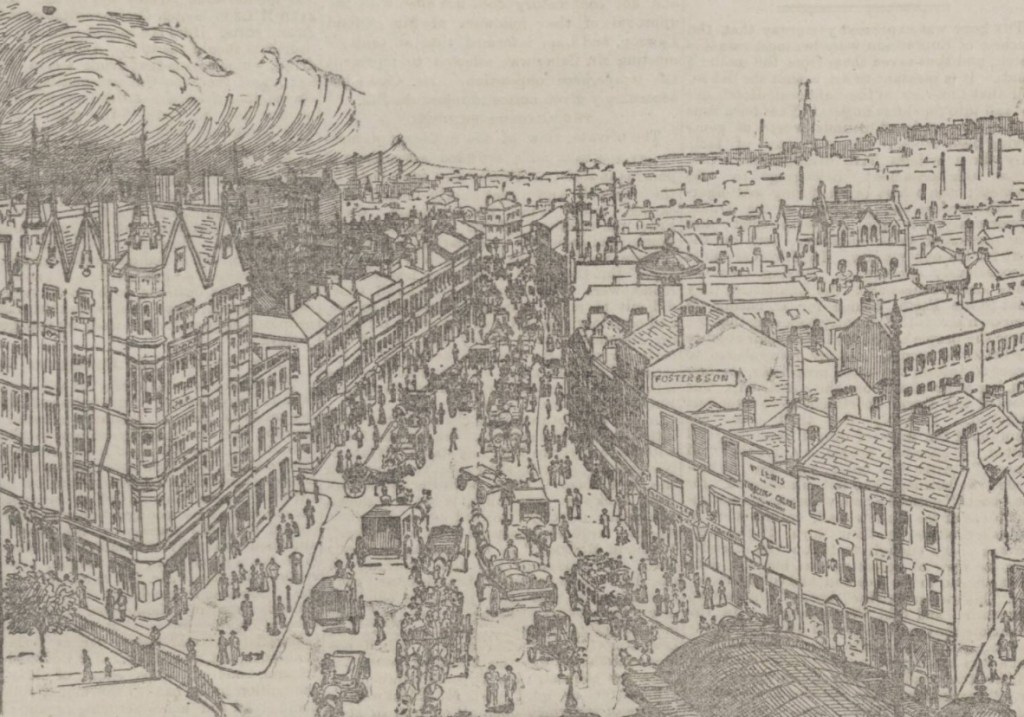
Back in Victorian times, High Street and its approach was compared to a bottle, of which the approach was the body and the street the neck.
From the Churchgates (Sheffield Cathedral) the road tapered away until constricted at what was known as ‘Grundy’s Corner’ – the bulging portion of which had been an eye-sore for years.
Horse-drawn traffic was the problem, and every year the neck became increasingly congested.
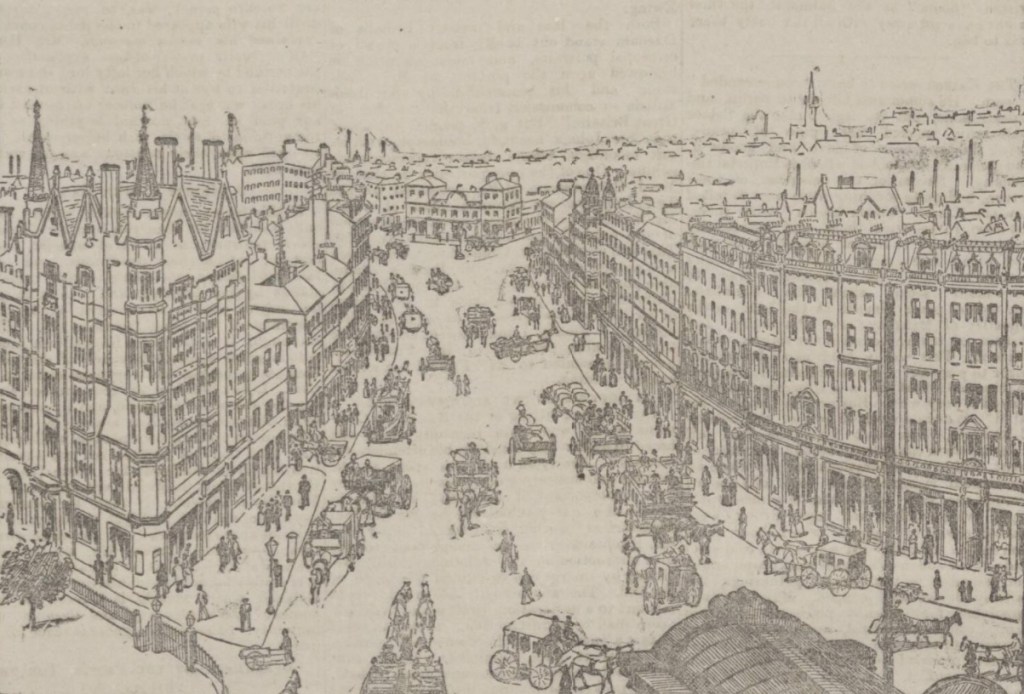
Plans to divert traffic away from High Street were considered impossible, and the Town Council had considered an ambitious widening of the street as far back as 1875.
However, it involved demolishing buildings and prompted objections from shopkeepers concerned about compensation and property boundaries, and it wasn’t until the 1890s that work started.
These two illustrations from 1890, both taken from Coles Corner, showed High Street as was, and the proposed widening of the street.
The proposed High Street widening from 1890. (British Newspaper Archive)
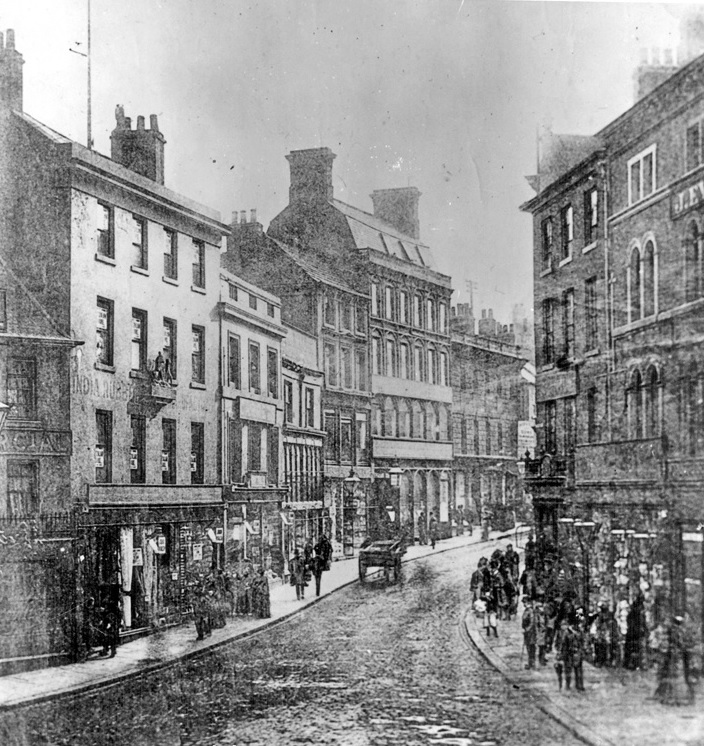
It was completed in 1895-1896 and involved demolition of buildings on the south side (to the right), replacing them with elegant Victorian structures, including the Foster’s Building.
Sadly, the Blitz of World War Two destroyed most of the property and we are left with twentieth century replacements including what was once Walsh’s department store, an old Sheffield name that mutated into Rackhams, House of Fraser, eventually handed over to TJ Hughes.
Only one building survives both sketches and is as familiar today as it was then. Parade Chambers, built for Pawson and Brailsford by Charles Hadfield, and constructed by George Longden & Son between 1883-1885.
High Street before the street widening of 1895-1896. (Picture Sheffield)
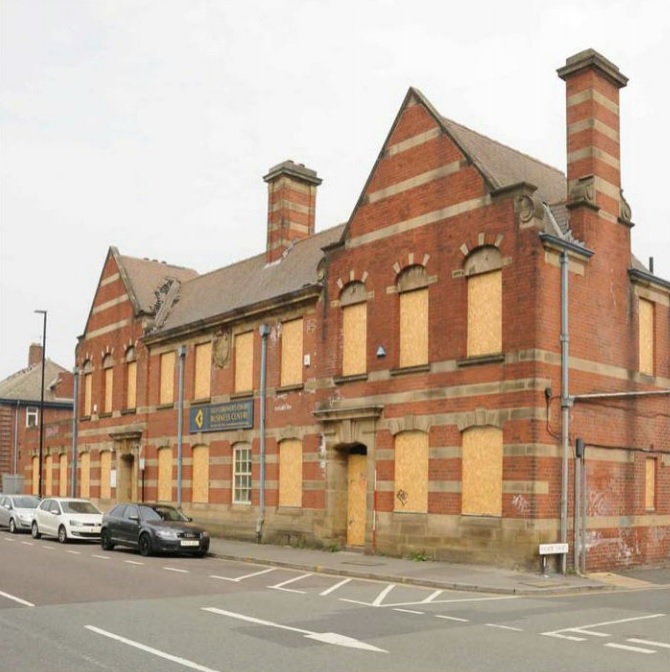
A miserable end for a fine old building. (Image: The Jessop Consultancy)
It is sad to be writing about a building that will soon be no more.
The Old Coroner’s Court on Nursery Street is to be demolished and replaced with 77 apartments, after a Government inspector overturned Sheffield City Council’s decision to halt the development.
Firestone, the developer, has been given permission to demolish the building as it is not listed, or in a conservation area.
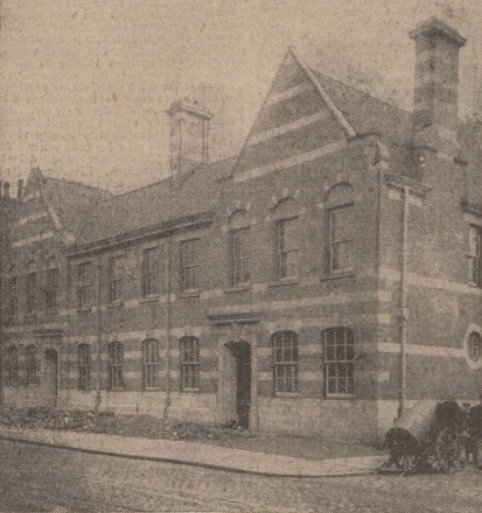
It will be a miserable end for the building built in 1913-1914, one damaged during the Blitz, the subject of severe flooding, and an arson attack.
This grainy photograph was taken in 1914 shortly after the coroner’s court and mortuary had opened. (Image: The British Newspaper Archive)
At the end of November 1912, it was agreed by Sheffield Corporation that a new Coroner’s Court and Mortuary should be built on surplus land remaining after the widening of Nursery Street.
Prior to this, the land had been an area of mixed domestic, retail and industrial buildings, a far cry from the days when this was “a green and pleasant land, when salmon could be caught in the Don, and flowers gathered in the meadow” of Spittal Gardens, or the Duke of Norfolk’s Nursery.
The new Coroner’s Court was championed by Dr W.H. Fordham, of the Heeley Ward, chairman of the special committee set up to build it. The urgency was to replace the old coroner’s court that had stood on Plum Lane, off Corporation Street, since 1884, and had long been a disgrace to the city.
The building was designed by Sheffield’s first city architect, Frederick Ernest Pearce Edwards (1863-1945), who had previously held a similar position with Bradford Corporation.
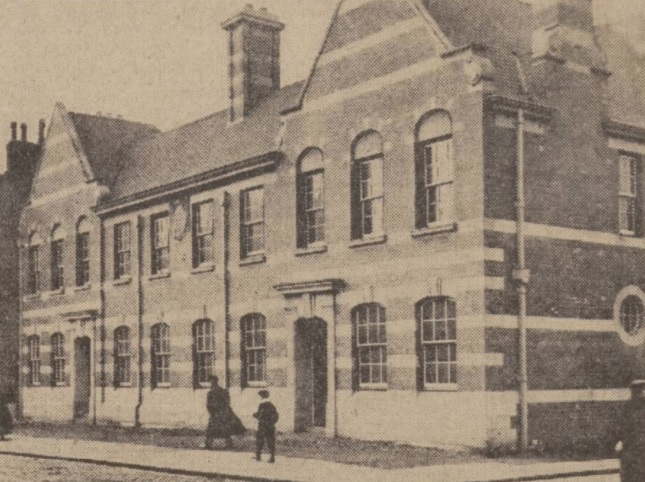
The Coroner’s Court in 1914. (Image: The British Newspaper Archive)
Built of brick and stone, it drew on the design of Gothic Revival, Queen Anne, and Baroque traditions of the nineteenth century. Construction was by George Longden and Son and cost £5,000 to build.
The main courtroom was 30ft x 20ft and 25ft high. Within the building were various mortuaries, waiting rooms, jury retiring rooms, coroner and doctor waiting rooms, viewing rooms, coach and motor houses, stables, and a caretaker’s house.
It was furnished throughout in oak and contained all the ‘up-to-date’ appliances, including fixed and revolving tables in the post-mortem room.
The coroner at the time was Mr J. Kenyon Parker, but the first case held here was in May 1914 when Dr J.J. Baldwin Young, deputy coroner, investigated the death of Edward Villers, a labourer, and determined that he ‘hanged himself while of unsound mind.’
Buildings behind were added in the 1920s, and following bomb damage in December 1940, new plans were drawn up by W.G. Davis, city architect, in 1952-1953 to extend the courtroom buildings.
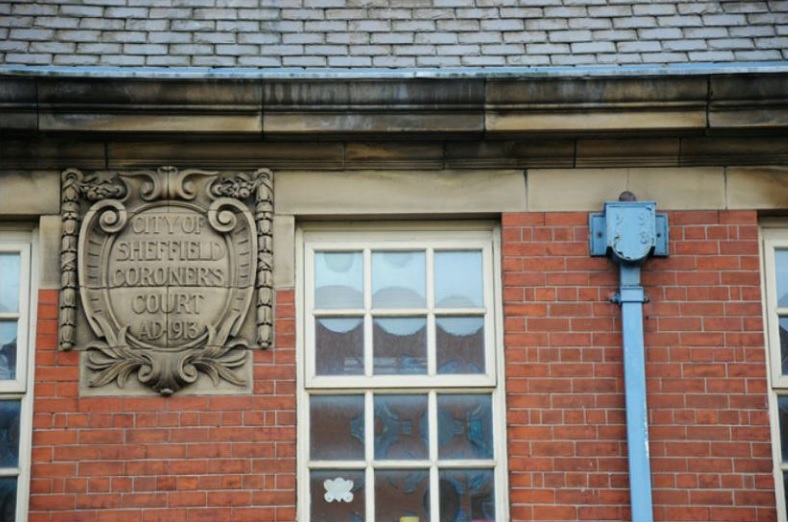
There is a chance that the developer will preserve the original date-stone. (The Jessop Consultancy)
The opening of the Medico Legal Centre on Watery Street, Netherthorpe, in the 1970s, brought an end to grisly proceedings on Nursery Street.
It became Sheffield City Council, Employment Department, Enterprise Works, and was subsequently sub-divided into 36 principal rooms. In later years it was known as the Old Coroner’s Court Business Centre.
Unfortunately, little remains of the original internal detail, but the outside is virtually untouched apart from minor restoration.
The building has been empty for several years and the developer had hoped to incorporate it into the new development, but this was considered unpractical.
And so, we lose another one of our historic buildings, to be replaced with something considered to be “favourable towards the character and appearance of the area.”
The inside of the building was sub-divided and this space once formed part of the old courtroom. (Image: The Jessop Consultancy)
The proposed development on the site of the Old Coroner’s Court. (Firestone)
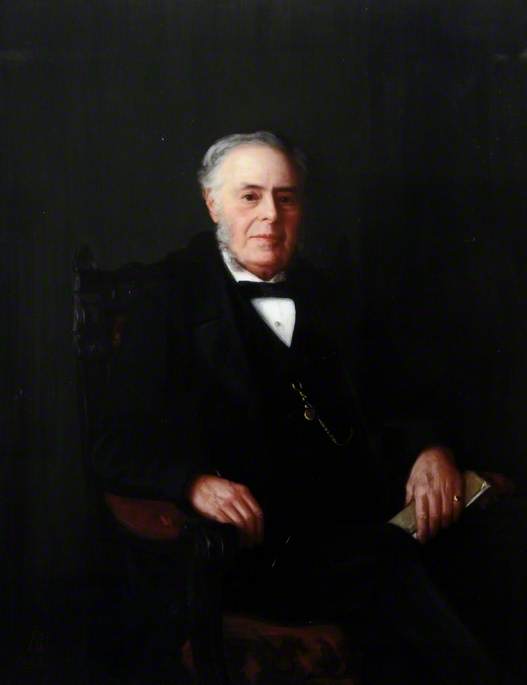
Bernard Edward Cammell’s portrait of Dr Mariano Martin de Bartolome (1813-1890), (Image: Sheffield Teaching Hospitals NHS Foundation Trust)
The Story of Dr Mariano Alejo Martin de Bartolomé might be straight from the pages of a novel.
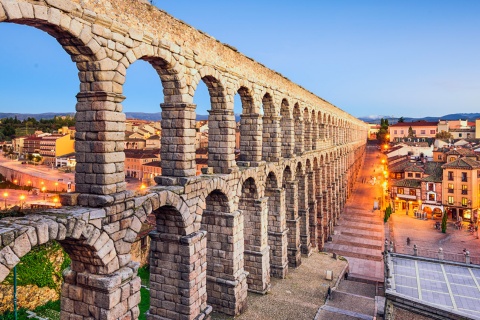
Bartolomé (1813-1890) was born in Segovia, Spain, and came from an old Castilian Hidalgo family, his father being the civil governor of the province.
Aged 8, he became a student at the Artillery College of the Alcazar of Segovia and had lined up a commission in the Hussars. However, Spain was in a state of revolution and the representative system was abolished. Ferdinand VII was restored by the intervention of the French, and the Bartolomé’s were driven out of Spain and their estate confiscated.
Segovia is a Spanish city located in the autonomous community of Castile and León. It is the capital and most populated municipality of the Province of Segovia.
They sought refuge in England, eventually taking up residence in Jersey.
It was here that Bartolomé met Mary Elizabeth Parker, the daughter of Rev Frank Parker of Dore, and they married in 1834. He had no profession, but Mary paid for him to become a medical student at Edinburgh University.
Bartolomé studied under Professor Sir Robert Christison, regarded as a brilliant physician and chemist, and gained his medical degree in 1838.
The couple moved to Sheffield taking up residence at 3 Eyre Street, popular with surgeons and physicians, and remained here for 45 years.
In 1840 Bartolomé was elected one of the honorary physicians to the Sheffield Hospital and Dispensary (later the Royal Hospital) and in 1846 joined the Sheffield Infirmary, later becoming senior physician. It was said that he rode there on a fine black horse and to have jumped the gate when he found it closed. By the time he retired through ill-health in 1889 it was estimated that Bartolomé had treated more than 750,000 patients.
Sheffield Infirmary (Image: Picture Sheffield)
In 1846, Bartolomé joined the staff of lecturers at the Sheffield Medical Institution, later the Medical School, delivering over 3,000 lectures and becoming its president.
As president he was instrumental in obtaining funds to build a new building in Leopold Street, finished in 1888, and after merging with Firth College and Sheffield Technical School it was renamed University College Sheffield before becoming University of Sheffield in 1905.
(University of Sheffield Library Digitals Collection)
His crowning glory was in 1876 when he was elected president of the British Medical Association (BMA) at a meeting in Sheffield. His presidential address was an exhaustive description of Sheffield, its surroundings, some of its trades, their effects on the health of workers, and suggestions as to future legislation.
Bartolomé was painted by artist Bernard Edward Cammell which was presented to him by the Medical School in November 1888.
“I came amongst you as a stranger and an alien, but you stretched out the right hand of friendship towards me, and I stand before you now one of the oldest Englishmen in the room, having been naturalised long before the majority of you were in existence.
“I wish that my portrait may remain in the midst of its givers – those friends whom I have so sincerely and frequently loved.”
Bartolomé moved his house and surgery to Glossop Road in the 1880s, the building on the corner with Hounsfield Road better known now as The Harley bar.
As well as his medical work, Bartolomé was a freemason at the Britannia and Brunswick Lodges (and laid the foundation stone at the Masonic Hall in Surrey Street) and was founder and president of Sheffield Athenaeum club.
In his last few years Bartolomé suffered from heart problems and was forced to give up a lot of work. In 1890, after waking, he attended his invalid son in an adjoining room and died soon after, supposedly “brought on by dressing somewhat hastily in order that he might visit his son.”
His wife, Mary, died in 1863, and Bartolomé married a second time, Mary Emily Jackson, the daughter of Samuel Jackson, who survived him.
After his death, Bartolomé’s family left the city, but his grandson, Dr Stephen M de Bartolomé (1919-2001), a former Sheffield University student returned to Sheffield to work for Spear & Jackson of which he became chairman.
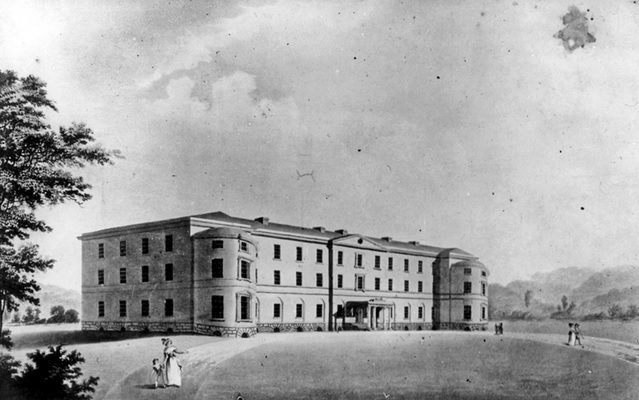
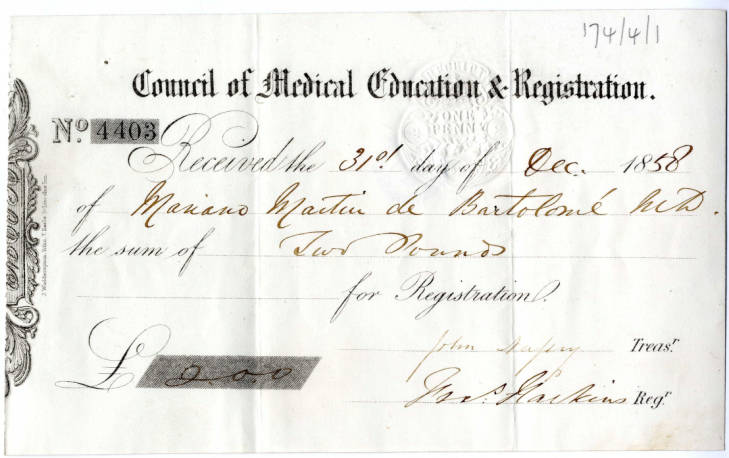
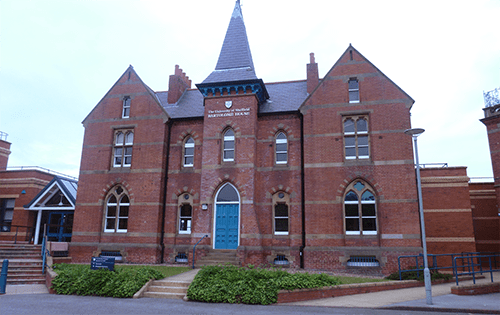
The Bartolomé Papers – a collection relating to the history of the family through both Bartolomés – is held at the University of Sheffield. As a fitting tribute the former Winter Street Hospital (and then St George’s Hospital) became the School of Nursing for the University of Sheffield in 1997, named Bartolomé House in 1998 after Dr Mariano Martin de Bartolomé, and now the School of Law.
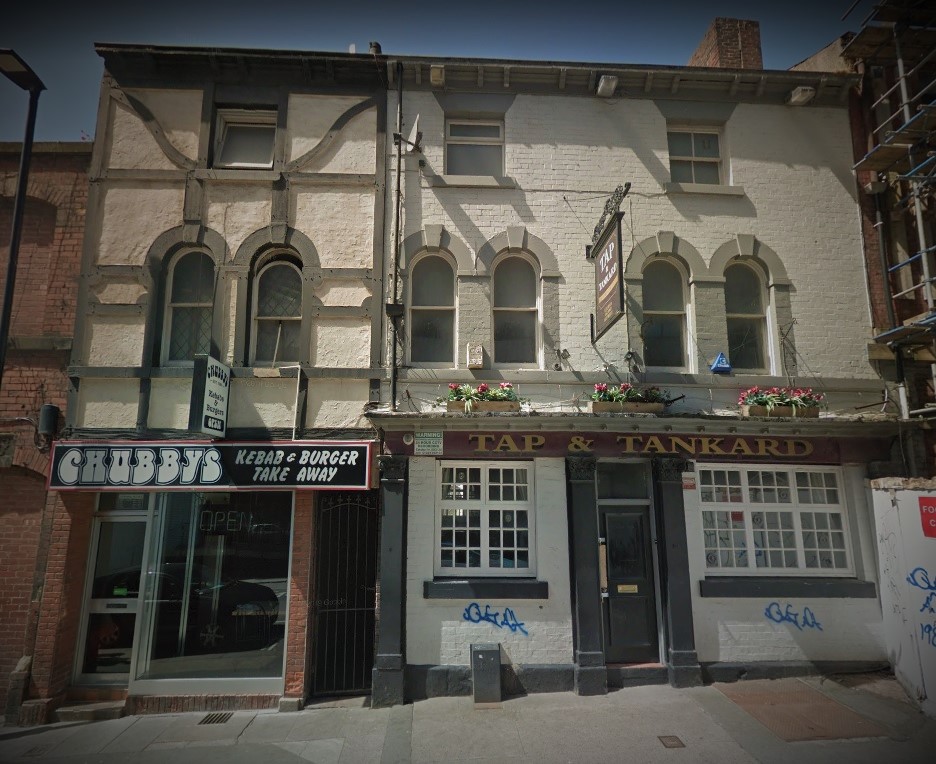
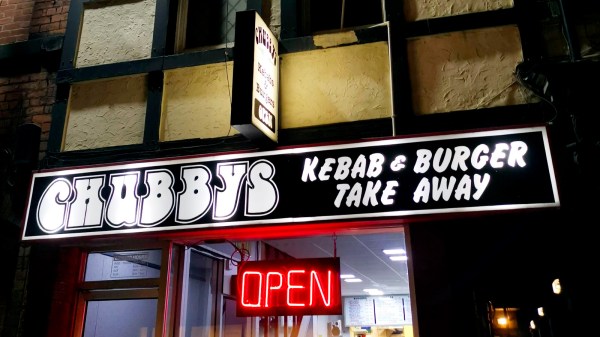
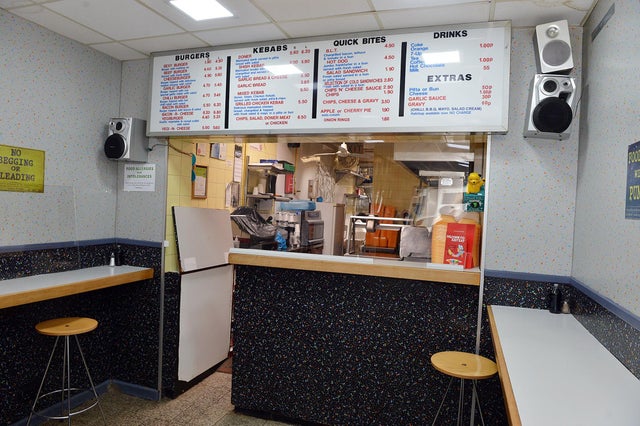
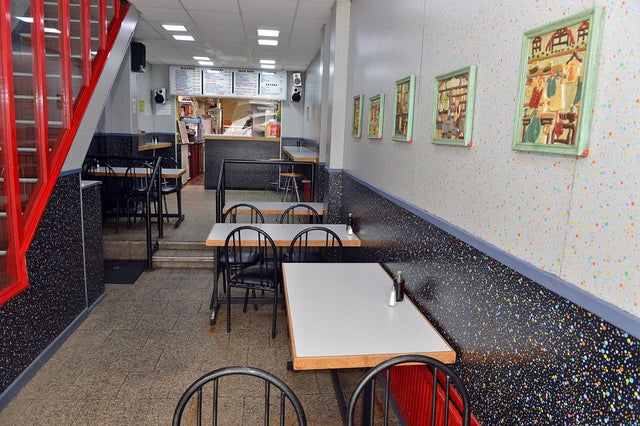
Chubbys, Michelin Three Star cuisine for the inebriated, is to close after 40 years.
The legendary takeaway on Cambridge Street will shut for the last time on Bank Holiday, August 31.
It has been a long journey for Mehran Behizad, Iranian by birth, who first came to Sheffield in 1973, to study industrial design at the polytechnic, but met his Sheffield-born wife and decided to stay and raise a family.
He set up Chubbys in 1980 with a few business partners but eventually became the sole owner. When it opened, it was only one of two late-night takeaways in the city centre, arguably the first place to get a kebab.
However, the staying power of Chubbys means we do not look beyond the familiar sign above the door.
The takeaway shares the same building as the empty Tap & Tankard (formerly The Sportsman) next door. Both ground floor units have two storeys above, with white painted red-brick and mock Tudor detailing, with applied black timber over Chubbys.
The date of construction is unknown, but we can trace The Sportsman’s Inn (later to become The Old Sportsman’s Inn and then The Sportsman) to 1828, which might suggest that the whole building was once used as a public house.
It also suggests that this is one of the oldest buildings on Cambridge Street, tracing its origins back to the days when it was still called Coal Pit Lane.
Before Chubbys, the unit had many uses, but had strong links with food and drink, at one time being a grocery shop, George Alfred Webster’s Dining Rooms, and the Cambridge Coffee House.
It is now subject to a compulsory purchase by Sheffield Council to make way for the ambitious Heart of the City II project and 70-year-old Mehran is using the opportunity of the enforced closure to retire.
The good news is that the building will be incorporated in the adjacent Leah’s Yard restoration, while the bricked-up former works below Chubbys will be demolished and become an open-space linking to the soon-to-be-restored Bethel Chapel.
And there is a suggestion that after the Covid-19 crisis subsides Chubbys might resurrect itself somewhere else in the city centre.
Sometimes there is more to a building than meets the eye. This former shop on Cambridge Street hides an interesting past and will be reborn soon.
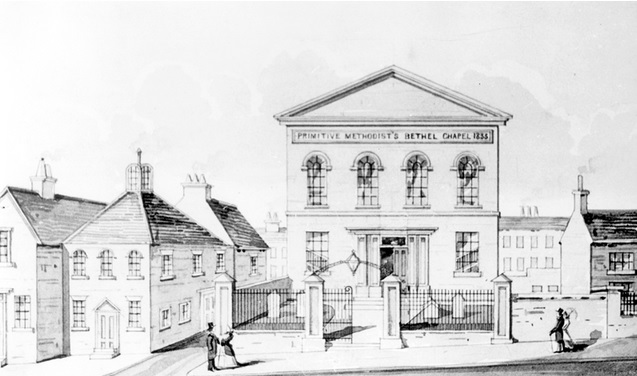
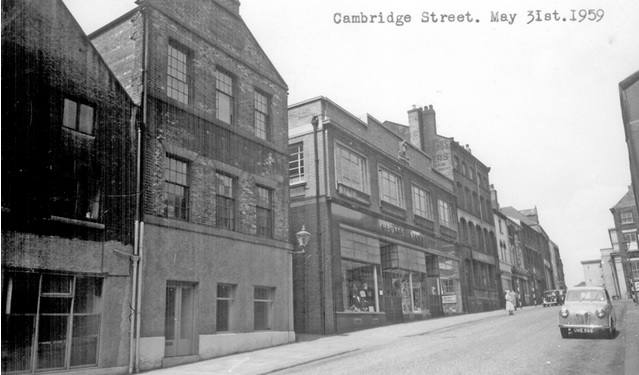
We know it as the former Sports and Toy Departments of Cole Brothers, more recently as a city centre outpost for Stone the Crows, but this empty shop is a 1930s front extension to the Bethel Chapel which stands behind.
From John Lewis’ car-park you can look down and see that the chapel, built in 1835, still survives behind the street frontage.
The chapel owes itself to John Coulson, the first leader connected with the Primitive Methodist Movement in Sheffield. A small society had been formed and services held in a building in Paradise Square. The movement seized hold of the working classes and later bought an existing old chapel in deprived Coal Pit Lane (later to become Cambridge Street), about 1823.
A few years later plans for a new building nearby were prepared and the mainly poor congregation helped demolish an existing house that had been converted into tenements. The foundation stone for the new chapel was laid in July 1835 and opened for services in June 1836.
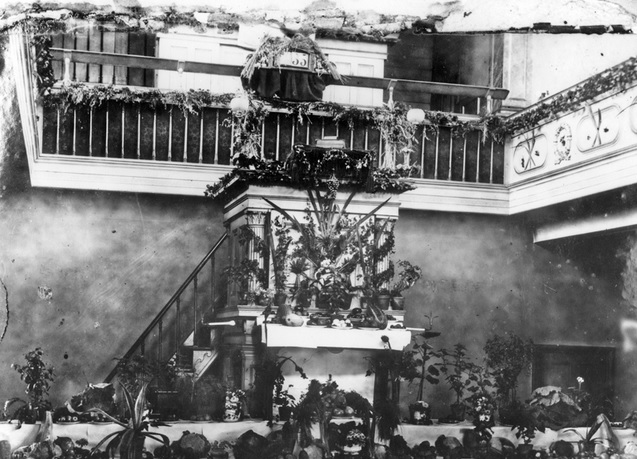
The Primitive Methodist Bethel Chapel existed for just over a century and was latterly connected with Sheffield Methodist Mission. Its final service was on Sunday 20th September 1936.
(Image: picture Sheffield)
(Image: Picture Sheffield)
It was briefly empty before George Binns, an outfitter at Moorhead, bought the old chapel to relocate the business.
The small churchyard at the front was swept away, including iron railings and stone pillars, and probably a few gravestones.
In 1938 a two-storey extension was added to the front of the chapel, with stone initials on its parapet showing ‘GB’ and the date ‘1868’, the year the business was founded.
(Image: Picture Sheffield)
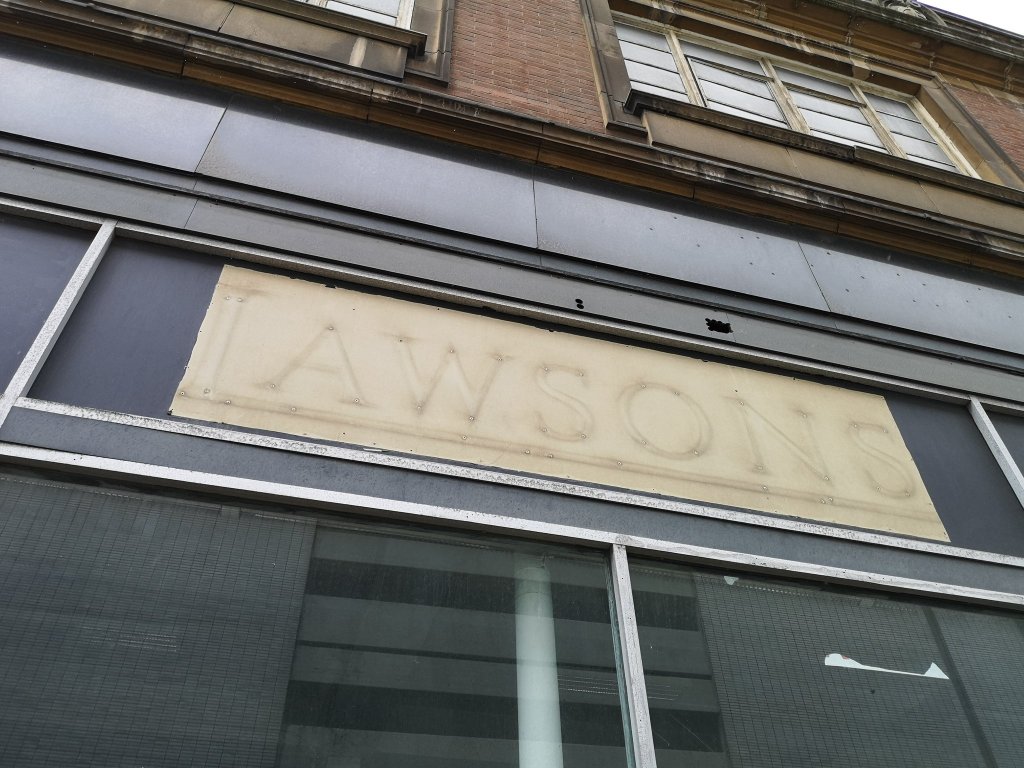
By the 1960s the shop had transferred to Lawsons Outfitters and in 1977 it was acquired by Cole Brothers (now John Lewis) to alleviate pressure on its store across the road.
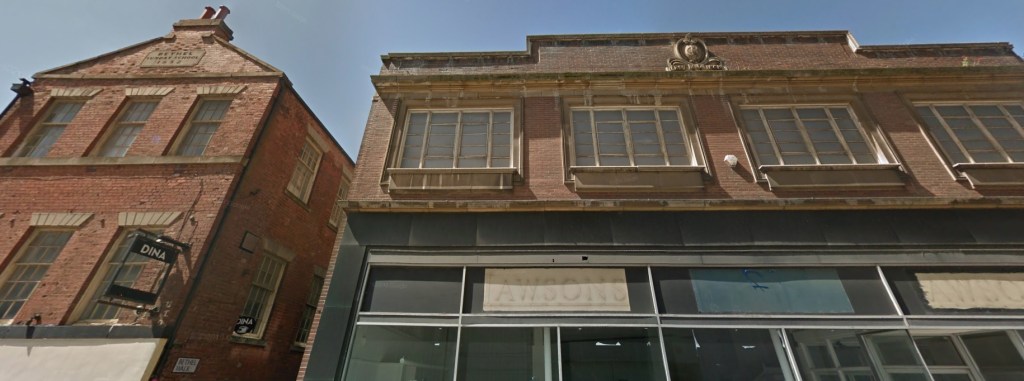
With a short spell as Stone the Crows, the building has been vacant for several years, with the ‘ghost name’ of ‘Lawsons’ revealing itself above shop windows.
(Image: Graham Soult)
Now subject of compulsory purchase, Sheffield City Council, with its partner Queensbury, is now looking for occupiers to run it as a performing arts venue as part of Block H in the ongoing Heart of the City II development.
The question. How much of the old chapel interior remains?
NOTE: Bethel Walk is between Bethel Chapel and the former Bethel Chapel Sunday School, a listed building also included in Heart of the City II plans.




 sheffielder.net