Categories
Buildings

“A miserable place. The stench here was unbearable.”

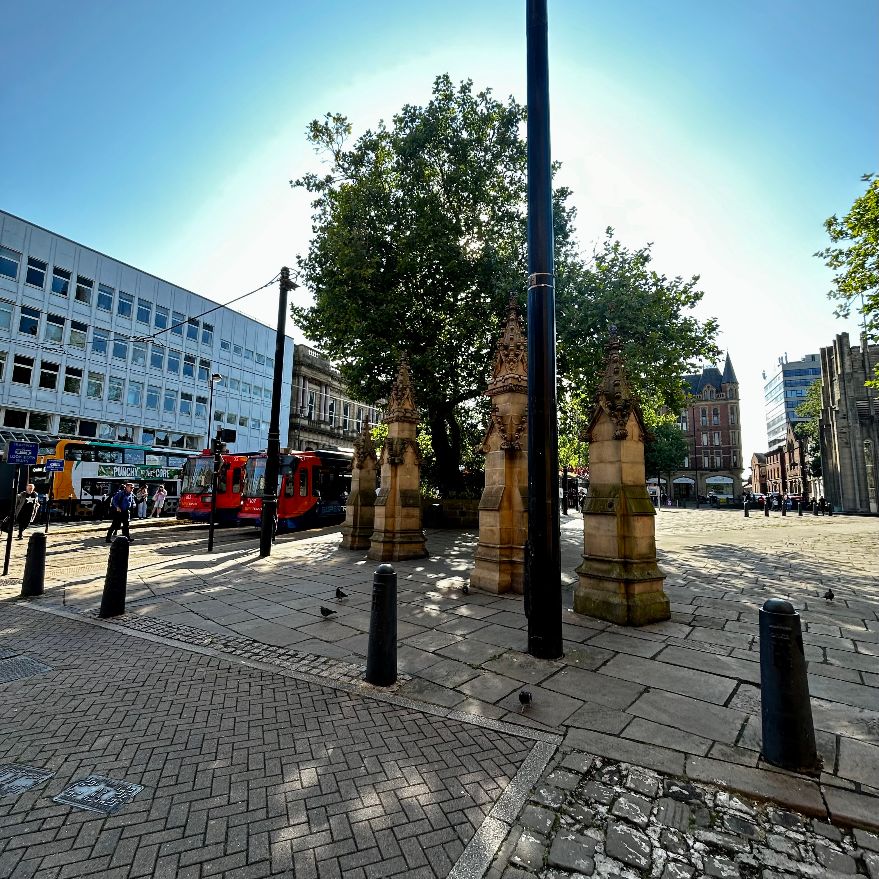
The sun shines, and a pigeon meanders between the old church gates near Sheffield Cathedral, next to the tram stop where High Street meets Church Street. It pays more attention to the gates than passers-by do, the majority of whom don’t know that they exist. These gates appeared in the nineteenth century and today I must use my imagination.

I have gone back to the time when these streets were crowded with pedestrians who had to keep their eyes open, and their wits about them, because they might easily have been run down by a horse and cart or Hackney Carriage. The air is abundant with noise, the clip-clopping of horses, hawkers selling their wares, and shouts of men who have consumed too much ale. Most people are shabbily dressed because they come from poor families, but there are also the gentlemen who wear breeches and stockings, waistcoats and frock coats, linen shirts, buckled shoes, and three-cornered hats. One of them carries a walking cane and pauses to read something that has caught his eye in the Sheffield Register. .

I am outside the Town Hall, built to the points of the compass in 1700, and which partly lies within the graveyard of Sheffield Parish Church and out into Church Lane. The man with the newspaper notices and walks over.

“What are you looking at?” he asks curiously. “I believe I am looking at Sheffield’s first Town Hall,” I reply. “Nay lad. That’s where you’re wrong. Let me tell you that there was one before this, up yonder, in a house near the Townhead Cross. It was a house converted for town affairs, and in its cellars were chains to keep hold of the misplaced souls of this parish. They built this one at the turn of the century to replace it.” The man looks at it and sighs. “It’s a miserable place. When the street was widened, I would have expected this building to be taken down, but it still stands as a disgrace to Sheffield.”

The stranger identifies himself as William Hollingworth, a solicitor on Norfolk Row, and he is right. The building is not grand like Town Hall’s should be, it is far too small, and built of plain brick with iron palisaded windows. Its northeast corner is separated by a narrow space from the southwest corner of Mr Heaton’s shop. Across this space, that I know as East Parade, the Church Gates have been placed diagonally. The long east front looks down High Street; the southeast corner and the short south side project into Church Lane, while the west and north sides are entirely in the church yard.

Hollingworth pointed his cane at the roof. “The only redeeming feature is the belfry, with its gilded ball, and the bell that is only rung on important occasions.”

He guided me up a flight of steps and stopped. “There is talk that we might build a new Town Hall over at Barker’s Pool, but that is too far away. My own preference would be to build one in the historic town, perhaps Waingate or Old Haymarket.” “What was here before?” “Nowt, as far as I know, but there used to be a well hereabouts, and that would have been filled in when they dug out the foundations.”

Hollingworth reached into his pocket and pulled out a large brass key to open the wooden door. He guided me into an ante room and closed the door behind him. Above us, far too high to reach, were leather buckets sat on shelves. “You’ll find similar ones in the church,” he said. He rested his cane against the wall, reached for a long pike and lifted one of them down. “Do you know what these are?” I had no idea. “Mr Rollynson made them. Before we had the town fire engine these buckets were used to fight fires. I’m afraid that they were no use because flames worked quicker than any man could.”

The door ahead was ajar and creaked as he pushed against it, opening into one large room, plain in décor, lined with rickety chairs, and a long mahogany table covered in green baize at its centre. The floor was covered with braided matting, well-worn, and fraying at the edges. It was gloomy, the windows struggling to let in enough light, with curtains, urgently in need of fresh dye, hanging either side. A candlestick was suspended from the ceiling, the candle long extinguished and a flow of cold wax could be seen. “This can be a jolly room. On special occasions we set tallow candles in clay and put them in each window.”

At the opposite end of the room, raised on a platform, was an impressive chair with a coat of arms fixed to the wall above it. Hollingworth noticed my interest. “That is the Royal Arms,” he said. “James Truelove did the iron work and Jonathan Rutter gilded and painted them.”

I sat in the chair that was hard and uncomfortable but suggested that somebody important might sit here.

“When it first opened, the Trustees said that the Town Hall could only be used by the town’s Burgesses to meet and consider the Collector’s accounts and keeping of the Courts of the Lord of the Manor.” Hollingworth laughed. “That didn’t last long because Yorkshiremen have regard for money. The temptation was irresistible. Before long, it was let to stage players, to Richard Smith, the bookseller and dancing expert, who rented it for weeks, to all kinds of showmen, and is popular for auctions. Now, the West Riding Sessions are held here every two years, and the magistrates sit in Petty Sessions once a week.”

“What is in that big chest under the window?”

Hollingworth tapped the chest with his walking cane. It was padlocked. “This is the ‘Town’s Chest’,” he said. “Inside is the true copy of the Town’s Burgesses’ grant to Thomas, Duke of Norfolk, for him, his heirs, and successors, and the keeping of the Courts belonging to Sheffield. There is a smaller wooden box inside that contains a note from Henry, Duke of Norfolk, to the Burgesses. Alas, I have yet to see the contents.”

I hadn’t noticed the narrow stone steps that descended into blackness below. Hollingworth pointed and summoned me to follow. “Careful as we go. These steps are slippery underfoot.” He stooped as we went down into a narrow passage.

The stench here was unbearable, a mix of piss and shit, and there was no light except for a shaft of daylight that came from a grate set high in the wall. My eyes grew accustomed to the darkness, and I saw that there were three huge wooden doors, two open and one closed.

“Look for yourself,” said Hollingworth, and I cautiously looked through one of the open doors. It was a small cell, about eight feet square and barely six feet high, and through it ran a gutter, the source of the unimaginable smell.

Hollingworth rapped his cane against the closed door and peered through a hole that had been cut into it. “See for yourself.” He moved aside to let me look. I thought that it was empty but then I saw movement on the floor, a hunched figure that lay on the stone slabs. “A vagabond!” Hollingworth cried. “The sessions were held yesterday, and this person will be spending a night or two before Sam Hall frees him or sends him on his way to Wakefield.”

I asked who Sam Hall was. “He’s the town constable, amongst other things – beadle, cutler, and now a dealer in china and glass. Upstairs is called Sam’s Parlour, and he earns sixpence for crying the meetings. But he’s not too proud of his official position to eke out a living selling earthenware in the weekly pot market outside.”

We retraced our steps and outside the smell of horse dung was welcome relief to the despicable cells. “A week or so ago, there were stocks here, but we have moved them to where Hick’s Field used to be. They are calling it Paradise Square now, but it’s farther from the town, and punishment is served better. There are too many do-gooders around these days.”

NOTE:

Poetic licence has been used here. William Hollingworth never existed. Had such a meeting taken place then this would have been in the 1790s.

His comments are fictional, while others came from Robert Eadon Leader and a later gentleman called Fred Bland. “When the street was widened, I would have expected this building to be taken down, but it still stands as a disgrace to Sheffield,” was uttered by the historian Joseph Hunter.

Little is known about Sheffield’s ‘first’ Town hall and no sketch exists as far as I am aware. The little we do know is included here.

The last important meeting held in the building was in the 1807 County of York parliamentary election when two of the three candidates – William Wilberforce and Charles Fitzwilliam, Lord Milton – made speeches. The third candidate who fought unsuccessfully for one of two seats was the Hon. Henry Lascelles and the election was called the great struggle between the Houses of Wentworth and Harewood.

The ‘second’ Town Hall was built at Waingate in 1808, enlarged in 1833, and again in 1867. It subsequently became the Crown Court and is currently empty and in dire condition.

Our ‘third’ and grandest Town Hall opened in 1897.

© 2024 David Poole. All Rights Reserved
Categories
Buildings Sculpture

Vulcan: the protector of Sheffield for 128 years

Vulcan stands on top of Sheffield Town Hall. Image: Thawantsshooitin

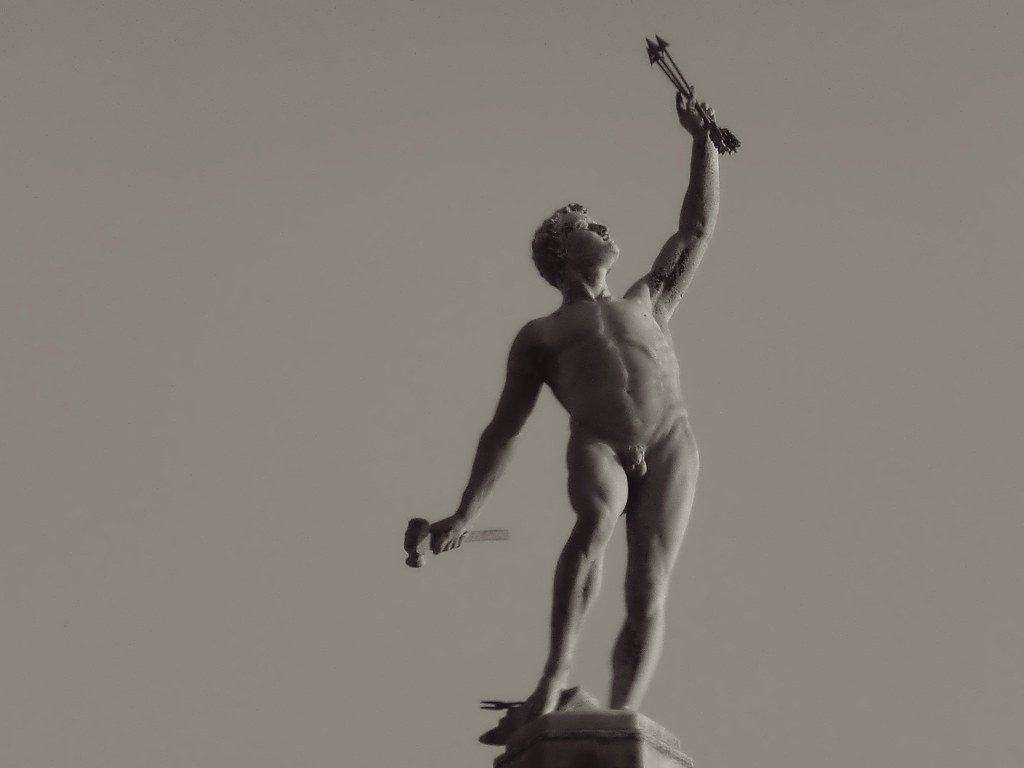
There is a statue of Vulcan on top of the Town Hall, and the more I look at it, the more I see him as the protector of Sheffield. And he’s been doing this for 128 years, and when bombs destroyed the city centre in December 1940, one of the local newspapers put a drawing of Vulcan on its front page and the words DEFIANT!

The Town Hall was built in Renaissance Revival style by Edward William Mountford, a London architect, who also designed Town Halls at Battersea and Lancaster, as well as the Old Bailey.

Work began in 1890 and finished by September 1896, but it wasn’t until 1897 that Queen Victoria officially opened it.

Mountford had wanted something special to stand on top of the one hundred feet clock tower and chose an Italian, Mario Raggi, to create the Vulcan statue.

Vulcan, the Roman God of the furnace, the patron of all smiths and other craftsmen who depend on fire, was adopted as a symbol of Sheffield in 1843.

Mario Raggi was born in Carrara, in Tuscany, in 1821, notable for marble used since the time of Ancient Rome, and it was no surprise that Raggi became interested in sculpture.

He trained at the local academy, and then studied in Rome under Pietro Tenerani before moving to London in 1850 where he first worked for Raffaelle Monti, and then under Matthew Noble.

Raggi exhibited at the Royal Academy and was famous for memorials to Benjamin Disraeli at Parliament Square and Gladstone at Albert Square, Manchester. He also completed three monumental statues of Queen Victoria in Hong Kong, Toronto, and Kimberley in South Africa.

In 1875, he set up his own workshop at Cumberland market, between London’s Regent’s Park and Euston Railway Station, at 44 Osnaburgh Street.

I have the first possible reference to our Vulcan… and that is in 1892 when Signor Raggi had almost completed a standing statue of Vulcan, ‘with a hammer in his right hand, his right foot resting on an anvil and in his left hand, held aloft, three arrows, and intended for Sheffield Town Hall.’

Vulcan is seven feet in height (although other measurements of nine and eleven feet have been given)… and modelled from a Life-Guardsman. It was cast in bronze at the foundry of Henry Young and Co, Eccleston Works, Pimlico.

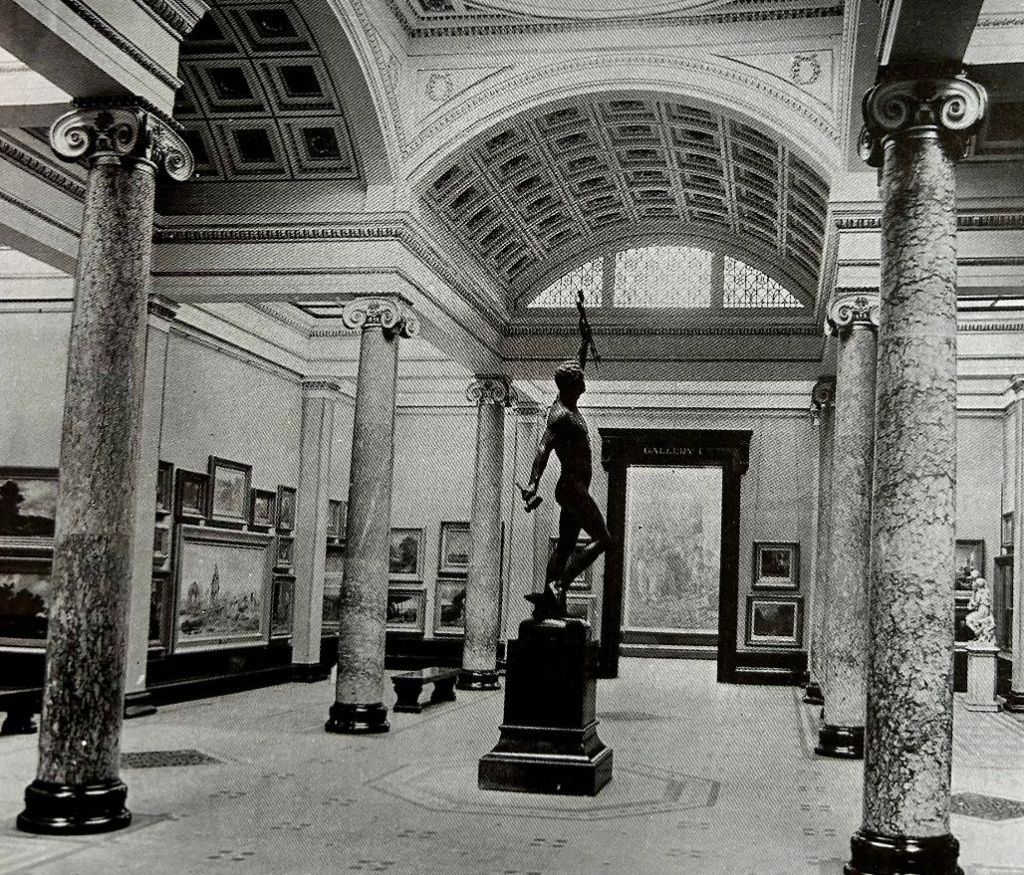
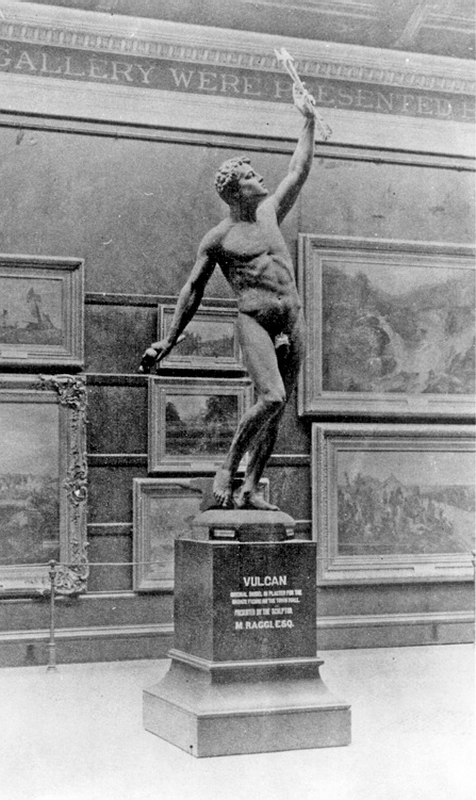
For a long time, the original plaster cast version was on show at the Mappin Art Gallery until it became irreparably damaged, due to frequent moving to avoid air raids during World War Two and was broken up and discarded.

The Special Gallery at Mappin Art Gallery in 1937. In the centre, the ‘lost’ plastercast version of Vulcan by Mario Raggi. Image: Sheffield City Council
The plastercast version of Vulcan seen in 1897

The bronze statue was erected in 1896 by Cromwell Wiley Hartley, a daring Sheffield steeplejack who completed the task in fierce winds that threatened to dislodge him, but he managed to securely bolt Vulcan to its foundation.

The following year, Hartley climbed the tower again, and fixed an electric light in Vulcan’s extended hand to celebrate the visit of Queen Victoria, then stood on the head of the statue earning him the title as the ‘man with the iron nerve.’ A photograph was taken at the time, by Mr Taylor of Norfolk Street showing him in this risky position but appears to be lost.

In 1926, Reginald T Rea, the manager of the Albert Hall, which stood on the site of the former John Lewis building, erected a telescope in Barker’s Pool which focused on the statue of Vulcan. It was intended as a publicity stunt and the one penny proceeds from looking through the telescope went to Sheffield hospitals.

It was an enormous success, with an average 2,500 views a day,  and the suggestion is that it became a permanent attraction. There is reference to a telescope in World War Two, and through this a story emerged that Vulcan had lost his delicate parts during an air raid. (He appears to be intact now).

While Vulcan is made of bronze, he now has a green patina, the result of a slow corrosion process, which I’m told should not affect his future.

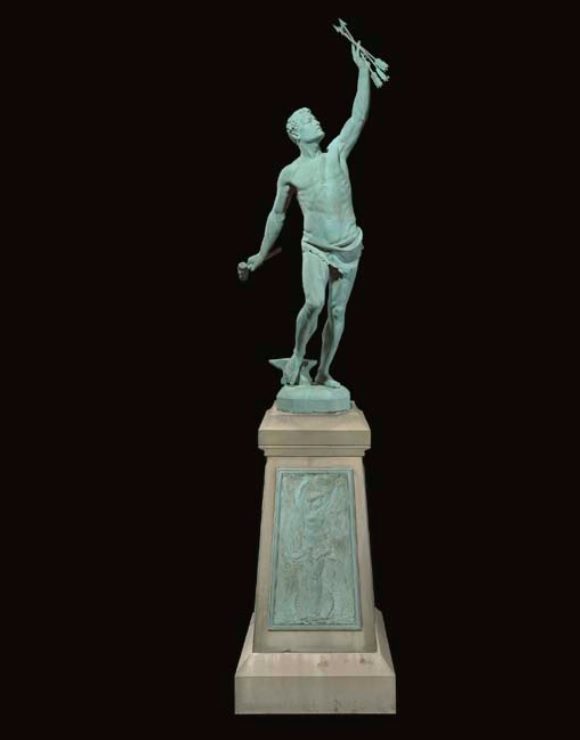
Another model of Vulcan was made at the same time, based on Raggi’s Sheffield original, cast by the Gorham Manufacturing Company, Providence, Rhode Island, and placed outside its headquarters in 1894. It differed slightly because while ours was nude, the American version wore a loin cloth. Alas, its whereabouts is unknown.

Vulcan. Cast by Gorham, Providence, after the model by Mario Raggi, dated 1893 on a spreading bronze-mounted granite plinth base

© 2024 David Poole. All Rights Reserved.

Categories
Late Night Tales

Late Night Tales #14

The old man with the pipe made another impromptu appearance. This time, outside the Town Hall. He looked sad as he rested underneath a lamppost. Good evening, I said. He didn’t answer straightaway. “Aye lad, it is a good evening.” He looked towards the Peace Gardens and sighed. “I must take leave of you lad. Tonight I’m meeting up with my family in the churchyard..” He walked away and I was distracted by the chimes of the Town Hall clock. When I looked back, the old man with the pipe faded in a light mist and was gone. Happy Easter everyone.

© 2022 David Poole. All Rights Reserved.

Categories
Streets

The people lined the street to catch a glimpse of Queen Victoria

Hereford Street, Sheffield. The road was one much wider, lined with shops, houses, and factories. Photograph: DJP/2021

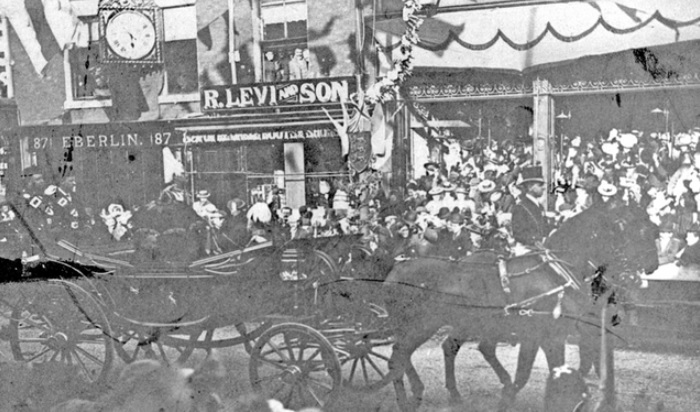
Hereford Street’s greatest moment was when Queen Victoria officially opened Sheffield Town Hall in May 1897 and travelled down here on her way to Norfolk Park. It might be hard to believe now, but let your imagination do the rest.

“To stand on The Moor, at the top of Hereford Street, and look down the latter thoroughfare affords the spectator a great amount of pleasure. A scene is presented of bright flags of dainty and artistic colours, fancy streamers of every description, while other kinds of bunting and bannerettes float out gaily in every direction.

“Venetian masts are erected on either side of the street, 15 yards apart, and are surmounted by large gilt spearheads, while banners, shields, and trophies of flags are fixed to each mast. Every alternate mast has a pedestal covered with crimson cloth and gilt ornamentation, and at the summit of each pedestal is a group of real plants.

“Across the street at intervals are fixed canopies of handsome floral work, and streamer flags of harmonious colours and flower baskets are suspended from the centre of each floral canopy, with lines of streamer flags along the street at either side connecting the masts with the whole design.

“The buildings, too, in Hereford Street have been dealt with in the most artistic manner. Flags float out bravely from the tops of the principal works and houses, and on the fronts are displayed handsome shields, backed up with designs of small flags and other similar trophies.

“As the time arrived for the stopping of traffic, the corner where Hereford Street joins the Moor became so blocked with cars, cabs, and buses that the Derbyshire police, who extended from the top of Hereford Street along part of St Mary’s Road were hard put to it to prevent serious accidents.

“People would still insist on leaving the shelter of the barriers and coming across the road, and then, as likely as not, they were stranded amongst the horses and vehicles, who, being unused to the terrible commotion, were almost frantic and the drivers, but for the efforts of the police, could not possibly have helped running down some of these belated wayfarers.

“However, this was soon cleared, the arrival of the 1st Battalion of the Hallamshire Rifles having a great deal to do with the transformation.

“The men were placed eight paces apart and covered the entire length of Hereford Street and part of St Mary’s Road.

The visit of Queen Victoria. Pictured here on The Moor. Photograph: Picture Sheffield

“The crowd was very orderly, only a few attempting to elude the vigilant eye of the constables, and those that attempted this being in most cases drunk.

“As the time wore on, however, getting tired, perhaps, and some of them thirsty, occasional rows occurred. People attempted to change their positions and their neighbours’ mild remonstrations gradually developed into what may be styled ‘words,’ and again, in some cases, where the sum was particularly irritating, into blows.

“The few fights, however, that did take place soon raised cries of ‘Police!’ and the guardians of the peace immediately quelled the disorder and left the combatants to sing and shout once more with the rest.

“Several cases of fainting occurred, and it was rather unfortunate that at this point of the route there was no ambulance corps, but the gallantry to the ladies of the rough and ready grinders was quite touching, and these were immediately made room for even in the thickest crushes.

“Of course, skits and jokes passed amongst the members of the crowd, but, as a rule, the language was ‘fit for the Queen.’

“Stands, windows, and roofs were all crowded, and the number of people in the street was, as far as can be judged, above the average.

“The procession passed, the military lined up, and the crowd in one huge migration, made tracks, some for the park, and others in order to get another view, if possible, along South Street, Park.”

Looking towards The Moor from Hereford Street. Today, this part of the road is pedestrianised and is occupied by Dempseys, bar and Club and QJ (the former Yorkshire Bank). Photograph: Picture Sheffield

© 2021 David Poole. All Rights Reserved
Categories
Streets

A lost street underneath Sheffield Town Hall

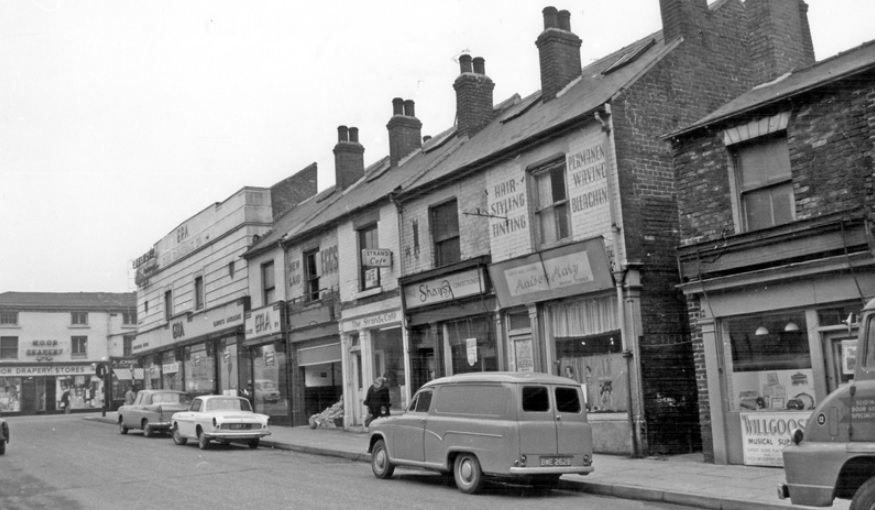
New Church Street, looking towards Pinstone Street, now the site of Sheffield Town Hall, No 7, Cutlers’ Arms P.H., No 9, Old Green Man, No 11, Henry Bocking, Beer Retailer. Late 1800s. Photograph: Picture Sheffield

Do council officials, working late at Sheffield Town Hall, ever hear strange noises in the stilly night?

Do they listen with bated breath to the sound of prancing horses and the ghostly cries of coachmen?

Or, when all is quiet, does a rich melodious voice, declaiming in grand style, passages from Shakespeare, ever strike their astonished ears?

Or, do council officials ever work late? Or do they work from home now?

If there is any such things as ghosts, Sheffield Town Hall must be peopled with a vast multitude of them.

New Church Street (not to be confused with Church Street, near the cathedral) was demolished about 1890 to provide room for the Town Hall. It lay almost through the middle of the site of the Town Hall, from what is now the (padlocked) main front entrance, to a point in the west wall opposite the Mercure Hotel.

The Cutlers’ Arms can be seen almost in the centre of the picture, with three people near the doorway, and was the terminus for all the Derbyshire coaches.

“It was a great sight to see them coming in from Tideswell, Castleton, Baslow, Bakewell, and other places. Each coach had its name; the only ones I can remember are the ‘Lady Peel’ and the ‘Surprise,’ both of Castleton,” said Ambrose J. Wallis, who owned the photograph in 1931.

“Next to the Cutlers’ Arms were the Old Green Man and the Grapes – three public houses in a row.

“Almost opposite the Cutlers’ Arms was the house of a man who used to engrave memorial plates, one of which was in York Minster.

“His wife kept a theatrical boarding house, where a number of famous actors stayed. The most famous of all was the great Shakespearean actor, Henry Irving.”

At another house, higher up New Church Street, Mr Wallis said, there lived a man called Dunkerley, who was one of the survivors of the Charge of the Light Brigade.

All this history now covered up by the Town Hall.

© 2021 David Poole. All Rights Reserved
Categories
Buildings

Sheffield Town Hall: the clock tower that came without a bell

Restoration work this century revealed that stone for the Town Hall clock tower came from a long-disused quarry at Walkley. Photograph: DJP/2021

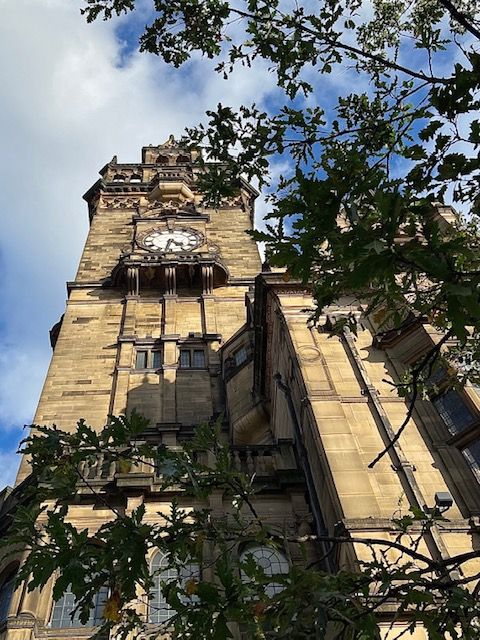
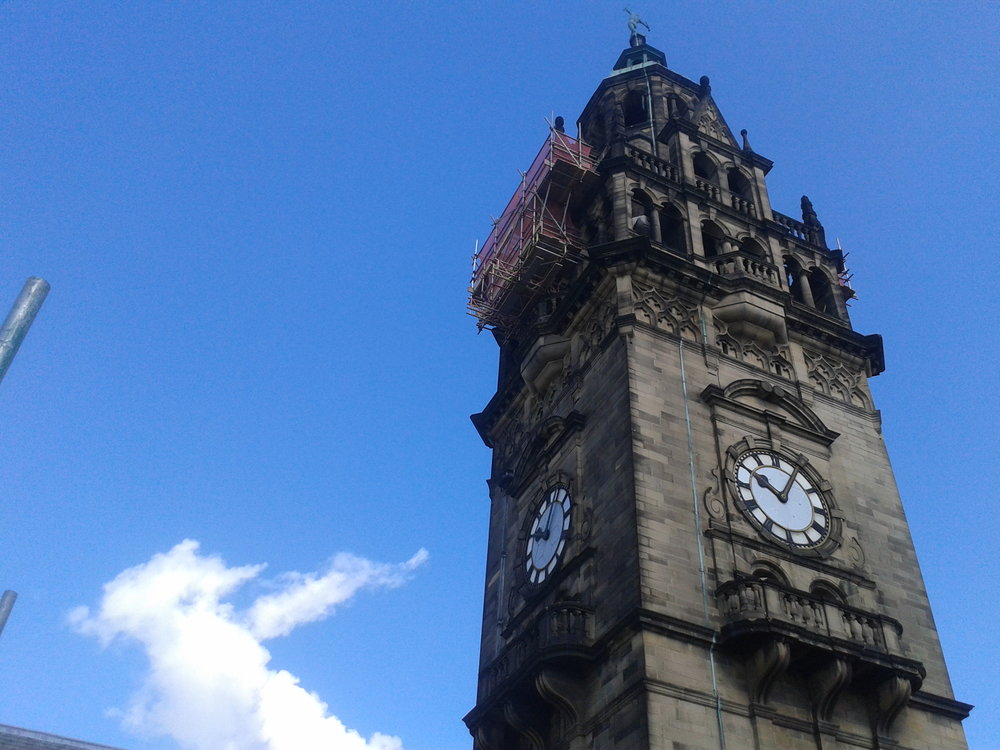
Sheffield’s third Town Hall was designed by Edward William Mountford, a London architect, and opened in 1897. Its clock and tower, the face of our city, stands at the north-east corner, over 100ft high and topped with a statue of Vulcan, the Roman god of fire and metalworking.

The tower is built on a bed of concrete, 30ft square, and 25ft thick; the concrete itself resting on solid rock. At ground level the walls are about five feet thick, and when it was built the strong room for the City Accountant was located here. The dome and spire at the top of the tower are covered with copper.

It was always thought that the tower was made of ‘Stoke’ stone from Stoke Hall Quarry, near Grindleford, but restoration work in 2017 revealed that it was from a long-disused quarry at Walkley.

The Town Hall clock was the work of William Potts and Sons, Leeds, clock makers to Queen Victoria, and was constructed to strike the quarters and hours on heavy bells. However, Sheffield Corporation waited for somebody to show their public spirit and provide the bells – something that never happened – and without it the striking parts of the clock were useless.

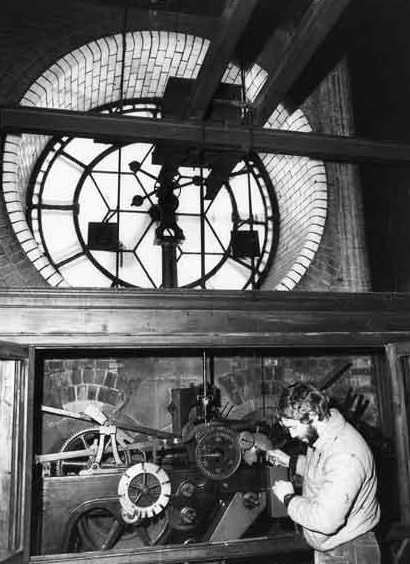
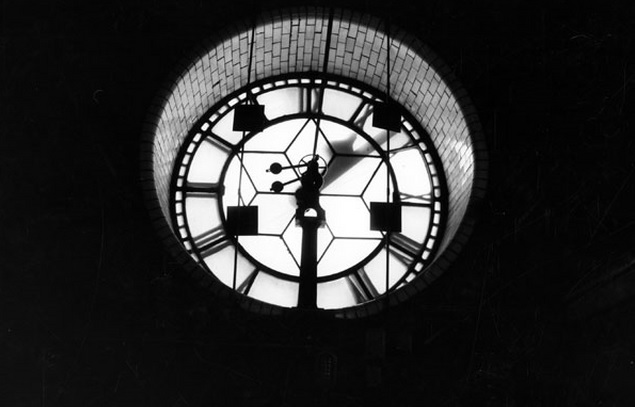
The frame of the clock was in one solid casing, planed perfectly flat on the top and bottom surfaces. It rested upon iron girders, supported by stone corbels built into the tower wall, and provided a rigid foundation for good time-keeping.

The large main wheels for the hour and quarter parts were 22 inches and 20 inches in diameter, respectively. The hour main wheel had ten steel cams attached for lifting the hammer to strike the large bell, with the quarter wheel having suitable cams in readiness for the ‘phantom’ bells. The large gong wheel was 20 inches in diameter.

The workings of the Town Hall clock. Seen here in the 1980s. Photograph: Picture Sheffield

There was special arrangement for accurately discharging both the hour and quarter parts, with set dials showing both seconds and minutes, and was known as the double three-legged gravity, the invention of Edmund Beckett, 1st Baron Grimthorpe, the man behind Big Ben’s clock, with the two seconds pendulum compensated for differences of temperature and heavy cylindrical bob.

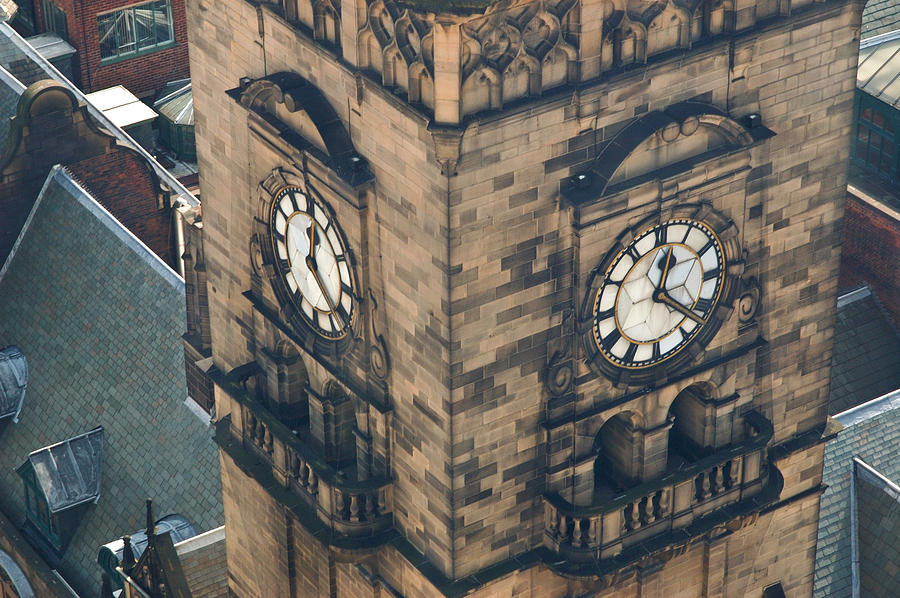
There were four dials, each 8ft, 6 inches in diameter, formed of skeleton iron castings filled in with opal glass, originally illuminated at night by gas, with suitable reflectors behind. The hands were made of stout copper, counterpoised inside, and the motion wheels were made of hard brass, the teeth cut out of it. The bevel work was carried by light iron girders placed across the clock room, and the whole clock was enclosed in a neat wooden case to keep it clean.

The four faces of Sheffield Town Hall’s clocks. Work started in 1890 and wasn’t completed until 1897. Photograph: Rob Huntley

It was not until 2002 that the Town Hall got bells – but nothing as elaborate as once intended. The chimes that now ring out across the city centre comes from an electronic sound-system providing hourly strikes and Westminster-style quarter chimes.

The clock tower was exposed to Sheffield’s pollution and weather for well over a hundred years and had to be restored at a cost of £86,000 in 2017. The original ironwork which had corroded within the structure was exposed and treated and indent repairs were conducted to the ornate carved capitals. Other masonry was repaired and repointed, as necessary. In addition, new rainwater pipes, asphalt floors and gutters were installed. Suitable fine sandstone providing a good match with the original stone was sourced from local suppliers based in Chesterfield.

The clock tower stands at the north corner of the Town Hall, set back slightly in deference to the main façade. This photograph from contractor Maysand shows restoration work in 2017
Sheffield Corporation could not decide whether or not to install a four-ton bell at a cost of £400 before the building of the tower was completed. It was said that if the bell were not put in, but it was decided to put it in later, a great deal money would have to be spent and serious damage done to the tower. Photograph: Picture Sheffield

Picture Sheffield

© 2021 David Poole. All Rights Reserved.

Categories
Other Streets

Connecting Sheffield

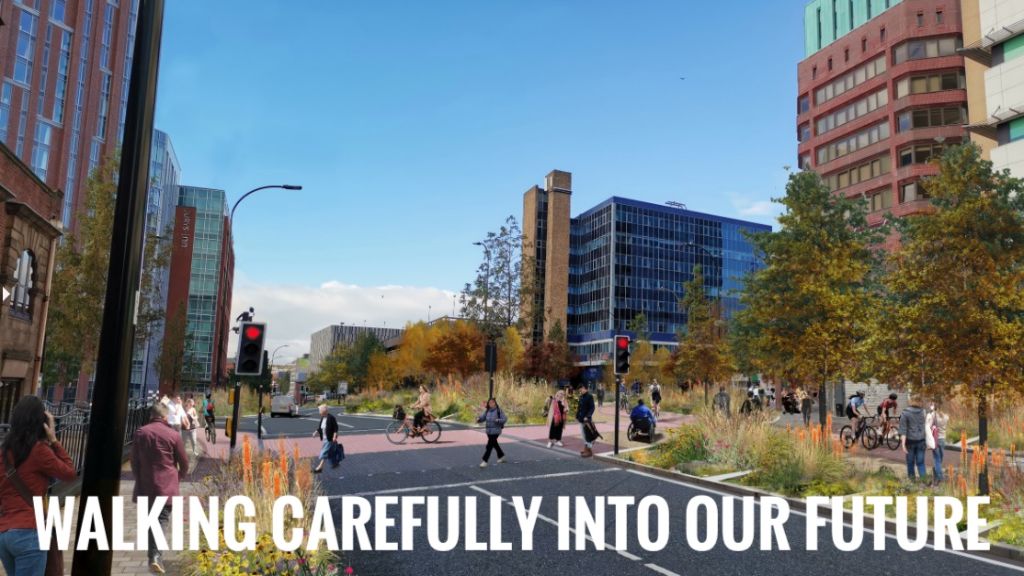
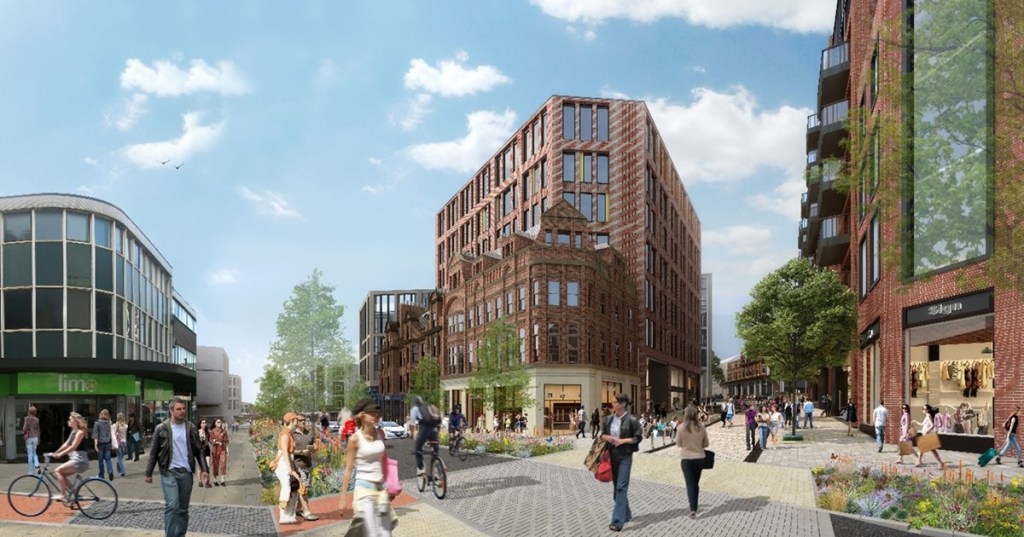
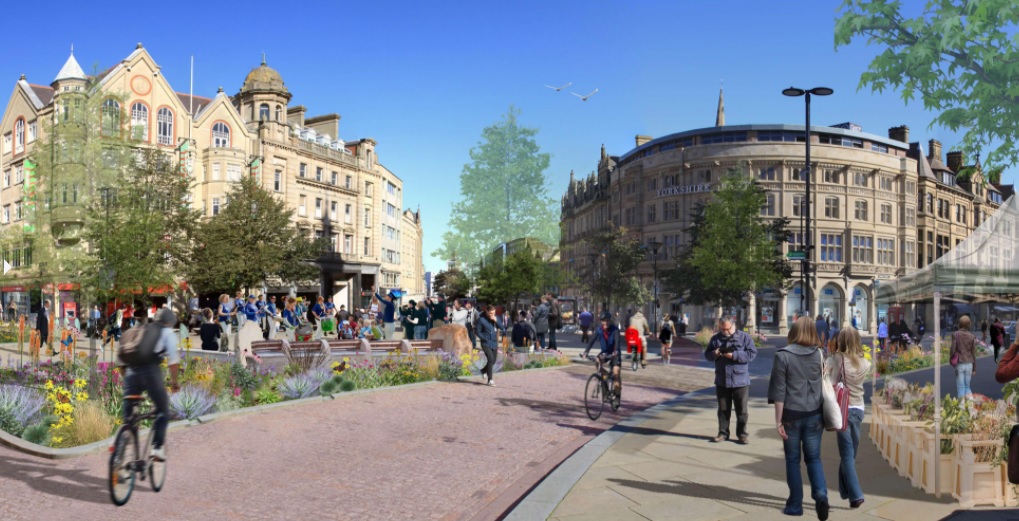
Our city centre may take on a new look if plans to pedestrianise large swathes of it get the go ahead. Sheffield City Council want to make foot and bicycle journeys easier and quicker, while streamlining public transport services.

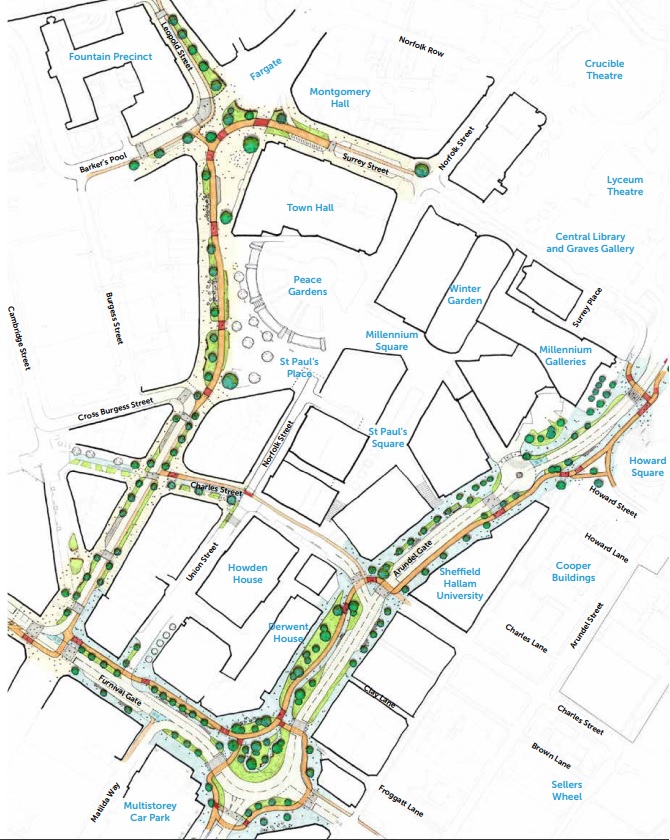
The proposals include pedestrianisation to Pinstone Street and Leopold Street, linking Fargate with the Peace Gardens, as well as Charles Street between Union Street and Pinstone Street. The pedestrianisation of Surrey Street would create a traffic-free Town Hall Square.

Work would include more greenery, replicating the ‘Grey-to-Green’ scheme already seen between Castlegate and West Bar.

Bus gates would be installed in both directions on Furnival Gate, and along Arundel Gate to Norfolk Street

Rockingham Street would get a new bus hub with improvements to pavements, green planting, a pocket park, and bus stops.

The future of our city? Pedestrianisation of Pinstone Street and Charles Street connects with Heart of the City II redevelopment, due for completion in 2021. (Image: Connecting Sheffield)

Of course, there are benefits to the scheme – improved air quality, better accessibility to shops and businesses, a more attractive city centre, and public spaces that create city uniqueness.

Artist impressions paint a bright picture, but there are notes of caution.

Sheffield city centre is at a midpoint in its regeneration, with the pandemic decimating footfall, and placing even more uncertainty on retail, hospitality, and office space requirements.

The city centre is a travesty of its former self, Covid-19 exposing retailers already reeling from Meadowhall and the internet. And, after restrictions are eventually lifted, how many pubs, bars, and restaurants, will have survived?   

Half-hearted attempts to open cycle lanes at the heart of the city, further reducing traffic flow, have met with lukewarm response. With respects to cyclists, our seven hills make four wheels the favoured choice in and out of the city.

The prospect of a Town Hall Square, with pedestrian access and cycle routes linking Fargate, Leopold Street, Surrey Street, and the Peace Gardens. (Image: Connecting Sheffield).

The key to any redevelopment must take into consideration transport links.

Cars are already deterred from entering due to over-complicated traffic flow and the extortionate cost of parking. Our buses remain empty, not least because nobody knows where they go, or where to catch them anymore. Our elderly citizens must walk a distance to catch a bus, and the question remains whether they will bother anymore?

We must tread carefully, mindful that change must happen if our city centre is to be revitalised.

Any changes must take place before 2023 to qualify for a Government grant, managed by Sheffield City Region, and must be subject of public consultation.  

An overview of the ‘Connecting Sheffield’ proposal, providing a green space around the city centre. (Image: Connecting Sheffield)

Connecting Sheffield

© 2020 David Poole. All Rights Reserved.

Categories
Other People

Sheffield Legends

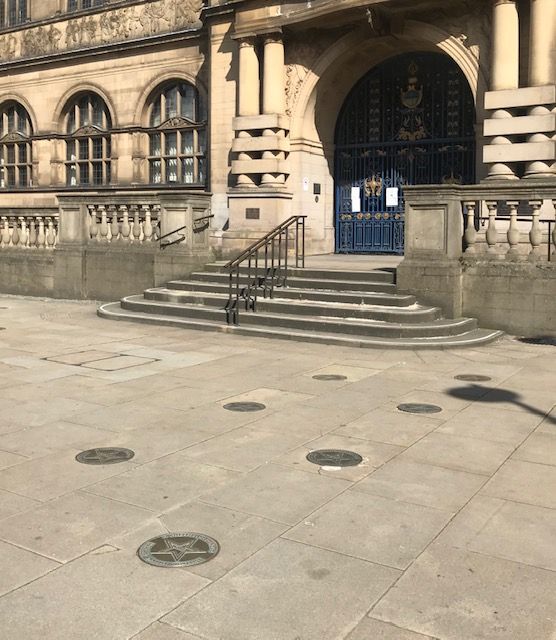
(Image: David Poole)

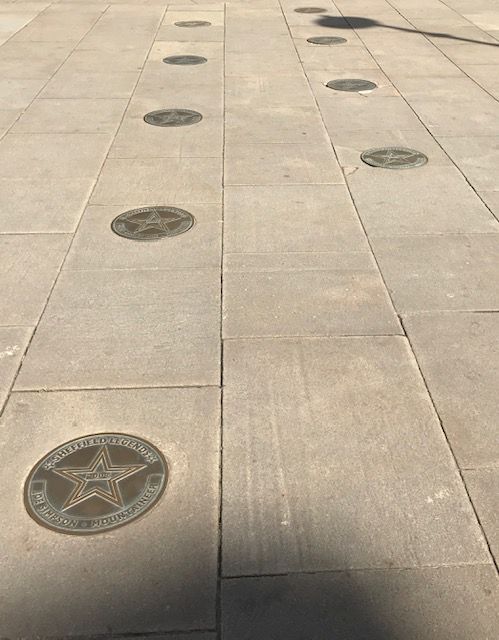
We walk over them regularly, and might be guilty of not giving them a second glance.

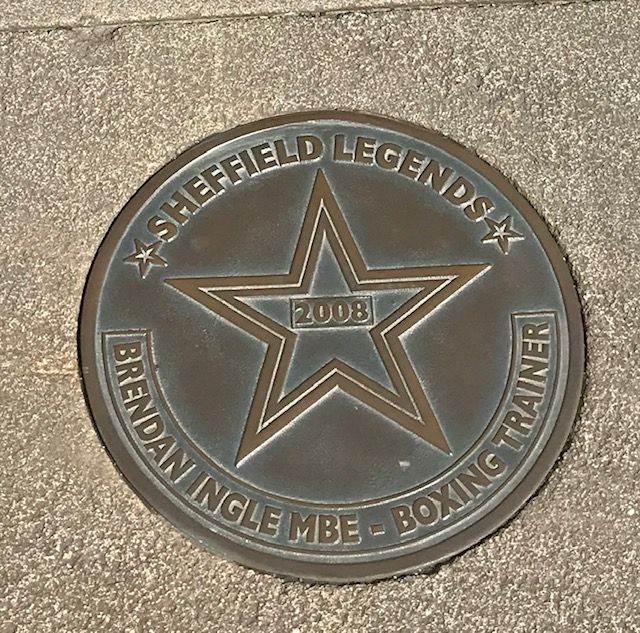
These are the Sheffield Legends, stars that line the pavement outside Sheffield Town Hall.

This is Sheffield’s Walk of Fame, honouring those who have achieved national or international acclaim. As in the Hollywood version, there are plaques with people’s names on them and why they are celebrated.

The idea was first suggested in 2005 when the people of Sheffield were asked who should be honoured after a local resident suggested honouring the footballer Gordon Banks, who grew up in Sheffield.

(Image: David Poole)

Nominations are considered by an independent selection board representing various sectors across the city such as the arts, sport, education, media, and business, and chaired by the Lord Mayor.

To date, the inductees are:

Gordon Banks – England’s World Cup winning goalkeeper
Sean Bean – film and TV actor
Joe Cocker – singer
Sebastian Coe – Olympic medal winner and President of the International Association of Athletics Federation
Derek Dooley – Footballing legend for United and Wednesday
Dame Margaret Drabble – internationally respected novelist and critic
Dame Jessica Ennis – Olympic Champion, double Outdoor and Indoor World Champion athlete
Professor Barry Hancock – OBE, world renowned cancer expert
Brendan Ingle – world famous boxing manager and trainer
Def Leppard – top-selling rock band
Nick Matthew – world squash champion
David Mellor – internationally renowned cutlery designer
Michael Palin – famous film and television personality
Steve Peat – champion downhill mountain biker
Helen Sharman – first British astronaut
Joe Simpson – renowned mountaineer, author, and motivational speaker
Joe Scarborough – one of Sheffield’s finest artists
Michael Vaughan – one of this country’s most successful cricket captains
Clinton Woods – world champion boxer
Grace Clough – Paralympic gold medallist, rowing
Tony Foulds – the man who inspired the spectacular flypast to remember those who died in the Mi Amigo wartime plane crash

(Image: David Poole)
Categories
Places

Barker’s Pool Garden

Photograph by Google

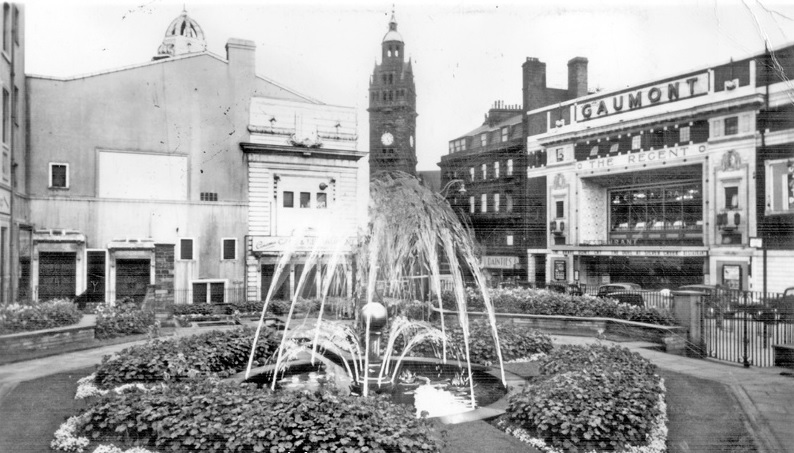
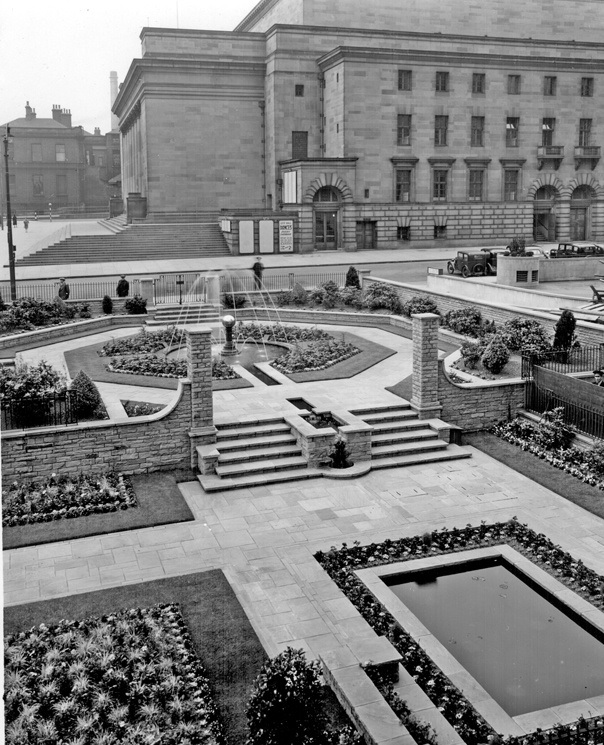
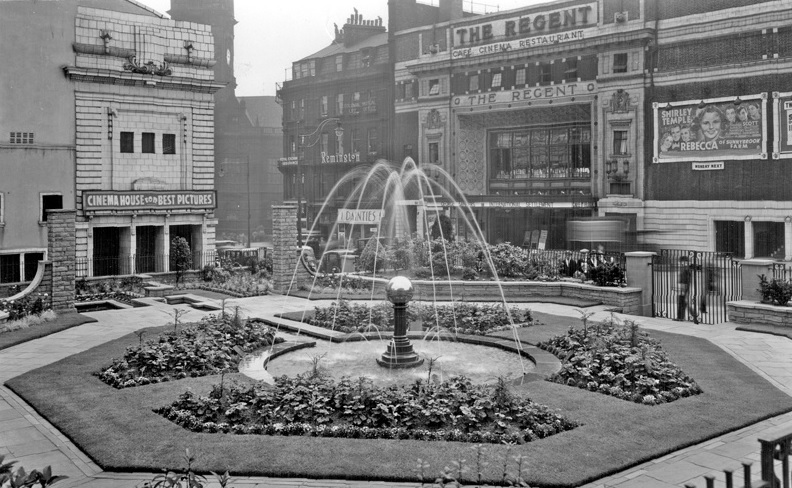
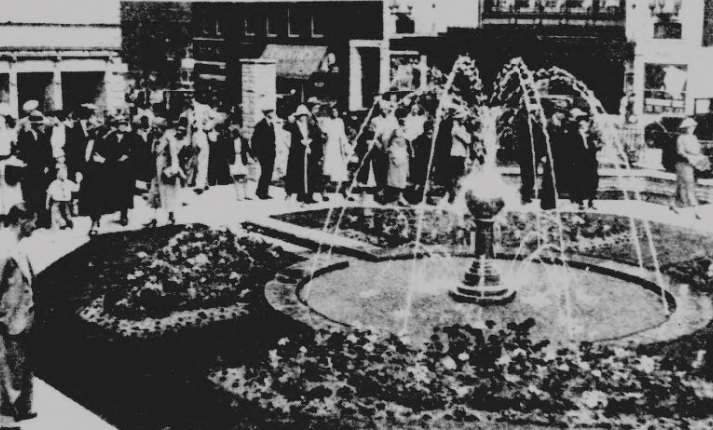
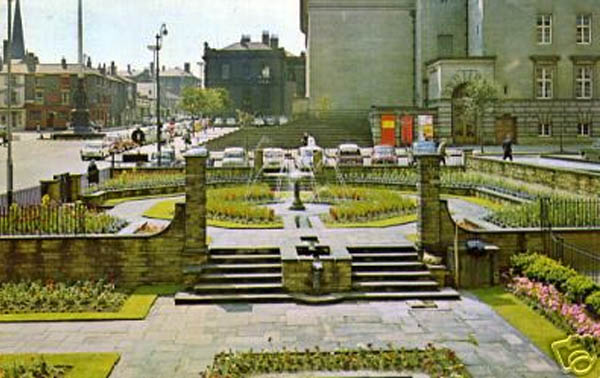
It is the “garden at the heart of the city”, and yet, the small plot at the corner of Barker’s Pool and Balm Green has never officially been named. It has been here since 1937, but these days most folk barely give it the time of day.

Barker’s Pool Garden, Balm Green Garden and Fountain Square are three of the names that have been attributed to it. However, when J.G. Graves, to whom Sheffield owes so much, attended the opening in 1937, he thought it unnecessary to give a name to the garden, but he had in mind its proximity to the City War Memorial.

“It will, I hope, provide a note of quiet sympathy which will be in harmony with the feelings of those who visit the War Memorial in the spirit of a visit to a sacred place.”

Photograph by Picture Sheffield

This garden, 400 square yards in size, would never have been created had it not been for the opening of the City Hall in 1932.

The land was owned by the adjacent Grand Hotel, the plot used as a car-park enclosed with advertising hoardings. But to J.G. Graves, it was an “eyesore”, obstructing the view of the splendid new City Hall from the Town Hall and the top of Fargate.

His solution was to negotiate the purchase of the land from the hotel. He paid £25 a square yard and outlined his plans in a letter to the Lord Mayor, Councillor Mrs A.E. Longden: –

“When planning the new City Hall, the architect, in order to give due importance and dignity to the elevation, placed the front of the building at some distance from the existing building line.

“This, of course, enhanced the architectural appearance of the Hall, but has had the incidental result of obstructing a view of the Hall from Fargate and the Town Hall corner, as is partially done now by the hoarding which surrounds the intervening plot of vacant land, and if in due course a tall building should be erected on the plot referred to, the possibility of a view of the City Hall from Fargate and the Town Hall would be completely lost.

“I feel it would be a misfortune if, through lack of action at the present time, building developments should proceed which would permanently deprive the city of an impressive architectural and street view at its very centre.

“With this in mind, I have arranged to buy the plot of land in question at its present day market value, with the intention of establishing thereon a formal garden, already designed by an eminent firm expert in this class of work.

“With this explanation I have the pleasure of offering the piece of land as a gift to the city, together with the garden which I propose to have established thereon at my own expense, and with the condition that the garden shall be maintained by the Corporation in as good a state as it will be when it is handed over on completion of the work.”

Photograph by Picture Sheffield

The gift was a personal one, not connected with the Graves Trust, and duly accepted by Sheffield Corporation.

In 1937, the Grand Hotel announced proposals for extensive alterations and to place their principal entrance on Balm Green. The whole of the corner was now thrown open and the new garden would later adjoin the forecourt to the Grand’s main entrance, running from Barker’s Pool to the building line of the hotel.

Photograph by Picture Sheffield

To complete the scheme the Grand Hotel management decided to reface the whole of the side of the hotel with a material approximate to the colour of the stone of the City Hall.

Photograph by Hazel Hickman

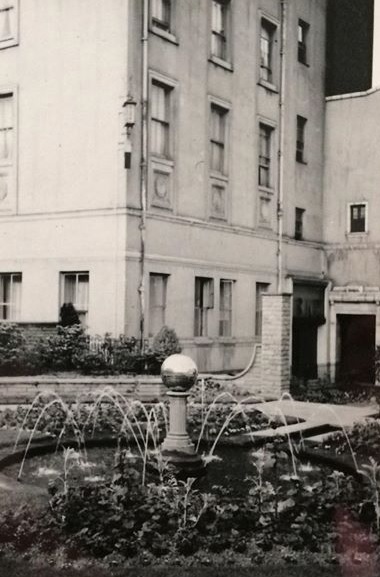
The garden had been laid out by “a famous firm of garden landscapers,” railed off from the footpath, with a border of shrubs, crazy paving, a fountain, and a water runway to a lily pond, and various flower beds.

Photograph by Picture Sheffield

A huge crowd gathered for the official opening on August 3, 1937.

“We shall always be proud of this garden, because it is not only a gift for all time,” said the Lord Mayor. “I hope the garden will become a real garden of remembrance for the future generation, who could thank the beauty of mind and heart which prompted the gift.”

Of course, two years later, Britain went to war with Germany again, the symbolism of the garden perhaps lost on the despairing public. However, the garden has remained, although J.G. Graves’ conditions seem to have been forgotten by subsequent councils.

Photograph of the opening by The British Newspaper Archive

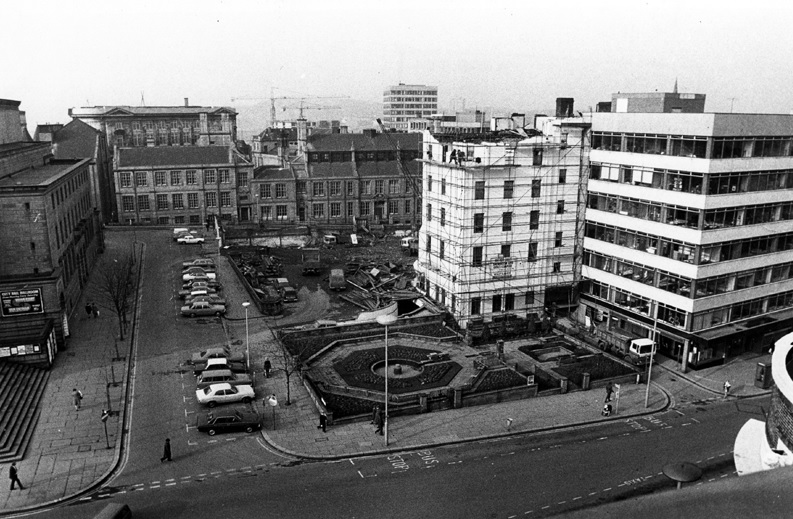
The fountain was eventually removed, the condition of the gardens fluctuating between mini-restorations, but its current state is a pale shadow of its original glory.

We might do well to remember the terms of J.G. Graves’ gift, although progress often comes into conflict with the past.

In 2019, initial plans were announced by Changing Sheffield action group (formerly Sheffield City Centre Residents Action Group) to create a unique space featuring ten large musical instruments and mini-trampolines, although the status of the application is unknown.

Photograph by Sheffield History