John Henry Andrew sat in the lounge of the steamship Montana feeling pleased with himself. He sipped his Old Forester bourbon and lit the cigar that he’d been given in New York. He was no stranger to travelling and calculated that this had been his thirtieth transatlantic trip.
He’d soon be back in Sheffield and would be able to tell his directors at the Toledo Works that he’d secured an important contract. It was a lucrative deal, supplying steel to Joseph Lloyd Haigh, a New York importer, and wire rope manufacturer, based at Brooklyn Wire Mills. More importantly, the steel would be used in the construction of the new bridge that would span the East River from Brooklyn.
Haigh had already taken a sample of steel from J. H. Henry and Company, drawing the rolled crucible steel rods into wire, and had presented a sample of it to the Brooklyn Bridge Company in 1876.
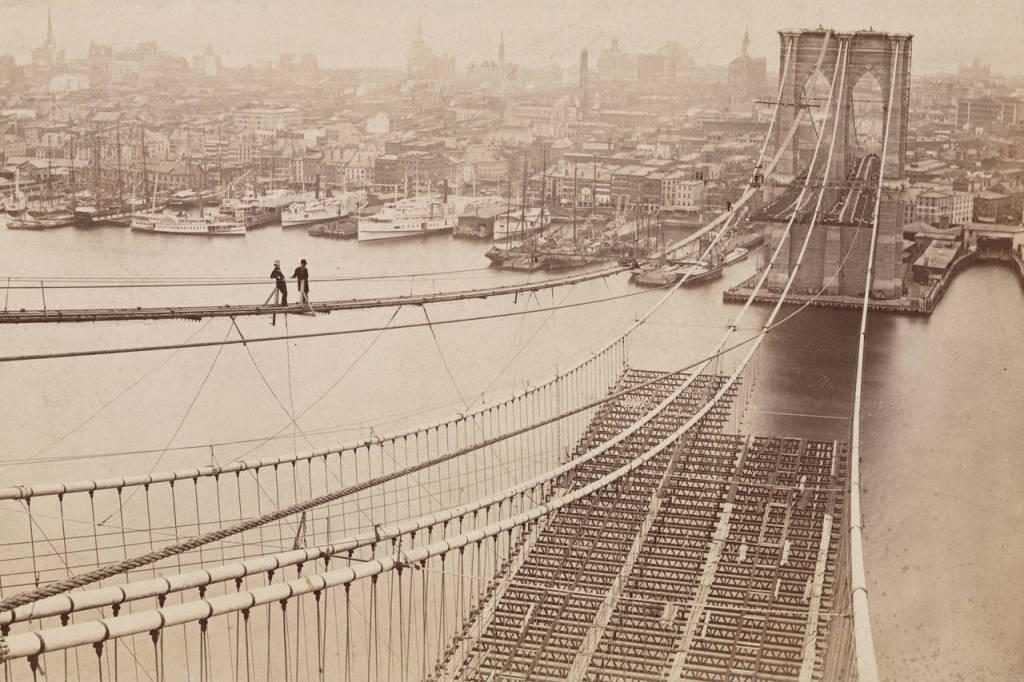
The ropes would be used to support the 486metre bridge, making it the longest in the world, and the sample had been enough to sway the directors that the Brooklyn Wire Mills was the ideal company to manufacture it. Haigh had beaten seven other companies for the contract, including one owned by the bridge’s architect, John Augustus Roebling.
Had John Henry Andrew known what lay ahead, then he might not have felt so pleased on that Atlantic crossing.
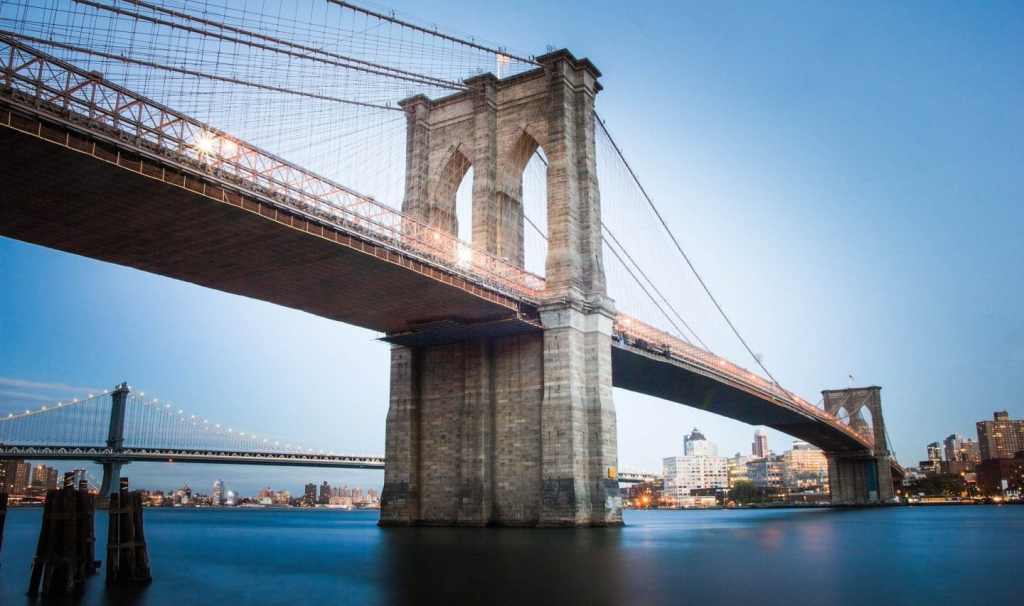
This had meant to be a positive post about the Brooklyn Bridge and the myth that it was constructed between 1869-1883 using Sheffield steel. Instead, this turned out to be an intriguing story of deceit, forgery, and monetary loss for the city’s steel manufacturers.
It was anticipated that English steel would be used in the Brooklyn Bridge’s construction, and the submitted bids came in cheaper than their American counterparts. However, the American steel companies put pressure on the US Treasury to increase import tariffs, effectively shutting down foreign competition.
A New York representative from the Sheffield Independent visited the Brooklyn Wire Mills in 1877 and found that only a small portion of steel for the four main cables had been supplied by Sheffield firms.
Haigh had reneged on his promise to J.H. Andrew, as well as the Hallamshire Steel and File Company, and had turned to Anderson and Parsevant of Pittsburgh to supply it instead.
Worse was to come.
Haigh struggled to meet deadlines for the wire rope, and this may have been the reason why he turned to deception to fulfil the contract.
In 1878, the Brooklyn Bridge Company discovered that Haigh had been supplying defective wire. Out of eighty rings evaluated, only five met standards, and it was estimated that Haigh had pocketed $300,000 from his dishonesty.
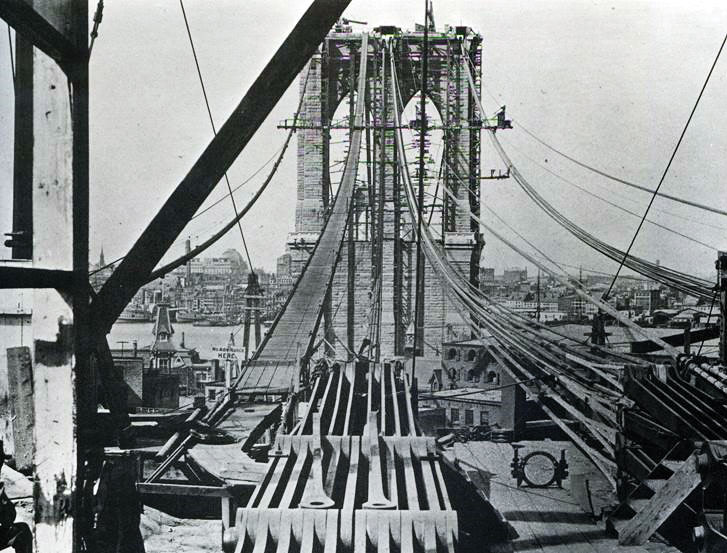
John Augustus Roebling thought that as much as 221 tons of rejected wire had been spun into cables and used, and so he demanded that another 150 wires were added to each cable as an additional safety factor. Had this not been detected, the consequences might have been catastrophic, and the sub-standard wires remain in place even today.
The Brooklyn Bridge Company decided to keep its discovery a secret and demanded that Haigh supply the extra high quality wire free-of-charge, but this led to his financial ruin.
Two years later, Haigh’s business failed, still owing approximately $20,000 to Sheffield companies, part of this for the Brooklyn Bridge, a figure that was never recovered.
Months later, Haigh was discovered to be a forger and had contributed to the collapse of America’s Grocer’s Bank, an action that led to his imprisonment in Sing Sing.
And so, we find out that the Brooklyn Bridge only has a small amount of Sheffield steel in its structure.
There is also another myth to dispel.
There are suggestions that Brooklyn Works at Kelham Island, once occupied by Alfred Beckett, saw maker, was named after the Brooklyn Bridge because steel from here was used.
We find that Beckett’s home was at Brook Hill, and he acquired his works in 1859 calling them Brooklyn Works, way before work on the bridge had ever started.
NOTE:- J.H. Andrew and Company subsequently became Andrews Toledo, based at Toledo Works in Neepsend.
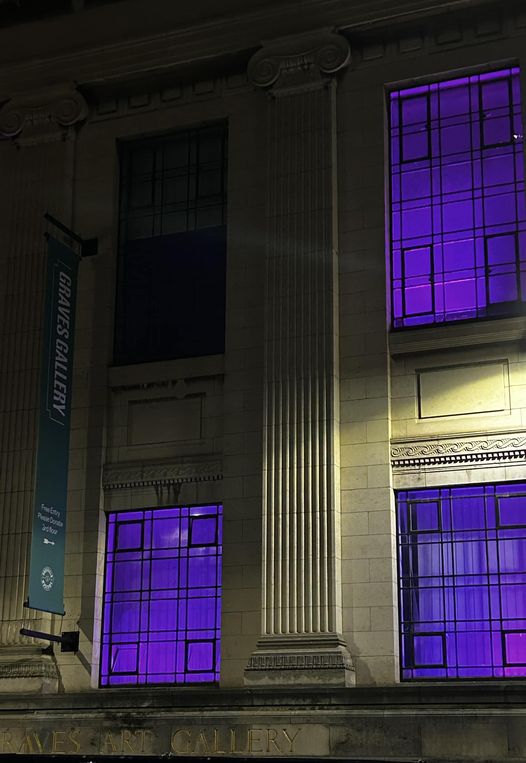
The ghost of J.G. Graves walked the corridors and sighed. He looked at his reflection through the window and thought, “If you can’t give a damn, give it to somebody who does. Give it to them for nothing if need be. Tell them to move the books somewhere else and turn the whole building into an art gallery that will be the envy of every city. But make them restore it… and look after it.” He smiled to himself. “Then I might be able to rest.”
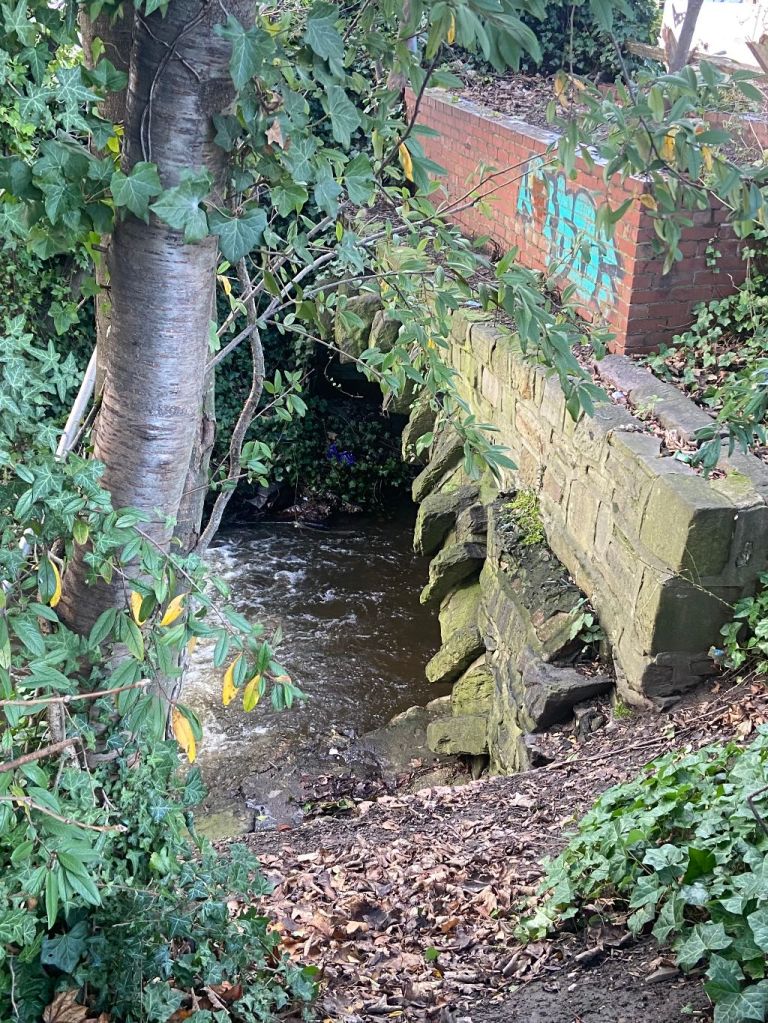
Bramall Lane Bridge, near former Staples Car Park. Image: DJP/2023
It was one night last summer, and I was taking photographs of skateboarders who had requisitioned the former Staples car park at the corner of St. Mary’s Gate and Eyre Street. There were about thirty of them, showing off to each other, trying to be cleverer than the next.
A small group noticed my interest and obliged by making their skateboards do remarkable things, but the resulting photos weren’t particularly good and soon forgotten.
Staples had long gone, so had Office Outlet that replaced it, and we forget that Mothercare had a shop here, later home to Theatre Delicatessen. The retail park was emptied, bought by Lidl for a new store, but plans had faltered, and the site had surrendered itself to broken windows and graffiti, hastening the rapid descent into decay.
Wooden gates had been erected, preventing entry into the car park, and allowing skateboarders to takeover.
The recent posts about St. Mary’s Church and Ladies’ Walk made me think about the conversations I’d had that night.
Taking a breather from their enactment, three boys sat on the tarmac, drinking bottled water, and chatting about their hallowed space.
I told them that where they were sitting had once been Ellin Street, still listed on maps, named after Thomas Ellin, who used waterpower from the adjacent Porter Brook where it widened into Bennett’s Dam. Here, he founded Vulcan Works with cutlery shops and a steel furnace, and the makeshift skateboard park was where the dam had been.
“That’s cool,” one said, “the dam disappeared, but the river’s still here.”
He was referring to nearby Porter Brook, and the reason Lidl withdrew their planning application last autumn. The discounter was aggrieved about calls to deculvert the river where it flowed under the site, with the loss of car parking spaces .
On the other side of Porter Brook is St. Mary’s Gate, where I took them to see an information board about an ancient structure called Bramall Lane Bridge. Like many Sheffielders, they had no idea about it, and were surprised to learn that it still existed, yards from where they skateboarded.
“Look here,” one of the boys said, pointing to a tongue in cheek warning on the sign.
“Best not to explore under the bridge as there are rumours that the Old Bramall Lane Bridge troll eats anything, especially with her carefully guarded bottle of Henderson’s.”
When told not to do something, lads of that age will do the opposite.
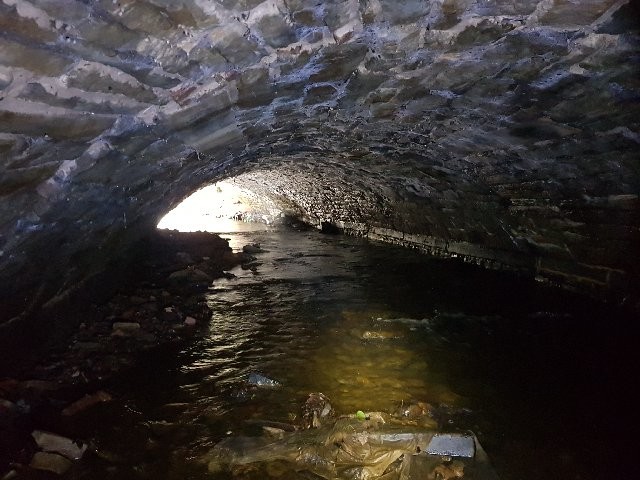
Days later, I saw them again, and they told me that they’d followed the river under the bridge, and then bottled it for fear of meeting the troll that protected it.
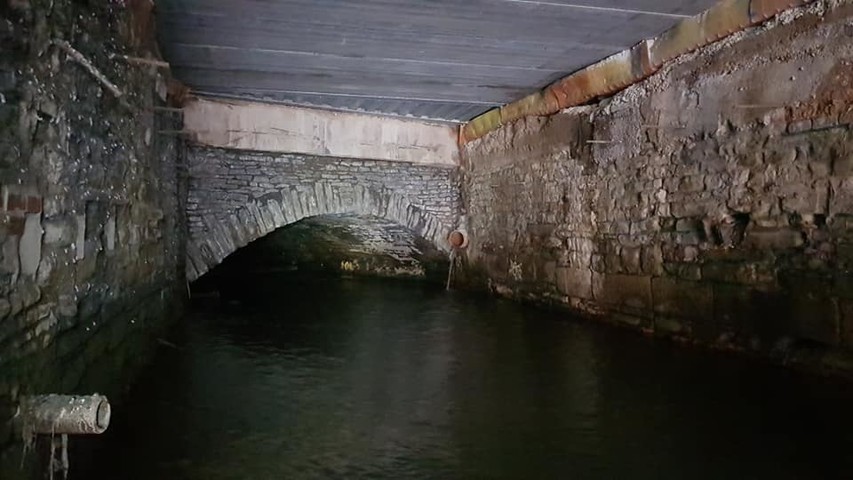
Their reaction is common because people don’t realise that Eyre Street, where it joins Bramall Lane Roundabout, is really built on a bridge that starts at the edge of the former Staples car park and ends on the other side of the dual carriageway near Decathlon.
The underside of Bramall Lane Bridge looking towards the former Staples car park end. Image: South Yorkshire Local Heritage List
These days, there is a Friends of Bramall Lane Bridge Facebook group that is responsible for the information board, and for getting the bridge listed on the South Yorkshire Heritage List. That was no mean feat because until the group had applied for its listing, the heritage body was also oblivious to its existence.
But what of its history?
I remembered a letter that had been published in the Sheffield Independent from 1831: –
“Permit me, Sir, through the medium of your valuable miscellany, to call the attention of the Town Trustees and others to this hitherto neglected, though now highly improving part of town. The bridge over the river Porter cannot remain as it is, and if all the owners of adjacent property were to come forward, I am certain the town trustees would not be appealed to in vain for their assistance in connecting Eyre Street, by means of a quadrant or an angle, with Brammall Street. This may be accomplished at considerably less expense than might be at first imagined, and most assuredly it would not only very much increase the value of property in the neighbourhood but would become a highly acceptable substitute for Porter Street, at the entrance to the new part of the town, by throwing open to view that most elegant structure, St. Mary’s Church.”
The letter showed remarkable foresight and within years, a new bridge had been built and Eyre Street eventually connected with Bramall Lane. Had this not been the case, then Bramall Lane might never have become home to Sheffield United FC.
The bridge’s history goes back to days when this was countryside, still a distance from the town that ended where Moorhead is now. At this time, Porter Brook had to be crossed by a narrow wooden footbridge, and horses and carts had to splash through the water to get to the other side.
When the file manufacturing Brammall family built White House and Sheaf House (now a pub), the road leading to the houses became known as Brammall Lane, later shortened to Bramall Lane, and extended across the Porter and would have finished near to where Moor Market is now.
By the 1835 Highways Act, Sheffield Corporation was allowed to replace a wooden bridge with a stone-built structure, and is thought to have been completed by 1845-1846, opening land for development to the south of the town, in places like Highfield, Little Sheffield, and Heeley.
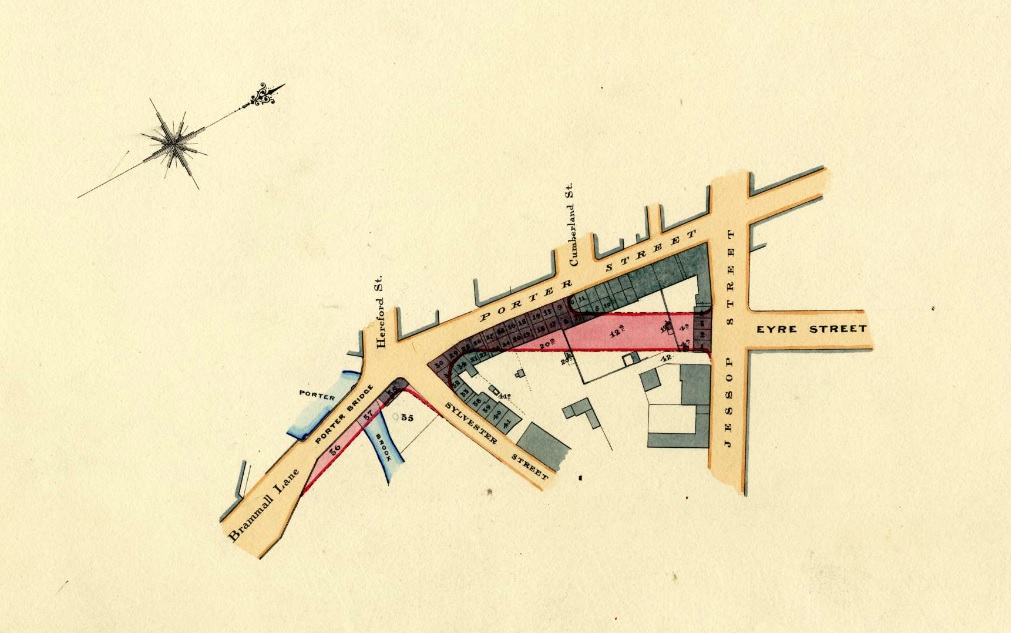
For a long time, it was known as Porter Brook Bridge, and was widened in January 1864, but there were already concerns that the bridge might not be strong enough to carry the traffic that might pass over it. The bridge was now 100metres wide and curved as it followed the course of the river.
This was the height of the Industrial Revolution, and rural land had been swallowed by the town. In 1876, Sheffield’s Medical Officer, F. Griffiths, reported that Porter Brook was full of sewage and the putrid remains of cats and dogs.
In 1877, the Corporation proposed plans to demolish houses between the west of Eyre Street, and the junction of Hereford Street, Porter Street, and Bramall Lane, allowing the extension of Eyre Street to the Bramall Lane Bridge where roads converged.
Once the roads connected, factories and houses were built, even on the bridge itself, but these have long disappeared, and the modern landscape is quite different.
These days, the only visible signs of the bridge are near Staples car park because the other end remains hidden, and most people are oblivious that Eyre Street runs directly over it.
Halfway under the bridge is the well preserved tail goit from the old Vulcan Works (Staples site) that joins the riverbank and has yielded finds such as a Victorian inhaler and oyster shells.
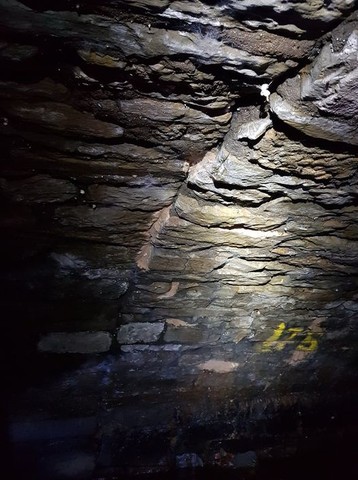
There is also a visible join in the structure about 25metres from the Decathlon end (75metres from the Staples end) that is thought to be the 1864 extension, while the Porter was culverted further from the Decathlon end of the bridge from the 1890s onwards.
Bramall Lane Bridge has stood the test of time, unlike the later culverted section that famously collapsed, forcing part of the Decathlon carpark to remain closed.
The Staples car park is now fenced off and the skateboarders have gone. This week Lidl announced that a revised planning application is pending, and it might include deculverting of another stretch of Porter Brook.
Joint in structure, towards Decathlon end. Image: South Yorkshire Local Heritage List
The other end of the bridge, hidden from view under the Decathlon car park. Image: South Yorkshire Local Heritage List
It is late summer in 1782, and the sun is slipping behind the distant hills. The ladies of the town, wives of respectable businessmen, clergymen, and doctors, are taking an evening stroll with their friends and their daughters.
The air is fragrant with scents of the countryside: corncockle, yellow-flag iris, harebell, and wood anemone. The long row of trees provide respite from the waning heat, and beyond the wooden fence, cows and sheep lollop in the fields knowing that it will soon be time to settle down for the night.
When the ladies reach the river, sparkling and clear, they might cross in single file, using the narrow wooden bridge, and walk a little further towards the tiny village ahead, where its few houses will already have cast shadows on the ground.
Most will turn around and retrace their gentle steps along the grass path that leads back into town, and where their gentlemen will be waiting, joking amongst themselves that their wives have been taking the air along Ladies’ Walk again.
A decade later, James Montgomery, a Scottish-born writer who had unsuccessfully attempted a literary career in London, moved to Sheffield township and became assistant to Joseph Gales, auctioneer, bookseller, and printer of the Sheffield Register.
On the first Sunday after his residence, Montgomery was encouraged to take a walk along this same path, and where it reached the river, he watched as a horse and cart coming from remote Heeley had splashed its way through the river because the flat wooden bridge was designed only for those on foot.
Montgomery became a hymn writer, poet, and newspaper editor, and by the time he was famous, he had witnessed the growth of Sheffield and its expansion from Alsop Fields, across Sheffield Moor, towards that tiny village called Little Sheffield (now London Road).
Ladies’ Walk subsequently disappeared, with houses, and small workshops built along both sides of the path, and by the time the new century dawned, it had become known as Porter Lane, the road heading towards Porter Brook where a wider bridge accommodated horses and carts.
In time, Porter Lane became Porter Street, one of the shabbiest, dingiest, and dirtiest of suburban streets, far removed from the days when elegant ladies took the night air, but it became the main route between Moorhead and Bramall Lane.
During World War Two, Hitler’s bombs rained down on Porter Street, reducing most of it to rubble, and for the next twenty years or so, swathes of wasteland would be reclaimed by those forgotten wildflowers of yesteryear.
In the end, Porter Street ceased to exist, its remaining buildings demolished to make way for post-war redevelopment, and the stories of Porter Lane and Ladies’ Walk disappeared.
And so, my twenty-first century friends, there is a clue as to where Ladies’ Walk was.
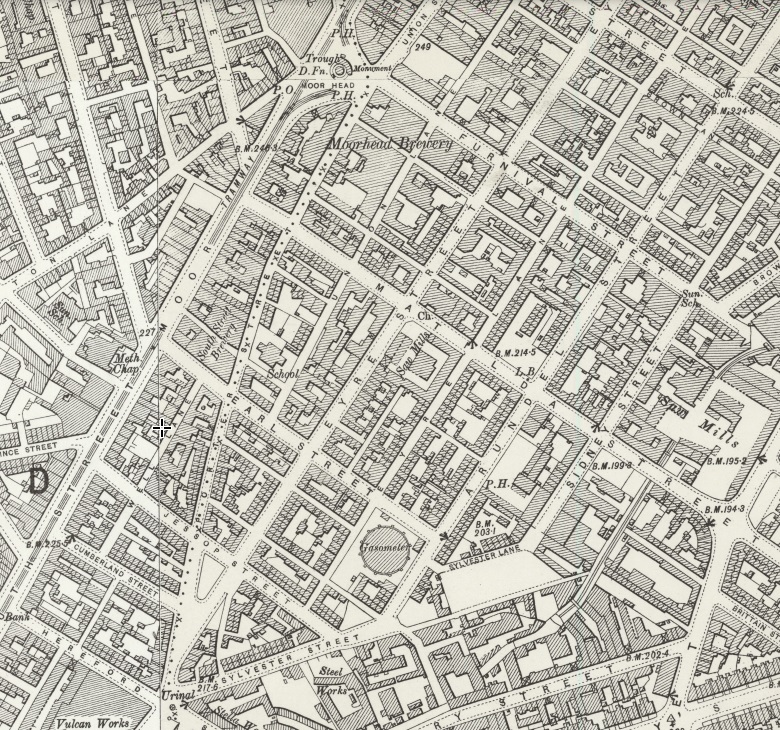
If you travel up Eyre Street from Bramall Lane roundabout, the road bends to the right near Decathlon. Eyre Street became the prominent road into the city centre, but Ladies’ Walk, then Porter Lane, and Porter Street, went straight ahead from where the road still bends.
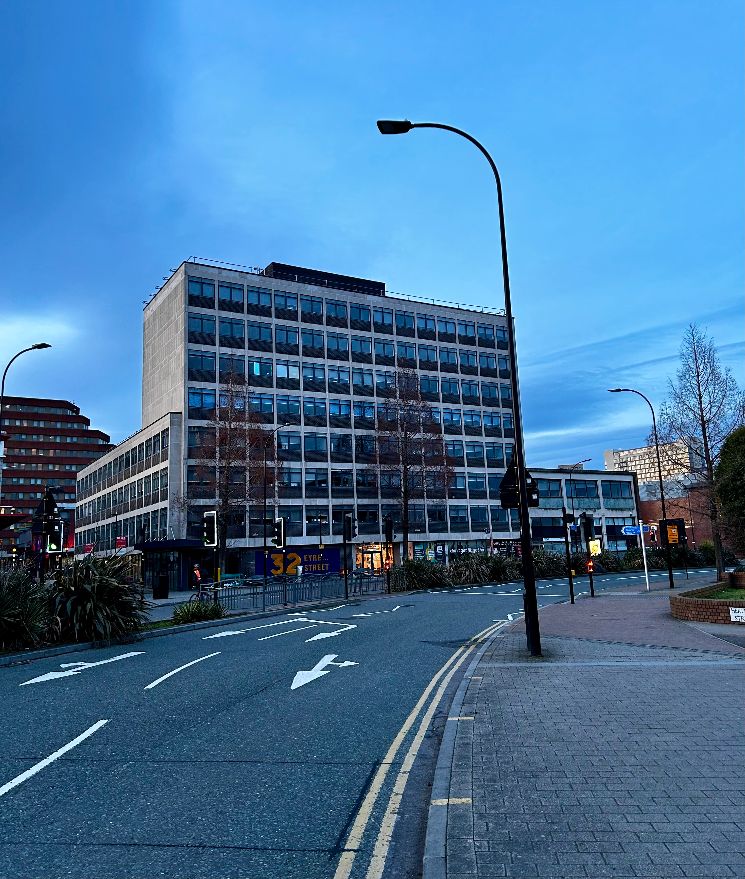
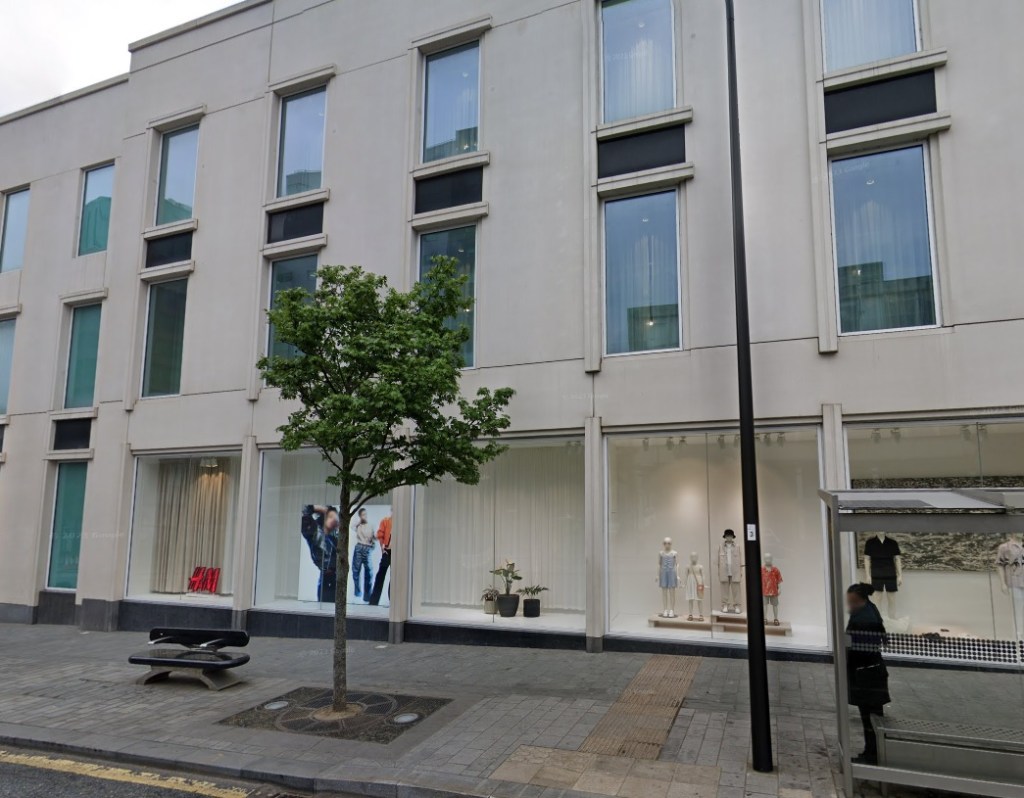
Imagine walking diagonally through 32 Eyre Street (known to many as Deacon House) at its corner with Hereford Street, across Cumberland Street, through Moor Market, across Earl Street, and through all the buildings until you reach Furnival Gate (once Furnival Street) where the modern H&M shop is now.
Those ladies would have walked from the end of Union Street on the opposite side of the road, straight through the side of the H&M shop, and into this lost and unimaginable rural idyll.
Eyre Street, Sheffield. 32 Eyre Street straight ahead.
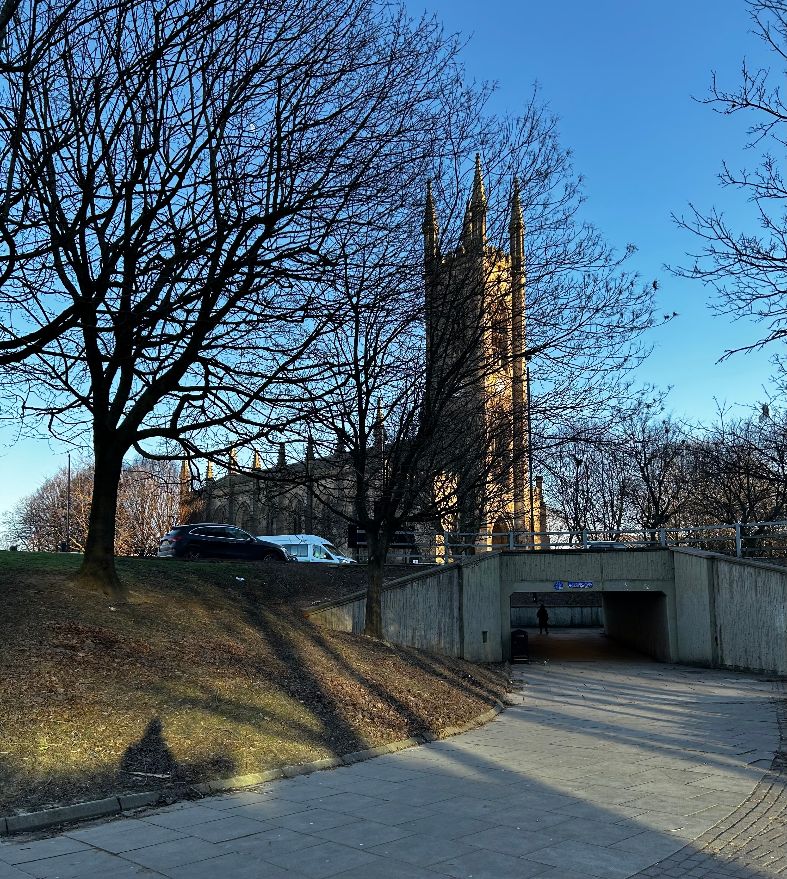
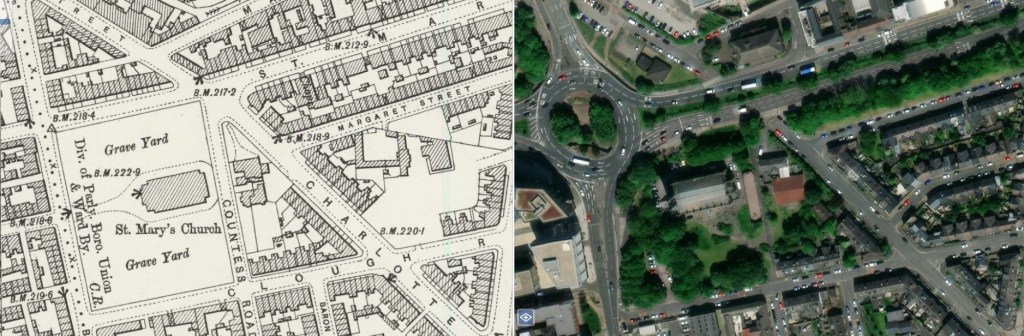
Let me take you down the subway at the roundabout which links Eyre Street, St. Mary’s Road, Bramall Lane, and St. Mary’s Gate. Once you get into its tree-lined centre, stop for a moment, and consider that several decades ago you would have been standing in the corner of a graveyard.
It is true.
The construction of Sheffield’s ring road required the widening of St. Mary’s Road and a roundabout. It meant that the graveyard at St. Mary’s Church was deprived of land, and where graves once stood, the subway has become a popular route for students and football fans journeying to Bramall Lane. Come down here at night at your peril because it is also the haunt of muggers and the like.
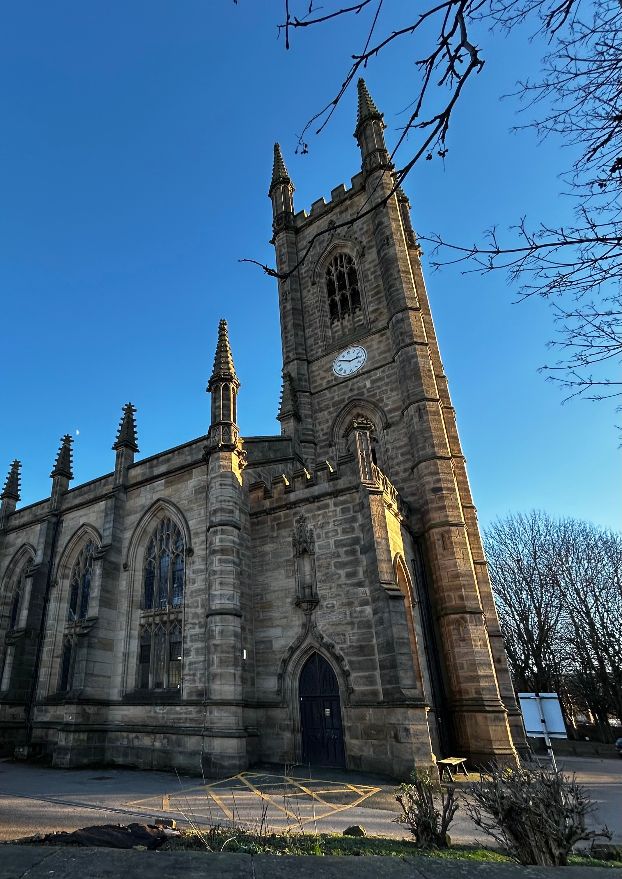
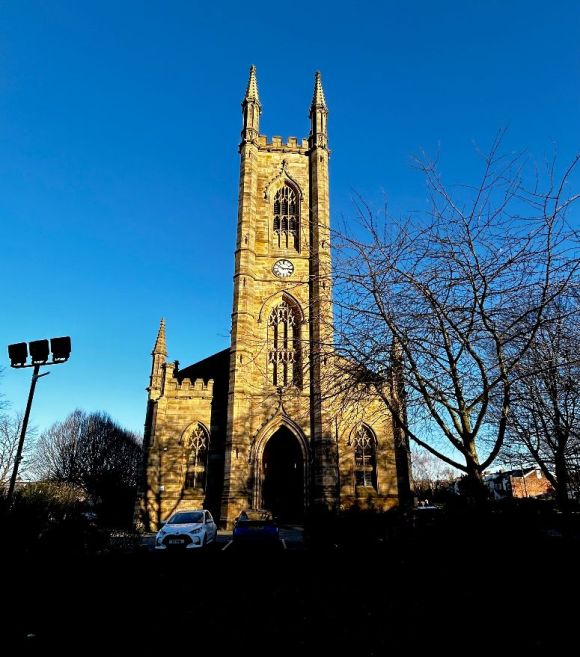
In a few years’ time, St. Mary’s Church will celebrate its bicentenary and where other big churches have faltered, it will be content that it still operates as a place of worship.
Let us start at the beginning.
The year is 1818 and to celebrate the recent end of the Napoleonic Wars, parliament passed the Act for Building New Churches, allocating £1 million for the task; the buildings that resulted were often known as the Waterloo churches.
The church was in crisis, a situation brought about by changing demographics and altering religious affiliations: the surge of the working-class population in major cities, especially in the north, and the drift to nonconformity.
The Church Building Commission turned to the government Board of Works, and its three advisory architects, John Nash (1752–1835), John Soane (1753–1837), and their junior, Robert Smirke (1780–1867), to set guidelines and advise on practicalities.
It stated that no church should cost more than £20,000, and by the end of the Commission’s term, in 1856, some 600 new churches would stand across the country.
In Sheffield, three churches were commissioned under the chairmanship of Rev. Thomas Sutton of Sheffield’s Church Building Committee– these were St. George’s, Portobello, St. Philip’s, Netherthorpe, and St. Mary’s at Highfield.
St Mary’s Church was the last of the three to be built and was constructed on land that had been gifted by Henry Charles Howard, the 13th Duke of Norfolk (also the Earl of Surrey). The foundation stone was laid by his wife, Lady Charlotte, Countess of Surrey, using an engraved silver trowel, in front of a huge crowd.
“With this trowel, Charlotte, Countess of Surrey, laid the foundation stone of St. Mary’s Church, Sheffield, 12 October 1826.”
The foundation stone contained a bottle in which were deposited coins and documents, but a few weeks later, a letter to the Sheffield Independent revealed that the stone had been removed the same night, and the bottle conveyed to the vicar’s house so that it would not be stolen.
The country was amid depression due to suspended credit and impoverished markets and the cutlery industry had suffered badly. For this reason, workmen employed on clearing the site and preparing the foundations were ‘able-bodied and willing minded cutlers’ who had fallen on hard times.
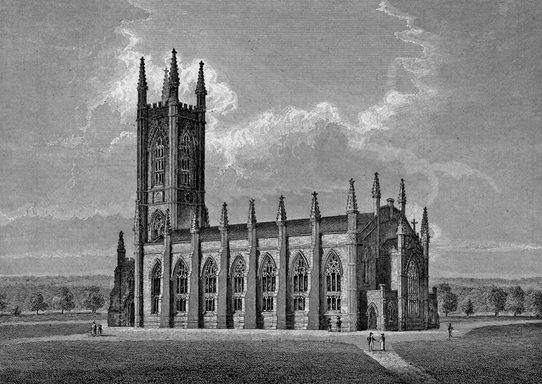
Original sketch by J. Potter and J. Rogers. Image: Picture Sheffield
The church was designed by Joseph Potter (1756-1842), a Lichfield-based architect, who early in his career had been employed by James Wyatt to supervise works at Lichfield Cathedral, Hereford Cathedral, St Michael’s Church in Coventry (now St Michael’s Cathedral) and the rebuilding of Plas Newydd, a house belonging to the 1st Marquess of Anglesey. He was the County Surveyor of Staffordshire for 45 years, as well as an engineer for the Grand Trunk Canal Company.
Potter’s eldest son, Robert (1795-1854), supervised the works at St. Mary’s, and he developed an attachment to the town because he opened an architectural practise here and built his home on Queens Road.
Building work was undertaken by Thomas Henry Webster of Stafford and the last stone was laid on top of the pinnacle at the southwest corner of the 140ft tower in November 1828, the occasion marked by the rising of the Standard of England and two other flags.
The church needed a minister and Rev. Sutton, Vicar of the Parish, appointed the Rev Henry Farish, Tutor of Queen’s College, Cambridge, at St. Mary’s in July 1829.
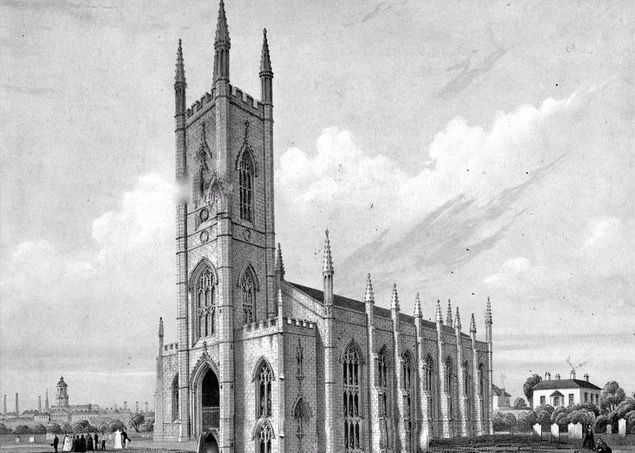
St. Mary’s Church. Clough Place in background. Image: Picture Sheffield
The church accommodated 2,000 people and had cost £13,927, the Church Building Commission covering the cost, as well as contributing £40 towards the cost of a bell in its tower. It was consecrated by the Archbishop of York on 21 July 1830.
However, its four-year construction had not been without its problems, but it took a letter to the Sheffield Daily Telegraph in October 1926, to reveal what had happened.
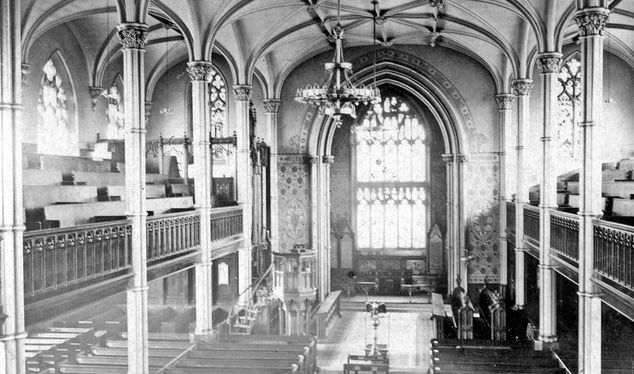
“By the original plan, the interior of the church was formed by two fine stone arcades into a handsome nave, with clerestory, and two side aisles, each vaulted, groined, and corbelled in stone. And the powerful buttresses, now on each side of the church, were built to take the weight and thrust of the internal vaulting. When the outside walls had scarcely reached the height of the parapet, an order came from headquarters to stop proceedings. It is supposed the million fund was about exhausted, but particulars were kept dark.
“This calamity completely stultified matters and new arrangements were made to finish the church with the least possible outlay. The result was the present lath and plaster imitation vaulting, supported by long thin cast iron props in lieu of stone pillars. This, I believe was the first and only instance of the use of cast-iron for such a purpose; its use here was owing to cheapness, and although these arrangements were a clever way out of a difficulty, they were always stigmatised by Robert Potter himself as an abortion and architectural curiosity, with which he disliked being associated.”
This revelation is backed by an old document that states that the plumbing, glazing, and imitation of stone on the walls and vaulted roof was by Robert Drury of Howard Street.
St. Mary’s Church had been in semi-rural surroundings. Its construction coincided with the growth of Sheffield, and once the old bridge over the nearby Porter Brook was replaced, the town expanded towards Little Sheffield, a hamlet that once stood in the London Road area that was swallowed up.
A lot has changed since then.
The west part of St. Mary’s was damaged by wartime bombing and was redeveloped by Stephen Welsh into a community centre in 1950. The division of the church was softened by APEC Architects in 1999-2000, who removed the 1950 work and created a new community centre of two floors and a mezzanine that filled all but the chancel and the two east bays of the nave, which is still used for worship.
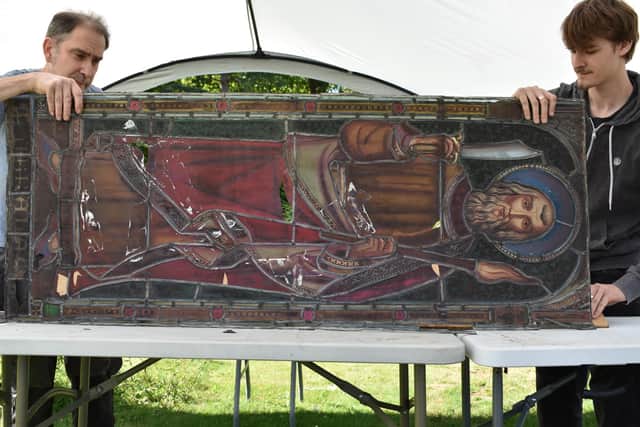
At the beginning of World War Two, a decision was made to remove the stained glass windows and safely store them. Unfortunately, their location was lost until 2020 when Colin Mantripp, a wood carver from Buckinghamshire, bought what he thought was a box of fragments of stained glass at auction.
When he collected the box, it turned out to be an 8 foot by 3 foot wooden box full of 13 stained glass panels. The outside of the box had St. Mary’s scrawled on the side. After careful research, he discovered that the windows had come from St. Mary’s Church and offered to gift them back providing they could be put back where they belong. The church declined because it wouldn’t have been practical to put them back. The panels are probably from the east window, which was filled with a new commission by Helen Whitaker in 2008.
One of the missing 13 stained glass panels from St Mary’s Church bought by Colin Mantripp at auction in Buckinghamshire. Image: Sheffield Star
Finally, as already mentioned by a previous correspondent, let us remember Lily Hawthorne, who was a cleaner at St. Mary’s Church and was murdered here on December 4, 1968. There is plenty of speculation surrounding this tragic incident, but the facts are that Hugh Mason was tried at the Sheffield Assizes in January 1969 on a charge of murder and, after hearing the evidence of three doctors that he was suffering from mental illness, the jury found him not guilty by reason of insanity. He was admitted to Broadmoor Hospital and later transferred to Sheffield’s Middlewood Hospital in 1972.
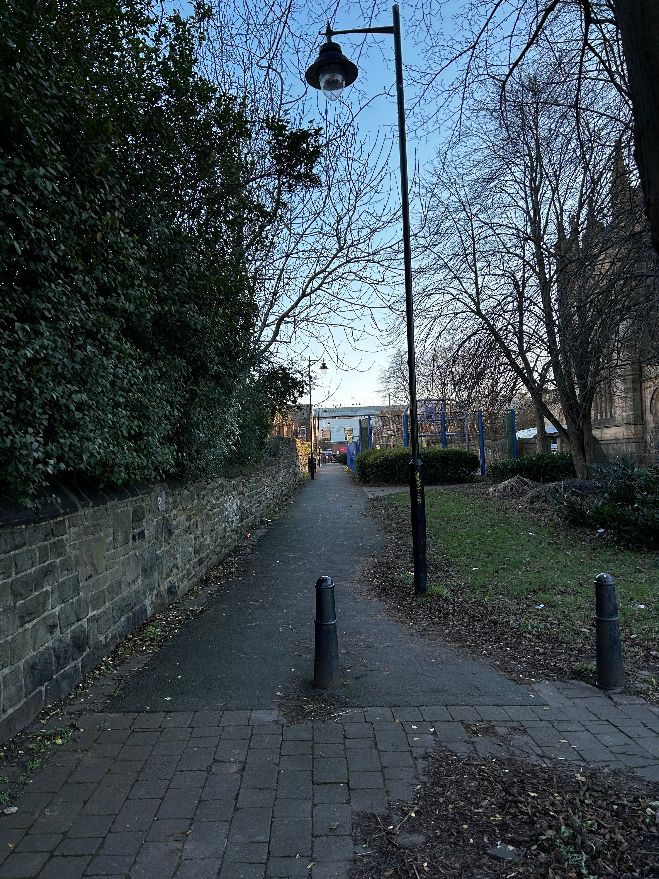
We cut through an alleyway that had once been the driveway to Clough Place, a house that had once belonged to William Hall, a file manufacturer, and which stood on the left. A substantial portion of that house has been demolished, but a section remains at the end of Charlotte Road looking onto St Mary’s Road.
To the right is a narrow basketball court that was once part of the garden to the house and had been adorned with carefully planted trees and shrubs.
I tell my colleague that I call this stretch of footpath ‘death alley,’ not as a joke, but because this was where a Sheffield solicitor had been shot dead by two assassins. My colleague is shocked.
It is broad daylight but there is a dark and looming presence that is St. Mary’s Church, and which casts a huge shadow over everything.
We continue up the path to where it opens into the graveyard. A man walks his dog on a stretch of grass, oblivious that the ground beneath him had once been the final resting place of the dearly departed, the gravestones removed. People sit on benches and appear harmless, happier drinking from their cans of beer. This is now called St. Mary’s Church Park, still a pleasant place to sit amongst the few remaining graves, but there is menace around.
There is a man loitering under a tree and he moves towards us. I don’t want to alarm my colleague, but I tell him to keep walking. I’m used to situations like this, but the best option is to keep a distance.
We cross Clough Road and head into Chaucer Yard where there is a vintage clothes shop and coffee house. My colleague goes in search of a bargain while I remain outside and light a cigarette.
The man appears on the other side of the road and stares. I recognise him and stare back. This isn’t a street drinker but someone who will rob for a living. He decides that I’m too tall, too clever, or perhaps not worth the effort, because he turns and disappears.
I lean on the wall and see Bramall Lane at the end of Clough Road where there is a constant flow of traffic, people walking up and down, and not the place where misdeeds are going to happen.
A police car turns into the road and hovers outside the gates of St. Mary’s Church, before making a left turn and cruising slowly along its driveway and vanishing on the other side.
Two men appear at the end of the road and walk quickly towards me, all the time casting furtive glances at the church gates. In no time at all, they pass, but before disappearing around the corner into Countess Road, they look back to make sure that nobody has seen them.
Moments later, a female comes from Bramall Lane, a student, but she is being followed by two more shifty characters. She knows that they are behind her and when she is level, stops and pretends to look for something in her bag. The two men pass and turn into Countess Road. Her eyes are alert, glad to see the back of them, and when she smiles, I know that she is grateful that I was there.
I finish my cigarette and cross the road to where I can see through the church railings. The old graveyard is empty, the loiterers have disappeared, and the guy who I thought was a robber had gone. They have seen the police car and know that it hasn’t returned, and that danger lurks for them too.
When my colleague returns, we go for coffee, and he asks if I’d noticed the dodgy character who’d followed us. I tell him not to worry.
But there is an issue because we are only a stone’s throw from the city centre and all its problems.
St. Mary’s Church Park is a bolt hole for those wanting to escape something or someone and is also a suitable retreat for peace and quiet. I consider that the church is for everyone: fellowships of every denomination, no social class, where God’s love can be shared, and that should apply to the outside.
Days after writing this post, I return to St. Mary’s alone and take photographs. It is a fabulously sunny day, and the light makes the old church shine. There are cars parked outside and I remember that this is still a working church, the website would indicate a thriving one, but today the former graveyard is deserted.
I sit on a bench, take in the surroundings, and think that this is quite a picturesque spot, and that its troubles are no different to those elsewhere in the city centre.
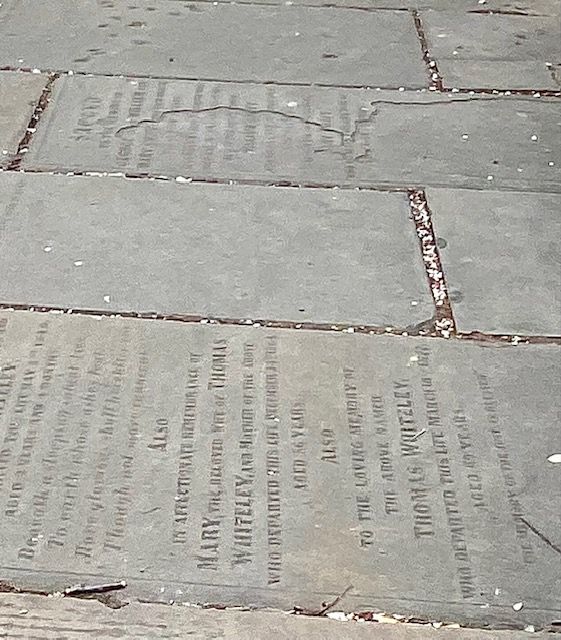
At that moment, a robin descends and hops on the ground in front of me. I notice that the flagstones are really gravestones, laid flat to form a path. I take it as a sign that our descendants are still around, and, in the spiritual community, it might be a visit from someone dead whose gravestone is missing.
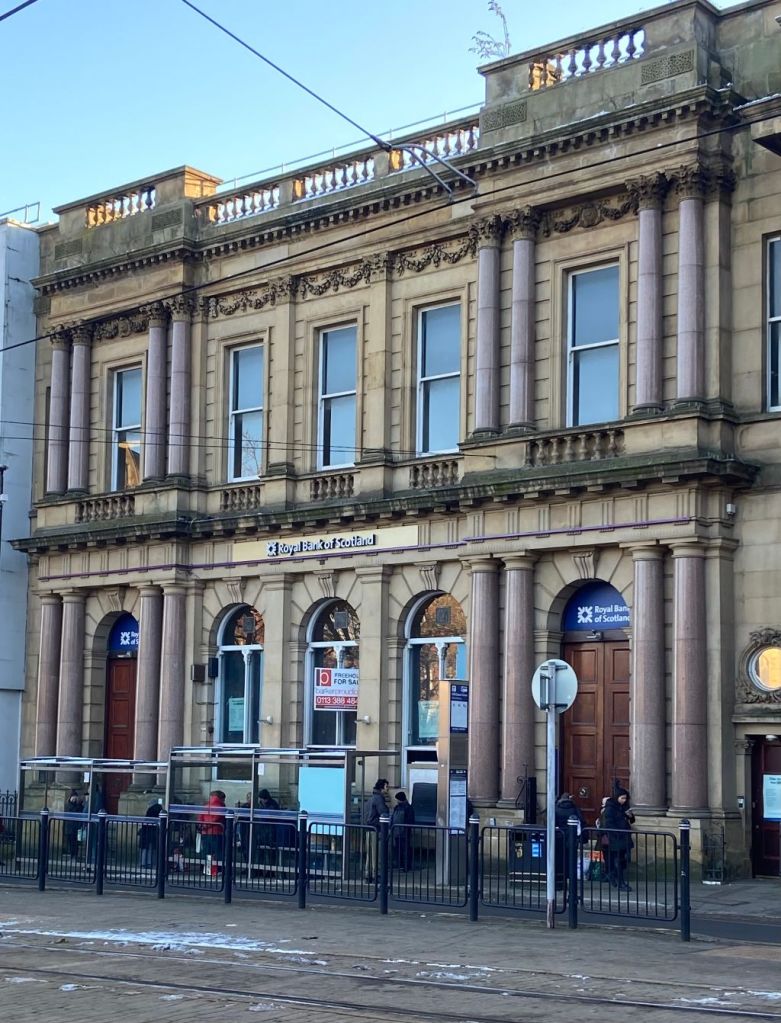
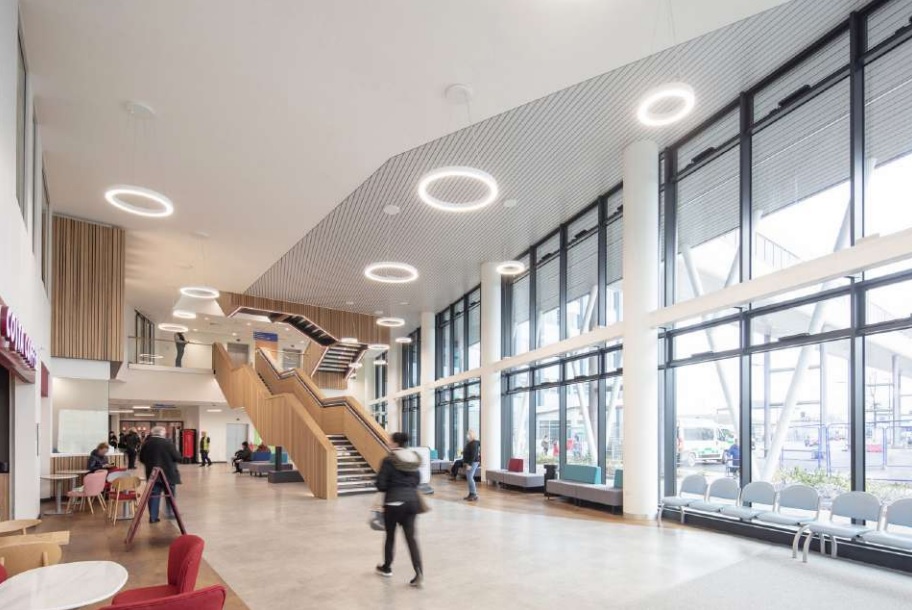
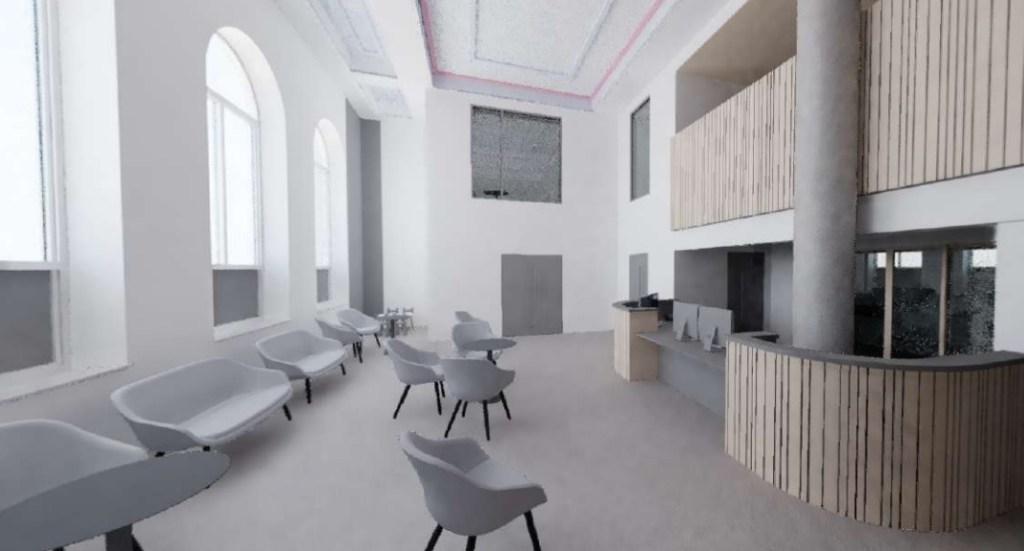
Plans have been lodged for the redevelopment of the Grade II-listed former Royal Bank of Scotland on Church Street in Sheffield city centre to create a new health hub.
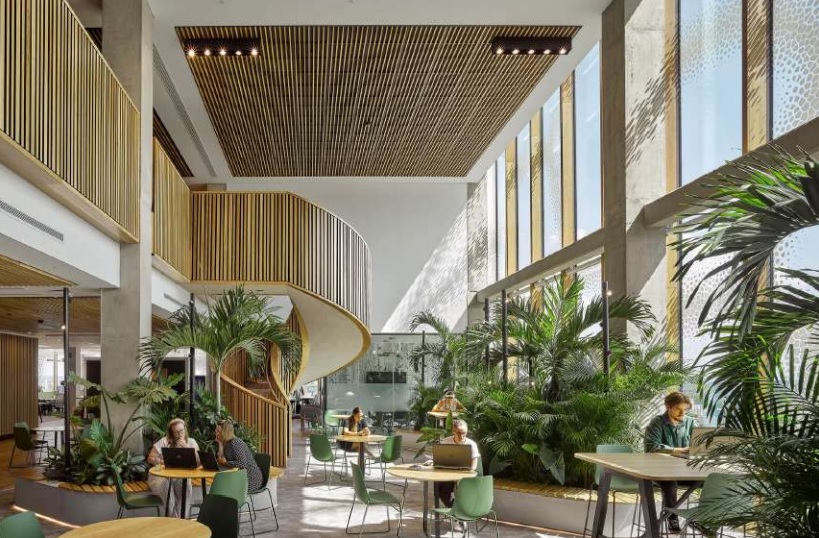
Sheffield City Council is behind the plans that would feature two GP practices and flexible shared bookable spaces for other health providers.
Under the plans, alterations would be made to the listed building, but demolition is limited to the creation of a new entry point on the west elevation of the building through the shared access with Cutlers’ Hall.
The building replaced an earlier bank for the Sheffield and Rotherham Bank in 1866-1867, designed by Flockton and Abbott, and constructed by Mr J Niell of Bradford and Sheffield.
In 1907, the bank was acquired by Williams Deacon’s Bank of London and Manchester, later becoming Williams & Glyn’s Bank and subsequently disappearing within Royal Bank of Scotland, which closed the branch in 2022.
Planned designs for the new Health Hub (Images: Race Cottam Associates)
In the same week that William Flockton’s The Mount is subject of a planning application comes news of another one of his buildings that could also be restored. It is one that most Sheffield folk will probably not have heard about.
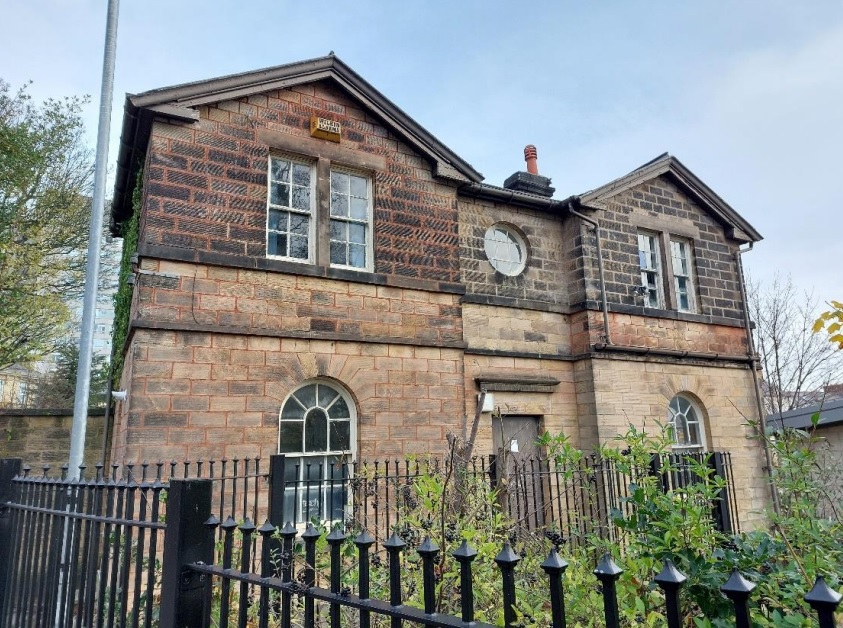
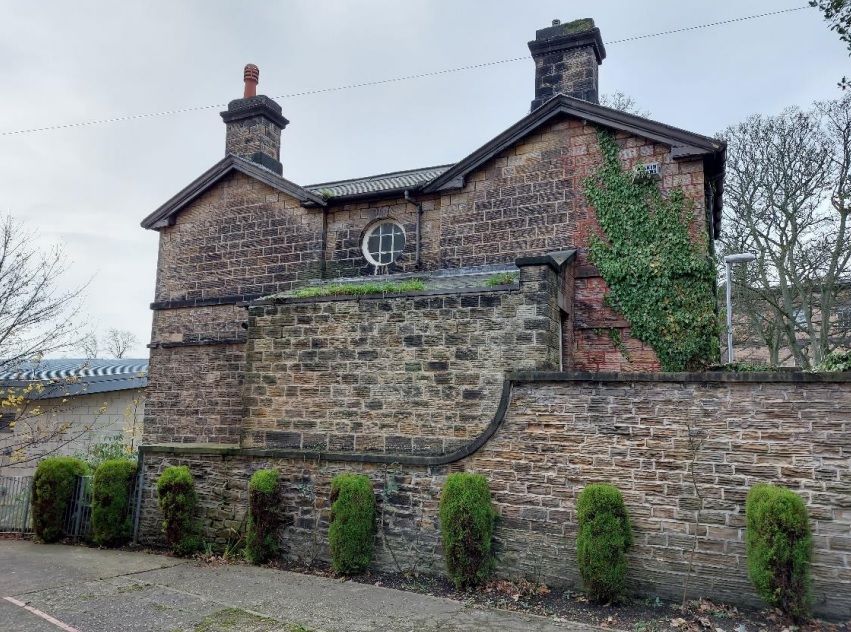
A planning application has been submitted by King Edward VII School for the refurbishment of the ‘Caretaker’s House’ on the upper school site. Once completed, the building would be used for small group work, a therapy, meeting, and isolation space, as well as a transition unit for students with complex needs and additional space for work with SEND students.
Externally the school wishes to bring the building ‘back’ into the secure school site as it currently is outside of the school’s fenced boundary, requiring all users to exit via the pedestrian site gates to gain access. The school also suggests that they are intending to use the external area to the front of the building for a sensory garden or similar, within existing trees.
Although the building is referred to as the caretaker’s house, it has not been used for this function for several decades and is currently being used for storage, small group working and music practice.
The plans by Jump Architects show no changes to the overall appearance of the building beyond the replacement and refurbishment of the existing fabric.
The Grade II listed building is believed to date from about 1838 and designed by Wiliam Flockton, originally built as the caretaker’s house to the main school building, which itself dates from 1837-38 and was built as the Wesleyan Proprietary grammar school.
William Flockton (1804–1864) was the son of Thomas Flockton, a carpenter and builder in Sheffield. He was brought up in his father’s trade and established himself as an architect in 1833. From 1845 to 1849 he operated the business with William Lee and his son Thomas James Flockton as Flockton, Lee and Flockton, continuing in partnership with Thomas James Flockton as Flockton & Son until his death on 24 September 1864.
More news about one of Sheffield’s architectural gems. Back in early 2022 it was announced that plans had been submitted to convert The Mount, on Glossop Road, into fifty-five residential apartments. The application was approved but work never started.
That was probably because there had been a rethink, and a new planning application has now been submitted by Axis Architecture that could see the Grade II* listed building turned into eight townhouses and four apartments instead.
This involves the removal of internal corridors, stairs and lifts associated with the former office use, and the reinstatement of internal dividing walls from front to back to form the townhouses and apartments, with new external stepped accesses to each entrance. The previously approved proposals included eighteen apartments within the main listed building.
The remaining new apartments would be built within the 1950s office block that stands behind Flockton’s building.
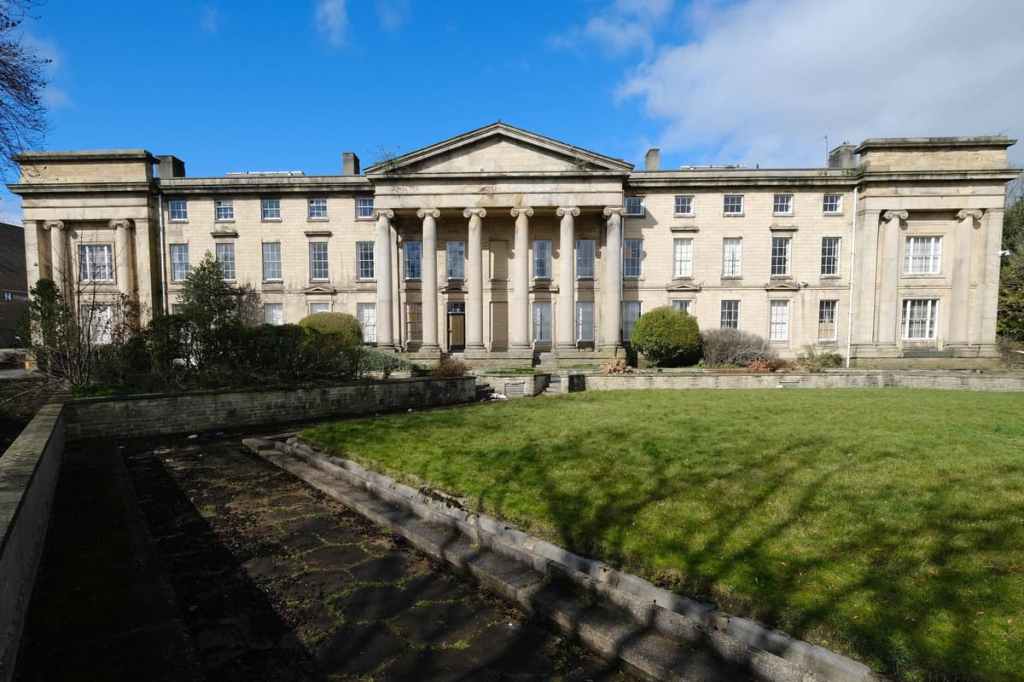
The Mount was an ambitious attempt to recreate the grand terraces of Bath’s Royal Crescent and London’s Regent’s Park. It was built between 1830-1832 by William Flockton, aged twenty-six, a builder, and forever famous as one of Sheffield’s leading architects.
Pevsner described it as “a palace-fronted terrace of eight houses, seventeen bays long, with an Ionic giant portico of six columns carrying a pediment and end pavilions with giant columns in antis.”
It was referred to as ‘Flockton’s Folly’ because for the first eight years after construction one person only occupied it. But its popularity increased and became a place of literary fame when James Montgomery lived and died here, while John Holland, another noted Sheffield poet, lived in one of the houses.
It was used as the model for the nearby Wesleyan Proprietary Grammar School in 1838, later Wesley College, and better known now as King Edward VII School.
In 1914, John Walsh, the department store owner, bought The Mount and served notice on its tenants. The need to expand his city centre store meant that his live-in shop assistants needed new accommodation. Numbers 10-16 were used for the purpose, and when the Blitz of 1940 destroyed the store, the building was used as temporary retail space for a year.
It was bought by United Steel Companies in 1958 and converted into offices, with extensive additions to the rear.
In 1967 it became the regional headquarters of British Steel Corporation and in 1978 was purchased by the insurance company General Accident, later becoming Norwich Union.
Aviva, formed from the merger of Norwich Union and Commercial General Union, later owned The Mount, and subsequently rented it to A+ English, a language school, which conducted significant improvements to the offices.
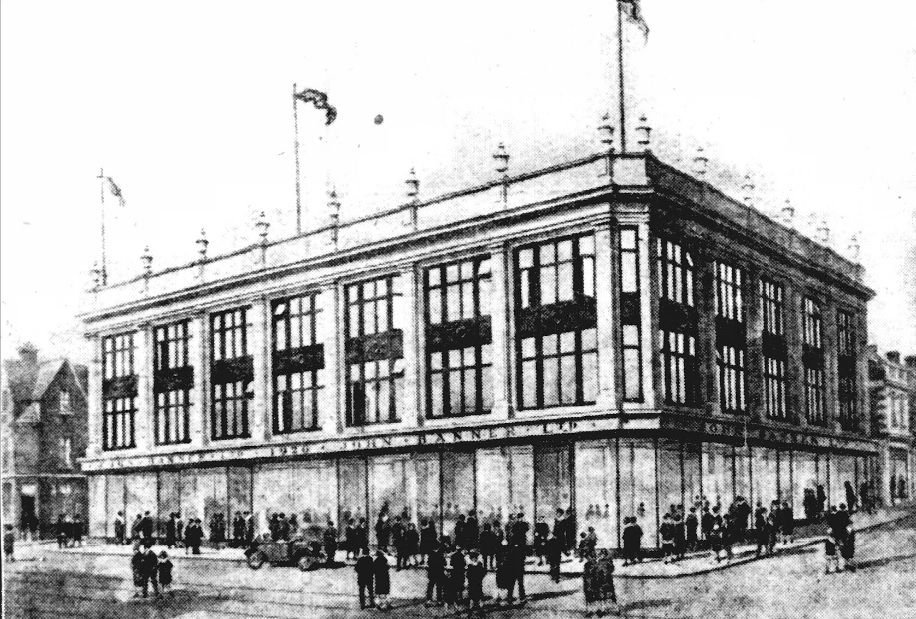
John Banner Ltd. Designed by Frank W. Chapman of Chapman and Jenkinson, Norfolk Row. Following his death, the scheme was finished under the supervision of Mansell Jenkinson and Eric Chapman. Image: British Newspaper Archive
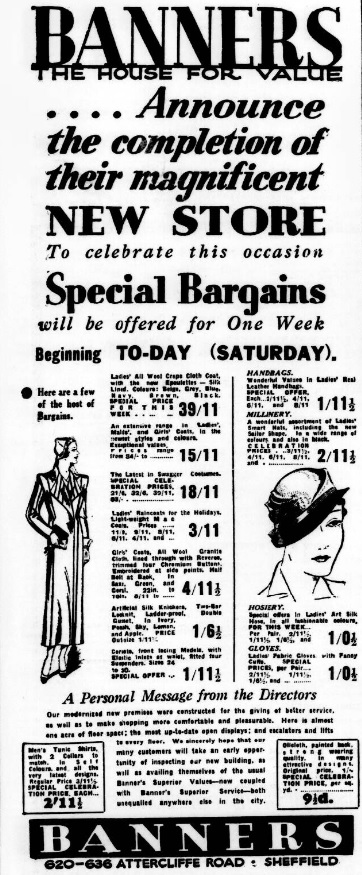
The news that Leeds-based developer Citu has bought the John Banner building at Attercliffe is a major boost for the area. The regeneration of Attercliffe has been a long time coming, and with Kelham Island quickly filling up, developers are finally looking at this neglected part of Sheffield.
The developer already has plans for a nearby 23-acre urban regeneration scheme known as Attercliffe Waterside that will transform brownfield land either side of the Sheffield and Tinsley Canal into more than 1,000 homes.
Citu has suggested that there will be ‘significant investment’ to restore the John Banner building, including the preservation of its façade to retain many of its original features. It is currently a mix of shops and offices with 25 occupiers including Co-op Legal Services, Sheffield Chamber of Commerce, Wosskow Brown Solicitors and EE.
More than once, it has been described as Attercliffe’s flagship building, but most of our younger generation will fail to see its significance.
It is named after John Banner (1851–1930) from Kimberley, in Nottinghamshire, who was eleven when his parents moved to Attercliffe. His first venture was a little shop which opened in October 1873, the same week that horse-drawn trams started to run between Attercliffe and Sheffield.
The millinery and drapery business were in what was known as Carlton Road, which together with the adjoining High Street, became Attercliffe Road. It was almost opposite what became Staniforth Road but was then known as Pinfold Lane reflecting the area’s rural aspect.
On the other side of the road were two houses, one with a large orchard attached, and fields stretched from the Zion Congregational Church. The pastor of that church was the Rev. John Calvert who occupied one of the two houses while a doctor lived in the other.
To get the business on its feet, John Banner worked elsewhere for five years while his wife, Sarah, looked after the shop. He eventually gave up his other job and came up with the slogan for his business, ‘The House for Value’.
Seven years after starting, larger premises were needed, and a move was made further up the street almost opposite what became the present building.
Fourteen years later, further development was necessary, and he crossed the road to the present site, building shops in the gardens of the two houses mentioned above that took up the corner at Shortridge Street.
Banner was joined by his four sons – Harold, Ernest, John and Cyril – each becoming co-directors after gaining experience, and two of his three daughters worked in the Attercliffe business, as well as at a new shop on Barnsley Road at Fir Vale.
When the opportunity arose, the intervening property between Shortridge Street and Baltic Road was purchased, including a shop which had once been Attercliffe sub-post office. These properties were pulled down and the building of a new shop commenced in 1928 that would fill the space between the two streets.
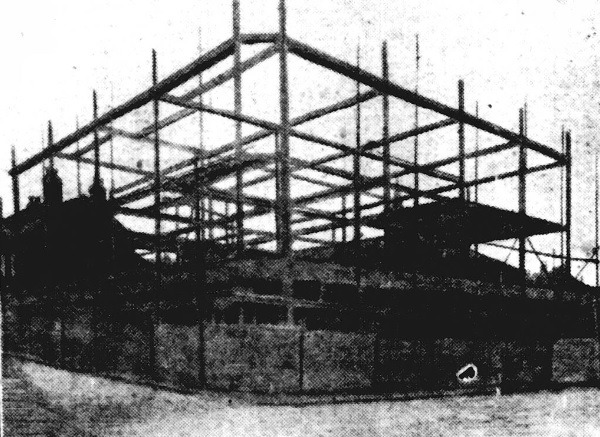
This photograph was taken by Robinson & Kershaw in 1928 and shows the steel framework looking from Attercliffe Road. Shortridge Street is to the left. It provides an important clue as to how construction was completed in two phases. The final addition, completed by 1934, would have been to the right looking towards Baltic Road. Image: British Newspaper Archive
By this time, the range at John Banner had been developed to include ladies’, men’s, and children’s wear, boots and shoes, and kitchen and household utensils, china, pictures, prams, and fire screens.
It is worth mentioning that the new John Banner department store took six years to complete. It was built in stages and by the time it was finished in 1934 both its founder, John Banner, and its architect, Frank W. Chapman, were dead.
John Banner died at his home on Beech Hill Road in 1930 and was buried at Crookes Cemetery.
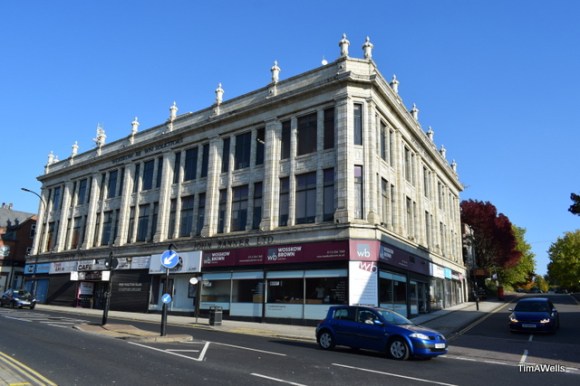
The design of the building was a modern phase of Renaissance, the elevations having pronounced pilasters which ran the height of the two upper storeys, carrying well-proportioned entablature with a parapet surmounted by handsome vases. The pilasters were sub-divided by similar pilasters and the breastwork between the floor filled with effective panelling.
The style of architecture lent itself to the clothing of the steel construction both in pillars and beams which supported the building, and the whole of the casing was finished in dull glazed grey terracotta.
It was built by T. Wilkinson and Sons of Midhill Road, and the steel frame was made by Robinson and Kershaw of Temple Ironworks, Manchester, who had been responsible for other Sheffield buildings including Glossop Road Baths, the Baptist Church at Hillsborough, and extensions to the University of Sheffield and the Royal Infirmary.
The entire frontage of the ground floor was devoted to window display, and a spacious arcade stretched over the whole of the Attercliffe Road frontage on which there were three main entrances. The shop windows were supplied by H.N. Barnes of Fulham with the floor of the arcade covered with marble terrazzo laid by Italian workmen.
The interior lights on all four floors were installed by H.J. Couzens of The Moor, and a novelty was the 300 shop window reflectors and on top of the building, ten attractive Flambean fittings, The first and second floor windows had handsome leaded lights supplied by T. Foster of Norfolk Street who were artists in stained glass and leaded lights.
John Banner Ltd. This photograph was taken shortly after completion in 1934. The project had taken six years and provided Attercliffe with one of its flagship buildings. Image: British Newspaper Archive
The last stage of construction, extending the building to the corner of Baltic Road, was built by John Middleton of Hoyle Street with steel skeleton frame manufactured by Thomas W. Ward.
The internal decoration was undertaken by William Chatfield, and it was complemented with wooden counters, shelving, and fittings, that were supplied by Rothervale Manufacturing Company of Woodhouse Mill.
The floors were served by a passenger lift and staircase at the rear of the store in a central position while the first and second floors could be accessed by wooden escalators, the first to be installed in Sheffield.
Shoppers were also fascinated by a system of pneumatic cash delivery tubes, installed by the Sturtevant Engineering Company, that ran from 75 cash stations to a double-sided desk in the offices.
One of John Banner’s sons, Ernest, died in 1931, and by the time the building was completed in 1934, the business was in the hands of Harold, John, and Cyril Banner.
John Banner Ltd survived the Second World War but a decision was made afterwards to sell the business to United Drapery Stores.
As people moved away from the area, the store’s fortunes went the same way as Attercliffe. It suffered a decline in sales, and for a time the basement area was leased to Grandways Supermarket. Along with the ailing fortunes of UDS , the decision was made to close John Banner in 1980.
John Banner shortly before closing in 1980. Image: Picture Sheffield
The building was subsequently divided into offices with retail space on the ground floor. It goes without saying that most of its rich interiors were lost in the transition.
Until this year it was owned by the John Banner Centre which went into administration in May. It has been acquired by Citu which is dedicated to preserving its historical significance.
The John Banner Building on Attercliffe Road today, withoffice space above and retail space at ground level. Image: Tim A. Wells
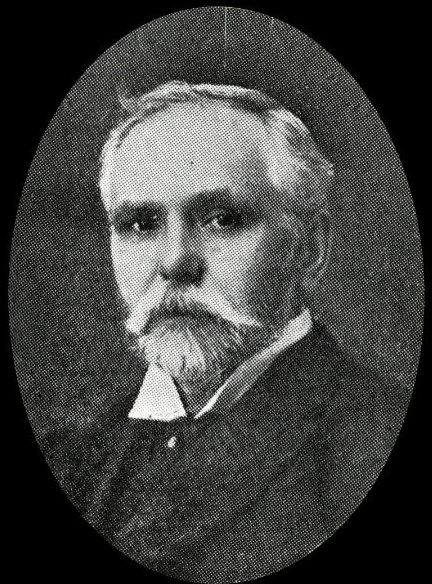
John Banner Biography
“There was a kindly smile to John Banner and rare civic spirit, devoid of self-seeking, and a sincere desire to express a Christian spirit in service. He had a great sense of loyalty and executive ability in getting things done, and never tired of a good cause.”
These words appeared in the Sheffield Independent following his death in 1930.
John Banner was born at Kimberley in 1851, the son of a carrier, and began work at the age of seven. His parents moved to Attercliffe when he was eleven, and John never forgot the hard struggles of his early life, and of the parents who, if they could not give him wealth, gave him character and good example.
Despite the growth of his millinery and drapery business he was never spoilt by success but looked at life and the struggles of others as he knew them.
“I can never forget those days, and knowing the hard lot that most folks have, it is my bounden duty to try to make things better for them.”
He was a keen Liberal, working in Attercliffe, but refused to seek election for the city council, and was instrumental in the formation of the Attercliffe Liberal Club where he was treasurer for more than quarter of a century. He was on the Sheffield Board of Guardians for 21 years, losing his seat in April 1922, and represented the Guardians on the Attercliffe Nursing Association. He was also on the South Yorkshire Joint Poor Law Committee.
His religious activities were at Shortridge Street Methodist New Connexion Chapel for 36 years. He was treasurer of the Sunday School and the church, a teacher at the Men’s Bible Class, and helped reduce the debt on the church from £1,950 to £250. When he moved to Oakledge at 16 Beech Hill Road, he worked with Broomhill United Methodist Church, and represented it on the Sheffield circuit conference.
John Banner married Sarah Ann Higgett in 1873 and had four sons and three daughters. Sarah died at the age of 81 in 1927.
John Banner died at Oakledge in 1930 and his funeral was at Crooke’s Cemetery after a service at Broomhill United Methodist Church. His shop on Attercliffe Road closed for the day as a mark of respect for its founder.




 sheffielder.net