Categories
Buildings Companies

John Atkinson – “The best services that can be provided by all who are responsible.”

“My great-grandfather used to go out and meet the carriages on The Moor when they arrived in the morning.” Nicholas Atkinson. Image: DJP/2022 

In March 1929, John Atkinson, aged 84, took to his bed at No. 86, The Moor, and remained there for a week. He had been in ill-health and died a week later.

His death meant that Sheffield had lost a veteran businessman, who not only had built up a great establishment, but was largely responsible for the development of the principal shopping thoroughfare in the city.

While John Atkinson lay on his death-bed, would he have ever contemplated that his business would still exist 150 years later?
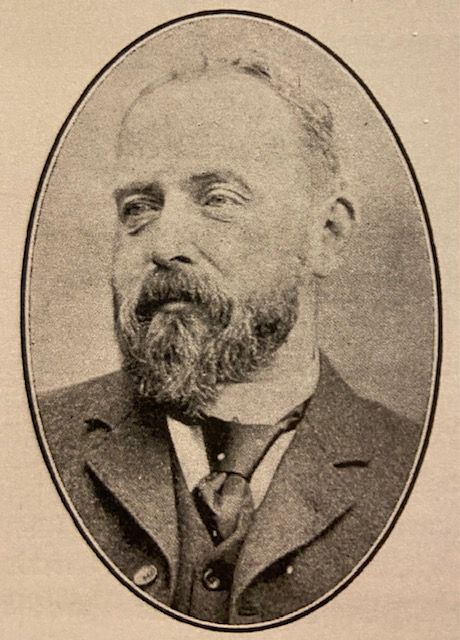
John Atkinson (1845-1929). Image: Neil Anderson

The Atkinson family came from Low Dunsworth, near Boroughbridge, and John, one of a family of nine, was determined to try his fortune away from his home surroundings.

His first venture was at York, where he became an assistant in a leading establishment of that city. But he was stirred with ambition, and he fixed his eye on Sheffield, a growing centre of commerce.

He came in 1865 and became acquainted with the Sheffield public by working at Cole Brothers, at their premises at the corner of Church Street.

Once settled in Sheffield, he looked for an opportunity, and in 1872 secured premises in South Street, on Sheffield Moor. No. 90 was a two-windowed shop and was opened by 26-year-old John in March of that year.

In those days the Moor was not the shopping centre that we are familiar with. It was on the fringe of the country and people used to ‘go to Sheffield’ to do their shopping when they really meant going to Fargate and High Street.

It was his mission to see that his windows were sufficiently attractive to draw the attention of those on their way to ‘shop in town’ and was one of the pioneers of the ‘Shop on the Moor’ movement and had the pride of seeing the completion of his commodious emporium that became his life work.

Atkinson worked hard for seven years and established gradual growth of regular customers. His business required expansion, and in 1879, a piece of land known as Holy Green became available. It adjoined his premises and two additional shops, Nos 86 and 88 were erected, the former leased to a trader. But trade and custom grew, and in 1884, No 86 was taken over by Atkinson and became the millinery department.
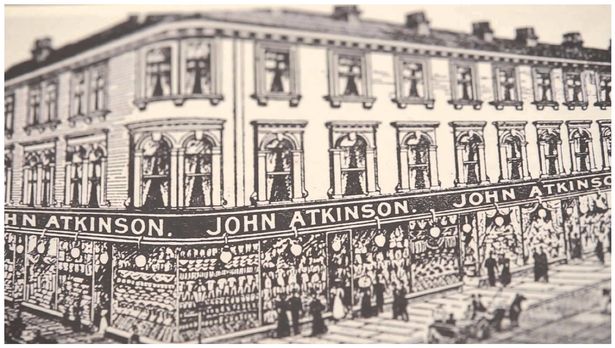
From 1900. John Atkinson, The Draper, 76, 80, 82, 86, 88 and 90, The Moor. Image: Picture Sheffield

Three years later, Nos. 2,4, and 6, Prince Street (a street that has disappeared) were added, and became the furniture department, and four years after that an extensive space at the back of the Prince Street premises was secured and covered for the development of the mantle and shawl trade of the day.

The business expanded, and a few years later brought another acquisition. In 1892, the shops, land, and works covering a large block of buildings as far back as Button Lane (another lost street), facing Eldon Street, were purchased, and in 1897 a new dress warehouse was built in another portion of Holy Green.

Atkinson’s love of beautiful architecture, and his ever expanding business, led him to demolish all his shops, ranging from Nos. 79 to 86, on the South Street site. The foundation stone was laid in 1901, and the new building was ready for occupation in 1902.

The store had a glass roof to let light down into the three floors which were decked with flowers and maintained by a gardener.
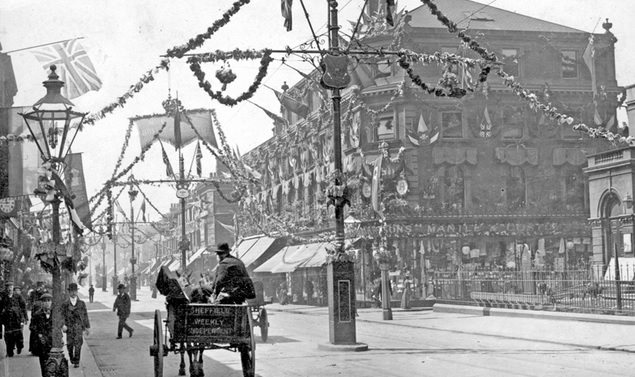
South Street, Moor, decorated for the Royal Visit of King Edward VII in 1905, Nos 76-90, John Atkinson, Draper. Image: Picture Sheffield

At the outbreak of World War One, the shop had empty warehouses, and these were utilised for war work, responsible for making hundreds of thousands of stamped parts for guns, shells, and tanks.

In 1918 two new wings were added, and in 1920 more of the Eldon Street block was brought into use.

By the time of its fifty year centenary in 1922, Atkinson was assisted by his sons, Harold Thomas Atkinson, and John Walter Atkinson.

“There is an atmosphere of completeness about the store. It is not merely a draper’s store. It is a general outfitting establishment, with its well-cuisined restaurant, and its café; with its departments for gas-fitting, and electrical outfit; its men’s clothing department and its footgear stores; it has an ironmongery branch; as well as its branches for stationary, sweetmeats, and drugs and perfumes; for china and glass, as well as for bedding and bedsteads; while its fur department, its section for robes and gowns, costumes and skirts, wools, dress goods, piece silks, velveteens, Manchester goods, and millinery, gloves, and hosiery, and its cabinet and carpet and oilcloth departments, are just part of the wide-varied whole.”
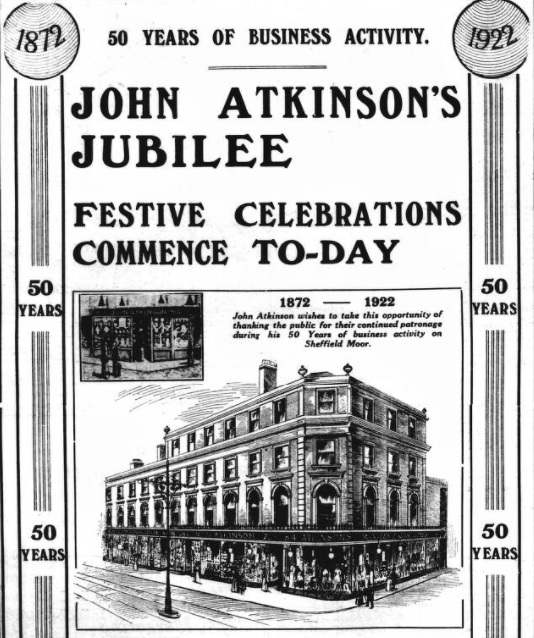
Newspaper advertisement celebrating fifty years of John Atkinson in 1922. Image: British Newspaper Archive

A lot changed afterwards, the business flourished, but during the Second World War the store was destroyed in the Blitz of 1940, resulting in temporary shops for all its departments across the city.

The business operated like this until 1960 when a new purpose built store opened on The Moor.

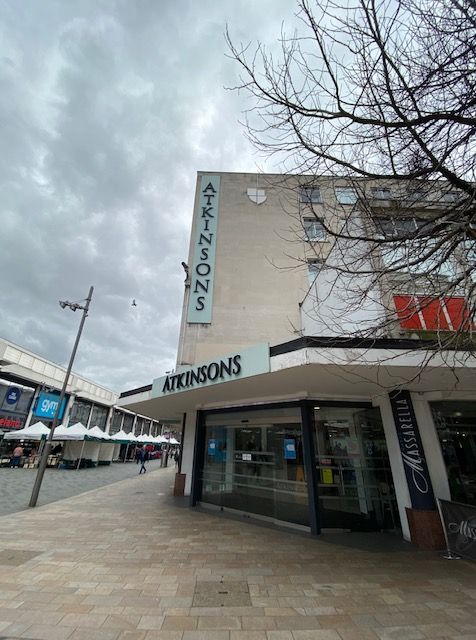
This year marks Atkinsons 150th anniversary and John Atkinson would have been  shocked to find that his family-owned store is now the only department store left in Sheffield.
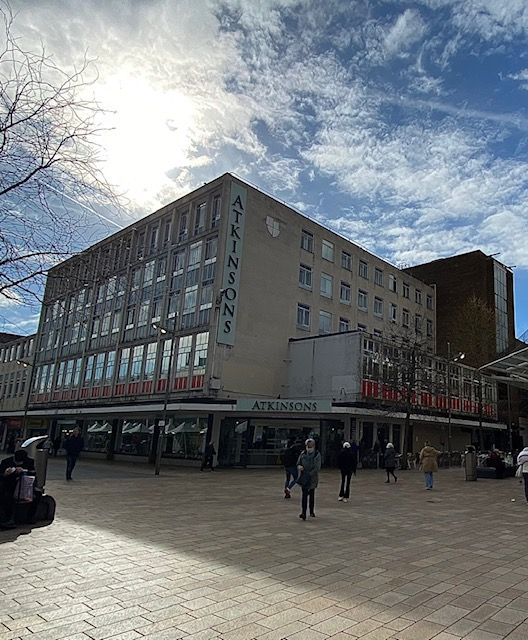
Atkinsons. The family-run business has seen wars, new out-of-town shopping developments and the coronavirus pandemic. Image: DJP/2022

© 2022 David Poole. All Rights Reserved.
Categories
Buildings

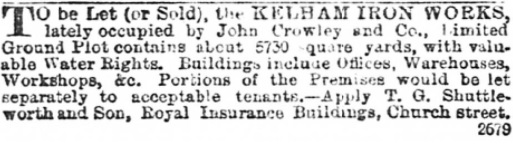
Flashback to 1895- the Kelham Iron Works is for sale

Sheffield Independent, 30 July, 1895

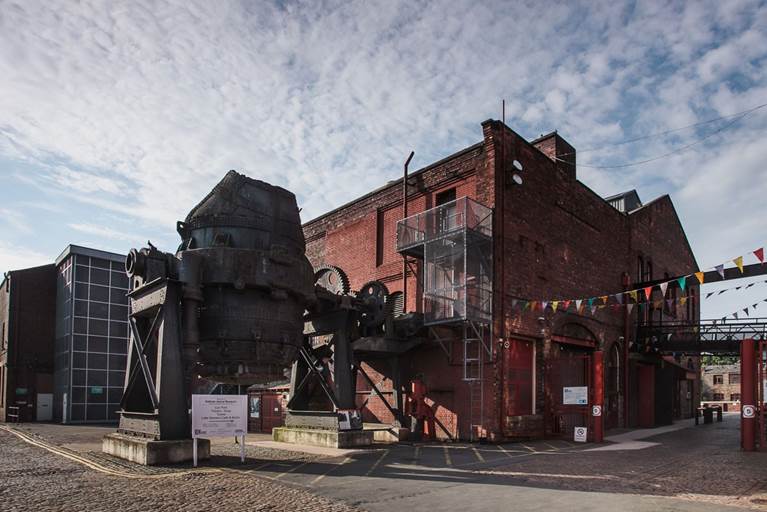
A small newspaper advertisement from July 1895. John Crowley and Co had left, and the Sheffield Tramways Committee bought the site for £7,575. It was cleared and rebuilt, and an order was placed with the British Thomson-Houston Company (a subsidiary of the General Electric Company) for eight engines and dynamos, and 12 boilers, to power Sheffield’s new electric tram network. It operated until the 1930s before being used for storage and workshops. And this building survives as Kelham Island Museum.

Kelham Island Museum

© 2022 David Poole. All Rights Reserved.
Categories
Streets

Sands Paviours – a long forgotten street

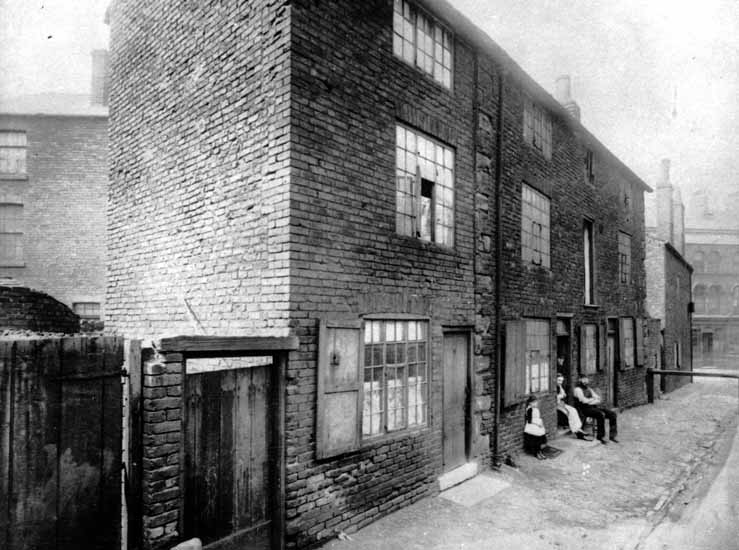
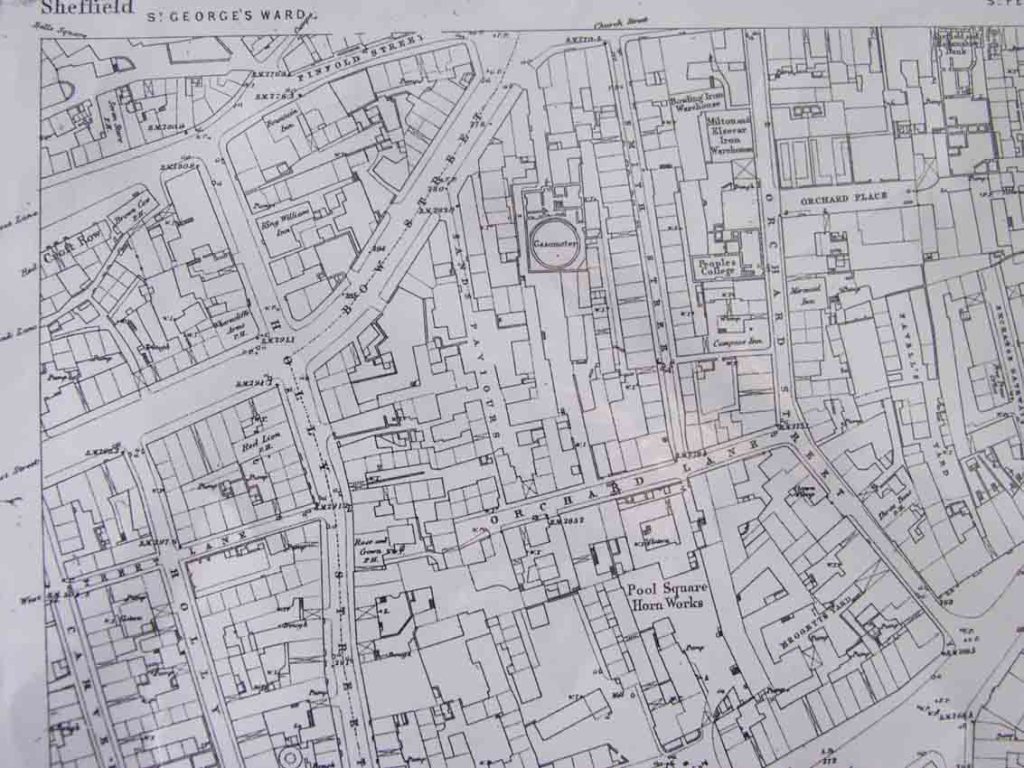
West side of Sands Paviours (ran from Orchard Lane to Bow Street), pre 1890, demolished to make way for the Central Schools, Science School. Image: Picture Sheffield

Today, a look at a street in Sheffield city centre that was consigned to history long ago.

In 1874, a plan was produced by Sheffield architects, Innocent and Brown, for the laying out of Leopold Street, and the realignment of Church Street and Bow Street (now the bottom-end of West Street).

About this time, land between Orchard Lane, Bow Street, Orchard Street and Balm Green was covered by old houses in two streets, Smith Street and Sands Paviours.

The site was bought by the Sheffield School Board for building the Central Schools and offices. At the same time, Mark Firth founded Firth College, later part of the University of Sheffield, and this was opened by Prince Leopold in 1879.

The removal of old property between Bow Street and Orchard Lane caused the obliteration of the marvellously named Sands Paviours.

But what had once been a pathway across rural land had become a street of slum housing, workshops, shops, and a public house called the Norfolk Arms. And murder and crime were evident on the street.

According to John Daniel Leader, this little court of houses may have derived its name from Samuel Sands, who flourished in the reign of Queen Ann.

By an indenture dated 25 September 1708, Samuel Sands, a Sheffield cutler, conveyed to George Hawke of Leavygreave, yeoman, for the sum of £100, all that messuage, near the Townhead Cross with a smithy, barn, orchard, and garden, lately in the possession of John Hobson; also, a cottage adjoining, lately in the possession of Mary Wilson, to hold the same for ever of the chief Lord or Lords of the fee. The vendor signed his name ‘Samwell Sandes.”

However, there was another suggestion for it being named so.

In other towns there were streets called Sans Paviours (without paving stones), and it might be that because Sandes’ house was here, that he saw the name Sans Paviours elsewhere, and thought it appropriate for his own property.

The mystery was cleared up when the land was bought by the School Board, and the old deeds showed that it had been in the family called Sandes from 1657 to 1727, and that early mention was also made to Sands Croft and Sands Orchard.

Like many old street names that were adapted over the years, Sands Paviours was also referred to as Saint Pavers.

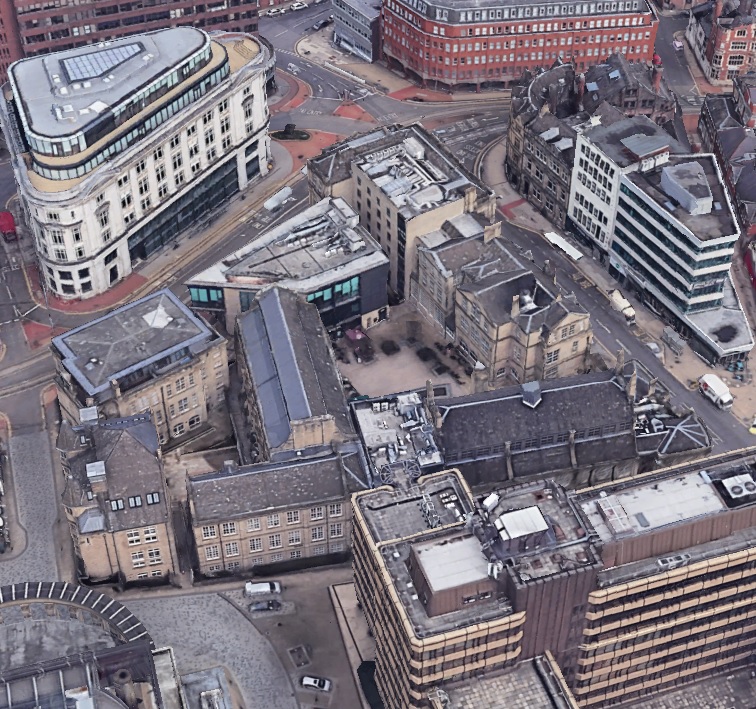
Remember this the next time you relax in Leopold Square. There is history beneath your feet.

Sands Paviors once ran from Orchard Lane to Bow Street (now the bottom part of West Street). Image: Google

© 2022 David Poole. All Rights Reserved.
Categories
Late Night Tales

Late Night Tales #9

March 1927. George Mooney and John Thomas Murphy arrived at the Raven Tavern in Fitzwilliam Street. The two drunken men came across their enemy and foe – Sam and Bob Garvin. The brothers shouted, “They’re here lads. Cut their heads off.” And a violent fight ensued. It was the latest instalment in Sheffield’s Gang Wars. Fast forward 95 years, and such history is lost under West One.

© 2022 David Poole. All Rights Reserved.
Categories
Buildings

Wine bar plan for old West Street building

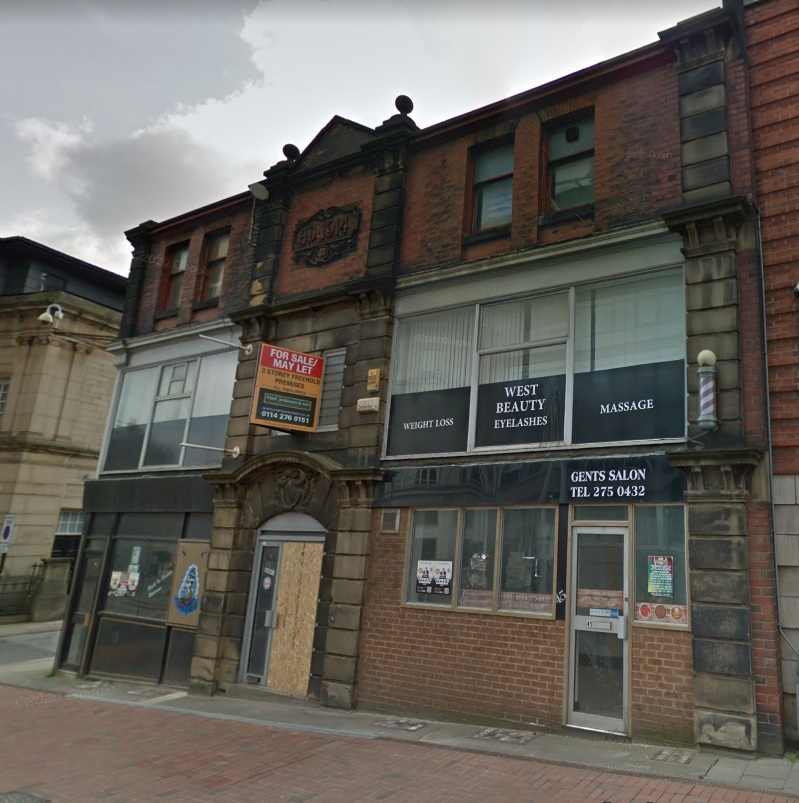
We wait with anticipation as to what happens to this redundant building at 43-45 West Street, at its corner with Holly Street. It was built in 1914, the year the First World War started, as shown by a carving in the Ashlar stone, and planning permission has been granted to turn it into a wine bar.

The property has most recently been used as a men’s’ hairdressers and salon and is now vacant.

The good news is that the exterior of the building will be sympathetically restored with the removal of ugly brick infills and floor-to-ceiling glazing at first-floor level.

The interior is remarkably narrow, with the back of the building mostly taken by the derelict former Old Red Lion public house.

Categories
Companies

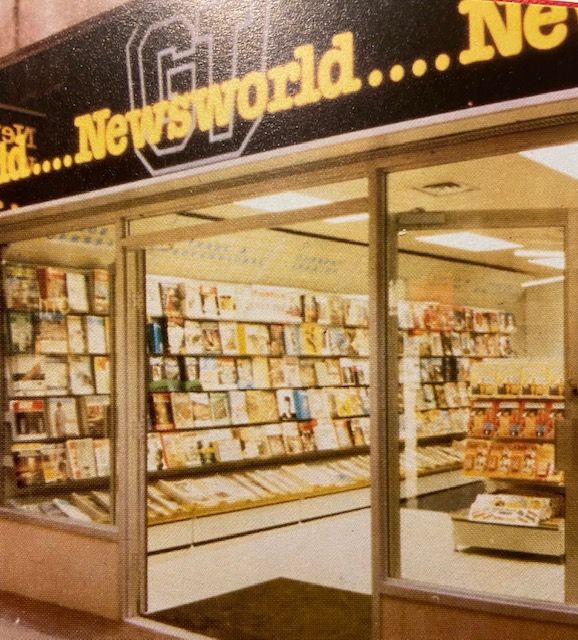
GT Newsworld – “It was the talk of the trade and attracted all the major publishers to look at ventures which broke new ground in its field.”

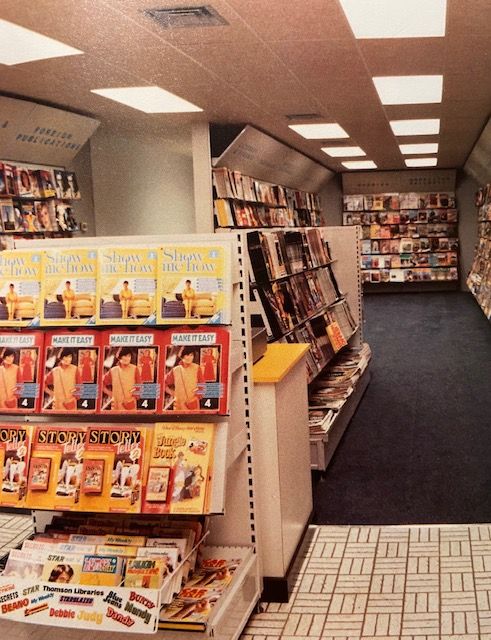
GT Newsworld, Chapel Walk, Sheffield. Image: Keith Farnsworth

They say that print has no future. This is the case with newspapers that are in terminal decline. These days, we choose to get our news from a mobile phone instead. Magazines have fared a little better, but even these will go the same way.

A few months ago, a mate of mine asked me where he could buy a copy of The Grocer, the long-time voice of the food industry. I couldn’t answer that one, but there was a solution. This turned out to be an expensive online subscription that quickly got the thumbs down.

And then, last week I was browsing the magazine section in WH Smith and there it was. A solitary copy of The Grocer sandwiched between The Oldie and The Week. “We shouldn’t have it,” said the shop assistant, “It came by mistake, and we certainly won’t be stocking it again.”

So, where do we buy magazines these days?

According to the Periodical Publishers Association there are about 8,000 titles published in the UK, with a quarter of this made up by consumer magazines, the ones that we might buy in a newsagent or supermarket.

The biggest retailer is still WH Smith, but the supermarkets took a big chunk of its market share. and now the choice of magazines has shrunk and take up less and less selling space.

It has become a subscription world, where material is available online, or a glossy copy of your favourite magazine arrives through your letter box.  

But it wasn’t always this way, and in 1984, long before a digital world existed, a shop opened on busy Chapel Walk that threatened the monopoly of WH Smith.

GT Newsworld opened on Friday 2 March and was distinctive in that it became the first outlet in the country to sell nothing but news, offering a range of nearly 2,000 titles, with 1,000 displayed full face.

It was part of the George Turner Group, established in 1891, and better known in Sheffield as GT News.

Keith Farnsworth, the local writer, wrote a marvellous book about the history of the company in 1991, and it probably contains the only account anywhere about this rebellious undertaking.

“It was the talk of the trade and attracted all the major publishers and others to look at ventures which broke new ground in its field.”

GT Newsworld. Image: Keith Farnsworth

No.20 Chapel Walk had been a jeweller and its 800 square foot selling space had become available. Initially, the company had thought of using it as a GT Sports outlet, but Ashley Turner, had reminded his fellow directors that it was the ideal spot for a specialist magazine shop.

And so, the shop was refitted at a cost of £25,000, incorporating a computer system in which every title was barcoded, to ensure that sales and stock were constantly updated to keep the full range of titles on view.

It appeared to be a success, with customers milling around all day choosing every type of magazine available, including those imported from the United States. And it was easy to part with a tidy sum of cash and leave with a stack of reading material that never got read. But was it just a reading room where people spent an hour or so browsing magazines before leaving empty-handed?

At any rate, it seems to have lasted until the 1990s before closing, and we haven’t seen anything like it since.

© 2022 David Poole. All Rights Reserved.
Categories
Late Night Tales

Late Night Tales #8

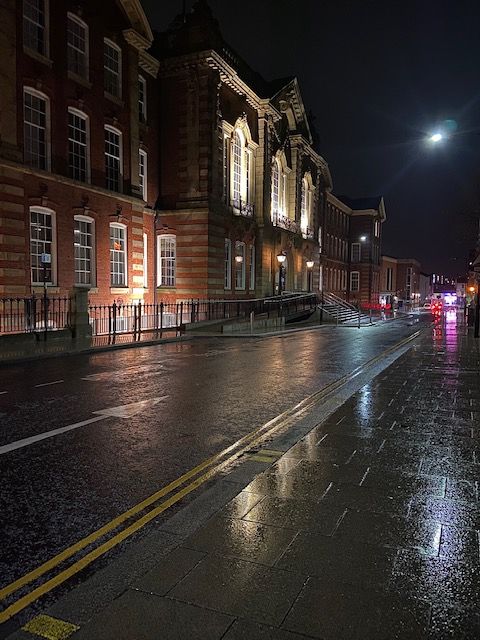
Mappin Street. Image: DJP/2022

Last night,  I met an elderly gentleman, who stood smoking a pipe outside the gate to St George’s Church. “It’s a wet night,” he obliged. “Aye, but Mappin Street looks very beautiful in the rain,” I said.

“Nay lad. This is Charlotte Street, and before that it was St George’s Square.” He paused. “I understand why you might be confused,” and pointed his pipe back towards West Street.

“Walk back yonder and look at the white paint on the building at the end. It says ‘Zarlot Street.’ Once upon a time, there was a Pitman Society in Sheffield, and they persuaded the town authorities to allow them to name our streets phonetically. That’s the last reminder, but it’s always been Charlotte Street to us.”

And Charlotte Street became Mappin Street, named after Sir Frederick Mappin, whose building for the University of Sheffield was completed in 1913.

© 2022 David Poole. All Rights Reserved.
Categories
Late Night Tales

Late Night Tales #7

Late Night Tales. In the 1600s, Barker’s Pool was sometimes used for ducking harsh-tempered or overbearing women. For this, the ‘cuck stool’ was brought up from Lady’s bridge. The chair was attached to a long wooden beam and was lowered into the water. Repeated ducking routinely proved fatal, the victim dying of shock or drowning. The reservoir went out of use and filled up with rubbish, and in 1793 it was done away with.

© 2022 David Poole. All Rights Reserved.
Categories
Companies

A Dublin view – ‘Sheffield’s £240m supertram superflop’.

I take you back to April 1998 when the Dublin Evening Herald published this gloomy article – ‘Sheffield’s £240m supertram superflop’.

“The experience of the Supertram in Sheffield is not a happy example of how LUAS can curb Dublin’s traffic problems. The light rail cost £240m in public funds to build and was touted as the green solution to traffic and pollution. Yet even its supporters now admit it’s been a disaster. Built in 1996, one year later, the Tories decided to privatise it. The value was set at £100m but late last year it was sold to Stagecoach, for £1m. It has always run at a loss and constantly failed to woo passengers from cars. Traffic is worse since construction was completed.”

Luas (Irish for ‘speed’), Dublin’s equivalent tram system opened in 2004, and was subject to the same pre-build criticism that Sheffield experienced.

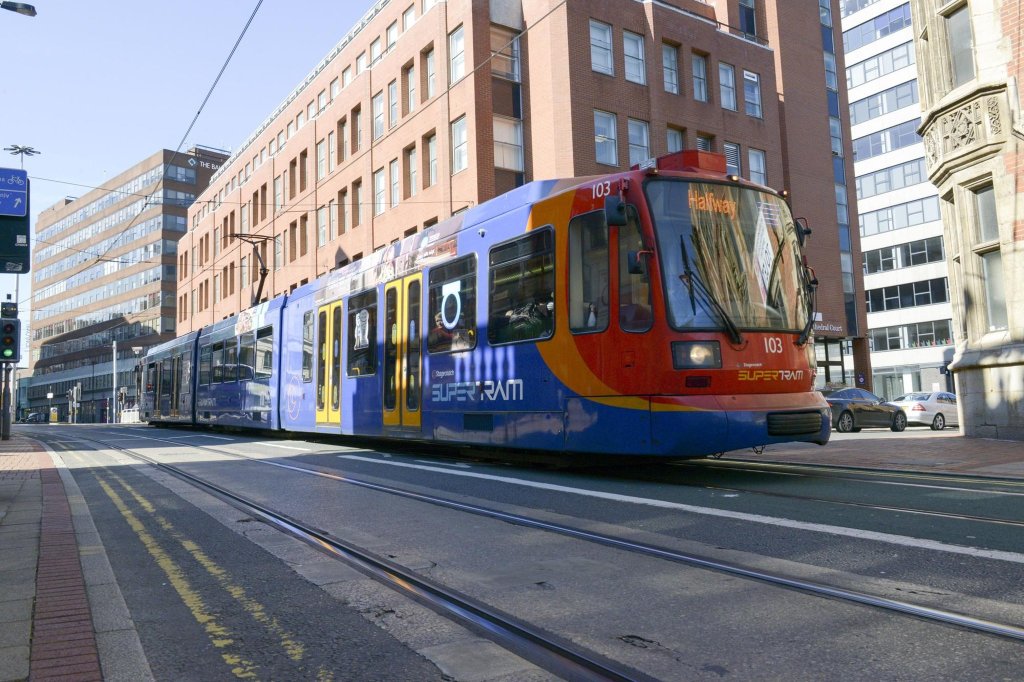
The Sheffield Supertram network flourished under the management of Stagecoach. Passenger numbers increased rapidly and reached a peak of 15million a year in 2009, 2011 and 2012. The network was expanded in 2018 with the Sheffield/Rotherham tram-train but passenger numbers fell between 2017-2020 and then, of course, COVID came along.

But far from being a disaster, Supertram is now embedded in Sheffield history.

Stagecoach’s existing contract runs out in 2024, the same year that South Yorkshire taxpayers are due to stop paying the 5p a week levy to plug the early losses.

© 2022 David Poole. All Rights Reserved.
Categories
Other

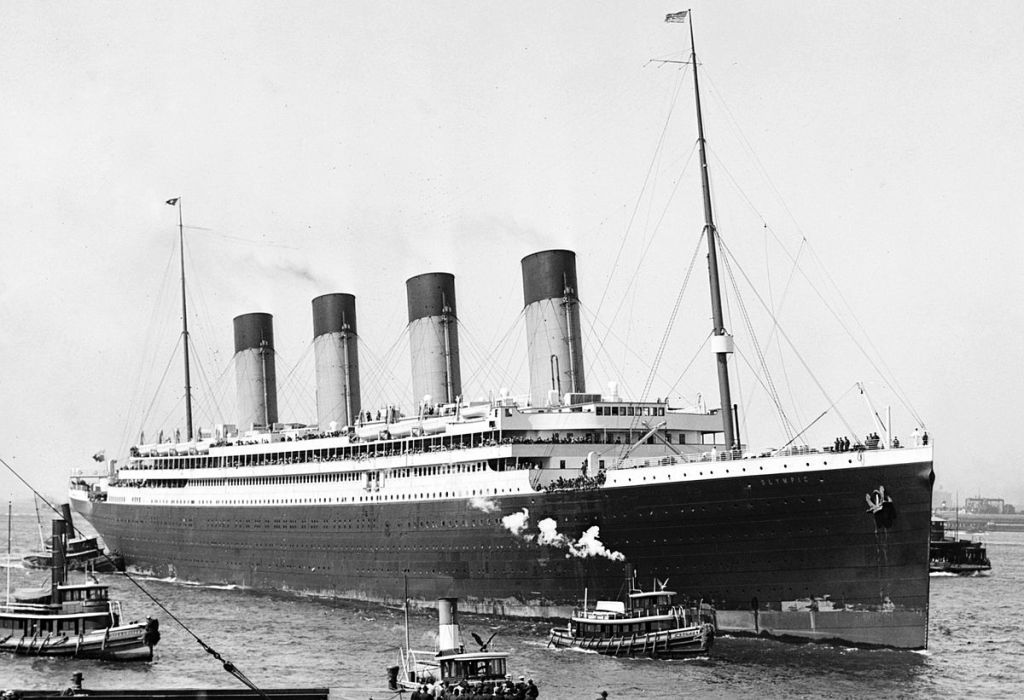
RMS Olympic and its Sheffield connections

The Olympic – the world’s newest, largest and most luxurious ocean liner – made her maiden voyage on June 14, 1911.

There was a heavy fog on the night of May 15, 1934, and the Nantucket Lightship lay anchored off Nantucket Shoals off Massachusetts. She sounded her foghorn as the 47,000 ton, 900 foot ocean liner, RMS Olympic, approached. The Olympic had been following the lightship’s radio beacon signal with the intent of altering her course when she was close enough, but the lookout had miscalculated the location of the Nantucket and was unable to see her until she was just 500 feet away. It was too late. The Olympic, nearly 75 times the size of the Nantucket, literally ran over her broadside and cut it in half.

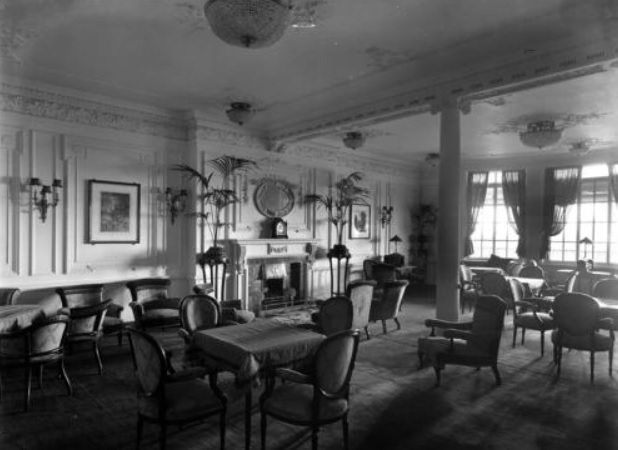
Passengers In the first-class drawing room of the Olympic were unaware of the collision. All they heard was a dull thump and the gentle, soothing, tinkling of clean wine glasses on a sideboard. If they had looked up, they might have seen that the large crystal light fitting was slowly swinging from side to side.   

The Captain of the Olympic halted the engines and ordered boats put over to save the crew, but the Nantucket sank within minutes. Seven of the eleven lightship crewmen drowned and four were rescued.

RMS Olympic. First Class Drawing Room. It may also have been known as the Reading and Writing Room. Take note of the light fittings. Image: Historic England

RMS Olympic was a British luxury liner belonging to the White Star Line and was sister ship of the Titanic and the Britannic. Construction started in 1908 at Harland and Wolff in Belfast and it was launched in 1910. At the time of its completion, it was the largest and most luxurious liner in the world and used on Trans-Atlantic crossings.

Olympic was retired from service a year after the Nantucket disaster and was sold to Sir John Jarvis who had it towed to Jarrow where the ship’s superstructure was demolished, and  its fittings stripped and auctioned off.  Two years later, the hull was towed to the shipbreaking yard of Sheffield firm T.W. Ward at Inverkeithing, in Fife. By the end of the year the steel shell had been melted and re-made into items for household and industrial use.  

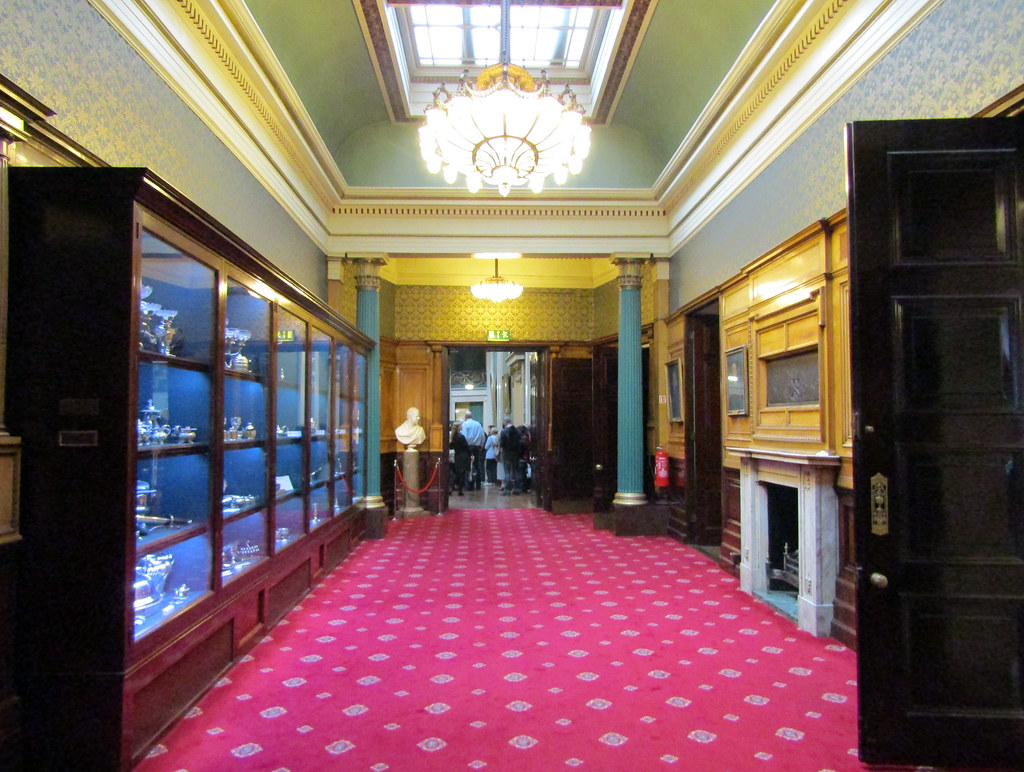
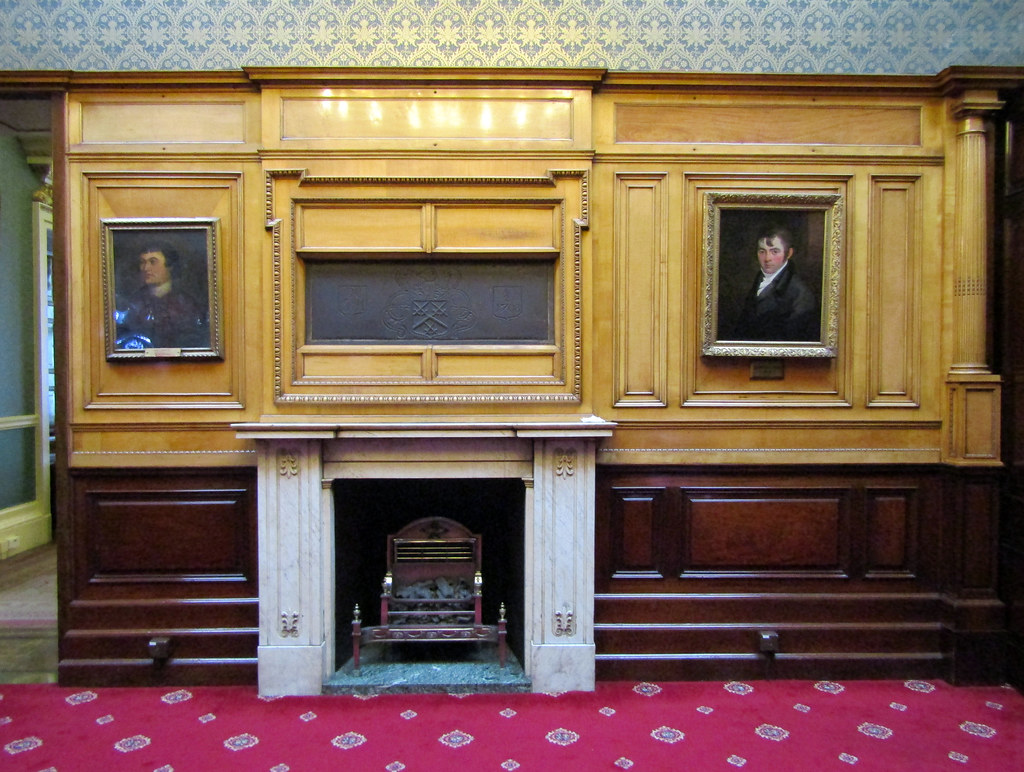
Some items from the Olympic found a new home in Sheffield, in the vestibules leading to the banqueting room at the Cutlers’ Hall.

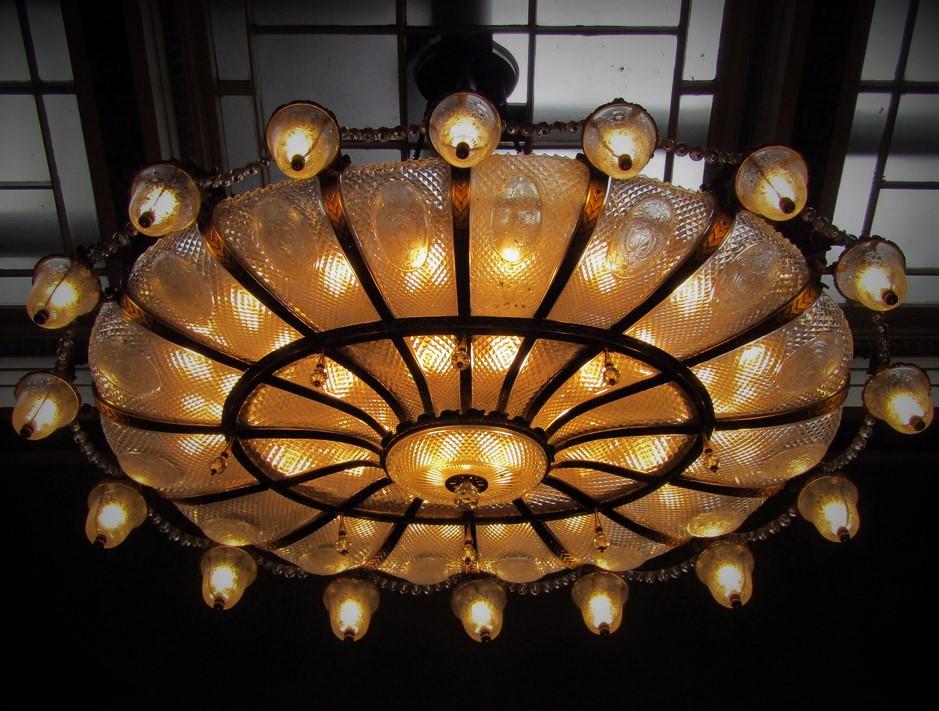
The most striking of the decorations was the same crystal and ormolu electrolier that had hung in the first class drawing room of the ship, bought by the Master Cutler, Sir Samuel Roberts, and presented by him to the Cutlers’ Company in 1936.

A light fitting from RMS Olympic now hangs in the Silver Vestibule at Cutlers’ Hall. This is only one of two ever made, the other went down on the Titanic. Image: David Johnson
The Silver Vestibule at Cutler’s Hall with light fittings and panelling from RMS Olympic. Image: David Johnson

The light was a massive ornamental ormolu electrolier with cut and engraved glass panels and cut glass beadings and had a border of 16 lights with engraved glass shades and bead festoons.

In the same vestibule, the walls were covered with mahogany dado and sycamore panelling to the level of the door heads. This was from the second class library of the Olympic and was purchased by the Cutlers’ Company and installed by Johnson and Appleyard’s of Sheffield.

The Cutlers’ Company also bought four ornamental ormolu, oval electroliers with shaped cut and engraved glass panels, and these were hung in the second and third vestibules.

The vestibules are hung with chandeliers and lined with maple panelling, all salvaged from the White Star liner Olympic – sister ship of the Titanic – when she was scrapped in 1936. Image: David Johnson

These relics from RMS Olympic can still be seen today, but other, stranger pieces, occasionally turn up in auction rooms.

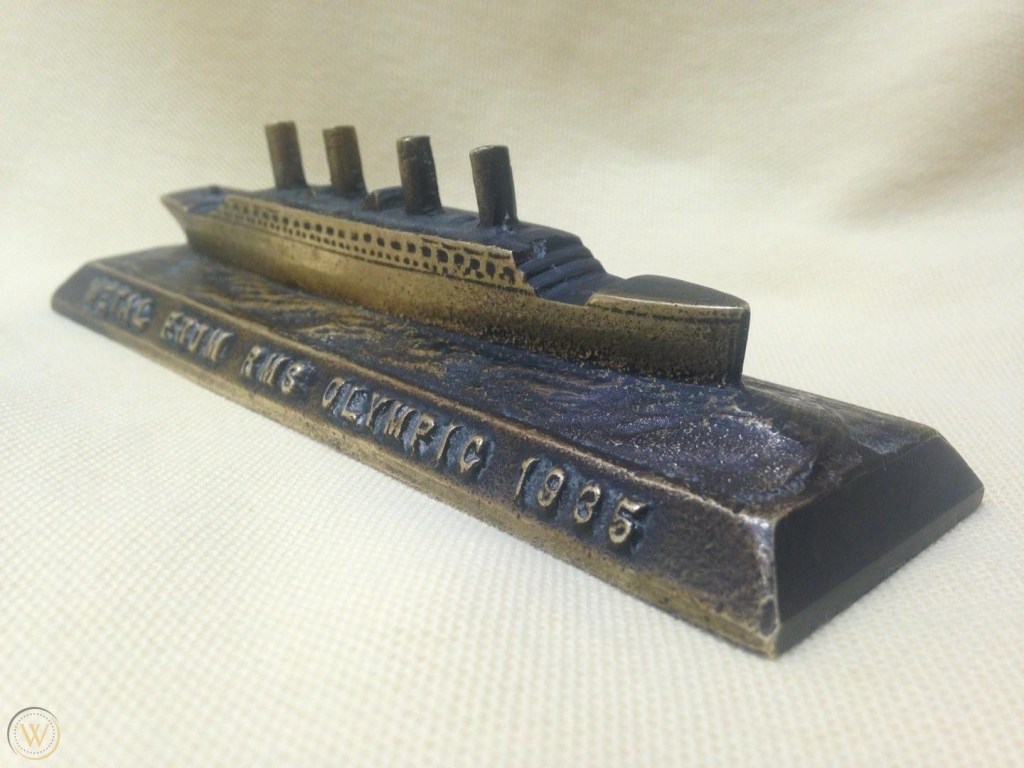
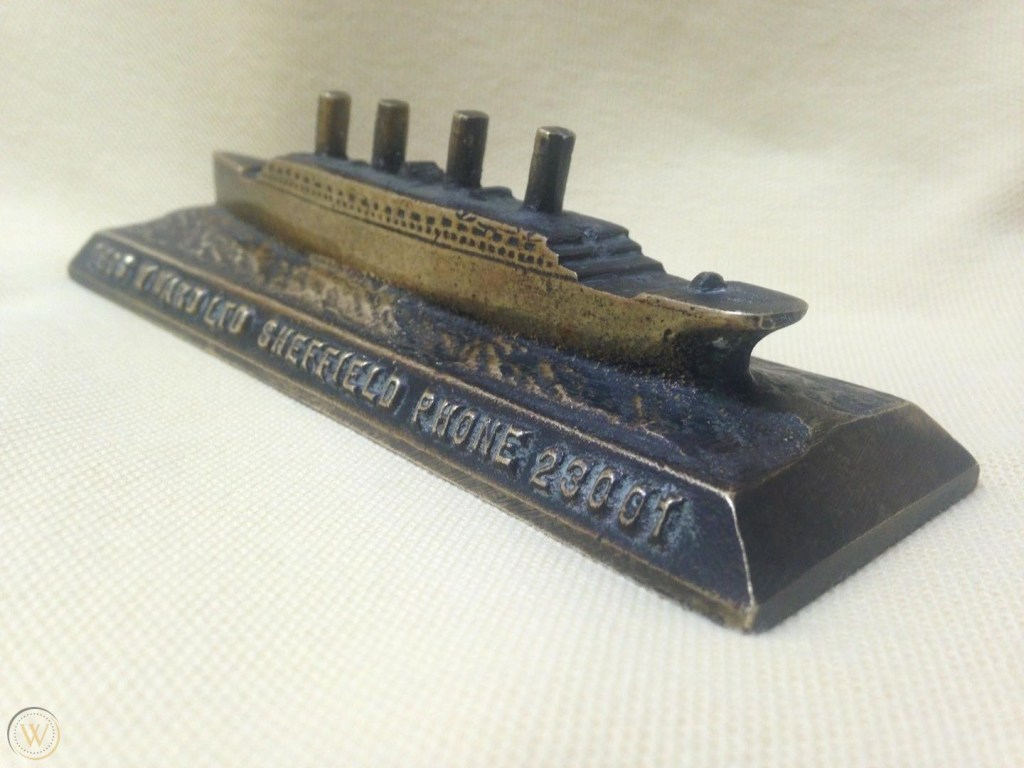
These include paperweights made from the Olympic’s scrap brass by T.W. Ward, presumably to give away as a marketing tool. The base has ‘Metal from the Olympic 1935’ on one side and on the other ‘Thos. W Ward Sheffield Phone 23001’.

Rare solid brass paperweight made from the metal of the White Star Liner R.M.S. Olympic
Images: Worth Point

© 2022 David Poole. All Rights Reserved.