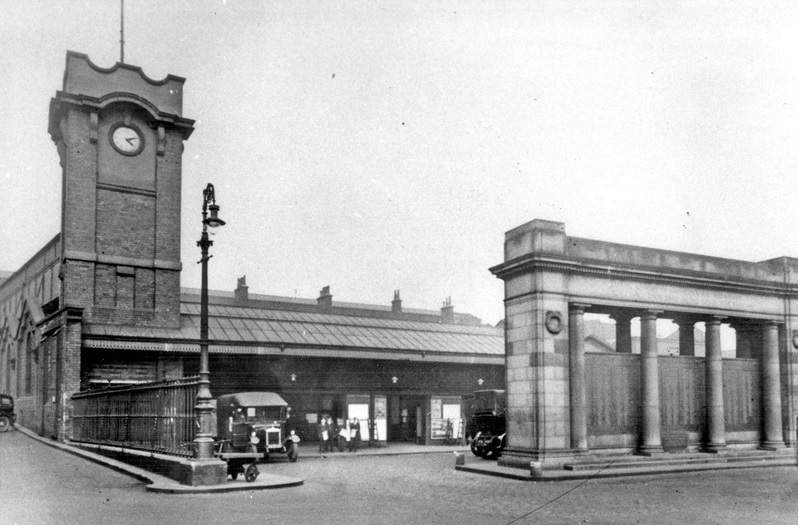
The original memorial outside Victoria Station. (Image: Picture Sheffield)
In our investigations into the Victoria Station one structure appeared on old photographs that deserved further investigation.
This was an elegant memorial that stood at the entrance of the railway station. The classical portico, with colonnade, contained nine columns with the names of workers of the Great Central Railway who died in World War One.
The names of 1,304 men were inscribed on tablets of French marble, and the memorial was unveiled by Earl Haig on Wednesday 9th August 1922. He had commanded the British Expeditionary Force on the WesternFront from late 1915 until the end of the war.
Sheffield had been chosen for the memorial because it was the centre of the railway’s operations. About 8,000 people turned up for the ceremony, including hundreds of relatives of the fallen.
Haig inspected a guard of honour composed of over 200 ex-servicemen employees who had gained decorations for gallantry in the field.
“The day will come when we in our turn will have passed on, but these stones will still stand as evidence of the splendid sacrifice and glorious achievement of the 1,300 brave and gallant men whose names they bear.”
The ceremony was presided by Lord Faringdon, chairman of the Great Central Railway, who said the memorial had been subscribed by no fewer than 3,000 shareholders and servants of the company as far afield as Canada, India, Australia, and Africa. He pointed out that over 10,000 employees had gone to war.
Canon Houghton dedicated the memorial, after which wreaths of remembrance were laid, and the service closed with a rousing rendition of the National Anthem.
They would have been forgiven that the future of the memorial was secured. However, within two years the marble had crumbled, and some names were already illegible.
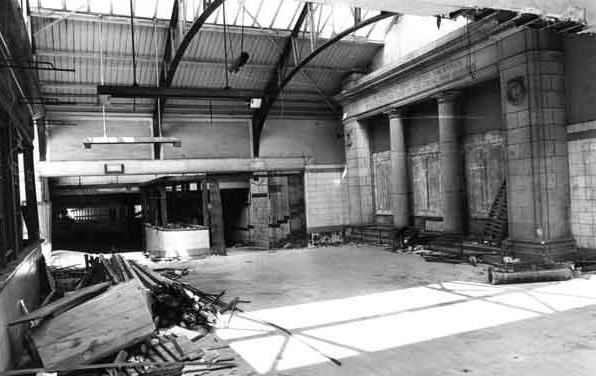
In 1925, the London North Eastern Railway (LNER), which had absorbed the Great Central Railway, graciously replaced the tablets with Kupron bronze plaques. The memorial stood on its own until 1938 when LNER improved the station, extending the booking hall, so that the memorial became its eastern wall. (I presume the memorial was reversed and the tablets were relocated inside).
It remained until the Victoria Station’s closure in 1970 and might have been lost with subsequent demolition.
Remains of the memorial before demolition in 1980. The plaques had been removed to the underneath of Wicker Arch. (Image: Picture Sheffield)
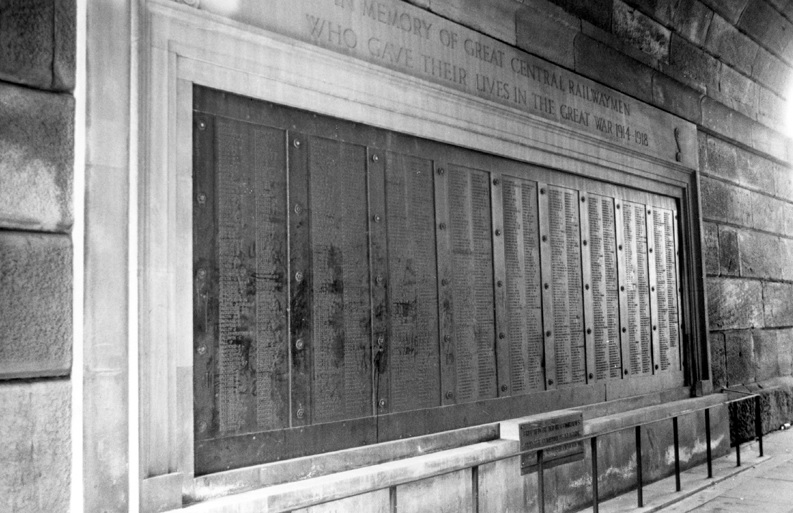
A handful of survivors campaigned for it to be saved and the bronze tablets were re-erected (somewhat hidden) underneath Wicker Arch, where it was rededicated in November 1971. The magnificent portico, in which they had stood, was sadly lost).
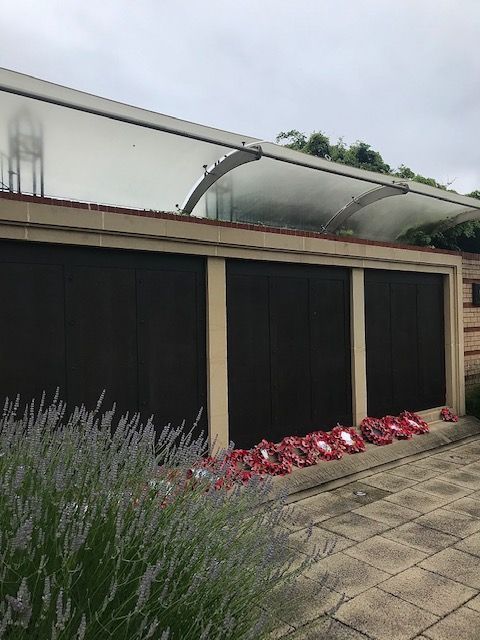
The decline of The Wicker is well publicised, and the memorial suffered from neglect and vandalism. Various locations were suggested as an alternative site, but it was the owners of the Royal Victoria Holiday Inn (the former Victoria Station railway hotel) that offered it a permanent home.
The memorial plaques underneath Wicker Arch. (Image: Picture Sheffield)
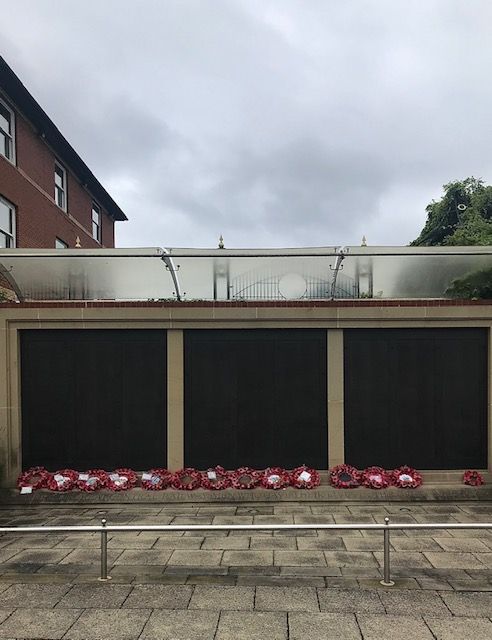
With support of the hotel, sponsors and a grant from the Heritage Lottery Fund, the Great Central Railway Society organised rescue of the plaques and relocation to its new home, almost on the site of the original memorial.
It was rededicated on Remembrance Day 2008 and remains outside the Royal Victoria Crowne Plaza. A Roll of Honour for all the men listed, collated by the Great Central Railway Society, can be found inside the hotel.
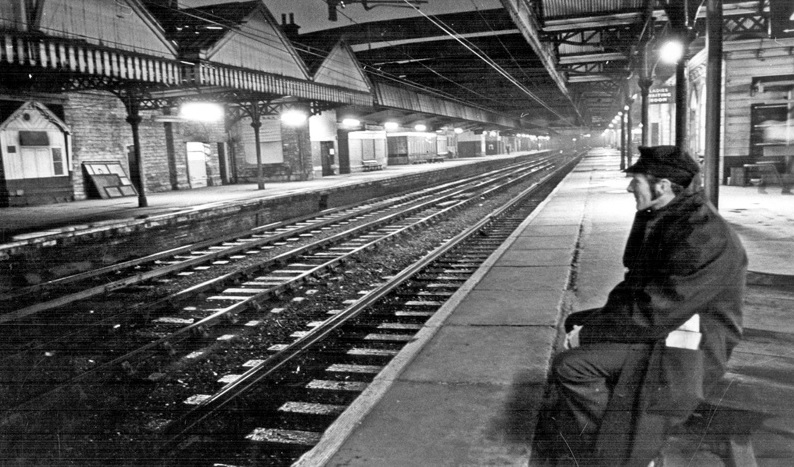
There is a photograph from January 1970 that shows a train driver, sitting in reflective mood on a bench at Sheffield’s Victoria Station. He was waiting to take out one of the last passenger trains from Sheffield Victoria to Manchester.
Once it had departed the lights went out and darkness descended on a railway station once considered the city’s ‘pride and joy’.
An eventual victim of cuts initiated by Dr Beeching, almost nothing remains today, but if you know where to look, and use a bit of imagination, you can see where once Sheffield folk hopped on a train across the Pennines and down to London’s Marylebone and King’s Cross stations.
Image: Picture Sheffield
The Sheffield, Ashton-under-Lyne and Manchester Railway was engineered by Joseph Locke and opened in 1845, the line originally terminating at Bridgehouses Station (the site on waste land above the lower end of Derek Dooley Way).
In 1847, it merged with two other railway companies to form the Manchester, Sheffield, and Lincolnshire Railway, prompting an extension of the line and construction of a new railway station about 1km to the east.
It was developed by Sheffield-born John Fowler, engineer-in-chief, and included a 40ft-high, 750-yard long, viaduct over The Wicker (Wicker Arches) and was completed in 1847-1848. The new Victoria Station opened on September 15th, 1851.
The railway station was opened for the convenience of the Manchester, Sheffield, and Lincolnshire, the Great Northern, and the south traffic of the Midland Company. It occupied a space between Wicker Arches to the canal, crossing the river, the site of the old Blonk Dam, the cattle market, and fairground, and the back of Sheaf Works.
Image: Picture Sheffield
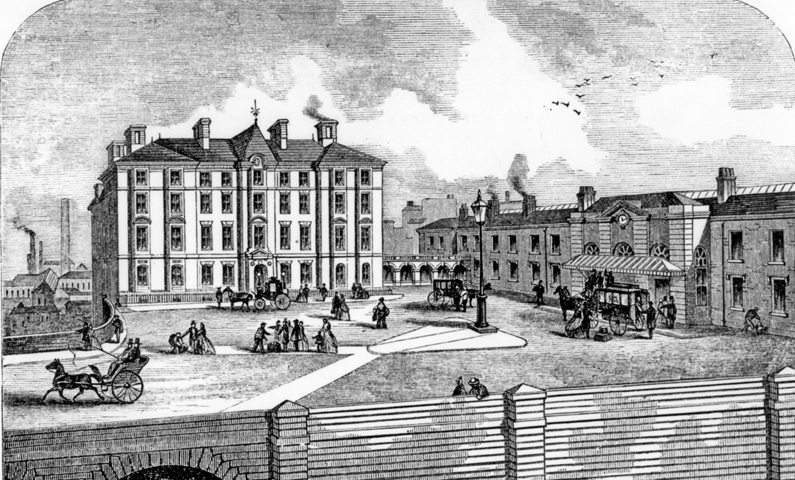
Built on arches by Miller, Blackie and Shortridge, it rose 40ft above the level of The Wicker, the station fronting south-west with prominent views of the Corn Exchange, the New Market Hall, and canal warehouses.
The approaches to the station and the platforms were the work of John and Amos Ridal, and the station buildings were erected by Robert Tomlinson Carlisle, the builder of Beighton Viaduct and the New Market Hall.
It was not the magnificent station envisaged by Fowler. The architects, Weightman, Hadfield and Goldie, were asked to reduce costs, probably the result of high expenditure engineering the approach to the station.
The front of the Victoria Station was destitute of ornament, being simple in architectural character. It was approached from Blonk Street by a straight incline, built upon the arches, 50ft wide, 220-yards long, and rose at a rate of 1 in 30. As the road approached the station it opened out into an extended area.
The station consisted of a centre and wings, the latter being extended with a high fence wall, with gateways for the exit of arriving passengers, and beyond these, on each side, covered by stands for horse-drawn cabs.
The length of the masonry front was 400ft, built of rock-faced Greenmoor stone, with chiselled beds and joints, and facings of ashlar stone from Wadsley.
A covered veranda, with glazed roof supported by iron brackets, extended the whole length of the centre building, to allow carriages to set people down under cover.
The entrance, or waiting hall, was 50ft by 30ft, and 25ft high, having an enclosed office for booking clerks. Tickets were issued at three windows. At the centre, first-class passengers of the Manchester, Sheffield, and Lincolnshire Railway got their tickets, and on the right-hand side, second and third class passengers got theirs. The left-hand window was for Great Northern passengers.
Image: Picture Sheffield
In the eastern wing were refreshment and waiting rooms, public conveniences, parcels office, and on the chamber floor the station master’s house. The refreshment rooms were rented by Mr Moyes, the landlord of the Great Northern Hotel at Lincoln.
In the western wing were the telegraph and station master’s office, rooms for lamps and porters, guards etc., and the engineer’s office. Above these were the boardroom and other offices.
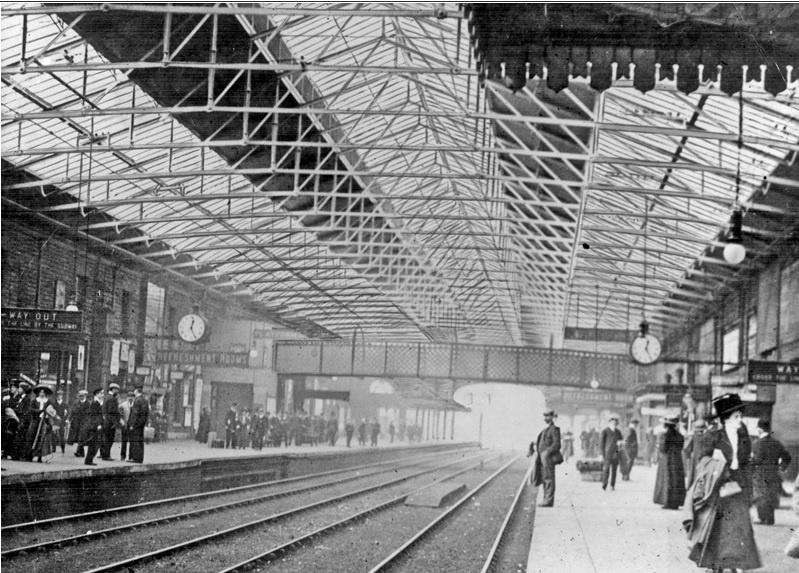
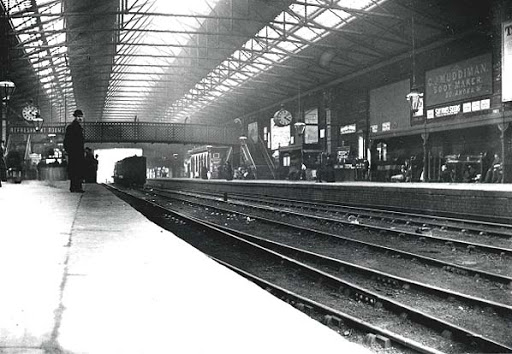
Having passed through the booking office and reaching the platform, the passengers were greeted with ample light and a conveniently arranged station.
The platforms were covered with a light roof of iron and glass, 83ft wide and 400ft long, regarded as one of the “first fruits of the Crystal Palace.” It was the work of Fox, Henderson and Company, a ridge and furrow roof, with Paxton gutters, designed to carry away rain and condensation underneath (used for water closets and urinals), and the centre of the roof was raised to permit a line of ventilation.
The roof was not supported by pillars, but its principals were set 25ft apart, resting on the inner wall of the station buildings on one side, and a lofty wall on the other. The glass was strong crown glass, about the thickness of ordinary pottery, and extended to an area of 34,600 sq. ft.
Through the station ran four lines of rails – two for passenger trains and two for spare carriages. Two other lines were laid outside the north-eastern wall for goods traffic.
The exits were closed by sliding gates, opened only when a train arrived and thus preventing ‘idlers’ entering the platforms, which themselves were divided by iron railings through which only passengers with tickets could pass.
With the building of Victoria Station, the Bridgehouses Station was converted into a goods, cattle and minerals station that operated until the 1960s.
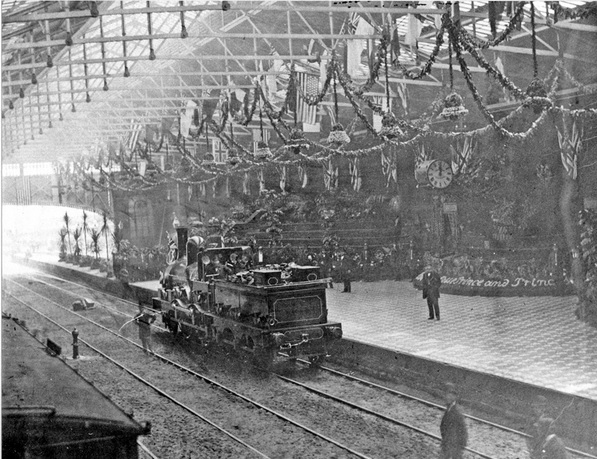
Victoria Station decked out for the visit of the Prince of Wales to open Firth Park in 1875. Image: Picture Sheffield
The Victoria Station opened on Monday September 15th, 1851. Although not fully completed, the station was elaborately decorated with flags, some bearing loyal inscriptions, others wishing good wishes for the prosperity of the railway and docks, while others were simple decorative banners.
The first train to leave the station was an early morning service with 500 passengers bound for Hull and Grimsby. About 9am, a pleasure train with 2000 travellers set off for Worksop, and in the early afternoon a special train left for London. Combined with local services the station was a scene of bustling activity, soon tested by the presence at the same time of two through trains and two Eckington trains sharing the same platforms.
With formalities out of the way, and the Victoria Station left to its daily business, Robert Tomlinson Carlisle, the builder responsible for the station buildings, entertained 500 of his men at the New Market Hall.
His workers were treated to a substantial dinner of beef and ham provided by Mrs Outram of the Black Swan in Snig Hill.
The ceremony was attended by John Fowler, engineer-in-chief, the man responsible for the massive project.
Robert Tomlinson Carlisle gave a toast to “The Queen, Prince Albert, Albert – Prince of Wales, and the rest of the Royal Family; Prosperity to the Manchester, Sheffield and Lincolnshire Railway, and the Grimsby Docks; Success to the Sheffield Markets, the Duke of Norfolk and the Earl of Yarborough.”
Charles Anderson Worsley Anderson-Pelham, 2nd Earl of Yarborough, former MP, was the chairman of the Manchester, Sheffield, and Lincolnshire Railway. His Lincolnshire estate was adjacent to the line and had been responsible for the development of the track through the county, especially its extension to Grimsby Docks
The Victoria Station was a success and received a new roof spanning main line platforms in 1867. Three years later the Midland Railway opened the Midland Station and it received its first real competition. Victoria was enlarged by Logan and Hemingway in 1874 and received a new frontage in 1908.
Image: Picture Sheffield
The Great Central Railway came into being when the Manchester, Sheffield and Lincolnshire Railway changed its name in 1897, anticipating the opening in 1899 of its London Extension. Interestingly, for a short time afterwards Victoria Station was renamed Great Central Station but as was often the case, old names refused to go away, and it reverted to its original name. The Great Central Railway was later grouped into the London and North Eastern Railway.
In 1948 the railways were nationalised, and it brought wholesale change to the network, as governments committed to the elimination of steam traction in favour of diesel and electric power.
After World War Two, the Victoria track was the first main line in the UK to be electrified, reaching Victoria Station by 1954.
Image: Picture Sheffield
Over time, with the growth of the road haulage sector, passengers replaced freight (especially coal transport) as the railways’ main source of income, and Victoria’s glory period was in the 1950s.
The Manchester London Road to London Marylebone service, via Victoria Station, used the Great Central Line. Other expresses ran to King’s Cross over the East Coast main line, and The Master Cutler, The Sheffield Pullman and The South Yorkshireman all served the station.
However, by the end of the decade expresses to Marylebone had either been cut or re-routed to King’s Cross and by the mid-1960s many local and express services had been transferred to the Midland Station. It left Victoria with just one hourly Manchester service and the daily Liverpool-Harwich ‘Continental’.
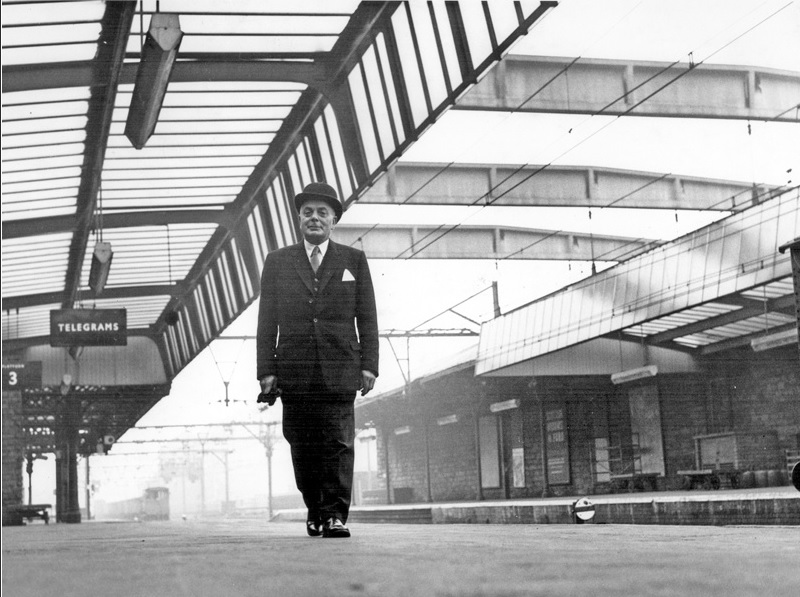
Percy Williamson. The last Station Master. Image: Picture Sheffield
Image: Picture Sheffield
The Beeching Report of 1963 resulted in the closure of a third of the rail network and originally favoured closing Midland Station. However, in the ensuing years Victoria Station became the chosen casualty instead, the Hope Valley line between Sheffield Midland Station and Manchester preferred because it served more communities. There was a suggestion that the cost of upgrading Victoria’s obsolete electric line was too expensive, but there were also suggestions that politics decided its fate. After much wrangling, and a two-year enquiry, passenger services were withdrawn from Victoria Station on January 5th, 1970.
Image: Picture Sheffield
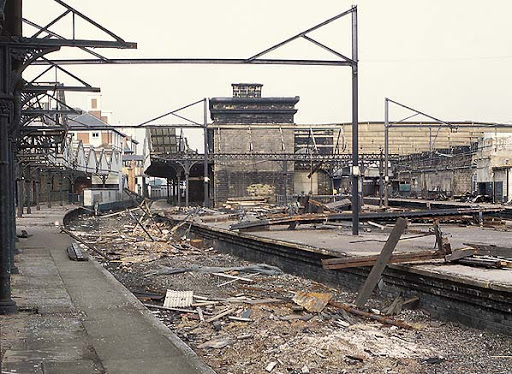
Goods traffic still ran through the station but all tracks (except one that still exists nearby) were lifted in 1983, and the station buildings demolished in 1989 to make way for extensions to the nearby Royal Victoria Hotel.
Image: Disused Stations
Perhaps we should mention HS2. The long-running saga of Britain’s next generation railway originally had plans for a station at Meadowhall, but Sheffield City Council wanted a city centre location.
For a brief time, it seemed that Victoria Station might have been resurrected but alas, once again, its old rival, the Midland Station (now Sheffield Station), became the preferred option instead.
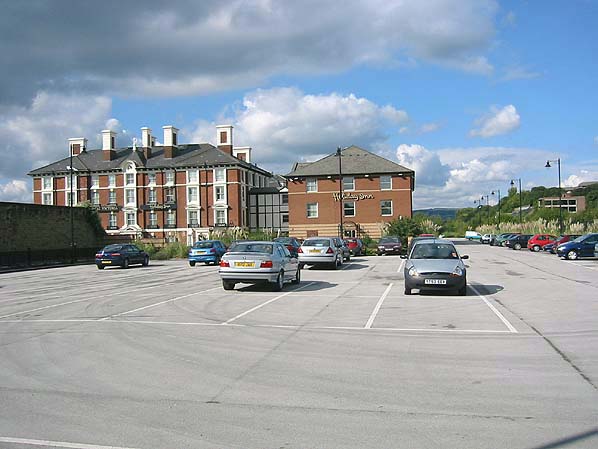
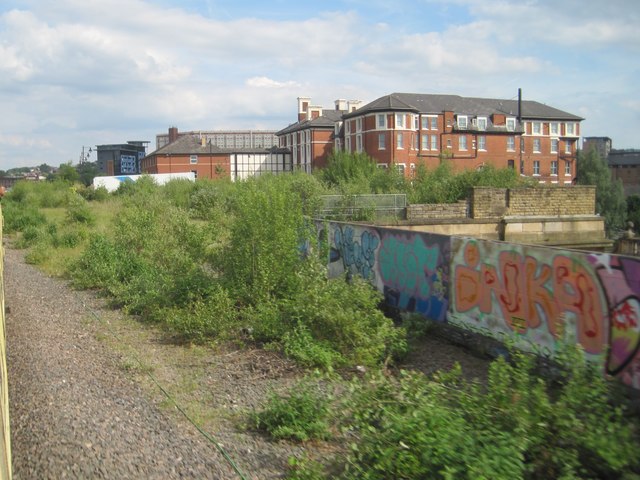
And so, to the present. Much of the site of Victoria Station’s former buildings and platforms is now lost under modern hotel buildings and car-parks. However, the elegant sloping approach to the Crowne Plaza Royal Victoria hotel remains much the same as it did when the station existed.
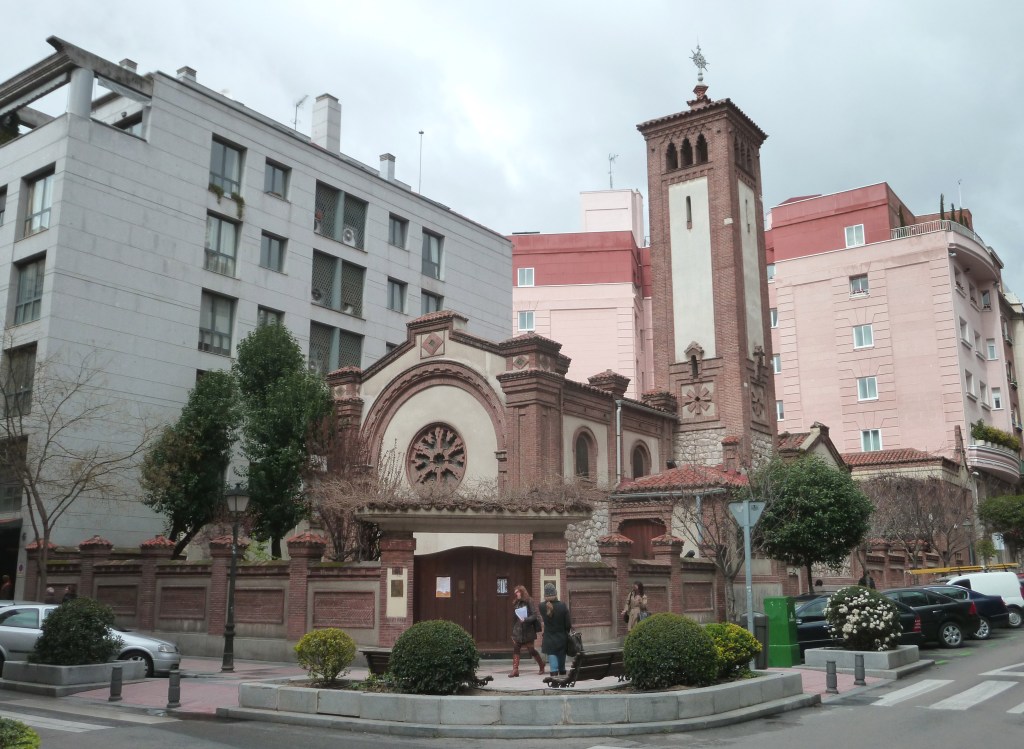
St George’s Anglican Church in Madrid. Built in 1926
It might be out of the question now, but if you get chance to visit Spain’s capital city there is a Sheffield connection.
The answer lies in a tablet over the south door of St George’s Anglican Church, on the corner of Calle Núñez de Balboa and Calle Hermosilla in the barrio Salamancadistrict of Madrid.
It reads:
“To the memory of William Edgar Allen. Born March 30th, 1837. Died January 28th, 1915. By whose generosity, this church was completed A.D. 1925.”
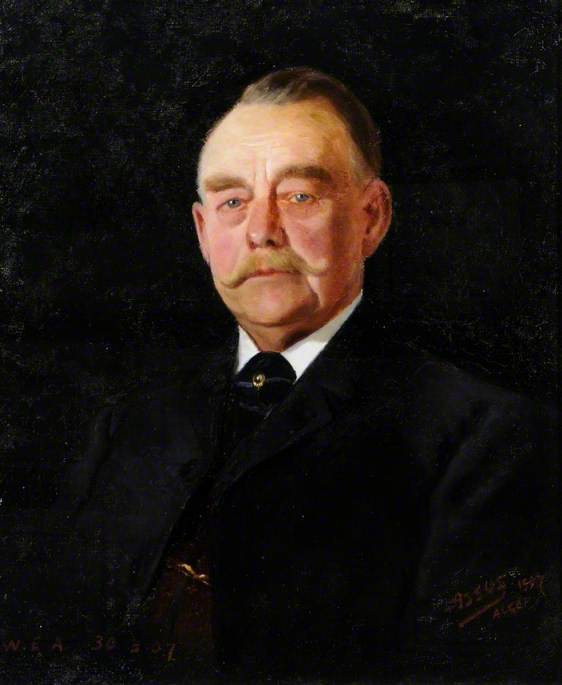
William Edgar Allen is a familiar name in Sheffield history. In 1868, he founded the firm of Edgar Allen and Co, Imperial Steel Works, at Tinsley. Taking advantage of his knowledge of continental firms, he soon obtained extensive orders for foreign arsenals, dockyards, and railway companies.
Besides other donations, Allen gave, in 1909, the Edgar Allen Library to the University of Sheffield, contributed £10,000 to Sheffield hospitals, and founded, in 1911, the Edgar Allen Institute (in Gell Street) for Medico-Mechanical treatment, the first institution of its kind in this country. It proved especially beneficial during the First World War; a great number of soldiers having recovered the use of their limbs through the effectiveness of the treatment.
In 1913, Edgar Allen, staying in Madrid, asked Edward Mitchel Gibbs, the famous Sheffield architect at Gibbs, Flockton and Teather, to visit the Spanish city and draw up plans for a Protestant Church.
The church, in Early English-style was to have seated 150 people, funded entirely by Edgar Allen. Unfortunately, the estimates for the building amounted to £10,300, a larger amount than Edgar Allen had anticipated, and the plan was abandoned.
However, at the suggestion of the architect, Edgar Allen, who was in failing health, bequeathed a legacy of £6,000 for a new church to be built.
Edgar Allen died at Whirlow House two years later, and his bequest was put towards the building of St George’s Church, the church of the British embassy, completed in 1925.
Spain was a Roman Catholic country, and rules as to the building of churches other than those of the Roman Catholic communion, were strict. Because St George’s was built on the premises of the British Legation, such restrictions did not apply.
“The workmanship and material of the church throughout were the best, and everything was in excellent taste.”
St George’s was designed by the Spanish architect Teodoro de Anasagasti, who blended elements of the Spanish Romanesque style (cruciform plan, semi-circular apse, bell tower, tiled roof) and the characteristic brick-and-stone construction of the uniquely Spanish “Mudéjar” tradition with specifically Anglican forms.
The chaplain of the church was the Rev. Francis Symes-Thompson, who received a grant of £250 per annum from the Foreign Office.
“If you want to see a monument to this man, look around you.”
Here is a man once described as “one of the makers of Sheffield,” for he was responsible for many of its principal buildings and played a leading part in changing the shape of the city.
His long list of work can be seen around Sheffield today.
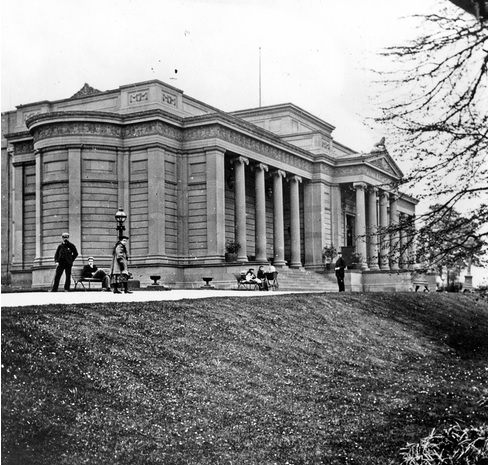
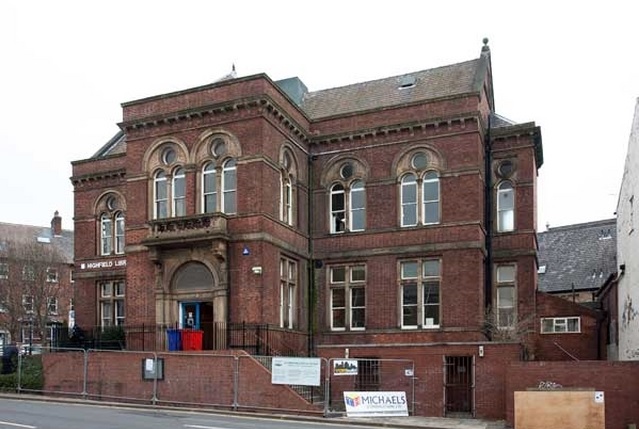
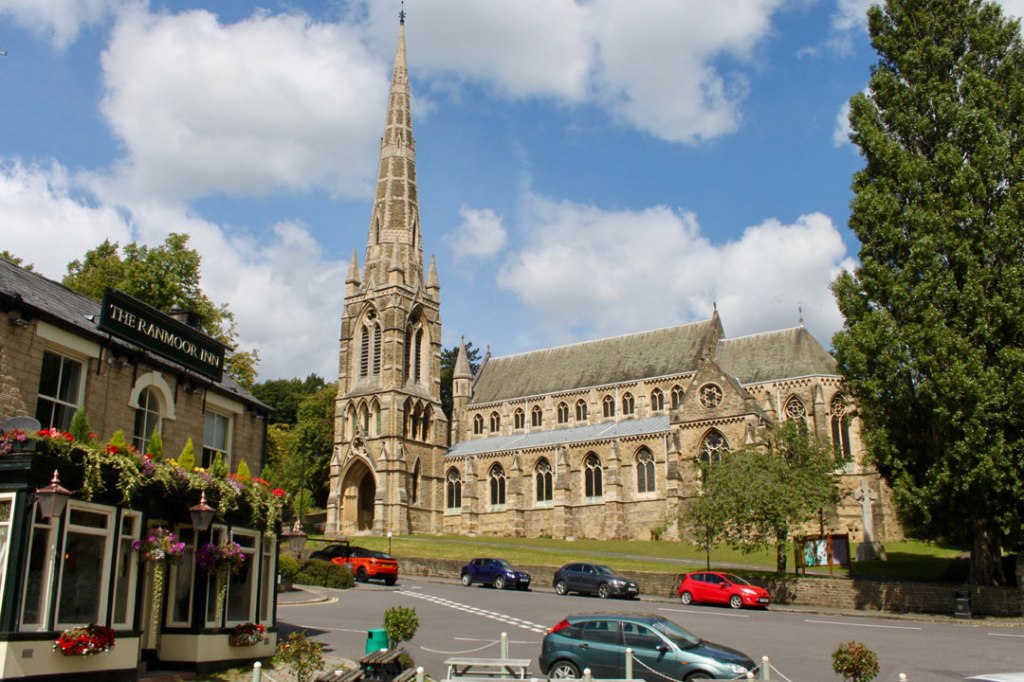
In his earlier years, Edward Mitchel Gibbs was architect for the branch libraries at Upperthorpe and Highfield, and later designed the Mappin Art Gallery, St. John’s Church at Ranmoor, the University of Sheffield, the Sheffield Telegraph Building, Lodge Moor Hospital, Channing Hall, Glossop Road Baths, Foster’s Building in High Street, and the White Building at Fitzalan Square. He was also responsible for some of the finest shops of the time in High Street and Fargate.
Sheffield Telegraph Building (Image: The British Newspaper Archive)
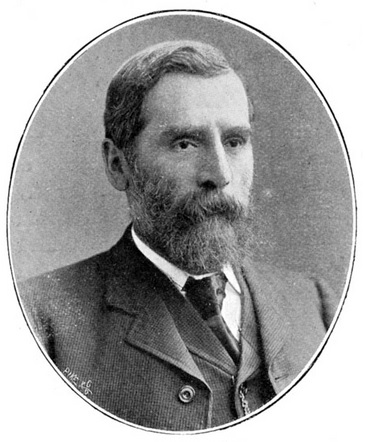
E.M. Gibbs (1847-1935) was born in Sheffield, educated at the Milk Street School, and articled to architects Flockton & Abbott between 1862 to 1868, remaining as principal assistant. He attended classes at Sheffield School of Art and subsequently spent time in London, studying at the Royal Academy Schools and assisting in the offices of Alfred Waterhouse.
Gibbs worked as Superintendent of Works to Archibald Neill of Leeds from 1868 until 1872, when he was taken into partnership by Flockton & Abbott.
He continued in partnership with Thomas James Flockton after the retirement of George Lewslie Abbott in 1875, and the partnership was joined by Flockton’s son, Charles Burrows Flockton, in 1895.
Gibbs became senior partner in 1902 (as Gibbs & Flockton), and the partnership was joined by John Charles Amory Teather in 1908, and Gibbs’ son, Henry Beckett Swift Gibbs, in 1921.
Mappin Art Gallery (Image: Picture Sheffield)
Like all good men, it was only after his death that people appreciated his contribution to the city.
His funeral in December 1935 was held at the Unitarian Upper Chapel on Norfolk Street (in which Gibbs had designed much of its interior) where the Rev. Alfred Hall paid tribute:
“Gibbs’ aim was to make Sheffield beautiful. All his artistic insight and architectural skill were devoted to that end, and, though tastes and fashion had changed, all men would acknowledge that the buildings he conceived and erected were dignified and noble.”
The funeral achieved national attention because Rev. Hall read out a document left by Gibbs:
“Born of Unitarian parents, I was a staunch supporter of the Unitarian precepts for many years, but under the teaching of Charles Darwin and Herbert Spencer became an agnostic. I hope the Minister, if he accepts the responsibility of conducting my funeral, will do so in the simplest manner possible, remembering that I die an agnostic.”
The clergyman admired his “sterling honesty” after which Gibbs’ remains were taken to City Road for cremation.
During his lifetime Gibbs thought positively and deeply and was a man of definite views. He was afraid that the country might fall into the hands of extremists and had the foresight to see the danger it faced arising out of Germany’s ambitions.
Highfield Library (Image: Picture Sheffield)
But he was not just an architect.
Gibbs had knowledge of property values and was retained by Sheffield Corporation in all cases of arbitration under the Tramways and Street Widening Act of 1897.
He also published essays: ‘The Town Planning of Sheffield’ and ‘The Finance of Housing and Reform of Rating’. In 1895, he presented a scheme for a central railway station in the vicinity of Haymarket. The plans were dismissed, as was his big scheme for housing.
Gibbs’ grand expansion plan was based on garden city principles with radiating main roads linked by a ring road with suburban settlements at its junctions.
Foster’s Building, High Street. (Image: Picture Sheffield)
As well as being a city magistrate, he was a trustee of Woofindin Homes, a director of the Gladstone Buildings Company and a governor of the University of Sheffield, where he was awarded a Master of Arts, and was instrumental in establishing the Department of Architecture.
He was admitted to the Royal Institute of British Architects (RIBA) in 1892 and was also president of the Sheffield and South Yorkshire Society of Architects and Surveyors. Gibbs also succeeded Thomas James Flockton as Consulting Surveyor to the Town Trustees, for which he designed the Fulwood Park estate.
The White Building, Fitzalan Square. (Image: David Poole)
Gibbs was married to Lucy, daughter of a manager at the Sheffield and Hallamshire Bank, who died a year before him, and lived at Woodcroft, 7 Riverdale Road. On his death he left gross estate of £52,939 (about £3.8 million today).
St John’s Church, Ranmoor. (Image: St John’s Ranmoor)
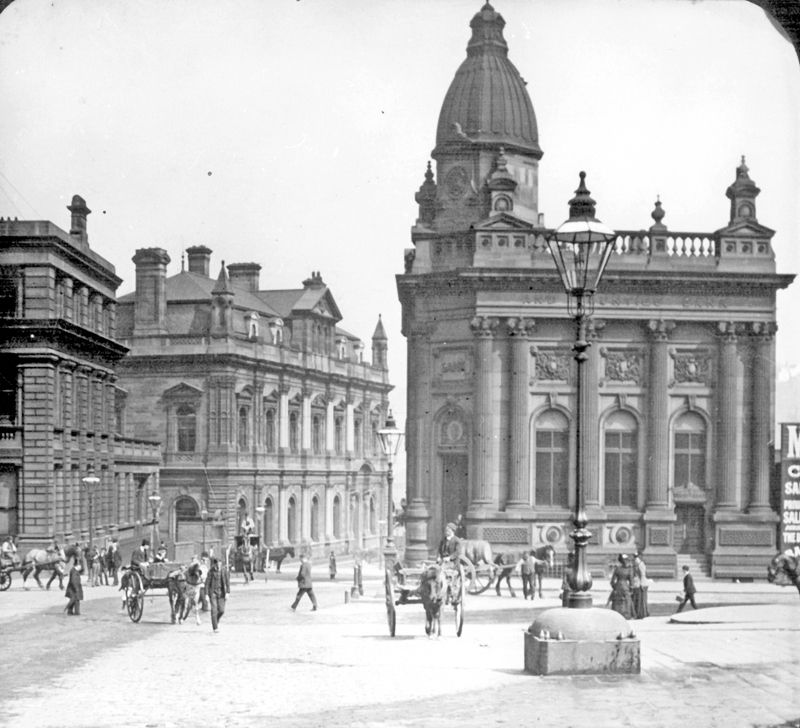
The one that got away. I bet only a handful of people will remember this building and it might have been one of Sheffield’s finest had it survived. But it didn’t, and you’ll be surprised to learn what stands in its place today.
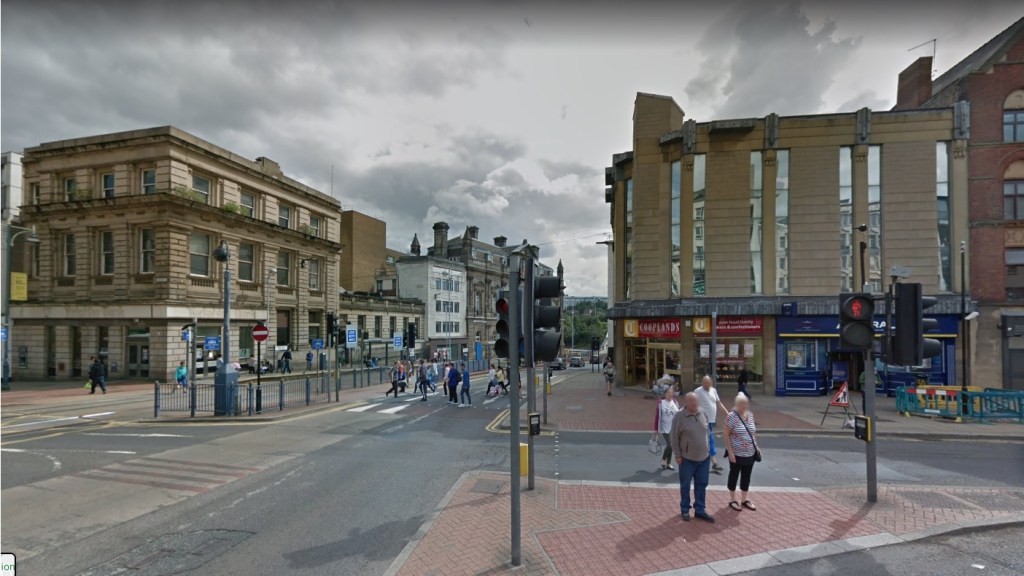
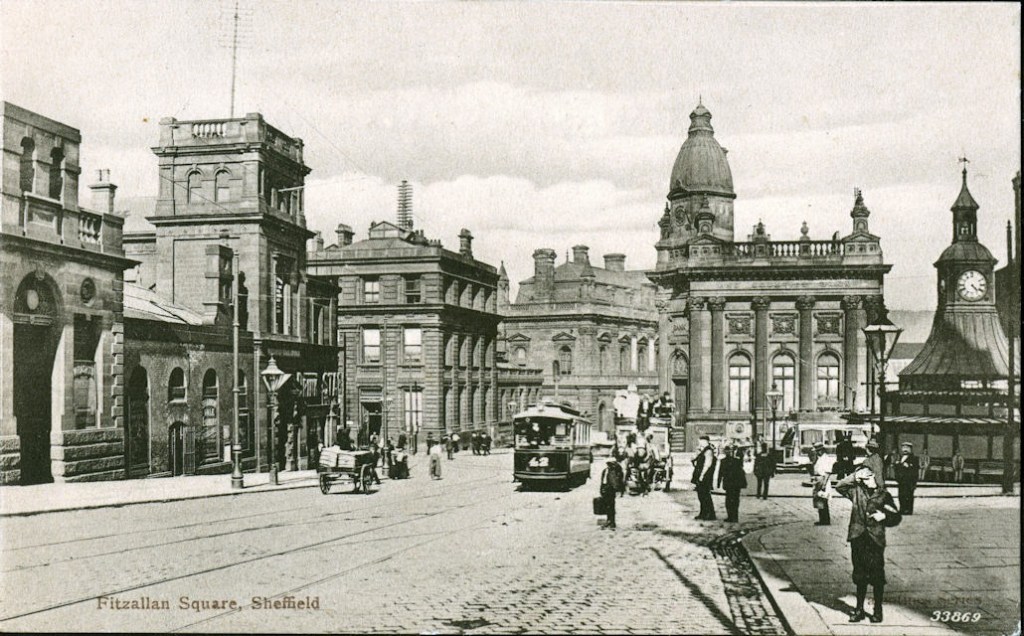
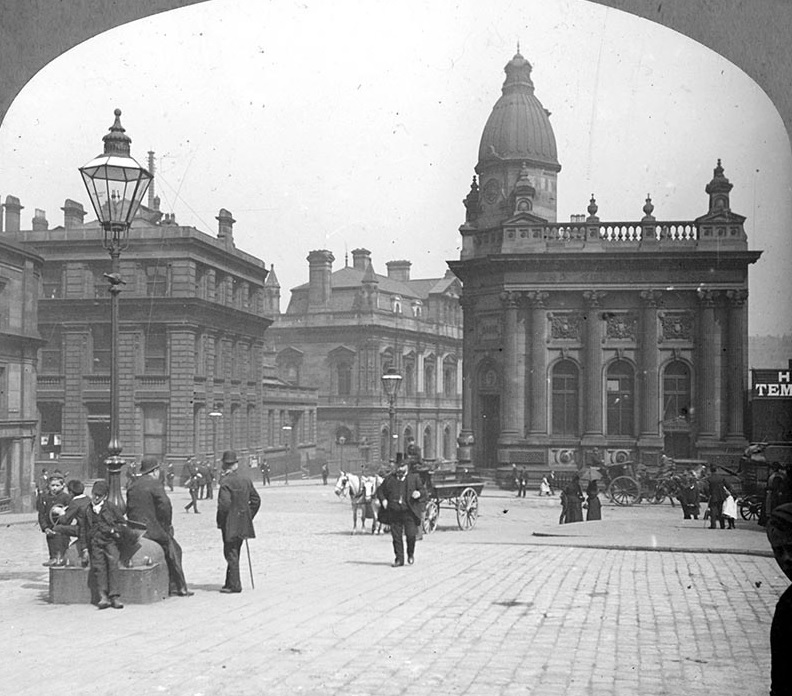
This was a bank that stood at the corner of Commercial Street and Fitzalan Square, demolished in the late sixties/early seventies to allow for road widening. Nowadays, its location is buried under the road section of Commercial Street, the Supertram tracks alongside following the course of the original road.
(Image: Google)
We can trace the building back to 1879, built for the Midland Banking Company (not to be confused with the Midland Bank, that 20th century institution). Its architect was Salmon Linton Swann whose office was on George Street.
It might have been this building that caused the downfall of the Midland Banking Company.
In 1878, the bank bought The King’s Arms in Commercial Street for £20,000, a portion of the public house demolished to make way for the new building.
The bank invited architects to submit plans. Thirteen architects competed for the design from Sheffield, Rotherham, Stamford, and Nottingham.
The directors awarded the prize to Swann, and the building contract to George Chambers and Son, a Sheffield construction company.
“The building will be of an imposing and handsome appearance, and the arrangements will tend to give privacy and facilitate easy and direct communication with the manager without passing through the bank room or incumbering the principal or main entrance with all the work of the bank.”
(Image: Picture Sheffield)
Its erection was well underway but a tragic accident in December 1879 halted progress and had devastating consequences for the reputations of those involved.
Just before Christmas, a whole length of projecting cornice, about 50ft above ground, fell and crashed through a wooden awning below. A workman, Thomas Moclar, fell to his death with it, and several workmen were seriously injured.
There was an air of complacency from Salmon Swann, who failed to attend the initial inquest and instead sent a letter. “I consider my presence or services not required, as I expect it will be a pure accident and one easily understood.”
The Coroner disagreed and ordered him to attend a few days later.
The jury found Swann censurable for not allowing sufficient tail weight to the cornice, and Chambers blameable for not calling the architect’s attention to such deficiency. However, they found the negligence insufficient to render them criminally culpable and that Thomas Moclar’s death had been an accident.
Construction was halted for a while, and progress hampered by having to rebuild the damaged section. By 1881, the bank was nearing completion and William Derry, a manager at the Huddersfield branch, was brought in to oversee its opening.
However, Derry arrived in difficult circumstances. Shortly before it opened, the Midland Banking Company realised that it was in financial difficulty. Believing it had ‘outgrown its resources’ a rescue was needed, and it came in the form of the Birmingham, Dudley and District Banking Company which amalgamated with it.
The bank opened under its new name, and quickly established a reputation in the city.
(Image: Picture Sheffield)
The height of the building was 70ft, the building preceding the development of Fitzalan Square, and cost about £17,000 to build.
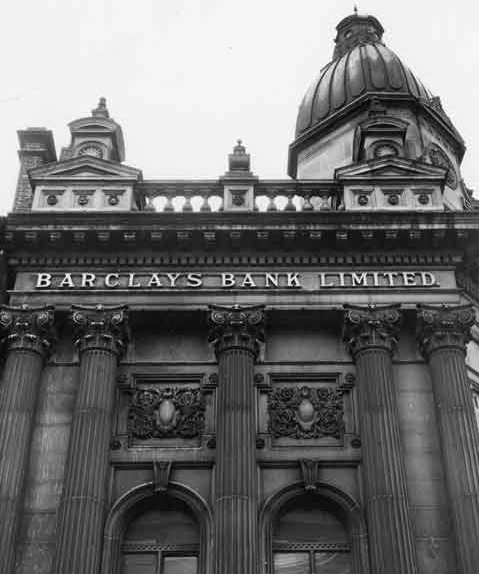
The architecture was adopted from ‘a free treatment of the classic order’, built with Huddersfield stone fronts and brick backs, having bold fluted columns along the front, with moulded bases and carved capitals dividing the wall spaces into panels, relieved by plate glass windows.
At the principal corner of the parapet was an ornamental stone tower with an ornamented panel bearing the Sheffield coat of arms, surmounted by the carved dome, supporting a moulded canopy and finial.
Internally, the wall spaces were divided into panels by means of moulded pilasters, in Parian cement, the panels fitted with the large windows. Those along the blank walls were fitted with silver-plated glass, which added a lustre of light.
The whole was surmounted by a moulded and enriched cornice, from which sprang a deep cove, relieved by a diaper work, supporting a moulded and panelled ceiling, from the centre of which was the dome, filled in with stained glass.
From the centre of the dome a ventilating sunflower fan was suspended to extract air from the bank, and to light the space below.
The whole of the bank floor was constructed with fireproof flooring covered with tiles.
The bank was heated with Perkins’ patent hot water apparatus, the pipes obscured by perforated iron skirting running around the walls.
The whole of the Commercial Street frontage was used as offices for the manager and waiting rooms, which were divided from the bank room with mahogany glazed screens, 10ft high, and covered with light glazed roofs, introducing Tobin’s principle of ventilating tubes for fresh air.
The remainder of the floor was divided and sub-divided by desks and counters, with the rear east wall fitted up with safes. Seats and desks were appropriated for the public under the windows.
Quite unusual for the building was an entrance to a basement (9ft high) in Commercial Street. This was used as a caretaker’s apartment, complete with sitting room, scullery, and bedrooms. There was also a dining room for clerks, two strong fireproof rooms, the hollow walls lined with white glazed bricks, to store ledgers, a bullion room, and toilets. The floor was laid with wood block flooring laid on a bed of concrete, thought more suitable to prevent damp and vermin. Below the basement was the boiler room, coal cellar, and a place to store ashes and dust.
The bank merged with the Wolverhampton and Staffordshire Banking Company in 1889 to become Birmingham, District and Counties Bank, eventually becoming United Counties Bank in 1907.
In the same year, a fire almost destroyed the dome after a spark in the built-in chimney set fire to woodwork. It was threatened until firemen managed to haul hoses up to a height of 70ft to extinguish the flames.
United Counties Bank was bought by Barclays Bank in 1916, a name long-associated with the building until its sad demolition.
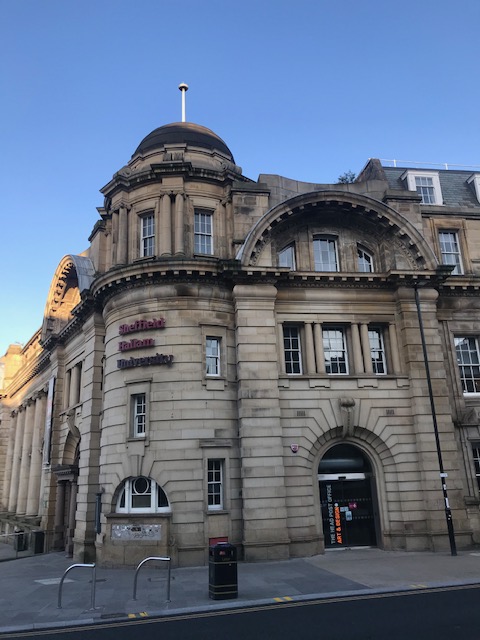
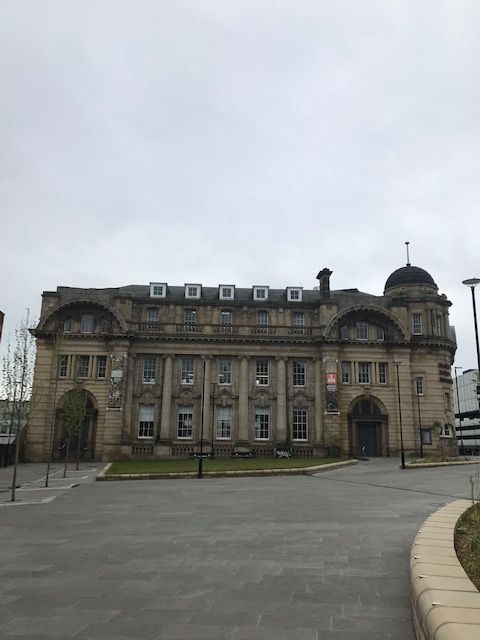
In a previous post we looked at the history of the General Post Office in Sheffield city centre. From humble beginnings on High Street, via Angel Street, Market Place, and Haymarket, the central post office ended up in Fitzalan Square.
However, the building now occupied by Sheffield Hallam University, was a long time coming.
In the first years of the twentieth century the Post Office acknowledged that facilities at the top of Haymarket had become too small.
By 1897, red-brick offices in Flat Street had opened and by 1900 all that remained at Haymarket was public counter work and the telegraphic department.
In fact, the Post Office had been buying up land around its Flat Street offices. By 1903, it had a triangular piece of land of one acre stretching from Fitzalan Square to Pond Hill.
(Image: David Poole)
The Post Office submitted plans to Sheffield Corporation for a building fronting Fitzalan Square, but the councillors were less than impressed. In 1907 it sent a delegation to see Lord Granard, who represented the Post Office in the House of Lords, to ask for a better building, including a finer elevation, than the one proposed.
Newspapers had been full of stories about a new post office and the people of Sheffield had started to think that the building might never get built.
However, the visit to London appeared to work and later that year plans were released by the Post Office for a new building in Fitzalan Square adjoining the existing Flat Street offices.
(Image: David Poole)
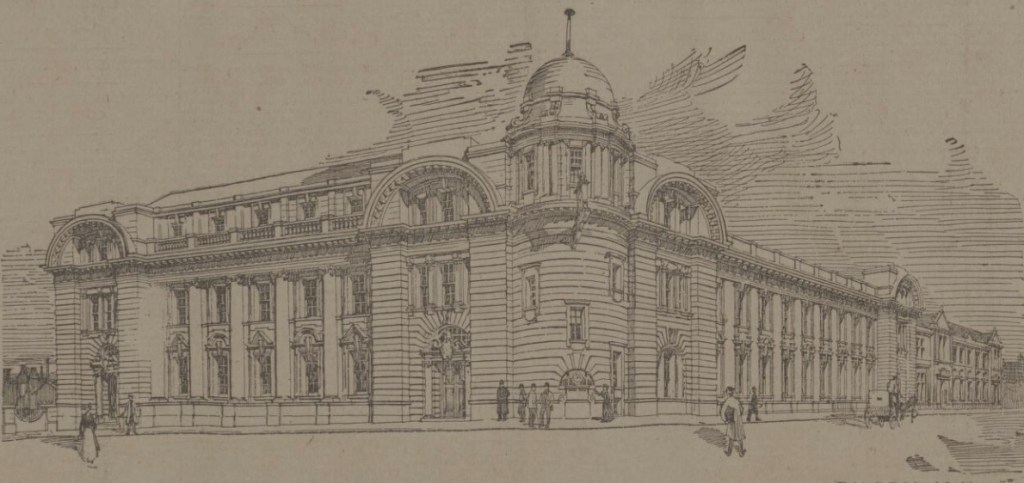
Work started in 1908, coinciding with Fitzalan Square improvement works, and an immense crane, 70ft high and with a jib 95ft long, dominated the skyline.
It was designed by Walter Pott, an architect who had started work with HM Office of Works in 1896 working in the London and Leeds offices.
The design was a modern adaptation of the Renaissance and allowed an additional storey over the wing in Flat Street.
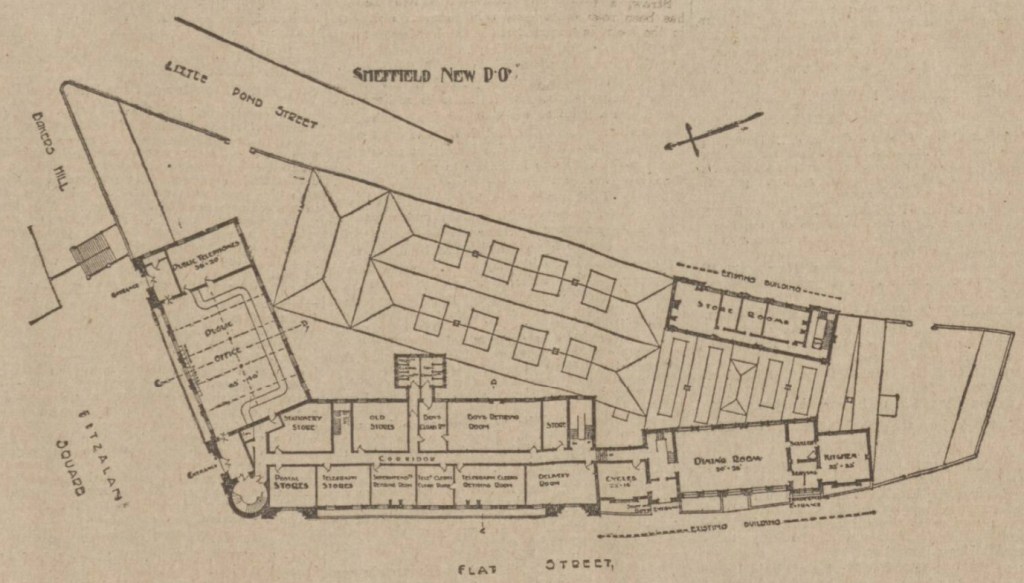
Plan of Sheffield Post Office in 1909. (Image: British Newspaper Archive)
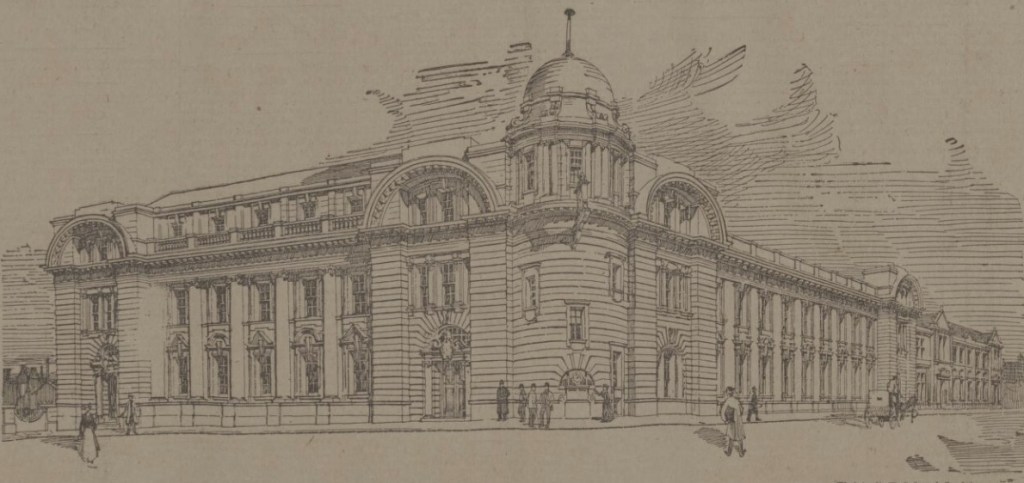
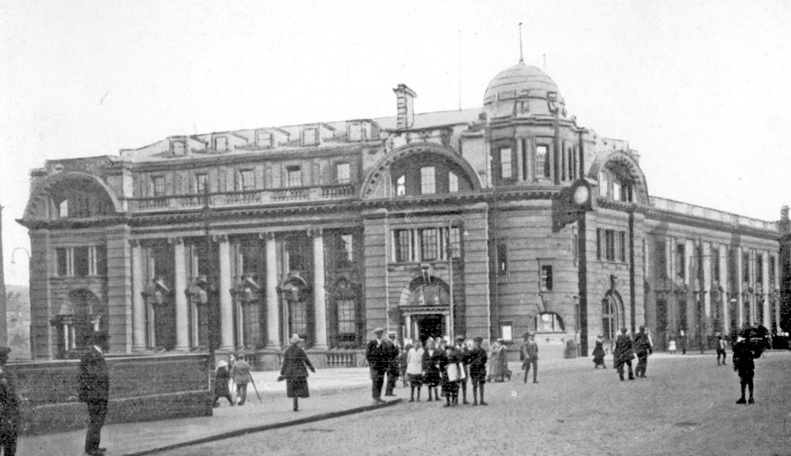
The principal front in Fitzalan Square was three storeys high, with a central portion having columns the full height of the two lower floors, these finished with carved Ionic caps and heavily moulded cornice and balustrade, which continued around the other fronts.
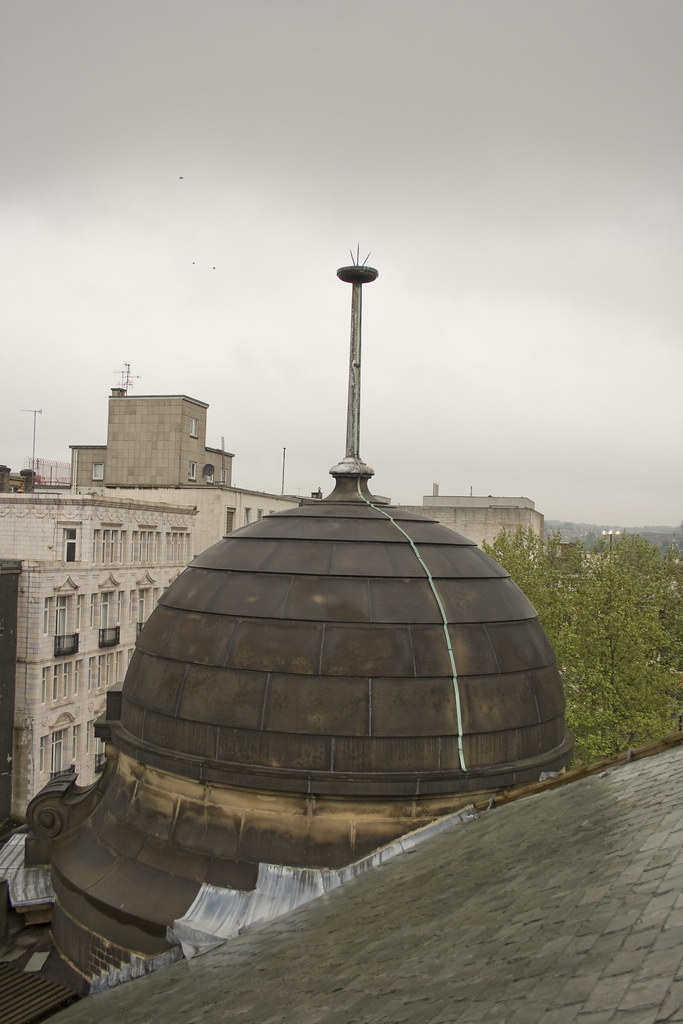
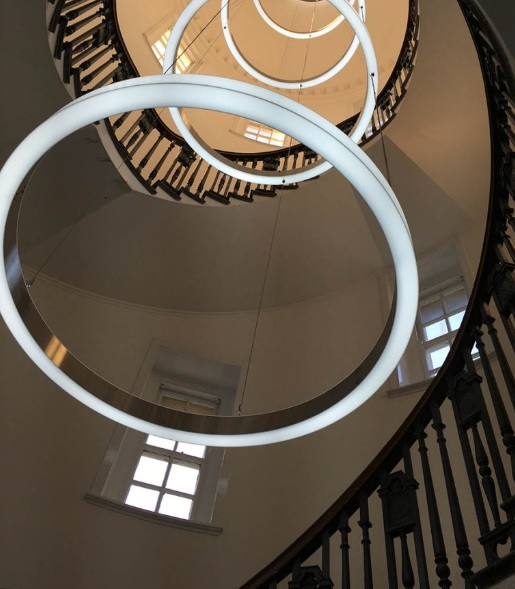
The front of Flat Street was treated in a similar manner but without the columns, and the corner with Fitzalan Square was rounded to accommodate a main staircase leading to the upper floors and finished with a dome.
The two principal entrances were in the wings of this portion, giving access to the public office, inquiry office, and Postmaster’s office. The upper parts of these were finished with heavy pediments.
Post boxes were at the base of the corner, with a large bracket clock (paid for by the council) above.
A sketch by Walter Pott of Sheffield Post Office in 1909. (Image: British Newspaper Archive)
The main post room, for the sale of stamps and postal orders, was 64ft long and 45ft wide, lit with windows back and front, and lined to a height of 8ft with marble, with a mosaic floor. Adjoining was a public telephone office with ‘silence boxes’ to allow messages to be sent without interference or risk of transactions being overheard.
The Postmaster, the Chief Clerk and writing staff, as well as the sectional engineer, were accommodated on the first floor immediately over the public office and front entrances, and on the floor above was the telephone switch-room and message-room. The basement was used for batteries and engineers’ equipment.
(Image: Picture Sheffield)
The Flat Street wing was set apart on the lower floors for retiring rooms for staff, for the messengers’ delivery room, and for storerooms. The first floor was entirely occupied by an instrument room.
The lower part of the site was in Little Pond Street, a much-needed extension to the existing sorting office, and for the provision of yards for loading and unloading mail and the storage of handcarts.
The new post office was designed throughout to meet modern sanitary requirements as regards light and ventilation, and the walls and passages occupied by staff were faced with glazed bricks. Four boilers, 146 radiators, and 1½ miles of heating pipe was installed by the Brightside Foundry and Engineering Co.
The building had been built on a hillside, and the result was that the greater portion was down below street level, and what people saw from Fitzalan Square was only the top.
Although history books give a date of 1910 for the building, it came into use without fuss during the summer of 1909. “The staff simply left their posts in one building and walked over to the incomparably better equipped accommodation across the Square.”
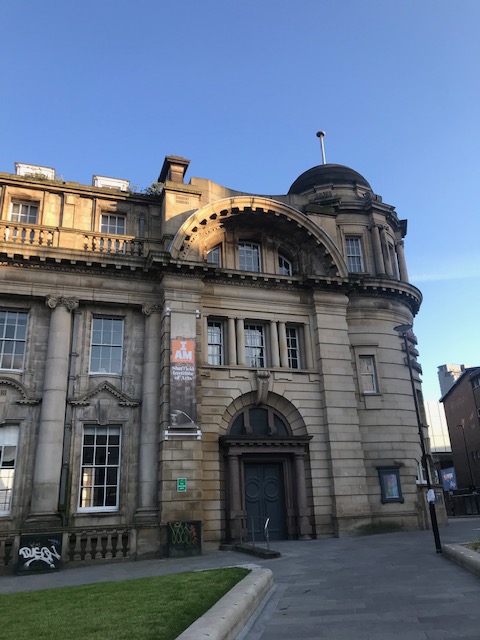
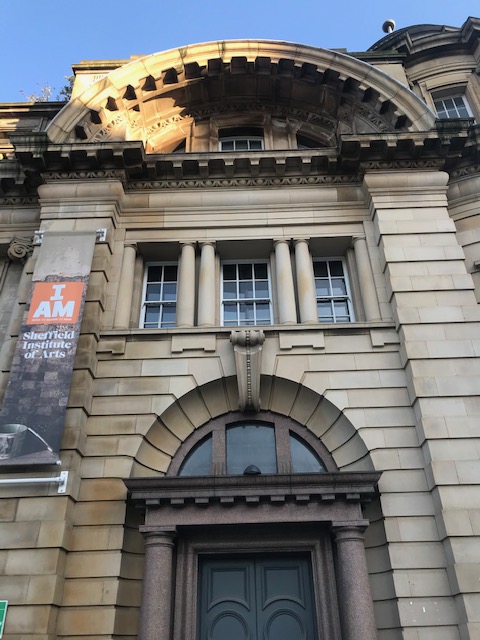
It remained in operation until 1999 and remained empty for several years, a ‘building at risk’, until rescued by Sheffield Hallam University which opened it as the Institute of Arts in 2016.
A sketch of Sheffield Post Office, Fitzalan Square, in 1909. Photograph by The British Newspaper Archive.
In this post, we look at the history of the Post Office in Sheffield, but a question before we start. Do you know where the Central Post Office is in Sheffield? I suspect a few might struggle to answer this, and I was the same. Answer at the end.
There is one certainty in the architectural world – we will never build Post Offices like we used to, if at all. Technology has done away with the need to create lavish buildings.
The story of the growth of the Sheffield Post Office mirrors the development of the city.
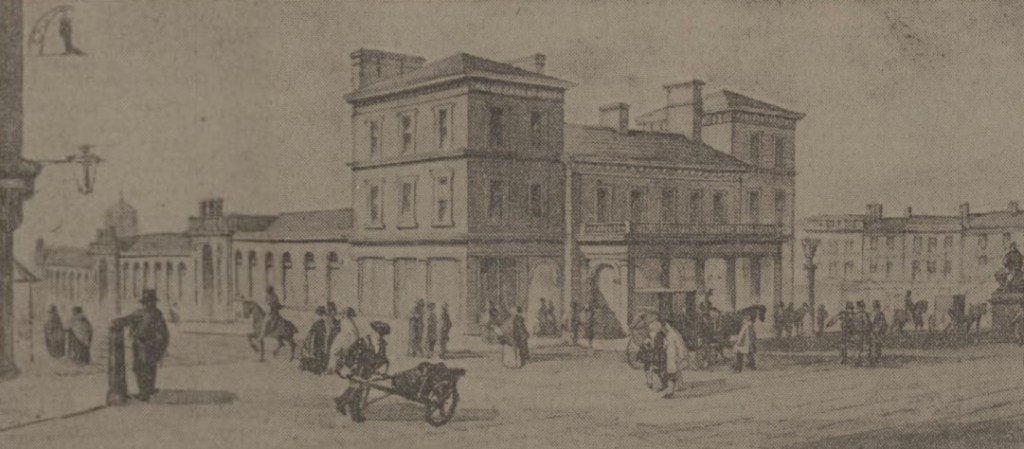
In January 1835, a Post Office and News-Room was opened at the Commercial Buildings in High Street (opposite where the Telegraph Building stands today).
A small room was all that was needed in those days, with postage stamps handed through a little door fixed in a hole cut through the wall. The population of Sheffield at this time was 91,692 but by 1851 this had risen to 140,000.
Sheffield’s first Post Office, in the Commercial Buildings on High street. Photograph by The British Newspaper Archive.
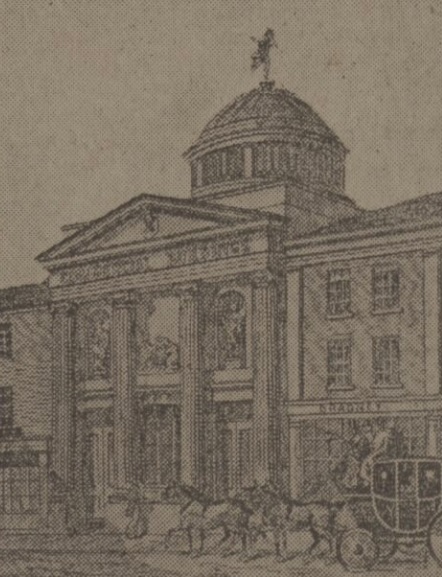
The demands on the Post Office increased and the facility was removed to Angel Street, in a part of a building that had once been Shore’s Bank.
The next move was to the top of Market Place (Castle Square), a much grander building that coincided with the increase in postal demand.
Sheffield Post Office, Market Place. Photograph by The British Newspaper Archive.
Sheffield’s industries were rapidly growing, and the population was advancing at an enormous rate. More general use was being made of postal facilities, and the authorities were improving the service, including the postal telegraph service, rates of postage to all parts of the world being reduced and the introduction of parcel post.
While the facilities in Market Place had been a great improvement on any previous office, there was a need for bigger premises.
In 1871, the population had reached nearly 240,000 and a new Post Office opened at the corner of Haymarket and Commercial Street (still standing, more recently home to Yorkshire Bank). However, by 1900 this was also too small and offices in Flat Street were opened and all that remained in the Haymarket was public counter work and the telegraphic department.
The Post Office had bought more land in Flat Street and Pond Hill from Sheffield Corporation as well as acquiring a site occupied by Mappin Brothers. By 1903, the Post Office had about one acre of land, a triangular plot stretching from Fitzalan Square and Pond Hill. Branch sorting offices were provided at Highfield, Broomhill, Montgomery Terrace Road, and Attercliffe, and sub-post offices opened all over the city.
These relieved the work at the central office, but still the business grew, and now, when the population was creeping up to half a million, a new office was provided at the top of Baker’s Hill, on the east side of Fitzalan Square.
The new Post Office, incorporating its Flat Street offices, opened in 1909, a Baroque-style building designed by Walter Pott of HM Office of Works. It coincided with Fitzalan Square improvement works and despite its grandiose appearance did not escape criticism.
In fact, the Post Office had been built on a hillside, and the result was that the greater proportion of the building was down below street level, and what people saw from Fitzalan Square was only the top.
The Post Office closed in 1999 and remained empty for several years before becoming the home to Sheffield Hallam University’s Institute of Arts in 2016. More about this building in a separate post.
And finally, the answer to that question. The Sheffield City Post Office can be found on the 1st floor of Wilko in Haymarket.
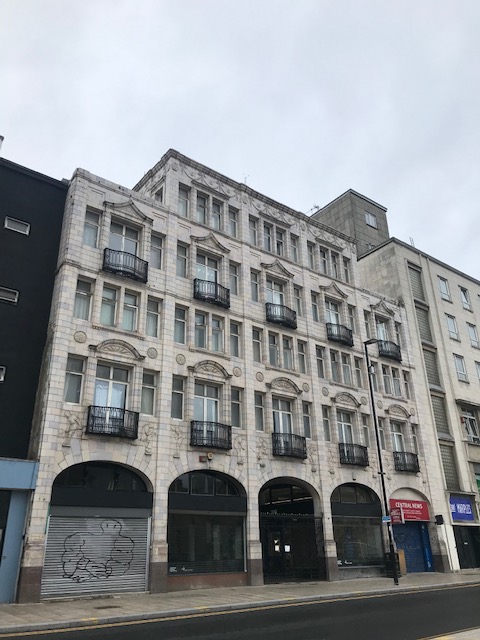
The White Building in Fitzalan Square. The old offices have been converted into apartments. (Image: David Poole)
This is probably one of Sheffield’s best-loved buildings. A glance through social media shows positive words about the White Building in Fitzalan Square, and yet little appears to be known about it.
The building is Grade II listed by Historic England, more so for the ten carved friezes that adorn its fascia, but its simple past, as shops and offices, means it is largely forgotten.
(Image: David Poole)
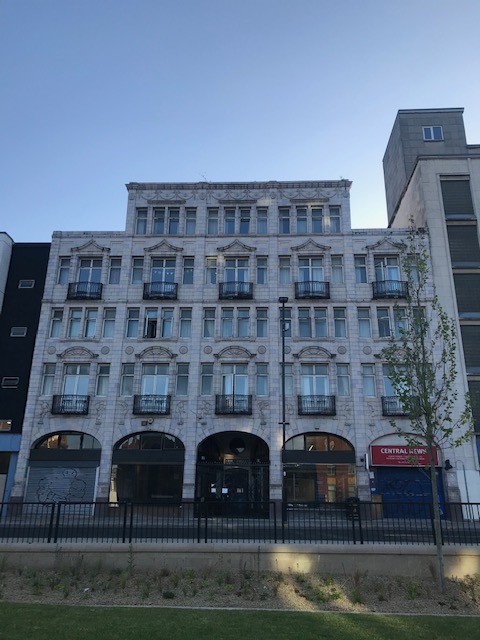
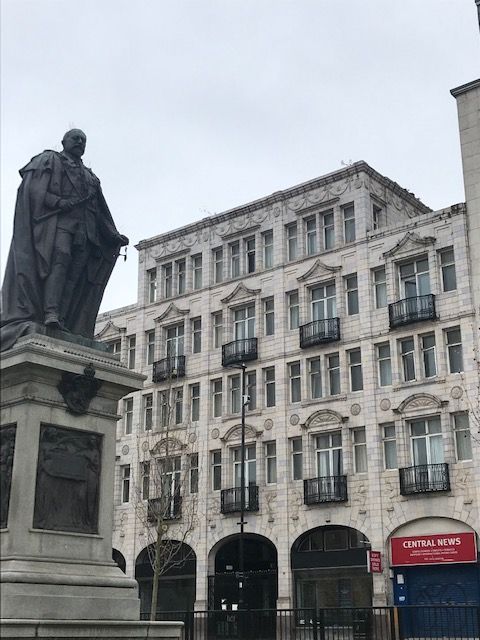
The White Building was built in 1908, named after the white faience used to dress it, quite different from the stone used in other buildings of the time. This material was used because it was ‘self-cleaning’, an antidote against the soot that clung to our city centre buildings in the past. (Another example, still seen today, was the Telegraph Building on High Street).
However, it would not look out of place on a typical Parisian street and comes into its own on a bright sunny day.
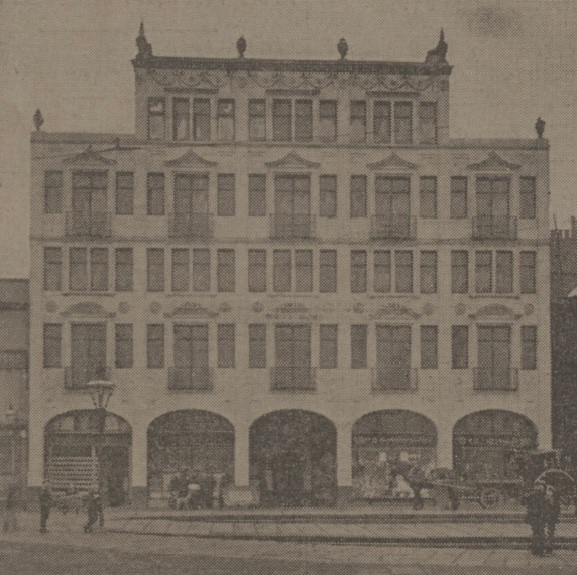
The White Building seen shortly after completion in 1908. This was one of several new buildings built at the same time as the square was ornamentalised. (Image: The British Newspaper Archive)
It was designed by Edward Mitchel Gibbs, of Flockton and Gibbs, who built and owned the building. No surprise then that its construction came the same time that Fitzalan Square was about to be rebuilt. Gibbs, as a member of the Sheffield and South Yorkshire Society of Architects and Surveyors, had consulted on plans for the square, and no doubt saw an opportunity to cash in on future success.
The White Building was built of four storeys with a raised attic storey in the centre. The use of French windows with balconies on the first and third floors provided welcome relief to the usual designs for commercial buildings.
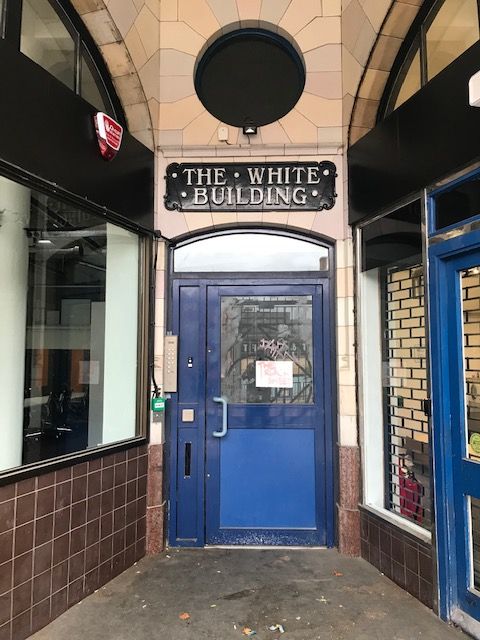
The building was accessed by an arcaded ground floor, the entrance, still with its original name plaque, recessed behind one of the plain elliptical arches.
It is above these five arches that the ten friezes can be seen. These were created by Alfred Herbert Tory and William Frank Tory, the brothers using real workers as models, before sending away the designs to be cast as hollow tiles (the moulding was done with terracotta tiles in Leeds).
With thanks to Darcy White and Elizabeth Norman ‘The Sheffield Trades’ are as follows:-
“A Silversmith (with a blowpipe): a Chaser: an Engineer: a File Cutter; a Steel Roller: a Cutler: a Grinder (using a flat-stick): a Hand Forger; a Buffer; and a Steel crucible teemer (with sweat rag in mouth).”
The Tory brothers made five each, casting their initials beneath their work, although these have weathered badly and are now difficult to read.
After the White Building opened, its ‘first class shops and offices’ were in huge demand and proceeded to be so until the decline of Fitzalan Square in the 1970s and 1980s. It was altered in the late twentieth century, including the removal of decorative rooftop urns, but remains pretty much as it did when first built.
These days the old offices have been converted into apartments and the ground floor shops await the revival of Fitzalan Square.
The King Edward VII Memorial with the White Building in the background. (Image: David Poole)
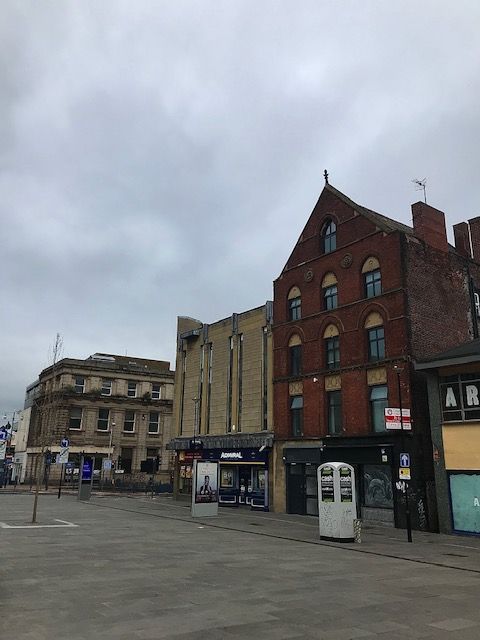
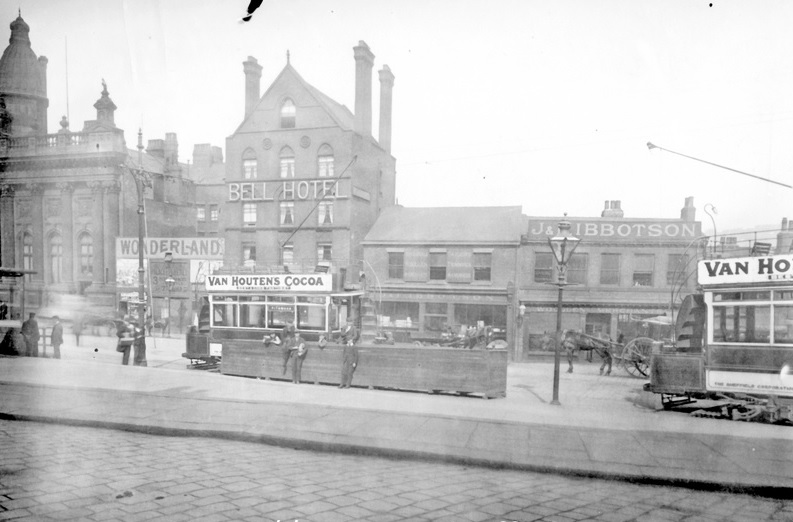
If buildings could only tell a story. Bell House is probably the oldest structure in Fitzalan Square. It was built after Sheffield Corporation spent a fortune from 1869 onwards purchasing and demolishing property between Market Street and Jehu Lane to create a new municipal open space.
The five storey building was the Bell Hotel (1872), its first landlord and owner being Henry Hardcastle, a wealthy man, previously of the Blue Bell in Commercial Street, one of those properties that was a casualty of the development.
For many years he had been a member of the 1st West York Yeomanry Cavalry, attaining the rank of sergeant-major, and proving popular with his comrades.
Hardcastle was good for a quick anecdote, could sing a good song, and make an admirable speech. Seemingly the right qualities needed for a publican. He was actively connected with the birth of building societies, whose meetings he allowed to be held in his pubs. He died in 1887 at the “ripe old age of 67-years” after collapsing in Snig Hill.
The Bell Hotel was put up for sale.
“That old established, substantially built and well-appointed hotel. Its central situation, and being within easy reach of both railway stations, the tramways and omnibus termini, secures for it a good commercial and country trade, and in the hands of an enterprising person it could not fail to continue a successful and prosperous undertaking.”
The woes of Fitzalan Square have been recorded in previous posts and at least one licensee fell victim to the area’s unsavoury characters. Annie Padley was one, pleading guilty to letting the Bell Hotel be used for betting purposes in 1901.
Photograph by David Poole
Another landlord, Arthur Browning, believed the Bell Hotel to be a gamble, one that might have rewarded him handsomely.
In 1902 he allowed the public house to be used for the trial of the Monarch fire escape, a convoluted device of poles, knitted ropes, hooks and slings, manufactured by Waddington and Co of Bradfield Road, to allow people escape from high-rise buildings. At the time, the Bell Hotel was one of the highest buildings in the city, the top floor window being about 50 feet from the ground.
Unfortunately, Browning was declared bankrupt in 1904 owing £1,398 (about £171,000 today).
The Bell Hotel (later The Bell) was for many years associated with Thomas Rawson and Co, a brewery long-established at nearby Pond Street, later acquired by Duncan Gilmour & Co (another local brewer), and finally falling into the hands of Joshua Tetley & Son. It closed in 1974.
Since then the ground floor has been occupied by shops and the upper floors converted into flats.
Look carefully above the three first floor windows and you can still see traces of the past – two pairs of bells above each window – one on top of each other.
This story is not unique to Sheffield. A once great house adapted over the years, and eventually falling on hard times. Across the nation there are many old houses that went this way, but they remain a fascination to us.
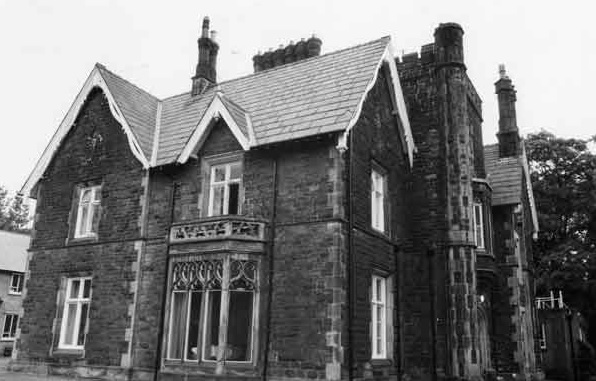
Brincliffe Towers was a town villa, built in 1852 in an area that eventually became one of the city’s most desirable suburbs.
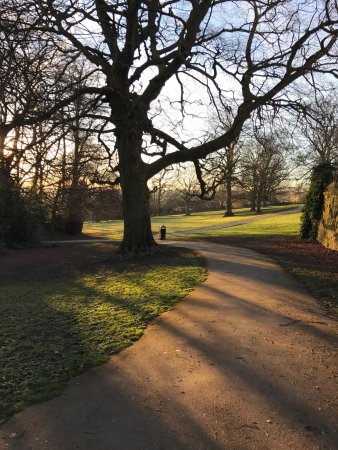
At the time of writing, the old house is empty, awaiting redevelopment, but its former grounds are known today as Chelsea Park, one of those public spaces that attracts little attention with most city people.
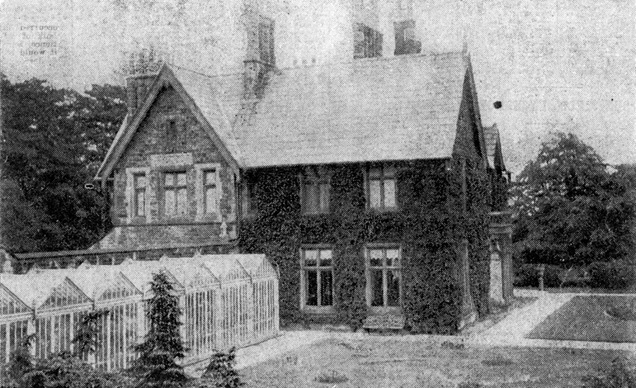
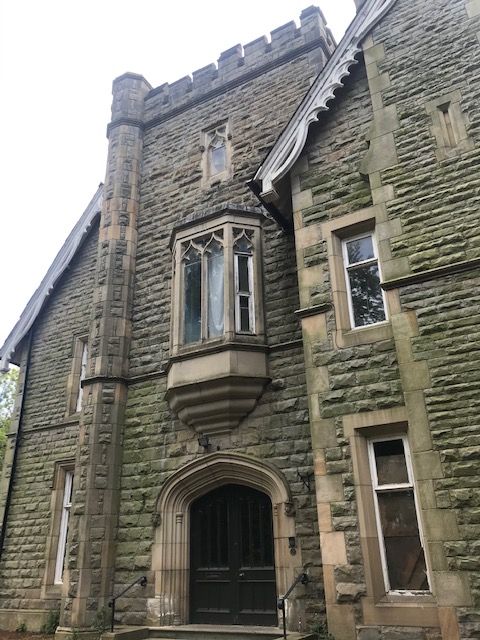
For this post we should refer to the mansion by its original name – Brinkcliffe Tower – an imposing mansion in Gothic-style, which formed a conspicuous object on the landscape. It was built by James Wilson, solicitor, for his own occupation. Built of Greenmoor rock-faced stone, with ashlar facings, no expense was spared to render it complete with every modern convenience.
Photograph by Picture Sheffield
With its park-like surroundings of 24 acres, Brinkcliffe Tower was one of the finest gentleman’s residences in this part of Sheffield, commanding a prospect of the most rich and beautiful scenery in the district.
James Wilson, a descendant of the Wilsons of Broomhead Hall, was the senior member of Wilson, Young and Pierson, and for many years had been Law Clerk to the Cutlers’ Company. He died in 1867 and the estate was put on the market: –
“The mansion contains a dining-room, drawing-room, breakfast-room, and the spacious vestibule, entrance hall, and principal staircase are lighted from the roof by a handsome lantern light. There are seven principal bedrooms and dressing-rooms, bathrooms, etc.
“The kitchens, servants’ hall, and other arrangements are of the most commodious description. There are large and lofty cellars (cut-out from the valuable bed of stone known as Brinkcliffe Edge Stone), servants’ staircase, butler’s pantry, sculleries, store closets, and four large upper rooms of stores and servants’ apartments.
“In the large paved yard is stabling for five horses, loose box, saddle and harness rooms, hay chamber, granary, and a spacious carriage-house, sheds and all the requisite appurtenances for a family mansion.
“The kitchen gardens are extensive and laid out in the best possible manner, while the grounds are enriched with fine timber and ornamental trees with flourishing shrubs.”
“Water is of the most common character, and during the dry summers of 1864 and 1865, a most abundant supply was always at hand.”
Photograph by Picture Sheffield
The Brinkcliffe Tower estate was bought by George Marples, descended from an old family line with origins at Barlborough and Stavely in North East Derbyshire. Until 1879, he was head of Marples and Marples, solicitors, Norfolk Row, at which time he vacated the position in favour of his son, George Jobson Marples.
George Marples died of a heart-attack in 1881 leaving personal estate worth £218,000 (that is almost £27million today), leaving Brinkcliffe Tower to George Jobson Marples, a man who had trained at the Inner Temple, but never practised as such. For twenty years he was a county magistrate in Derbyshire and senior magistrate at Bakewell.
In the 1890s, George Jobson Marples bought Thornbridge Hall, near Bakewell, for £160,000, leaving Brinkcliffe Tower behind, and eventually putting it up for sale.
Photograph by David Poole
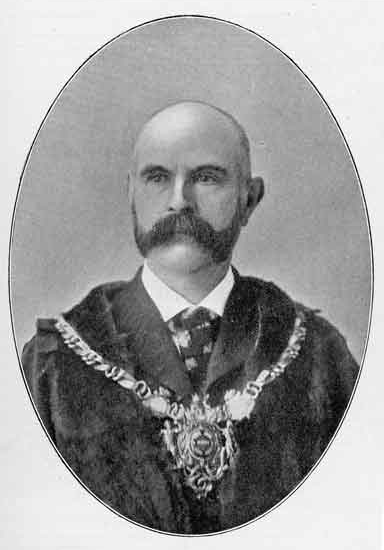
In 1897, it was acquired by Robert Styring(1850-1944), another solicitor, councillor, Lord Mayor, and a man whose contribution to Sheffield has been unforgivably overlooked, and subject of another post.
Styring remembered his father speaking of the building of Brinkcliffe Tower, which at the time had been regarded locally by many as “one of the seven wonders of the world.”
Not a man to miss an opportunity, Styring disposed of parts of the “valuable building estate” and in 1916 was involved in a dispute with Sheffield Corporation over land development.
An inquiry by the Local Government Board Inspector covered a scheme affecting Banner Cross, Brincliffe, Kenwood Park and Nether Edge. The Corporation had insisted that a maximum of twelve houses should be built per acre but, according to Mr Gibson, Deputy Town Clerk, Styring wanted to be free to build 25 houses to the acre.
Styring had married Annie Frances Hovey in 1880, and her death would have significant implications for the house and estate.
While addressing a meeting of women at the Victoria Hall in March 1925 she remarked, “Excuse me one moment,” sat in her chair, collapsed, and died.
Her death affected Styring deeply. “It was entirely due to her that I entered public life, and due to her efforts, won what was thought to be a forlorn hope, a seat in the City Council for St. Peter’s Ward in 1886.”
Photograph of Robert Styring by Picture Sheffield
In November 1925, Styring decided to gift the Brinkcliffe Tower estate to the city. To be handed over after his death, as well as the house, there were twelve acres of grounds which were to be used as a public park.
“We have enjoyed the pleasure of the estate and nothing would have given her greater satisfaction than to know the purpose to which it was to be adapted.”
After handing over the deeds to the council, Styring remained at Brinkcliffe Tower until 1935, by which time he chose to enjoy retirement in Paignton, Devon. As a result, he vacated the property, gave the keys to Sheffield Council, along with three houses on Brincliffe Edge Road, and left behind a Japanese tapestry and two large oil paintings. He died in 1944, aged 94, at Lancaster House in Paignton.
For a time, the grounds were considered as a memorial garden, the alternative site for a Peace Gardens, proposed after the Munich Agreement of 1938, but which were eventually created on the site of St Paul’s Church next to the Town Hall. Instead, the grounds were turned into Chelsea Park, named after nearby Chelsea Road, once known as Palmerston Road, until renamed in 1886.
As for the house, as always, there was a dilemma for the council. It remained empty for a while, and for a brief period was a girls’ school dormitory during World War Two. It became a nursing home, known as Brincliffe Towers, and in 1959 was refurbished and enlarged with “modernistic” 1950s extensions, funded by the J.G. Graves Charitable Trust.
Photograph by David Poole
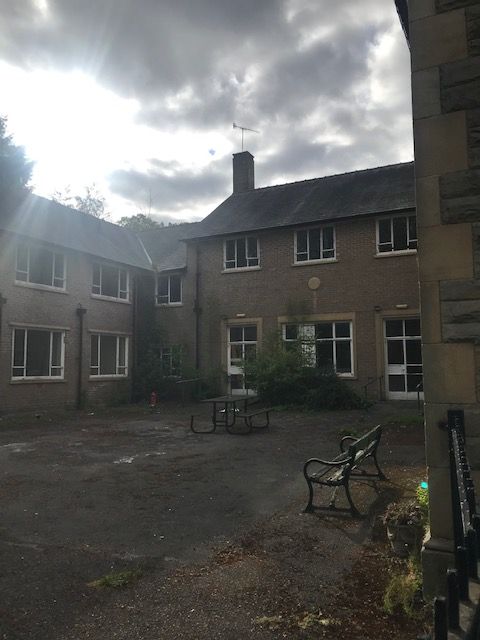
Eventually falling into private hands, the care home closed in 2011, victim of modern legislation, and since then there have been various controversial schemes to convert the house back into a single dwelling, funded by the conversion of the coach-house and erection of new houses in the wooded grounds.
Photograph by David Poole
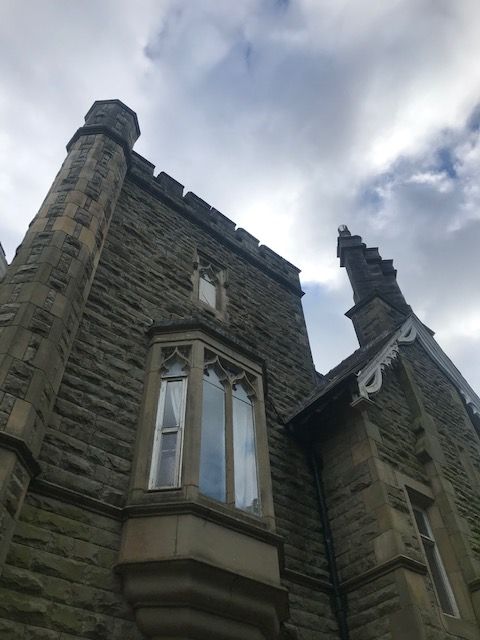
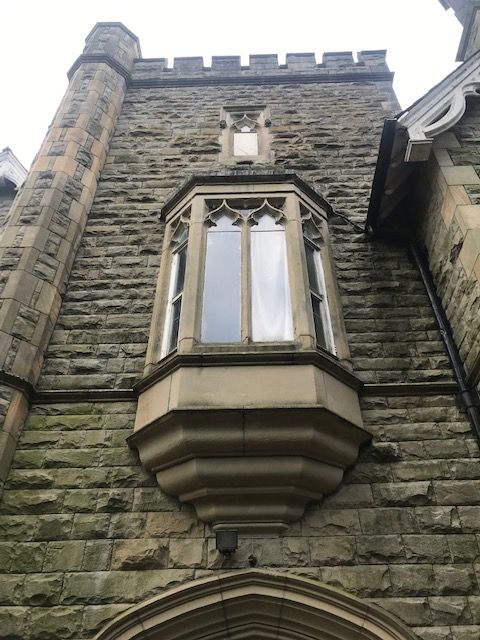
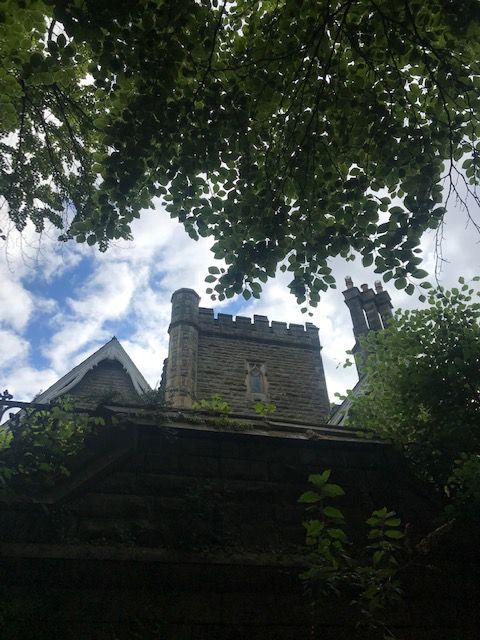
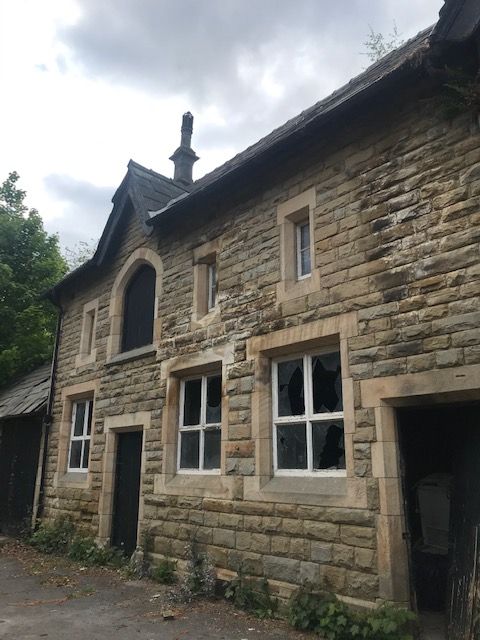
Sadly, the property is in poor condition, but still retains original characteristics, including the main entrance overlooking Chelsea Park, beyond the balustraded terrace, elaborately carved timber bargeboards, carved stone bay windows, doorways, and towers.
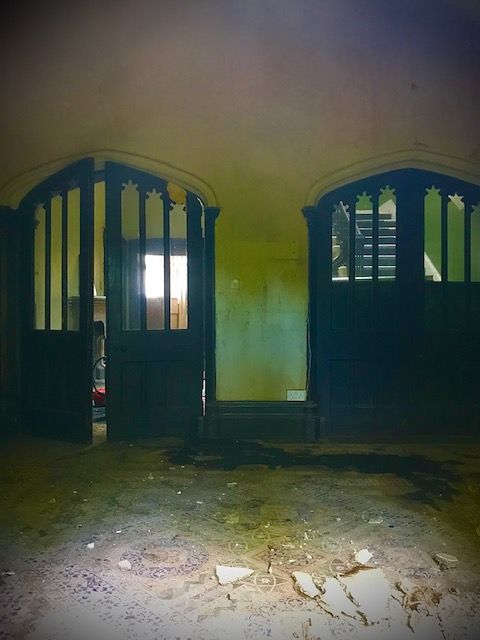
The internal fabric of the building has diminished overtime. However, there are some original features remaining to ground floor rooms, including fireplaces, architraves and coving and ceiling detailing. Rooms to the upper floors have been significantly altered and reconfigured through partition walls, but the tower and ceiling light remains intact.






 sheffielder.net