Categories
Buildings Companies

That ‘German’ company’: The rise and fall of Wilson Peck

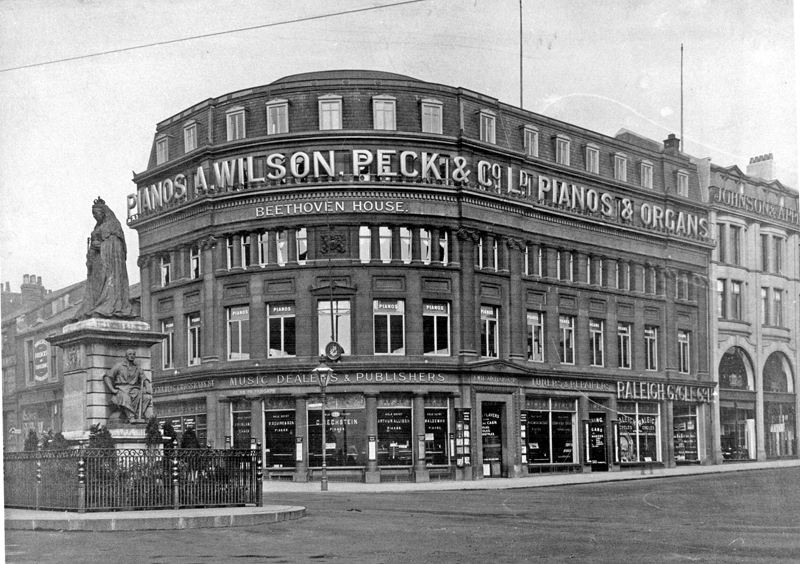
Wilson Peck Ltd., Beethoven House, Music Warehouse, Nos, 66, 68 and 70, Leopold Street, from Town Hall Square. Image: Picture Sheffield

The year is 1917 and Maximilian Lindlar is feeling annoyed. He had decided to sue Herbert Sinclair, editor of The Piano Maker, and its printers, King and Jarrott, for damages for an alleged libel contained in an issue of the paper.

Lindlar, born in Dusseldorf, left Germany at an early age, and had lived in Britain for forty years. A naturalised Englishman, denaturalised in Germany, he was a freeman of the City of London and between 1884 and 1912 he had been in the service of Edwin Bechstein, of Johanns Strasse, piano makers of Berlin.

The Bechstein business was founded in Berlin in 1853, developing a full range of pianos that met the requirements of professional pianists, musical institutions, and private music lovers alike. In London, its distribution was centred at Bechstein Hall in Wigmore Street, with upwards of one thousand grand and upright pianos displayed in different showrooms, with over one hundred musicians engaged for teaching purposes, and over four hundred concerts held every year.

While under the employment of Bechstein, Lindlar became involved with two British companies, Arthur Wilson and Peck Ltd of Sheffield, and Hopkinson Successors Ltd of Leeds, two retailers with monopolies for selling pianos in their respective cities.

In 1915, the total capital of Arthur Wilson and Peck was £20,000; Edwin Bechstein holding £10,250 of shares and Max Lindlar possessing £1,500. Lindlar’s brother, William Ludwig, a director, was the second highest shareholder with £2,562.

When war against Germany broke out in 1914, Bechstein’s holdings had allegedly been transferred to British shareholders, but this turned out not to be the case.

Lindlar had taken offence that Sinclair had published a scathing article and had dragged up comments made by him in preceding years.

“It is a national impossibility for an Englishman to produce a piano with each note perfectly balanced in tone. He has no true ear. His piano sounds all right to him, he does not know.”

Sinclair also published comments that Lindlar had made about the war.

“I do not think that England will be able to hold out financially to the end as Germany is very strong and well organised.”

What irked Lindlar most was a story in a newspaper that claimed he was attempting to drive British officers out of London’s German Athenaeum Club.

Such was the controversy over Arthur Wilson Peck and Co’s German influence that it was discussed in Parliament and subject to investigation by the Board of Trade in 1916.

Lindlar won his case and was awarded one farthing in damages, but Arthur Wilson Peck and Co suffered, its name  ‘MUD in large letters’ according to one journal while others continued to call it a ‘German’ company. Soon afterwards, Edwin Bechstein’s shares were sold to a British businessman and the Lindlar brothers held a dinner at Sheffield’s Grand Hotel to announce that their interests had also been sold and were retiring from the business.

Afterwards, it was business as usual for Arthur Wilson and Peck Ltd, a Sheffield company that grew out of Victorian enthusiasm for the piano.
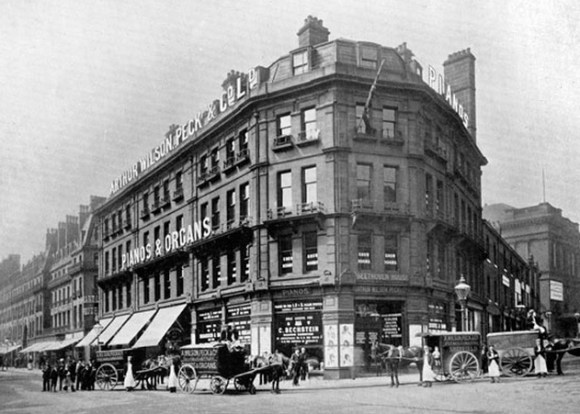
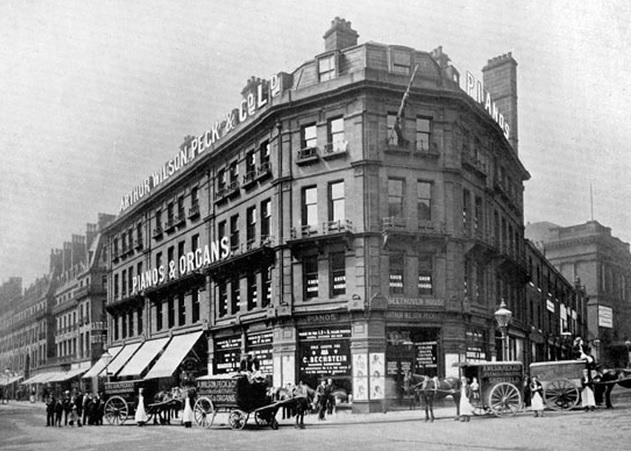
The first shop. Arthur Wilson, Peck and Co., Ltd., pianoforte, organ, and musical instrument dealers, Beethoven House, Pinstone Street. 1897. Image: Picture Sheffield

The company was created after Max Lindlar had masterminded the merger of two successful Sheffield piano sellers, Arthur Wilson, and John Peck, in 1892.

Arthur Wilson had started out as a piano shop at the corner of York Street before moving to Fargate and West Street, while John Peck, a piano tuner, had a business at the County Piano Saloon on Church Street (situated in the Gladstone Building).

The story behind Arthur Wilson is a strange one because the name was a pseudonym created to disguise the identity of the shop’s real owner.

He was Henry Charles Brooklyn Mushet (1845-1923) from Belgrove House, Cheltenham, the son of Robert Forester Mushet, the inventor of ‘Mushet’ steel, a self-hardening steel, who came to Sheffield with his brother Edward in 1871 to supervise the manufacture of ‘Mushet’ steel at Samuel Osborne and Co, Clyde Steel Works, on The Wicker. A music lover, he set up Arthur Wilson as a side line in 1878 and became an agency for Bechstein Pianos, where he met Max Lindlar.

John Peck (1841-1922) was born in Blyth, near Worksop, and was also regarded as the “father of the city’s fiddlers,’ his skills as a violinist surpassing those of the ‘stars’ who visited Sheffield and a man who went on to become a successful conductor.

With Max Lindlar’s connection to Bechstein Pianos it was decided to form Arthur Wilson, Peck and Co Ltd in 1892. With capital worth £20,000, Lindlar became chairman and John Peck joined as a director, but Mushet decided to step down from the business. Other notable appointments were William Cole, another piano dealer, who served as Managing Director for the first year and C.D. Leng, son of newspaper publisher William Christopher Leng, and a partner in the Sheffield Telegraph.

The first task for the new company was to close its three shops on West Street, Fargate, and Church Street, and consolidate its business in premises vacated by Hepworth Tailor’s at the corner of Pinstone Street and Barker’s Pool. It had cost £470 to set up the company and convert the building into ‘Beethoven House’.
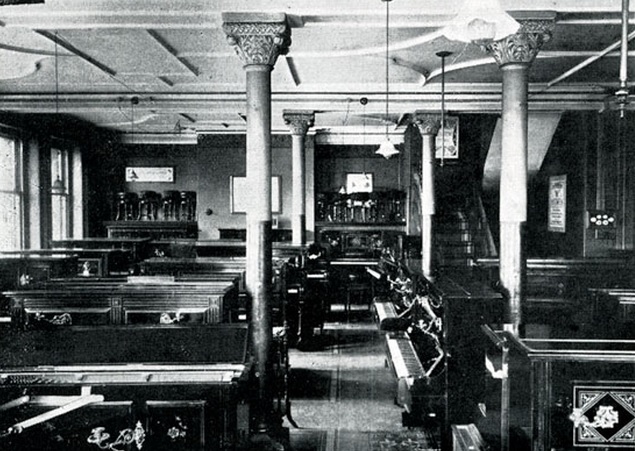
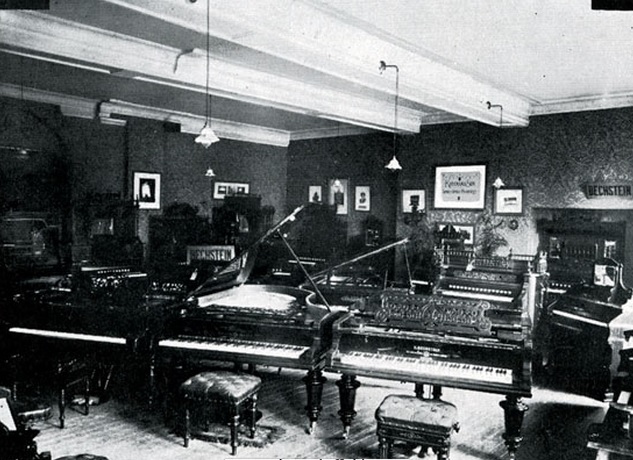
Arthur Wilson, Peck and Co., Ltd., pianoforte, organ and musical instrument dealers, Beethoven House, Pinstone Street – 1897. Portion of Show-Room for High-class Upright Grands. Image: Picture Sheffield
Arthur Wilson, Peck and Co., Ltd., pianoforte, organ and musical instrument dealers, Beethoven House, Pinstone Street – 1897. A Corner of the Show-Room for Grands. Image: Picture Sheffield
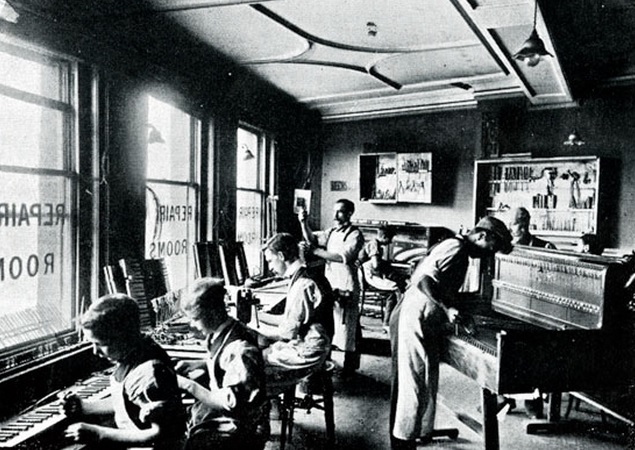
Arthur Wilson, Peck and Co., Ltd., pianoforte, organ and musical instrument dealers, Beethoven House, Pinstone Street – 1897. Repairing Room No.14. Image: Picture Sheffield
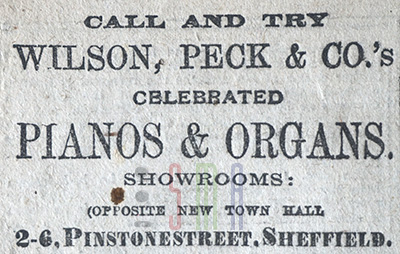
Newspaper advertisement. 1890s. Image: British Newspaper Archive

Within months, Max had been joined by his brother, William Ludwig Lindlar, who had intended to follow in the footsteps of their father, the landscape painter J.W. Lindlar. Instead, he assumed musical and commercial work, and would eventually become vice-president of the Music Trades Association of Great Britain. He became managing director in 1894 and was responsible for organising important concerts in Sheffield and Nottingham, where the company had established a second store.

They were described as pianoforte, harmonium and American organ merchants, tuners, and repairers, as well as sole agents for Bechstein pianos. Within the Pinstone Street building it also had a concert hall used for concerts and recitals.

In 1905, Wilson Peck moved to the opposite corner of Barker’s Pool in the former premises of Appleyards and Johnson, cabinet makers. It was described as ‘the best equipped premises outside London’ and the replacement Beethoven House is the building that most of us still remember.

Wilson Peck were famous for selling musical instruments, sheet music, hosting concerts, and selling ‘new’ phonographic records. On its upper floors it had rooms that could be used for tutors to teach music. In later years it developed a thriving business selling concert tickets for the City Hall and other venues across the country. Wilson Peck ended up with Sheffield’s oldest record department (memorable for its soundproofed listening booths) with sales of records accounting for a sizeable proportion of its business.

Shares in the business changed hands following the departure of the Lindlar brothers and at one stage its chairman was B. J. Readman, who also happened to be chairman of John Brinsmead & Sons, one of England’s premier piano makers. Additional branches soon followed on London Road and Ecclesall Road.

A 1956 advert claims the shop to be ‘the place to go for everything musical: Pianos, Television, Radio, Radiograms, Records, Concert Tickets, etc.’

Wilson Peck was held in high esteem, and it is hard to determine when its decline began. Two World Wars didn’t help a niche market, and the Victorian ideal of making music at home, when pianos were a common sight, had disappeared by the early twentieth century, having a devastating effect on sales of musical instruments and sheet music.

By the 1970s, the directors at Wilson Peck had diversified into property investment culminating in several subsidiary companies and ownership of buildings across the UK. Originally known as the Wilson Peck Group, it changed its name in the 1980s to Sheafbank Properrty Trust, subsequently becoming UK Estates.
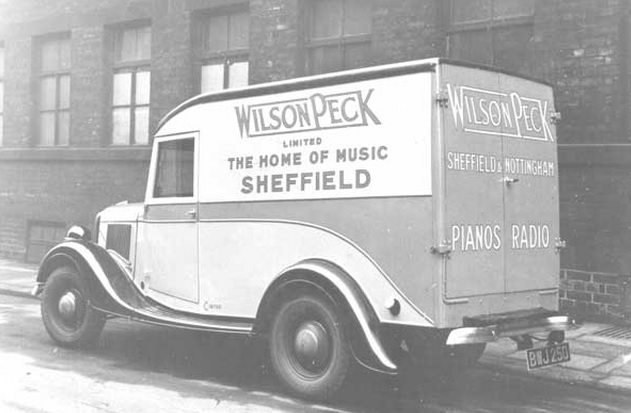
Delivery van, Wilson Peck Ltd. Image: Picture Sheffield

The retailing demise came in the 1980s when Sheffield City Hall decided to take its ticket sales in-house, and the emergence of national record chains (HMV, Virgin Records, Our Price etc.) eroded into Wilson Peck’s earnings.

In 1988, the company vacated Beethoven House, and H.L. Brown, jewellers, moved in. Wilson and Peck downsized to premises on Rockingham Gate but that proved short lived. I’m led to believe that Wilson Peck ended up in ‘an end-of-terrace’ corner shop on Abbeydale Road that closed in 2001.
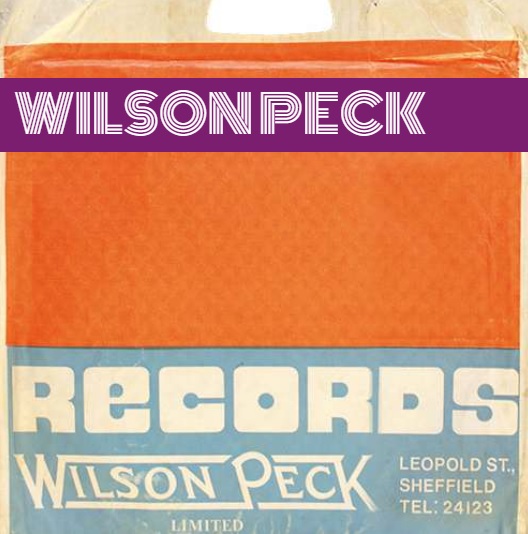
Retro bag for Wilson Peck. Image: British Record Shop Archive

NOTE: –
During the Parliamentary discussion about Arthur Wilson, Peck and Co in 1916, it was said that they also owned a business called Hilton and Company. There is no trace of this business, not helped because Wilson and Peck didn’t retain its archives.

However, there is a post from 2015 on the UK Piano Page whereby somebody said that they had bought an old upright piano: –

“The piano has ‘Hilton & Co’ written in gold writing in the centre of the key cover, also it has ‘Wilson Peck, Fargate, Sheffield’ written on it on the right hand side of the key cover.”

There was a Yorkshire piano company called Hilton and Hilton, but this piano appears not to have been manufactured by them.

Was Hilton and Co a brief attempt by Arthur Wilson, Peck and Co to sell its own manufactured pianos? Somebody, somewhere, might have the answer.

© 2024 David Poole. All Rights Reserved.
Categories
Buildings

Town Hall Chambers: I bet you didn’t know what it was intended to be

This post was planned as a tribute to one of Sheffield’s most famous shops, Wilson Peck, but research into its origins have proved to be rather complex. That post is imminent, but during the investigation some fascinating facts emerged about one of the buildings that it once occupied.

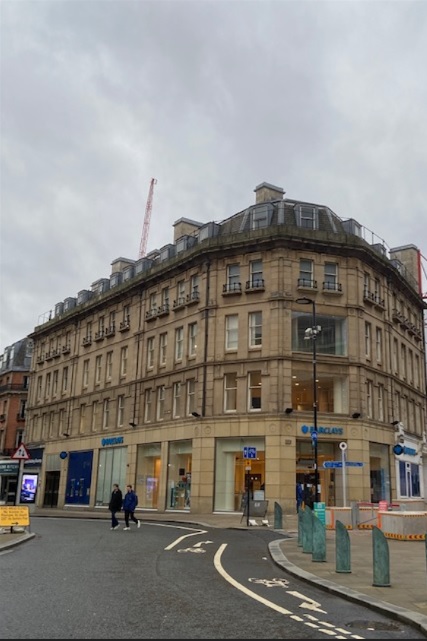
I’m talking about Town Hall Chambers that sits at the corner of Pinstone Street and Barker’s Pool, and now home to the city centre’s last surviving Barclays Bank.

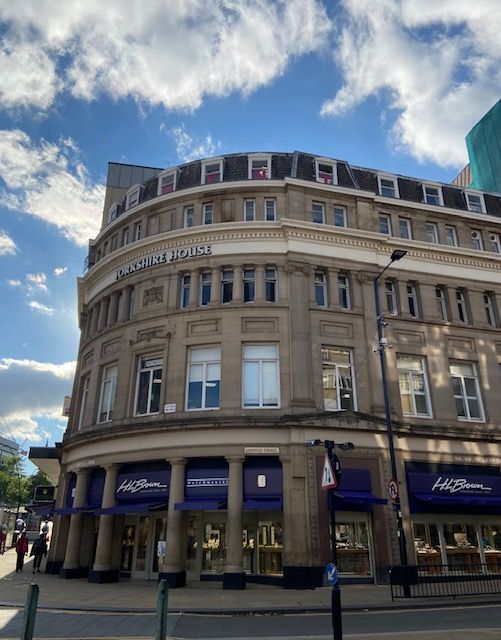
According to Pevsner, it is a ‘worthy, but slightly dull five-storey block of shops and offices’, and like nearby Yorkshire House (another home of Wilson Peck), it has never been listed by Historic England.

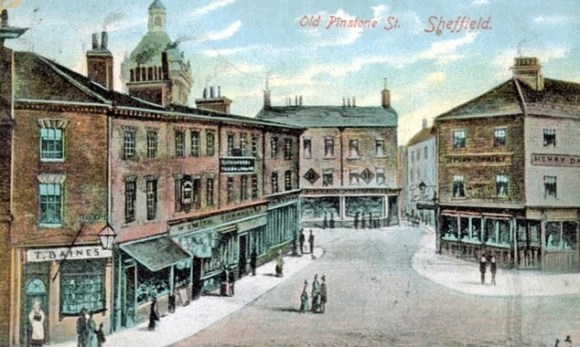
The building was designed by Sheffield architect John Brightmore Mitchell-Withers in 1882-85 as part of the street improvement scheme that reinvented Pinstone Lane, a salubrious and narrow thoroughfare, into Pinstone Street, long recognised as one of the city’s most prominent streets.

The site had been an old hostelry called the Norfolk Hotel that was demolished in 1881 as part of the street widening programme. Evidence suggests that J.B. Mitchell-Withers bought the plot of land to build upon, and now I’ve discovered that it was built as a hotel.

Pinstone Street from Orchard Street, No. 73 Fargate, T. Baines, hairdresser, left, No. 79 Barker’s Pool, Norfolk Hotel (landlord-Henry Darley), right, premises on Pinstone Street include No. 3 Wm Smith, hatter, Nos. 5 – 7 John Richardson, tailor. 1879. Image: Picture Sheffield

In 1884, newspapers advertised that the New Scarborough Hotel was available to let, containing a dining room, commercial room, smoke room, billiard room, refreshments bar and forty bedrooms. It also boasted the best modern appliances for cooking, hydraulic and other lifts, and electric bells.

The following year, it was announced that Lewis’s had ‘acquired the important block of buildings at the corner of Pinstone Street and Barker’s Pool, known as the Scarborough Hotel, and shops below,’ suggesting that the hotel never opened after failing to attract any interested parties.

The name of Lewis’s is famous in the history of UK department stores and the fact that it once had a branch in Sheffield comes as a bit of a surprise.

The first Lewis’s store was opened in 1856 in Liverpool by entrepreneur David Lewis, as a men’s and boys’ clothing store, mostly manufacturing his own stock. In 1864, Lewis’s branched out into women’s clothing, later expanding all its departments, and his motto was ‘Friends of the People’.

The first Lewis’s outside Liverpool opened in Manchester in 1877 followed by Birmingham in 1885. However, it was the Manchester store that it was best known for and later included a full scale ballroom on the fifth floor, which was also used for exhibitions. Its fourth store was in Sheffield, but with stiff local competition from John Atkinson and Cole Brothers, it proved unprofitable, and closed in 1888.

Negotiations quickly took place between the trustees of David Lewis and Joseph Hepworth and Son, a suit manufacturer that had rapidly expanded with over sixty shops across the country.

The premises underwent extensive alterations to accommodate its ready-made clothing, hats, and outfitting departments. The entire building was redecorated and lit with electric lamps, and when plans were submitted for Sheffield Town Hall in 1890, it was proudly referenced as the Hepworth’s Building.

Hepworth’s stay lasted four years, and in 1892 Arthur Wilson, Peck and Co, announced that they were vacating their three premises in Church Street, West Street, and Fargate, and consolidating business in the Hepworth’s Building.

It became known as Beethoven House and lasted until 1905 when it moved to the opposite corner in premises vacated by cabinet makers Appleyards and Johnson, and now known as Yorkshire House.

Arthur Wilson, Peck and Co., Ltd., pianoforte, organ, and musical instrument dealers, Beethoven House, Pinstone Street. 1897. Image: Picture Sheffield

At which point the building became known as Town Hall Chambers is uncertain, but by the 1930s, the ground floor had been subdivided into smaller shops, and the floors above converted into offices for numerous insurance companies.

Our generations will remember it as a centrepiece shoe shop for Timpson’s and as a short-lived branch of Gap, before being reinvented as a futuristic Barclays Bank. I’d be grateful if anyone can name any other businesses that might have been located here.

And so, we’ve discovered that Town Hall Chambers started as an ill-fated hotel. The building itself survived two World Wars and managed to escape Heart of the City redevelopment, but the irony is that neighbouring Victorian buildings further along Pinstone Street, also built as part of the 1880s street widening scheme, will soon become the Radisson Blu Hotel.

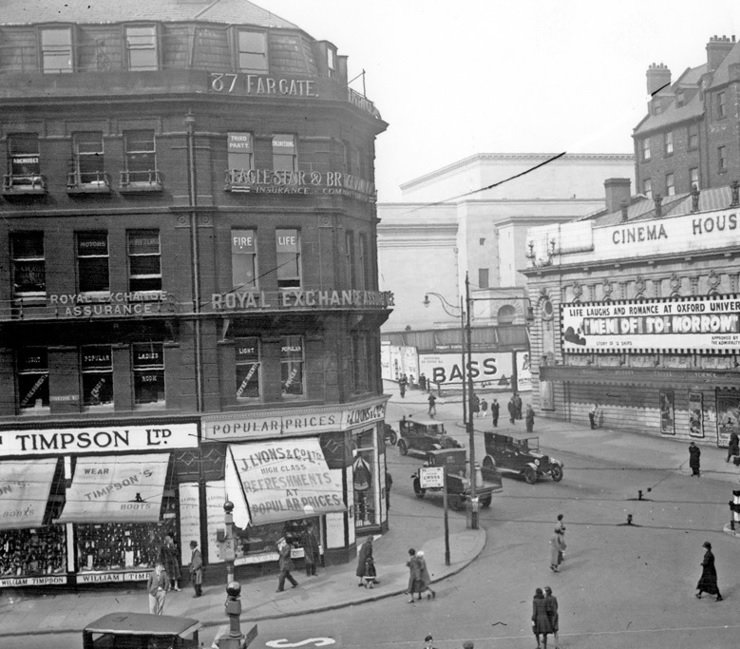
Town Hall Square and Barkers Pool, Town Hall Chambers, William Timpson Ltd., Shoe Shop and J. Lyons and Co. Ltd., Dining and Tea Rooms on left, Cinema House on right. 1935. Image: Picture Sheffield

© 2024 David Poole. All Rights Reserved.
Categories
Buildings People

Johnson and Appleyards: “Excessive capital was taken out of the business to fund lavish lifestyles.”

Yorkshire House, Leopold Street, Sheffield. The building has failed to get listing from Historic England. Much of the original interior has been lost in modern redevelopment.

This post is about Johnson and Appleyards, not many people will have heard of it, but that shouldn’t have been the case. Life is full of what ifs. What if things had been done differently? If they had been, then we might have been fondly remembering Johnson and Appleyards as we do Cole Brothers and Walsh’s.

Our story starts on 10 February 1909 when Councillor Walter Appleyard received a cable from Kobe in Japan. It was from his brother, Frank, and informed him that their older brother, Joseph, had died. The fact that it happened in a foreign country was no surprise because Joseph had travelled extensively to Australia, South Africa, and South America, and this latest excursion which started five months previous, had taken in Egypt, India, Burma , and China. The next stop would have been Canada before heading home.

The news might have suggested that this was the first stage of failure for Johnson and Appleyards, cabinet designers and manufacturers, upholsterers, decorators, undertakers, carpet warehousemen, colonial merchants, and exporters, but the decline had already begun, not that anybody had realised it.

Joseph Appleyard (1848-1909)

The three Appleyard brothers, Joseph, Walter, and Frank were the sons of Joseph Appleyard, a Conisborough cabinet maker, who had a business until 1872, when he established J. Appleyard and Sons at Westgate and Main Street in Rotherham which the brothers ran.

In 1879, the brothers took over the Sheffield furniture-making business of William Johnson & Sons, with premises on Fargate, and renamed it Johnson and Appleyards. It was a bold move, but within a few years the business needed bigger premises to display its furniture.

They chose a prime site at the corner of Fargate and Leopold Street and employed architects Flockton and Gibb to design an impressive showroom built in Huddersfield stone with a mixture of giant ionic and stubby doric pilasters on its first and second floors.

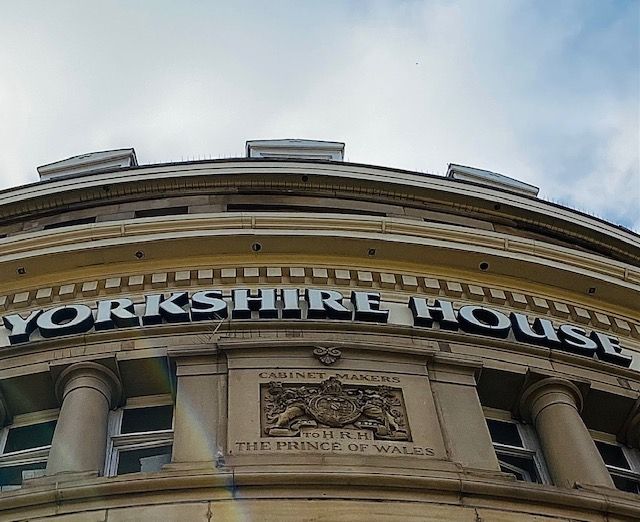
The building was completed in 1883 and survives as Yorkshire House, where Barker’s Pool (then an extension of Fargate) turns the corner into Leopold Street. The only remaining trace of Johnson and Appleyards is a stone plaque, high up, that states ‘Cabinet makers to HRH The Prince of Wales’. For some reason, the building has failed to get listing from Historic England, and we now know it as home to jewellers H.L. Brown.

The only remaining clue that the building was built for Johnson and Appleyards, cabinet makers, in 1883-84. Designed by Flockton & Gibb.

Johnson and Appleyards were the only firm to supply the complete range of domestic furnishings, selling their own furniture as well as famous names like Chippendale, Sheraton, Louis Quatorze, and Louis Quinze. In the basement, were showrooms for carpets, linoleum, bedlinen, and blankets. The ground floor held wallpapers together with general goods, along with the counting house, and stables and carriage/van sheds at the back. The first floor was dedicated to furniture with workshops behind, and on the second floor, further showrooms with draughtsmen’s offices and decorators’ shops to the rear. The third floor housed gilders’ workshops, polishers, upholsterers and bedding makers.

The purpose-built premises of Johnson & Appleyards, Sheffield, showing the additional story that was added in 1892

Johnson and Appleyards became a limited company in 1891, and the following year the building was extended, with an attic story and mansard roof built to create more retail and workshop space. At the same time, manufacturing was moved to a four-storey building on Sidney Street.

Johnson and Appleyards achieved national and international recognition with a ‘Prize medal awarded for Superiority of Design and Workmanship’ (York, 1879) and a gold medal award at the Paris Exhibition (1900).

There is a clue that business at Johnson and Appleyards had dwindled, because in 1906 the firm had moved to smaller premises next door on Leopold Street. While retaining ownership of the showcase corner property, it was leased at a handsome price to A. Wilson Peck & Co, wholesale and retail dealers of pianos, organs, and musical goods. (Wilson Peck – Beethoven House – another fascinating story for another day).

Joseph Appleyard (1848–1909), as senior partner, was the only brother to remain active in the firm, and although he remained a director, Walter had other business interests and would become Lord Mayor, while Frank had left by 1905.

Joseph’s marriage to Sarah Flint Stokes had given him eight children, none of whom had much interest in the business. Only two of his four sons, Joseph (1881-1902) and Harry (1876-1954) showed any enthusiasm. Joseph Jnr was employed by Wallis & Co, linen drapers, in Holborn, but drowned aged twenty-one in a boating accident on the Thames, while Harry, who had trained at Harrods in London and Maple & Co in Paris, joined the firm but left shortly after his father’s death. His other two sons joined the services, to avoid joining the firm and collaborating with their father.

A biography of Joseph Appleyard states that he was a strong conservative but had no desire to enter politics. He was a member of the King Street and Athenaeum Clubs, as well as being an affiliate at the Wentworth Lodge of Freemasons.

Julie Banham’s ‘Johnson & Appleyards Ltd of Sheffield: A Victorian family business’ (2001) hints that Joseph Appleyard was prone to violence and regularly beat his sons, while his wife turned to drink and became an alcoholic.

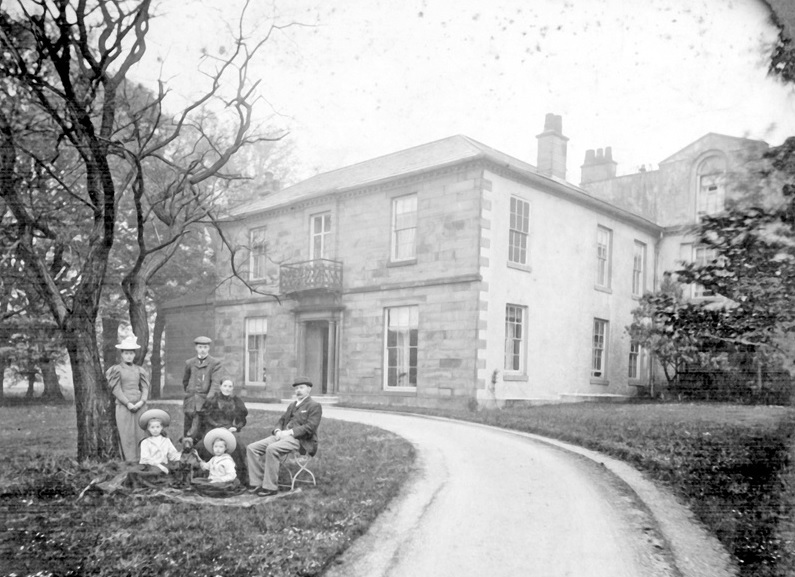
Mr and Mrs Joseph Appleyard (Managing Director of Johnson and Appleyards Ltd.) and children, in the grounds of The Beeches, Park Grange, off Park Grange Road, Norfolk Park (1899). Most historical records refer to the family living at Park Grange, a nearby house. Image: Picture Sheffield
The Drawing Room at The Beeches, home to Joseph Appleyard. Shortly before his death, the family moved to Broombank House, 7 Clarkehouse Road, Sheffield. Image: Picture Sheffield

All these years later, it is difficult to determine the type of person that Joseph might have been. At that time, newspapers filled columns with obituaries of local dignitaries, often shown in positive light, but Joseph’s death had little mention. Is this an indication that there weren’t any kind things to say about him? He was cremated in Japan and his ashes interned at Fulwood Church.

Johnson and Appleyards had built its reputation on Victorian tastes that lingered into the Edwardian period. But the new century meant styles had changed. On hindsight, the firm seemed reluctant to evolve with the times, and while sales dwindled, excessive capital was still taken out of the business to fund lavish lifestyles. After Joseph Appleyard’s death, the management team struggled to find a long-term strategy, and two world wars did nothing to improve its fortunes.

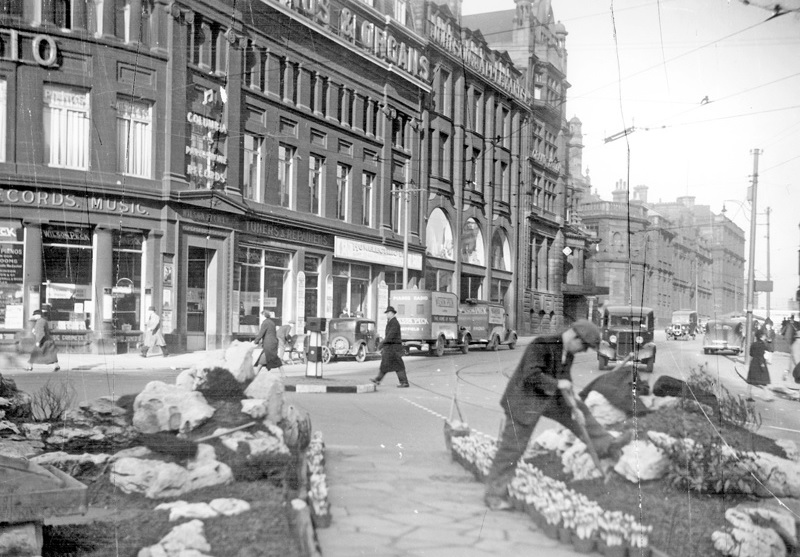
Town Hall Square Rockery and Leopold Street premises in 1938, including Grand Hotel, Johnson and Appleyards in their smaller premises, and Wilson Peck (left) that occupied the cabinet maker’s former premises. The building occupied by Johnson and Appleyards was later demolished and replaced with a new block. It stands approximately where the Bessemer bar is now. Image: Picture Sheffield

The end of Johnson and Appleyards was inadvertently caused by German bombs that rained on Sheffield during 1940. One of them destroyed John Atkinson’s store on The Moor and it was forced to seek alternative premises in the city centre. It bought all the shares in Johnson and Appleyards, if only to secure the Leopold Street building, and would remain until its replacement store was built on The Moor. The old Johnson and Appleyards shop would eventually be swept away, along with the Grand Hotel, to build Fountain Precinct in the 1970s.

Here’s the surprise. Did you know that Johnson and Appleyards still exists, if only in name? Its shares are registered to Atkinsons on The Moor.

First floor showroom at Johnson and Appleyards c.1900
Showroom of Drawing Room furniture c.1900
The Oak Showroom. Johnson and Appleyards c.1900. The company was responsible for furnishing many of Sheffield’s notable buildings, including the Town Hall and Cutlers’ Hall.

© 2024 David Poole. All Rights Reserved.