Categories
Buildings

Tiger Works

Tiger Works has become a mainstay of West Street’s nightlife, establishing itself as a modern bar within an old building. It’s been open nearly ten years now, lasting much longer than previous uses as a fitness centre, Indian restaurant, nightclub and a Tequila bar.

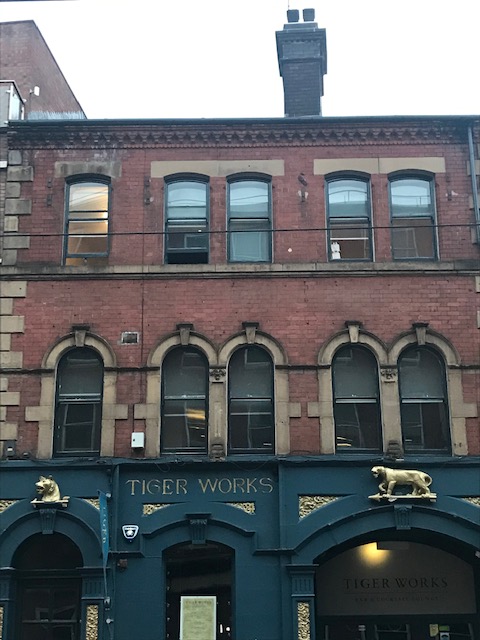
Officially known as 136-138 West Street, the three-storey building is dated at 1884, with the name “Tiger Works” incised on a narrow but ornate façade at the front. And you can’t fail to notice the two carved tigers that sit above ground floor level.

It doesn’t take you long to realise that the bar adopted the name of the former factory, but its unique moniker has long puzzled locals. The clue REALLY does rest with the carved lions.

You might be surprised to learn that this was the second Tiger Works built in Sheffield.

The first Tiger Works belonged to Joseph Tingle Deakin, a Britannica metals manufacturer, who set up a factory at Green Lane, Kelham Island, in 1860, going into partnership with Henry Ecroyd, Ernest George Reuss and John Bottomley.

Deakin, Ecroyd and Company, were manufacturers of steel files, tools, saws, springs and table cutlery, its trademark consisting of a tiger, standing upon an arrow, with the word “Tiger” underneath. It was no surprise that the factory was named after its hallmark.

The partnership was dissolved in 1874, Deakin and Reuss continuing the business as Deakin Reuss and Company, establishing links with the Spanish and South American cutlery trade and exporting general hardware.

In 1884, the firm relocated to these new premises at West Street, although there is evidence that it had been operating on the site two years before. And it was here that the distinctive carved tigers appeared and have remained ever since.

Joseph Deakin died in 1896, by which time the company had changed its name to Deakin and Sons.

Despite the relatively small frontage, Tiger Works was deceivingly large, with an entrance to the factory through a cart entrance (now forming the main entrance to today’s bar), into a small courtyard surrounded by workshops.

The company moved out after Deakin’s death, with John Townroe and Sons, electro-platers, taking over No. 138 West Street in 1898, sharing with John Scholey, mark manufacturers, who occupied No. 136.

Scholey’s lease was subsequently taken over by J.G. Graves, the famous Sheffield mail order company, which used Tiger Works to sell jewellery, cameras, electro-plate musical instruments, clocks, phonographs and records.

Between 1910 and 1914 , Willie and Emile Viener, electro plate manufacturers, had taken over No. 136, and after they vacated, this section of the building was regularly offered to rent.

John Townroe and Sons, famous for its chromium stainless plating, remained until the 1940s, when it was taken over by the Aurora Gear and Engineering Company.

With various uses for the building ever since, it is somewhat remarkable that the “Tiger Works” name survives, in a very different manner, to that first created 160 years ago.
Categories
Places

Into the Megatron (1)

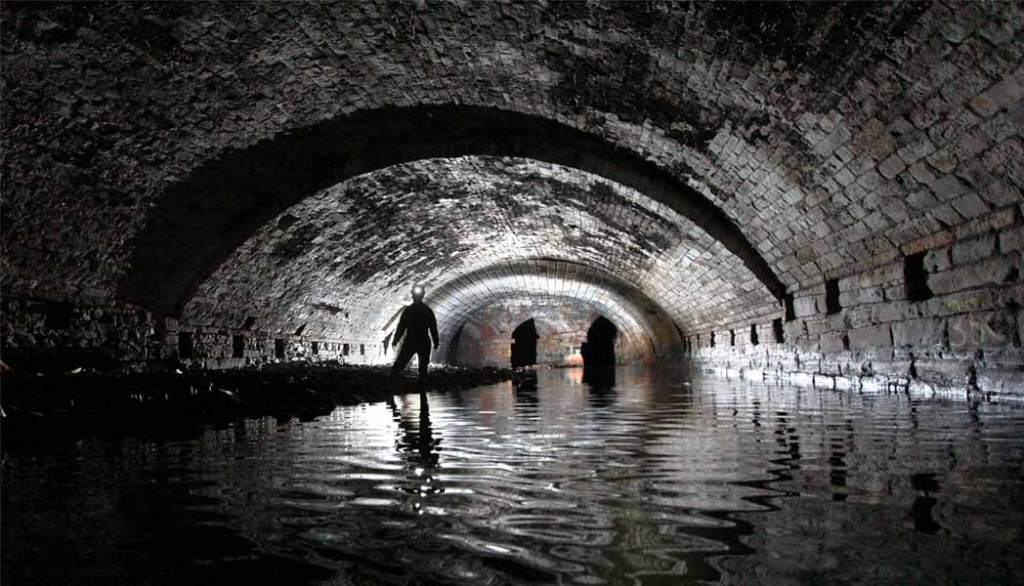
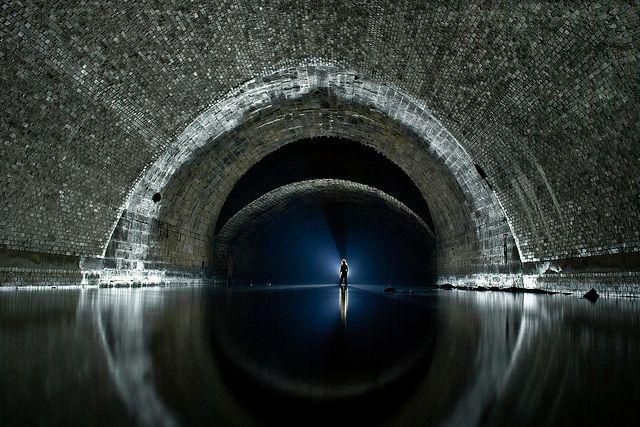
Most of us known about Megatron, a Victorian-engineered labyrinth of storm drains with cathedral-like brick archways and interconnected dark tunnels to contain the overflow of water. (Although officially, the Megatron is one huge chamber further up the network).

Seemingly forgotten for years, this complex system of underground waterways, gained worldwide attention when it was “rediscovered,” becoming a favourite for urban explorers, and even attracting guided tours.

The misconception is that these subterranean drainage channels were built in the mid-1800s, an effort to channel the huge flow of water from Sheffield’s three main rivers – the Don, Sheaf and Porter, but the real story is very different.

Let’s start with the Porter Brook, with its source on Burbage Moor, descending into Sheffield before disappearing into culverts in the city centre. During the late 19th century, sections of the Porter were covered over, partly because the water supply was so poor and had become a sewer, but also to allow for the construction of factories above.

The Porter Brook joins the River Sheaf, the river that gave Sheffield its name, in the Sheaf Valley at a location that becomes evident later.

The Sheaf Valley had historically been prone to severe flooding, the areas around Pond Street and Ponds Forge, particularly susceptible when the River Sheaf burst its banks, and rendering much of the land unusable.

The River Sheaf flows through Sheffield, joining the mighty River Don at Blonk Street Bridge, near to where old Castle Markets stood, and the site of long-lost Sheffield Castle.

Our story really begins with the arrival of the Midland Railway Company, connecting Sheffield with London, which had blundered on its original route, inconveniencing passengers to change at Rotherham Masborough Station and take a branch line to The Wicker.

By the late 1850s, the company made proposals to rectify the matter, bringing the direct line into Sheffield. The site chosen for the new railway station caused disbelief as it was in the valley through which the River Sheaf flowed.

In the 1860s, after gaining Parliamentary consent, land was cleared on a site that was bounded east by Granville Street, on the west by Pond Lane, at north by Harmer Lane, and south by Turner Street.

The platforms were to be built where the River Sheaf flowed, and so the whole distance of the river between Harmer Lane and Turner Street was spanned by three arches and then covered over. The Porter Brook was spanned with two arches, also enclosed, and a portion of the nearby Bamforth Dam (now Sheaf Square) was filled in.

“For months and months past, seeming chaos has reigned in Granville Street and the region adjoining. Thick-booted, muddy-smocked navvies have laboured along in dust and mud, fine weather and wet, pulling down houses and the foundations on which they stood, tearing up banks, blasting rocks, making huge caverns which they said were to serve for tunnels, heaping up and then carting away great mounds of earth. The lines of the rails will run over the bed of the River Sheaf, which is degraded to the condition of a sewer. The work is being undertaken by Messrs. Chadwick and Thurwall for £20,000.”

The Midland Station, now Sheffield Station, opened in 1870, its passengers forgetting that the River Sheaf flowed under their feet (now Platforms 5-8), before emerging again after Harmer Lane.

It was a huge success and by the late 1890s the Midland Railway Company was planning the expansion of the station, and the widening of the tracks.

In 1899, the land in front of the station was cleared and between 1900-1903 its facade was built further forward and surrounding land used for railway business.

The River Sheaf, between Suffolk Road and the Midland Station was arched over and covered, as was a section running underneath Sheaf Street towards Commercial Street. A little-known stream, Pond Brook, between Station Road and Harmer Lane was also diverted through another large culvert.

More importantly, the confluence of the Porter Brook and Sheaf was also covered and is now underneath the south end of Platform 5, close to where Platform 2A is. Thank you to Phil Jones, who volunteers for the Sheaf and Porter Rivers Trust, for explaining that today there is a large square wooden access cover, exactly over the confluence.

As to who funded what, is a matter of debate, but it is likely that the “sewer” system, as the River Sheaf was ingloriously relegated to, was funded and built by Sheffield Corporation.

And so, the first parts of the underground maze were completed, and hereon becomes something of mystery.

Categories
Places

Into the Megatron (2)

We’ve already looked at the building of Sheffield’s underground tunnel system around Sheffield Station and the ingenious method of “hiding” the Porter Brook and River Sheaf. (Available to read on a separate post).

In this post, we move on from Sheffield Station (formerly Midland Station), which had doubled in size in the first few years of the twentieth century, and resulted in long stretches of the River Sheaf bidding farewell to the light of day.

After the Midland Station, the River Sheaf emerged briefly at a weir, as it does now, close to what is now the Digital Campus.

It then flowed through further culverts under the Electric Light Works (now the front of Ponds Forge International Sports Centre). The river then streamed under Commercial Street and beneath what was once the site of Sheaf Market (now the Travelodge).

Onwards it flowed under Castlefolds Markets, until being freed at Exchange Street and flowing open-air until meeting the River Don at its confluence near Blonk Street. (Remember that the River Sheaf once ran alongside Sheffield Castle).

As elaborate as the underground tunnels were underneath Sheaf Valley , the most spectacular part of the network lay underneath Exchange Street, now known as the “Megatron Chamber” – “something excellent and impressive” – a massive arched brick-lined cathedral that dwarfed any man who stood inside.

The reason for the Megatron has been provided by Heather Smith and Phil Jones from the Sheaf and Porter Rivers Trust. It seems that the giant Megatron arch was built for a very specific purpose, to carry heavy old trams across the river on Exchange Street, which rises slowly up the hill, and get them into the city.”

From the Megatron, the River Sheaf flowed out into the open-air, past the old Alexandria Theatre. This last section was culverted over in 1916 after the demolition of the theatre, another massive scheme that allowed the eventual construction of Castle Market above, the rebuilding of Blonk Street and a tunnel entrance that allowed the Sheaf to flow straight into the Don.

The underground system of tunnels is Victorian engineering at its best.

The arched roofs were built with three layers of brick, strong enough to resist the huge torrents of water that the Porter Brook and River Sheaf threw at them during times of high flood.

Alas, as good as the system is, it has failed on occasions, with stories of the old Sheaf Markets flooding at high water, and then there was the memorable Sheffield flood of 2007 when Sheffield Station found its tracks underwater for several days.

A poignant reminder from the River Sheaf that it is still around.

Mostly, the tunnels are accessible to walk through, but should never be entered without permission and expert supervision.

Underneath Sheffield Station the sound of trains can be heard rumbling overhead, and in the lower reaches, bats skim the surface of the Sheaf with fish evident.

As part of the Returning Rivers to the City Scheme, Sheffield City Council is considering reopening the last few yards of the River Sheaf from the Megatron to the River Don, in a park to be called Sheaf Field.

Categories
Places

Sheaf Field Park

We’ve already had a look at the series of culverts and tunnels that hide the River Sheaf underneath Sheffield city centre.

The last part of the river to be covered was the stretch from the Megatron, underneath Exchange Street, towards the confluence of the River Don at Blonk Street Bridge.

This was covered in 1916 after the demolition of the Alexandria Theatre, another massive scheme that allowed the eventual construction of Castle Market above, the rebuilding of Blonk Street and a tunnel entrance that allowed the Sheaf to flow straight into the Don.

Following the demolition of Castle Market in 2015, Sheffield City Council announced that a park would be created between Castlegate and Exchange Street.

Alas, four years down the line, the plans are still on the table, but the council is committed to delivering the project.

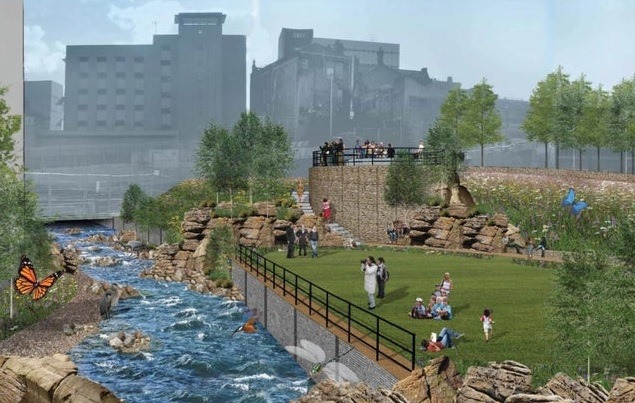
Sheffield Council wants to take the roof off the underground culvert, which the river currently runs through and is in a poor state of repair, and bring the waterway back into the open, surrounded by grass, flowers, trees, seating and other landscaping. The aim is to make the area more attractive to visitors, bring in new investment and reduce the risk of flooding.

The scheme would also complement the proposed Castlegate development on the site of the former market, which the council and its partners are still pursuing, and which will feature the exposed ruins of Sheffield Castle.

The park has the working title of Sheaf Field.

A waterside meadow and an elevated viewpoint would be created at the waterside and low stone walls built overlooking the river. The weir within the Sheaf culvert will be lowered, and the river channel remodelled, to improve natural habitats.

The plans also involve using way markers or pavement art to follow the River Sheaf’s course where it remains in a tunnel under Castle Square, Sheaf Street, the railway station and through Granville Square. Also, temporary art installations and ‘interactive sound experiences’ could be set up in the Megatron.

In 2019, the Sheaf and Porter Rivers Trust was set up to promote and support the deculverting and improve the environment of the River Sheaf and Porter Brook. The group’s founders aim to open the waterways and are trying to recruit as many members as possible to help make that happen. One of their hopes is to make sure that Sheaf Field comes to fruition.

Categories
Buildings

Arts Tower

For fifty-five years, the University of Sheffield’s Arts Tower has dominated the Sheffield skyline.

This was once the city’s tallest building at 78metres, built in a commanding position on high ground, eventually eclipsed by St. Paul’s Tower in 2011.

A Building for Arts was first discussed in 1953, with designs submitted by architects Gollins, Melvin, Ward and Partners, and it went through several radical changes before the University’s planning group chose a “cube of steel, glass and concrete.”

Thirteen storeys were originally planned, with six more added, including two floors in which additional funding had to be found because the University Grants Committee refused to underwrite it.

“Every time the planning group for the building met, the height went up by two storeys.”

It finally reached nineteen storeys (although a further two can be found underground) and became the tallest university building in the country.

Construction started in 1961, the foundations built on solid rock thirty feet beneath the surface and was topped-out in October 1964.

The University moved in during the summer of 1965, with accommodation for 18 departments and 160 staff. The Architecture Department occupied the top floors (as it still does), because “it gave them a very good view over Sheffield to see all the town planning that was going on.”

The Arts Tower was officially opened by the Queen Mother in June 1966, where she was made an honorary Doctor of Music, and memorably described the structure as “the tower of light and learning.”

The tower was built with a concrete frame, exposed at ground level by sixteen columns, and sheathed with glass-curtain walling, long being subject of speculation that it was based on the Seagram Building in New York City, as well as the CIS Tower and New Century House in Manchester, although no documentary evidence supports any of these theories.

It was connected at first-floor level with the Library (built 1955-1959) and originally had a wide bridge between fountains over a shallow pool in front of the building, but this was drained and covered over due to strong down-drafts, resulting in people getting soaked when entering and leaving the building.

In 2009, the Arts Tower underwent major renovation, the interiors being reorganised, and a new façade added.

Being as tall as it is, stories have persisted about the tower’s sway in strong winds – this turns out to be true, reported as being “slight but measurable” on windy days.

And, of course, we cannot fail to mention the famous Paternoster lift, subject to a separate post.

“Like the big wheel in a fairground,” this was a revolutionary solution to save space (there was only room for four lift shafts), designed to speed up movement of students and staff between floors.

Thirty-eight cars continuously circulate allowing people to step on and off at each level and is now said to be the largest surviving Paternoster lift still in use in the UK.

Categories
Buildings

Arts Tower

In another post, we’ve looked at the University of Sheffield’s Arts Tower, arguably one of the city’s iconic buildings. It was built during the 1960s, designed by Gollins, Melvin, Ward and Partners – a cube of steel, glass and concrete – and at 78metres high is the tallest university building in Britain.

The design only allowed for four lift shafts, including two high-speed lifts primarily to the top floors, and two paternoster lifts, a revolutionary system as few had been built and none the size of Sheffield.

The paternoster was introduced to speed up movement of students and staff between floors. It has no doors and moves continuously without stopping at floor level, and is only one of two left in the country, certainly the tallest operational lift of its kind in Europe.

It was originally installed by the Schindler Lift Company, and comprises 38 two-person cars, travelling the full 22-storeys of the building. A journey between floors takes 13 seconds and allows 76 people to move at any one time.

The paternoster system was designed in the 1860s by Peter Ellis, a Liverpool architect, and gets its name from its resemblance to rosary prayer beads and is Latin for “Our Father,” which opens The Lord’s Prayer.

The paternoster lift was popular in Europe during the early and mid-twentieth century, but production was halted in the 1970s after a series of accidents.

The Arts Tower paternosters were completely rewired in 2009, with new controls and additional lighting. The gearbox and sprockets were recut, wooden guides replaced where necessary, and new safety features were introduced.

And so, to the mischief caused by students on the paternosters.

In the early days, and no doubt still applicable, second- and third-year students liked to scare freshers by emerging from the top of the shaft doing a handstand to prove that the cars turned right over (which they didn’t).

The trip wire on each compartment can easily be triggered by mischief-makers, resulting in the paternosters stopping completely.

There is a story from the 1960s, whereby George Porter, Professor of Physical Chemistry, and his wife, were attending a tea party hosted by the Vice-Chancellor on the thirteenth floor.

“We travelled smoothly in the new wondrous Paternoster lift until, as our heads appeared above the thirteenth floor, we were able to see our host receiving the guests. As he turned to greet us the lift stopped, leaving us about neck level to the floor. The Vice-Chancellor immediately joined us, though necessarily at a higher level, and during the twenty minutes which passed before the lift could be started again, graciously served us tea on the floor.”

Categories
Buildings

Wharncliffe House

According to Historic England, which gave Wharncliffe House a Grade II listing in 1995, this is a town house built for the Earl of Wharncliffe about 1885.

However, in this post we’re going to challenge these facts, although the Bank Street building does have a definite link to the Wharncliffe family.

Bank Street wasn’t created until 1792, and was intended to be called Shore Street, named after John Shore, a banker, and this was the name used on leases granted when he cut up his land for building purposes.

In 1793, we find reference to a “new” street in Sheffield called Bank Street, indicating that Shore had just built the town’s first bank here.

Wharncliffe House, or more correctly Wharncliffe Chambers, was described as a new building on Bank Street in 1874, probably built for John Henry Wood (1830-1914), a mining engineer and landowner, who had offices here, the building later forming part of his estate.

The original structure was of traditional brickwork, three-storeys and described as Italianate. (It had the misfortune of having an insensitive fourth storey added in 1980).

The central doorcase was decorated with masks, brackets and garlands, while bearded heads formed two keystones of two windows either side and on the left return, all below a deep bracketed cornice. Wrought iron railings were added to the little balconies over the doorway.

John Henry Wood was born at Burton-on-Trent and came to Sheffield in his youth. With the object of learning mining engineering, he became a pupil of John Jeffcock, and later went into business with Vincent Charles Stuart Wortley Corbett, a relative of the Earl of Wharncliffe.

For forty-six years, Wood was mineral agent and waterworks engineer to the Wortley family, retiring in 1907, and having the honour of serving under three heads at Wortley Hall, including the 1st and 2nd Earls of Wharncliffe, and was responsible for building the reservoir at Wortley.

He died in 1914, the 2nd Earl of Wharncliffe offering condolences to his son, Reginald Barritt Wood.

“Your father did the most valuable work for my family estate, and besides the regret I feel for his death, I have a very strong sense of gratitude for all he did.”

After John Henry Wood’s death, Wharncliffe Chambers, “the finest suite of offices in the city,” was put up for sale, advertisements describing a basement, lavatories, W.C.’s and cellars, as well as a suite of offices that were let, “in the best professional part of Sheffield, and always occupied by high-class tenants.”

Wharncliffe Chambers sold for £6,200, falling into different owners, but always retaining its use as offices for architects, solicitors and professionals.

In 1921, it was renamed Wharncliffe House, creating confusion amongst historians, and unsurprisingly linking it to the Earl of Wharncliffe’s London house of the same name on Curzon Street, Mayfair, sold to Lord Crewe in 1899 and renamed Crewe House.

This century, Wharncliffe House was acquired by the Mandale group, which restored the building, painting it all-white, and turning the offices into apartments in 2017.

The ground floor became Foundry Coffee Roasters, a coffee house, later taken over by Cassinelli’s, an Italian-inspired eatery.

And so, did the Earl of Wharncliffe build Wharncliffe House, and did he use it as a townhouse?

Probably not.

Based on this evidence, it was likely called Wharncliffe Chambers as a compliment to the Wharncliffe estate, to which John Henry Wood had very close connections.

Categories
Companies

Top Shop

It appears that Topshop in Sheffield has come the full circle.

The news that Topshop and Topman is closing on Fargate could end a long-time association with Sheffield city centre. According to a recently submitted planning application, Nos. 33-35 Fargate, look to be falling into Superdrug hands.

The irony is that Topshop was founded in Sheffield in 1964, a brand extension of the Peter Robinson department store, then situated at the corner of Castle Square (now occupied by easyHotel).

Peter Robinson was a women’s fashion chain, founded in 1873, that had become part of Burton’s in 1946.

It opened as Peter Robinson’s Top Shop, a youth brand, selling fashion by young British designers such as Polly Peck, Mary Quant, Gerald McCann, Mark Russell and Stirling Cooper.

The Top Shop name was later used for a large standalone store on Oxford Street, London, and expanded into further Peter Robinson branches at Ealing, Norwich and Bristol.

It wasn’t until 1973 that Top Shop was split from Peter Robinson, focusing on the 13-24 age groups, leaving the department store to concentrate on the over 25s.

The Top Shop (later Topshop) brand flourished, subsequently becoming part of Phillip Green’s Arcadia Group, with 500 shops worldwide, of which 300 were in the UK.

Alas, by the end of the 1970s, the Peter Robinson name had all but disappeared.

In Sheffield, C&A had absorbed the former Peter Robinson shop, and when it pulled out of the UK, the unit transferred to Primark.

However, as we well know, times have been difficult for Phillip Green. Last year, the Arcadia Group went through a Company Voluntary Arrangement (CVA) with a significant number of stores closing.

Categories
Places

Concord Park

A set of wrought-iron gates which are associated with some of the greatest figures in English history can be found in Sheffield.

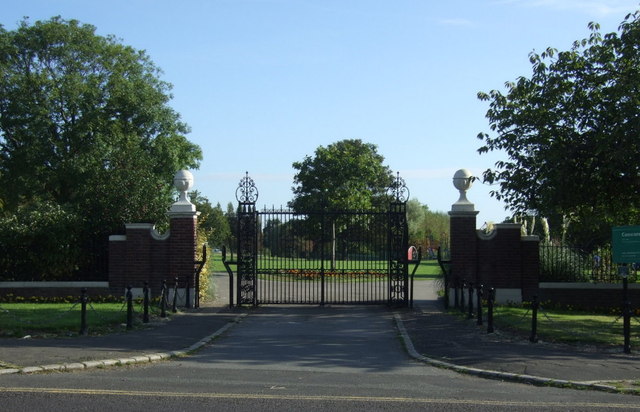
The gates are at the main entrance of Concord Park, on Shiregreen Lane, and were gifted to the city in 1932 through the generosity of Charles Boot, of Henry Boot and Sons, building contractors.

The elaborate gates had been at Hayes Park Place, Kent, a former residence of Sir Everard Hambro, the house built by William Pitt, the 1st Earl of Chatham, who was one of the greatest English statesmen and Parliamentary orators.

Henry Boot and Sons had bought the estate to demolish the stately home and build a new housing estate in its place.

Charles Boot confirmed his gift in a letter addressed to the Town Clerk.

“Mr W.G. Davies, City Architect, has inspected the gates, and I understand that he considers them to be quite suitable for the purpose. Will you, therefore, kindly convey my formal offer of this gift to the appropriate Committee, and, if acceptable, I will have them delivered immediately the site is ready for them.

“In pulling down this old place we are compelled to disperse any interesting relics, and I am pleased that Sheffield will have this memento.”

William Pitt was the grandson of Thomas Pitt, the Governor of Madras, known as “Diamond Pitt” due to having sold a diamond of extraordinary size to the Regent Orleans for £135,000. Through this fortunate transaction he raised his family to a position of wealth and political influence.

Many great personages had passed through the gates at Hayes Park Place – Lord Nelson, who planted a tree in the park, the Duke of Cumberland, uncle of George III, who went there in 1765, to persuade Chatham to resume office in Government, as well as numerous politicians.

The 1st Earl Chatham died at Hayes Park Place in May 1778.

William Pitt, his second son, was born here in 1759, going on to be Prime Minister in 1765-1766, leading the country through one of its most eventful periods, and dying shortly after the Battle of Trafalgar.

Forty-eight hours after that glorious victory had been announced, Pitt passed through these gates to deliver a message, which was to be his last:

“Let us hope that England, having saved herself by her energy, may save Europe by example.”

Categories
People

Julia Bradbury

Returning to our profiles of people with Sheffield connections. Julia Bradbury (born 1970), television presenter, specialising in documentaries and consumer affairs.

Best known for co-presenting BBC1’s Countryfile with Matt Baker from 2009 until 2014. She also presented Watchdog, Planet Earth Live, Take on the Twisters, The Wonder of Britain and Britain’s Best Walks.

These days, she’s making a living out of walking documentaries (just about everywhere) and has unfortunately been nicknamed the “Walking Man’s Totty.”

Born in Dublin, but growing up in Sheffield, she attended acting classes, and took part as a child in the Crucible Theatre’s production of Peter Pan, starring Joanne Whalley and Paula Wilcox.

“My family moved to Sheffield and I went to King Edward VII School, which had just turned into a mixed comprehensive. My father worked in the steel industry, hence Sheffield, and my mother, who was in the fashion business, opened her first shop.”