Late Night Tales. In the 1600s, Barker’s Pool was sometimes used for ducking harsh-tempered or overbearing women. For this, the ‘cuck stool’ was brought up from Lady’s bridge. The chair was attached to a long wooden beam and was lowered into the water. Repeated ducking routinely proved fatal, the victim dying of shock or drowning. The reservoir went out of use and filled up with rubbish, and in 1793 it was done away with.
In August 1835, at about two o’clock in the morning, some dastardly villains broke the rappers and bell pulls of several houses in Union Street. The watchman in that neighbourhood sprung his rattle and followed the ruffians down Norfolk Street, but with no other night guardians answering the call, they managed to escape.
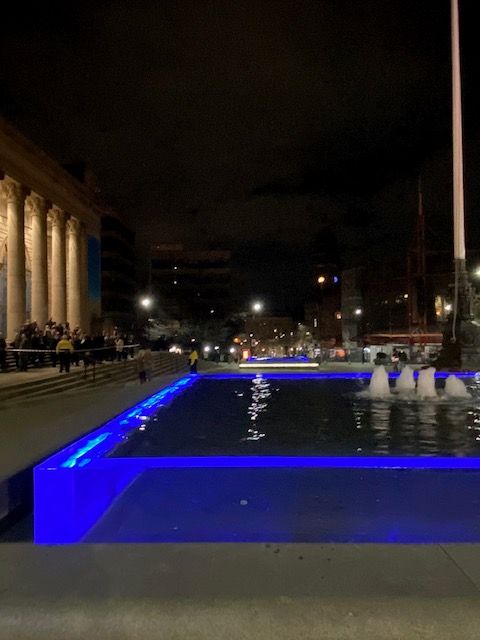
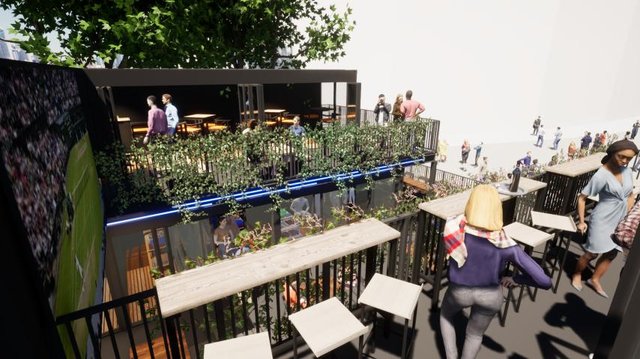
It’s a long time since the Goodwin Fountain was a permanent fixture at the top of Fargate. It disappeared in 1998 and since then the site has hosted everything from big wheels to pop-up bars. Now its’s going to be a hub of cafes, shops, and toilets.
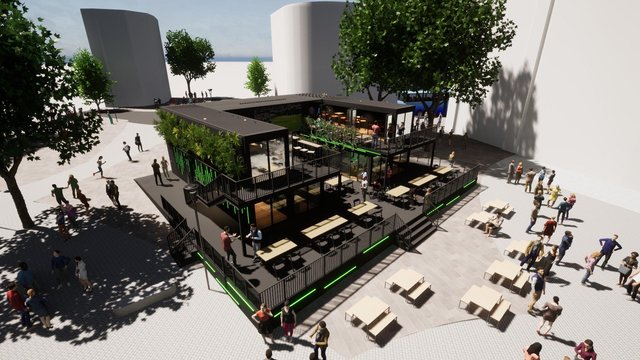
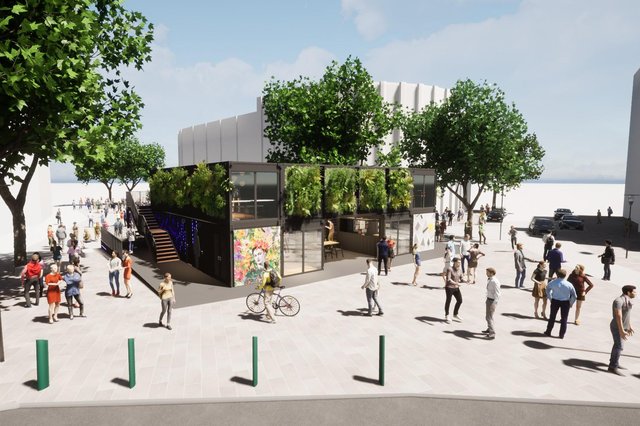
Planning permission has been granted for the 462 square metre installation made up of repurposed shipping containers, to be painted in a dark colour. Construction is underway in Leeds before it arrives in Sheffield and should be open in the next few months.
As well as independent shops, cafes, and free-to-use public toilets, the site will have a big screen, living walls and outdoor seating, and will be open daily between 8am and 11pm.
Sheffield City Council has secured £300K funding for the temporary container installation from the ‘Get Britain Building Fund’ through the South Yorkshire Mayoral Combined Authority. It has been designed by SteelYard, a locally owned company which operates a container complex over 2 floors and open event space at Kelham Island.
The appearance of the container installation will be softened using a combination of planting and artwork. This will allow it to fit within the existing context of nearby buildings.
Pinstone Street redevelopment (2022). Image: DJP/2022
In 1892, the opening of a new shop on Pinstone Street offered splendid facilities for pickpockets. A crowd stretched across the road, and while those were looking through the windows, the light-fingered gentry deftly relieved them of their purses and wallets which contained the bulk of their week’s wages.
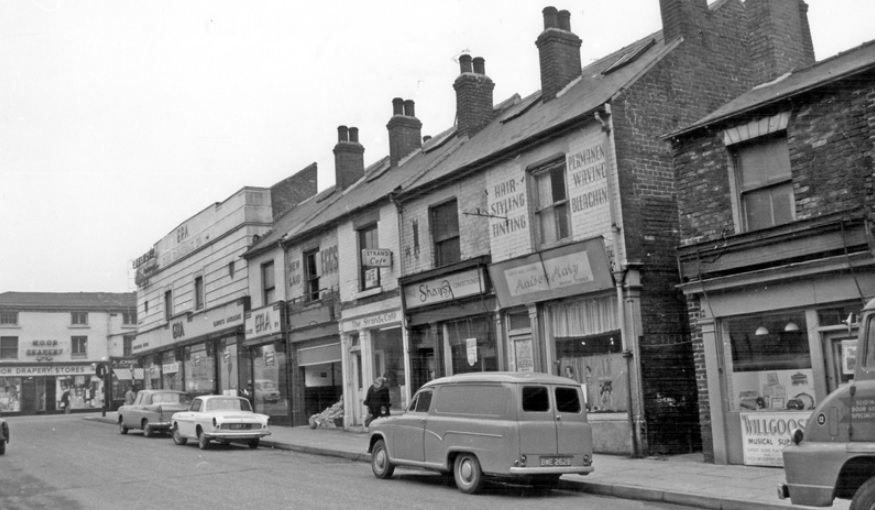
Hereford Street, Sheffield. The road was one much wider, lined with shops, houses, and factories. Photograph: DJP/2021
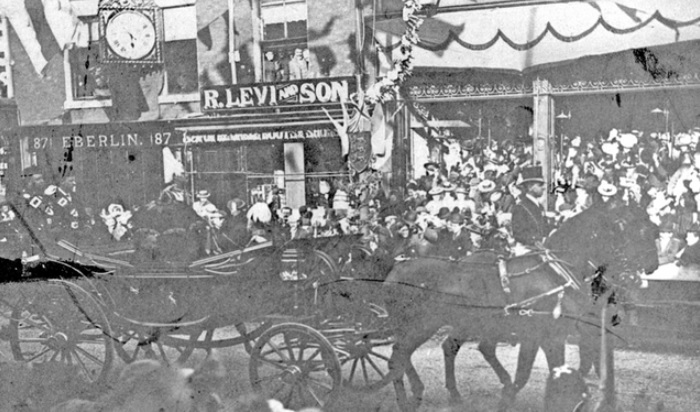
Hereford Street’s greatest moment was when Queen Victoria officially opened Sheffield Town Hall in May 1897 and travelled down here on her way to Norfolk Park. It might be hard to believe now, but let your imagination do the rest.
“To stand on The Moor, at the top of Hereford Street, and look down the latter thoroughfare affords the spectator a great amount of pleasure. A scene is presented of bright flags of dainty and artistic colours, fancy streamers of every description, while other kinds of bunting and bannerettes float out gaily in every direction.
“Venetian masts are erected on either side of the street, 15 yards apart, and are surmounted by large gilt spearheads, while banners, shields, and trophies of flags are fixed to each mast. Every alternate mast has a pedestal covered with crimson cloth and gilt ornamentation, and at the summit of each pedestal is a group of real plants.
“Across the street at intervals are fixed canopies of handsome floral work, and streamer flags of harmonious colours and flower baskets are suspended from the centre of each floral canopy, with lines of streamer flags along the street at either side connecting the masts with the whole design.
“The buildings, too, in Hereford Street have been dealt with in the most artistic manner. Flags float out bravely from the tops of the principal works and houses, and on the fronts are displayed handsome shields, backed up with designs of small flags and other similar trophies.
“As the time arrived for the stopping of traffic, the corner where Hereford Street joins the Moor became so blocked with cars, cabs, and buses that the Derbyshire police, who extended from the top of Hereford Street along part of St Mary’s Road were hard put to it to prevent serious accidents.
“People would still insist on leaving the shelter of the barriers and coming across the road, and then, as likely as not, they were stranded amongst the horses and vehicles, who, being unused to the terrible commotion, were almost frantic and the drivers, but for the efforts of the police, could not possibly have helped running down some of these belated wayfarers.
“However, this was soon cleared, the arrival of the 1st Battalion of the Hallamshire Rifles having a great deal to do with the transformation.
“The men were placed eight paces apart and covered the entire length of Hereford Street and part of St Mary’s Road.
The visit of Queen Victoria. Pictured here on The Moor. Photograph: Picture Sheffield
“The crowd was very orderly, only a few attempting to elude the vigilant eye of the constables, and those that attempted this being in most cases drunk.
“As the time wore on, however, getting tired, perhaps, and some of them thirsty, occasional rows occurred. People attempted to change their positions and their neighbours’ mild remonstrations gradually developed into what may be styled ‘words,’ and again, in some cases, where the sum was particularly irritating, into blows.
“The few fights, however, that did take place soon raised cries of ‘Police!’ and the guardians of the peace immediately quelled the disorder and left the combatants to sing and shout once more with the rest.
“Several cases of fainting occurred, and it was rather unfortunate that at this point of the route there was no ambulance corps, but the gallantry to the ladies of the rough and ready grinders was quite touching, and these were immediately made room for even in the thickest crushes.
“Of course, skits and jokes passed amongst the members of the crowd, but, as a rule, the language was ‘fit for the Queen.’
“Stands, windows, and roofs were all crowded, and the number of people in the street was, as far as can be judged, above the average.
“The procession passed, the military lined up, and the crowd in one huge migration, made tracks, some for the park, and others in order to get another view, if possible, along South Street, Park.”
Looking towards The Moor from Hereford Street. Today, this part of the road is pedestrianised and is occupied by Dempseys, bar and Club and QJ (the former Yorkshire Bank). Photograph: Picture Sheffield
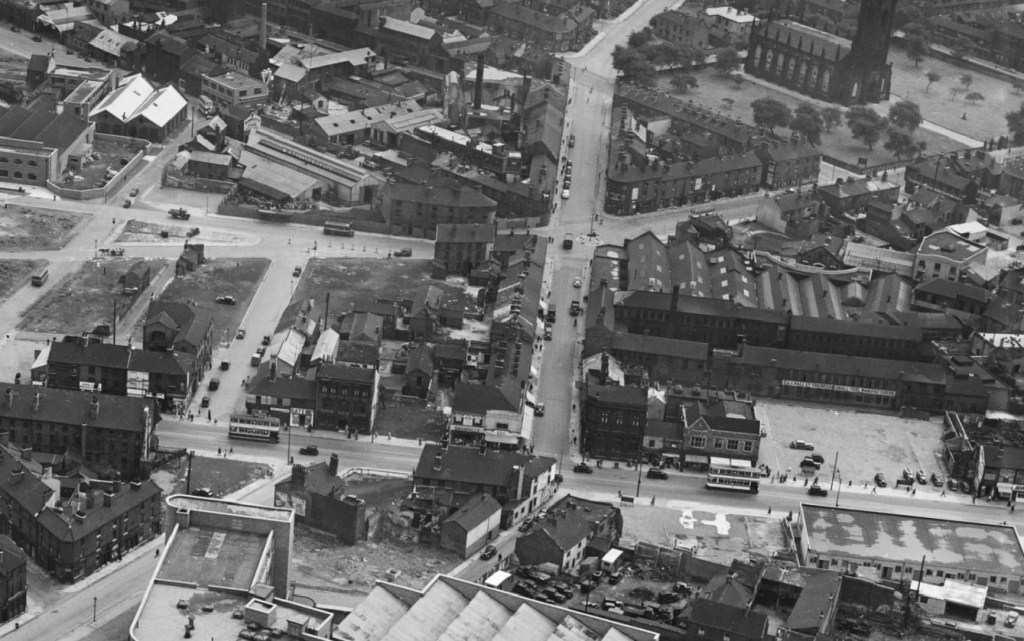
Aerial photograph of Hereford Street (top to bottom) in 1951
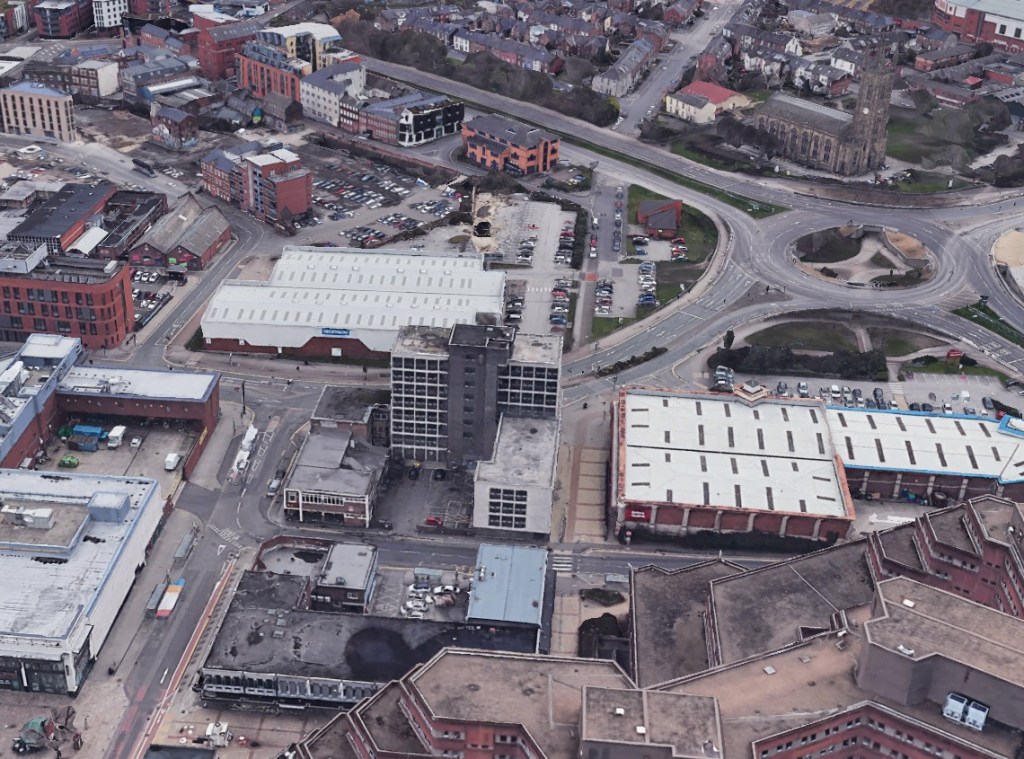
Aerial photograph of Hereford Street (top to bottom) in 2021
Two photographs that show how a Sheffield street lost its identity.
Hereford Street is shown as a wide thoroughfare in 1951, a continuation of Charlotte Road, and intersected by narrow St Mary’s Road, and Porter Street (that became the lower end of Eyre Street). It joined The Moor that continued south towards London Road. Note that Bramall Lane roundabout did not exist.
Seventy years later, the outline of Hereford Street can still be seen but is split by two dual carriageways – St Mary’s Road and Eyre Street. Gone are the factories, houses, and small shops, and the Moor-end is pedestrianised, and this section of The Moor lost beneath the Moorfoot Building.
Sadly, this area has become an unloved part of the city centre with Hereford Street falling on hard times.
Most astonishing is that few buildings appear in both photographs. Most were swept away for road development, factories were surplus to requirement, and old houses and shops deemed unfit for purpose.
St Mary’s Church, on Bramall Lane, does appear in both photographs. In 1951, it was covered in soot and suffered from air pollution, but look how large the churchyard was, and how much was taken away to make St Mary’s Road a dual-carriageway.
Buildings to point out in the modern-day image are the South Yorkshire Fire and Rescue Headquarters and Moor Markets (left), Decathlon and Deacon House (centre) and, of course, the Moorfoot Building (bottom).
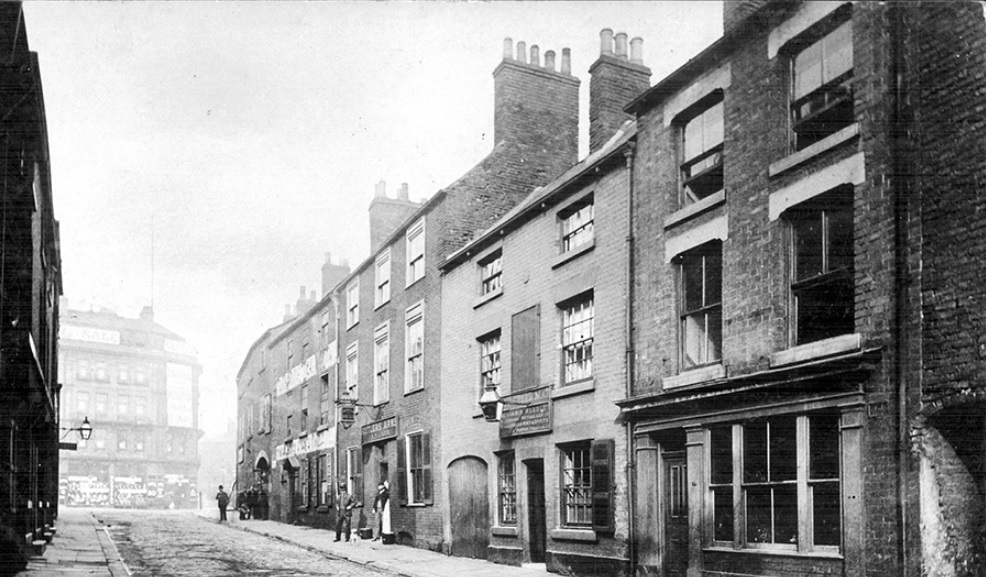
New Church Street, looking towards Pinstone Street, now the site of Sheffield Town Hall, No 7, Cutlers’ Arms P.H., No 9, Old Green Man, No 11, Henry Bocking, Beer Retailer. Late 1800s. Photograph: Picture Sheffield
Do council officials, working late at Sheffield Town Hall, ever hear strange noises in the stilly night?
Do they listen with bated breath to the sound of prancing horses and the ghostly cries of coachmen?
Or, when all is quiet, does a rich melodious voice, declaiming in grand style, passages from Shakespeare, ever strike their astonished ears?
Or, do council officials ever work late? Or do they work from home now?
If there is any such things as ghosts, Sheffield Town Hall must be peopled with a vast multitude of them.
New Church Street (not to be confused with Church Street, near the cathedral) was demolished about 1890 to provide room for the Town Hall. It lay almost through the middle of the site of the Town Hall, from what is now the (padlocked) main front entrance, to a point in the west wall opposite the Mercure Hotel.
The Cutlers’ Arms can be seen almost in the centre of the picture, with three people near the doorway, and was the terminus for all the Derbyshire coaches.
“It was a great sight to see them coming in from Tideswell, Castleton, Baslow, Bakewell, and other places. Each coach had its name; the only ones I can remember are the ‘Lady Peel’ and the ‘Surprise,’ both of Castleton,” said Ambrose J. Wallis, who owned the photograph in 1931.
“Next to the Cutlers’ Arms were the Old Green Man and the Grapes – three public houses in a row.
“Almost opposite the Cutlers’ Arms was the house of a man who used to engrave memorial plates, one of which was in York Minster.
“His wife kept a theatrical boarding house, where a number of famous actors stayed. The most famous of all was the great Shakespearean actor, Henry Irving.”
At another house, higher up New Church Street, Mr Wallis said, there lived a man called Dunkerley, who was one of the survivors of the Charge of the Light Brigade.
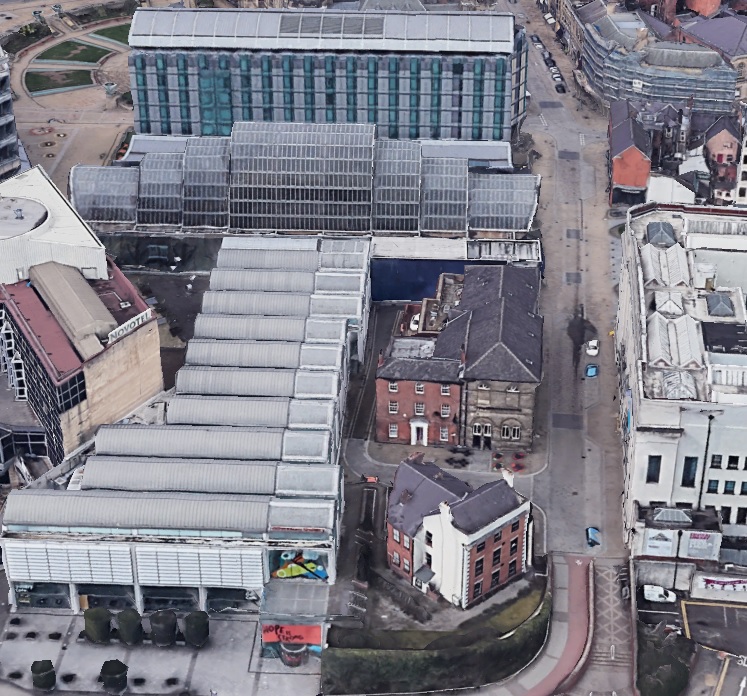
Cadman Lane ran from Eyre Street (this part of Eyre Street is now Arundel Gate) up to Norfolk Street, opposite where the Town Hall is. Only a small portion of the street remains in the centre of the picture. Photograph: Google Earth
Yesterday, we featured a sketch of Cadman Lane, drawn by Sheffield artist Kenneth Steel (1906-1970). The drawing brought several queries as to the whereabouts of this characteristic old street. Presumably lost? Well, you might be surprised to know that Cadman Lane still exists.
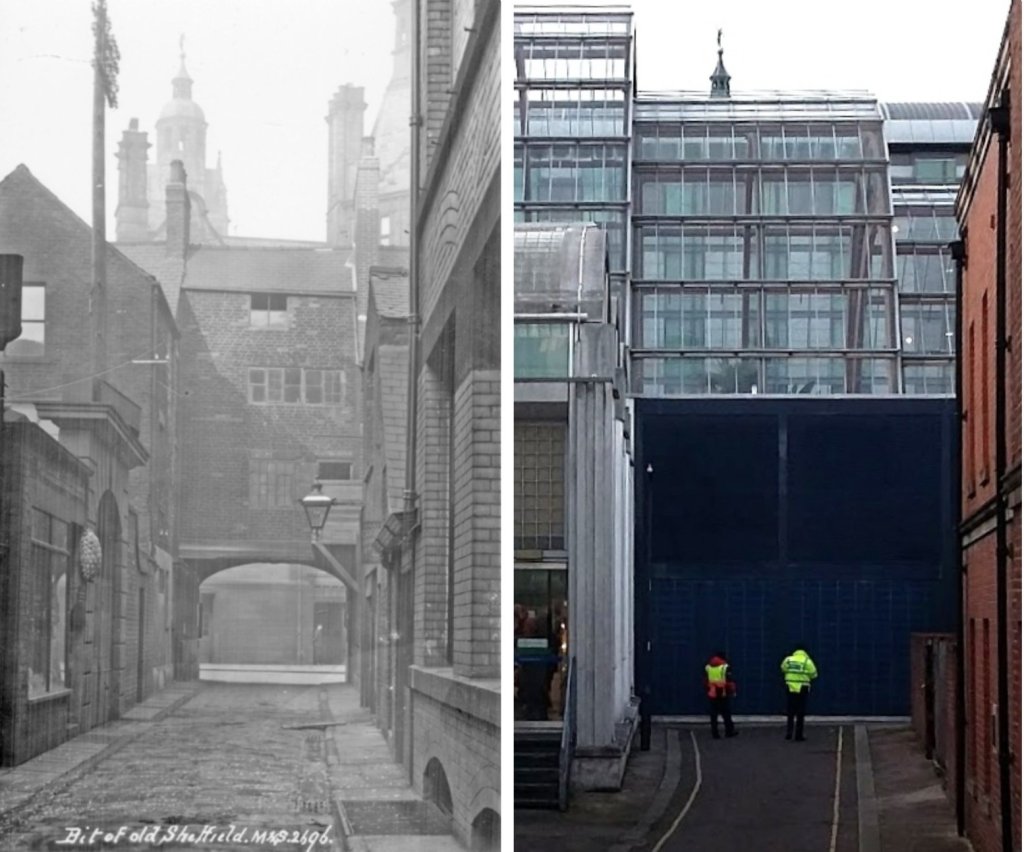
Granted, it is not a street that many wander down anymore. It is a far cry from its heyday when it was a busy thoroughfare lined with factories, workshops, and offices. It survives in truncated form and can be found behind the Graduate public house, running parallel with the Millennium Gallery, and cut short by the presence of the Winter Garden.
How did Cadman Lane get its name?
In the 1780s, there is a story of Thomas Leader walking with the father of T Wilkinson in the field through which Surrey Street was later built. He remarked that the land below had been measured for building. “Yes,” said his companion, “It’s for young Roberts and for a plated manufactory, too.” This was Samuel Roberts, coupled with the mechanical cleverness of his colleague, George Cadman, and “aided by the capital of Mr Naylor, Unitarian Minister, as sleeping partner, and enabled the firm of Roberts and Cadman to outstrip local competitors.”
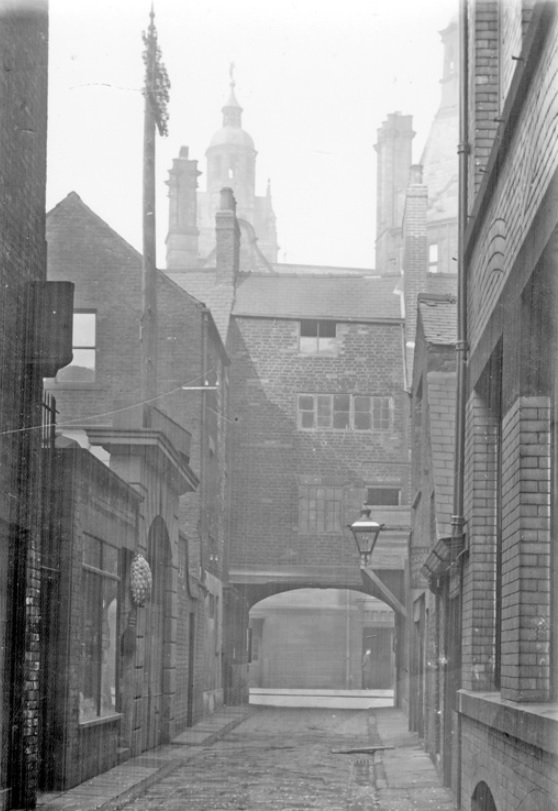
Cadman Lane looking towards Norfolk Street and Town Hall. This part of the road is now underneath the Winter Garden and the Mercure Hotel. Photograph: Picture Sheffield
The most likely candidate for the naming of the street is Peter Cadman, a merchant, who, in 1781 had houses up the south-east side of Norfolk Street. He died in 1812 in the house which he built next “to the gateway in Norfolk Street.” The gateway in question may well have been the arched entrance to Cadman Lane.
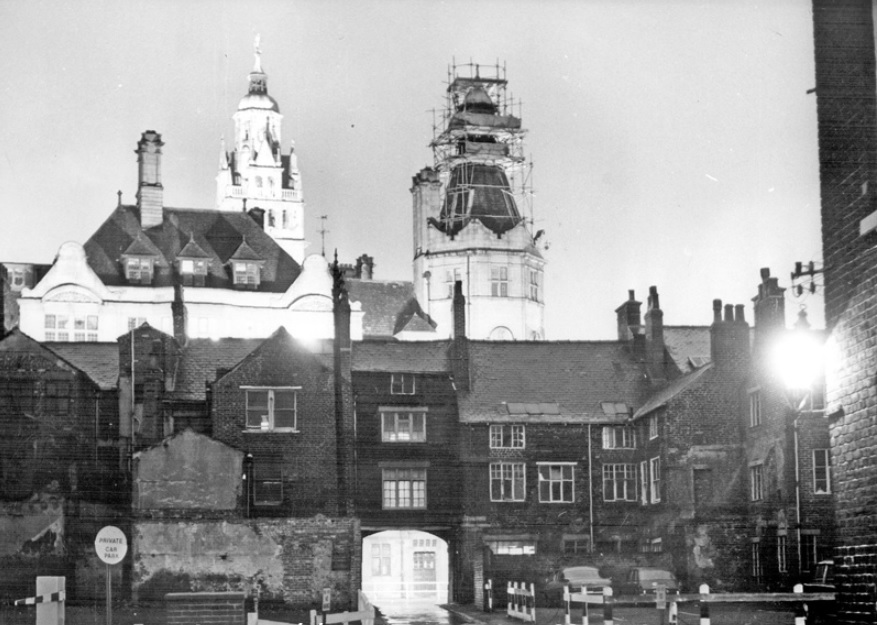
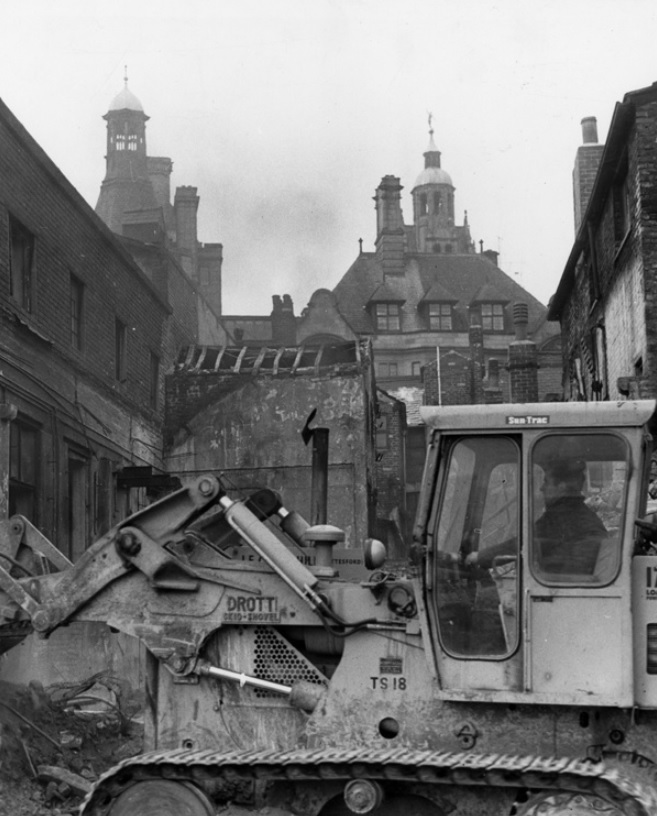
In 1929, Sheffield Corporation bought the block of property with the intention of reserving the land to build new administrative offices or public buildings. However, demolition did not start until the 1960s and the new Town Hall extension (the ‘egg box’) opened in 1977. It was demolished in 2002 and replaced with the Millennium Gallery, Winter Garden and McDonalds (now Mercure) Hotel.
Cadman Lane with the Town Hall in the background, 1967. Photograph: Picture Sheffield
Demolition on Cadman Lane in 1966 with the Town Hall in the background. Photograph: Picture Sheffield
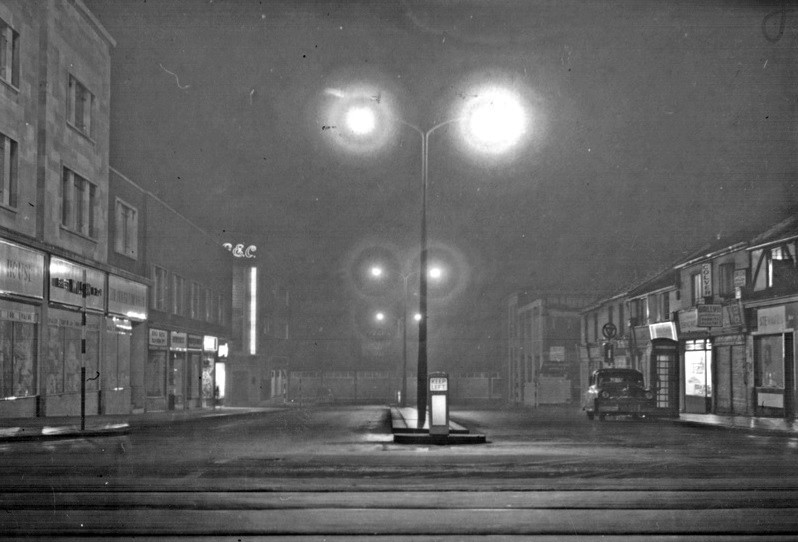
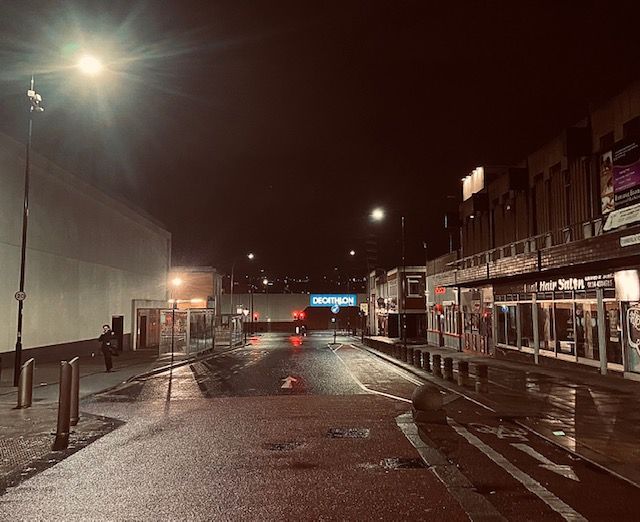
Two night-time shots of Cumberland Street, Sheffield, sixty years apart. The black and white photograph, looking towards Eyre Street, was taken in the early 1960s, and even though almost everything was demolished, it is still recognisable.
The row of shops down the left became Moor Market, including the tall and imposing General Electric Company building.
The old properties down the right were replaced in the early 1970s, including the addition of the Whetstone Public House, later Moorfoot Tavern, and now El Paso restaurant.
Only one building survives – the former Martin’s Bank at the far right corner of Cumberland Street with Eyre Street.
About halfway down are two roads with contrasting fortunes. To the right, South Lane, then a narrow thoroughfare, but significantly widened. To the left, Cumberland Way, lost during Moor Market construction, and now forming the entrance to the market service area.
In the far gloom was the factory belonging to W.A. Tyzack (built in 1958 and demolished in 1984), and now the site of Decathlon.
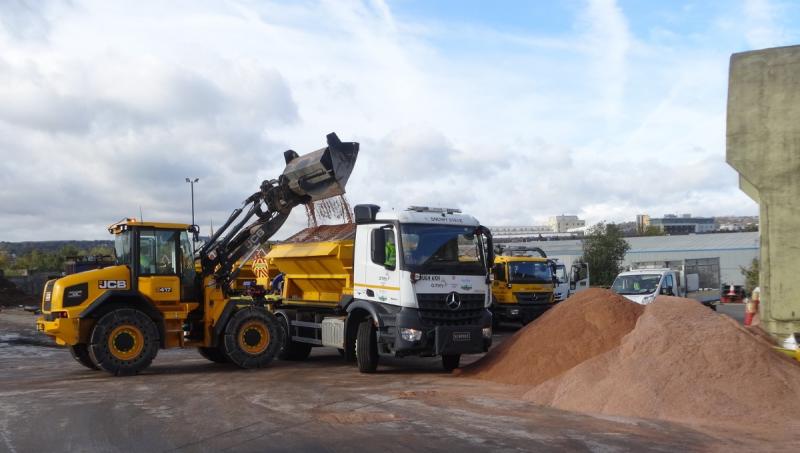
Gritter lorries on standby at the Streets Ahead Olive Grove depot. Photograph: Sheffield City Council
Temperatures are set to fall this week, with ice and possibly some snow forecast, and Sheffield’s gritters are ready to treat the roads. One thing is certain, we’ll all have a good moan if they get it wrong.
There are five weather stations across the city providing up-to-the-minute weather forecasts. This helps Streets Ahead contractor Amey to determine when there is a need to grit our roads.
Contrary to belief, over 60% of the city’s highway network is gritted in priority order. That is 610 miles of urban and rural roads and can take up to 8.5 hours to complete a full gritting run. Priority 1 routes include main arterial roads linking Sheffield to other towns and motorways. Priority 2 routes are bus routes, link roads, roads where public service facilities are located, and rural routes. Snow is also cleared from city centre pavements, but pavements across the city are not gritted anymore.
As the temperature drops to near freezing point the gritters will be out, but it isn’t grit they are spreading. It is rock salt. And the salt used comes from mines of ancient underground deposits in Cleveland, County Antrim, and below the Cheshire town of Winsford, and lowers the freezing point of moisture. Pure salt is the most effective pre-treatment, but grit is often added once snow has started to lay and compact.
The pre-treating of the highway network mitigates the formation of ice and snow, although traffic is needed to make it effective. Very often, when an area has slush or rainfall, it washes the salt away and makes the road vulnerable again, necessitating them to be re-gritted a second time before the weather freezes.
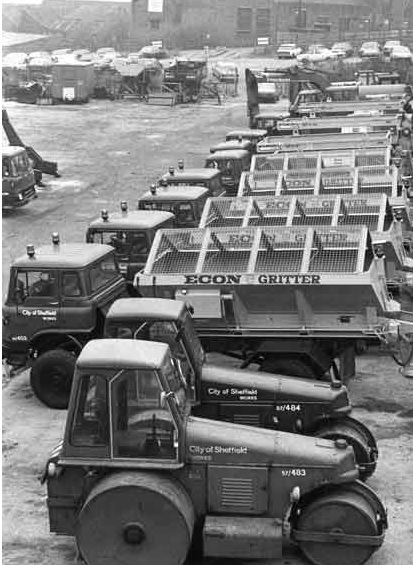
Gritter lorries and road rollers at Sheffield Works Department’s Manor Lane site in 1982. Photograph: Picture Sheffield
In 2003, the Highways Act 1980 was amended to place Sheffield City Council (and others) under a legal obligation to keep the roads clear. According to the amendment: “A highway authority are under a duty to ensure, so far as is reasonably practicable, that safe passage along a highway is not endangered by snow or ice.”
It is a far cry from Victorian times when sand was shovelled off the backs of horses and carts, and although the switch to motor vehicles greatly improved operations, it wasn’t until the development of the first spinning salt distribution gritter in 1970 by Ripon-based Econ Engineering that the process was speeded up.
Today, Econ supply 85% of the UK’s rock salt spreaders and even have a dedicated gritting museum with fully restored vintage road maintenance vehicles, gritters, spreaders and snowploughs.
October is the start of the Streets Ahead winter maintenance period and is in operation 24-hours a day, seven days a week. Photograph: Sheffield City Council
Whilst rock salt has been the choice for generations it can have a negative effect on soil and plants, interfering with the nitrogen cycle, and causing roots to absorb salt instead of important minerals. Salt water can also drain into soil affecting insects and can disturb the eco-system in watercourses. In addition, sodium chloride can be harmful to animals. And let’s not forget that it can cause damage to road surfaces.
As you might expect, alternative methods are being sought including urea (used in the production of fertilizer), potassium chloride, calcium chloride, potassium acetate (all incredibly expensive), beet juice, cat litter (yes, you read right), sand, ashes, and stone grits. Other eco-friendly alternatives being explored are cheese brine, garlic salt, potato juice, pickle brine and coffee grounds.
But for now, it seems rock salt will be here for a while because it remains cheap and readily available.
Finally, the truth surrounding gritter lorries in the summer. In very hot weather when tar is at risk of melting the gritters spread salt. This absorbs moisture from the air and cools the tar and creates a non-stick road surface.
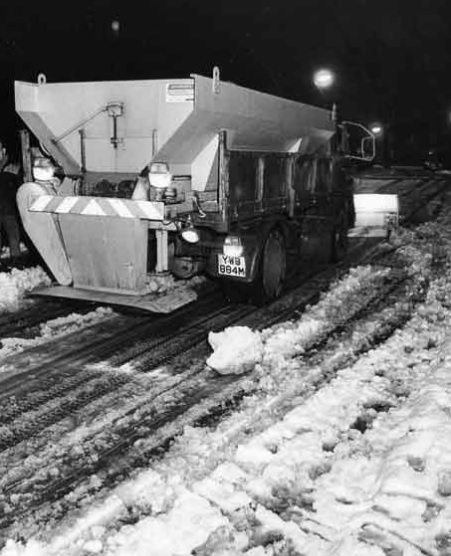
Gritter and snowplough seen here in a wintery 1977. Photograph: Picture Sheffield


 sheffielder.net