Categories
Buildings

St Paul’s Building

Completing this week’s look around the Peace Gardens, we look at the elaborate building on St. Paul’s Parade, which runs between Pinstone Street and Norfolk Street.

This walkway once ran alongside St. Paul’s Church, demolished in 1938 and replaced with St. Paul’s Gardens, later Peace Gardens, and known as South Parade.

It was renamed St. Paul’s Parade in 1901, largely because of John Dodsley Webster’s new building that had just been completed, the second stage of a development that ran around the corner into Norfolk Street, started by the construction of the Central Hall for the Sheffield Workmen’s Mission in 1899.

Ruth Harman and John Minnis in Pevsner’s Architectural Guide to Sheffield (2004), suggest that the warm-coloured brick with red sandstone dressings, was an unusual combination for Sheffield, where the buff Yorkshire and Derbyshire sandstones were much more common.

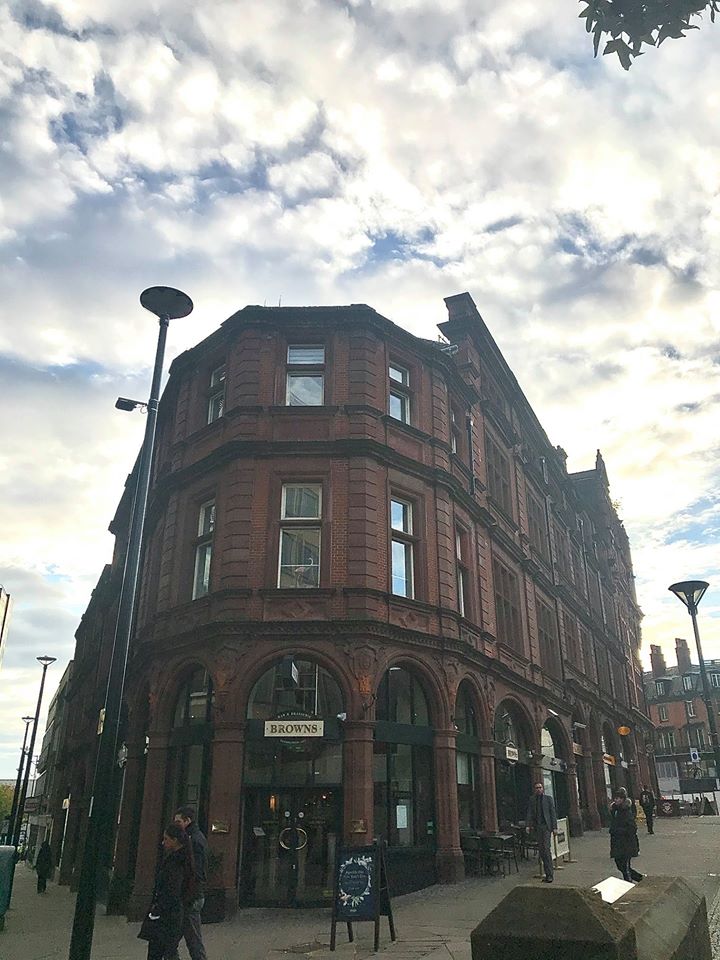
The St. Paul’s Building comprised shops, offices and residential flats, along with a gallery and studio, although only the original facades remain following redevelopment behind.

It retains the arcaded shopfronts with carved stone piers and arches, with the faces of lions and rose, shamrock and thistle emblems still decorating the spandrels.

When it was completed, the building was home to James Moore’s Art Classes, which took place in a “beautifully lighted” new studio, its customers promised painting and drawing from live models, portrait and figure compositions, as well as flower and still-life subjects.

Over one hundred years later, the St. Paul’s Building, still retains pretty much the same use, although there have been unsuccessful attempts to have it demolished.

Had it been, the redevelopment of the Peace Gardens as part of the Heart of the City project, might have been very different.

Shops aplenty have occupied the ground floor, the most famous being the Army and General Store, famously sited at its rounded corner with Norfolk Street, later occupied by the Ha Ha Bar, and now Brown’s Bar and Brasserie.

There can be no denying that this area is one of the city centre’s most attractive, St. Paul’s Building sitting comfortably alongside the Prudential Assurance Building, built in 1895 on Pinstone Street.

NOTE: St. Paul’s Building is now referred to as St. Paul’s Chambers. However, when the building was constructed in 1901, St. Paul’s Chambers would have been associated with a completely different building, one that had been demolished to make way for the Town Hall between 1890 and 1897.

Categories
Buildings

Sheffield Town Hall

Look at this, Sheffield Town Hall, brand new and clean, seen here in May 1897, shortly before the official opening by Queen Victoria. Within weeks the building was already taking on the tone common to Sheffield, smoke being the culprit, and within decades the Stoke Hall stone was almost black in appearance.

Sheffield’s fourth Town Hall was built between 1891-1896 by Edward William Mountford (1855-1908), one of 178 architects to enter a competition with Alfred Waterhouse as judge.

Mountford was successful despite protests from Flockton & Gibbs, who claimed their “patent” design for municipal buildings had been incorporated into instructions for finalists and used in Mountford’s scheme.

“The architect’s aim, of course, was to obtain the dignity essential for the Corporation’s buildings of the fifth provincial city in England, combined with the maximum amount of internal convenience, and abundant light and air!”

The building contract was awarded to Edmund Garbutt of Liverpool, whose tender amounted to £83,945, but the actual cost, including the site, approached £200,000.

Understandably, the Sheffield public were “up in arms” about the cost, and critical of the expensive embellishments inside and out, protesting that ratepayers’ money was better spent on street improvements and housing for the poor.

The Town Hall was built on an almost triangular site, bought by the council as part of a general improvement scheme, and replacing dilapidated properties either side of New Church Street, a road lost beneath the development.

The principal front faced Pinstone Street (200ft long), although the main entrance was at the centre of the Surrey Street front (280ft long). Its crowning glory was the 64ft-high clock tower complete with Mario Raggi’s bronze statue of Vulcan.

Although the Town Hall clock was designed to be capable of working with bells, they were never fitted, and it wasn’t until 2002 that an electronic bell ringing system was installed, giving hourly strikes with Westminster-style quarter chimes.

On the right of the Pinstone Street entrance were the offices of the waterworks; on the left, the City Accountant’s department. The Town Clerk and members of his department had rooms on the first floor, as were the committee rooms.

On this floor were the Mayor’s reception hall, dining-hall and the Mayor’s parlour, as well as the Council Chamber (60ft x 40ft, and reaching a height of 28ft), light being afforded by traceried windows, and with a public gallery seating 60 people.

The main staircase, 10ft wide, leading to the first floor, was supported on columns of red and grey Devonshire marble, with alabaster balustrades and an ornate marble handrail, the walls being lined with polished Hoptonwood stone.

In other parts of the building, the corridors had floors of glass mosaic and a specially designed dado of antique glazed tiles.

The rich decorative scheme of stone carving, both externally and internally, was devised by Mountford and Frederick William Pomeroy (1856-1924), Royal Academy Gold Medallist, and took pride in Sheffield’s history and the art and skill of its workforce.

The foundation stone was laid by Alderman W.J. Clegg in 1891 and the Town Hall should have been opened by Queen Victoria in 1896, but the death of Prince Henry of Battenberg prevented her from doing so.

The Town Hall was opened by Queen Victoria on the afternoon of May 21, 1897, a story worthy of a separate post.

Categories
Buildings

Sheffield Town Hall

Sheffield Town Hall was opened by Queen Victoria on the afternoon of May 21, 1897, postponed from a year earlier, due to the death of Prince Henry of Battenberg, husband to Beatrice, her youngest child.

The story of the grand opening is remarkable because Queen Victoria completed the ceremony, and other duties in the city, without ever leaving her carriage.

On 23 September 1896, Victoria had surpassed George III as the longest-reigning monarch in British history (that distinction now going to our present Queen), but she requested that celebrations be delayed until 1897, to coincide with her Diamond Jubilee.

By this time, she was 77-years-old, much frailer, and her time spent in Sheffield was momentary.

The Town Hall opening was a disruption in her journey from Windsor to Balmoral, where she would celebrate her birthday and spend the summer holidays.

Because of this, she didn’t arrive in Sheffield until late afternoon, arriving at Sheffield Railway Station accompanied by Princess Christian and the Duke of Connaught.

The Royal party were met by the Mayor and Mayoress, the Duke of Norfolk, and his sister, Lady Mary Howard. From the station, a procession was led by the Chief Constable and his mounted police, and a troop of the 17th Lancers.

Thousands of cheering people lined the streets, waving flags, as the parade headed towards the principal entrance of the Town Hall on Pinstone Street, met by the Lord Chamberlain, Lord Lathom, who directed the ceremony.

At 5pm, Victoria remained in her carriage while the Recorder of Sheffield read an address, handed to her in a gold casket, specially made for the occasion by Mappin and Webb.

The Queen handed her reply to the Mayor, after which other addresses were presented by the Duke of Norfolk, on behalf of the Sheffield General Infirmary, by Sir Frederick Mappin, MP, on behalf of the Town Trustees, and by Mr Alexander Wilson, Master Cutler, representing the Cutlers’ Company.

The “golden key” (also by Mappin and Webb) was handed to Victoria, who inserted it into a detached lock, connected by electricity to the gates of the entrance. As she turned the key, the gates swung back as if by magic, and a flourish of trumpets announced that the Town Hall was open.

Afterwards, the Royal procession went to Norfolk Park, where fifty thousand schoolchildren had gathered by invitation of the Duke of Norfolk.

She then went to the Cyclops Steel and Iron Works, belonging to Charles Cammell and Company, where her carriage was drawn into a temporary shed in front of a mighty furnace. Here, the party held glass screens before their eyes, and watched the rolling of armour plate for the new battleship “Ocean”.

By 7.30 in the evening, Queen Victoria was speeding northwards by train to “gain strength for her approaching jubilee.”

Categories
Streets

Pepper Alley

I bet most of you have never heard of the delightfully named Pepper Alley. This was once a thoroughfare passing from Fargate to Norfolk Street, quite close to the surviving Upper Chapel.

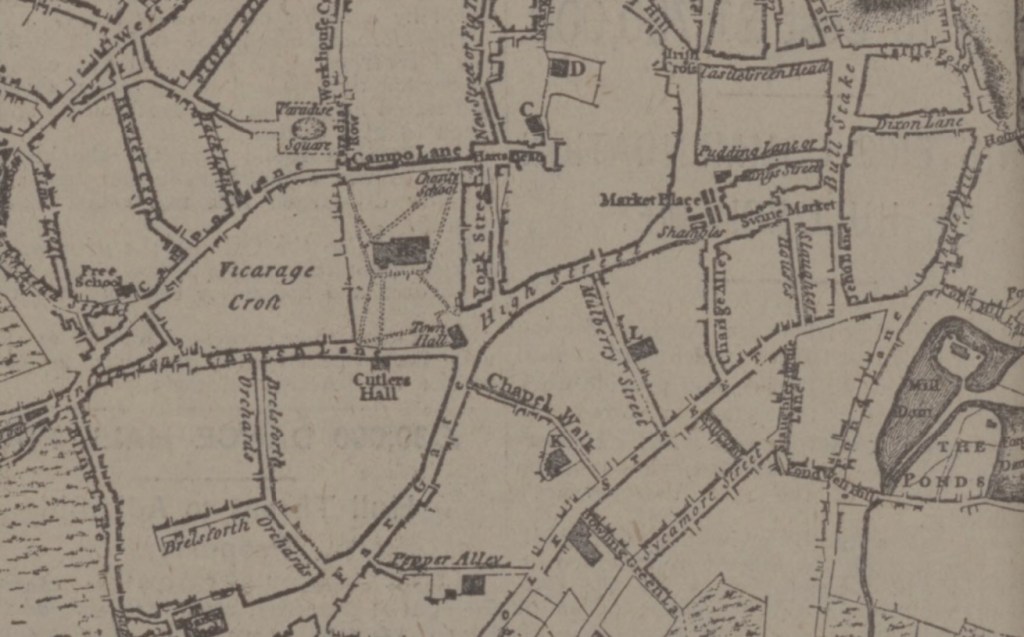
Its existence is shown on this map, taken from “A Correct Plan of the Town of Sheffield, in the County of York, drawn by William Fairbanks, 1771.”

You’ll notice that Norfolk Row, pictured, doesn’t appear on the map at all, only coming into existence about nine years later. However, Chapel Walk is shown.

A little bit of Pepper Alley (Pepper is a local surname) can still be seen today, leading into Upper Chapel Yard, behind the shops which form part of the former YMCA property, now named Carmel House, at the corner with Fargate.

If you study the map you’ll see that the Town Hall stood by the Church Gates (now the Cathedral), at the junction of High Street and Church Lane (now Church Street).

Other names to look for are Bullstake (now Haymarket), Pudding Lane (King Street), Castle Green Head (Castle Street), Irish Cross (Queen Street), and Pinstone Croft Lane (Pinstone Street)

Categories
Buildings

Midcity House

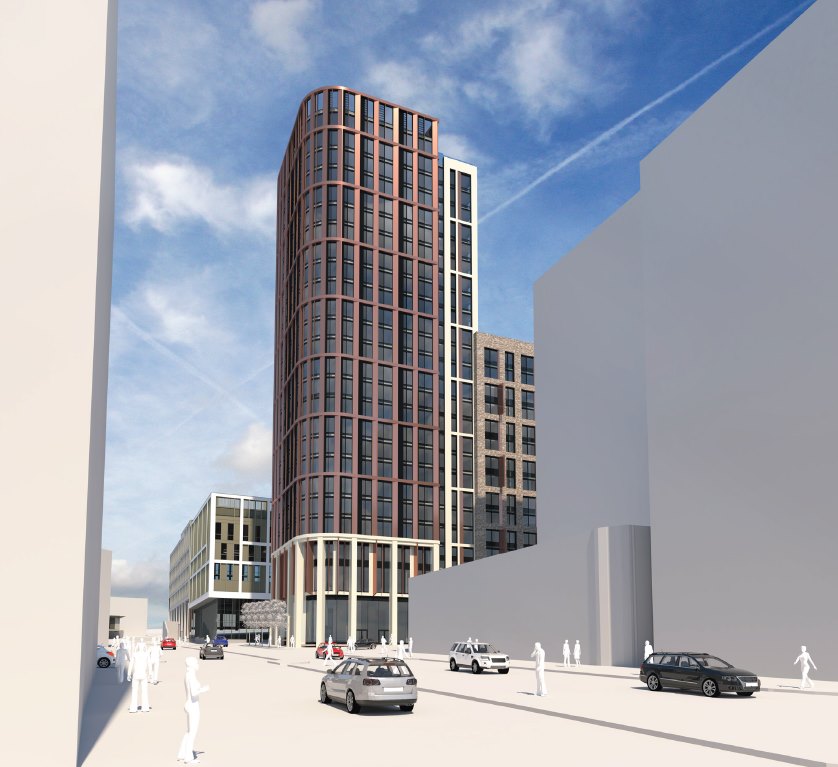
Union Street Limited, a Gibraltar-based developer, has submitted plans to Sheffield City Council for the redevelopment of Midcity House, on a site between Pinstone Street, Furnival Gate and Union Street.

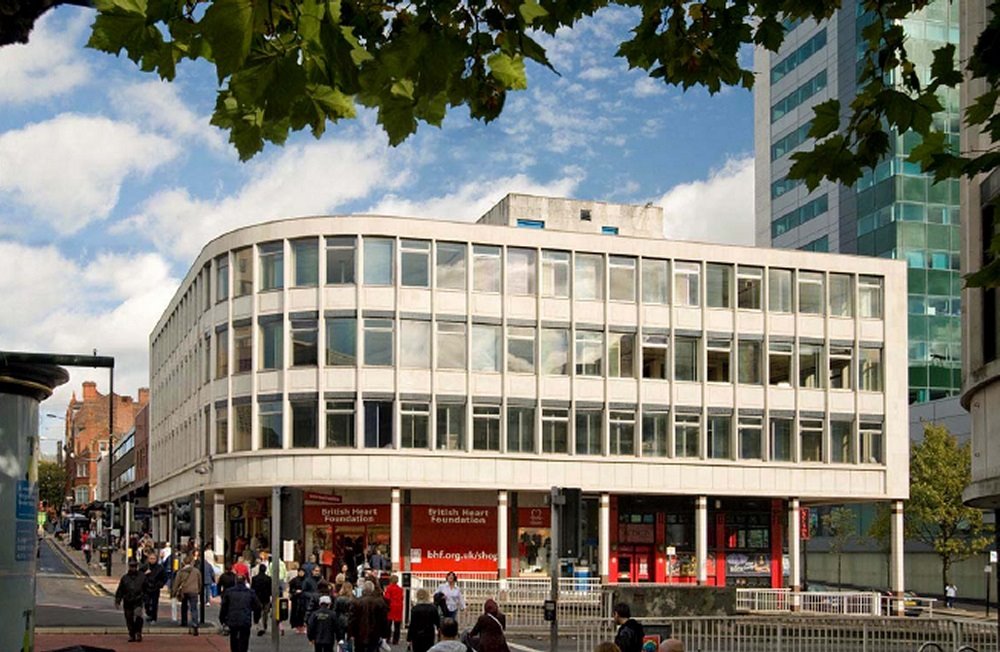
The proposal includes the demolition of the existing four-storey concrete-clad building consisting of ground-floor retail, bar, offices and limited student accommodation above.

In its place would be three blocks, up to 25-storeys high, with four ground-floor retail units and 271 dwellings above for the build-to-rent market.

The site once stood on the boundary of old Sheffield Moor, part of a field in 1736, and occupied by houses, shops, workshops and yards by 1771.

Most of the properties survived until 1853 but had been demolished by the late nineteenth-century.

In later times it was occupied by the Nelson Public House, Cambridge Arcade and a series of shops, with most buildings replaced in the 1960s with the present structure.