Categories
Buildings

Stone House

Let’s not dwell too much on the recent history of the Stone House pub on Church Street. Famous in the seventies and eighties as the must-go-to bar on a Saturday night, and memorable for the courtyard that gave you the impression that you were standing underneath a star-filled sky.

The courtyard disappeared in the 1980s after the building of Orchard Square, the Stone House refurbished as a trendy establishment that lasted until 2005.

It was bought by the owners of Orchard Square, London & Associated Properties, for £2.5million, space given for the expansion of T.K. Maxx, and the older, listed part, left empty.

It’s a sad time for this Grade II-listed building, seemingly unloved, and not likely to attract a new tenant soon.

There is some confusion as to the date when the Stone House was built.

A band inscribed across the front states “1795, White & Sons, late Thomas Aldam.” But, the two-storey building we see today dates from the 1840s.

Over the doors, round-arched panels are inscribed with “The Stone House” and “Private Lodgings.”

Thomas Aldam, an importer of wines and spirits, moved here in the 1840s, continuing until his death in 1858.

The business was taken over by Dunkelspiehl Brothers & Company in 1867, trading from the site until the late 1870s.

The business transferred to J.B. White and Sons; an old Chesterfield company that had been established in 1795 (hence the date seen on the building today).

The name of the Stone House first appeared in 1913 following the acquisition of J.B. White and another Sheffield wine merchant, William Favell and Company, by brewer Duncan Gilmour and Company.

The two companies became White Favell and Company, wines and spirits merchants and cigar importers, operating in the front of the building. More importantly, the rest of the building became the Stone House public house.

White Favell and Company was later run by J. Lomax Cockayne, the managing partner in what became White, Favell and Cockayne.

Duncan Gilmour and Company was taken over by Leeds-based Tetleys in 1954, the wines and spirits business gradually being phased out and part of its old windowed frontage bricked up.

An illustrious past for the building, now waiting for a new lease of life.
Categories
Buildings

Midcity House

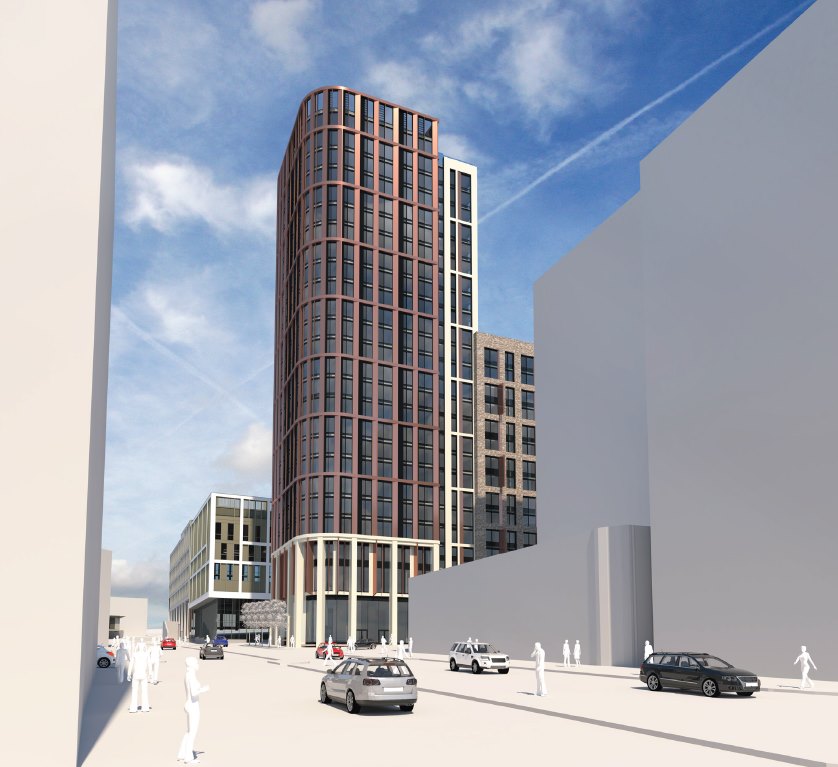
Union Street Limited, a Gibraltar-based developer, has submitted plans to Sheffield City Council for the redevelopment of Midcity House, on a site between Pinstone Street, Furnival Gate and Union Street.

The proposal includes the demolition of the existing four-storey concrete-clad building consisting of ground-floor retail, bar, offices and limited student accommodation above.

In its place would be three blocks, up to 25-storeys high, with four ground-floor retail units and 271 dwellings above for the build-to-rent market.

The site once stood on the boundary of old Sheffield Moor, part of a field in 1736, and occupied by houses, shops, workshops and yards by 1771.

Most of the properties survived until 1853 but had been demolished by the late nineteenth-century.

In later times it was occupied by the Nelson Public House, Cambridge Arcade and a series of shops, with most buildings replaced in the 1960s with the present structure.

Categories
Buildings

No. 35 George Street

No. 35 George Street, located between High Street and Norfolk Street, isn’t that old compared to some of our buildings. Built in 1913-1914, this Grade II-listed structure might look a little lost these days.

It was built as the Yorkshire and Derbyshire office for the Alliance Insurance Company, established by Nathan Meyer Rothschild and Moses Montefiore in 1824, to rival Lloyds of London.

The George Street site had originally been the workplace of the Sheffield Fire Insurance Company, with offices on the upper floors and the town fire engine, small enough to be drawn up narrow passages, housed below.

The business transferred to the Alliance Insurance Company in 1864, but by the start of the twentieth century the offices were too small.

The insurance company moved into an adjoining building that once formed part of the Athenaeum Club, and the old building was demolished.

Its demise wasn’t without controversy. Then, like now, there were those who mourned the loss of an old building. However, the company offered to keep the whole of the top balustrade, comprising pillars with urns bearing the Sheffield coat-of-arms.

During construction, there were those that criticised the plan.

“Most of the property at the High Street and Norfolk Street ends of George Street is old, and if it had been made into a good wide street, its rateable value would also have increased. The ‘dog’s hind leg’, half-way along, is still to be perpetrated – a danger to traffic, and a perpetual monument to our Corporation’s ineptitude.”

That ‘dog’s hind leg’ still exists, but the finished offices, designed by Goddard & Co, were well-received.

“It is one of the most elegant, though, unfortunately one of the least prominently situated of Sheffield’s new buildings. Romanesque in design, and built of white stone, it is one of those buildings which are completely deceptive as to size. It gives the impression of consisting merely of one large hall, instead of which one finds on entering not only a main hall (56ft x 26ft), without counting a large annexe, but an extensive suite of offices in three floors. One reason for the deception is that the site extends through into Mulberry Street, where there is considerable frontage.”

And this deception still exists. Take a walk under the adjacent covered roadway into Mulberry Street, and you can see that there is a lot more to the building than meets the eye. It was clever use of fitting a prestigious building into a tiny site.

“Artistically designed as is the exterior of the building, the interior is even more so. The large hall is elegantly panelled in oak up to the ceiling, which is richly ornamented, and the annexe is lighted by a glass dome. The appointments of the board room are in keeping with those of the large hall, and all the offices are handsomely fitted and furnished, while the walls of the stairways and corridors are lined with tiles of a pretty design.”

How much of the original interior survives is uncertain, the Portland stone exterior has weathered, but the building retains its dignity.

The Alliance Insurance Company remained here until the second part of the twentieth century, merging with the Sun Insurance Company in 1959, and finally amalgamating with the Royal Insurance Company to form Royal Sun Alliance in 1996.

No. 35 George Street was later used by Midland Bank as an administrative facility, and is today occupied by the NSPCC as its Sheffield Service Centre.

Before you go, look closely at this photograph, taking note of the two stone urns, as well as the well-worn Sheffield coat-of-arms within the pediment. These are the only survivors from the long-demolished Sheffield Fire Insurance Company building… and I bet you never knew that!

Categories
Buildings

No. 35 George Street

While researching the history of No. 35, George Street, Sheffield, this remarkable old print came to light.

The site of what is now the NSPCC, Sheffield Service Centre, opposite the Curzon Cinema, used to be the office of the Sheffield Fire Insurance Company.

The Sheffield Fire Brigade used to practice in the space in front of what became Alliance Chambers, following the acquisition of the company in 1864 by the Alliance Insurance Company (now Royal Sun Alliance).

The small horse-drawn fire engine, small enough to get up alleyways, was housed on the ground floor.

The building was demolished in 1912 and replaced with new offices for the Alliance Insurance Company in 1913-1914.

However, two stone urns and the Sheffield coat-of-arms, seen here in this sketch, were transferred to the replacement building and can still be seen today. (The coat-of-arms built into the stone pediment).

Categories
Buildings

St. George’s Church

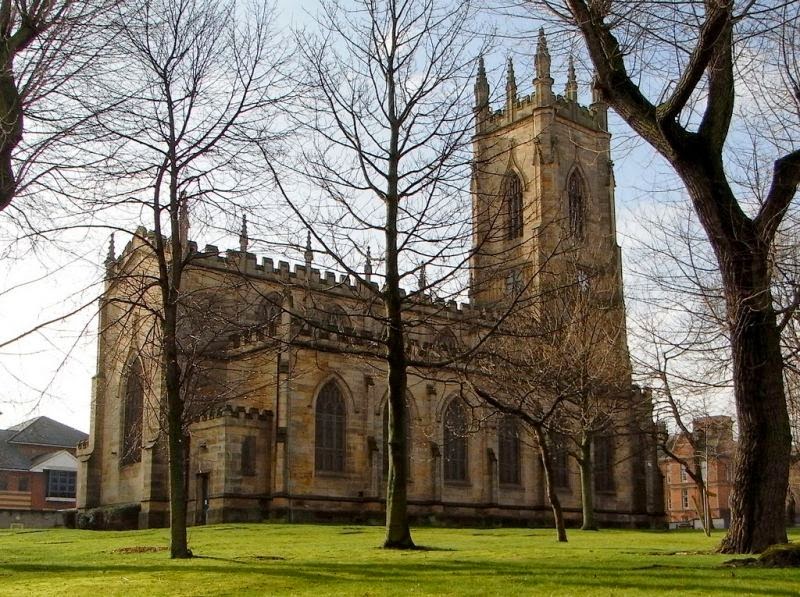
It stands rather grandiose, next to Broad Lane, on the way to Brook Hill roundabout. St. George’s Church, aside from Sheffield’s two cathedrals, is one of two magnificent churches around the city centre.

St. George’s was built for the Church Building Commission between 1821-1825, one of three churches to have been built in Sheffield under the Church Building Act of 1818. (The others were St. Mary’s, Bramall Lane, still standing, and St. Phillip’s at Netherthorpe, demolished in 1951).

A Commissioner’s Church was an Anglican church built with money voted by Parliament, aiming to increase the number of church places for parishioners.

By the start of the Industrial Revolution, people had moved from rural areas into towns and cities, putting unprecedented demand on places of worship. Before these three new churches, Sheffield had just 6,280 seats for a population of 55,000 people.

The foundation stone for St. George’s, built on a piece of spare land, was laid by Thomas Sutton, Vicar of Sheffield, on 19 July 1821, the Coronation day of King George IV, hence the name.

The church was designed by Woodhead and Hurst, in Perpendicular Gothic style, at a cost of £15,181 (about £1.2million today) and was planned to have been completed by October 1824.

It was an ambitious building scheme, overseen by John Smith, Superintendent of Works for Thomas Flockton, builder and contractor for many of Sheffield’s churches.

The construction was carefully planned with master craftsmen brought him from various Yorkshire companies.

Ironwork was provided by Raynor and Company, of St. James’s Street, while Nowell’s of Dewsbury afforded masons and bricklayers, the slate roof completed by Brown’s of Division Street, Sheffield, and plumbing and glazing carried out by Smith and Binks of Rotherham.

William Nicholson, of St.James’s Street, provided plasterers, and Robert Drury, from Eyre Street, supplied a team of painters and decorators. Carpentry and joinery were completed by a team from Thomas Flockton, based on Rockingham Street.

St. George’s was finally completed in 1825, the consecration ceremony held by Edward Venables-Vernon-Harcourt, Archbishop of York, on 29th June 1825.

A procession formed in the chancel of the Parish Church (now Sheffield Cathedral) and proceeded to St. George’s, the parade made up from members of the clergy, charity girls and boys, the Town Collector and Trustees as well as the Master Cutler and members of the Cutlers’ Company.

Such was the demand to view the ceremony that members of the public were only admitted by ticket.

The finished church was 122ft long and 67ft wide, with a flat-ceilinged nave of six bays, a single-bay chancel and a 140ft high tower. Galleries extended the length of the north and south walls, and there was a two-tiered gallery on the west wall, providing total seating for 380 worshippers.

It was soon apparent that St. George’s was going to be a success, attracting a congregation from nearby high-density housing. However, the Archbishop considered it unfit for the internment of the dead, due to the churchyard not being properly fenced off, and burials only commenced from 1830.

St. George’s prospered, but declining attendances during the 1970s resulted in its closure in 1981. It stood unused for many years until the University of Sheffield bought it in 1994, its presence slowly extending towards the city centre.

The church was converted by Peter Wright and Martin Phelps, with a lecture theatre sited in the nave, seating provided in the west gallery, a dais set in the chancel, and three floors of student accommodation built in the aisles.

Standing at the centre of St. George’s Square, the former church is best seen at night when it is floodlit.

Categories
Buildings

St. George’s Church

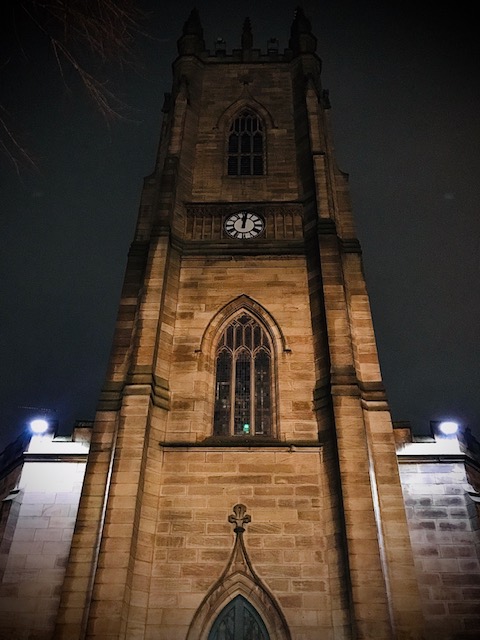
The tower of St. George’s Church, Portobello, now owned by the University of Sheffield and used as a lecture hall and three floors of student accommodation.

The church was built between 1821-1825 using money provided by the Church Building Commission, the result of the Church Building Act of 1815.

Designed by Woodhead and Hurst, the church was built by Thomas Flockton of Rockingham Street, Sheffield. The foundation stone was laid by Thomas Sutton, Vicar of Sheffield, and consecrated in 1825 by Edward Venables-Vernon-Harcourt, Archbishop of York.

During the construction of the 140ft high tower, St. George’s claimed the lives of two workmen.

In 1823, apparatus used to draw stones up to the tower was being dismantled, when part of the machinery gave way, precipitating three workmen onto rafters of the floor below. James Bower was dreadfully crushed and dead within minutes, his two colleagues being seriously injured.

Further tragedy occurred a year later, in 1824, when a plank on which Charles Lee, a labourer, gave way, causing him to fall to the bottom of the tower. He pitched onto beams and died a few minutes later, after being removed to a nearby public house, and before medical help could arrive.

St. George’s closed in 1981 and stood empty for thirteen years, its condition deteriorating, until bought by the University of Sheffield in 1994, and restored.

Categories
Buildings Sculpture

Moorfoot

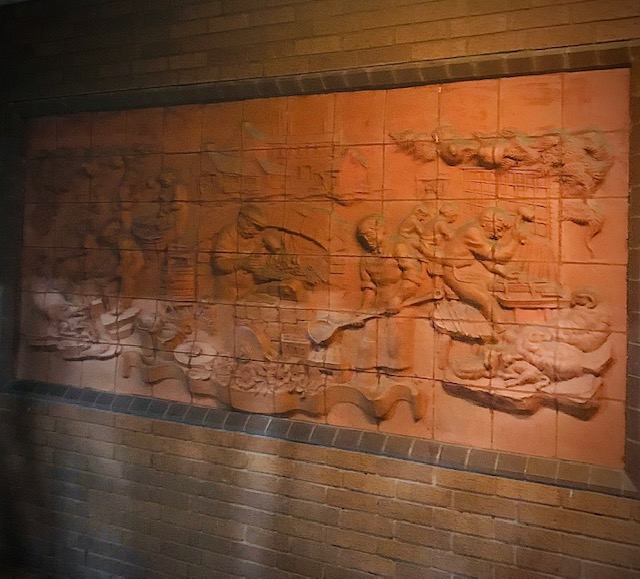
Oh, how happy sculptor Judith Bluck (born 1936) must feel. Thirty-four years after creating a brick wall relief, it now adorns the outside of a boarded-up toilet block at Moorfoot.

The frieze was created for the Manpower Services Commission in 1985, the theme based on different kinds of skills used in the “little mesters” workshops formerly on the site.

Bluck visited Kelham Island Museum for inspiration and made a master in Glass Reinforced Polyester Resin from which a mould was formed. Pan tiles, each 25cm square, were produced by Nori (a subsidiary of Accrington Brick).

Working from her studio in the Yorkshire Dales, Bluck was also responsible for the Crucible Fountain outside the Moorfoot building (covered in another post).

She also created numerous works around the country including Small Workhorse, at Ealing Broadway, Legend of the Iron Gates, Wilmslow, Sheep in Milton Keynes, and a 20ft high relief narrative on security doors at Portsmouth Crown Court.

Categories
Buildings Companies

Cole Brothers

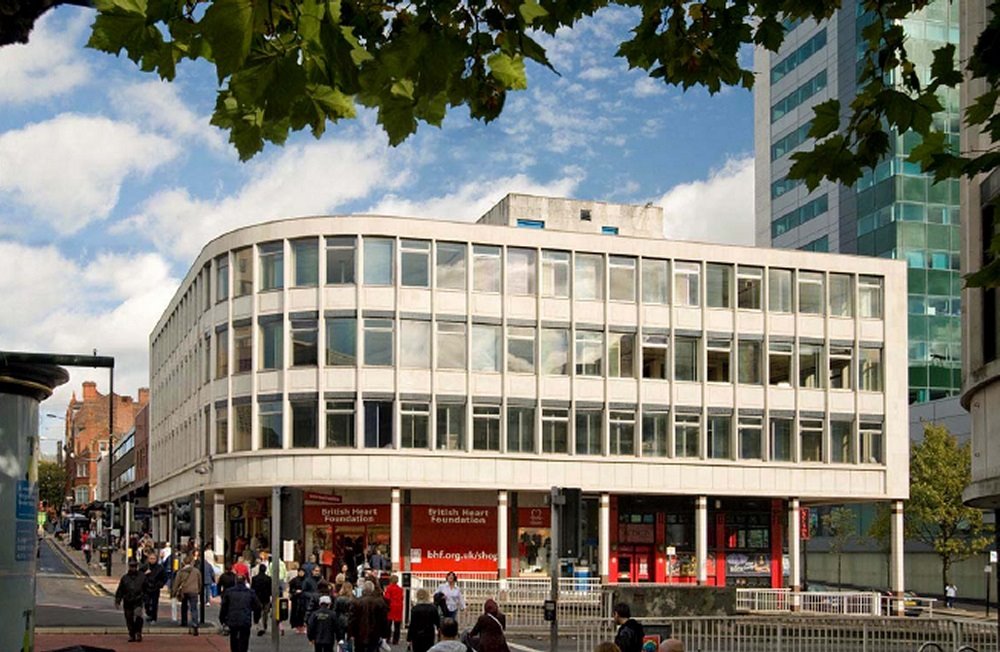
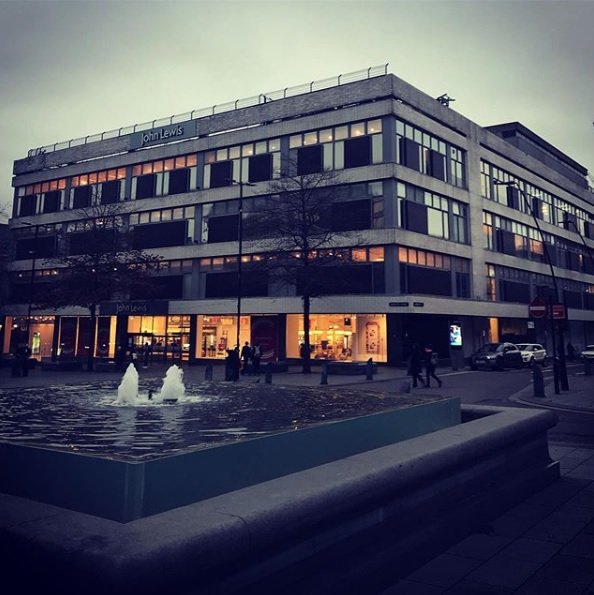
There was a time, not that long ago, when this department store at Barker’s Pool was scheduled for demolition.

The ill-fated Sevenstone retail project earmarked shiny new premises for John Lewis on the site of the old fire station on Wellington Street. When that scheme stumbled, replaced with the more sympathetic Heart of the City II development, John Lewis said they were staying put.

For the modernists amongst us, it was a welcome reprieve for a building that was constructed between 1961-1965 for Cole Brothers, renamed John Lewis in 2002.

The land on which it stands was once site of the Albert Hall, destroyed by fire in 1937. There was talk of a new Gaumont Cinema in its place, but it never materialised. After World War Two, Sheffield Corporation bought the plot for proposed new law courts, but again these never happened, the land subsequently acquired by Cole Brothers.

The design was conceived by Yorke, Rosenberg & Mardall, an architectural company set up in 1944 by Francis Reginald Stevens Yorke (1906-1962), an Englishman, Eugene Rosenberg (1907-1990), born in Slovakia, practising in Prague before World War Two, and Finnish-born Cyril Mardall (1909-1994).

The practice attracted talent from around the world, including David Allford (1927-1997), Sheffield-born, a graduate of the University of Sheffield and lifelong Sheffield Wednesday supporter.

Allford, who went on to become chairman, had a hand in Gatwick Airport, several large hospitals including St. Thomas’ in London and Hull Royal Infirmary, numerous comprehensive schools and offices, Warwick University, and Cole Brothers department store in his home city.

Built by Trollope & Colls (later Trafalgar House Construction), the store is clad in the architects’ hallmark white tiles with panels of brown mosaic to the window bays. The surface was inspired by Le Corbusier’s use of tiles on the entrance drum of the Armée de Salut (1929) in Paris, and the General Pensions Institute (1929-1934) in Prague, designed by Havlicek and Karel Honzik, and worked on by Eugene Rosenberg.

Rectangular in design, it was the replacement for Cole Brothers’ old premises on the corner of Fargate and Church Street (celebrated in Richard Hawley’s song ‘Coles Corner’), outdated and sold for £1million in 1962.

Spread across five floors, the new Cole Brothers store contained sixty departments, with access to each level from a multi-ramp carpark, accommodating 400 cars.

Innovative as the design may have been, the carpark became notorious for suicides, many people jumping from the building’s top deck, up until the time wire fencing was erected.

These days, the department store is looking rather tired, the white tiles in need of a deep-clean and counting the days to its restoration.

Categories
Buildings

No. 14 Fargate

Sheffield is full of surprises. But if you don’t look up then you’ll miss them.

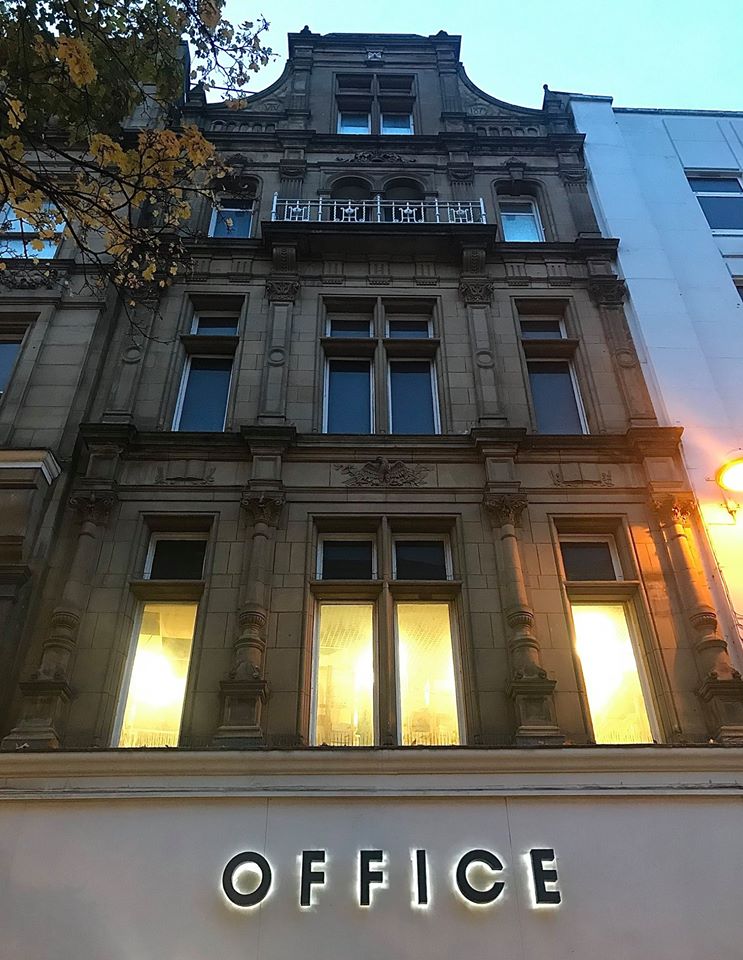
The next time you walk down Fargate, look at the versatility of buildings that were erected during the 1870s. No. 14, Fargate, now occupied by Office, has a narrow-gabled stone front that reflects the width of the plots preserved from much earlier development.

During the 1870s, Fargate was widened, necessitating the demolition of certain properties and rebuilding them further back.

No. 14 Fargate had been occupied by Thomas Widdison, a bookseller, printer and stationer, and in 1879 he temporarily relocated to No. 37 Fargate while his premises were rebuilt.

Thomas Widdison came to Sheffield as a boy and remained all his life. He opened his bookshop on Fargate in 1868, “a business of a high-class description, and all the best book-loving population knew the place and Mr Widdison well.”

A newspaper advertisement from 1889 describes Thomas Widdison as a seller of books, fancy stationary, bibles, prayer books, hymn books, photographic albums and leather goods.

Remarkably, customers were also able to order Flockton Wallsend Coal, “the celebrated drawing-room coal” at 12 shillings per ton.

Thomas was assisted by his wife, also his son, Charles D. Widdison, and continued until 1900, when failing health compelled him to retire from continuous work, afterwards becoming a manager at Boots the Chemist on High Street. He died of paralysis in November 1910.

His premises were swallowed up by Cole Brothers next door, a department store that had opened in 1847, and which had slowly extended its business along Fargate and Church Street (and immortalised as Coles Corner).

Cole Brothers remained until the 1960s before moving to new premises in Barker’s Pool, now John Lewis.

No. 14 Fargate remains as the only surviving reminder of the old Cole Brothers building.

Categories
Buildings

Sheffield Telephone Exchange

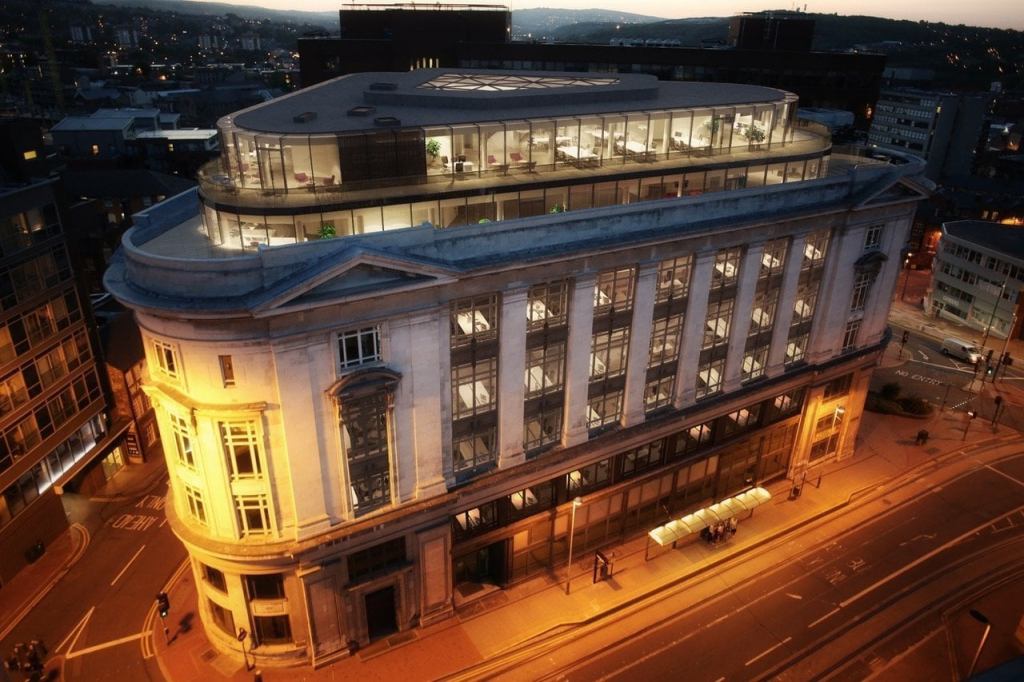
Let us not underestimate the importance of this building in the history of Sheffield. Completely gutted in the past few years, with office-space built around a central atrium and a glass roof extension, the outside of Grade II-listed Steel City House remains pretty much as it was in 1927.

This was once the Sheffield Telephone Exchange Building, occupying a triangular piece of land bordering Bow Street, Pinfold Street and Holly Street. I should explain that Bow Street later became West Street, the road we now associate with the building.

The origins of the building go back to 1879 when John Tasker, Mayor of Sheffield, opened the Sheffield Telephone Exchange, along with a dozen subscribers, later taken over by the National Telephone Company, operating out of Change Alley, and consolidating both companies on Commercial Street.

The General Post Office (GPO) took over the National Telephone Company in 1912, effectively nationalising the network, the beginning of one of Britain’s greatest technological developments.

As early as 1920, there had been a proposal for a telephone exchange system in Sheffield, including several new exchanges and the extension of underground cables to the city from London and other centres.

These were the days when making a telephone call meant speaking to an operator, who connected you with the recipient at the other end. However, times were changing, and talk was of a new automated exchange system allowing callers to dial a number direct.

In the end, the idea was postponed due to the long wait for new apparatus to be sourced, and it wasn’t until the latter part of 1921 that a decision was reached between the GPO and Sheffield Corporation.

As part of the agreement, a new central telephone exchange was to be built, designed by Henry Edward Treharne Rees (1871-1937), of His Majesty’s Office of Works and Public Buildings.

Work began on the site in November, oddly enough, the land prepared by the Co-operative Wholesale Society, and it wasn’t until March 1922 that the construction was really appreciated with the raising of the girded steel frame.

What followed was a long-protracted development, repeatedly held up by red-tape, and not helped by having to lay thousands of miles of cable across the city. This alone, originally estimated to cost £85,000, was held up because a ‘patching’ policy was used instead, whereby new sections of cable were laid down and patched to existing wires.

The Sheffield Central Telephone Exchange opened in March 1927, but not before about 10,000 subscribers had been visited to have the new system explained to them.

Sheffield wasn’t the first city to get an automated service, that honour went to Hull, but it was the largest and biggest conversion undertaken. It was joined by further exchanges at Attercliffe, Beauchief, Broomhill, Ecclesfield, Oughtibridge, Owlerton, Sharrow and Woodhouse.

The main entrance was at the junction of Pinfold Street and Bow Street (West Street). The basement was used for telephone stores and heating chambers. The first floor was used as offices and showrooms for the telephone service, with similar offices on the second floor, and third floor offices let out to tenants.

Nearly the whole of the top floor was occupied by a series of “selectors,” together with “change” machines and “ringer” machines for supplying power. Another machine automatically registered every local call made.

Shops were available to rent in Bow Street and Pinfold Street, and a Post Office was moved here from Church Street.

In 1930, Martin’s Bank (later Barclays) rented a large space at the rounded corner of the building, taking over the main entrance and becoming the anchor tenant until modern times.

The exchange lasted until the 1960s, when it was replaced with a bigger facility at Eldon House, on Wellington Street, the building given over to offices. It was refurbished in 1995 but soon became outdated and “not fit for purpose.”

Steel City House, as it had become, was refurbished in 1995, and underwent its biggest renovation in 2015, part of a £10million plan by Scott’s Developments, gutting the interior and turning it into a new-age office facility.