Categories
Buildings

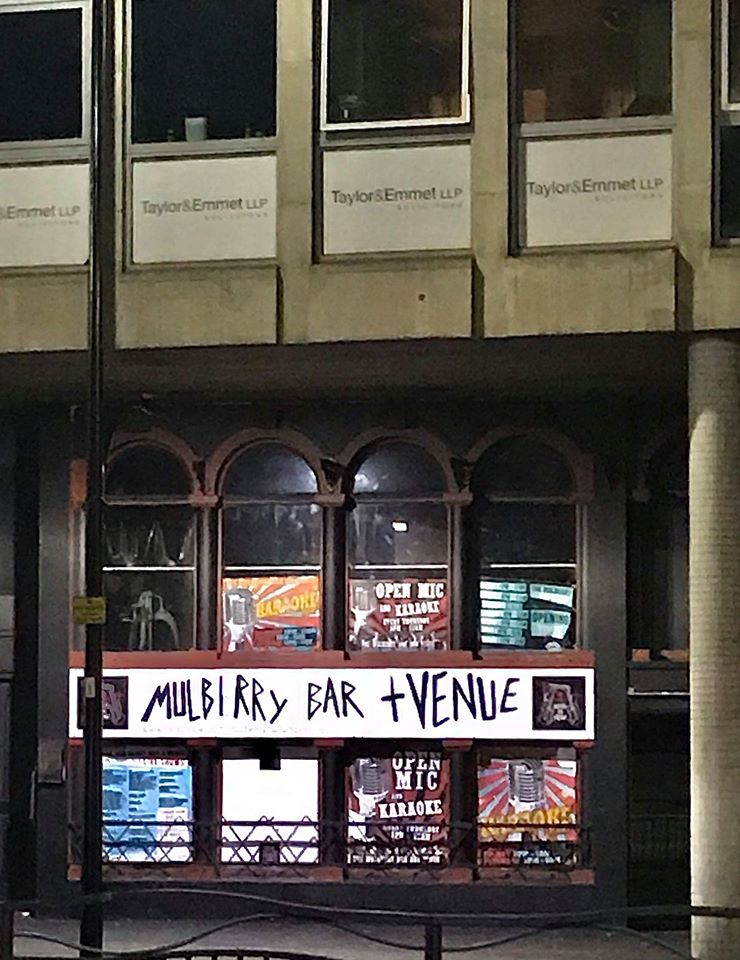
Mulberry Bar & Venue

The Mulberry Bar and Venue on Arundel Gate is making a few waves on the Sheffield music scene. It follows a few years of decline for the Mulberry Tavern, empty in the 1990s, later reopening as Affinity, a short-lived gay venue.

However, it’s the name of the pub that gives us a clue to the history of the site.

This 1970s reincarnation is named after the original Mulberry Tavern on Mulberry Street, behind Arundel Gate, reputed to have been Sheffield’s second-oldest pub after the Old Queen’s Head in Pond Street. In fact, photographs from the 1960s show it as being called The Ye Olde Mulberry Tavern.

According to Sheffield City Council, both Mulberry Street and the Mulberry Tavern were named after a tree that once stood here.

How long is it since mulberry trees grew in Mulberry Street, a very unlikely site for a tree of any sort?

There is no Mulberry Street on Gosling’s plan of 1736, but it duly appears on Fairbanks’ map of 1771. At the earlier date the area was made up of gardens between High Street to Alsop Fields, through which Norfolk Street was later constructed.

But we can bring the date a little earlier because, in 1757, John Wesley’s Methodists turned what had been a warehouse in Mulberry Street into a Preaching House.

The street had been made through gardens in which, no doubt, there were mulberry trees – a more popular fruit than it is today.

Categories
Buildings

Millennium Gallery

I wonder if the Millennium Gallery will become one of Sheffield’s iconic buildings.

Considering this is a modern-build, the white concrete construction appears to have settled comfortably into the hillside around Arundel Gate.

To understand the origins of the Millennium Gallery, we must go back to 1994 when the Heart of the City redevelopment scheme was initiated. Part of the masterplan involved building a new gallery, part of the new century celebrations, linked to a Winter Garden and the Peace Gardens above.

In 1995, a competition was held inviting architects to submit proposals, subsequently won by London-based Pringle Richards Sharratt. Although the Winter Garden might be easily recognisable, public response to the Millennium Gallery has remained positive.

When it was completed in 2001, the Millennium Gallery provided 1,800 square metres of exhibition space, including permanent displays of the Ruskin Collection and the city’s metalwork and silver collections.

The architects had to overcome the sloping topography of the site, creating galleries on the upper level over a service undercroft. Escalators lead to a first floor avenue, used as an indoor street to the Winter Garden, and access to five galleries on the left side.

Look up and you’ll see the barrel vaults of fine white pre-cast concrete, complete with columns and beams of the same material. Glass blocks in the avenue’s roof vaults and north wall provide diffused natural light.

The largest gallery, Sheffield’s largest exhibition space, is flexibly planned with moveable full-height screens that run parallel with the vaults. It is here that the Millennium Gallery has staged major touring exhibitions, such as those from the Victoria & Albert Museum and Tate Gallery.

The last of the galleries contains the Ruskin Collection, separated from the Winter Garden by a glazed wall, with glass panels by Keiko Mukaide, symbolising water and clouds.

John Ruskin established a collection of material he hoped would inspire Sheffield’s workforce at the St. George’s Museum, Walkley, in 1875. The collection of watercolours, drawings, prints, plaster casts, minerals, illustrated books, manuscripts and coins is owned by the Guild of St. George (and managed by Museums Sheffield) and has had several homes in the city.

Categories
Buildings

Pennine Centre

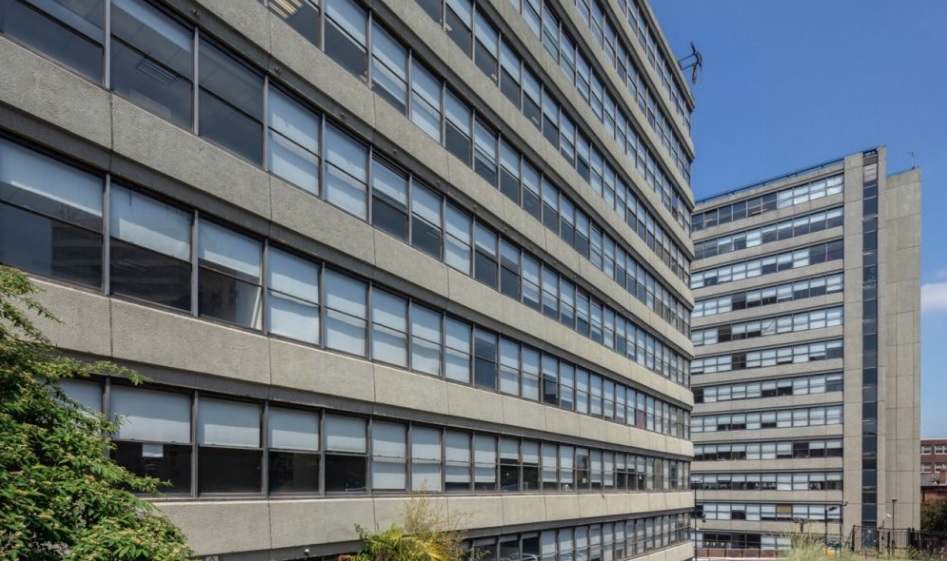
We’re now at that stage when those 1970s modernist office blocks need to start reinventing themselves. This is the case with the Pennine Centre between Tenter Street and Silver Street Head, Sheffield, built between 1973 and 1975, for the Midland Bank (now HSBC), and formerly known as Griffin House.

Opened to great fanfare in October 1976, the five blocks accommodated over a thousand workers, but changing market conditions eventually resulted in a reduction in staff numbers. When HSBC’s lease ended, it had already made plans to move to the smaller Grosvenor House, part of the Heart of the City II development, at Charter Square.

The tallest block at the Pennine Centre is 13-storeys (50 metres high).

The building, previously owned by US-based Kennedy Wilson, was sold for £18million to RBH Properties in the spring, which announced plans for flats and shops.

However, high conversion costs prompted the Portsmouth-based developer to rethink, the result being Pennine Five, the new name for the site.

The company plans to revamp all five blocks and let them to businesses, with potential to accommodate 2,500 people.

Within the development will be offices, co-working spaces, meeting rooms, cafes and restaurants, and by removing the ground and first floors of Block 4, will create a new public square. The site already has a four-storey underground car-park with 457 spaces.

Work on the five inter-connected blocks is scheduled to start in January 2020.

Categories
Buildings

Central Hall

The next time you settle into a seat at one of our multiplex cinemas, take a moment to consider that there are still traces of Sheffield’s original cinema.

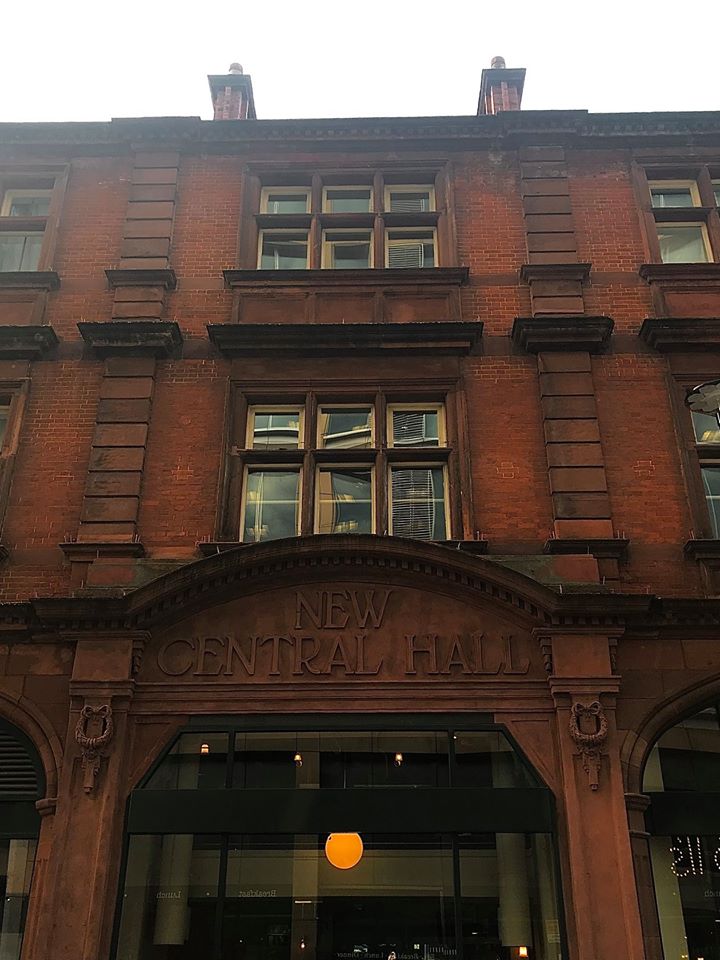
Head down to Norfolk Street, and look at part of Brown’s Brasserie and Bar. Above one of the plate glass windows is the name New Central Hall, the remains of a former decorative arched entrance.

This part of the building, just around the corner from St. Paul’s Parade, was built in 1899 by architect John Dodsley Webster as the Central Hall for the Sheffield Workmen’s Mission, established by Pastor A.S.O. Birch in 1880 at the old Circus on Tudor Street. (The building was constructed by James Fidler, contractor, of Savile Street).

The cost, exclusive of land, was about £4,000, made possible by a £3,500 loan from Mr F.E. Smith, “trusting those who will attend the hall to repay him when they can.”

The Central Hall had a frontage of 46 feet, the ground and first floors devoted to the main hall, which contained a gallery, and seating accommodation for 500 people. The second floor was occupied by five classrooms and an office, while the basement was taken up by a large kitchen and store-rooms.

It had been designed as a place of public worship; the Mission having previously held services at the Montgomery Hall on Surrey Street and opened in December 1899.

However, no sooner had it opened when, somewhat unexplainable, the Workmen’s Mission left and taken up residence at the Albert Hall in Barker’s Pool.

It was left to John Dodsley Webster to advertise the Central Hall as being available to buy or let on lease, “suitable for conversion to offices, flats or business premises.”

It wasn’t until November 1904 that we find evidence that the building was in use again.

Nelsons Ltd, “The Pensions Tea Men,” advertised that it was opening its drapery, ready made clothing and boot and shoe departments at Central Hall. It was another short-lived scheme, because in March 1905, the shop had gone into liquidation.

Nonetheless, there was somebody waiting in the wings who saw Central Hall as a long-term answer to a conundrum.

Henry Jasper Redfern (1871-1928) is almost forgotten now, but he packed a lot into a relatively short life. Here was a man who had made a fortune with a long list of business successes – “optician, refractionist, manufacturer of optical, photographic and scientific instruments, photographer, expert in animated photography and Rontgen rays, electrician and public entertainment.”

Born in Sheffield, Redfern trained as an optician, opened a business on Surrey Street, and later added a photography shop nearby.

However, he was more famous in the realms of cinematography, a subject he studied in its early stages, and became a pioneer in exhibiting moving pictures.

Alongside his daily routine, he toured the country with “Jasper Redfern’s world-renowned animated pictures and grand vaudeville entertainment” show.

Redfern decided that a permanent venue was required, and Central Hall provided a convenient solution.

In July 1905, New Central Hall opened to great flourish with the showing of the “Royal visit to Sheffield in its entirety,” shown twice nightly, along with a complete programme of live variety entertainment.

In the following months, there were screenings of more moving pictures, with titles like “Winter Pastimes in Norway” and “North Sea Fishing”, as well as resident acts, such as the two French conjuring midgets and songs by Madame McMullen and Lawrence Sidney.

New Central Hall attracted big houses twice a night, much to the dismay of Smith and Sievewright, clothiers, which occupied the shop next door, and took Redfern to court complaining that the queue of waiting patrons was detrimental to their business.

But, by 1912, the cinema was in financial difficulties, although its company secretary, Norris H. Deakin, found backing to improve amenities, increasing the size of the stage and adding a proscenium arch, and increasing seating capacity to 700.

Jasper Redfern & Company Ltd was wound up and replaced with the New Central Hall Company in early 1913, with Deakin as managing director. At what stage Jasper Redfern left is uncertain, but he emerged elsewhere in the country, his life story worthy of a separate post.

The tenancy of New Central Hall quickly passed to yet another company, Tivoli (Sheffield) Ltd, and the cinema reopened in January 1914 as the Tivoli, newly decorated and improved, with variety acts stopped a year later.

The Tivoli was a success but suffered a disastrous fire during the night in November 1927. Four fire engines raced to the scene, one using a new £3,000 ladder, and attempted to put out flames coming from the roof. However, parts of the roof were destroyed, the balcony was a charred mass, and the ground floor was a mass of burning woodwork.

The cinema was rebuilt and opened in July 1928 as the New Tivoli, completely refurbished with carpets by T. & J. Roberts of Moorhead, theatre furnishings by L.B. Lockwood & Co, Bradford, and lighting effects provided by J. Brown & Company, of Fulwood Road.

In the following decade, a Western Electric sound system was installed and because of a penchant for screening cowboy films, the New Tivoli was popularly known as “The Ranch.”

The curtain finally fell on the cinema on 12 December 1940, the result of Blitz fire damage. It was never rebuilt, the cinema area adapted for offices, restaurant and shop.

All that remains of the original Central Hall is its frontage, and the only nostalgic reminder of its cinema days being the stone-carved sign.
Categories
Buildings

St Paul’s 4

I’m sure a few people will remember the demolition of the Empire Theatre, on Charles Street, back in 1959.

The grand old theatre was replaced by shops and offices, bridging the gap between Union Street and Pinstone Street, the most beloved tenant being Sugg Sport that closed in 2000.

They say that today’s buildings are tomorrow’s history.

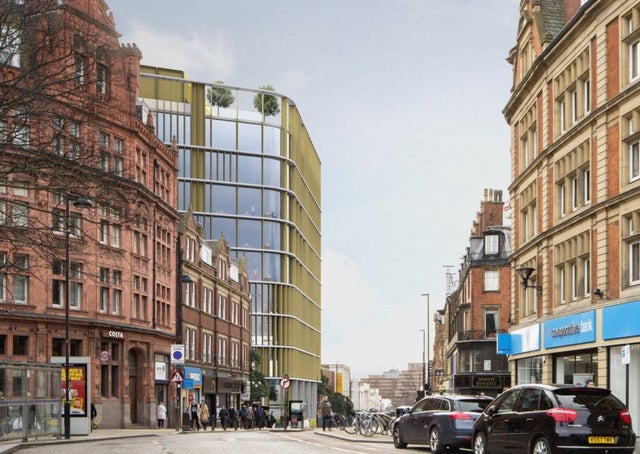
This will be the case if Manchester-based developer CTP eventually gets the go-ahead for St. Paul’s 4, a 10-storey office block, planned in place of this 1960s building.

The £35million scheme was proposed in June last year, when CTP wanted half of the building pre-let before launching the project. A pre-let – signing a tenant while a building is still on the drawing board – would then trigger a bank or financial institution.

Initial talks had taken place with Sheffield City Council, thought to be supportive of the development, and CTP stated that “demand for the project was so high that they were happy to forge ahead.”

A pre-planning application had been expected last autumn, but has yet to materialise.

The optimism for St. Paul’s 4 was based on Sheffield’s office take-up reaching a ten year high in 2017, when prime office space availability fell to its lowest level on record.

However, the update from CTP is perhaps less optimistic.

With several new office blocks completed in the city centre, the developer has now downgraded its status to “serious tenant enquiries.”

CTP has an excellent track record in Sheffield, being responsible for St. Paul’s 1,2 and 3, as well as the Mercure Hotel, Cheesegrater car-park and St. Paul’s Tower.

It promises that St. Paul’s 4 would “respect the heritage” of historic buildings in the area, and complement an adjacent 32-storey tower block, proposed for the site of Midcity House, at the junction of Furnival Gate, Pinstone Street and Union Street.

CTP has a ‘quasi joint venture’ with Schroders, an asset management company, that owns the land and building on the site.

If St. Paul’s 4 gets off the ground, then it will be one of the most significant changes to Pinstone Street in modern times.

Categories
Buildings

St Paul’s Building

Completing this week’s look around the Peace Gardens, we look at the elaborate building on St. Paul’s Parade, which runs between Pinstone Street and Norfolk Street.

This walkway once ran alongside St. Paul’s Church, demolished in 1938 and replaced with St. Paul’s Gardens, later Peace Gardens, and known as South Parade.

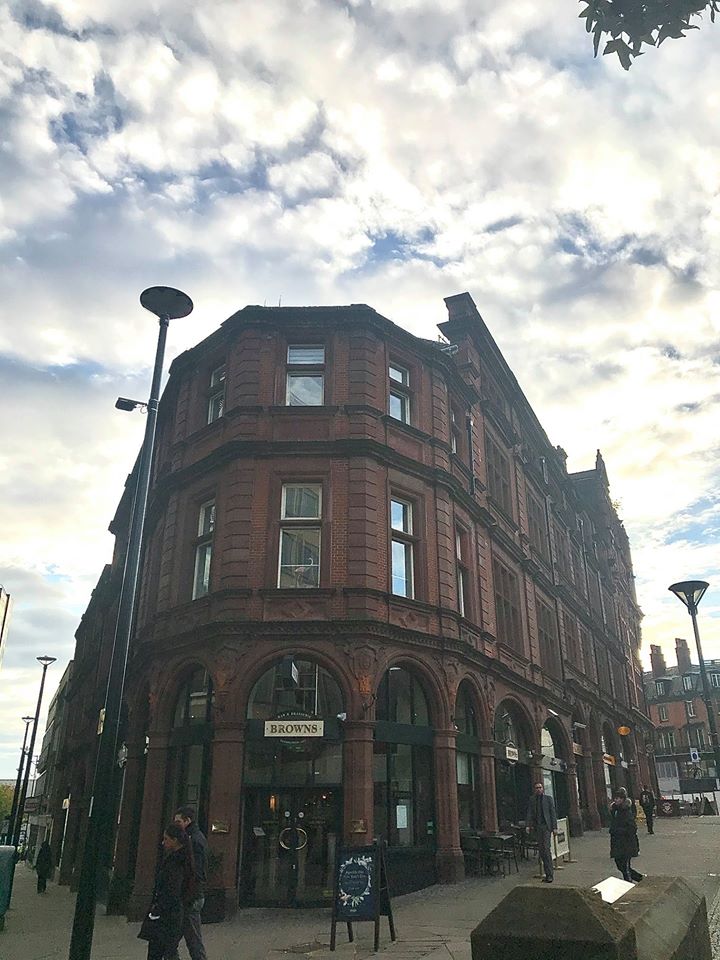
It was renamed St. Paul’s Parade in 1901, largely because of John Dodsley Webster’s new building that had just been completed, the second stage of a development that ran around the corner into Norfolk Street, started by the construction of the Central Hall for the Sheffield Workmen’s Mission in 1899.

Ruth Harman and John Minnis in Pevsner’s Architectural Guide to Sheffield (2004), suggest that the warm-coloured brick with red sandstone dressings, was an unusual combination for Sheffield, where the buff Yorkshire and Derbyshire sandstones were much more common.

The St. Paul’s Building comprised shops, offices and residential flats, along with a gallery and studio, although only the original facades remain following redevelopment behind.

It retains the arcaded shopfronts with carved stone piers and arches, with the faces of lions and rose, shamrock and thistle emblems still decorating the spandrels.

When it was completed, the building was home to James Moore’s Art Classes, which took place in a “beautifully lighted” new studio, its customers promised painting and drawing from live models, portrait and figure compositions, as well as flower and still-life subjects.

Over one hundred years later, the St. Paul’s Building, still retains pretty much the same use, although there have been unsuccessful attempts to have it demolished.

Had it been, the redevelopment of the Peace Gardens as part of the Heart of the City project, might have been very different.

Shops aplenty have occupied the ground floor, the most famous being the Army and General Store, famously sited at its rounded corner with Norfolk Street, later occupied by the Ha Ha Bar, and now Brown’s Bar and Brasserie.

There can be no denying that this area is one of the city centre’s most attractive, St. Paul’s Building sitting comfortably alongside the Prudential Assurance Building, built in 1895 on Pinstone Street.

NOTE: St. Paul’s Building is now referred to as St. Paul’s Chambers. However, when the building was constructed in 1901, St. Paul’s Chambers would have been associated with a completely different building, one that had been demolished to make way for the Town Hall between 1890 and 1897.

Categories
Buildings

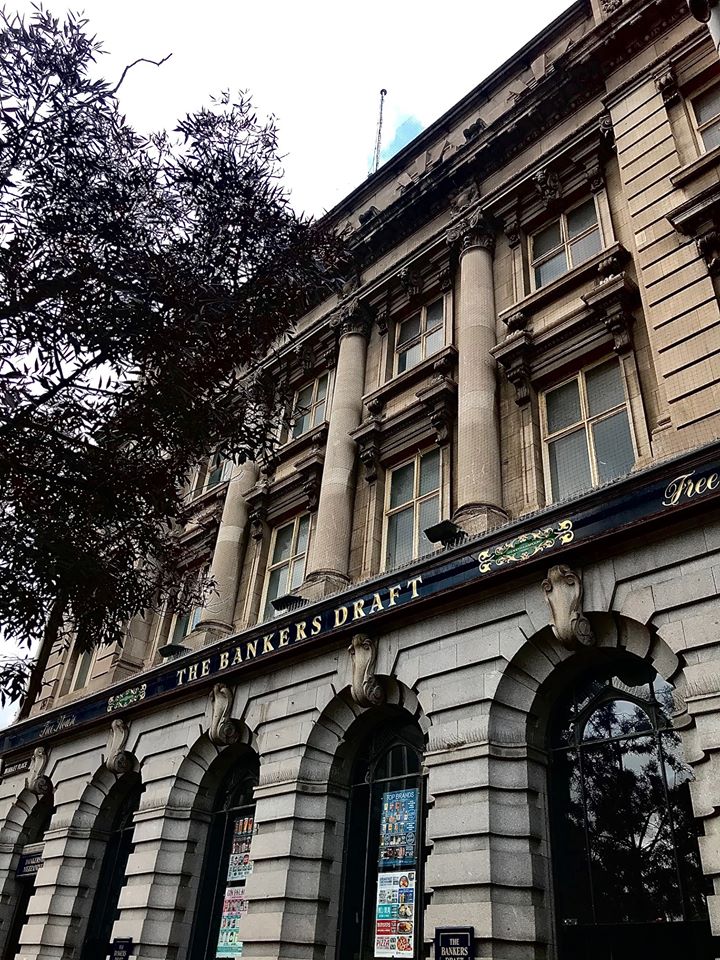
The Bankers Draft

This building stands in one of Sheffield’s most historic parts and survives in an area that has changed considerably in the past eighty years. Thanks to the Blitz, the Hole-in-the-Road and Supertram, the environs show no resemblance to the day it was constructed.

These days we know it as The Banker’s Draft, a Grade II listed building, in Market Place, one of the first J.D. Wetherspoon pubs to open in Sheffield, but its origins goes back to the turn of the twentieth century.

In the old days, the three landmarks of Sheffield were the Castle, the Market Place and the Parish Church. When tradesmen recognised the Castle as less than a means of protection, they started clustering around the Market Place (or The Shambles), a place where they could face anyone proceeding towards the church, by means of High Street.

Markets had been held here since 1296, and its original buildings were replaced with picturesque timbered latticed gabled properties about 1752, and again around 1812.

Once, amidst the atmosphere of drapery, leather, grocery and hats, the place had a banking tradition, one that repeated itself later. Hannah Haslehurst and Son, departing from ancestral grocery, founded The Sheffield Old Bank on this spot, but it collapsed in 1785.

In 1901, the Market Place area was described as ‘an aching void,’ sharing the fate of similar early 19th century buildings, the homes of humble traders, that were demolished to make way for the York City and County Bank.

The bank was designed by Walter Brierley (1862-1926), a York architect, described as being the ‘Yorkshire Lutyens’ or ‘Lutyens of the North.’ He created 300 buildings across the north between 1885 and his death, mainly family mansions, churches, schools and banks. Brierley was also architect for North Riding County Council and the Diocese of York.

Construction started in 1901, the contractor being Sheffield-based George Longden and Son, and was finished in 1904.

Described as being Edwardian Baroque, built in Aberdeen granite and Italian marble, its interiors were lavish. A parquet floor was laid by the Acme Wood Flooring Company of London, with furnishings supplied by Goodall, Lamb & Heighway, manufacturers of high quality furniture, upholsterers and carpet warehousemen from Manchester.

Quite forgotten, is that the York City and County Bank had bought more land than it really needed. It rented out offices on the first, second and third floors, as well as the spacious basement (where remains of old stables can still be seen).

However, it was also proposed to build a first-class hotel next door, also designed by Brierley, that was never erected, probably the result of a long dispute with the council over its alcohol licence.

The York City and County Bank (established 1830) amalgamated with the London Joint Stock Bank in 1909, which itself merged with the London City and Midland Bank in 1919.

Despite the area being mostly destroyed during the Sheffield Blitz, the Midland Bank (as it became) survived unscathed, and remained open until 1989, before relocating to the end of Fargate.

Standing empty for a while, it was bought by J.D. Wetherspoon, operating as The Banker’s Draft ever since.

NOTES: –
Walter Brierley was the architect who designed several buildings in the village of Goathland, North Yorkshire, that were seen during the opening credits of ITV’s Heartbeat (1992-2010).

Market Place is now commonly known as Castle Square. However, Market Place is officially the paved area running in front of The Banker’s Draft, between High Street to Angel Street.

Categories
Buildings

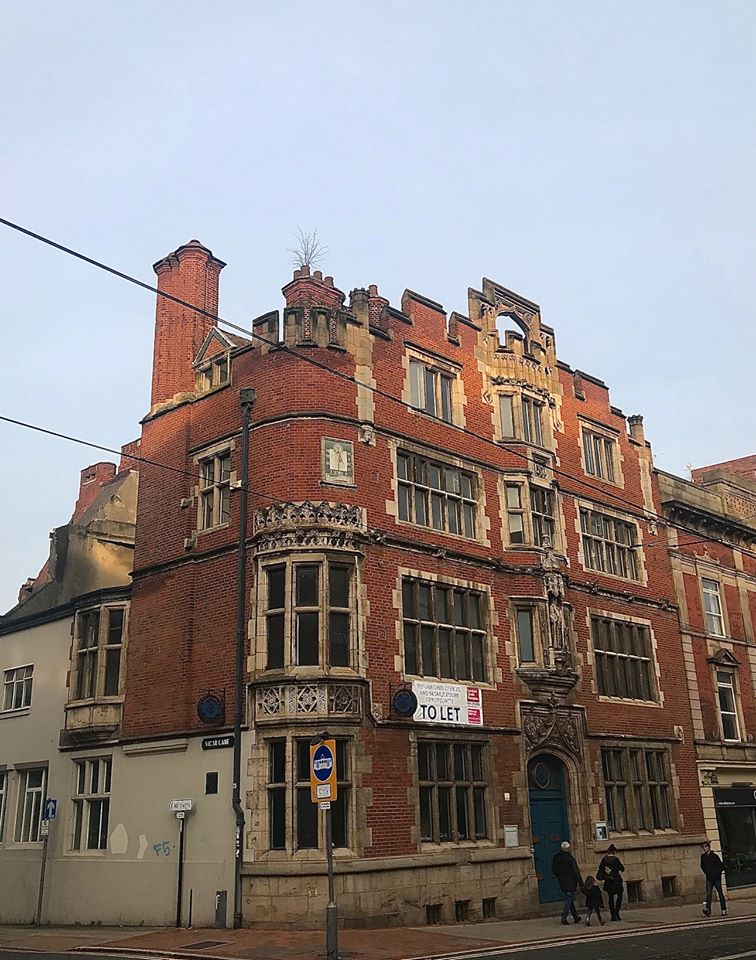
Cairn’s Chambers

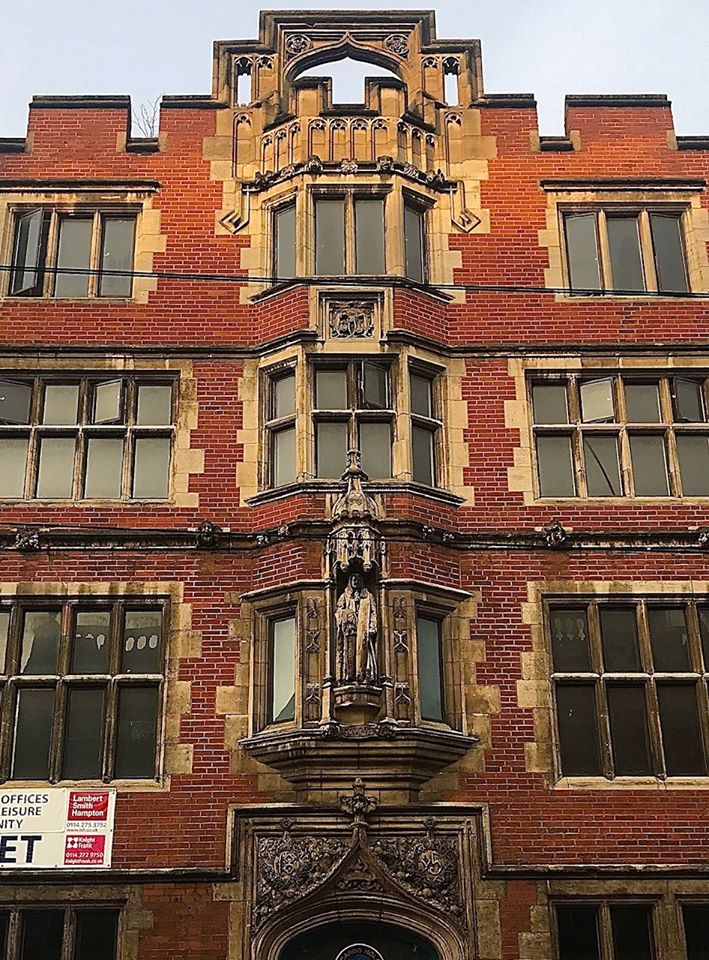
We pass this building on Church Street and probably don’t give it a second glance. This Grade II-listed property is looking unloved these days, its condition deteriorating. Look at the windows left open to the elements, and the tree growing out of the chimney pot. A sad reminder that this was an impressive and important Sheffield building.

Cairn’s Chambers was built between 1894-1896 by Charles Hadfield, of M.E. Hadfield, Son and Garland for Henry and Alfred Maxfield, solicitors. It was built in scholarly Tudor-style, a favourite of Hadfield’s, featuring decorative stonework by Frank Tory Sr.

The structure was described in Builder in 1897, as “very quiet and self-restrained, it also remarked that “this architect’s detail is always markedly good, particularly in the matter of scale.”

In 1916, Wilfrid Randolph, an architectural critic, considered Cairn’s Chambers as being one of Hadfield’s finest pieces. “Its quiet composition and detail, stands as an admirable application of traditional English forms to present day purposes, unspoiled by the straining after effect which mars so much contemporary street architecture.”

Henry and Alfred Maxfield occupied a large suite of offices, but it was also built to accommodate other businesses, a common trait of Victorian entrepreneurship.

The offices were used for almost 40 years by Charles Hadfield’s own company, C & C.M. Hadfield, architects, and later by Hadfield and Cawkwell. It was also where John Dodsley Webster, another Sheffield architect, had his office with an entrance at the back, on St James’s Street. Another long-serving tenant was Septimus Short and Co, a Sheffield agent for the Sun Insurance office.

The Hadfield company remained until World War Two, leaving after the building was damaged by a German bomb in 1940. The rear of the property was almost destroyed, but the decorative front survived.

Afterwards, Cairn’s Chambers became a branch of the District Bank, subsequently becoming NatWest until its closure.

The building stood empty for 15 years before the ground floor was taken over by Eua De Vie Leisure Ltd, which opened it as Cargo Hold in 2018, a seafood restaurant.

Alas, Cargo Hold closed earlier this year, the Cairn’s Building empty once again, and craving for a new occupier.

Categories
Buildings Sculpture

Cairn’s Chambers

We’ve already had a look at the history of Cairn’s Chambers on Church Street, a Grade II-listed building that has been empty for most of the past sixteen years.

Built between 1894-1896 by Charles Hadfield for Henry and Alfred Maxfield, an established Sheffield firm of solicitors.

Almost unnoticed these days, are the decorative features that emblazoned the building, and which survived a Second World War German bomb.

The stone carvings, at the front, were the work of Frank Tory and Sons, Sheffield-based architectural sculptors, operating from the early 1880s until the 1950s, consisting of Frank and his twin sons Alfred Herbert and William Frank.

The crowning glory of Cairn’s Chambers was the statue of Hugh McCalmont Cairns (1819-1885), 1st Earl Cairns, an Irish statesman, and Lord Chancellor of Great Britain. He became a Q.C. in 1856, Solicitor-General in 1858, and was knighted in May of the same year, becoming Attorney-General in 1866.

The statue looks extremely miserable these days, weather-beaten, covered with dirt, and with some parts missing.

As well as the statue of Cairns, the building also features a sundial, and the heads of the then Prince and Princess of Wales, later Edward VII and Queen Alexandra.

Categories
Buildings

Gladstone Buildings

Sheffield’s grandest street is in a state of crisis. Once a prosperous hub, the magnificent buildings around Church Street are at midpoint, as the shift in shop and office space moves towards the Moor and the edges of the city centre.

But things are cyclical, and these buildings will most likely prosper again.

One such building, caught in the transition, is 1 St James Row, a Grade II listing building, better known to generations as Gladstone Buildings.

This tall late Gothic block was built in red brick with sandstone dressings by Hemsoll and Smith in 1885.

To understand its history, we must acknowledge William Ewart Gladstone (1809-1898), British statesman and Liberal politician, who served for twelve years as Prime Minister, spread over four terms beginning in 1868, and ending in 1894.

In 1882, it was announced that a new Sheffield company had been formed. The Gladstone Buildings Company Ltd was set up with a share issue of £15,000 (later rising to £25,000), with the purpose of buying land and erecting a “central, inexpensive and convenient club” for Liberal-minded supporters.

The Sheffield Reform Club, as it would be called, would pay an annual rent of £150 to the company, contributing to the upkeep of the building, further supported by office space on its top floors and shops at ground level.

The company bought a plot of land for £5,000 at the corner of the Parish churchyard (now the Cathedral) and requested four designs to be drawn up. The chosen plan was by William Frederick Hemsoll and Joseph Smith, a Sheffield-based architectural partnership between 1881-1891.

Described as being “Domestic Gothic of 15th century-style,” its steep slate roof had a fine arrangement of dormers and spiky turrets with wrought-iron finials and cresting.

There were arcaded ground floor openings for shops, two floors with double-mullioned and transomed windows for the principal club rooms – a dining room for 100 people, reading and writing rooms, a reference library, billiards room and members lounge – with offices above.

One commentator from the time had high expectations:

“Politicians, if my experience goes for anything, are clubbable people; and the discussion of political questions is made none the less interesting when accompanied by creature comforts, and in a well-furnished, well-ventilated and well-lighted room.”

Construction started in 1884 and moved at rapid pace, blighted by the death of John Hodgson, a 17-year-old crane driver, who died when his chain suddenly stopped causing the crane to collapse. He fell onto an iron girder in the cellar, the crane falling on top of him.

Gladstone Buildings was completed in 1885, set back to allow a carriageway from St James’ Row into St James’ Street, and was officially opened by the Earl of Rosebery on Tuesday 20 October.

The Sheffield Reform Club continued until 1942, its demise no doubt putting financial pressure on The Gladstone Buildings Company, which was voluntarily wound up in 1946.

Gladstone Buildings was adapted for additional office space whilst retaining much of the old club and became a listed property in 1973.

It wasn’t enough to save it from threat of demolition three years later, thankfully averted and rebuilt as offices behind the façade by Hadfield Cawkwell Davidson and Partners.