Categories
Buildings

Yorkshire Bank

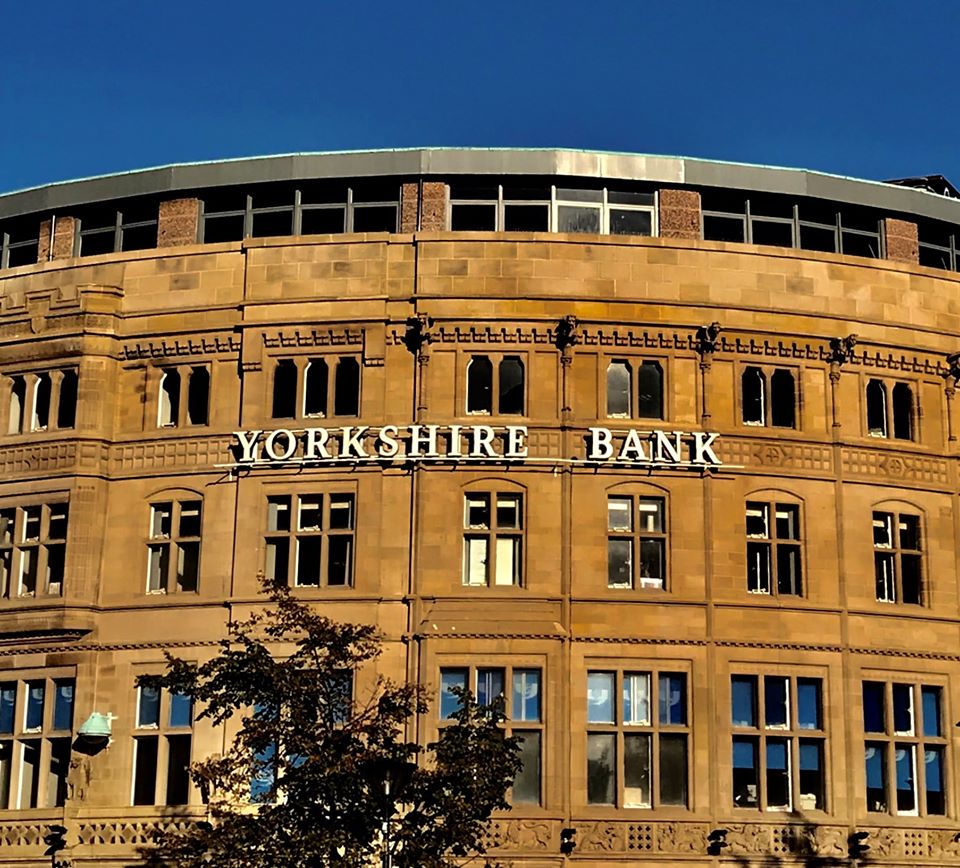
This is one of the most imposing buildings in Sheffield city centre. The Yorkshire Bank building, in late-Gothic design, with five-storeys and a long curved Holmfirth stone front, stands at the top of Fargate, nudging around the corner into Surrey Street.

With it comes a long history and a few surprises as to its former use.

In the 1880s, when a plot became available at the side of the Montgomery Hall on (New) Surrey Street, the directors of the Yorkshire Penny Savings Bank bought the land to erect a new bank.

It turned to Leeds-based architects Henry Perkin and George Bertram Bulmer who were asked to create a brilliant show of Victorian entrepreneurship.

The corner stones were laid on 18 January 1888 by builders Armitage and Hodgson of Leeds and was completed in the summer of 1889.

The Yorkshire Penny Savings Bank occupied two floors – at ground level was the large banking hall, fitted out in polished wainscot oak with a mosaic-tiled floor, the basement contained the strong-room.

Lord Lascelles, the president of the bank, officially opened it on 25 July 1889.

The remainder of the building was used as a restaurant and first-class hotel, leased by Sheffield Café Company, formed in 1877 as part of a growing movement of temperance houses throughout the country. No drink allowed here.

The Albany Hotel opened in September 1889 with electric light throughout, a restaurant, billiard room, coffee and smoking rooms, private dining rooms as well as 40 bedrooms above.

By the 1920s, the Sheffield Café Company, with multiple cafes and restaurants across the city, was struggling financially and ceased trading in 1922.

Their assets were bought by Sheffield Refreshment Houses, which operated the hotel until the 1950s.

With grander hotels nearby and with dated facilities the Albany Hotel closed in 1958.

The Yorkshire Penny Savings Bank became Yorkshire Bank in 1959 and the old hotel was converted into offices – known as Yorkshire Bank Chambers – after 1965.

The interiors have long altered but the external appearance remains much the same, with carved winged lions, medieval figures, shields and gargoyles on the outside of the building. Gabled dormers, lofty chimneys and a crenelated parapet were sacrificed during the 1960s.
Categories
Buildings

The Ruskin Building

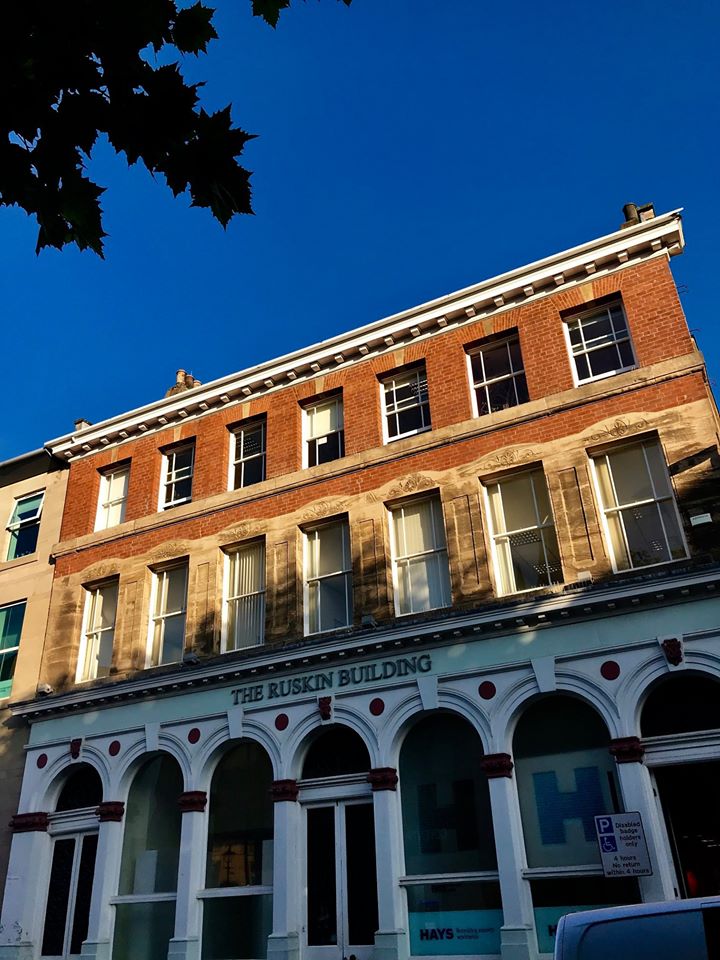
This attractive building at 97-101 Norfolk Street is known as the Ruskin Building. However, this was once the premises of one of the country’s leading wine merchants. Mr J.T. Gunn, a Sheffield merchant, originally opened a store at 47 Norfolk Street for the sale of Sicilian produce. Wines and fruits from Sicily were attracting considerable attention in Georgian times so Gunn went directly to producers in Italy for supplies, and early in 1829 shipped his first cargo of produce from Palermo to Goole onboard a freight ship called the Cythia. His relation,

Alexander Hay, entered into the partnership in 1849 , and in 1871, his son, Captain Charles H. Gilbert Hay (1850-1925), took over the management and expanded the firm’s connections abroad in America, West Africa, Russia and the Far East. In 1876, Hay and Son, wine merchants, commissioned Sheffield architects Flockton & Abbott to construct new premises, the building we see today.

Captain Hay regularly visited wine-producing districts and carefully selected the best vintages, imported back home and distributed throughout the country. As well as being present on Norfolk Street, Hay and Son also opened premises on London Road, Deepcar, Eckington and Tinsley, as well as opening an office at Glasgow in 1905.

The Sheffield Daily Telegraph visited Norfolk Street in 1925 and reported that there were “thousands and thousands of bottles stowed away, three rows deep in some places, and leaving but a narrow pathway.”

Hay and Son continued until 1970 after which the building was vacant for a time. It was restored in 1985 when it became home to the Ruskin Gallery, displaying minerals, paintings, ornithological prints, drawings, manuscripts and architectural plaster casts, assembled by John Ruskin (1819-1900), the Victorian art critic, draughtsman, watercolourist, social thinker and philanthropist. The museum closed in 2002 and is now located at the Millennium Gallery.

These days the building survives as offices, ironically its biggest tenant being Hays Recruitment, with no connection to the wine merchant.

Categories
Buildings

Sheffield Citadel

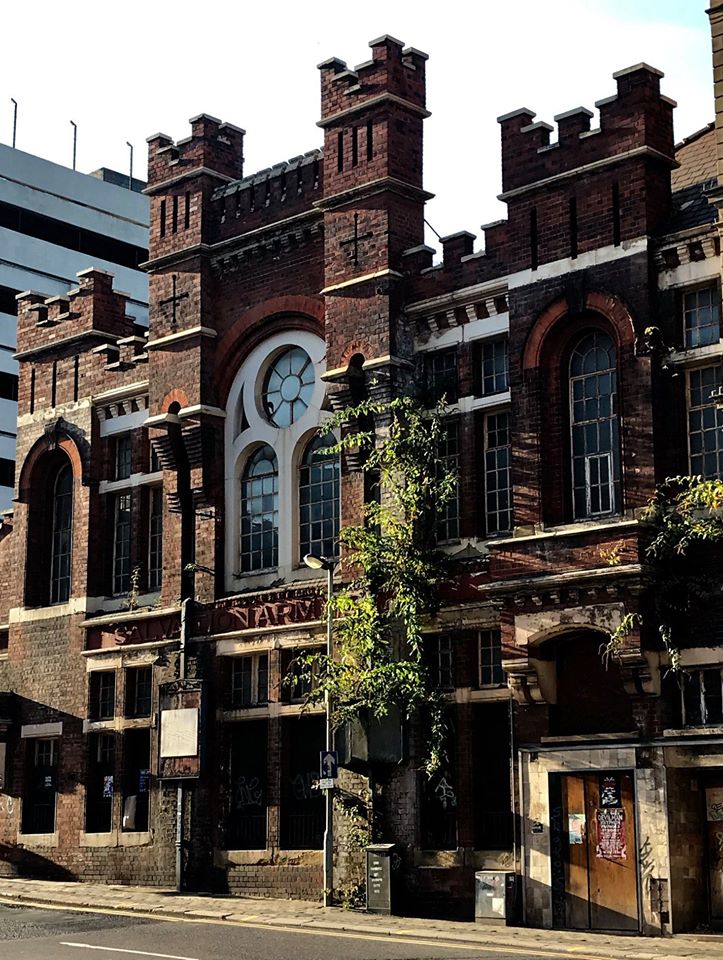
This photograph says it all. Trees and bushes growing out of the brickwork of the Grade II-listed Salvation Army Citadel on Cross Burgess Street, Sheffield. A favourite of urban explorers, this remarkable looking building has stood empty since the Salvation Army moved to Psalter Lane in 1999. The building’s future looks a little brighter, with Tandem Properties currently awaiting a planning decision to turn it into a bar and restaurant, the development forming part of the Heart of the City 2 project.

The Salvation Army arrived in Sheffield during 1878 and within three years had four halls attracting attendances of over 4,000 people. It was obvious that a bigger venue was needed for the No. 1 Corps which had previously met in a small building on Thomas Street. The London headquarters of the Army promised to fund the construction of a new meeting hall on the understanding that there would be a local contribution of £2,000. A piece of land on the junction of Pinstone Street and Cross Burgess Street was bought from Sheffield Corporation at a cost of £7,812.

The architect William Gillbee Scott (1857-1930), who had conceived the Gower Street Memorial Chapel in London, was asked to design the new Citadel along with shops and offices alongside. The foundation stones were laid in September 1892 with construction completed by the end of 1893. Its fortress-like appearance, with battlements and towers, lived up to the Citadel’s name. Completed at a cost of £25,000, the building consisted of a large hall, various rooms and apartments, with three large business premises on Pinstone Street, which were let almost immediately.

The main hall in the Citadel had seating for 2,000 people. At one end was a theatre-like platform with an orchestra behind. A main gallery occupied three sides of the hall with boxes sited at each end. An upper gallery was also situated at the back. In addition, there were ante-rooms, a band room for use of the brass band, and a large room under the orchestra accommodating another 300 people.

The Salvation Army Citadel opened in January 1894, spoilt by heavy rain, forcing the planned outdoor event to be adjourned inside. The ceremony started when the order was given to fire a volley, followed by a rousing rendition of Hallelujah.

The Citadel survived for 105 years, its popularity waning in time, resulting in its final departure to smaller premises at the end of last century. Admired by many, but seemingly unable to attract the right kind of developer, the building has been subject to several unsuccessful redevelopment plans.

Categories
Buildings

Bethel Sunday School

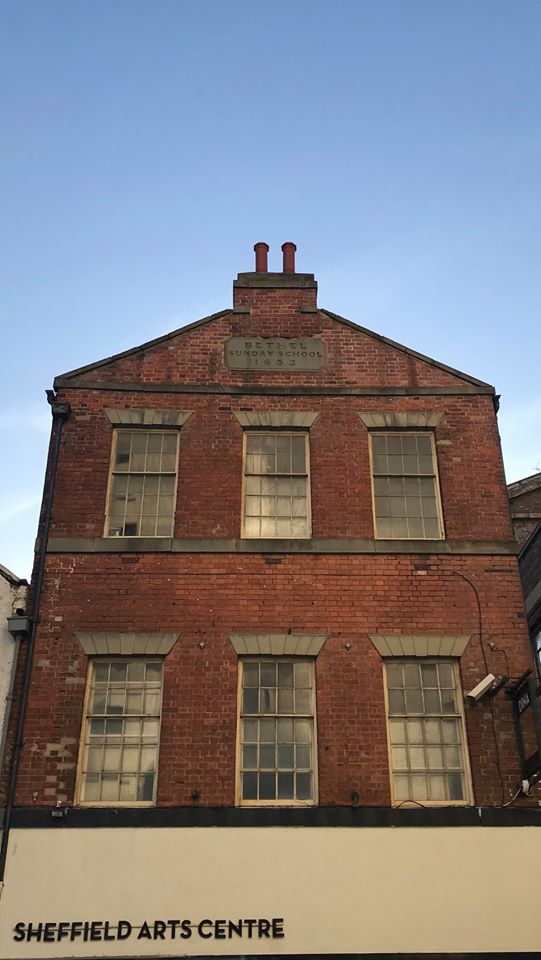
The origin of this building at 32 Cambridge Street can be seen on a stone plaque near the roof-line. It shows ‘Bethel Sunday School – 1852’. Presumably this was the date it was built and differs from its Historic England listing that claims it was built twenty years earlier.

To understand its existence, we must go back to the eighteenth century when Edward Bennet, a sugar-baker, funded a Methodist chapel to be built on Coal Pit Lane, which led to a pit towards the West Fields, abandoned because of the dangers of subsidence. In 1790, the church built a larger chapel on Howard Street and Coal Pit Lane was occupied by different Independent societies before standing empty.

Primitive Methodism was introduced into Sheffield at the end of the 18th century and made use of the redundant Coal Pit Lane chapel until 1835, when they built a new chapel (part of which still survives) on the other side of Bethel Walk. The old chapel was demolished, and the Bethel Sunday School was built in its place, accommodating over 500 scholars and were the means of educating and influencing thousands of children.

Coal Pit Lane, by the way, was renamed Cambridge Street when the Duke of Cambridge laid the foundation stone of the Crimean monument in 1857.

It is difficult to determine when the Methodists vacated the building, but by the 1920s it was being used as factory premises for Killeen, Rothwell and Company, men’s and boys’ cap manufacturers. Of course, later generations know it better as being part of Bar Centro, later The Cutler/Stardust Bar, opened next door in a former spoon factory.

At present it is occupied by DINA Venue, a hub for creative and digital space, with the former school known as Sheffield Arts Centre. It is astonishing that the building survived at all , but its Grade II-listing allows it to be retained in a future phase of the Heart of the City 2 masterplan.

Categories
Buildings

Queens Road

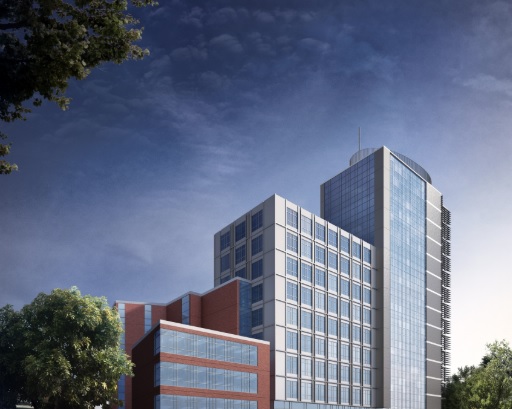
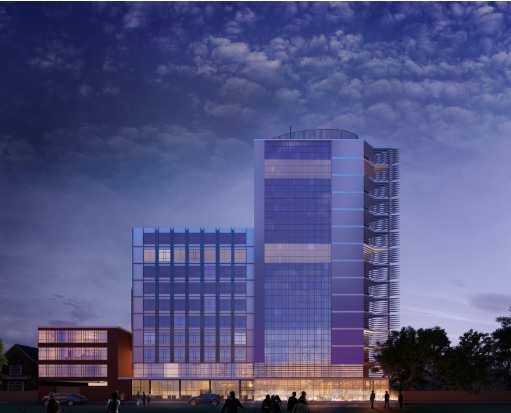
A new 15-storey building providing almost 250 student beds could be constructed in Sheffield if newly submitted plans get the go-ahead. DLP Planning, on behalf of Hermes Great Estate, has applied to Sheffield City Council for a development on Queens Road on the outskirts of the city centre. The applicant’s proposal is for a luxury development of studio and en-suite student apartments, to be known as Queens Court.

Approval is sought for the construction of three blocks, the tallest standing at 15 storeys. In total, 245 student bed spaces would be provided, with 37 six-bed cluster flats and 23 studios. A common room, gym, laundry room, reception space and office unit would be created on the ground floor, with a car park also provided for use by management staff and disabled students.

The site is currently occupied by Whitehall Financial Independent (WFI House), which would be demolished under the plans, and is opposite the Grosvenor Casino.

Categories
Buildings

Odeon Luxe

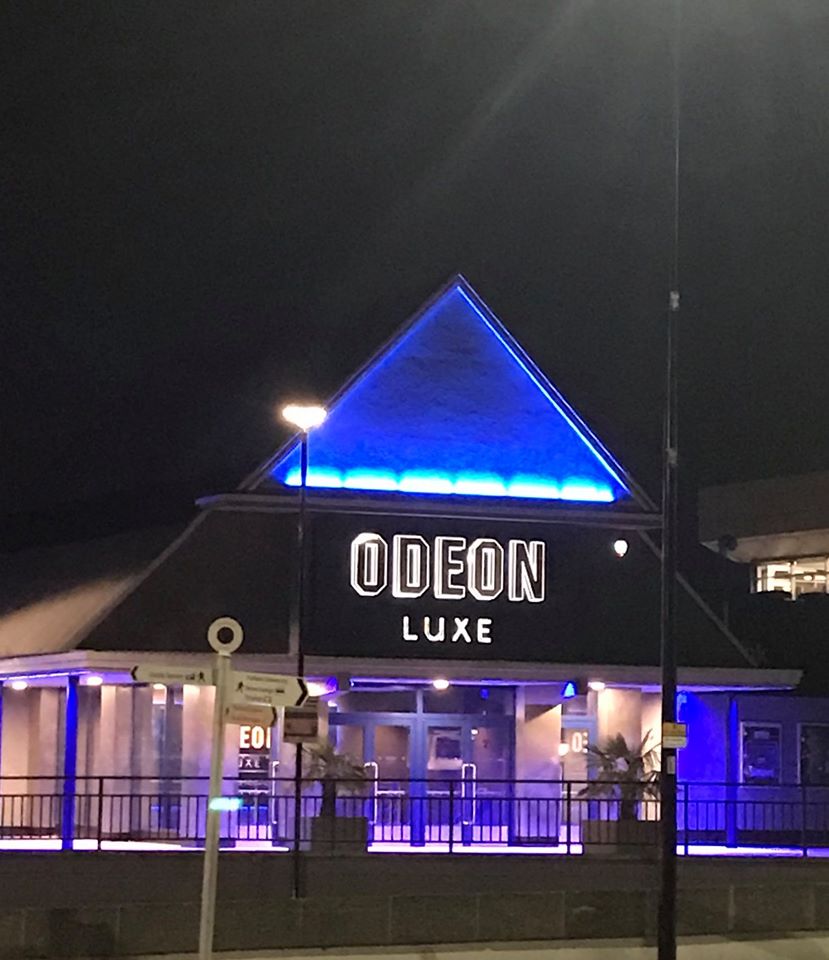
The cinema experience in Sheffield is reaching new heights with the opening of The Light and the recent makeover of the Odeon on Arundel Gate. Now rebranded as Odeon Luxe – “cinema like you’ve never experienced before” – it’s hard to believe this building was constructed in the sixties.

The history will be lost to a younger generation, familiar with the cinema and Tank nightclub alongside, but its beginnings go back to the Epic Development of 1968-1969, a massive £1million project to provide an entertainment complex for the city.

The scheme exploited the steeply sloping ground above Pond Street, rising to the newly-constructed inner ring road (Arundel Gate). With shops and car-parking below, it linked Pond Street bus station to the city centre by means of walkways, escalators and subways. The key features were two large windowless blocks, clad entirely in panels of white tiles, designed by Jefferson Sheard & Partners, responsible for the brutalist Moore Street Substation.

One of the buildings was taken by the Rank Organisation as a 2,500 capacity nightclub and conference centre, known to generations as Top Rank (later the Roxy, now the O2 Academy), while the other unit was proposed as another nightclub with twin cinemas underneath.

The Cinecenta cinemas opened in January 1969, but it wasn’t until the summer of 1970 that a cabaret club opened above. This was the Fiesta Club, operated by two brothers, Keith and Jim Lipthorpe, who had managed the Club Fiesta at Stockton-on-Tees since 1965. The cost of fitting out the building was said to be £500,000, a huge undertaking, and provided 1,300 seats in the auditorium.

It was reputed to be the largest cabaret club in Europe, building a reputation in attracting big names to the city. The Jackson Five, The Beach Boys, Roy Orbison, Stevie Wonder, Ella Fitzgerald and The Four Tops all played here.

And there were many famous homegrown names too – Cilla Black, Bruce Forsyth, Les Dawson, Tommy Cooper and Sheffield’s own Tony Christie – to name but a few. Legend suggests that Elvis Presley nearly appeared here, but alas it never happened.

For a time, the Fiesta Club was legendary, but the ever-increasing demands of artists and agents had taken its toll. In 1976, following a 17-day strike by staff wanting to join a union, the Fiesta Club closed with debts of £300,000.

After a spell in darkness, it reopened under the management of a Scarborough-based company, but when this also failed it passed into the hands of the Rank Organisation. Uncomfortable with such a large venue, it leased the Fiesta Club to a businessman who later disappeared.

The Epic Development never reached the heights it intended. Far from providing a link to the city centre, Arundel Gate was the problem, wider then, and only crossed by pedestrians via a series of subways. By the end of the seventies the area was already down-at-heel, the underpasses were dangerous places at night, the escalators had stopped working, and the shops were only attracting low-end retailers.

The lights finally went out at the Fiesta Club in 1980, standing empty until the Rank Organisation converted it into the Odeon multiplex cinema in 1992. Five of the seven screens were fitted into the shell of the Fiesta, two screens were taken in the former Cinecenta auditoriums, and extra screens added later.

Categories
Buildings

Telephone House

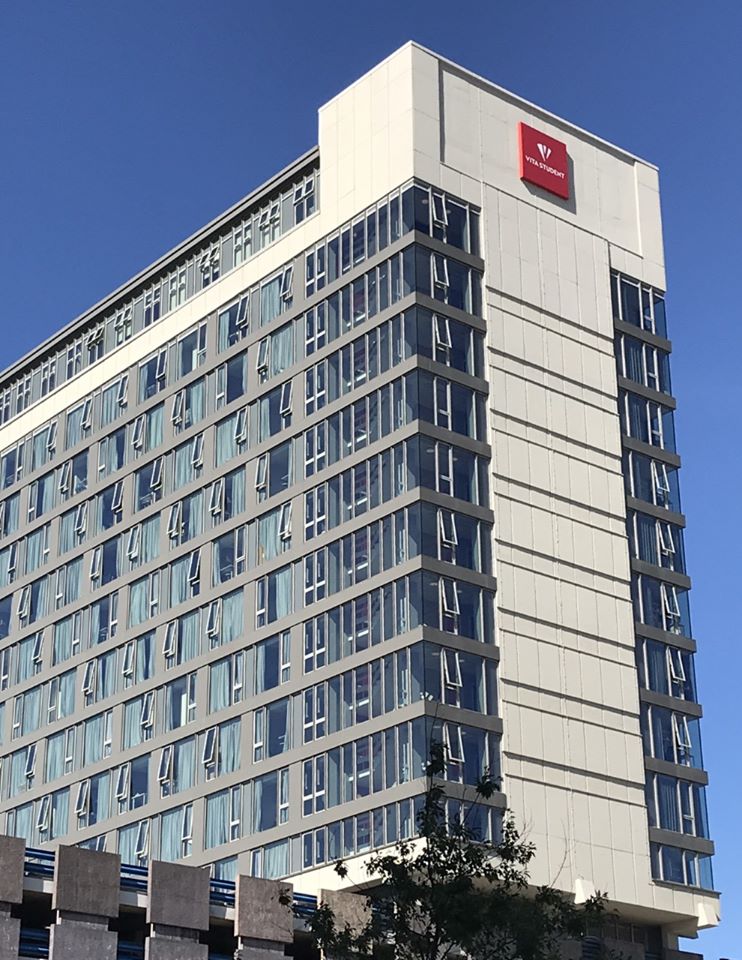
We all watched with interest when Telephone House on Wellington Street underwent mega-renovation a few years ago.

Sheffield’s thirteenth tallest building, standing at 56 metres, was typical of late sixties office blocks that leapt up around the country.

After World War Two, the city adopted a comprehensive redevelopment plan for the area between Cambridge Street and Upper Hanover Street. Part of this strategy allowed the General Post Office (GPO) to build a 15-storey glass-fronted block in place of old housing.

Building started in the late 1960s and was completed by 1972. It was used to manage the telephone network in the area while parts of the lower building included independent retail units as well as a multi-storey car park. Yorkshire Television (YTV) later installed technical equipment on the roof linking the studio in Charter Row to its Leeds studios.

Telephone House was subsequently re-badged with a huge BT logo when the GPO became British Telecommunications in 1980.

In 2012, BT announced it was closing Telephone House and selling the property to a business consortium, Ace Liberty and Stone, which intended to sell-off parts of the building to developers. BT vacated the building in October with the loss of around 400 jobs.

In March 2014, the tower block section, excluding the retail units and car park, were sold to Vita Student, a developer, which converted the offices into ‘high-standard’ apartments for students. The project started in July 2014, costing £35million, and involved complete refurbishment of the interior as well as an exterior facelift. A sixteenth floor was added containing 14 luxury penthouses and suites.

Work finished in August 2015 leaving Telephone House offering ‘the World’s best student accommodation’ – SMART TVs, big double beds and large kitchens – as well as communal facilities including cinema, entertainment areas, gym, laundry and a library/study area.

The accommodation isn’t cheap, anywhere between £176 to £260 per week – and has appealed to foreign students, with deep pockets, attending both universities.

Categories
Buildings

Prudential Assurance Building

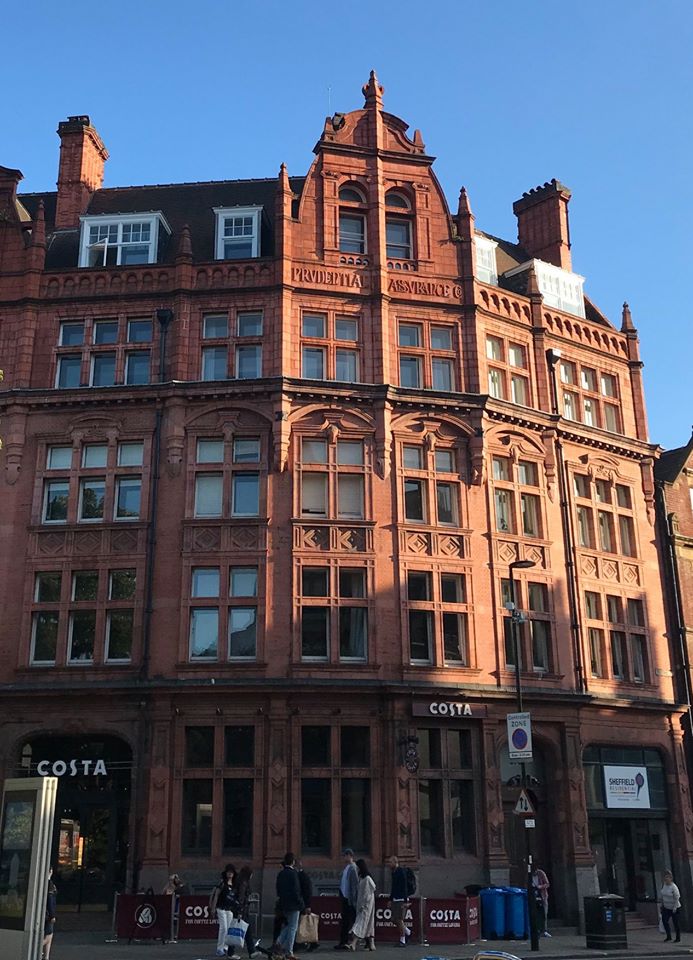
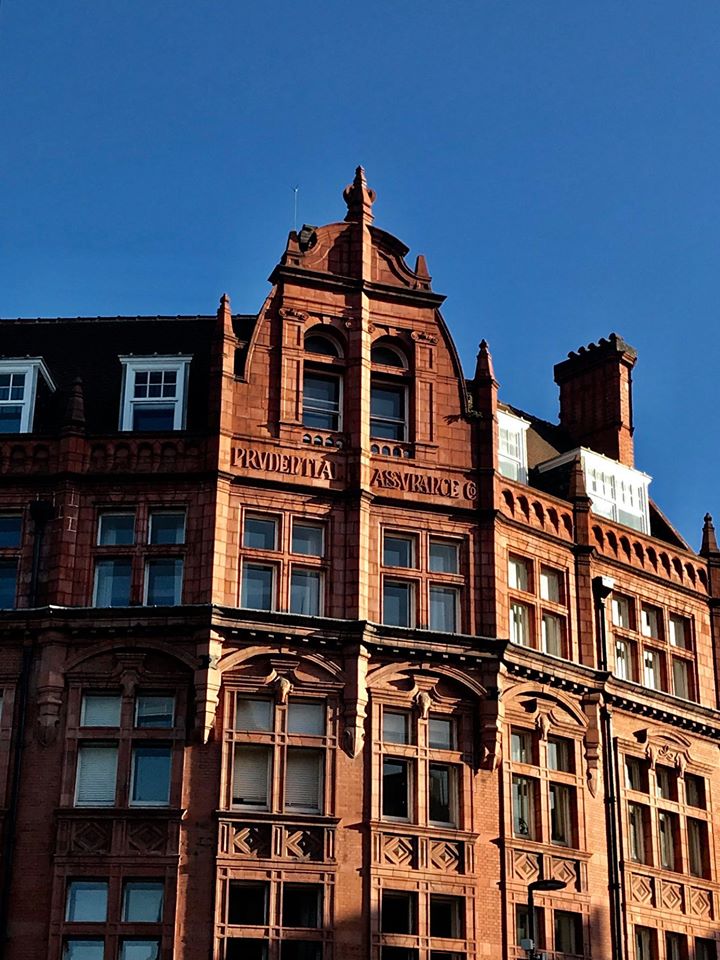
I think this is one of the finest looking buildings in Sheffield. Also, special because it was designed by Alfred Waterhouse, responsible for Manchester Town Hall and the Natural History Museum in South Kensington.

Looking into the history of the Prudential Assurance Building also reveals one of those ‘I never knew that’ moments – the fact that for twelve months, at least, part of it was used as a hotel.

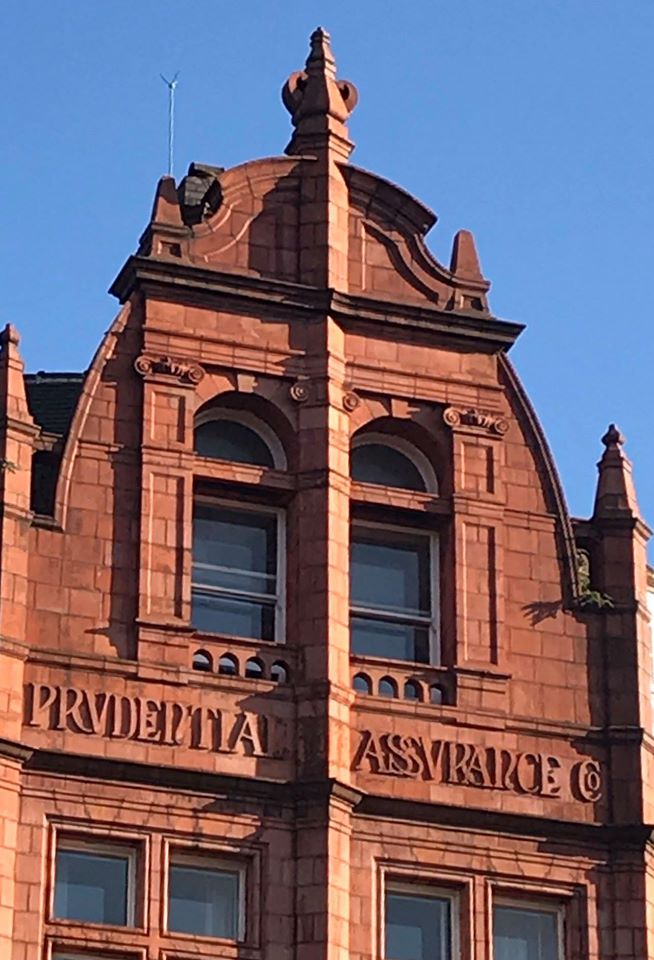
The Prudential Assurance Building is an imposing Grade II-listed property built in 1896 on Pinstone Street adjoining what was then St Paul’s churchyard (now the Peace Gardens). It was the latest in a series of constructions that appeared around the country, designed by Alfred Waterhouse and Son, London, for Prudential Assurance.

Often built in red brick with a granite plinth and the company’s favoured terracotta dressings from J.C. Edwards of Ruabon, these handsome Renaissance-Revival buildings were to be seen in London, Liverpool, Manchester, Leeds, Bradford, Glasgow, Birmingham, Newcastle, Portsmouth, Leicester, Dundee and Nottingham. The exception was Edinburgh, where the authorities objected to the use of terracotta and insisted on stone instead.

This was boom-time for the insurance industry. At the end of 1896, Prudential Assurance had twelve million policies in force within its industrial division – one third of the population of Great Britain – with a further 500,000 policies taken out at its ‘ordinary’ division. These generated a combined income of £7million and assets worth £27million.

The cost of the building and land in Sheffield was £25,000, a large sum but easily affordable for the company. The shape of the land also posed a problem resulting in the absence of corridors throughout.

The building contract was given to the Sheffield firm of George Longden and Son, work starting in 1896 and completed the following year.

There were two entrances.

On the left, a door led into the main offices, designed to impress the visitor, elegantly fitted and decorated. There was a glaced faciene from the Bormantoft Works and the fittings were Spanish mahogany and American walnut.

To the right, there was a staircase and lift leading downwards to a spacious restaurant tenanted by Mr William Bird, and upwards to offices (subsequently let off) and to a billiard and other rooms connected with the restaurant. A shop to the right of the door (still there) also formed part of Mr Bird’s tenancy.

William Bird, caterer and refreshment house-keeper had opened Bird’s Restaurant on (New) Surrey Street in 1895 (in part of the building most recently used by Halifax Bank). He took out a lease in the Prudential Assurance Building and, as well as opening another restaurant, created thirty bedrooms above, as well as coffee, billiard, sitting and commercial rooms – all under the guise of Bird’s Hotel.

The hotel lasted just twelve months, and in 1898 William Bird executed a deed of assignment, meaning he had to give up the property and contents for non-payment of rent to the Prudential company.

His restaurant on Surrey Street also collapsed in 1901 when receivers were called in.

In modern times, Prudential Assurance vacated the building, its ground floor converted into a shop for Laura Ashley, and latterly turned into Costa Coffee.

Categories
Buildings

Sheffield Town Hall

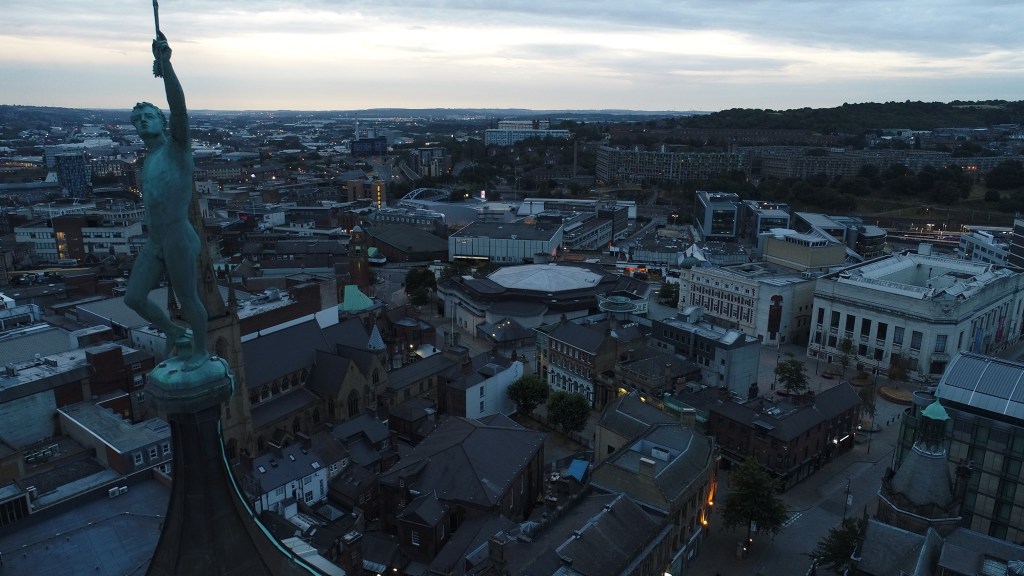
This extraordinary photograph was taken by Paul Stinson of Hovaloft Drone Aerographics. It shows the bronze statue of Vulcan on top of Sheffield Town Hall, created in 1896 by artist Mario Raggi.

This muscular male nude has protected the city for 123 years, seeing us through two World Wars, but almost forgotten by people below.

Darcy White and Elizabeth Norman in Public Sculpture of Sheffield and South Yorkshire provide the life story of this undoubtedly cold naked character.

Vulcan, the symbol of Sheffield, has a hammer in his right hand (not seen here), his right foot rests on an anvil and in his left hand, held aloft, he carries three arrows.

The Roman God of the furnace is the patron of all smiths and other craftsmen who depend on fire. He was adopted as a symbol of the city in 1843 and the idea of including a figure as part of the Town Hall design came from the architect, Edward William Mountford.

The figure was modelled from a Life-guardsman and for a long time the original plaster was on show at the Mappin Gallery until it became too badly damaged, due to frequent moving to avoid air raids during World War Two and was broken up and discarded.

Mario Raggi (1821-1907) was born at Carrara, Italy where he learnt to sculpt, although much of his reputation was made in England, where he first exhibited busts at the Royal Academy in 1878 and continued to do so until 1895. Settling in England in 1880, he set up a workshop at Cumberland Market in north London. He was given some major commissions; memorials to Benjamin Disraeli at Parliament Square and Gladstone at Albert Square, Manchester.

Categories
Buildings

Showroom Workstation

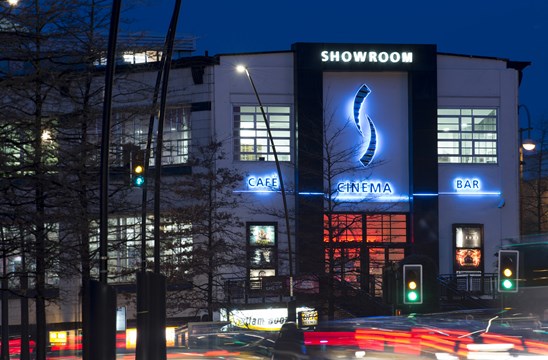
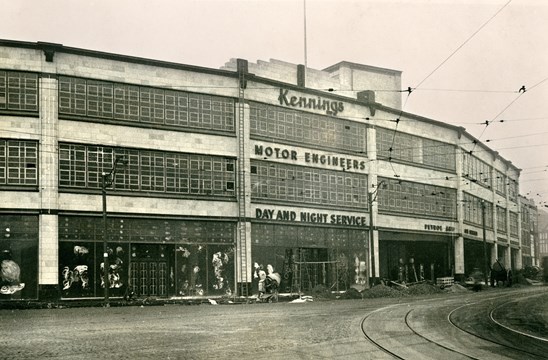
We all know this art-deco building as the Showroom Workstation, but to an older generation this was once called Kenning House. It was designed in 1936 by Frederick William Tempest, a Mansfield architect, as a garage and showroom for Kennings Ltd.

The building was officially opened in December 1937 by William Morris, 1st Viscount Nuffield, the millionaire founder of Morris Motors, and a friend of George Kenning (1880-1956), a Clay Cross businessman who started by hawking paraffin in Derbyshire villages, progressing by way of bicycles, motor-cycles and motor cars.

By the time this Sheffield garage was built, George Kenning was head of thirty companies, which owned between 30 and 40 garages, and was the biggest distributor of Morris Cars in the provinces.

The Sheffield Independent reported that Kenning House was “an imposing structure which struck a pleasing modern note with its cream faience intersected with black faience dressings.”

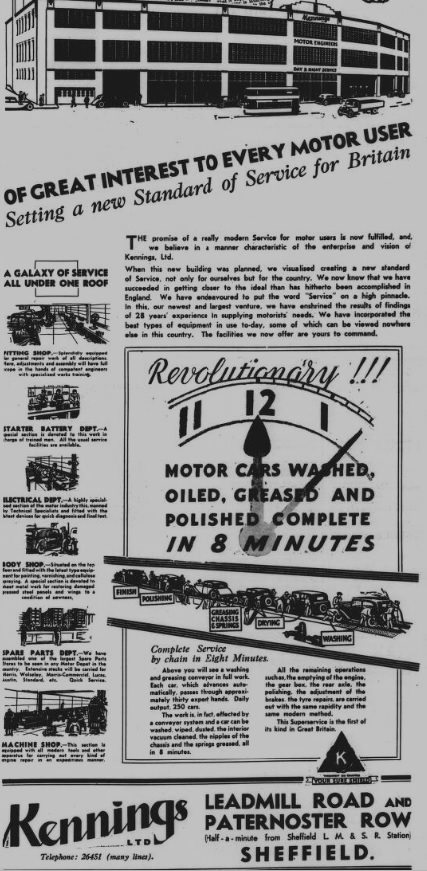
It was called Sheffield’s ‘wonder garage,’ designed “to show London, Paris, New York – the whole world, the way in garage development.”

The building was the brainchild of George’s son, Frank Kenning, built on three floors with frontages on two main thoroughfares. Two street levels had to be overcome in construction – the ground floor approached from Leadmill Road, the middle and upper storeys from Paternoster Row.

Kenning House had equipment never equalled at any garage in the British Isles. In addition to state of art repair bays, the ground floor contained a 126-foot long chain-driven car valeting line, manned by a squad of thirty men, washing and lubricating at a rate of one car every eight minutes. (A massive 5,000-gallon water tank was installed to service the plant).

“The businessman has no time or inclination to wash his own car and give it the attention by which alone he can expect a long life from it,” said George Kenning. “By this new equipment he can have his car serviced while he smokes a cigarette.”

At the end of the conveyor, a three and a half ton lubricating unit and flush-fitting lift was installed, while a covered petrol pump station was built near the main entrance.

Built at a cost of £100,000, this was undoubtedly Kennings flagship garage and showroom.

The huge structure, using 650 tons of steel, was designed, fabricated and erected by Plowright Brothers of Chesterfield. Construction was by C.H. Hill and Sons of Mansfield, while bricks were provided by the Woodside Brick Company on Chesterfield Road.

Hodkin and Jones supplied 20,000 pre-cast terrazzo tiles and the metal windows, ‘Eclipse’ patent roof glazing and lantern lights were provided by Mellowes & Co of Sheffield. Industrial lighting was installed by the General Electric Company.

In the 1960s a roof extension was added, but the garage closed in the 1970s, overtaken by out of town developments. It stood empty before Sheffield City Council bought the property in 1983, intending to develop the site as a long-term replacement for the Anvil Municipal Cinema at Charter Row.

In 1989, the ‘Showroom Project’ was launched by Sir Richard Attenborough, initial structural work starting the following year, with plans devised by Allen Tod and Tatlow Stancer.

Screens one and two were opened by Sir Sydney Samuelson, the first British Film Commissioner, in 1995, and two more screens launched by actor Pete Postlethwaite three years later.

The entrance foyer from Sheaf Square leads into an atrium created from the original vehicle lift to the first-floor repair shop.

Nearly a quarter century later, the Showroom Workstation continues to be an independent cinema, café bar and creative workspace, central to Sheffield’s Cultural Industries Quarter.