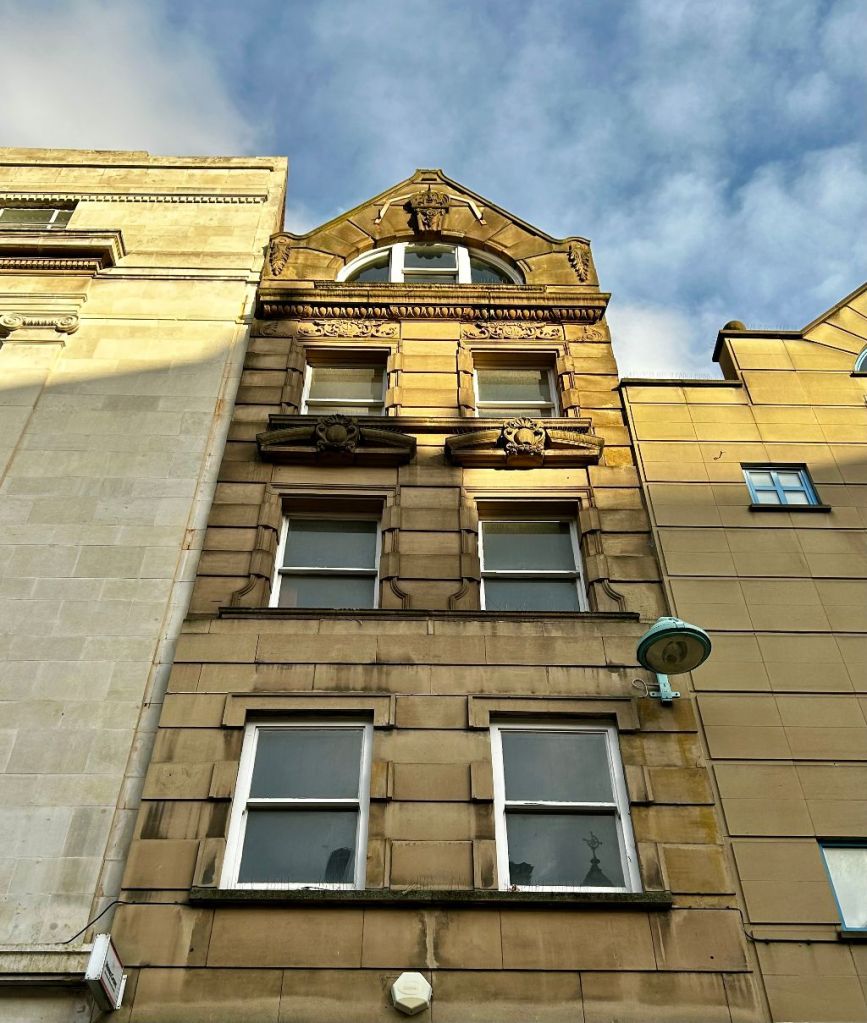
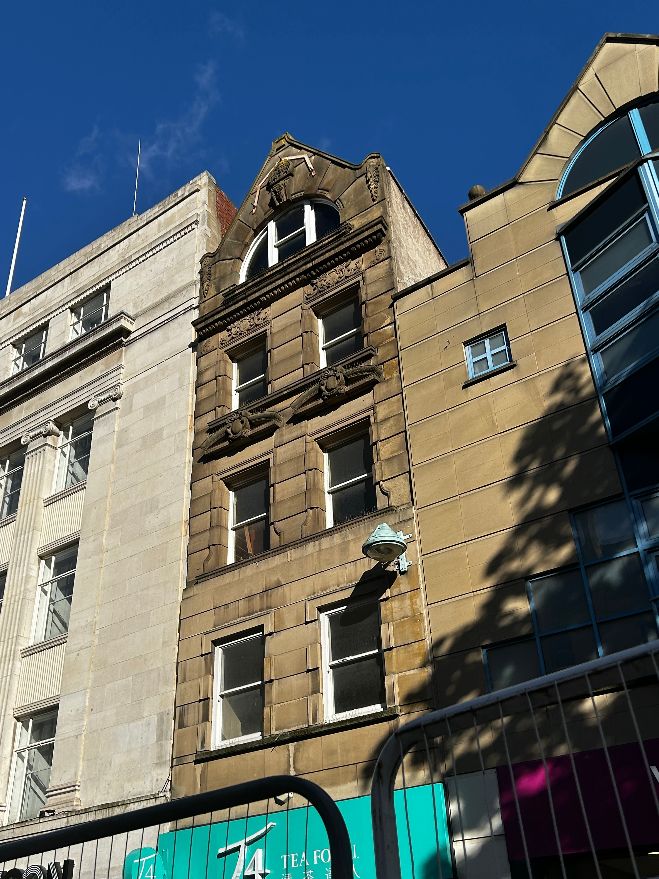
No.37 Fargate, a Victorian survivor. Image: DJP / 2025
If buildings could talk, they might be able to fill in the blanks. Like when this building was constructed, what the carvings on the outside mean, and might provide us with forgotten stories of the people who passed within its walls. It might also be dismayed to see Fargate as it is now.
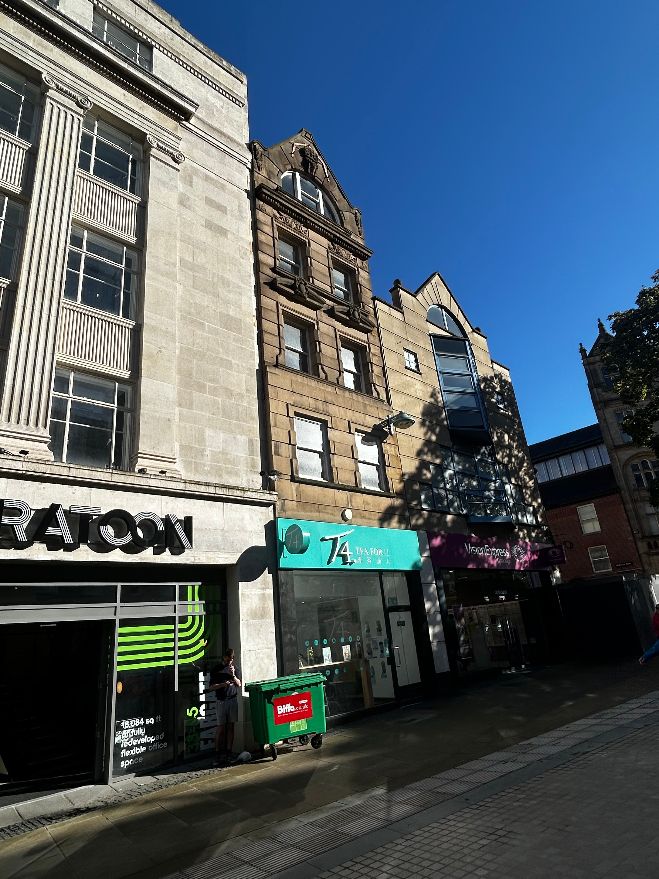
This is No. 37 Fargate, with its grand Victorian (or might that be Edwardian) facade, home to T4, a Taiwanese tea store, which opened earlier this year, and ended a few years of abandonment.
The interesting thing about the building is that it is sandwiched between two newer constructions, and the last in this block to survive street improvements from the 1890s onwards. Look up the next time you pass, and you’ll see what I mean.
The likelihood is that it was built for one of Sheffield’s wealthy entrepreneurs who snapped up this sliver of land as part of the street widening programme and enjoyed the rents that the ground floor shop provided.
The Victorians turned Fargate into a shopping street, and prior to this, the site had been home to businesses including the Misses Innocents’ hosiery and fancy goods store, Singer’s Sewing Machines, Bagshawe Bros, bicycle shop, and a brief spell as an auction house.
T4 – a Taiwanese tea shop that opened in 2024. Image: DJP / 2024
The property was likely built in 1903-04, and taken by Bonnet and Sons, who installed mahogany fittings, and turned two long rooms into a high-class cafe.
The business, founded in 1880 by Swiss chocolatier Louis Bonnet, had other concerns in Bath, Bristol, Scarborough, and Bradford, and specialised in freshly made chocolate and all kinds of French confectionery, catering for the ‘best class of people’ who were prepared to pay a moderate price for the delicacies.
“Bonnet and Sons are preparing special novelty boxes filled with these sweetmeats. The cases, attractive in character, have been brought from Paris and Vienna, but are filled in Sheffield immediately before their despatch to a customer, with the result that the chocolate and fondants are quite fresh. They are just the kind that go to ornament the supper table at a party or are delightful as a dessert. They are typically French. Two dozen of these petits gateaux are put in the boxes to retail at two shillings. The best way to obtain an opinion is to visit Bonnet and Sons’ Cafe where, together with a cup of delicious tea, coffee, or chocolate, the confectionery can be enjoyed.” – Sheffield Independent – November 1905.
The cafe closed in 1912, as eventually did the other branches, except for Scarborough, where astonishingly, the business survives under different ownership as Bonnets on Huntriss Row.
Between 1912 and 1922, the building was the Sheffield outpost for Van Ralty Studios, owned by Harry Wolff, a portrait photographer, with studios in Liverpool, Manchester, Nottingham, Oldham, and Bolton. Its work continues to be popular, the vintage postcards and photographs eagerly sought by collectors.
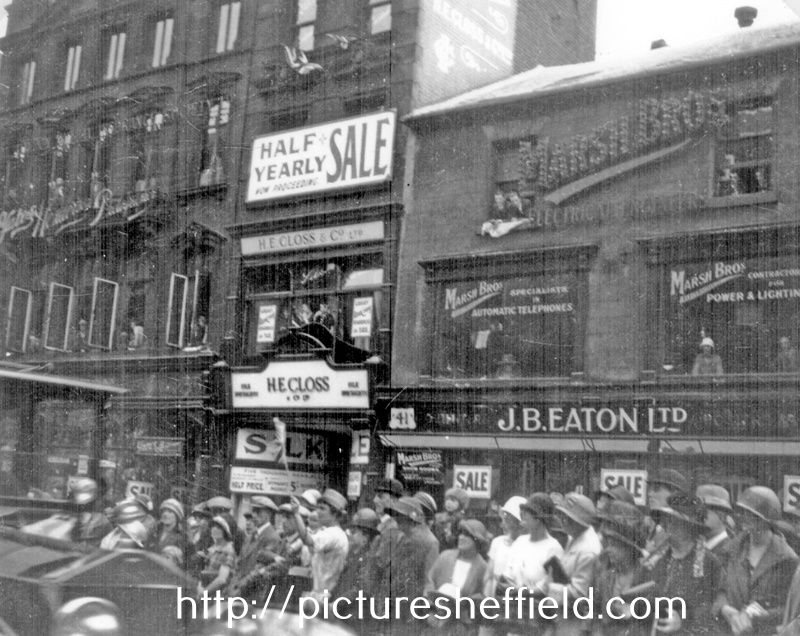
There are a couple of images in Picture Sheffield’s extensive collection that shows No. 37 Fargate belonging to H.E. Closs and Company, silk merchants. This was Harold Edward Closs’s first shop, but he quickly expanded with branches across the country. His buyers visited the Continent to choose the latest modes of colour and design, providing its shoppers with the latest silk fashions. It ceased trading in the 1930s, and Harold Closs set up a new business with Cyril Hamblin and still trades in the southeast as Closs & Hamblin (formerly C&H Fabric Specialists).
Unidentified royal visit passing Fargate, possibly Elizabeth, Queen Mother, 1934, shops include Nos. 41 – 43 J.B. Eaton Ltd., drapers and Marsh Brothers (Electricians) Ltd., No. 37 H.E. Closs and Co. Ltd., silk merchants, No. 35 Yates and Henderson. Image: Picture Sheffield
Next into No.37 was Thomas Cook, the travel agents, which turned out to be the building’s longest occupant, remaining here until its dramatic collapse in 2019. Although acquired by Hays Travel it closed soon afterwards.
Fargate always liked its eateries, but these gave way to shops during the latter part of the twentieth century, but, as one historian told me, history has a habit of repeating itself, with Fargate earmarked for leisure and hospitality.
No. 37 Fargate starts a new chapter as T4, its chrome and glass interior far removed from the days when Bonnet and Sons charmed the folk of Sheffield with fancy chocolates and cakes.
No.37 Fargate. With elaborate carvings at higher level. Image: DJP / 2025
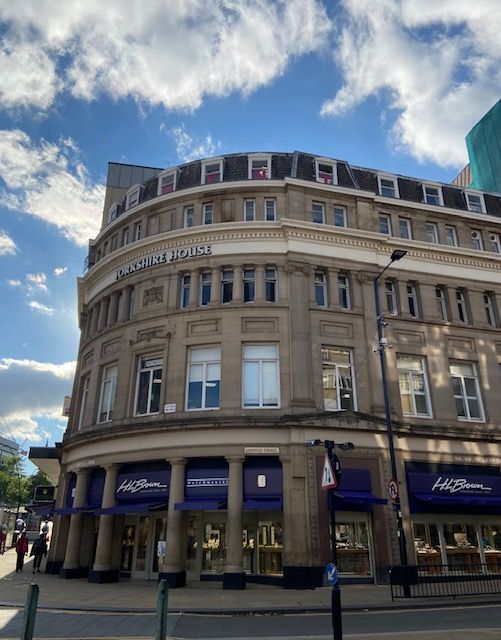
Yorkshire House, Leopold Street, Sheffield.The building has failed to get listing from Historic England. Much of the original interior has been lost in modern redevelopment.
This post is about Johnson and Appleyards, not many people will have heard of it, but that shouldn’t have been the case. Life is full of what ifs. What if things had been done differently? If they had been, then we might have been fondly remembering Johnson and Appleyards as we do Cole Brothers and Walsh’s.
Our story starts on 10 February 1909 when Councillor Walter Appleyard received a cable from Kobe in Japan. It was from his brother, Frank, and informed him that their older brother, Joseph, had died. The fact that it happened in a foreign country was no surprise because Joseph had travelled extensively to Australia, South Africa, and South America, and this latest excursion which started five months previous, had taken in Egypt, India, Burma , and China. The next stop would have been Canada before heading home.
The news might have suggested that this was the first stage of failure for Johnson and Appleyards, cabinet designers and manufacturers, upholsterers, decorators, undertakers, carpet warehousemen, colonial merchants, and exporters, but the decline had already begun, not that anybody had realised it.
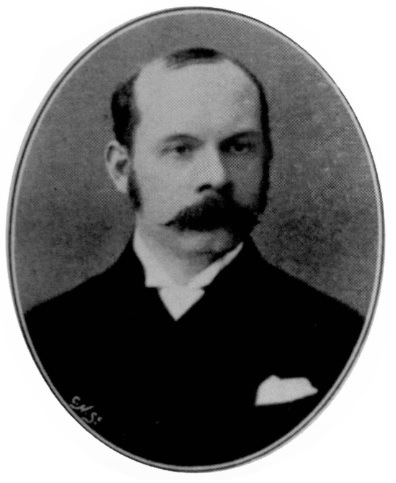
Joseph Appleyard (1848-1909)
The three Appleyard brothers, Joseph, Walter, and Frank were the sons of Joseph Appleyard, a Conisborough cabinet maker, who had a business until 1872, when he established J. Appleyard and Sons at Westgate and Main Street in Rotherham which the brothers ran.
In 1879, the brothers took over the Sheffield furniture-making business of William Johnson & Sons, with premises on Fargate, and renamed it Johnson and Appleyards. It was a bold move, but within a few years the business needed bigger premises to display its furniture.
They chose a prime site at the corner of Fargate and Leopold Street and employed architects Flockton and Gibb to design an impressive showroom built in Huddersfield stone with a mixture of giant ionic and stubby doric pilasters on its first and second floors.
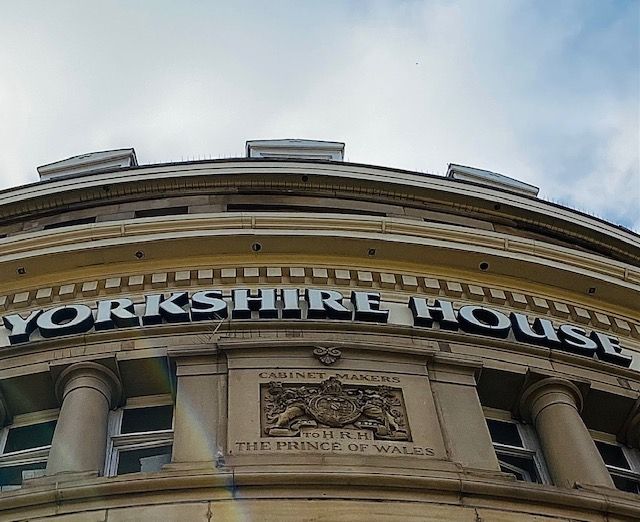
The building was completed in 1883 and survives as Yorkshire House, where Barker’s Pool (then an extension of Fargate) turns the corner into Leopold Street. The only remaining trace of Johnson and Appleyards is a stone plaque, high up, that states ‘Cabinet makers to HRH The Prince of Wales’. For some reason, the building has failed to get listing from Historic England, and we now know it as home to jewellers H.L. Brown.
The only remaining clue that the building was built for Johnson and Appleyards, cabinet makers, in 1883-84. Designed by Flockton & Gibb.
Johnson and Appleyards were the only firm to supply the complete range of domestic furnishings, selling their own furniture as well as famous names like Chippendale, Sheraton, Louis Quatorze, and Louis Quinze. In the basement, were showrooms for carpets, linoleum, bedlinen, and blankets. The ground floor held wallpapers together with general goods, along with the counting house, and stables and carriage/van sheds at the back. The first floor was dedicated to furniture with workshops behind, and on the second floor, further showrooms with draughtsmen’s offices and decorators’ shops to the rear. The third floor housed gilders’ workshops, polishers, upholsterers and bedding makers.
The purpose-built premises of Johnson & Appleyards, Sheffield, showing the additional story that was added in 1892
Johnson and Appleyards became a limited company in 1891, and the following year the building was extended, with an attic story and mansard roof built to create more retail and workshop space. At the same time, manufacturing was moved to a four-storey building on Sidney Street.
Johnson and Appleyards achieved national and international recognition with a ‘Prize medal awarded for Superiority of Design and Workmanship’ (York, 1879) and a gold medal award at the Paris Exhibition (1900).
There is a clue that business at Johnson and Appleyards had dwindled, because in 1906 the firm had moved to smaller premises next door on Leopold Street. While retaining ownership of the showcase corner property, it was leased at a handsome price to A. Wilson Peck & Co, wholesale and retail dealers of pianos, organs, and musical goods. (Wilson Peck – Beethoven House – another fascinating story for another day).
Joseph Appleyard (1848–1909), as senior partner, was the only brother to remain active in the firm, and although he remained a director, Walter had other business interests and would become Lord Mayor, while Frank had left by 1905.
Joseph’s marriage to Sarah Flint Stokes had given him eight children, none of whom had much interest in the business. Only two of his four sons, Joseph (1881-1902) and Harry (1876-1954) showed any enthusiasm. Joseph Jnr was employed by Wallis & Co, linen drapers, in Holborn, but drowned aged twenty-one in a boating accident on the Thames, while Harry, who had trained at Harrods in London and Maple & Co in Paris, joined the firm but left shortly after his father’s death. His other two sons joined the services, to avoid joining the firm and collaborating with their father.
A biography of Joseph Appleyard states that he was a strong conservative but had no desire to enter politics. He was a member of the King Street and Athenaeum Clubs, as well as being an affiliate at the Wentworth Lodge of Freemasons.
Julie Banham’s ‘Johnson & Appleyards Ltd of Sheffield: A Victorian family business’ (2001) hints that Joseph Appleyard was prone to violence and regularly beat his sons, while his wife turned to drink and became an alcoholic.
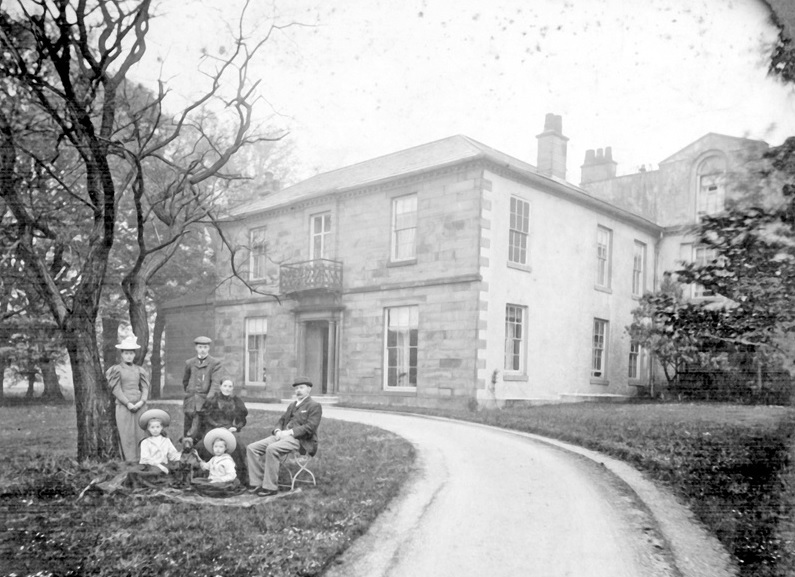
Mr and Mrs Joseph Appleyard (Managing Director of Johnson and Appleyards Ltd.) and children, in the grounds of The Beeches, Park Grange, off Park Grange Road, Norfolk Park (1899). Most historical records refer to the family living at Park Grange, a nearby house. Image: Picture Sheffield
The Drawing Room at The Beeches, home to Joseph Appleyard. Shortly before his death, the family moved to Broombank House, 7 Clarkehouse Road, Sheffield. Image: Picture Sheffield
All these years later, it is difficult to determine the type of person that Joseph might have been. At that time, newspapers filled columns with obituaries of local dignitaries, often shown in positive light, but Joseph’s death had little mention. Is this an indication that there weren’t any kind things to say about him? He was cremated in Japan and his ashes interned at Fulwood Church.
Johnson and Appleyards had built its reputation on Victorian tastes that lingered into the Edwardian period. But the new century meant styles had changed. On hindsight, the firm seemed reluctant to evolve with the times, and while sales dwindled, excessive capital was still taken out of the business to fund lavish lifestyles. After Joseph Appleyard’s death, the management team struggled to find a long-term strategy, and two world wars did nothing to improve its fortunes.
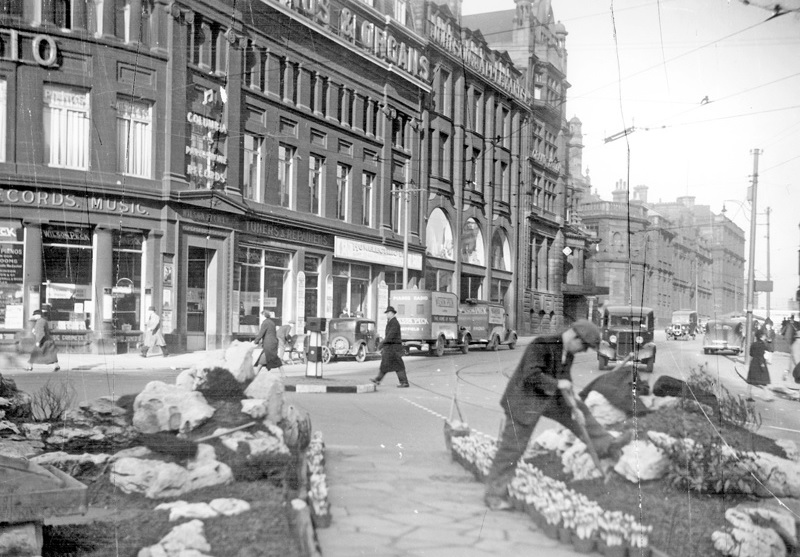
Town Hall Square Rockery and Leopold Street premises in 1938, including Grand Hotel, Johnson and Appleyards in their smaller premises, and Wilson Peck (left) that occupied the cabinet maker’s former premises. The building occupied by Johnson and Appleyards was later demolished and replaced with a new block. It stands approximately where the Bessemer bar is now. Image: Picture Sheffield
The end of Johnson and Appleyards was inadvertently caused by German bombs that rained on Sheffield during 1940. One of them destroyed John Atkinson’s store on The Moor and it was forced to seek alternative premises in the city centre. It bought all the shares in Johnson and Appleyards, if only to secure the Leopold Street building, and would remain until its replacement store was built on The Moor. The old Johnson and Appleyards shop would eventually be swept away, along with the Grand Hotel, to build Fountain Precinct in the 1970s.
Here’s the surprise. Did you know that Johnson and Appleyards still exists, if only in name? Its shares are registered to Atkinsons on The Moor.
First floor showroom at Johnson and Appleyards c.1900
Showroom of Drawing Room furniture c.1900
The Oak Showroom. Johnson and Appleyards c.1900. The company was responsible for furnishing many of Sheffield’s notable buildings, including the Town Hall and Cutlers’ Hall.
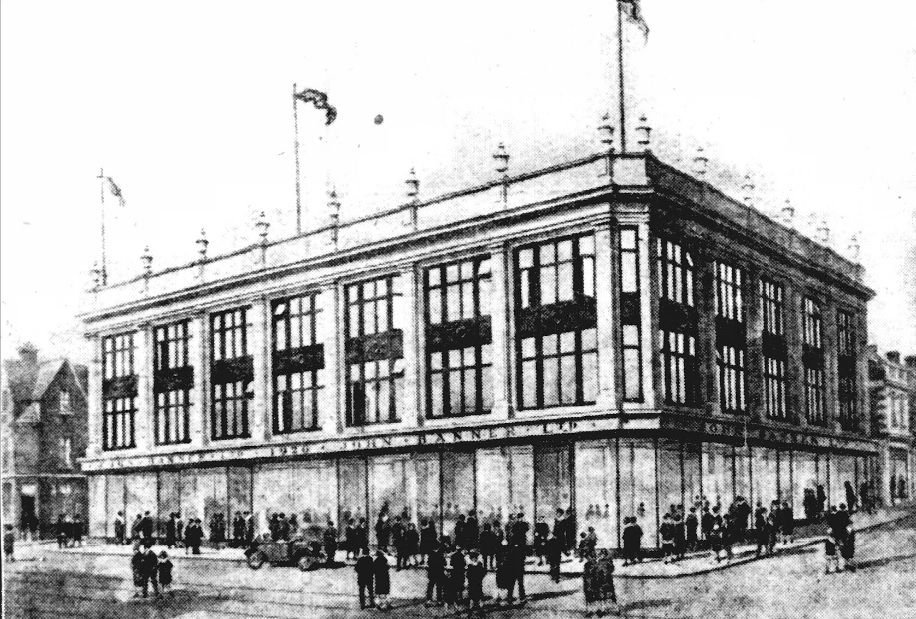
John Banner Ltd. Designed by Frank W. Chapman of Chapman and Jenkinson, Norfolk Row. Following his death, the scheme was finished under the supervision of Mansell Jenkinson and Eric Chapman. Image: British Newspaper Archive
The news that Leeds-based developer Citu has bought the John Banner building at Attercliffe is a major boost for the area. The regeneration of Attercliffe has been a long time coming, and with Kelham Island quickly filling up, developers are finally looking at this neglected part of Sheffield.
The developer already has plans for a nearby 23-acre urban regeneration scheme known as Attercliffe Waterside that will transform brownfield land either side of the Sheffield and Tinsley Canal into more than 1,000 homes.
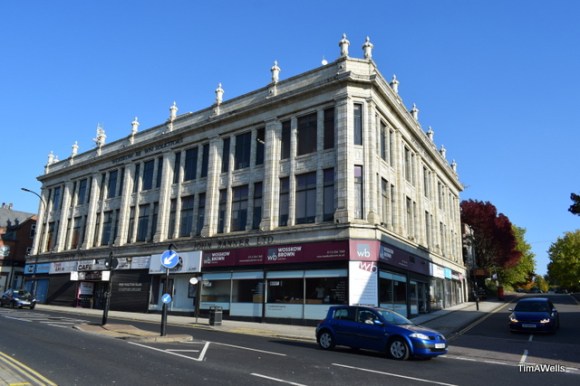
Citu has suggested that there will be ‘significant investment’ to restore the John Banner building, including the preservation of its façade to retain many of its original features. It is currently a mix of shops and offices with 25 occupiers including Co-op Legal Services, Sheffield Chamber of Commerce, Wosskow Brown Solicitors and EE.
More than once, it has been described as Attercliffe’s flagship building, but most of our younger generation will fail to see its significance.
It is named after John Banner (1851–1930) from Kimberley, in Nottinghamshire, who was eleven when his parents moved to Attercliffe. His first venture was a little shop which opened in October 1873, the same week that horse-drawn trams started to run between Attercliffe and Sheffield.
The millinery and drapery business were in what was known as Carlton Road, which together with the adjoining High Street, became Attercliffe Road. It was almost opposite what became Staniforth Road but was then known as Pinfold Lane reflecting the area’s rural aspect.
On the other side of the road were two houses, one with a large orchard attached, and fields stretched from the Zion Congregational Church. The pastor of that church was the Rev. John Calvert who occupied one of the two houses while a doctor lived in the other.
To get the business on its feet, John Banner worked elsewhere for five years while his wife, Sarah, looked after the shop. He eventually gave up his other job and came up with the slogan for his business, ‘The House for Value’.
Seven years after starting, larger premises were needed, and a move was made further up the street almost opposite what became the present building.
Fourteen years later, further development was necessary, and he crossed the road to the present site, building shops in the gardens of the two houses mentioned above that took up the corner at Shortridge Street.
Banner was joined by his four sons – Harold, Ernest, John and Cyril – each becoming co-directors after gaining experience, and two of his three daughters worked in the Attercliffe business, as well as at a new shop on Barnsley Road at Fir Vale.
When the opportunity arose, the intervening property between Shortridge Street and Baltic Road was purchased, including a shop which had once been Attercliffe sub-post office. These properties were pulled down and the building of a new shop commenced in 1928 that would fill the space between the two streets.
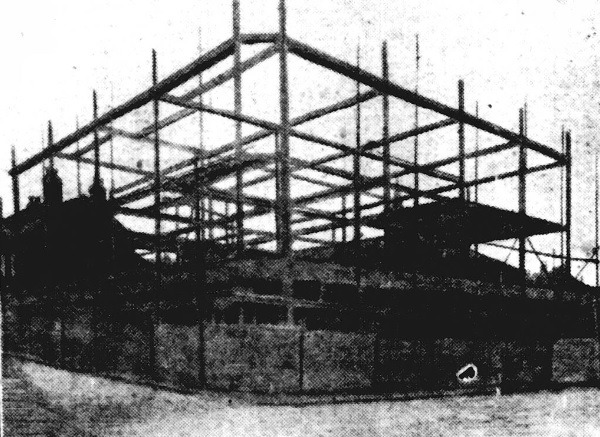
This photograph was taken by Robinson & Kershaw in 1928 and shows the steel framework looking from Attercliffe Road. Shortridge Street is to the left. It provides an important clue as to how construction was completed in two phases. The final addition, completed by 1934, would have been to the right looking towards Baltic Road. Image: British Newspaper Archive
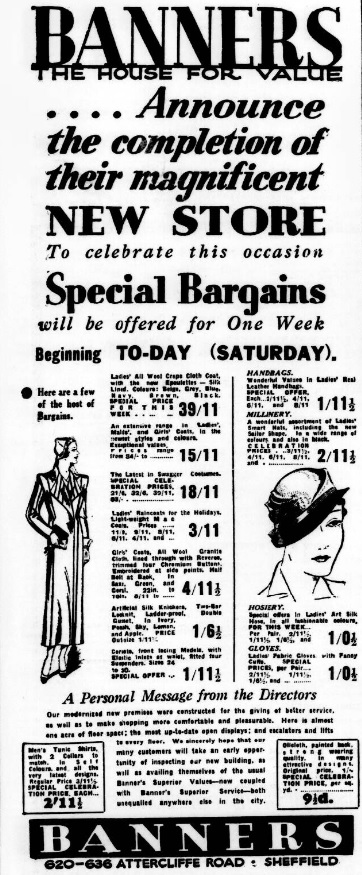
By this time, the range at John Banner had been developed to include ladies’, men’s, and children’s wear, boots and shoes, and kitchen and household utensils, china, pictures, prams, and fire screens.
It is worth mentioning that the new John Banner department store took six years to complete. It was built in stages and by the time it was finished in 1934 both its founder, John Banner, and its architect, Frank W. Chapman, were dead.
John Banner died at his home on Beech Hill Road in 1930 and was buried at Crookes Cemetery.
The design of the building was a modern phase of Renaissance, the elevations having pronounced pilasters which ran the height of the two upper storeys, carrying well-proportioned entablature with a parapet surmounted by handsome vases. The pilasters were sub-divided by similar pilasters and the breastwork between the floor filled with effective panelling.
The style of architecture lent itself to the clothing of the steel construction both in pillars and beams which supported the building, and the whole of the casing was finished in dull glazed grey terracotta.
It was built by T. Wilkinson and Sons of Midhill Road, and the steel frame was made by Robinson and Kershaw of Temple Ironworks, Manchester, who had been responsible for other Sheffield buildings including Glossop Road Baths, the Baptist Church at Hillsborough, and extensions to the University of Sheffield and the Royal Infirmary.
The entire frontage of the ground floor was devoted to window display, and a spacious arcade stretched over the whole of the Attercliffe Road frontage on which there were three main entrances. The shop windows were supplied by H.N. Barnes of Fulham with the floor of the arcade covered with marble terrazzo laid by Italian workmen.
The interior lights on all four floors were installed by H.J. Couzens of The Moor, and a novelty was the 300 shop window reflectors and on top of the building, ten attractive Flambean fittings, The first and second floor windows had handsome leaded lights supplied by T. Foster of Norfolk Street who were artists in stained glass and leaded lights.
John Banner Ltd. This photograph was taken shortly after completion in 1934. The project had taken six years and provided Attercliffe with one of its flagship buildings. Image: British Newspaper Archive
The last stage of construction, extending the building to the corner of Baltic Road, was built by John Middleton of Hoyle Street with steel skeleton frame manufactured by Thomas W. Ward.
The internal decoration was undertaken by William Chatfield, and it was complemented with wooden counters, shelving, and fittings, that were supplied by Rothervale Manufacturing Company of Woodhouse Mill.
The floors were served by a passenger lift and staircase at the rear of the store in a central position while the first and second floors could be accessed by wooden escalators, the first to be installed in Sheffield.
Shoppers were also fascinated by a system of pneumatic cash delivery tubes, installed by the Sturtevant Engineering Company, that ran from 75 cash stations to a double-sided desk in the offices.
One of John Banner’s sons, Ernest, died in 1931, and by the time the building was completed in 1934, the business was in the hands of Harold, John, and Cyril Banner.
John Banner Ltd survived the Second World War but a decision was made afterwards to sell the business to United Drapery Stores.
As people moved away from the area, the store’s fortunes went the same way as Attercliffe. It suffered a decline in sales, and for a time the basement area was leased to Grandways Supermarket. Along with the ailing fortunes of UDS , the decision was made to close John Banner in 1980.
John Banner shortly before closing in 1980. Image: Picture Sheffield
The building was subsequently divided into offices with retail space on the ground floor. It goes without saying that most of its rich interiors were lost in the transition.
Until this year it was owned by the John Banner Centre which went into administration in May. It has been acquired by Citu which is dedicated to preserving its historical significance.
The John Banner Building on Attercliffe Road today, withoffice space above and retail space at ground level. Image: Tim A. Wells
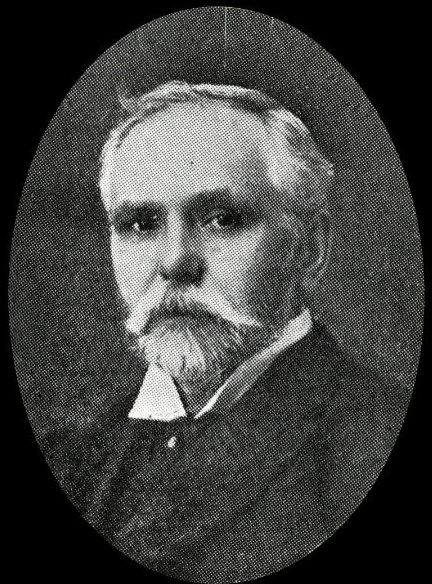
John Banner Biography
“There was a kindly smile to John Banner and rare civic spirit, devoid of self-seeking, and a sincere desire to express a Christian spirit in service. He had a great sense of loyalty and executive ability in getting things done, and never tired of a good cause.”
These words appeared in the Sheffield Independent following his death in 1930.
John Banner was born at Kimberley in 1851, the son of a carrier, and began work at the age of seven. His parents moved to Attercliffe when he was eleven, and John never forgot the hard struggles of his early life, and of the parents who, if they could not give him wealth, gave him character and good example.
Despite the growth of his millinery and drapery business he was never spoilt by success but looked at life and the struggles of others as he knew them.
“I can never forget those days, and knowing the hard lot that most folks have, it is my bounden duty to try to make things better for them.”
He was a keen Liberal, working in Attercliffe, but refused to seek election for the city council, and was instrumental in the formation of the Attercliffe Liberal Club where he was treasurer for more than quarter of a century. He was on the Sheffield Board of Guardians for 21 years, losing his seat in April 1922, and represented the Guardians on the Attercliffe Nursing Association. He was also on the South Yorkshire Joint Poor Law Committee.
His religious activities were at Shortridge Street Methodist New Connexion Chapel for 36 years. He was treasurer of the Sunday School and the church, a teacher at the Men’s Bible Class, and helped reduce the debt on the church from £1,950 to £250. When he moved to Oakledge at 16 Beech Hill Road, he worked with Broomhill United Methodist Church, and represented it on the Sheffield circuit conference.
John Banner married Sarah Ann Higgett in 1873 and had four sons and three daughters. Sarah died at the age of 81 in 1927.
John Banner died at Oakledge in 1930 and his funeral was at Crooke’s Cemetery after a service at Broomhill United Methodist Church. His shop on Attercliffe Road closed for the day as a mark of respect for its founder.






 sheffielder.net