Categories
Buildings

St. George’s Church

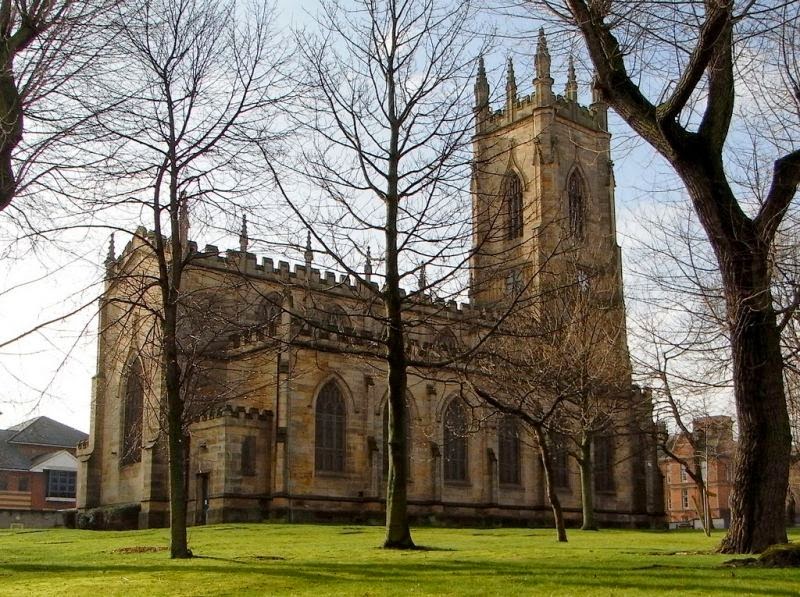
It stands rather grandiose, next to Broad Lane, on the way to Brook Hill roundabout. St. George’s Church, aside from Sheffield’s two cathedrals, is one of two magnificent churches around the city centre.

St. George’s was built for the Church Building Commission between 1821-1825, one of three churches to have been built in Sheffield under the Church Building Act of 1818. (The others were St. Mary’s, Bramall Lane, still standing, and St. Phillip’s at Netherthorpe, demolished in 1951).

A Commissioner’s Church was an Anglican church built with money voted by Parliament, aiming to increase the number of church places for parishioners.

By the start of the Industrial Revolution, people had moved from rural areas into towns and cities, putting unprecedented demand on places of worship. Before these three new churches, Sheffield had just 6,280 seats for a population of 55,000 people.

The foundation stone for St. George’s, built on a piece of spare land, was laid by Thomas Sutton, Vicar of Sheffield, on 19 July 1821, the Coronation day of King George IV, hence the name.

The church was designed by Woodhead and Hurst, in Perpendicular Gothic style, at a cost of £15,181 (about £1.2million today) and was planned to have been completed by October 1824.

It was an ambitious building scheme, overseen by John Smith, Superintendent of Works for Thomas Flockton, builder and contractor for many of Sheffield’s churches.

The construction was carefully planned with master craftsmen brought him from various Yorkshire companies.

Ironwork was provided by Raynor and Company, of St. James’s Street, while Nowell’s of Dewsbury afforded masons and bricklayers, the slate roof completed by Brown’s of Division Street, Sheffield, and plumbing and glazing carried out by Smith and Binks of Rotherham.

William Nicholson, of St.James’s Street, provided plasterers, and Robert Drury, from Eyre Street, supplied a team of painters and decorators. Carpentry and joinery were completed by a team from Thomas Flockton, based on Rockingham Street.

St. George’s was finally completed in 1825, the consecration ceremony held by Edward Venables-Vernon-Harcourt, Archbishop of York, on 29th June 1825.

A procession formed in the chancel of the Parish Church (now Sheffield Cathedral) and proceeded to St. George’s, the parade made up from members of the clergy, charity girls and boys, the Town Collector and Trustees as well as the Master Cutler and members of the Cutlers’ Company.

Such was the demand to view the ceremony that members of the public were only admitted by ticket.

The finished church was 122ft long and 67ft wide, with a flat-ceilinged nave of six bays, a single-bay chancel and a 140ft high tower. Galleries extended the length of the north and south walls, and there was a two-tiered gallery on the west wall, providing total seating for 380 worshippers.

It was soon apparent that St. George’s was going to be a success, attracting a congregation from nearby high-density housing. However, the Archbishop considered it unfit for the internment of the dead, due to the churchyard not being properly fenced off, and burials only commenced from 1830.

St. George’s prospered, but declining attendances during the 1970s resulted in its closure in 1981. It stood unused for many years until the University of Sheffield bought it in 1994, its presence slowly extending towards the city centre.

The church was converted by Peter Wright and Martin Phelps, with a lecture theatre sited in the nave, seating provided in the west gallery, a dais set in the chancel, and three floors of student accommodation built in the aisles.

Standing at the centre of St. George’s Square, the former church is best seen at night when it is floodlit.
Categories
Buildings

St. George’s Church

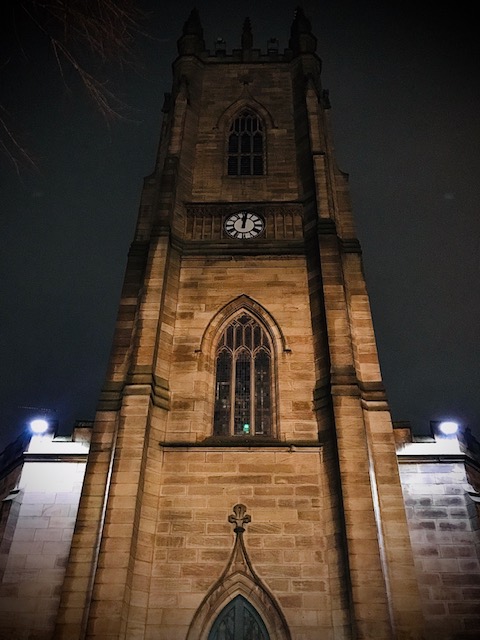
The tower of St. George’s Church, Portobello, now owned by the University of Sheffield and used as a lecture hall and three floors of student accommodation.

The church was built between 1821-1825 using money provided by the Church Building Commission, the result of the Church Building Act of 1815.

Designed by Woodhead and Hurst, the church was built by Thomas Flockton of Rockingham Street, Sheffield. The foundation stone was laid by Thomas Sutton, Vicar of Sheffield, and consecrated in 1825 by Edward Venables-Vernon-Harcourt, Archbishop of York.

During the construction of the 140ft high tower, St. George’s claimed the lives of two workmen.

In 1823, apparatus used to draw stones up to the tower was being dismantled, when part of the machinery gave way, precipitating three workmen onto rafters of the floor below. James Bower was dreadfully crushed and dead within minutes, his two colleagues being seriously injured.

Further tragedy occurred a year later, in 1824, when a plank on which Charles Lee, a labourer, gave way, causing him to fall to the bottom of the tower. He pitched onto beams and died a few minutes later, after being removed to a nearby public house, and before medical help could arrive.

St. George’s closed in 1981 and stood empty for thirteen years, its condition deteriorating, until bought by the University of Sheffield in 1994, and restored.

Categories
Companies

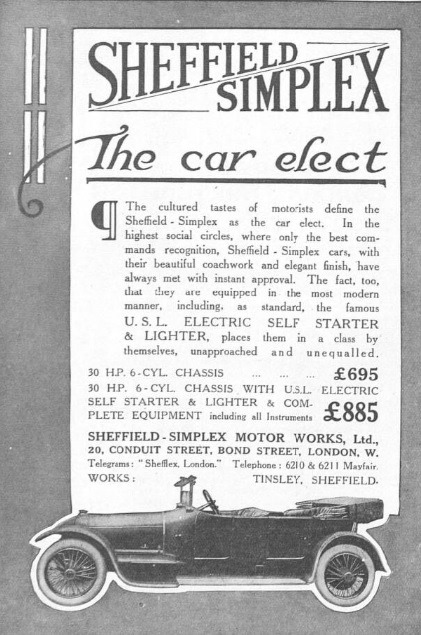
Sheffield Simplex

In the early part of the twentieth century, the World’s best car was unquestionably the Rolls-Royce Silver Ghost.

But a legion of fresh luxury cars soon appeared, and the Rolls-Royce revolution was challenged by Lanchester, Leyland Eight, Hispano-Suiza, Ensign, Farman… and the Sheffield-Simplex.

And yes, for loyal younger readers… Sheffield could and should have been a centre for car production.

The Sheffield-Simplex owed its success to Earl Fitzwilliam, from Wentworth Woodhouse, whose attempt at the Templeborough works to make the finest motor car in the world very nearly succeeded.

The company received financial backing from the Earl, the first few cars called Brotherhoods, and were a continuation of the Brotherhood-Crocker cars made in London in which he had been an investor.

Brotherhood sold the London site in 1905 and moved to Peterborough but could not get permission to build a car factory, so the Earl suggested a move to Sheffield where he built a new factory in Tinsley.

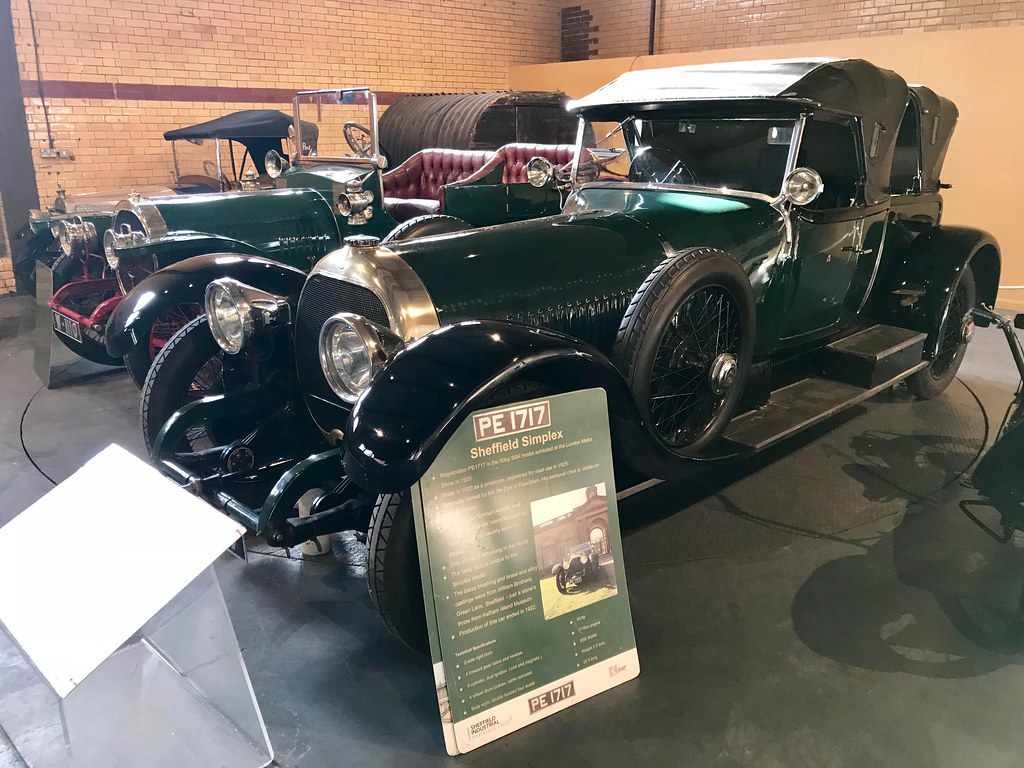
In 1908, the first cars to bear the Sheffield-Simplex name appeared designed by Percy Richardson, ex Daimler and Brotherhood. The LA1 had a six cylinder 6,978 cc engine and three speed gearbox.

It was joined in 1908 by the LA2, intended for lighter open bodies which did without a conventional gear system.

Four smaller cars joined the line-up in 1910 but lasted only one year, and in 1911 were replaced by the LA7 with a six cylinder 4,740 cc engine.

Sheffield-Simplex considered their only rival to be Rolls-Royce and even opened a London showroom in Conduit Street very close to theirs.

During World War One, the company made armoured cars which were supplied to the Belgian and Russian armies, as well as making ABC Wasp and Dragonfly aircraft engines and munitions.

Car production resumed in 1919, and judged by pre-war standards, the Simplex was a very fine car indeed. But it was also very costly, and it never again captured the exclusive market.

Sheffield-Simplex went into steep decline, building a few Shefflex trucks and the Ner-a-Car fully enclosed motorcycle to the designs of the American, Carl A. Neracher. When the doors finally closed, around 1500 cars had been made during the company’s history… and it seems that only three survive, two of which are at Kelham Island Museum.

Categories
Companies

Sheffield Simplex

In 1911, Sheffield Simplex Motor Works opened commodious London showrooms at 20, Conduit Street, off Bond Street, where its models were displayed.

“Now that its many attractive features are made easy to view in London all the year round, instead of necessitating correspondence with Tinsley, we may expect the Sheffield-Simplex to secure a larger vogue among those to whom the best only appeals.”

Wilfred G. Aston, a motoring correspondent for The Tatler, was a big fan.

“The Sheffield-Simplex is a car with a very pronounced personality, and you must be a very pachydermatous lump if you don’t appreciate that fact after about five minutes’ running in one.”

Production of the Sheffield-Simplex car ended about 1920. Too expensive and perhaps a little old-fashioned after the First World War.

Categories
Buildings Sculpture

Moorfoot

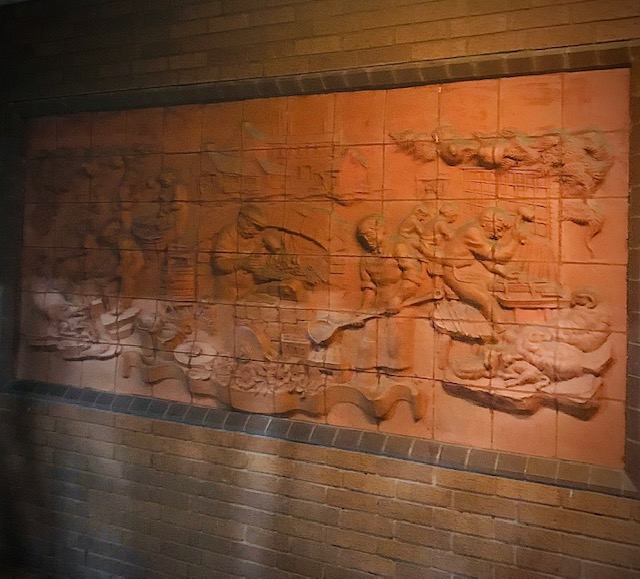
Oh, how happy sculptor Judith Bluck (born 1936) must feel. Thirty-four years after creating a brick wall relief, it now adorns the outside of a boarded-up toilet block at Moorfoot.

The frieze was created for the Manpower Services Commission in 1985, the theme based on different kinds of skills used in the “little mesters” workshops formerly on the site.

Bluck visited Kelham Island Museum for inspiration and made a master in Glass Reinforced Polyester Resin from which a mould was formed. Pan tiles, each 25cm square, were produced by Nori (a subsidiary of Accrington Brick).

Working from her studio in the Yorkshire Dales, Bluck was also responsible for the Crucible Fountain outside the Moorfoot building (covered in another post).

She also created numerous works around the country including Small Workhorse, at Ealing Broadway, Legend of the Iron Gates, Wilmslow, Sheep in Milton Keynes, and a 20ft high relief narrative on security doors at Portsmouth Crown Court.

Categories
Sculpture

Crucible Fountain

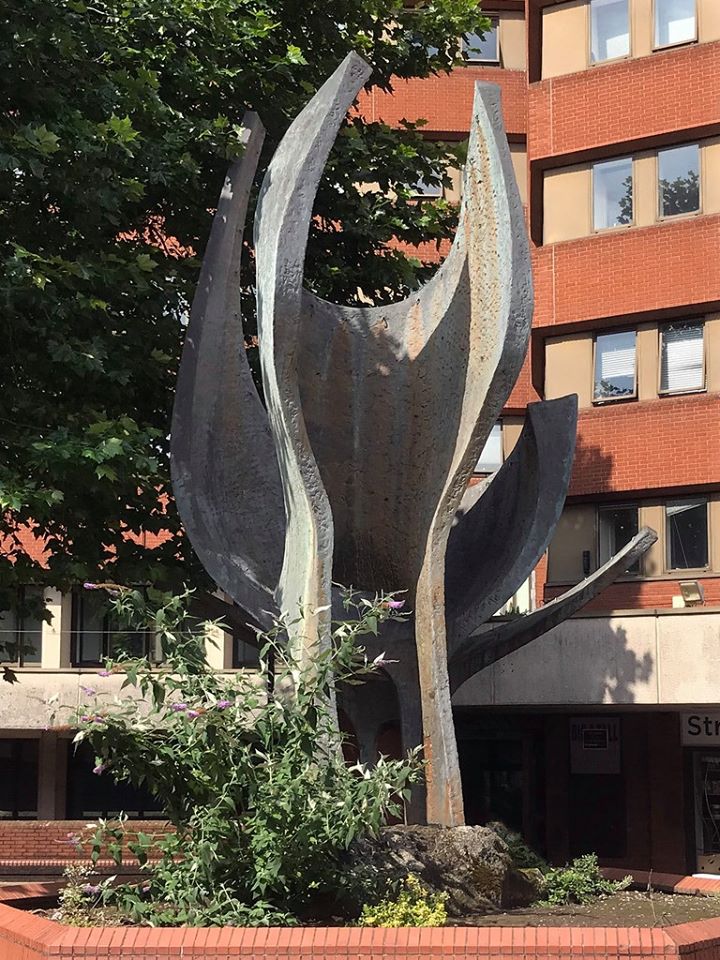
It might have seen better days, and quite frankly, it’s at the arse-end of The Moor. But how many people even notice the monument outside the Moorfoot building?

It is called the Crucible (or Crucible Fountain) and was commissioned by the Property Services Agency, Department of the Environment, to stand in front of the former Manpower Services Commission building. It was installed in 1979, the work of sculptor Judith Bluck, and cost £30,000.

Unsurprisingly, the sculptor chose something that was “rooted in Sheffield,” and based the design on a crucible used in the steel industry, along with the shape of a bird with spread-out wings.

After being conceived as a paper and wire-scale model on a turntable, the sculpture was created in Accrington, using a building with lifting gear, to lift a rolled steel joist armature, covered in chicken wire, and then sprayed with Glass Reinforced Polyester Resin.

The surface was created with a coating of “techfil,” made up of recycled fuel ash and crushed coal mixed with resin and applied by trowel. This was then sanded down and stippled with centrifugally atomised bronze.

Brought to Sheffield, the 30ft monument was mounted on two reinforced concrete pads.

Originally, the sculpture included water, supplied by three separate jets, positioned so that water falling off the structure didn’t blow in the wind and soak passers-by.

The surface texture was created to enhance the sound of water and provide a sparkling effect. By night, the monument was illuminated to augment the overall appearance.

A lot has happened to it since then.

The water was switched off in the distant past and the floodlights removed. The raised garden in which it stands was planted with shrubbery that eventually consumed much of the lower part of the monument.

I kid you not when I say that the sculpture provided the perfect safe place for the homeless, hidden from view, in which to sleep overnight.

Most of the overgrowth was removed in early 2016 when this part of The Moor was used in the filming of Brief Encounters, an ITV comedy-drama, detailing the beginning of the Ann Summers company, through four women who sought happiness and fulfilment by selling lingerie and sex toys.

Now in need of much care and attention, this cries out for restoration.

Note: Look out for Bluck’s wall frieze outside the disused toilet block nearby, covered in a separate post.

Categories
Companies

Cole Brothers

Our younger readers might not be acquainted with Cole Brothers, but for generations this name was recognisable across Sheffield.

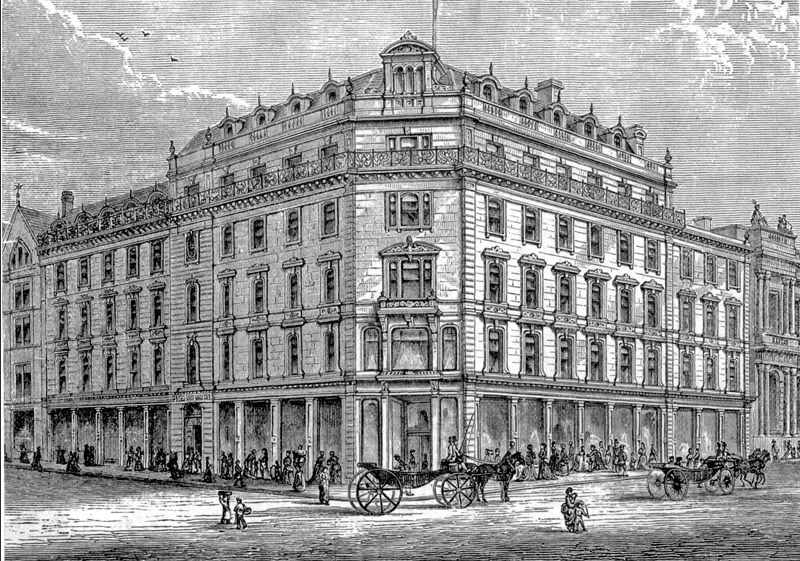
Better known now as John Lewis, the beginning of this department store goes back to 1847, when John Cole, silk mercer and hosier, opened a shop at No.4 Fargate. He was later joined by his brothers, Thomas and Skelton Cole.

The shop expanded along Fargate and around the corner into Church Street, the main block rebuilt in 1869 with two extra storeys added. Later, the premises of Thomas Watson and Sons, grocers, were procured, and the bookshop occupied by Thomas Widdison was added in 1892.

To accommodate its growing business, works and stables were acquired at Pinfold Street in 1861, later enlarged by the addition of the old Canterbury Music Hall in 1889.

Skelton Cole died in 1896, John Cole two years after in 1898, the same year that Cole Brothers became a limited company.

The Pinfold Street works were soon inadequate and subsequently sold, with new premises on Norfolk Street bought from Harrison Brothers and Howson in 1901.

At the beginning of the twentieth century, two Cole sons – Thomas and Thomas Skelton – were in charge, leading the store through a period of change.

In 1909, the first women were employed in the shop and offices, its first motor delivery van was obtained in 1911, and the first cash registers were installed during 1916.

The Cole family were fervent Methodists and instilled disciplines within the business. Up to World War One, it was daily practice for staff to say prayers before trading began, but change was about to come.

‘The London shop invasion begins,’ said one Sheffield newspaper when it was announced that Cole Brothers had been sold to Harry Gordon Selfridge, the exalted storeowner, in October 1919.

The glitzy American, immortalised recently by ITV’s Mr Selfridge, had already acquired a dozen department stores across Britain, including shops in Liverpool, Leeds, Watford, St. Albans, Peterborough and Windsor.

The addition of Cole Brothers to Selfridge Provincial Stores was a surprise, and one that promised to bring the department store new riches. The London house had been modelled on American lines and was described as supplying anything, from a needle to a haystack.

Thomas Cole and Thomas Skelton Cole retired from the business, but the family retained an interest with the appointment of Arthur U. Cole and Maurice Cole as directors.

Almost immediately, the shop premises were extended and restructured, Harry Gordon Selfridge’s drama and flair embraced by his son, Harry Gordon Selfridge Jr, the man tasked to manage the provincial stores.

Newspaper advertisements were lavish, publicising Cole Brothers as ‘One of the Selfridge stores,’ and consequently increasing sales.

The golden age of Cole Brothers lasted until 1940, when war and loss of family control over Selfridges, caused Harry Gordon Selfridge Jr, to return to the United States. The Selfridge Provincial Stores were sold to the John Lewis Partnership, which rather abruptly found itself 15 stores better off overnight.

While many Sheffield department stores suffered during the Sheffield Blitz, Cole Brothers survived unscathed, remaining at Fargate and Church Street until the 1960s when it was announced that it was moving to a new shop as its old premises were outdated.

A site was bought from Sheffield Corporation at Barker’s Pool, once occupied by the Albert Hall until destroyed by fire in 1937, and at one time earmarked as new law courts.

Designed by Yorke, Rosenberg and Mardall, the white-tiled building was opened on 17 December 1963. Spread across five floors, the new Cole Brothers store contained sixty departments, with access to each level from a multi-ramp carpark, accommodating 400 cars.

In 1974, offices were moved into Barker’s Pool House, later connected by a landmark bridge, and a warehouse was opened at Tinsley. The store also moved its sport and toy departments to a site in Cambridge Street in 1977-1978.

The 1980s and 1990s saw a decline in Cole Brothers fortunes, not helped by the opening of Meadowhall, but a refurbishment and ensuing rebrand to John Lewis reversed its fortunes.

Alas, retail is suffering now, with department stores particularly hurting, and despite reassurances there is an air of uncertainty over John Lewis’ future in Sheffield city centre.

Categories
Buildings Companies

Cole Brothers

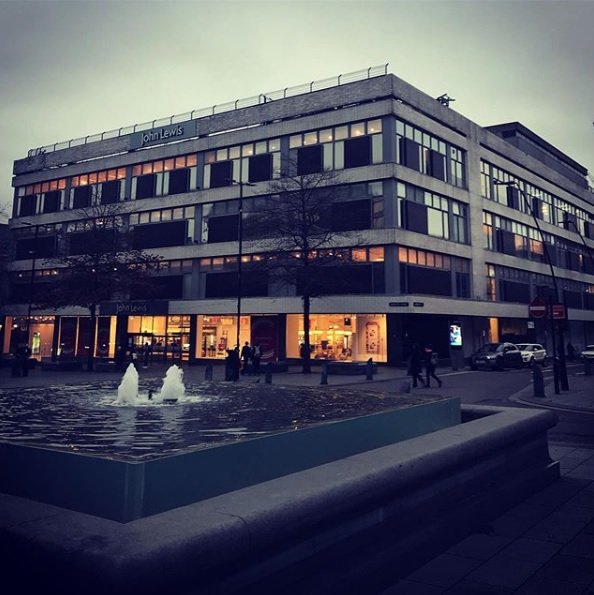
There was a time, not that long ago, when this department store at Barker’s Pool was scheduled for demolition.

The ill-fated Sevenstone retail project earmarked shiny new premises for John Lewis on the site of the old fire station on Wellington Street. When that scheme stumbled, replaced with the more sympathetic Heart of the City II development, John Lewis said they were staying put.

For the modernists amongst us, it was a welcome reprieve for a building that was constructed between 1961-1965 for Cole Brothers, renamed John Lewis in 2002.

The land on which it stands was once site of the Albert Hall, destroyed by fire in 1937. There was talk of a new Gaumont Cinema in its place, but it never materialised. After World War Two, Sheffield Corporation bought the plot for proposed new law courts, but again these never happened, the land subsequently acquired by Cole Brothers.

The design was conceived by Yorke, Rosenberg & Mardall, an architectural company set up in 1944 by Francis Reginald Stevens Yorke (1906-1962), an Englishman, Eugene Rosenberg (1907-1990), born in Slovakia, practising in Prague before World War Two, and Finnish-born Cyril Mardall (1909-1994).

The practice attracted talent from around the world, including David Allford (1927-1997), Sheffield-born, a graduate of the University of Sheffield and lifelong Sheffield Wednesday supporter.

Allford, who went on to become chairman, had a hand in Gatwick Airport, several large hospitals including St. Thomas’ in London and Hull Royal Infirmary, numerous comprehensive schools and offices, Warwick University, and Cole Brothers department store in his home city.

Built by Trollope & Colls (later Trafalgar House Construction), the store is clad in the architects’ hallmark white tiles with panels of brown mosaic to the window bays. The surface was inspired by Le Corbusier’s use of tiles on the entrance drum of the Armée de Salut (1929) in Paris, and the General Pensions Institute (1929-1934) in Prague, designed by Havlicek and Karel Honzik, and worked on by Eugene Rosenberg.

Rectangular in design, it was the replacement for Cole Brothers’ old premises on the corner of Fargate and Church Street (celebrated in Richard Hawley’s song ‘Coles Corner’), outdated and sold for £1million in 1962.

Spread across five floors, the new Cole Brothers store contained sixty departments, with access to each level from a multi-ramp carpark, accommodating 400 cars.

Innovative as the design may have been, the carpark became notorious for suicides, many people jumping from the building’s top deck, up until the time wire fencing was erected.

These days, the department store is looking rather tired, the white tiles in need of a deep-clean and counting the days to its restoration.

Categories
Companies People

Cole Brothers

It was August 1930, Cole Brothers at the corner of Fargate and Church Street, had been part of Selfridge Provincial Stores (owned by Harry Gordon Selfridge) for ten years.

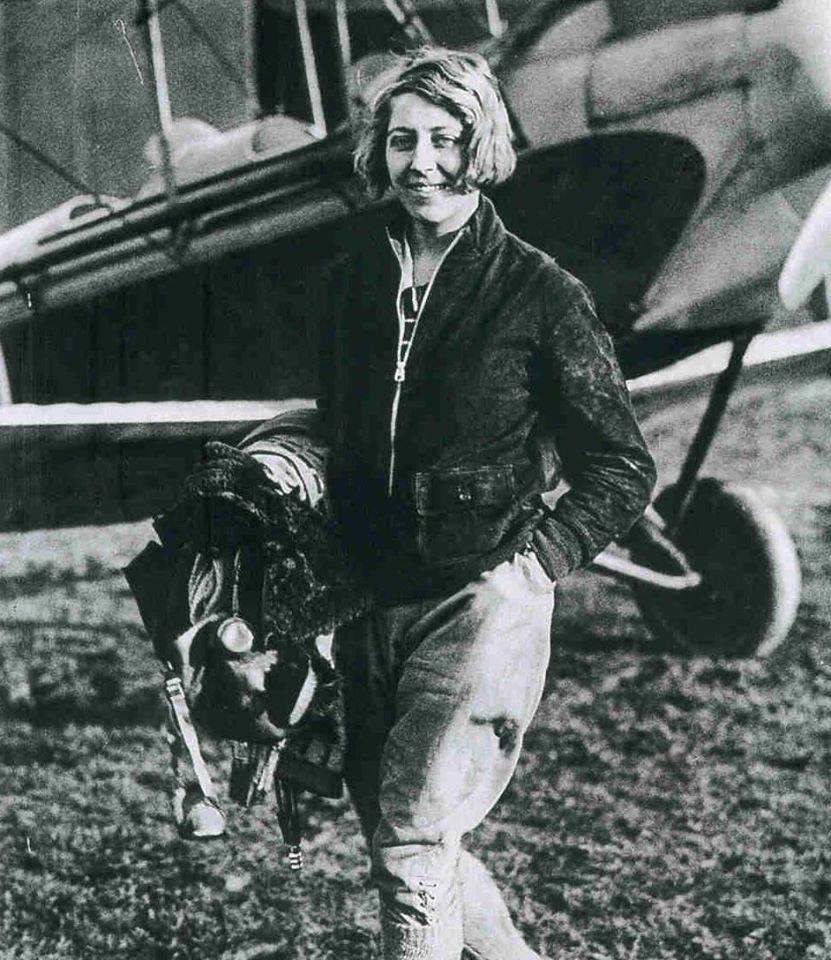
There was excitement with news that Miss Amy Johnson’s aeroplane, a Gypsy Moth called ‘Johnnie’, was travelling overnight by lorry to go on display in Cole Brothers shop window.

The plane had been presented to her in Hyde Park, London, by Air Vice-Marshal Sir Sefton Brancker, Director of Civil Aviation, and was a replica of the ‘Jason’ machine in which Amy Johnson had made her epoch-making flight to Australia. She intended to use the aeroplane for pleasure flying.

It had been funded by the Daily Sketch, with the help of readers of the Sheffield Daily Telegraph and Yorkshire Telegraph and Star, and had been on view at Selfridges in London.

‘Johnnie’ was displayed at Cole Brothers for one week, creating enjoyment for the huge crowds that gathered in front of the store.

But there had already been an Amy Johnson connection with Sheffield.

She graduated from Sheffield University in 1925 having studied Latin, French and Economics. She then became the first woman to fly solo from Britain to Australia after buying a single engine De Havilland Gypsy Moth aircraft naming it ‘Jason’.

Amy Johnson died in 1941 after a plane she was flying crashed into the Thames Estuary.

Categories
Buildings

No. 14 Fargate

Sheffield is full of surprises. But if you don’t look up then you’ll miss them.

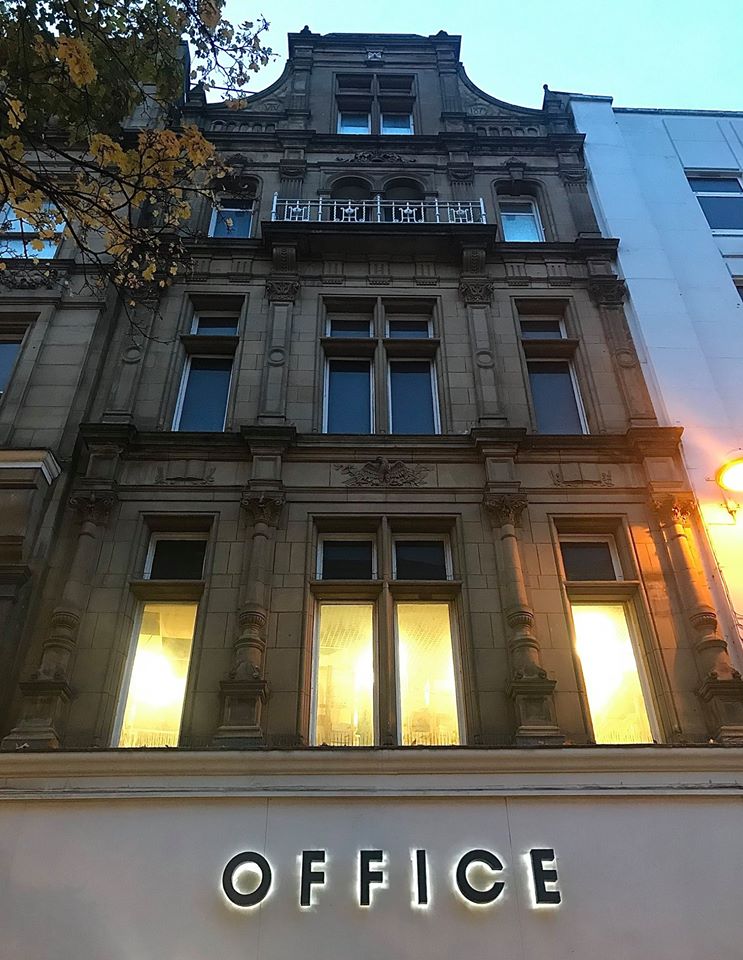
The next time you walk down Fargate, look at the versatility of buildings that were erected during the 1870s. No. 14, Fargate, now occupied by Office, has a narrow-gabled stone front that reflects the width of the plots preserved from much earlier development.

During the 1870s, Fargate was widened, necessitating the demolition of certain properties and rebuilding them further back.

No. 14 Fargate had been occupied by Thomas Widdison, a bookseller, printer and stationer, and in 1879 he temporarily relocated to No. 37 Fargate while his premises were rebuilt.

Thomas Widdison came to Sheffield as a boy and remained all his life. He opened his bookshop on Fargate in 1868, “a business of a high-class description, and all the best book-loving population knew the place and Mr Widdison well.”

A newspaper advertisement from 1889 describes Thomas Widdison as a seller of books, fancy stationary, bibles, prayer books, hymn books, photographic albums and leather goods.

Remarkably, customers were also able to order Flockton Wallsend Coal, “the celebrated drawing-room coal” at 12 shillings per ton.

Thomas was assisted by his wife, also his son, Charles D. Widdison, and continued until 1900, when failing health compelled him to retire from continuous work, afterwards becoming a manager at Boots the Chemist on High Street. He died of paralysis in November 1910.

His premises were swallowed up by Cole Brothers next door, a department store that had opened in 1847, and which had slowly extended its business along Fargate and Church Street (and immortalised as Coles Corner).

Cole Brothers remained until the 1960s before moving to new premises in Barker’s Pool, now John Lewis.

No. 14 Fargate remains as the only surviving reminder of the old Cole Brothers building.