Categories
People

The Devil Man: Edgar Wallace and The Life and Death of Charles Peace

Edgar Wallace (1875 – 1932)

Reading a biography of Edgar Wallace is an exhausting experience. He was the author of over 170 books, translated into more than thirty languages. More films were made from his books than any other twentieth-century writer, and in the 1920s a quarter of all books read in England were written by him.

He was said to sleep just a few hours every night. The rest of the time was spent dictating novels, plays (many of which were performed at Sheffield’s Theatre Royal and Lyceum), newspaper articles, and racing tips. His secretaries typed out finished copy and sent them off to publishers.

Edgar Wallace, the illegitimate son of a travelling actress, rose from poverty in Victorian England to become the most popular author in the world and a global celebrity of his age. He scooped the signing of the Boer War peace treaty when working as a war correspondent, before achieving success as a film director and playwright. At the height of his success, he was earning a vast fortune, but the money went out as fast as it came in. Famous for his thrillers, with their fantastic plots, in many ways Wallace did not write his most exciting story: he lived it.
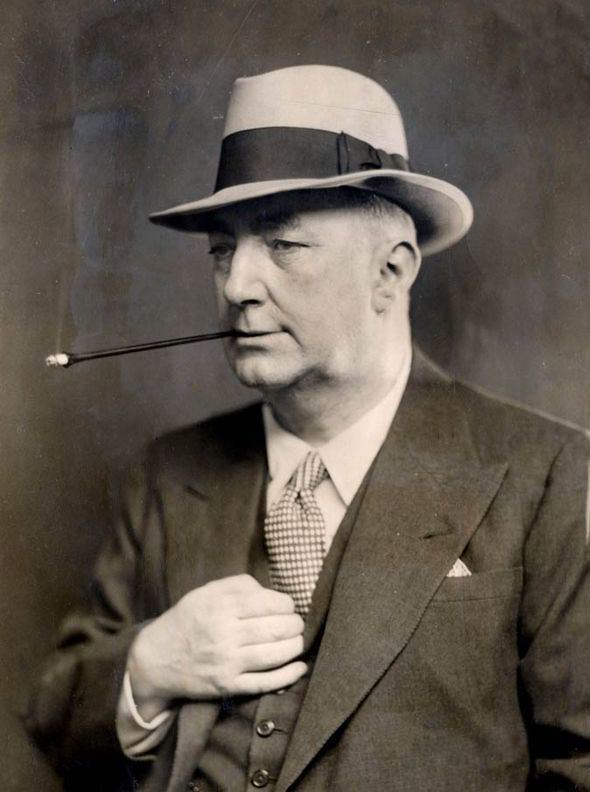
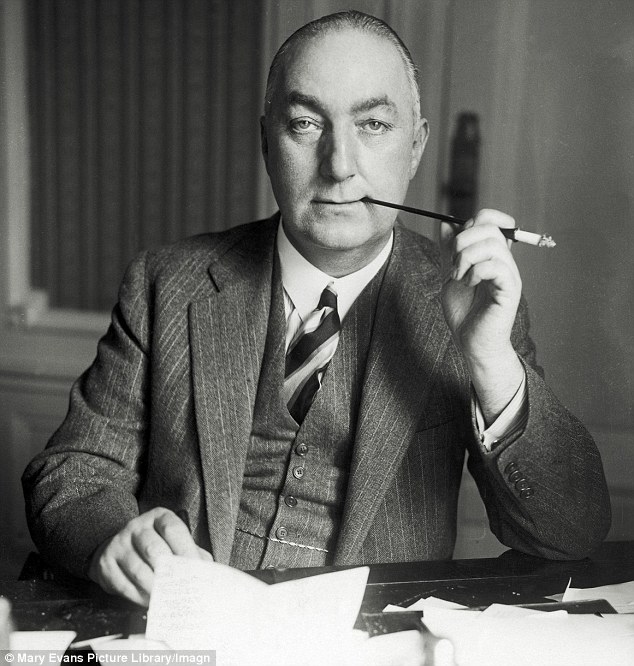
Edgar Wallace. “He knew wealth & poverty, yet had walked with kings and kept his bearing. Of his talents he gave lavishly to authorship – but to Fleet Street he gave his heart.”

In the 1930s, Joseph P. Lamb, the Sheffield city librarian, analysed borrowing trends and decided that people wanted the same type of books – they ‘read along mass lines,’ he once said, and people were irritated when ‘their’ books were out on loan. As a result of this, books by populist authors like Edgar Wallace were purchased in fifties of each title.

In 1931, Edgar Wallace published ‘The Devil Man,’ with definitive links to Sheffield.

The book focused on Sheffield’s favourite criminal Charles Peace. According to the Sheffield Daily Independent it held the reader throughout. ‘The bad little man is as fascinating in Mr Wallace’s pages as he was supposed to be to women during his lifetime.’

“He was a queer, incongruous figure of a man. His height could not have been more than five feet; the big, dark, deep-set eyes were the one pleasant feature in a face which was utterly repulsive. They were the eyes of an intelligent animal. The forehead was grotesquely high, running in furrows almost to where at the crown of his head, a mop of grey hair rolled back. The unshaven cheeks were cadaverous, deeply lined and hollow. He wore home-knitted mittens, and in one hand clutched an ancient violin case.”
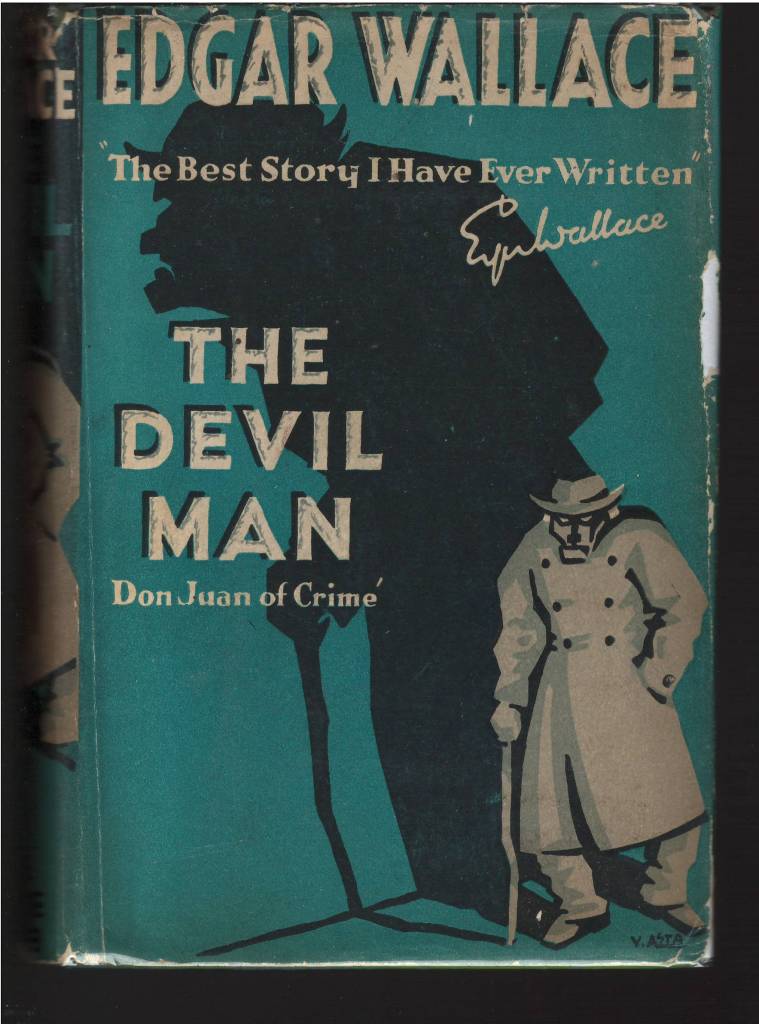
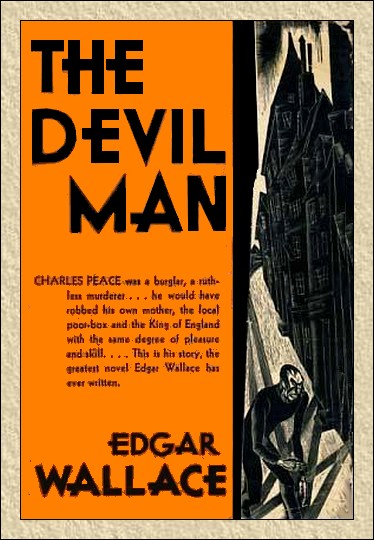
The Devil Man: The Life and Death of Charles Peace (1931)

Wallace did not mix fiction with fact, ‘he rather built an additional storey of fiction on the solid house of fact.’

Wallace raked Peace’s ugly career as it stood – his friendship with the flashy Mrs Dyson and the subsequent murder of her husband – and superimposed a strange plot regarding the secret of a new steel process – presumably stainless.

Dyson had in his possession a bottle containing some all-important crystals, and Peace is offered a large sum of money by foreigners living in Sheffield if he will steal the bottle.

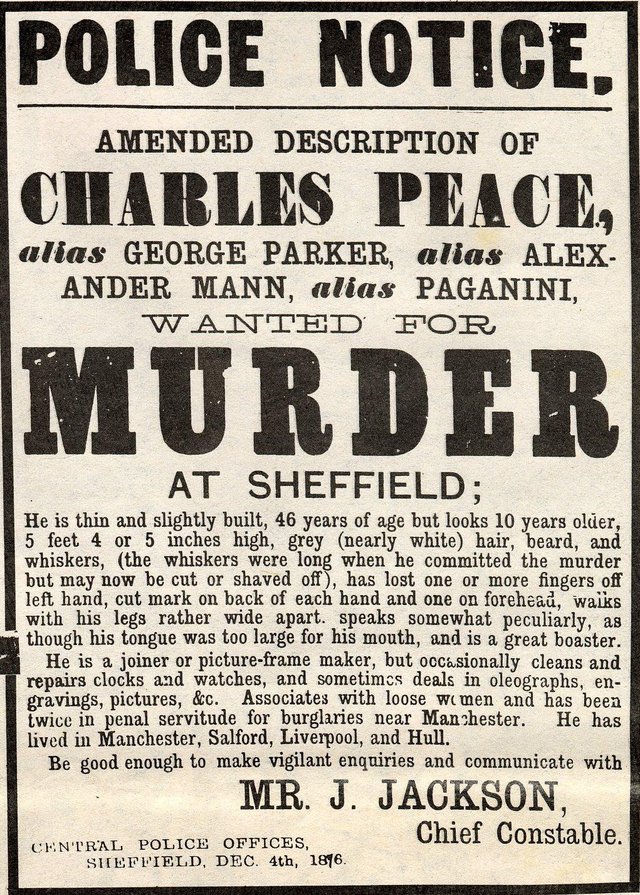
This, according to Wallace, was his errand on that terrible night in Banner Cross in November 1876 when Peace shot Dyson, a former neighbour at Darnall.

Peace quarrelled with Mrs Dyson, shot her husband, secured the bottle, and then handed it to a confederate, which was the last he ever saw of it. It was in connection with this murder  that, according to Wallace, Peace had previously gone to Manchester to commit a burglary and murdered a policeman.
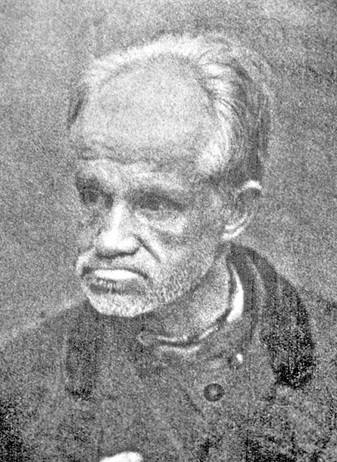
Charles Peace (1832-1879) Photograph: Picture Sheffield

‘The atmosphere of Sheffield in the ‘70s is deftly caught,’ said the Sheffield Daily Independent. ‘And although one feels in this book as one does in other Wallace novels – that toward the end the author has got a little bored with his subject: the story is brilliantly told.’

Wallace stated that it had taken him four years to collect the facts for the story, four months to construct the book, and four days to write it.

According to author Neil Clark, who penned ‘Stranger Than Fiction – The Life of Edgar Wallace’, ‘Sir Patrick Hastings was a guest during the weekend Wallace wrote the 70,000-word novel in just sixty hours. Hastings had difficulty in sleeping on the Friday night, and had gone to Wallace’s study where he found him dictating. He sat and watched him for two hours and was enthralled by the way Wallace worked. By nine o’clock on Monday morning, Wallace had completed his task, which earned him £4,000 in serial rights alone. He then went to bed for two days to make up for the sleep he had missed.’

A year after the novel was published, Edgar Wallace went to Hollywood to work on the RKO ‘gorilla picture’ King Kong, but his gruelling lifestyle finally caught up with him, and he died of diabetes and double pneumonia in February 1932.

In his will it was revealed that he had debts of £140,000 and almost all his possessions had to be sold. However, within two years, the royalties from Wallace’s work had cleared all the debts.
Sources: Stranger Than Fiction – The Life od Edgar Wallace, The Man Who Created King Kong, by Neil Clark (2014) and Val Hewson at The Auden Generation and After conference, Sheffield Hallam University, 17 June 2016.
Categories
Buildings

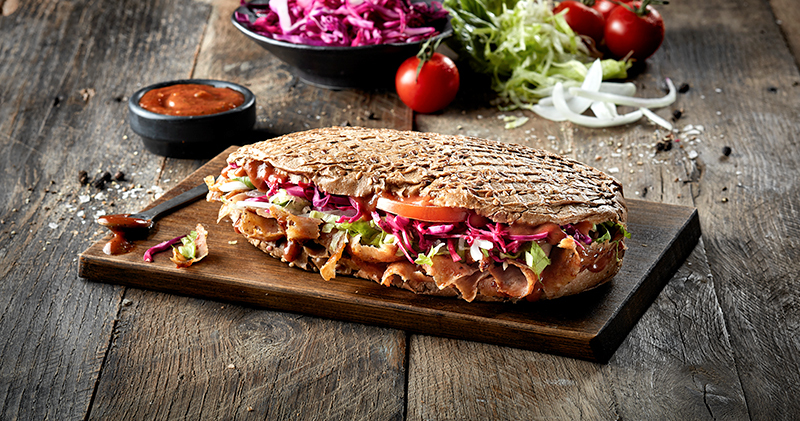
Will a posh doner kebab kickstart the High Street?

Photograph: German Doner Kebab

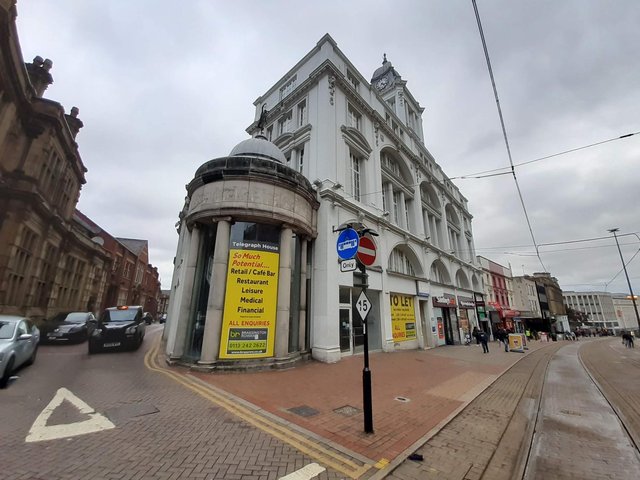
The Germans made a mess of High Street during World War Two, we made a mess of it afterwards, and there is an irony that the first seeds of future regeneration might be coming in the shape of a German doner kebab.

The upmarket German Doner Kebab is opening at Telegraph House in space previously occupied by Santander. The former headquarters of the Telegraph and Star were built between 1913 and 1916 by Sheffield architects Gibbs, Flockton & Teather, and constructed by George Longden & Son.

Photograph: Sheffield Star

German Doner Kebab opened its first store in Berlin in 1989, and while we might turn our noses up at a cheap takeaway favourite, these promise to be different. According to its website, the kebabs use beef and meats imported from Germany, enhancing them with ‘secret sauces’ and locally-produced vegetables in a special bread.

The doner kebab was a Turkish creation, but its popularity came from Germany. More than 17 million are now sold throughout the country. In Berlin, there are over 1,000 kebab eateries and they even outsell the city’s most famous snack, the Currywurst.

In the late 1950s, thousands of Turkish workers made their way to West Germany to support a depleted workforce. As the country’s economic fortunes changed in the 1960s, many Turks sought alternative employment in hospitality.

Three of these Turkish workers would have their names intrinsically linked with the introduction of the Döner Kebab.Kadir Nurman opened a small eatery at the Zoologischer Garten train station, Mehmet Aygün claims to have introduced the kebab at his parents Turkish restaurant in 1971, while Nevzat Salim opened a snack stand in Reutlingen – near Stuttgart – back in 1969.

As with any culinary creation, sourcing its actual origin is always problematic – like most things, food and recipes evolve, but now the German doner will finally find its way to Sheffield.

Photograph: German Doner Kebab

© 2021 David Poole. All Rights Reserved.

Categories
Buildings Companies

Boots: Prescriptions on the High Street for 123 years

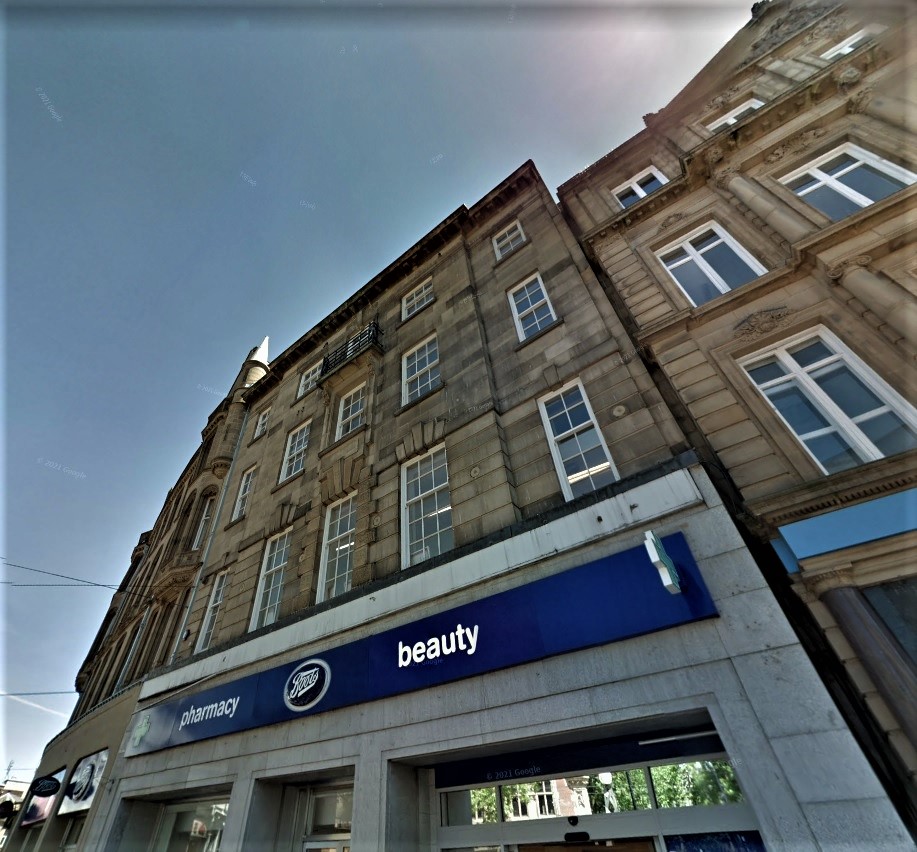
A modern-day view of Boots on High Street, Sheffield

Boots might be a Nottingham company, but Sheffield has played an important part in its long history. Established in 1849 by John Boot, it was his son Jesse who built the company into a household name with stores all over the world. Its first chemist branch outside Nottingham was at 17 Spital Hill, in 1884, followed by branches at Snig Hill, West Street, South Street (The Moor), Attercliffe, London Road, Netherthorpe, Abbeydale, and Shalesmoor.

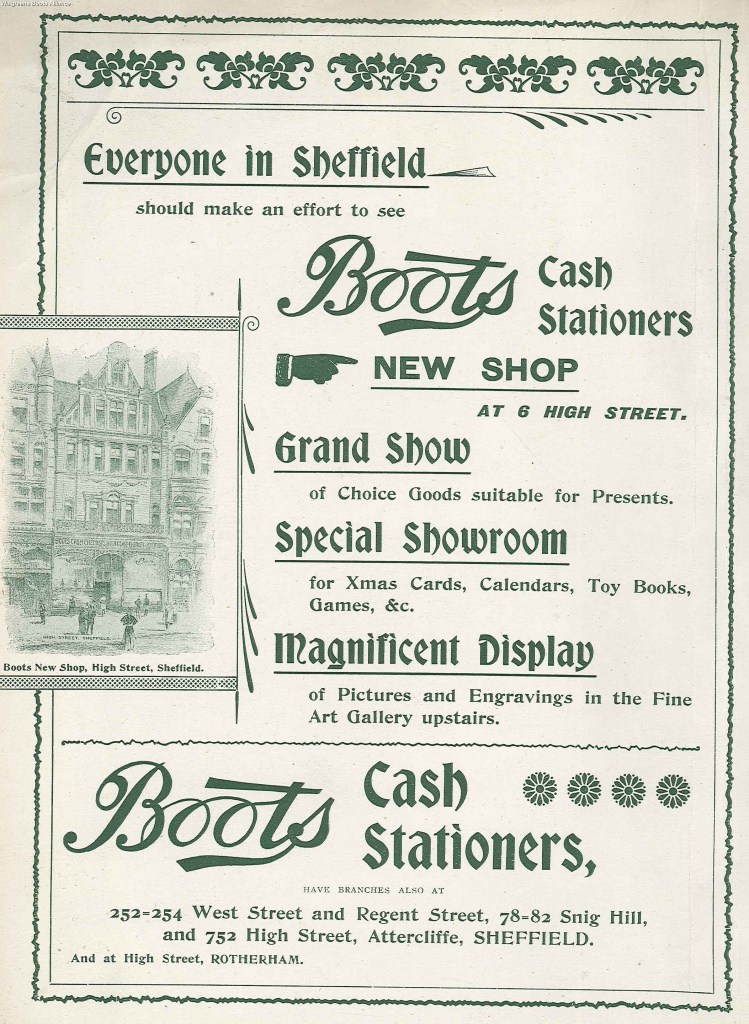
Sheffield was firmly in Jesse Boots’ sights and for a brief time, in the early 1890s, he lived here with his wife Florence. Its most prominent branch opened in May 1898 at 6 High Street, on land owned by John Walsh (of department store fame) between the Fosters Building (erected 1896) and the auctioneers Nicholson, Greaves, Barber and Hastings (now Café Nero). All were constructed as part of High Street widening plans.

The High Street branch opened in 1898 and the illustration shows what the original building looked like. Photograph: British Newspaper Archive

Boots opened its narrow shop alongside the Thatched House Restaurant, taking advantage of heavy footfall between High Street and Fargate. On 8 October 1918, a Government Information Bureau opened in-store. The Bureaux had been established by the government earlier in the year to provide information to the public on matters relating to the First World War; national war aims, national services, war savings, food, labour, and so on. This was one of just twenty such bureau, each located in a prime Boots store, and it required only two square yards of space for its small, pre-fabricated stand.

Boots refitted its store in 1922, but when the Thatched House Restaurant came on the market in 1929 it bought the property and announced plans to extend next door. The plans were radical and involved demolition of both properties, only 33 years after they had been constructed.

The new enlarged building was designed by Percy J. Bartlett, the Boots’ architect, and was constructed by Thomas Wilkinson and Sons, Olive Grove Works, Sheffield.

“Cheap drugs would be dear if they were cheap and nasty. Nasty to the palate many drugs are bound to be; but worse is the nastiness of bad quality.” – Jesse Boot

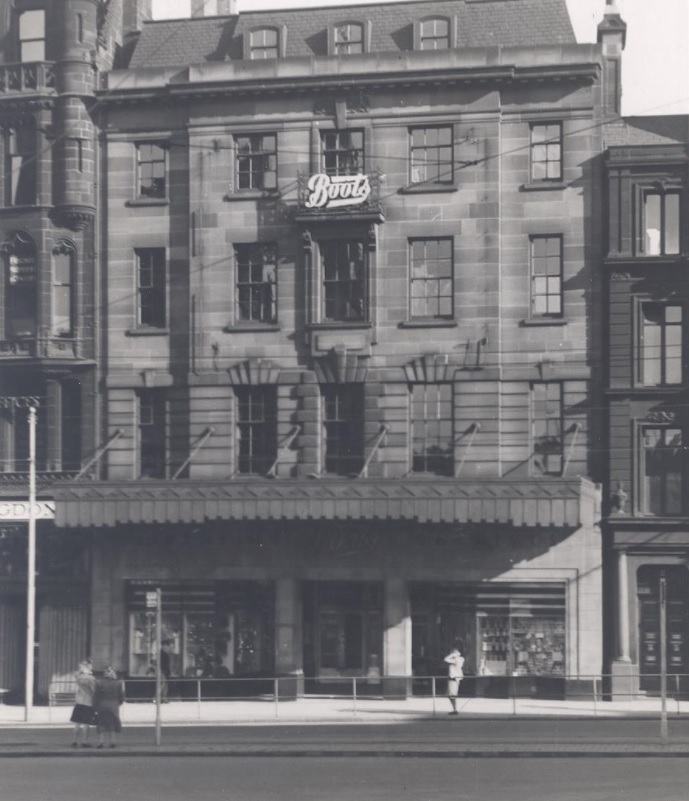
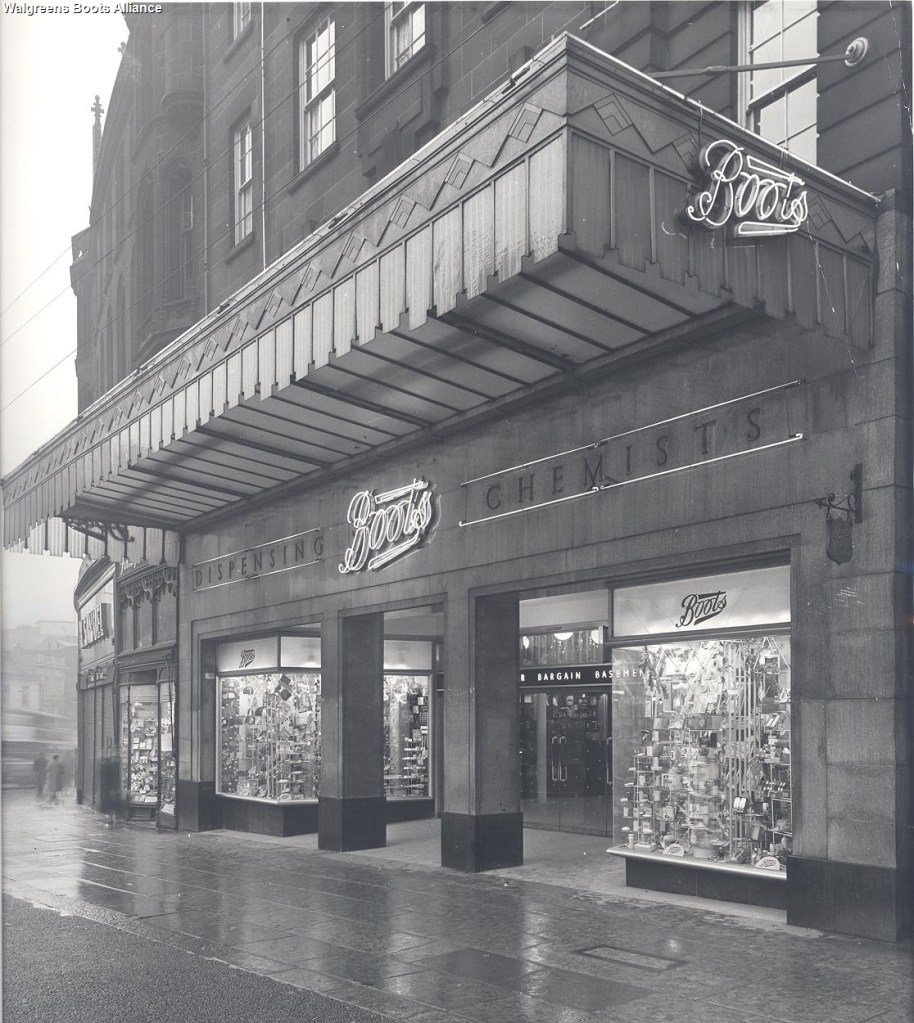
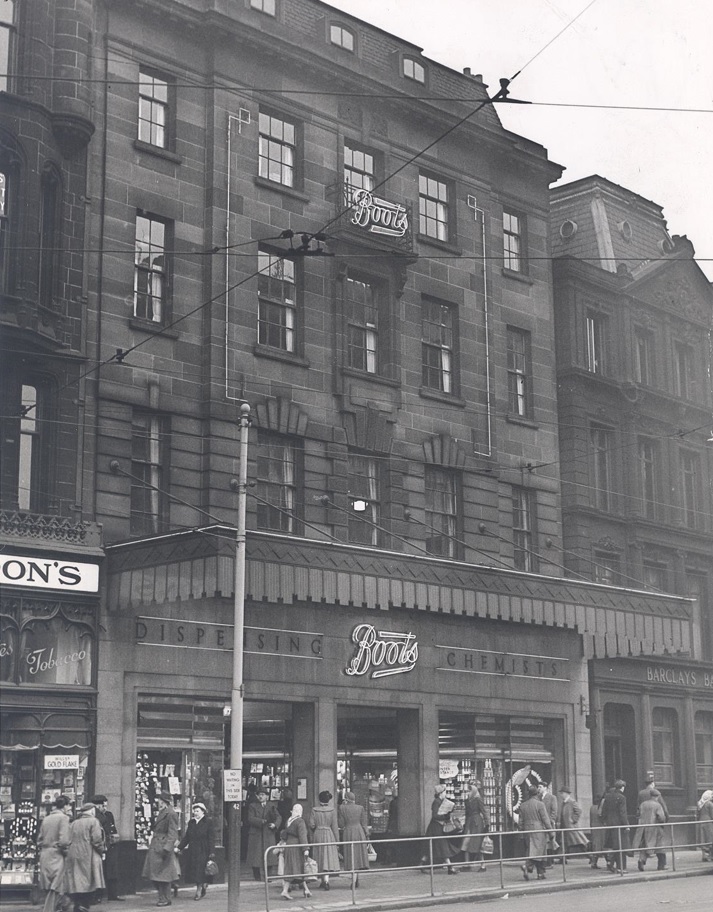
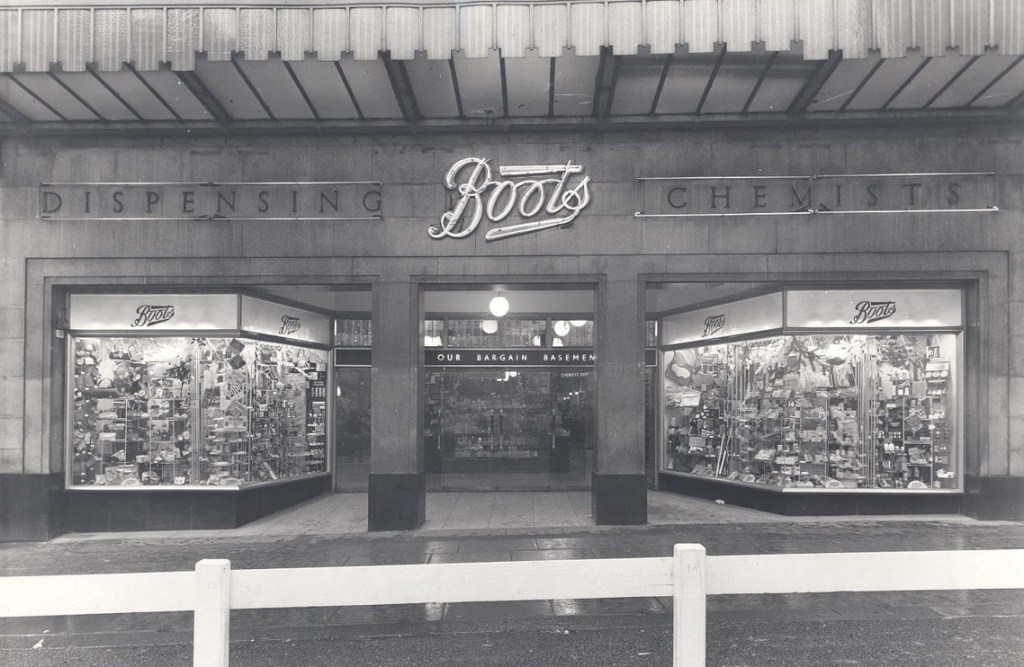
The handsome elevation was based on the Renaissance style, the modern shop front, the black and silver canopy, the green slates surmounting the lower story, and the blue-green of the windows above, formed a modern building combined with traditional beauty.

It was constructed in Stoke Hall stone, provided by Percy J. Turner from their own quarries at Grindleford. Warm yellow in colour, it claimed to be impervious to the effects of acids in smoke-laden atmospheres.

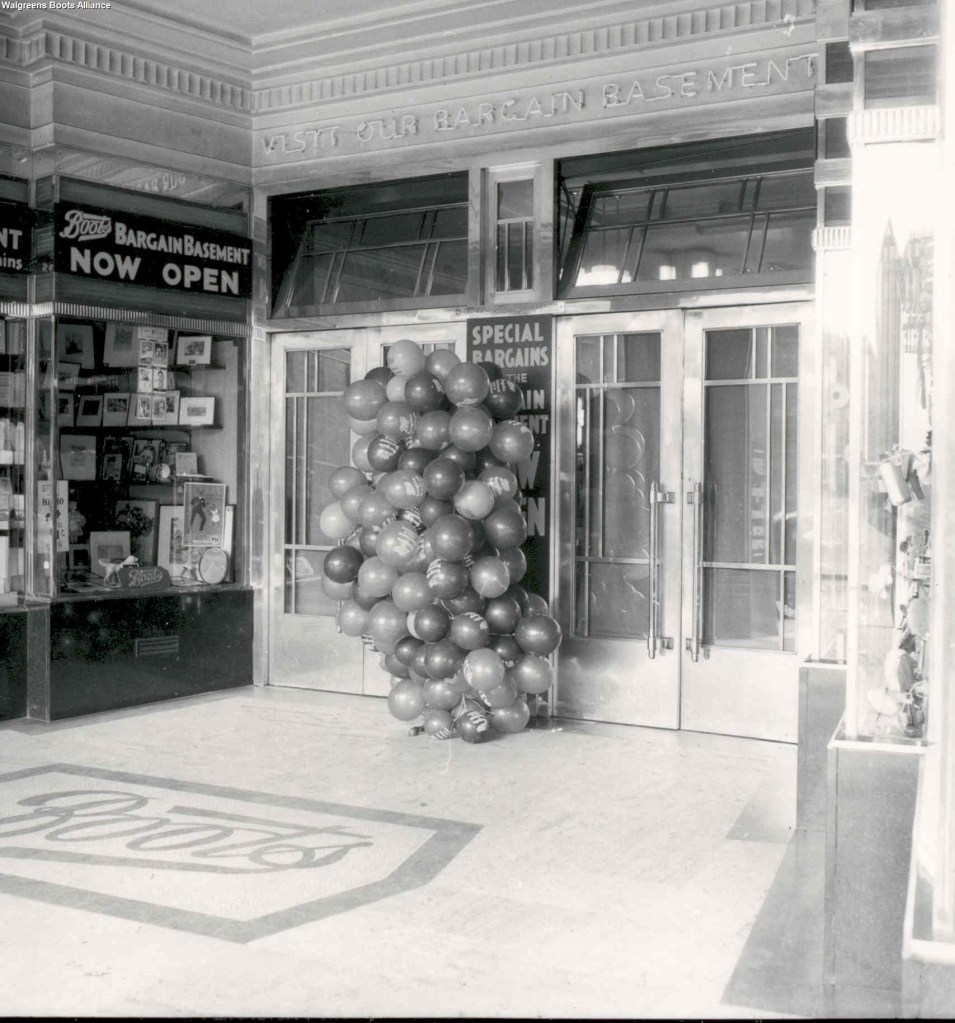
The shop front was a tribute to Sheffield’s staple industry, completed in Firth Brown ‘Staybrite’ steel, which was as much attractive to the eye as the deeply recessed entrance, and non-slip paving. The steel was used for framing the windows and main entrance doors, and the Boots sign was cast in Staybrite and mounted with neon lights.

The glass and iron canopy decorated in black and silver was capable of illumination at night, and replaced old-fashioned shop blinds, to provide permanent protection against rain.

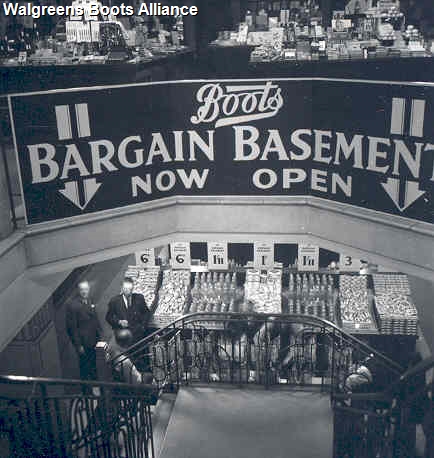
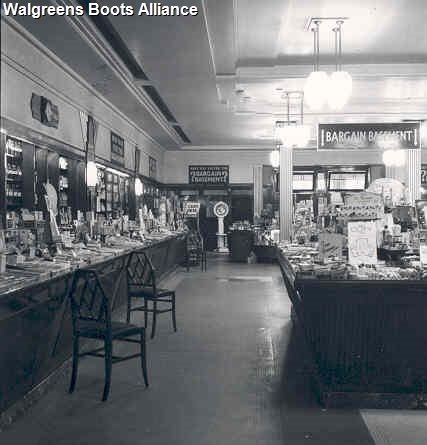
Photographs: Walgreens Boots Alliance

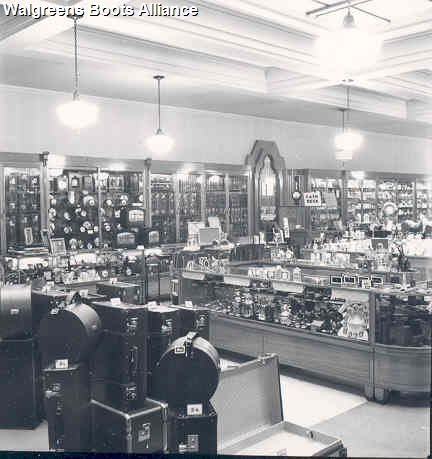
The interior fittings were chiefly light mahogany, the floors laid in ceramic mosaic on top of ‘bison’ concrete flooring, and heating was generated by rooftop pipes to provide even temperature throughout its three sales floors.

The ground floor was set aside for the principal business of chemist and toiletries. A surgical department, staffed by fully trained nurses, provided a private fitting room and a dispensary.

Photograph: Walgreens Boots Alliance

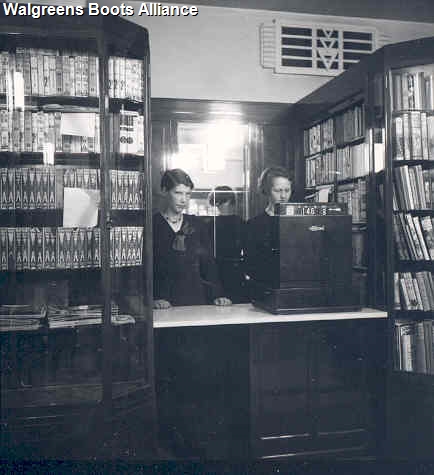
A staircase in the centre of the showroom led to the basement, where travelling goods, stationary, books, pictures and artists’ materials were displayed. The first floor contained the ‘Booklovers’ Library’ decorated in blue and green, and a fascinating exhibition of artistic gifts, silver, and fancy merchandise. All three floors were served by a staircase and two lifts.

Electric lighting in the store was designed by Harcourts, of Birmingham, based on original suggestions of Percy J. Bartlett. The fittings were arranged to take four one hundred watt Cosmos lamps, with a combination of four crystal etched glass cylinders.

Photograph: Walgreens Boots Alliance

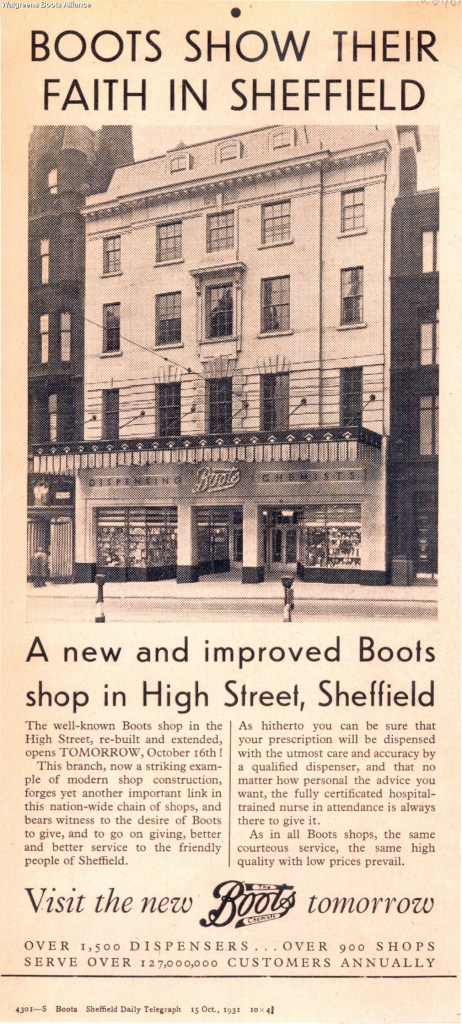
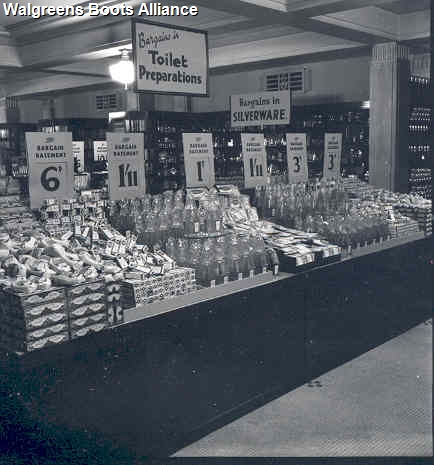
It opened in October 1931, and the address became 4-6 High Street. Two years later a Bargain Basement opened, bringing a modern style of retailing to the store. Further alterations were made in 1936 and it was later extended into the adjacent Foster’s Building.

Photographs: Walgreens Boots Alliance

Those of a certain generation will remember that the basement eventually opened out into a subway that stretched across High Street, and which was eventually lost when Supertram works started.

Sadly, the frontage we see today is the result of the generic modernisation of the retail sector, but remember it only disguises the past.

Boots is now part of the Retail Pharmacy International Division of Walgreens Boots Alliance, Inc.

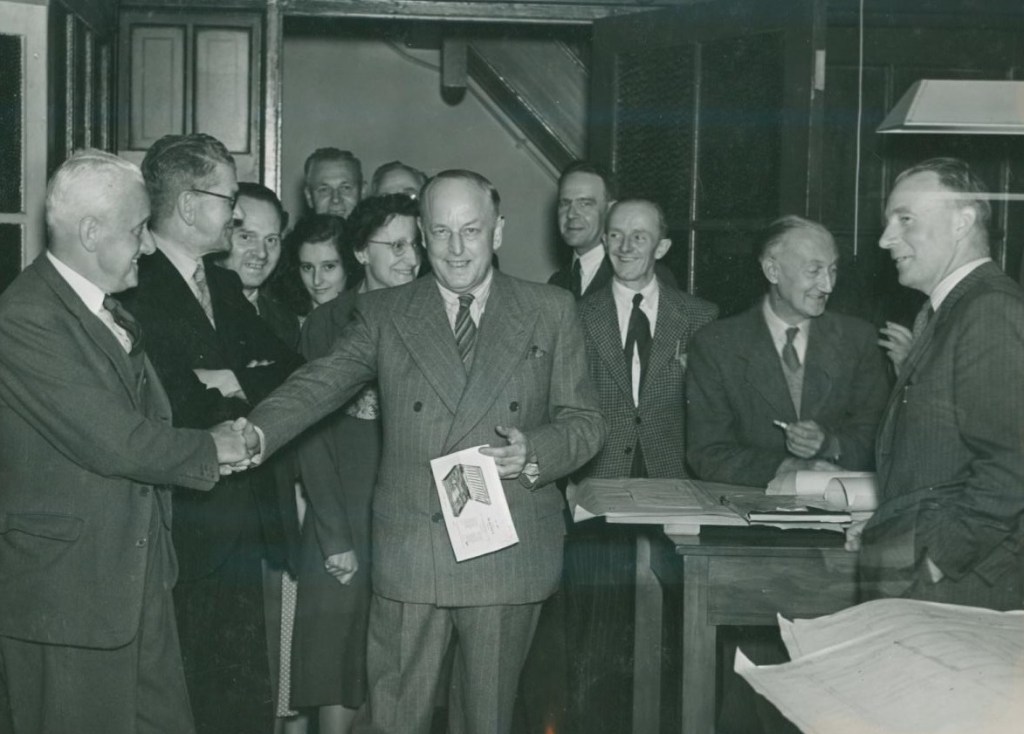
Percy J. Bartlett, the Boots’ architect, on his retirement. Photograph: Walgreens Boots Alliance
Shop windows as they used to be. Photograph: Walgreens Boots Alliance

See also Walgreens Boots Alliance Archive and Lenton Hall as featured on House and Heritage – the sister site to Sheffielder

© 2021 David Poole. All Rights Reserved.

Categories
Buildings Sculpture

A relentless quest to eradicate disease

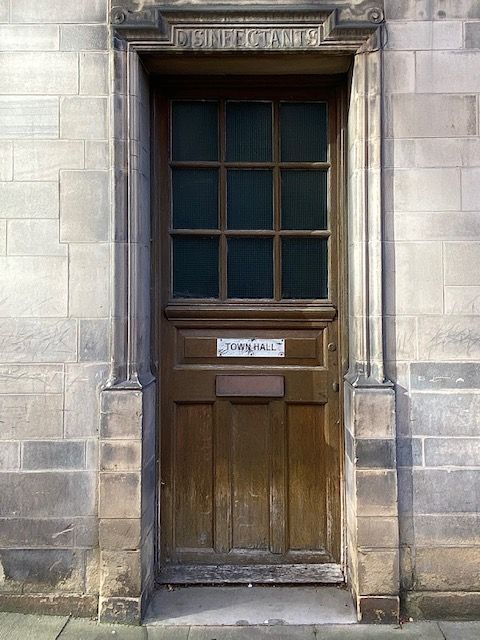
Behind the Town Hall, on Norfolk Street, is a single doorway with the words ‘Disinfectants’ carved into the lintel above. It appears to originate from 1897, the year that Sheffield’s new Town Hall opened, and where ratepayers were able to buy disinfectant for their homes.

Disease was a worry for our Victorian ancestors and the city was still recovering from outbreaks of smallpox, scarlet fever, measles, whooping cough, and puerperal fever. In 1896, Sheffield’s population was 347,278 and quickly expanding into Walkley, Attercliffe and Heeley. In that year, 6,732 people died, many from disease, although the trend was decreasing. Astonishingly, 392 people had died from diarrhoea.

Medical science was concerned with tracking disease to its source with a view to prevention and was no longer content to repair the ravages of disease which might have been prevented.

In a time when preventative vaccines were still in their infancy, disinfectant was used to spearhead the fight against zymotic diseases. Where disease was evident in the home it was the use of carbolic acid powder and chloride of lime that allowed walls to be washed while articles were removed and burned.

One of the concerns was that if people were ill with infection, to make sure that they didn’t pass it on, cleaning and disinfecting, both where they lived, and the things that they owned and had contact with, was a way of eradicating germs

Sheffield had a disinfecting station at Plum Lane where infected people and their possessions would enter the station from one side, move through the process of steam disinfection and exit out the other side. There were also metal hoppers in which people would have placed their infested clothes before taking a sulphur bath to treat their condition.

These sorts of places were common across the country and were a very important part of how Victorian and Edwardian local authorities responded to outbreaks. And when outbreaks did occur, high-occupancy slum housing meant it spread quickly. In 1899, a typhoid outbreak at Brightside speedily infected over 100 people within a half mile radius.

Carbolic acid remained one of the most popular disinfectants, sold in liquid and powdered form at pharmacist’s shops, but also pre-mixed with soap. But there was also a leading brand of disinfectant, made right here in Sheffield, and this was Izal, a supplier to the British army, and the only liquid disinfectant used on troops in the Boer War. It was thought to have been beneficial for the treatment of typhoid and diarrhoea when administered internally.

In the 1930s, as infectious diseases became less virulent and more treatable thanks to a combination of vaccines and antibiotics, the use of disinfectants declined, but manufacturing processes made it more widely available to the population.

© 2021 David Poole. All Rights Reserved.

Categories
Buildings

Sheffield Town Hall: the clock tower that came without a bell

Restoration work this century revealed that stone for the Town Hall clock tower came from a long-disused quarry at Walkley. Photograph: DJP/2021

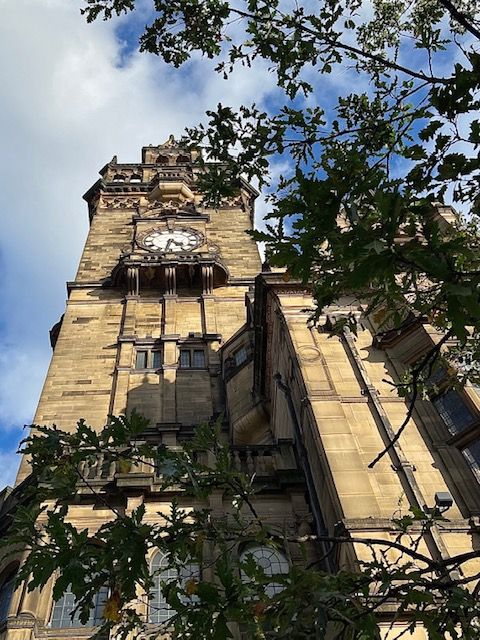
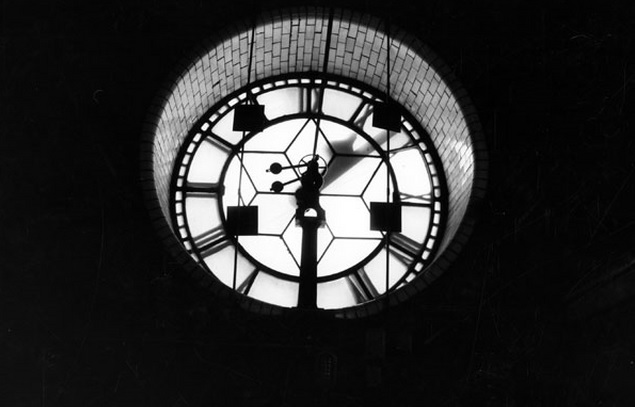
Sheffield’s third Town Hall was designed by Edward William Mountford, a London architect, and opened in 1897. Its clock and tower, the face of our city, stands at the north-east corner, over 100ft high and topped with a statue of Vulcan, the Roman god of fire and metalworking.

The tower is built on a bed of concrete, 30ft square, and 25ft thick; the concrete itself resting on solid rock. At ground level the walls are about five feet thick, and when it was built the strong room for the City Accountant was located here. The dome and spire at the top of the tower are covered with copper.

It was always thought that the tower was made of ‘Stoke’ stone from Stoke Hall Quarry, near Grindleford, but restoration work in 2017 revealed that it was from a long-disused quarry at Walkley.

The Town Hall clock was the work of William Potts and Sons, Leeds, clock makers to Queen Victoria, and was constructed to strike the quarters and hours on heavy bells. However, Sheffield Corporation waited for somebody to show their public spirit and provide the bells – something that never happened – and without it the striking parts of the clock were useless.

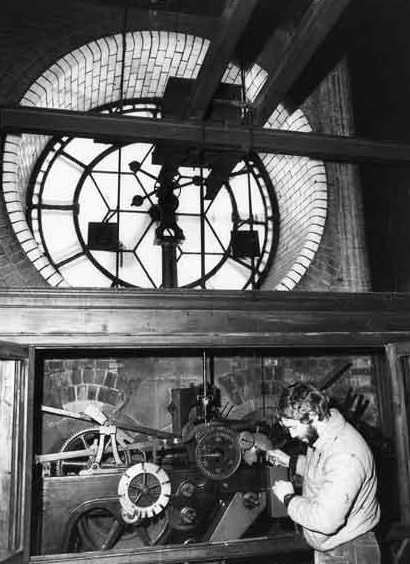
The frame of the clock was in one solid casing, planed perfectly flat on the top and bottom surfaces. It rested upon iron girders, supported by stone corbels built into the tower wall, and provided a rigid foundation for good time-keeping.

The large main wheels for the hour and quarter parts were 22 inches and 20 inches in diameter, respectively. The hour main wheel had ten steel cams attached for lifting the hammer to strike the large bell, with the quarter wheel having suitable cams in readiness for the ‘phantom’ bells. The large gong wheel was 20 inches in diameter.

The workings of the Town Hall clock. Seen here in the 1980s. Photograph: Picture Sheffield

There was special arrangement for accurately discharging both the hour and quarter parts, with set dials showing both seconds and minutes, and was known as the double three-legged gravity, the invention of Edmund Beckett, 1st Baron Grimthorpe, the man behind Big Ben’s clock, with the two seconds pendulum compensated for differences of temperature and heavy cylindrical bob.

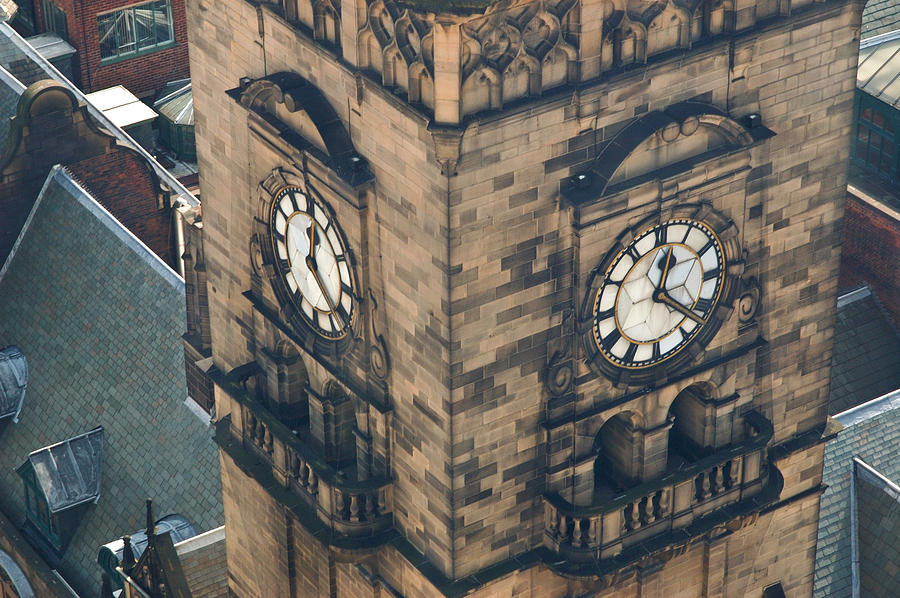
There were four dials, each 8ft, 6 inches in diameter, formed of skeleton iron castings filled in with opal glass, originally illuminated at night by gas, with suitable reflectors behind. The hands were made of stout copper, counterpoised inside, and the motion wheels were made of hard brass, the teeth cut out of it. The bevel work was carried by light iron girders placed across the clock room, and the whole clock was enclosed in a neat wooden case to keep it clean.

The four faces of Sheffield Town Hall’s clocks. Work started in 1890 and wasn’t completed until 1897. Photograph: Rob Huntley

It was not until 2002 that the Town Hall got bells – but nothing as elaborate as once intended. The chimes that now ring out across the city centre comes from an electronic sound-system providing hourly strikes and Westminster-style quarter chimes.

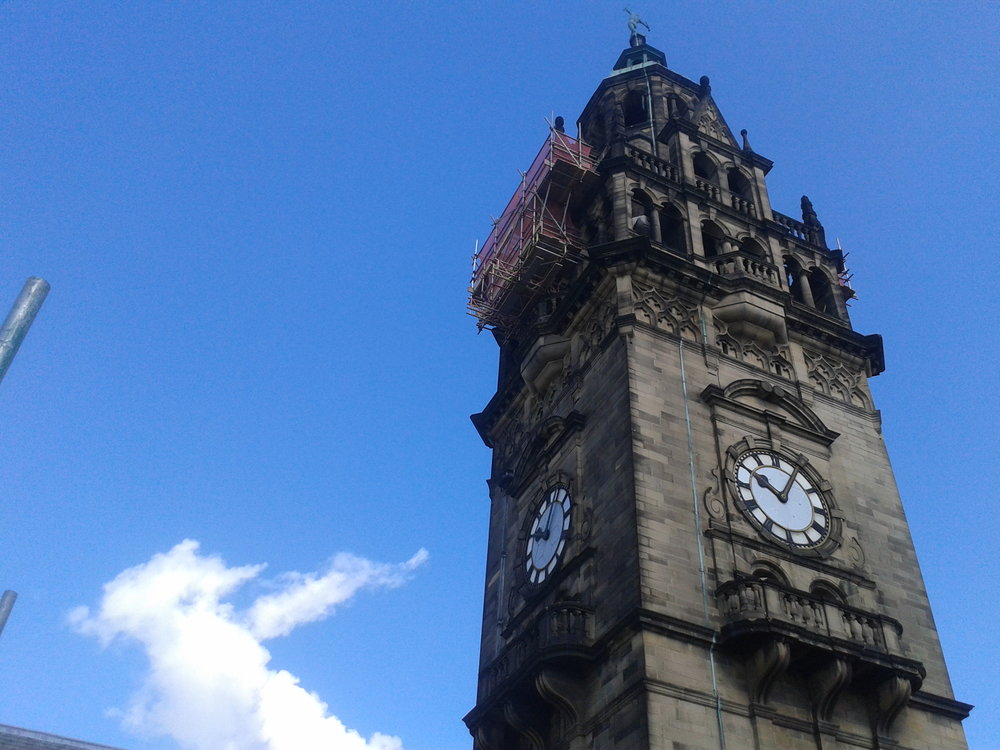
The clock tower was exposed to Sheffield’s pollution and weather for well over a hundred years and had to be restored at a cost of £86,000 in 2017. The original ironwork which had corroded within the structure was exposed and treated and indent repairs were conducted to the ornate carved capitals. Other masonry was repaired and repointed, as necessary. In addition, new rainwater pipes, asphalt floors and gutters were installed. Suitable fine sandstone providing a good match with the original stone was sourced from local suppliers based in Chesterfield.

The clock tower stands at the north corner of the Town Hall, set back slightly in deference to the main façade. This photograph from contractor Maysand shows restoration work in 2017
Sheffield Corporation could not decide whether or not to install a four-ton bell at a cost of £400 before the building of the tower was completed. It was said that if the bell were not put in, but it was decided to put it in later, a great deal money would have to be spent and serious damage done to the tower. Photograph: Picture Sheffield

Picture Sheffield

© 2021 David Poole. All Rights Reserved.

Categories
Companies

From horse and cart to Big Green Parcel Machine

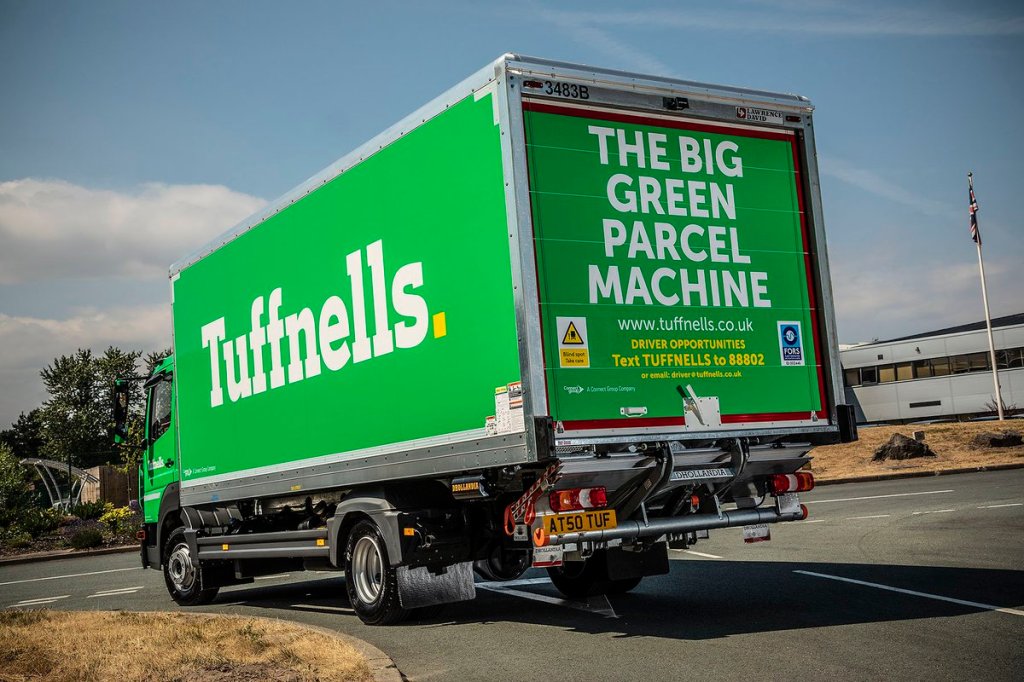
Tuffnells adopted its slogan – The Big Green Parcel Machine – in 1985. Photograph: Tuffnells

Which Sheffield company operates from a network of 34 depots, with a head office in the city, and serves about 4,000 businesses?

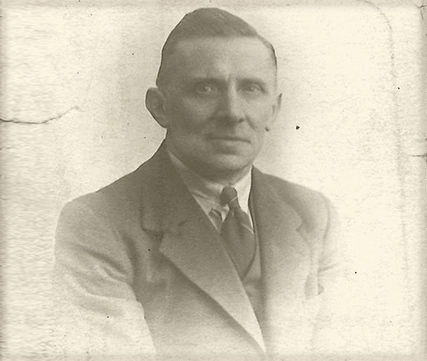
This is a company founded in 1914 by Harold James Tuffnell  (1886-1963) with a horse and a cart he bought for £100. His surname is the giveaway, and today Tuffnells is a nationwide parcels carrier.

Harold James Tuffnell was once a groom to Charles Crookes, a steel manufacturer of East Cliffe House, East Bank Road. He died at the Royal Hospital in 1963. Photograph: Tuffnells

By the 1920s, Harold Tuffnell was operating on Langdon Street as a motor haulage contractor and coal merchant, living at 261 Pearl Street. By 1936, H.J. Tuffnell Ltd, carriers, were on Mary Street, with Harold living at 149 Folds Lane

By 1951, H.J. Tuffnell operated seven vehicles with a livery of maroon and cream, but two years later was sold to Mr E.J. Shaw, who had bought into removal company Caudles (established in the 1890s by William Caudle as a coal merchant, furniture remover, and haulier).

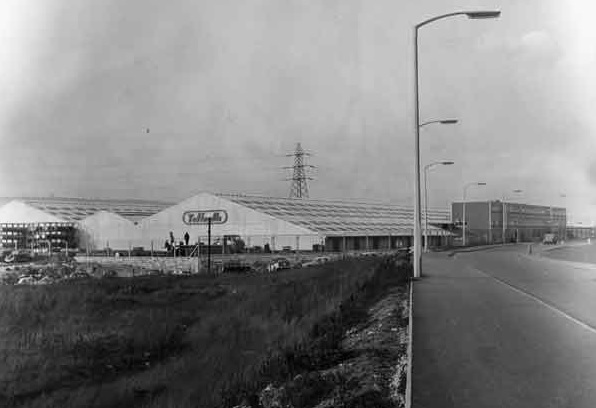
The company moved to Woodbourn Road, and subsequently to Shepcote Lane in the late 1960s.

Tuffnells new Shepcote Lane distribution centre in 1968. Photograph: Picture Sheffield

In 1971, Tuffnells was sold to TDG (Transport Development Group), a company founded in 1922 as The General Lighterage Co, and which eventually was swallowed up by Nobert Dentressangle and XPO Logistics. Under TDG, Tuffnells expanded and by the 1980s operated out of fifteen depots nationwide.

It changed its name to Tuffnells Parcels Express in 1985, and with a fleet of two hundred vehicles, adopted the slogan, The Big Green Parcel Machine.

Tuffnells was subject to a £33m management buyout in 2005 and turnover exceeded £100m for the first time. It came to the attention of the Connect Group, another company with a long history – originally known as W.H. Smith News and renamed Smiths News in 2006 from the demerger of W.H. Smith. It became the Connect Group before reverting to Smiths News again.

Connect paid £100m for Tuffnells in its centenary year, later moving its main distribution centre to Europa Close and its head office to the former Sheffield City Council Offices on Carbrook Hall Road.

The takeover was not without its problems and subject to a run of poor performance, (“a drag on profitability and cash”), Connect had considered closing it, before off-loading the company (and its 1,200 green trucks) to investment vehicle Palm Bidco for £15m in July 2020, effectively returning the company back into private hands once again.

Still going strong, despite plans by the Connect Group to close the business in 2019. Photograph: Tuffnells
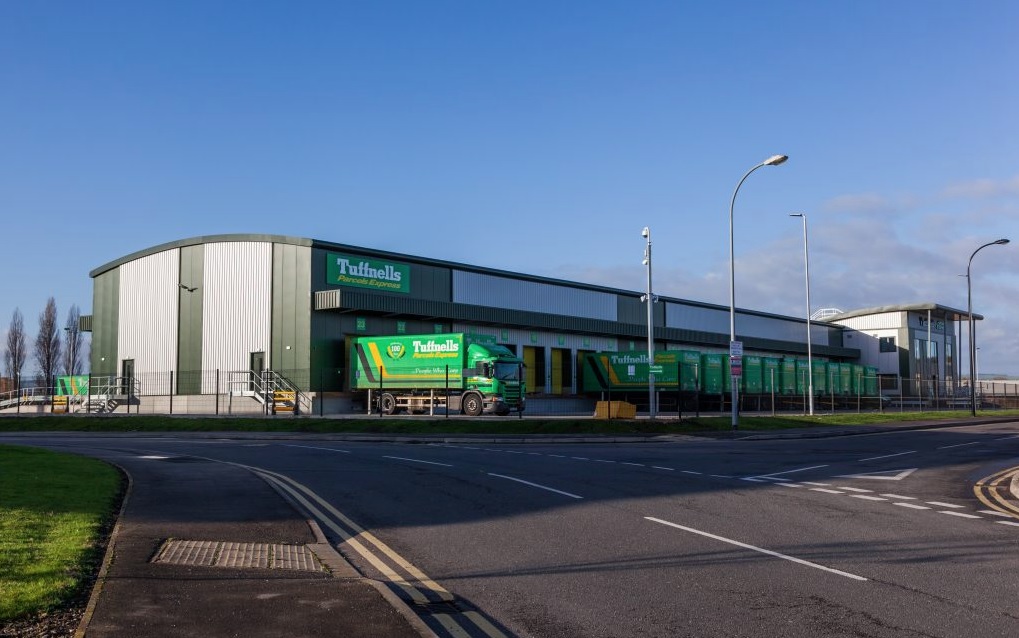
Measuring 20,000 square foot and sitting on a four-acre site, the Europa Close site is home to 41 vehicles, 51 loading bays and 139 employees. Photograph: AKV Group

Picture Sheffield

© 2021 David Poole. All Rights Reserved.

Categories
Buildings

Pinstone Chambers: Its forgotten history lies within the entrance

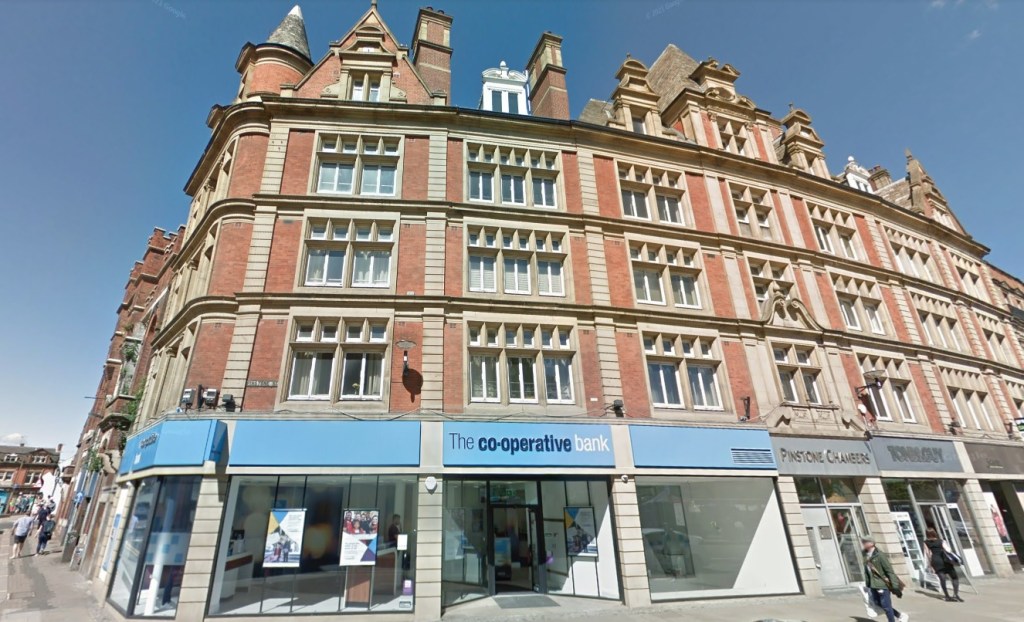
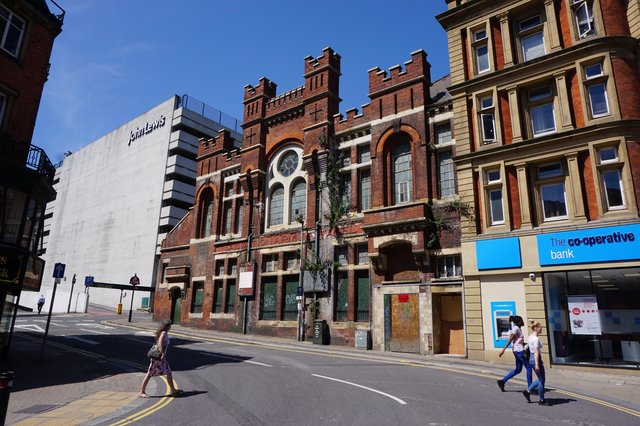
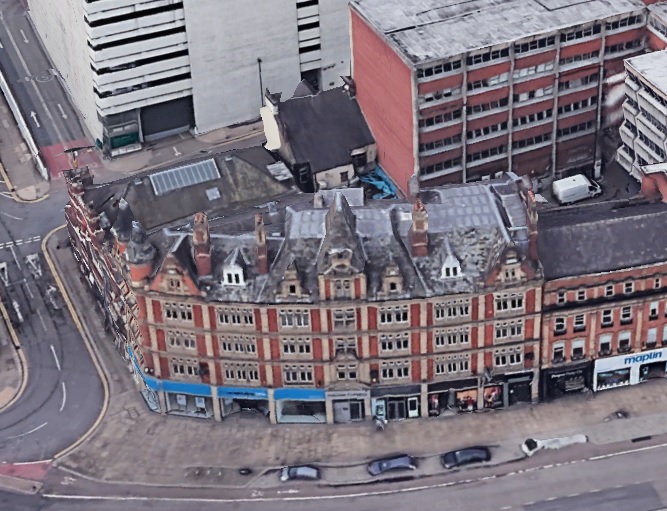
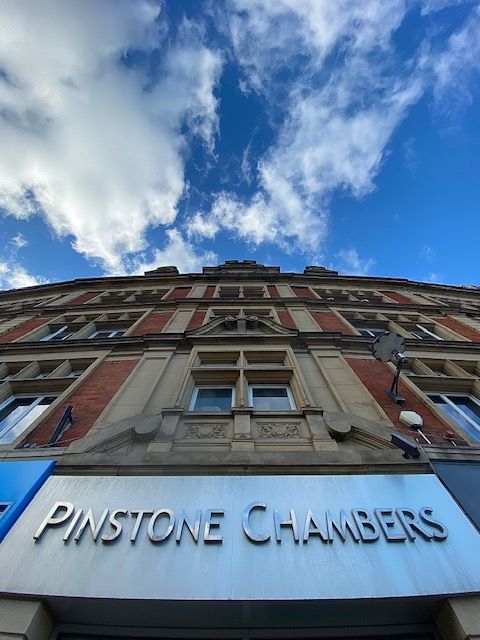
Pinstone Chambers. Elegant, its exterior untouched, and one of the few buildings that doesn’t form part of the Heart of the City II development. Photograph: Google.

Heart of the City II is altering the way our city centre looks. We must go back to Victorian times to see anything resembling the magnitude of this change. Before then, the area around Pinstone Street was a region of dirty, narrow, streets and alleys that led to nowhere. The poor were abundant, and then the jennel known as Pinstone Street was replaced by a broad thoroughfare, and the people who lived under the shadow of St. Paul’s dome (now Peace Gardens) migrated southward. With it came shops and offices that are no longer suitable for the 21st century… and now we are preserving the look, but removing the myriad of old corridors, staircases, and rooms behind.

Once completed, almost the whole of the west side of Pinstone Street will have been touched by redevelopment… and that is quite a remarkable achievement.

One building will remain, oblivious to the change around it, and one that rarely gets a mention.

Few people realise that the entrance to Pinstone Chambers once led to the remarkable building behind.
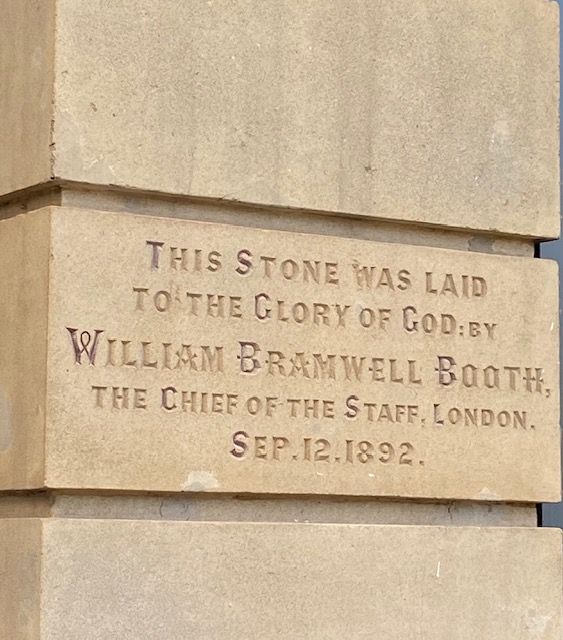
For all to see. This stone was laid by William Bramwell Booth, the Salvation Army’s Chief of Staff. It can be seen to the right of the modern-day entrance. Photograph: DJP/2021

We can trace Pinstone Chambers (Nos. 44-62 Pinstone Street), at its corner with Cross Burgess Street, back to 1891, when the Salvation Army ‘planted the flag’ on a piece of land bought from Sheffield Corporation. A year later, a ceremony took place to turn the first sod. ‘The waste piece of ground has been as free of turf as a billiard ball is of hair, it was hard to see where the sod would be found.’   

The foundation stones were laid in September 1892, and formed part of an inner wall, the inscriptions on them visible in the entrance hall by which the Sheffield Citadel behind was approached from Pinstone Street. By this, we know that this building was steadfastly linked with the Salvation Army’s place of worship, one that survives in disgraceful neglect, and awaits its own course of redevelopment.

The architect was William Gillbee Scott (1857-1930), who designed the Gower Street Memorial Chapel (now the Chinese Church in London), and the London and Provincial Bank in Enfield.

The building is curved on plan, has five storeys, and has seven bays at the east return and one along Cross Burgess Street to the south. The building is Classical in style and has red brick elevations with contrasting sandstone dressings. Architectural features include ground floor shopfronts, mullioned fenestrations, casement windows and rusticated pilasters between bays.

The building was erected by Messrs. Thomas Fish and Son, Nottingham, and comprised accommodation on the top floor, offices beneath, and six large shops on Pinstone Street. Painting and decoration were by Thomas Toon, of Nottingham.

The land cost £7,812, and the building work over £16,000, the shops and offices used to bring in considerable income for the Salvation Army.

It was opened by Commissioner Thomas Henry Howard, on 27 January 1894.

This photograph in the Picture Sheffield collection shows the construction of the Citadel Building between 1892-1894. St. Paul’s Church, on the right, stood where the Peace Gardens are now. Photograph: Picture Sheffield.
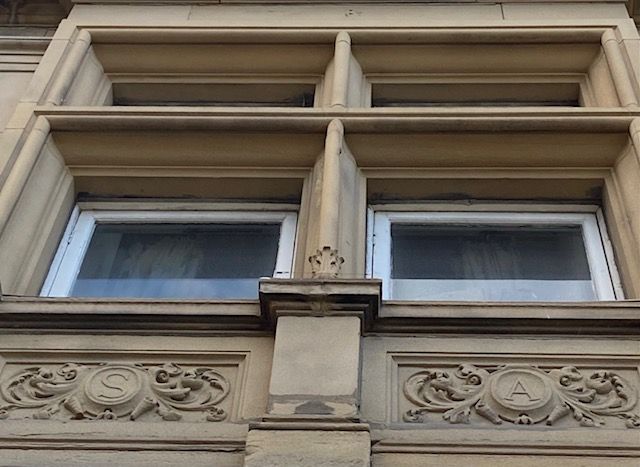
The carved initials of the Salvation Army above the main entrance. Photograph: DJP/2021

The main entrance to the Citadel was from Pinstone Street, flanked by the row of shops. The visitor passed along a vestibule lit by gas in ruby globes. The walls were decorated in green sage, with a deep maroon dado, and the floor was paved in mosaic style. Inserted into the wall on the right were the dozen stones, laid when the building commenced, with the names of those who undertook that duty.

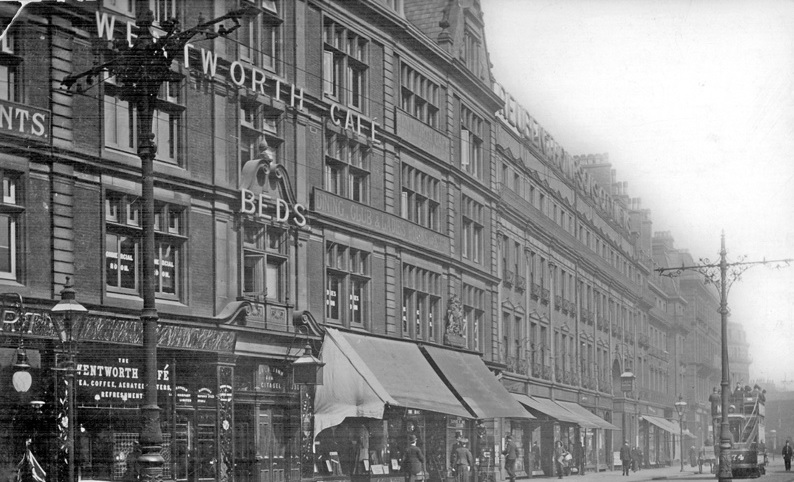
While the temperance rooms at the Citadel are decisively linked with the Salvation Army, the Citadel Building (as it became known) was better known for its commercial activities. Soon after it opened it was occupied by the Wentworth Café and Hotel, moving here from Holly Street, a socialist meeting place famously linked with Edward Carpenter. That association ended in 1922 when the whole of the premises was leased by Stewart and Stewart, the well-known tailors, who extended from next door.

The Wentworth Cafe and Hotel occupied most of the building from about 1898 to 1922. The entrance to the Salvation Army Citadel can be seen centre-left. Photograph: Picture Sheffield.
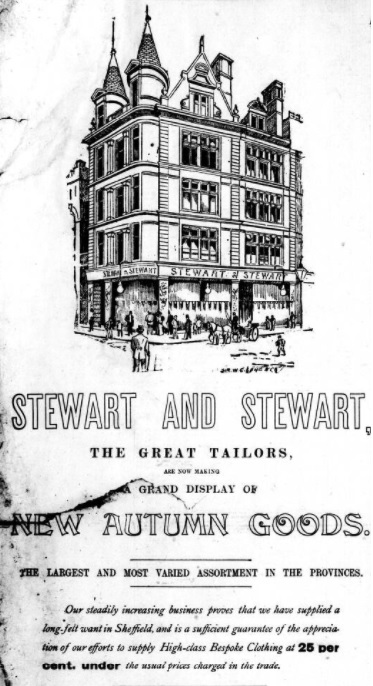
One of the original occupants. This newspaper advertisement from 1898 is for Stewart and Stewart who later leased the whole of the ground floor. Photograph: British Newspaper Archive.
The Sheffield Citadel was built at the same time as Pinstone Chambers. Despite the contrasting styles, the two buildings were connected by a corridor leading from its main entrace on Pinstone Street. Photograph: Sheffield Star.

Afterwards, while shops frequently changed hands, the upper floors were used as offices until the interiors of Pinstone Chambers were completely remodelled for city living accommodation.

The Salvation Army moved out of the Citadel in 1999, the crumbling shell still attached to Pinstone Chambers, but the old main entrance and corridor to it long since blocked-off.

Is the ‘foundation stone’ wall still visible in the old vestibule? What survives of the Victorian floor mosaic? Is there any evidence of the sage green and deep maroon decoration?

Probably not.

With its curved Queen Anne facade, Pinstone Chambers remains one of Sheffield’s most attractive buildings. Photograph: Google.
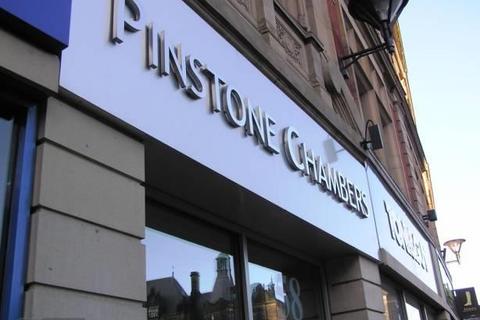
Pinstone Chambers. The National Market Traders Federation was founded at the Wentworth Café in 1899. Photograph: DJP/2021)
Pinstone Chambers. The carved initials of the Salvation Army can be seen above the entrance. Photograph: DJP/2021

Picture Sheffield
© 2021 David Poole. All Rights Reserved.

Categories
People

“War and work, work and war, and it is said it might have been so different.”

On the nights of 11th and 13th December 1940, a German attack on Sheffield lasted for many hours, and cinemas, stores, and shops, were wrecked, and some churches damaged. Two days later, on the 15th and 16th, Sheffield was again attacked with material results, explosions, and a considerable number of fires observed.

“Between 3.30 and 4.00 a.m. on 13th December 1940, from our terrace we watched Sheffield burn. Sheffield is my native city. I felt then that the rest of my life must be devoted to helping to restore and rebuild the fortunes of the city.”

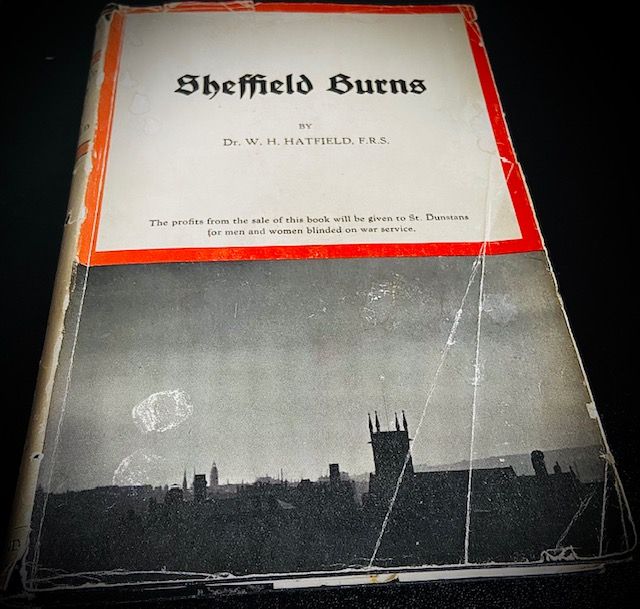
These words were written by Dr W. H. Hatfield in the introduction of his book, Sheffield Burns, published in 1943, in which he idealises and hopes the city will have a brighter future.

“My father desired to rest with his father, and I remember subsequently on a quiet wintry afternoon standing before their tombstone and reading the dates on which my grandfather and my father passed away, and then realising that I could from the inscriptions before me, predict the approximate date upon which I, given good fortune, would also pass away.”

Hatfield gave the final proofs of his book to his publisher on 13th October 1943 and died four days later, much sooner than he had probably anticipated.

He died through strain and overwork in furthering our war effort,” said his wife Edith at the time. “Working unflinchingly at all hours, day and night for four years without rest or holiday, for our armaments and aircraft industry.”

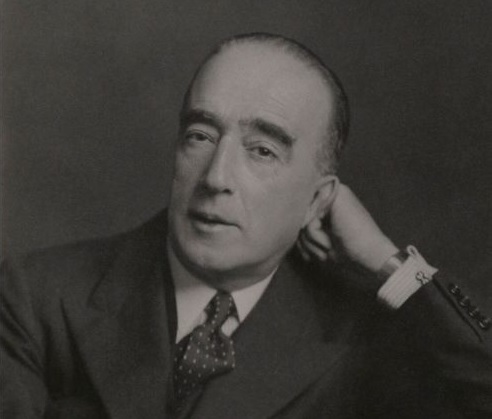
William Herbert Hatfield was born in 1882, and worked in the laboratory of Henry Bessemer and Co, while at the same time studying at University College, Sheffield, where he became Doctor of Metallurgy in 1913. Later he became a metallurgist at John Crowley and Co and was subsequently appointed director of the Brown-Firth Research Laboratories, and later with the board of Thomas Firth and John Brown.

It was Hatfield who discovered 18/8 stainless steel in 1924 which happens to be the most widely used stainless steel in the world today. For all his efforts, he is sadly overlooked by history, except for the Hatfield Memorial Lecture, held every December by the University of Sheffield.

© 2021 David Poole. All Rights Reserved.

Categories
Buildings

Graves Art Gallery: another touch of the benefactor

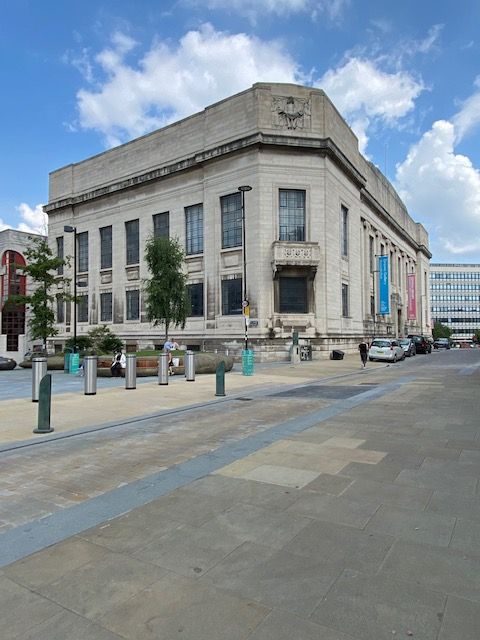
Sheffield Central Library on Surrey Street is also home to Graves Art Gallery. Photograph: DJP/2021.

You’ve probably seen the Bowmer & Kirkland signs on hoardings and cranes around Sheffield. The Derbyshire-based construction and development company is responsible for Moor Market, No.3 St. Paul’s Place, St. Vincent’s Place, New Era Square, and is backing the developer behind the West Bar scheme.

The company was established in 1923 as a partnership between joiner Alfred Bowmer and bricklayer Robert William Kirkland. The current chairman is Jack Kirkland, businessman, art collector and philanthropist.

Bowmer & Kirkland was founded in 1923 and is based at Heage, near Belper, Derbyshire. Photograph: Bowmer & Kirkland.

Kirkland first started buying art around 20 years ago, purchasing a work by the US conceptual sculptor Tom Friedman. While big on American modernism and Latin American contemporary art, his collection also includes Hellenistic bronzes, a Carracci portrait, and an Egyptian faience baboon. 

His sizeable collection of interwar European photography is promised to the Tate, where he is Co-Chair of its Photography Acquisitions Committee. He is also the chairman of Nottingham Contemporary and a trustee of the Bridget Riley Art Foundation.

Kirkland is also chairman and settlor of The Ampersand Foundation, a UK-awarding charity that supports the visual arts, exhibitions, projects, and supporting public collections, provided they are free to the public at least one day per week.

Jack Kirkland’s art collection has been loaned for international exhibitions, and some of the works have been previously shown at Graves Gallery in Sheffield. Photograph: Apollo Magazine.

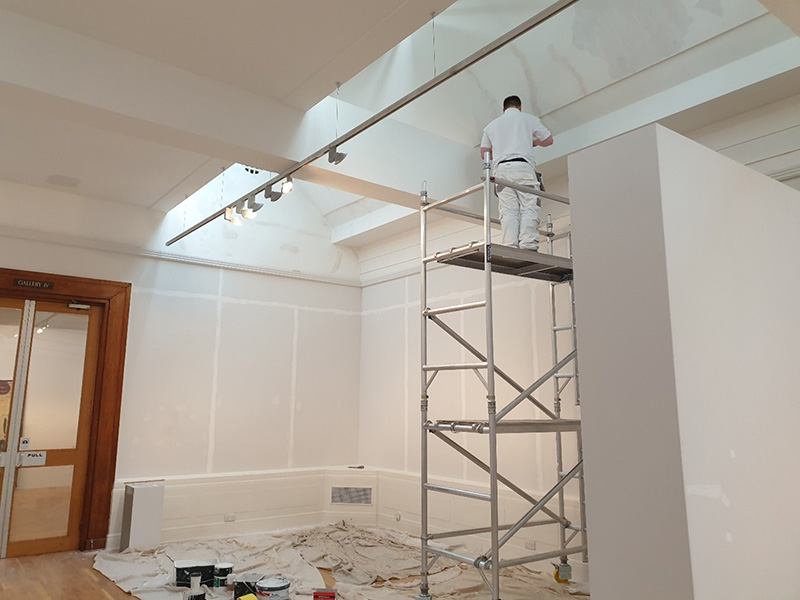
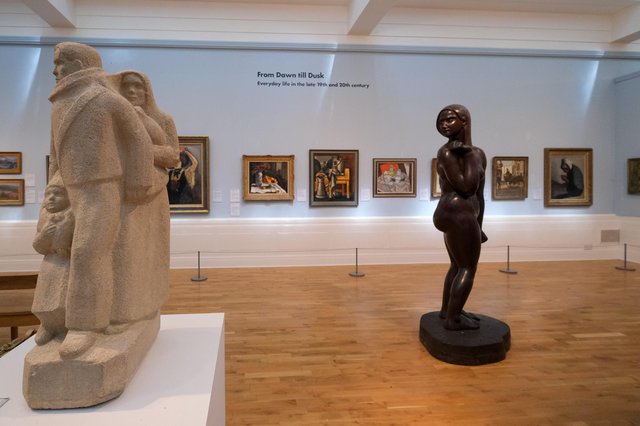
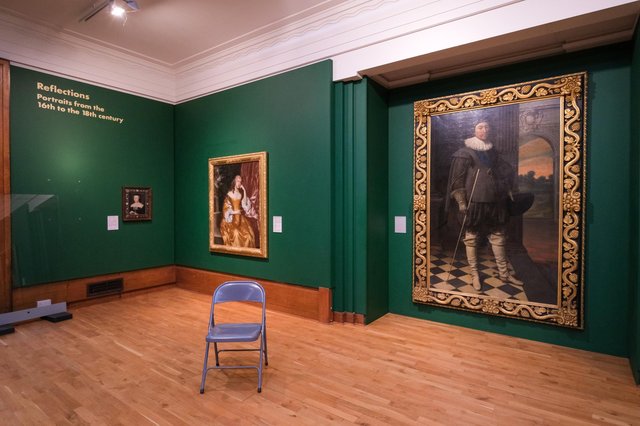
Last Friday (3 Sep 2021), the Graves Art Gallery in Sheffield reopened after six months of renovation work to redecorate, re-clad the walls in galleries largely untouched since 1934, bring many artworks out of storage for new displays, and to showcase work with a fresh perspective on classic art.

It has all been possible after a grant of £455,000 from the Ampersand Foundation, a long-time backer of Sheffield Museums, and the largest single amount ever awarded by the charity.

The grant echoes the day when Sheffield Central Library and Graves Art Gallery were opened by the Duchess of York (Queen Mother to our younger readers) in July 1934.

The newly reclad and redecorated temporary exhibition space, galleries 2 and 3, will reopen with an exhibition celebrating the work of sculptor Mark Firth, great, great grandson of steel magnate and philanthropist Mark Firth. Photograph: Sheffield Museums.

The total cost of the building was estimated at £141,700, of which £114,700 represented the structure, and £27,000 the furnishing. Alderman John George Graves contributed £30,000 and gave the gallery’s director, Dr J.M. Rothenstein, unrestricted choice from his own art collection, with power to borrow whatever was needed.

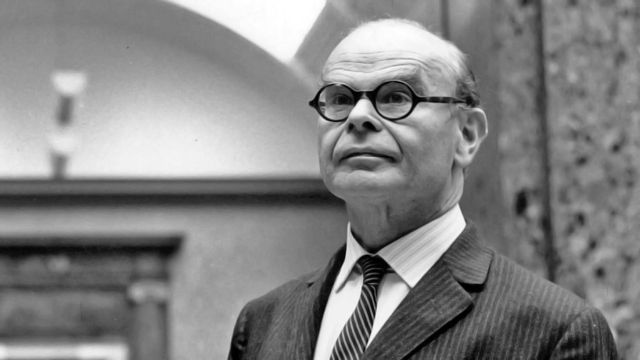
John Rothenstein was born in London in 1901, the son of Sir William Rothenstein, whose family was connected to the Bloomsbury Set. Photograph: Geni.

Sir John Knewstub Maurice Rothenstein CBE (1901–1992) had served as Director of Leeds City Art Gallery, and was appointed Director of Sheffield City Art Galleries (1932-38) where he oversaw the establishment and opening of the Graves Art Gallery. From 1938–64 Rothenstein was Director of the Tate Gallery in London.

Rothenstein carefully planned the interior which was of dark blue rough-textured paper, to take advantage of each collection in its eight galleries.

It’s been a long road since, overshadowed by recent events in which the Central Library and Graves Art Gallery were almost sold to become a five-star hotel, and the fact that it needs about £30m investment in maintenance.

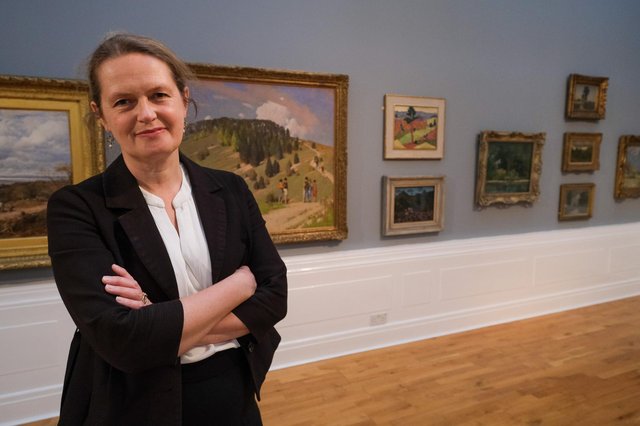
Kim Streets was appointed to the role of CEO of Museums Sheffield (now Sheffield Museums)in 2012. She is seen here at Graves Art Gallery before the reopening to the public. Photograph: Sheffield Telegraph.

The gallery has not had a major redisplay and some of the spaces were in desperate need of a refresh.

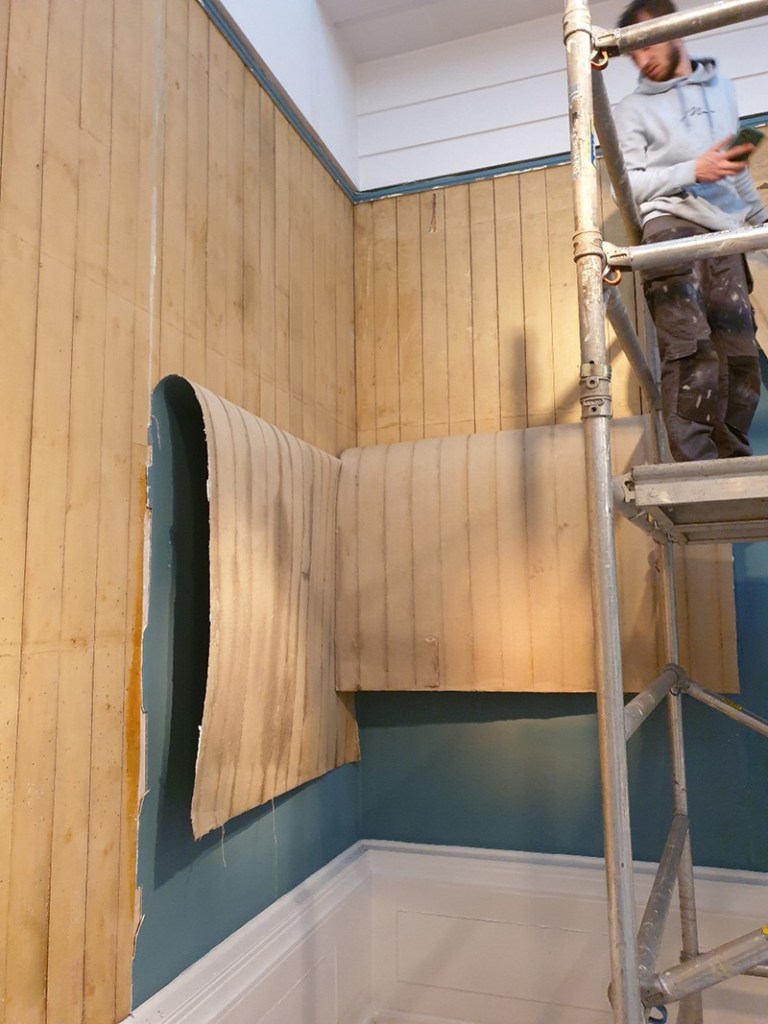
The project began back in the winter with the removal of the artworks from the gallery walls, allowing skilled contractors to re-clad galleries 2, 3 and 6. The contractors removed the existing wall cladding before fixing new sheets of MDF to create smooth walls – a first in decades for these galleries.
The final phase of the improvements was the installation of new MDF walls and woodwork, that were then painted and finished ready for the new displays. 

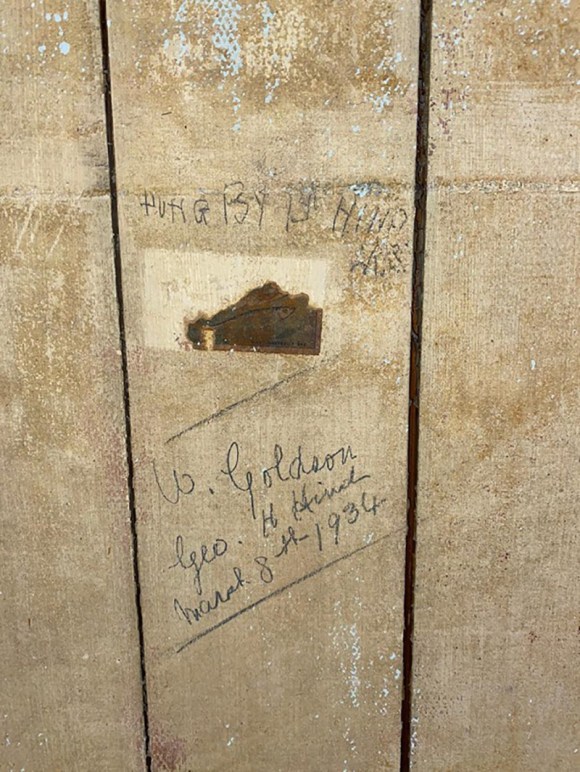
Top layer of the walls coming away to reveal vertical wooden planks. These planks had been covered in hessian many decades ago and the hessian had then been covered with layers and layers of paint over the years. Photograph: Sheffield Museums.
A set of signatures by the original builders of the Central Library and Graves Art Gallery, which opened in 1934. Photograph: Sheffield Museums.
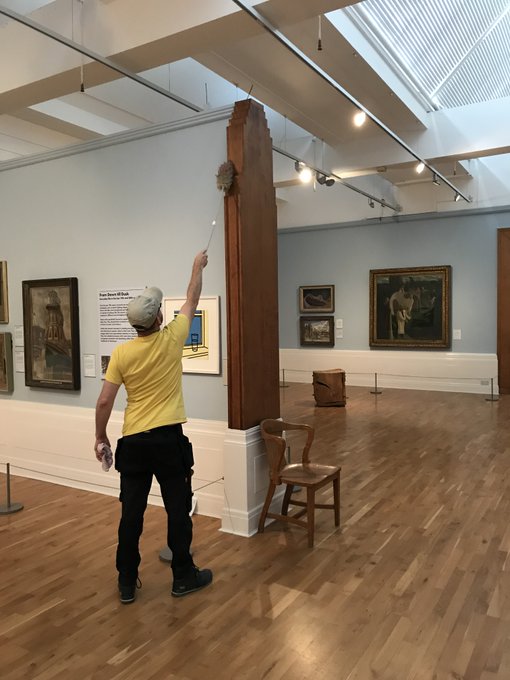
Refurbishment and re-hanging nears completion as Graves Art Gallery gets ready to reopen to the public. Photograph: Sheffield Telegraph.

It is understood that the Ampersand Foundation will be supporting the Graves Art Gallery with further redisplays, conservation of the city’s art collection, work with schools and artists, and more over the next four years,

Jack Kirkland, the charity’s chairman, says Sheffield Museums is “using the money as it was intended to be used: that is for the benefit of all Sheffield residents and visitors, and in particular children and young people”.

I might suggest that J.G. Graves would have approved.

A fresh new look for Graves Art Gallery. Photograph: Sheffield Telegraph.

© 2021 David Poole. All Rights Reserved.

Categories
Buildings

Bank Street and the building that never came to be

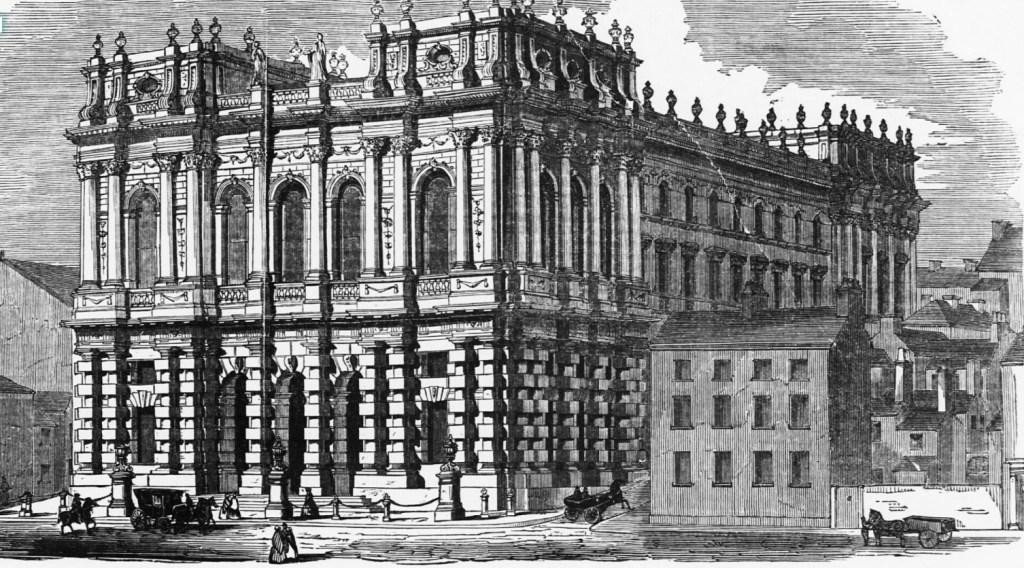
“The architects have embodied and concentrated, in an excellent manner, the scattered ideas that were floating in the minds of many.” – Sheffield and Rotherham Independent (1847). Photograph: British Newspaper Archive.

From the archives. The year is 1847, and there was talk of a new public building in Sheffield. People were excited. The town was without a public building worthy of its name and enviously looked to Liverpool with St. George’s Hall, and Birmingham with its noble Town Hall.

Unexpectedly, the architects, Flockton, Lee, and Flockton, off its own back, came up with a design, and presented it to the Town Council. This would have been an ample hall for public meetings, a large room for public dinners or lectures, permanent places for the Town Council, the Bankruptcy Court, the Small Debts Court, the School of Design, and a large Museum.

The Town Council was shocked, flinched at the cost to build it, and dismissed the proposal.

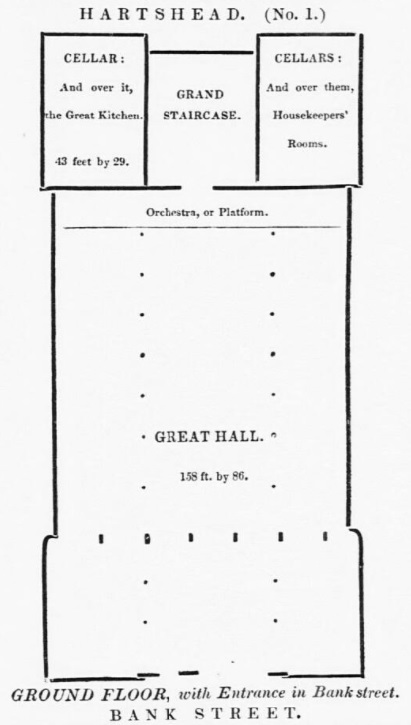
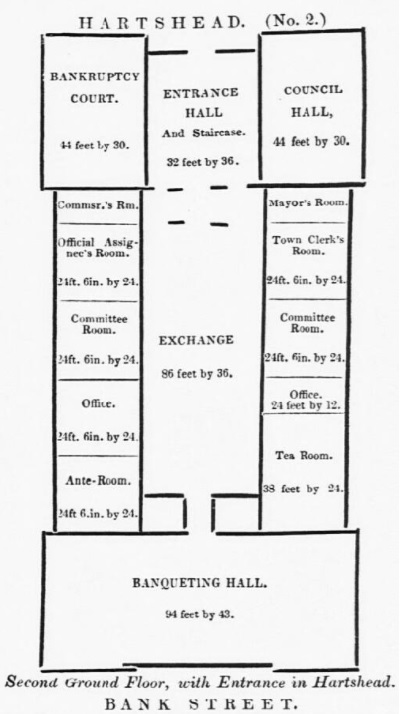
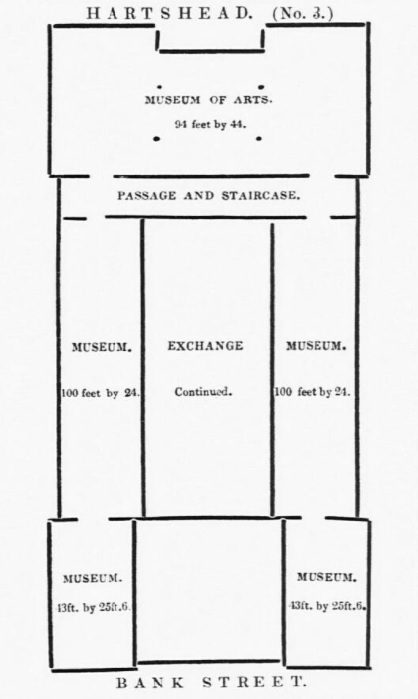
However, the Sheffield and Rotherham Independent, a supporter of the scheme, had other ideas. The newspaper published a detailed sketch of the building, along with floor plans, and advocated that it should be built.

The public was divided. Some said it had to be done, others said they would like to see it built because Sheffield would then have had a building unequalled by other towns, but the general feeling was that times were hard, and that it could not be allowed to continue.

It wasn’t built, and if it had been, we can only speculate as to what its future fate might have been. Would it still be standing? What condition would it be in? Might it have been destroyed by German bombers?

Most of us will be surprised as to where it was intended to be.

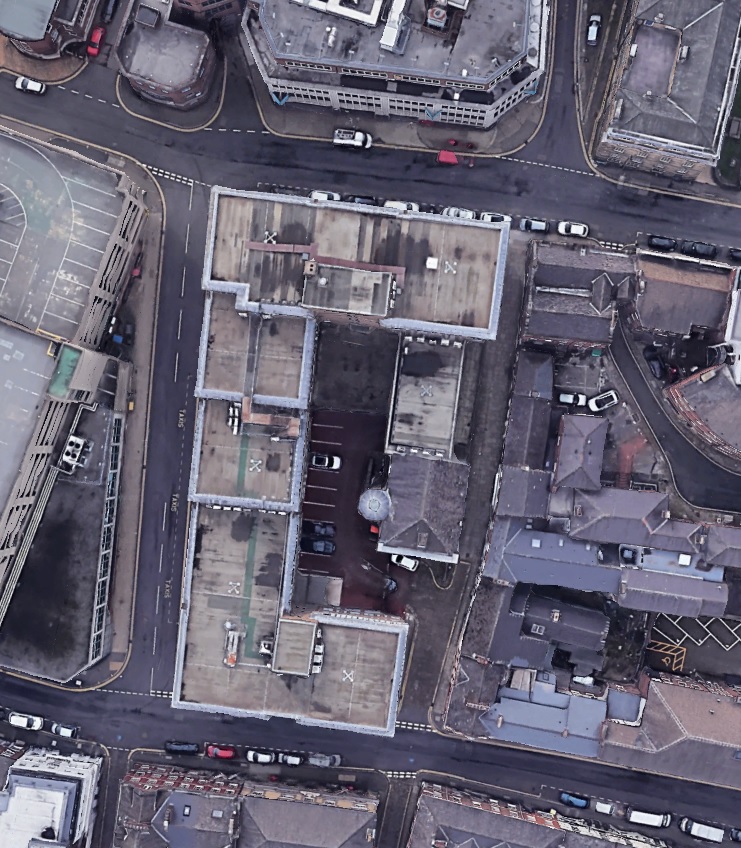
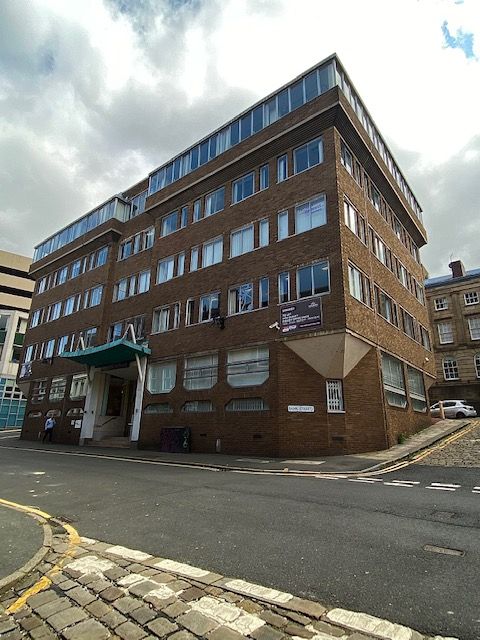
The proposed site comprised nearly 3000 square yards, in an oblong shape, stretching from Bank Street (bottom) to Hartshead (top). “It was occupied by buildings which are of small value.” Photograph: Google.

The site was a plot of sloping land bounded on the north by Bank Street, on the south by Hartshead, on the east by Meetinghouse Lane, and on the west by Figtree Lane. Today, it might seem to have been absurdly in the wrong place, but in the 1840s the area was close to where Sheffield began.

Bank Street wasn’t created until 1792, and was intended to be called Shore Street, named after John Shore, a banker, and this was the name used on leases granted when he cut up his land for building purposes.

In 1793, we find reference to a “new” street in Sheffield called Bank Street, indicating that Shore had just built the town’s first bank here. In effect, the area was a developing financial district, and a public building might not have been so preposterous after all.

“Is the town prepared for so large an undertaking?” asked the Sheffield and Rotherham Independent. “Perhaps not, just now; but there are several considerations that may tend to prepare it.

“In the first place,  if the town is to build, as build it must ere many years have elapsed, it must look beyond the present. A public building is not made like a coat, to fit exactly when made, and be soon worn out. It should be built for two centuries, or more.

The question should not be how little will it serve now? But how can we adequately provide for the present and future, combining at once magnitude of conception, liberality of spirit, and wise economy?

“The expense could not fail to be considerable, but spread over thirty or forty years, it would never be felt as a very heavy burden. This is a wide policy of the Wesleyan body, who, when they build a chapel for the next generation as well as for the present, conceive that the payment should be by those who are to enjoy it hereafter, as well as by themselves.”

What would our ancestors have got for their money?

The descent from Hartshead to Bank Street was about 30ft, allowing for two frontages – one to Bank Street, and the other to Hartshead.

It was proposed to make the Bank Street entrance into a large hall for public meetings, affording standing room for 9000, or sitting room for 3000 persons. This hall would have occupied the whole base of the building with a grand staircase leading up to Hartshead.

The entrance hall at Hartshead would have led to a Bankruptcy Court on one side, and a Council Hall on the other. To these rooms would have been private apartments for the Mayor and the Bankruptcy Commissioner. The entrance hall would have led into an Exchange, covered by a glass dome 50ft above. Alongside would have been offices and committee rooms, with a Banqueting Hall at the Bank Street end.

The topmost story would have extended the whole of the building, excepting the Exchange, and would have provided a Museum of Arts, as well as four additional museum spaces.

Simple plans were prepared by the Sheffield and Rotherham Independent that showed the three-floor layout of the public building. Photograph: British Newspaper Archive.

In connection with the plan, it was intended to open a new street from Hartshead to High Street (along the line of what became Aldine Court) and opening the end of Watson’s Walk into Angel Street. Figtree Lane and Meetinghouse Lane would have been made wide enough for carriages.

“We do not suppose that the Town Council will embark hastily in this measure. They will listen for the public voice.”

The newspaper was correct because it was never built, and had it been so, we might not have had a need for Sheffield Town Hall or City Hall.

The building that never came to be. This modern-day image shows where the Bank Street entrance would have been had it been built. Photograph: DJP/2021.

© 2021 David Poole. All Rights Reserved.

.