Categories
Big Houses

Endcliffe Hall – ‘The House Beautiful’ and its uncertain future

What is going to happen to Endcliffe Hall?

It was a headline that dominated local newspapers in 1913 when it was threatened with demolition. It might also apply to now, with the army planning to end its one hundred and ten year ownership of the large Victorian mansion.

In 1914, with Britain on the brink of war, Endcliffe Hall was bought by the Hallamshire Rifles (4th Yorks and Lancaster Regiment) and although the unit was disbanded in 1968 it remains the regimental Headquarters of Army Reserve Unit 212 (Yorkshire) Field Hospital.

A recent planning application asked for works to be removed ahead of the sale of the house and land. It is believed that the removal of a large painting called ‘Entering Fontenay’ and two glass fronted display cases, including the one for the Royal Army Medical Corps flag would require listed building consent, as part of the ballroom wall would need to be altered to take the items out safely.
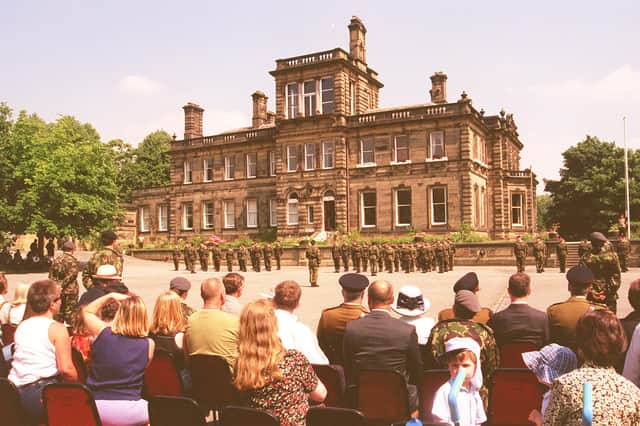
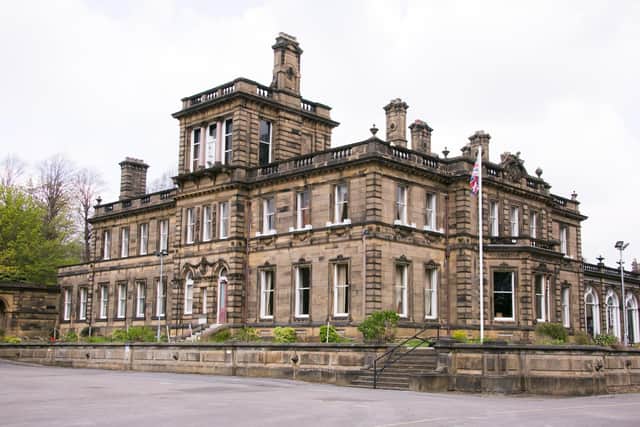
Endcliffe Hall in modern times. Note that the French-style tower roof was removed in the twentieth century. Image: Sheffield Star

What will happen to Endcliffe Hall when it is put on the market? This time around, demolition won’t be an option because it was Grade II* listed in 1973. I have an inkling that it might find a new life as a luxury hotel, although there might have to be extensions, thus increasing the number of rooms to make it viable.

Endcliffe Hall is referred to as Sheffield’s biggest mansion – ‘The House Beautiful’ as the Sheffield Daily Telegraph called it in 1893. It was built between 1863 and 1865 by Flockton and Gibbs for the industrialist John Brown for a reputed £100,000 (that is about £10.6m today).

John Brown was born in Favell’s Yard, Fargate, in 1816, a part of the town favoured by people in good position for residence. His father wanted to apprentice the fourteen year old to a linen draper, but John disagreed. “I want to be a merchant, because a merchant trades with the whole world.” He was apprenticed to Earl, Horton & Co, cutlery manufacturers, in Orchard Place, and eventually took over the business.

In 1844, Brown moved into steel production on Orchard Street and Furnival Street manufacturing railway springs and files. His invention of the conical spring buffer brought him incredible wealth and allowed him to open further factories on Holly Street, Hereford Street and Backfields. These were later consolidated into one site – Atlas Works – in Savile Street.

Adopting the Bessemer process, Brown was a pioneer of the armour making industry, deciding that hammered armour plating could be rolled instead, and would receive orders to protect about three quarters of the ships of the Royal Navy.

In 1856, Brown became a member of the Town Council, an alderman three years later, and Mayor in 1861 and 1862.

John Brown married his childhood sweetheart, Mary Schofield, and lived comfortably at Shirle Hill (now Nether Edge) but with immense wealth, wanted to build a magnificent mansion. In 1863, when the Endcliffe Hall estate went to auction, Brown bought it and demolished the old hall (the second to have stood on the site) and replaced it with a mansion in the Italian style, with free use of the French interpretation. The only relic to survive from the previous hall was a piece of quaint animal carving that was fixed over the fireplace of the principal kitchen.

In those days, the house stood in countryside. “The air is pure, from the best source, the high moors. A lofty range of hills rising behind this south-eastern aspect, forming a grand and imposing background, sheltering it from northern winds. A view of Sylvan Scenery in the valley of the River Porter, and the wood-crowned heights of Brinkcliffe Edge. The eye is carried through the lovely Vale of Whiteley Wood, up to the Moorlands of Hallamshire. There is a plentiful supply of the purest water and building materials from the ground.”

John Brown employed Flockton and Abbott to design and carry out the 36 room mansion almost regardless of cost, and those gentlemen succeeded in producing a building which, for perfect architecture, excellent workmanship, unique domestic arrangement, and appropriate accessories, could not be surpassed in the provinces.

Nearly 300 workmen had worked on it and the proportions of all the rooms were said to be magnificent, with a light and cheerful appearance, and a sense of perfect ventilation throughout. On completion, in 1865, the house was, on the invitation of the architects, opened over two days for inspection, and on each day crowds of leading gentry and merchants visited to see it for themselves.
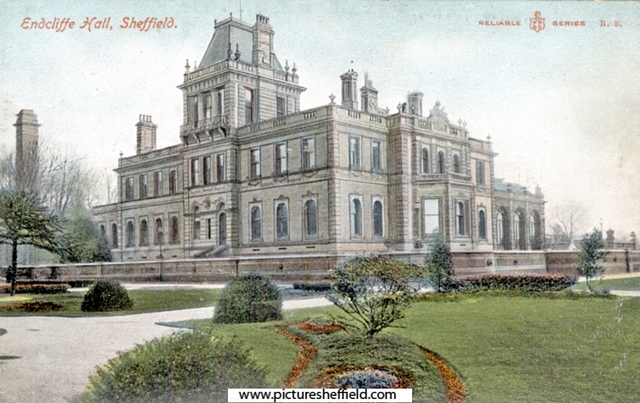
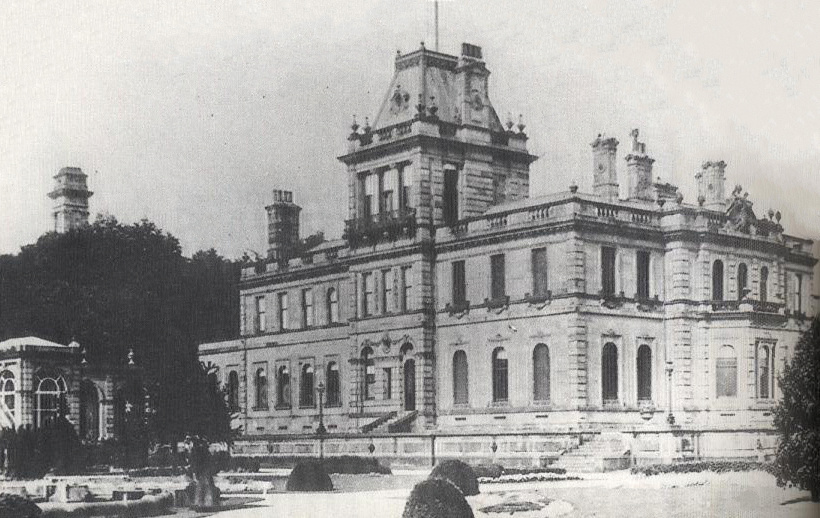
Endcliffe Hall in all its former glory. Built between 1863 and 1865 by Flockton and Gibbs for the industrialist John Brown. Image: Picture Sheffield

John Brown was knighted in 1867, and there is a saying that money cannot buy happiness. In hindsight, one wonders whether John Brown and his wife were truly happy at Endcliffe Hall. A year later, Brown denied that he had sold the estate, the rumour fuelled by their desire to spend the winter months in Torquay, and only returning to Sheffield in the spring. Sir John and Lady Mary both suffered ill-health, and it is only during research for this post that we can now speculate that his ailments were due to his mental health.

In 1871, the John Brown Co had set up its subsidiary —the Bilbao River and Cantabrian Railway Company Limited— and bought plots in Sestao (Bilbao), Spain, to construct blast furnaces and process iron ore from the nearby Galdames mines they owned, which was to be transported by a factory owned railway they started building that same year. The railway was finished in 1876, and blast furnaces were completed in 1873. The political climate —the third Carlist War [1873-76] and its aftermath— are one of the reasons which motivated the company to abandon the blast furnace project and sell the installations to the Duke of Mudela —Francisco de las Rivas— in July of 1879. The second and more important reason for selling its processing plant was the fact that ore deposits in Galdames were significantly less than prospected. It was lamentable that Sir John’s career should have been so clouded owing to heavy losses in the Bilbao project.

Lady Brown died from a painful disease in 1881, and Sir John gradually withdrew from public life, his health deteriorated, and he spent increasing amounts of time in southern England. He left Endcliffe Hall for the last time in 1892 and two years before his death in 1896 had been declared legally insane.
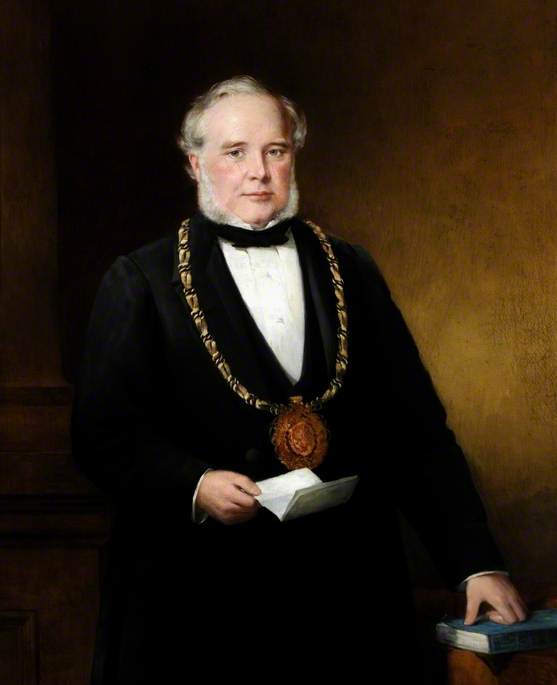
Sir John Brown (1816-1896), KT, DL, Mayor of Sheffield (1861-1862)

Rumours circulated as to the future of the estate. Some suggested that it would remain in local hands, others speculated that it was being split up for building plots, while a third rumour suggested that the Duke of Norfolk might buy the house. Certainly, an enquiry was made but never followed up.

The sale of Endcliffe Hall had been put in the hands of London-based Maple and Co, and in January 1893 it offered Sheffield Corporation the chance to buy it for £70,000. The amount of money involved and uncertainty as to what to do with it meant that the corporation politely declined. Neither had there been any other offers for the estate.

Maple and Co sent the entire contents of Endcliffe Hall to auction in April 1893. “The best of furniture, the richest of appointments, the costly statuary, bronzes, pictures – the art treasures collected through many years – are to be scattered far and wide,” the Sheffield Daily Telegraph reported. The contents raised between £9.000 and £10,000 and were believed to have been sold for about a third of their cost

In local eyes  it was the embodiment, in stone and lime, of a career unique even among merchant princes and manufacturers. Next week the beautiful home will be desolate; its costly contents, collected from all quarters, dispersed under the hammer, and no doubt not a few Sheffield families will in days to come treasure in their lares and penates some relic of the most complete and perfect amongst the many pleasant dwelling-places reared by the Men of Mark in our midst. Surely the goodliest habitation within our borders, its masonry fair of face as the day one stone was laid upon another, will not come down in the cutting up of the gardens and grounds, the terraces and parks, to make way for rows of villas to be raised by the speculative builder.” – Sheffield Daily Telegraph, Sat 15 April 1893

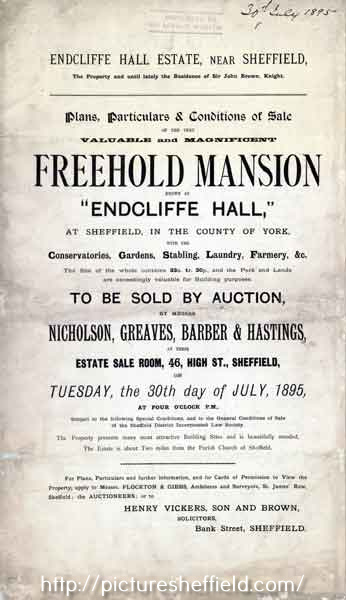
In July 1895, Endcliffe Hall and the estate went to auction at Nicholson, Greaves, Barber, and Hastings. It was bought for the knock-down price of £26,000 by a secret syndicate of eight local gentlemen. Their identity would later be revealed when the Endcliffe Hall Estates Company Limited was formed, with the directors named as Henry Herbert Andrew, J. W. Barber, Robert Colver, Robert Abbott Hadfield and William Samuel Laycock, with John Wortley as secretary. A large portion of the estate would be sold for building quality residences, but the future of the house remained in doubt.
The company adopted a scheme prepared by H.E. Milton, of Westminster, for laying out a new housing estate and plans were subsequently submitted to Sheffield Corporation for Endcliffe Grove Avenue, Endcliffe Park Avenue, and Endcliffe Hall Avenue.

Whilst grand new houses were built on parts of the estate, the Endcliffe Hall Estates Company used the mansion and remaining grounds as an entertainment venue. It operated between 1896 and 1913 and was used for meetings, ceremonies, dances, dinners, weddings, exhibitions, fetes, bazaars, and even as a location for several Shakespeare plays.

“The wealthy man of the West End desiring to invite his friends to dance, dinner, or concert, have turned to Endcliffe Hall as a place affording accommodation often superior to that available at his own house, and a place presenting many advantages over a hotel by reason of its privacy and its situation in the principal residential district of the city. He has been able to entertain a large party with as much success as if they were at his own home, and without subjecting himself to those little inconveniences and disturbances which he would have suffered if his own home had been used. All the worry of arranging rooms has been lifted off the shoulders of the host and hostess when they have gone to Endcliffe Hall.”

Like many large houses, the upkeep of Endcliffe Hall proved to be a problem for the company. Income from these events did not cover the upkeep of the house, and it attempted to close it in 1906, but met with opposition. Charles Burrows Flockton, from the well-known dynasty of Sheffield-based architects (which had designed the house), proposed setting up a company to purchase the hall and carry on as an entertainment venue or country club. In the event, the company chose to keep the hall and persevere, but failed to make it a success.

In 1913 it decided to sell the house and the remaining five acres of land that remained unbuilt, but with no buyers forthcoming, it proposed demolition. Once again, there was opposition and C.D. Leng, of the Sheffield Telegraph, campaigned to try and save it for the use of residents in the West End. He sent out thousands of circulars and reply postcards pleading for subscriptions to buy it. Leng decided that it would cost £60,000 to buy, and the whole place could be taken with a ground rent of £300. He proposed the addition of a stage in the ballroom for theatrical performances and there would also be room in the grounds for tennis, croquet and bowls.

Despite Leng’s efforts, the surveyor for the Endcliffe Hall Estates Company revealed that he had received an offer from another source. It was understood that the hall was going to be bought by solicitor Branson and Son on behalf of some Sheffield gentlemen who intended to retain it for public use.

It was actually a smokescreen because Colonel George Ernest Branson was commanding officer of the Hallamshire Rifles and wanted to transfer the officers and men from the cramped, ill-adapted, and inconveniently situated barracks at Hyde Park to Endcliffe Hall.

The purchase was approved at a meeting of the West Riding Territorial Association at York in January 1914 and cost £10,000 with the vendors agreeing to spend £2,000 on internal alterations and repairs, and the stables and coach houses were converted to become the drill hall for the regiment.

Of course, Britain would soon be at war, and during World War One, Endcliffe Hall was used as a hospital with eight indoor wards for 120 patients, and 32 beds in the ballroom. An open air ward was added on the site of the former conservatory.
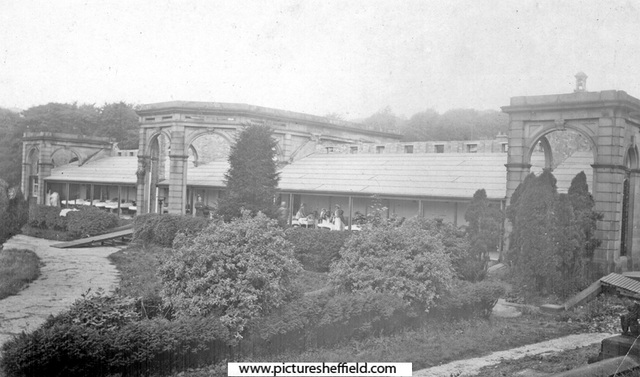
Open Air Secton, 3rd Northern General Hospital, Endcliffe Hall annexe, World War I. The remains of the Grand Conservatory after the removal of glass to create an open-air ward. Image: Picture Sheffield

And so we come to the present day with the overall aim of the RFCA being “to sell the Endcliffe Hall site, including all land and buildings, thus bringing the Army’s 100 years of occupancy and ownership of the site to a close.”
© 2024 David Poole. All Rights Reserved
Categories
Buildings

The popular rendezvous for politicians is Mr Wiley’s Window in Old Haymarket

October 1851

“It’s not that I’m afraid of dying, but I’m more concerned that I might be forgotten.” These words seemed out of character for Thomas Wiley. 

William Hollingworth sat in the drawing room at Claremont Place and realised that Wiley was sicker than he had realised, and that his friend was preparing himself for death. 

“I’m quite certain that you will not be forgotten,” Hollingworth told him. “Besides, there are a lot of people who owe you a debt of gratitude.” 

“I presume that you are referring to my family,” Wiley pondered. “I could not turn my back on them like they once did to me.”

“You never have told me why your father cut you adrift.” Hollingworth hoped that Wiley would finally reveal the cause of the rift.

“That is not important,” said Wiley, “But I vowed that I would make it on my own, and now that I am a rich man, I can provide them with financial support after they bankrupted my father’s drapery shop. I bear them no malice”

Hollingworth liked Alderman Wiley. On many topics he was the main source of information to multitudes; while to a more limited circle his sound and acute judgement made him an invaluable adviser. He did not allow sounding phrases to determine his opinions without the effort to think. He grasped firmly the subjects that came before him, subjected them to analysis, tested their evidence, and rarely failed to arrive at a well-grounded result. And yes, Wiley was a generous man and every Christmas he gladdened the hearts of old people by presents of blankets and seasonal fare. He had no children but had become a ‘father’ to the adopted orphans of several of his relatives.

A few weeks later, Hollingworth remembered that last conversation with Wiley. It was the day of the funeral and he had listened to the story of how Wiley had jumped out of bed, collapsed in a chair, and died at the age of 57. The surgeon had found that Wiley’s heart had been twice the size it should have been. The streets were lined with thousands of mourners as the cortege slowly made its way to St. John’s Church.

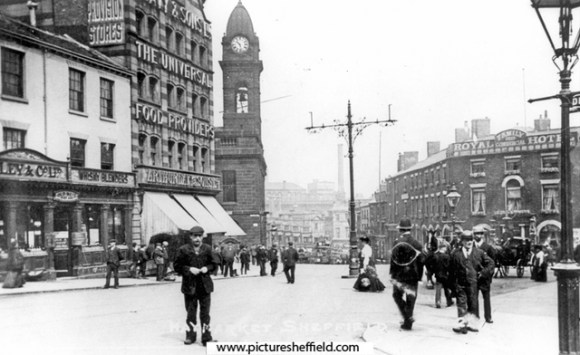
Haymarket looking down Waingate. Royal Hotel, right, Nos. 23 and 25 Wiley and Co. Ltd, wine and spirit merchants, Old No. 12 Arthur Davy and Sons Ltd., provision merchants, Court House (Old Town Hall), left. Image: Picture Sheffield

October 2024

The story of Thomas Wiley ended that day, but despite his fears, his name lived on for many years afterwards. Yes, he would eventually be forgotten, but by a quirk of fate, his story resurfaces 173 years later.

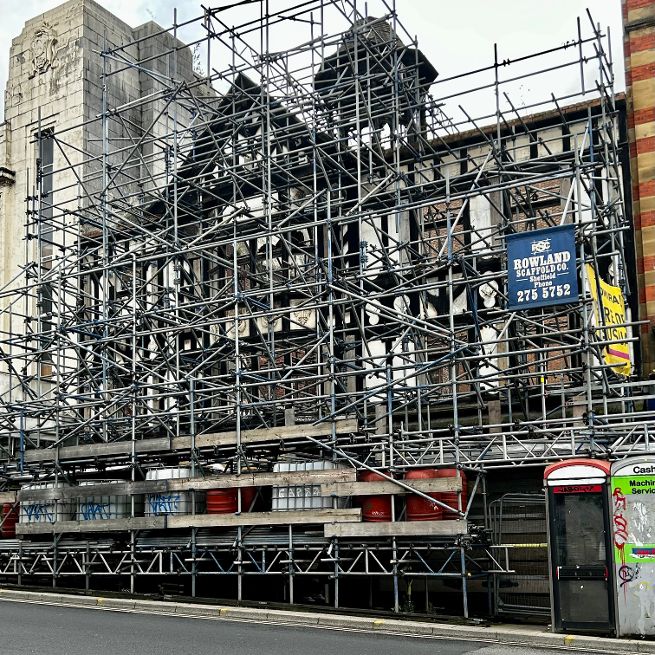
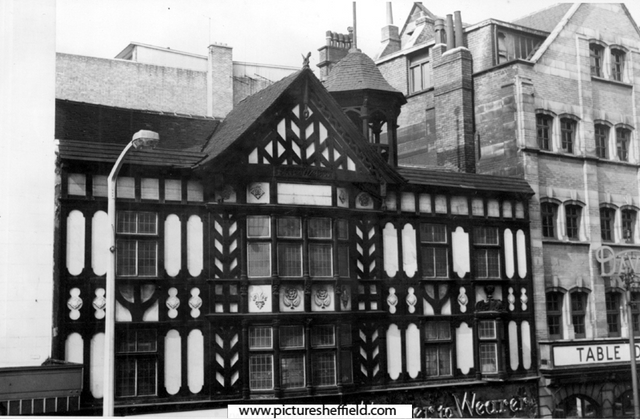
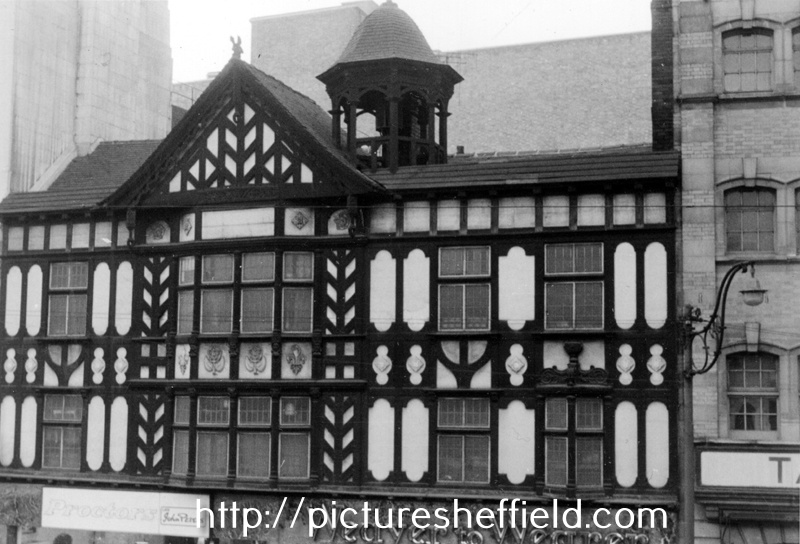
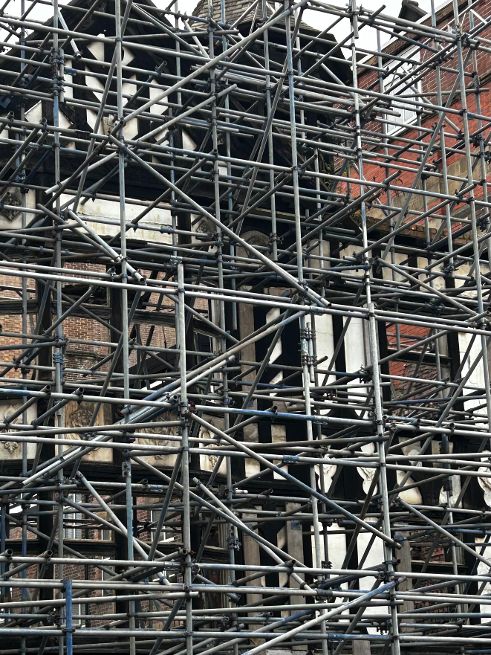
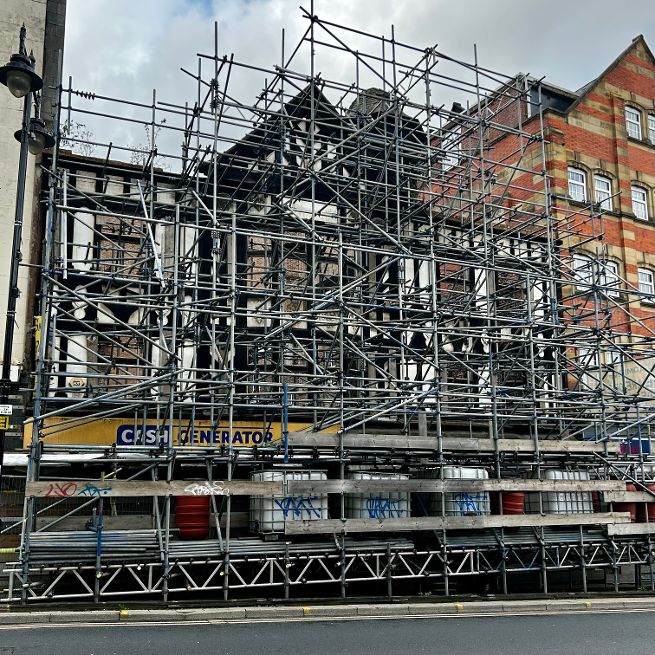
In September, local news reported that Sheffield City Council had stepped in with plans to demolish the frontage of No. 25, Wiley and Co, in Sheffield’s Haymarket. It referred to the century-old Tudor-inspired facade complete with wood and plaster mouldings, a turret, and a dragon perched on top. Five years ago, it gave developer Brijesh Patel permission to demolish the historic building behind and replace it with six storeys of studio apartments, on condition the façade was retained. Alas, the development hasn’t been completed and scaffolding has propped up the flimsy facade until it now poses a danger to the public. According to Hallamshire Historic Buildings, the developer and scaffolder are in dispute, and the latter wants its scaffolding back. Now the council says it must dismantle the building “while at the same time preserving as much of it as possible should the building’s owner wish to reinstate it at a later date, which we hope will be the case.”

Wiley and Co hasn’t been here for a long time, and although the Tudor frontage was believed to have been added in the 1920s, the demolished interior was understood to have dated to the early 19th century.

In 1832, Thomas Wiley removed to the Sun Tavern and Chop House at Old Haymarket, opposite the Tontine Inn coaching house. At considerable expense he fitted it up and advertised soups, steaks, chops, snacks served at a few minutes notice, as well as selling excellent old port, sherry, claret, champagnes, amber ale, London draught and bottled porter, prime Havana cigars, and London morning and evening papers.

Wiley added to his business of wine and spirit merchant, that of newsagent, a business in its infancy. At that time, Murdo Young, proprietor of the Sun newspaper, had broken new ground. He had begun to publish late editions of his paper, giving the Parliamentary debates up to post time. The excitement of the public mind throughout 1831 and 1832, caused by the reform agitation, aided his design, and the Sun, far outstripping its older rivals, became the favourite evening paper. On special occasions Young sent his papers by express to the principal towns of England. Wiley became his agent, and frequently brought down the express papers to Sheffield.

Ten years later, Wiley demolished the Sun Tavern and rebuilt it as Old No. 12.

“The design is new and exceedingly appropriate. The fault which has been found with many new shops on account of the disproportionate size and quantity of plate-glass is avoided here. The whole facade is in correct style; the capitals have been expressly modelled from a classic example, and substantially cast in iron. The window frames and doors are of Spanish mahogany, most beautifully executed; and the whole front is surmounted by an elegant balcony, in which the fruit and tendrils of the vine form the principal feature. Altogether, this front may be considered one of the most successful of its kind yet attempted; the architects are Weightman and Hadfield, and the contractors Alcock and Leesly.”

Old No. 12 became a Sheffield institution, not least for the inn, but for the adjacent wines and spirits business called Wiley and Co, and the fact that Wiley had also set up probably the town’s first newsagency.

“We observe with pleasure that Mr Wiley has long since parted with his pigeons, he would not suffer the public to be without authentic information on the Leger race; to effect, which, he sent his man from the course with a horse and gig, which arrived in Sheffield an hour and a half after the race was over, i.e. at five o’clock.” – Sheffield Independent – Sat 16 Sep 1843.

In the 1840s and 1850s, ‘Wiley’s Window’ was famous. In that window all the events of the day were chronicled – debates in Parliament, election results, deaths and disasters, all these occurrences which later formed the stock-in-trade of morning and evening newspapers. When rumours were rife on any subject, it was to Wiley’s window that the people flocked, quite sure that if anything had come through it would be posted up there. Wiley made great efforts to get his news, and it is said that more than once he ran special express coaches to London and back simply to have the first news of something of outstanding importance for his window. 

The great and popular rendezvous for all the superficial and some of the really thoughtful politicians is Mr Wiley’s Window, the well-known Old No. 12, Haymarket. We have much been pleased this week, during the Ministerial changes, as we have often been before, to see the peaceful grouping and pleasing excitement caused by the frequent and varied announcements which have been made in their proper and convenient order. As well as lounging and idle newsmongers, many an industrious tradesman and shopkeeper, and even families and females, in times of excitement, often derive their first knowledge of important commercial and national intelligence, by means of mornings or afternoon messengers despatched to Wiley’s Window.” – Sheffield Independent – Sat 4 July 1846.

He issued every year the ‘Sheffield and Rotherham Historical Pocket Almanac’. This was an invaluable book of reference, with local information for public bodies and institutions connected with the Borough. It was issued free of charge to all friends and customers at Old No.12. From this it seems that Thomas Wiley, in addition to the wine and spirit business, ran the newsagency, obtaining papers by coach, and later by railway, from all over the country and distributing them to subscribers in Sheffield, while local papers, which included the Sheffield Iris, Mercury, and Independent, the Doncaster Gazette, and Leeds Mercury, were on sale on the morning of publication.

Following Wiley’s death, the business was run by his widow for a short time before ending up in the hands of John Roebuck, a member of the Town Council until his death in 1867. George Trickett became the proprietor of Old No. 12 with his sons, Frederick and Francis, succeeding to the business of Wiley and Co. Francis served on the board of Tennant Brothers brewery when it acquired Wiley and Co in 1904. 

Weaver to Wearer Ltd., tailors, No. 25 Haymarket with A. Davy and Sons Ltd. Cafe extreme right Image: Picture Sheffield
No. 25 Haymarket, plain early 19th century houses with elaborate applied half timbering, a bay window with leaded lights and a rustic bellcote added in the 20th century. Information from: Pevsner Architectural Guides Sheffield by Ruth Harman and John Minnis. Image: Picture Sheffield

Tennant Brothers were probably responsible for the reimagining of Wiley’s building in the 1920s and the introduction of its Tudor-inspired appearance.

Here onwards, Wiley and Co was known as the off licence business for Tennant Brothers, with branches across Sheffield and the north, but the name would disappear after the Sheffield-based brewery was bought by Whitbread in 1961. 

Wiley and Co and Old No.12 disappeared and the building was used by a succession of shops before Haymarket’s decline led to the arrival of amusement arcades. 

© 2024 David Poole. All Rights Reserved
Categories
Buildings

The life and times of No. 37 Fargate – one of Sheffield’s narrowest buildings

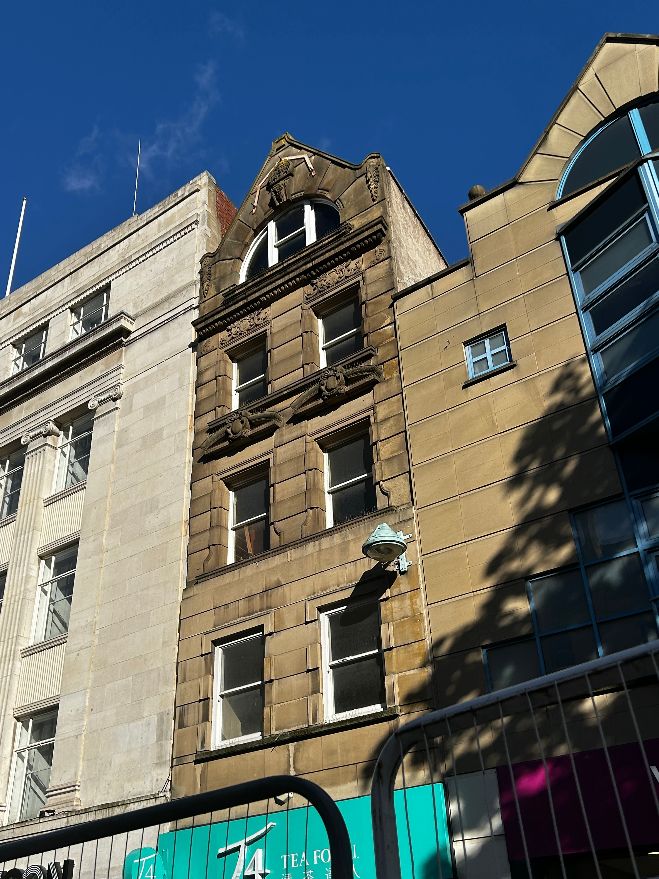
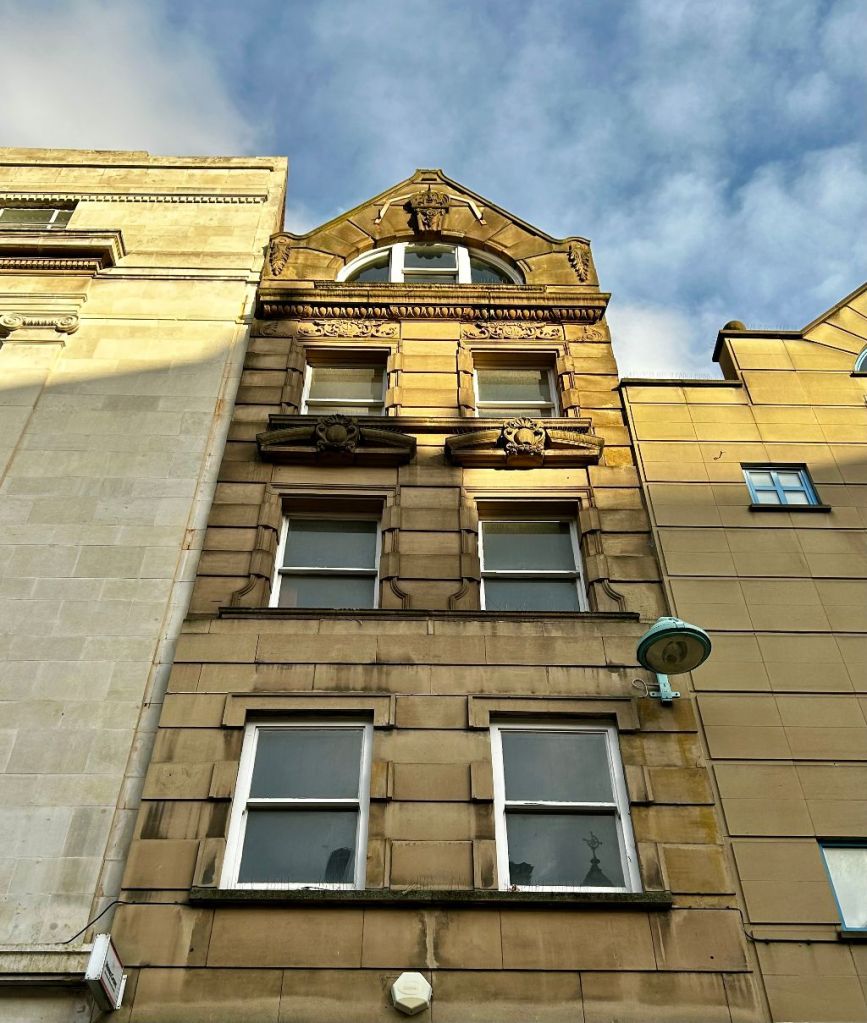
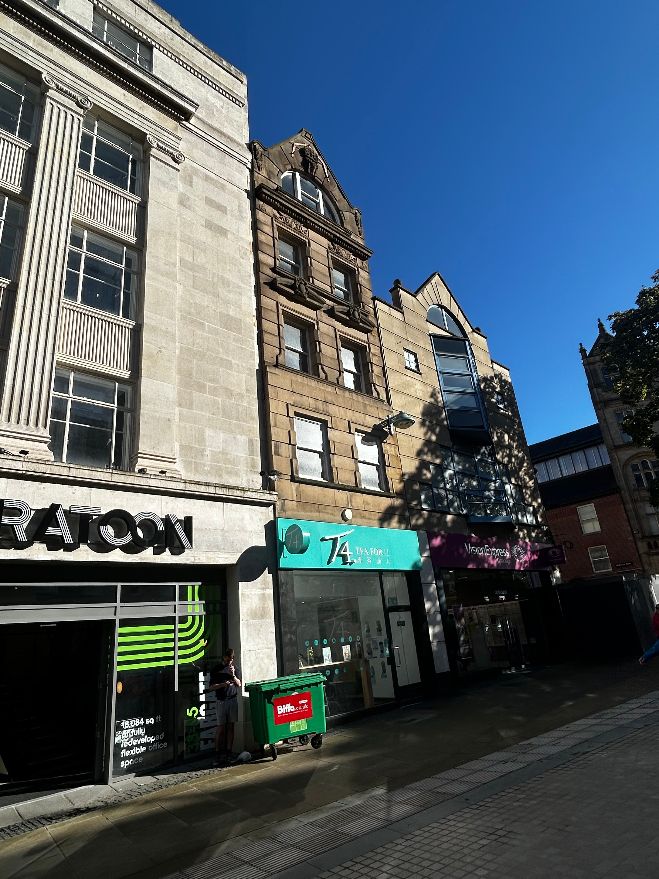
No.37 Fargate, a Victorian survivor. Image: DJP / 2025

If buildings could talk, they might be able to fill in the blanks. Like when this building was constructed, what the carvings on the outside mean, and might provide us with forgotten stories of the people who passed within its walls. It might also be dismayed to see Fargate as it is now.

This is No. 37 Fargate, with its grand Victorian (or might that be Edwardian) facade, home to T4, a Taiwanese tea store, which opened earlier this year, and ended a few years of abandonment. 

The interesting thing about the building is that it is sandwiched between two newer constructions, and the last in this block to survive street improvements from the 1890s onwards. Look up the next time you pass, and you’ll see what I mean.

The likelihood is that it was built for one of Sheffield’s wealthy entrepreneurs who snapped up this sliver of land as part of the street widening programme and enjoyed the rents that the ground floor shop provided.

The Victorians turned Fargate into a shopping street, and prior to this, the site had been home to businesses including the Misses Innocents’ hosiery and fancy goods store, Singer’s Sewing Machines, Bagshawe Bros, bicycle shop, and a brief spell as an auction house.

T4 – a Taiwanese tea shop that opened in 2024. Image: DJP / 2024

The property was likely built in 1903-04, and taken by Bonnet and Sons, who installed mahogany fittings, and turned two long rooms into a high-class cafe. 

The business, founded in 1880 by Swiss chocolatier Louis Bonnet, had other concerns in Bath, Bristol, Scarborough, and Bradford, and specialised in freshly made chocolate and all kinds of French confectionery, catering for the ‘best class of people’ who were prepared to pay a moderate price for the delicacies. 

“Bonnet and Sons are preparing special novelty boxes filled with these sweetmeats. The cases, attractive in character, have been brought from Paris and Vienna, but are filled in Sheffield immediately before their despatch to a customer, with the result that the chocolate and fondants are quite fresh. They are just the kind that go to ornament the supper table at a party or are delightful as a dessert. They are typically French. Two dozen of these petits gateaux are put in the boxes to retail at two shillings. The best way to obtain an opinion is to visit Bonnet and Sons’ Cafe where, together with a cup of delicious tea, coffee, or chocolate, the confectionery can be enjoyed.” – Sheffield Independent – November 1905.

The cafe closed in 1912, as eventually did the other branches, except for Scarborough, where astonishingly, the business survives under different ownership as Bonnets on Huntriss Row.

Between 1912 and 1922, the building was the Sheffield outpost for Van Ralty Studios, owned by Harry Wolff, a portrait photographer, with studios in Liverpool, Manchester, Nottingham, Oldham, and Bolton. Its work continues to be popular, the vintage postcards and photographs eagerly sought by collectors.

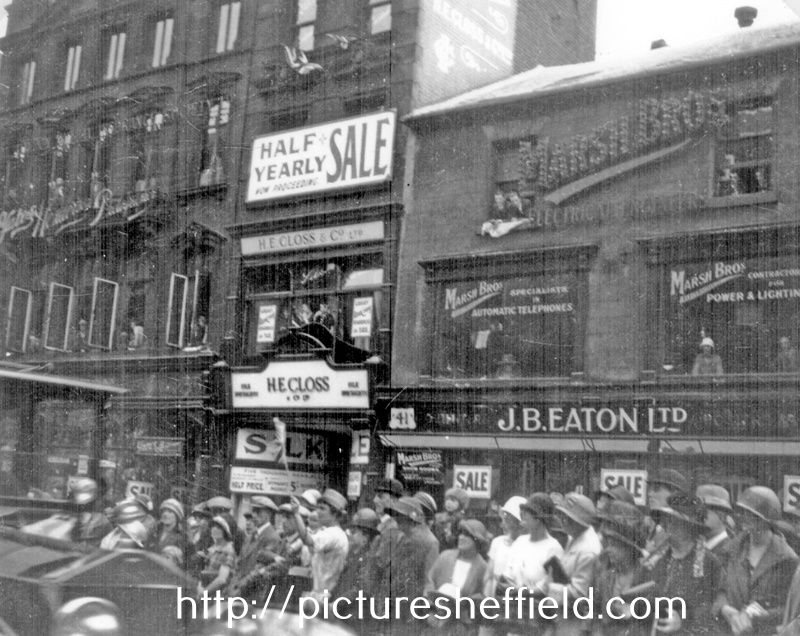
There are a couple of images in Picture Sheffield’s extensive collection that shows No. 37 Fargate belonging to H.E. Closs and Company, silk merchants. This was Harold Edward Closs’s first shop, but he quickly expanded with branches across the country. His buyers visited the Continent to choose the latest modes of colour and design, providing its shoppers with the latest silk fashions. It ceased trading in the 1930s, and Harold Closs set up a new business with Cyril Hamblin and still trades in the southeast as Closs & Hamblin (formerly C&H Fabric Specialists).

Unidentified royal visit passing Fargate, possibly Elizabeth, Queen Mother, 1934, shops include Nos. 41 – 43 J.B. Eaton Ltd., drapers and Marsh Brothers (Electricians) Ltd., No. 37 H.E. Closs and Co. Ltd., silk merchants, No. 35 Yates and Henderson. Image: Picture Sheffield

Next into No.37 was Thomas Cook, the travel agents, which turned out to be the building’s longest occupant, remaining here until its dramatic collapse in 2019. Although acquired by Hays Travel it closed soon afterwards.

Fargate always liked its eateries, but these gave way to shops during the latter part of the twentieth century, but, as one historian told me, history has a habit of repeating itself, with Fargate earmarked for leisure and hospitality. 

No. 37 Fargate starts a new chapter as T4, its chrome and glass interior far removed from the days when Bonnet and Sons charmed the folk of Sheffield with fancy chocolates and cakes.

No.37 Fargate. With elaborate carvings at higher level. Image: DJP / 2025

© 2024 David Poole. All Rights Reserved


Categories
Buildings

“Young Man… it’s fun to stay at the YMCA”

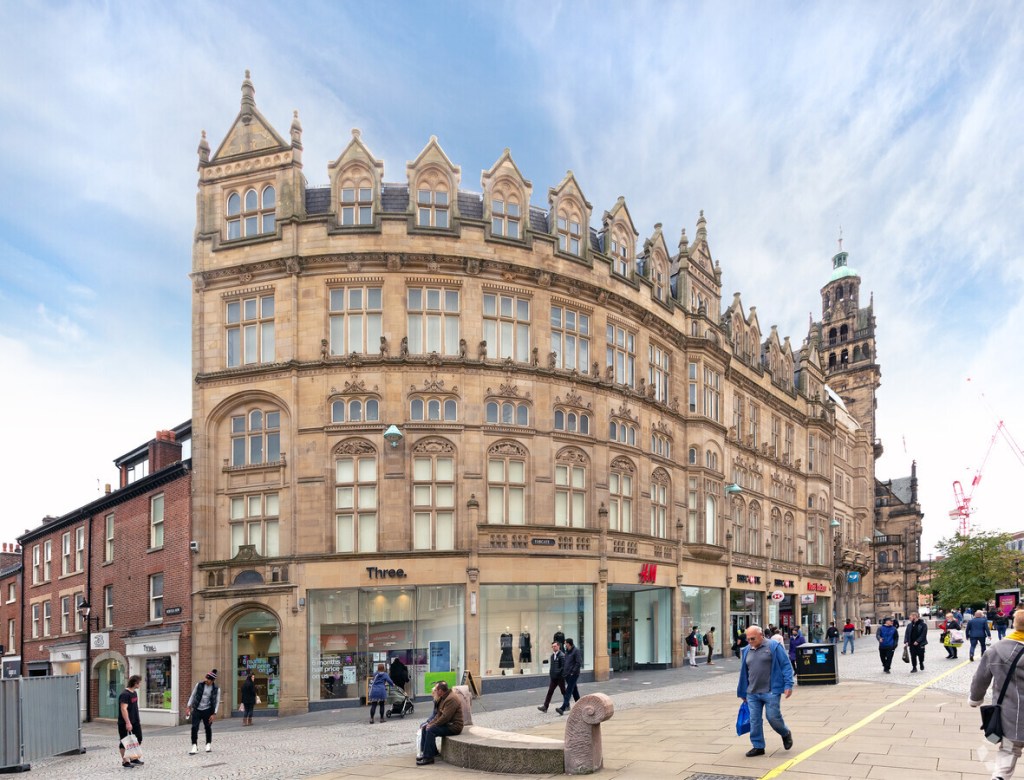
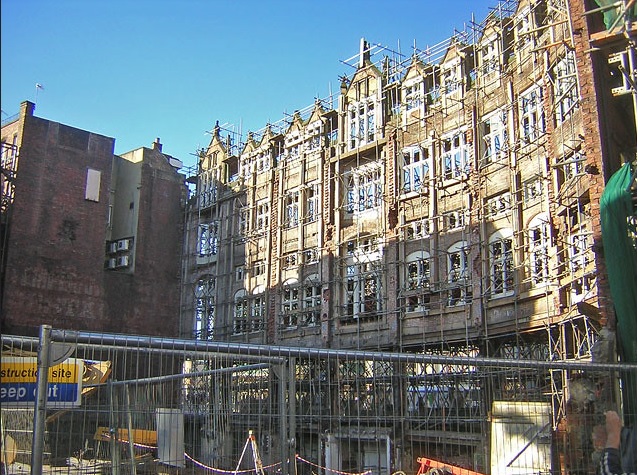
Carmel House, at the top of Fargate, is one of Sheffield’s finest buildings, an example of Victorian architecture that survived when much of it was lost. But appearances can be deceptive, and what is behind that elegant facade is entirely twenty-first century. In 2004, the guts of Carmel House were ripped out, replaced with a steel framework, and all that remains of this Grade II listed building is the frontage (like recent redevelopment works on Pinstone Street).

It was built in 1889-91 to designs by Sheffield architect Herbert Watson Lockwood, the subject of last week’s post. Younger readers might be surprised that this was built for the Young Men’s Christian Association, on two plots of land between the then ‘newly built’  Yorkshire Penny Bank, and the offices of Alfred Taylor, solicitor, on Norfolk Row.

Prior to this, the Sheffield YMCA had cramped rooms on Norfolk Street, but the membership had soared to above 300. It was fortunate to have as its president, Emerson Bainbridge, who wanted to build purpose built facilities. He battled with the Prudential Assurance Company to buy two plots of land, eventually securing the freehold of both in 1888 for £16,000 (including £7,000 out of his own finances), and forming the Association Buildings Company Ltd to raise capital for its construction. (The Prudential would eventually build its offices at the corner of Pinstone Street and St Paul’s Parade).

The building of the YMCA wasn’t without problems.

Work started in August 1889, delayed due to a dispute with Alfred Taylor who was paid compensation for his right to light. Then, while the site was being excavated, it caused subsidence to the adjacent Yorkshire Penny Bank. There was another blow in December 1889 with the failure of its builder, William Bissett and Sons, and work came to a halt. It was picked up in 1890 by Armitage and Hodgson, the Leeds-based builder of the Yorkshire Penny Bank next door. 

It was finally completed in May 1891 and opened a month later.

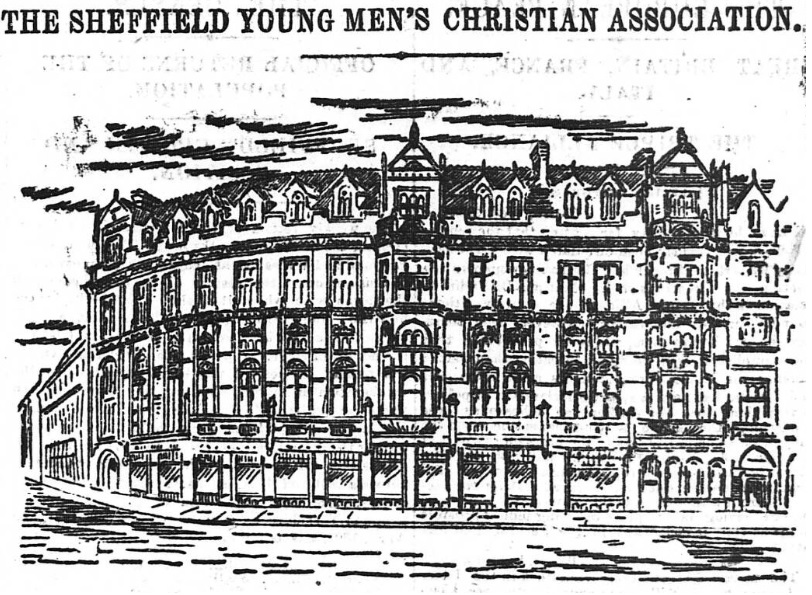
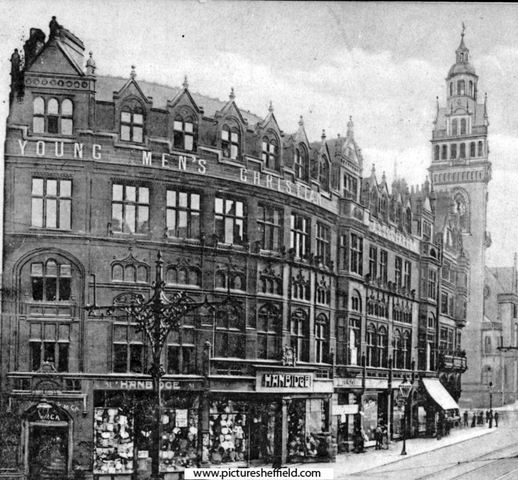
The YMCA had a frontage of 135 ft, and an average height of 54 ft, faced with Holmfirth Stoke Hall stone. It was hand finished with open arcading, above which were lofty gables, the style being late-Gothic, of a Flemish type, the straight portion of the front flanked by projecting oriel windows, carried up two storeys, 

Sheffield Young Men’s Christian Association, Fargate, Sheffield, 1891.

The principal entrance was at the corner of Norfolk Row, with a wide arched doorway over which was a stone balcony, having in the centre a panel inscribed ‘One is your Master, even Christ, and all ye are brethren.’

“Symbols of the four evangelists are carved in the corbelling to the balcony over the entrance, six arched panels on the curved portion of the front depicting the six days of Creation and in four other panels the progress of Divine Law from its delivery on Sinai in the two tablets, its development as the scrolls of the law and its completion in the form of the Bible, finishing with a crowned shield bearing on its field the Star of Bethleham. The shields in the main cornice bear the arms or signs of the twelve Apostles. All is by Frank Tory.”

Over the entrance was a handsome projecting lamp carried on a bracketed and enriched wrought iron hoop.

The new premises had six shops on the ground floor, which brought in rental income of about £850 to £975 each year. 

Let us now consider its original and lost interior.

From the entrance was a broad flight of stone steps leading to the entrance hall, which was lit from above by a rich stained glass ceiling light, made by Mansfield and Co, of Gresley, near Burton-on-Trent. The floor was laid out with mosaic to a sunflower design.

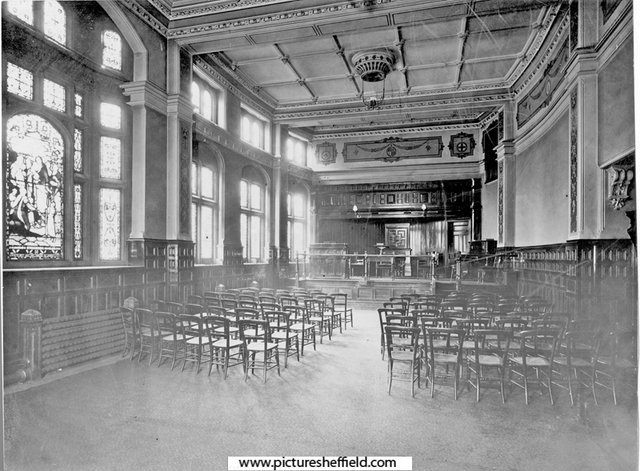
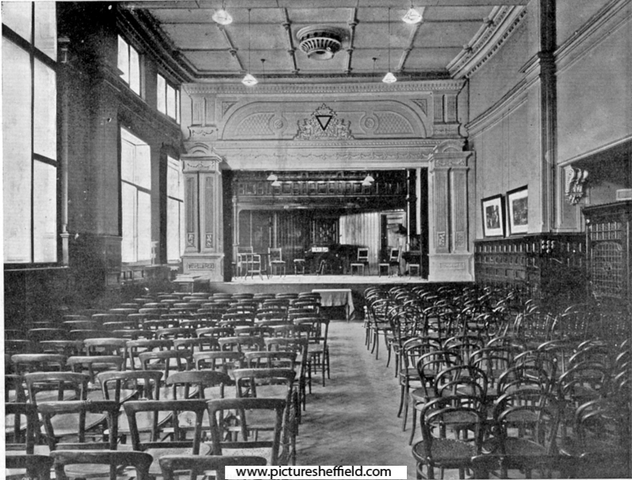
On the right was the secretary’s office, platform entrance to the hall, and a staircase leading to the assembly hall, a well-lit room about 60 ft long, 30ft wide, and 21 ft high, fronting to Fargate. At one end was the public gallery, with a curved front of pitched pine, relieved with arches and octagonal shafts. At the other end was the platform, and over it a private gallery, serving partly as a sounding board, and made of pitch pine and polished walnut.

In the centre, opposite the entrance, was a large bay filled in with a painted window, representing Christ blessing little children, and presented by Emerson Bainbridge. This, along with all the coloured windows had been manufactured by Lazenby Stained Glass Works at Leeds.

The hall seated 250 people, but held 300, exclusive of the two galleries that held 100 more.

YMCA Assembly Hall, Carmel House, Fargate. Image: Picture Sheffield.
YMCA Fargate, the Theatre. This is not mentioned in the original design notes. Possibly a later alteration. Image: Picture Sheffield.

To the left of the hall entrance was the corridor to the gymnasium, the principal staircase, and inquiry office. The gymnasium was 44ft long, 35 ft high, and was kitted up by George Heath of Goswell Road, London. At one end was a public gallery, behind which were the dressing rooms, lockers, and bathrooms. The whole of the floor was covered iron and concrete, covered with Lowe’s patent wood block flooring in pitched pine.

On the mezzanine floor were the honorary secretaries’ rooms and toilets. From this floor, a stone staircase, with covered ceiling, and lit by stained glass windows, rose to a second floor, on which, fronting Fargate, were the library and writing room, fitted with walnut bookcases, meeting room, reading room, annexe, parlour, and refreshment room. At the back were storerooms and caretaker’s house, each communicating with each floor by a hand powered lift.

On the top floor were rooms for the junior department, classrooms and bedrooms.

The dull polished dark oak furniture was supplied by Johnson and Appleyard and consisted of settees and easy chairs, covered in saddlebags, and chairs and curtains in the main rooms upholstered in crimson Utrecht velvet.

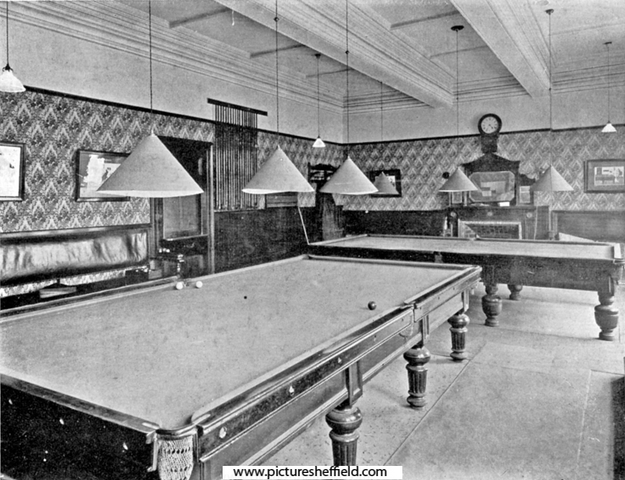
YMCA Fargate, Billiard Room. Possibly a later addition to its facilities. Image: Picture Sheffield.

The YMCA remained here until the late 1960s, by which time the building, in a prime city centre location, proved too big for its dwindling membership. It moved to smaller headquarters at Broomhill in 1970.

The building’s interior was probably gutted at this stage, redefined as offices, and I hope that somebody will confirm whether this is what happened.

At which point the building became known as Carmel House is uncertain, but the word ‘Carmel’ can be characterised by an awareness of God’s presence in a person’s heart, a sense of the sacred, and a desire for things divine.

As with most Victorian buildings, they can look incredibly attractive, but what lies behind is often unsuitable for twenty-first century use. In 2004, planning permission was granted for the complete redevelopment of the site, including demolition of everything behind the stone facade.

The following year, an important discovery was made during excavations for its new foundations. A medieval well was found on the site, as well as ancient pots and jugs, and possibly dug around the same time as Sheffield Castle was rebuilt in stone about 1270.

Sheffield District Y.M.C.A., Carmel House, Fargate, shops include Nos. 53 – 55 Robert Hanbidge, ladies outfitter. 1900-1919. Image: Picture Sheffield.
Carmel House. November 2005. The facade of the former YMCA building is supported by scaffolding while its interior is reconstructed to modern designs. To the left is the former Yorkshire (Penny) Bank. Image: Flickr/SheffDave
Ghost doorway. Former Norfolk Row entrance to the upper floors of the Young Men’s Christian Association building. Pictured here in 2022. Image: DJP / 2022.

© 2024 David Poole. All Rights Reserved
Categories
Buildings

“A miserable place. The stench here was unbearable.”

The sun shines, and a pigeon meanders between the old church gates near Sheffield Cathedral, next to the tram stop where High Street meets Church Street. It pays more attention to the gates than passers-by do, the majority of whom don’t know that they exist. These gates appeared in the nineteenth century and today I must use my imagination.

I have gone back to the time when these streets were crowded with pedestrians who had to keep their eyes open, and their wits about them, because they might easily have been run down by a horse and cart or Hackney Carriage. The air is abundant with noise, the clip-clopping of horses, hawkers selling their wares, and shouts of men who have consumed too much ale. Most people are shabbily dressed because they come from poor families, but there are also the gentlemen who wear breeches and stockings, waistcoats and frock coats, linen shirts, buckled shoes, and three-cornered hats. One of them carries a walking cane and pauses to read something that has caught his eye in the Sheffield Register. .

I am outside the Town Hall, built to the points of the compass in 1700, and which partly lies within the graveyard of Sheffield Parish Church and out into Church Lane. The man with the newspaper notices and walks over.

“What are you looking at?” he asks curiously. “I believe I am looking at Sheffield’s first Town Hall,” I reply. “Nay lad. That’s where you’re wrong. Let me tell you that there was one before this, up yonder, in a house near the Townhead Cross. It was a house converted for town affairs, and in its cellars were chains to keep hold of the misplaced souls of this parish. They built this one at the turn of the century to replace it.” The man looks at it and sighs. “It’s a miserable place. When the street was widened, I would have expected this building to be taken down, but it still stands as a disgrace to Sheffield.”

The stranger identifies himself as William Hollingworth, a solicitor on Norfolk Row, and he is right. The building is not grand like Town Hall’s should be, it is far too small, and built of plain brick with iron palisaded windows. Its northeast corner is separated by a narrow space from the southwest corner of Mr Heaton’s shop. Across this space, that I know as East Parade, the Church Gates have been placed diagonally. The long east front looks down High Street; the southeast corner and the short south side project into Church Lane, while the west and north sides are entirely in the church yard.

Hollingworth pointed his cane at the roof. “The only redeeming feature is the belfry, with its gilded ball, and the bell that is only rung on important occasions.”

He guided me up a flight of steps and stopped. “There is talk that we might build a new Town Hall over at Barker’s Pool, but that is too far away. My own preference would be to build one in the historic town, perhaps Waingate or Old Haymarket.” “What was here before?” “Nowt, as far as I know, but there used to be a well hereabouts, and that would have been filled in when they dug out the foundations.”

Hollingworth reached into his pocket and pulled out a large brass key to open the wooden door. He guided me into an ante room and closed the door behind him. Above us, far too high to reach, were leather buckets sat on shelves. “You’ll find similar ones in the church,” he said. He rested his cane against the wall, reached for a long pike and lifted one of them down. “Do you know what these are?” I had no idea. “Mr Rollynson made them. Before we had the town fire engine these buckets were used to fight fires. I’m afraid that they were no use because flames worked quicker than any man could.”

The door ahead was ajar and creaked as he pushed against it, opening into one large room, plain in décor, lined with rickety chairs, and a long mahogany table covered in green baize at its centre. The floor was covered with braided matting, well-worn, and fraying at the edges. It was gloomy, the windows struggling to let in enough light, with curtains, urgently in need of fresh dye, hanging either side. A candlestick was suspended from the ceiling, the candle long extinguished and a flow of cold wax could be seen. “This can be a jolly room. On special occasions we set tallow candles in clay and put them in each window.”

At the opposite end of the room, raised on a platform, was an impressive chair with a coat of arms fixed to the wall above it. Hollingworth noticed my interest. “That is the Royal Arms,” he said. “James Truelove did the iron work and Jonathan Rutter gilded and painted them.”

I sat in the chair that was hard and uncomfortable but suggested that somebody important might sit here.

“When it first opened, the Trustees said that the Town Hall could only be used by the town’s Burgesses to meet and consider the Collector’s accounts and keeping of the Courts of the Lord of the Manor.” Hollingworth laughed. “That didn’t last long because Yorkshiremen have regard for money. The temptation was irresistible. Before long, it was let to stage players, to Richard Smith, the bookseller and dancing expert, who rented it for weeks, to all kinds of showmen, and is popular for auctions. Now, the West Riding Sessions are held here every two years, and the magistrates sit in Petty Sessions once a week.”

“What is in that big chest under the window?”

Hollingworth tapped the chest with his walking cane. It was padlocked. “This is the ‘Town’s Chest’,” he said. “Inside is the true copy of the Town’s Burgesses’ grant to Thomas, Duke of Norfolk, for him, his heirs, and successors, and the keeping of the Courts belonging to Sheffield. There is a smaller wooden box inside that contains a note from Henry, Duke of Norfolk, to the Burgesses. Alas, I have yet to see the contents.”

I hadn’t noticed the narrow stone steps that descended into blackness below. Hollingworth pointed and summoned me to follow. “Careful as we go. These steps are slippery underfoot.” He stooped as we went down into a narrow passage.

The stench here was unbearable, a mix of piss and shit, and there was no light except for a shaft of daylight that came from a grate set high in the wall. My eyes grew accustomed to the darkness, and I saw that there were three huge wooden doors, two open and one closed.

“Look for yourself,” said Hollingworth, and I cautiously looked through one of the open doors. It was a small cell, about eight feet square and barely six feet high, and through it ran a gutter, the source of the unimaginable smell.

Hollingworth rapped his cane against the closed door and peered through a hole that had been cut into it. “See for yourself.” He moved aside to let me look. I thought that it was empty but then I saw movement on the floor, a hunched figure that lay on the stone slabs. “A vagabond!” Hollingworth cried. “The sessions were held yesterday, and this person will be spending a night or two before Sam Hall frees him or sends him on his way to Wakefield.”

I asked who Sam Hall was. “He’s the town constable, amongst other things – beadle, cutler, and now a dealer in china and glass. Upstairs is called Sam’s Parlour, and he earns sixpence for crying the meetings. But he’s not too proud of his official position to eke out a living selling earthenware in the weekly pot market outside.”

We retraced our steps and outside the smell of horse dung was welcome relief to the despicable cells. “A week or so ago, there were stocks here, but we have moved them to where Hick’s Field used to be. They are calling it Paradise Square now, but it’s farther from the town, and punishment is served better. There are too many do-gooders around these days.”

NOTE:

Poetic licence has been used here. William Hollingworth never existed. Had such a meeting taken place then this would have been in the 1790s.

His comments are fictional, while others came from Robert Eadon Leader and a later gentleman called Fred Bland. “When the street was widened, I would have expected this building to be taken down, but it still stands as a disgrace to Sheffield,” was uttered by the historian Joseph Hunter.

Little is known about Sheffield’s ‘first’ Town hall and no sketch exists as far as I am aware. The little we do know is included here.

The last important meeting held in the building was in the 1807 County of York parliamentary election when two of the three candidates – William Wilberforce and Charles Fitzwilliam, Lord Milton – made speeches. The third candidate who fought unsuccessfully for one of two seats was the Hon. Henry Lascelles and the election was called the great struggle between the Houses of Wentworth and Harewood.

The ‘second’ Town Hall was built at Waingate in 1808, enlarged in 1833, and again in 1867. It subsequently became the Crown Court and is currently empty and in dire condition.

Our ‘third’ and grandest Town Hall opened in 1897.

© 2024 David Poole. All Rights Reserved
Categories
Buildings

2 Haymarket: an exciting future for this important but unloved building

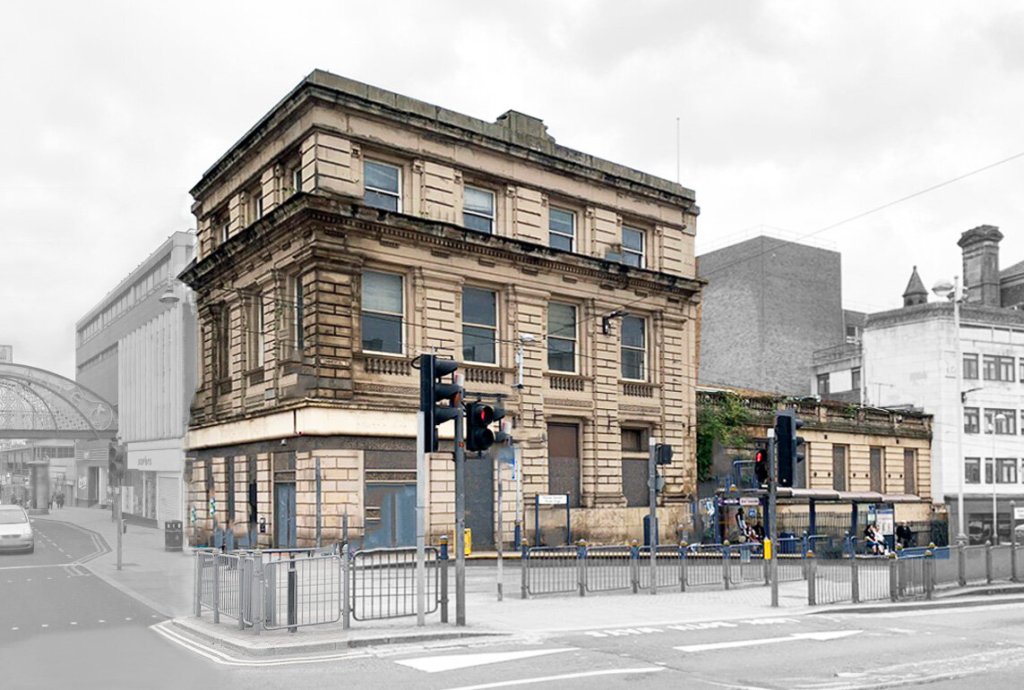
Former Post Office, Stock Exchange, and Bank. Haymarket/Commercial Street, Sheffield. Image: S1 Artspace.

In the early hours of Sunday 19 March 1871, workers at Sheffield Post Office completed an important task. At 1.30 in the morning, business was transferred from its old Market Place site to a new Post Office at Haymarket. Forty-five minutes later, the first mail was despatched south, and moments later, a Sheffield lady posted the first letter here, and its destination was Doncaster.

I wonder what these folk would think about the state of the Post Office now – poor service, scandals, and tarnished reputation. They would also be disheartened at the state of this former branch, decaying and empty since Yorkshire Bank abandoned it over a decade ago.

The good news is that the Grade II listed building has been sold to S1 Artspace to become an arts and cultural venue. Once completed, it will feature spacious public galleries across two floors, artist studios, a community and events space, research centre, shop, and an independent bar. The facility will be a neighbour to Harmony Works at Canada House, which is to be a £14m music education hub.

Until then, we must look back 153 years to the time when it was one of Sheffield’s most desirable properties. Built in a particular class of the Grecian order of architecture known as the Doric, the front Hollington stone elevation rose to three stories. It was designed by James Williams (1824 – 1892), who entered H.M. Office of Works in 1848 and was later appointed the first Surveyor for the construction of Post Offices until 1884. It was built by Neil and Son of Manchester.

“At present it is at its best – clean, and fresh of face. Sheffield smoke will soon set its mark on the refreshingly white freestone and bring it into disagreeable harmony with surrounding blackness. We are afraid that the ‘deeply rusticated’ work will not be so pleasantly conspicuous when the badge of Sheffield industry settles down upon its fair face. In point of external beauty, it is certainly no ‘romance in stone and lime’.” These words from the Sheffield Daily Telegraph on the day after it opened.

The newspaper was less impressed with the diminishing look of the left hand side of the building, but there was a reason behind this, the entrance here leading to upper rooms that were given to the Inland Revenue, its purpose to give the public the idea that it had no connection with the Post Office.

Later alterations hid the designation of the building – ‘Post Office’ – cut into the stone, and the original layout has been obliterated over the decades.

Customers entered from Old Haymarket, ascending stone steps, through a massive door into a vestibule, with their feet upon an iron grating, answering the purpose as a ‘scraper’ to take mud off their boots.

A folding door led into the public office, 33 ft long by 30ft wide, with two mahogany counters carried along the entire length of the room on either side. The floor was made of stone, and close to the counters were hollow conduits, their purpose being for rainy days and in winter, when people brought in wet umbrellas, or were themselves dripping, or shaking the snow off their garments, the water instead of standing in pools on the floor, would find its way into the channels and be carried off.

The walls and ceiling were plain, the only speciality being the plaster dentelli cornice. There were five massive windows – three at the side, and two in front, with glass inserted into the doors. By night, gas light was issued from six pillars fixed on the counter. It was heated by two fireplaces, of which the mantelpiece and supports were in dark Italian marble known as ‘St Ann’s’.

The sorting office was separated by a screen and extended to 80ft long and 30 ft wide, with a lantern-light roof supported on iron columns, running parallel with the ‘new road’ to the Midland Station – this would become Commercial Street.

It contained two stamping tables, with vulcanised India-rubber laid in stone, large mahogany ‘facing’ and ‘sorting’ tables, and compartments covered with kamptulicon and separated by trelliswork in brass. Unheard of now, were ‘bag horses’, brass rings placed on iron pillars, from which bags were suspended, twenty-six to each horse.

It had originally been intended to house the Sheffield Postal Telegraph Department in the rooms above the Post Office, but an oversight meant that the space available would have been smaller than its existing office in The Shambles. The Inland Revenue also found its accommodation too small and moved out a few months later, allowing the telegraph department to finally make the move.

By 1900, the Post Office was itself inadequate, and additional offices were built in Flat Street and all that remained in the Haymarket was public counter work and the telegraphic department. When a new Post office was built in Fitzalan Square in 1909, the building was vacated and served as the Sheffield Stock Exchange from 1911 before becoming a branch of the Yorkshire Bank in 1967.

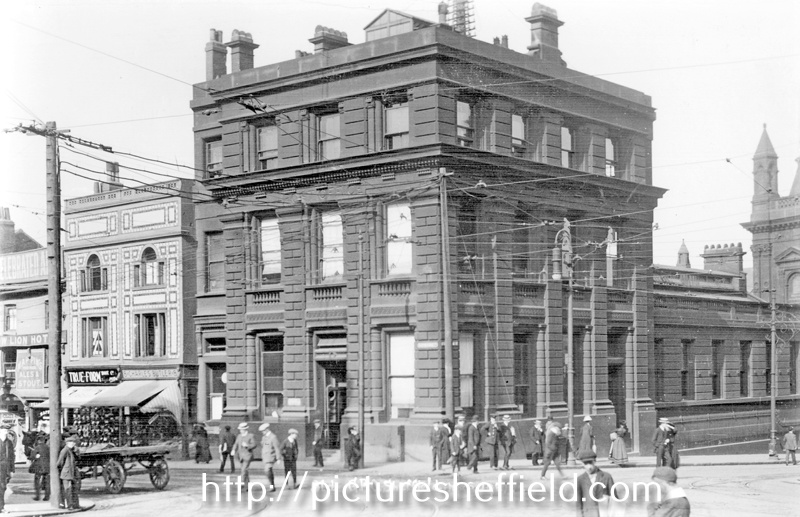
Old General Post Office, Haymarket, from Fitzalan Square with (right) Commercial Street. Image: Picture Sheffield

© 2024 David Poole. All Rights Reserved
Categories
Buildings Companies

The long history of Eadon, Lockwood and Riddle

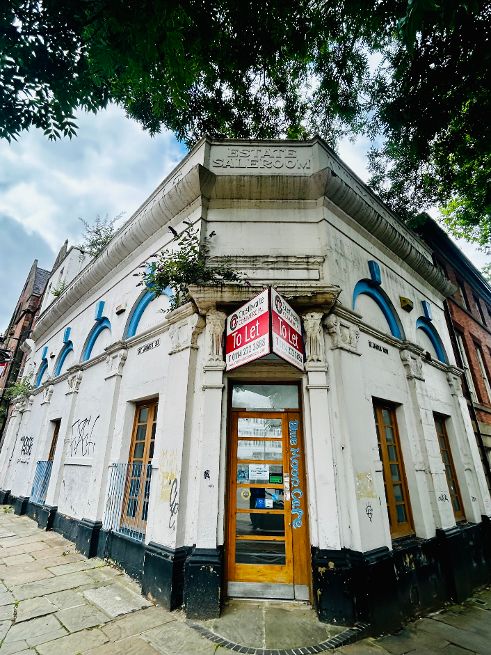
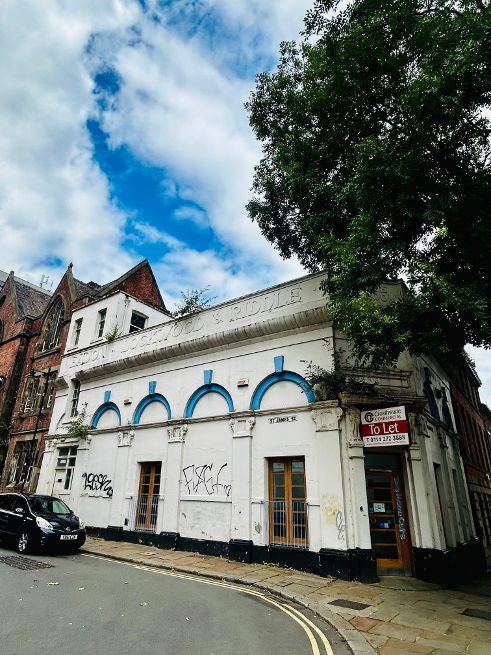
Former Estate Saleroom of Eadon, Lockwood and Riddle at 2 St James Street. More recently it was used by the Blue Moon Cafe. Image: DJP / 2024

I remember something somebody once said to me. “We have ELO (Electric Light Orchestra), ELP (Emerson Lake and Palmer), and ELR (Eadon Lockwood and Riddle).”

The last one was meant as a joke, but it showed the strength of a local business that was founded almost two centuries ago.

The firm of Eadon and Lockwood was founded in 1840 by William Henry and John Alfred Eadon, the second and third sons of George Eadon, a well known cabinet maker.

The business was carried on as W.H. and J.A. Eadon, auctioneers, valuers and share brokers for some years at Fargate in part of the premises that we refer to today as Coles Corner.

In 1855, they moved to new premises at No. 2 St James Street, which were built on the site of the old Sheffield Parish Church vicarage by George William Travis, known in his day as a builder and contractor, who subsequently sold it to tenants.

William Henry Eadon died in 1876, after being in failing health for five years, and his son, William Mitchell Eadon, who had joined the business in 1867, became a partner, and eventual head of the firm. Vincent Percy Eadon, the son of J.A. Eadon subsequently joined the business.

J.A. Eadon retired about 1880 and died shortly afterwards.

The business carried on under the same name until 1887, when, although the partnership continued, the stock-broking part of the business was separated, and attended to by Vincent Percy Eadon until his death in 1900, after which date William Mitchell Eadon carried on their auction and valuation business as sole partner until joined in 1917 by Joseph Cyril Lockwood, who married his daughter.  

He was the grandson of Joseph Lockwood, and second son of William Lockwood of Lockwood Brothers (another auctioneer and well-known amateur cricketer). William Mitchell Eadon had already been in business with Lockwood (and Ernest Dutchmann) as a stock and share broker but this had been dissolved in 1912.

Eadon and Lockwood covered a wide range, including many extensive sales of machinery, while, after the First World War, a succession of sales for the Disposals Board was entrusted to them, the amount of money raised reaching nearly half-a-million pounds.

Art sales also formed a part of the firm’s activities including collections by Richard Bayley, Henry Elliott Hoole, William Turner, W.H. Crowley, and the Craven collection. Among important sales of property were the estate of Robert Younge in the 1870s and the Duke of Norfolk estate.

Sales of antique furniture, silver plate, and other objects occupied a prominent place in the firm’s operations.

The Eadon and Lockwood partnership was dissolved in 1933, and a new company formed when John Tharratt Riddle, the younger son of J.C. Riddle of Grindleford, joined the firm. He had previously been articled to a firm of Sleaford auctioneers and the Sheffield connection probably came through his father who was head of silversmiths Walker and Hall Ltd.

Over the following years, ELR became one of the region’s biggest and most trusted estate agents, as well as operating the auction house business.

The St James Street building was sold in 2001 and obtained by the Blue Moon Cafe looking for somewhere larger after their initial Norfolk Row premises were proving too small. Refurbishment was by Burnell Briercliffe Architects. Blue Moon Cafe closed in January 2023.

ELR auctions continued at the Nichols Building at Shalesmoor and in 2010, now independent to the estate agent business, underwent a substantial programme of expansion, constructing a modern, purpose-built saleroom, re-branding, and becoming the Sheffield Auction Gallery at Windsor Road, Meersbrook.

The estate agency business was sold to Abaco for £4m in 1987 and would form the regional office of Lambert Smith Hampton in 1988, and was one of the few acquisitions that was allowed to trade under its own name.

It was forced to downsize either side of the millennium, and in 2006, a new independent company was created called Eadon Lockwood and Riddle Ltd, and still maintains its Sheffield connection as the city’s  longest established estate agent. 

Former Estate Saleroom of Eadon, Lockwood and Riddle at 2 St James Street. It has been empty since Blue Moon Cafe closed in January 2023. Image: DJP / 2024

© 2024 David Poole. All Rights Reserved
Categories
Buildings Streets

An important development for the future of Chapel Walk

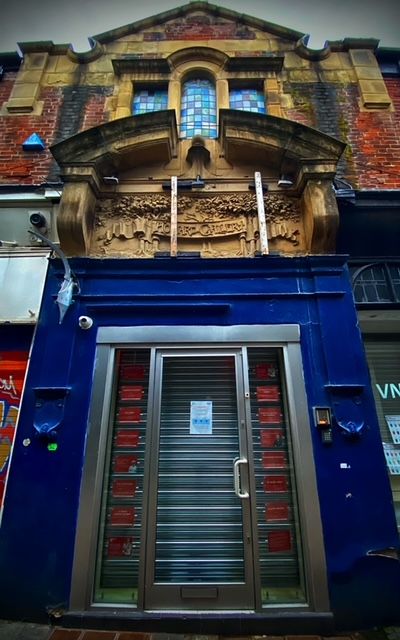
‘Howard Gallery’ carved relief above the now
shuttered entrance to the first floor staircase

Chapel Walk has gone through a tough time of late, but here’s positive news about one of its most interesting buildings.

Fowler Sandford on behalf of The Twelve Capital Burgesses and Commonalty of the Town and Parish of Sheffield in the County of York have submitted a planning application for The Howard Building, which incorporates retail units 15-31 Chapel Walk to the ground floor and first floor offices above. The building fronts Chapel Walk with the rear elevation facing Black Swan Walk.

The proposal relates to the refurbishment of the promenade of shopfronts to improve the street scene along Chapel Walk within the City Centre Conservation Area, alongside the refurbishment and replacement of first floor office windows to the front and rear elevations, and the repair and restoration of the original roof lights. These works will accompany the refurbishment of the vacant first floor offices along with their entrance leading onto Chapel Walk.

No. 25 Chapel Walk to the left adjoined by
modern shopfronts, shutters and the central entranceway to
The Howard Gallery. Image: Walker Wood

It is thought that this narrow strip of buildings may reflect the layout of medieval burbage plots, with No. 9 Fargate (formerly Austin Reed) effectively standing at its head.

The building was designed by Flockton Gibbs & Flockton alongside Alwyn Henry Holland whose provisions store was at No. 9 Fargate, with associated offices and Holland’s Café located in the Howard Building.

Alwyn Henry Holland also established The Howard Gallery in rooms above the shops in Chapel Walk, the gallery opening its doors to the public at the end of the nineteenth century. Consisting of eight ground floor shops, along with Howard’s Café and Howard Gallery, the business failed in 1909 and by 1919 it housed a billiards saloon and offices.

Few of the internal gallery features remain but there are partly exposed roof trusses, stained glass windows to the staircase, and areas of original roof lanterns, installed to allow natural light into the gallery beneath.

Original roof timbers and roof lantern within
the west wing of the former Howard Gallery. Image: Walker Wood
Original roof lantern where historically the
glazing has been removed and blocked up. It is the intention
to reinstate this
. Image: Walker Wood

Externally, above the central staircase entrance, a reminder of the origins of the building’s use is visible within a carved stone relief.

Named by Holland after the Duke of Norfolk, the relief incorporates the ‘Howard Gallery’ name set within a carved treescape, celebrating the duke’s contribution to the city by granting public access to his parkland at Norfolk Park in the mid-nineteenth century, which he would later go on to donate to the city.

The application states that all remaining historical features will be retained and restored.

Read more about Alwyn Henry Holland and the Howard Gallery here
Read more about No.9 Fargate here
Read more about Black Swan Walk here

© 2024 David Poole. All Rights Reserved
Categories
Short Stories

Nearly a century watching, not speaking, and not going away

Former Manor Cinema, Manor Top, Sheffield. Image: DJP / 2024

The ghosts are undisturbed in the cavernous void of a Saturday afternoon. They are trapped in the past, but familiar with the crumbling plaster, forgotten staircases, and rows of seats that are sometimes there, but mostly not.

And then light flickers above that hidden balcony, brighter and brighter, until those damp bricks are alive again. And from the dark, a thunderous roll of a piano makes them settle down and watch. Nelson fights his battles with the French fleet and canoodles with Lady Hamilton.

“What year are we now?” somebody asks. Nobody answers. But eventually a man replies from within. “Back where we started. It is 1927.”

© 2024 David Poole. All Rights Reserved.

Categories
Buildings

St George’s Hall: a war memorial you’ve probably never heard of

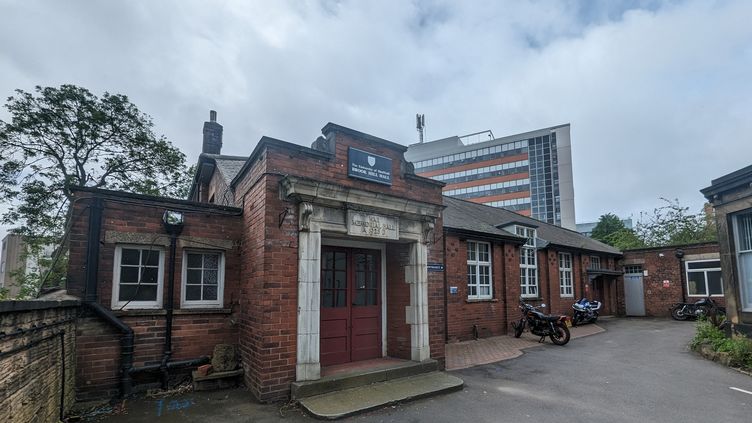
Brook Hill Hall, formerly St George’s Memorial Hall. Image: University of Sheffield

Brook Hill Hall, grand as it sounds, is a single storey red brick building located behind 205 Brook Hill, and like all properties here, belongs to the University of Sheffield.

It was bought in 1963 having been constructed in 1925 and previously known as St George’s Hall.

It was used for exams, student society activities and a small amount of teaching but as it fell into poor condition, was used for storage.

Had it not been for an application in June to demolish it, then we might not have heard about it. Sheffield City Council refused the application, because it is a war memorial registered on the Imperial War Museum’s War Memorials Register.

It was built as St George’s Memorial Hall, attached to St George’s Church at Portobello, lower down Brook Hill, to commemorate those lives lost in World War One.

The war memorial scheme had begun in 1918 and included the purchase of the freehold of St Anne’s Vicarage , Brook Hill, for £1,600. (St Anne’s Church was  at Netherthorpe). The house was adapted for social recreation for young people connected with the church, and the Memorial Hall was built in the grounds attached at a cost of £4,000.

It was built by B. Powell and Son, in red brick with an Empire stone entrance, measuring 60ft by 40ft, and a seating capacity for 500. It was fitted with electric lighting, heating, kitchen, and cloakrooms, with a stage at one end which was used for concerts.

Over the years, the hall was used for church meetings, Sunday School purposes, and social gatherings. 

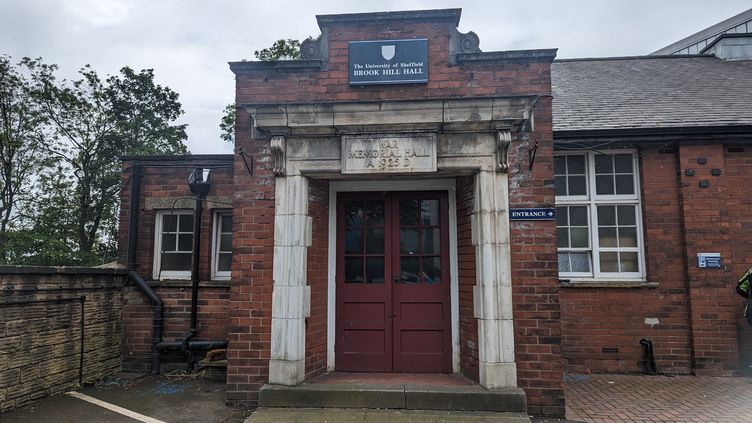
There is a memorial plaque above the door which the University of Sheffield had promised to carefully remove during demolition and relocate in a public location on campus. It also promised to salvage other materials from the building to be reused in future projects across the University estate.

For now, St George’s Memorial Hall lives to see another day.

A memorial plaque is sited above the door. Image: University of Sheffield


© 2024 David Poole. All Rights Reserved.