Categories
Buildings

“The last house in Sheffield, where the weary traveller could refresh themselves.”

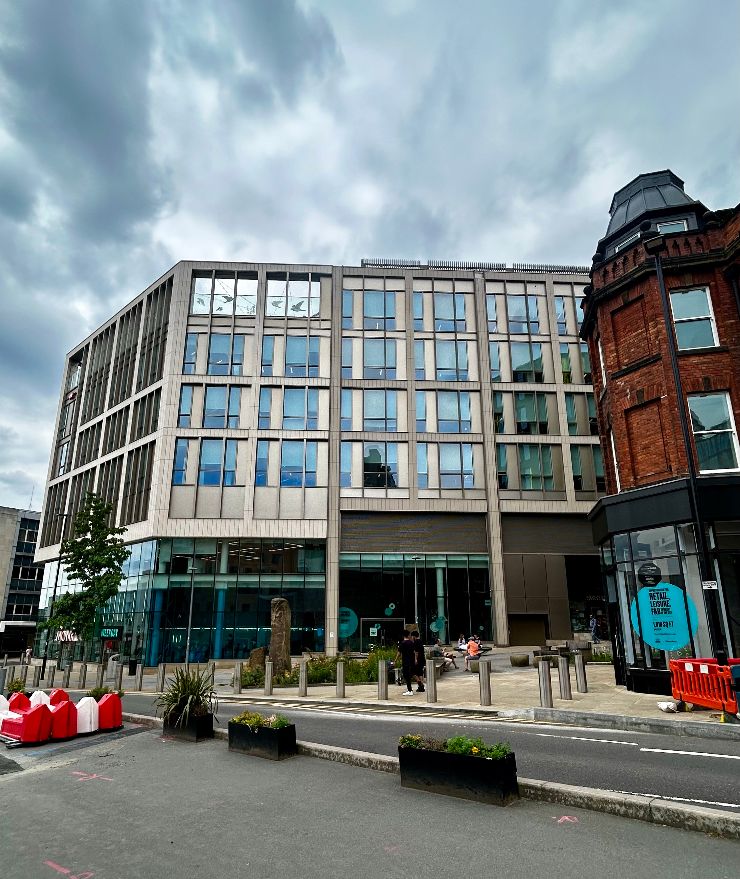
Grosvenor House, at the corner of Pinstone Street and the bottom of Cambridge Street, Sheffield. Image: DJP

Grosvenor House, home to HSBC, one of the first buildings to be completed in Sheffield’s Heart of the City 2 development. Prior to this, the site was occupied by a 1960s concrete block, topped by the Grosvenor House Hotel.

But let’s imagine that we can peel back time, to when this would have been wild moorland. The year was 1682 and a small house was built here. For whom, we shall never know, but it was extended over the next hundred years, and marked the edge of Sheffield town. Beyond the house was Sheffield Moor, a barren stretch of land, reputedly dangerous to cross, that stretched from the town boundary until it reached a small hamlet called Little Sheffield.

The likelihood is that somebody saw a business opportunity because by the early 1800s the house had been converted into an inn and stood on Coalpit Lane (renamed Cambridge Street in the 1860s).
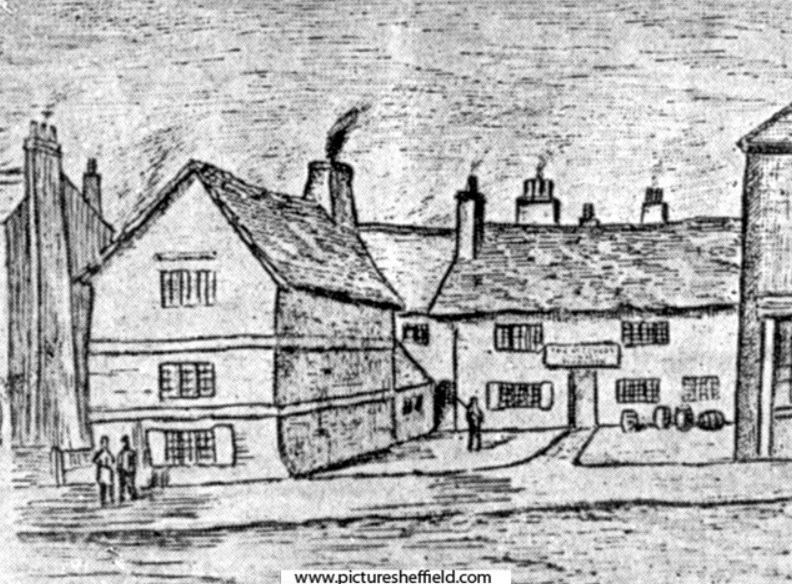
Chequers Inn, Coalpit Lane. Image: Picture Sheffield

“It was originally the last house in Sheffield, where the weary traveller, journeying between London and the immediate towns, could refresh themselves in the ‘qualifying flagon’ of home-brewed ale.”

In front of the inn stood two posts that held stocks in which evildoers were fastened and exposed to the jeers of passers-by. It was a frequent sentence inflicted on anyone found tippling during the hours of Divine service on Sundays or playing pitch-and-toss. The victims in the stocks were seated, and their ankles held fast.

Sheffield was well supplied with stocks. At one time, stocks and a pillory stood by the Town Hall which at that time was situated where the entrance to East Parade is now. There were also stocks at Attercliffe, Bridgehouses, and Fulwood.

It was a puzzle as to why there were stocks outside the Chequers Inn, especially as it was so close to the Sheffield stocks. This side of Coalpit Lane was actually outside the town boundary and the start of Ecclesall, and it was likely that the Sheffield constable (to save the rates) handed over a vagabond to the Ecclesall constable, and this was the ideal spot for him to be placed until released by the Ecclesall official and then he would be transferred from one place to another until his birthplace was found, and who would be compelled to keep him.

The Chequers Inn, also briefly known as the Old Cow, was in the Alsop and Barker family generation after generation, when it was purchased by James Padley, whose sons (one was the Borough Accountant) sold the property to Daniel Henry Quigley Coupe.

D.H. Coupe came from Worksop as a young man and had many ‘irons in the fire’, starting out as a labouring carter before buying the business of his employer Mr Milner. He grew the business until he owned 82 horses and carts before branching out into the coal trade at Midland Station. After he sold his coal business, he moved into the brewing industry and was sole partner in D.H. Coupe and Co, of the Albion Brewery, Ecclesall Road. He was the largest cottage property owner in Sheffield and paid more rates than any other man in the town.

By the time he bought the Chequers Inn, Sheffield had rapidly expanded, and it no longer backed onto the countryside. Not only that, but the inn was in a poor state of repair. In 1860, slates and stone slabs had fallen off the roof, followed directly by the roof itself. Chequers Yard, behind the inn, was a coal yard, and contained notorious lodging houses, home to vagrants in a hopeless state of destitution and disease.

D. H. Coupe’s plans for the Chequers Inn was to demolish it and erect a new hotel on its site while retaining its old sign, one of its quarterings being the coat of arms of the old Lord of the Manor. However, he died in 1883 and the executors did not see their way to carry out the project, hence it remained in dilapidated condition.
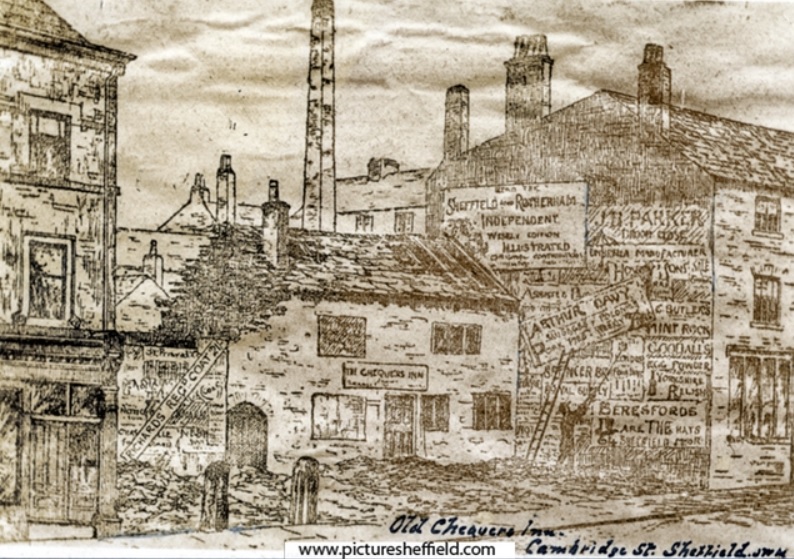
Last days of the Chequers Inn, Cambridge Street. Image: Picture Sheffield

The area bordering old Sheffield Moor had become known as Moorhead, and when the town started its street improvements programme, the Chequers Inn owed its survival because it stood just above the point where New Pinstone Street cut through Coalpit Lane (Cambridge Street). The demolition of properties around it brought the Chequers into daylight again and a ‘somewhat out-at-elbows appearance’, and the inrush of light had proved so dazzling that the windows were boarded up and accentuated the poor condition of the public house. The uninhabited appearance meant that its days were numbered, and a report from this time stated that one of the old stock stones had fallen. It was a far cry from the days when writers had referred to the smart Chequers Inn with its grass plot facing the street, but in its last days that grassy plot had been used as a skittle alley.

T and J Roberts, milliners, had built a grand new shop at the corner of Cambridge Street and New Pinstone Street in 1882 and they purchased the Chequers Inn to construct a Cambridge Street extension in 1888.

Workmen who demolished the Chequers Inn came upon a stone lintel which bore coloured checks – blue, red, etc. – bright as the day it was painted. The sign had been papered over and above the lintel was the name of ‘Alsop’. Other stones laid bare had the date ‘1682’ carved into them. There is some mystery as to what happened to the old stones that had supported the stocks. Charlesworth Brothers, who built Roberts extension, stated that they had been used intact in the foundations of it, but a letter to the Sheffield Daily Telegraph claimed that a passer-by had bought them with the intention of presenting them to Sheffield for display in one of its parks.

Alas, the Chequers Inn disappeared and was quickly forgotten. T and J Roberts closed its shop in 1937 and the building survived until replaced by the 1960s concrete construction that was in turn demolished as part of the recent Heart of the City redevelopment.
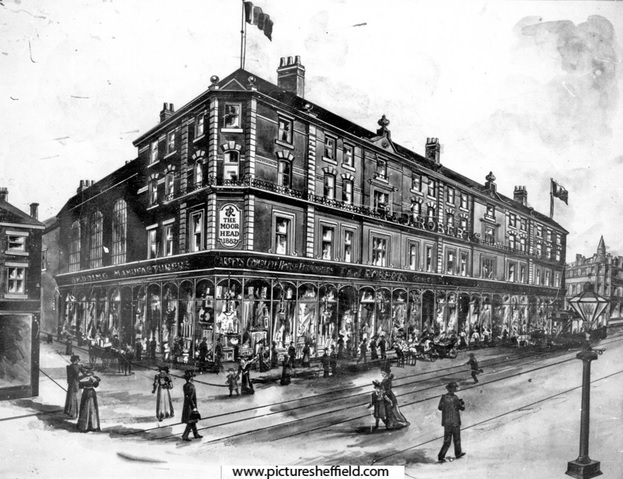
T and J Roberts, Moorhead, with Cambridge Street to the right. 1885. Image: Picture Sheffield

© 2024 David Poole. All Rights Reserved.
Categories
Late Night Tales

Late Night Tales #10

Thursday 29 May 1856. Thousands of people attended a May-day procession to celebrate the fall of Sevastopol, the capital of Crimea, the previous October. “The view from Moor-head along this fine street was lively in the extreme, presenting to the eye at one glance a greater number of flags and banners than perhaps any other part of the town.”

© 2022 David Poole. All Rights Reserved.
Categories
Buildings

Livesey-Clegg House

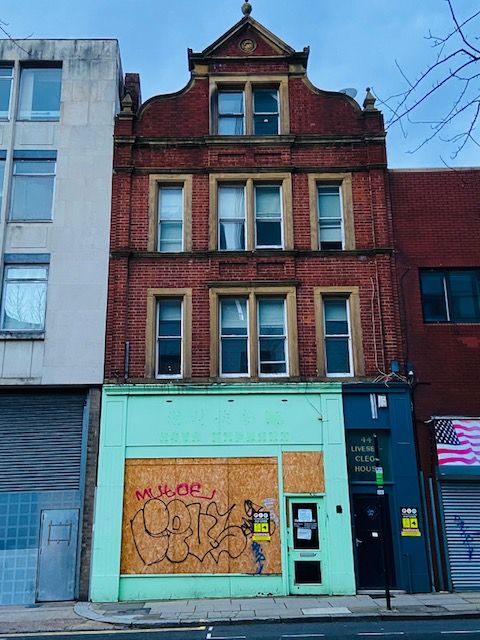
The last remaining Victorian building on Union Street is due to be demolished. (Image: David Poole)

Union Street is not a fashionable road, its role as one of Sheffield’s important thoroughfares, and its ancient connection with Norfolk Street, long diminished.

Post-war redevelopment deprived Union Street of its character, and one of its most important buildings, the shops and offices that made up Cambridge Arcade (with its covered walkway into Pinstone Street) disappeared in the 1970s.

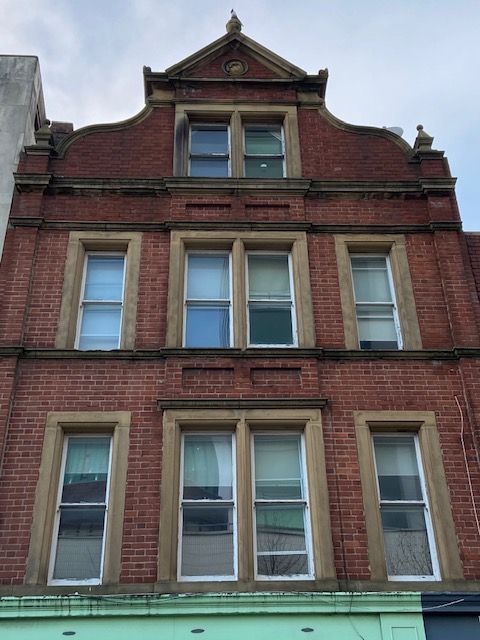
A walk along Union Street today shows that almost all its architecture is from the sixties onwards. All except for one narrow building, a survivor of Sheffield’s Victorian past, sandwiched between unsightly 20th century structures.

However, Livesey-Clegg House, at 44 Union Street, is expected to go the same way as its long-lost neighbours soon.

If plans to create Midcity House, three new tower blocks, up to 25-storeys high, are given the go ahead, then this old building will be demolished.

The last Victorian building to survive on Union Street was built for Thomas Henry Vernon, cork manufacturer, in 1881. His father’s business had originally existed at 2 Union Street at the junction with the old line of Pinstone Street.

Street improvements in 1875 resulted in the creation of Moorhead and comprehensive redevelopment in the area. As part of this, Vernon’s old premises were demolished, with Thomas Henry Vernon succeeding to the business and relocating to Milk Street. When his new premises were built in 1881, he moved to 44 Union Street, and employed about a dozen people.

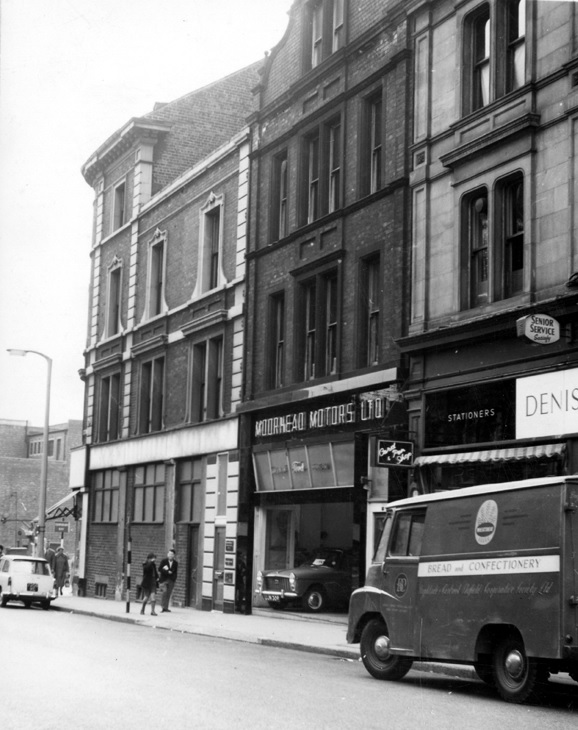
Vernon died in 1919, the ground floor becoming a small car showroom for Midland Motors, later Moorhead Motors, and the upper floors converted into offices.

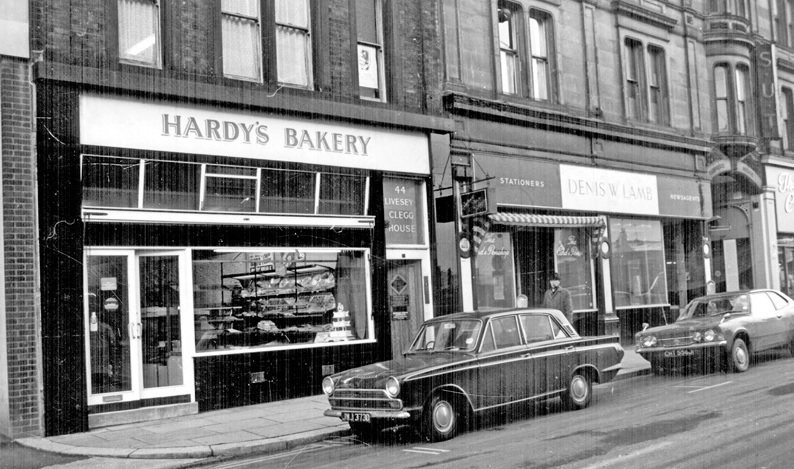
The ground floor was taken over by Hardy’s Bakery in the 1970s, and frequently changed hands afterwards, used as a shop and several food takeaways, and is now empty and boarded-up.

Livesey-Clegg House. The ground floor was occupied by Moorhead Motors in 1961. (Image: Picture Sheffield)

While most Sheffield folk were interested in what went on at street level, it is the floors above that provide the real sense of history.

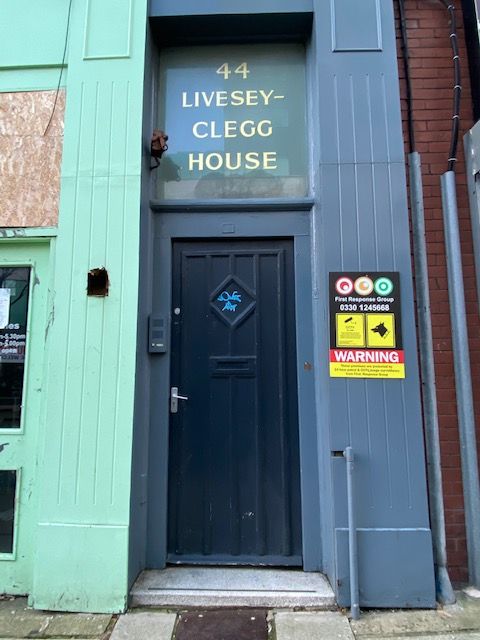
The name above an adjacent door – Livesey-Clegg House – indicates that this was once home to the British Temperance League.

(Image: David Poole)

In Victorian times, high levels of alcohol consumption and drunkenness were seen by some as a danger to society’s well-being, leading to poverty, child neglect, immorality, and economic decline. As a result, temperance societies began to be formed in the 1830s to campaign against alcohol.

The British Temperance League, a predominantly northern teetotal and Christian society, was the new name in 1854 for the British Association for the Promotion of Temperance. In 1880 it moved its headquarters from Preston to Union Street in Sheffield, largely due to the influence of the Clegg family.

Successive members of the Clegg family served as chairman of the executive committee: William Johnson Clegg (1826-1895), sometime alderman of Sheffield, and his son Sir (John) Charles Clegg, best known as chairman and president of the Football Association. His brother, Sir William Edwin Clegg, sometime Mayor of Sheffield, was a vice-president.

By the 1890s its finances and prestige were in decline, but the society persevered and by 1938 was looking for new premises.

“Street widening and re-planning will shortly make it necessary for us to vacate the offices in Union Street, of which we have been tenants for more than 50 years,” said Herbert Jones, the secretary. “We have long felt the need of a permanent home for books, pictures, and other treasures of the movement.”

The ground floor was occupied by Hardy’s Bakery in the 1970s. The sign above the doorway to the right of the shop still exists. (Image: Picture Sheffield)

In 1940, the society moved into 44 Union Street and called it Livesey-Clegg House – named after Joseph William Livesey (1794-1884), a temperance campaigner, politician, and social reformer, and Sir John Charles Clegg (1850-1937), chairman and president of Sheffield Wednesday and founder of Sheffield United.

As well as the headquarters of the British Temperance League, its collection of journals, monographs, bound collections of pamphlets and non-textual items, including lantern slides, posters, banners, textiles, and crockery, were housed in Victorian bookcases in a large old-fashioned room that was used as a library.

The BTL merged with the London-based National Temperance League in 1952 to become the British National Temperance League, with the HQ in Sheffield. It remained until 1987 when the historically valuable library was transferred to the University of Central Lancashire in Preston (now known as the Livesey Library after teetotal pioneer Joseph Livesey).

The old offices and library at Livesey-Clegg House were eventually turned into student accommodation.

Alas, the building is not considered to be of architectural importance and will most likely be demolished soon.

(Image: David Poole)

© 2021 David Poole. All Rights Reserved.