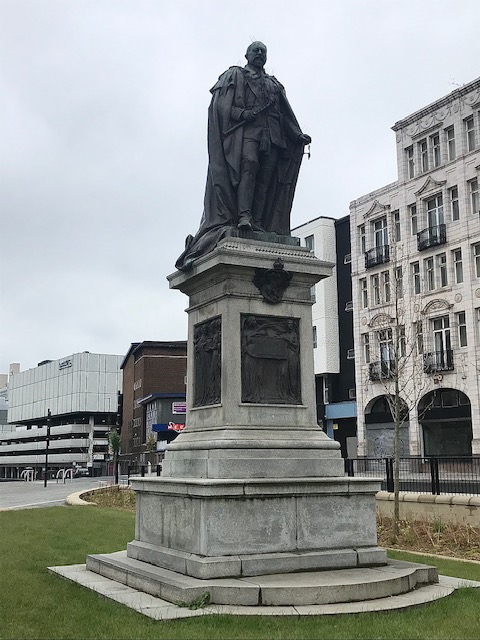
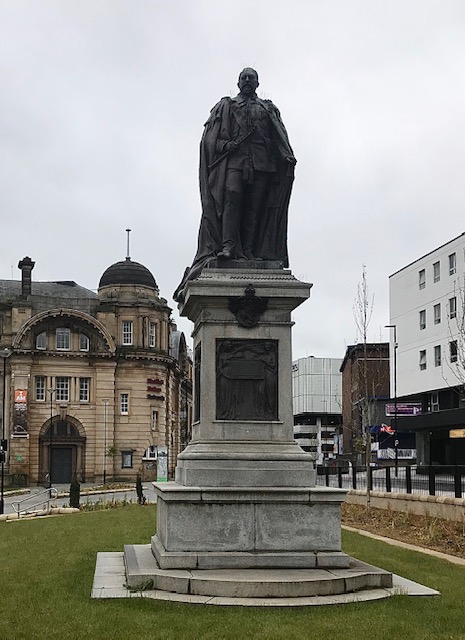
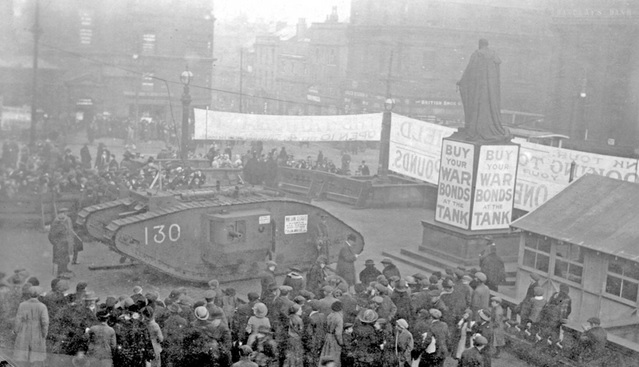
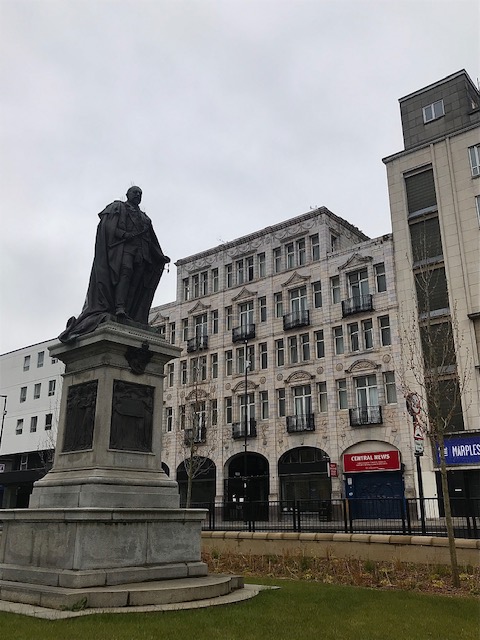
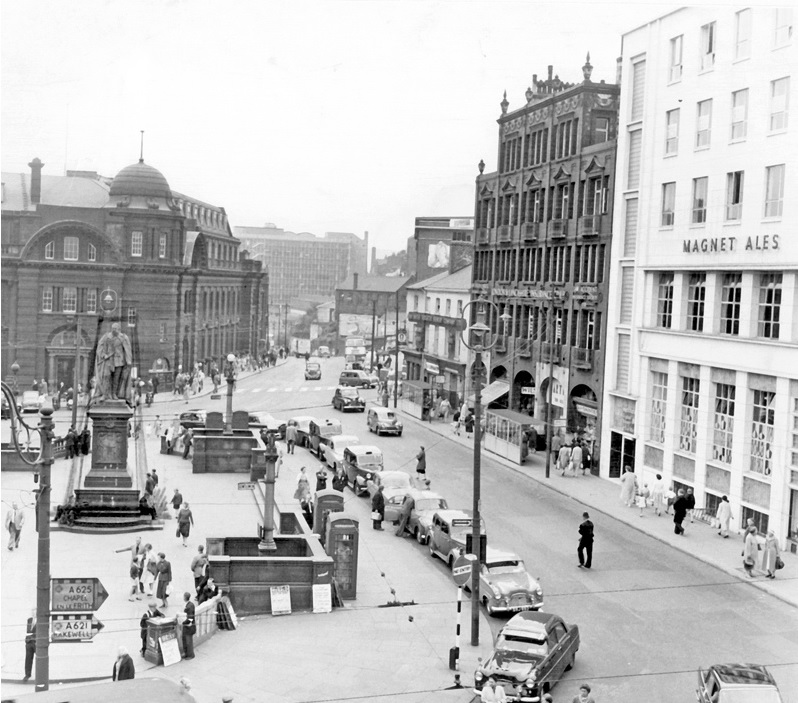
The King Edward VII Memorial in Fitzalan Square was unveiled by the Duke of Norfolk in October 1913. The statue, designed by Alfred Drury, is made of bronze, and set upon an Aberdeen Kemnay Granite plinth.
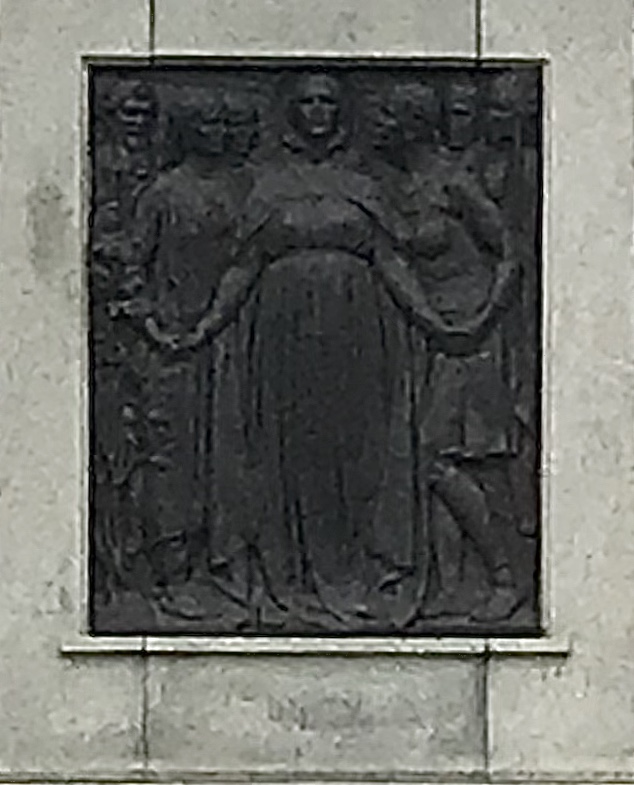
Around the statue pedestal are four panels whose meaning have been forgotten over time. This is probably not surprising because Sheffield’s industrial pollution meant the statue was covered in soot for generations.
Since cleaned up, some of the wording has weathered, and had it not been for the Sheffield Daily Telegraph explaining the meaning of each panel in 1913, then we might be unsure of their relevance today.
If you get the opportunity, visit the Grade II listed statue, and use this post for an understanding of each of the four panels. Click on each photo for an explanation.
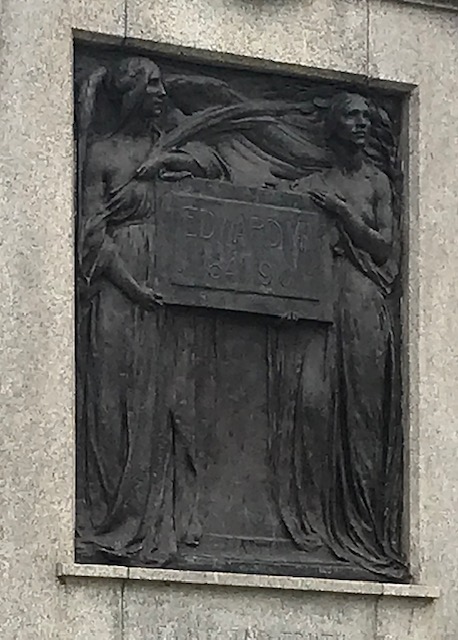
“The front panel consists of two figures – Fame and Truth holding the inscription ‘Edward VII. 1841-1910’. The majestic figure of fame is portrayed with wings, as fame flies through the length and breadth of the land. Truth is represented by a serene figure with eyes uplifted to the source of Truth.”
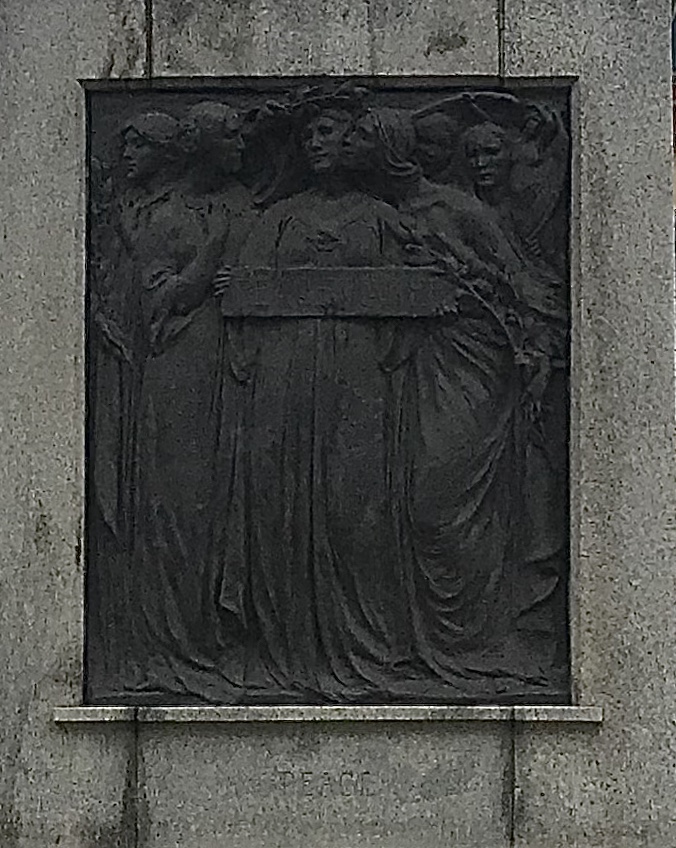
“The back panel represents Peace – ever the great aim of King Edward – being crowned by Gratitude, who bears in her left hand an olive branch. Behind Gratitude is a woman holding a small winged figure of Liberty, which should be the outcome of peace. The other two figures express the idea of Rest and Contentment, brought about by Peace.”
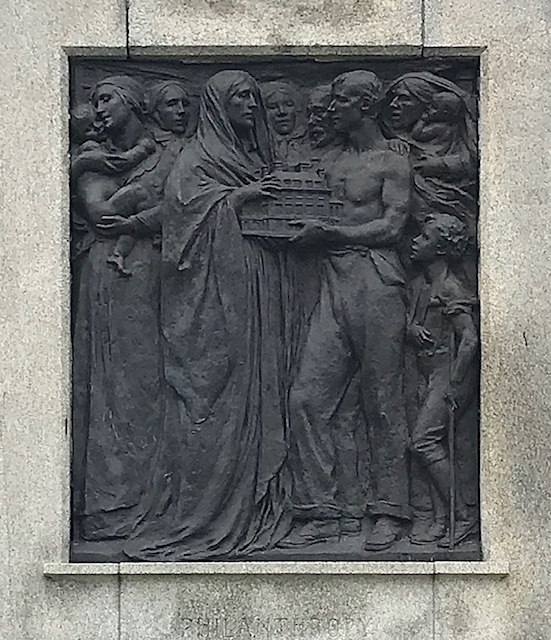
“One of the side panels represents Philanthropy in the graceful and stately figure of a woman presenting the Crippled Children’s Institute to a finely built man typical of Labour. Near to him is a group of interested spectators, one of these being a poor little cripple who is evidently anticipating benefit from the Institution. Behind him is a poor mother and her baby, and an old man, delightedly interested in what promises to be of so great service to the class they represent. Behind the central figure of Philanthropy are two nurses, and to the left a mother and the babe she has gratefully received back from the Institution cured. Thus, are depicted on this panel Anticipation and Realisation.”
“The remaining panel is symbolic of Unity – a woman in the prime of life holding by each hand figures representative of India and China; the idea of Unity is further carried out most convincingly by the presence (behind these figures) of the North American Indian, the Maori of New Zealand and the Aborigine of Australia.”
Despite the mixed fortunes of Fitzalan Square, one structure has stood proudly for well over a hundred years. The King Edward VII Memorial in the centre of the square was erected in October 1913, Sheffield’s commemoration of the King who had died three years before. The bronze statue has seen out two World Wars, surviving the destruction of the immediate area during the Blitz.
It might seem hard to believe now, but Edward was a popular King with Sheffield people. His mother, Queen Victoria, had been a relative stranger to the city, but as the Prince of Wales, he had opened Firth Park in 1875, and attended the opening of an industrial exhibition by the Cutlers’ Company in 1885. There were also stories of Edward’s incognito visits, including those to friends in the suburbs and a town centre hostelry.
He visited again in 1905, this time as Monarch, to open the University of Sheffield and to unveil the Boer Monument to the York and Lancaster Regiment outside Sheffield Parish Church (now the Cathedral).
After his death in 1910, it seemed appropriate that Sheffield should honour him with a statue. As always, the proposal sparked debate amongst its people.
Photograph by The British Newspaper Archive
Sheffield Corporation made it known it intended to add an equestrian statue and fountains at both end of Fitzalan Square, already upgraded in 1909. However, opinion was divided because of the poor reputation the square had long held.
A grander scheme had also been proposed for a new King Edward Square nearby, on the site of the Fitzalan Market (where the easyHotel stands today). This scheme would have cost excess of £100,000 and after much deliberation was abandoned.
Any memorial to King Edward had to be funded through voluntary public subscription, and so Fitzalan Square was deemed more suitable as the cheaper option.
Sheffield Corporation had already been solicited by artists keen to work on the memorial, including Benjamin Creswick, Albert Bruce-Joy, Frederick Pomeroy, and Adrian Jones.
In March 1911, the city architect, Mr Edwards, invited artists to submit designs for both an equestrian statue and a standing figure. As well as those proposals already received, there were others from Alfred Drury, Francis Derwent Wood, William Goscombe John, Henry Alfred Pegram, Paul Raphael Montford, Thomas Brock and Charles John Allen.
It became known that King George preferred non-equestrian statues of his late father, and Sheffield respected those wishes with its choice.
Photograph by Picture Sheffield
The winning design was by Alfred Drury (1856-1944), a sculptor with a fine reputation in London. He quoted between £1600 and £2000 for the design, and £2000 as his fee, although he eventually received 2000 guineas.
A photograph of the design was published in December 1911, and the following month Fitzalan Square was officially announced as the chosen site.
Fundraising was slow, and the project might have faltered, had it not been for a £5,000 donation from Samuel Meggitt Johnson, of George Bassett and Co, on the condition that a home and school for ‘crippled’ children also be built in the city.
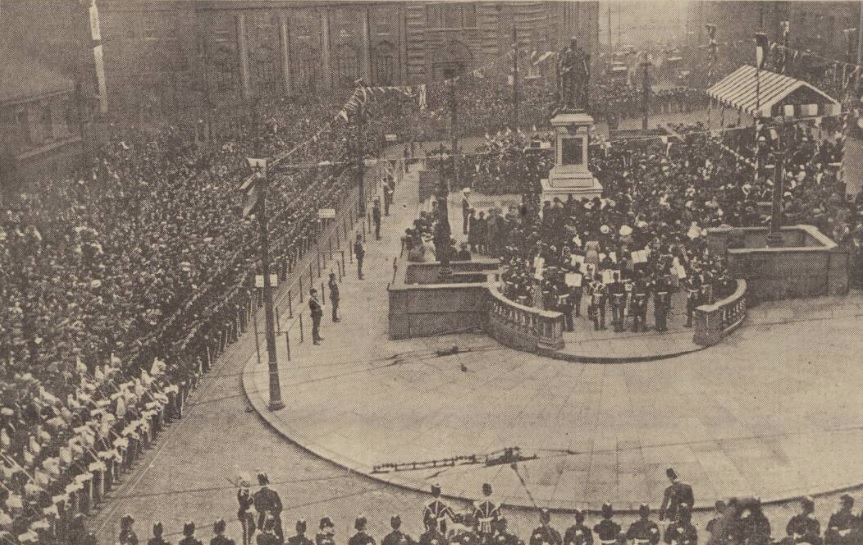
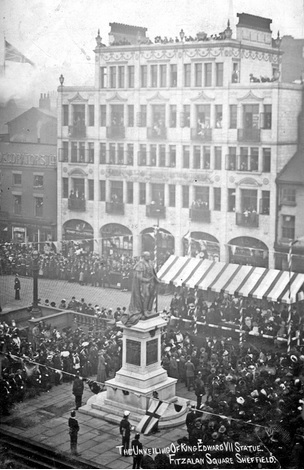
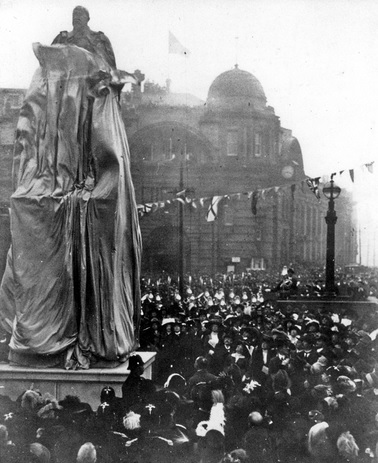
The statue was winched into place in October 1913, quickly covered, and officially unveiled by the Duke of Norfolk at a high-profile ceremony on 28 October, the same day that the Duchess of Norfolk laid the foundation stone of the ‘Cripples’ home in the Rivelin Valley.
Photograph by Picture Sheffield
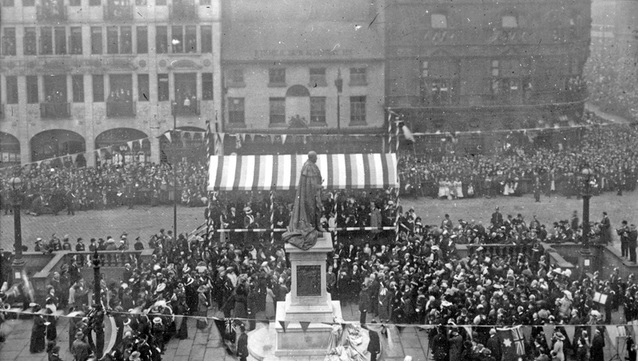
Thousands of people turned up for the ceremony, curious to see the uncovering of a statue, something that was not commonplace in Sheffield. At the time, there were only three other statues on display – Queen Victoria opposite the Town Hall (now at Endcliffe Park), James Montgomery and Ebenezer Elliot. Sheffield had only recently possessed wider streets, and the old narrow congested roads had always been unsuitable for statuary.
Before the arrival of the Duke and Duchess of Norfolk, the vast crowd was entertained by the bands of the 2nd Battalion Sherwood Foresters and the Queen’s Own Yorkshire Dragoons, playing in turn, while troops lined the enclosure around Fitzalan Square.
At 3.30pm there were speeches by Samuel Osborn (Lord Mayor), Colonel Henry Kenyon Stephenson (Chairman of the Memorial Committee), Thomas W. Ward (Master Cutler), Alderman William Henry Brittain (Town Collector), and Alderman John Hobson (Deputy-Lord Mayor).
Photograph by Picture Sheffield
The Duke of Norfolk drew the cord which allowed the covering to fall from the statue, to an outburst of cheering and the playing of the National Anthem.
“I highly esteem the honour of being allowed to unveil in this great city the statue of a great King. We have assembled to place a lasting remembrance in the centre of the city which will bring home to the minds of other generations who will only hear of him as a memory of the past, and as a historical character, the personality of their late King.”
The King Edward VII statue (2.9 metres high) was made of bronze, situated on top of an Aberdeen Kemnay Granite plinth (4.27 metres high), designed by a local architect, similar to one Drury had designed in Aberdeen, but also thought better to withstand Sheffield’s industrial pollution.
There are four panels in stone on all four sides of the plinth – ‘Fame and Truth’, ‘Philanthropy, ‘Unity’ and ‘Peace’, with the word ‘Peacemaker’ incorporated into a banner across one of the bronze reliefs.
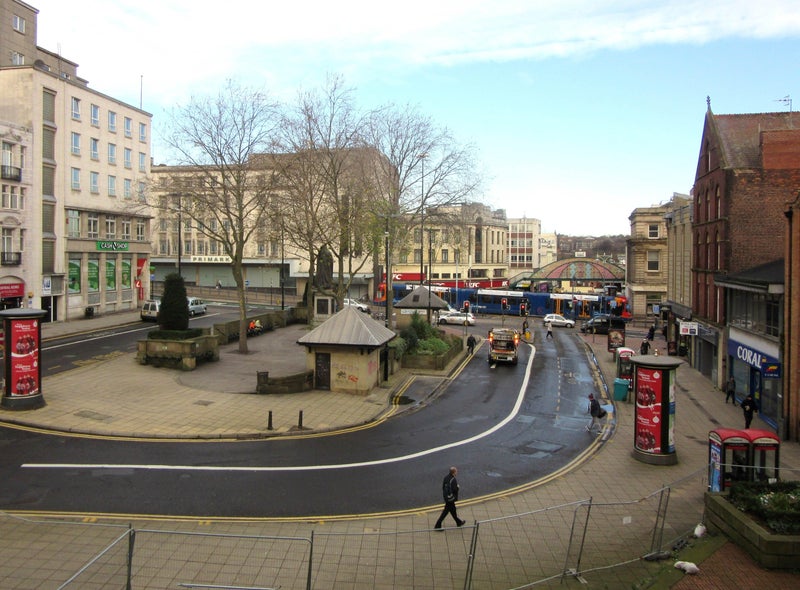
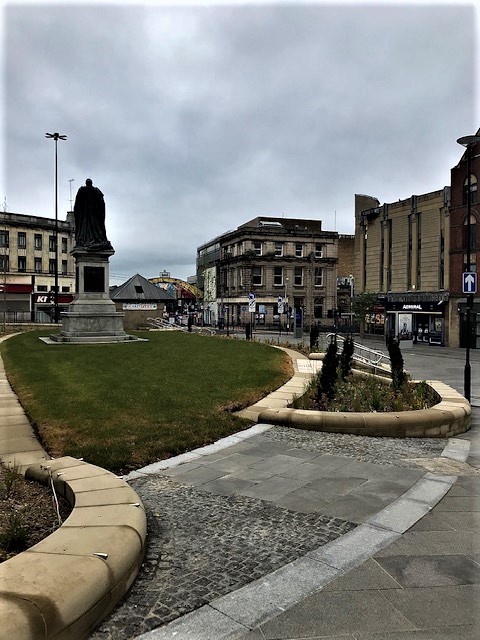
What do you do with a problem like Fitzalan Square? Those of you that have seen it lately cannot have failed to notice its recent overhaul with a new grassed area around the statue of King Edward VII, and the addition of new trees. The square has also been given open access from Norfolk Street, across Arundel Gate, and down Esperanto Place.
The improvements to Fitzalan Square and the surrounding area are part of a £5.5million ‘Knowledge Gateway’ project to transform the area which runs from the Cultural Industries Quarter up to the square.
However, there will be doubters that look upon this work with a note of scepticism. Fitzalan Square has never lived up to its name, not helped by unremarkable twentieth century buildings on one side of the square, and a tendency to attract ‘undesirables’.
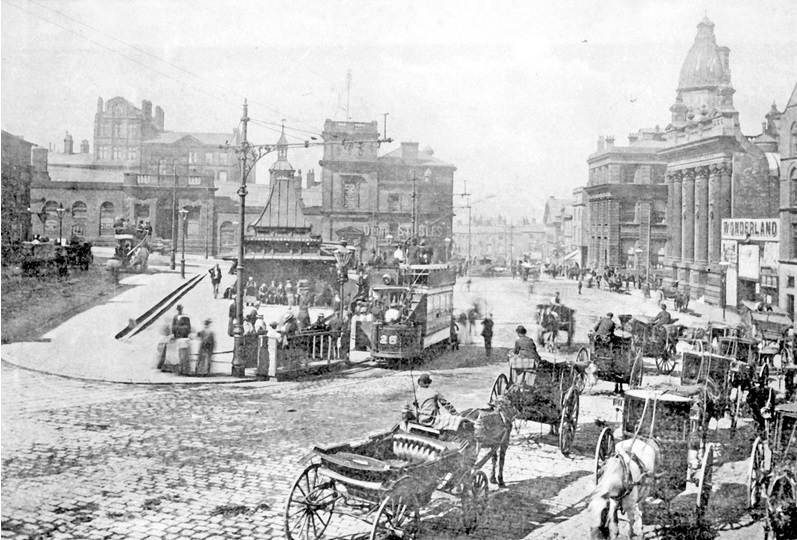
Its history goes back to 1869 when Sheffield Corporation started purchasing and demolishing premises on the east side of Market Street (where the top end of the square is now) and the south side of the old Haymarket.
Several properties came down, including the Star Hotel, Theaker’s Coffee House, the King’s Arms Hotel, the Blue Bell, Fisher and Sons, Mr Arnison’s drapery, and Mr Jeffrey’s pawnbrokers.
A large portion of the premises belonged to the Misses Shearwood. These two ladies objected to part with their property and refused to lend themselves in any way to the proceedings for acquiring it. Sheffield Corporation had to execute a deed poll vesting the property in themselves and paid money into a bank account for the benefit of the ladies. The Sheriff of Yorkshire was called in to give the Corporation possession of the property, and did so by placing in the street an article of furniture and getting the tenants to ‘attorn’ to the Corporation – that was to admit that the Corporation was their landlord. The money remained in a Bank of England account until the death of the ladies some years later.
When the property between Market Street and Jehu Lane (still standing off Commercial Street) was pulled down the open space was called Fitzalan Square, after the Duke of Norfolk’s family.
It was in 1882 that the council announced that it was obtaining plans and specifications for completing a new layout in the open space.
“The space will be levelled, and a retaining wall built along Market Street, surmounted with ornamental palisades, leaving a part open in the centre with steps down to the space levelled, at each of which is to be erected two small ornamental stone buildings, the one near the markets for the use of gentlemen, to contain a good reception or waiting room, lavatory, retiring and attendant’s rooms. The building at the other end near to Norfolk Street, for the use of ladies; to be provided with similar accommodation. The open space is to be well spaced with good flagstones, and in the centre a suitable fountain to be erected, or a statue to William Jeffcock, the first Mayor of Sheffield.”
It appears that the plans were rejected in full, the toilets not built, but some improvements were made to ‘Welshers’ Oval’, as the Sheffield Independent called Fitzalan Square.
“The police were asked to undertake the keeping of order in the open space,” said Le Flaneur in the newspaper. “I am afraid this open space will be very much like the proverbial white elephant. It certainly cost enough to get, and now a permanent addition of the police force will be necessary to keep it constantly free of the loafers, idlers and book makers that make it their daily resort.”
Photograph by Picture Sheffield
It was left to Police-constable George Warhurst to be the object of terror. Betting loungers were prompt to obey his orders to make themselves scarce, and it was a difficult task for the Chief Constable when Warhurst died in 1884.
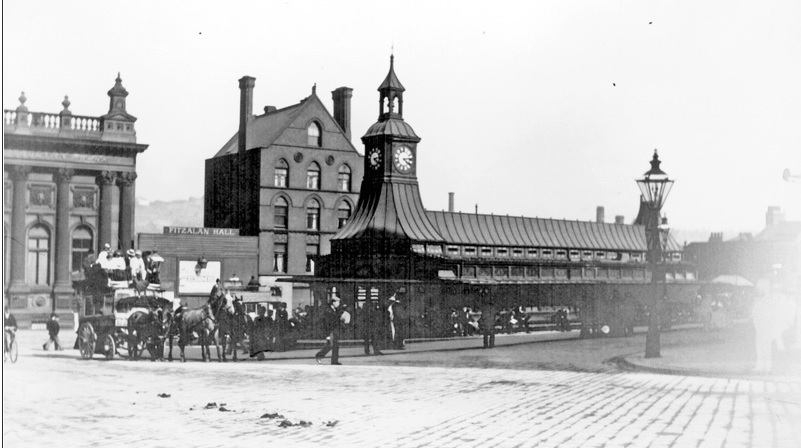
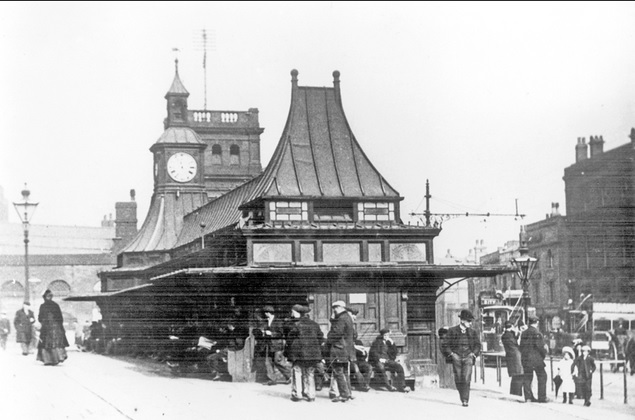
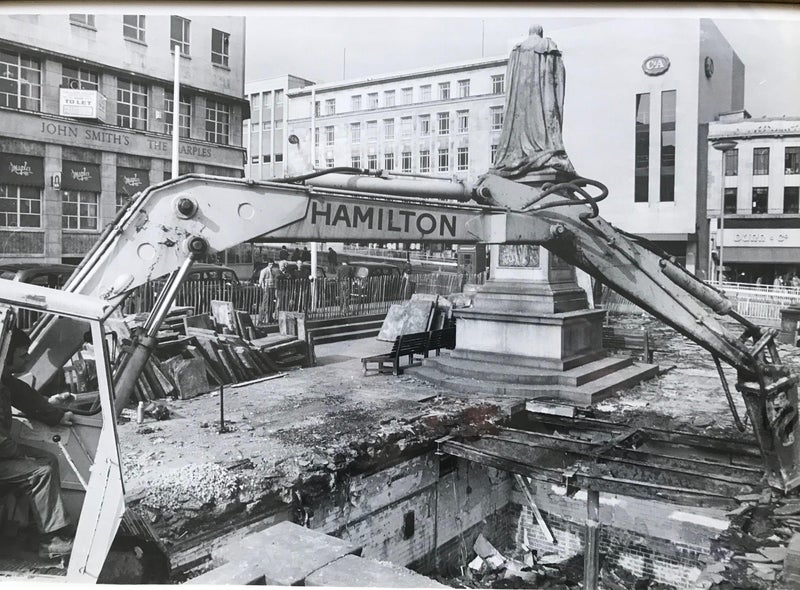
Matters did not improve after a pagoda-style building, comprising tram waiting rooms, water closets and urinals, as well as a clock turret, was built in the centre of the square in 1885.
Photograph by Picture Sheffield
Far from enhancing the appearance of the square, it provided shelter to ‘mouldy old men and frowsy women’ and in a short time had acquired a shabby reputation.
“If only some of our worthy Aldermen and Councillors would make it convenient to spend a few hours each day, for a week, in the immediate vicinity of this structure, they would, I am sure, be earnest in their endeavours to put an end to the constant ‘loafing’ which takes place by ‘undesirables’ at this particular sport,” said one letter to the Sheffield Daily Telegraph.
Photograph by Picture Sheffield
It was a subject repeated day after day.
“The evil at the shelter is a radiating evil. It embraces all the seats around, for the reason that, while the shelter is the converging point of the very pick of Sheffield’s undesirable characters, they also use it as a kind of base from which they carry on their predatory prowling: a long rest, then a short spell of loafing at the street corners, – that is the day’s programme.”
And
“It has been a disgrace far too long, and from every point of view. In my judgement the lavatories themselves are a menace to public decency.”
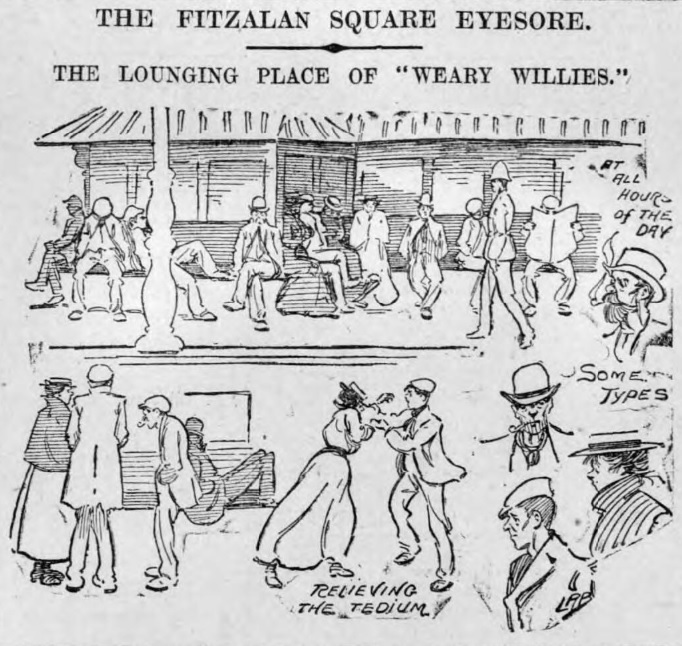
The ‘Current Topics’ column in the Sheffield Daily Telegraph took up the matter and its biting words make painful reading today.
“The correspondents who are raising the question of this unpicturesque resort of the city’s Weary Willies and Tired Tims will do good service if they can stimulate the authorities into action. We will confess that we never pass through Fitzalan Square without experiencing a keen desire to turn a hose pipe on those seats, partly because it would be a pleasing novelty to see the people run, as in their abhorrence of cold water they would, and partly because both they and the seats they occupy look as if they would be the better for a smart wash.
“There need be no sentiment wasted over the denizens of Fitzalan Square. When we are really civilised, we shall transport such people to Labour Colonies and give them to eat exactly what they earn. Failing that there is neither reason nor sense in retaining them as permanent decorations to the city’s ‘finest site’. Fitzalan Square might be something to be proud of. At present it is only disgusting.”
Illustration from 1903 by The British Newspaper Archive
Sheffield Corporation was indeed stimulated into action, probably the result of land at one end of the square being chosen as the site for the new General Post Office.
While land was cleared for the Post Office in 1907, councillors proposed reconstructing Fitzalan Square to harmonise with the new building.
It was probably one of the best known public spaces in Sheffield, but the most ardent son could scarcely claim that the pagoda-like structure which gave it its chief characteristic had added either architectural grace or dignity to this part of the city.
“The pagoda had served various purposes satisfactorily, and, notably, as a rendezvous for a little army of folk with apparently little to do than doze and gossip the day through.”
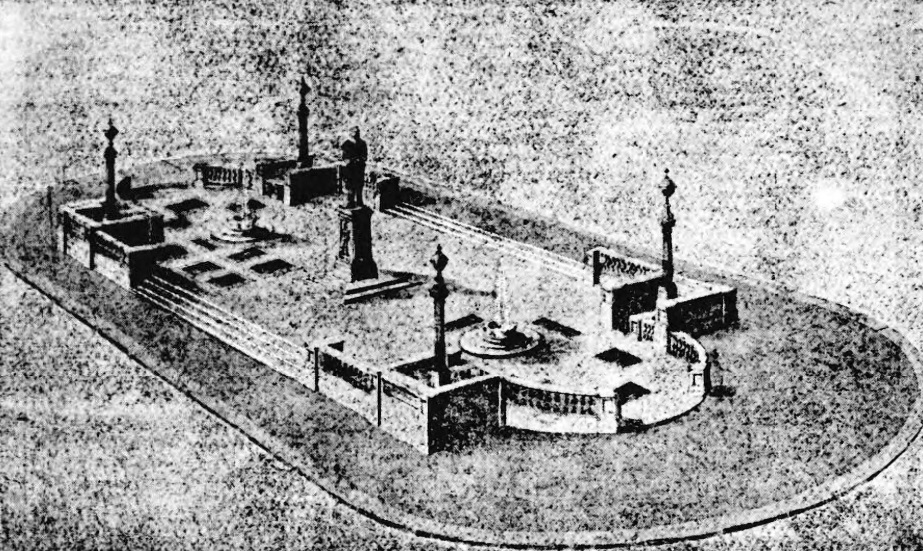
The council adopted a scheme for laying out Fitzalan Square in ornamental style as an open space, and at the same time taking advantage for utilitarian purposes. The scheme was worked out by Mr C.F. Wike, City Engineer, based on drawings prepared by the Sheffield Society of Architects and Surveyors.
At the time it was noted that there were more pipes laid through Fitzalan Square than through any part of the city. Here, the lines to the GPO, the National Telephone, and Electric Light Power stations converged. The Post Office was also laying cables to connect trunk wires to the new GPO building and on completion of work, in January 1909, renovation of the square commenced.
The contractor chosen for the work was George Longden and Son, but the original plan had been shorn of ornamental detail due to cost, although the property overlooking the square was nearly all rebuilt.
The ugly pagoda went and the central part of the square it occupied was enlarged. This was made possible by removing an old cab stand and filling up the slope on the south side of the square to make it level and wider.
The upper part of Baker’s Hill, a sloping road in front of where the new GPO was being built, had been done away with, and steps substituted as an outlet from that corner of the square into Pond Street.
Illustration from 1908 by The British Newspaper Archive
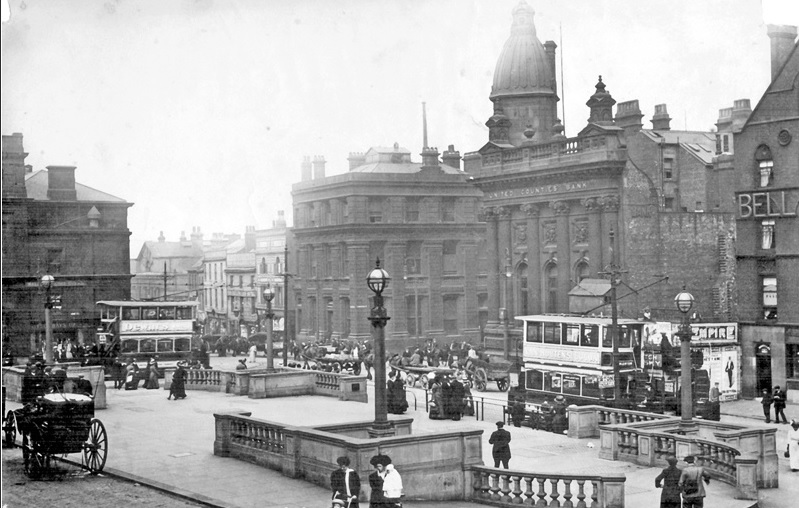
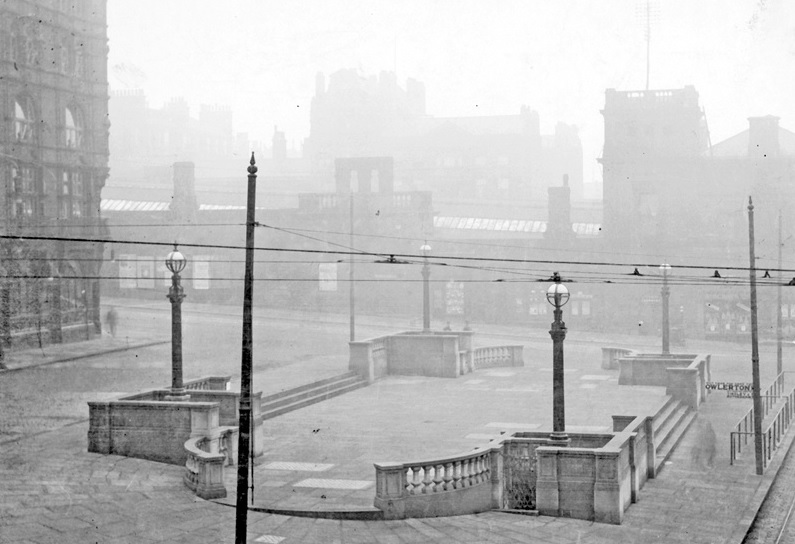
The new scheme provided an ornamental stone balustrade, public conveniences at either end of the square, and a tramway office, all underground. At the four corners were electric arc lamps, with further embellishments, in the shape of a fountain and a statue, planned for a later date.
Photograph by Picture Sheffield
However, the scheme was embroiled in controversy, the council wanting to use Norwegian or Swedish granite because it resisted damage, but the majority wanting cheaper Stoke Hall stone. In the end, the balustrades were built of imported granite.
Fitzalan Square was formally opened on Wednesday December 8, 1909, by the Lord Mayor, Earl Fitzwilliam, at which he made an expressive speech: –
“We live in a time when the question – a burning question in some cities – of open spaces is bidding fair to see some very satisfactory accomplishment. In no city more than Sheffield are these open spaces desirable. In a city like Sheffield where we burned the very best ‘South Yorkshire’, they made the very best mess of the South Yorkshire atmosphere. Science has not yet taught us how altogether to avoid this murky effect, but by providing open spaces we might make best of the atmosphere that is left to us. Sheffield is especially fortunate in its open spaces and in this particular one, because although in the past they had had a space here, it had not been one worthy of the size or importance of the city.”
The improvements had cost £9,000 (about £1.1 million now), but the age-old problems refused to go away, and criticism was often scathing.
Photograph by Picture Sheffield
Photograph by Picture Sheffield
“Within a year an article appeared in the Sheffield Evening Telegraph, written by an anonymous correspondent, under the heading ‘THAT SQUARE’: –
“A good deal of the recent talk about Fitzalan Square may have been ineffectual, but if it did nothing else it sent me to inspect the place. Though my work brings me into the city daily, I had never had reason to descend to the bottom of High Street since the so-called improvement had taken place. Yesterday I determined to see for myself what the fuss was all about.
“I have no desire to exaggerate but I do not hesitate to say that Fitzalan Square is the most pestilently ill-favoured open space in England. This is patent without seeing all the others, for there is an instinct which tells you when you have seen the absolute nadir of ugliness. I have seen IT.
“If you are at all run down the effect of suddenly coming upon such a spectacle as this forlorn wilderness of paltry dog kennels and pretentious architectural incoherencies may easily cause a shock dangerous to health.
“The said ‘improvement’ consists of a stone balustrade round a large piece of nothing at all. What this petty stone fence is meant to enclose or exclude is not obvious. There are four lamp-posts of the most abysmal hideousness. Possibly there is poetic fitness in this, for they are meant to light the way below.
“It might be roofed in and let as a skating rink or turned into a rifle range. It might be dug up and let out to husbandmen. Unless three out of four of the surrounding buildings are absolutely wiped out and a big sum spent in covering up the alleged ‘improvement’ which has recently been carried out, nothing can be done to make the place decent.”
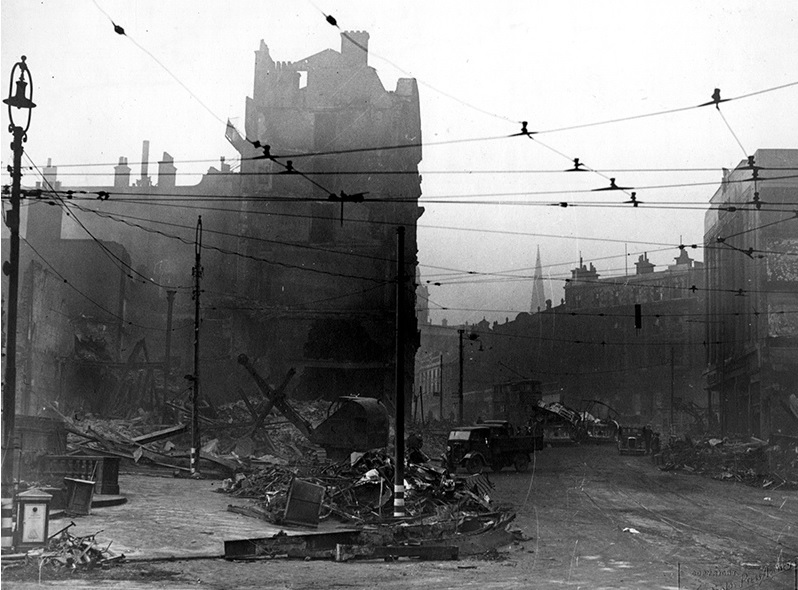
Wartime bomb damage. Photograph by Picture Sheffield
Photograph by Sheffield Star
And so, the tone was set, for decades subject of ridicule, damaged during the Blitz, and often left to its own unsavoury devices.
The fountain never materialised and a plan to relocate a statue of Ebenezer Elliot from Weston Park to Fitzalan Square was abandoned. It was graced with a statue of King Edward VII (subject of another post) in 1913.
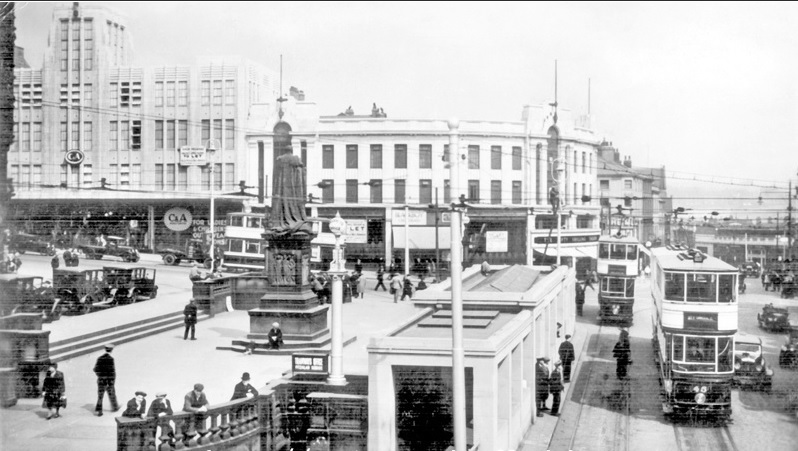
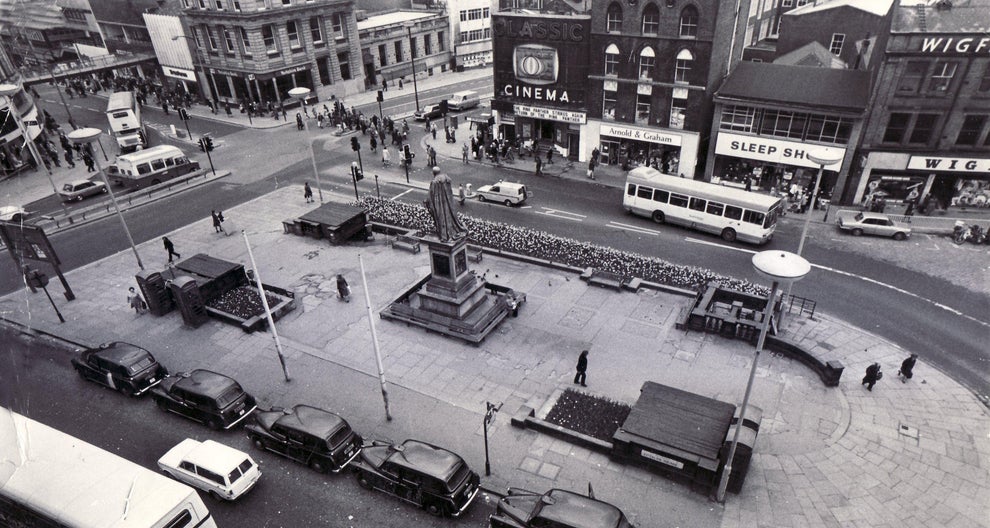
In time the underground toilets were removed, the trams disappeared, and even the taxis left for busier parts of the city centre.
Photograph by Picture Sheffield
Photograph by Sheffield Star
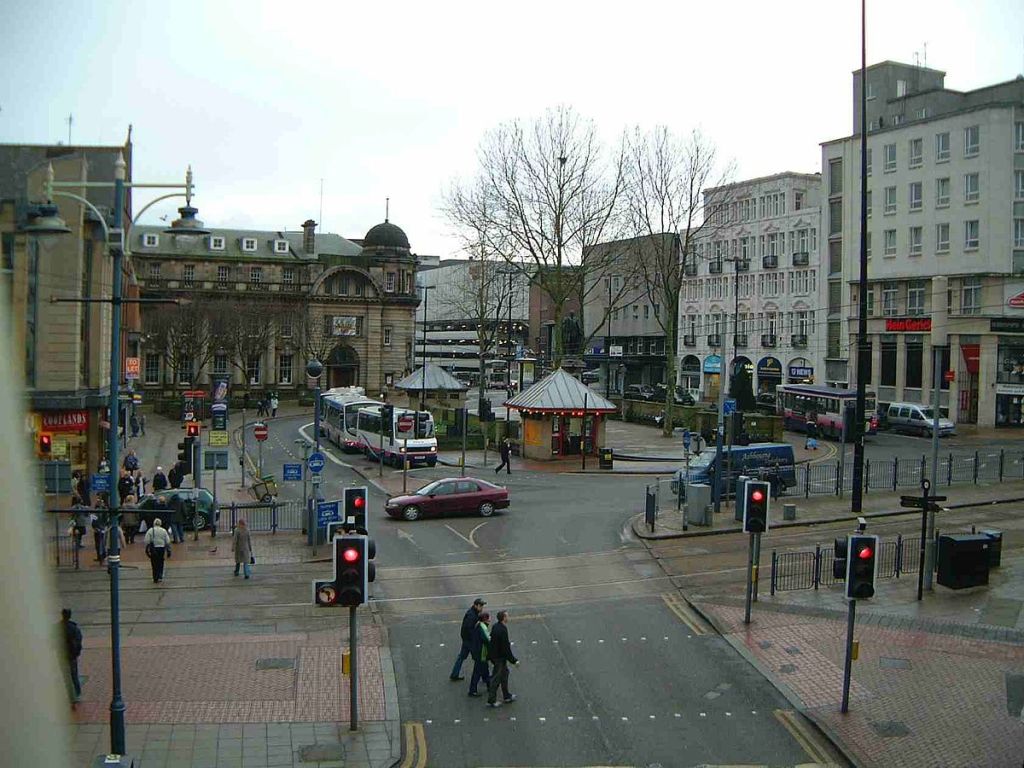
When the area has become too down-at-heel there have been attempts to restore it, including a 2003 facelift, with the restoration of the King Edward VII statue, new sandstone paving, steel benches and improved street lighting.
The latest restoration comes at a time when this part of the city centre is in transition. A vast proportion of people have migrated to The Moor along with the old market, the old General Post Office now belongs to Sheffield Hallam University, and the future depends on the Castlegate development and most probably our student population.
Fitzalan Square in 2020. Photograph by David Poole
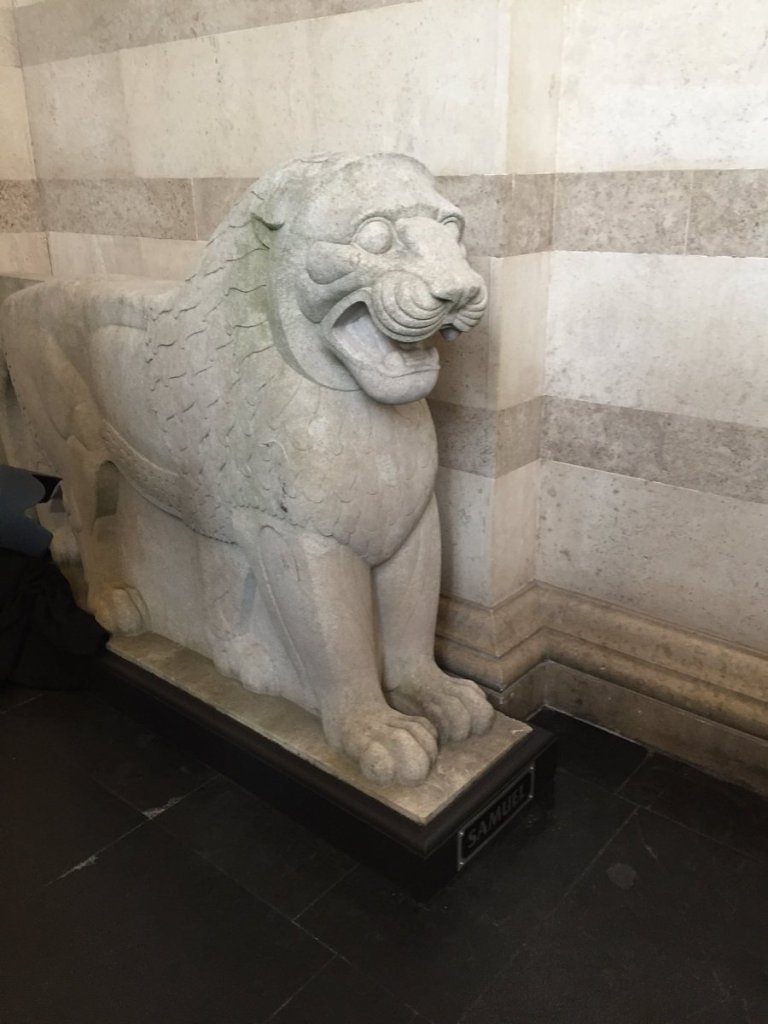
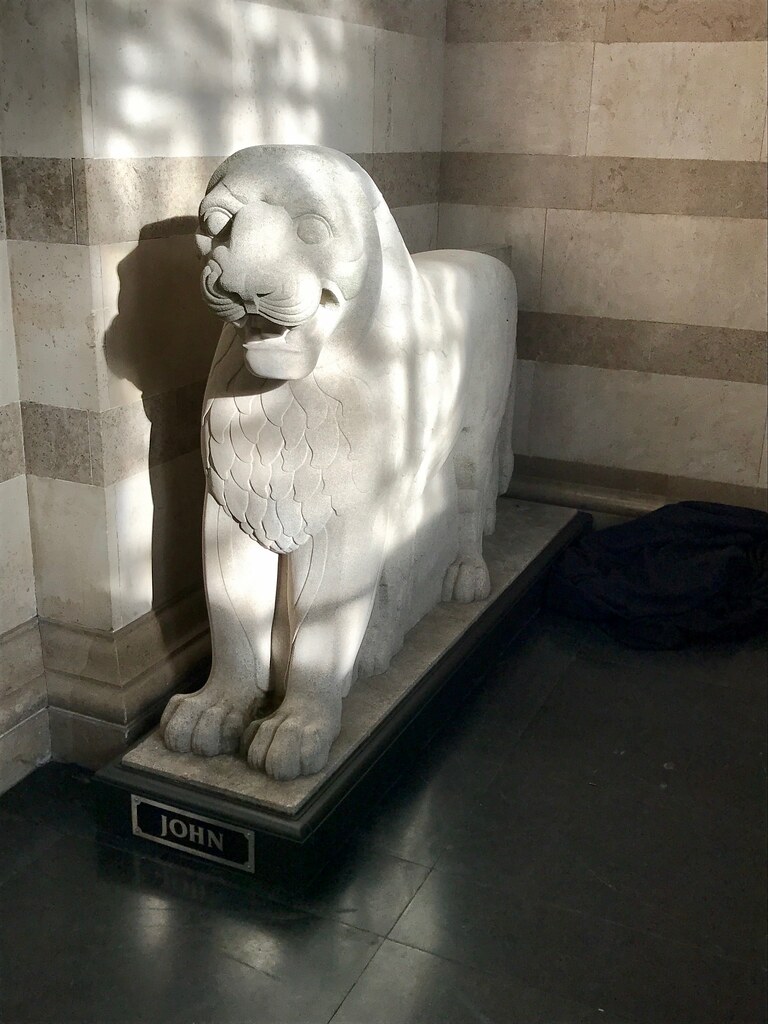
The next time you visit Sheffield City Hall, look out for John and Samuel. These two old fellows are a pair of stone Assyrian lions who have quite a story to tell.
Their tale begins in the early 1930s at Middleton-by-Wirksworth, a small village the other side of Matlock.
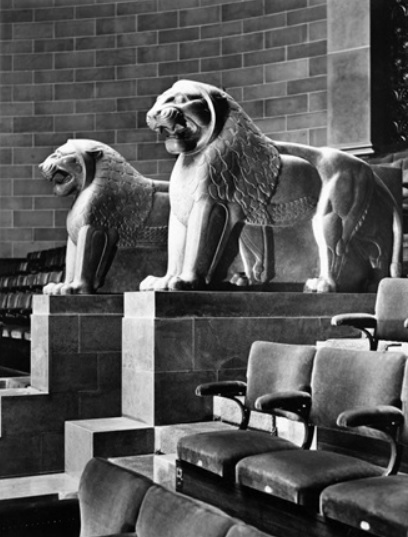
Made of Hopton Wood stone, the two lions were created by Sheffield sculptor John Hodge, a man with an elusive history, “a tall mysterious figure,” seen regularly wearing a large-brimmed black hat and matching cape, and causing fright amongst children at night as he walked to and from his project at Derbyshire Stone’s works.
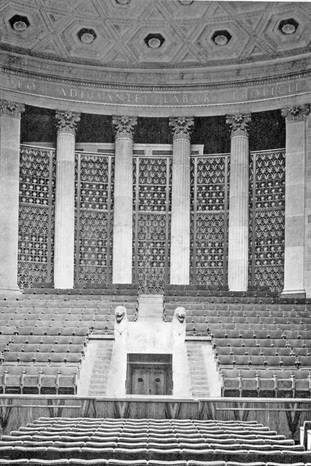
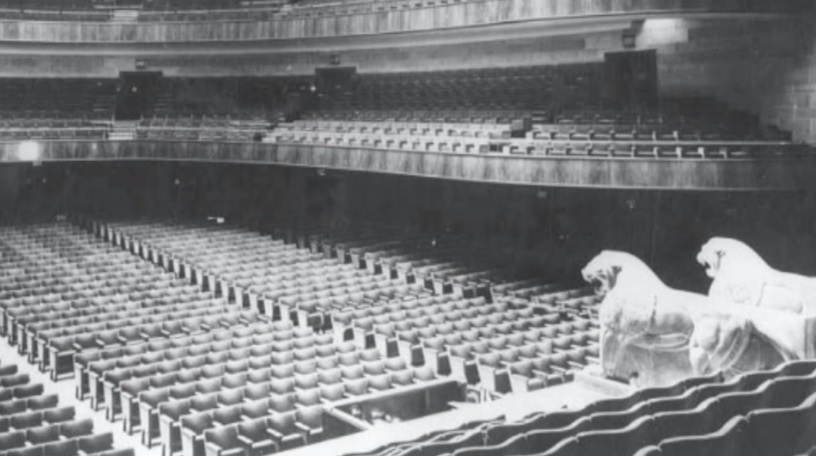
The two lions, each four-feet-high and weighing 2.5 tonnes, were predestined to be night cats, commissioned by architect Emanuel Vincent Harris to sit either side of the “Entrance of Honour” to the stage of the newly-built Sheffield City Hall.
Photograph by Picture Sheffield
Photograph by BBC News
When the City Hall opened in 1932 the two lions could be seen by everyone in the Oval Hall, admired at first, but soon subject of ridicule and anger.
The trouble, apparently, was that the lions split up a choir or orchestra, so that there was a lack of cohesion between artists on two sides of the platform.
The lions became subject of letters to local newspapers: –
“The proper place for the City Hall lions is outside, on the pedestals flanking the columns.”
“These ridiculous stone lions block up valuable space in the centre of the orchestra.”
“Admittedly they are a fine piece of work, but they ought not be there. They obtrude themselves on one’s vision, and hardly seem to fit in with the otherwise pleasing artistry of the interior.”
The most damning criticism came from Sir Thomas Beecham, conductor, and impresario, best known for his association with the London Philharmonic and Royal Philharmonic orchestras. Addressing an audience of musicians on stage at the City Hall in 1935, he reckoned that the platform had been expressively designed for “clock golf.”
“AND THESE,” he shouted pointing at the two big cats,” “THESE MUST GO. I don’t know who devised them, but it looks like Epstein. Isuppose they are works of art, but why can’t they be placed at the other end of the hall?”
In 1936, the Sheffield Hall Committee, perhaps influenced by Beecham’s description of them as “horrors” and “huge brown beasts,” recommended to the City Council that the lions be removed. The council, not be bullied, refused to do so, and the two lions remained on stage for thirty years.
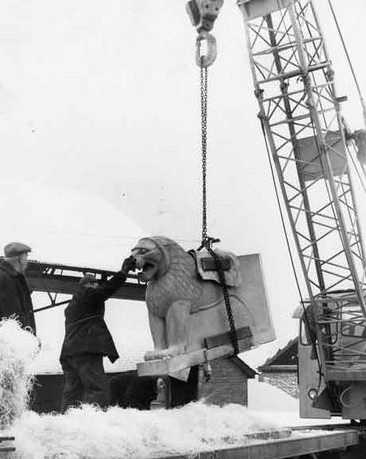
It wasn’t until 1962, a year after Beecham’s death, that the lions were banished when the auditorium was refurbished.
The two lions were bought for £600 by John Hadfield, the sympathetic chairman of Derbyshire Stone Ltd. They were hoisted out of the hall, put on the back of a lorry, and reunited back in Derbyshire.
Photograph by Picture Sheffield
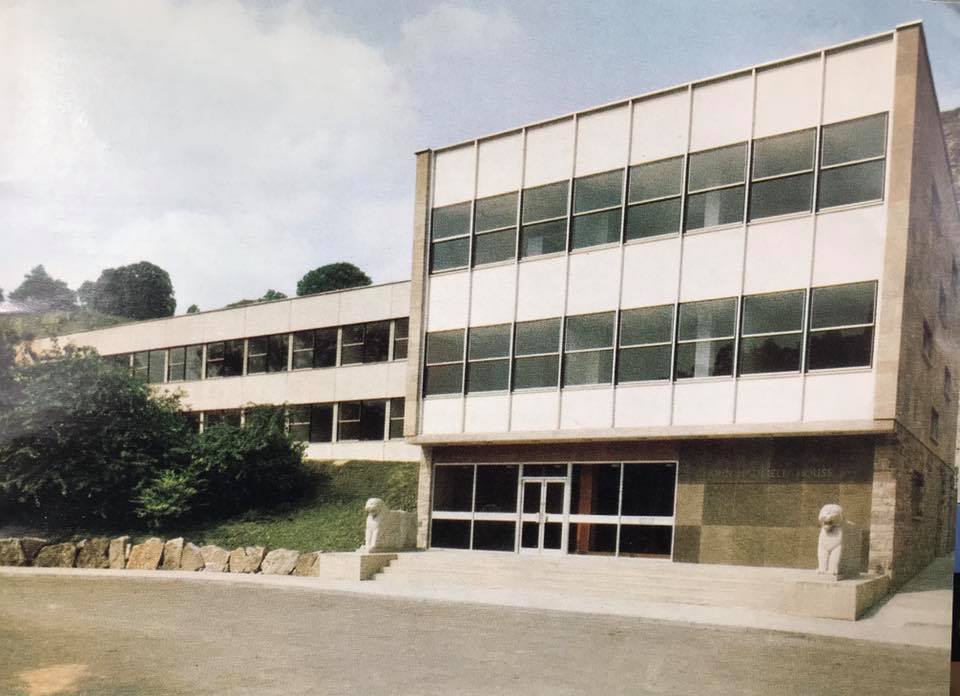
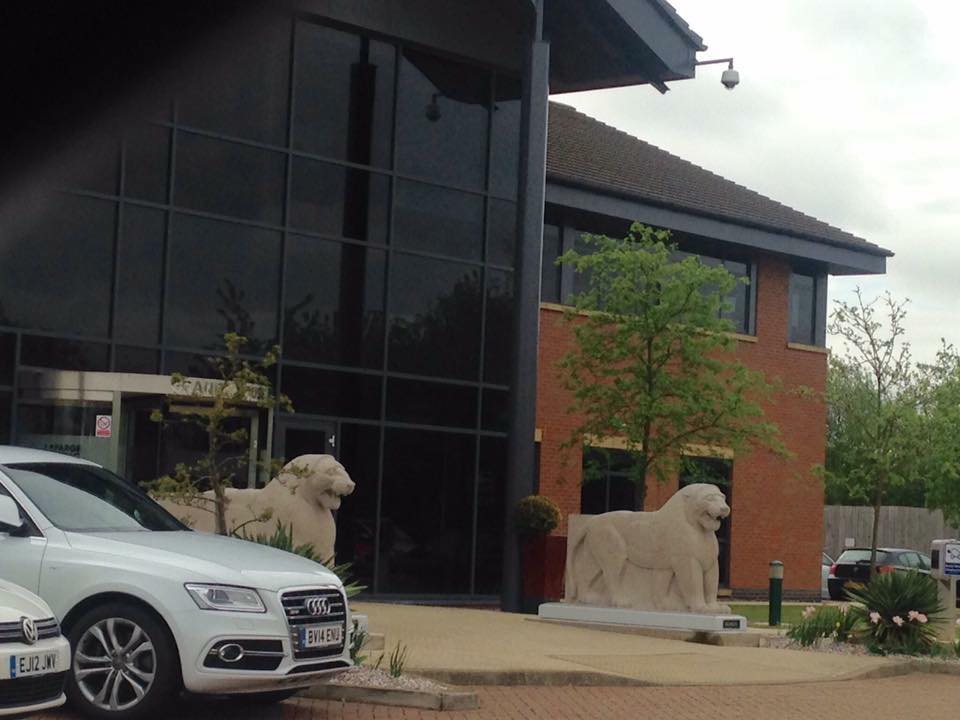
They were eventually built into the steps of John Hadfield House at Matlock, constructed in 1968 by Tarmac Construction, for Derbyshire Stone, and later becoming Tarmac Eastern’s regional office for over 30 years.
Photograph by Tarmac Roadstone
When the company vacated the building, the lions were moved to Tarmac’s Ettingshall office, Wolverhampton, and when that closed, the poor lions ended up at their regional office near Leicester.
Photograph by Tarmac Roadstone
After nearly fifty years living outside, the fate of the Assyrian lions took a remarkable twist in 2017.
As part of Sheffield City Hall’s 85th birthday celebrations, John, and Samuel, as they were now called, were cleaned up, returned to the City Hall, and given ‘pride’ of place in the foyer.
Photograph by Abi Jaiyola on TwitterPhotograph by David Johnson on Flickr
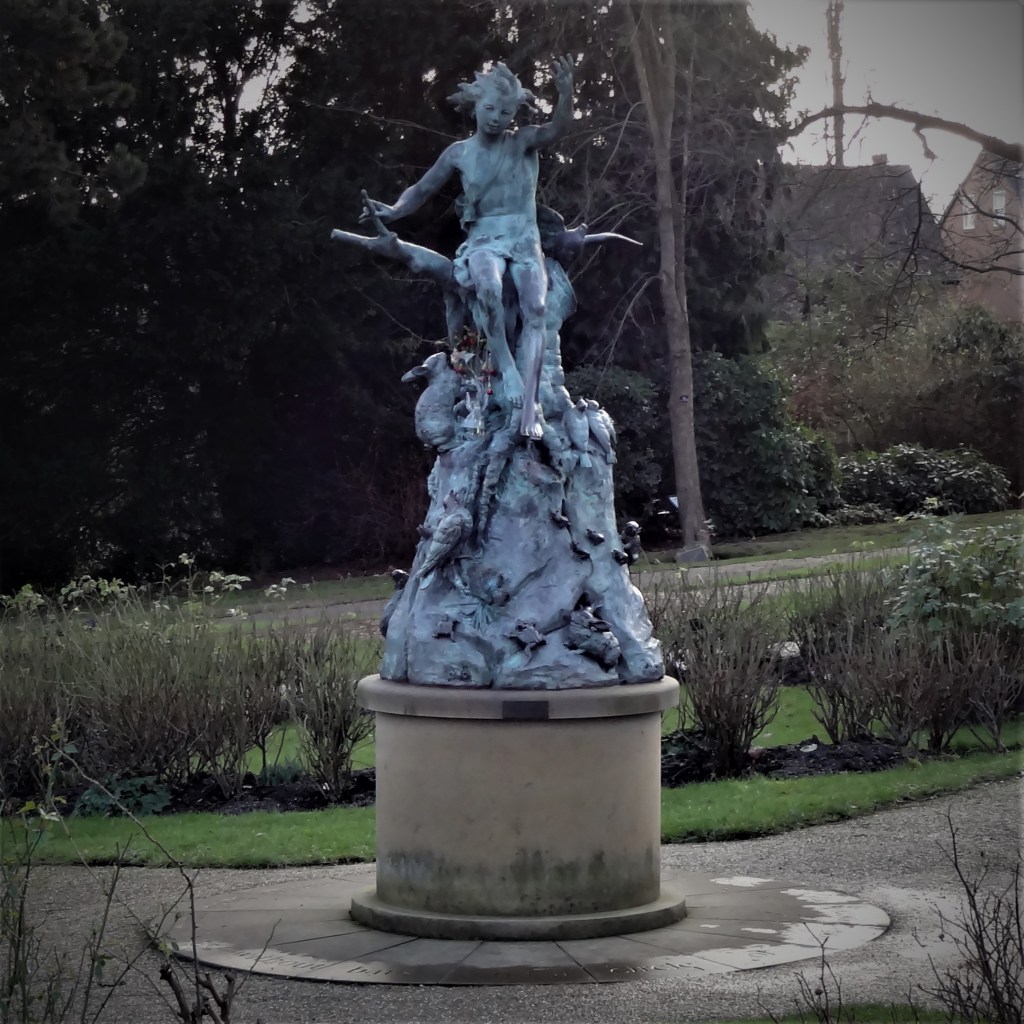
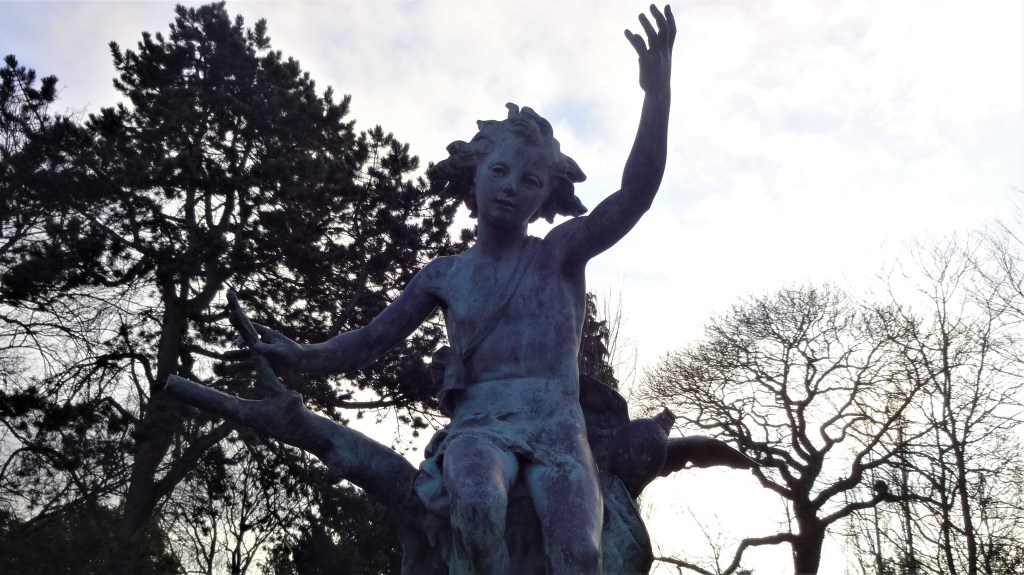
Within the Rose garden at the Botanical Gardens, in Sheffield, is a sculpture called Pan: Spirit of the Wood. This was a gift to the city by Sir Charles Clifford, proprietor of the Sheffield Telegraph and Star, on his death in 1936.
However, the city’s inhabitants had to wait a long time to see the sculpture, only made available after the death of his widow, Lady Alice Clifford, in 1941.
He had expressed a wish that the sculpture would be placed in Endcliffe Wood or Whiteley Wood, but it wasn’t until 1952 that Spirit of the Wood was finally placed in the newly designed and restored Rose Garden at the Botanical Gardens.
Although his will referred to Peter Pan, it was almost certainly a statue of Pan: Greek god of pastures, flocks and woods, seated on a tree stump. Around the statue are brass birds, rabbits, mice, frogs and squirrels, while elves are imaginary woodland spirits. Cast in bronze, about 2 metres high, the sculptor has remained unknown.
The condition of the sculpture deteriorated over the years and it wasn’t until 2003 that restoration was undertaken at a cost of £40,000.
Spirit of the Wood was sent away to Chris Boulton, a restorer, who found that it had been made in sections and bolted together. Grit was blasted away, the patina removed, and rough cement detached from the stone base.
It was discovered that the cast was of poor quality, with the likelihood that the sculpture had been made of scrap-metal.
Once completed, Pan: Spirit of the Wood was reinstalled in the centre of the Rose Garden and nowadays forms part of the Riddle Trail.
The only clue to its creator can be found on an inscription – “H.W. Cashmore – Westminster” – a company of metal workers that had a foundry in Balham.
It had been set up by George Henry William Cashmore and Malcolm Hankey and became part of the Bromsgrove Guild of Applied Arts, established in 1894 by Walter Gilbert as a company of modern artists associated with the Arts and Crafts movement.
The guild worked in all sorts of materials including metal, wood, plaster, bronze, tapestry and glass. As a result of their most famous commission, the iron and bronze gates at Buckingham Palace, they were issued with a Royal Warrant appointing them metal workers to King Edward VII, an honour repeated two years later under George V.
By 1908, the guild was using H.W. Cashmore at 96 Victoria Street, Westminster, as a showroom and studio.
The partnership between Henry William Cashmore (he’d now dropped the initial G from his name), and Malcolm Hankey was dissolved in 1911 and became known as H.W. Cashmore and Company.
The showrooms flourished and attracted the attention of Country Life magazine in March 1914, which did a feature on the company. Later the same year, The Gardeners’ Chronicle provided perhaps the best insight into the workings of H.W. Cashmore.
“Mr Cashmore has been careful to surround himself with workers who are not only skilled in their several branches, but are also imbued with the true craftsman’s instinct, and are therefore capable of applying themselves zealously to the realisation of high ideals. The effect is seen in the many examples of beautifully wrought and finely-finished metal work and carried out by the firm’s staff in a manner worthy of the invariably artistic designs to which they work.
“These productions take the form of garden statuary and elegantly modelled figures, ornamental bronze work, wrought iron gates, grilles and railings. The appreciation of their work now reaches to the most distant parts of the world. Examples of their skill and taste have gone as far afield as India, China, Japan and South America, as well as to the United States and Canada.
“Much of their work is used in the new commercial buildings of the world, on the other hand, a great deal of their skill seems to be utilised by clients who inhabit some of the most beautiful of the old English country homes – as found at Eltham Hall and Rushton Hall.”
Photograph by Sheffielder
Although records suggest that Spirit of the Wood was created in the 1930s, the likelihood is that it originates to about 1915 when Sir Charles Clifford bought Whirlow from Denys Hague, a coal-owner. Britain was at war, with metal commanding premium prices, and the inclusion of scrap-metal in its creation was understandable.
The sculpture probably stood in his garden at Whirlow, as did a pair of wrought iron gates, most likely by H.W. Cashmore as well, also bequeathed to the city, with Sir Clifford hoping that they would stand at the entrance to the bird sanctuary in Ecclesall Wood. As it happens, the gates are still hanging outside Clifford House on Ecclesall Road South (as Whirlow became known).
It seems we shall never know the designer of Spirit of the Wood, the obvious answer being that it was probably designed by one of Cashmore’s employees. Sir Charles doubtless ordered the statue from a catalogue, or even after visiting the Westminster showroom.
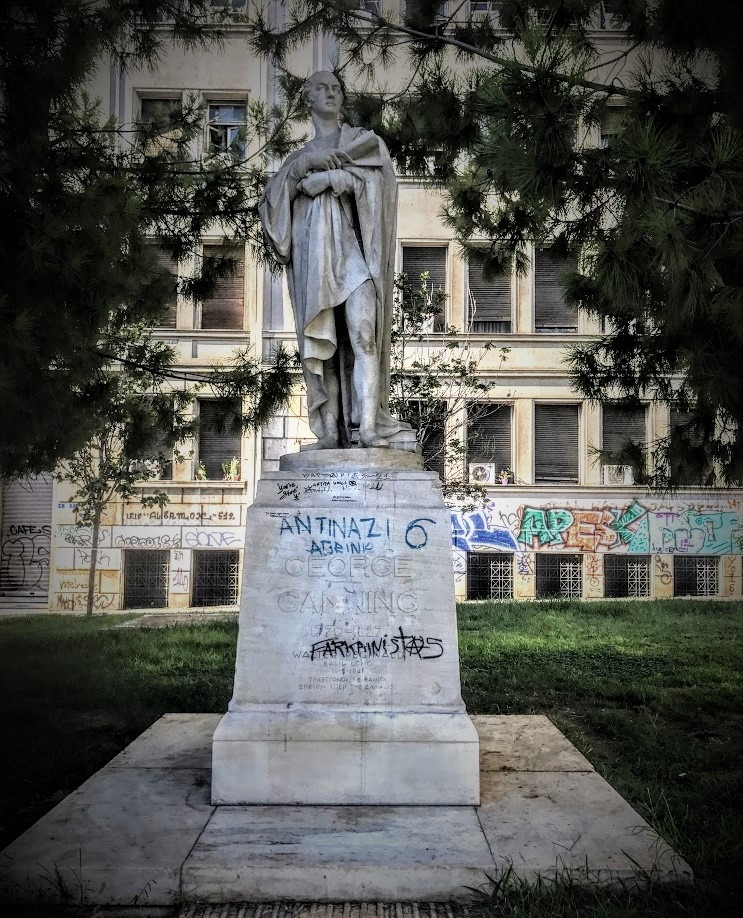
This sorry-looking statue of George Canning, the British Prime Minister who from 1825 to 1827 saved Greece from conquest by the Turks, stands in the George Canning Square in Athens.
But what is its connection to Sheffield?
George Canning, who was Britain’s shortest-serving prime minister, gave diplomatic support to the Greeks in the struggle against the Turks for freedom and ensured the eventual creation of an independent Greek state. In 1827, he signed the Treaty of London with Russia and France, with the object of securing Greek independence.
Canning’s successor as Prime Minister, the Duke of Wellington, tried to undo his work by making a truce with Turkey, but the Treaty of London had secured Greek independence.
The statue of George Canning from 1834 has a simple inscription: ‘George Canning 1770-1827’.
It was unveiled, wrapped in British and Greek flags, by the Greek Prime Minister, Eleftherios Venizelos, on 6 April 1931, at a ceremony attended by Sir Patrick Ramsay, the British ambassador, and the English builder and developer Charles Boot (1874-1945), who donated the statue to the Greek nation.
And here are the Sheffield connections.
Charles Boot was the Sheffield-born son of Henry Boot, the builder, and became a successful businessman and creator of Pinewood Studios.
He acquired the 10ft-high statue when he bought Thornbridge Hall, Great Longstone, near Bakewell, in 1929.
The statue, the work of famous Jordanthorpe-born sculptor, Sir Francis Chantrey (1781-1841), had originally been at Trentham Hall, Staffordshire, the last work commissioned by the Duke of Sutherland.
It was transferred to Thornbridge Hall, and after the death of the Liberal statesman, Chantrey made a replica which was erected at Westminster Abbey.
As a result of big business dealings between his firm, Henry Boot and Sons, with the Greek Government, it occurred to Charles Boot to present the statue to the Greek nation, and has remained here ever since.
Sadly, if you think that Sheffield has a graffiti problem, then I suggest you look at Athens.
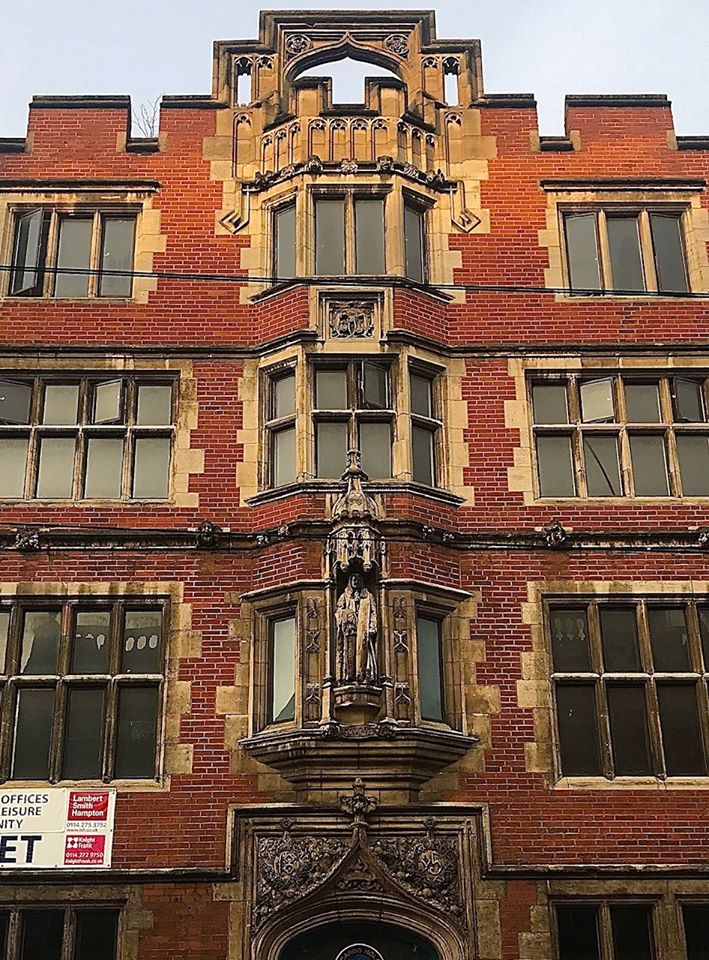
We’ve already had a look at the history of Cairn’s Chambers on Church Street, a Grade II-listed building that has been empty for most of the past sixteen years.
Built between 1894-1896 by Charles Hadfield for Henry and Alfred Maxfield, an established Sheffield firm of solicitors.
Almost unnoticed these days, are the decorative features that emblazoned the building, and which survived a Second World War German bomb.
The stone carvings, at the front, were the work of Frank Tory and Sons, Sheffield-based architectural sculptors, operating from the early 1880s until the 1950s, consisting of Frank and his twin sons Alfred Herbert and William Frank.
The crowning glory of Cairn’s Chambers was the statue of Hugh McCalmont Cairns (1819-1885), 1st Earl Cairns, an Irish statesman, and Lord Chancellor of Great Britain. He became a Q.C. in 1856, Solicitor-General in 1858, and was knighted in May of the same year, becoming Attorney-General in 1866.
The statue looks extremely miserable these days, weather-beaten, covered with dirt, and with some parts missing.
As well as the statue of Cairns, the building also features a sundial, and the heads of the then Prince and Princess of Wales, later Edward VII and Queen Alexandra.
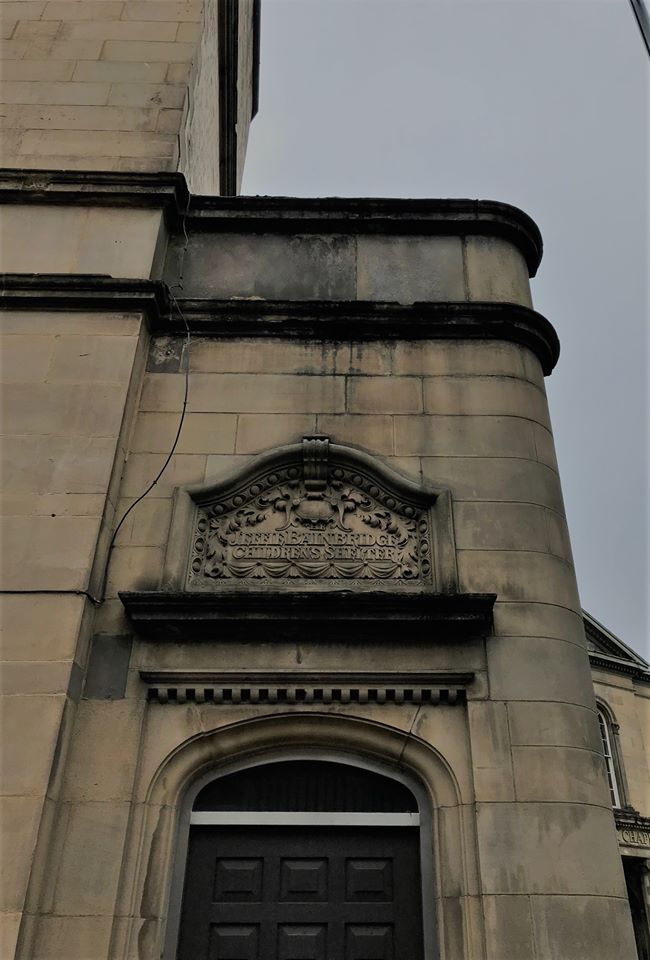
I bet most of you have never noticed this above a door at the top of Norfolk Street. This carved panel is on the old Halifax Bank at the corner of Surrey Street. The building was commissioned by Emerson Bainbridge, a mining engineer consultant and philanthropist, following the death of his wife, Jeffie.
It was erected as a memorial to her and opened by the Duke and Duchess of Portland in 1894.
The first floor formed a shelter for waifs and strays, and a large suite of offices on the second floor were given to the local branch of The Society for the Prevention of Cruelty to Children, of which Bainbridge was a committee member.
The ground floor consisted of shops that were let out to tenants in order to raise revenue to support the rent-free premises above.
The sculptor is unknown, but the architect was John Dodsley Webster, who also designed the Gladstone Buildings next to the Cathedral.
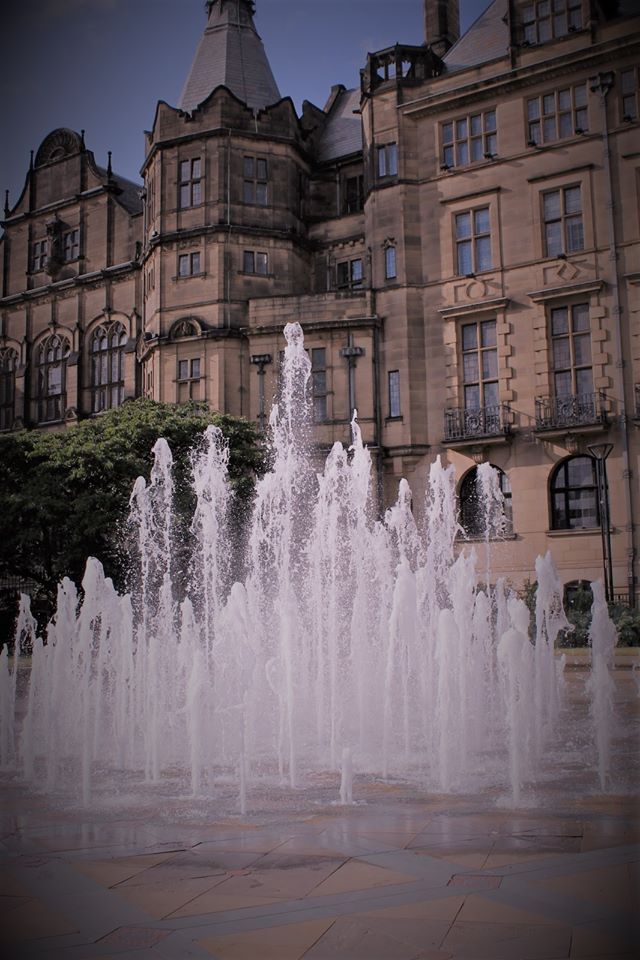
The Goodwin Fountains in the Peace Gardens. Eighty-nine individual jets of water inviting Sheffield’s kids to run through them during the summer and avoid them during winter. These are dedicated to Sir Stuart Goodwin (1886-1969), head of the Neepsend Steel and Tool Corporation. He gave away over £500,000 to charities and was honoured with the original Goodwin Fountain which stood at the top of Fargate between 1961 and 1998.
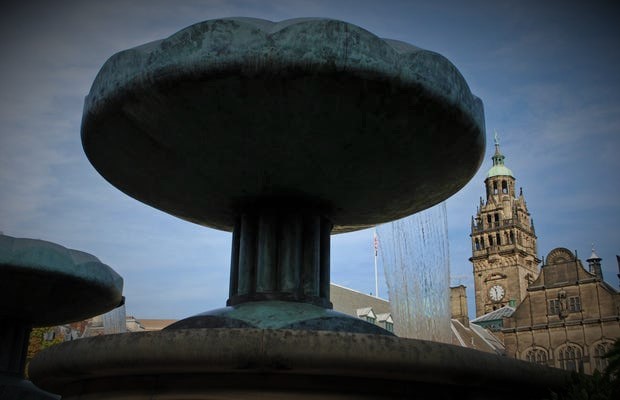
The Holberry Cascades. Named after the Chartist leader Samuel Holberry (1814-1842), they consist of eight large water features located on either side of the four main entrances to the Peace Gardens. The waterfalls from the bronze vessels represent both the pouring of water into Sheffield’s five rivers, and the pouring of molten metal used in the city’s metal industries. 57,000 litres of water are pumped through its water features, the system using a water re-circulation system, and is kept clean using a brine solution rather than chemicals.
 sheffielder.net