Categories
Buildings

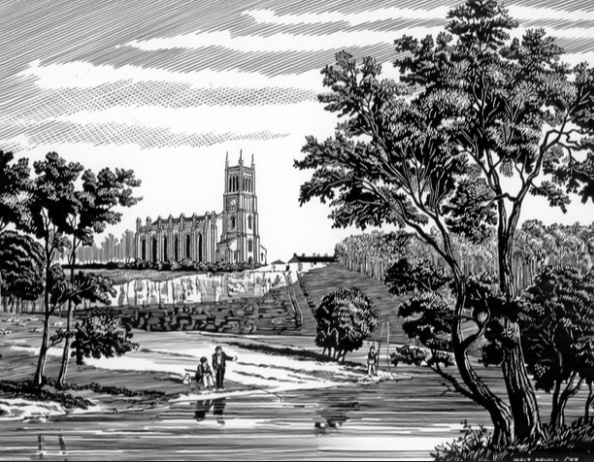
Attercliffe Parish Church – “Standing on a bold cliff which overhangs the Don.”

Christ Church, Attercliffe Road, from the River Don by Walter Revill. Described in early directories as standing near the bold cliff which overhangs the Don. Image: Picture Sheffield

We forget about Attercliffe, and so it is inevitable that we forget its lost buildings.

One example is Attercliffe Parish Church, also known as Christ Church Attercliffe, once a grand place of worship, badly damaged in the Sheffield Blitz of 1940 and later demolished.

And we might be forgiven for not knowing where it stood, but its site is plain to see.
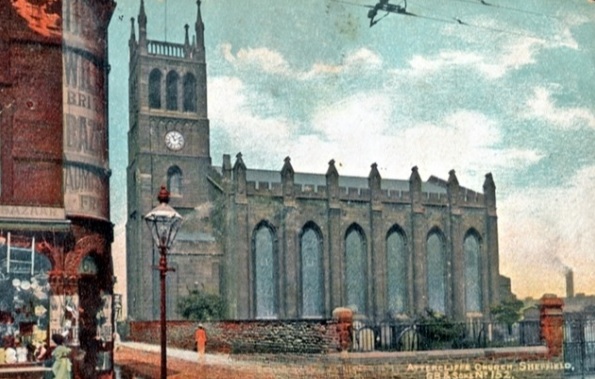
Christ Church, Attercliffe Road. Image: Picture Sheffield/G. Bagshaw and Sons

We can turn to Pawson and Brailsford’s Illustrated Guide to Sheffield (1868) for details: –

“There is a handsome church at Attercliffe, which is about two miles from the centre of town, on the Doncaster Road. Formerly Attercliffe was a detached village, but now it is practically a busy manufacturing suburb of Sheffield. It was opened in 1826, having been built by means of a Parliamentary grant, at the cost of £14,000. It is a Gothic building, with lancet windows and a handsome groined roof. It will accommodate from 1,100 to 1,200 persons.”

The old chapel-of-ease of the Township of Attercliffe-cum-Darnall, dating from the 17th century, had been replaced by the new church.

Attercliffe, at that time, was a comparatively small place, and largely consisted of lanes and fields, and the new church was one of four churches built in Sheffield out of what was known as the ‘Million Fund.’

The nucleus of the building fund consisted of a grant from an indemnity paid to England by Austria after the Battle of Waterloo.
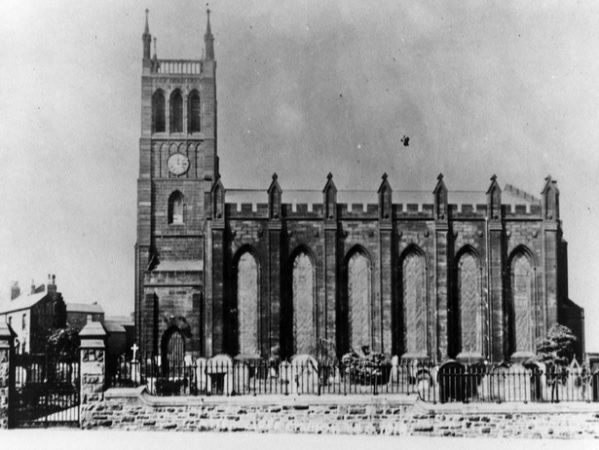
Christ Church, Attercliffe Road. Built at a cost of £14,000. Image: Picture Sheffield
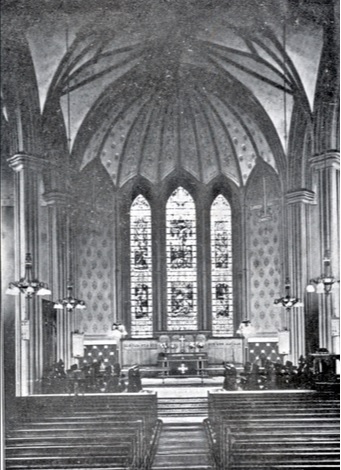
Interior of Christ Church, Attercliffe Road. In 1867 the galleries were removed, and the interior reseated with open benches. Image: Picture Sheffield

The first stone was laid by the 12th Duke of Norfolk assisted by the 4th Earl Fitzwilliam in October 1822 and took four years to build. It was consecrated by the Archbishop Vernon Harcourt of York in 1826.

Early directories referred to the church as standing near the bold cliff which overhangs the Don.

“Time was when Attercliffe was a place of sylvan beauty and picturesque repose, of pleasant pastures and stately houses on the banks of a River Don whose waters were clear and transparent.”

“In the church, there are galleries on the sides and at the west end; which, with the pews in the body of the church, contain two thousand sittings. Some of the windows of the church are ornamented with painted glass, containing the arms of Fitzwilliam and Surrey, Gell, Milner, Staniforth, and Blackburn.”

The churchyard closed for burials in 1856 and a cemetery leading down to the Don was opened in 1859.

In 1876, the church was closed for cleaning and redecoration.

“Below the windows the walls are tinted puce, but above they are straw-coloured, with ornamental work above the windows. The groins are picked out in stone and the roof is coloured buff. White is the groundwork of the chancel roof, but other tints are introduced.”

The church didn’t forget the men who served in World War One, and at a cost of £300 a memorial was erected in the form of oak reredos and panelling together with remembrance panels framed in oak, bearing the names of all those who answered the call of their country.

By the time of its centenary in 1926, the parish embraced around 33,000 souls, but it was a different place.

“The mere mention of Attercliffe to those who are closely acquainted with it is scarcely calculated to send them into ecstasies of delight, for the very sound reason that Attercliffe has precious little that appeals to the aesthetic sense. Attercliffe and throbbing, thriving industry are – in normal times – synonymous terms, and when the clang and clatter, the smoke and grime of heavy trades fill the air, Attercliffe, from the casual visitor’s point of view, is a place to get away from rather than to remain at.

“Looking back upon a picture of a rural landscape, with its common (now filled with shops), its thatched cottages, and its sheep grazing on the riverbanks, the individual might well exclaim: ‘All this has changed.’”

The church was in debt for years, especially after the installation of electricity, and following the departure of Rev. A. Robinson in 1930, the church revealed that its finances were “vague and confused,” and that he had left a debt of £550-£600.

Unfortunately, the church was closed after bomb damage in 1940. Most of its contents were destroyed and Sheffield lost one of its finest churches.
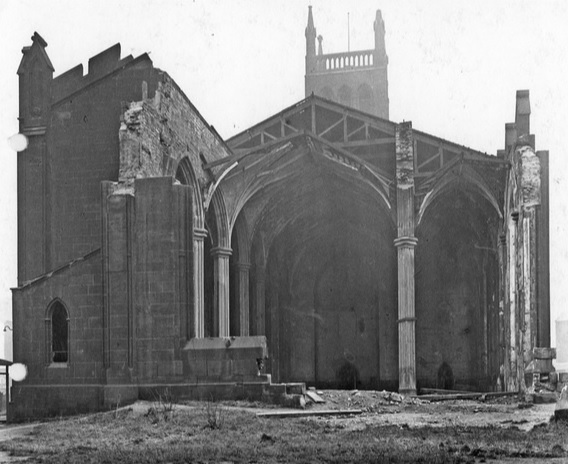
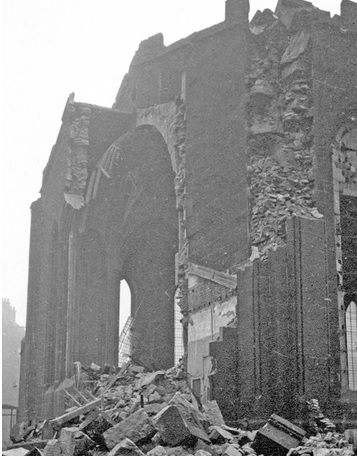
Christ Church, Attercliffe, after bomb damage. Image: Picture Sheffield
Attercliffe Road – Christ Church after air raids. Image: Picture Sheffield
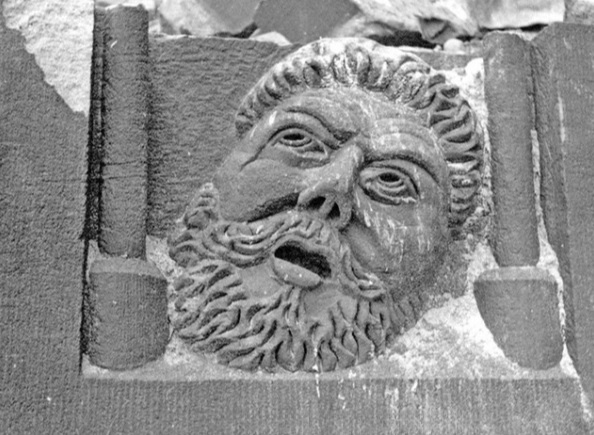
Carved detail from Christ Church, Attercliffe after air raid. Image: Picture Sheffield

The organ from the blitzed church was rebuilt and taken to St Andrew’s Presbyterian Church on Hanover Street.

The adjacent church hall became the parish church until 1950, and then functioned as a chapel in the parish of Attercliffe-cum-Carbrook until it was closed in April 1981. The new church of St Alban (Darnall) is now the parish church of Attercliffe.

In 1953, the site of the old church and its graveyard was turned into a garden, an area of pleasant green turf bordered by paths. It was opened by the Lord Mayor, Coun. Oliver S. Holmes, who said, “it was inspiration to the whole city that good will make beauty rise from the rubble of war.”
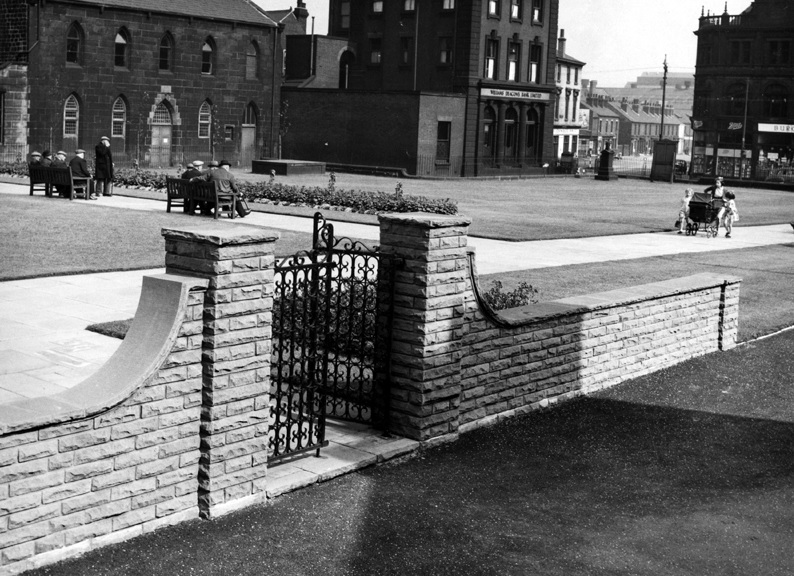
Attercliffe Garden of Rest (in the grounds of former Christ Church), Attercliffe Road from Church Lane with Christ Church Sunday School and No. 747, William Deacons Bank in the background. 1959. Image: Picture Sheffield

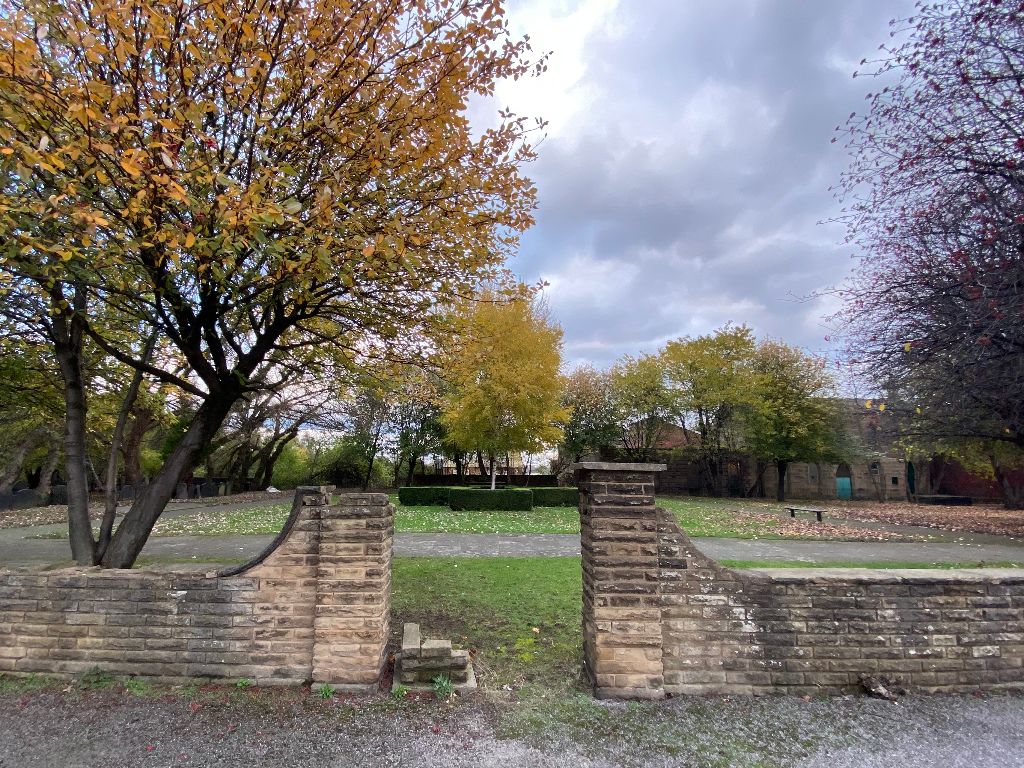
The church site and the garden of remembrance can be seen on Attercliffe Road, opposite the Don Valley Hotel. Access is available into old Attercliffe Cemetery behind and the Five Weirs Walk.

NOTE
A rare book, ‘The Church in Attercliffe,’ by Rev. Arthur Robinson, was published to celebrate the church’s centenary in 1926.
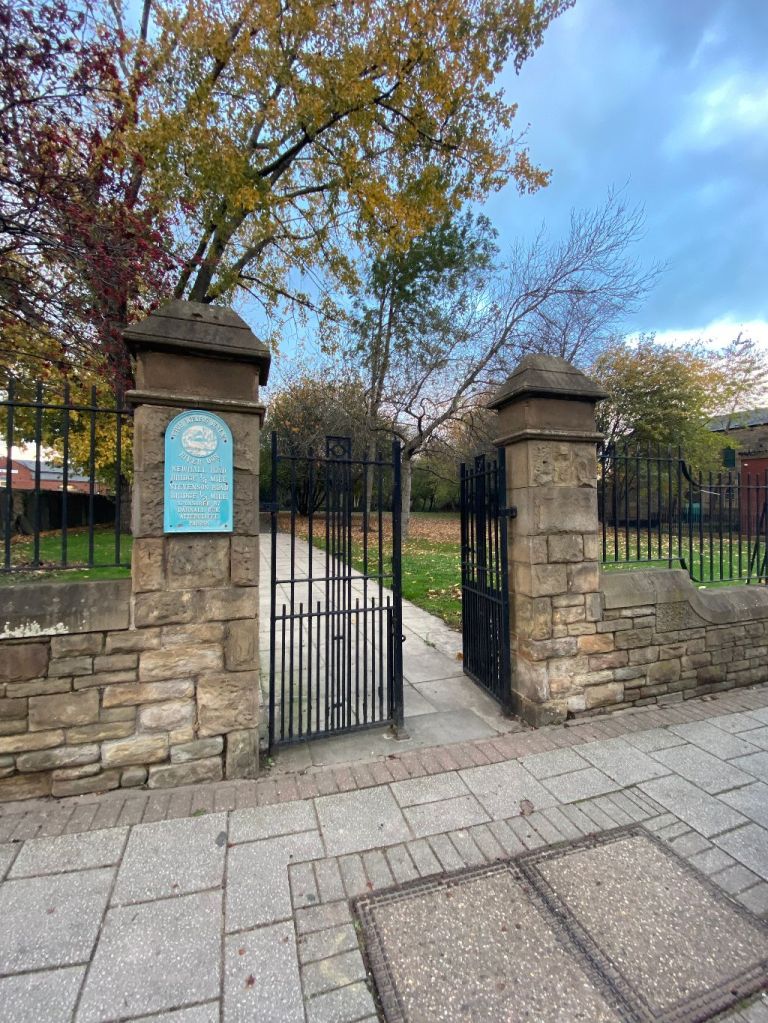
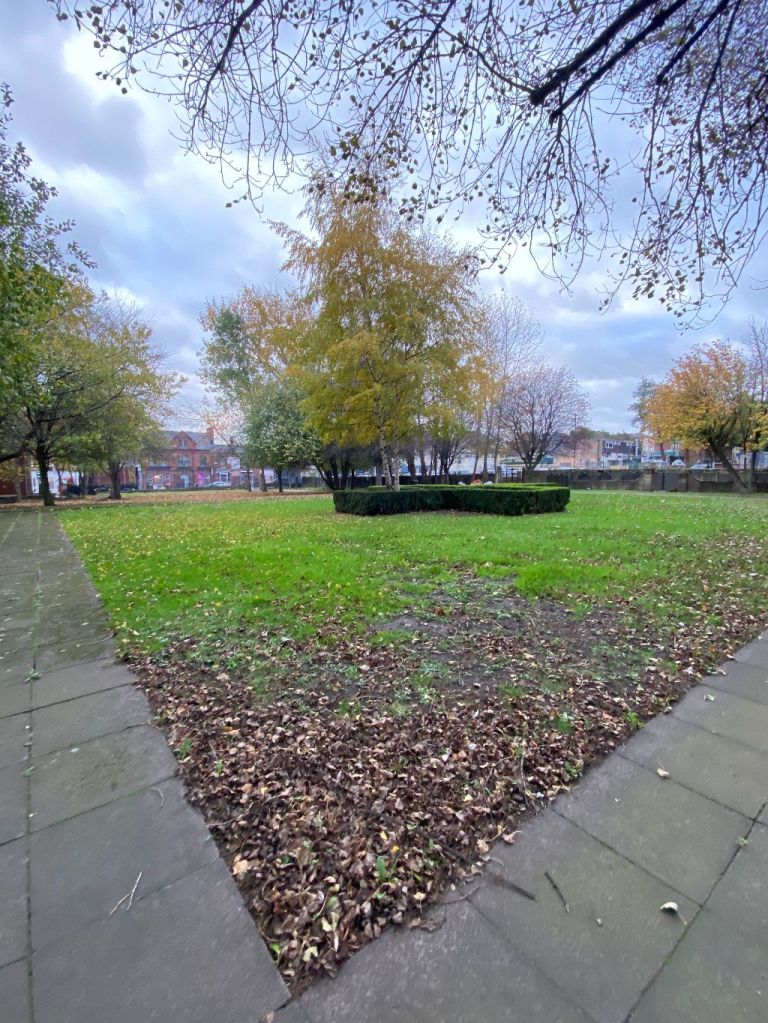
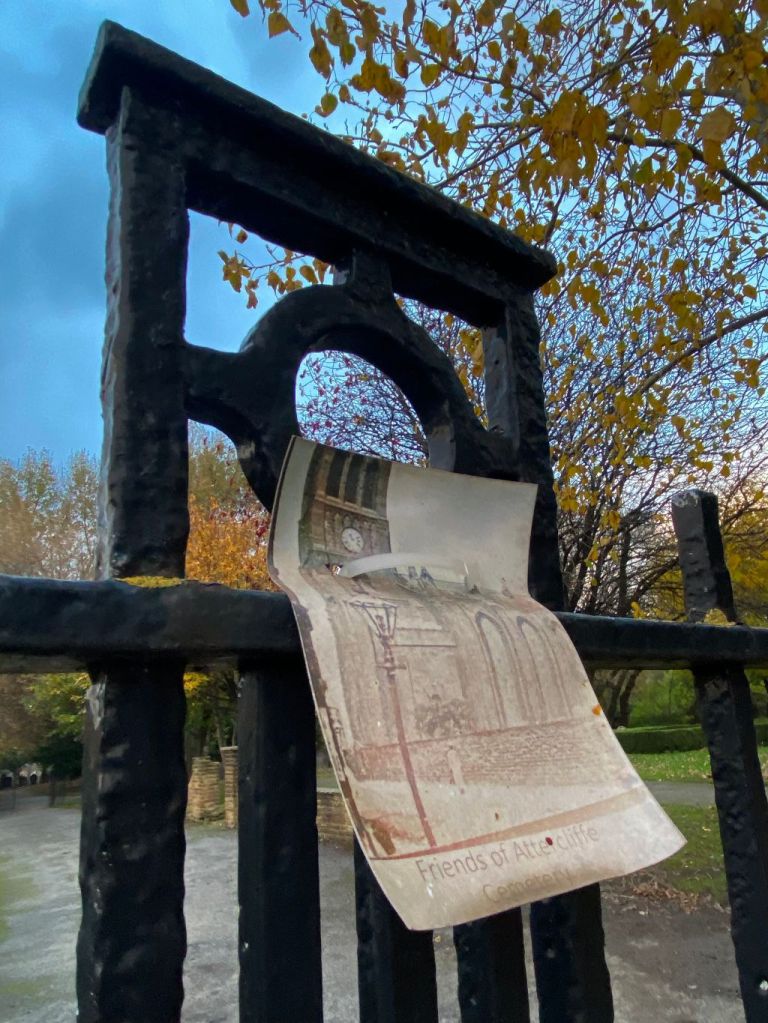
The site of Attercliffe Parish Church. Images: DJP/2022

©2022 David Poole. All Rights Reserved.
Categories
Buildings

The Adelphi really is at the heart of Attercliffe

It’s hard to imagine Attercliffe with green fields and a beautiful river. It became a village, and when Sheffield’s industry exploded, it turned into a busy suburb. It was almost a town, but when the downturn came, we ignored it, and look at its present sorry state.

This will change because Attercliffe is a development opportunity waiting to happen. It’s close to the city centre, motorway, and Meadowhall, and it’s mostly brownfield site.

Sheffield Council probably thinks the same.

It is buying the Grade II-listed Adelphi building, on Vicarage Road, using some of the £37m government levelling-up funds allocated to the city, to buy and refurbish the site and open it for community use.

And the council says there are other ‘important’ buildings on Attercliffe’s faded high street that it might consider buying.

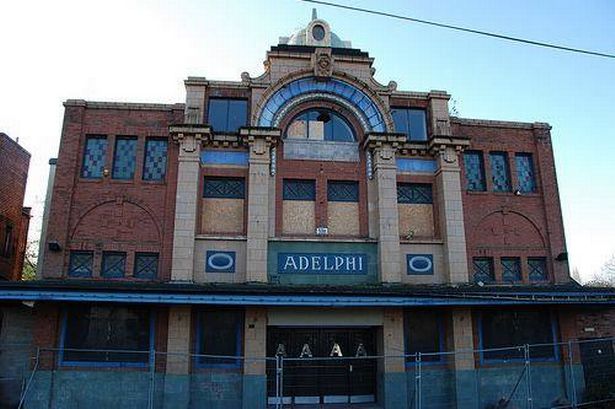
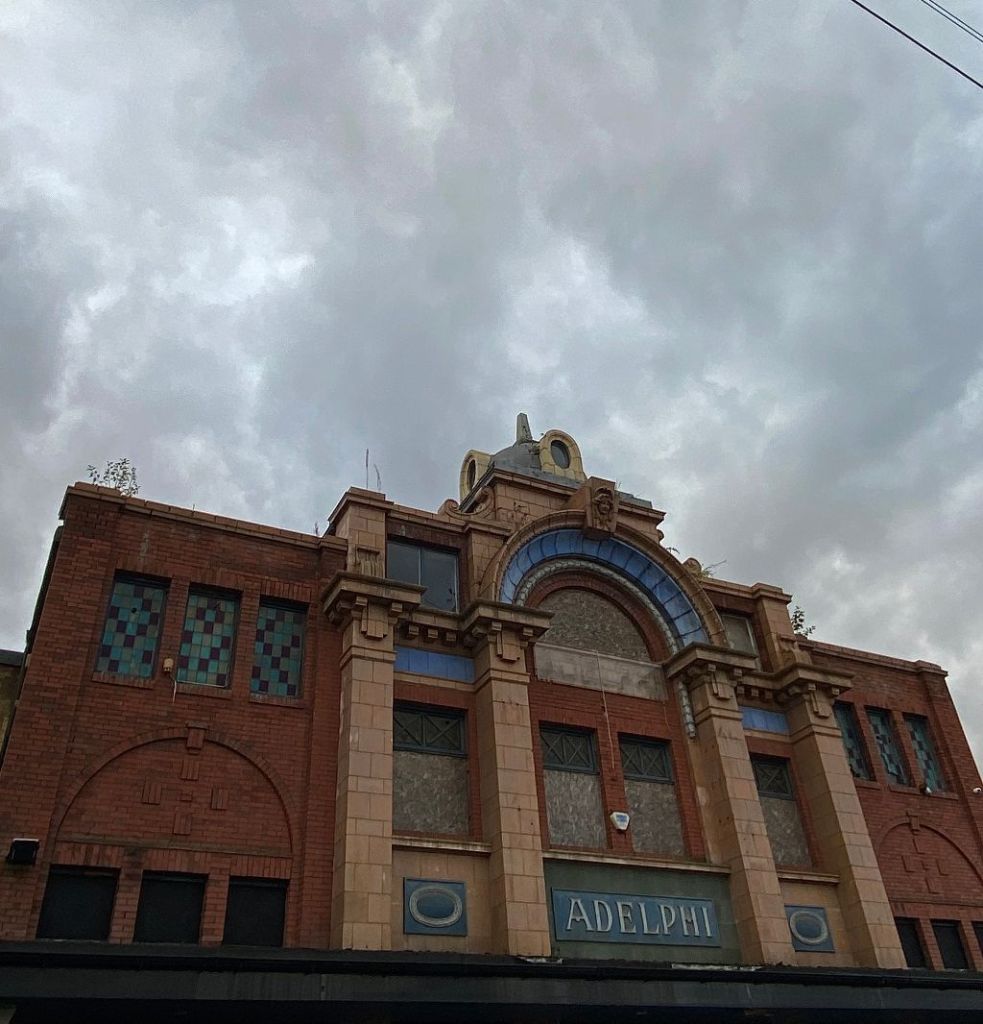
The former Adelphi Cinema with obligatory trees growing on the roof. Image: DJP/2022

The Adelphi opened as a cinema in October 1920, built on the site of former vicarage gardens.

It was designed by William Carter Fenton (1861-1959), alderman and subsequently Lord Mayor of Sheffield, and a former corporation surveyor who established the architectural practice of Hall and Fenton.

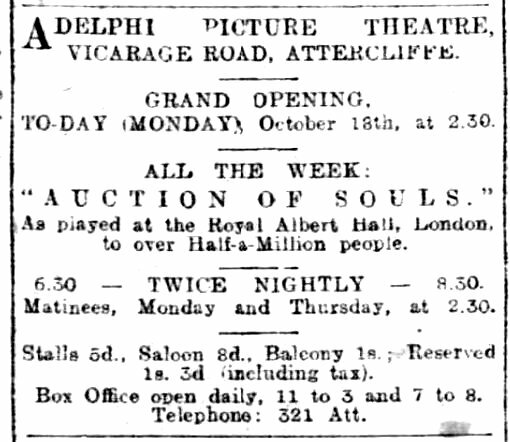
With a seating capacity of 1,350, it joined four other cinemas at Attercliffe, and it’s first showing was Irving Cummings in Auction of Souls.

Opening advertisement. Image: The British Newspaper Archive

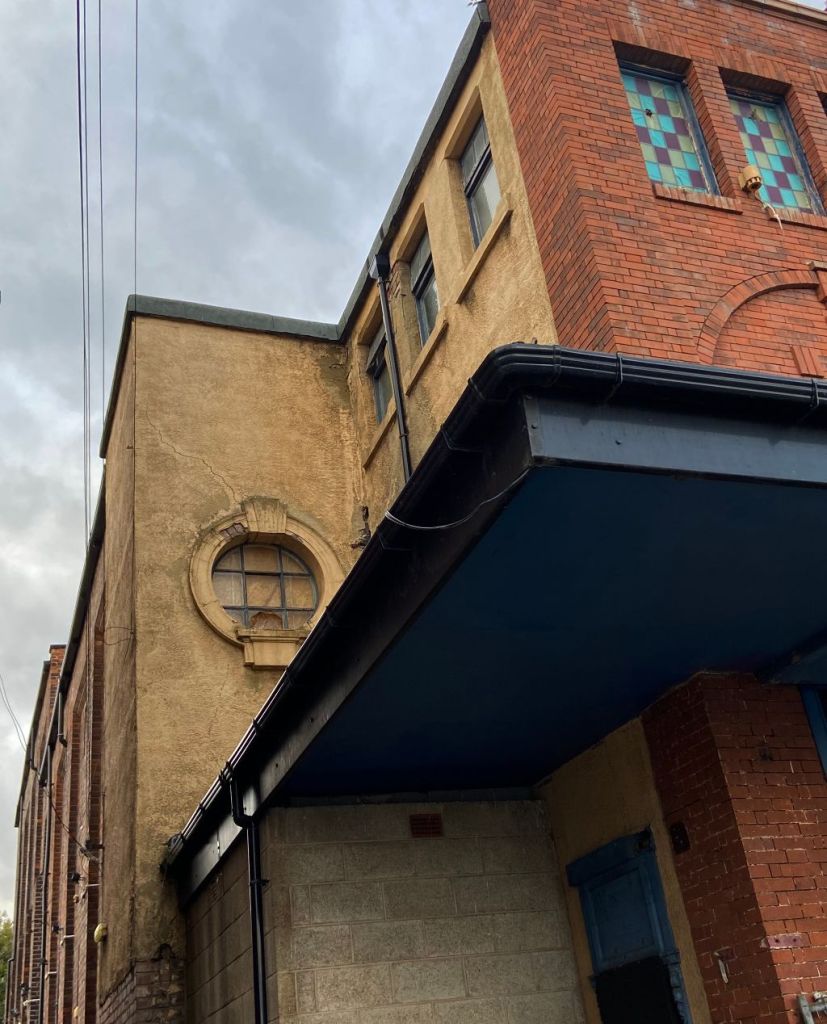
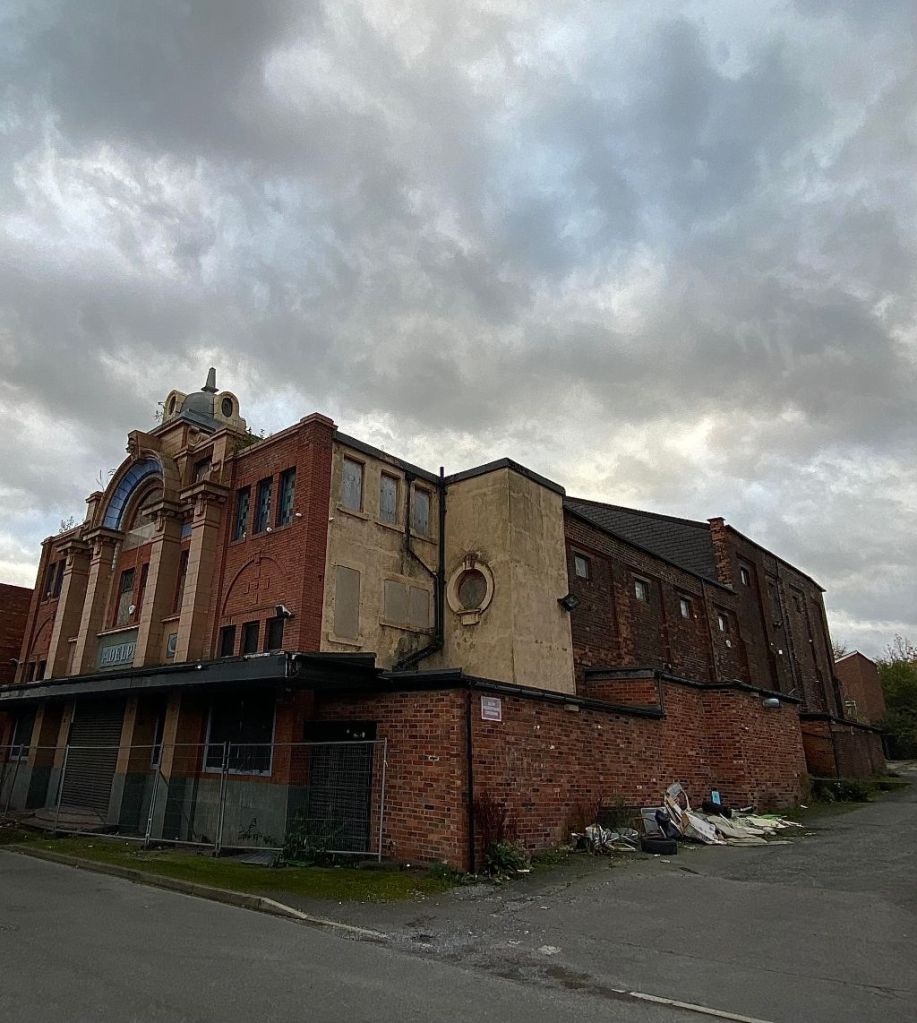
According to Cinema Treasures, the red brick building has buff and blue coloured terracotta enrichments on the façade, especially on the small turret dome over the entrance, which also has stained glass windows.

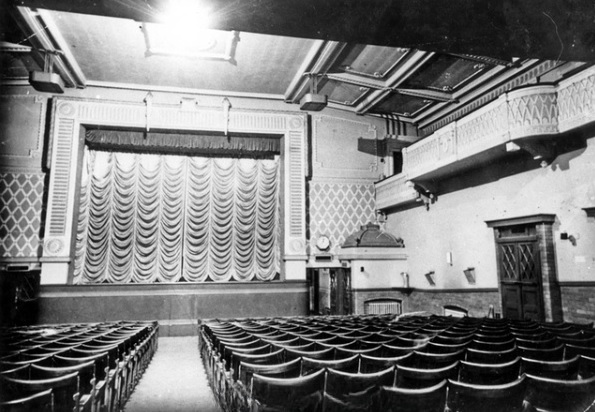
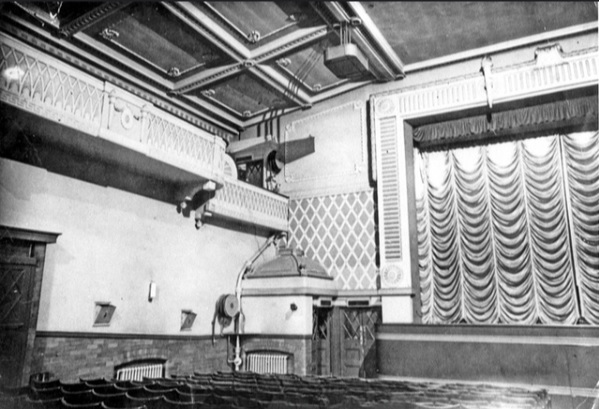
“Internally the features add to its grandeur with detailed ceilings, granite floors and wide staircases. Seating in the auditorium was provided in stalls and circle, and the projection box was in the rear stalls, underneath the circle.

“The cinema was in reverse, and patrons entered the auditorium from behind the screen. The decoration includes pilasters, a segment-arched panelled ceiling and a moulded proscenium arch with a central crest which is flanked by torches. The circle has a lattice-work plaster front.”

The familiar ‘soft carpets that harboured and carried disease’ were replaced with cork carpet and linoleum. But from the standpoint of health, it allowed fresh air and sunshine to be admitted. There were no fewer than 17 windows and between performances these were thrown wide open, and during showings they were covered with dark blinds.

Adelphi Picture Theatre opened Monday 18th October 1920 closed 28th October 1967. Image: Picture Sheffield
The Adelphi was later used as a Bingo Hall and more recently became a nightclub. Image: Picture Sheffield

It underwent some restoration in 1936 and a re-decoration in 1939. It received some bomb damage during the second week of the blitz and was closed for around a month. It received further renovation in 1946.

The Adelphi operated as a cinema until 1967 after which it became a bingo hall. The striking art deco building later hosted Sheffield’s famous Gatecrasher club nights, among other events, and was also used as a music teaching centre. It sat empty from 2006 until 2013 and has since been used only for storage.

Last year, CODA Bespoke on behalf of Olympia Wellbeing Academy, was granted permission to convert the building’s ground floor into an educational and sporting facility for children.

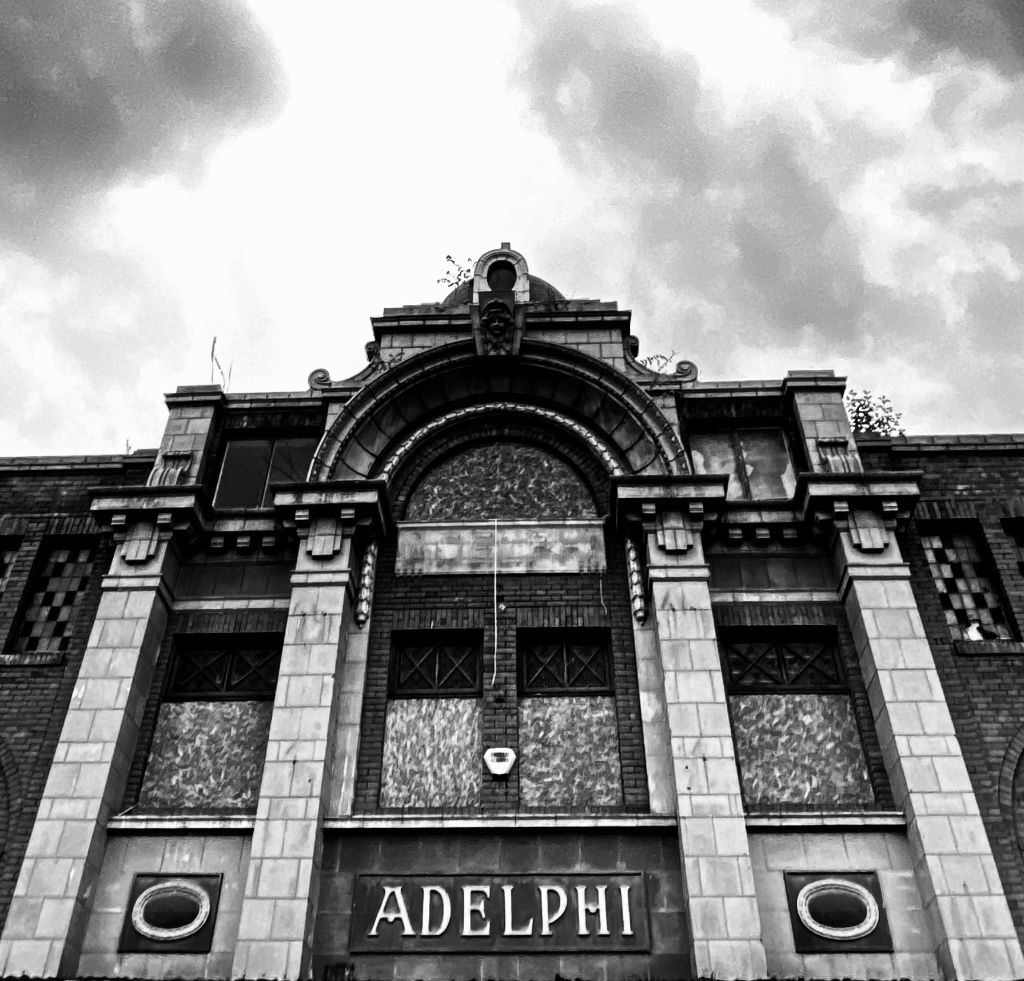
Since 1996, the Adelphi Picture Theatre was designated a Grade II Listed building by English Heritage (now Historic England). Image: DJP/2022
The Adelphi Picture Theatre is located in the Attercliffe district in the east of Sheffield. Image: DJP/2022
The Adelphi Picture Theatre closed on 28th October 1967 with Robert Vaughn in “The Karate Killers” and “Glenn Ford in “The Rounders”. Image: DJP/2022

©2022 David Poole. All Rights Reserved.
Categories
Buildings

How site of Newspaper House evolved into Marks & Spencer

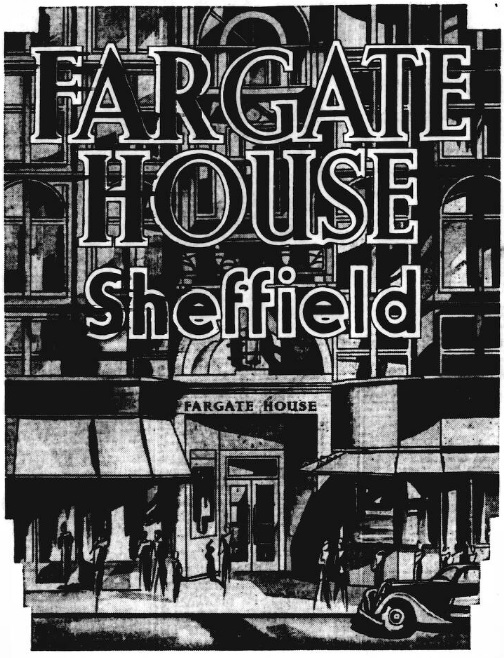
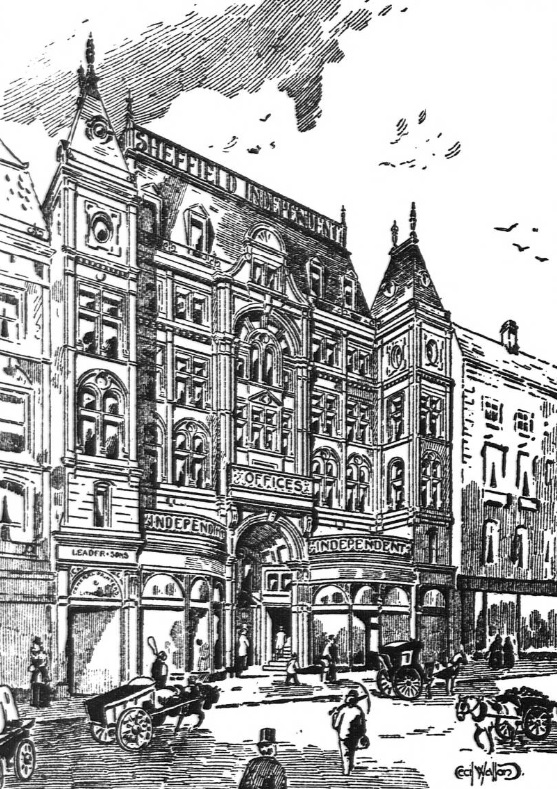
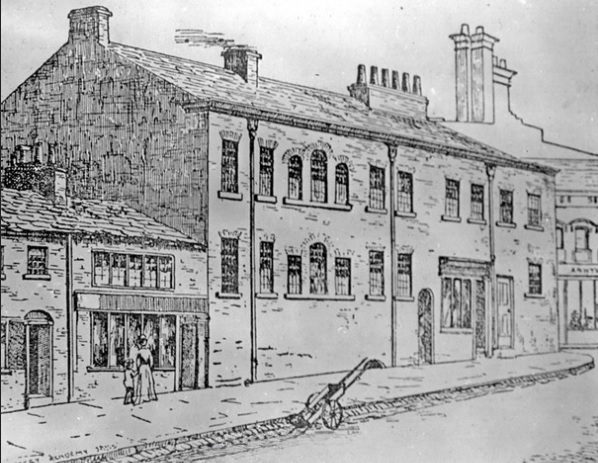
Fargate House. A sketch from 1938. Image: British Newspaper Archive

It was the 1960s, retail was in ascendancy, and Marks & Spencer, with a small shop on Fargate, wanted to build a new store and expand. To do so, it purchased an adjacent property called Fargate House, and Sheffield lost one of its finest buildings.

“As we drove along, we happened to pass a very splendid building. On looking up, I saw it was the new offices of the ‘Independent’ newspaper,” said the Archbishop of York in 1892, the year it had been built.

In the 1890s, there were two newspapers in Sheffield. W.C. Leng owned the Sheffield Daily Telegraph (forerunner to The Star), and the Leader family were proprietors of the Sheffield and Rotherham Independent. This was a time when newspapers sold thousands of copies daily, and the two were bitter rivals.

The Independent, founded in 1819, to secure ‘British independence, and an amelioration of the condition of the British people,’  had moved premises several times, and when Sheffield Corporation began widening Fargate, it purchased a plot of land.

The site nestled between Tuckwood’s Supply Store and the properties of George Shepley and T.R. Marsden. It was described as an inverted capital ‘T’, the top crossing Fargate and the tail pointing towards Norfolk Street behind. Much the same as Marks & Spencer today.

As were many Sheffield buildings of the day, the new Independent offices were designed by Flockton and Gibbs and constructed by William Ives of Shipley. The crosspiece on Fargate contained shops and commercial offices that were let, while the tail was occupied by the newspaper across six floors.

Once completed, the front of ‘Newspaper House’ was said to be the most imposing of numerous buildings erected in Fargate.

The architectural treatment was defined as ‘modern,’ the front too valuable to afford space for heavy piers and walls. The main arched entrance was set back from the building line, the wings on each side giving the shops on the ground floor a graceful curve to the front. The whole was covered with a steep picturesque roof, and surmounted with a sky sign, the letters of which were four feet high.

The style was said to be a development of early French Renaissance, more particularly the phase of it, which was seen in the Chateaux of the Valley of the Loire, of which the high pitched hipped roofs were an essential feature, but with ornament and mouldings more Greek than Roman.

The Sheffield Independent office – 1892. Image: British Newspaper Archive

Newspaper House was built with best Huddersfield stone, celebrated for its durability and its resistance in some measure, to the blackening influence of town atmosphere. On the last count, it failed, because within years it was as black as the rest of Sheffield’s buildings.

The arched recess entrance was placed at the centre, built of moulded stone; it embraced three entrances, leading respectively to the counting-house, a stone staircase, and an upholstered passenger lift to the offices.

The basement was occupied by the machine room with two Victory News machines capable of producing 16,000 copies per hour, and one of the latest forms of the famous Hoe printing machines. Two powerful steam-engines, manufactured by Shardlow of Attercliffe, stood at the far end.

Above was a bookbinding department, where account books, pamphlets and books were bound in all styles, as well as the paper warehouse.

The Counting House, with tesserae floor, and massive mahogany counter, was where the public placed advertisements and orders. The building also contained a library of Sheffield newspaper files dating back to 1787, all copies of the London Times, and an immense collection of Parliamentary records.  

On the second floor, reporters were clustered around a central corridor which extended the length of the building.

A technical advance was the installation of two telephones – one in the commercial department for use by day, the other in the sub-editor’s room for use during the night.

Messengers raced between the office and Sheffield’s two railway stations bringing in packets dispatched by district correspondents, while every few hours a large bag of letters were brought from the Post Office.

The rest of the building housed the composing room, lithograph and letterpress departments, and rooms for photography and zincography, both in their infancy.

“The inconveniences of photography consequent upon the dull atmosphere of Sheffield will be entirely overcome by the adoption of electric light for photographic purposes.”

At the Norfolk Street end, newspapers were despatched overnight. Carts distributed parcels to local newsagents and railway stations, the aim being that readers had their morning paper on their breakfast tables.

In 1931, consolidation within the newspaper industry meant that the Sheffield Independent was taken over by Allied Newspapers, now owner of the Sheffield Telegraph, and Newspaper House was surplus to requirement.

By the time it merged with the Telegraph in 1938, the old building had been sold and completely refurbished by architect Victor Heal as offices. The building was gutted, the frontage retained, but the upholstered lift and stone staircase were replaced.

A new entrance was made from Hoptonwood stone and black marble, surmounted by a dome, with an artistic lantern, in green and cream, and an illuminated electric clock with the figures ‘No.21’. Beneath were green enamel letters that stated the building’s new name – Fargate House.

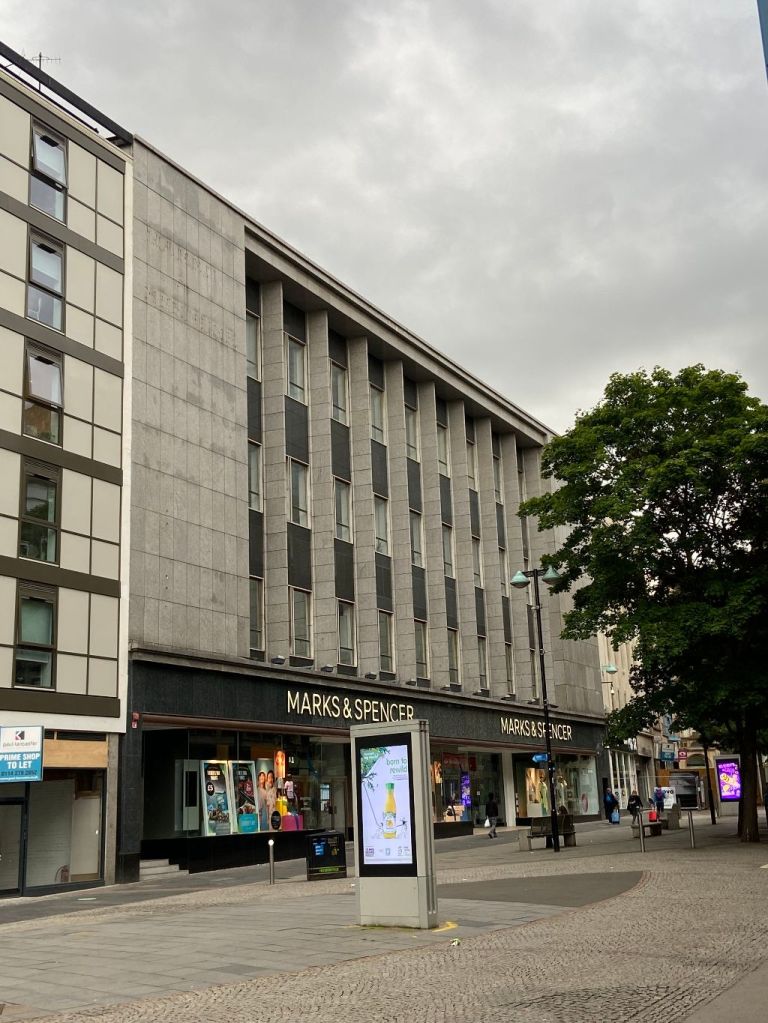
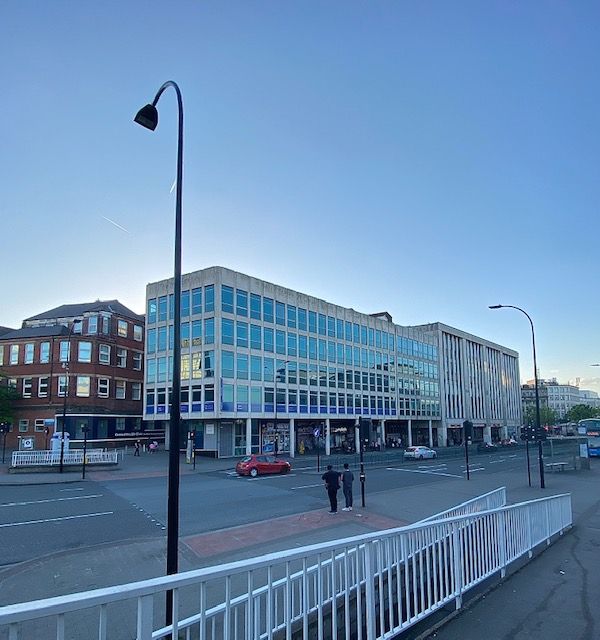
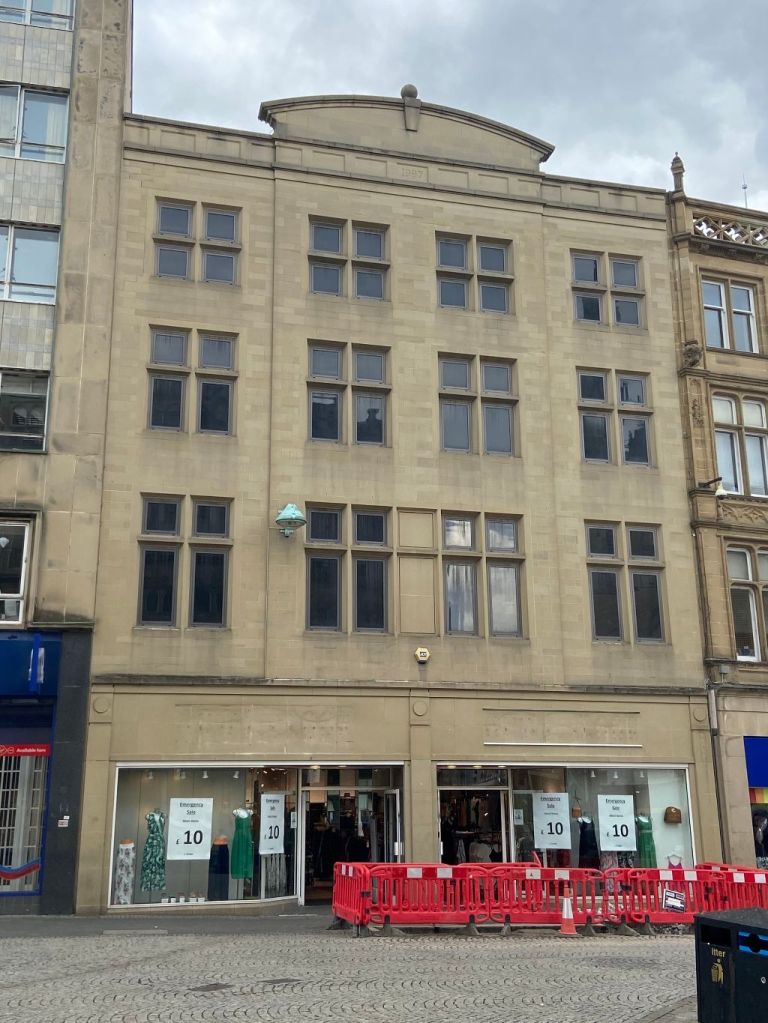
It lasted until the 1960s, but Fargate had become one of Sheffield’s premier shopping streets. It was demolished in 1965 and the stylish new Marks & Spencer store built in its place. 

Marks & Spencer was built on the old newspaper site. Image: DJP/2022

©2022 David Poole. All Rights Reserved.
Categories
Buildings

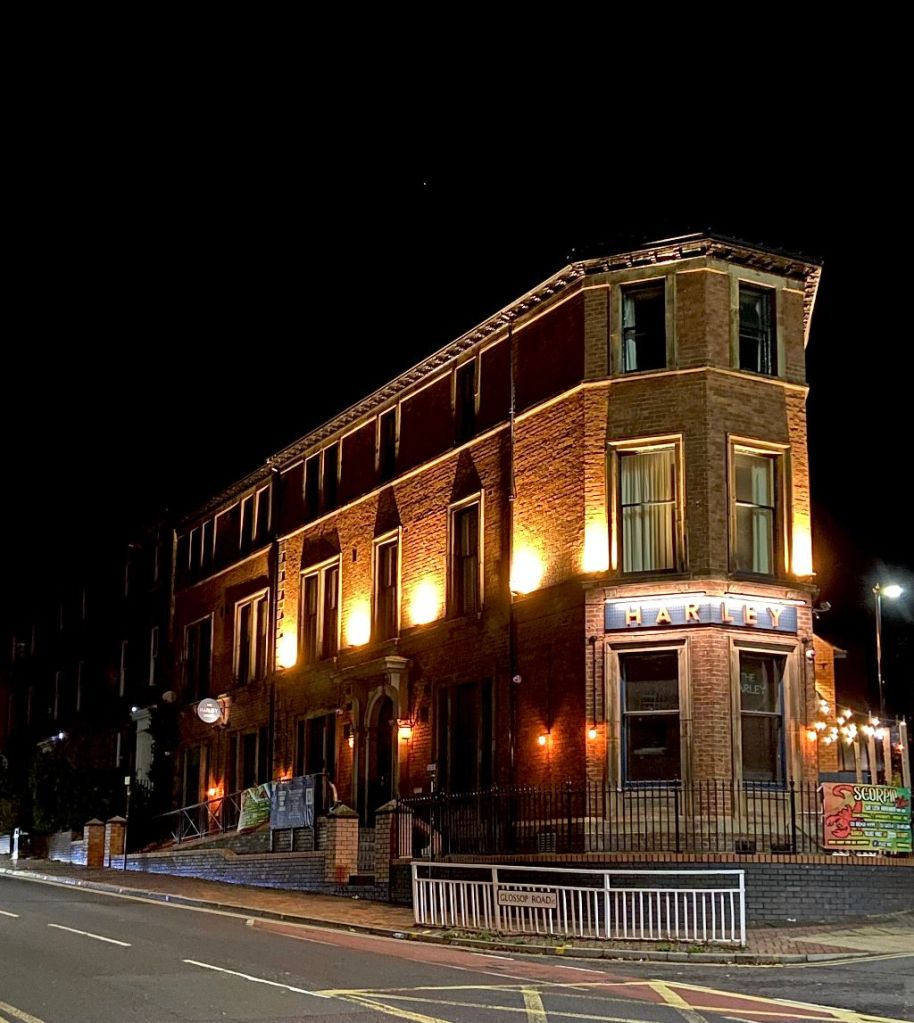
The Harley – doctor’s house to student hangout

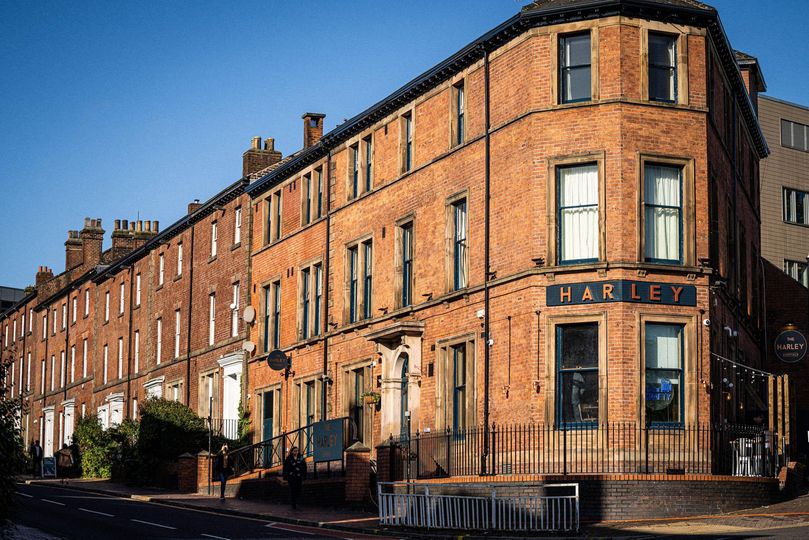
The Harley, Glossop Road. Image: Sheffield Star

The death of Dr Marriott Hall was tragic, but it kick-started a series of episodes that would give its name to The Harley, now a popular student bar and live entertainment venue, on Glossop Road.

In March 1878, aged 38, Hall was riding along Endcliffe Vale Road on his way to visit a patient at Broomhill Park. His horse threw him, rolled over him, and his head struck a kerbstone. He was taken to the lodge at Oakbrook, belonging to his father-in-law, Mark Firth, where his injuries were treated.

“Oh, my poor head,” he complained, and suffered a slow agonising death.

The son of the Rev. Hall of Greasbrough, Marriott Hall had been assistant to Mr Porter, surgeon, Eyre Street, afterwards appointed assistant house-surgeon at the General Infirmary, subsequently rising to top position.

He started practice with his brother, John, on Victoria Street, going alone at the Bath Buildings on Glossop Road about 1865, until joined by Dr William Cleaver ten years later.

When Hall married Sarah Taylor Bingham Firth, the daughter of Mark Firth, in 1866, their wedding present from the steel magnate was 334 Glossop Road, a new house and surgery added to the end of 1850s terraced villas at the corner with Hounsfield Road.

Hall’s widow remained until the 1880s before taking up residence at The Gables, in Ranmoor.

Dr Mariano Alejo Martin de Bartolome bought the house in 1886 and stayed until his own death four years later, after which it was bought in 1891 by the adjoining Sheffield Nurses’ Home and Training Institution for £1,500.

This organisation had been set up by James Henry Barber at a time when Sheffield’s population was increasing rapidly and often nurses had to be obtained from as far away as Lincoln. The new premises allowed for a staff of district nurses for the working classes.

At the start of World War One it became the Sheffield Queen Victoria District Nursing Association, with a staff of 25 nurses, which remained until 1928 when the building was sold to a group of Liverpool businessmen for £2,962.

The entrepreneurs formed a company, Harley Houses Ltd, acknowledgement of the building’s medical history, the name derived from London’s famous Harley Street, “to build, alter and construct, repair and sustain 334 Glossop Road, or any other premises, to use as a residential club or private hotel.”

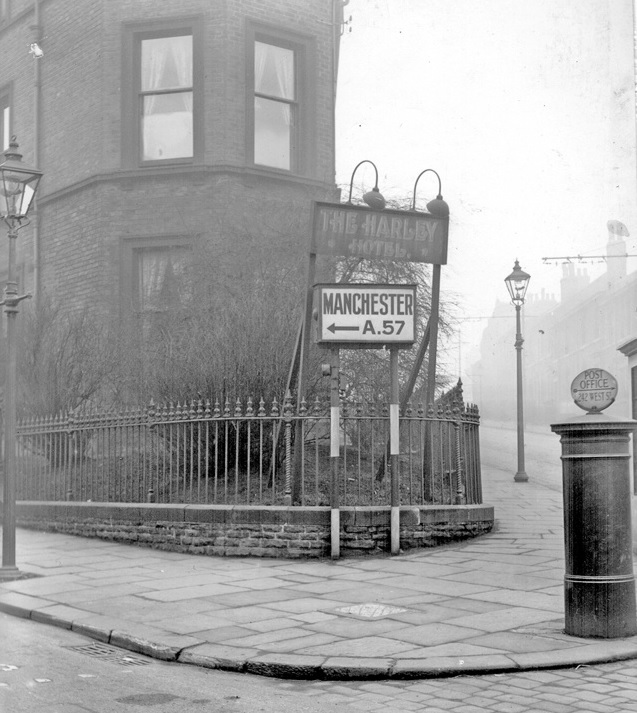
Harley Hotel, at the junction of Glossop Road and Hounsfield Road, with an illuminated classified road sign used where the obvious route does not happen to be the main road. Image: Picture Sheffield

In May 1928, it opened as Harley Residential Club for professional businessmen and women.

“Elaborately and tastefully decorated and furnished, with three attractive and reposeful lounges, writing rooms, hot and cold running water in every bedroom, and with comfort, cuisine and service.”

It provided accommodation for 26 residents and visitors to the city, and within a year had been renamed The Harley Hotel, the biggest downside being its inability to obtain an alcohol licence.

The Harley Hotel remained until the late sixties by which time it had fallen into disrepair and was derelict for most of the 1970s.

After several temporary uses it was rescued in 2003 when it became The Harley, operated by Dave Healey, co-founder of Tramlines, as a pub, burger joint, hotel and tearoom.

The Harley played host to many bands, including Arctic Monkeys, ALT-J and Royal Blood to name but a few.

It closed in April 2019 due to financial problems, after which the building’s owner, Mitchell & Butlers, decided to take over the running of the venue, with the Harley Hotel existing upstairs with 23 rooms.

The Harley. Glossop Road. Image:DJP/2022

©2022 David Poole. All Rights Reserved.
Categories
Buildings Streets

Milk Street swept away by the construction of Arundel Gate

Milk Street Academy 1860-1880. Image: Picture Sheffield

It is hard to imagine that beneath Arundel Gate, at its junction with Norfolk Street, is a lost road. When the dual carriageway was constructed in the 1960s, it swept away a street that had once been one of the most influential in Sheffield.

As someone who researches our past, the name of Milk Street frequently appears in the obituaries of well-known medical men, clergymen, merchants, manufacturers, solicitors, and people who rose to prominence, not only in Sheffield, but across Britain, and in all parts of the world.

Milk Street had once been called Petticoat Lane, but by the 1700s had changed its name, and in 1800 became the site of Milk Street Academy, its most famous building.

The academy was established by John Hessay Abraham, a Methodist, as a classical, commercial, philosophical, and mathematical seminary for boys. It used a single room in an existing building and was soon successful enough to occupy the rest of it.

Beneath Arundel Gate, at its junction with Norfolk Street, is a lost road. Image: DJP/2022

At this time, elementary education in Sheffield was poor, and only the wealthiest people paid for the privilege of private schooling. The boys started lessons at 7am and the curriculum included English, French, mathematics, penmanship, drawing, and the use of the globe. That a very high standard was reached may be judged in the London ‘Universal Magazine’ for April 1805, which produced ‘Juvenile Essays, comprising, in order of merit, the first and second half-yearly prize competitions of the pupils belonging to the Milk Street Academy, Sheffield.’

J.H. Abraham has appeared on these pages before as one of the occupants of Holy Green House. He was an extremely clever man, a Fellow of the Royal Society, and on his death in 1846, his extensive library was auctioned and included standard works in literature, especially philosophy, astronomy, electricity, magnetism, galvanism, chemistry, and mathematics.

In 1840, his daughter Emma had married Richard Bowling, a teacher of twenty years at Milk Street, who succeeded Abraham as principal.

Under ‘Dicky’ Bowling, the academy thrived and achieved success at preparing pupils for Oxford and Cambridge.

He was a fine gentleman – 5ft 11in high and very proportionate, a thorough disciplinarian – a good, all-round scholar who besides the three r’s which he thoroughly drilled into his pupils, taught Latin and Greek.

One guinea a quarter was the fee, drawing and languages extra, and when a new scholar arrived, the father had to pay a 5 shillings entrance fee.

There were about 400 boys in total, and there was what was called the Cabinet, which went to the boy who attained first prize in all subjects.

However, Bowling’s methods were somewhat barbaric.

“For playing truant he laid a boy across the desk (or on another boy’s back) and put his trousers down and gave him the cane on his bare flesh,” said a former pupil. “One boy was made to stand on the form while he sent another boy for an old-fashioned treacle-stick. He tore part of the paper off and made him suck it for a quarter of an hour allowing the schoolboys to jeer at him all the time.”

“I remember him giving me a severe blow to the side of the face because I was holding my pen improperly,” said another. “However, I remember Mr Bowling with pleasant memories as a great and distinguished schoolmaster, who developed in us the faculties which have contributed to any success we may have attained.”

All in all, the boys appeared to enjoy themselves, with physical education taking place at playing fields on the site of the old Winter Street Hospital, now part of Sheffield University. When let loose, they used Cheney Square (lost underneath the Town Hall) as happy hunting grounds.

Bowling resided at Norwood Rise, Pitsmoor, and subsequently at Clough House. At both places he had boarders, who attended the school every day. On his death in 1876, the academy became Milk Street School and continued under the partnership of his son, Walter Henry Bowling, and John Irwin, a former master, who, aged eighteen, had been apprenticed to the academy.

However, its days were numbered, hastened by the 1870 Education Act, the first legislation to provide for national education and create school boards across the country.   

Milk Street from Sycamore Street looking towards Norfolk Street (1851-1859). Image: Picture Sheffield

In August 1880, Irwin closed Milk Street School, now surrounded by industry, and moved it to Montgomery College, Sharrow.

Gone, but not forgotten. “One Sheffield institution which is frequently mentioned in records of the early careers of public men is the old Milk Street School,” said a newspaper in 1904. “It is referred to more frequently even than the Grammar School or Wesley School as the educational home of prominent citizens. There seem to be few records of the school left, and the old boys have not formed themselves into an association.”

A few years later, the Rescue and Evangelisation Mission was established in the old building, and in 1913 it was occupied by the Sheffield Chauffeurs’ Society, that promoted sociability amongst its drivers, and to safeguard members. It later became premises for Harry Hartley and Son, hardware merchants.

The building and the street may have long disappeared, but you might be interested to know that the name lives on, and not far away from its original location.

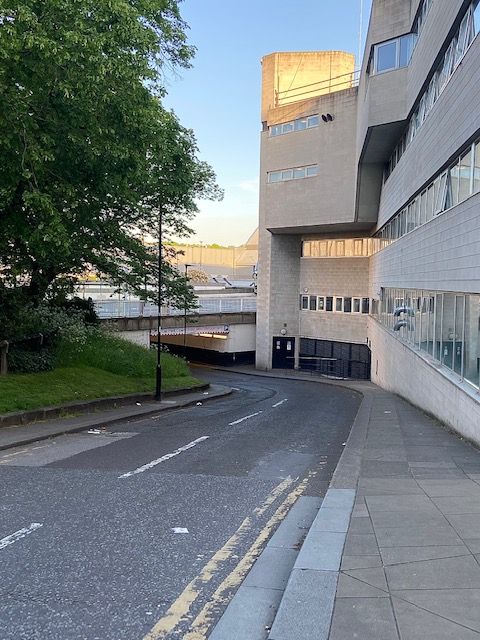
Beside the Crucible Theatre, leading from Norfolk Street, underneath Arundel Gate to the multi-storey car-park, is a service road, appropriately called… Milk Street.

Besides the Crucible Theatre, leading from Norfolk Street, underneath Arundel Gate to the multi-storey car-park, is a service road, appropriately called Milk Street. Image: DJP/2022

©2022 David Poole. All Rights Reserved.
Categories
Buildings

Ban-Thai. Like so many old buildings, its original use is overlooked

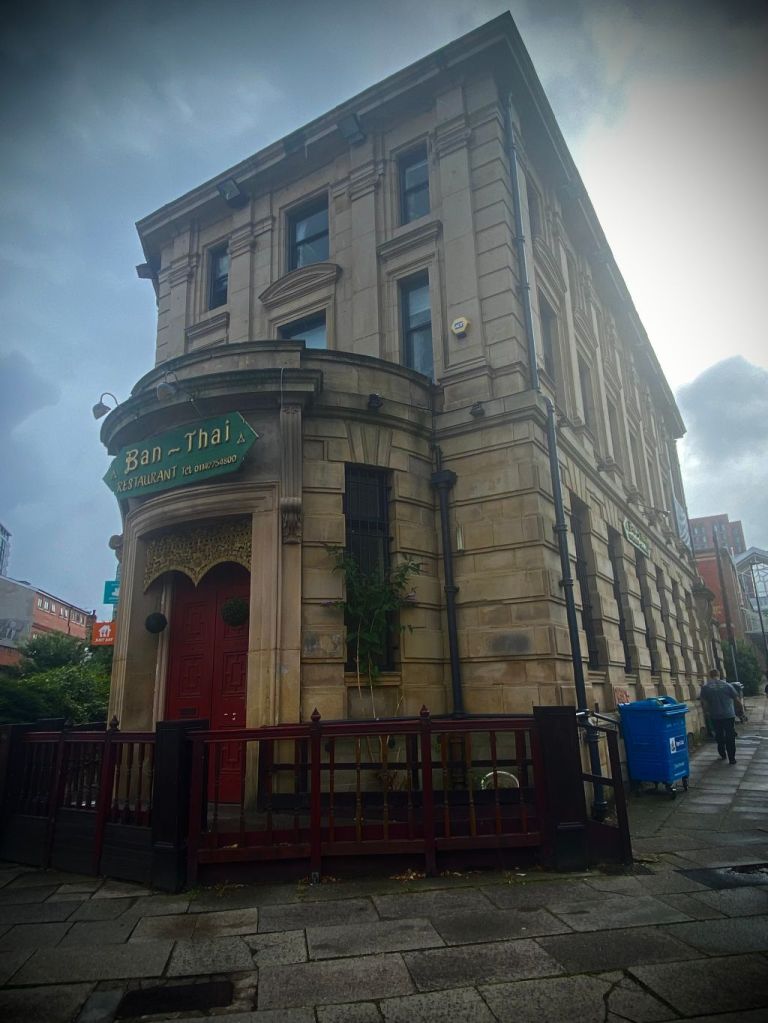
Ban Thai restaurant, on the west side of St. Mary’s Gate, is known to many, but like many old buildings, its original use is overlooked.

It was built in 1894 for the Sheffield Union Bank at the corner of Cemetery Road and Ecclesall Road. The postal address is still No.1 Ecclesall Road and goes back to when it stood adjacent to the Sheffield & Ecclesall Co-op building, demolished to make way for the Safeway (Waitrose) supermarket, and before the widening of St. Mary’s Gate.

Sheffield Union Bank was established in 1843, taking over the business of the Yorkshire District Bank. Its first branch opened in Retford in 1846, and expanded across Sheffield, Rotherham, Penistone, and Chesterfield.

This office was confusingly referred to as the Sheffield Moor branch and after the bank’s amalgamation with the London City & Midland Bank in 1901, it operated as the Midland Bank. The branch was offloaded to the Trustee Savings Bank in the later part of the twentieth century.

When the bank closed, it became Robert Brady, outfitters, before becoming Barbarella’s restaurant and bar and then Ban Thai. The upper floors were converted to provide two storey student accommodation in 1995.

The design of the Grade II listed building was the work of architects J.B. Mitchell-Withers & Son, whose practice was on Surrey Street.

John Brightmore Mitchell-Withers (1838-1894) came from the family of Samuel Mitchell, a name often mentioned in Hunter’s Hallamshire, and the son of W.B. Mitchell. He was educated at Collegiate College, later tutored by architect Samuel Worth, and set up on his own as an architect and surveyor. 

By the will of his aunt, Sarah Withers, he inherited her Sheffield property with the stipulation that he took the name of Withers.

Mitchell-Withers’ work can still be seen across the city. He was responsible for the extension to the Cutlers’ Hall after winning a competition in 1888. There are also Town Hall Chambers on Pinstone Street (1885), Firs Hill Junior School, the Licensed Victuallers’ Association Almhouses, Abbeydale Road South, as well as St John the Baptist Church, Penistone Road, St. Silas Church, Broomhall Street, and restorations to the nave of St. Mary Church at Ecclesfield. He also built his home,  Parkhead House (then called Woodlands) on Ecclesall Road South.

He was an enthusiastic watercolour painter with involvement in the local art scene. He became president of the Sheffield School of Art and the Sheffield Society of Artists and was vice-president and treasurer of Sheffield Society of Architects and Surveyors. The Duke of Devonshire engaged him to supervise the restoration of painted ceilings in the state rooms at Chatsworth House.

This branch of the Sheffield Union Bank was one of his last commissions and he died of a heart attack in the year it was built. Another commission for Union bank on Langsett Road had to be completed by his eldest son, also called John Brightmore Mitchell-Withers in 1895.

John Brightmore Mitchell-Withers (1865-1920) succeeded his father and initiated several distinguished buildings. These included extensions to Central Schools on Orchard Lane between 1893-1895 (now adjacent to Leopold Square), High Court on High Street, John Walsh’s department store (bombed), and Clifford House at Ecclesall Road South.

As a boy, he was educated at Rugby where he won several prizes and gained his cap in rugby football at the school. After joining his father’s practice, he passed the examination of the Royal Institute of British Architects (RIBA) in 1890.

Mitchell-Withers Jnr was a member of Hunter Archaeologist Society and like his father, was involved with the Sheffield Society of Artists and became president of the Sheffield Society of Architects and Surveyors, representing them on the council of RIBA.

He became an honorary lecturer on English Gothic architecture at Sheffield University and a council member with the Sheffield Literary and Philosophical Society.

Mitchell-Withers was also an agent for the Burgoyne estate and the Duke of Devonshire’s land near Dore.

©2022 David Poole. All Rights Reserved.
Categories
Buildings

Harris Leon Brown and the one o’clock time signal

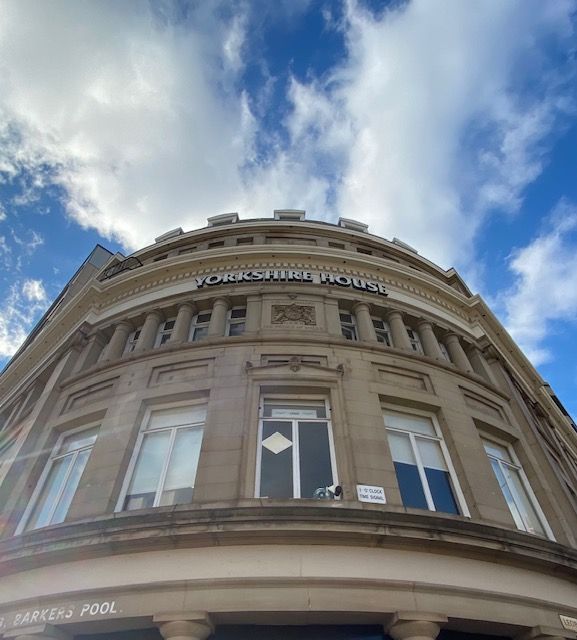
H.L. Brown is situated in Yorkshire House at 2 Barker’s Pool. Sheffield. The time signal can be seen in the first floor central window. Image: DJP/2022

It confuses many people but is a reliable reminder to others. I’m referring to the one o’clock time signal that blasts out daily from above H.L. Brown at Barker’s Pool.

Today it’s a quirky tradition, and a reminder of a time when the concept of time was a bit fuzzier.

The origin of the time signal goes back to 1874, when in Angel Street, Harris Leon Brown fixed and maintained a ‘Greenwich time ball’ – that was placed on a flagstaff outside his premises, and which by an electric current fell at exactly 1p.m., Greenwich mean-time.

Back then, – different towns tended to keep different times, and thus Greenwich Mean Time was established.

Back in Sheffield, the 1 o’clock Time Signal became a handy way for city workers to mark the end of their lunch breaks, though its position above the watchmaker was used to ensure that his timepieces were accurate.

The equipment was admired for two years, but electric signals in the open air were affected by the weather and its failure to ‘drop’ on several occasions caused it to be removed.

In 1876, he entered into an agreement with the Government to supply him daily for three years with the correct time. A wire connected his shop in Angel Street with the Royal Observatory at Greenwich, and at one o’clock every day the ball dropped with remarkable precision as the sixtieth part of a second.

In his window, Harris Brown displayed several English keyless chronometer watches, especially adapted for pocket timekeepers. All of these were regulated by the time ball placed outside his shop door.

In 1891, a ‘Greenwich mean time flashing signal and time bell’ was installed in the window of H.L. Brown at new premises at 71 Market Place. It was a synchronised clock with flashing signal and bell, showing mean time daily at 1p.m. and was unaffected by rain or snow.

The clock was 14 inches in diameter, and on either side were two open circles, about half the size of the clock dial.

The one on the left contained a ‘flashing signal’ – a disc of metal painted red, and finely balanced on a pivot. Throughout the day this disc remained with its edge towards the front and was almost invisible. But precisely at one o’clock in the afternoon (GMT) the electric current arrived, giving the disc a quarter revolution, and causing it to reveal its full face, and fill up the open circle, remaining in that position for two seconds.

Simultaneously, the time bell fixed in the open dial to the right of the large clock was struck, so that the electric current made its arrival known both to sight and sound.

To obtain this equipment, H.L. Brown had to enter a five year agreement with the Post Office and pay a large yearly subscription. They were the only watch manufacturer to receive this direct signal. He stated that one of the reasons for installing the equipment was because he had sold many watches from the Government observatory at Kew, and which were guaranteed to keep exact time.

By visiting the Market Place any day at one o’clock, he said that users could ascertain if their watch was ‘on time’ as accurately as by a visit to London.

H.L. Brown later moved to 65 Market Place, and along with it went his equipment. It was bombed in 1940 and the shop moved to 70 Fargate at the corner with Leopold Street.

The time signal was subsequently replaced with a siren, and this was relocated to its current position at Barker’s Pool when H.L. Brown’s Fargate shop was demolished in 1986 for the construction of Orchard Square.

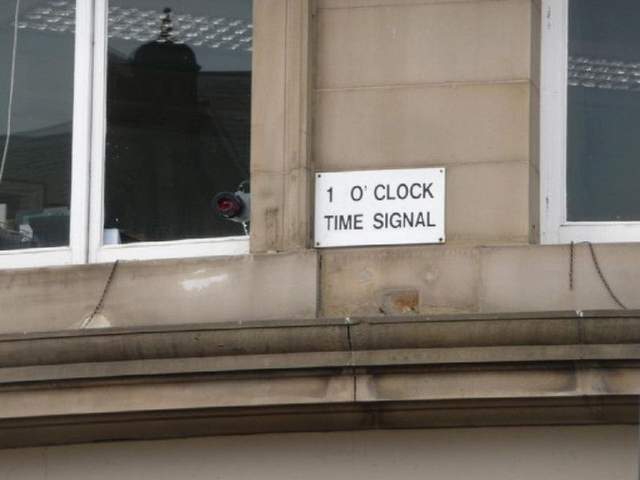
Above the entrance, there’s a small black and white sign proclaiming “1 o’clock time signal” and alongside it, the siren that you hear each and every day. Image: Sheffield Star

©2022 David Poole. All Rights Reserved.
Categories
Buildings

Tesco Express to open on Fargate

42-46 Fargate. The site of a new Tesco Express. Image: DJP/2022

We recently looked at 42-46 Fargate, an existing retail unit that was formerly used by New Look. The building has been demolished and redeveloped multiple times, with the present, existing building having been constructed in the 1990s.

This was once the site of the Green Dragon Hotel, built in 1884, with R. H. Ramsden shoe and hat shop occupying the ground floor retail unit. In 1922, it was adapted to become Winchester House, the former hotel rooms becoming offices and studios. During the 1950s and 1960s, Winchester House became offices for the Provincial Insurance Company. In the 1970s, the building was demolished and replaced with a standard 1970s design.

The demise of Fargate and its pending renaissance is well documented, but here comes news that Tesco Express is to occupy the building.

The retail giant has applied for planning permission for the installation of a new realigned shopfront and new aluminium automatic telescopic sliding door, as well as new signage and rooftop plant machinery.

Tesco Express shops are convenience stores averaging 200 square metres (2,200 sq ft), stocking mainly food with an emphasis on higher-margin products, and the necessity to maximise revenue per square foot, alongside everyday essentials. They are in busy city-centre districts, small shopping precincts in residential areas, small towns and villages, and on Esso petrol station forecourts.

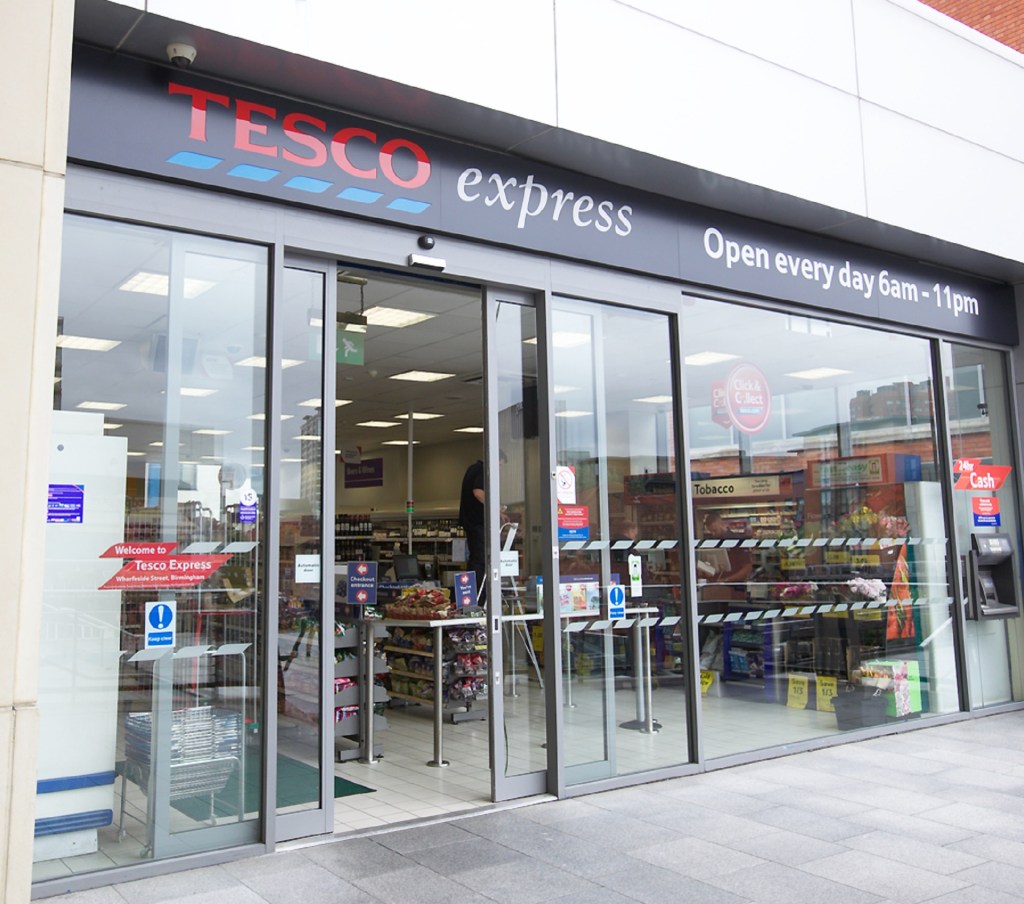
A typical Tesco Express store at the Mailbox, Birmingham.

Categories
Buildings

“The mansion stood in a rural situation within sight of Sheffield, surrounded by farmland.”

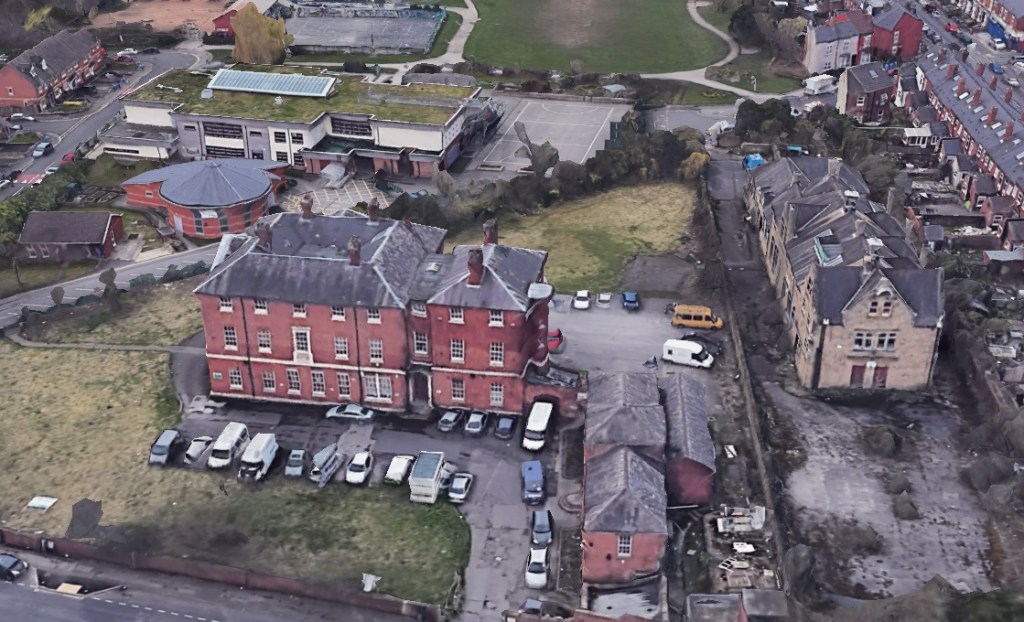
It is one of Sheffield’s forgotten big houses, but the future of Mount Pleasant on Sharrow Lane looks much brighter.

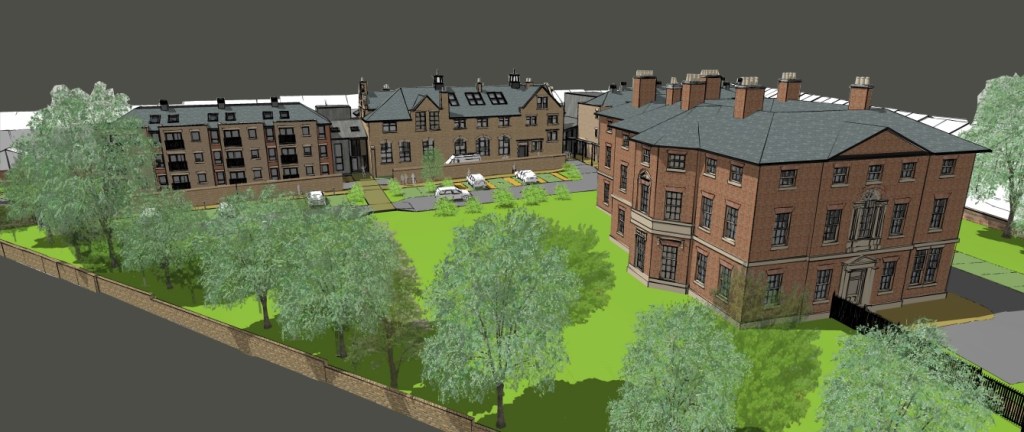
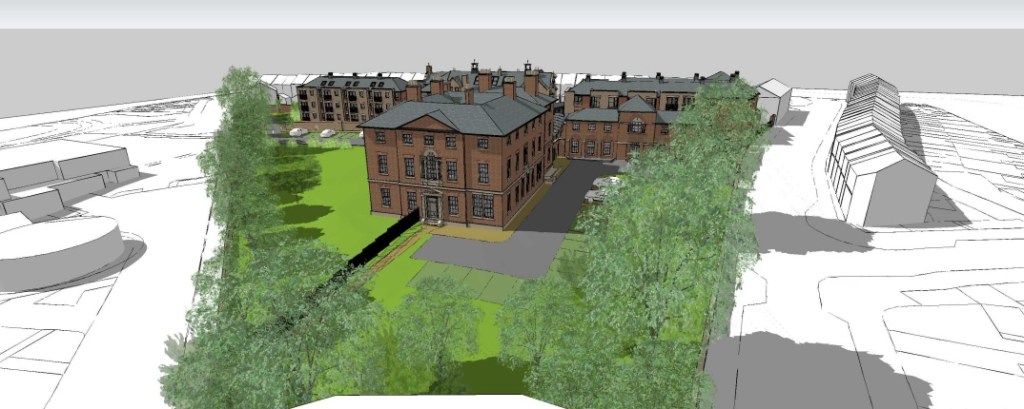
Hermes Care, supported by Axis Architecture, has submitted a full planning and listed building application to Sheffield City Council for the conversion of the grade II* listed Mount Pleasant building, together with the partial demolition and retention of the former Highfield School building and new build extensions.

Planning permission is sought for the redevelopment of the site to create a care village offering supported living, assisted living and 24-hour specialist care.

The Mount Pleasant Building would be converted into one-, two- and three-bed residential care spaces, and a new-build 39-bedroom care home would be built on the playground area of the former Highfield School building.

The ground floor of Highfield School would be converted to create communal spaces for the new care home with the remainder providing a communal residential care lounge and day centre. The first floor would be converted into four one-, two- and three-bed residential suites.

The plans also include the demolition of former Highfield School extensions and a three-storey new build extension to the south to create 12 one-bed residential suites.

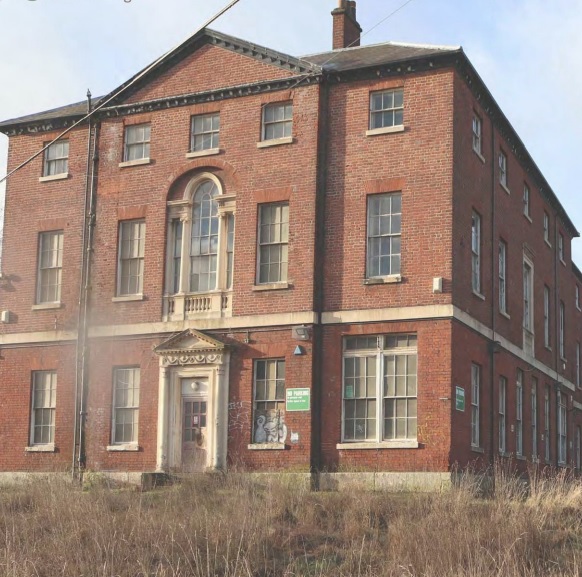
Artist impressions of Mount Pleasant care village. Image: Axis Architecture

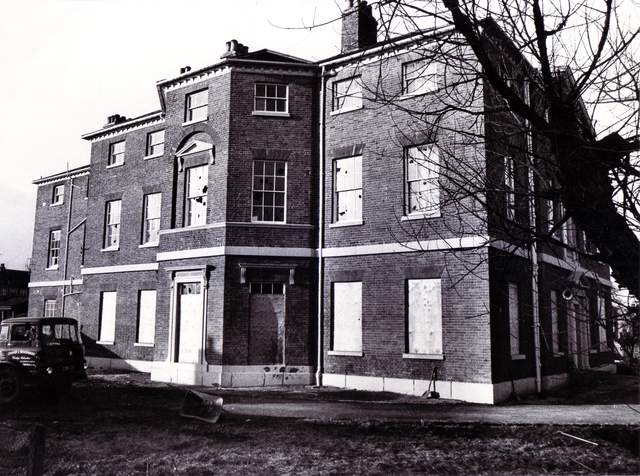
Mount Pleasant is an 18th Century mansion and was built for the Sitwell family by Francis Hurt Sitwell. The house was constructed in 1777 using the architect John Platt (1728– 1810) of Rotherham. When first built, the mansion stood in a rural situation within sight of the centre of Sheffield, surrounded by farmland at the top of a slight gradient overlooking the valley of the River Sheaf.

The Sitwells owned Mount Pleasant for less than 20 years as in 1794 it was sold to Samuel Broomhead Ward. By the 1850s, the family of Thomas Tillotson, a Sheffield merchant, were living at Mount Pleasant, after that the building was utilised for various purposes.

In 1868, the committee of the West Riding County Asylum at Wakefield acquired a five-year lease on Mount Pleasant and used it to alleviate overcrowding at their main hospital. As an asylum, Mount Pleasant accommodated approximately 75 residents, with eight staff, and in 1872, all residents were transferred to the newly built South Yorkshire Asylum at Wadsley.

In 1874, Mount Pleasant became the Girls’ Charity School when it was relocated from its original location in St James Row at the side of Sheffield Cathedral. In 1927, the school was renamed the Mount Pleasant School for Girls.

It was requisitioned for use by the Government during World War II and afterwards the building continued to be used by various Government departments with the Ministry of Works Engineering Department, the Ministry of Fuel and the Ministry of Transport all having office space there.

Mount Pleasant, with former Highfield School to right. Image: Google

Mount Pleasant was designated a listed building in May 1952.

By 1961 there was just the National Assistance Board and the Drivers Examiners Department using the buildings, with the latter using the old stables and coach house buildings as offices.

When the building was vacated by the government, it fell into a state of near ruin during the late 1960s and early 1970s, but was restored by the mid-1970s and converted into a Community Centre with the stables used as a Youth Club known as The Stables Connexions Centre.

Only the Stable Block currently remains in use, by Shipshape Health and Wellbeing Centre, with Mount Pleasant left vacant for several years along with the former Highfield School, which was vacated and relocated to a new school on an adjacent site in 2006.

The Stable Block does not form part of the development proposals, with Shipshape being retained as tenants for the foreseeable future.

Mount Pleasant House, Sharrow Lane (Girl’s Charity School). Established in 1786, the school relocated from St. James’ Row to Sharrow Lane in 1874. Image: Picture Sheffield

The Guardians of Mount Pleasant were granted permission to occupy the Mount Pleasant building to maintain a level of on-site security.

However, the former Highfield School building was left empty and has been badly vandalised and impacted by pigeon infestation, and drug users, although thankfully now, the building is secure and has been cleaned internally by the new owners.

The area has suffered extensively from petty crime and the misuse of drugs, with the limited security to the perimeter of the site compounding matters.

Mount Pleasant, Sharrow Lane, Sheffield, pictured in 1974. Image: Sheffield Star
Categories
Buildings

The mystery behind the Lord’s House

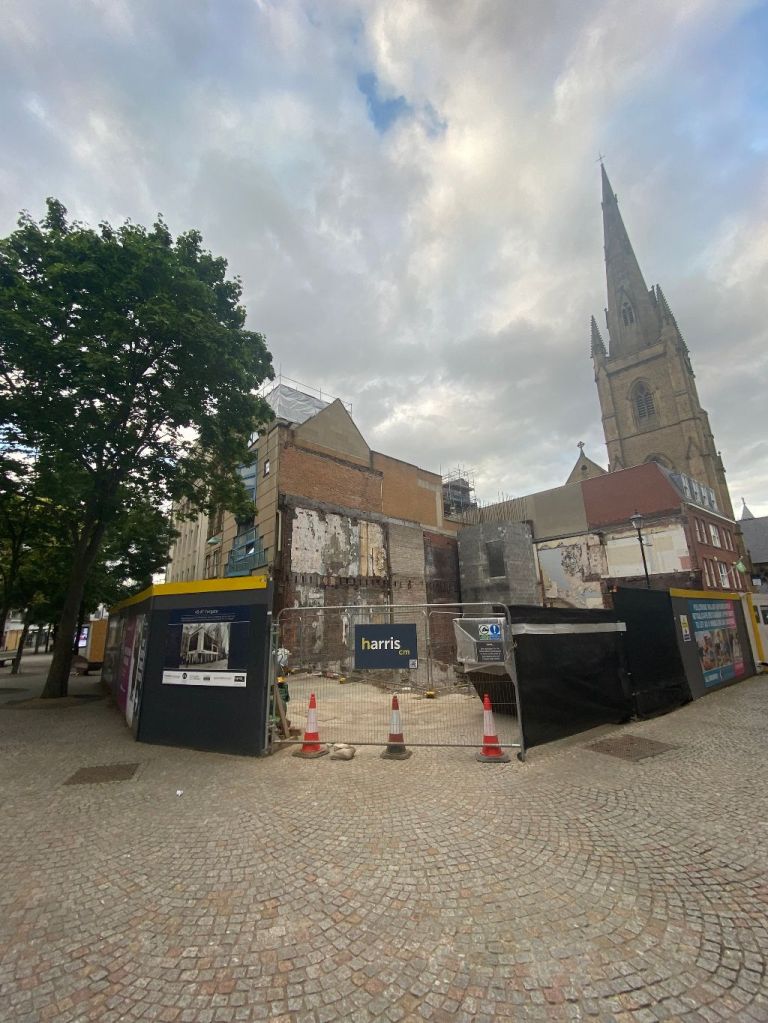
45-47 Fargate, Sheffield. The site of the Lord’s House. Image: DJP/2022

The year is 1815 and a big old town house on Fargate was demolished. It was replaced by a shop and in later years the site at its corner with Norfolk Row was occupied by Robert Hanbridge and Sons, hosier, hatters, and glovers, before becoming Hepworth tailors and finally a branch of Next.

The story of 45-47 Fargate has been covered here already, and the former Next building was recently demolished to reveal its underground secrets. But if we were able to dig even deeper there may be further treasures.

After Sheffield Castle was demolished in 1646, the Manor House remained, and the agent of the Duke of Norfolk, Lord of the Manor, resided here.

In 1706, however, the Manor House was dismantled, and a year later the Lord’s House was built in Fargate, of moderate size and pretensions, for the accommodation of the steward, and the occasional visits of the Lord of the Manor.

In the middle of the eighteenth century Henry Howard, then resident agent to the Duke of Norfolk lived here, and his son, Bernard Edward, who was born in the Lord’s House in 1765 eventually succeeded to the title on the death of his cousin, and became the 12th, Duke. But the Lord’s House was mostly occupied by his agents, the last one being Vincent Eyre.

In 1791, rioters had tried to burn it down in protest at the Enclosures Acts and were only prevented by the timely arrival of the military, which had been summoned from Nottingham the day before.

Towards the end of its life, the Lord’s House became a school where Samuel Scantlebury, the brewer, was a pupil.

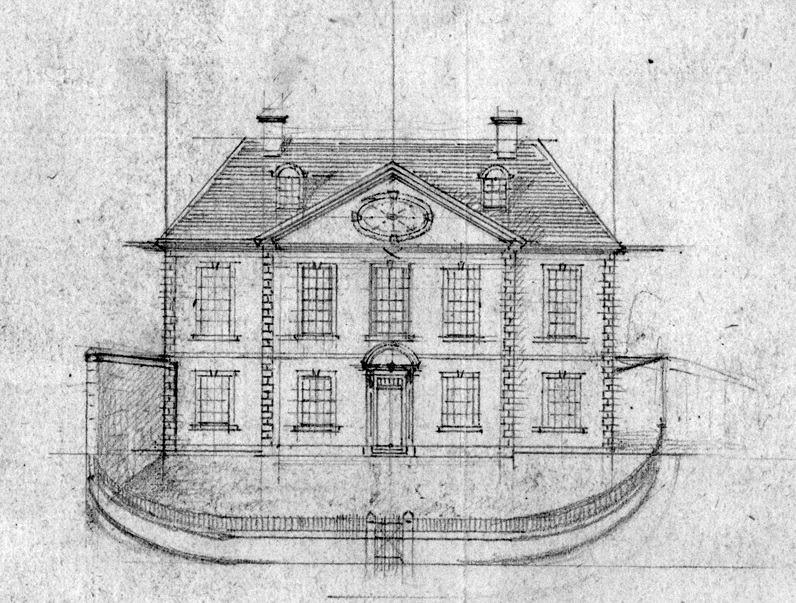
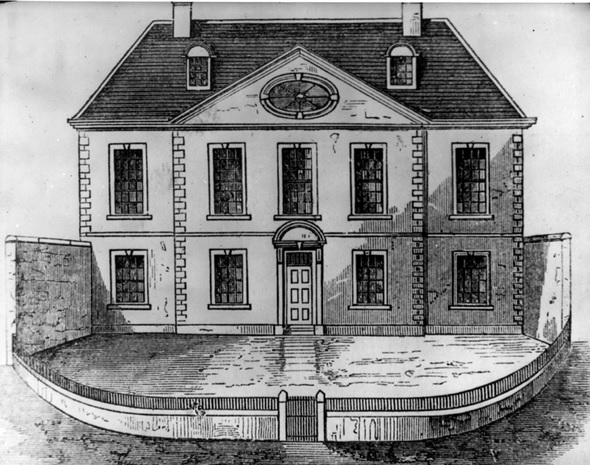
View of the Lord’s House, Fargate, demolished 1815. Taken from a pen drawing in the possession of Mr R. Drury (1867). Sketch made 31st October, 1867. Image: Picture Sheffield
The Lord’s House was built in 1707 for the Duke of Norfolk on his occasional visits to Sheffield. It was mostly occupied by his agents, the principal one being Vincent Eyre. It was situated in Fargate, at the corner of Norfolk Row. The house was demolished in 1814. Image: Picture Sheffield

“At the end of Norfolk Row was the building called the old Lord’s House,” said George Leighton in 1876. “It formed the corner of Fargate and Norfolk Row and stood where there are the shops so long occupied by Mr Holden, watchmaker (now Mr Rennie’s, hosier), and the adjacent ones, as far as the Old Red House.

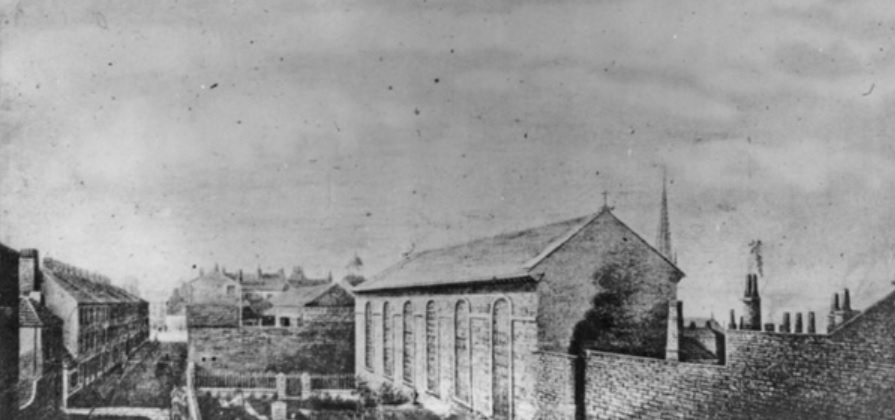
“There was a double flight of steps leading to a balcony on the level of the first floor. Mr Rimmer, the catholic priest, had a small room in the house, used as a chapel. The entrance was from Norfolk Row side, and there were two or three steps up to the chapel.

“About the time I am speaking of (1814-1815), the building was taken down, and the land was quite open from Fargate to the Assembly Rooms in Norfolk Street, and it continued open for years. Mr Rimmer got a chapel built upon the ground, right at the back (in 1816), and that continued to be the Roman Catholic place of worship until the present St Marie’s Church was built (1846-1850). We used to play on the ground, and ‘Old Rimmer’ did not like it, and drove us off. He was a nice old gentleman – a cheerful old chap. For a long time, the ground was unfenced, but ultimately a palisade was put up.”

The Lord’s House was sold in 1814 and dismantled in 1815, but the replacement chapel was short-lived. The palisade in the house’s former gardens was St. Marie’s Roman Catholic Church, better known today as the Cathedral Church of St Marie, Sheffield.

These days we have little visual evidence as to how the Lord’s House looked. However, within Sheffield Archives are two sketches, one of which is a pen drawing that was in the possession of Mr R. Drury in 1867.

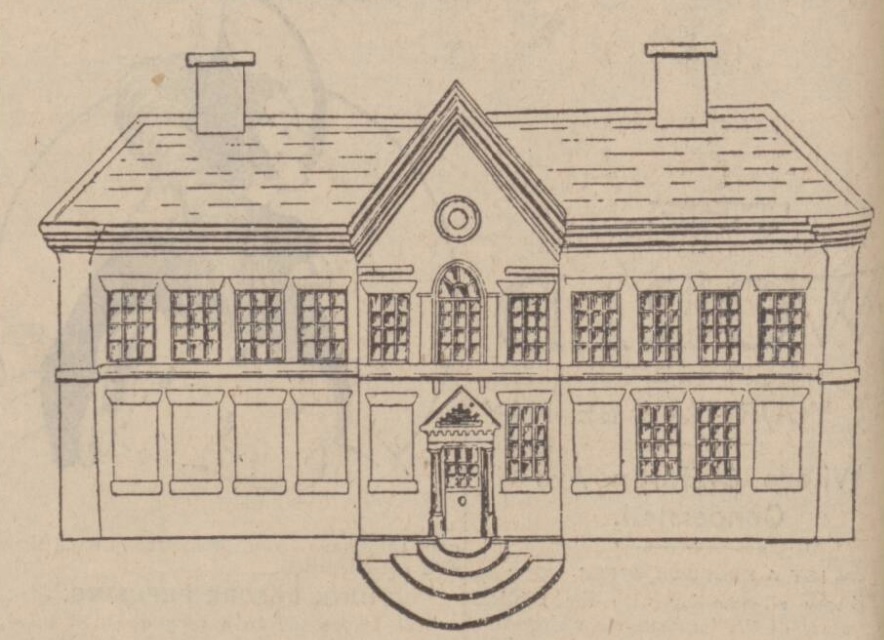
Both are remarkably similar, but in Charles Hadfield’s ‘History of St Marie’s,’ published in 1899, he provides another sketch that was taken from a porcelain model, the property of Arnold J. Ward. This model purported to represent the old mansion in Fargate. Mrs Fisher (widow of Henry Fisher, surgeon, Eyre Street) who died in 1881, stated that her father had purchased the model at a sale.

The Lord’s House. From Charles Hadfield’s ‘History of St Marie’s’ 1889. Image: British Newspaper Archive

That the model was a correct representation of the Lord’s House was testified by several residents including Septimus Clayton, John Kirk, George Thompson, James Brown, and William Clayton, well within the recollection of these old men.

In 1931, the Sheffield Daily Telegraph queried the whereabouts of the porcelain model and discovered that it had been presented to the Duke of Norfolk by Arnold J. Ward in 1897 who received an acknowledgement.

The newspaper contacted the ducal seat at Arundel Castle in Sussex and received the following response.

“We have a model in porcelain which might be described as follows: Circular front with door in centre, two round turret towers on either side with battlements around the top of each and with a square tower in centre of model which resembles an ordinary church. There is no record stating that this is the model asked about.”

The description suggests a different property to all the sketches, but there was consensus at the time that the model was the Lord’s House.

And we should also remember George Leighton’s recollections that ‘the Lord’s House had a double flight of steps, leading to a balcony on the first floor.’ Again, this contradicts all the sketches.

Somebody has suggested to me that the sketches might show the rear of the property, and one does show a retaining wall to the left hand side that might have been alongside Norfolk Row.

For now, I have submitted a request to Arundel Castle to determine whether the porcelain model still exists, and whether they have any more information on the Lord’s House.

Catholic Chapel, Norfolk Row (Original St. Marie’s). Norfolk Row to left. Fargate in background. Image: Picture Sheffield

©2022 David Poole. All Rights Reserved.
.