Categories
Companies

Bassetts

We’ve already looked at the life of George Bassett, a man who died before his most famous product, Liquorice Allsorts, was created.

Bassett’s Liquorice Allsorts came about by accident in 1899, when Charlie Thompson, a salesman for Bassett’s visited a wholesaler with a sample of liquorice and cream paste specialities – chips, rocks, buttons, nuggets, plugs and twists.

Each item was offered to the wholesaler and in turn was refused. The salesman clumsily gathered his samples boxes together, knocking them over and spilling the colourful sweets on the floor.

The wholesaler saw more attraction in the ‘mixed’ sweets and placed an order. The salesman named them Liquorice Allsorts.

Made of liquorice, sugar, coconut, aniseed jelly, fruit flavourings, and gelatine, allsorts are now produced by many companies around the world, but are most popular in Britain and continental Europe (especially the Netherlands where they are called Engelse drop, meaning English liquorice). They are also common in Scandinavia, where they are called Engelsk onfekt or Lakridskonfekt.

In 1929, the George Bassett company created Bertie Bassett, a mascot for Liquorice Allsorts, designed to appeal to young and old, and he’s been going strong for 90 years.

In the 1950s, visitors to the factory at Owlerton were confronted on the main staircase by the friendly figure of Bertie Bassett, serving as a reminder that “the important and unchanging things in life are the human things, and as a challenge to any who would subjugate those human things to the changing dictates of expediency.”

Such waffle plays a secondary role now.

Indeed, Bertie Bassett is under threat, reeling from the double blow of declining sales and the war on sugar.

Last month, it was reported that sales of Liquorice Allsorts had shrunk by nearly 8 per cent to £23.5million in the past year, the only type of confectionery to see a downturn in demand.

And new rules that sweets contain less than 50 per cent sugar could spell the end of Bertie Bassett.

According to The Grocer: “That’s bad news for liquorice allsorts, which are made almost entirely of sugar.”

Categories
Companies

Bassetts

A final burst of Bassett’s for today.

A look at Jelly Babies, the soft sugar jelly sweet, dusted in starch, and shaped as plump babies in a variety of colours, made in Sheffield.

The sweets were invented in 1864 by an Austrian immigrant working at Fryers of Lancashire. It is thought that he was asked to make a mould for jelly bears, but the resulting sweets looked more like new-born infants and were subsequently given the ghoulish name, Unclaimed Babies.

Tim Richardson, author of Sweets: A History of Temptation, said although the name might sound ghastly to modern ears, sweet-eaters in the Victorian era would barely have batted an eyelid.

Their popularity waned, but in 1918, they were produced by George Bassett in Sheffield as “Peace Babies” to mark the end of World War I.

Production was suspended during World War II, due to wartime shortages, but the product was relaunched in 1953 as Jelly Babies.

The sweet is famous for being Doctor Who’s favourite sweet, often carried around in a white paper bag. However, they are specifically associated with Tom Baker’s fourth Doctor, who had a predilection for offering them to strangers in order to defuse tense situations (and in one episode bluffing another alien into thinking them a weapon).

In the 1990s, Jelly Babies ditched their nappies in favour of baseball boots and bumbags and given names: Brilliant (red; strawberry), Bubbles (yellow; lemon), Baby Bonny (pink; raspberry), Boofuls (green; lime), Bigheart (purple; blackcurrant) and Bumper (orange).

At the time, a company spokesman said that, “We wanted to increase their street cred.”

Still going strong today.

Categories
Buildings

Pennine Centre

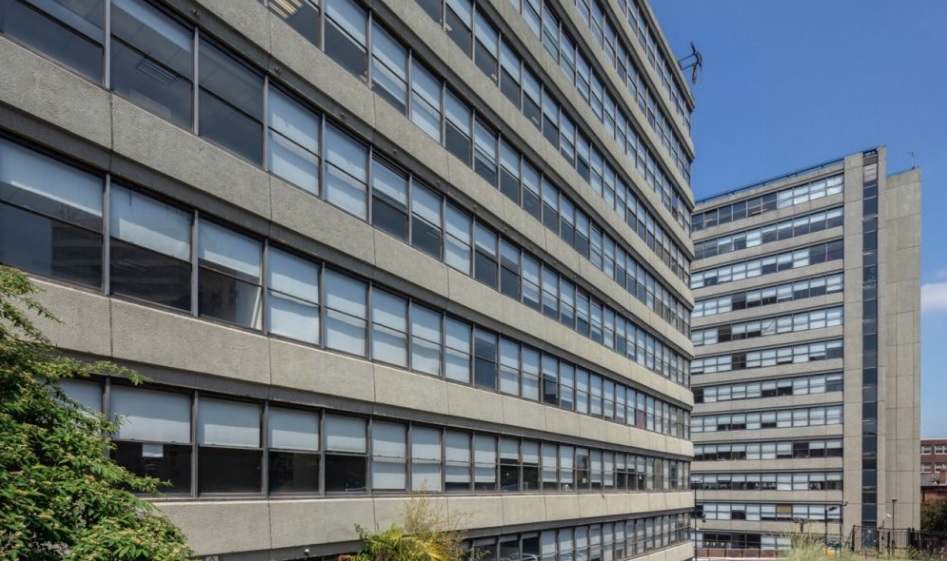
We’re now at that stage when those 1970s modernist office blocks need to start reinventing themselves. This is the case with the Pennine Centre between Tenter Street and Silver Street Head, Sheffield, built between 1973 and 1975, for the Midland Bank (now HSBC), and formerly known as Griffin House.

Opened to great fanfare in October 1976, the five blocks accommodated over a thousand workers, but changing market conditions eventually resulted in a reduction in staff numbers. When HSBC’s lease ended, it had already made plans to move to the smaller Grosvenor House, part of the Heart of the City II development, at Charter Square.

The tallest block at the Pennine Centre is 13-storeys (50 metres high).

The building, previously owned by US-based Kennedy Wilson, was sold for £18million to RBH Properties in the spring, which announced plans for flats and shops.

However, high conversion costs prompted the Portsmouth-based developer to rethink, the result being Pennine Five, the new name for the site.

The company plans to revamp all five blocks and let them to businesses, with potential to accommodate 2,500 people.

Within the development will be offices, co-working spaces, meeting rooms, cafes and restaurants, and by removing the ground and first floors of Block 4, will create a new public square. The site already has a four-storey underground car-park with 457 spaces.

Work on the five inter-connected blocks is scheduled to start in January 2020.

Categories
Buildings

Central Hall

The next time you settle into a seat at one of our multiplex cinemas, take a moment to consider that there are still traces of Sheffield’s original cinema.

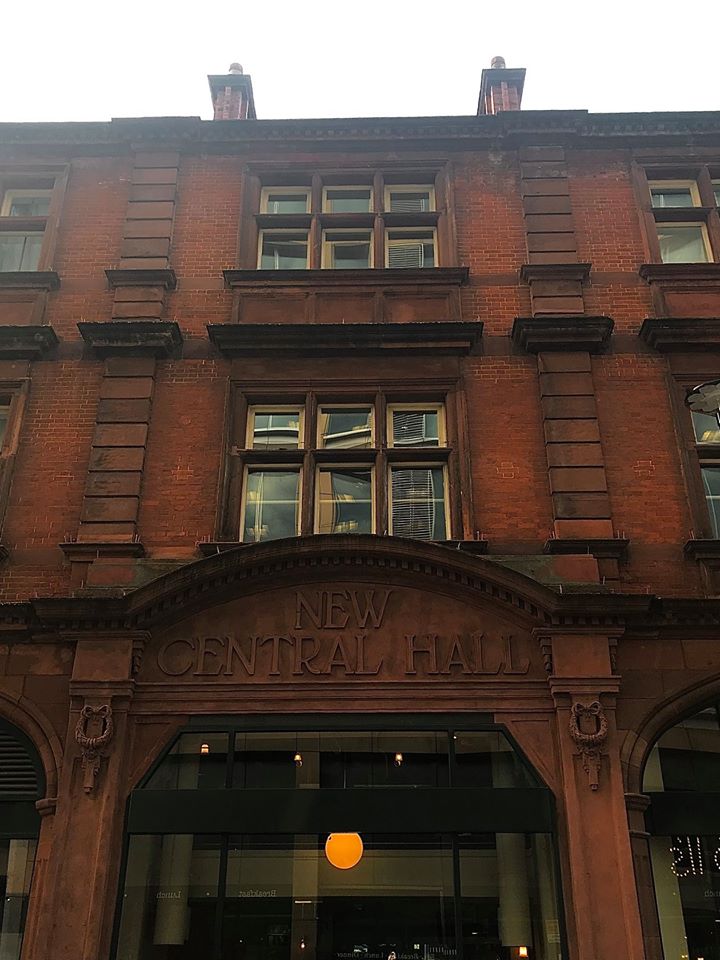
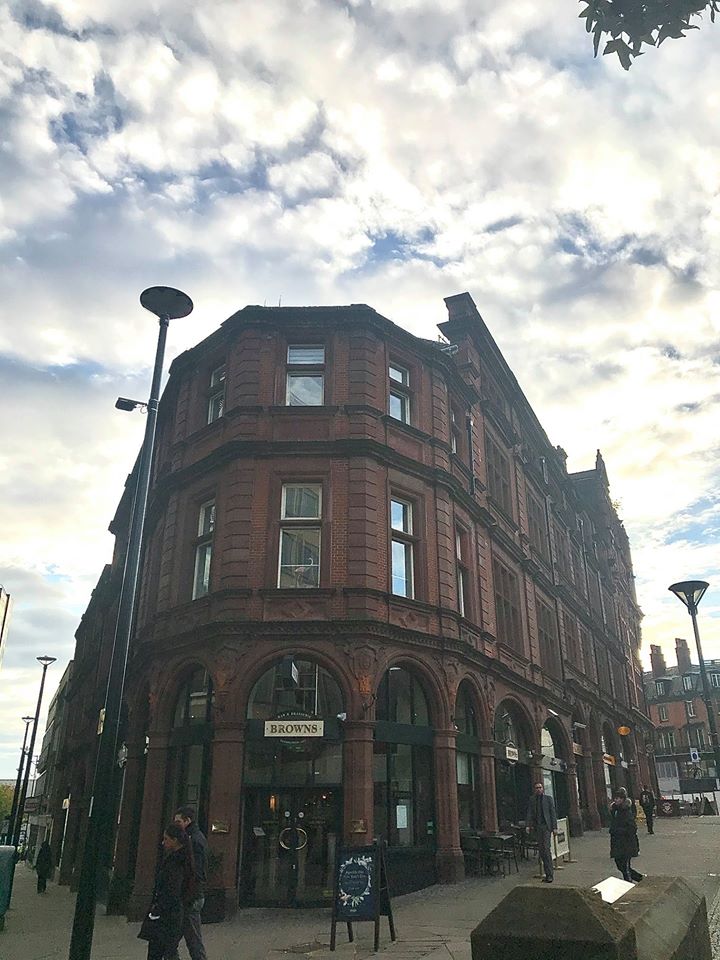
Head down to Norfolk Street, and look at part of Brown’s Brasserie and Bar. Above one of the plate glass windows is the name New Central Hall, the remains of a former decorative arched entrance.

This part of the building, just around the corner from St. Paul’s Parade, was built in 1899 by architect John Dodsley Webster as the Central Hall for the Sheffield Workmen’s Mission, established by Pastor A.S.O. Birch in 1880 at the old Circus on Tudor Street. (The building was constructed by James Fidler, contractor, of Savile Street).

The cost, exclusive of land, was about £4,000, made possible by a £3,500 loan from Mr F.E. Smith, “trusting those who will attend the hall to repay him when they can.”

The Central Hall had a frontage of 46 feet, the ground and first floors devoted to the main hall, which contained a gallery, and seating accommodation for 500 people. The second floor was occupied by five classrooms and an office, while the basement was taken up by a large kitchen and store-rooms.

It had been designed as a place of public worship; the Mission having previously held services at the Montgomery Hall on Surrey Street and opened in December 1899.

However, no sooner had it opened when, somewhat unexplainable, the Workmen’s Mission left and taken up residence at the Albert Hall in Barker’s Pool.

It was left to John Dodsley Webster to advertise the Central Hall as being available to buy or let on lease, “suitable for conversion to offices, flats or business premises.”

It wasn’t until November 1904 that we find evidence that the building was in use again.

Nelsons Ltd, “The Pensions Tea Men,” advertised that it was opening its drapery, ready made clothing and boot and shoe departments at Central Hall. It was another short-lived scheme, because in March 1905, the shop had gone into liquidation.

Nonetheless, there was somebody waiting in the wings who saw Central Hall as a long-term answer to a conundrum.

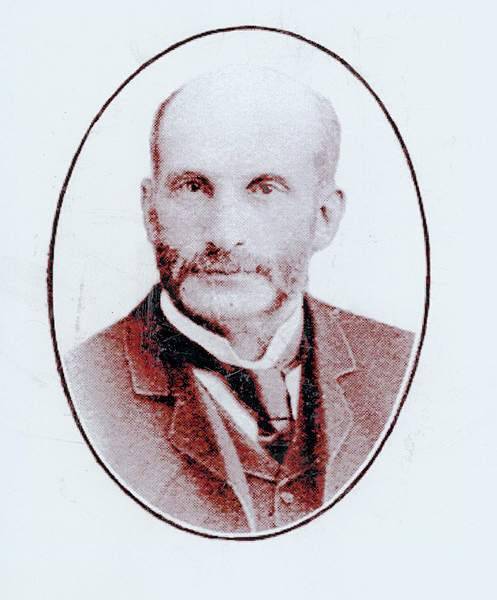
Henry Jasper Redfern (1871-1928) is almost forgotten now, but he packed a lot into a relatively short life. Here was a man who had made a fortune with a long list of business successes – “optician, refractionist, manufacturer of optical, photographic and scientific instruments, photographer, expert in animated photography and Rontgen rays, electrician and public entertainment.”

Born in Sheffield, Redfern trained as an optician, opened a business on Surrey Street, and later added a photography shop nearby.

However, he was more famous in the realms of cinematography, a subject he studied in its early stages, and became a pioneer in exhibiting moving pictures.

Alongside his daily routine, he toured the country with “Jasper Redfern’s world-renowned animated pictures and grand vaudeville entertainment” show.

Redfern decided that a permanent venue was required, and Central Hall provided a convenient solution.

In July 1905, New Central Hall opened to great flourish with the showing of the “Royal visit to Sheffield in its entirety,” shown twice nightly, along with a complete programme of live variety entertainment.

In the following months, there were screenings of more moving pictures, with titles like “Winter Pastimes in Norway” and “North Sea Fishing”, as well as resident acts, such as the two French conjuring midgets and songs by Madame McMullen and Lawrence Sidney.

New Central Hall attracted big houses twice a night, much to the dismay of Smith and Sievewright, clothiers, which occupied the shop next door, and took Redfern to court complaining that the queue of waiting patrons was detrimental to their business.

But, by 1912, the cinema was in financial difficulties, although its company secretary, Norris H. Deakin, found backing to improve amenities, increasing the size of the stage and adding a proscenium arch, and increasing seating capacity to 700.

Jasper Redfern & Company Ltd was wound up and replaced with the New Central Hall Company in early 1913, with Deakin as managing director. At what stage Jasper Redfern left is uncertain, but he emerged elsewhere in the country, his life story worthy of a separate post.

The tenancy of New Central Hall quickly passed to yet another company, Tivoli (Sheffield) Ltd, and the cinema reopened in January 1914 as the Tivoli, newly decorated and improved, with variety acts stopped a year later.

The Tivoli was a success but suffered a disastrous fire during the night in November 1927. Four fire engines raced to the scene, one using a new £3,000 ladder, and attempted to put out flames coming from the roof. However, parts of the roof were destroyed, the balcony was a charred mass, and the ground floor was a mass of burning woodwork.

The cinema was rebuilt and opened in July 1928 as the New Tivoli, completely refurbished with carpets by T. & J. Roberts of Moorhead, theatre furnishings by L.B. Lockwood & Co, Bradford, and lighting effects provided by J. Brown & Company, of Fulwood Road.

In the following decade, a Western Electric sound system was installed and because of a penchant for screening cowboy films, the New Tivoli was popularly known as “The Ranch.”

The curtain finally fell on the cinema on 12 December 1940, the result of Blitz fire damage. It was never rebuilt, the cinema area adapted for offices, restaurant and shop.

All that remains of the original Central Hall is its frontage, and the only nostalgic reminder of its cinema days being the stone-carved sign.

Categories
People

John Dodsley Webster

Here’s a name that keeps appearing on Sheffielder.

John Dodsley Webster (1840-1913), might not have been our best-known architect, neither was he responsible for Sheffield’s finest buildings, but his legacy was probably the most important.

J.D. Webster was born in Sheffield, received private tuition from Rev. H.D. Jones, Vicar of Heeley, and was later educated at Mansfield Grammar School.

Afterwards, taking up a career in architecture, he was articled to M.R. Mallinson, the Burnley ecclesiastical architect, later managing the Halifax office of Mallinson & Healey, after which he returned to Sheffield and spent time with Worth & Campbell.

Webster set up on his own soon after 1865 and along with his son, John Douglas Webster, who became his partner, practiced in Sheffield for nearly 50 years.

He became Diocesan Surveyor for the Diocese of Sheffield, and before that for the Archdeaconry of Sheffield when in the Diocese of York.

Unsurprisingly, with clerical interests, he was a prominent churchman, and for several years was warden at St. Mark’s Church at Broomhill.

Webster was the architect of St. Matthias’, Emmanuel Church (Attercliffe), St. Bartholomew’s (Burgoyne Road), Carbrook Church, St. Cuthbert’s (Fir Vale), St. Paul’s (Norton Lees), St Anne’s (Netherthorpe) and prepared the designs of extensions to Heeley Church.

Other works included Grenoside Church, the “Fox” Memorial Church (Stocksbridge) and the Trinity Church at Highfields (the last regarded as one of the best examples of its class).

With his son, he also designed St. Augustine’s Church (Brocco Bank), St. Oswald’s (Millhouses), St. Timothy’s (Crookes) and St. Clement’s (Newhall).

In addition, his name can be ascribed to Gleadless School, now vacant on Hollinsend Road, Woodhouse East, on Station Road, and Woodhouse West, at Sheffield Road.

A fellow of Royal Institute of British Architects (RIBA), his best-known works were the former Jessop’s Hospital, Sheffield Children’s Hospital, and extensions to the Royal Infirmary and Ecclesall Union.

In Clarkson Street, at the corner with Western Bank, is the oldest surviving part of the Children’s Hospital which moved here in 1878. J.D. Webster was one of the hospital founders and chairman of its management committee.

The Jessop’s Hospital for Women, on the north side of Leavygreave Road, opened in 1878, a rather forbidding building in late Gothic style, that lost the top stage of its central tower during the Second World War, but survives as the University of Sheffield’s Department of Music.

Unfortunately, Webster’s Edwardian wing of 1902 was demolished, despite Grade II-listing, in 2013. The site is now occupied by The Diamond, the university’s futuristic home to the Faculty of Engineering.

There are few examples of Webster’s work in the city centre, but those that survive are passed on a regular basis by locals.

The Davy’s Shop in Fargate (1882) is now home to W.H. Smith, the Bainbridge Building on Surrey Street (1894) was most recently occupied by Halifax Bank, and the attractive St. Paul’s Parade building at the side of the Peace Gardens was completed in 1901.

Around the corner, in Norfolk Street, is the original frontage to the Central Hall for Sheffield Workmen’s Mission (1899), later becoming New Central Hall, the city’s first cinema, and now occupied by Brown’s Bar and Brasserie.

J.D. Webster practised at 19 St. James’s Street and lived at Sunbury, on Westbourne Road, at Broomhill.

He died in October 1913, aged 74, and was succeeded by his son, John Douglas Webster

Categories
Buildings

St Paul’s 4

I’m sure a few people will remember the demolition of the Empire Theatre, on Charles Street, back in 1959.

The grand old theatre was replaced by shops and offices, bridging the gap between Union Street and Pinstone Street, the most beloved tenant being Sugg Sport that closed in 2000.

They say that today’s buildings are tomorrow’s history.

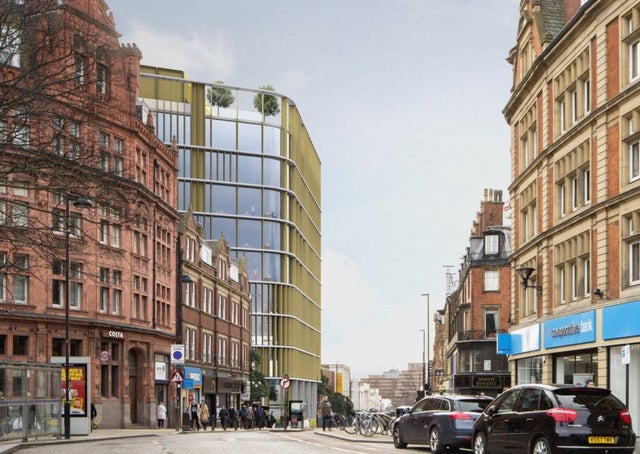
This will be the case if Manchester-based developer CTP eventually gets the go-ahead for St. Paul’s 4, a 10-storey office block, planned in place of this 1960s building.

The £35million scheme was proposed in June last year, when CTP wanted half of the building pre-let before launching the project. A pre-let – signing a tenant while a building is still on the drawing board – would then trigger a bank or financial institution.

Initial talks had taken place with Sheffield City Council, thought to be supportive of the development, and CTP stated that “demand for the project was so high that they were happy to forge ahead.”

A pre-planning application had been expected last autumn, but has yet to materialise.

The optimism for St. Paul’s 4 was based on Sheffield’s office take-up reaching a ten year high in 2017, when prime office space availability fell to its lowest level on record.

However, the update from CTP is perhaps less optimistic.

With several new office blocks completed in the city centre, the developer has now downgraded its status to “serious tenant enquiries.”

CTP has an excellent track record in Sheffield, being responsible for St. Paul’s 1,2 and 3, as well as the Mercure Hotel, Cheesegrater car-park and St. Paul’s Tower.

It promises that St. Paul’s 4 would “respect the heritage” of historic buildings in the area, and complement an adjacent 32-storey tower block, proposed for the site of Midcity House, at the junction of Furnival Gate, Pinstone Street and Union Street.

CTP has a ‘quasi joint venture’ with Schroders, an asset management company, that owns the land and building on the site.

If St. Paul’s 4 gets off the ground, then it will be one of the most significant changes to Pinstone Street in modern times.

Categories
Buildings

St Paul’s Building

Completing this week’s look around the Peace Gardens, we look at the elaborate building on St. Paul’s Parade, which runs between Pinstone Street and Norfolk Street.

This walkway once ran alongside St. Paul’s Church, demolished in 1938 and replaced with St. Paul’s Gardens, later Peace Gardens, and known as South Parade.

It was renamed St. Paul’s Parade in 1901, largely because of John Dodsley Webster’s new building that had just been completed, the second stage of a development that ran around the corner into Norfolk Street, started by the construction of the Central Hall for the Sheffield Workmen’s Mission in 1899.

Ruth Harman and John Minnis in Pevsner’s Architectural Guide to Sheffield (2004), suggest that the warm-coloured brick with red sandstone dressings, was an unusual combination for Sheffield, where the buff Yorkshire and Derbyshire sandstones were much more common.

The St. Paul’s Building comprised shops, offices and residential flats, along with a gallery and studio, although only the original facades remain following redevelopment behind.

It retains the arcaded shopfronts with carved stone piers and arches, with the faces of lions and rose, shamrock and thistle emblems still decorating the spandrels.

When it was completed, the building was home to James Moore’s Art Classes, which took place in a “beautifully lighted” new studio, its customers promised painting and drawing from live models, portrait and figure compositions, as well as flower and still-life subjects.

Over one hundred years later, the St. Paul’s Building, still retains pretty much the same use, although there have been unsuccessful attempts to have it demolished.

Had it been, the redevelopment of the Peace Gardens as part of the Heart of the City project, might have been very different.

Shops aplenty have occupied the ground floor, the most famous being the Army and General Store, famously sited at its rounded corner with Norfolk Street, later occupied by the Ha Ha Bar, and now Brown’s Bar and Brasserie.

There can be no denying that this area is one of the city centre’s most attractive, St. Paul’s Building sitting comfortably alongside the Prudential Assurance Building, built in 1895 on Pinstone Street.

NOTE: St. Paul’s Building is now referred to as St. Paul’s Chambers. However, when the building was constructed in 1901, St. Paul’s Chambers would have been associated with a completely different building, one that had been demolished to make way for the Town Hall between 1890 and 1897.

Categories
People

Henry Jasper Redfern

It is incredibly difficult to write about Henry Jasper Redfern (1871-1928). Almost forgotten now, his curriculum vitae is almost too long:- optician, photographer, exhibitor, filmmaker, the proprietor of a photographic and lantern business, cinema pioneer, as well as being an x-ray and radiographic innovator.

On reflection, he was a jack-of-all trades, probably master of none, because his business undertakings often ended in financial failure.

Born in Sheffield, Redfern trained as an optician and opened a business on Surrey Street, later opening a photography shop nearby. However, he was more famous in the realms of cinematography, studying the form in its early stages, and became a forerunner in exhibiting moving pictures.

In 1898, Redfern was offering photographic supplies and instruction, Röntgen rays (X-rays), and exhibitions of the Lumière Cinématographe, for which he was one of a number of agents in Britain at this time.

Specialising in ‘locals’, films of interest around Sheffield, Redfern travelled around with Sheffield United during 1899, photographing at least four major matches, climaxing with the Cup Final at Crystal Palace, when Sheffield United played Derby. He entitled the series Football Events. He also filmed local cricket matches.

The following year he seems to have made a tour of Africa (Morocco, Tunisia, Algeria), making travelogues, and eventually went wholeheartedly into the moving picture business with his ‘World Renowned Animated Pictures and Refined Vaudeville Entertainments’.

These package shows eventually led to his owning and operating a seaside summer show at Westcliffe, ‘Jasper Redfern’s Palace by the Sea’, the ‘Grand Theatre of Varieties’ in Manchester, while also operating the Theatre Royal, Windsor, and the Public Hall in Barnsley.

Together with Frank Mottershaw, he made the first outdoor films in Sheffield, producing A Daylight Robbery in 1905.

In the same year, Redfern took over the lease of the Central Hall in Norfolk Street, built in 1899 for the Sheffield Workmen’s Mission. Here, he showed his own work, opening with ‘The Royal Visit to Sheffield in its Entirety.’

Redfern was also famous in x-ray work. In its infancy, he travelled from hospital to hospital around the country with portable apparatus, subsequently joining the Army during the Great War where his expertise was used to treat wounded soldiers.

Afterwards, Redfern was a radiologist at Grange Thorpe Hospital, Manchester, but had lost use of most of his fingers due to x-ray work. He died from cancer, thought to have been accelerated by the effects of radiation poisoning.

Redfern died in comparative poverty and obscurity, aged 56, leaving a widow and four children, and his collection of motion picture memorabilia was presented to the Science Museum.

Categories
People

Marina Lewycka

Not strictly a Sheffielder, but somebody who chose to settle in the city. She is Marina Lewycka, British novelist of Ukrainian descent.

She is the author of A Short History of Tractors in Ukrainian (2005), a million-seller, Two Caravans (2007), We Are All Made of Glue (2009), Various Pets Alive and Dead (2012), The Lubetkin Legacy (2016) and the soon-to-be-published The Good, the Bad and the Little Bit Stupid (2020).

Lewycka was born in 1946 at a displaced persons camp in Schleswig Holstein in Germany. Her family subsequently moved to England, where she attended Gainsborough High School for Girls and Witney Grammar School, Oxfordshire, later graduating from Keele University and the University of York.

In 1985, Lewycka moved to Sheffield with her husband, who worked for the National Union of Mineworkers. She became a teacher and afterwards a lecturer of Media Studies at Sheffield Hallam University, retiring in 2011.

She now splits her time between Sheffield and London and is aware of the north-south divide. “When I get off a train (in Sheffield) you can just see how poor everybody is.”

Categories
Buildings

The Bankers Draft

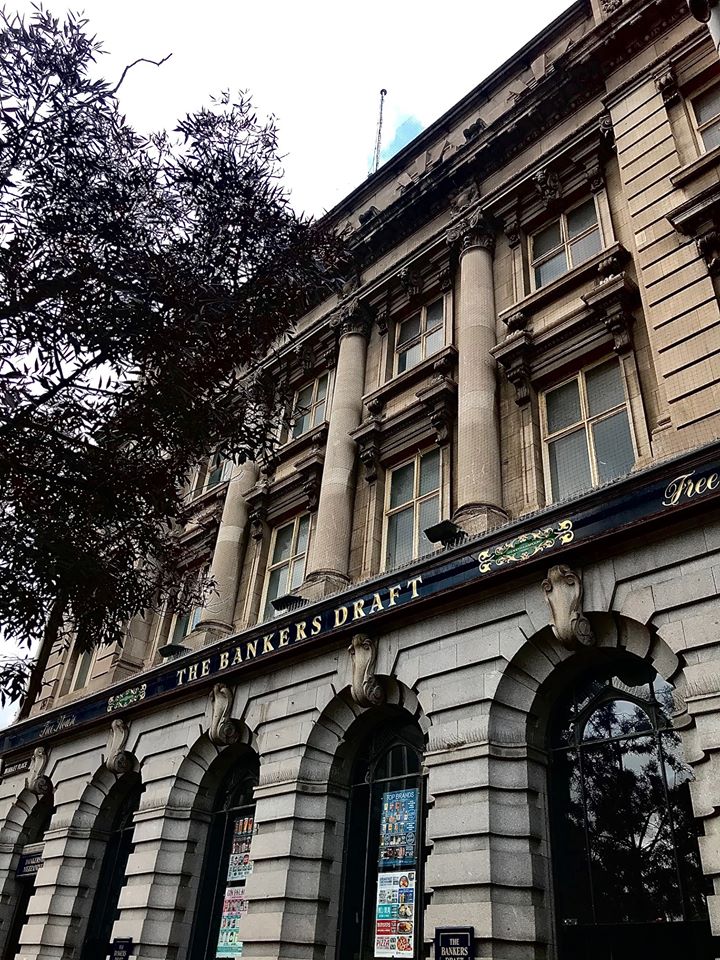
This building stands in one of Sheffield’s most historic parts and survives in an area that has changed considerably in the past eighty years. Thanks to the Blitz, the Hole-in-the-Road and Supertram, the environs show no resemblance to the day it was constructed.

These days we know it as The Banker’s Draft, a Grade II listed building, in Market Place, one of the first J.D. Wetherspoon pubs to open in Sheffield, but its origins goes back to the turn of the twentieth century.

In the old days, the three landmarks of Sheffield were the Castle, the Market Place and the Parish Church. When tradesmen recognised the Castle as less than a means of protection, they started clustering around the Market Place (or The Shambles), a place where they could face anyone proceeding towards the church, by means of High Street.

Markets had been held here since 1296, and its original buildings were replaced with picturesque timbered latticed gabled properties about 1752, and again around 1812.

Once, amidst the atmosphere of drapery, leather, grocery and hats, the place had a banking tradition, one that repeated itself later. Hannah Haslehurst and Son, departing from ancestral grocery, founded The Sheffield Old Bank on this spot, but it collapsed in 1785.

In 1901, the Market Place area was described as ‘an aching void,’ sharing the fate of similar early 19th century buildings, the homes of humble traders, that were demolished to make way for the York City and County Bank.

The bank was designed by Walter Brierley (1862-1926), a York architect, described as being the ‘Yorkshire Lutyens’ or ‘Lutyens of the North.’ He created 300 buildings across the north between 1885 and his death, mainly family mansions, churches, schools and banks. Brierley was also architect for North Riding County Council and the Diocese of York.

Construction started in 1901, the contractor being Sheffield-based George Longden and Son, and was finished in 1904.

Described as being Edwardian Baroque, built in Aberdeen granite and Italian marble, its interiors were lavish. A parquet floor was laid by the Acme Wood Flooring Company of London, with furnishings supplied by Goodall, Lamb & Heighway, manufacturers of high quality furniture, upholsterers and carpet warehousemen from Manchester.

Quite forgotten, is that the York City and County Bank had bought more land than it really needed. It rented out offices on the first, second and third floors, as well as the spacious basement (where remains of old stables can still be seen).

However, it was also proposed to build a first-class hotel next door, also designed by Brierley, that was never erected, probably the result of a long dispute with the council over its alcohol licence.

The York City and County Bank (established 1830) amalgamated with the London Joint Stock Bank in 1909, which itself merged with the London City and Midland Bank in 1919.

Despite the area being mostly destroyed during the Sheffield Blitz, the Midland Bank (as it became) survived unscathed, and remained open until 1989, before relocating to the end of Fargate.

Standing empty for a while, it was bought by J.D. Wetherspoon, operating as The Banker’s Draft ever since.

NOTES: –
Walter Brierley was the architect who designed several buildings in the village of Goathland, North Yorkshire, that were seen during the opening credits of ITV’s Heartbeat (1992-2010).

Market Place is now commonly known as Castle Square. However, Market Place is officially the paved area running in front of The Banker’s Draft, between High Street to Angel Street.