Categories
Other

Death by paralysis

It’s a question asked by more than one person here and has appeared in more than one story.

I’m sure that after this, some qualified and knowledgeable individual will say that everything I write here is a load of rubbish.

But being the curious type, I’ve attempted to investigate a cause of death attributed so many times in Victorian and Edwardian Sheffield, that being “death by paralysis,” and even ‘death by creeping paralysis.”

Nowadays, the cause of death of an individual is more precise, largely due to the advance of science and medicine. Back then, paralysis might have been assigned to a death certificate for any number of reasons, unknown then, but common to us today.

“Death by paralysis” or “death by creeping paralysis” might have covered any number of causes – botulism, either caught through eating infected food or through an infected wound; multiple sclerosis; vitamin B12 deficiency as a result of alcoholism or eating disorder; cervical spondylosis; and even motor neurone disease.

However, the terms were often used to avoid family embarrassment, because death was caused as a result of syphilis or alcoholism.

Syphilis was extremely difficult to cure. Often patients would think that their disease had disappeared or been cured, only to have their bodies betray them with a resurgence of symptoms.

Concealment of the sexual disease was common, and women expected not even to show knowledge of the disease, with infection of families by men widespread across all classes.

Victorian case notes on venereal-disease patients, often follow a dishearteningly familiar pattern. Having responded well to treatment, many relapsed several months or years later. Stigmatising infections, lengthy treatments and uncertain outcomes took an emotional toll on patients.

Nineteenth-century doctors took seriously the notion that a diagnosis of syphilis could trigger acute despair and melancholia.

In fact, the final stages of syphilis triggered brain disease, characterised by dementia, progressive muscular weakness and paralysis. Unsurprisingly for the times, many ended up in mental institutions, diagnosed as “General paralysis of the insane.”

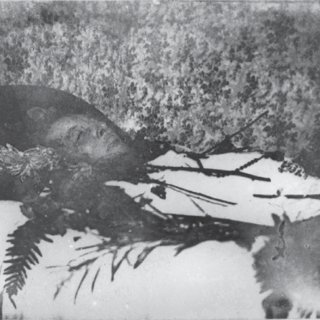
Oscar Wilde drew his last, laboured breath on November 30, 1900. He was only 46 years old. Ever since that moment, literary scholars, doctors and Wilde fans have argued about the precise cause of his death. The long-held theory was that Oscar Wilde succumbed to the ravages of tertiary, or end-stage, syphilis.

Categories
Buildings

The Ruskin Building

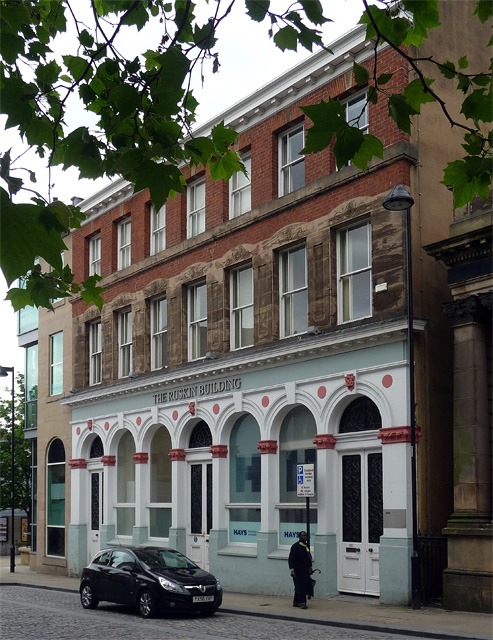
A few weeks back we looked at 95-101 Norfolk Street, constructed by Flockton & Abbot for Hay and Son, wine merchants, in 1876. The business lasted until 1970 and was restored to become the Ruskin Gallery in 1985. The museum closed in 2002 and the collection is now housed at the Millennium Gallery.

In recent times, it has been home to several businesses, the ground floor occupied by Handlesbanken, a Swedish commercial bank.

Now, the Ruskin Building is undergoing further renovation as The Bank, operated by Sheffield Theatres Trust.

The Bank is part of Sheffield Theatres’ The Making Room project, a network of local artists in collaboration with Theatre Deli, The Bare Project and Third Angel. The new venue will be used as a theatrical and reading space, a rehearsal area and basement storage. This is where the next generation of creative talent will be nurtured.

The project has been made possible after a financial gift from long-standing Sheffield Theatres supporters, Jo and Chris Hookway.

The former Handlesbanken bank was separate to the former Ruskin Gallery, divided by a partition wall. This will be reconfigured and allow the extension of The Crucible Corner, an adjacent bar and restaurant, providing room for 20 extra covers. The remaining part will be used for The Making Room venture.

The opening of The Bank, scheduled for late November, does not affect the historic fabric or architectural features of the Grade II-listed building.

Categories
Buildings

New Era Square

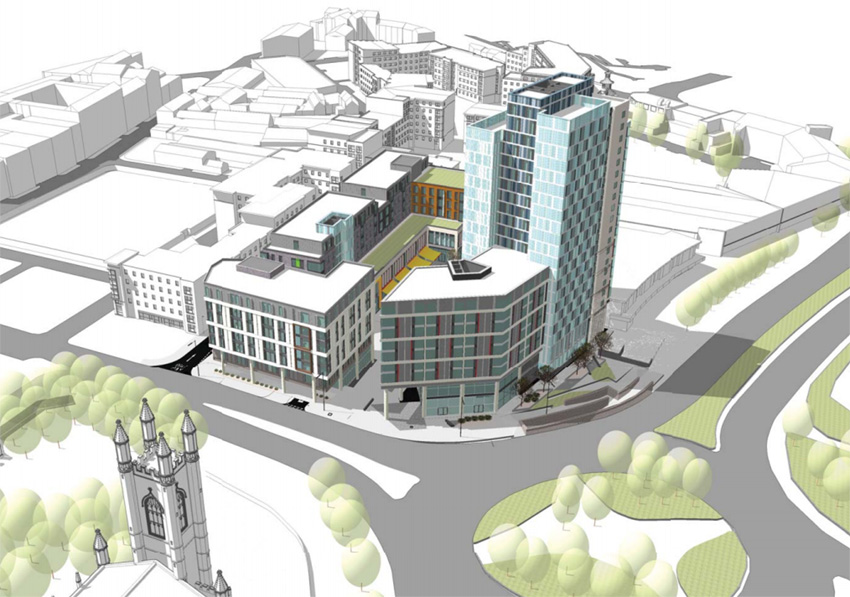
It is probably Sheffield’s longest-running construction project. New Era Square, at the corner of St. Mary’s Gate and Bramall Lane, seems to be taking an eternity to complete. Construction of the £66million project started in late 2015 with building work still ongoing four years later.

The residential and leisure development is the creation of Jerry Cheung, a UK-Chinese businessman, local property developer, restaurant owner, and chair of the Sheffield Chinese Community Centre.

Cheung is head of New Era Development (UK) Ltd, an international property development company based in Sheffield, founded in 2013 to develop large-scale Chinese-funded projects in the north of England.

Local media have dubbed their first project, New Era Square, designed by Hadfield Cawkwell Davidson Ltd, as “Chinatown” and “Sheffield’s very own version of New York’s Times Square.”

Building work is being undertaken by Derbyshire-based Bowmer & Kirkland with Phase 1 finished last year, consisting mainly of student living space.

Phase 2 is underway after £27million of funding from Barclays, and will include cluster student accommodation, restaurants, retail and office space, all built around a central plaza.

As construction moves towards completion, restaurants are already being lined up to move in.

This week, Oriental fine dining restaurant OISOI announced that it would be moving into New Era Square early next year.

The company is opening OISOI Gathering/The Party Room and The Artisan Patisserie and Bakery, providing a new concept in live music, in-house party bands and state-of-the-art holographic technology.

Categories
Companies

Henderson’s Relish

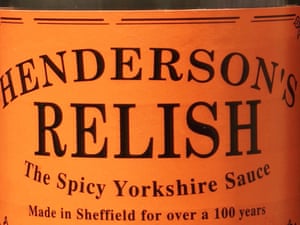
Henderson’s Relish is a Sheffield institution, poured over pies, stews, chips, almost anything, has its own unique flavoured crisp, and the secret of its recipe remains a closely guarded secret.

It is about as Sheffield as you can get, virtually unheard-of outside city boundaries, except for those cases exported to home-sick expatriates around the world.

Henderson’s Relish, Worcestershire sauce-like (without the anchovies), owes its existence to Henry Henderson, born at Walkeringham, Nottinghamshire, in 1850. He was the thirteenth child of Joseph and Hannah Henderson and grew up working on the family farm.

At 21, he left home and worked as an apprentice miller before setting up home in Sheffield with his first wife, Clara Cornthwaite, in 1874. In the early 1880s, Henry became a ‘drysalter’ – somebody who supplied salt or chemicals for preserving food, and somebody who might also have sold pickles, relishes and dried meat.

The Henderson’s set up home at 35 Broad Street, where Henry created a spicy Yorkshire relish in 1885, sold from his adjoining general merchant’s shop, and where customers returned their empty bottles to be refilled from huge barrels.

After Clara died in 1898, Henry remarried in 1904, Eliza Ann Swinterland, but suffered ill-health and made several attempts to sell the business, advertised as a Relish Manufacturer, Wholesale Druggist and Smallwares Dealer.

Henderson’s Relish was sold to Shaw’s of Huddersfield, pickles manufacturer, still in existence today, and appointed Charles Hinksman as General Manager.

Henry retired and lived at Beechwood House, Kenbourne Road, at Nether Edge, and died while on holiday at the Granby Hotel, Skegness, in 1930.

During the 1920s, the business moved the short distance, to Leavygreave Road, near the Jessop’s Hospital, where its small factory became a talking point. According to legend, nobody was ever seen entering or leaving the building.

In 1940, Hinksman bought the company from Shaw’s, renaming it Henderson’s (Sheffield) Ltd, and it has remained in the family ever since.

Harvey Freeman took over from his sister, Gladys, Charles Hinksman’s wife, in 1975, slowly growing the business, and it was handed over to Dr Kenneth Freeman in 1991, the man credited for the dramatic rise in the company’s fortunes. After he died in 2013, aged 92, his wife, Pamela, became its Managing Director.

In 2013, Henderson’s Relish sold the Leavygreave Road factory to the University of Sheffield, which had plans to develop the building as a Henderson’s themed pub. Production of relish was transferred to a new factory on J.F. Finnegan’s 58-acres Sheffield Parkway Business Park.

Stocked by supermarkets across the city, it’s a must for restaurants and takeaways, and woe betide anybody who compares it to Worcestershire Sauce, as did Lewisham MP, Jim Dowd, during a House of Commons speech in January 2014. He lived to regret his faux pas.

Categories
People

Dominic West

I sometimes think these posts ought to be called “They escaped from Sheffield.”

Dominic Gerard Francis Eagleton West. Born Sheffield, in 1969. Actor and producer. Educated at Westbourne School, Broomhill, Eton College and Trinity College, Dublin. First cousin, once removed, of American Thomas Eagleton, briefly the 1972 Democratic nominee for Vice President. West is celebrated for once spending four months as a cattle herder in Argentina.

Best known for The Wire (2002), Chicago (2002) and Tomb Raider (2018). Also famous for playing serial killer Fred West in ITV’s Appropriate Adult and appearing three times on the Crucible Theatre stage (The Country Wife, Othello and My Fair Lady).

West is married to Catherine FitzGerald, daughter of Desmond FitzGerald, 29th Knight of Glin, and lives in Shepherd’s Bush, London, and Glin Castle, County Limerick.

He’s also received an Honorary Doctorate from Sheffield Hallam University and an Honorary Degree from the University of Sheffield.

“When I meet anyone from Sheffield, they look at me sceptically, as if to say, ‘You don’t come from Yorkshire’.”

Categories
Buildings

Mulberry Bar & Venue

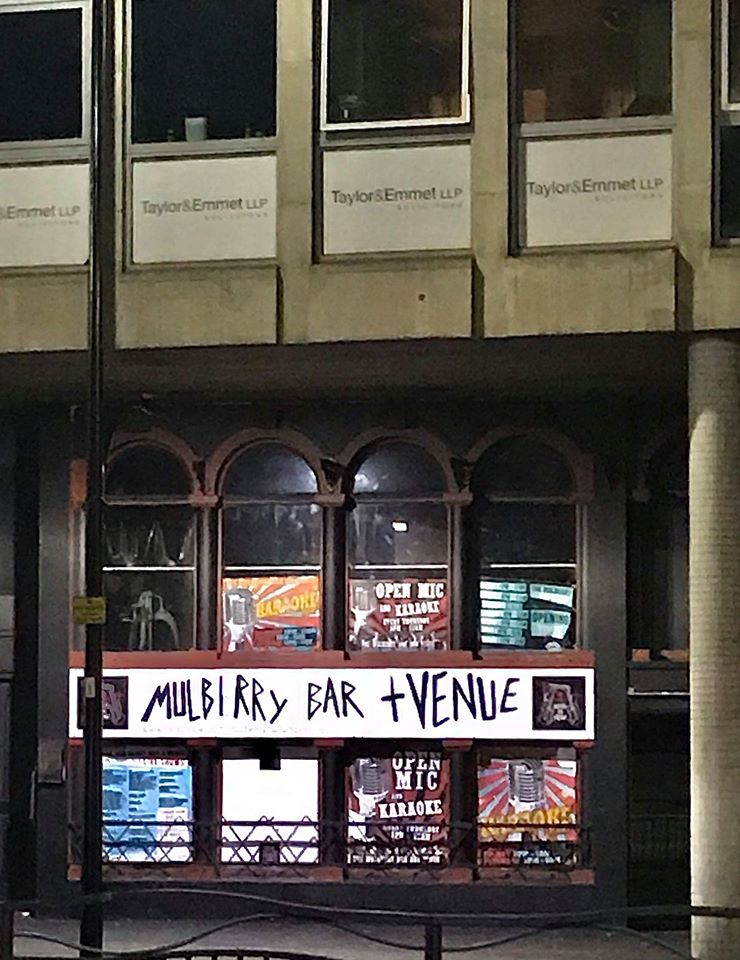
The Mulberry Bar and Venue on Arundel Gate is making a few waves on the Sheffield music scene. It follows a few years of decline for the Mulberry Tavern, empty in the 1990s, later reopening as Affinity, a short-lived gay venue.

However, it’s the name of the pub that gives us a clue to the history of the site.

This 1970s reincarnation is named after the original Mulberry Tavern on Mulberry Street, behind Arundel Gate, reputed to have been Sheffield’s second-oldest pub after the Old Queen’s Head in Pond Street. In fact, photographs from the 1960s show it as being called The Ye Olde Mulberry Tavern.

According to Sheffield City Council, both Mulberry Street and the Mulberry Tavern were named after a tree that once stood here.

How long is it since mulberry trees grew in Mulberry Street, a very unlikely site for a tree of any sort?

There is no Mulberry Street on Gosling’s plan of 1736, but it duly appears on Fairbanks’ map of 1771. At the earlier date the area was made up of gardens between High Street to Alsop Fields, through which Norfolk Street was later constructed.

But we can bring the date a little earlier because, in 1757, John Wesley’s Methodists turned what had been a warehouse in Mulberry Street into a Preaching House.

The street had been made through gardens in which, no doubt, there were mulberry trees – a more popular fruit than it is today.

Categories
Places

Heart of the City II

One thing is certain, Sheffield City Council will always attract criticism for its attitude towards old buildings. Local forums are full of scathing comments about its past performance, often unwarranted, but it has certainly made a few controversial and unpopular decisions over the years.

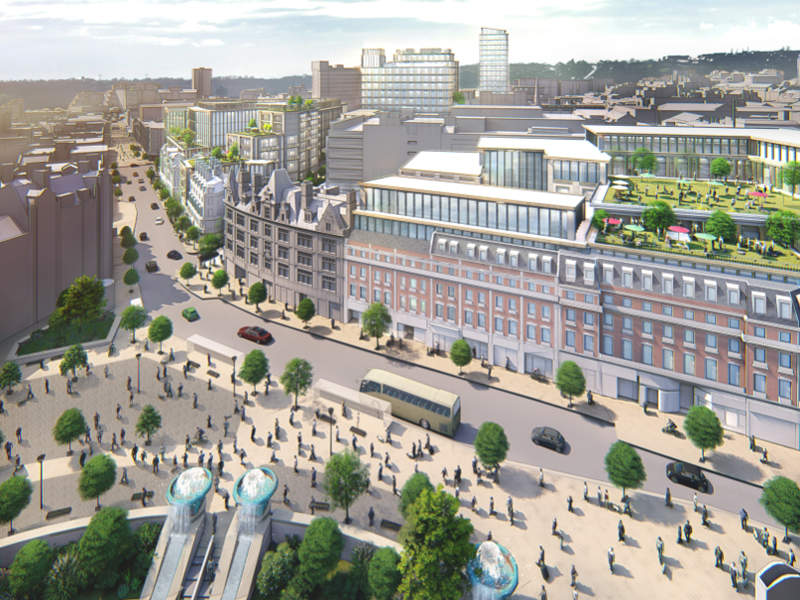
However, the Heart of the City II scheme looks on course with the makeover of Charter Square and the new £90million HSBC building already delivered.

The scheme is the inspiration of Sheffield City Council, along with its strategic development partner, Queensbury.

Demolition work is underway on Pinstone Street, Charles Street, Cambridge Street and Cross Burgess Street, with new buildings destined to rise behind existing Victorian facades.

The phased project will cost about £469million, funded with taxpayers’ money, and makes use of existing streets, with emphasis on extra office and residential space, and less on retail, reflecting the consumer switch to internet shopping. The few shops created will be used to attract premium retail brands. In addition, there will be restaurants, cafes, a food hall and two high-end hotels.

Heart of the City II essentially replaced the ill-fated Sheffield Retail Quarter, a scheme which would have involved moving the John Lewis department store and the demolition of several historic buildings.

For those not convinced, take a look at the original Heart of the City programme, initiated in 1994 to regenerate the city centre with new and improved public spaces, new public buildings and the redevelopment of the site of the Town Hall extension, known as the ‘egg box.’

It was managed by Urban One, an urban regeneration company set up by the government in February 2000, to facilitate development.

At the time, funding was provided by a £20.5million grant from the Millennium Commission and over £100million from the private sector and other sources.

The result was the transformation of the Peace Gardens, the construction of the Winter Garden, Millennium Gallery and the Mercure Hotel, as well as St. Paul’s Tower, ‘cheesegrater’ car-park and various new office blocks.

The development was completed in 2016, successful in attracting residents and visitors alike, and is arguably one of the most successful regeneration schemes ever seen in Sheffield.

Categories
Buildings

Millennium Gallery

I wonder if the Millennium Gallery will become one of Sheffield’s iconic buildings.

Considering this is a modern-build, the white concrete construction appears to have settled comfortably into the hillside around Arundel Gate.

To understand the origins of the Millennium Gallery, we must go back to 1994 when the Heart of the City redevelopment scheme was initiated. Part of the masterplan involved building a new gallery, part of the new century celebrations, linked to a Winter Garden and the Peace Gardens above.

In 1995, a competition was held inviting architects to submit proposals, subsequently won by London-based Pringle Richards Sharratt. Although the Winter Garden might be easily recognisable, public response to the Millennium Gallery has remained positive.

When it was completed in 2001, the Millennium Gallery provided 1,800 square metres of exhibition space, including permanent displays of the Ruskin Collection and the city’s metalwork and silver collections.

The architects had to overcome the sloping topography of the site, creating galleries on the upper level over a service undercroft. Escalators lead to a first floor avenue, used as an indoor street to the Winter Garden, and access to five galleries on the left side.

Look up and you’ll see the barrel vaults of fine white pre-cast concrete, complete with columns and beams of the same material. Glass blocks in the avenue’s roof vaults and north wall provide diffused natural light.

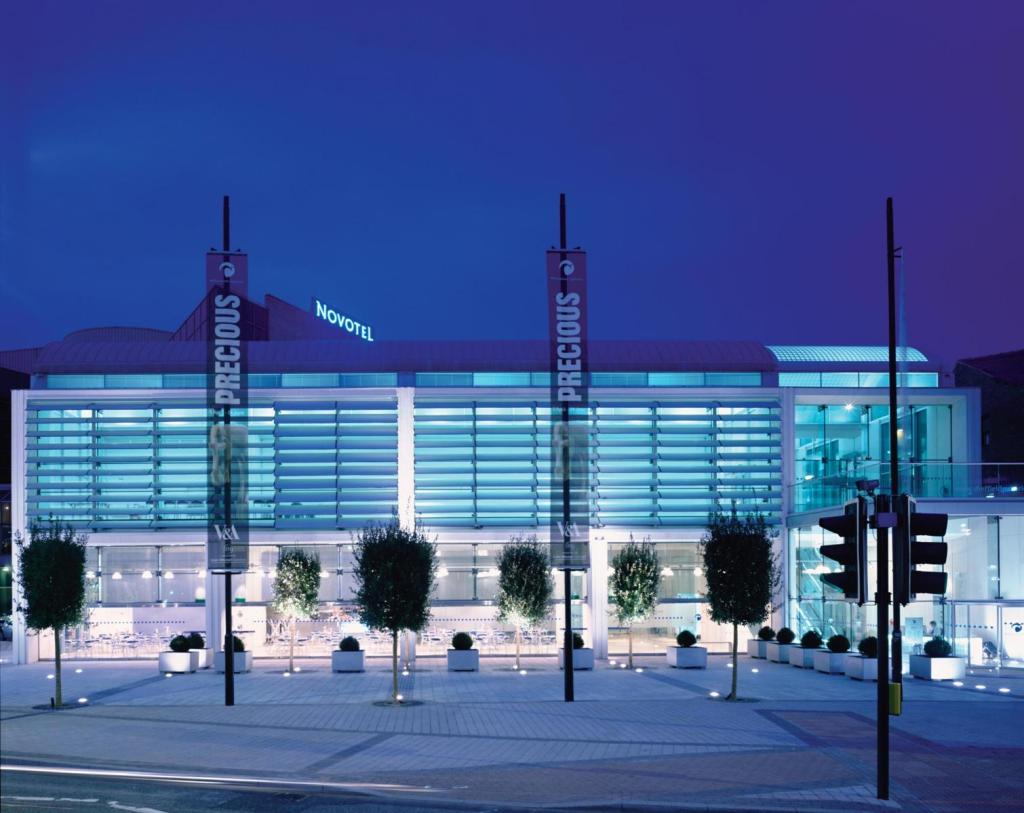
The largest gallery, Sheffield’s largest exhibition space, is flexibly planned with moveable full-height screens that run parallel with the vaults. It is here that the Millennium Gallery has staged major touring exhibitions, such as those from the Victoria & Albert Museum and Tate Gallery.

The last of the galleries contains the Ruskin Collection, separated from the Winter Garden by a glazed wall, with glass panels by Keiko Mukaide, symbolising water and clouds.

John Ruskin established a collection of material he hoped would inspire Sheffield’s workforce at the St. George’s Museum, Walkley, in 1875. The collection of watercolours, drawings, prints, plaster casts, minerals, illustrated books, manuscripts and coins is owned by the Guild of St. George (and managed by Museums Sheffield) and has had several homes in the city.

Categories
Streets

Barker’s Pool

A prominent street with a name that has been familiar for centuries. In Barker Pool, or Barker’s Pool as we now know it, we have the first attempt to give the inhabitants of Sheffield a constant supply of pure water.

The tradition is that one Mr Barker, of Balm Green, in 1434, took steps to make some sort of reservoir for the storage of water supplied by springs.

All we know for certain, is that in this year, there had been a “Barker of Balm”, and that there had been a William Barkar in 1379.

“Barker Powle” is mentioned in a deed of 1567, and in 1570 the Burgery was ‘amerced’ in the sum of 3s. 3d., paid as a fine, or rent, to the Lord of the Manor, for the pool.

From this date until 1786, the cleansing and keeping of the pool was acknowledged as one of the specific charges upon the town property.

Indeed, we can bring it to a later date than this, for after the pool, superseded by a more efficient water supply, had been removed as a nuisance in 1793, the Town Trustees put up a pump nearby which remained, although unused in later years, until 1876.

The pool was an oblong, walled space, about 36 yards by 20, not quite right-angled, for it was slightly wider at its upper than at its lower end, and ran across what eventually became the entrance to Division Street.

It appears that Barker Pool was, on occasion, used for ducking undesirable characters, for in the constables’ accounts for 1654, there is a charge for bringing the cucking stool (from Lady’s Bridge) up to Barker Pool. (Cucking stools or ducking stools, were chairs used for punishment of disorderly women, scolds (troublesome and angry people who habitually chastised, argued and quarrelled with their neighbours) and dishonest tradesmen.

We get our best description of the part the pool played in the local economy from the autobiography of Samuel Roberts in 1849.

In it, he gives a vivid account of the excitement caused amongst residents in the streets down which the channels passed, when periodical flushings afforded a general clean-up of the town: –

“All the channels were then in the middle of the streets which were generally in a very disorderly state, manure heaps often lying in them for a week together. About once every quarter the water was let out of Barker Pool, to run into all these streets into which it could be turned, for the purpose of cleansing them. The bellman gave notice of the exact time, and the favoured streets were all bustle, with a row of men, women and children on each side of the channel, anxiously and joyfully awaiting, with mops, brooms, and pails, the arrival of the cleansing flood, whose first appearance was announced by a long, continuous shout. Some people were throwing the water up against their houses and windows; some raking the garbage into the kennel; some washing their pigs; some sweeping the pavement; youngsters throwing water on their companions or pushing them into the widespread torrent. Meanwhile a constant, Babel-like uproar, mixed with the barking of dogs, and the grunting of pigs, was heard both above and below, till the waters, after about half an hour, had become exhausted.”

Barker Pool was also used when fires broke out in the town, water being let out of the reservoir, and leather buckets hung in the Church and Town Hall for residents to use. By 1703, the Town Trustees had improved on this by providing a fire engine.

And that, as they say, is the history of why we call it Barker’s Pool all these years later.

Categories
Companies

Bassetts

When George Bassett died in May 1886, his death merited an obituary in local newspapers, largely because he was an ex-alderman and former Mayor of Sheffield.

In the last years of his life a stroke had partly paralysed him, providing plenty of time for him to reflect on his life and achievements.

However, when he finally passed away at his Endcliffe home, the result of a fourth stroke, he died not knowing his legacy would one day become world famous.

George Bassett was born at Ashover, Derbyshire, in 1818, where his father was a small farmer and landowner, and his ancestors had lived for generations.

As a young man, he was apprenticed to William Haslam, a Chesterfield confectioner in Low Pavement, and afterwards moved to Sheffield where he started his own confectionery business in Broad Street, Park, in 1842.

Described as a “Wholesale Confectioner, Lozenge Manufacturer and British Wine Merchant,” Bassett started selling to druggists and shopkeepers elsewhere, boasting that he was always “in stock of lozenges, comfits, pipes, acid drops, jams, juice, candied lemon, Carr’s Fancy Biscuits, American soda biscuits, nuts, pickles, fish sauces, Firkin Butter and lard.”

On reflection, it appears that although confectionery was a large part of George Bassett’s business, he was better known as a wholesale merchant, selling tea, coffee, sugar and general provisions to shops around the town.

He subsequently opened another shop in the New Market Hall, another in West Bar and additional premises at Snig Hill.

Although considered to be a retailer, Bassett ultimately became a manufacturing confectioner, and in 1859 opened a steam-powered factory in Portland Street, by the Royal Infirmary, considered to be the largest and most complete in the country. To achieve this, he had gone into partnership with William Lodge, renaming the company as Bassett and Lodge, and choosing to dispose of the retail business.

The partnership was dissolved in 1861 and a few years later, Bassett entered business with Samuel Meggitt Johnson (1837-1925), one of his former apprentices, a liaison that lasted until George Bassett’s death, after which Johnson assumed sole control of the firm.

By 1871, Bassett employed 150 people, and at the time of his death, the company was the largest confectionery manufacturer in the country.

Nevertheless, George Bassett was more famous locally as a public servant. He became a member of the Council in 1851, when elected as one of the representatives of the Park Ward. In 1873, Bassett was raised to the aldermanic bench, and in 1876, just twenty-five years after first entering the council, he was unanimously elected as the Mayor.

During his mayoralty, the former United States president General Ulysses S. Grant, paid a visit to Sheffield, and was a guest at both Bassett’s Endcliffe Crescent home and at a banquet given in his honour at the Cutler’s Hall.

Like many Victorians, Bassett was a religious man, a Wesleyan Methodist, fulfilling many roles for the church, and generously contributing to its funds.

As well as his own confectionery business, Bassett also took up directorship roles at the Union Banking Company as well as at Earle’s Shipbuilding Company.

He married twice, his first wife was Sarah Hodgson, daughter of Joseph Hodgson, iron merchant, who died in 1861, and with which he had six daughters. His second wife was Sarah Ann Hague, daughter of Mr Hague of Broad Street, who survived him and provided two sons.

The grave of George Bassett can still be seen today, amidst dense vegetation, at the Sheffield General Cemetery.

But what became of the business after his death?

Under Samuel Meggitt Johnson the company flourished, concentrating on lozenges, candied peel, and liquorice confectionery, enjoying nationwide distribution and developing a considerable export trade.

The birth of liquorice allsorts took place in 1899, and will always be associated with Charlie Thompson, of York, a representative of the firm for nearly 60 years. The various units which make up the selection known as liquorice allsorts had been sold separately for many years.

One day, Mr Thompson, when calling on a customer in Leicester, tripped over the doormat and spilled his tray of samples of these units on the floor. As he was gathering the sweets together into a heap with his foot, the customer was struck by the attractiveness of the resultant assortment, and forthwith placed an order – “for all sorts.”

The new line met with instant success and was eventually imitated by manufacturers throughout the world.

The rapid expansion of sales which followed the introduction of liquorice allsorts taxed the firm’s productive capacity, despite having opened the Don Works, on Bridge Street, in 1899. Accordingly, a new factory was built at Owlerton in 1900 to take over the manufacture of candied peel and glace cherries under the subsidiary company of Samuel M. Johnson & Sons.

Sales of confectionery continued to grow at such a rate, however, that soon the new Owlerton factory had to help the Portland Street factory by producing confectionery as well.

Samuel Meggitt Johnson died in 1925, and subsequently George Bassett was incorporated in 1926 with a capital of £350,000.

The Don Works closed in 1927, but manufacturing continued at Portland Street and Owlerton. In 1933, the directors gave up production of peel and cherries and concentrated on confectionery, at the same time centralising all manufacturing activities at the Owlerton premises.

Accordingly, a new four-storey factory was built to take over the whole of liquorice allsorts production and was in operation by 1934.

Business boomed, hindered only by the Second World War, producing liquorice allsorts, a wide range of gums, pastilles, jellies, mixtures, pan lines, mints, lozenges, and medicated confectionery.

In 1961, George Bassett acquired W.R. Wilkinson of Pontefract, followed by Barratt’s, a leading children’s confectionery manufacturer, in 1966.

However, by the 1980s Bassett’s had fallen to third place in the British sugar confectionery market, behind Trebor and Rowntrees, and was acquired by Cadbury for £91million in 1989, merging the businesses of Pascall-Murray and Lion into the larger Bassett concern.

Later that year, Cadbury-Schweppes bought Trebor for £110million, renaming its sugar confectionery subsidiary Trebor Bassett.

These days the company is a brand of Cadbury, owned by Mondelez International, the Owlerton factory making iconic brands like Liquorice Allsorts, Jelly Babies and Trebor Extra Strong Mints. In addition to this, the Sheffield site also produces Ritz Crisp & Thins, and has also been used to produce the company’s Oreo and Belvita biscuit lines.

Look in shops today and you’ll see a wide range of products under the Maynards Bassetts branding.