Categories
Buildings

Telephone House

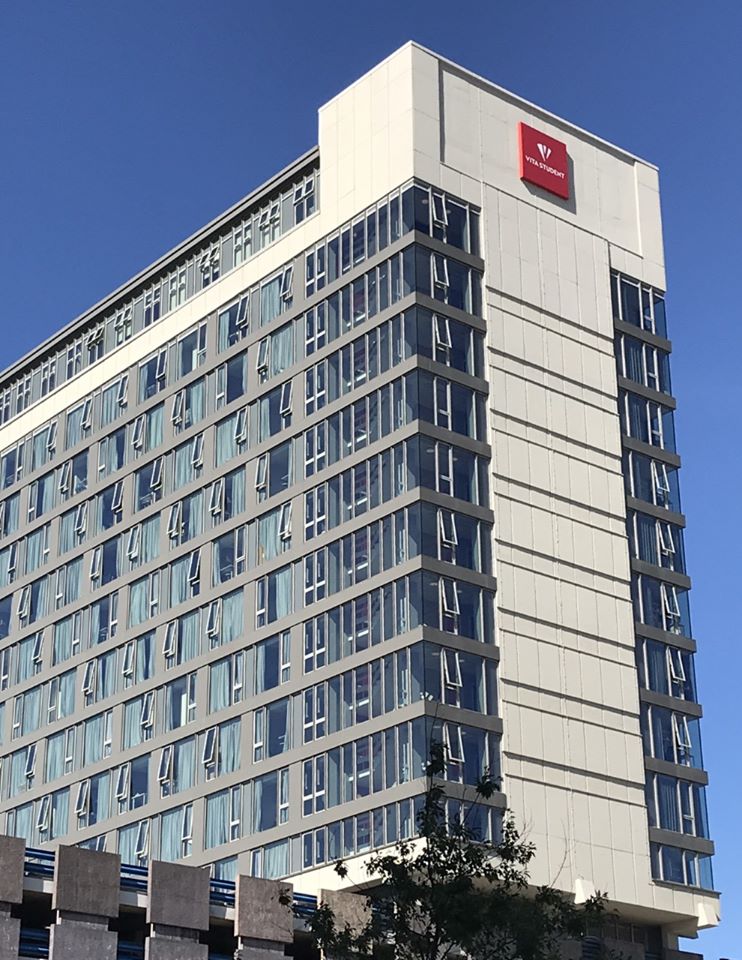
We all watched with interest when Telephone House on Wellington Street underwent mega-renovation a few years ago.

Sheffield’s thirteenth tallest building, standing at 56 metres, was typical of late sixties office blocks that leapt up around the country.

After World War Two, the city adopted a comprehensive redevelopment plan for the area between Cambridge Street and Upper Hanover Street. Part of this strategy allowed the General Post Office (GPO) to build a 15-storey glass-fronted block in place of old housing.

Building started in the late 1960s and was completed by 1972. It was used to manage the telephone network in the area while parts of the lower building included independent retail units as well as a multi-storey car park. Yorkshire Television (YTV) later installed technical equipment on the roof linking the studio in Charter Row to its Leeds studios.

Telephone House was subsequently re-badged with a huge BT logo when the GPO became British Telecommunications in 1980.

In 2012, BT announced it was closing Telephone House and selling the property to a business consortium, Ace Liberty and Stone, which intended to sell-off parts of the building to developers. BT vacated the building in October with the loss of around 400 jobs.

In March 2014, the tower block section, excluding the retail units and car park, were sold to Vita Student, a developer, which converted the offices into ‘high-standard’ apartments for students. The project started in July 2014, costing £35million, and involved complete refurbishment of the interior as well as an exterior facelift. A sixteenth floor was added containing 14 luxury penthouses and suites.

Work finished in August 2015 leaving Telephone House offering ‘the World’s best student accommodation’ – SMART TVs, big double beds and large kitchens – as well as communal facilities including cinema, entertainment areas, gym, laundry and a library/study area.

The accommodation isn’t cheap, anywhere between £176 to £260 per week – and has appealed to foreign students, with deep pockets, attending both universities.

Categories
People

James Fox

Imagine you are a famous actor, at the top of your game, and have just appeared in a movie with Mick Jagger. And then you give it all up and move to Sheffield to become a travelling salesman. This story has done the rounds since the 1970s and yes, it is all true.

William Fox, born London 1939, was the son of theatrical agent Robin Fox and actress Angela Worthington. He first appeared on film in 1960 in The Miniver Story but was working in a bank when director Tony Richardson offered him a minor role in The Loneliness of a Long-Distance Runner.

Under his stage name, James Fox, he went on to star in The Servant, King Rat, Thoroughly Modern Millie, Those Magnificent Men in their Flying Machines and The Chase. Handsome and appealing, Hollywood was calling, but there was a problem.

After playing alongside Mick Jagger in Performance in 1968 (not released until 1970 owing to its sexual content and graphic violence), James Fox was in a crisis.

“There were so many things that caused tension in me,” he said. “Working on Sundays, making love on screen and using bad language.”

The result of this self-torture was that Fox turned to religion. In 1970 he joined a Christian group called The Navigators, his involvement the subject of a BBC documentary, Escape to Fulfilment, in 1971.

“When it was over, I had to decide what to do in the longer term. I had met another Christian, Alan, from near Sheffield, that summer, and we immediately became friends. He was an administrative manager with British Steel at Stocksbridge. He invited me to come north to live with his family.

“I was told that I’d have to get a job, so I bought a copy of the Sheffield Morning Telegraph and sat down in Barker’s Pool to study it. Just about the only job I could see that I could do was as a salesman and there was a vacancy for a post with Phonatas, to get new clients for their office telephone sterilising service in the Sheffield and Rotherham area.

“On my first day at work, I went to London Road. My second stop was a car showroom. The manager interviewed me. ‘You’re James Fox, aren’t you? What on earth are you doing here?’ I told him I wanted him to sign up to have five phones cleaned weekly and that I’d come to live in Sheffield and was doing this as a job. I was given the contract by the incredulous manager.”

For the next eighteen months he toured every business district in Sheffield and Rotherham, the evenings spent making evangelism visits, attending meetings and Bible studies.

Attracted by the estate agency business, Fox moved to T. Saxton and Co, to become an assistant in its commercial property department. During the summer of 1972 he met Mary, a nurse, whom he married the following year and set up home at Oughtibridge.

“I went to the office each day by bus down London Road, which I had walked so many times as a salesman, and in the evening, I came home to my wonderful wife and her cooking.”

After he was offered a chance to join the staff of The Navigators, Fox and his wife finally left Sheffield and moved to Leeds in 1974.

By the early eighties, suitably refreshed, Fox decided to return to acting. The first role he was offered was playing opposite Meryl Street in The French Lieutenant’s Woman, a role he understandably turned down.

In the end, his comeback involved several dramas for the BBC before hitting the big screen again with Greystoke: The legend of Tarzan, Lord of the Apes, A Passage to India and Absolute Beginners.

Since then, Fox has enjoyed a second career on stage and screen, although often overshadowed by acting brother, Edward Fox.

James and Mary Fox have five children – Thomas, Robin, Laurence (DS James Hathaway in Lewis), Lydia and Jack, the youngest two also capable actors. He is, of course, also uncle to other acting offspring – Emilia and Freddie Fox.

The Sheffield connection may now be forgotten, but when James Fox appeared on Desert Island Discs, he chose Oft in the Stilly Night by the Bolsterstone Male Voice Choir, as one of his eight discs.

Categories
Buildings

Prudential Assurance Building

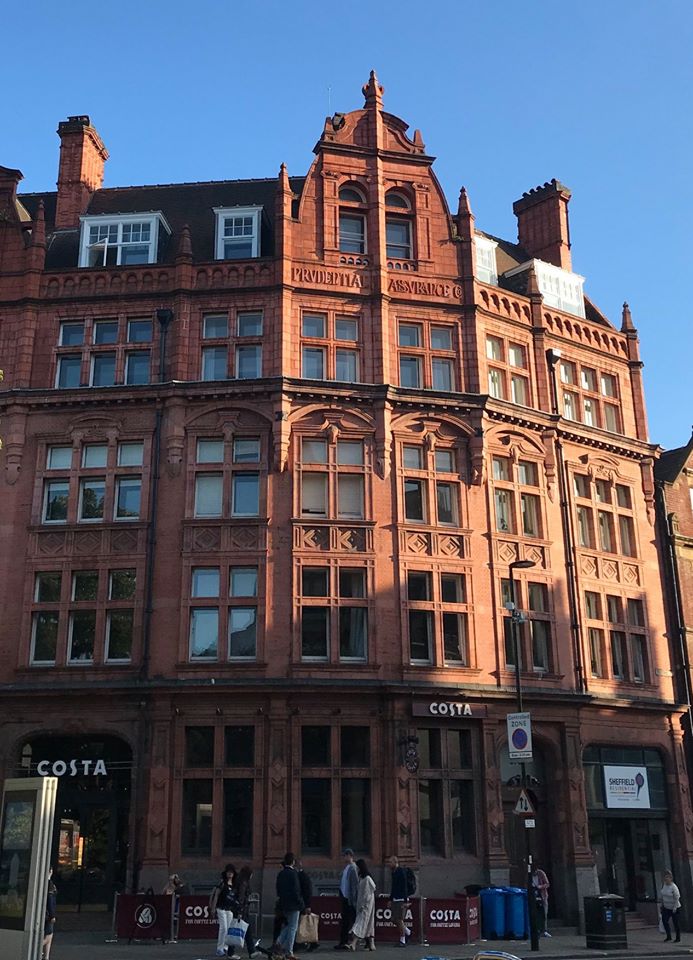
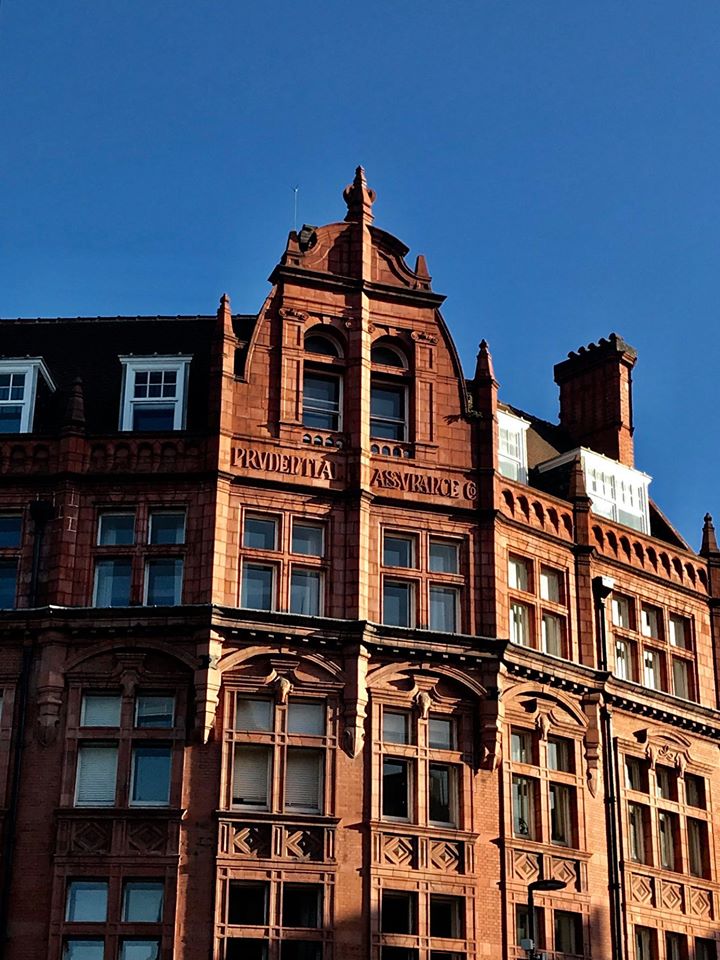
I think this is one of the finest looking buildings in Sheffield. Also, special because it was designed by Alfred Waterhouse, responsible for Manchester Town Hall and the Natural History Museum in South Kensington.

Looking into the history of the Prudential Assurance Building also reveals one of those ‘I never knew that’ moments – the fact that for twelve months, at least, part of it was used as a hotel.

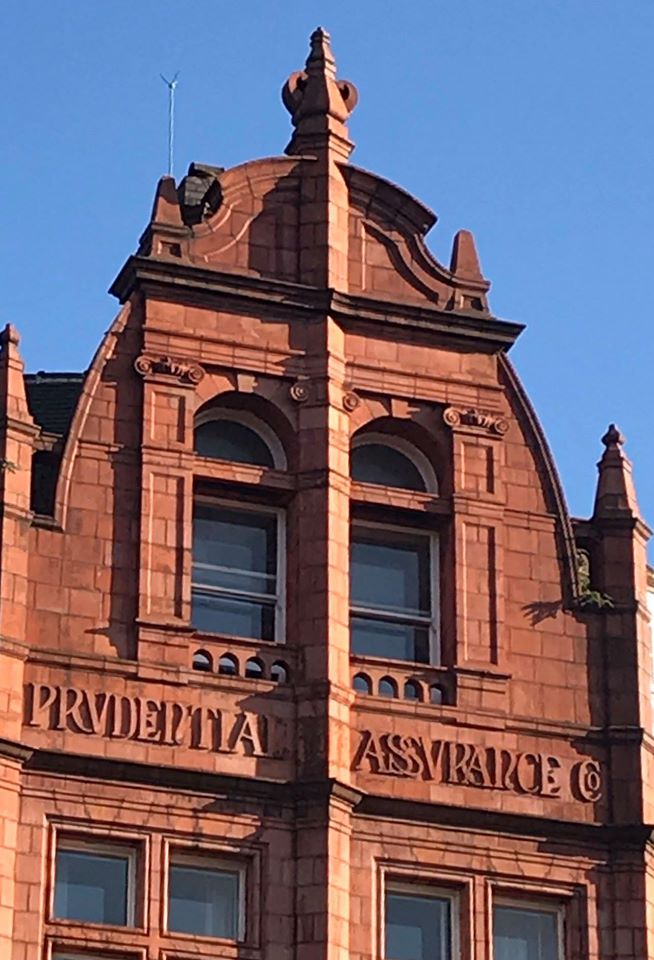
The Prudential Assurance Building is an imposing Grade II-listed property built in 1896 on Pinstone Street adjoining what was then St Paul’s churchyard (now the Peace Gardens). It was the latest in a series of constructions that appeared around the country, designed by Alfred Waterhouse and Son, London, for Prudential Assurance.

Often built in red brick with a granite plinth and the company’s favoured terracotta dressings from J.C. Edwards of Ruabon, these handsome Renaissance-Revival buildings were to be seen in London, Liverpool, Manchester, Leeds, Bradford, Glasgow, Birmingham, Newcastle, Portsmouth, Leicester, Dundee and Nottingham. The exception was Edinburgh, where the authorities objected to the use of terracotta and insisted on stone instead.

This was boom-time for the insurance industry. At the end of 1896, Prudential Assurance had twelve million policies in force within its industrial division – one third of the population of Great Britain – with a further 500,000 policies taken out at its ‘ordinary’ division. These generated a combined income of £7million and assets worth £27million.

The cost of the building and land in Sheffield was £25,000, a large sum but easily affordable for the company. The shape of the land also posed a problem resulting in the absence of corridors throughout.

The building contract was given to the Sheffield firm of George Longden and Son, work starting in 1896 and completed the following year.

There were two entrances.

On the left, a door led into the main offices, designed to impress the visitor, elegantly fitted and decorated. There was a glaced faciene from the Bormantoft Works and the fittings were Spanish mahogany and American walnut.

To the right, there was a staircase and lift leading downwards to a spacious restaurant tenanted by Mr William Bird, and upwards to offices (subsequently let off) and to a billiard and other rooms connected with the restaurant. A shop to the right of the door (still there) also formed part of Mr Bird’s tenancy.

William Bird, caterer and refreshment house-keeper had opened Bird’s Restaurant on (New) Surrey Street in 1895 (in part of the building most recently used by Halifax Bank). He took out a lease in the Prudential Assurance Building and, as well as opening another restaurant, created thirty bedrooms above, as well as coffee, billiard, sitting and commercial rooms – all under the guise of Bird’s Hotel.

The hotel lasted just twelve months, and in 1898 William Bird executed a deed of assignment, meaning he had to give up the property and contents for non-payment of rent to the Prudential company.

His restaurant on Surrey Street also collapsed in 1901 when receivers were called in.

In modern times, Prudential Assurance vacated the building, its ground floor converted into a shop for Laura Ashley, and latterly turned into Costa Coffee.

Categories
Buildings

Sheffield Town Hall

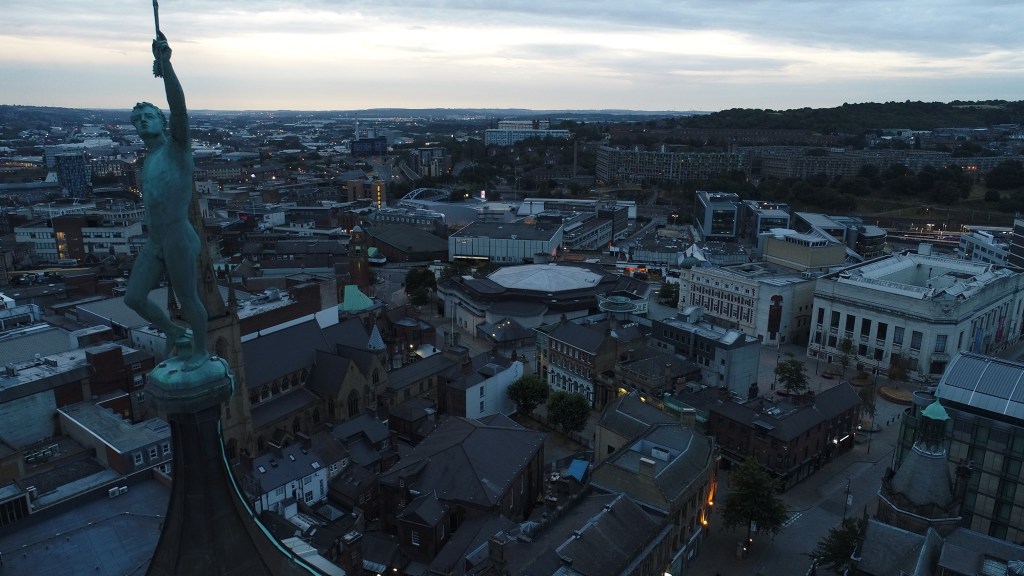
This extraordinary photograph was taken by Paul Stinson of Hovaloft Drone Aerographics. It shows the bronze statue of Vulcan on top of Sheffield Town Hall, created in 1896 by artist Mario Raggi.

This muscular male nude has protected the city for 123 years, seeing us through two World Wars, but almost forgotten by people below.

Darcy White and Elizabeth Norman in Public Sculpture of Sheffield and South Yorkshire provide the life story of this undoubtedly cold naked character.

Vulcan, the symbol of Sheffield, has a hammer in his right hand (not seen here), his right foot rests on an anvil and in his left hand, held aloft, he carries three arrows.

The Roman God of the furnace is the patron of all smiths and other craftsmen who depend on fire. He was adopted as a symbol of the city in 1843 and the idea of including a figure as part of the Town Hall design came from the architect, Edward William Mountford.

The figure was modelled from a Life-guardsman and for a long time the original plaster was on show at the Mappin Gallery until it became too badly damaged, due to frequent moving to avoid air raids during World War Two and was broken up and discarded.

Mario Raggi (1821-1907) was born at Carrara, Italy where he learnt to sculpt, although much of his reputation was made in England, where he first exhibited busts at the Royal Academy in 1878 and continued to do so until 1895. Settling in England in 1880, he set up a workshop at Cumberland Market in north London. He was given some major commissions; memorials to Benjamin Disraeli at Parliament Square and Gladstone at Albert Square, Manchester.

Categories
Buildings

Showroom Workstation

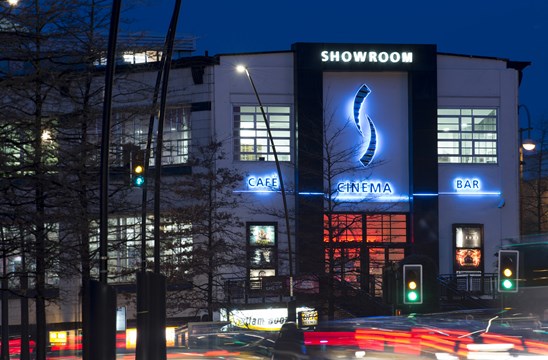
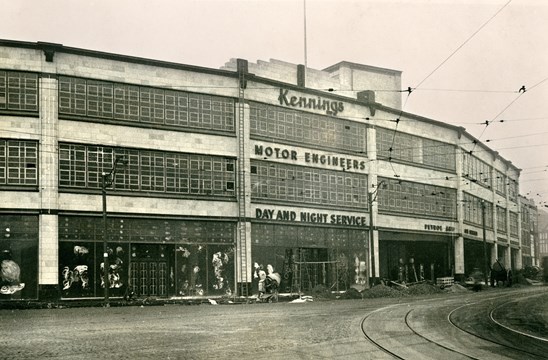
We all know this art-deco building as the Showroom Workstation, but to an older generation this was once called Kenning House. It was designed in 1936 by Frederick William Tempest, a Mansfield architect, as a garage and showroom for Kennings Ltd.

The building was officially opened in December 1937 by William Morris, 1st Viscount Nuffield, the millionaire founder of Morris Motors, and a friend of George Kenning (1880-1956), a Clay Cross businessman who started by hawking paraffin in Derbyshire villages, progressing by way of bicycles, motor-cycles and motor cars.

By the time this Sheffield garage was built, George Kenning was head of thirty companies, which owned between 30 and 40 garages, and was the biggest distributor of Morris Cars in the provinces.

The Sheffield Independent reported that Kenning House was “an imposing structure which struck a pleasing modern note with its cream faience intersected with black faience dressings.”

It was called Sheffield’s ‘wonder garage,’ designed “to show London, Paris, New York – the whole world, the way in garage development.”

The building was the brainchild of George’s son, Frank Kenning, built on three floors with frontages on two main thoroughfares. Two street levels had to be overcome in construction – the ground floor approached from Leadmill Road, the middle and upper storeys from Paternoster Row.

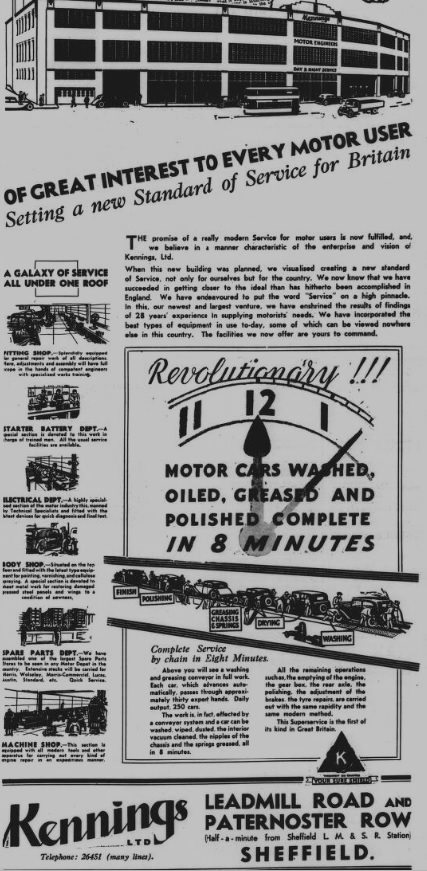
Kenning House had equipment never equalled at any garage in the British Isles. In addition to state of art repair bays, the ground floor contained a 126-foot long chain-driven car valeting line, manned by a squad of thirty men, washing and lubricating at a rate of one car every eight minutes. (A massive 5,000-gallon water tank was installed to service the plant).

“The businessman has no time or inclination to wash his own car and give it the attention by which alone he can expect a long life from it,” said George Kenning. “By this new equipment he can have his car serviced while he smokes a cigarette.”

At the end of the conveyor, a three and a half ton lubricating unit and flush-fitting lift was installed, while a covered petrol pump station was built near the main entrance.

Built at a cost of £100,000, this was undoubtedly Kennings flagship garage and showroom.

The huge structure, using 650 tons of steel, was designed, fabricated and erected by Plowright Brothers of Chesterfield. Construction was by C.H. Hill and Sons of Mansfield, while bricks were provided by the Woodside Brick Company on Chesterfield Road.

Hodkin and Jones supplied 20,000 pre-cast terrazzo tiles and the metal windows, ‘Eclipse’ patent roof glazing and lantern lights were provided by Mellowes & Co of Sheffield. Industrial lighting was installed by the General Electric Company.

In the 1960s a roof extension was added, but the garage closed in the 1970s, overtaken by out of town developments. It stood empty before Sheffield City Council bought the property in 1983, intending to develop the site as a long-term replacement for the Anvil Municipal Cinema at Charter Row.

In 1989, the ‘Showroom Project’ was launched by Sir Richard Attenborough, initial structural work starting the following year, with plans devised by Allen Tod and Tatlow Stancer.

Screens one and two were opened by Sir Sydney Samuelson, the first British Film Commissioner, in 1995, and two more screens launched by actor Pete Postlethwaite three years later.

The entrance foyer from Sheaf Square leads into an atrium created from the original vehicle lift to the first-floor repair shop.

Nearly a quarter century later, the Showroom Workstation continues to be an independent cinema, café bar and creative workspace, central to Sheffield’s Cultural Industries Quarter.

Categories
Other People

A Cornish mystery

Here’s a story that goes back to November 1912… one that takes place in Newquay, on the Cornish coast, but involves two people with Sheffield connections. This is a mystery that captured the attention of the British people and one that has never been solved.

On Saturday November 23, 1912, Marian Nowill, the wife of Sheffield merchant Sidney Nowell, went missing from the Atlantic Hotel at Newquay, Cornwall.

Nine days later her body was recovered from the sea near the hotel.

Her husband was Sidney Nowill (1851-1920), second son of John Nowill, who had left England when he was 15 years old, to be educated at the Greek College near Constantinople. After being apprenticed to a Scottish merchant he started his own business, later joined by his brother, Stephen, acting as overseas brokers for the family firm of John Nowill and Sons, Sheffield-based knife manufacturers. In time, Sidney Nowill and Co, extended business to other Sheffield firms and opened an office in Athens.

He lived abroad up until his marriage to Marian Foster (born 1877), whom he had known since she was a baby. When they married in 1900 Sidney was twenty-six years older than Marian. The couple settled at Sandygate House, 94 Ivy Hall Road, Sheffield, but Sidney made annual visits to Constantinople and Athens, and to Egypt every three years.

It was while the couple were travelling by boat to Port Said in 1910 that they met James Arthur Delay, a retired Singapore solicitor. The three of them became good friends and Delay was a regular visitor to Sandygate House.

In November 1912, Delay arrived at the Atlantic Hotel in Newquay, later joined by Marian Nowill and her mother. It didn’t take a lot of imagination for other guests to realise that Marian and Delay were involved in a romantic affair. The two played golf each day and spent most evenings together. She was described as a cheerful individual while Delay was often morose, nicknamed by guests as ‘The Singapore Tiger’.

On the night of November 22, they had dinner and talked for a while in the hotel lounge. She retired to bed and was seen at breakfast the following day, guests noticing distinct coolness between Marian and Delay. She appeared to be pre-occupied, very absent-minded, and repeatedly asked hotel reception about train times to London. She told her mother that Delay was “a bad lot,” subsequently accusing him of taking her purse.

In the afternoon, after returning from a walk with Delay she went out again wearing her golfing clothes, promising to return for tea, but was never seen again.

For two days, the lonely coast was beaten by search -parties, the man who was her intimate friend aiding in the quest. Delay was grief -stricken and in the middle of one search tried to throw himself off a cliff but was prevented from doing so by a coastguard.

At 11 o’clock on the Sunday morning Delay posted a letter, to whom it was never determined. In the afternoon he remained in the hotel, very depressed, later going to his room. Late on Monday his door was forced, and Delay was found hanging by braces from the hook in the door.

For more than a week the country was riveted.

Sidney Nowill travelled to Newquay to be close to the search, seemingly oblivious to the tragic liaison between Marian and Delay. There had been reported sightings across the country, but Sidney thought her dead, and nine days later, just as a telegram arrived stating she had been ‘seen’ in Southport, a body was spotted in the sea.

At three o’clock in the afternoon, a local fisherman, Joseph Harris, was looking over cliffs near to the Atlantic Hotel, when he observed the body amidst rocks and foam. The police arrived as did hundreds of people, including Sidney Nowill, while Coastguard Noad descended a rope ladder. He reached the safety of the sand, despite the huge breakers dashing over the rocks, and managed to secure the body that had become wedged. Despite it being dreadfully mangled the body was identified as being Marian Nowill. It had been high water for the previous nine days, and it was presumed that the body had been lodged, only to emerge at the next low water.

It was only afterwards that events took a sinister turn.

During the inquest a coastguard recalled seeing Marian and Delay on their morning walk. “The gentleman would walk a few yards and then take hold of the lady’s hand. She would push him away and appeared to have an altercation.”

We can only speculate as to the cause of the argument.

However, when Delay’s will became public, it revealed that he was in fact married, a situation unknown to his family and friends. He had wooed Mary Leslie Young, convincing her to leave her husband, Edward, a solicitor’s clerk. After marrying her in New York in 1911 she had settled in London, apparently oblivious to her new husband’s double-life. Was it this information that had caused a rift between Marian and Delay?

Even more sensational, was the news that Delay had left £30,000 to Marian Nowill. In time, Sidney Nowill managed to convince the Coroner to record Marian’s death as being on Saturday 23 November, two days before Delay’s suicide, therefore forfeiting any claim to the money.

And this is where the story ends, still a mystery all these years later.

Was Marian alone when out walking that fateful afternoon? Was she pushed? Did James Delay follow her? Why did he take his own life? Was it guilt, or was he simply grief-stricken? Did Sidney know more than he revealed? Or was it all just a terrible accident?

Sidney Nowill returned to Sheffield, immersed himself in business affairs, and in his last three years suffered failing health. He died at Sandygate House in 1920, the newspaper obituaries failing to mention anything about Marian, apparently air-brushed from his life.

Sandygate House still stands, as does the Atlantic Hotel in Newquay. 
Categories
Buildings

Prudential Assurance Building

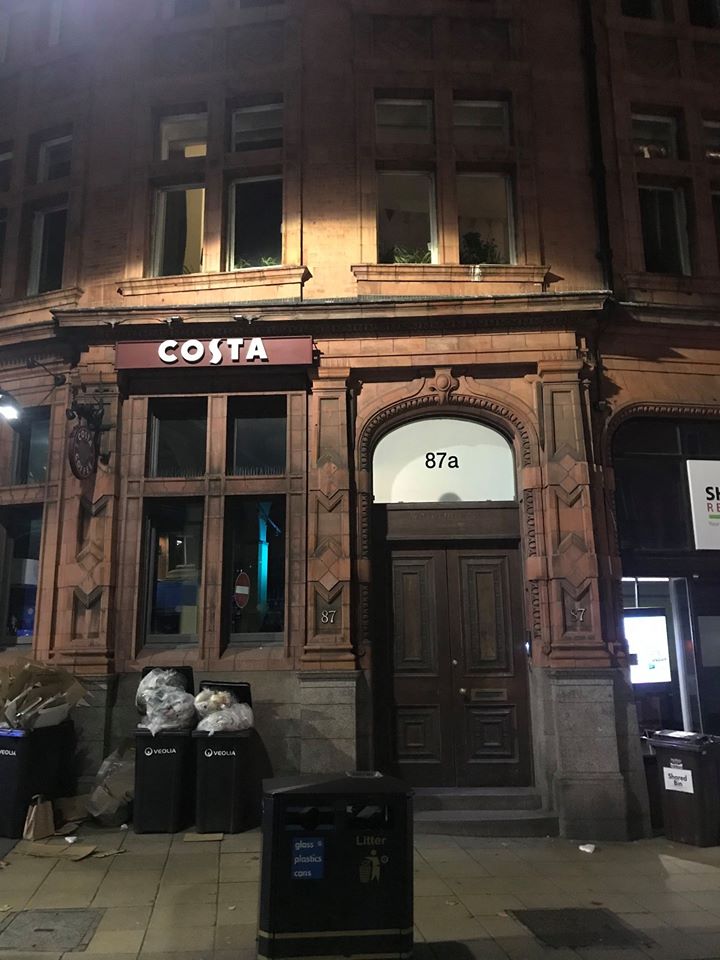
Not the best image of Costa Coffee at the Prudential Assurance Building on Pinstone Street, Sheffield. However, late night is the best time to explore the city. Behind the rubbish lies a story. When this was built in 1896 the doorway was the entrance to Birds Hotel, the shop front on its right forming part of the restaurant. It lasted about twelve months before Prudential Assurance booted William Bird out for not paying his rent. Here is the interesting part. The window to the left is actually the original entrance to the ground floor Prudential Assurance office, as architect Alfred Waterhouse designed it, later reconfigured and moved around the corner.

Categories
People

Lee Child

James Dover Grant. Born Coventry in 1954. Better known as author Lee Child, writer of the Jack Reacher thriller series, following a former American military policeman who wanders the United States (selling over 100 million books to date).

He has strong connections with Sheffield, studying law at the University of Sheffield in the 1970s.

“I was here for four years to do my three-year degree as I failed the second year and retook it. All my memories are of the University of Sheffield Drama Studio where I spent most of my time. I remember the lovely people alongside the sex, drugs and rock & roll! My favourite places whilst I was here were the Drama Studio and the open country – I used to party to 4/5am and then catch a bus out to the moors and watch the sun come up.”

Afterwards he worked for Granada Television as a presentation director, until being made redundant in 1995, turning his attention to writing novels.

Now living in New York, but a regular visitor to Sheffield, Child has funded 50 ‘Jack Reacher Scholarships’ in the city, supporting students through their studies, and was presented with an Honorary Doctor of Letters from Sheffield University in 2009.

Categories
Buildings

Sheffield and Hallamshire Savings Bank

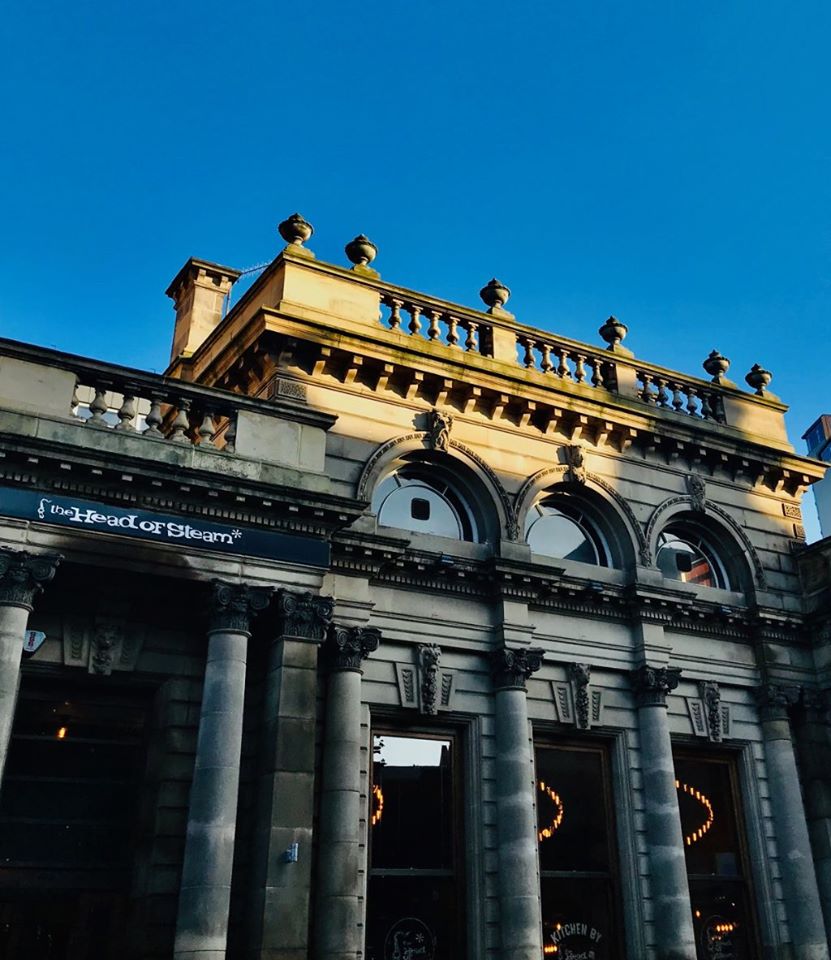
One thing is certain. They won’t build banks like this anymore, if they build any new banks at all. We know this old building as the Head of Steam, on Norfolk Street, but like so many bars it wouldn’t exist if it hadn’t been for banking.

The story of this building goes back to 1819, when the Sheffield and Hallamshire Savings Bank was established by subscription, the business being carried on at the Cutlers’ Hall until 1832, and afterwards in Surrey Street.

It was founded largely due to the influence of James Montgomery (1771-1854), newspaper editor and poet, whose friend was the Rev. Henry Duncan, who had set up the world’s first commercial savings bank (eventually becoming TSB). The Savings Bank appealed to working people (largely steelworkers) whose savings were too small to be accepted by other banks.

When the Sheffield and Hallamshire Savings Bank outgrew the Surrey Street premises, it bought a plot of land on nearby Norfolk Street, hosting a competition in 1858, asking for someone to design brand new facilities.

The challenge was won by Thomas James Flockton, whose plan was for a two-storey cube of three bays, flanked by single-storey entrance wings with projecting porticoes. It was embellished with a rusticated stone front with round and square Corinthian columns on the ground floor. “One of the first buildings in the town centre with any pretension of elegance.”

The new bank was built out of surplus funds of the Bank at a cost of £5,500, opening in June 1860, its business hours being 10am until 2pm daily and on Saturday evenings from 5 to 7.

At the beginning of the twentieth century, the Bank engaged in small-scale expansion by opening several branch offices. It wasn’t until after the Second World War, however, that significant growth occurred with 15 new branches opening.

In 1974, a rear extension was built (now leading into Tudor Square) by Mansell Jenkinson & Partners, part of a massive refurbishment programme that retained the façade and the dentilled cross-beam ceiling interior.

The TSB Act of 1976 led to the restructuring of savings banks across the country, and the Bank was amalgamated into the Trustee Savings Bank (TSB) the following year.

By the 1990s the Bank had closed, a small branch in a massive network, but the building deemed suitable for conversion into a bar.

The Fraternity opened in the late 90s, changing into the Old Monk at the Fraternity House, before becoming the Old Monk. The bar was operated by the Old Monk Company, founded by Gerry Martin, younger brother of Tim Martin, boss of the high-profile, larger J.D. Wetherspoon, but which collapsed into administration in 2002.

Gerry Martin bought back the Old Monk in Norfolk Street, along with bars in Cardiff and Birmingham, setting up a new company called Springbok Bars. In December 2015, Hartlepool-based Cameron’s Brewery bought the Old Monk in Sheffield, opening it as their eighth branded Head of Steam bar in April 2016.

Categories
Buildings

Heart of the City II

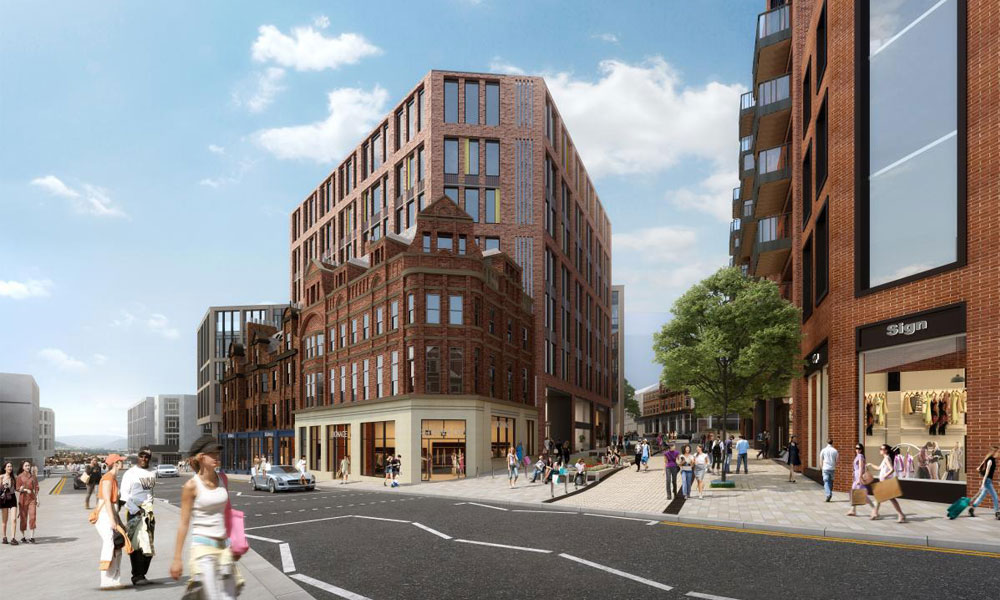
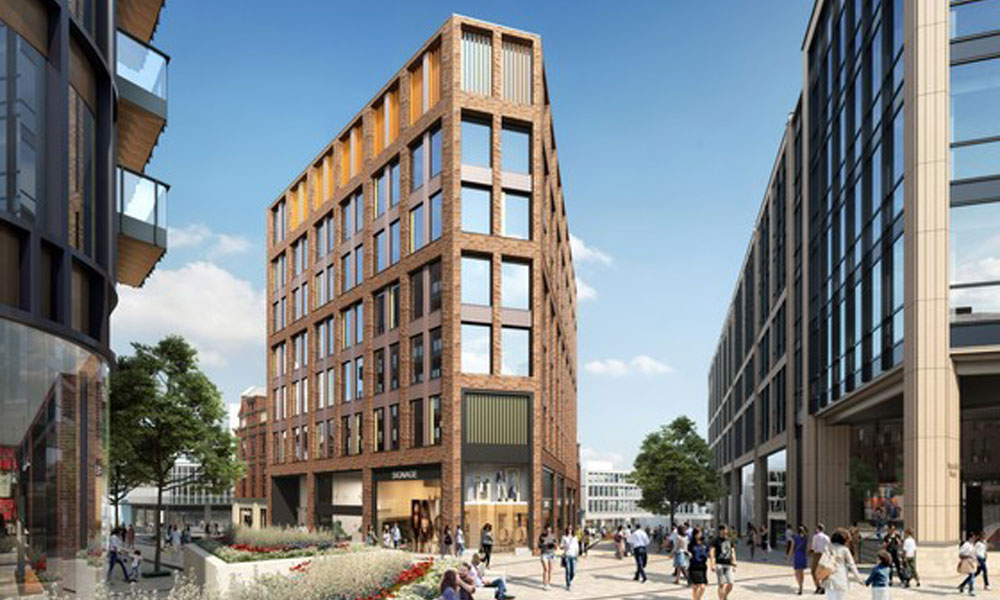
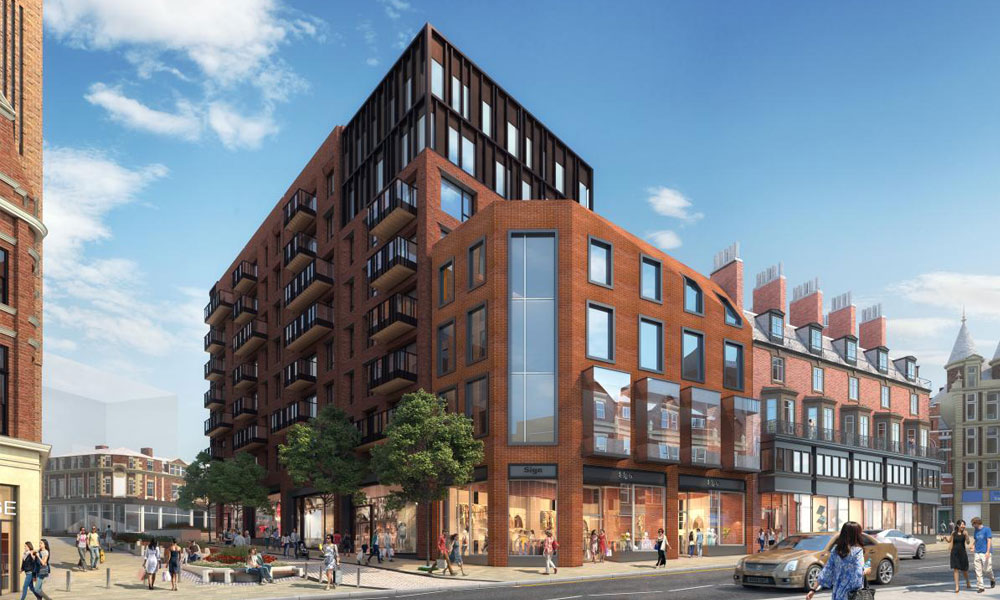
New images have been released of Sheffield’s Heart of the City II scheme. The £500million development is being built on land between Pinstone Street. Barker’s Pool and The Moor, including shops, two four or five-star hotels, offices, apartments leisure venues and a high-end food hall, all set around tree-lined streets and public spaces overlooked by rooftop bars and cafes.

The CGI images show the Victorian facades on Pinstone Street being retained. They also show the Five Ways area – the name being given to the pedestrianised interchange where Cross Burgess Street, Charles Street, Cambridge Street and Wellington Street meet.

There is also work to restore Laycock House, a late Victorian building that survives almost completely intact, as part of the Block B element of the scheme. Known as Athol House, it will provide space for restaurants or cafes on the ground floor, while the floors above will include office space.

Block C will be known as Isaacs House after Victorian-era paper-hangings merchant David Isaacs. Behind the Pinstone Street frontage the re-imagined building will contain workspaces, prime retail and leisure space.

Heart of the City II is one of Sheffield’s key economic projects. Backed by Sheffield City Council, with Queensberry as its Strategic Development Partner, it is not just a retail scheme, but mixed-use development.

The scheme builds on the hugely successful original Heart of the City project that kick started the regeneration of Sheffield city centre at the start of the Millennium.