Categories
People

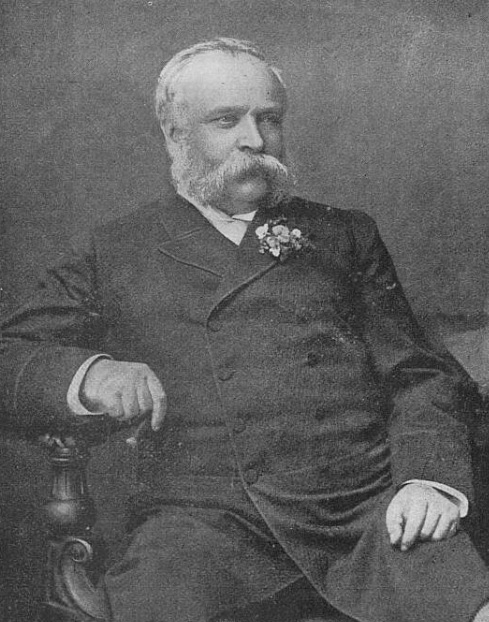
William Leng: the newspaper editor who carried a gun

Photograph by The British Newspaper Archive

In 1894, The Sketch magazine said that when the romance of journalism was written a very large chapter would have to be devoted to Sir William Christopher Leng, editor and proprietor of the Sheffield Daily Telegraph. “Although there are probably thousands who have never heard his name.”

William Leng was born in Hull in 1825 and started out as a wholesale chemist. He contributed anonymously to local newspapers in Hull – overloading on steamers, the growth of ultramodernism among British Catholics, and parodies in prose and verse on leading writers of the day. He also wrote for the Hull Free Press, featuring sketches of local celebrities, portraying their virtues, foibles, failings, and distinguishing features.

His brother, John (later Sir John Leng, proprietor of the Dundee Advertiser) entered journalism and persuaded William to join his newspaper as leader writer and reviewer.

In 1864, aged 39, William entered partnership with Frederick Clifford and purchased the Sheffield Daily Telegraph, the first provincial daily newspaper, becoming its editor and changing its fortunes.

“He brought with him to Sheffield all the Imperialistic traditions of his father, all the anti-slavery feeling inherited from his mother, all his own independence of thought, all his old determinations to make his writings reflect his own beliefs, all that manly courage which led him to defy consequences if only he were faithful to the truth as it seemed to him.”
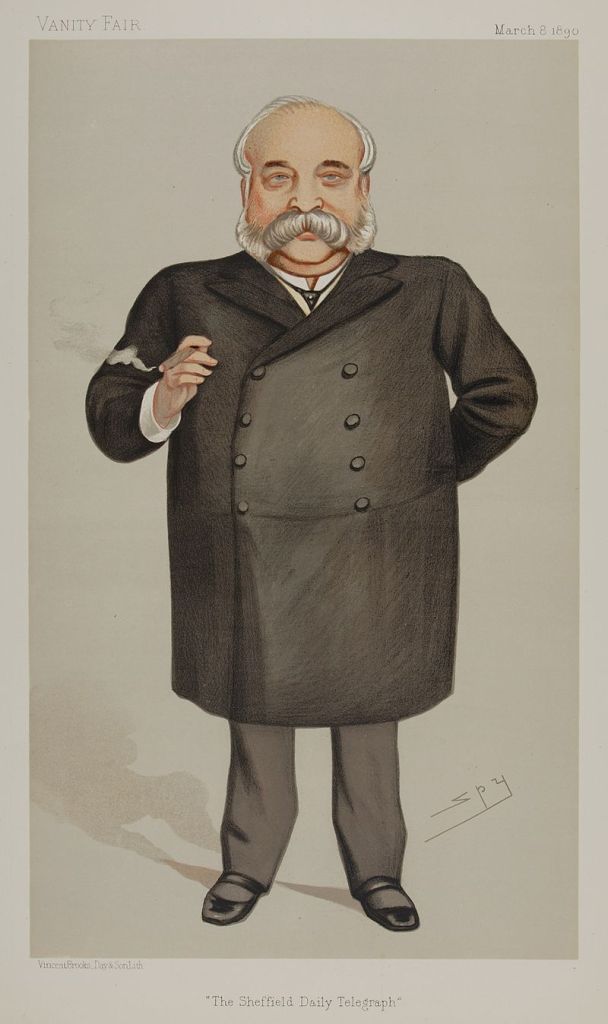
Photograph by Vanity Fair

During his time as editor, he waged war on radicalism, slum housing, American Confederate sympathisers, on the tyranny of trade unionism, and supported Turkey in their conflict with Russia. His association with Samuel Plimsoll was able to revolutionise safety for sailors and prevent overloading on ships.

When he came to Sheffield, Conservatism was at its lowest ebb, but by his writings, he managed to change working class views and by the end of his tenure they held four out of five seats on the council.

At the time, Sheffield was the centre of British trade union revolt, the stronghold of William Broadhead, secretary of the Sawgrinders’ Union, and instigator of murderous trade outrages which paralysed British commerce. If a manufacturer quarrelled with his workmen, Broadhead issued an instruction, and men went forth to destroy his machinery and burn down his factory.

William Leng took up against Broadhead, who sneered at him, having already killed one Sheffield newspaper and confident he could annihilate another. However, Broadhead was unprepared for the broadside that the Sheffield Telegraph hurled at him.

Every day William tossed his journalistic javelins into Broadhead’s camp, and every day was threatened for his boldness. He wrote his leaders with a pistol by his side and walked through the streets at night with his finger on the trigger of a revolver. For weeks he carried his life in his hands.
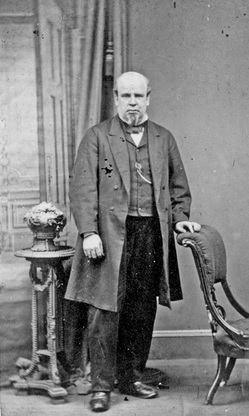
Wm Broadhead-Picture Sheffield

The ruthless arbiters of Labour had resolved to crush Broadhead, and when a Royal Commission was obtained William had to sit in open court between two policemen for fear that he should be assaulted.

The result of the Commission was a triumph for William, the manufacturers who had suffered at the hands of Broadhead subscribed 600 guineas and presented them to him, and a grateful Government rewarded him for his services by the honour of a knighthood, recommended by Lord Salisbury, in 1887.

William continued writing for the Telegraph until his death in 1902 and was buried at Ecclesall Church.

The Sheffield Daily Telegraph eventually became the Morning Telegraph, surviving as the weekly Sheffield Telegraph, and established what we now know as the Sheffield Star.
Categories
Buildings Companies People

Sheffield Telegraph

Photograph by Picture Sheffield

In 1855, soon after the abolition of newspaper stamp duty, that had set newspaper prices at 5d to 7d, a dour down-at-heel Scotsman called Mr Benson turned up in Sheffield. After looking the town over, he called at the offices of Joseph Pearce Jnr, a printer and bookseller on High Street, and told him that he had people in London and Manchester who proposed starting a newspaper in Sheffield.

Joseph Pearce was convinced, and Benson recruited shop canvassers from street corners to obtain subscribers at 1s 6d for a month’s issues. The campaign netted a small fortune, and the next day Mr Benson arrived at the office wearing a brand new hat a new pair of wellingtons.

Photograph by The British Newspaper Archive

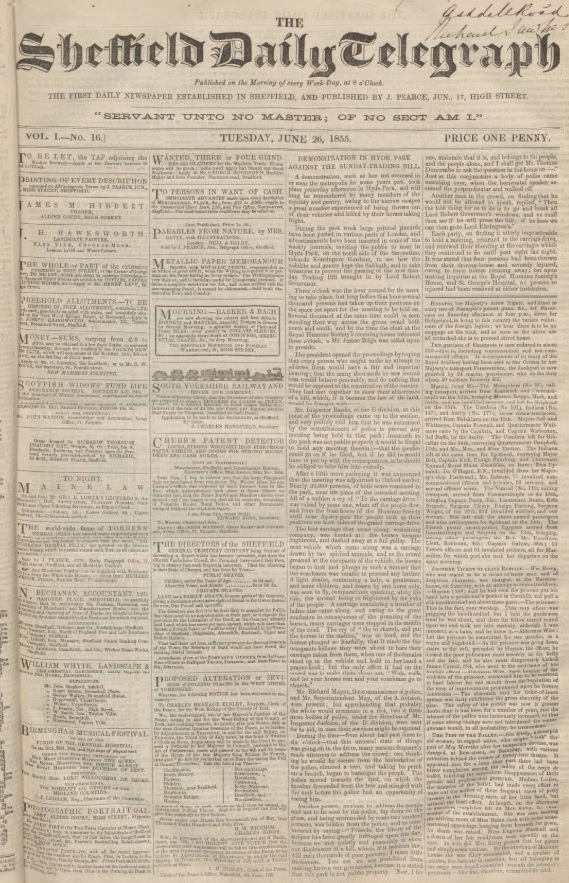
The first issue of the four-page Sheffield Daily Telegraph appeared on June 8, 1855, distributed by Benson’s messengers on the back of a wheelbarrow.

Ten days later, Mr Benson, the comic-faced Scot disappeared and was never heard of again. His promised capital was so far behind him that it never caught up.

A man sent to London to telegraph back news milked from the national papers found himself out of pocket, and unable to ask for help, because Benson had failed to mention his colleague back in Sheffield. On his last night in London, the representative of the ‘country’s first great provincial daily’ had to split his journey home.

Joseph Pearce, left with the fallout, met his obligations to initial subscribers and decided to carry on. He arranged to take Reuter dispatches from the Crimean War, a story that was filling everybody’s minds, and sales started to grow.

There were already several weekly newspapers in Sheffield, all of which ignored this ‘upstart’, but when Sheffield writers gathered around the Sheffield Daily Telegraph, it burst this bubble of complacency, and one of them, the Sheffield Independent, was forced to publish daily as well.

Despite the rising popularity of the paper, published at 8am every day, it was a financial struggle for Joseph Pearce, and after nine years he decided to make way for younger blood.

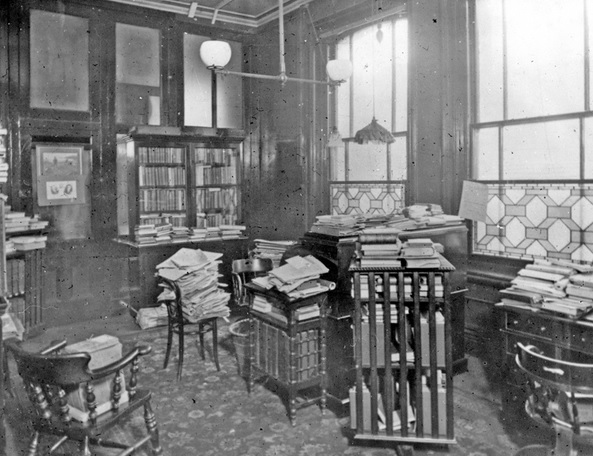
Photograph of Editor’s office by Picture Sheffield

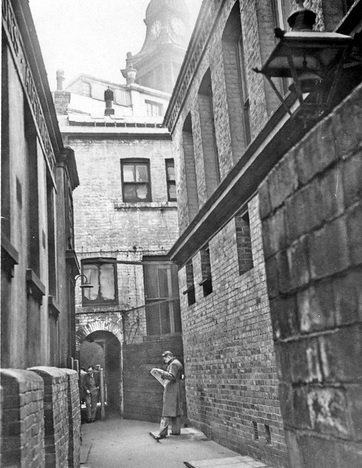
In 1864, Frederick Clifford and William Christopher Leng arrived, the latter becoming editor, and relocating to Aldine Court, off High Street.

Under these two, the Sheffield Daily Telegraph aimed to popularise the Conservative Party cause amongst the working class, and Leng’s trenchancy and personal courage during the trade union outrages in the 1860s enhanced the newspaper’s prestige.

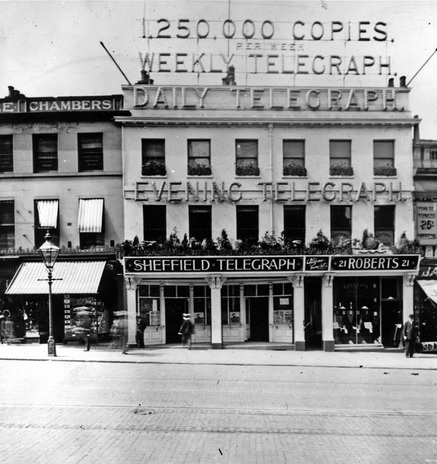
By 1898 it was selling 1.25 million copies a week, along with its sister publications, the Sheffield Weekly Telegraph, with articles and serialised fiction, and the Sheffield Evening Telegraph.

In 1900, Winston Churchill became South African war correspondent for the Sheffield Daily Telegraph, as well as the Morning Post, and the January issue carried his story in four columns of his capture by the Boers.

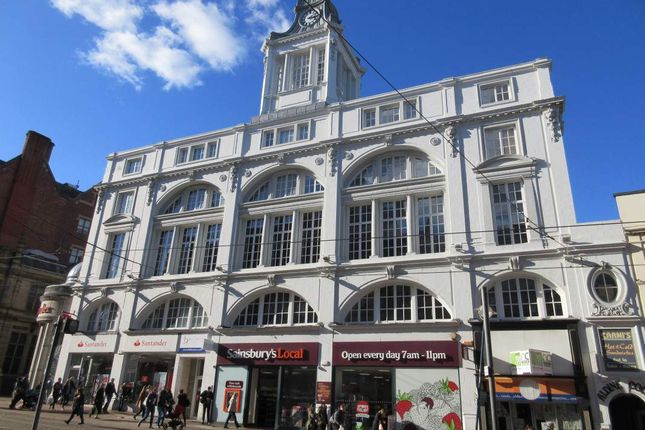
Photograph by Prime Location

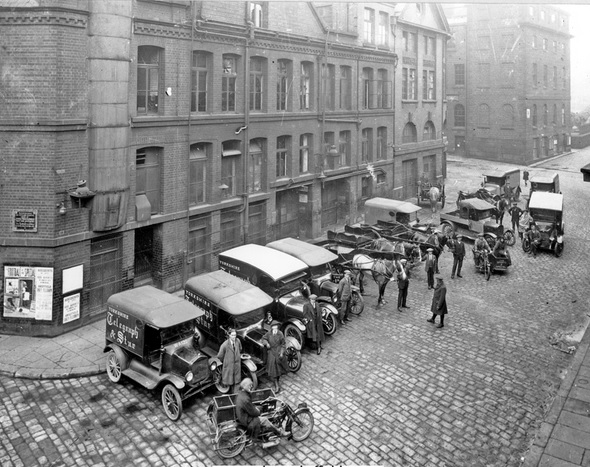
Between 1913 and 1916, a new front to the extensive old buildings of the editorial and printing departments at Aldine Court, was built. Constructed in English Renaissance-style, it was designed by Edward Mitchel Gibbs, and still dominates High Street today. (It was eventually replaced with modern buildings on York Street).

Photograph by Picture Sheffield

The Clifford-Leng ownership ended in 1925, bought by Allied Newspapers, controlled by William Ewart Berry, Gomer Berry and Sir Edward Mauger Iliffe, which had been systematically buying up provincial newspapers, though chairmanship was retained by Frederick Clifford’s son, Charles, who actively shared management of the paper until his death in 1936.

Sir Charles Clifford had arrived in 1878 and ten years later was instrumental in the purchase of the Sheffield Evening Telegraph’s rival, the Evening Star, a name familiar to us now as the Sheffield Star.

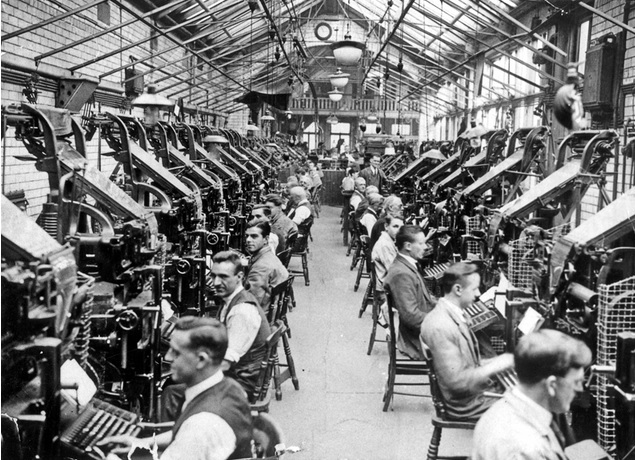
Photograph by Picture Sheffield

In 1931, Allied Newspapers bought the rival Sheffield Independent, printing both separately, but both papers started losing ground to the national press and at one time the loss of both seemed possible.

The Allied Newspapers partnership was dissolved in 1937, each partner needing a raft of holdings to pass onto their heirs, with James Gomer Berry, 1st Viscount Kemsley, taking control of the Sheffield operation, briefly dropping the word ‘Daily’ from Sheffield Telegraph, and amalgamating it with the Sheffield Independent in 1938 to become the Sheffield Telegraph and Daily Independent, with a broader policy embracing the fundamental principles of both newspapers.

During the first years of World War Two, Kemsley Newspapers, as it had been renamed by Lord Kemsley, became the Telegraph and Independent, commanding world correspondents of Kemsley newspapers, and across the British Isles.

The newspaper eventually became the Sheffield Telegraph and Independent, subsequently the Sheffield Telegraph, and was bought by Roy Herbert Thompson, 1st Baron Thomson of Fleet, in 1959.

Photograph by Picture Sheffield

In 1965, it was briefly renamed the Sheffield Morning Telegraph, then the Morning Telegraph, continuing a long tradition of producing excellent news correspondents .

Notable staff across its history have included Sir Harold Evans, who was later Public Relations Officer to Prime Minister Harold Macmillan, and head of ITV News; author Peter Tinniswood; novelists John Harris and J.L. Hodson; cartoonists Ralph Whitworth and J. F. Horrabin; critics George Linstead and E. F. Watling; sports writers John Motson, the BBC football commentator, Lawrence Hunter, Peter Keeling, Peter Cooper, Frank Taylor (who later survived the Munich Air crash of 1958), and Keith Farnsworth.

Other editorial staff members have included Keith Graves, who was later with the BBC and Sky TV as a much-travelled reporter; Peter Harvey, a long-serving feature writer who was awarded the MBE in 2002; Geoffrey L. Baylis, who in later years was honoured for services to journalism in New Zealand; Barry Lloyd-Jones, Brian Stevenson and Clive Jones, who were news editors; Leslie F. Daniells and Frazer Wright were long serving industrial reporters; Alf Dow, a news editor who was later the company’s first training officer, and ended his career in public relations at Newton Chambers; Richard Gregory, who became a leading figure at Yorkshire Television and was later chairman of the Yorkshire Bank; George Hopkinson; Jean Rook, who was later a women’s writer with the Daily Express; and Will Wyatt.

Photograph by Hold the Front Page

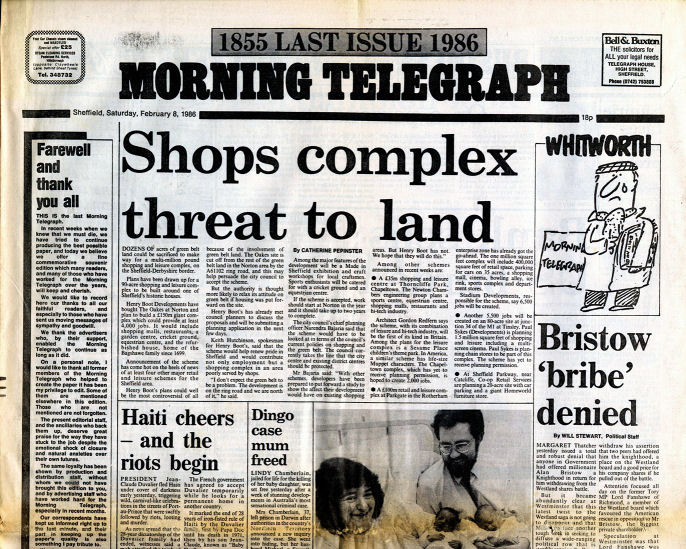
The Morning Telegraph was sold (along with The Star) to United Newspapers in the 1970s, ceasing production in 1986.

The collapse of the newspaper was attributed to moves by estate agents to move advertising away from the highly-popular Saturday edition, and set up what turned out to be an unsuccessful rival property guide.

In 1989, the Sheffield Telegraph was relaunched as a weekly and continues to this day, although now under ownership of JPI Media, formerly the ill-fated Johnston Press.

Categories
People

Henry Steel

Photograph by Vanity Fair

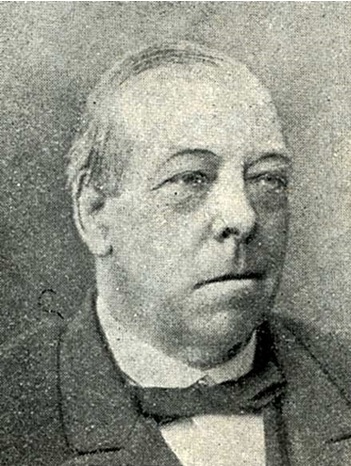
Allow me to introduce you to Henry Steel (1832-1915), somebody you’ve never heard of, but one of Sheffield’s larger-than-life characters. This ‘Great Master of the Odds’ made a fortune from bookmaking, earning so much money that his account at the Westminster Bank in Sheffield was its largest.

It all started with fishmongery, but as a young man he was quick to realise the gains to be made from horse racing. At first, he speculated with the ‘silver book’, but soon established a vein of gold having received the commission for St. Albans and later moving into London.

He became acquainted with John Jackson and Harry Hargreaves, both racehorse owners, and, along with his best friend, William Peech, ended up securing their extensive Turf business.

Henry’s clients included the rich and famous, counting amongst his close friends Lord Rosebery, and King Edward VII, when he was Prince of Wales, and who once gave him a valuable breast-pin. When Edward opened the University of Sheffield in 1905, he recognised Henry, left the procession, and shook him heartily by the hand.

After Blue Gown won the Epsom Derby in 1868, it is said that Henry strolled jauntily and unconcernedly down to Tattersall’s, the auctioneers, and deposited £90,000 (about £10.2million today) to buy a horse.

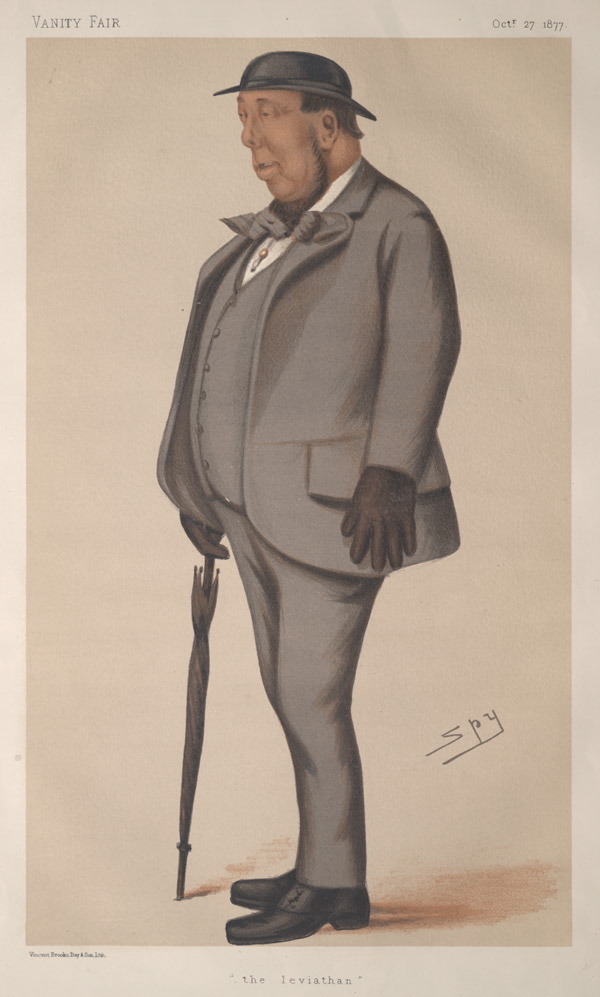
Henry was known at every racecourse and his transactions so enormous that he became known as ‘the Leviathan’, leader of the ring in the 1860s and 1870s, with society magazine, Vanity Fair, speculating that he was probably the richest man ever to have made his fortune in bookmaking.

His frankness and freedom sometimes tainted his reputation as a bookmaker, but he was always equal to jibes, and a ready repartee gave him the better of his critics.

Photograph by Picture Sheffield

Henry eventually moved to London, buying the Archbishop of York’s house, along with an extensive wine collection, but soon tired of it. He returned to Sheffield in 1870, bought Westbourne, and after some years moved to Tapton Court.

However, away from the track, Henry Steel was also famous for establishing Steel, Peech and Tozer, a famous Rotherham steel firm.

In 1875, the works of the Phoenix Bessemer Company had gone into liquidation with liabilities of £140,000. Henry, along with William Peech, Edward Tozer and Thomas Hampton, bought the works for £36,500, and turned it into a private company with a capital of £70,000. After enlargements and improvements, the business became a huge success.

Henry Steel died at Tapton Court in 1915, his will worth £652,418, that’s around £67.5million today.

Steel, Peech and Tozer joined Samuel Fox & Co, Stocksbridge, and Appleby-Frodingham Steel, Scunthorpe, to form United Steel Companies in 1918, subsequently becoming part of British Steel Corporation.

Categories
People

Julian Ovenden

Photograph by imdb

Back to those with connections to Sheffield, although this one remembers little about our city, and was brought up in very different circumstances to most of us.

Julian Mark Ovenden, actor and singer. Born Sheffield in 1975, the son of Rev. Canon John Ovenden, who was a vicar in these parts for two years. He moved away as a baby when his father took up a position at Ely, Cambridgeshire, and ended up living in North London after his father was appointed Chaplain to the Queen at Windsor Castle.

He knows the Queen, and when Julian wanted to research Noel Coward for a school project, he popped around to see the Queen Mother to discuss her love of Coward’s music. He ended up playing the piano, she sang.

As a youngster, Julian sang in St. Paul’s Choir and received a music scholarship to Eton College before reading music at New College, Oxford.

We know him for appearing in five series of Foyle’s War (as Andrew, the RAF fighter pilot son of Christopher  Foyle) and in two seasons of Downton Abbey. In America, he’s appeared in Person of Interest.

Away from TV, Julian regularly appears in leading roles in the West End and Broadway, including Merrily We Roll Along, Finding Neverland and All About Eve. He’s also appeared at the Albert Hall and Carnegie Hall.

“I don’t really have any memories, sadly, of Sheffield. I do feel, when I come back up north, at home here, and I do love the people. But it would be stretching it to say I feel a northerner or a true Sheffield native. It’s a great city and culturally it’s thriving.”

He’s married to opera singer Kate Royal and has two children, Johnny Beau and Audrey.

Categories
Other

A hidden danger beneath our streets

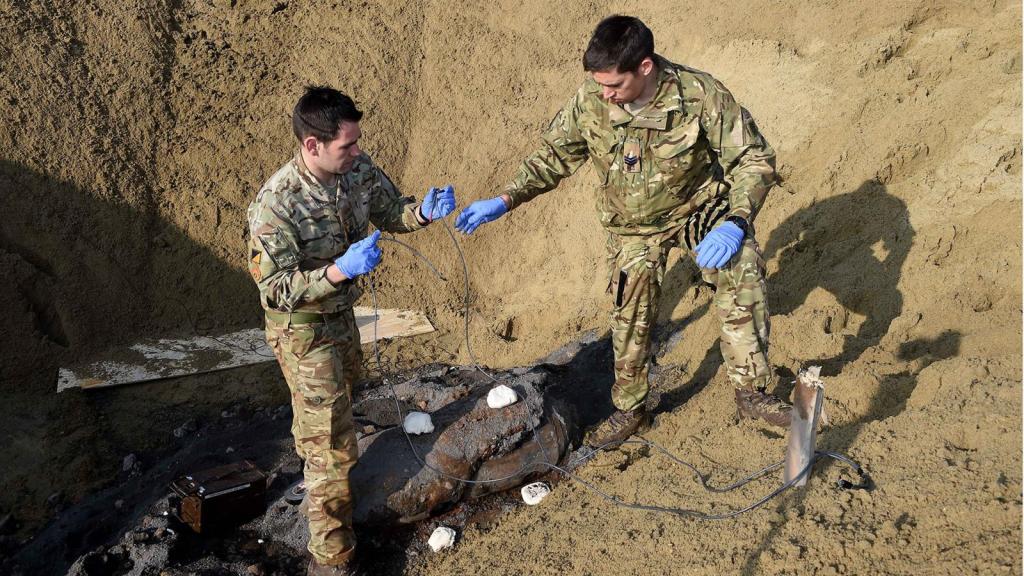
Photograph by the Ministry of Defence

I don’t wish to alarm people in these sobering times, but there is another threat to the people of Sheffield, and it lies beneath our feet.

It’s almost eighty years since German bombers dropped around 355 tonnes of high explosives and 16,000 incendiary canisters on Sheffield during the Blitz of 1940. The bombers targeted residential and industrial areas and the city centre received incredible damage, with The Moor, Angel Street and King Street almost obliterated.

While death and destruction were immense, Sheffield’s citizens might have been forgiven that one of our nastiest periods had been consigned to history.

Alas, we are still likely to suffer the consequences for years to come.

Photograph by Sheffield Star

According to experts, Sheffield is a ‘high risk’ area for unexploded bombs, those that fell from the sky, failed to detonate, and buried themselves deep underground.

Bombs often failed to explode because they were ‘dud’ – casualties of fast, furious and error-prone wartime manufacturing.

But why didn’t the authorities deal with them?

At terminal velocity, a bomb would have penetrated 3-4 storeys before detonating. If it failed, its downward motion sent it deep underground, leaving destruction behind and almost impossible for watchers to determine the exact number and location.

The legacy is that we almost certainly have dozens of unexploded bombs hidden under the streets of Sheffield, as well as in other cities across Britain.

It is only now that some of these unexploded devices are returning to haunt us. Over the years, bombs have been discovered near Bramall Lane, Hillsborough, Don Valley, Owlerton and Burngreave. And it is just four years ago that four bombs were successively discovered in Matilda Street.

Most of these bombs have been found on construction sites, the Construction Industry Research and Information Association stating that in one two year period an estimated 15,000 military items were extracted from UK building sites. Now that buildings are getting taller, foundations dug deeper, we are starting to uncover devices , about five per cent of which are still live.

Worryingly, discoveries are still being made as original sites are being redeveloped for a second time after blocks thrown up in the post-war building boom reach the end of useful life.

The problem with unexploded bombs is their unpredictability, with Army Bomb Disposal Units (split between the Royal Engineers and Royal Logistic Corp Ammunition Technicians) having little information about how long it has been there and how it might have changed over time.

Photograph by The Independent

Most construction in the UK is now subject to risk assessment on the likelihood of unexploded bombs underground. These assessments may take the form of visual interpretation using historical photographs, as well as with geophysical and geothermic surveys. A similar set of processes was used when the site was cleared to make way for the construction of the Moor Market.

The situation is a lot worse in Germany where barely a week goes by without a new discovery. In 2014, a German digger driver was killed after accidentally striking an unexploded British device at Euskirchen, north of Frankfurt. And last year, a large explosion in a field near Ahlbach created a huge crater and turned out to be an undiscovered wartime bomb exploding after 75 years.

“According to the rule of thumb, if German ordnance hit the ground, it exploded, while Allied bombs were notoriously unreliable,” says Stephen Taylor, a period munitions expert.

Photograph by BBC News
Categories
Streets

Fitzwilliam Street

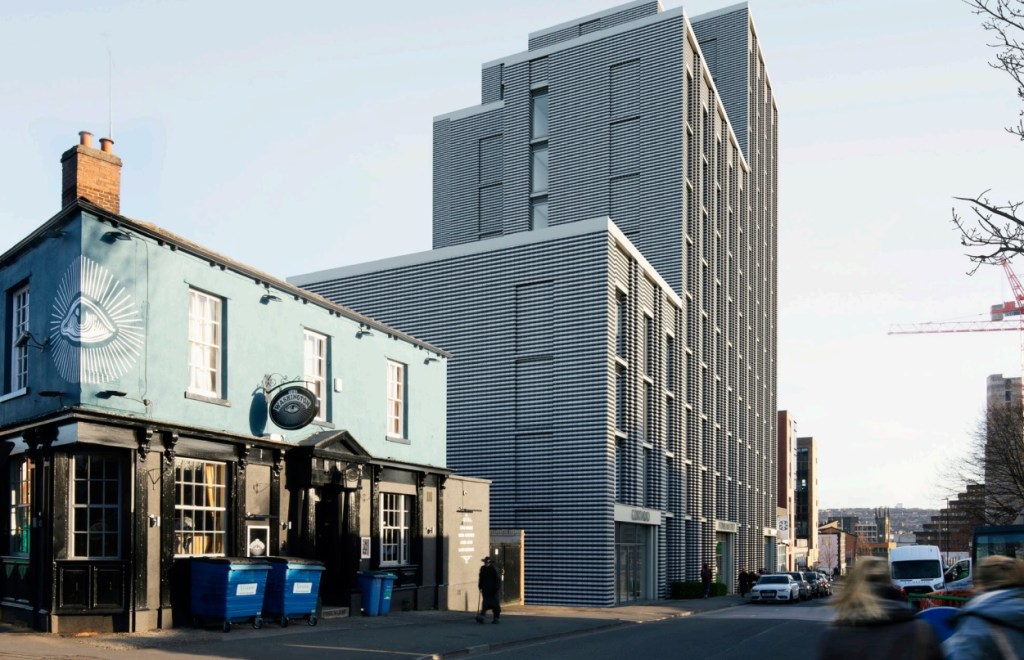
Planning application has been received for a new 13-storey development below the Washington public house. Photograph by Cartwright Pickard

The Fitzwilliam Street part of Sheffield city centre was developed in the early 19th century, from agricultural fields into Victorian terracing and warehouses. Of significance, is that the area was heavily bombed during World War Two and as a result was cleared and remained largely undeveloped until the 1970s and 1980s.

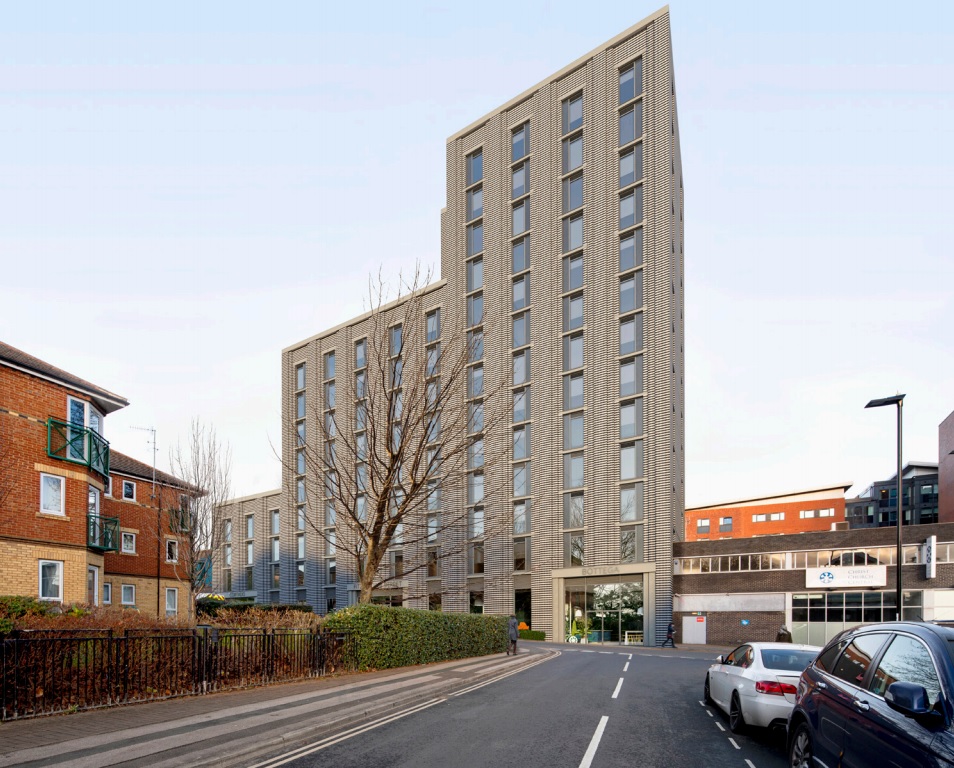
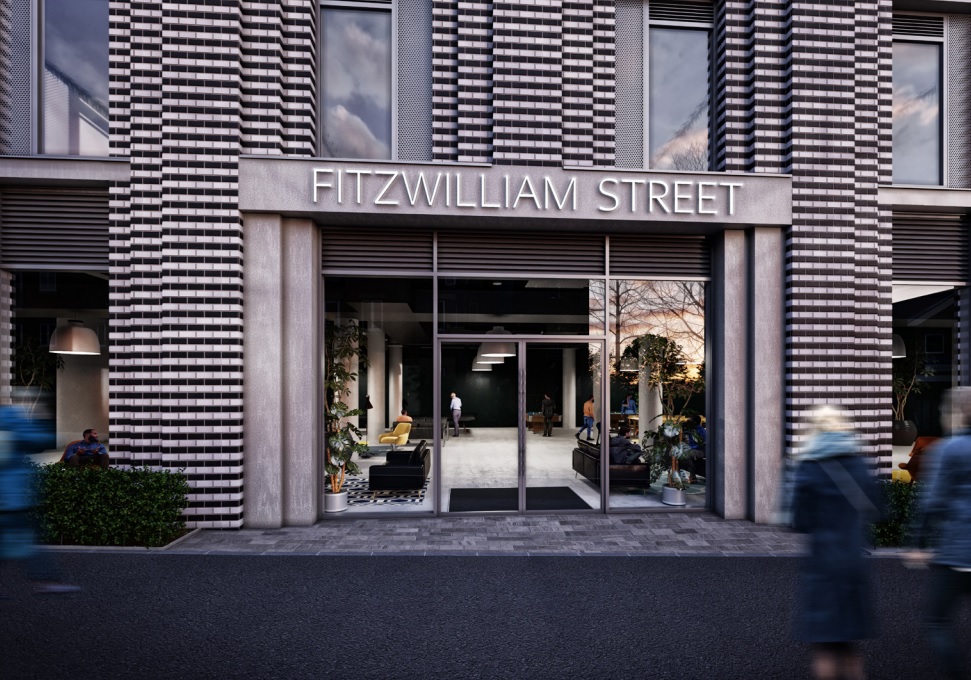
The boom in student accommodation has resurrected the area in the past decade, not least with another new planning application submitted to Sheffield City Council for a thirteen-storey block of 209 student studio apartments. If all current applications are approved, the area will once again revert to residential use.

But what is the history of Fitzwilliam Street?

Back in 1874, Samuel Everard, a prominent citizen of the town, made the following observations: –

“As we pass Bright Street, Fitzwilliam Street and Rockingham Street, let us know them as illustrations of the origin of our street names. They at once indicate the ownership of the soil by the house of Wentworth (of Wentworth Woodhouse).”

Photograph by Cartwright Pickard

The last Marquis of Rockingham, Charles Watson-Wentworth, married Mary, the daughter and heir of Thomas Bright, of Badsworth, near Pontefract, in 1752, who in her own right was Lord of the Manor of Ecclesall and owner of extensive estates in the vicinity.

It was said that the Marquis, when once taunted with marrying a woman of no blood, had replied, “If she had no blood, she had plenty of suet.”

The marriage brought the land into possession of the Marquis of Rockingham and it descended to his nephew, William Fitzwilliam, 4th Earl Fitzwilliam.

The names of Fitzwilliam Street and Rockingham Street are familiar to us all, but Bright Street, named after the Lord of the Manor of Ecclesall, has long disappeared.

It ran directly from the bottom end of Fitzwilliam Street towards Cumberland Street, crossed by South Street (that we now know as The Moor). It broadly spanned the same line as does Fitzwilliam Gate today.

Update. See revised plans for the scheme submitted in May 2022

Photograph by Cartwright Pickard
Categories
Companies

“Does exactly what it says on the tin.”

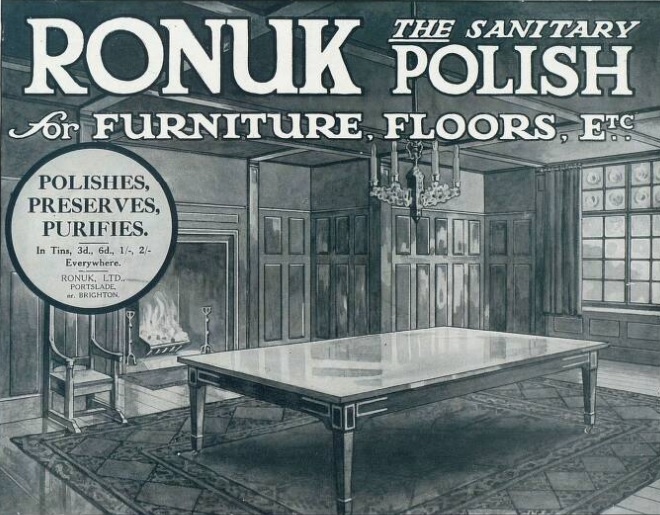
This story doesn’t start in Sheffield, but 230 miles away at Brighton in East Sussex, when in the late 1800s, a gentleman by the name of Fowler formulated a special polish called Fowler’s Wax Composition, although legend suggests it might have been Mrs Fowler who came up with the putty-coloured substance.

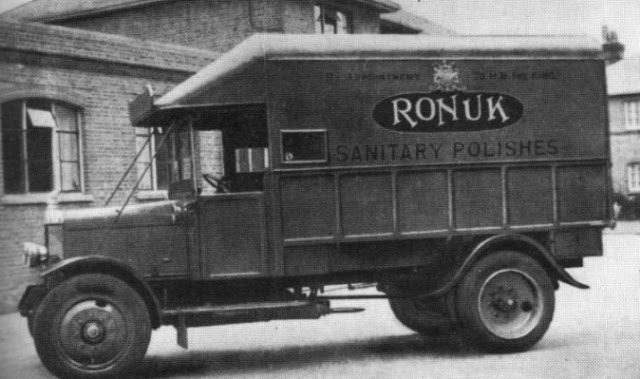
Production was taken over by his son, Thomas Horace Fowler, who registered the name of the polish as Ronuk in 1896, an anglicised form of a word suggested by an ex-Indian Army officer signifying brilliance.

Photograph by Brighton & Hove City Libraries

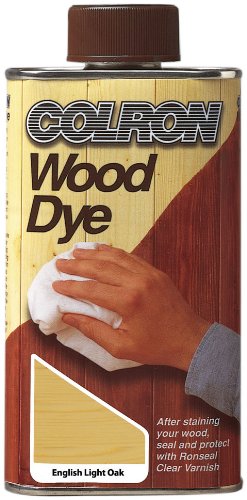
Manufacturing switched to Portslade, a suburb of Brighton, and in 1927, Ronuk launched Colron Wood Dyes that helped establish the company as a leading UK DIY brand, followed by Ronseal wood varnish in 1956.

Our story switches to Chapeltown in 1960, when Newton Chambers, one of England’s largest industrial companies, founded in 1789 by George Newton and Thomas Chambers, bought Ronuk.

The brands were absorbed into the company’s Izal division in 1963, and the following year manufacturing was switched to Sheffield. With significant investment, the Ronuk, Ronseal and Colron brands soon became dominant, but by 1968, Roncraft had been adopted as the name for Ronseal.

Newton Chambers was bought by Central and Sheerwood in 1972, and the following year Izal was sold to the Sterling Winthrop Group, renaming the Roncraft business as Sterling Roncraft.

In 1989, Sterling Winthrop was bought by Eastman Kodak, until the multinational photographic company sold all its DIY business to New York-based investment bank Forstmann Little & Co, which included the Roncraft brand (reverting back to its Ronseal name) within its Thompson Minwax Holding Corporation.

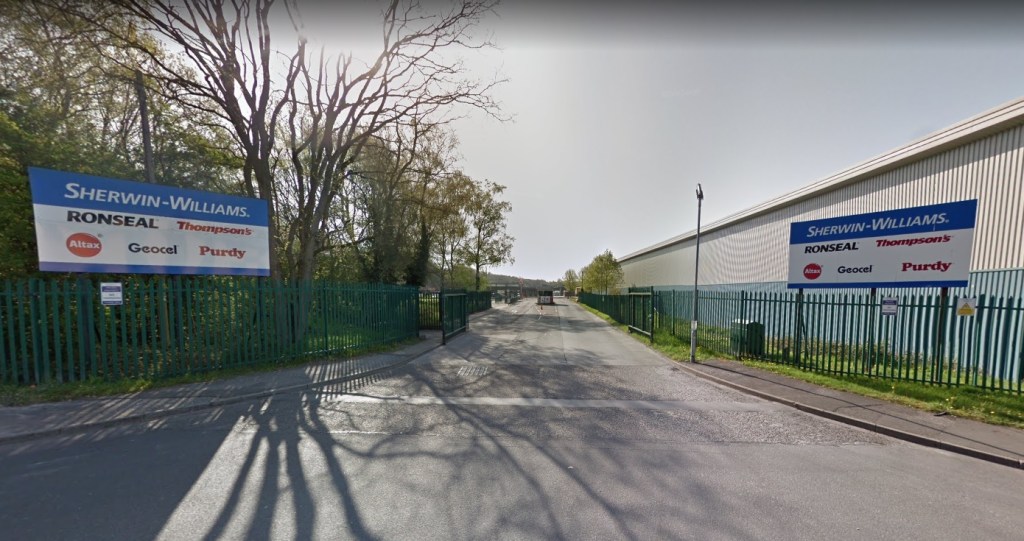
The brands were sold again in 1997 to Cleveland-based Sherwin-Williams, involved in the manufacture of paint coatings across North and South America and Europe. Far from diluting the integrity of the brand it renamed the Roncraft business as Ronseal Ltd, advancing the name with a new slogan – “Does exactly what it says on the tin” – devised by advertising agency HHCL.

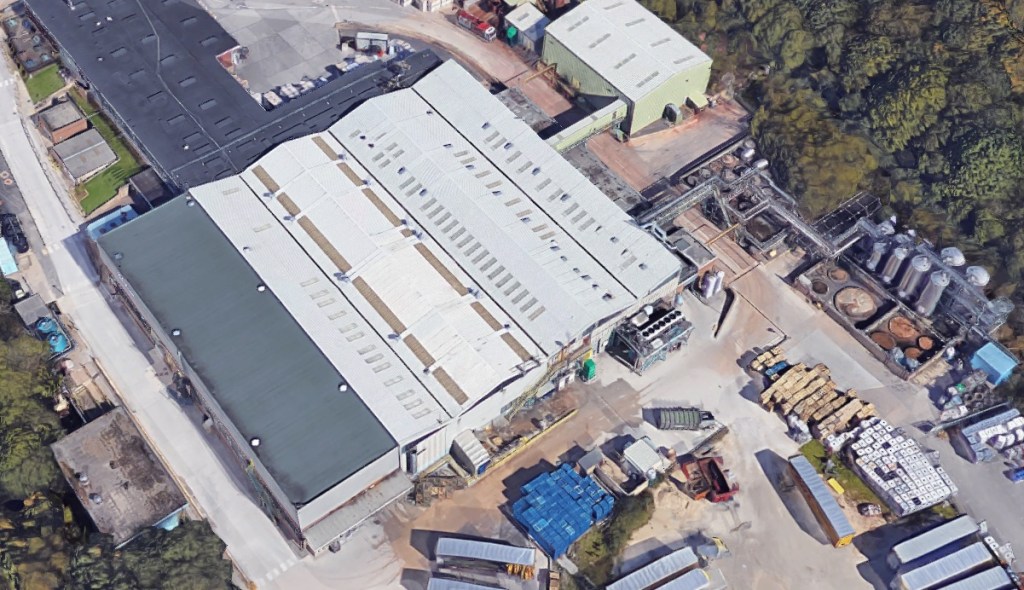
With production now taking place at a new facility in Thorncliffe Park, Chapeltown, a new warehouse was opened in 2007. Two years later, Sherwin-Williams acquired Altax, a woodcare company in Poland, and added to its Ronseal Coatings division.

Still owned by Sherwin-Williams and considered to be the UK brand leader in varnish and woodstain products, Ronseal achieved acclaim in 2013 when Prime Minister David Cameron told a mid-term press conference that the coalition between the Conservatives and Nick Clegg’s Liberal Democrats was a “Ronseal deal.”

Photograph by Google
Categories
Buildings

Clifford House

Photograph by St Luke’s Clifford House

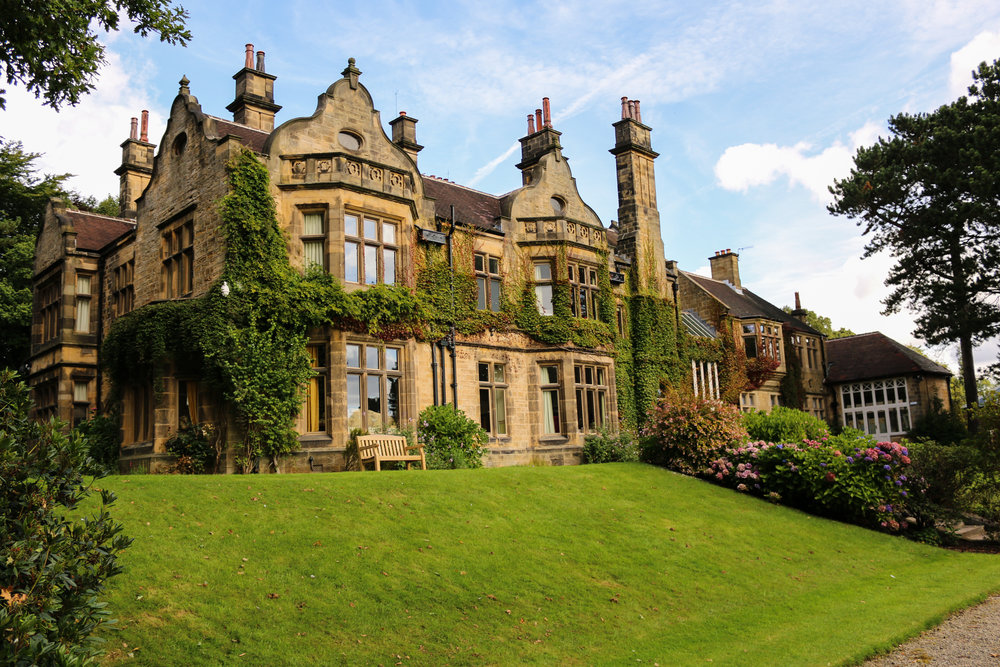
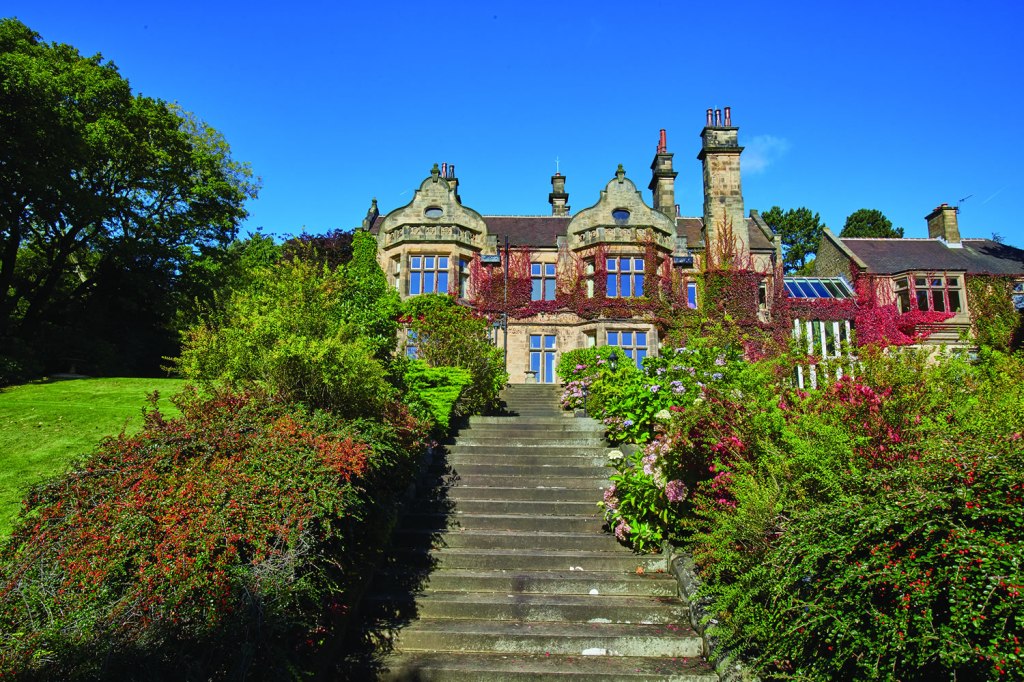
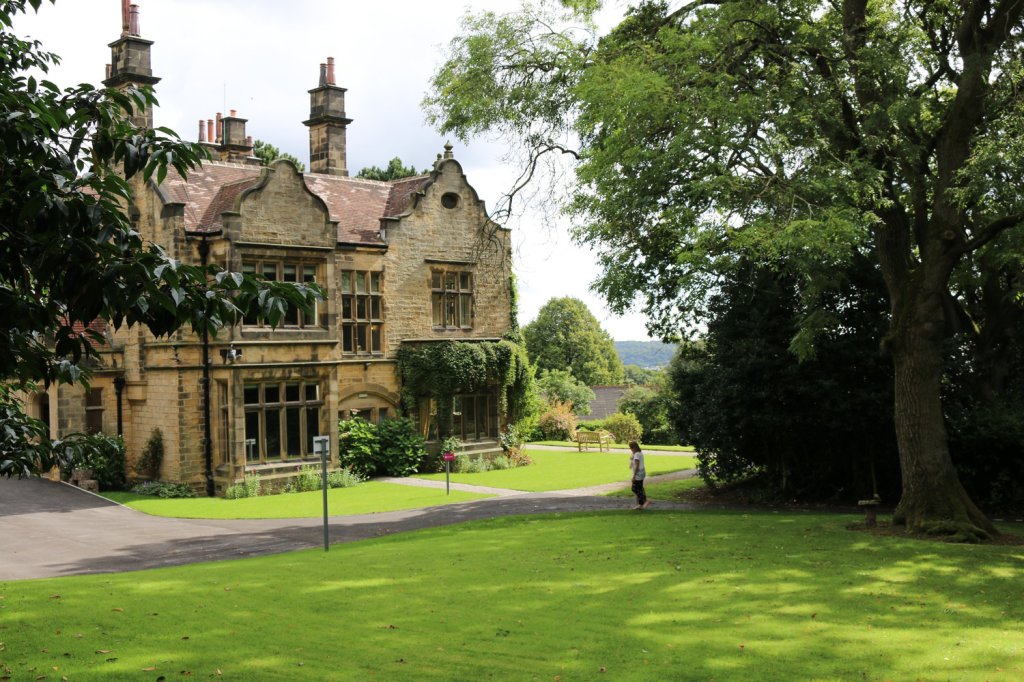
Clifford House is a former mansion on Ecclesall Road South, once the home of Sir Charles Clifford, proprietor of the Sheffield Telegraph and Star, and these days owned by St Luke’s Hospice.

However, it is only in modern times that it has been called Clifford House.

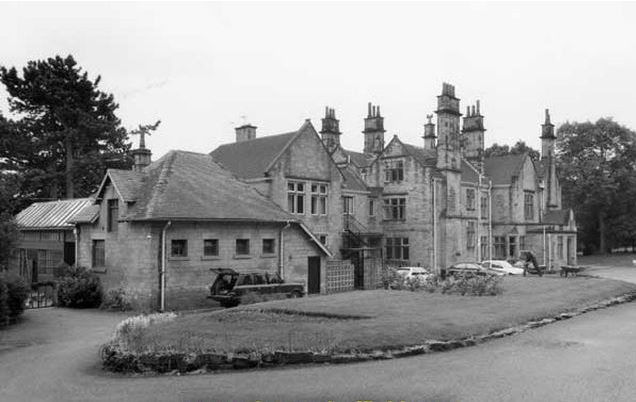
When the house was built for Denys Hague in 1896 it was called Whirlow, named after the well-appointed district in which it stands.

The house was well-equipped with a large hall, drawing-room, dining and morning rooms, kitchen, butler’s pantry, nine bedrooms, bathroom, WC, and four cellars, all illuminated with electric light. Outside was a four-stall stable, harness room and four acres of grounds.

Photograph by Welcome to Yorkshire

Denys Hague was a leading figure in the South Yorkshire coalfields and member of a well-known family. He was the second son of Charles Hague, of The Broom and Ferham House, in Rotherham, and a prominent coal-owner.

Celebrated in industrial circles, Denys was a director of the Hickleton Main Colliery Company and Manvers Main Colliery Ltd at the time of his death in 1929, and for a long time had been a director of the Midland Iron Company in Rotherham.

His brother, Ernest Hague, another coal-owner, had lived at Castle Dyke at Ringinglow, and died a few years before.

Denys was a keen fisherman, a member of the River Noe Fishing Club, and was a lover of art, with a fine collection hanging at Whirlow.

The value of the collection was only realised when 52 oil paintings – including works by Daubigny, Corot, Boudin, Le Sidaner, Lépine, Harpignies, Maris, Constable, Jacques, Ter Meulen, Collier, Monticelli, Landseer, Van Marcke and Cossaar – went on display at the Mappin Art Gallery in 1907, and at Liverpool’s Walker Gallery in 1913. Most of these works were auctioned at Christies in 1923.

Denys married Frances Davy, third daughter of David Davy, founder of Davy Bros, a famous Sheffield engineering company.

In 1907, the Hague’s decided to leave Sheffield and move to London. Frances Hague died in 1923 and Denys died at the Hotel Russell in Russell Square in 1929. (It is now known as the Kimpton Fitzroy London Hotel).

Photograph by Picture Sheffield

Whirlow was put up for sale, probably rented for a while, and eventually sold to Charles Clifford in 1915.

The vast grounds were regularly used for entertaining, his newspaper staff invited to summer garden parties, as were members of Clifford’s Conservative Association. He also built a full-size cricket pitch where matches were held between local clubs. As well as the house, Charles Clifford also owned a farm on Little Common Lane.

Charles Clifford died in 1936, his widow, Lady Alice Clifford staying on until her own death in 1941, at which time Whirlow was requisitioned by the Government for the remainder of the Second World War.
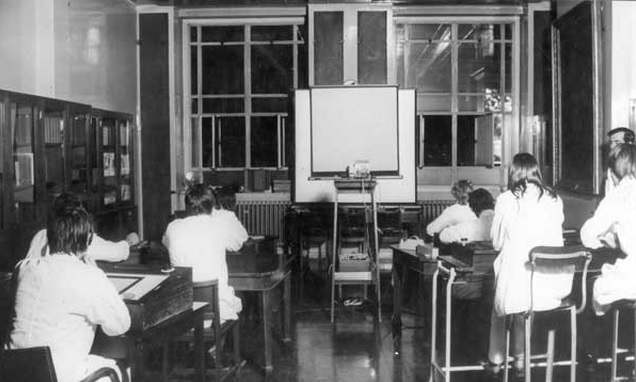
Afterwards, it was acquired by a private steel company which became part of British Steel Corporation (BSC) on nationalisation.

In 1968, BSC donated some of the land behind Clifford House (as it was now known) to St Luke’s Hospice which built a new facility on Little Common Lane and opened in October 1971.

In 2000, BSC sold the house and land to Hugh Facey, founder of Gripple, for £1.05million, who later built a new home next door, selling the mansion to St Luke’s in 2016, and reuniting the house and land for the first time in 48 years.

The house was altered and refurbished by D&P Construction of Wath-upon-Dearne to plans by the Hooley Tratt Partnership.

Clifford House is now used for patient drop-ins, activities, practical support and advice, relaxation and well-being, as well as available to hire for events and conferences.

Photograph by St Luke’s Clifford House
Categories
Sculpture

Pan: Spirit of the Wood

Photograph by Sheffielder

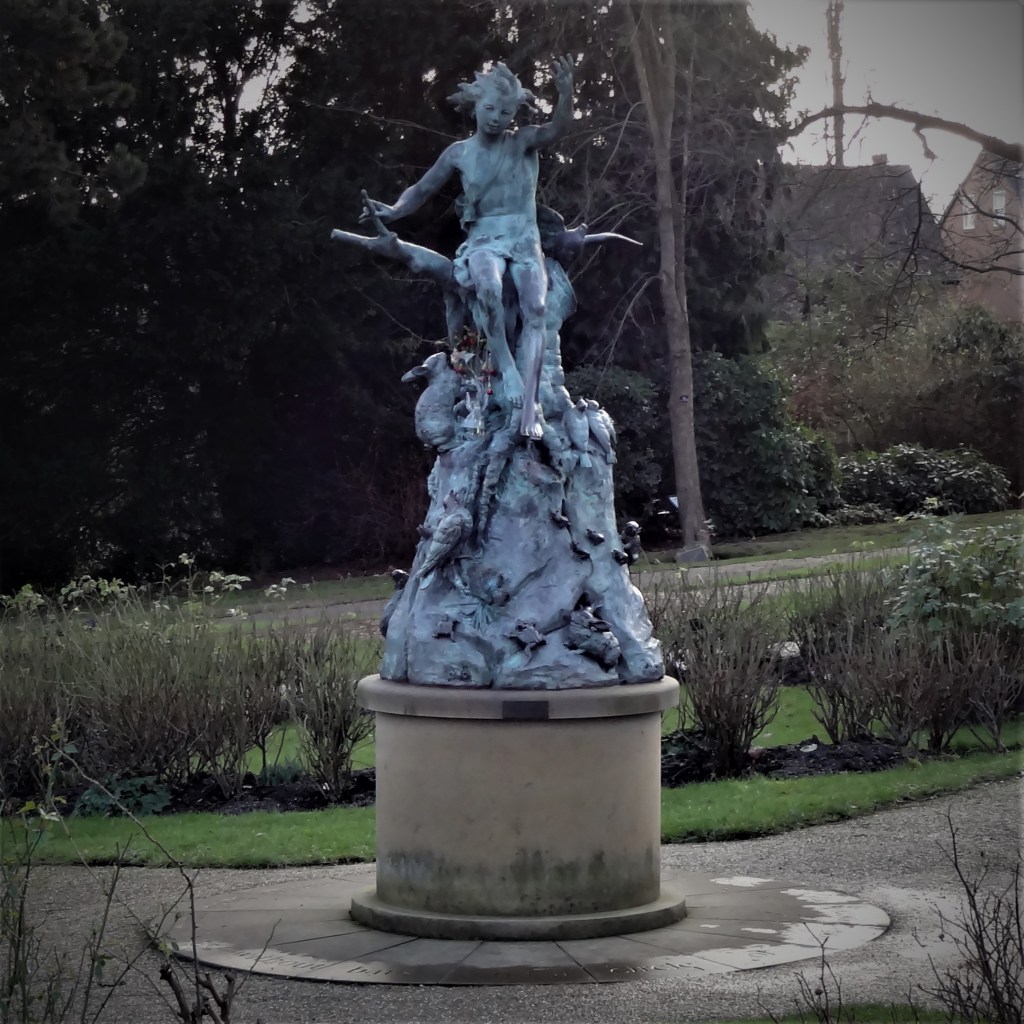
Within the Rose garden at the Botanical Gardens, in Sheffield, is a sculpture called Pan: Spirit of the Wood. This was a gift to the city by Sir Charles Clifford, proprietor of the Sheffield Telegraph and Star, on his death in 1936.

However, the city’s inhabitants had to wait a long time to see the sculpture, only made available after the death of his widow, Lady Alice Clifford, in 1941.

He had expressed a wish that the sculpture would be placed in Endcliffe Wood or Whiteley Wood, but it wasn’t until 1952 that Spirit of the Wood was finally placed in the newly designed and restored Rose Garden at the Botanical Gardens.

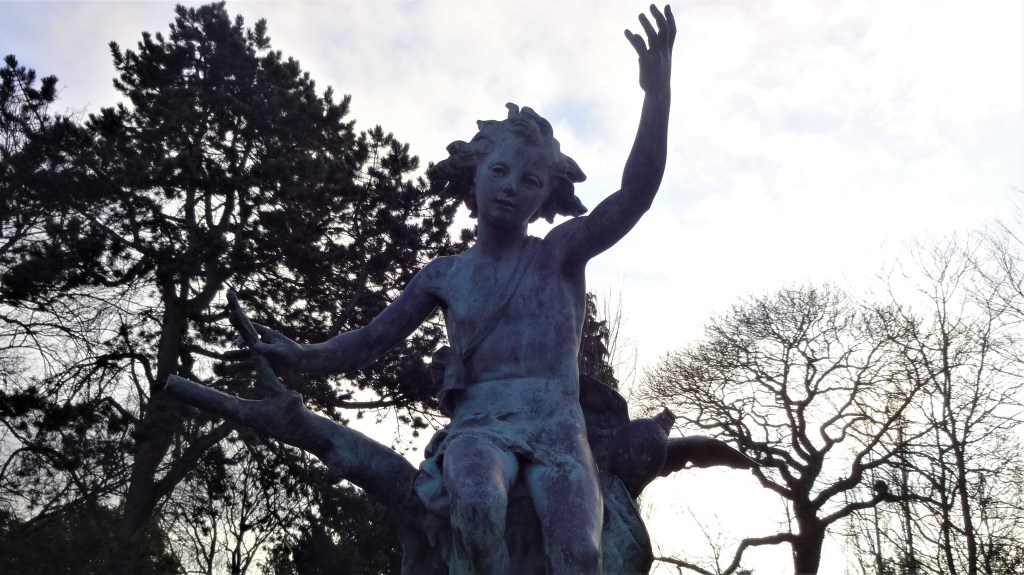
Although his will referred to Peter Pan, it was almost certainly a statue of Pan: Greek god of pastures, flocks and woods, seated on a tree stump. Around the statue are brass birds, rabbits, mice, frogs and squirrels, while elves are imaginary woodland spirits. Cast in bronze, about 2 metres high, the sculptor has remained unknown.

The condition of the sculpture deteriorated over the years and it wasn’t until 2003 that restoration was undertaken at a cost of £40,000.

Spirit of the Wood was sent away to Chris Boulton, a restorer, who found that it had been made in sections and bolted together. Grit was blasted away, the patina removed, and rough cement detached from the stone base.
It was discovered that the cast was of poor quality, with the likelihood that the sculpture had been made of scrap-metal.

Once completed, Pan: Spirit of the Wood was reinstalled in the centre of the Rose Garden and nowadays forms part of the Riddle Trail.

The only clue to its creator can be found on an inscription – “H.W. Cashmore – Westminster” – a company of metal workers that had a foundry in Balham.

It had been set up by George Henry William Cashmore and Malcolm Hankey and became part of the Bromsgrove Guild of Applied Arts, established in 1894 by Walter Gilbert as a company of modern artists associated with the Arts and Crafts movement.

The guild worked in all sorts of materials including metal, wood, plaster, bronze, tapestry and glass. As a result of their most famous commission, the iron and bronze gates at Buckingham Palace, they were issued with a Royal Warrant appointing them metal workers to King Edward VII, an honour repeated two years later under George V.

By 1908, the guild was using H.W. Cashmore at 96 Victoria Street, Westminster, as a showroom and studio.

The partnership between Henry William Cashmore (he’d now dropped the initial G from his name), and Malcolm Hankey was dissolved in 1911 and became known as H.W. Cashmore and Company.

The showrooms flourished and attracted the attention of Country Life magazine in March 1914, which did a feature on the company.  Later the same year, The Gardeners’ Chronicle provided perhaps the best insight into the workings of H.W. Cashmore.

“Mr Cashmore has been careful to surround himself with workers who are not only skilled in their several branches, but are also imbued with the true craftsman’s instinct, and are therefore capable of applying themselves zealously to the realisation of high ideals. The effect is seen in the many examples of beautifully wrought and finely-finished metal work and carried out by the firm’s staff in a manner worthy of the invariably artistic designs to which they work.

“These productions take the form of garden statuary and elegantly modelled figures, ornamental bronze work, wrought iron gates, grilles and railings. The appreciation of their work now reaches to the most distant parts of the world. Examples of their skill and taste have gone as far afield as India, China, Japan and South America, as well as to the United States and Canada.

“Much of their work is used in the new commercial buildings of the world, on the other hand, a great deal of their skill seems to be utilised by clients who inhabit some of the most beautiful of the old English country homes – as found at Eltham Hall and Rushton Hall.”

Photograph by Sheffielder

Although records suggest that Spirit of the Wood was created in the 1930s, the likelihood is that it originates to about 1915 when Sir Charles Clifford bought Whirlow from Denys Hague, a coal-owner. Britain was at war, with metal commanding premium prices, and the inclusion of scrap-metal in its creation was understandable.

The sculpture probably stood in his garden at Whirlow, as did a pair of wrought iron gates, most likely by H.W. Cashmore as well, also bequeathed to the city, with Sir Clifford hoping that they would stand at the entrance to the bird sanctuary in Ecclesall Wood. As it happens, the gates are still hanging outside Clifford House on Ecclesall Road South (as Whirlow became known).

It seems we shall never know the designer of Spirit of the Wood, the obvious answer being that it was probably designed by one of Cashmore’s employees. Sir Charles doubtless ordered the statue from a catalogue, or even after visiting the Westminster showroom.  

Categories
Buildings

Charles Clifford Dental Hospital

In another post, we looked at Sir Charles Clifford (1860-1936), proprietor of the Sheffield Telegraph and Yorkshire Telegraph and Star, and on the Council at the University of Sheffield.

Little is known about him nowadays, but his name is familiar with generations across the city.

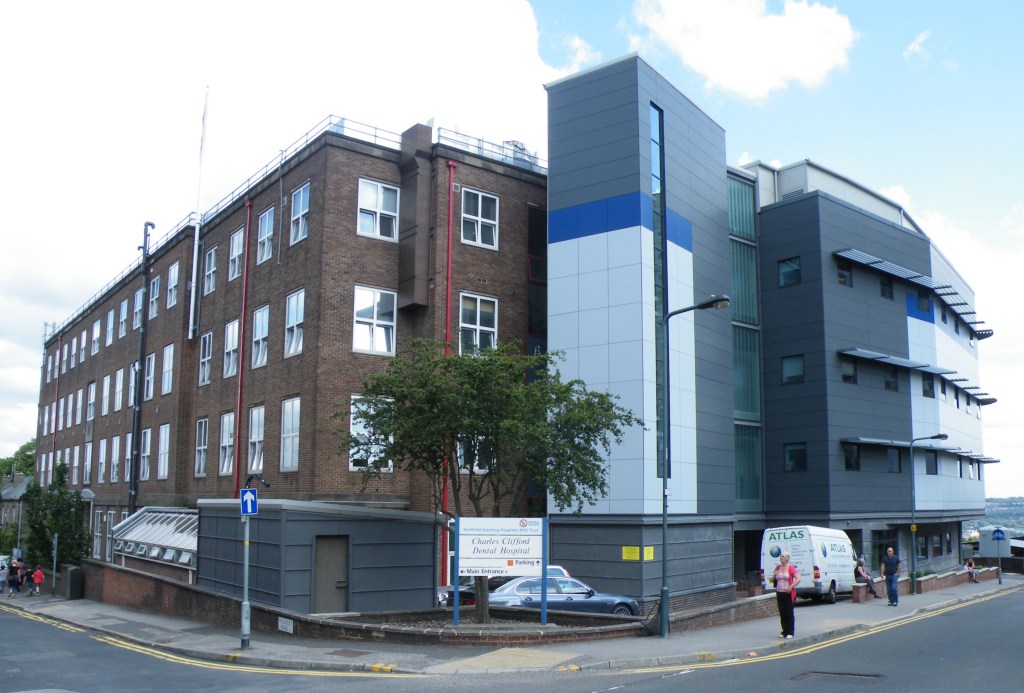
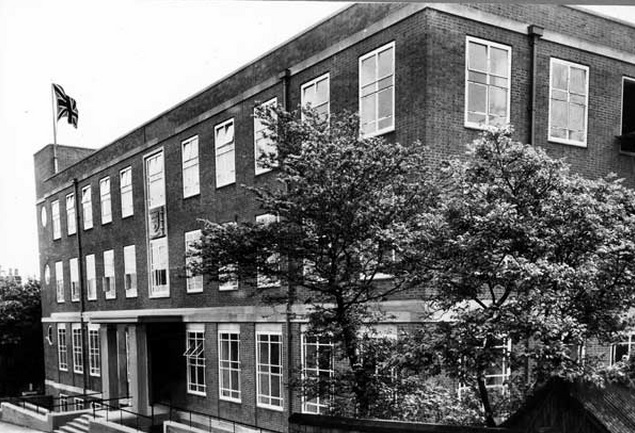
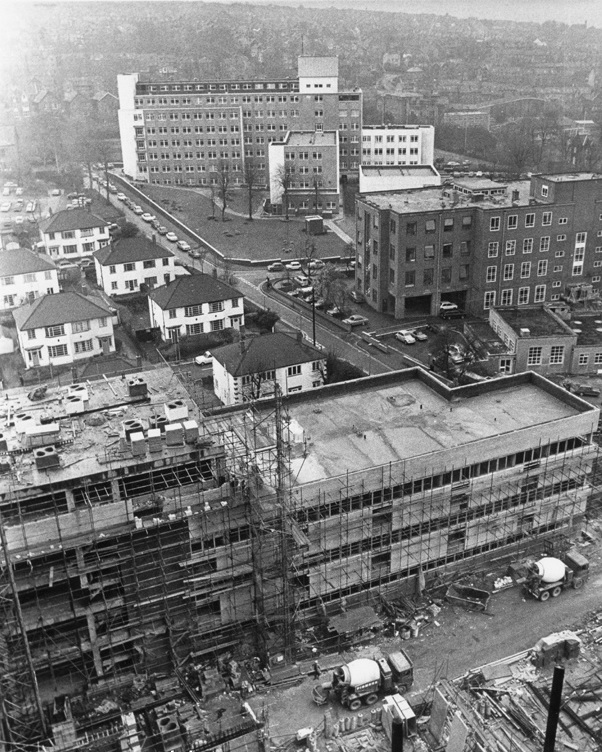
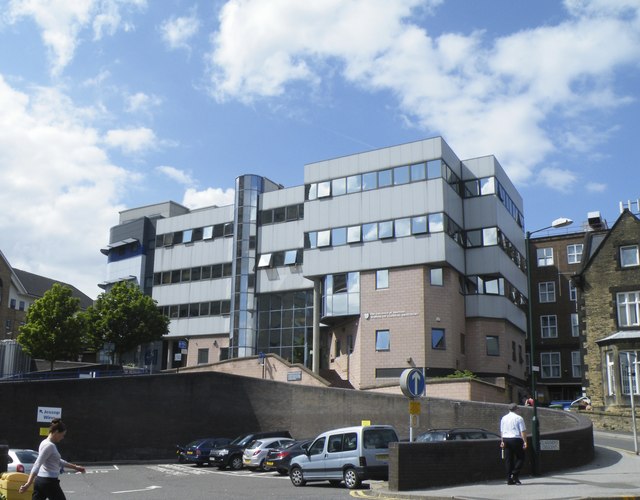
The Charles Clifford Dental Hospital, on Wellesley Road, was opened in 1953 to provide dental care for people in Sheffield.

Photograph by Picture Sheffield

Its origins were in the Dental department of the Royal Hospital on West Street, but the facilities became too cramped, and so, in 1935, Sir Charles Clifford bought Broom Bank, an empty house on Glossop Road, for the purpose.

Sir Charles Clifford died in 1936, also leaving more than £77,000 for the “general purpose of the university.” It later emerged that there was a problem with Broom Bank because the site had been earmarked for a new general hospital to replace the Royal Hospital and Royal Infirmary (it subsequently became the Royal Hallamshire Hospital).

The plans had to be abandoned, and war prevented development of the Charles Clifford Dental Hospital (on another site on Wellesley Road) until revived in 1950. In the meantime, Broom Bank was demolished in 1947, a decision criticised by the local press as the loss of a short-term chance to adapt it for the purposes of the hospital.

The foundation stone was laid by Hilary A. Marquand, Minister of Health, in September 1951, and was finally opened by the Duchess of Gloucester in 1953.

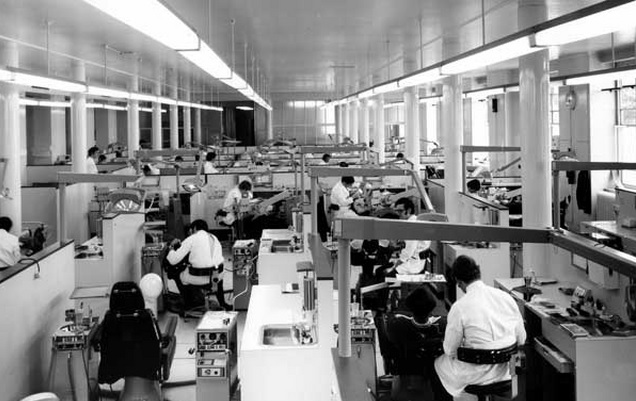
When it opened it was “one of the finest dental schools in the country,” with laboratories, teaching rooms, a library and common rooms as well as one floor devoted to general treatment, and a second, with forty dental chairs, for “conservative restoration of teeth and periodontal work.”

Photographs by Picture Sheffield

The NHS provided most of the funding, but £7,800 of Sir Charles Clifford’s legacy was used to buy equipment.   In 1966, the facility was extended, and in 1995 the hospital was absorbed into the Central Sheffield University Hospitals NHS Trust, which merged with the Northern General NHS Trust in 2001 to become Sheffield Teaching Hospitals NHS Trust. A major refurbishment programme that cost £5.3million was completed in 2009 and now includes The School of Dentistry at the University of Sheffield.

Photograph by Picture Sheffield
Photograph by Terry Robinson