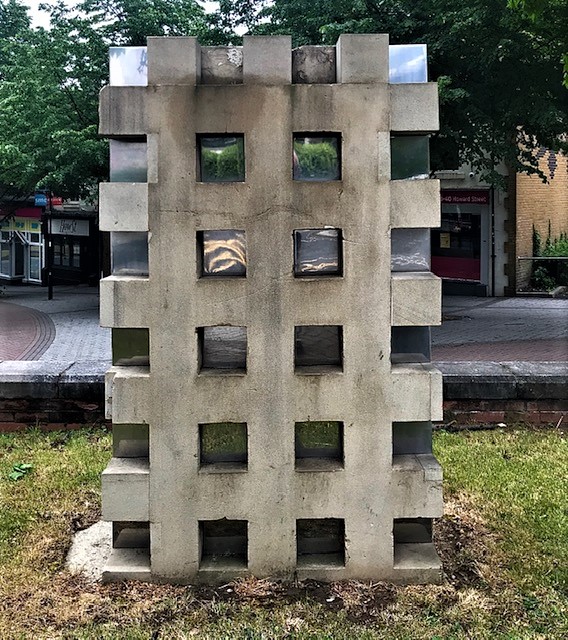
It’s remarkable that Sheffield has never officially paid tribute to Marti Caine. However, there is a sculpture at the top of Howard Street, near Sheffield Hallam University, that is named after her.
Marti Caine grew up in Shiregreen and her vocal talents, wit and engaging personality made her a mainstay of the northern club circuit before she leapt to national prominence by winning the TV talent show New Faces in 1975 – a programme she went on to present with great success.
In her later years, she campaigned tirelessly on behalf of cancer charities before succumbing to lymphatic cancer on November 4, 1995, aged 50, after a long illness.
Marti was awarded an honorary doctorate by Sheffield Hallam University in recognition of her contribution to the world of entertainment, and the film Funny Cow, starring Maxine Peake, was loosely based on her compelling life story.
The gritstone and stainless steel sculpture dedicated to her, originally called Sheen, is often referred to simply as ‘Marti’, one of the pieces made for the Stone City Symposium of 1995. It was commissioned by Sheffield Hallam University and was to have been revealed by Marti Caine, who died two weeks before the opening; it was decided to dedicate the sculpture to her instead.
The stainless steel was intended to reflect the changing weather and reflect passing traffic which flicker across the inset steel squares on the Arundel Gate side of the sculpture.
Describing his work at the time, Mick Farrell, its creator said: “Using stainless steel and stone I hope to set up a contradiction within the nature of both materials. This architectural piece would act both as a landmark and a point to view from.”
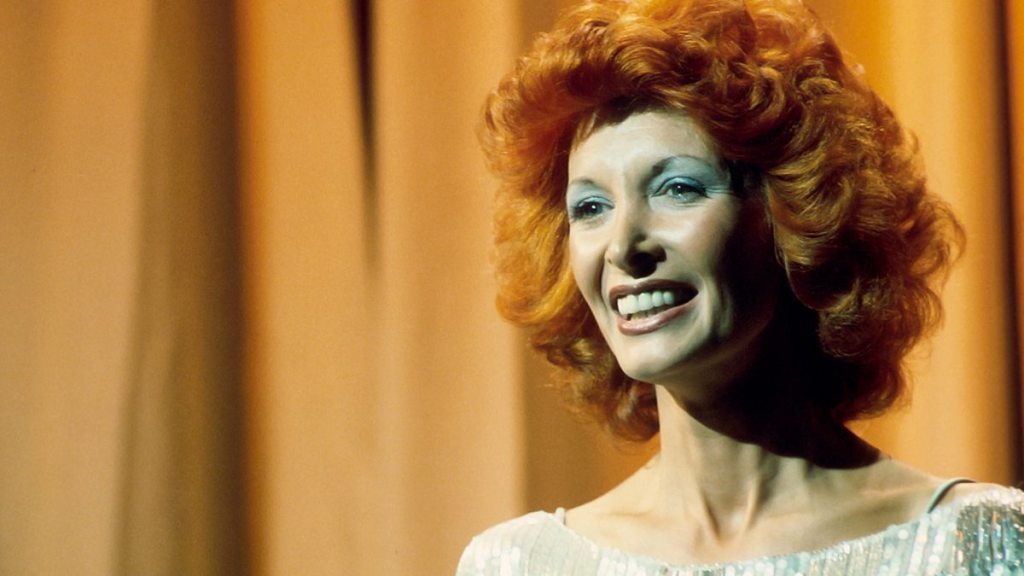
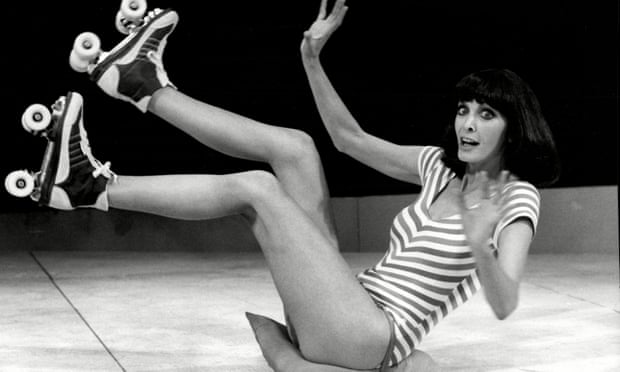
Marti Caine (1945-1995). Comedian, actress, singer and dancer. (Image: BBC)
It’s been a while since we had a look at some of those people with Sheffield connections. Today, the lady once considered to be Britain’s premier comedienne and the clown queen of TV comedy.
Like America’s Lucille Ball and Phyllis Diller, she paved the way for women working in light entertainment, whether it was the tough world of northern clubs or hosting her own television specials.
Born in 1945 at Sheffield, Lynne Denise Shepherd worked as a model, petrol pump attendant and a croupier. She’s better known to us as Marti Caine, her first professional performance aged 18 at a working men’s club in Rotherham, which led to more than 12 years playing the northern cabaret circuit.
Professionally she wasn’t Marti Caine then, or even Lynne Stringer. She was Sunny Smith for all of three weeks, followed by a spell as Zoe Bond. Unhappy with both, she scoured a gardening book for inspiration. Her husband Malcolm Stringer tinkered with tomato cane and came up with Marta Cane. The club she was playing misheard and billed her as Marti Caine.
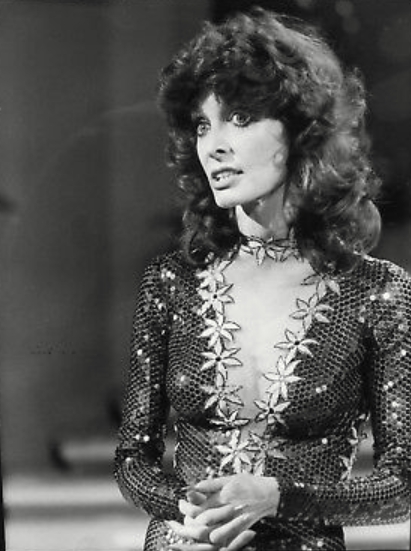
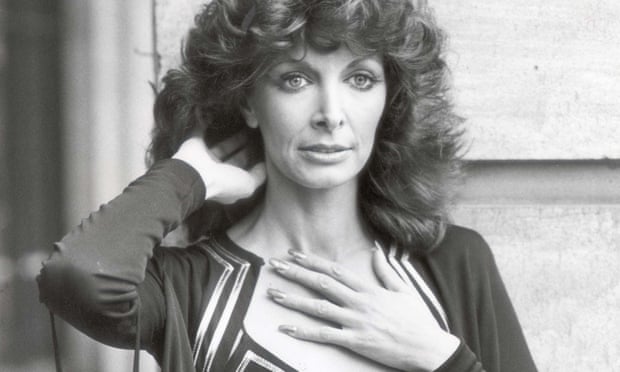
She became an overnight star at the age of 30 on the TV talent show New Faces. Viewers took to her gawky, but highly glamorous looks and quickfire timing and she soon became a household name on television and starred on her own show, Marti Caine, on BBC2 from the early 1980s.
Marti starred in Funny Girl, in 1989, playing the lead as Fanny Brice, at the Crucible Theatre.
Marti Caine found fame by appearing in the television talent show New Faces. (Image: Daily Mail/REX/Shutterstock)
During the last ten years of her life she combined an outstanding career in light entertainment with that of one on the stage and undertook tours including a notable performance in Alan Ayckbourn’s Seasons Greetings. In 1986 she presented her own one woman show, An Evening with Marti, at the Donmar Warehouse in London.
For three years from 1986 Caine hosted ITV’s New Faces, where she was noted for her friendliness and encouragement to young performers appearing on television for the first time.
In 1992 she toured Britain to record BBC’s Joker in the Pack and later completed another series, Your Best Shot, also for the BBC.
Pantomime was one of her first loves and for many years she made the character of the Red Queen a special part in Snow White and the Seven Dwarfs which played in Cambridge, Bath, Bournemouth and in London’s West End at the Strand Theatre.
She talked about her TV image as if she were an acquaintance, someone she didn’t particularly like, but had grown to accept.
“She drives too fast, smokes too much, her language is a bit choice and she is very ambitious. I am an emotional coward. I don’t like being the centre of attention. When Marti Caine is out under the spotlight, I’m in the wings throwing up with nervousness.”
In 1988, it was made publicly known that she was suffering from cancer of the lymphoid cells which prompted her to ask her doctor “Does this mean I am a lymphomaniac?”
She was given two years to live but refused to stop working and fought against the disease for seven years.
Marti died aged 50 at her home in Oxfordshire in November 1995, her second husband, Kenneth Ives, by her side. A funeral service was held at Sheffield Cathedral. It was attended by showbusiness personalities and a public address system was set up outside to relay the service to those unable to get inside.
“Remember me with a smile. I don’t want any weeping and wailing when I’ve gone. I want people to dance in the aisles.”
The 2017 film, Funny Cow, starring Maxine Peake, tells the story of a female comedian playing working- men’s clubs in the 1970s and is said to be loosely based on Caine’s story.
Caine appearing in Funny Girl at the Crucible Theatre in 1984. (Image: Kevin Holt/ANL/REX/Shutterstock)
The one that got away. I bet only a handful of people will remember this building and it might have been one of Sheffield’s finest had it survived. But it didn’t, and you’ll be surprised to learn what stands in its place today.
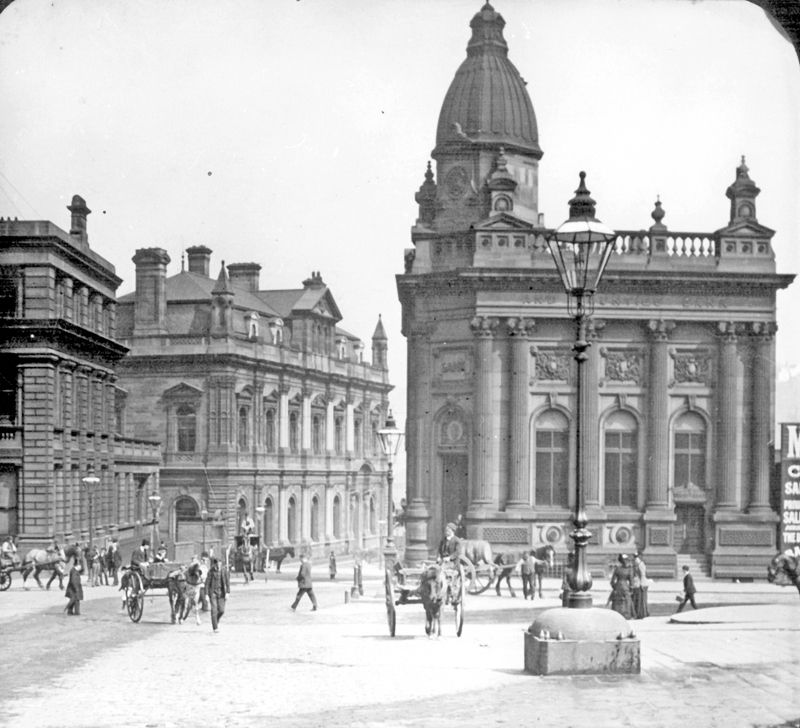
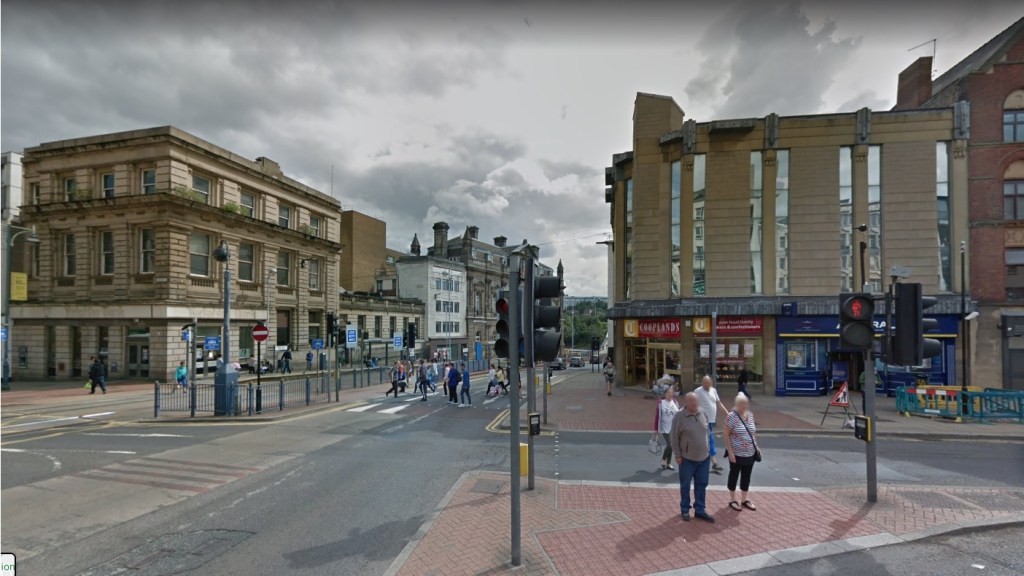
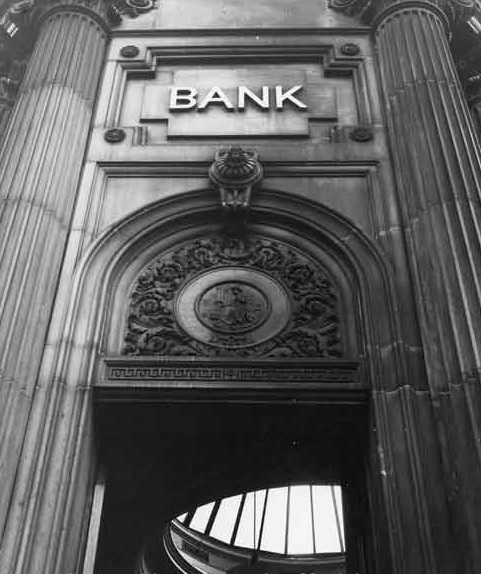
This was a bank that stood at the corner of Commercial Street and Fitzalan Square, demolished in the late sixties/early seventies to allow for road widening. Nowadays, its location is buried under the road section of Commercial Street, the Supertram tracks alongside following the course of the original road.
(Image: Google)
We can trace the building back to 1879, built for the Midland Banking Company (not to be confused with the Midland Bank, that 20th century institution). Its architect was Salmon Linton Swann whose office was on George Street.
It might have been this building that caused the downfall of the Midland Banking Company.
In 1878, the bank bought The King’s Arms in Commercial Street for £20,000, a portion of the public house demolished to make way for the new building.
The bank invited architects to submit plans. Thirteen architects competed for the design from Sheffield, Rotherham, Stamford, and Nottingham.
The directors awarded the prize to Swann, and the building contract to George Chambers and Son, a Sheffield construction company.
“The building will be of an imposing and handsome appearance, and the arrangements will tend to give privacy and facilitate easy and direct communication with the manager without passing through the bank room or incumbering the principal or main entrance with all the work of the bank.”
(Image: Picture Sheffield)
Its erection was well underway but a tragic accident in December 1879 halted progress and had devastating consequences for the reputations of those involved.
Just before Christmas, a whole length of projecting cornice, about 50ft above ground, fell and crashed through a wooden awning below. A workman, Thomas Moclar, fell to his death with it, and several workmen were seriously injured.
There was an air of complacency from Salmon Swann, who failed to attend the initial inquest and instead sent a letter. “I consider my presence or services not required, as I expect it will be a pure accident and one easily understood.”
The Coroner disagreed and ordered him to attend a few days later.
The jury found Swann censurable for not allowing sufficient tail weight to the cornice, and Chambers blameable for not calling the architect’s attention to such deficiency. However, they found the negligence insufficient to render them criminally culpable and that Thomas Moclar’s death had been an accident.
Construction was halted for a while, and progress hampered by having to rebuild the damaged section. By 1881, the bank was nearing completion and William Derry, a manager at the Huddersfield branch, was brought in to oversee its opening.
However, Derry arrived in difficult circumstances. Shortly before it opened, the Midland Banking Company realised that it was in financial difficulty. Believing it had ‘outgrown its resources’ a rescue was needed, and it came in the form of the Birmingham, Dudley and District Banking Company which amalgamated with it.
The bank opened under its new name, and quickly established a reputation in the city.
(Image: Picture Sheffield)
The height of the building was 70ft, the building preceding the development of Fitzalan Square, and cost about £17,000 to build.
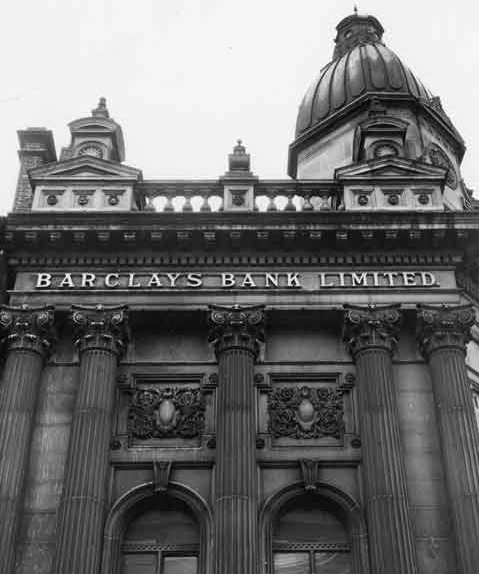
The architecture was adopted from ‘a free treatment of the classic order’, built with Huddersfield stone fronts and brick backs, having bold fluted columns along the front, with moulded bases and carved capitals dividing the wall spaces into panels, relieved by plate glass windows.
At the principal corner of the parapet was an ornamental stone tower with an ornamented panel bearing the Sheffield coat of arms, surmounted by the carved dome, supporting a moulded canopy and finial.
Internally, the wall spaces were divided into panels by means of moulded pilasters, in Parian cement, the panels fitted with the large windows. Those along the blank walls were fitted with silver-plated glass, which added a lustre of light.
The whole was surmounted by a moulded and enriched cornice, from which sprang a deep cove, relieved by a diaper work, supporting a moulded and panelled ceiling, from the centre of which was the dome, filled in with stained glass.
From the centre of the dome a ventilating sunflower fan was suspended to extract air from the bank, and to light the space below.
The whole of the bank floor was constructed with fireproof flooring covered with tiles.
The bank was heated with Perkins’ patent hot water apparatus, the pipes obscured by perforated iron skirting running around the walls.
The whole of the Commercial Street frontage was used as offices for the manager and waiting rooms, which were divided from the bank room with mahogany glazed screens, 10ft high, and covered with light glazed roofs, introducing Tobin’s principle of ventilating tubes for fresh air.
The remainder of the floor was divided and sub-divided by desks and counters, with the rear east wall fitted up with safes. Seats and desks were appropriated for the public under the windows.
Quite unusual for the building was an entrance to a basement (9ft high) in Commercial Street. This was used as a caretaker’s apartment, complete with sitting room, scullery, and bedrooms. There was also a dining room for clerks, two strong fireproof rooms, the hollow walls lined with white glazed bricks, to store ledgers, a bullion room, and toilets. The floor was laid with wood block flooring laid on a bed of concrete, thought more suitable to prevent damp and vermin. Below the basement was the boiler room, coal cellar, and a place to store ashes and dust.
The bank merged with the Wolverhampton and Staffordshire Banking Company in 1889 to become Birmingham, District and Counties Bank, eventually becoming United Counties Bank in 1907.
In the same year, a fire almost destroyed the dome after a spark in the built-in chimney set fire to woodwork. It was threatened until firemen managed to haul hoses up to a height of 70ft to extinguish the flames.
United Counties Bank was bought by Barclays Bank in 1916, a name long-associated with the building until its sad demolition.
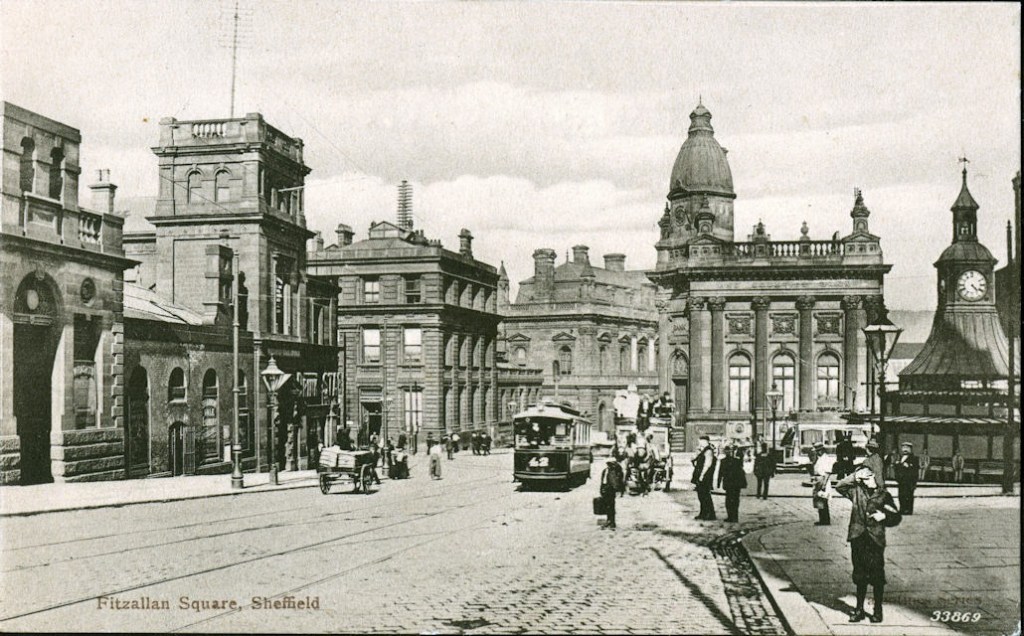
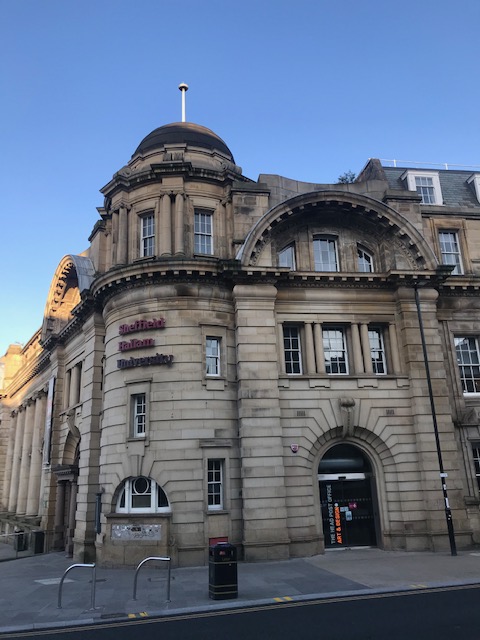
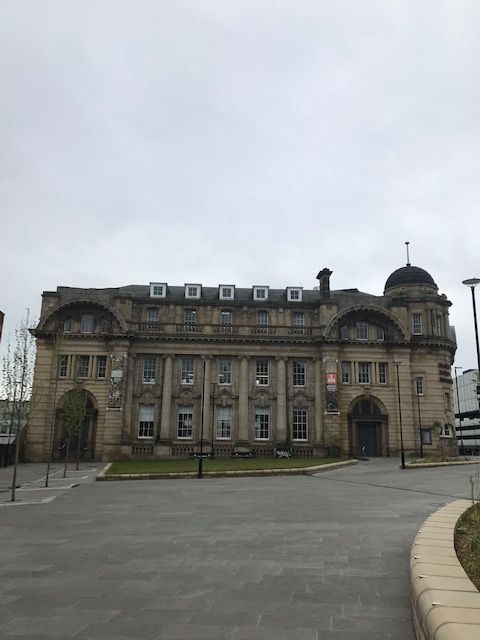
In a previous post we looked at the history of the General Post Office in Sheffield city centre. From humble beginnings on High Street, via Angel Street, Market Place, and Haymarket, the central post office ended up in Fitzalan Square.
However, the building now occupied by Sheffield Hallam University, was a long time coming.
In the first years of the twentieth century the Post Office acknowledged that facilities at the top of Haymarket had become too small.
By 1897, red-brick offices in Flat Street had opened and by 1900 all that remained at Haymarket was public counter work and the telegraphic department.
In fact, the Post Office had been buying up land around its Flat Street offices. By 1903, it had a triangular piece of land of one acre stretching from Fitzalan Square to Pond Hill.
(Image: David Poole)
The Post Office submitted plans to Sheffield Corporation for a building fronting Fitzalan Square, but the councillors were less than impressed. In 1907 it sent a delegation to see Lord Granard, who represented the Post Office in the House of Lords, to ask for a better building, including a finer elevation, than the one proposed.
Newspapers had been full of stories about a new post office and the people of Sheffield had started to think that the building might never get built.
However, the visit to London appeared to work and later that year plans were released by the Post Office for a new building in Fitzalan Square adjoining the existing Flat Street offices.
(Image: David Poole)
Work started in 1908, coinciding with Fitzalan Square improvement works, and an immense crane, 70ft high and with a jib 95ft long, dominated the skyline.
It was designed by Walter Pott, an architect who had started work with HM Office of Works in 1896 working in the London and Leeds offices.
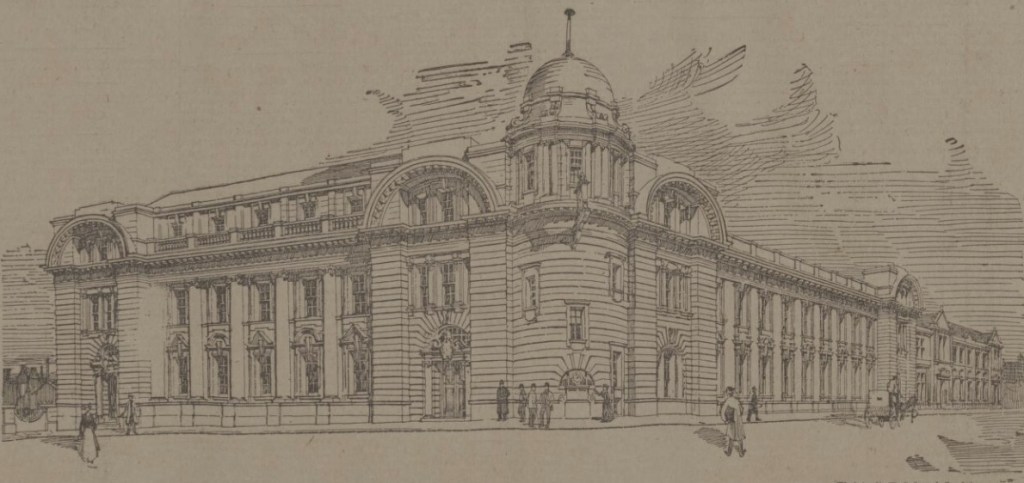
The design was a modern adaptation of the Renaissance and allowed an additional storey over the wing in Flat Street.
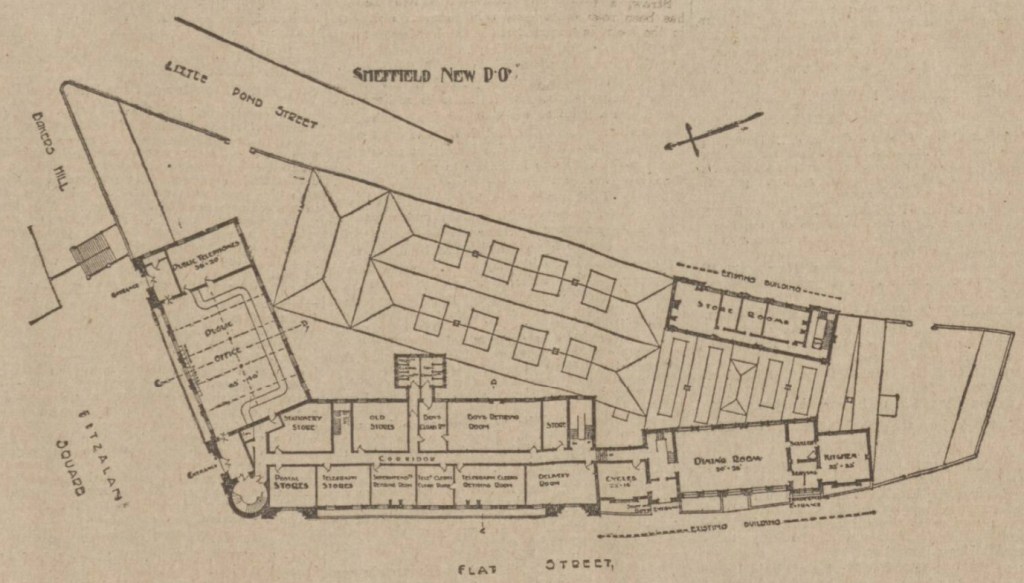
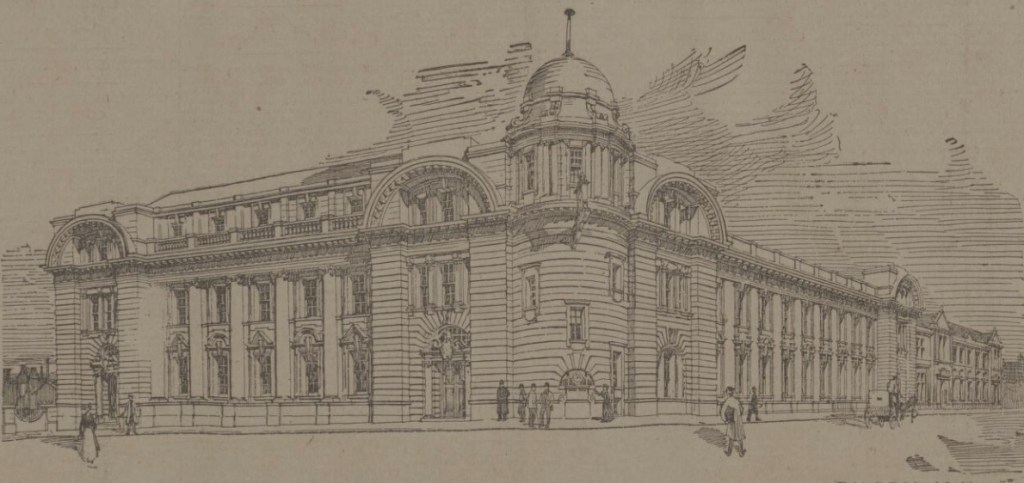
Plan of Sheffield Post Office in 1909. (Image: British Newspaper Archive)
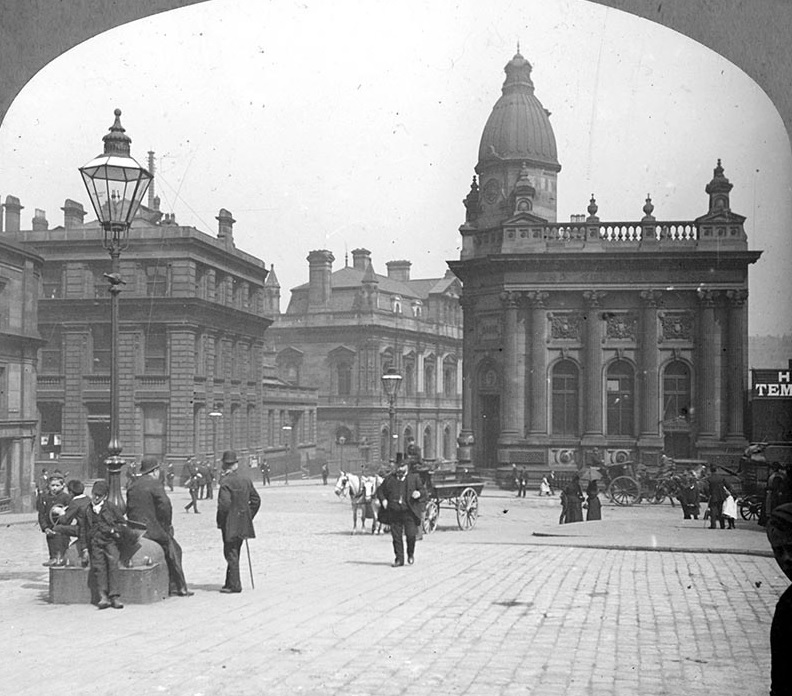
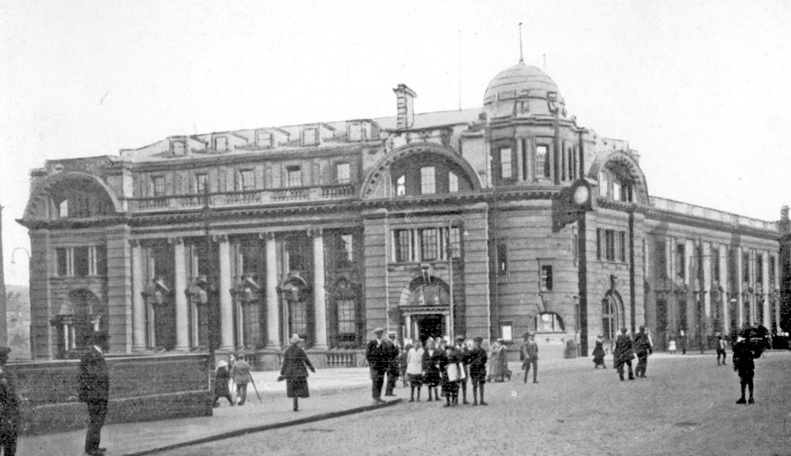
The principal front in Fitzalan Square was three storeys high, with a central portion having columns the full height of the two lower floors, these finished with carved Ionic caps and heavily moulded cornice and balustrade, which continued around the other fronts.
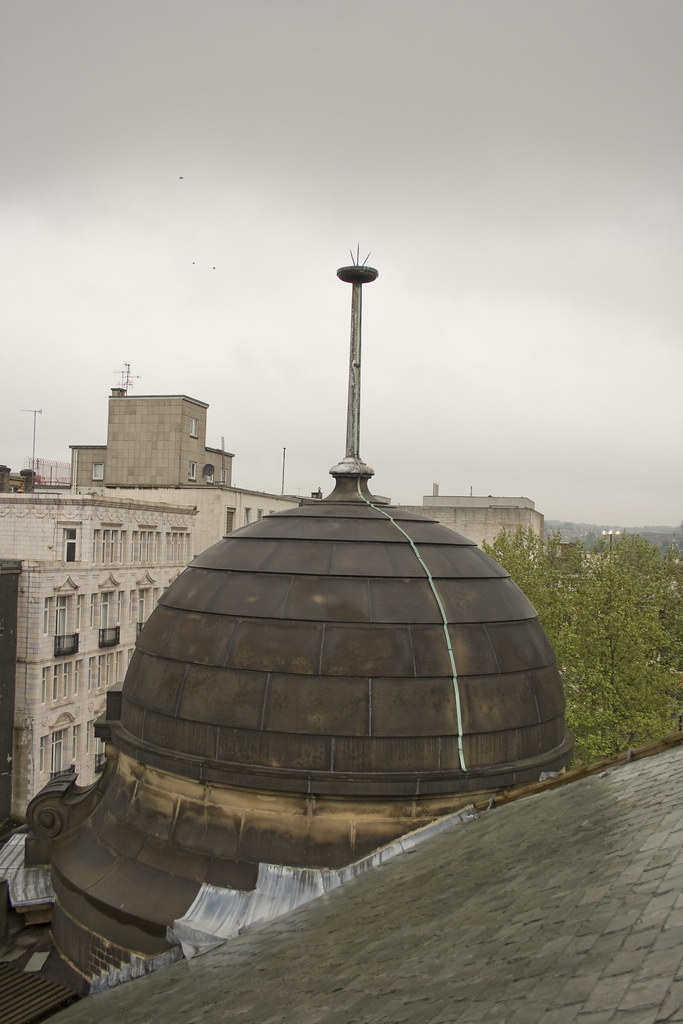
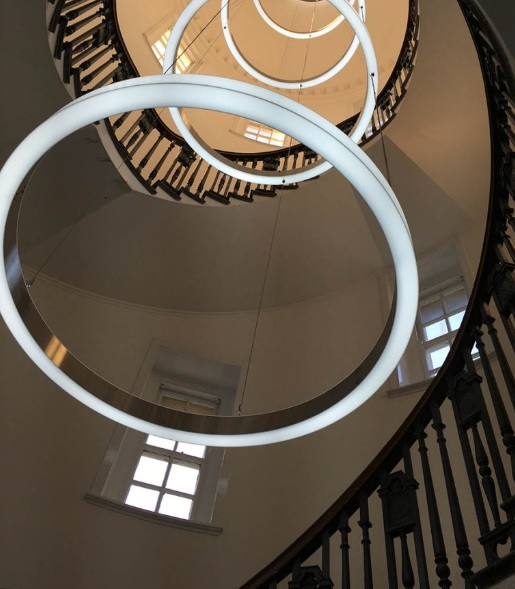
The front of Flat Street was treated in a similar manner but without the columns, and the corner with Fitzalan Square was rounded to accommodate a main staircase leading to the upper floors and finished with a dome.
The two principal entrances were in the wings of this portion, giving access to the public office, inquiry office, and Postmaster’s office. The upper parts of these were finished with heavy pediments.
Post boxes were at the base of the corner, with a large bracket clock (paid for by the council) above.
A sketch by Walter Pott of Sheffield Post Office in 1909. (Image: British Newspaper Archive)
The main post room, for the sale of stamps and postal orders, was 64ft long and 45ft wide, lit with windows back and front, and lined to a height of 8ft with marble, with a mosaic floor. Adjoining was a public telephone office with ‘silence boxes’ to allow messages to be sent without interference or risk of transactions being overheard.
The Postmaster, the Chief Clerk and writing staff, as well as the sectional engineer, were accommodated on the first floor immediately over the public office and front entrances, and on the floor above was the telephone switch-room and message-room. The basement was used for batteries and engineers’ equipment.
(Image: Picture Sheffield)
The Flat Street wing was set apart on the lower floors for retiring rooms for staff, for the messengers’ delivery room, and for storerooms. The first floor was entirely occupied by an instrument room.
The lower part of the site was in Little Pond Street, a much-needed extension to the existing sorting office, and for the provision of yards for loading and unloading mail and the storage of handcarts.
The new post office was designed throughout to meet modern sanitary requirements as regards light and ventilation, and the walls and passages occupied by staff were faced with glazed bricks. Four boilers, 146 radiators, and 1½ miles of heating pipe was installed by the Brightside Foundry and Engineering Co.
The building had been built on a hillside, and the result was that the greater portion was down below street level, and what people saw from Fitzalan Square was only the top.
Although history books give a date of 1910 for the building, it came into use without fuss during the summer of 1909. “The staff simply left their posts in one building and walked over to the incomparably better equipped accommodation across the Square.”
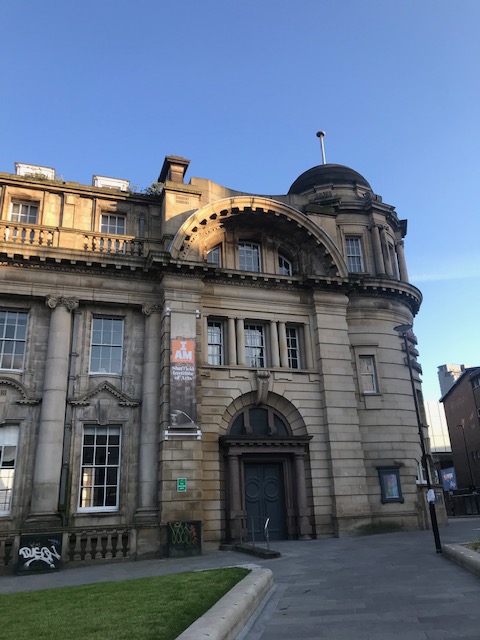
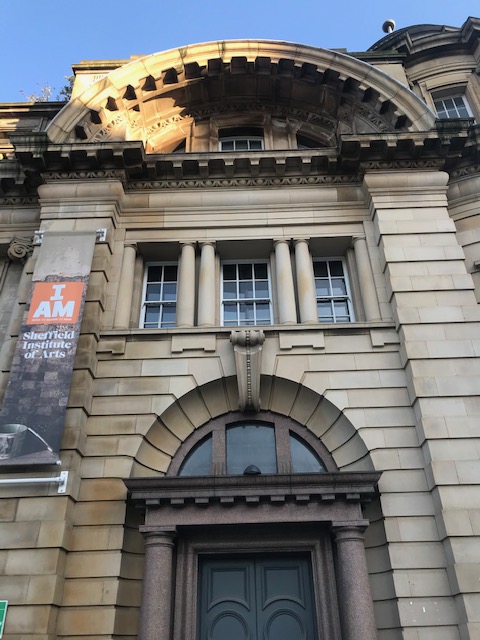
It remained in operation until 1999 and remained empty for several years, a ‘building at risk’, until rescued by Sheffield Hallam University which opened it as the Institute of Arts in 2016.
A sketch of Sheffield Post Office, Fitzalan Square, in 1909. Photograph by The British Newspaper Archive.
In this post, we look at the history of the Post Office in Sheffield, but a question before we start. Do you know where the Central Post Office is in Sheffield? I suspect a few might struggle to answer this, and I was the same. Answer at the end.
There is one certainty in the architectural world – we will never build Post Offices like we used to, if at all. Technology has done away with the need to create lavish buildings.
The story of the growth of the Sheffield Post Office mirrors the development of the city.
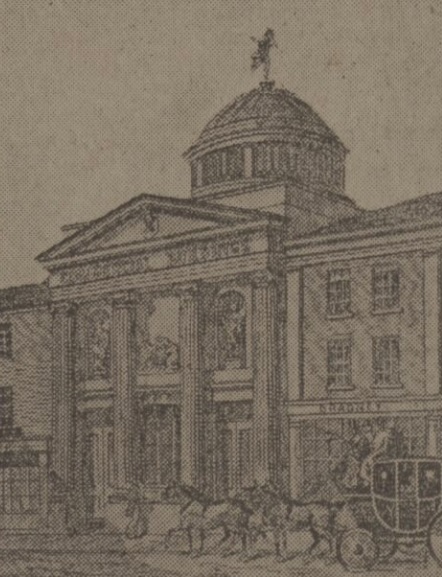
In January 1835, a Post Office and News-Room was opened at the Commercial Buildings in High Street (opposite where the Telegraph Building stands today).
A small room was all that was needed in those days, with postage stamps handed through a little door fixed in a hole cut through the wall. The population of Sheffield at this time was 91,692 but by 1851 this had risen to 140,000.
Sheffield’s first Post Office, in the Commercial Buildings on High street. Photograph by The British Newspaper Archive.
The demands on the Post Office increased and the facility was removed to Angel Street, in a part of a building that had once been Shore’s Bank.
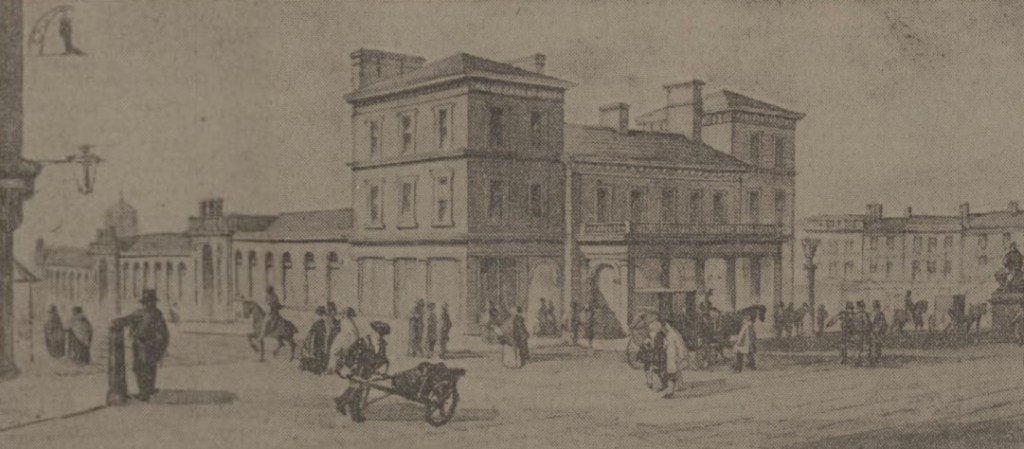
The next move was to the top of Market Place (Castle Square), a much grander building that coincided with the increase in postal demand.
Sheffield Post Office, Market Place. Photograph by The British Newspaper Archive.
Sheffield’s industries were rapidly growing, and the population was advancing at an enormous rate. More general use was being made of postal facilities, and the authorities were improving the service, including the postal telegraph service, rates of postage to all parts of the world being reduced and the introduction of parcel post.
While the facilities in Market Place had been a great improvement on any previous office, there was a need for bigger premises.
In 1871, the population had reached nearly 240,000 and a new Post Office opened at the corner of Haymarket and Commercial Street (still standing, more recently home to Yorkshire Bank). However, by 1900 this was also too small and offices in Flat Street were opened and all that remained in the Haymarket was public counter work and the telegraphic department.
The Post Office had bought more land in Flat Street and Pond Hill from Sheffield Corporation as well as acquiring a site occupied by Mappin Brothers. By 1903, the Post Office had about one acre of land, a triangular plot stretching from Fitzalan Square and Pond Hill. Branch sorting offices were provided at Highfield, Broomhill, Montgomery Terrace Road, and Attercliffe, and sub-post offices opened all over the city.
These relieved the work at the central office, but still the business grew, and now, when the population was creeping up to half a million, a new office was provided at the top of Baker’s Hill, on the east side of Fitzalan Square.
The new Post Office, incorporating its Flat Street offices, opened in 1909, a Baroque-style building designed by Walter Pott of HM Office of Works. It coincided with Fitzalan Square improvement works and despite its grandiose appearance did not escape criticism.
In fact, the Post Office had been built on a hillside, and the result was that the greater proportion of the building was down below street level, and what people saw from Fitzalan Square was only the top.
The Post Office closed in 1999 and remained empty for several years before becoming the home to Sheffield Hallam University’s Institute of Arts in 2016. More about this building in a separate post.
And finally, the answer to that question. The Sheffield City Post Office can be found on the 1st floor of Wilko in Haymarket.
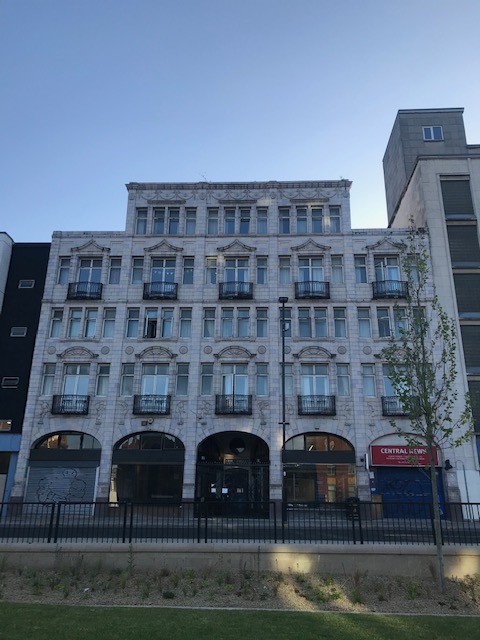
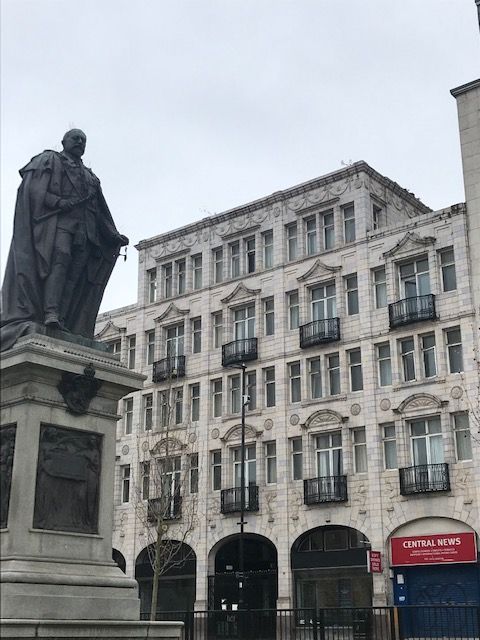
The White Building in Fitzalan Square. The old offices have been converted into apartments. (Image: David Poole)
This is probably one of Sheffield’s best-loved buildings. A glance through social media shows positive words about the White Building in Fitzalan Square, and yet little appears to be known about it.
The building is Grade II listed by Historic England, more so for the ten carved friezes that adorn its fascia, but its simple past, as shops and offices, means it is largely forgotten.
(Image: David Poole)
The White Building was built in 1908, named after the white faience used to dress it, quite different from the stone used in other buildings of the time. This material was used because it was ‘self-cleaning’, an antidote against the soot that clung to our city centre buildings in the past. (Another example, still seen today, was the Telegraph Building on High Street).
However, it would not look out of place on a typical Parisian street and comes into its own on a bright sunny day.
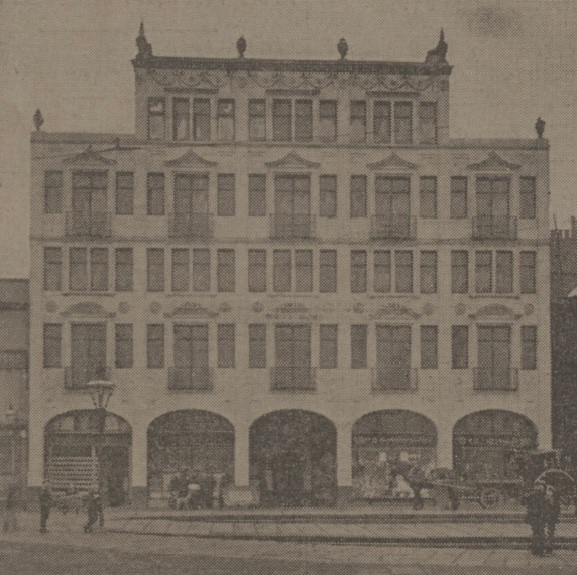
The White Building seen shortly after completion in 1908. This was one of several new buildings built at the same time as the square was ornamentalised. (Image: The British Newspaper Archive)
It was designed by Edward Mitchel Gibbs, of Flockton and Gibbs, who built and owned the building. No surprise then that its construction came the same time that Fitzalan Square was about to be rebuilt. Gibbs, as a member of the Sheffield and South Yorkshire Society of Architects and Surveyors, had consulted on plans for the square, and no doubt saw an opportunity to cash in on future success.
The White Building was built of four storeys with a raised attic storey in the centre. The use of French windows with balconies on the first and third floors provided welcome relief to the usual designs for commercial buildings.
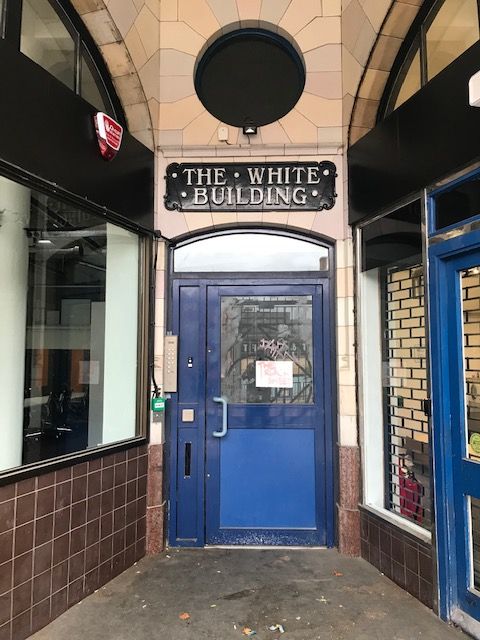
The building was accessed by an arcaded ground floor, the entrance, still with its original name plaque, recessed behind one of the plain elliptical arches.
It is above these five arches that the ten friezes can be seen. These were created by Alfred Herbert Tory and William Frank Tory, the brothers using real workers as models, before sending away the designs to be cast as hollow tiles (the moulding was done with terracotta tiles in Leeds).
With thanks to Darcy White and Elizabeth Norman ‘The Sheffield Trades’ are as follows:-
“A Silversmith (with a blowpipe): a Chaser: an Engineer: a File Cutter; a Steel Roller: a Cutler: a Grinder (using a flat-stick): a Hand Forger; a Buffer; and a Steel crucible teemer (with sweat rag in mouth).”
The Tory brothers made five each, casting their initials beneath their work, although these have weathered badly and are now difficult to read.
After the White Building opened, its ‘first class shops and offices’ were in huge demand and proceeded to be so until the decline of Fitzalan Square in the 1970s and 1980s. It was altered in the late twentieth century, including the removal of decorative rooftop urns, but remains pretty much as it did when first built.
These days the old offices have been converted into apartments and the ground floor shops await the revival of Fitzalan Square.
The King Edward VII Memorial with the White Building in the background. (Image: David Poole)
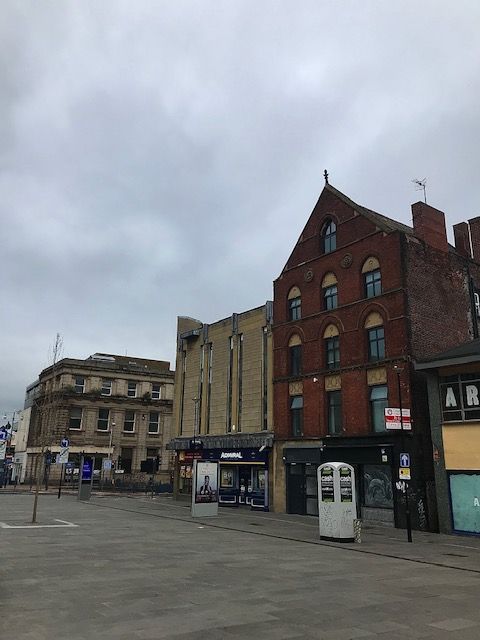
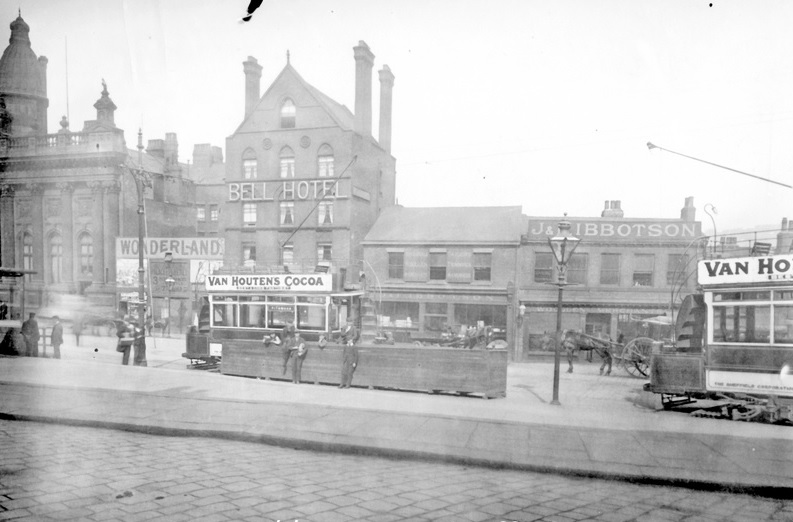
If buildings could only tell a story. Bell House is probably the oldest structure in Fitzalan Square. It was built after Sheffield Corporation spent a fortune from 1869 onwards purchasing and demolishing property between Market Street and Jehu Lane to create a new municipal open space.
The five storey building was the Bell Hotel (1872), its first landlord and owner being Henry Hardcastle, a wealthy man, previously of the Blue Bell in Commercial Street, one of those properties that was a casualty of the development.
For many years he had been a member of the 1st West York Yeomanry Cavalry, attaining the rank of sergeant-major, and proving popular with his comrades.
Hardcastle was good for a quick anecdote, could sing a good song, and make an admirable speech. Seemingly the right qualities needed for a publican. He was actively connected with the birth of building societies, whose meetings he allowed to be held in his pubs. He died in 1887 at the “ripe old age of 67-years” after collapsing in Snig Hill.
The Bell Hotel was put up for sale.
“That old established, substantially built and well-appointed hotel. Its central situation, and being within easy reach of both railway stations, the tramways and omnibus termini, secures for it a good commercial and country trade, and in the hands of an enterprising person it could not fail to continue a successful and prosperous undertaking.”
The woes of Fitzalan Square have been recorded in previous posts and at least one licensee fell victim to the area’s unsavoury characters. Annie Padley was one, pleading guilty to letting the Bell Hotel be used for betting purposes in 1901.
Photograph by David Poole
Another landlord, Arthur Browning, believed the Bell Hotel to be a gamble, one that might have rewarded him handsomely.
In 1902 he allowed the public house to be used for the trial of the Monarch fire escape, a convoluted device of poles, knitted ropes, hooks and slings, manufactured by Waddington and Co of Bradfield Road, to allow people escape from high-rise buildings. At the time, the Bell Hotel was one of the highest buildings in the city, the top floor window being about 50 feet from the ground.
Unfortunately, Browning was declared bankrupt in 1904 owing £1,398 (about £171,000 today).
The Bell Hotel (later The Bell) was for many years associated with Thomas Rawson and Co, a brewery long-established at nearby Pond Street, later acquired by Duncan Gilmour & Co (another local brewer), and finally falling into the hands of Joshua Tetley & Son. It closed in 1974.
Since then the ground floor has been occupied by shops and the upper floors converted into flats.
Look carefully above the three first floor windows and you can still see traces of the past – two pairs of bells above each window – one on top of each other.
It is a strange name for a small street in Sheffield. Esperanto Place is the short road that stretches between Arundel Gate, going down past Mecca Bingo, and into Fitzalan Square.
Many years ago, this was the eastern end of Norfolk Street, later separated by the construction of Arundel Gate, and insignificant to most people.
However, in 1974, when Sheffield hosted the British Esperanto Conference, this section of road was renamed in its honour.
Sheffield has been important in the world of Esperanto, hosting the British Esperanto Conference on four occasions, and is one of the few places in Britain to have a street named Esperanto.
Esperanto is a language created in the 19th century which soon became the most widely-spoken constructed international auxiliary language in the world. Advocates included film star Charlie Chaplin and writers J. R. R. Tolkien and Leo Tolstoy.
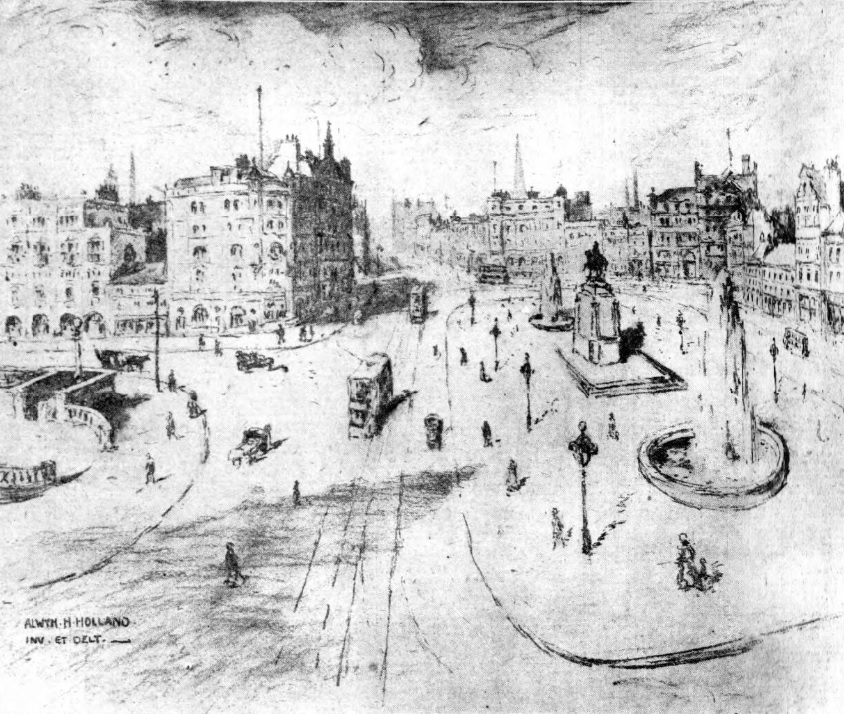
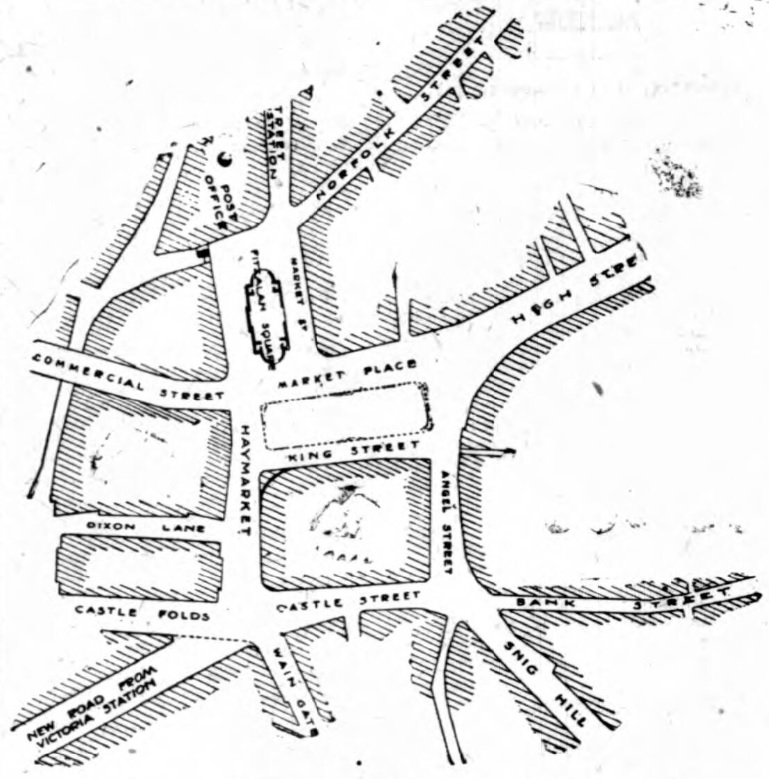
This extraordinary sketch shows a grand municipal square that was once proposed for the centre of Sheffield. The illustration from 1911 was by Alwyn Henry Holland, and showed King Edward Square, considered as a memorial to King Edward VII who died in 1910.
At the time, Alderman George Franklin had suggested that the Fitzalan Market should be swept away and the central block between King Street and Fitzalan Square used as a handsome open square. In its centre was to be an equestrian monument celebrating King Edward with fountains either side.
The proposal would have meant that the main streets of the city would run into the square and afford adequate space for dealing with increasing tram traffic.
Photograph by The British Newspaper Archive
It was understandable that Sheffield considered such a scheme.
The city was often compared to Leeds, with its city square and ornamental embellishments, and the architecture of its public buildings and offices were thought far superior.
Fitzalan Market, dating back to the 18th century, was considered an ‘eyesore’ and described by market traders as being like the “Black Hole of Calcutta.”
The scheme was subject of several meetings at the Town Hall, and serious consideration was given to the plan. Alas, with the cost estimated at £200,000 (nearly £24 million today), the idea was abandoned in favour of the much-cheaper standing figure of King Edward VII in nearby Fitzalan Square.
From the illustration we can determine where King Edward Square would have been.
The road at the centre of the sketch is Commercial Street, leading into High Street, with Fitzalan Square to the left. The road on the right side of the square is King Street. Several buildings are familiar, including The White Building on the left and the York City and County Bank (now The Banker’s Draft) in the centre of the picture. The spire of Sheffield Parish Church, now the Cathedral, can be seen behind.
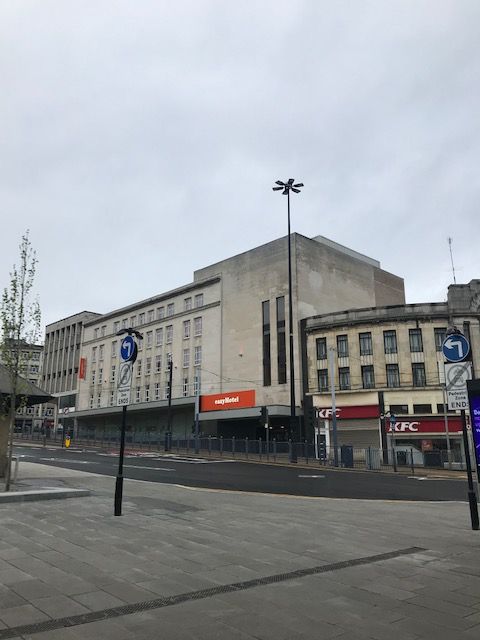
Fitzalan Market was demolished in 1930 and a large part of the site was acquired by C&A Modes Ltd for a new department store. This was destroyed in the Blitz and replaced with a less spectacular building, later acquired by Primark, and now easyHotel.
NOTE:- Alwyn Henry Holland (1861-1935) was a little-known painter in watercolours who was initially articled to the architect John Dodsley Webster. He acted as Honorary Secretary of the Sheffield Society of Artists but, on the death of his father, succeeded to the family grocery business. Holland was the owner and architect for the Howard Fine Art Gallery on Chapel Walk, which opened in 1898 for the exhibition of old, modern, pictorial, and applied arts.
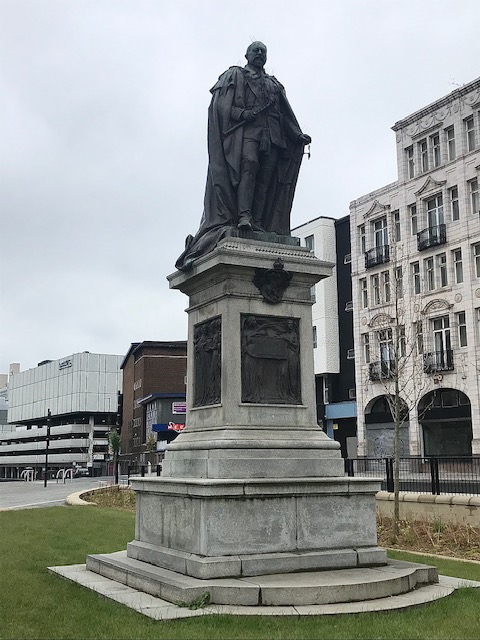
The King Edward VII Memorial in Fitzalan Square was unveiled by the Duke of Norfolk in October 1913. The statue, designed by Alfred Drury, is made of bronze, and set upon an Aberdeen Kemnay Granite plinth.
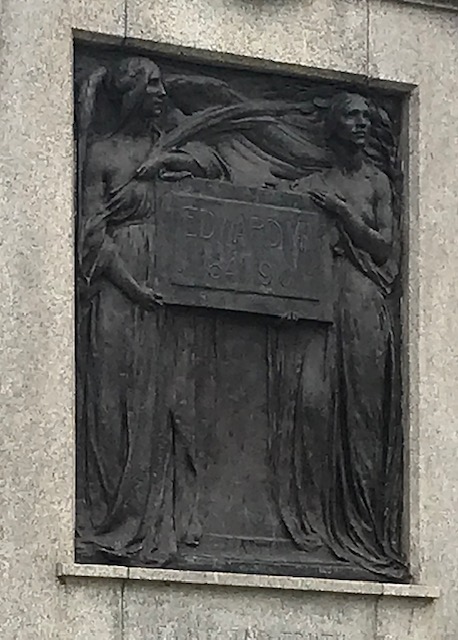
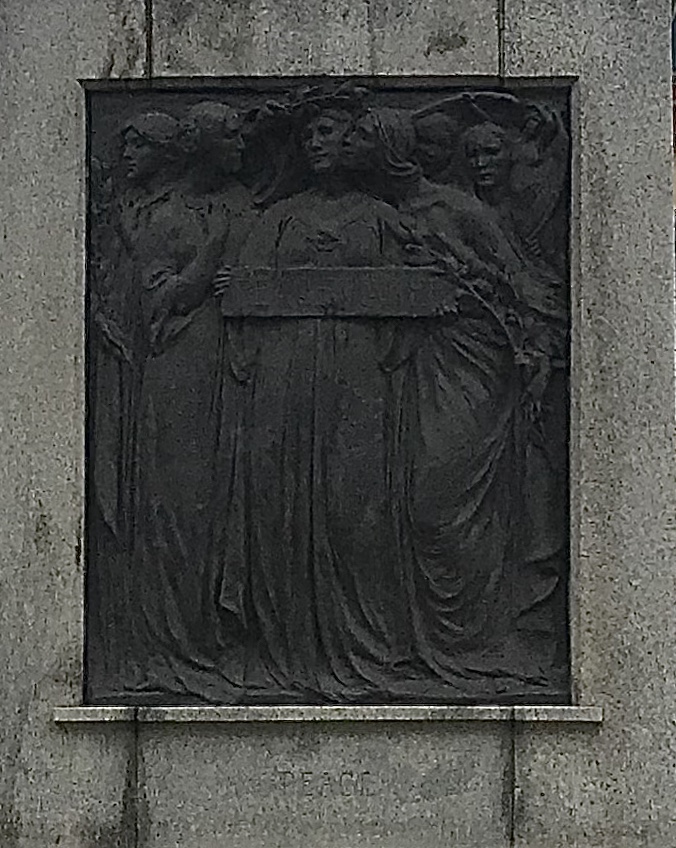
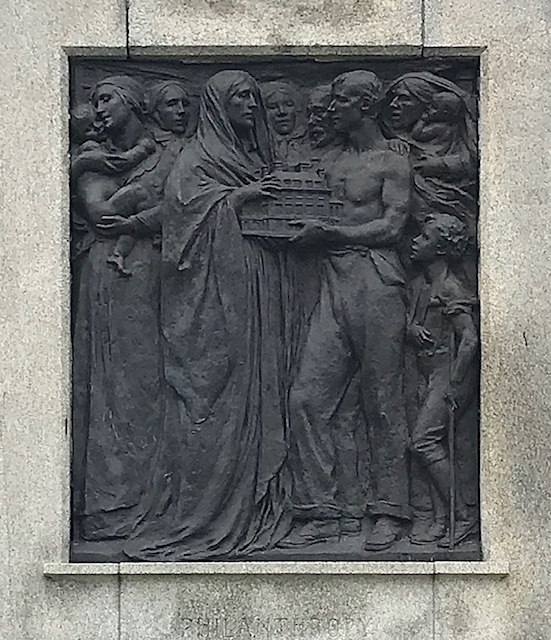
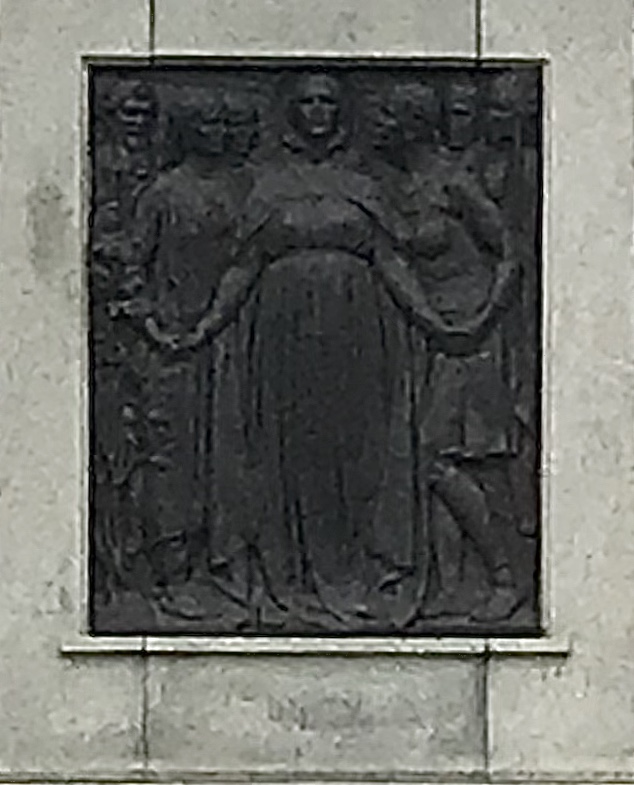
Around the statue pedestal are four panels whose meaning have been forgotten over time. This is probably not surprising because Sheffield’s industrial pollution meant the statue was covered in soot for generations.
Since cleaned up, some of the wording has weathered, and had it not been for the Sheffield Daily Telegraph explaining the meaning of each panel in 1913, then we might be unsure of their relevance today.
If you get the opportunity, visit the Grade II listed statue, and use this post for an understanding of each of the four panels. Click on each photo for an explanation.
“The front panel consists of two figures – Fame and Truth holding the inscription ‘Edward VII. 1841-1910’. The majestic figure of fame is portrayed with wings, as fame flies through the length and breadth of the land. Truth is represented by a serene figure with eyes uplifted to the source of Truth.”
“The back panel represents Peace – ever the great aim of King Edward – being crowned by Gratitude, who bears in her left hand an olive branch. Behind Gratitude is a woman holding a small winged figure of Liberty, which should be the outcome of peace. The other two figures express the idea of Rest and Contentment, brought about by Peace.”
“One of the side panels represents Philanthropy in the graceful and stately figure of a woman presenting the Crippled Children’s Institute to a finely built man typical of Labour. Near to him is a group of interested spectators, one of these being a poor little cripple who is evidently anticipating benefit from the Institution. Behind him is a poor mother and her baby, and an old man, delightedly interested in what promises to be of so great service to the class they represent. Behind the central figure of Philanthropy are two nurses, and to the left a mother and the babe she has gratefully received back from the Institution cured. Thus, are depicted on this panel Anticipation and Realisation.”
“The remaining panel is symbolic of Unity – a woman in the prime of life holding by each hand figures representative of India and China; the idea of Unity is further carried out most convincingly by the presence (behind these figures) of the North American Indian, the Maori of New Zealand and the Aborigine of Australia.”
 sheffielder.net