Categories
People

It started in Sheffield. Keith Barron spent little time off our screens over his 56-year career with over 160 credits

Keith Barron once wistfully explained that he had ‘enjoyed a career of two stages’: in the first, he’d had the luxury of getting many roles that required “Penetration Acting” – having sex on screen (fake, of course); and the second stage was what he called “Heart Attack Acting” – playing older characters whose ‘bedroom antics have cardiac consequences.’ Photograph: British Newspaper Archive

He might not have been from Sheffield, but actor Keith Barron owed his success to the city. He was born in Mexborough in 1934, and left its Technical College with ambitions to be an actor, spending eight years with the Mexborough Theatre Guild.

“I had always been interested in the theatre, but my father had a wholesale provisions business and wanted me to take it over. I found it very difficult, so I used to take off and read film magazines. We had a terrible row, he sold the business, and I went into rep at the Sheffield Playhouse in 1956. I had to start at the bottom, making tea for a pound a week for nine months. It’s valuable experience, it makes you really sure that you want to do it.”

The Sheffield Repertory Company was on Townhead Street and Keith lived on Kenwood Road.

“Visitors to Sheffield Playhouse will be pleased to see Keith Barron making his professional debut in Sheffield Repertory Company’s production of Ibsen’s A Doll’s House. He has the small part of a porter. Although he has only two lines to say and his appearance does not last more than 30 seconds what little he had to do, he does well.”

His first sizeable role was as the spy in Peter Ustinov’s Romanoff and Juliet, and starred in dozens of productions over the next few years, including amongst many, The Winter’s Tale, Frost at Midnight, Graham Greene’s The Potting Shed, A Touch of the Sun, Toast and Marmalade and a Boiled Egg, An Inspector Calls,  Blithe Spirit, and as the Rev. Guy Saunders in another Ustinov classic, The Banbury Nose.

Like the other men of his generation, Keith Barron was forced to partake in the National Service which stood in the way of his acting dreams. It wasn’t until he had completed his time in the RAF after dropping out of school, that he was able to follow his passion and begin studying acting at what was the Sheffield Playhouse. Photograph: BBC News

In 1959, 25-year-old Keith was described by a newspaper “as a modest, aspiring young man, and standing on the brink of success.”

“There is perhaps, no more impressive moment in a theatre when an audience is moved to spontaneous applause by the sheer power of a player’s acting. This is happening every night at Sheffield Playhouse with Keith Barron in The Ring of Truth,” said The Stage in 1960.
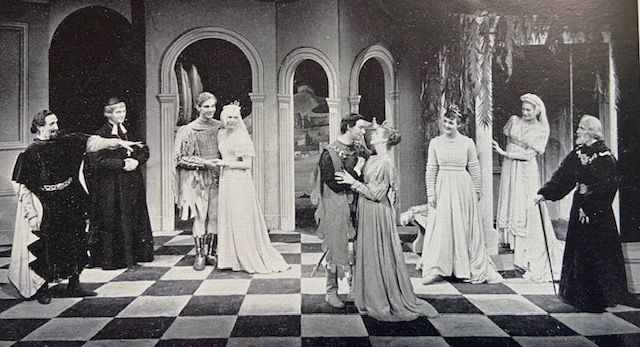
Much Ado About Nothing at the Sheffield Playhouse in February 1958. Left to right. Bernard Archard, Keith Barron, Neville McGrath, Judy Bailey, Kenneth Dight, Anne Godfrey, Julie Paul, Judith Chappell, and Bryan Drew.

Keith was also amongst Sheffield Playhouse actors chosen to record An Inspector Calls for BBC radio for its Saturday Night Theatre slot.

His departure from Sheffield Playhouse in 1961 was regarded as a serious loss. “A sound young actor with a compelling sense of rhetoric: he has held many audiences enthralled by his command of rapid dialogue accompanied by quick stage movements. He is definitely a live theatre actor, but like too many he is going into television.”
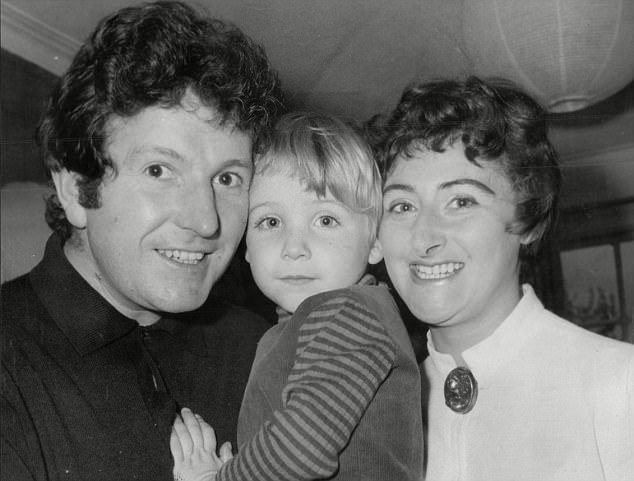
Keith Barron enjoyed a ‘long and varied career’, and was survived by his wife of 58 years, Mary Pickard(right), and his son Jamie (middle). Photograph: Daily Mail

Keith never gave up on the stage, joined the Bristol Vic, and didn’t want to go to London but television was the future.

He appeared as Detective Sergeant John Swift in The Odd Man (1962-65) and the policing spin-off It’s Dark Outside. His first sitcom success was in The Further Adventures of Lucky Jim (1967) and later in No Strings (1974). He deftly switched from comedy to drama, from the title character in Vote, Vote, Vote for Nigel Barton (1965) and as David, in Duty Free (1984-86) about two couples on a package holiday in Marbella and attracted seventeen million viewers.
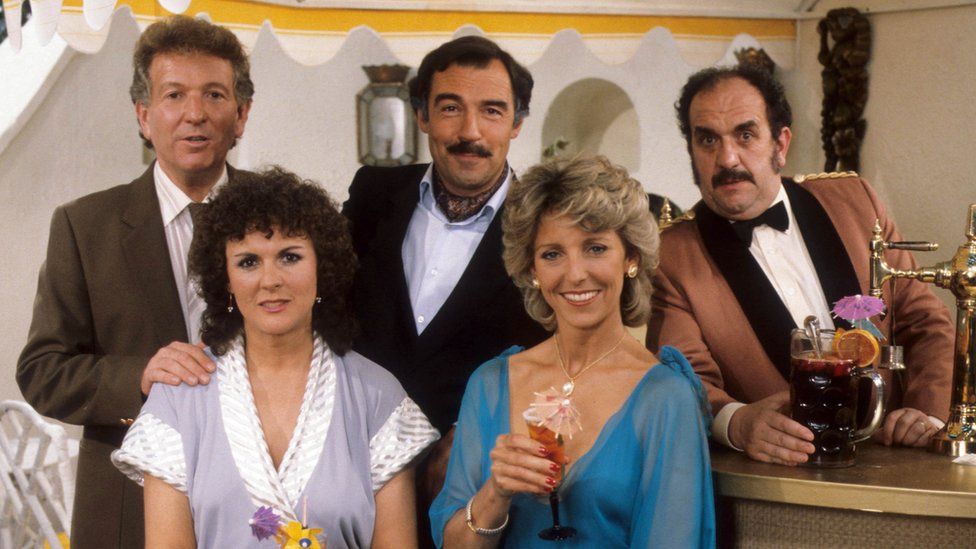
Duty Free was about two British couples, David and Amy Pearce and Robert and Linda Cochran, who meet while holidaying at the same  Spanish hotel in Marbella and the interruptive affair conducted by David and Linda during their break. It was made by Yorkshire Television. Photograph: BBC News

His other TV roles were prolific, and included Room at the Bottom, Haggard, Prince Regent, The Good Guys, Telford’s Change, Stay with Me till Morning, Take Me Home, Doctor Who, Coronation Street, DCI Banks, All Night Long, Where the Heart Is, Kay Mellor’s The Chase, and Dead Man Weds. And he was in Countdown’s Dictionary Corner on numerous occasions.

Keith died in November 2017, survived by his wife, Mary Pickard, a former stage designer, whom he met in Sheffield and married in 1959, and a son, Jamie, also an actor.

© 2021 David Poole. All Rights Reserved
Categories
People Places

From Ballifield, Handsworth, to Ballifield, USA

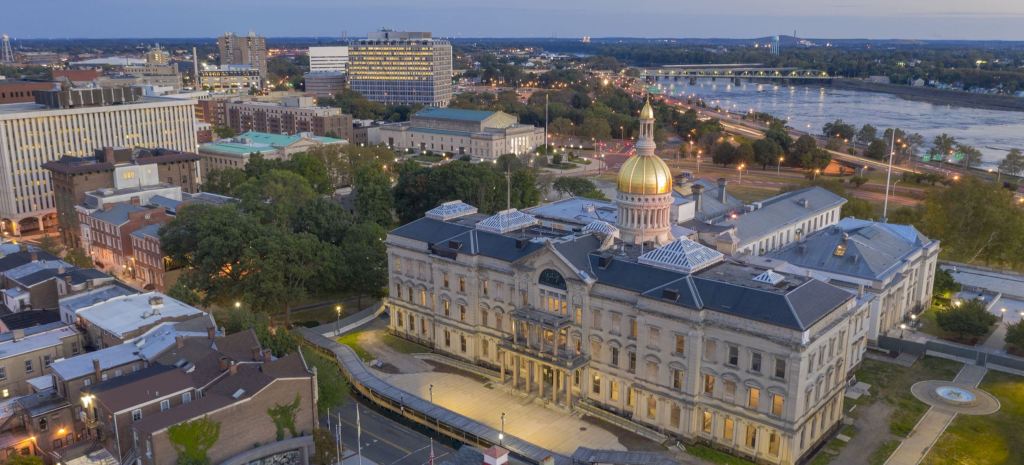
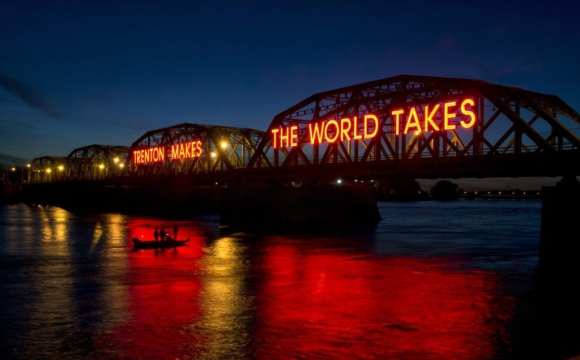
Trenton is the capital city of the U.S. state of New Jersey and the county seat of Mercer County. It briefly served as the capital of the United States in 1784

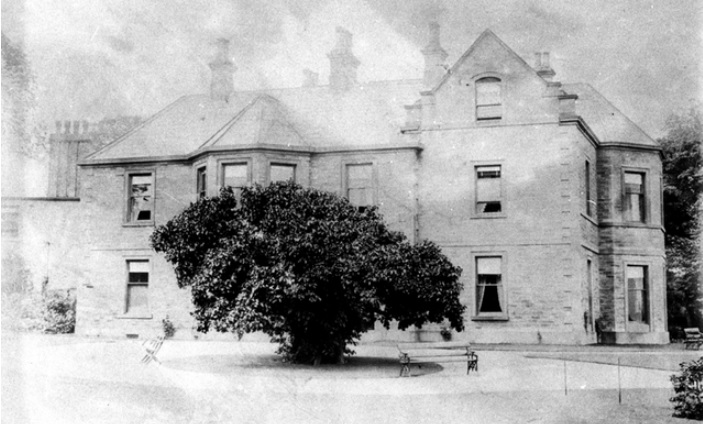
Mahlon Stayce was born at Dore House on the family’s Ballifield estate, Handsworth, in 1638, and married Rebekah Ely in 1668. Both their families were English Quakers, a new religious movement that was treated with suspicion and hostility under the parliamentary rule of Oliver Cromwell following the English civil war. With the return of the monarchy by Charles II, Quakers were subject to persecution for their refusals to conform to the Church of England. Their refusal to pay mandatory tithes meant they faced crippling fines or imprisonment, and many decided to practice their faith in the American colonies.

Mahlon Stayce, a tanner, acquired, as a creditor, a large chunk of colonial soil in West Jersey, America, and his family sailed from Hull in 1678. He established his home on the south bank of the Assunpink Creek and called it Ballifield after his ancestral home at Handsworth.

Ballifield Hall in the late 1800s, rebuilt by Peter Cadman, and for many years previous was the home of the Stacye Family. Photograph: Picture Sheffield

Stacye was given permission to build a new settlement at the side of the Delaware River where he founded a church. The town was originally called The Falls, and later Stacye’s Mill.

Stacye held a large estate, had several business interests, and held many titles in public life.  He died a wealthy and respected citizen in 1704.

By 1719, the town had adopted the name “Trent-towne”, after William Trent, a Philadelphia merchant, who purchased much of the surrounding land from Stacye’s family

This humble settlement, with its Handsworth origins, grew into a big city – Trenton, New Jersey.

Back in Sheffield, Ballifield Hall has gone, the Ballifield housing estate built on its former parkland.

In 1910, the Trenton Chamber of Commerce put out a contest to create the slogan to be put on the bridge. S. Roy Heath was the winner of the contest, making him the creator of “Trenton Makes, The World Takes.”
Categories
Streets

The people lined the street to catch a glimpse of Queen Victoria

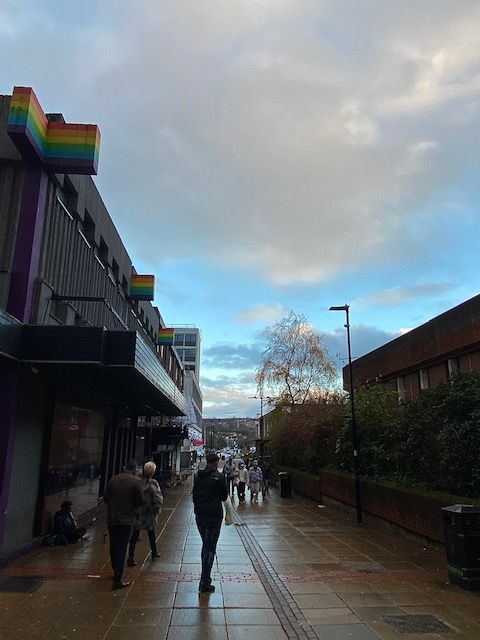
Hereford Street, Sheffield. The road was one much wider, lined with shops, houses, and factories. Photograph: DJP/2021

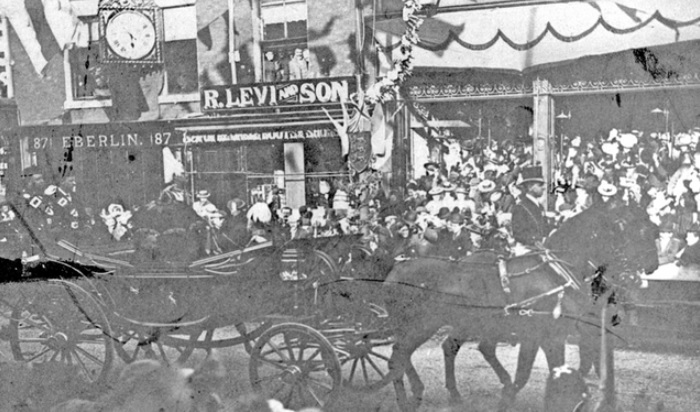
Hereford Street’s greatest moment was when Queen Victoria officially opened Sheffield Town Hall in May 1897 and travelled down here on her way to Norfolk Park. It might be hard to believe now, but let your imagination do the rest.

“To stand on The Moor, at the top of Hereford Street, and look down the latter thoroughfare affords the spectator a great amount of pleasure. A scene is presented of bright flags of dainty and artistic colours, fancy streamers of every description, while other kinds of bunting and bannerettes float out gaily in every direction.

“Venetian masts are erected on either side of the street, 15 yards apart, and are surmounted by large gilt spearheads, while banners, shields, and trophies of flags are fixed to each mast. Every alternate mast has a pedestal covered with crimson cloth and gilt ornamentation, and at the summit of each pedestal is a group of real plants.

“Across the street at intervals are fixed canopies of handsome floral work, and streamer flags of harmonious colours and flower baskets are suspended from the centre of each floral canopy, with lines of streamer flags along the street at either side connecting the masts with the whole design.

“The buildings, too, in Hereford Street have been dealt with in the most artistic manner. Flags float out bravely from the tops of the principal works and houses, and on the fronts are displayed handsome shields, backed up with designs of small flags and other similar trophies.

“As the time arrived for the stopping of traffic, the corner where Hereford Street joins the Moor became so blocked with cars, cabs, and buses that the Derbyshire police, who extended from the top of Hereford Street along part of St Mary’s Road were hard put to it to prevent serious accidents.

“People would still insist on leaving the shelter of the barriers and coming across the road, and then, as likely as not, they were stranded amongst the horses and vehicles, who, being unused to the terrible commotion, were almost frantic and the drivers, but for the efforts of the police, could not possibly have helped running down some of these belated wayfarers.

“However, this was soon cleared, the arrival of the 1st Battalion of the Hallamshire Rifles having a great deal to do with the transformation.

“The men were placed eight paces apart and covered the entire length of Hereford Street and part of St Mary’s Road.

The visit of Queen Victoria. Pictured here on The Moor. Photograph: Picture Sheffield

“The crowd was very orderly, only a few attempting to elude the vigilant eye of the constables, and those that attempted this being in most cases drunk.

“As the time wore on, however, getting tired, perhaps, and some of them thirsty, occasional rows occurred. People attempted to change their positions and their neighbours’ mild remonstrations gradually developed into what may be styled ‘words,’ and again, in some cases, where the sum was particularly irritating, into blows.

“The few fights, however, that did take place soon raised cries of ‘Police!’ and the guardians of the peace immediately quelled the disorder and left the combatants to sing and shout once more with the rest.

“Several cases of fainting occurred, and it was rather unfortunate that at this point of the route there was no ambulance corps, but the gallantry to the ladies of the rough and ready grinders was quite touching, and these were immediately made room for even in the thickest crushes.

“Of course, skits and jokes passed amongst the members of the crowd, but, as a rule, the language was ‘fit for the Queen.’

“Stands, windows, and roofs were all crowded, and the number of people in the street was, as far as can be judged, above the average.

“The procession passed, the military lined up, and the crowd in one huge migration, made tracks, some for the park, and others in order to get another view, if possible, along South Street, Park.”

Looking towards The Moor from Hereford Street. Today, this part of the road is pedestrianised and is occupied by Dempseys, bar and Club and QJ (the former Yorkshire Bank). Photograph: Picture Sheffield

© 2021 David Poole. All Rights Reserved
Categories
Streets

Hereford Street: two photographs seventy years apart

Aerial photograph of Hereford Street (top to bottom) in 1951
Aerial photograph of Hereford Street (top to bottom) in 2021

Two photographs that show how a Sheffield street lost its identity.

Hereford Street is shown as a wide thoroughfare in 1951, a continuation of Charlotte Road, and intersected by narrow St Mary’s Road, and Porter Street (that became the lower end of Eyre Street). It joined The Moor that continued south towards London Road. Note that Bramall Lane roundabout did not exist.

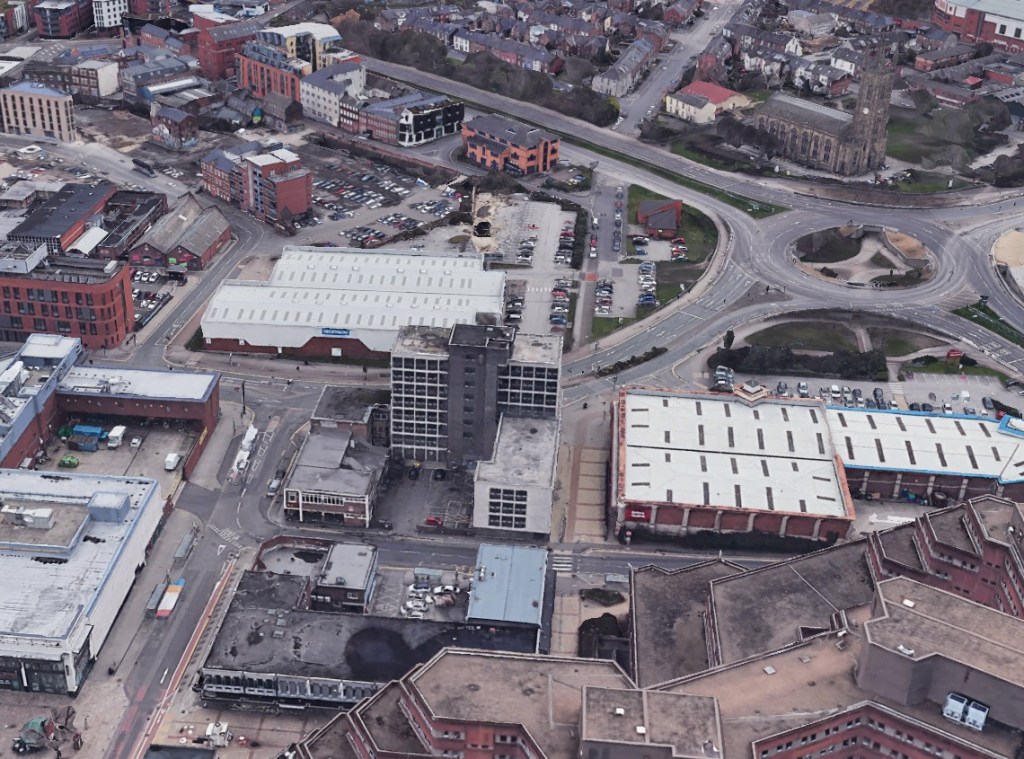
Seventy years later, the outline of Hereford Street can still be seen but is split by two dual carriageways – St Mary’s Road and Eyre Street. Gone are the factories, houses, and small shops, and the Moor-end is pedestrianised, and this section of The Moor lost beneath the Moorfoot Building.

Sadly, this area has become an unloved part of the city centre with Hereford Street falling on hard times.

Most astonishing is that few buildings appear in both photographs. Most were swept away for road development, factories were surplus to requirement, and old houses and shops deemed unfit for purpose.

St Mary’s Church, on Bramall Lane, does appear in both photographs. In 1951, it was covered in soot and suffered from air pollution, but look how large the churchyard was, and how much was taken away to make St Mary’s Road a dual-carriageway.

Buildings to point out in the modern-day image are the South Yorkshire Fire and Rescue Headquarters and Moor Markets (left), Decathlon and Deacon House (centre) and, of course, the Moorfoot Building (bottom).

© 2021 David Poole. All Rights Reserved
Categories
Buildings

History in the wall – From Martins Bank to an eyesore

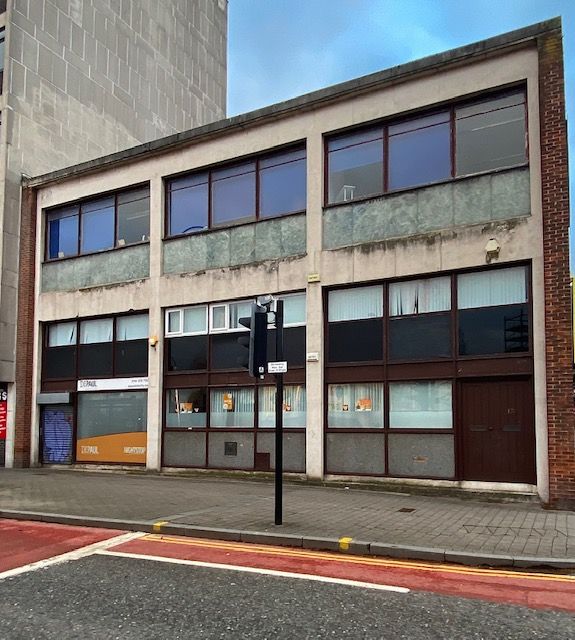
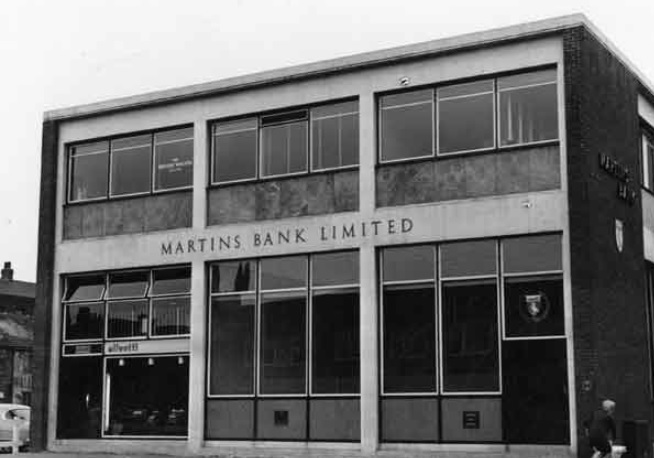
Former Martins Bank, now listed as Cumberland House, on Eyre Street, Sheffield. Photograph: DJP/2021

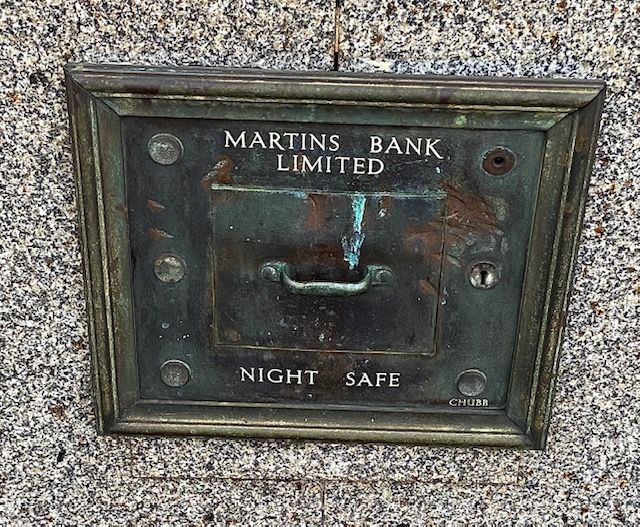
History is all around us. Keep your eyes open and sometimes you will see something that reveals something of our past. At the corner of Eyre Street and Cumberland Street, set in the wall of a building, is an old night safe. Unused for forty-eight years, it is marked ‘Martins Bank Limited’.

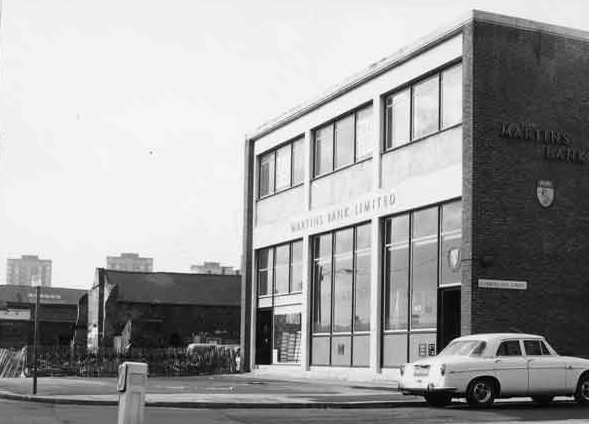
It is an obvious clue as to the origins of this rather run-down looking 1960s building, and tells us that once-smart buildings can become eyesores if we don’t look after them.

A clue at the building’s former use. Night safes were built on the outside of banks, allowing money to be deposited into the bank’s safe outside of bank opening hours. Photograph: DJP/2021

Martin’s Bank was a London private bank that could trace its origins back to the London goldsmiths. Martin’s agreed to its acquisition by the Bank of Liverpool in 1918, which wanted a London presence and a seat on the London Bankers’ Clearing House; the Martin’s name was retained in the title of the enlarged bank which was known as The Bank of Liverpool and Martin’s Limited. The title was shortened to Martins Bank Limited (without an apostrophe) in 1928.

The bank had a presence in Sheffield from 1927 when the Equitable Bank, at 64 Leopold Street, merged with the Bank of Liverpool and Martins. It outgrew the premises and opened a new branch in the Telephone Buildings at the bottom of West Street in 1930. It wasn’t until 1960 that a Sheffield University branch was opened, quickly followed by this purpose-built bank  – Sheffield Moor – on Eyre Street. (Another, on Bank Street, came later).

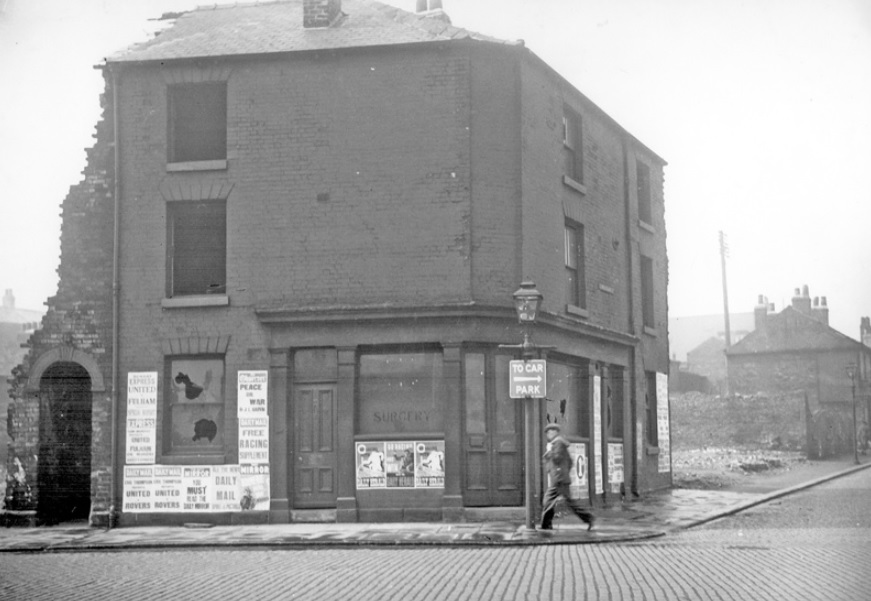
This branch opened in 1961 on land that had once been the site of Greer and Rigby, Surgeons, and land left vacant after the bombings of World War Two.

Junction of Porter Street and Cumberland Street (in background). No 118, Porter Street, former premises of Greer and Rigby, Surgeons. Former entrance to Court No. 10 on left. Porter Street later became part of Eyre Street. Photograph: Picture Sheffield
Martins Bank in 1963. It did not occupy all the building, following the Victorian tradition of creating shop and office rental space to generate additional income. Photograph: Picture Sheffield
Martins Bank in 1970. The old buildings adjacent were demolished to make way for Deacon House. Photograph: Picture Sheffield

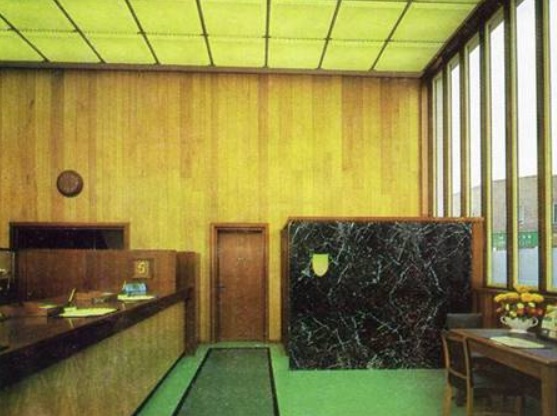
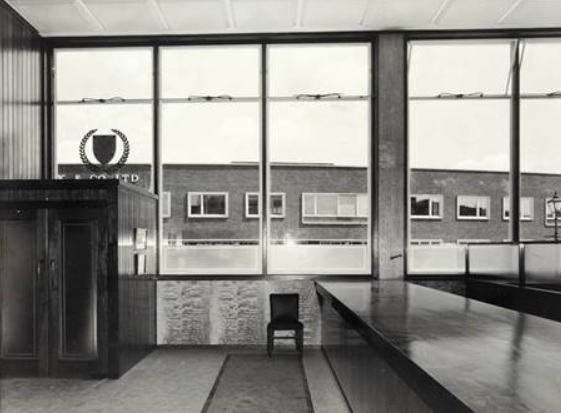
According to archives, this part of Sheffield was too far from the old commercial quarter to be effectively served by the West Street branch. “A beautiful modern building with interior décor which responds to the full blaze of sunshine most cheerfully, or, on a dark day when the illuminated ceiling has to be switched on, creates an oasis of light, warmth and welcome which makes it a pleasure to step inside.”

The ground floor was shared with Olivetti, typewriters, and office machine dealers, while the British Wagon Company occupied part of the first floor.

Martins Bank was bought by Barclays in 1968 and five years later the Sheffield Moor branch was closed – its existence as a bank lasting only twelve years.

The building itself was used for a variety of purposes, even a gym, and is now sub-divided as office space.

© 2021 David Poole. All Rights Reserved
Categories
Streets

A lost street underneath Sheffield Town Hall

New Church Street, looking towards Pinstone Street, now the site of Sheffield Town Hall, No 7, Cutlers’ Arms P.H., No 9, Old Green Man, No 11, Henry Bocking, Beer Retailer. Late 1800s. Photograph: Picture Sheffield

Do council officials, working late at Sheffield Town Hall, ever hear strange noises in the stilly night?

Do they listen with bated breath to the sound of prancing horses and the ghostly cries of coachmen?

Or, when all is quiet, does a rich melodious voice, declaiming in grand style, passages from Shakespeare, ever strike their astonished ears?

Or, do council officials ever work late? Or do they work from home now?

If there is any such things as ghosts, Sheffield Town Hall must be peopled with a vast multitude of them.

New Church Street (not to be confused with Church Street, near the cathedral) was demolished about 1890 to provide room for the Town Hall. It lay almost through the middle of the site of the Town Hall, from what is now the (padlocked) main front entrance, to a point in the west wall opposite the Mercure Hotel.

The Cutlers’ Arms can be seen almost in the centre of the picture, with three people near the doorway, and was the terminus for all the Derbyshire coaches.

“It was a great sight to see them coming in from Tideswell, Castleton, Baslow, Bakewell, and other places. Each coach had its name; the only ones I can remember are the ‘Lady Peel’ and the ‘Surprise,’ both of Castleton,” said Ambrose J. Wallis, who owned the photograph in 1931.

“Next to the Cutlers’ Arms were the Old Green Man and the Grapes – three public houses in a row.

“Almost opposite the Cutlers’ Arms was the house of a man who used to engrave memorial plates, one of which was in York Minster.

“His wife kept a theatrical boarding house, where a number of famous actors stayed. The most famous of all was the great Shakespearean actor, Henry Irving.”

At another house, higher up New Church Street, Mr Wallis said, there lived a man called Dunkerley, who was one of the survivors of the Charge of the Light Brigade.

All this history now covered up by the Town Hall.

© 2021 David Poole. All Rights Reserved
Categories
Streets

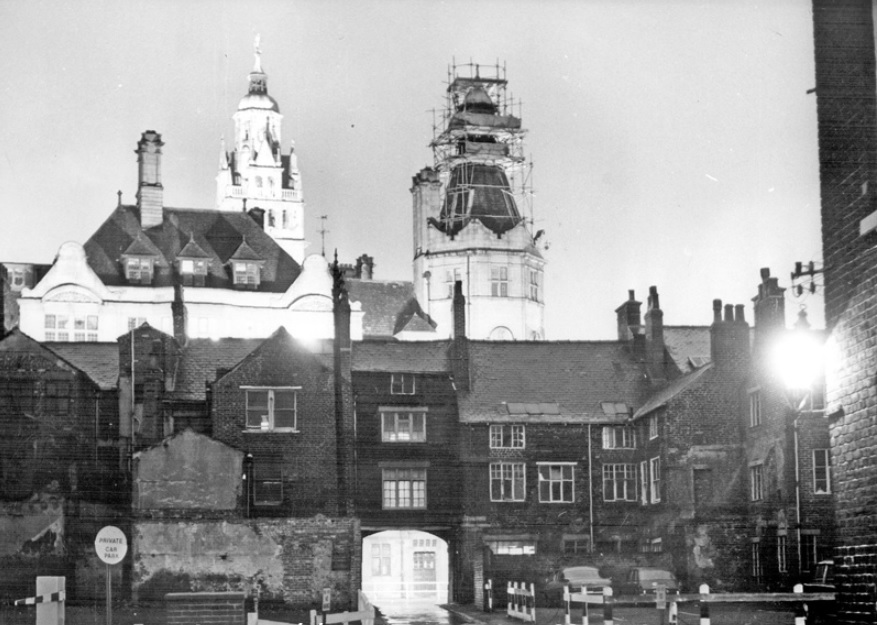
Cadman Lane: a city centre street buried underneath modern Sheffield

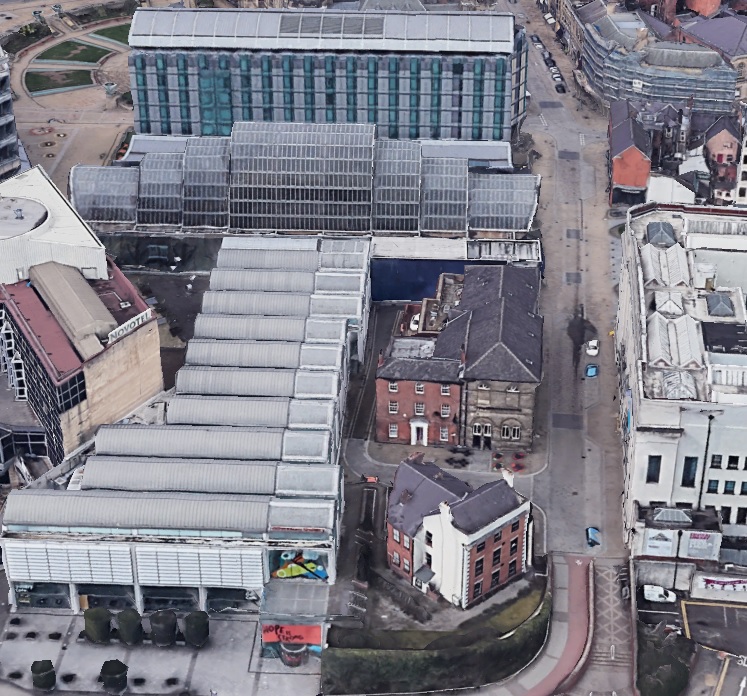
Cadman Lane ran from Eyre Street (this part of Eyre Street is now Arundel Gate) up to Norfolk Street, opposite where the Town Hall is. Only a small portion of the street remains in the centre of the picture. Photograph: Google Earth

Yesterday, we featured a sketch of Cadman Lane, drawn by Sheffield artist Kenneth Steel (1906-1970). The drawing brought several queries as to the whereabouts of this characteristic old street. Presumably lost? Well, you might be surprised to know that Cadman Lane still exists.

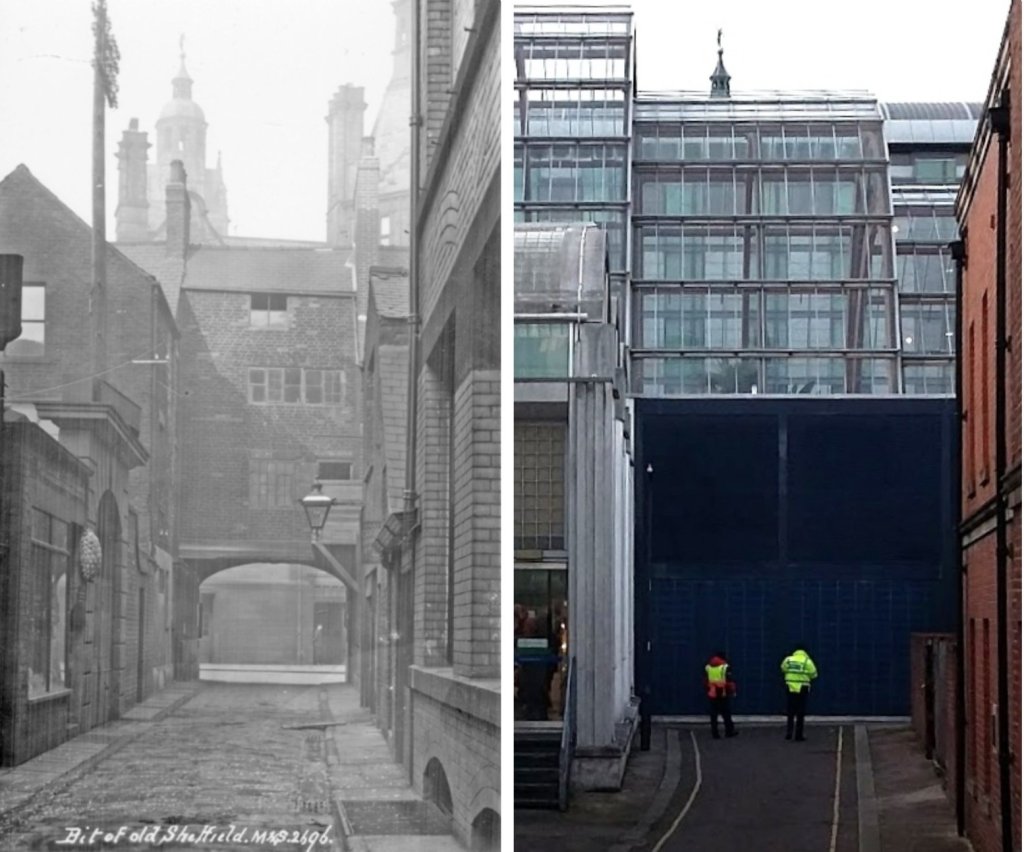
Granted, it is not a street that many wander down anymore. It is a far cry from its heyday when it was a busy thoroughfare lined with factories, workshops, and offices. It survives in truncated form and can be found behind the Graduate public house, running parallel with the Millennium Gallery, and cut short by the presence of the Winter Garden.

How did Cadman Lane get its name?

In the 1780s, there is a story of Thomas Leader walking with the father of T Wilkinson in the field through which Surrey Street was later built. He remarked that the land below had been measured for building. “Yes,” said his companion, “It’s for young Roberts and for a plated manufactory, too.” This was Samuel Roberts, coupled with the mechanical cleverness of his colleague, George Cadman, and “aided by the capital of Mr Naylor, Unitarian Minister, as sleeping partner, and enabled the firm of Roberts and Cadman to outstrip local competitors.”

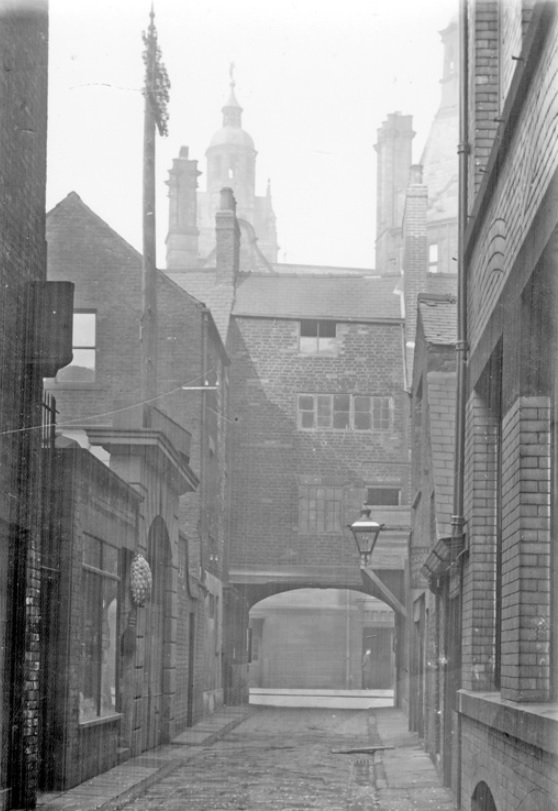
Cadman Lane looking towards Norfolk Street and Town Hall. This part of the road is now underneath the Winter Garden and the Mercure Hotel. Photograph: Picture Sheffield
Cadman Lane. Then and now. Photograph: Aidan Stones

The most likely candidate for the naming of the street is Peter Cadman, a merchant, who, in 1781 had  houses up the south-east side of Norfolk Street. He died in 1812 in the house which he built next “to the gateway in Norfolk Street.” The gateway in question may well have been the arched entrance to Cadman Lane.

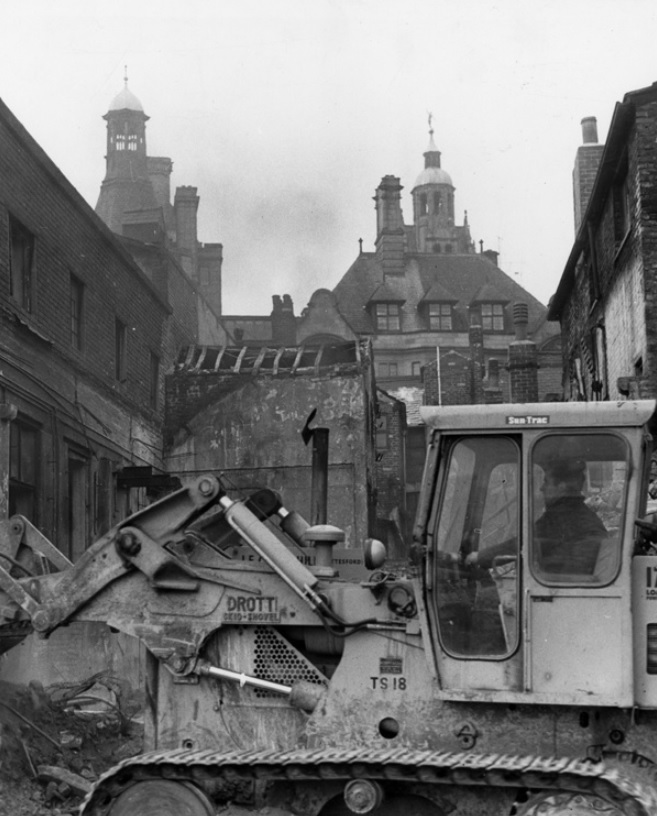
In 1929, Sheffield Corporation bought the block of property with the intention of reserving the land to build new administrative offices or public buildings. However, demolition did not start until the 1960s and the new Town Hall extension (the ‘egg box’) opened in 1977. It was demolished in 2002 and replaced with the Millennium Gallery, Winter Garden and McDonalds (now Mercure) Hotel.

Cadman Lane with the Town Hall in the background, 1967. Photograph: Picture Sheffield
Demolition on Cadman Lane in 1966 with the Town Hall in the background. Photograph: Picture Sheffield

© 2021 David Poole. All Rights Reserved
Categories
People

A forgotten son who created visuals for classic mid-century travel posters and architectural landmarks

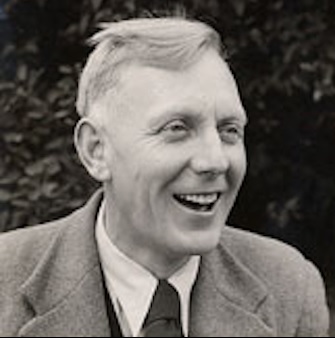
Time makes us forget, and this applies to the work of Sheffield artist Kenneth Steel. He was a painter and etcher, noted for his watercolours, but since his death in 1970 his work is often overlooked.

Kenneth Steel was born in 1906, the son of George Thomas Steel, an artist and silver engraver. His eldest brother, George Hammond Steel (1900-1960) was a successful landscape painter, and both brothers studied at Sheffield College of Art under Anthony Betts. During the 1920s, Kenneth studied briefly under landscape artist, Stanley Royle, and exhibited his watercolours, oils, and engravings in Sheffield at the Heeley Art Club and Hallamshire Sketch Club.

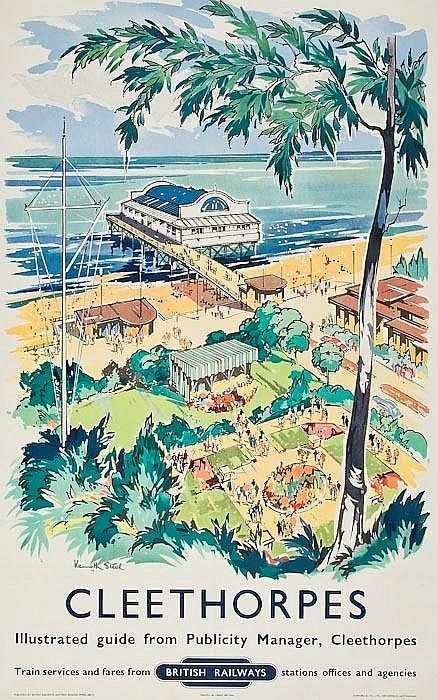
In 1932 he secured a contract with the print publishers, James Connell and Sons, and annually published line engraving and drypoint prints both before and after the War. In 1935 he exhibited two of these prints at the Royal Academy and then in November 1935 he became the youngest elected member of the Royal Society of British Artists. His work in watercolour was shown at three one man exhibitions in London in 1934 and 1937 and Dublin in 1938. After World War Two he diversified into the fields of perspective drawings and commercial art. This included railway posters and carriage prints.

Among his most famous pieces are Sheffield Castle from 1964, commissioned by the Brightside and Carbrook Co-operative Society to hang in Castle House, an imaginary view of Sheffield Castle as it might have looked.

Oil Painting of Sheffield Castle by Kenneth Steel R.B.A. S.G.A. Art., commissioned by the Board of Directors for the new Boardroom at Castle House, September 1964. 

From his studio in Crookes, Kenneth found work preparing watercolour washed perspective drawings commissioned by the construction industry. One of these, the Electricity Sub Station on Moore Street, painted in 1965-1966, was a classic piece of Brutal architecture. Other works included Jodrell Bank Observatory, South Kirkby Colliery and Abbeydale Industrial Hamlet.

Kenneth wrote a number of books on artistic techniques and had his work widely reproduced in such publications as Arts Review, Sphere, Studio and The Artist.

Cadman Lane by Kenneth Steel, looking towards the Town Hall and Norfolk Street. Photograph: Picture Sheffield

But there was tragedy in his life. His mother and pregnant wife were both killed during the Sheffield Blitz, and much of his work destroyed. He remarried in 1953 and the last two decades of his life produced some of his most experimental artistic work.

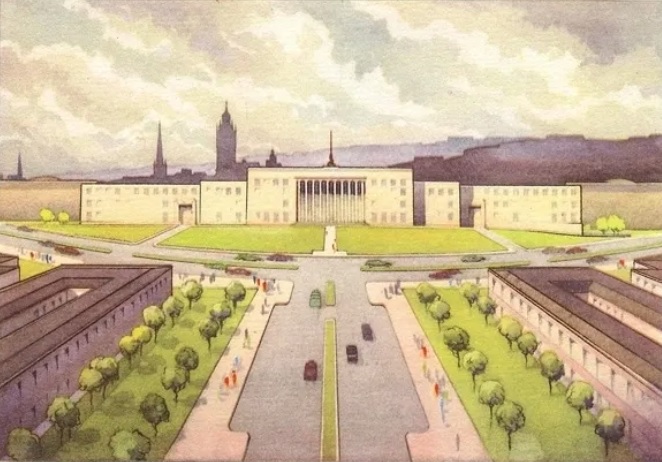
The proposed Sheffield city centre redevelopment, 1908-1926 showing the Law Courts from a new Chester Street. There were a number of artworks created by Kenneth Steel that are thought to be lost. Devonshire Green now occupies the site of the original Chester Street. The proposal never came to light. Photograph: Artist’s Estate

His work can be found in a book ‘Kenneth Steel. Catalogue Raisonné of Prints and Posters’ with full-colour illustrations of his watercolour and oil paintings, plus his perspective drawings and later palette knife oil paintings of the Balearic Islands and beyond. The appendices include a complete catalogue of his fifty-four line engraving and drypoint prints, plus a full catalogue raisonné of his 48 Railway posters and thirty-five carriage prints.

These now sought-after posters – nostalgic reminders of a vanished world – adorned railway station platforms, carriages, and waiting rooms.

This month you can view Kenneth Steel’s work in a new exhibition at Weston Park Museum. It is curated by Lucy Cooper, exhibitions and display curator at Sheffield Museums, and runs from December 17 until May 2.

Categories
Places

Rewilding our urban space has never been so important

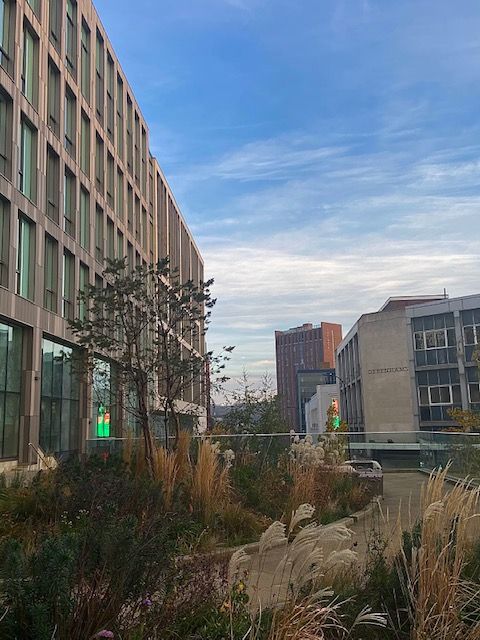
Charter Square. Photograph: DJP/2021

Sheffield is becoming an even greener city. The grey-to-green project around Castlegate has been well received, and other parts of the city centre are benefiting from a return to nature.

In these times of climate change the greening of public spaces – parks, squares, rooftops, and streets, can contribute to climate mitigation if they become green spaces. If a single healthy tree can have the cooling power of more than ten air-conditioning units, let’s rewild our public space and cool down our planet.

Outdoor spaces not only allow us to move more safely during the pandemic but are also linked to our well-being. Green urban areas facilitate physical activity, relaxation, recreation, and social interaction.

Time for me to be controversial.

If we are left with unwanted (and perhaps unloved) city centre buildings, might there be an argument to knock them down and start again? Might it be sensible to create green spaces from these footprints?

This photograph of Charter Square shows that redevelopment, and the introduction of greenery, can have a positive impact. The problem here is the shabby Debenhams building that will struggle to find an alternative use.

© 2021 David Poole. All Rights Reserved
Categories
Streets

Cumberland Street – two photos – 60 years apart

Cumberland Street. Photograph: Picture Sheffield
Cumberland Street. Photograph: DJP/2021

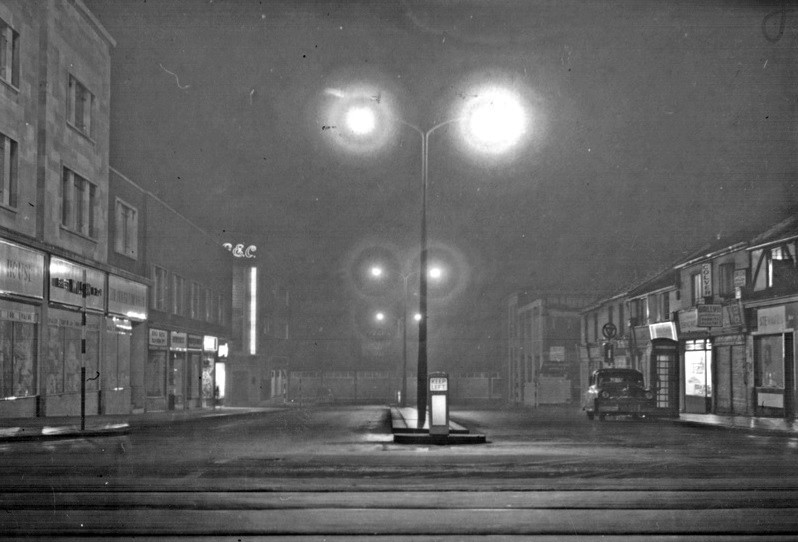
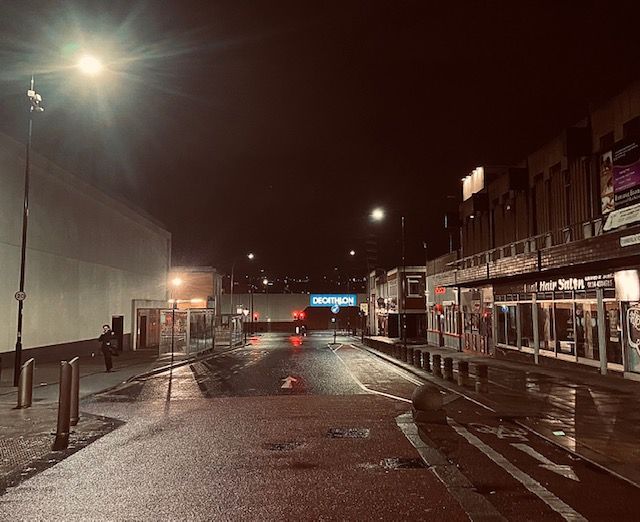
Two night-time shots of Cumberland Street, Sheffield, sixty years apart. The black and white photograph, looking towards Eyre Street, was taken in the early 1960s, and even though almost everything was demolished, it is still recognisable.

The row of shops down the left became Moor Market, including the tall and imposing General Electric Company building.

The old properties down the right were replaced in the early 1970s, including the addition of the Whetstone Public House, later Moorfoot Tavern, and now El Paso restaurant.

Only one building survives – the former Martin’s Bank at the far right corner of Cumberland Street with Eyre Street.

About halfway down are two roads with contrasting fortunes. To the right, South Lane, then a narrow thoroughfare, but significantly widened. To the left, Cumberland Way, lost during Moor Market construction, and now forming the entrance to the market service area.

In the far gloom was the factory belonging to W.A. Tyzack (built in 1958 and demolished in 1984), and now the site of Decathlon.

© 2021 David Poole. All Rights Reserved