Categories
Buildings

Exchange Place Studios: the story of a century-old survivor

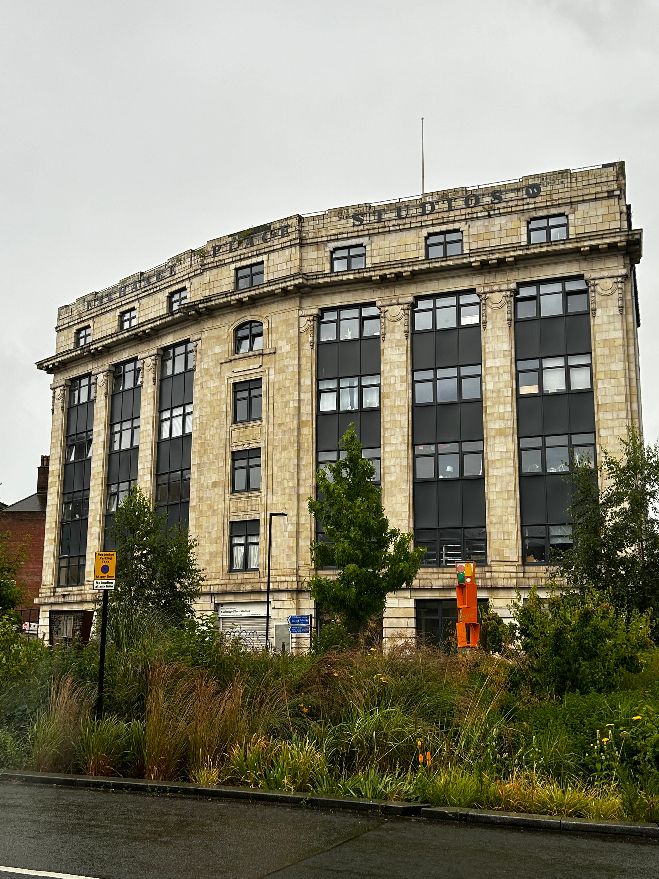
Exchange Place Studios, Sheffield. Image: DJP/2024

The recent post about WH Smith created a lot of interest, and this got me thinking about another Sheffield building associated with the company. Not as a shop, but as wholesale premises.

I’m referring to Hambleden House, at Exchange Place, often ignored by historians, that was built 102 years ago, and a fine example of an Art Deco building. These days it goes by the name of Exchange Place Studios, run by Yorkshire Artspace, and provides workspace for more than eighty artists and makers in 60 studio spaces.

In 1922, W.H. Smith erected this building on part of the site of the old Alexandra Theatre and was seen as an extension to the street improvement scheme around Exchange Street.

Since 1902, W.H. Smith had operated its wholesale business from York Street, but the growth of the business meant larger premises were required. The chosen site was ideal because of its proximity to the Victoria and Midland railway stations.

“The building itself fulfils the great essentials of good architecture and practical application, and undoubtedly declares its purpose in the scheme of things. The Doultonware facings are particularly suitable for a manufacturing city like Sheffield, and the general quality of the design of the front is most pleasing. With the iron panels in between, the whole effect strikes a modern note in construction.”

The Sheffield Daily telegraph described it as ‘simple and well-proportioned, bearing the distinctive characteristics of other W.H. Smith buildings which were to be found all over the country.’

This wasn’t surprising because the man who had the greatest influence over its design was F.C. Bayliss, superintending architect at W.H. Smith, and Marshall and Tweedy, all fellows of the Society of Architects. Its construction was completed by D. O’Neill and Son of Solly Street, which had been responsible for many large and important buildings in Sheffield.

The transfer between York Street and Exchange Place had to be executed so as not to disrupt the distribution of newspapers. It required careful planning, and with the help of A.B. Beckett, of Broomhall Street, it concluded business at York Street at one o’clock on the afternoon of Saturday 30 September 1922 and was installed in the new building by 6.15 the same day.

The News Despatch Department was in the basement with each district provided for. Every customer was given a numbered box and labelled with the customer’s name. As the papers arrived in the early morning, they were dropped down a chute, counted, and the customer’s orders were made up and boxed. To minimise labour, an electric lift went from the basement to the entrance door where parcels were loaded onto drays and conveyed to customers.

The ground floor acted as a shop where newsagents were able to buy back numbers at a moment’s notice. It seems strange now that the public often went into a newsagent’s and asked for out-of-date newspapers. The Book department was also here with large stocks of literature available for shopkeepers to buy.

On the first floor was a choice collection of stationary, fancy goods, leather articles, and china, that were set out in glass cabinets provided by A. Edmonds of Birmingham for the perusal of customers. Alongside it was the sweet store.

This was a good introduction to the second floor, that housed a vast collection of British and foreign toys, all imported by W.H. Smith itself. They sourced toy makers abroad and the goods went directly to the retailer without going through a middleman and allowing them to be sold cheaper.

The various representatives were housed on the third floor with special rooms arranged so that the firm’s buyers could meet with people and deal with their samples.

On the floors above were stockrooms from where the whole despatch of stock, apart from newspapers and books, were dealt with. On arrival, goods were checked, invoiced, and packed ready for delivery by rail or road. Part of the accommodation was set aside with a comfortable tea-room where customers could buy refreshments at nominal charges.

An innovation at the time was the use of pre-cast hollow concrete floors in its construction, a saving in dead-weight of 900 tons. This was brought to the site ready cast by the Leeds firm of Concrete Ltd and presumably remain.

Much was made about the amount of light that flooded the rooms through ‘modern and efficient’ windows. Mellowes and Co, a Sheffield firm, supplied the steel sashes and casements, and the special design allowed adequate strength to provide ‘walls of daylight’ and fulfilling the requirements of ventilation and safety.
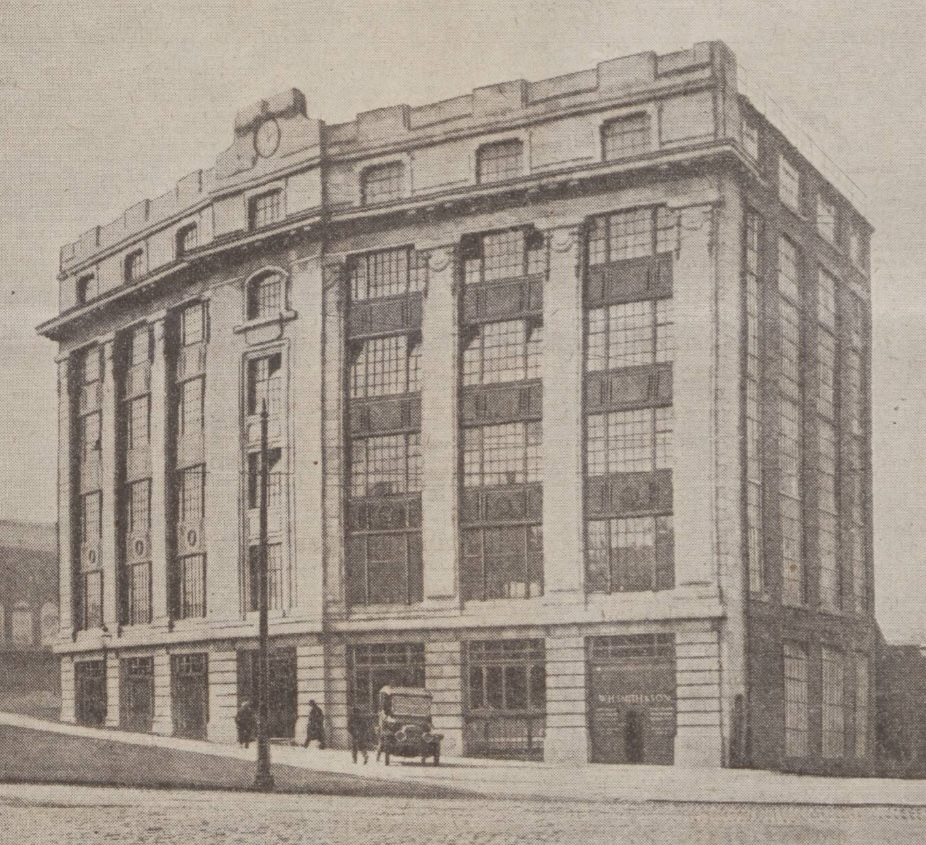
Hambleden House, pictured here in 1922. Image: British Newspaper Archive

Why was it called Hambleden House?

It was named after William Frederick Danvers Smith, 2nd Viscount Hambleden (1868-1928), who had inherited the business in 1891.

W.H. Smith remained here until 1965 when it moved into part of Sheaf House, built for British Rail, next to Midland Station, where almost all its newsprint business had consolidated. Hambleden House had become too large and would subsequently be taken over by South Yorkshire Passenger Transport Executive from 1974.

Now thoroughly modernised, the exterior of the building looks much the same as it always did, except for the absence of a large clock that had originally been installed by A.G. Burrell and Co, of Change Alley, and once provided a service to railway passengers hurrying to catch their train.

NOTE: In September 2006, a new company, Smiths News, was created, the result of a demerger of W.H. Smith’s newpapers, magazines, books, and consumables, distribution business.

© 2024 David Poole. All Rights Reserved.
Categories
Companies

WH Smith got the business because they were better at it than their competitors

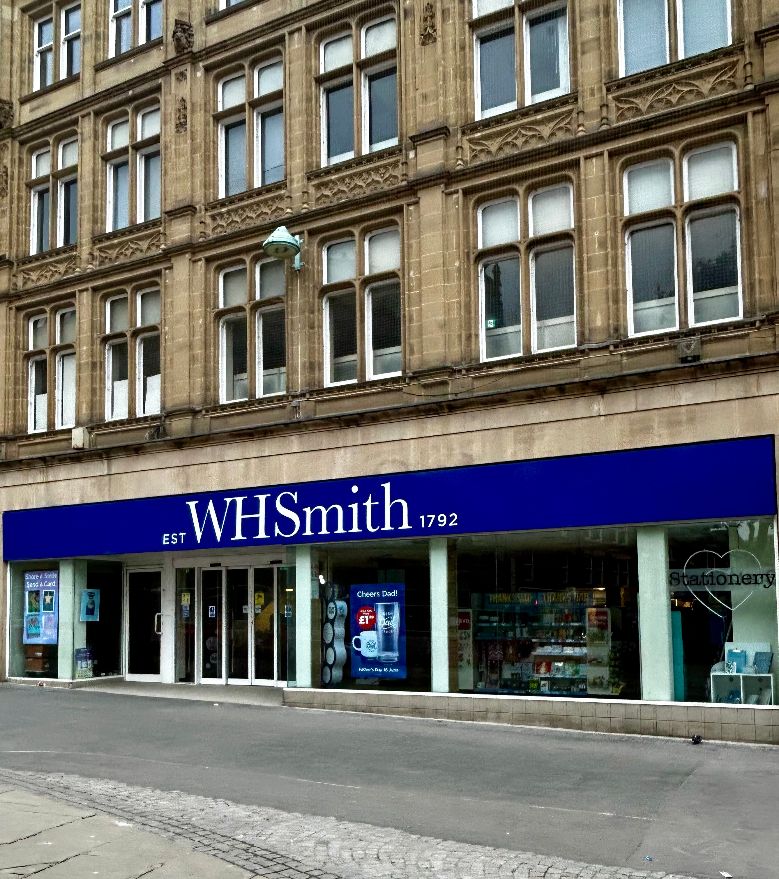
Fargate is in a bit of a mess as it moves away from traditional retail space towards a leisure and social hub. If we’re being honest, we all expect Marks & Spencer to announce the closure of its store at some stage, and what a devastating blow that will be. But there is another retailer that might have a wobbly time ahead. I’m referring to WH Smith whose city centre store opened in the 1970s and is only the second retailer to have occupied 38-40 Fargate. It was, of course, built for provisions merchant Alfred Davy in 1881-1882 by Sheffield architect John Dodsley Webster. Look closely at the exterior and you can still see the carved stone heads of a sheep, cow, pig, and ox.

All is not well at WH Smith, and its High Street stores are struggling to cope with life in the twenty first century. Last month, WH Smith reported another year-on-year dip in sales at its large stores. This contrasts with an eight per cent rise in revenue at its travel stores, those situated in airports and railway stations across the world. “The transformation of the business to a one-stop-shop for travel essentials is delivering strong results, increasing average transaction values and returns,” says the company.

It is a case of things going full circle as I shall explain in a moment, but the question remains. How long will it be before WH Smith calls time on its High Street operation? Sales of newspapers, magazines, books, and stationary, have been eroded by the internet, resulting in a watered-down offer. Instead, we’re left with too many phone chargers and fridges full of chilled drinks. The result is a store lacking atmosphere and too few staff to make the shops look as nice as they used to.

The WH Smith archive is held at the University of Reading but the exact date when it was founded is uncertain. The best guess is sometime between 1787 and 1792 but we do know that its roots were in the newspaper distribution business.

Records show that Henry Walton Smith (1738-1792) to be owner of a Mayfair ‘paper round’ in 1792, delivering expensive newspapers to rich London clients. This was also the year of his death, and the year of William Henry Smith’s birth. Anna Easthaugh, Henry Walton’s widow, ran the business until her death in 1816.

It was her second son, William Henry (1792-1865), who turned it into ‘a house… without its equal in the world’, as The Bookseller described it in its obituary. He had exploited the market for London papers that existed outside the capital, using the newly developed network of seven hundred daytime stagecoaches to get newspapers to the provinces  many hours before traditional carriers, the night-time mail coaches. There was little profit in the operation, and it took him thirty years to realise that he needed help, and a successor.

His son, William Henry II (1825-1891), had wanted to be a clergyman, but his father demanded that he join the business instead. It was a shrewd move, because William Henry II capitalised on the new railway network as a speedier alternative to the coach, and then he started bookstalls, and developed the more familiar role that the company became famous for. By the end of the century, there was a WHS bookstall on almost every station (in 1902, there were 1,242 of them).

Writing about the history of WH Smith in 1985, Michael Pountney said that “expansion seemed unstoppable. Extension of the railway network meant more stations. Elimination of stamp duty on newspapers meant lower prices and more sales. Better education meant more readers. Unstoppable, but not inevitable: Smith’s got the business because they were better at it than their competitors, more reliable, more efficient, better able than their less scrupulous rivals to do good business without offending against the stern moral values of the age.”

Things were about to change.

Before the end of the nineteenth century, railway expansion slowed almost to a halt, the Victorian boom slowed, and William Henry had become an MP that took him away from the business. He died in 1891, leaving the business floundering.

The merger of two of the biggest railway companies, GWR and the LNWR, in 1905, resulted in WHS losing 250 bookstalls at its stations, but it responded by opening 144 shops in towns where they had lost a stall. The man credited for this entrepreneurial genius was CH St J Hornby, friend of WHS’s new proprietor, William Frederick Danvers Smith (later second Viscount Hambleden).

Opening shops was a retaliatory measure against the loss of the bookstall contracts, but its move onto the High Street was a success, with rapid extension across most of the country in the twentieth century, matched by a reduction in the importance of bookstalls. Only with the full development of the shops did the stationary, book and record departments come to rival the supremacy of news and periodicals.

WH Smith went public in 1949 but continued to be run by the Smith family until 1972 when David Smith stepped down as chairman, and then Julian Smith’s retirement in 1992 marked the end of family involvement in executive management.

In 1966, WH Smith created a standard book number consisting of a nine-digit code, which was adopted in 1970 as the international standard number and finally became the International Book Number (ISBN) in 1974.

Let us not forget the other enterprises that WH Smith were once involved with. WH Smith Travel operated from 1973 to 1991, and in 1979 it acquired the Do It All chain of DIY stores, later merging with Payless DIY (owned by Boots). It went on to purchase 75 per cent of share in Our Price music stores and even held a minority stake in ITV. Between 1989 to 1998, the company was a major stakeholder in the Waterstones bookshops, resulting in WHS own bookshop brand Sherratt and Hughes (which had already subsumed Bowes & Bowes) being merged into Waterstones. WHS eventually pulled out of all its external interests.

And so, we come that full circle. The High Street shops are struggling, victim of changing shopping trends, and the future of the company appears most likely to be catering to the needs of travellers, over 640 stores in thirty countries outside the UK, much like those Victorian bookstalls did.

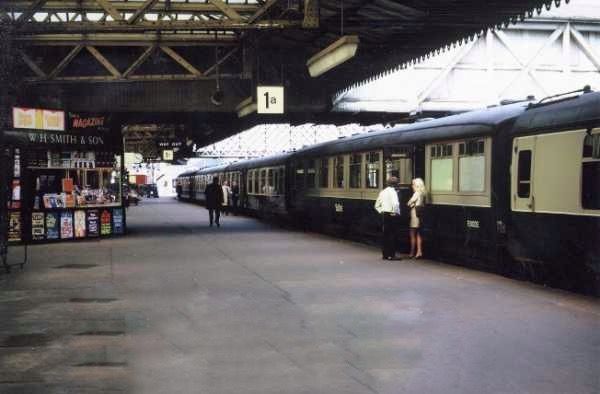
Platform 1, Sheffield Midland railway station showing (left) WH Smith and Son, newspaper stall. WH Smith also had a newspaper stall Sheffield’s Victoria Station. Image: Picture Sheffield

© 2024 David Poole. All Rights Reserved.
Categories
Buildings Streets

38-40 Fargate – Still here, 140 years after being built

‘Fargate of the present’ declared the Sheffield and Rotherham Independent in 1884. It showed the recently constructed shop for Arthur Davy. Image: British Newspaper Archive.

We have covered this building before, but as always happens, new material surfaces.

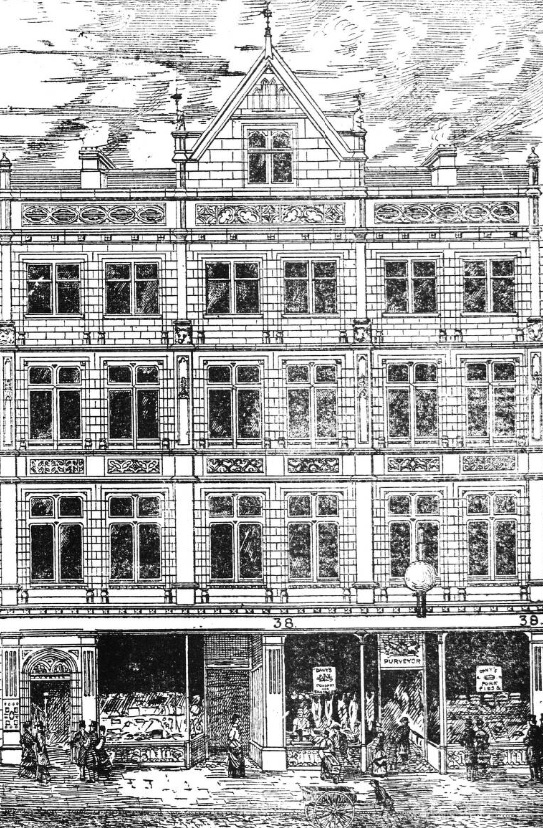
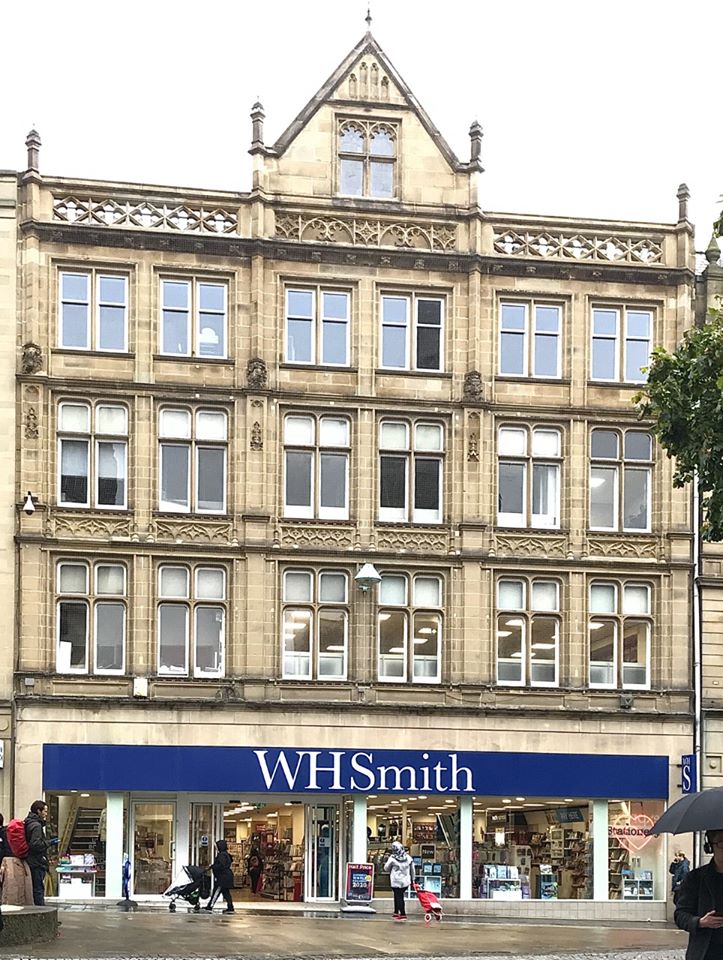
Take a close look at this sketch from 1884. It looks different these days but stands proudly as ever. This is 38-40 Fargate, erected in 1881-1882 for Arthur Davy, and described at the time as the largest retail provision store in Great Britain. Since the 1970s, it has been occupied by WH Smith.

It was erected because of Sheffield Corporation’s Street Widening Programme of the late 1800s that encompassed Pinstone Street, Fargate, and later, High Street. In modern terms, this might be considered to have been Sheffield’s original Heart of the City redevelopment.

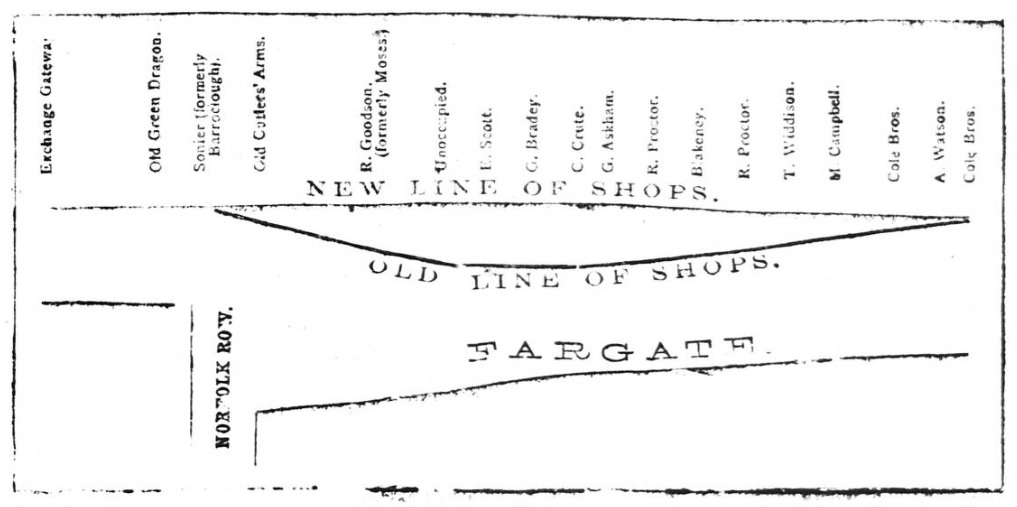
Before this, Fargate was much narrower, the street line on the north side extending much further forward into what is today’s pedestrian precinct.  In fact, there was a ‘pinch-point’ in front of old shops that previously occupied the site. When these were demolished, Arthur Davy’s building was built much further back along a straight line of new buildings, most of which survive.

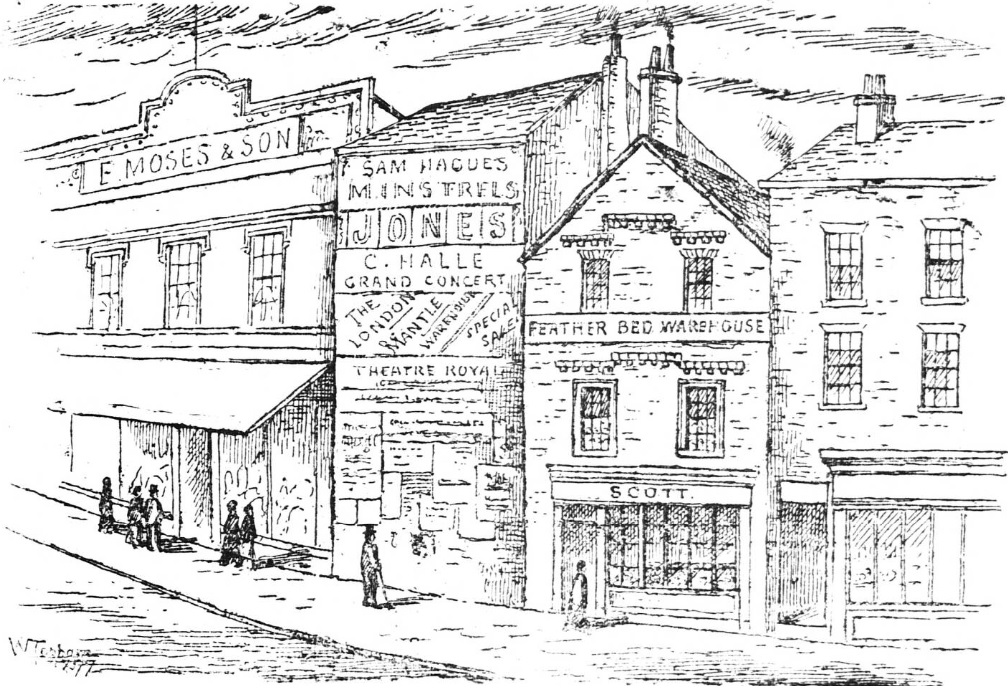
We also know which shops were demolished to make way for the new building. These were R. Goodson, a mantle shop (formerly E. Moses), a vacant unit (they even had empty shops then), E. Scott, feather bed warehouse, and George Bradley, watch and clockmaker.

Former buildings where 38-40 Fargate now stands. The old line of shops was demolished and the street made wider. Note the empty shop that was used for advertising purposes. Image: British Newspaper Archive

Pevsner describes John Dodsley Webster’s design for the new building as ‘economic handling of a late Gothic style, with carved animal heads advertising hams, potted meats and pork pies for which it was famous.’ Look carefully, these are still visible above WH Smith today.

Where stationary, magazines, and books, line the interior today, we must use our imagination as to what it used to look like.

The ground floor sales shop was 75ft long and 40ft wide, lined with Minton’s White Tiles. On the right was a counter for the sale of hams, bacon, butter, cheese, eggs, and tinned goods. On the left was the counter for pork, polonies, sausages, pork, veal and ham pies, brawn, pork, and lard. There was also a room in which to hang 50 pigs, 4000 hams, 2000 sides of bacon, besides a considerable number of polonies and sausages.

An entrance via Exchange Gateway (the small lane that exists to the left) led to a slaughterhouse, where Royal Pigs were killed, the carcases lowered through a trap door into a room below, where they were opened and dressed, and hung upon rails at the back of the shop.

Another room held the bakehouse where the crust for pork pies was made and baked in two Jennison Smokeless 2-Deckers, capable of baking 12cwt of pies per day.

It’s hard to believe, but where many of us remember WH Smith’s record department, this used to be where sausages and polonies were made, as well as the curing of ham and bacon. These were conveyed to the shop above by hydraulic lift.

In later years, the upper floors also became Davy’s Victoria Café, used for light refreshments, luncheons and afternoon teas.

Carved panels above the first-floor windows and open quatrefoils in the parapets either side of the central gable. Carved animal heads advertise hams, potted meats, and pork pies that Arthur Davy was famous for.

Sadly, Davy’s closed in 1972, and converted into WH Smith, complete with a flat canopy outside that has long-since been removed. In recent years, the shop had to close for a significant period, temporarily relocating to Pinstone Street, after roof supports failed and had to be replaced.

See the previous post about Arthur Davy here

©2022 David Poole. All Rights Reserved.