Categories
Buildings

Town Hall Chambers: I bet you didn’t know what it was intended to be

This post was planned as a tribute to one of Sheffield’s most famous shops, Wilson Peck, but research into its origins have proved to be rather complex. That post is imminent, but during the investigation some fascinating facts emerged about one of the buildings that it once occupied.

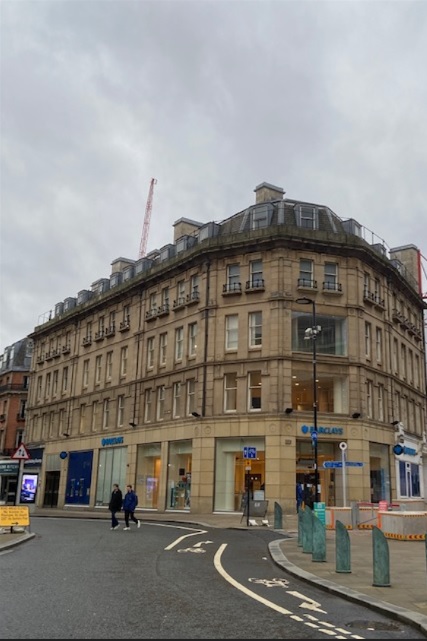
I’m talking about Town Hall Chambers that sits at the corner of Pinstone Street and Barker’s Pool, and now home to the city centre’s last surviving Barclays Bank.

According to Pevsner, it is a ‘worthy, but slightly dull five-storey block of shops and offices’, and like nearby Yorkshire House (another home of Wilson Peck), it has never been listed by Historic England.

The building was designed by Sheffield architect John Brightmore Mitchell-Withers in 1882-85 as part of the street improvement scheme that reinvented Pinstone Lane, a salubrious and narrow thoroughfare, into Pinstone Street, long recognised as one of the city’s most prominent streets.

The site had been an old hostelry called the Norfolk Hotel that was demolished in 1881 as part of the street widening programme. Evidence suggests that J.B. Mitchell-Withers bought the plot of land to build upon, and now I’ve discovered that it was built as a hotel.
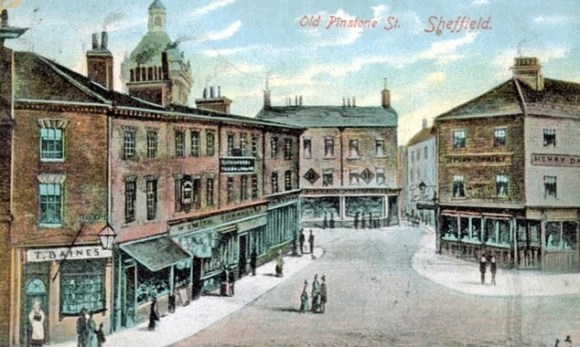
Pinstone Street from Orchard Street, No. 73 Fargate, T. Baines, hairdresser, left, No. 79 Barker’s Pool, Norfolk Hotel (landlord-Henry Darley), right, premises on Pinstone Street include No. 3 Wm Smith, hatter, Nos. 5 – 7 John Richardson, tailor. 1879. Image: Picture Sheffield

In 1884, newspapers advertised that the New Scarborough Hotel was available to let, containing a dining room, commercial room, smoke room, billiard room, refreshments bar and forty bedrooms. It also boasted the best modern appliances for cooking, hydraulic and other lifts, and electric bells.

The following year, it was announced that Lewis’s had ‘acquired the important block of buildings at the corner of Pinstone Street and Barker’s Pool, known as the Scarborough Hotel, and shops below,’ suggesting that the hotel never opened after failing to attract any interested parties.

The name of Lewis’s is famous in the history of UK department stores and the fact that it once had a branch in Sheffield comes as a bit of a surprise.

The first Lewis’s store was opened in 1856 in Liverpool by entrepreneur David Lewis, as a men’s and boys’ clothing store, mostly manufacturing his own stock. In 1864, Lewis’s branched out into women’s clothing, later expanding all its departments, and his motto was ‘Friends of the People’.

The first Lewis’s outside Liverpool opened in Manchester in 1877 followed by Birmingham in 1885. However, it was the Manchester store that it was best known for and later included a full scale ballroom on the fifth floor, which was also used for exhibitions. Its fourth store was in Sheffield, but with stiff local competition from John Atkinson and Cole Brothers, it proved unprofitable, and closed in 1888.

Negotiations quickly took place between the trustees of David Lewis and Joseph Hepworth and Son, a suit manufacturer that had rapidly expanded with over sixty shops across the country.

The premises underwent extensive alterations to accommodate its ready-made clothing, hats, and outfitting departments. The entire building was redecorated and lit with electric lamps, and when plans were submitted for Sheffield Town Hall in 1890, it was proudly referenced as the Hepworth’s Building.

Hepworth’s stay lasted four years, and in 1892 Arthur Wilson, Peck and Co, announced that they were vacating their three premises in Church Street, West Street, and Fargate, and consolidating business in the Hepworth’s Building.

It became known as Beethoven House and lasted until 1905 when it moved to the opposite corner in premises vacated by cabinet makers Appleyards and Johnson, and now known as Yorkshire House.
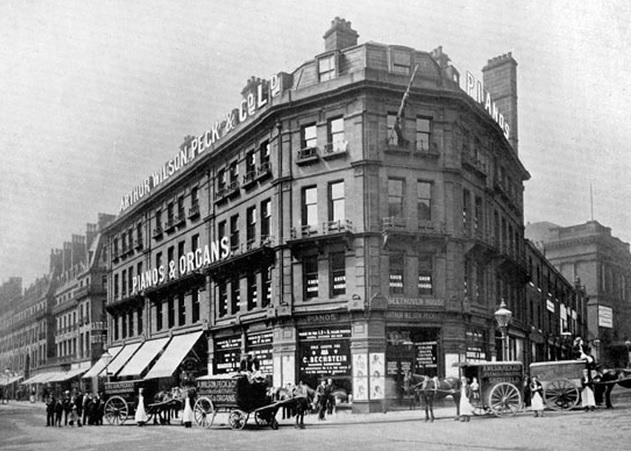
Arthur Wilson, Peck and Co., Ltd., pianoforte, organ, and musical instrument dealers, Beethoven House, Pinstone Street. 1897. Image: Picture Sheffield

At which point the building became known as Town Hall Chambers is uncertain, but by the 1930s, the ground floor had been subdivided into smaller shops, and the floors above converted into offices for numerous insurance companies.

Our generations will remember it as a centrepiece shoe shop for Timpson’s and as a short-lived branch of Gap, before being reinvented as a futuristic Barclays Bank. I’d be grateful if anyone can name any other businesses that might have been located here.

And so, we’ve discovered that Town Hall Chambers started as an ill-fated hotel. The building itself survived two World Wars and managed to escape Heart of the City redevelopment, but the irony is that neighbouring Victorian buildings further along Pinstone Street, also built as part of the 1880s street widening scheme, will soon become the Radisson Blu Hotel.
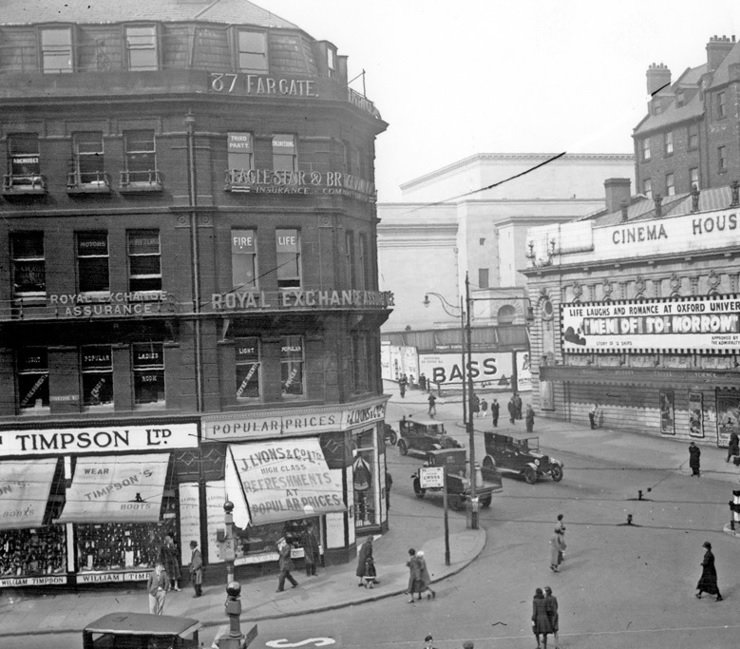
Town Hall Square and Barkers Pool, Town Hall Chambers, William Timpson Ltd., Shoe Shop and J. Lyons and Co. Ltd., Dining and Tea Rooms on left, Cinema House on right. 1935. Image: Picture Sheffield

© 2024 David Poole. All Rights Reserved.
Categories
Buildings

42-46 Fargate – where a Green Dragon once stood

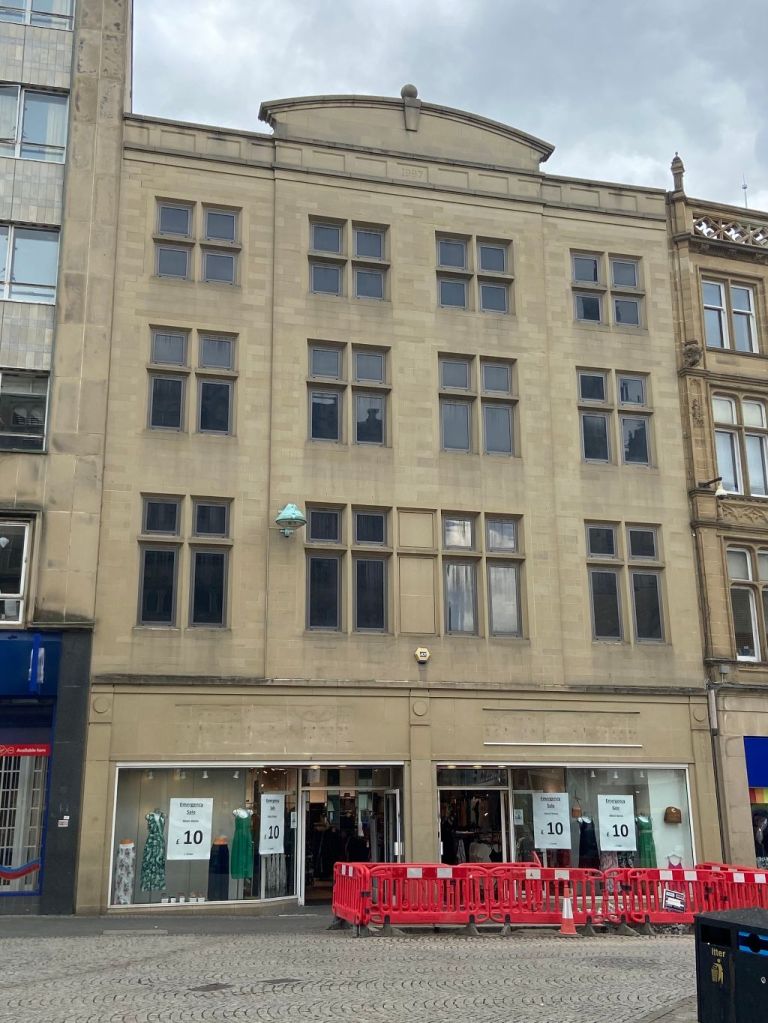
42-46 Fargate. Image: DJP/2022

I have a memory from the 1970s of an old building on Fargate being demolished, and seeing a huge gap, and then the construction of a new one. When looking at 42-46 Fargate, I found I was correct. But the memory also plays tricks. Because I have no recollection of the replacement building also being demolished in the 1990s and substituted with what we see today.

This story starts in 1868 when Robert Henry Ramsden opened a shop in Barker’s Pool as a hat and cap dealer. He had no business experience but established himself  with a reputation for the quality of his goods, and the reasonable prices at which he sold them.

He only allowed cash transactions, and avoided bookkeeping , and by not incurring loss by bad debts, he could afford to sell his goods at a lower rate of profit. He styled himself as ‘The Reasonable Hatter’ and later his advertisements declared that ‘Cash is King.’

He became very successful and opened other shops across Sheffield and Rotherham, and added boots and shoes, and other goods, to his stock.

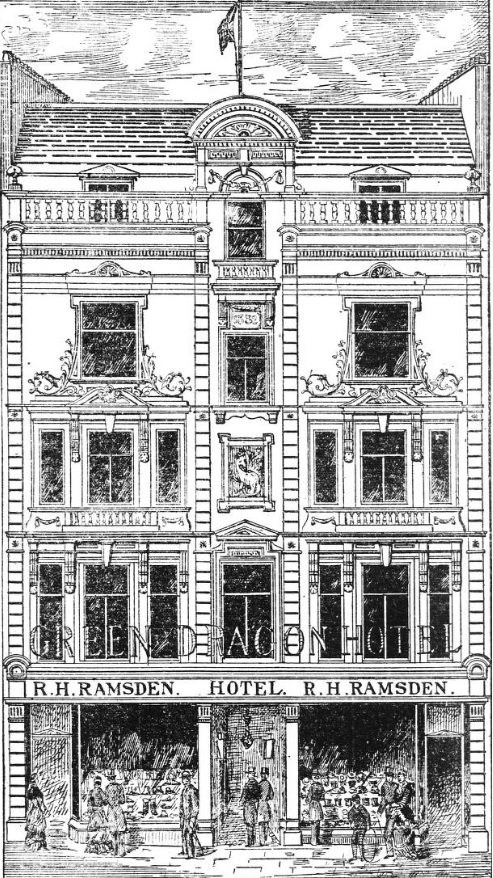
When important improvements were taking place on Fargate, he purchased a large plot of land, on which was a portion of the old Green Dragon Hotel. Here, he built new shops in which to carry on a portion of his business with a ‘Grand and Sumptuous Hotel.’

The new Green Dragon Hotel was built in 1884, from designs by Thomas Jenkinson, architect, East Parade. Ramsden held the hotel in his name, but it was managed by his son Samuel.

Green Dragon Hotel. Drawing from 1884. Image: BNA

Mr Ramsden’s hat shop was to the right, and the boot and shoe shop to the left, the windows of which extended some way down the passage in the centre, which led to the hotel.

All the floors were laid with encaustic tiles, at the entrance to the hotel being a dragon rampant, with the words ‘Green Dragon Hotel’ beneath. To the right in the passage was the luncheon bar, and to the left a second-class bar, at the end being the smoke room.

The walls and panelled ceilings of these rooms, as well as the passages, were covered with Lincrusta Waltona, with painted decorations. Around the rooms, mirrors were arranged, the seating being upholstered in maroon velvet and lit with massive brass gas chandeliers and brackets manufactured by John Horton and Sons, Sheffield.

The bar was to the right of the smoke room, and the kitchens beyond.

The billiard room, on the first floor, contained two Cox and Yeaman’s tables. A corridor on each side contained a cloakroom, as well as other rooms, leading to the grand dining hall which was 40ft long and 18ft wide, capable of serving 80 people. It was also lined with Lincrusta Waltona, of a handsome figured design with bronze enrichments, the panelled ceiling being painted and gilded. The fittings were mahogany, ebony, and gold, and the mirrors were lit with two massive 6-light brass chandeliers.

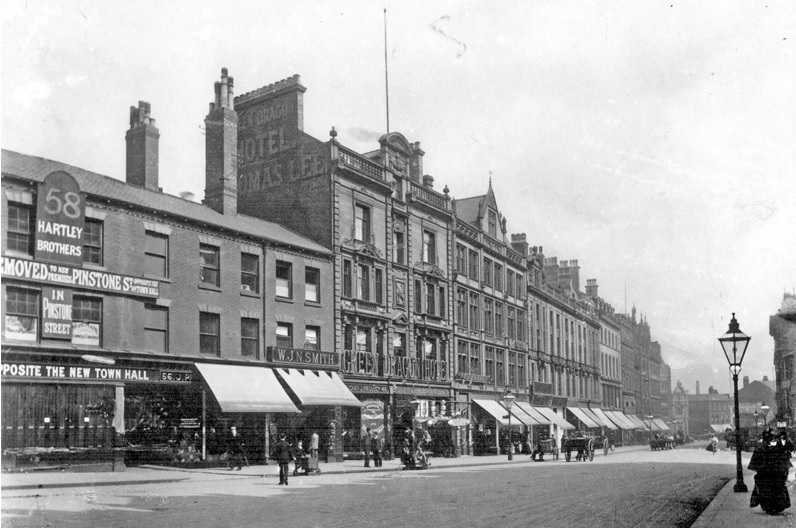
Fargate including No 58, former premises of Hartley Brothers, Exchange Gateway, No 56, J. Preston, Nos 54-46, William John N. Smith, Milliner, No 44, Green Dragon Hotel (later became Winchester House), No 40, Davy’s Buildings. Image: Picture Sheffield

On the floor above were club rooms, sitting rooms, bedrooms, store rooms, bathroom, housemaids’ rooms, and lavatories. In the basement were extensive cellars for the storage of wine and beer. A lift ran from the cellar to the top floor, and each room was equipped with electric bells and speaking tubes.

The walls of the hotel were such a thickness that air shafts ran from top to bottom, allowing ventilation for each room, and to conduct bad air into the drains, instead of being carried from the base of the building to the premises above.

All doors to the principal rooms were panelled with elegant cut plate glass with a dragon rampant device.

The hotel aimed to provide the public with refreshments of every description, from a 3d. sandwich or pie, to an elaborate eight or ten-course dinner; and from a glass of beer or bottle of mineral water, to the most costly wines of the best vintages.

Ramsden adopted the same business principle as his other businesses. This was the cash system, allowing him to offer the best at the lowest possible prices.

He died in 1922, aged 82, at 8 Herbert Road, Nether Edge, but his trustees relinquished the licence, and the building and contents of the hotel were auctioned in July 1925.

It was adapted to become Winchester House, the former hotel rooms becoming offices and studios.

The Winchester Restaurant was operated by the Little Tea Shop Company but failed in 1928. And there were several important names that had offices within, including John J. Jubb, accountants, and the Sheffield College of Voice Training.

They were joined in the 1930s by Yates and Henderson (Photographers), the Christadelphian Room, the Sheffield School of Operatic, Classical, and Ballroom Dancing, but its largest tenant became the Berlitz School of Languages, with its name displayed across the front of the building.

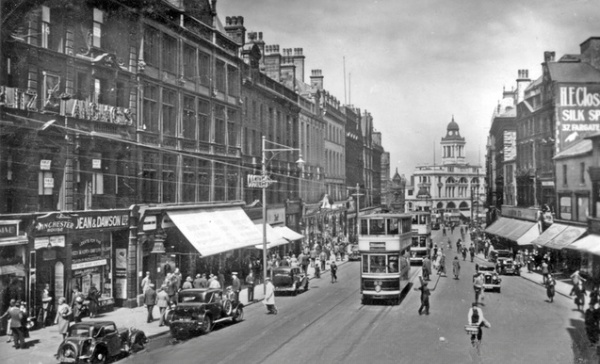
Fargate looking towards High Street and Kemsley House in 1937. Fargate including No 42/46, Winchester House and No 38/40, Arthur Davy and Sons, Provision Dealers, Davy’s Building (now WH Smith), left. Image: Picture Sheffield

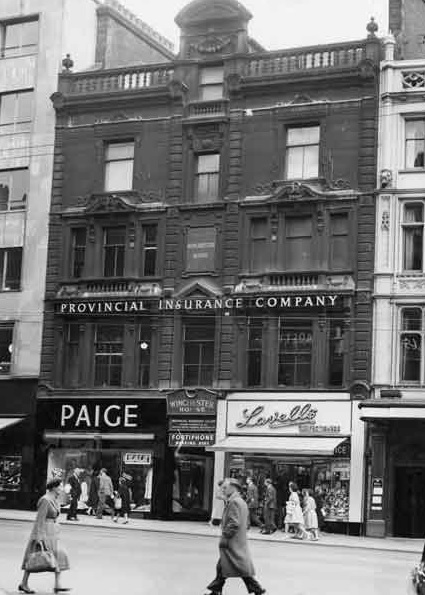
During the 1950s and 1960s, Winchester House became offices for the Provincial Insurance Company, founded by Sir James Scott in Manchester in 1903.

Provincial Insurance Company, Winchester House. c1960. Image: Picture Sheffield

The two shops at the front changed hands several times and some are worth mentioning, including Maison Sonia at No. 46 in the 1930s, later becoming Paige Gowns and Lovell’s Confectioners at No.48.

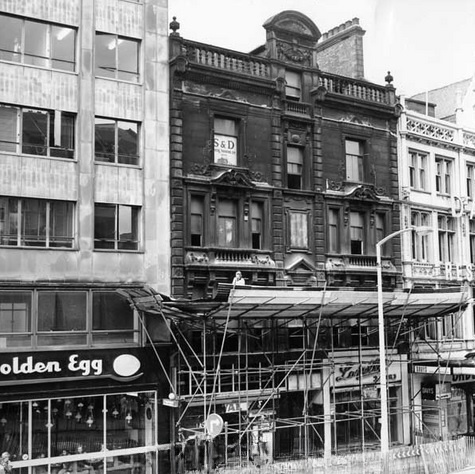
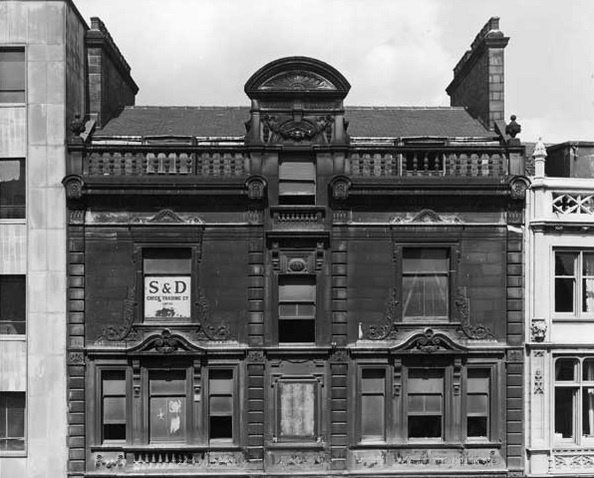
However, by the 1960s the building was in serious decline. Most of the offices were empty, with no inclination to find new tenants. Worst of all, the building had become dangerous, with masonry crumbling from above, and it was boarded up at ground level to prevent serious injury to passers-by.

Fargate, the scaffolding on Winchester House being due to masonry falling off the building. Next door is the Golden Egg cafe and coffee shop, May 1971. Image: Picture Sheffield
Upper levels of Winchester House, 1971. Image: Picture Sheffield

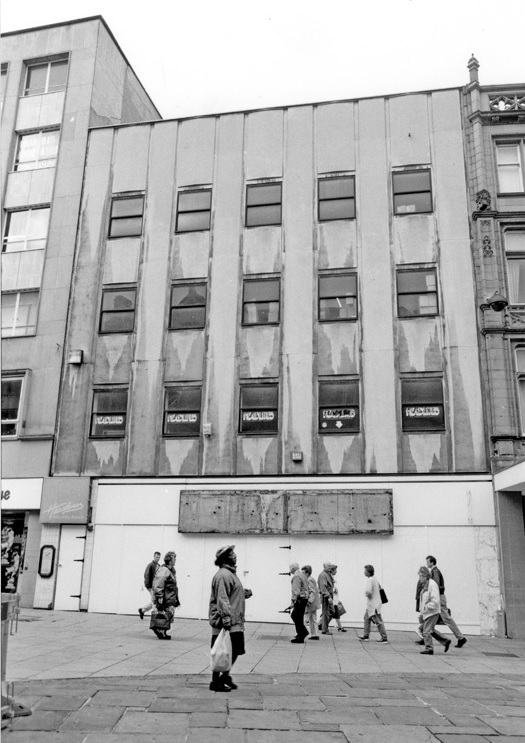
Inevitably, it was demolished and replaced with a standard 1970s design. It contained a large shop at ground level, occupied by Dolcis, with modern offices above.

It never fitted in with adjacent Victorian architecture, and was itself demolished in 1996-97, replaced with the present building, and occupied by New Look until its closure.

Now, like the rest of Fargate, it is in limbo, occupied by a short-term let, but its offices are empty. It is for sale with an asking price of around £800K, with potential to extend the upper parts.

But while it waits the renaissance of Fargate, remember the site’s rich history, and of what came before.

No. 42 Fargate, formerly Dolcis shoe shop awaiting demolition in 1996. Image: Picture Sheffield

©2022 David Poole. All Rights Reserved.