Categories
Steelopolis

A week in Steelopolis

It was Halloween

“Oh how the candles will be lit and the wood of worm burn in a fiery dust. For on all Hallows Eve will the spirits come to play, and only the fruit of thy womb will satisfy their endless roaming.” – Solange Nicole.

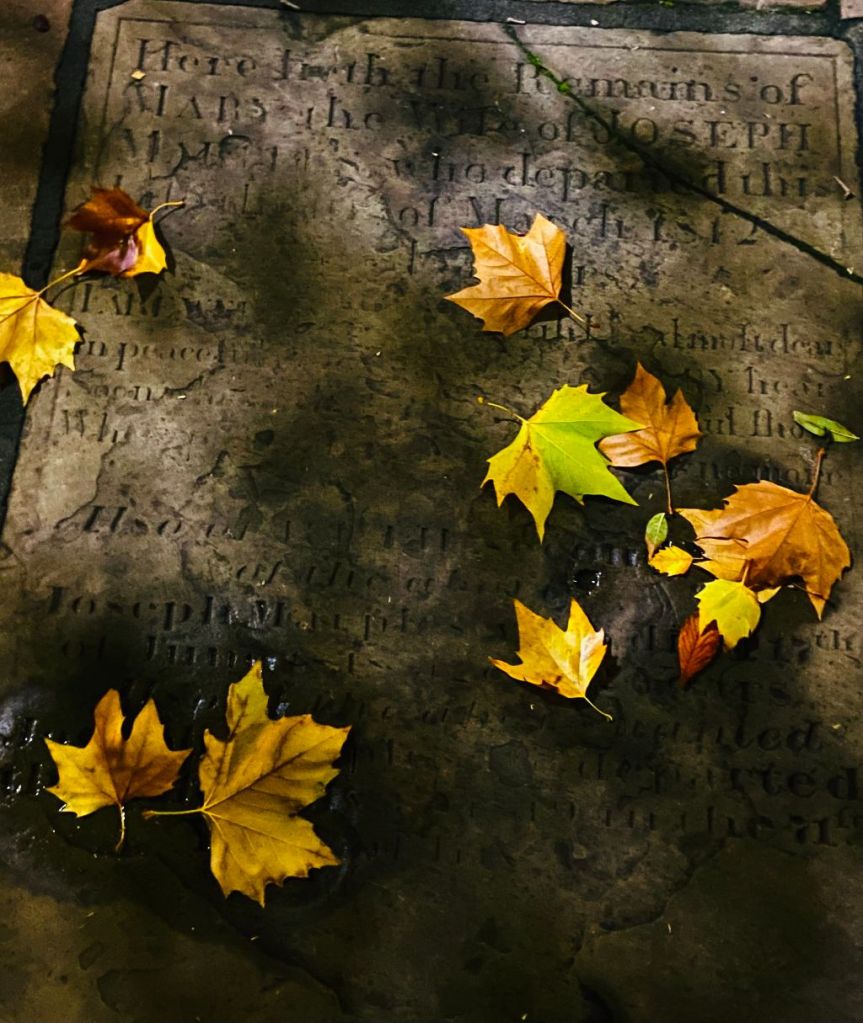
Before the rains came. Autumn leaves and a gravestone. Sheffield Cathedral.

*****
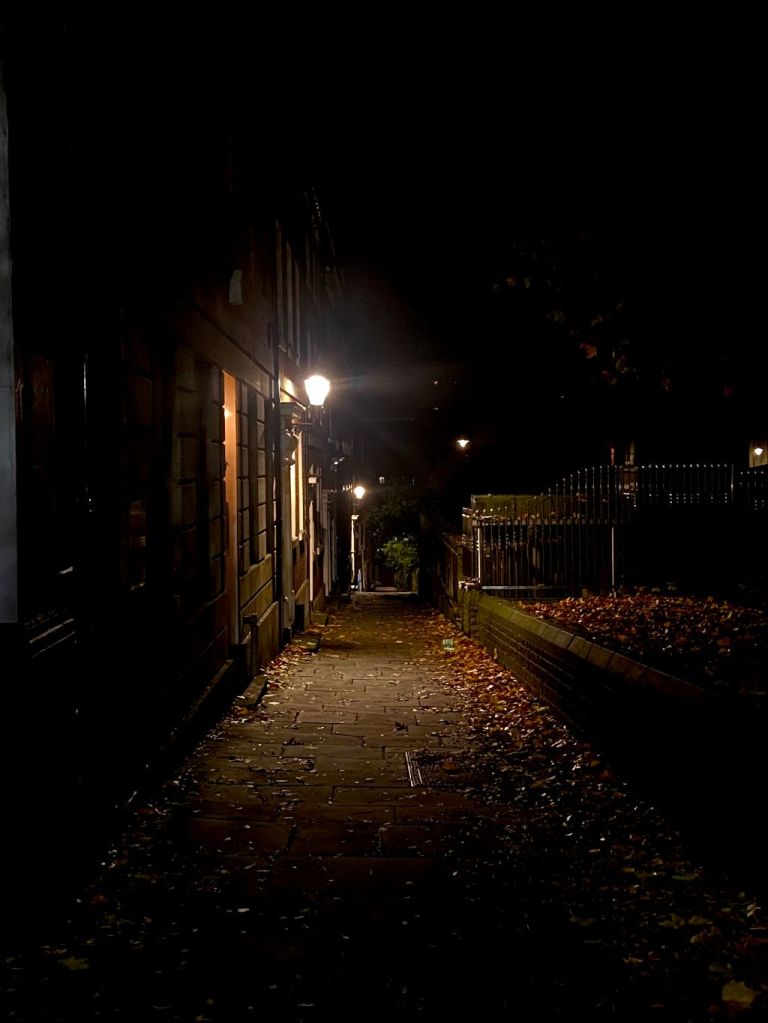
In the still of an autumn night

St James’ Row, beside Sheffield Cathedral. It took its name from St James’ Church that stood at the end of St James’ Street (next to where St James House now stands). The church was consecrated in 1789, but by 1945 its roof and fittings had gone, destroyed by the blitz. The shell of the building remained, awaiting the hands of an appreciative restorer, but one never came. It was eventually dismantled in 1950.

*****
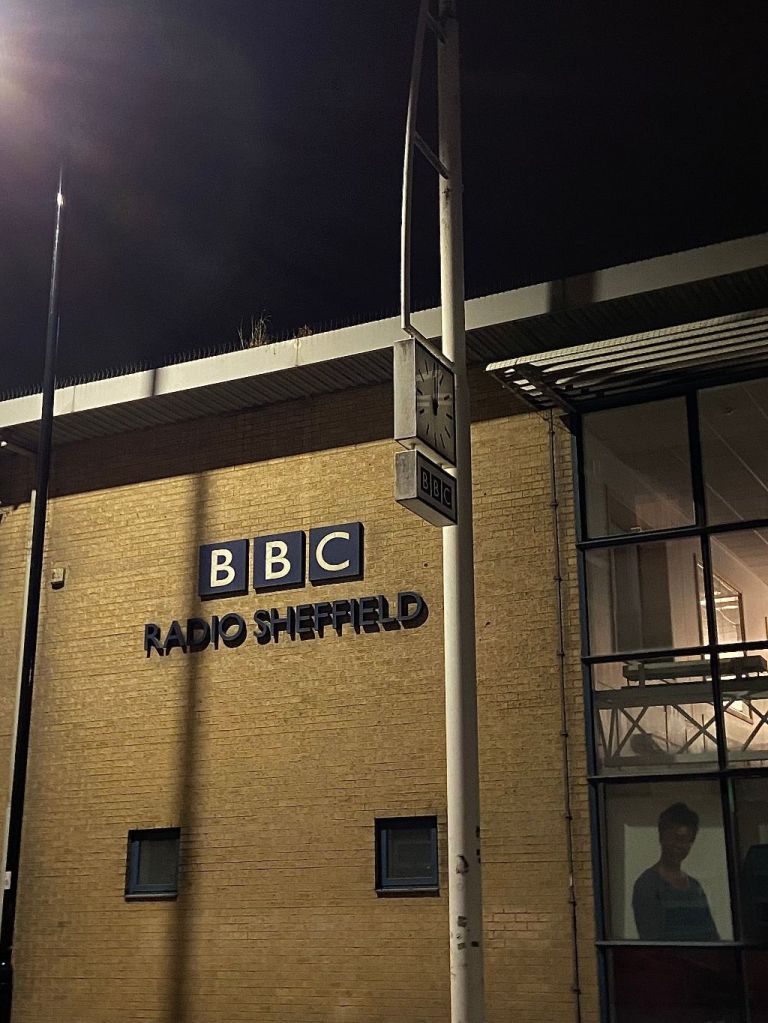
It was business as usual

Listeners didn’t suspect a thing. It was business as usual. But it must have been hard for BBC Radio Sheffield presenters to take to the airwaves.

It was the second BBC local radio station to go on the air, launching in November 1967, and yesterday, they heard that Acting Director of BBC England, Jason Horton, was going to “grow local impact in all parts of the country.”

In other words, the BBC are cutting jobs on local radio stations in England, as part of its strategy to become a ‘modern, digital-led’ broadcaster.

Local shows will only survive on weekday mornings and lunchtimes (6am till 2pm) whilst the rest of the output, apart from evening and weekend sport, will be shared either regionally or nationally.

A possible 139 posts will be at risk because of the changes, and a voluntary redundancy drive is being launched. So, who will go? Toby Foster? Paulette Edwards? Howard Pressman?

There will be six regions going forward, covering North West/North East, Yorkshire and Lincolnshire, Midlands, London and East, South, and South West.

It means that outside the eight hours of local programming, the station effectively becomes the radio equivalent of TV’s Look North – BBC Radio North anyone?

*****
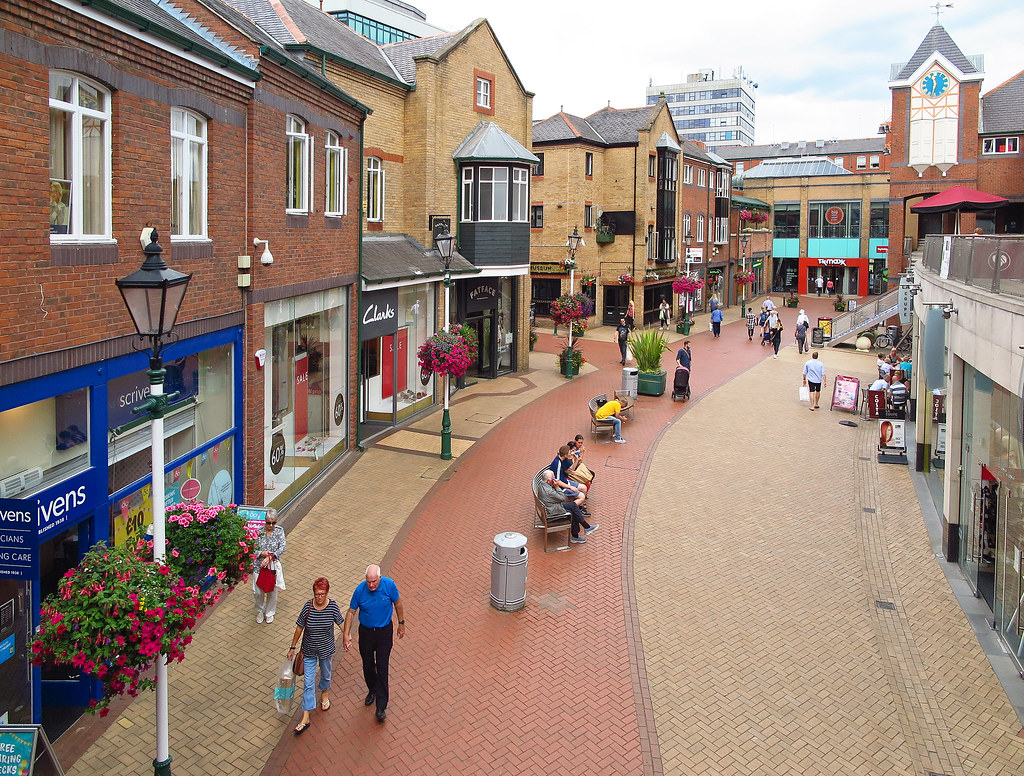
Orchard Square. Image: Tim Dennell/Flickr

Orchard Square and its mega-canopy

In 1987, Orchard Square was ground-breaking, and provided an exciting addition to Sheffield’s shopping scene. And yet, I always got the feeling that people were reluctant to leave Fargate and try something different.

Thirty five years later, Orchard Square finds itself at midpoint.

Nobody could have predicted the internet, a pandemic, and the fact that our shops became stale and generic. And for a long time, we made a mess of the city centre. Like the rest of town, Orchard Square suffered from shop closures and empty units.

But I’m firmly on the side of those that say city centre regeneration will be worth it afterwards. But as I’ve said before, I’m also one of those that hates the slow progress of planning and development.

The future of Orchard Square is going to be leisure, entertainment, and city living.

In January, its owners, London Associated Properties, said it planned to create an events space as well as 13 flats from empty shops.

And now it has submitted a planning application to install a massive canopy in the centre of the square to provide weather protection so markets and events can be held all year. It would be suspended on wires and ‘demountable’ to stop it creating ‘more shade than is desirable.’

The application also includes plans to install more than a dozen awnings above shops to ‘add colour and visual interest’ and ‘provide protection.’

It seems likely that the scheme will get the go-ahead, with Sheffield City Council earmarking £750K of public money from the Future High Streets Fund towards it.

*****

I like colour and light

This is Lightbox, student accommodation on Earl Street, and typical of the things I see at night.

I’m a nightwalker and enjoy seeing Sheffield city centre when most of you are in bed. The use of colour and light makes everything more mysterious and interesting.

But things are changing.

The significant increase in our energy bills means lights are being switched off across the city.

And who can blame anyone for doing so?

But it will make everything seem rather drab.

*****
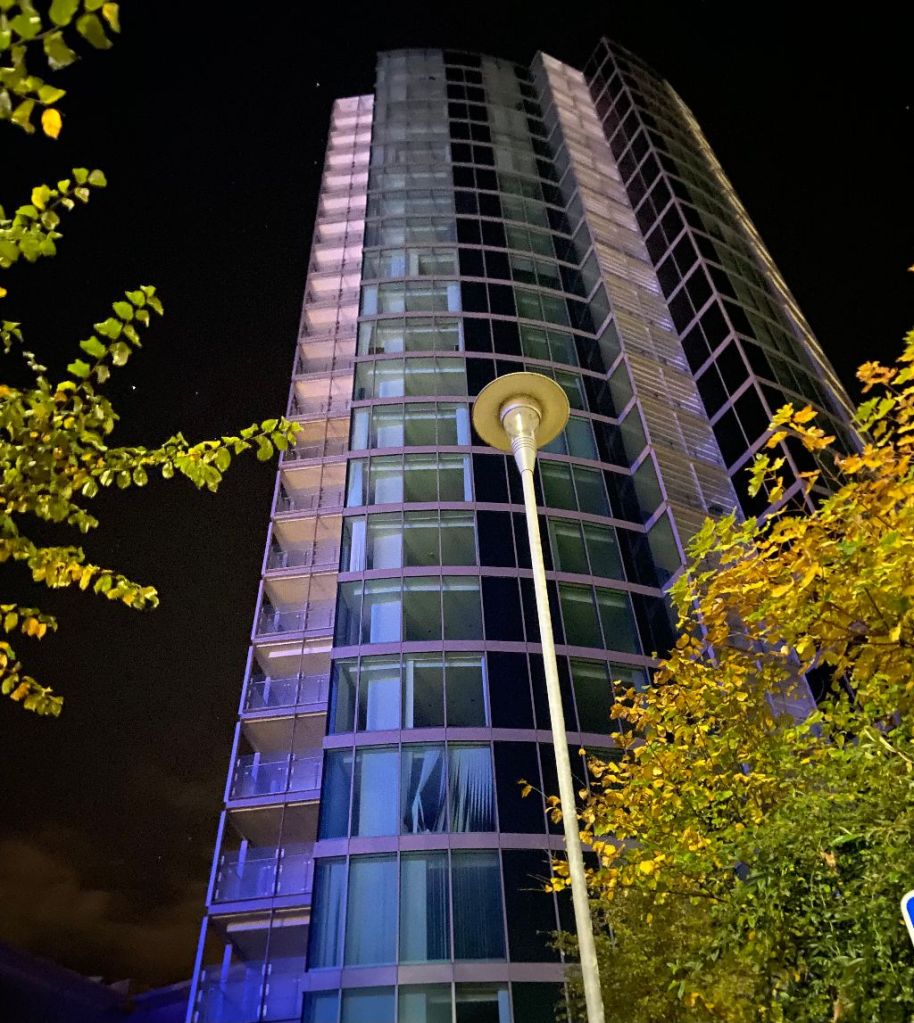
Soaring into autumn darkness

Is everybody in bed, or are most of these apartments empty? And those rumpled vertical blinds really annoy me.

Velocity Tower should have been 30-storeys high, but construction halted on the 21st floor. When the developer went into administration it was eventually sold to Dubai-based Select Group which also agreed a deal to build the £6.5m Ibis Hotel next door.

*****
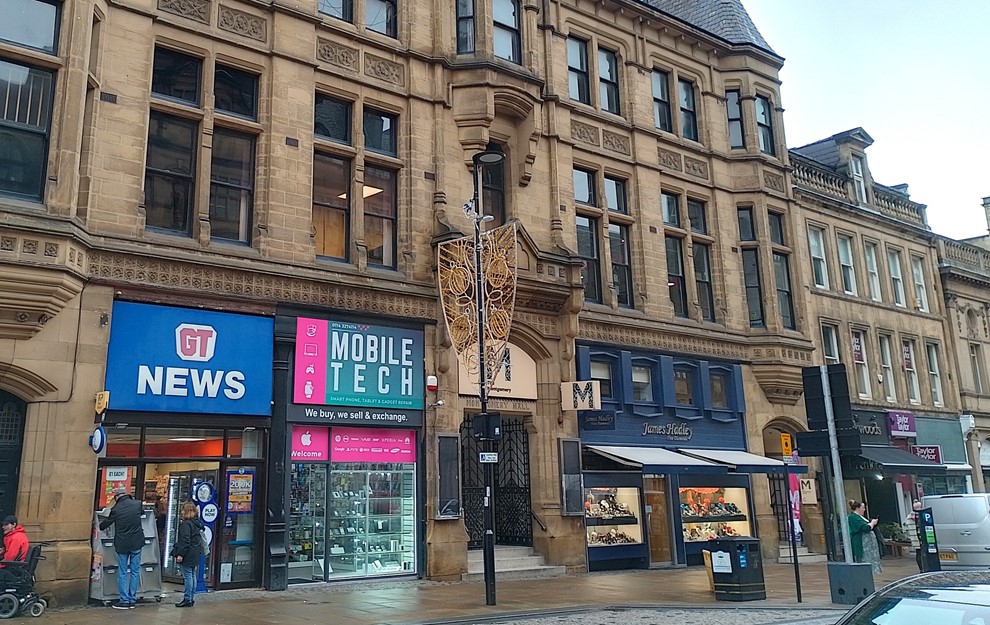
A Victorian renaissance

The Montgomery Theatre on Surrey Street is set to receive funding as part of the Future High Streets Fund.

The owners are set to receive £495K to support them in redeveloping the 136-year-old building. The money would go towards making all public areas accessible for the first time as well as changes to the interior design and layout. The upper floors of the building will also be opened.

The grant will help support and expand The Montgomery’s vision of becoming Yorkshire’s leading arts centre for children and young people.

Built in Domestic Gothic-style at a cost of £15,000 in 1884-1886, the Montgomery Hall, as it was called, was designed by Sheffield architect Charles John Innocent (1839-1901) and constructed by George Longden and Son.

The Future High Streets Fund supports landowners to utilise unused space by opening the upper floors of their building and make improvements to frontages on Fargate, High Street and connecting routes such as Surrey Street and Chapel Walk.

Earlier this week, we looked at plans to cover Orchard Square with a huge canopy, and the conversion of the upper floors into eight new apartments. If approved, the scheme is set to receive £990K of funding.

Sheffield City Council’s Finance Sub-Committee will meet next week to discuss both proposals.

*****
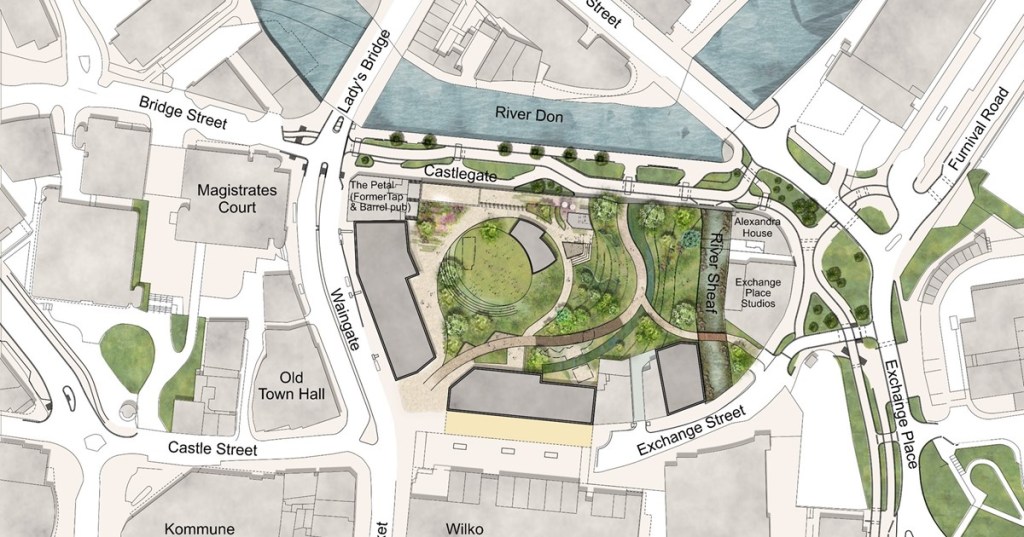
Castlegate plans move forward

At last, positive news about Castlegate, once home to Sheffield Castle and Castle Market.

You may remember that Sheffield City Council secured £18m funding from the Levelling Up Fund to develop the derelict site, and it will go to public consultation from next week.

The council hopes to create a new public space which focuses on heritage, culture, and sustainability. It would see the Castle site transformed with new ‘grey to green’ planting, footpaths, a community events space, a de-culverted River Sheaf, and other infrastructure needed to unlock future development.

A ‘Concept Plan’ vision can be seen at the Moor Market between 8-11 November, as well as scheduled presentations at 18 Exchange Street and a Zoom session.

Visitors will be able to comment at Moor Market and an online survey will be available from November 7.

A planning application is due in early 2023, with construction starting in summer and finishing in spring 2024.

However, the Council has estimated that ‘high level’ costs of the proposed changes included in the Concept Plan means the Levelling Up Fund may not be enough to cover all the costs.

*****
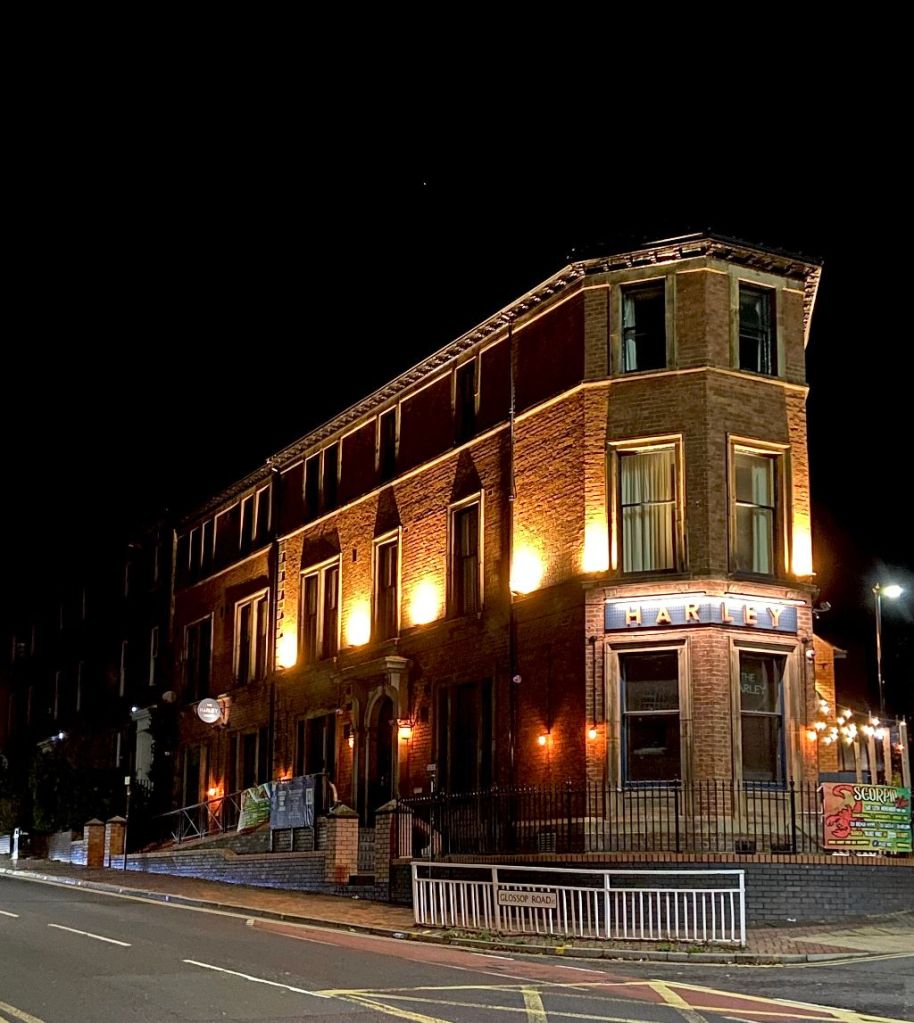
“Oh,my poor head.”

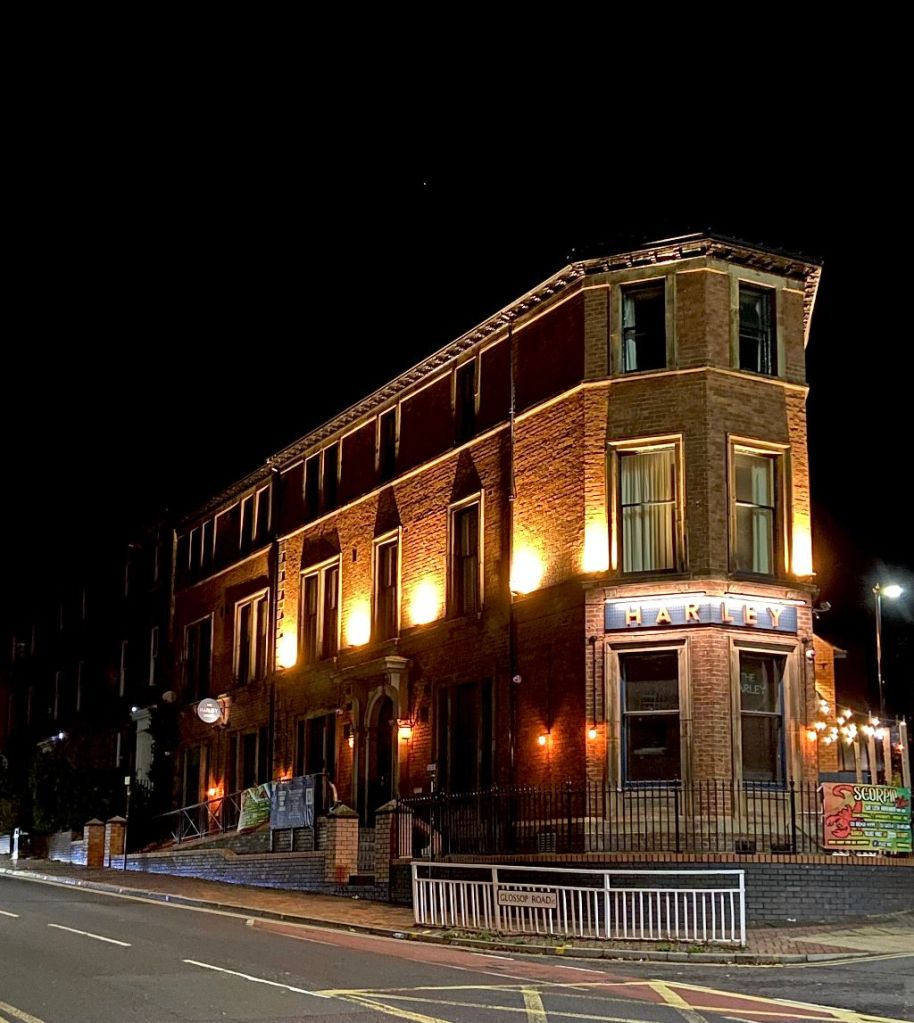
I walked into the night to see what I could find. The only person I saw was a drunken young lad staggering somewhere. “It’s the Harley,” he slurred, as I took a photograph.

I remembered Dr Marriott Hall who married Sarah Firth in 1866. She was the daughter of Mark Firth, the steel magnate, who gave them a new house and surgery at this corner on Glossop Road.

And then, I thought of Dr Hall riding his horse along Endcliffe Vale Road in 1878. The horse threw him off and the doctor’s head struck a kerbstone.

“Oh, my poor head,” he complained, and suffered a slow agonising death.

Lastly, I thought of students. Drinking, dancing, and shouting.

*****
Harry Styles was singing

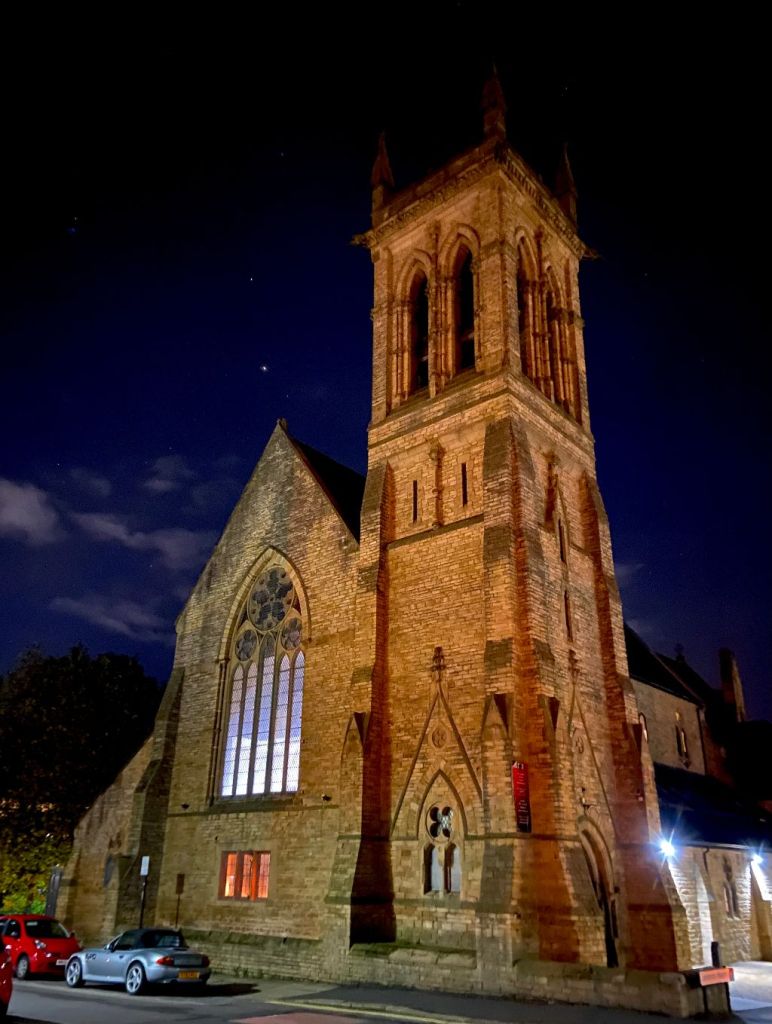
The Gothic Revival church of St Silas lit up like a beacon. It’s a far cry from the cold and gloomy day of February 1869 when the Archbishop of York consecrated this new church in front of a full congregation.

It cost £8K, a gift from Henry Wilson of Sharrow, and the work of John Brightmore Mitchell-Withers.

His Grace read the 24th Psalm, but on this autumn night all I can hear from inside is Harry Styles singing Late Night Talking, which seems appropriate and inappropriate at the same time.

The church closed at the Millennium and is now student accommodation.

*****
And finally… look what happened in 1929

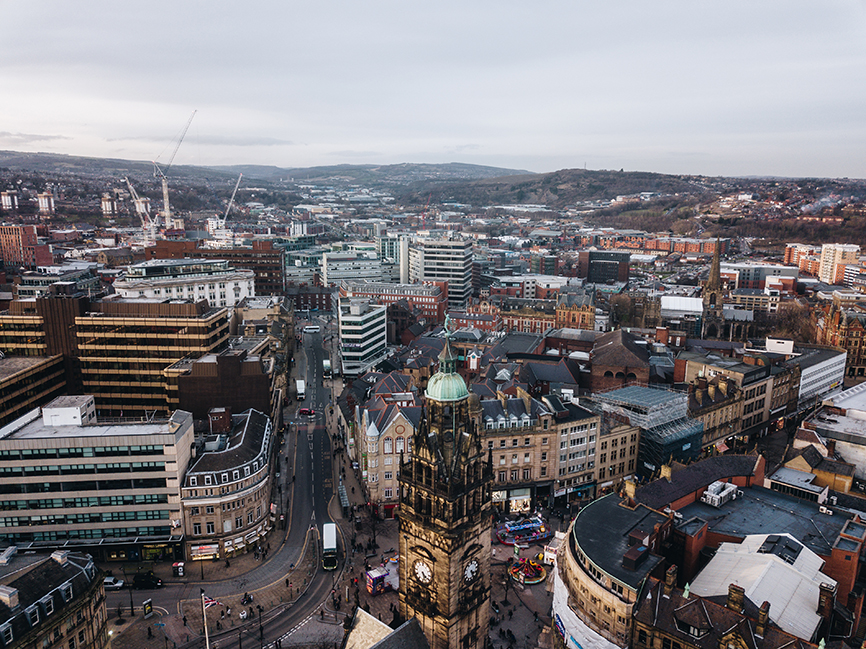
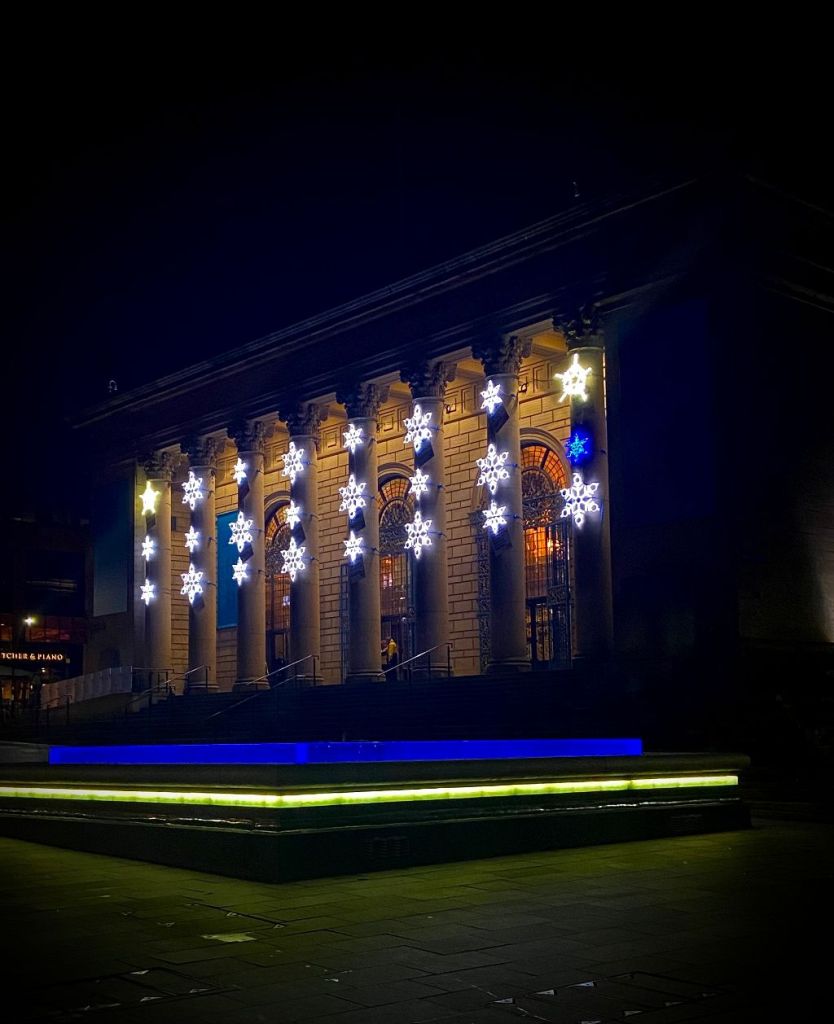
Sheffield City Hall is getting into early festive spirit.

When it was constructed between 1929-1932, the foundations were sunk to a depth of 30ft. The earth that was removed was taken to build a new dirt track for motor-cycle racing, and this became Owlerton Stadium.

*****

©2022 David Poole. All Rights Reserved.
Categories
Buildings

The Harley – doctor’s house to student hangout

The Harley, Glossop Road. Image: Sheffield Star

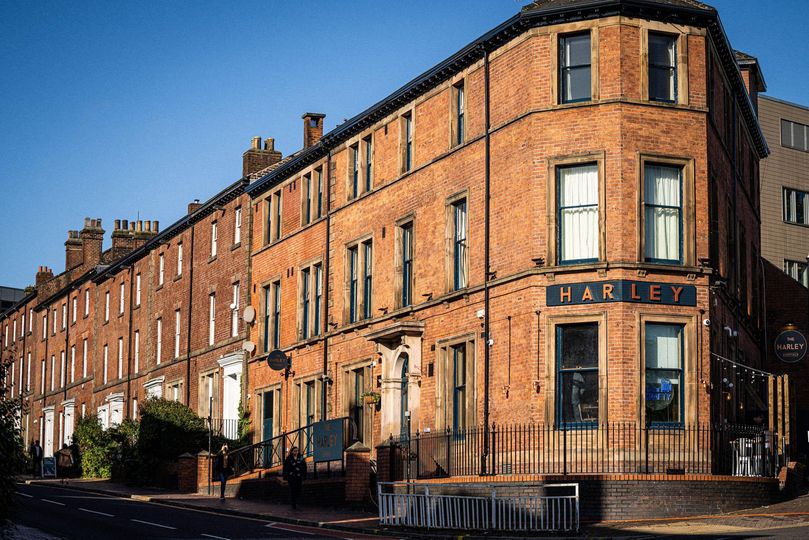
The death of Dr Marriott Hall was tragic, but it kick-started a series of episodes that would give its name to The Harley, now a popular student bar and live entertainment venue, on Glossop Road.

In March 1878, aged 38, Hall was riding along Endcliffe Vale Road on his way to visit a patient at Broomhill Park. His horse threw him, rolled over him, and his head struck a kerbstone. He was taken to the lodge at Oakbrook, belonging to his father-in-law, Mark Firth, where his injuries were treated.

“Oh, my poor head,” he complained, and suffered a slow agonising death.

The son of the Rev. Hall of Greasbrough, Marriott Hall had been assistant to Mr Porter, surgeon, Eyre Street, afterwards appointed assistant house-surgeon at the General Infirmary, subsequently rising to top position.

He started practice with his brother, John, on Victoria Street, going alone at the Bath Buildings on Glossop Road about 1865, until joined by Dr William Cleaver ten years later.

When Hall married Sarah Taylor Bingham Firth, the daughter of Mark Firth, in 1866, their wedding present from the steel magnate was 334 Glossop Road, a new house and surgery added to the end of 1850s terraced villas at the corner with Hounsfield Road.

Hall’s widow remained until the 1880s before taking up residence at The Gables, in Ranmoor.

Dr Mariano Alejo Martin de Bartolome bought the house in 1886 and stayed until his own death four years later, after which it was bought in 1891 by the adjoining Sheffield Nurses’ Home and Training Institution for £1,500.

This organisation had been set up by James Henry Barber at a time when Sheffield’s population was increasing rapidly and often nurses had to be obtained from as far away as Lincoln. The new premises allowed for a staff of district nurses for the working classes.

At the start of World War One it became the Sheffield Queen Victoria District Nursing Association, with a staff of 25 nurses, which remained until 1928 when the building was sold to a group of Liverpool businessmen for £2,962.

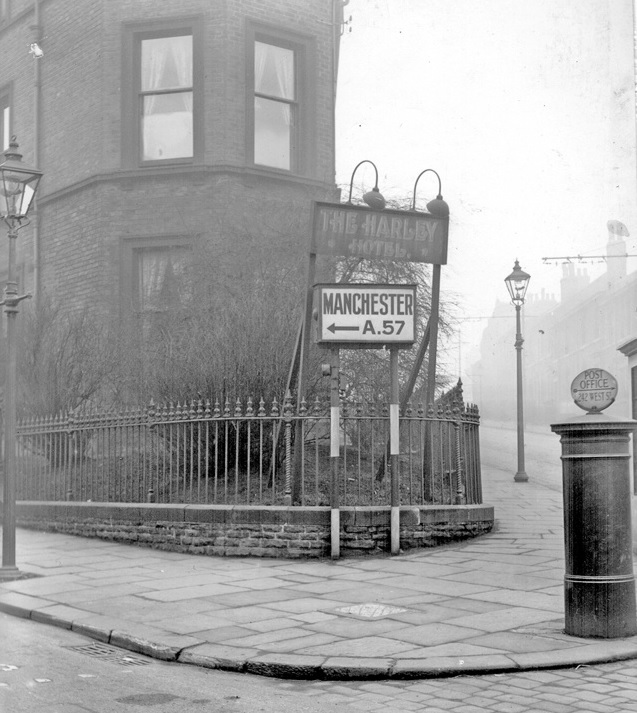
The entrepreneurs formed a company, Harley Houses Ltd, acknowledgement of the building’s medical history, the name derived from London’s famous Harley Street, “to build, alter and construct, repair and sustain 334 Glossop Road, or any other premises, to use as a residential club or private hotel.”

Harley Hotel, at the junction of Glossop Road and Hounsfield Road, with an illuminated classified road sign used where the obvious route does not happen to be the main road. Image: Picture Sheffield

In May 1928, it opened as Harley Residential Club for professional businessmen and women.

“Elaborately and tastefully decorated and furnished, with three attractive and reposeful lounges, writing rooms, hot and cold running water in every bedroom, and with comfort, cuisine and service.”

It provided accommodation for 26 residents and visitors to the city, and within a year had been renamed The Harley Hotel, the biggest downside being its inability to obtain an alcohol licence.

The Harley Hotel remained until the late sixties by which time it had fallen into disrepair and was derelict for most of the 1970s.

After several temporary uses it was rescued in 2003 when it became The Harley, operated by Dave Healey, co-founder of Tramlines, as a pub, burger joint, hotel and tearoom.

The Harley played host to many bands, including Arctic Monkeys, ALT-J and Royal Blood to name but a few.

It closed in April 2019 due to financial problems, after which the building’s owner, Mitchell & Butlers, decided to take over the running of the venue, with the Harley Hotel existing upstairs with 23 rooms.

The Harley. Glossop Road. Image:DJP/2022

©2022 David Poole. All Rights Reserved.
Categories
Buildings Streets

Milk Street swept away by the construction of Arundel Gate

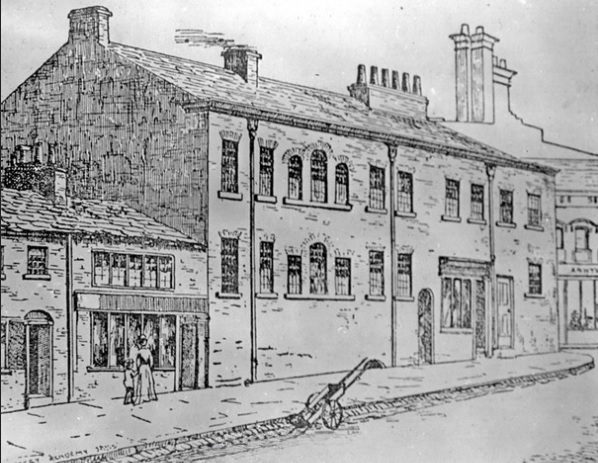
Milk Street Academy 1860-1880. Image: Picture Sheffield

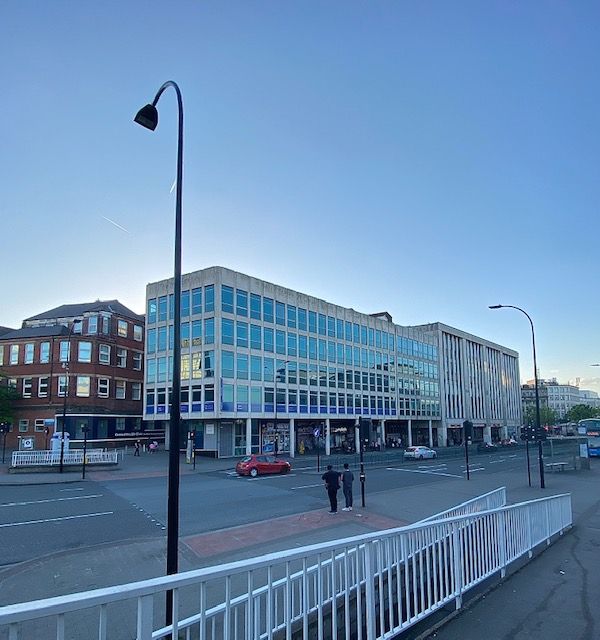
It is hard to imagine that beneath Arundel Gate, at its junction with Norfolk Street, is a lost road. When the dual carriageway was constructed in the 1960s, it swept away a street that had once been one of the most influential in Sheffield.

As someone who researches our past, the name of Milk Street frequently appears in the obituaries of well-known medical men, clergymen, merchants, manufacturers, solicitors, and people who rose to prominence, not only in Sheffield, but across Britain, and in all parts of the world.

Milk Street had once been called Petticoat Lane, but by the 1700s had changed its name, and in 1800 became the site of Milk Street Academy, its most famous building.

The academy was established by John Hessay Abraham, a Methodist, as a classical, commercial, philosophical, and mathematical seminary for boys. It used a single room in an existing building and was soon successful enough to occupy the rest of it.

Beneath Arundel Gate, at its junction with Norfolk Street, is a lost road. Image: DJP/2022

At this time, elementary education in Sheffield was poor, and only the wealthiest people paid for the privilege of private schooling. The boys started lessons at 7am and the curriculum included English, French, mathematics, penmanship, drawing, and the use of the globe. That a very high standard was reached may be judged in the London ‘Universal Magazine’ for April 1805, which produced ‘Juvenile Essays, comprising, in order of merit, the first and second half-yearly prize competitions of the pupils belonging to the Milk Street Academy, Sheffield.’

J.H. Abraham has appeared on these pages before as one of the occupants of Holy Green House. He was an extremely clever man, a Fellow of the Royal Society, and on his death in 1846, his extensive library was auctioned and included standard works in literature, especially philosophy, astronomy, electricity, magnetism, galvanism, chemistry, and mathematics.

In 1840, his daughter Emma had married Richard Bowling, a teacher of twenty years at Milk Street, who succeeded Abraham as principal.

Under ‘Dicky’ Bowling, the academy thrived and achieved success at preparing pupils for Oxford and Cambridge.

He was a fine gentleman – 5ft 11in high and very proportionate, a thorough disciplinarian – a good, all-round scholar who besides the three r’s which he thoroughly drilled into his pupils, taught Latin and Greek.

One guinea a quarter was the fee, drawing and languages extra, and when a new scholar arrived, the father had to pay a 5 shillings entrance fee.

There were about 400 boys in total, and there was what was called the Cabinet, which went to the boy who attained first prize in all subjects.

However, Bowling’s methods were somewhat barbaric.

“For playing truant he laid a boy across the desk (or on another boy’s back) and put his trousers down and gave him the cane on his bare flesh,” said a former pupil. “One boy was made to stand on the form while he sent another boy for an old-fashioned treacle-stick. He tore part of the paper off and made him suck it for a quarter of an hour allowing the schoolboys to jeer at him all the time.”

“I remember him giving me a severe blow to the side of the face because I was holding my pen improperly,” said another. “However, I remember Mr Bowling with pleasant memories as a great and distinguished schoolmaster, who developed in us the faculties which have contributed to any success we may have attained.”

All in all, the boys appeared to enjoy themselves, with physical education taking place at playing fields on the site of the old Winter Street Hospital, now part of Sheffield University. When let loose, they used Cheney Square (lost underneath the Town Hall) as happy hunting grounds.

Bowling resided at Norwood Rise, Pitsmoor, and subsequently at Clough House. At both places he had boarders, who attended the school every day. On his death in 1876, the academy became Milk Street School and continued under the partnership of his son, Walter Henry Bowling, and John Irwin, a former master, who, aged eighteen, had been apprenticed to the academy.

However, its days were numbered, hastened by the 1870 Education Act, the first legislation to provide for national education and create school boards across the country.   

Milk Street from Sycamore Street looking towards Norfolk Street (1851-1859). Image: Picture Sheffield

In August 1880, Irwin closed Milk Street School, now surrounded by industry, and moved it to Montgomery College, Sharrow.

Gone, but not forgotten. “One Sheffield institution which is frequently mentioned in records of the early careers of public men is the old Milk Street School,” said a newspaper in 1904. “It is referred to more frequently even than the Grammar School or Wesley School as the educational home of prominent citizens. There seem to be few records of the school left, and the old boys have not formed themselves into an association.”

A few years later, the Rescue and Evangelisation Mission was established in the old building, and in 1913 it was occupied by the Sheffield Chauffeurs’ Society, that promoted sociability amongst its drivers, and to safeguard members. It later became premises for Harry Hartley and Son, hardware merchants.

The building and the street may have long disappeared, but you might be interested to know that the name lives on, and not far away from its original location.

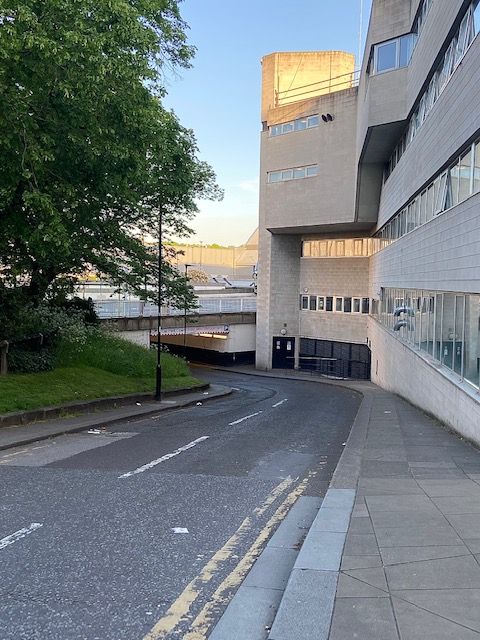
Beside the Crucible Theatre, leading from Norfolk Street, underneath Arundel Gate to the multi-storey car-park, is a service road, appropriately called… Milk Street.

Besides the Crucible Theatre, leading from Norfolk Street, underneath Arundel Gate to the multi-storey car-park, is a service road, appropriately called Milk Street. Image: DJP/2022

©2022 David Poole. All Rights Reserved.
Categories
Buildings

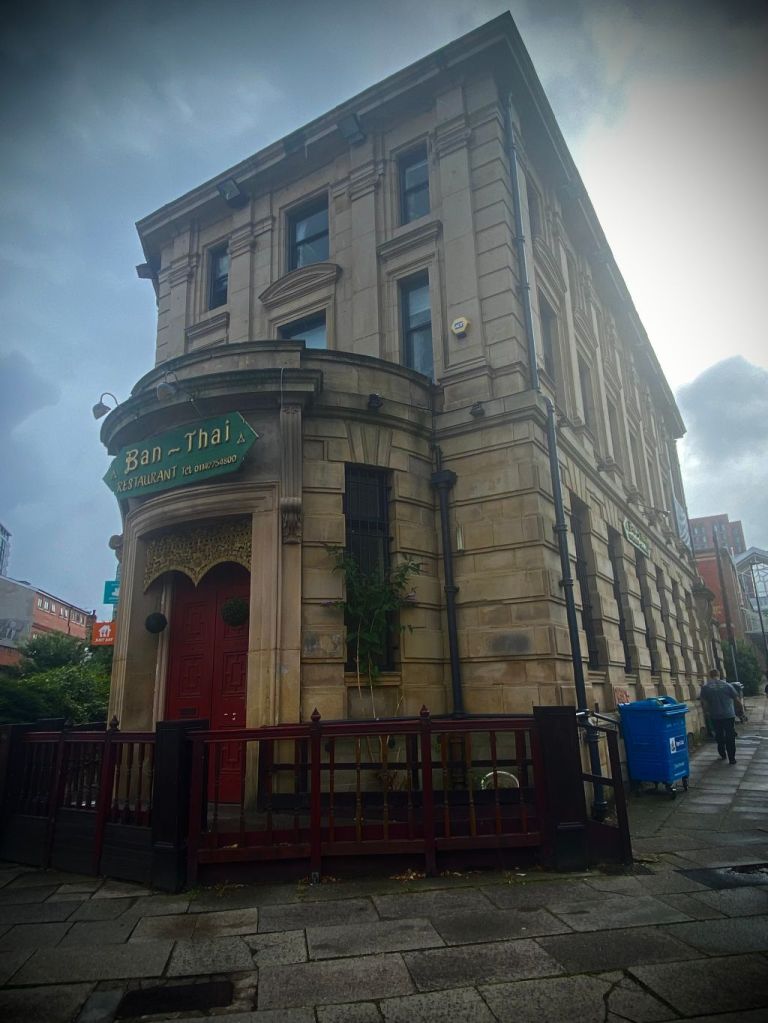
Ban-Thai. Like so many old buildings, its original use is overlooked

Ban Thai restaurant, on the west side of St. Mary’s Gate, is known to many, but like many old buildings, its original use is overlooked.

It was built in 1894 for the Sheffield Union Bank at the corner of Cemetery Road and Ecclesall Road. The postal address is still No.1 Ecclesall Road and goes back to when it stood adjacent to the Sheffield & Ecclesall Co-op building, demolished to make way for the Safeway (Waitrose) supermarket, and before the widening of St. Mary’s Gate.

Sheffield Union Bank was established in 1843, taking over the business of the Yorkshire District Bank. Its first branch opened in Retford in 1846, and expanded across Sheffield, Rotherham, Penistone, and Chesterfield.

This office was confusingly referred to as the Sheffield Moor branch and after the bank’s amalgamation with the London City & Midland Bank in 1901, it operated as the Midland Bank. The branch was offloaded to the Trustee Savings Bank in the later part of the twentieth century.

When the bank closed, it became Robert Brady, outfitters, before becoming Barbarella’s restaurant and bar and then Ban Thai. The upper floors were converted to provide two storey student accommodation in 1995.

The design of the Grade II listed building was the work of architects J.B. Mitchell-Withers & Son, whose practice was on Surrey Street.

John Brightmore Mitchell-Withers (1838-1894) came from the family of Samuel Mitchell, a name often mentioned in Hunter’s Hallamshire, and the son of W.B. Mitchell. He was educated at Collegiate College, later tutored by architect Samuel Worth, and set up on his own as an architect and surveyor. 

By the will of his aunt, Sarah Withers, he inherited her Sheffield property with the stipulation that he took the name of Withers.

Mitchell-Withers’ work can still be seen across the city. He was responsible for the extension to the Cutlers’ Hall after winning a competition in 1888. There are also Town Hall Chambers on Pinstone Street (1885), Firs Hill Junior School, the Licensed Victuallers’ Association Almhouses, Abbeydale Road South, as well as St John the Baptist Church, Penistone Road, St. Silas Church, Broomhall Street, and restorations to the nave of St. Mary Church at Ecclesfield. He also built his home,  Parkhead House (then called Woodlands) on Ecclesall Road South.

He was an enthusiastic watercolour painter with involvement in the local art scene. He became president of the Sheffield School of Art and the Sheffield Society of Artists and was vice-president and treasurer of Sheffield Society of Architects and Surveyors. The Duke of Devonshire engaged him to supervise the restoration of painted ceilings in the state rooms at Chatsworth House.

This branch of the Sheffield Union Bank was one of his last commissions and he died of a heart attack in the year it was built. Another commission for Union bank on Langsett Road had to be completed by his eldest son, also called John Brightmore Mitchell-Withers in 1895.

John Brightmore Mitchell-Withers (1865-1920) succeeded his father and initiated several distinguished buildings. These included extensions to Central Schools on Orchard Lane between 1893-1895 (now adjacent to Leopold Square), High Court on High Street, John Walsh’s department store (bombed), and Clifford House at Ecclesall Road South.

As a boy, he was educated at Rugby where he won several prizes and gained his cap in rugby football at the school. After joining his father’s practice, he passed the examination of the Royal Institute of British Architects (RIBA) in 1890.

Mitchell-Withers Jnr was a member of Hunter Archaeologist Society and like his father, was involved with the Sheffield Society of Artists and became president of the Sheffield Society of Architects and Surveyors, representing them on the council of RIBA.

He became an honorary lecturer on English Gothic architecture at Sheffield University and a council member with the Sheffield Literary and Philosophical Society.

Mitchell-Withers was also an agent for the Burgoyne estate and the Duke of Devonshire’s land near Dore.

©2022 David Poole. All Rights Reserved.
Categories
Places

Tales of the riverbank. Where does your water come from?

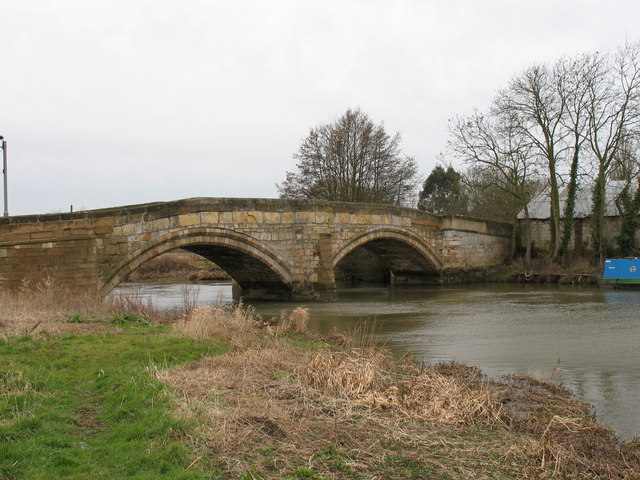
River Derwent, North Yorkshire

Water has been a big topic this summer. We haven’t got enough of it. But things might have been worse if it hadn’t been for a pioneering scheme in the 1960s that allowed Sheffield to source water from an unlikely source.

South Yorkshire has at least fifteen reservoirs and more minor ones, but according to Dr Jenny Stephenson in her book ‘The History of Water – the Sheffield reflection’ (2019) not all these service water to the area. Some act as ‘balancing’ or ‘service reservoirs’ which receive water, pumped, or channelled into them, their purpose being to balance supply with demand. Others are ‘impounding’ reservoirs into which a river flows naturally.

The biggest shock is that Sheffield’s water is mainly from the River Ouse and River Derwent, in North Yorkshire, only in part being from the reservoirs on high ground above Sheffield.

The water from rivers is typically classed as hard water because the water gathers minerals (mainly calcium and magnesium) as it runs through and over rocks. Water from reservoirs is normally softer as it comes from high ground and moorlands.

Increasing demand in the 1960s, in which Sheffield used nearly 38 million gallons of water daily for industry and domestic use, meant that the city’s water supply from the Pennine hills had reached its limit.

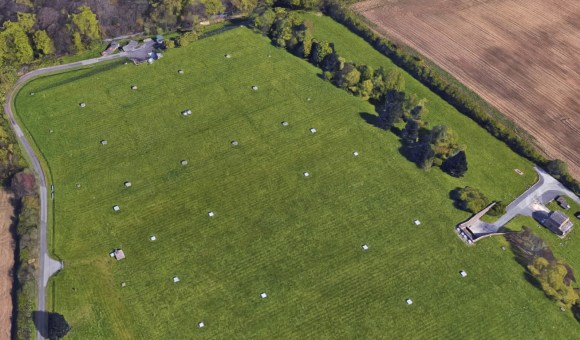
In 1965, it was supplemented with the Yorkshire Derwent Scheme, which involved river water being treated at Elvington, near York, and delivered along 37 miles of pipeline to an underground service reservoir at Hoober Stand near Rotherham.

You might be surprised that the scheme was instigated by Sheffield Corporation, because of the Sheffield Water Order 1961, and it designed and executed the work at a cost of over £8m. It was cleverly designed so that Leeds, Barnsley, and Rotherham, also received a share of the water and paid contributions to Sheffield.

The treatment works at Elvington softened, clarified, and filtered water to remove impurities and sterilise it.

The first pipe was laid in May 1962, built by John Brown Ltd, land and marine constructors, and used bitumen lined welded steel pipes, involving four river crossings, including the Ouse and Aire,  13 railways crossings, and 53 road crossings. Once completed it allowed 15 million gallons of water to be pumped into the city daily.

The first water arrived in Sheffield in December 1964 and was celebrated at a Town Hall luncheon hosted by the Lord Mayor, Alderman Albert Smith, who toasted his 80 guests with water mixed with wine and brandy.

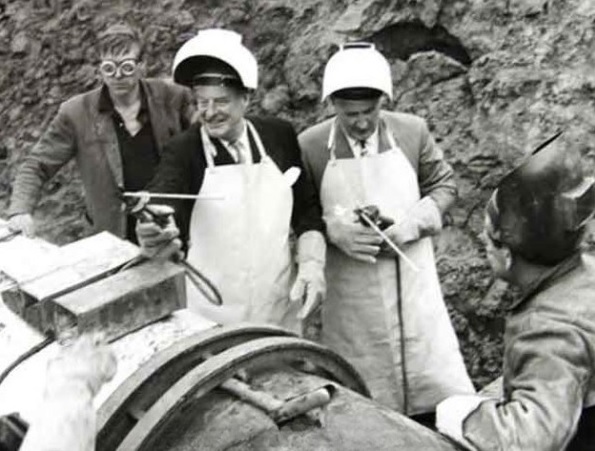
It was inaugurated in September 1965, eight months ahead of schedule, and the last weld was made by Alderman Charles Ronald Ironmonger, chairman of the Sheffield Corporation Water Committee and John Staniforth, managing director of John Brown Ltd.

The last section of the 37-mile all-welded pipeline linking the river Derwent at Elvington, seven miles east of York, with the Sheffield Corporation reservoir at Hoober. Picture Sheffield

At the official opening of the Elvington treatment works, Sir William Goode, chairman of the Water Resources Board, referred to Sheffield needing to increase water flow to 25 million gallons a day and suggested that a reservoir might be built on land owned by Hull Corporation at Farndale on the North Yorkshire Moors. This would have meant flooding the valley, like previous schemes at Ladybower, Derwent, and Howden, in Derbyshire, and provide water for Hull and Sheffield.

However, the scheme was derailed in the 1970s, and Sheffield’s municipal water company was amalgamated into a regional board in 1974 and privatised in 1989 and is now part of Yorkshire Water PLC.

The Yorkshire Derwent Scheme subsequently became a segment in the Yorkshire Water Grid which allows transfer of water around the region to balance supply and demand.

By the way, water from the Ladybower dams, is largely used in the East Midlands.

Hoober Stand Reservoir, Rotherham. Image: Google

©2022 David Poole. All Rights Reserved.
Categories
Buildings

Harris Leon Brown and the one o’clock time signal

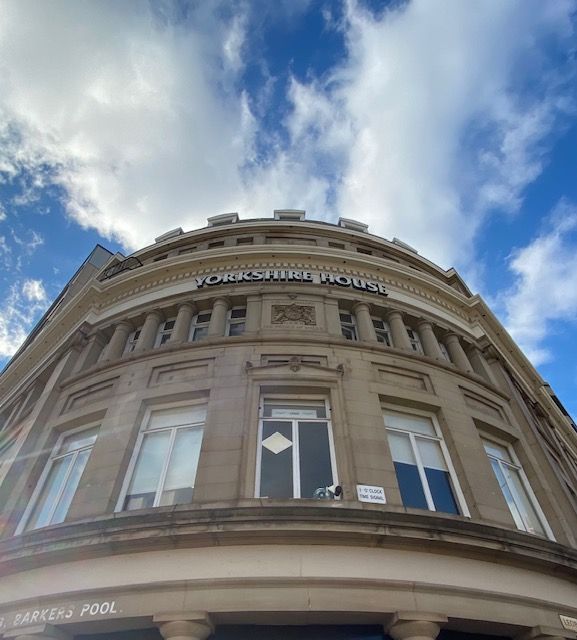
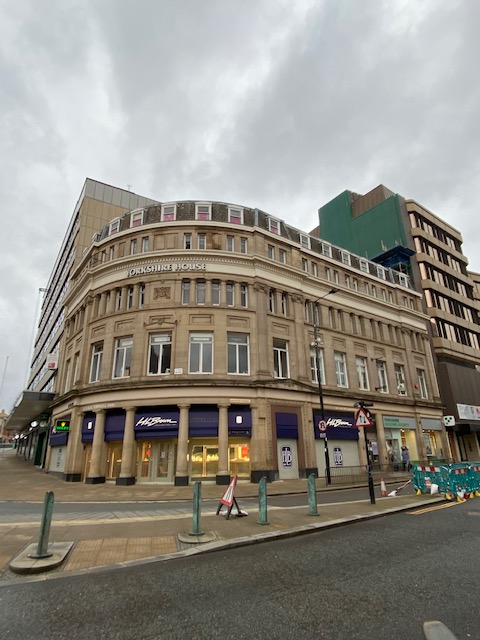
H.L. Brown is situated in Yorkshire House at 2 Barker’s Pool. Sheffield. The time signal can be seen in the first floor central window. Image: DJP/2022

It confuses many people but is a reliable reminder to others. I’m referring to the one o’clock time signal that blasts out daily from above H.L. Brown at Barker’s Pool.

Today it’s a quirky tradition, and a reminder of a time when the concept of time was a bit fuzzier.

The origin of the time signal goes back to 1874, when in Angel Street, Harris Leon Brown fixed and maintained a ‘Greenwich time ball’ – that was placed on a flagstaff outside his premises, and which by an electric current fell at exactly 1p.m., Greenwich mean-time.

Back then, – different towns tended to keep different times, and thus Greenwich Mean Time was established.

Back in Sheffield, the 1 o’clock Time Signal became a handy way for city workers to mark the end of their lunch breaks, though its position above the watchmaker was used to ensure that his timepieces were accurate.

The equipment was admired for two years, but electric signals in the open air were affected by the weather and its failure to ‘drop’ on several occasions caused it to be removed.

In 1876, he entered into an agreement with the Government to supply him daily for three years with the correct time. A wire connected his shop in Angel Street with the Royal Observatory at Greenwich, and at one o’clock every day the ball dropped with remarkable precision as the sixtieth part of a second.

In his window, Harris Brown displayed several English keyless chronometer watches, especially adapted for pocket timekeepers. All of these were regulated by the time ball placed outside his shop door.

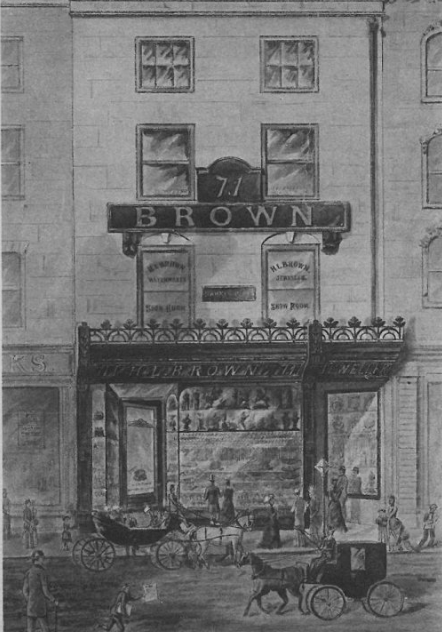
In 1891, a ‘Greenwich mean time flashing signal and time bell’ was installed in the window of H.L. Brown at new premises at 71 Market Place. It was a synchronised clock with flashing signal and bell, showing mean time daily at 1p.m. and was unaffected by rain or snow.

The clock was 14 inches in diameter, and on either side were two open circles, about half the size of the clock dial.

The one on the left contained a ‘flashing signal’ – a disc of metal painted red, and finely balanced on a pivot. Throughout the day this disc remained with its edge towards the front and was almost invisible. But precisely at one o’clock in the afternoon (GMT) the electric current arrived, giving the disc a quarter revolution, and causing it to reveal its full face, and fill up the open circle, remaining in that position for two seconds.

Simultaneously, the time bell fixed in the open dial to the right of the large clock was struck, so that the electric current made its arrival known both to sight and sound.

To obtain this equipment, H.L. Brown had to enter a five year agreement with the Post Office and pay a large yearly subscription. They were the only watch manufacturer to receive this direct signal. He stated that one of the reasons for installing the equipment was because he had sold many watches from the Government observatory at Kew, and which were guaranteed to keep exact time.

By visiting the Market Place any day at one o’clock, he said that users could ascertain if their watch was ‘on time’ as accurately as by a visit to London.

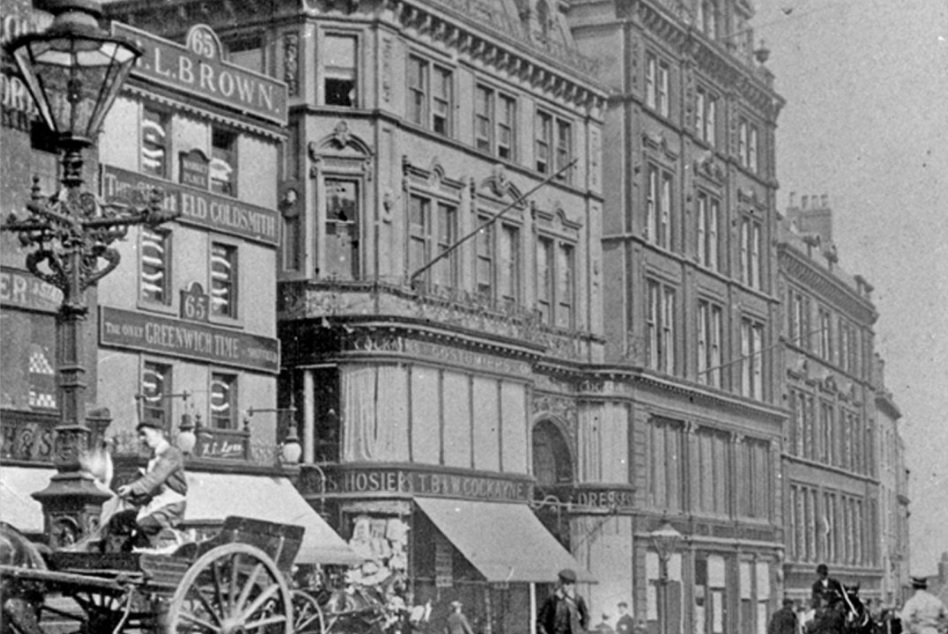
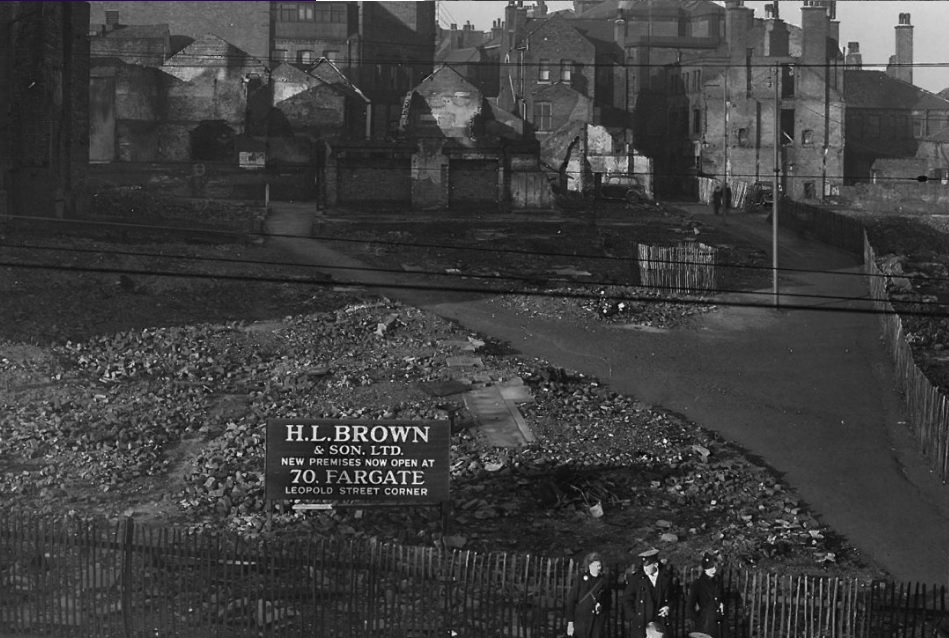
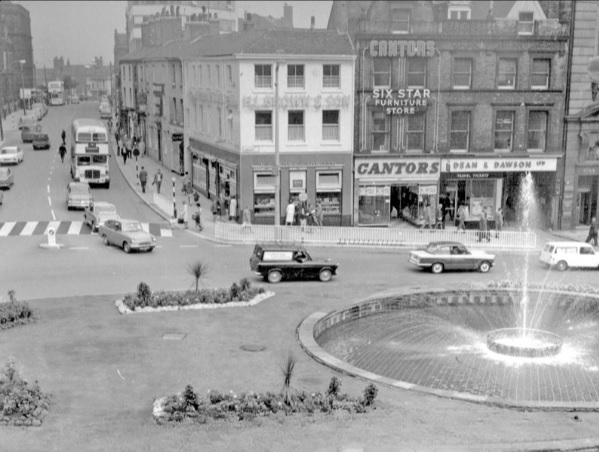
H.L. Brown later moved to 65 Market Place, and along with it went his equipment. It was bombed in 1940 and the shop moved to 70 Fargate at the corner with Leopold Street.

The time signal was subsequently replaced with a siren, and this was relocated to its current position at Barker’s Pool when H.L. Brown’s Fargate shop was demolished in 1986 for the construction of Orchard Square.

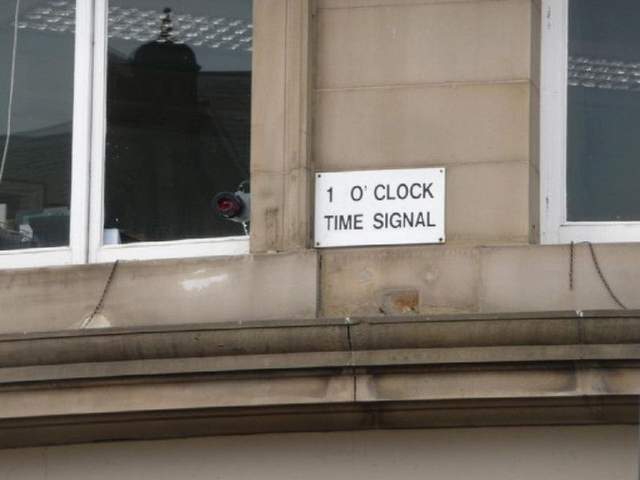
Above the entrance, there’s a small black and white sign proclaiming “1 o’clock time signal” and alongside it, the siren that you hear each and every day. Image: Sheffield Star

©2022 David Poole. All Rights Reserved.

Categories
Companies People

Harris Leon Brown – a Polish refugee who made Sheffield his home

Harris Leon Brown came to England from Poland with an introduction to Alfred Beckett & Sons. He started by travelling around as a watch maker. Image: H.L. Brown

This is a story of an Eastern European fleeing from Russia, and the tale of a refugee who ended up in Sheffield.

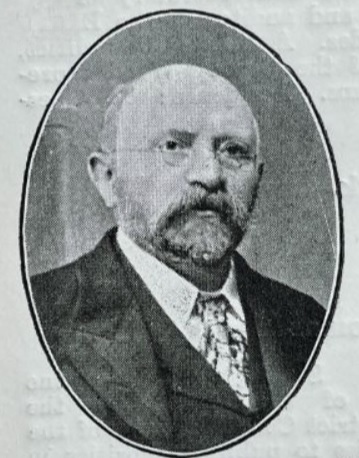
Harris Leon Brown, jeweller, diamond merchant, and horologist, was born in Warsaw, Poland, in 1843, the son of a Russian government contractor, Baruch Brown.

He received his education at Warsaw Seminary Schools, and became an apprentice to Moses Neufeld, one of the largest firms in Warsaw engaged in the Sheffield trades.

When only 17, he was a revolutionary in Poland, one of the many who could not tolerate the oppression which Russia sought to impose upon his country. His part in the insurrection was of short duration, for he saw too many of his friends either shot by the military or hanged in the streets, so he determined to seek refuge in England. This was no easy task, for in those days the passage of Poles through Germany was fraught with the danger of being caught by the Germans with the inevitably painful process of being pushed back to Poland.

But sleeping during the day and the friendly conveyance of market carts during the night enabled him to make progress to Hamburg, then a ‘free’ port, where he took a boat to Hull.

Harris Leon Brown (1843-1917), diamond merchant, jeweller and horologist of Poland and Sheffield. Image: Picture Sheffield

Sheffield was his destination, and with no money to his name, and a ‘stranger in a strange city’ he was introduced to Alfred Beckett and Sons (with whom Moses Neufeld did extensive business) and Burys Ltd. These firms, especially the former, treated him in a paternal manner, and through their guidance he remained in Sheffield.

With his instinct for trading, and by strictly honourable dealing, he founded a lucrative business in 1861 as a watchmaker; he began trading from 29 Gower Street in 1867; by 1876 H.L. Brown was situated at 24 Angel Street and in 1877 connected directly to Greenwich, with the introduction of the 1.00pm clock time signal.

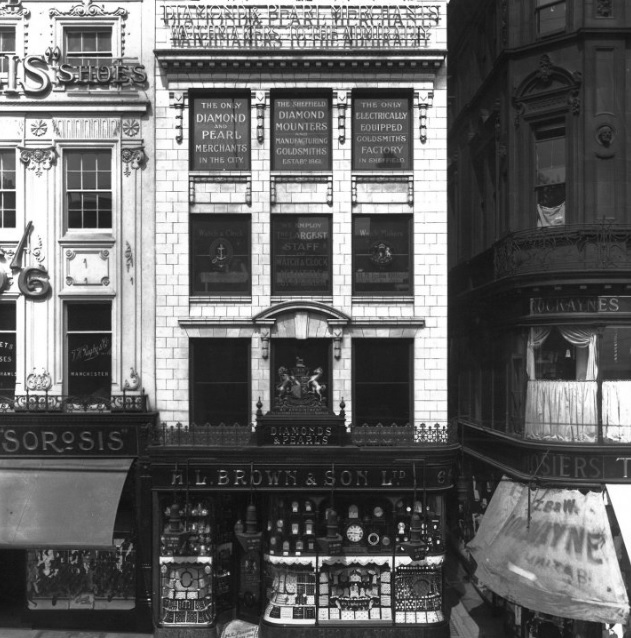
H.L. Brown, 71 Market Place, Sheffield. Image: H.L. Brown

Around 1888, the firm moved to 71 Market Place (where the earliest known image of the premises exists).

In 1896 the firm moved again to 65 Market Place and by 1906 he had opened a branch on Regent Street.

In 1896, H.L. Brown moved to 65 Market Place, Sheffield. Image: H.L. Brown
In the 1930s, H.L. Brown was modernised. Image: H.L. Brown
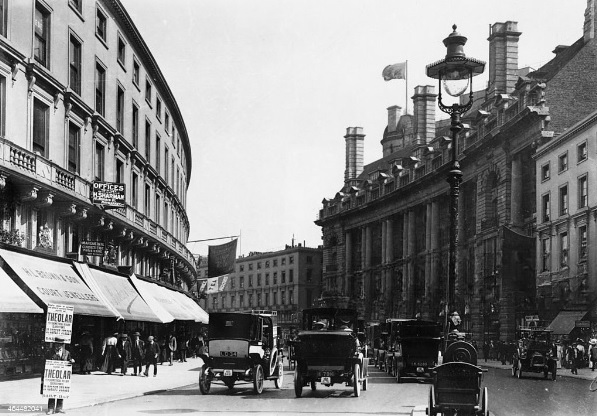
While searching for photographs of London’s Regent Street, this image from 1910 appeared and shows H.L. Brown at 90 and 90A. Image: Getty Images

Harris Brown married a Sheffield woman, Ann Kirby (daughter of Charles Kirby, Cutler) at St Mary’s Church, Bramall Lane, in 1865. Instead of giving a dinner for his golden wedding anniversary, he sent a cheque for £100 to the Lord Mayor to distribute among various war charities.

During his early years in Sheffield, unable to speak English, he saw a review of troops at Wardsend, and feeling grateful to his new homeland, joined the Hallamshire Rifles, and took pride in doing ambulance work with the local corps. It was characteristic of him that he presented to the St John Ambulance Association a silver shield for competition.

He became the oldest member of Sheffield’s Jewish community, and for many years was Chairman of the Sheffield Jewish Board of Guardians and served as President of the Sheffield Hebrew congregation. He was a prime mover in building a Synagogue in North Church Street, as well as a new place of worship at Lee Croft. He also helped secure a Hebrew burial ground at Ecclesfield. In 1910, he was elected a member of the Jewish Board of Deputies, the first occasion on which a Sheffield Jew had been so honoured.

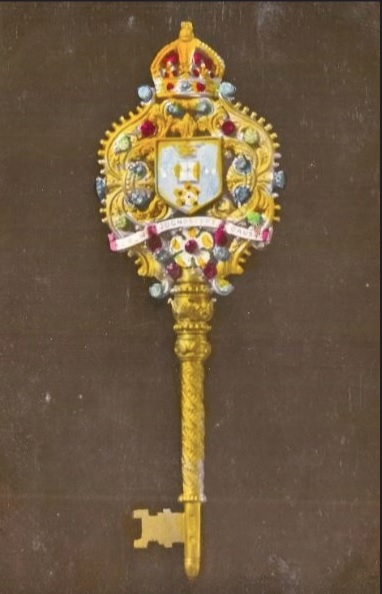
H.L. Brown and Son had contracts with the Government’s Admiralty and India offices  for their watches, and had obtained, for excellence in workmanship, several Kew (Class A) certificates. In their goldsmith’s workshops they manufactured the jewelled key which was presented to King Edward when he opened the University of Sheffield in 1905.

The jewelled key presented to King Edward VII at the opening of the University of Sheffield. Image: Picture Sheffield
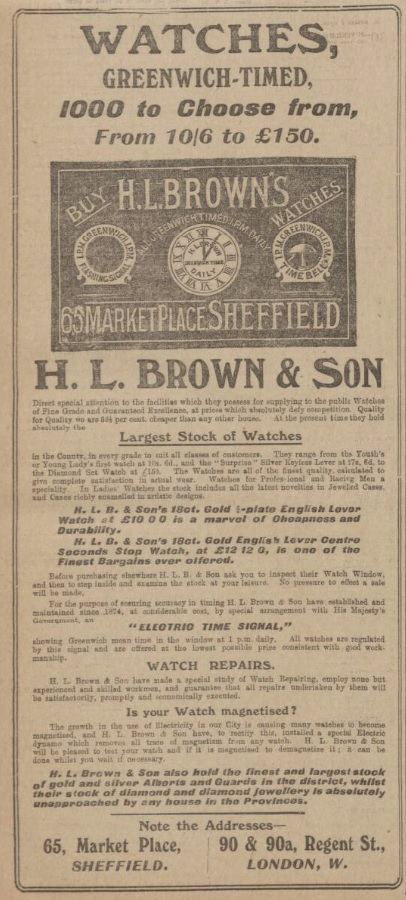
Newspaper advertisement from 1907. Image: British Newspaper Archive

In 1914, he was on holiday with his wife in Germany when war was declared. After eight nerve-racking days, they made their way home, avoiding the gauntlet of military patrols, before escaping back to England.

When in Sheffield, he resided at Kenyon House, 10 Brincliffe Crescent. He died, aged 74, following a seizure at his London residence, 23 Briardale Gardens, West Hampstead, in 1917.  He was survived by his wife, three sons, and four daughters. One of his sons, Bernard Brown, succeeded him in the business.

At the time of his death, it was said that “he took pride in recognising all the obligations which the adoption of English nationality should entail.”

His interment was at the Jewish Cemetery, Edmonton, London. He had great aversion to any kind of display, and by his own expressed wish, the funeral ceremony was simple. No flowers were sent, the coffin was covered in plain black, and the obsequies were conducted with the strictly simple solemnities of the Jewish ritual. In accordance with the custom of that ritual, no ladies were present.

He left property of the value of £29,785 and gave £100 each to the Jewish congregation in North Church Street, the Central Synagogue, and the Talmud Terah School, as well as donations to the Sheffield Royal Infirmary, Sheffield Royal Hospital, Jessop Hospital for Women, and the Sheffield Hospital for Sick Children.

In the 1920s and 1930s, H.L. Brown opened branches in Doncaster and Derby, with Bell brothers of Doncaster joining the family business.

In 1940, the Sheffield shop was destroyed in the Blitz and business moved to 70 Fargate. Image: H.L. Brown

During the Sheffield Blitz (1940) H.L. Brown’s was bombed and business moved to 70 Fargate, at the corner with Leopold Street. The firm moved to its current location of 2 Barker’s Pool when Orchard Square was built in 1986. To this day, the 1,00pm time signal still sounds daily.

Town Hall Square in 1967 looking towards Fargate and Leopold Street, Goodwin Fountain, foreground, and No 70, H.L. Brown and Son Ltd. Image: Picture Sheffield

James Frampton (Harris Brown’s great great grandson) joined the business in 1989 after qualifying as a gemologist and training in the jewellery trade in Switzerland and London. He became MD from 2001 onwards.

In 2020, the store was modernised, and a Rolex showroom introduced.

Today,  H.L. Brown operates in Sheffield and Doncaster (still using the Bell Brothers name), as well as Barbara Cattle (York), James Usher (Lincoln) and Bright and Sons (Scarborough).

H.L. Brown at 2 Barker’s Pool, Sheffield, in 2022. Image: DJP/2022

©2022 David Poole. All Rights Reserved.
Categories
Places

Sheffield’s clean air programme to celebrate its fiftieth anniversary

There is an important anniversary coming up in Sheffield’s story.

In 1972, Sheffield completed its clean air programme, and one person who had cause to feel proud was Joseph Batey, nicknamed ‘Smokey Joe,’ who had just retired as the city’s smoke control officer.

Fifty years on, many of us won’t appreciate the importance of this milestone. We are used to clear skies, (mostly) fresh air, and spectacular views across the city.

But it wasn’t always this way.

Concern over Sheffield’s air quality stretched back at least 400 years. As early as 1608 Sir John Bentley expected to be ‘half choked with town smoke’ while visiting Sheffield.

A traveller’s diary of 1798 said: “We had an excellent view of the town of Sheffield enveloped in smoke.” ; and in 1828: “Others have become so accustomed to regard an increase in smoke as an indication of improving trade that they can see nothing in a clear sky but ruin.”

By the 19th century it was apparent that measures were necessary to reduce atmospheric pollution in urban areas.

In 1819, industrial firms were being fined for undue smoke emissions. And in 1843, the Select Committee on Smoke Prevention issued its report, and locally, the Borough Council’s Watch Committee directed the police to enforce Smoke Byelaws.

“The Queen’s Most Excellent Majesty in Council’ disallowed the city’s smoke byelaws in 1852, but the council tried again the following year and were successful.

The Sanitary Act of 1866 permitted local sanitary authorities to act against smoke nuisances. It was not until 1875 however, with the passing of the Public Health Act, that attempts were made to control air pollution across the whole country.

In 1890, Sheffield’s first chief smoke inspector noted that the average smoke emission of all chimneys observed by his staff was ‘80 minutes smoke an hour.’

The real break-through came with the Clean Air Act of 1956 which established ‘smokeless zones’ in which only smokeless fuels could be burned. Here was a piece of legislation (and the city’s representatives were consulted when it was being drafted) which swept away the old, misconceived notions and gave any city that cared to have a go the chance for clean air for all.

The citizens proved worthy of their heritage. With power to prohibit smoke from domestic premises, now recognised as the biggest smoke producer, and a 40 per cent grant from the Government towards the cost of domestic conversions to smokelessness (a bonus that few Yorkshiremen could resist) the first area, in the city centre, became smokeless on December 1, 1959.

There was a clean wind blowing into the city from the Derbyshire moors, and the strategy adopted was to work for smoke elimination into this clean wind direction, namely into the south-west sector of the city, but there was not a large volume of heavy industry in the south-west, and smoke gauges in the north east sector, where heavy industry was located, only started to show a steady decline in the early sixties as the programme gained momentum in the south west.

Another advantage which accrued from working in what was largely the ‘domestic’ area was that industry was being alerted to the necessity of ‘getting it clean’ and ‘keeping it clean.’ There was little hope of clearing smoke from a house in the industrial belt if an adjacent factory chimney was pouring out smoke. The Clean Air Act of 1968 forced certain industries to use tall chimneys, and the cooperation of most managements was positive.

A final programme of complete domestic smoke control was forwarded to the then Ministry of Housing and Local Government in 1960, showing the completion date as 1972. This programme was adhered to, and the promise kept.

By turning over to smokeless fuels there was a welcome reduction in the sulphur dioxide measurements, using measuring stations.

Fog or smog days disappeared by the late 1960s and Sheffield Transport’s manager stated, in reply to a query regarding bus time-keeping – “I can say that it is the opinion of all my staff that over the years with the introduction of smokeless zones, the problem has almost entirely disappeared.”

The effect on health was carried out at Sheffield University, but few needed convincing that cleaner air, more sunshine, and less dirt, was conductive to good health.

By 1972, the city of 71 square miles with over half a million population, and 186,000 houses, had tamed air pollution in 12 years, even though its basic industry, producing three million tons of steel, was notorious for its pollution problems.

The creation of smoke control areas was so successful that by the early 1980s they covered the whole of the urban parts of the city, and the transformation of Sheffield’s air was thought to have been complete. The 1956 and 1968 Clean Air Acts were repealed by the Clean Air Act 1993, which consolidated and extended the provisions of the earlier legislation.

However, the new threats from traffic emissions became the next clean air challenge.

In early 2023 Sheffield’s Clean Air Zone is due to start. This is a class C chargeable zone for the most polluting large goods vehicles, vans, buses, and taxis that drive within the inner ring road and city centre.

©2022 David Poole. All Rights Reserved.
Categories
Sculpture

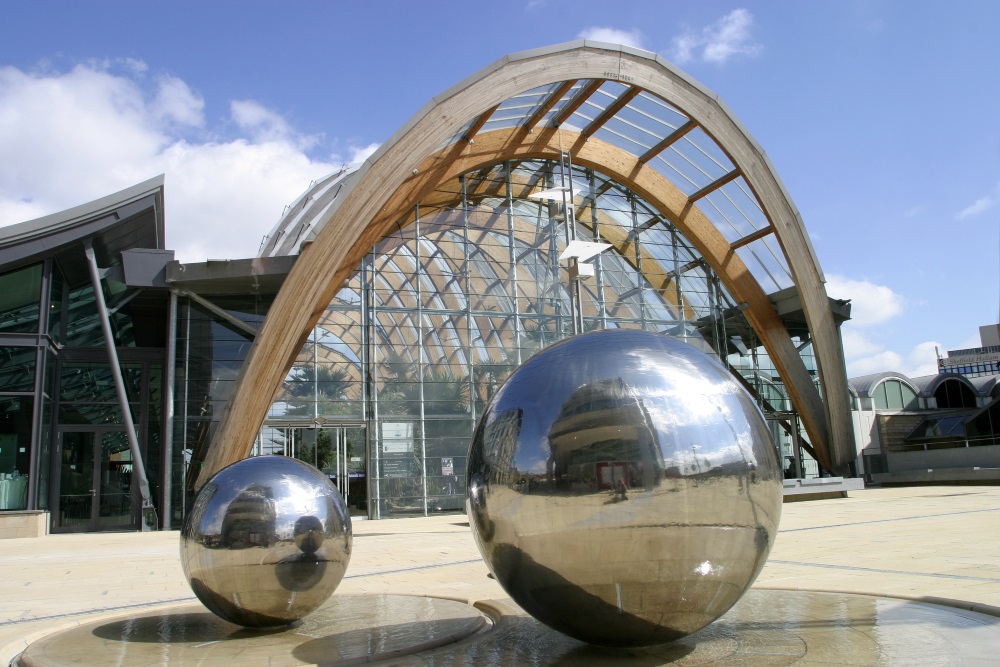
‘Rain’ – ‘Passers-by seem drawn to these polished spheres.’

‘Rain’ – Millennium Square, Sheffield. Image: Cassini International

Let’s talk about Colin Rose, sculptor, printmaker, and lecturer. He was born in Newcastle upon Tyne in 1950 and studied at the Polytechnic and University there.

Over the years he has worked in a variety of mediums from mirror polished stainless steel to stone. More unusually he has worked with Rope, Brick and even Coal Dust depending on the requirement of the brief.

But what is his connection to Sheffield?

Colin Rose. Sculptor and printmaker. Image: Cheeseburn

He was the winner of a design competition in 2003 which resulted in a ‘blue space’ water feature that is representative of Millennium Square.

‘Rain’ is designed to evoke the falling of rain drops upon the ground, with the small pools at the base of each steel ball creating the ripple effect.

The steel balls, of which there are nine spheres in varying sizes up to 2m in diameter, symbolise the steel, craftsmanship, stonework, and water, which are symbolic of Sheffield’s industrial heritage.

The water sparkles at night due to dozens of colour-changing LED lights set in the paving, and into the rim of the pools under each of the steel ball raindrops.

Rose’s commissions can be seen throughout the UK and include: ‘Meteor’ – Jodrell Bank, ‘You – Genome Centre, Cambridge, StarBall – EBI, Cambridge, ‘Swirl Cone – Carmarthen, and 10 Swirl – Gateshead.

While developing his practice Colin taught fine art and was head of Sculpture at Sunderland University from 2000 till 2006.

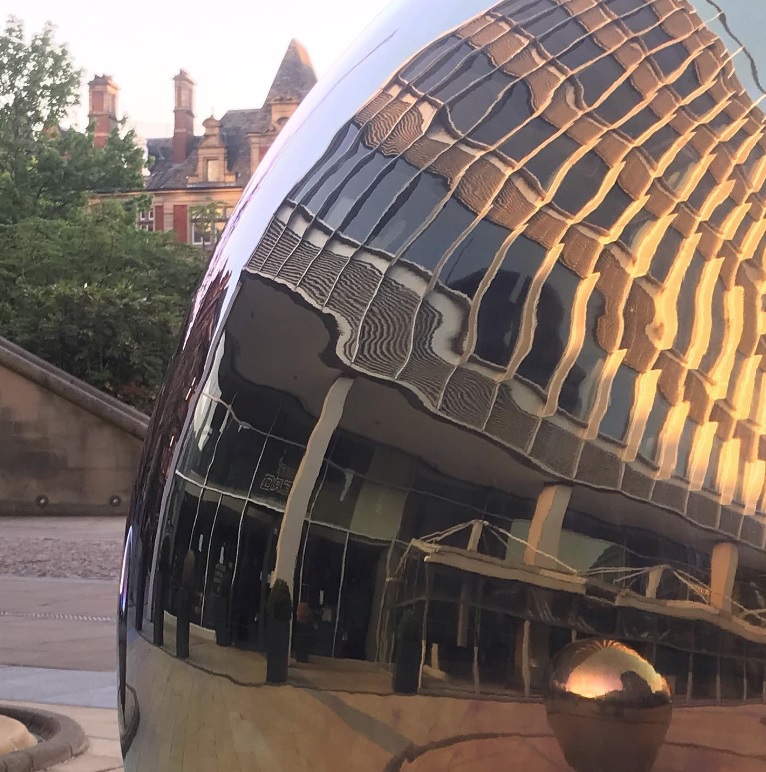
Steel reflection. ‘Rain’ – Millennium Square, Sheffield. Image: DJP/2020

©2022 David Poole. All Rights Reserved.
Categories
Buildings

Tesco Express to open on Fargate

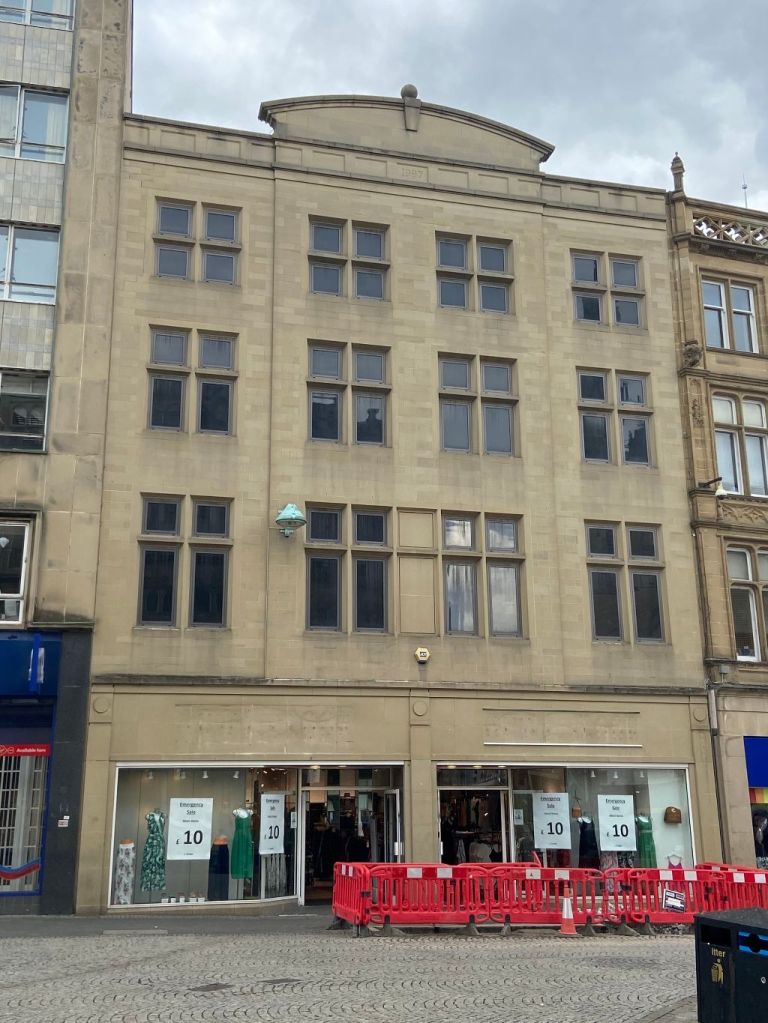
42-46 Fargate. The site of a new Tesco Express. Image: DJP/2022

We recently looked at 42-46 Fargate, an existing retail unit that was formerly used by New Look. The building has been demolished and redeveloped multiple times, with the present, existing building having been constructed in the 1990s.

This was once the site of the Green Dragon Hotel, built in 1884, with R. H. Ramsden shoe and hat shop occupying the ground floor retail unit. In 1922, it was adapted to become Winchester House, the former hotel rooms becoming offices and studios. During the 1950s and 1960s, Winchester House became offices for the Provincial Insurance Company. In the 1970s, the building was demolished and replaced with a standard 1970s design.

The demise of Fargate and its pending renaissance is well documented, but here comes news that Tesco Express is to occupy the building.

The retail giant has applied for planning permission for the installation of a new realigned shopfront and new aluminium automatic telescopic sliding door, as well as new signage and rooftop plant machinery.

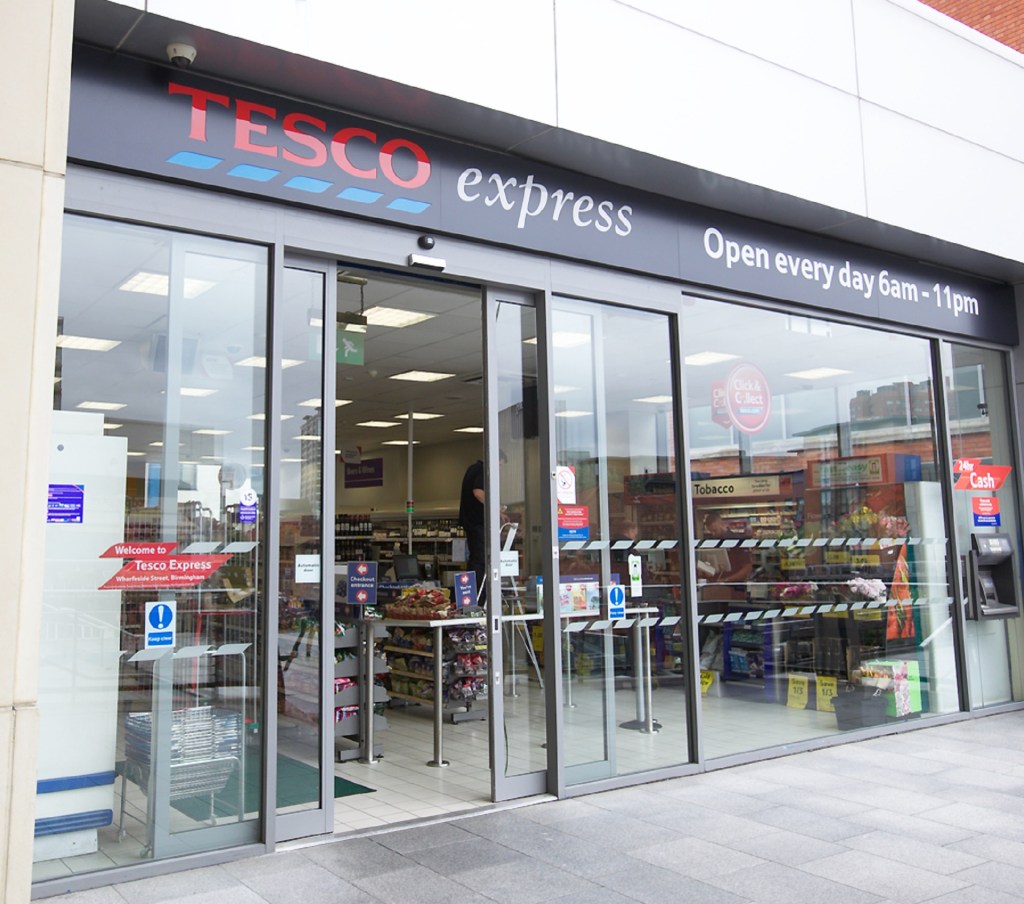
Tesco Express shops are convenience stores averaging 200 square metres (2,200 sq ft), stocking mainly food with an emphasis on higher-margin products, and the necessity to maximise revenue per square foot, alongside everyday essentials. They are in busy city-centre districts, small shopping precincts in residential areas, small towns and villages, and on Esso petrol station forecourts.

A typical Tesco Express store at the Mailbox, Birmingham.