Categories
Places

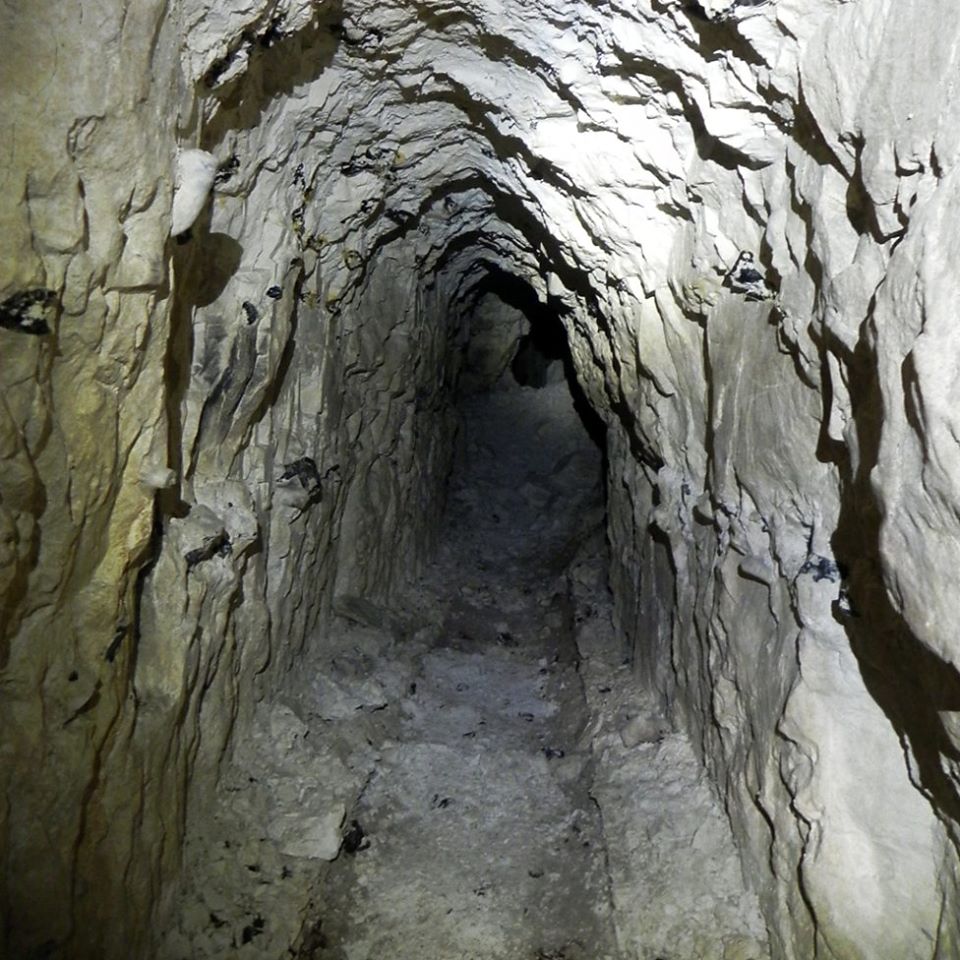
Secret tunnels of Sheffield (1)

One day soon, Sheffield Castle might give up some of its secrets. The castle was one of the grandest and most powerful in the north of England before it was demolished by the parliamentarians in 1648.

The site of the castle was built over several times, the remains discovered in the 1920s, and covered over once again. And then Castle Market was built over it in the 1960s.

It might come as a surprise now, but during the 18th and 19th centuries there was doubt as to where Sheffield Castle had stood.

Most historians guessed correctly, and from here on, Victorians liked the romantic notion of secret tunnels running underneath the town, supposedly relics from the old castle.

Different generations handed stories down, with tales of hidden tunnels running from Sheffield Castle towards Manor Lodge, the Old Queen’s Head at Pond Hill, and towards Sheffield Cathedral.

We’re no closer to the truth now, but evidence has been uncovered over the years to suggest there might have been some legitimacy to the stories.

In 1896, during excavations for Cockayne’s new shop on Angel Street, a subterranean passage was discovered, arousing the interest of archaeologists and antiquarians.

However, it wasn’t enough to excite local journalists who were invited to accompany an exploring party up the passage.

Said one. “The expedition sounded attractive, but when I found that to gain admission it was necessary to crawl through a particularly small entrance, and that on the other side the passage had a covering of a foot of water, my exploring enthusiasm was dampened.”

He took consolation with the foreman’s claims that it was merely an “unromantic sewer,” his view confirmed by the explorers.

Alas, the march of progress ended any further exploration, and the passage was duly blocked up.

And there was another story from the same year, but one that didn’t emerge until 1920, when a retired reporter sent a letter to the Sheffield Daily Telegraph.

“At the bottom of High Street, at the curve which leads off towards Bank Street, some excavations were made in connection with drainage works, and at a depth of several yards, the opening in the ground cut right through an ancient subterranean way.

“I undertook an investigation with the view of establishing the correctness or incorrectness of the generally accepted theory. The foreman of the works was good enough to detail one of his men to be my guide, and with a lighted candle we began to walk along the passage towards the church. The opening in the direction of the river had been so badly disturbed during the excavations that the ingress on that side was out of the question.

“It was quite plain to see, as we advanced, that the passage had been cut through stone – it was not hard rock, but a rather soft and friable substratum. It was three feet wide, and at first, we could walk upright, but its height diminished a little, and twenty yards or so from the opening where we entered, we had to stoop to make our way along.

“At length we emerged into a dark cellar, with thralls all around it. The roof was of stone, but without ornamentation of any kind, and, altogether, it had the appearance of one of those underground caverns – crypts, they are commonly, but wrongly, called – in which a business had been carried on hundreds of years previously, and which was, in the first instance, reached by steps from without.

“These steps had disappeared however, and my guide brought me to daylight again up ordinary inside cellar steps, and we emerged into a dilapidated building.

“Pursuing my enquiries, I gathered that the premises beneath which the cellar lay had been for many years, at a remote period, the business place of a wine merchant, And the explanation of the passage was that it was, in all likelihood, a drain to conduct water from the cellar to the river.

“It was objected at the time that the cost of such a drain was altogether against the correctness of this theory; but, on the other hand, it is an established fact that drains of this character were common in medieval times. The residents in a locality would combine to bear the cost and to reap the advantage of such a construction, and, doubtless, if my guide and I had a better light, or if we had been more careful in traversing the passage, we might have seen junctions with the drain coming from the other premises.”

It was a disappointment to those who thought that this was part of a tunnel running from Sheffield Castle to the Parish Church, but the so-called secret passages which ran underground in most towns were either sewers or watercourses.

The story was forgotten, only to emerge again in the 1930s, and subject of another post.
Categories
Places

Secret tunnels of Sheffield (2)

For hundreds of years there have been rumours of secret tunnels that existed between Sheffield Castle, going towards the Parish Church (now Sheffield Cathedral), and heading out to Manor Lodge and the Old Queen’s Head at Pond Hill.

After an underground tunnel was found underneath Angel Street in the 1890s, dismissed as an old sewer, interest in the stories waned.

However, excitement resurfaced in 1920, when discoveries were made at Skye Edge as a result of a coal strike.

In order to keep engines running in a nearby brickworks, several men were digging coal from an outcrop on Sky Edge quarry, when they unearthed what appeared to be a subterranean passage cut out of the solid ironstone.

Sky Edge was amid many historical associations – the old Manor Lodge to which Mary Queen of Scots was held captive – was less than a mile away.

It was possible to penetrate for about 100 yards with a naked light, but further on the tunnel appeared to show signs of caving in, and the presence of foul gases made it unwise for the men to carry on.

The main passage had an arched roof, 6ft high, and the floor was on a seam of coal, 3ft thick.

In the light of similar discoveries made at the time, in River Lane, near Pond Street, and at High Street, the discovery raised the possibility that the tunnel at Sky Edge was part of a subterranean passageway which at one time connected Sheffield Castle at Waingate (where the unfortunate Queen was also imprisoned).

Four years later, Sheffield Corporation workmen laying sewers near Manor Lodge unearthed another tunnel, at a depth of nearly 10ft deep, although it ended in a heap of dirt and stones.

The tunnel ran across the road towards Manor Woods. Explorations revealed that in the direction of the Castle the passage was only about ten yards long, apparently demolished at an earlier stage. But in the opposite direction it was possible to walk about 50 yards.

At the time, it was thought that it had some connection with a tunnel found at Handsworth two years previous.

In some places the roof of the tunnel had shifted slightly, thought to have been caused by ploughing operations above, where coping stones had previously been unearthed.

A reporter from the Sheffield Daily Telegraph was invited into the tunnel.

“All sounds from the outside world are cut off, and the thought that people long since dead had trodden the same path was decidedly eerie. The floor, walls, and roof are all made of stone, some of the blocks on the floor being of quite considerable size and thickness.”

An old man at the time, told the same newspaper that he knew of the passage, as it had been opened for the Duke of Norfolk about fifty years previous.

“The tunnel was opened out in the field, and one day, I, in the company of other lads, went on a tour of exploration. We took our lamps with us and were able to walk for quite a considerable distance in the direction of the castle. At last, however, our progress was arrested by a heap of stones and earth and we were compelled to return. I remember the incident well enough because we all got a “belting” when we returned.”

Another claimed that he knew where the tunnel came out of Manor Lodge.

“One had to go down a number of steps into a cellar and from there it was possible to walk some distance along a corridor until a heap of rubbish was encountered. The cellar was within a few yards of the road, being near the large ruined tower,”

The secret tunnel to Sheffield Castle is said to have been through a small opening which was situated in a wall dividing the Lodge from the grounds of the Turret House. This had been boarded up at the time, but rusty staples suggested the fact that years before a strong door was fitted to the passage.

The secret way possibly served two ends. It could either have been used as a means of escape when the Lodge was surrounded, or to assist in the hunting of deer which once abounded in the vicinity.

The legend that Manor Lodge was connected by a subterranean passage to the Castle, the two homes of the Shrewsbury’s, was an old one. But one that suggested that Manor Lodge was connected to the Old Queen’s Head Hotel in Pond Hill had only surfaced later.

There was evidence from a few years before in Thomas Winder’s British Association Handbook and Guide to Sheffield (1910):

“We know that there was a chapel in the Manor House, from the account of the funeral of the 5th Earl, but its position is unknown. The corpse was secretly brought from the said Manor to the Castle.”

Some years before, an underground passage had been discovered, about 4ft high, during drainage excavations under Castle Hill, a passage that was never explored further.

According to that writer, the secret passage from the Manor might have ended near Castle Hill, and not the Old Queen’s Head. Furthermore, the height of the Castle Hill passage corresponded with that of the Manor – about 4ft – whilst the supposed entrance at the Old Queen’s Head was said to be half as high again.

Drainage excavations, which led to the discovery of traces of a passage were referred to in “Rambles Round Sheffield (1915). The writer mentions the Lodge-end of the supposed passage.

“The old lady (custodian at Manor Lodge) will point to the entrance to the subterranean passage which is said to have connected the Lodge with the Castle. During drainage excavations at the castle years ago, traces of a passage were found, but the workmen smashed them in before attention was directed to them. Perhaps some day efforts will be made to trace the passage.”

It was possible that there were two passages, one going from the Castle to the Manor, and the other from the Castle to the gabled structure in Pond Hill (now the Old Queen’s Head), but supposed to have been the laundry of the Castle.

With regards the Old Queen’s Head, a reporter from the Sheffield Daily Telegraph visited in March 1925 and spoke with the landlord, Mr Ellis.

“Yes, there is an old tunnel here,” he said, “which is supposed to go to the Manor Castle, but it is all stoned up, although the entrance can plainly be seen.”

Proceeding into one of the cellars, the reporter was shown the entrance which faced in the direction of Midland Railway Station and was about six feet high. It was impossible to go in, as within two feet of the wall a strong stone barricade had been erected.

“I feel quite sure that this goes to the Manor,” said Mr Ellis, “as since the work commenced up there (Manor Lodge), we have been ‘swarmed’ with rats, and, possibly, they have been driven down here.”

And finally, there was the story of a worker at Steer and Webster, cutlery manufacturers, on Castle Hill, who told his fellows in the late 1800s about the works yard where a shaft or dry well was being used to deposit rubbish, and at some distance down the shaft, on the Manor side, there was an opening, apparently a doorway, which he declared was the entrance to the secret passage to the Manor.

Categories
Places

Secret tunnels of Sheffield (3)

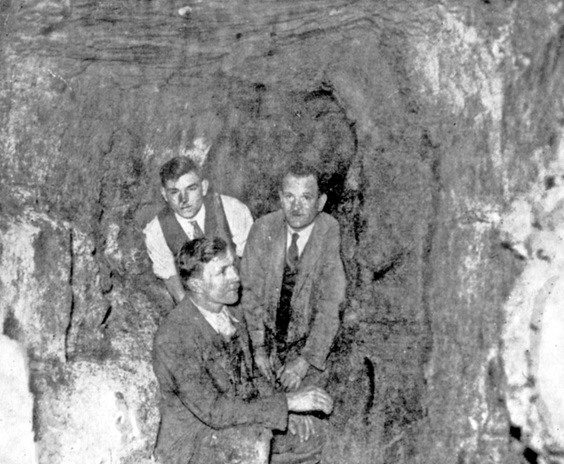
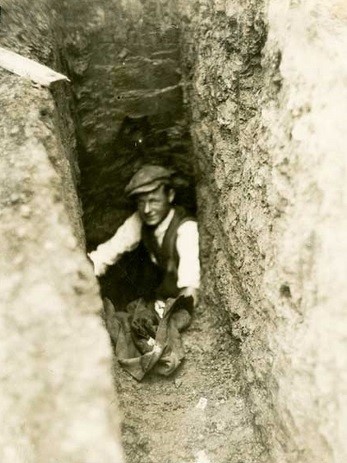
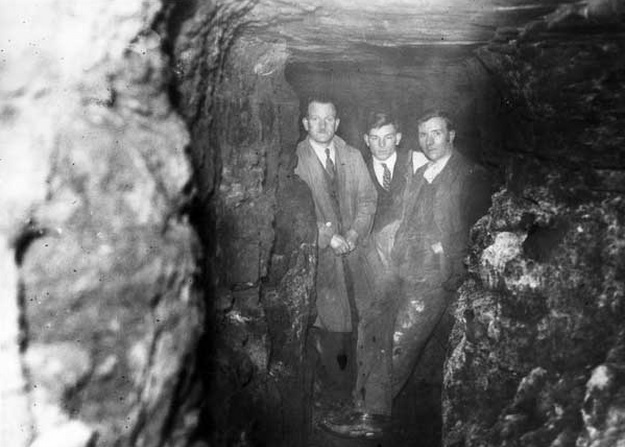
Our final instalment about hidden tunnels underneath Sheffield takes us to 1936, when Frank H. Brindley investigated a tunnel found by workmen underneath the offices of the Telegraph and Star newspaper at Hartshead.

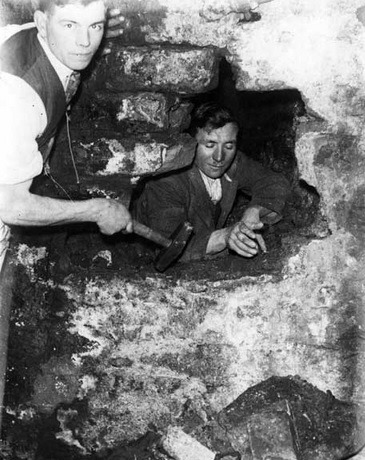
Brindley explored the opening using two skilled masons. The floor was described as well-worn as from long usage, and bone dry, without any trace of rubbish.

“The tunnel was cut from solid rock, about six foot in height and five to six feet wide. Its first direction was east, taking a line towards Castle Hill.
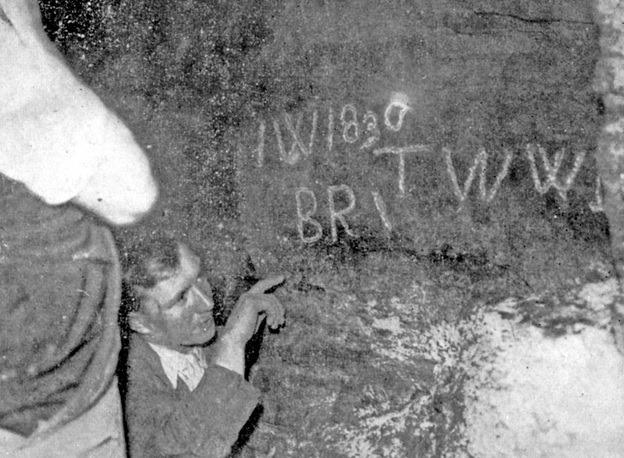
“It turned slightly south and then resumed its eastern direction, and when 50 foot from the entrance hall, we found the first trace of others having found this mystery tunnel before.

“On one of the rock walls were the following letters ‘I.W. 1830’ then just below ‘B.R.’, a dash and then ‘T.W.W.B.'”

Exploring further, they passed beyond High Street and after rounding several bends found the tunnel ended abruptly at a brick wall, probably the foundations of a building in King Street.

If the wall hadn’t been built, they would have been able to walk underneath the buildings of King Street and entered what was once Sheffield Castle at a point where the markets were then situated.

Pictures and an interview were published in the Yorkshire Telegraph and Star in 1936, providing clear proof of their existence.

Brindley concluded that this was the missing tunnel from Sheffield Castle to the Parish Church (now Sheffield Cathedral), and was undoubtedly the one that had been uncovered in 1896, when Cockayne’s were excavating for a new store on Angel Street, which had then been dismissed as a sewer.

Mr Brindley was in the headlines again at the start of World War Two, when he placed details of underground passageways at the disposal of Sheffield’s Air Raid Precautions (ARP) authorities.

He explained that over the years, tunnels had repeatedly been found cut in the sandstone. Some appeared to have been old colliery workings, but many couldn’t be explained, while many appeared to radiate from the site of Sheffield Castle and were probably connected to mansions in the neighbourhood.

Brindley also shed further light on the 80ft shaft he’d found at Hartshead, that headed towards High Street.

The shaft had led to another tunnel running under Fargate, towards Norfolk Row. Unfortunately, explorations had come to an end when one of the investigating party was overcome by fumes only 50ft from the bottom of the shaft.

This time, Mr Brindley elaborated that the tunnel was part of a network that also connected Sheffield Castle with Manor Lodge.

It’s hard to believe now, but the hillside in Pond Street was said to be honeycombed with coal workings, but Brindley claimed that there were two other “mystery” tunnels found.

One section running from a cellar at the Old Queen’s Head Hotel, he said, was found when Pond Street Bus Station was being built during the 1930s, and the other was found near the top of Seymour Street (wherever that might have been). Beginning in an old cellar it ran beneath the site of the Royal Theatre, towards the Town Hall, where it was lost.

As far as I am aware, this was the last occasion that these tunnels were explored, probably sealed up but still hidden underneath the city centre.

We’ll end these posts as we began by saying that – “One day soon, Sheffield Castle might give up some of its secrets.”

Categories
Buildings

Sheffield Telephone Exchange

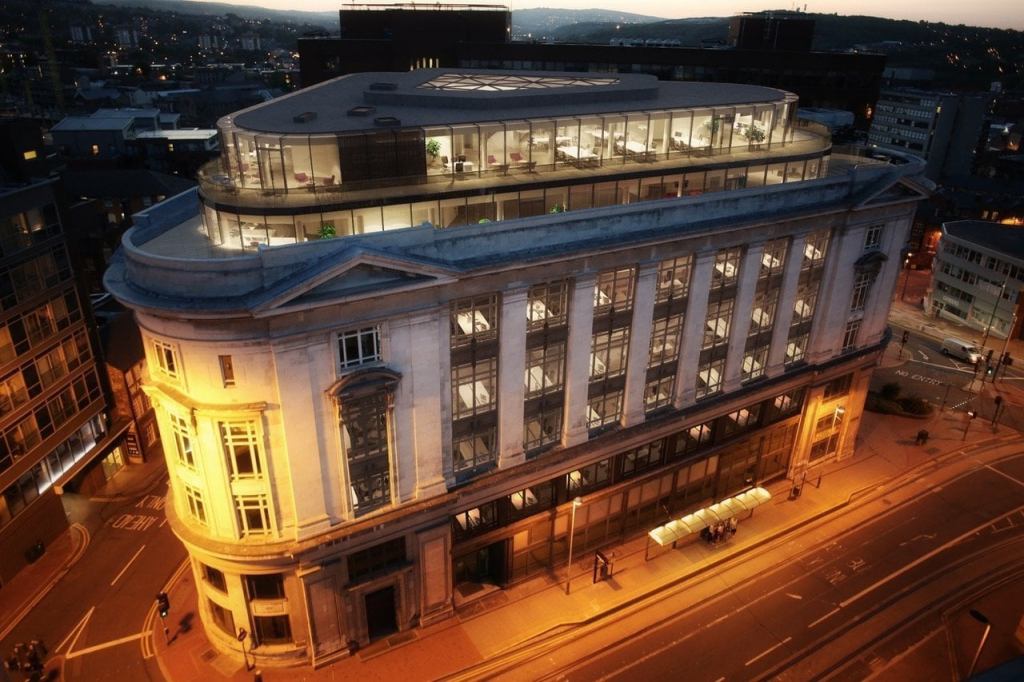
Let us not underestimate the importance of this building in the history of Sheffield. Completely gutted in the past few years, with office-space built around a central atrium and a glass roof extension, the outside of Grade II-listed Steel City House remains pretty much as it was in 1927.

This was once the Sheffield Telephone Exchange Building, occupying a triangular piece of land bordering Bow Street, Pinfold Street and Holly Street. I should explain that Bow Street later became West Street, the road we now associate with the building.

The origins of the building go back to 1879 when John Tasker, Mayor of Sheffield, opened the Sheffield Telephone Exchange, along with a dozen subscribers, later taken over by the National Telephone Company, operating out of Change Alley, and consolidating both companies on Commercial Street.

The General Post Office (GPO) took over the National Telephone Company in 1912, effectively nationalising the network, the beginning of one of Britain’s greatest technological developments.

As early as 1920, there had been a proposal for a telephone exchange system in Sheffield, including several new exchanges and the extension of underground cables to the city from London and other centres.

These were the days when making a telephone call meant speaking to an operator, who connected you with the recipient at the other end. However, times were changing, and talk was of a new automated exchange system allowing callers to dial a number direct.

In the end, the idea was postponed due to the long wait for new apparatus to be sourced, and it wasn’t until the latter part of 1921 that a decision was reached between the GPO and Sheffield Corporation.

As part of the agreement, a new central telephone exchange was to be built, designed by Henry Edward Treharne Rees (1871-1937), of His Majesty’s Office of Works and Public Buildings.

Work began on the site in November, oddly enough, the land prepared by the Co-operative Wholesale Society, and it wasn’t until March 1922 that the construction was really appreciated with the raising of the girded steel frame.

What followed was a long-protracted development, repeatedly held up by red-tape, and not helped by having to lay thousands of miles of cable across the city. This alone, originally estimated to cost £85,000, was held up because a ‘patching’ policy was used instead, whereby new sections of cable were laid down and patched to existing wires.

The Sheffield Central Telephone Exchange opened in March 1927, but not before about 10,000 subscribers had been visited to have the new system explained to them.

Sheffield wasn’t the first city to get an automated service, that honour went to Hull, but it was the largest and biggest conversion undertaken. It was joined by further exchanges at Attercliffe, Beauchief, Broomhill, Ecclesfield, Oughtibridge, Owlerton, Sharrow and Woodhouse.

The main entrance was at the junction of Pinfold Street and Bow Street (West Street). The basement was used for telephone stores and heating chambers. The first floor was used as offices and showrooms for the telephone service, with similar offices on the second floor, and third floor offices let out to tenants.

Nearly the whole of the top floor was occupied by a series of “selectors,” together with “change” machines and “ringer” machines for supplying power. Another machine automatically registered every local call made.

Shops were available to rent in Bow Street and Pinfold Street, and a Post Office was moved here from Church Street.

In 1930, Martin’s Bank (later Barclays) rented a large space at the rounded corner of the building, taking over the main entrance and becoming the anchor tenant until modern times.

The exchange lasted until the 1960s, when it was replaced with a bigger facility at Eldon House, on Wellington Street, the building given over to offices. It was refurbished in 1995 but soon became outdated and “not fit for purpose.”

Steel City House, as it had become, was refurbished in 1995, and underwent its biggest renovation in 2015, part of a £10million plan by Scott’s Developments, gutting the interior and turning it into a new-age office facility.

Categories
Buildings

Sheffield Telephone Exchange

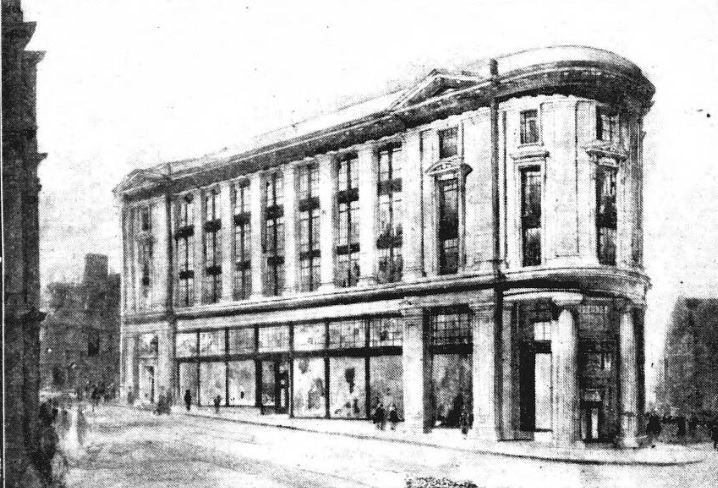
A sketch of Sheffield Telephone Exchange taken shortly after completion in March 1927. The building survives as Steel City House, at the bottom of West Street, the subject of a recent £10million office conversion.

The triangular building was designed by Henry Edward Treharne Rees (1871-1937), of His Majesty’s Office of Works and Public Buildings, with construction starting in 1921 on a site that had been empty for years, and had “formed the forum for keen agitators among the unemployed.”

Now classed as Art Deco, but at the time described as being a “modern adaptation of Renaissance-style, harmonising with existing buildings in the area.”

It was built with 40,000 cubic feet of Portland stone, the rough blocks conveyed from Dorset with final sawing and dressing done in Sheffield. The floors were made of reinforced concrete with about 40 tons of reinforcing rods used in the construction.

With rounded corners, massive Doric columns supported a semi-circular portico to the main entrance at the corner of West Street and Pinfold Street.

The five-storied building was built by Henry Boot and Sons, based on Moore Street, which claimed to be Britain’s biggest builder, with a yearly output of £1.7million.

The iron and steelwork were by Manchester-based Lambourne and Company, constructional engineers, the cause of much disappointment to local steel companies which tendered for the contract.

The sole contractor for the installation of electric lighting was Marsh Brothers, which had showrooms on Fargate and works at Edmund Road.

The extensive plumbing and glazing work were in the hands of M. Newman and Son, of Union Street, and the installation of “regency” metal windows and ornamental cast ironwork completed by Williams & Williams of Chester.

The House of Sage – Frederick Sage and Company, of London and Leeds – executed the bronze metal and teak shop-fronts, entrances to the offices and the main entrance.

The electric lifts were installed by William Wadsworth and Sons, Bolton and London, which had installed lifts in several other Government departments.

Marble and terrazzo paving, crafted by Italian experts, were supplied by Hodkin & Jones of Queen’s Road, and interior painting and decoration was undertaken by Smiths (Decorators), with a showroom in Fitzalan Square.

However, the most important contract was reserved for Siemens Brothers, Woolwich, which designed and supplied the whole of the automated telephone exchange equipment, comprising nine exchanges across Sheffield.

Soon after construction, Martin’s Bank became an anchor tenant, moving from Leopold Street, taking over the main entrance between West Street and Pinfold Street.

It spent a small fortune decking the new bank with Cuban mahogany, the floors with polished maple and borders of oak and jarrah, a dark coloured Australian wood.

The telephone exchange operated until the 1960s when a bigger facility was built at Eldon House on Wellington Street. Martin’s Bank later became Barclays until its eventual closure.

Categories
Buildings

Carver Street National School

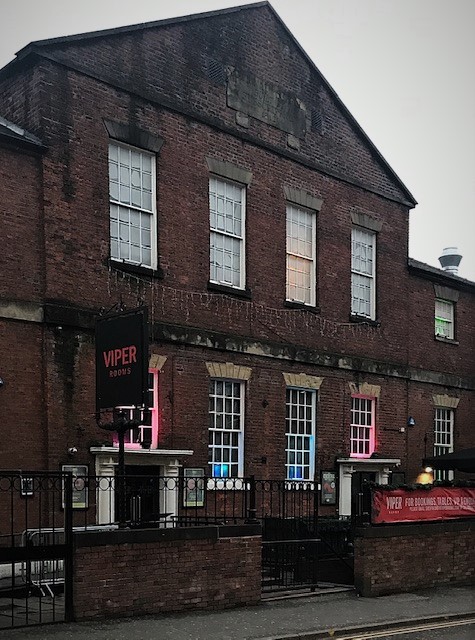
By the time you read this, it should have been another busy night at The Viper Rooms, on Carver Street. Situated at the heart of Sheffield’s hectic night scene, this club is the latest reincarnation of a building with completely different origins.

Behind the glitz and glamour, you can see traces of its humble beginnings. Not least, a large plaque above the four-bay gabled centre, which declares that this was once the “National School – Built by Subscription – 1812.”

The National School was set up in 1811 by the National Society for Promoting Religious Education, providing an elementary education with teaching of the Church of England to children of the poor. Supported by voluntary subscriptions and donations, it was probably the first near-universal system of education in England and Wales.

Sheffield had a good supply of National Schools, conveniently distributed, allowing the working man a choice of schools within easy distance to which he could send his children.

The oldest of these was the Carver Street school, opened in 1813, consisting of two large rooms, one downstairs for boys and the upper one for girls, to which committee rooms were attached, and a playground outside.

In 1823, a report said there were 340 boys and 513 girls in attendance, although three years earlier three thousand children had squeezed inside for a rally.

The National School on Carver Street survived until 1882, its demise probably caused by rising population and a building unable to cope with demand. There was, also, the Victorian idea that all children should go to school, and in 1880 schooling became mandatory, all children attending until they were 10-years-old, initiating a school-building programme across the town.

The building stood empty, although parts of it had already been let to John B. Corrie, plumber and glazier, and the vast arched-brick cellars rented by J.J.G. Tuckwood as warehousing for his general supply stores.

The Sheffield School Board expressed interest in buying the building when it went to auction in 1884, but the remainder of the leasehold (99 years from March 1794) was eventually bought by the Sheffield Technical School for £538.

However, the technical school never used it, writing its history elsewhere, and the subject of a future post.

In 1913, the building was bought by Charles Constantine, builders’ merchants and hardware factors, complementing premises down the hill on Fargate.

Eventually, the business consolidated here and was joined by Woollen and Company, sign specialists and colour printers, in 1929, moving here from Holly Green, as a result of street widening for the new City Hall.

Generations of people will remember it as Constantine’s Ironmongers, remaining here until the 1970s, by which time the property had fallen into disrepair and after the closure of the business became derelict.

For younger readers, understand that Carver Street, along with Division Street, was very different to the area seen today. It was populated with small shops, factories and workshops, all past their best, and came as a surprise when the building was converted into a public house in 1981.

Opening as Dickens at ground level, it offered a separate venue, Le Metro, making use of the old arched-cellars to echo the Paris underground.

It was inspired planning, quick to exploit eighties bar culture, and became a must-go-to place on a Saturday night.

It subsequently became Ruby Lounge and Cellar 35, later reinventing itself as The Viper Rooms, along with late licence, and a credible reputation with Sheffield’s student population.

Next time you pay a visit, take a moment to look at the stone plaque above your head, and remember that this was once something far removed from its present use.

Categories
Places

A deer city

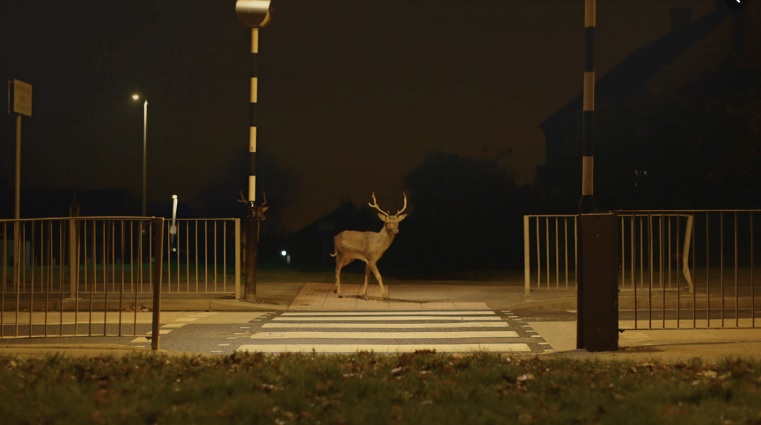
We’re used to seeing foxes and badgers in Sheffield, but sightings of deer in the city are becoming increasingly common.

And we’re not just talking about in the outer suburbs, where the boundary between the countryside and housing has become blurred.

According to Ian Rotherham, Professor of Environmental Geography at Sheffield Hallam University, who has studied populations of deer in the UK since the 1980s, deer are now regular visitors.

“Red deer are established to the west and south-west of Sheffield with a population centred on Big Moor, but now ranging in all directions from there. In the west and north-west, the populations are joining long-standing feral herds around Wharncliffe and Bitholmes with individuals now recorded from Rivelin and Strines.

“Roe deer colonised Sheffield originally from the east and north-east, but now also from the south-west. The population is now well-established in the heart of the urban catchment, with regular sightings, for example, in Crookes, Nether Edge and Sharrow.”

Visitors to the Sheffield General Cemetery, a stones-throw from busy Ecclesall Road, have also reported roe deer, and last August one was found dead in Endcliffe Park.

Muntjac was first recorded in Sheffield during the early 1990s with individual sightings in the Moss Valley.

“Since then there has been progressive movement into the city with recorded sightings in Woodseats, Heeley, Gleadless, Norton, Nether Edge, Sharrow, Parkwood Springs and Queen’s Road.”

The deer population in the UK is at the highest it has been for at least 1,000 years, at around two million.

There are many reasons for this: since wolves, lynx and bears became extinct hundreds of years ago, deer have had no predators to contend with.

They, along with other wildlife, have also benefited from other factors including milder winters, increased woodland cover in some areas and changes in farming such as the planting of winter crops.

“The urban area offers huge possibilities in terms of food,” says Ian Rotherham.

“If you’re a muntjac getting into an allotment or garden, who knows what’s on offer for you? It’s easy pickings.”

Deer are now making their homes in urban woodlands and near rivers, which provide habitats, cover and safe corridors to allow them to find food and breeding opportunities, making Sheffield, with its five rivers, the perfect place.

Categories
Buildings Streets

Fargate

The long-term plan for Fargate is to address the decline of retail and focus on leisure instead.

The regeneration of The Moor as a retail destination and the future development of Heart of the City II, which on completion will consolidate the retail core to the south of Fargate, has prompted Sheffield City Council to bid for up to £25million of government funding to improve the pedestrianised street.

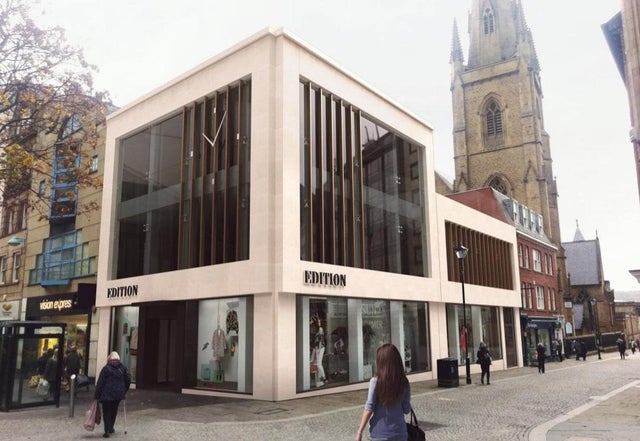
It comes as no surprise then that the council has granted planning permission for the conversion of the old Next building at the corner of Norfolk Row.

Woodhead Investments’ proposal for a dining venue, along with a roof terrace fronting Norfolk Row, was accepted by the council, seen as regenerating the area.

Next relocated to The Moor in August, and the empty store was used as a pop-up Christmas shop during November and December.

The unit will be renovated to designs by Pearce Bottomley Architects, using new glazed panels and stone cladding, with a minimalist clock placed at the front of the building.

Categories
Companies

Westfield Health

A flashback to July 1921, and plentiful support had been given to the “Penny in the Pound” scheme for aiding Sheffield voluntary hospitals.

The Sheffield Hospitals Council had launched the scheme to support the city’s four hospitals: The Royal, The Royal Infirmary, The Children’s and Jessop Hospital for Women during the aftermath of World War One, when accommodation was short and no means to modernise or re-equip wards.

Whereby for every pound of an employee’s pay, a penny would contribute to the hospital’s finances in return for free hospital treatment, and employers would contribute a third of any money raised.

There were few who were not willing to recognise their responsibility to the hospitals.

Merchants, tailors, painters, brewers, wheelwrights, printers and many other trades had heard about the scheme.

The Sheffield Law Society had recommended the scheme to its members, and 96 per cent of staff of the Sheffield and Ecclesall Co-operative Society had agreed to pay contributions.

The Tramways and Motor committee, the Electric Supply committee, and the Sheffield Water committee, had each agreed to pay the employers’ portion of the scheme and the Parks men had shown sympathetic interest.

“Penny in the Pound” was dropped when the NHS came into being in 1948, but the Sheffield Hospitals Council survived by introducing innovative new schemes.

And what became of the Sheffield Hospitals Council?

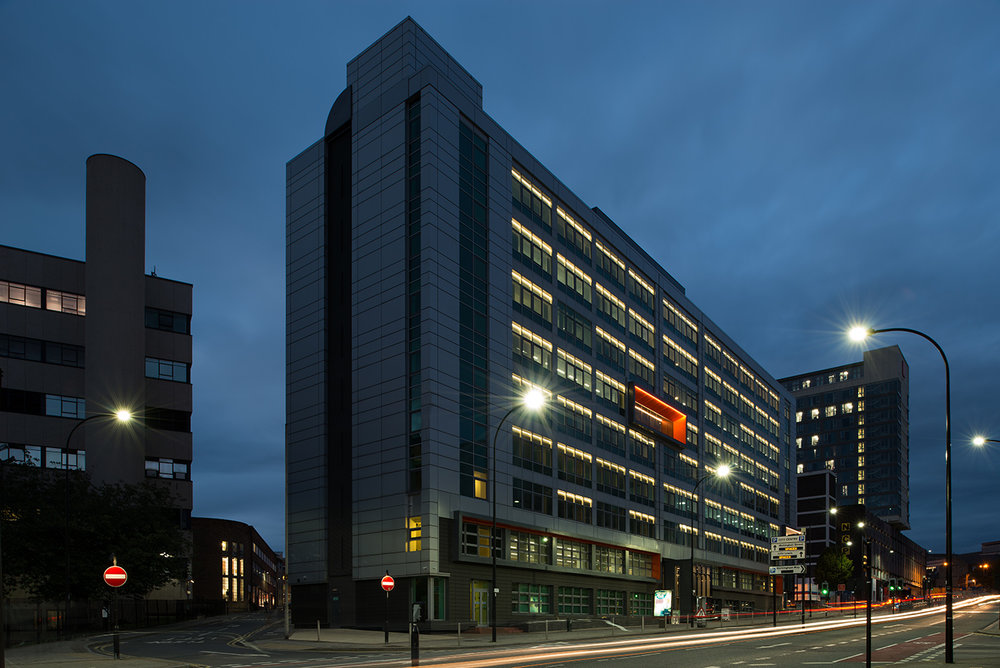
It was renamed the Westfield Contributory Health Scheme in 1974, and as Westfield Health, has become one of Britain’s biggest Health Cash Plan providers. It moved to bigger premises at Charter Row in 2016.

Categories
Companies

Westfield Health

“Are you in the Westfield?” A question often asked at our Sheffield hospitals. But what do you know about the history of the Westfield Contributory Health Scheme?

It’s an institution, now nationwide, and its origins can be traced to July 1919, founded as the Sheffield Consultative and Advisory Hospitals Council, later shortened to The Sheffield Hospitals Council.

Its formation was to support Sheffield’s four hospitals: The Royal, The Royal Infirmary, The Children’s and Jessop Hospital for Women during the aftermath of World War One.

The war had crippled finances at Sheffield’s hospitals, with accommodation short and no means to modernise or re-equip wards.

The honorary medical staff at the hospitals suggested that a Joint Council should be formed, principally to tackle the financial difficulties after the war. They put their views into writing, produced a document to present to members of the Board and asked that a Joint Council should be set up to put the finances of the hospitals on a sound basis and to make the people of Sheffield, hospital health conscious.

The Sheffield Hospitals Council stepped in with the “Penny in the Pound” scheme, devised by businessman Fred Osborn, whereby for every pound of an employee’s pay, a penny would contribute to the hospital’s finances in return for free hospital treatment, and employers would contribute a third of any money raised.

The scheme was launched in April 1921, raising almost a million pounds for hospitals in the first six years, proving to be one of the largest and most successful in the country.

It quickly caught the imagination of the city’s biggest firms, trade unions and principal employers’ associations.

For 25 years it raised nearly five million pounds, surviving the Great Depression of the 1930s, when local people still contributed to the scheme from their wages.

During World War Two the scheme continued to support the hospitals, funding a new maternity unit at Jessop’s Hospital for Women after it suffered during a heavy air raid.

It also provided two ambulances in 1942 which transported patients to the city’s hospitals, and to and from nursing homes, travelling a total of 191,788 miles.

As well as delivering 9,000 Christmas Gifts each year, it also donated Easter eggs to patients in the Sheffield Voluntary Hospitals.

On 5th July 1948, the NHS was born with the aspiration to make healthcare available to all, regardless of a person’s wealth.

The NHS threatened the viability of the Sheffield Hospital’s Council, and although contributions fell, it closed the “Penny in the Pound” scheme and launched a “Special Purposes Fund,” providing amenities that weren’t covered by the NHS to patients and hospital staff.

In 1951, the NHS was struggling and introduced charges for prescriptions, dental services, and glasses, with the Sheffield Hospital’s Council creating an extended scheme of general benefits, becoming the innovator of the Health Cash Plan.

It was also the same year that the “Hospital Cinema Service” was launched, providing patients at the city’s hospitals with a cinema, showing full-length feature films, newsreels and shorts to help raise spirits for patients.

On 14th October 1965, the organisation established the Sheffield and District Hospitals Services Charitable Fund, donating annual funds for the purchase and repairs of equipment in hospitals, since donating over £15million to local and national hospitals and charities supporting people’s health and wellbeing.

More change was on the horizon. Due to the rapid expansion of the contributory scheme, it moved into a purpose-built office called Westfield House in 1973, followed by a change of name in 1974 to become the Westfield Contributory Health Scheme.

In 1999, Westfield became pioneers of the corporate paid Health Cash Plan, whereby employers rewarded employees with cashback on essential healthcare and access to health and wellbeing services.

The scheme launched in 2000 and has since become one of Britain’s biggest providers.

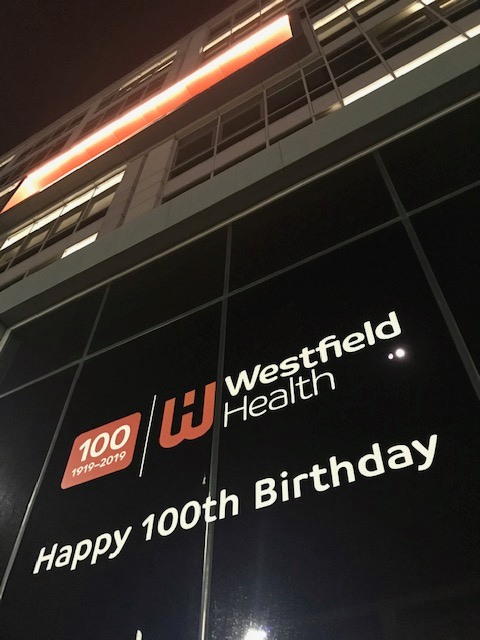
Westfield Health moved to bigger offices on Charter Row in August 2016, and celebrated its centenary last year.