Taylor’s Eyewitness was founded in the early 19th century and have been producing kitchen knives, pocket knives, scissors and sharpeners for over150 years. Image: Capital & Centric
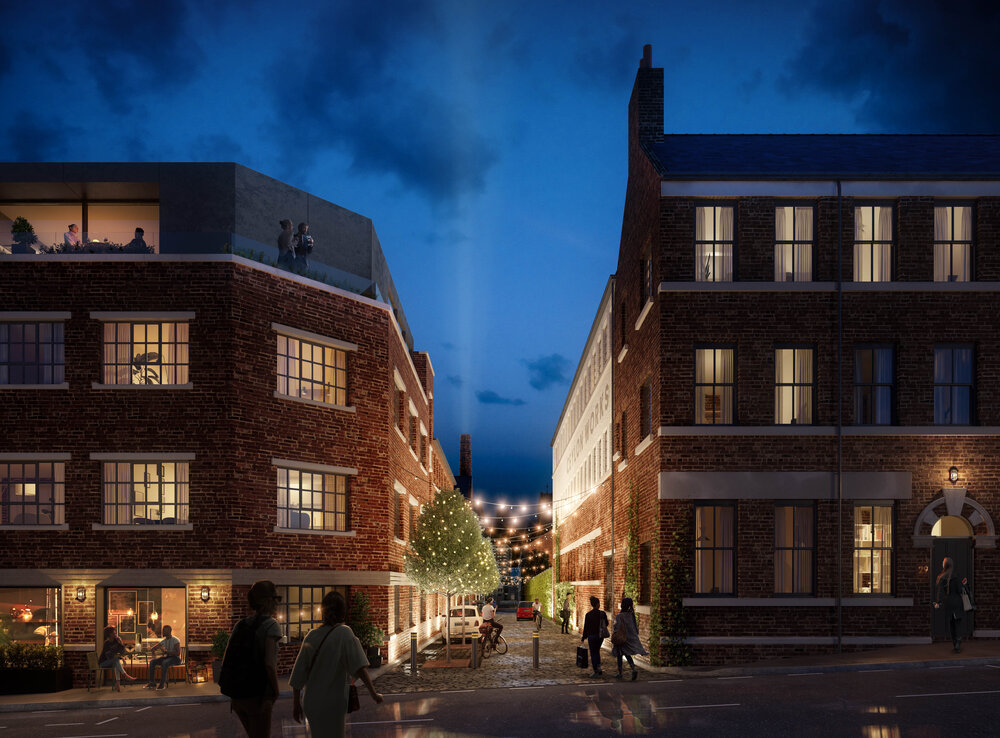
Taylor’s Eyewitness Works, a former cutlery factory, on Milton Street, is currently being transformed into 97 loft apartments and townhouses as part of a £21m restoration.
The developer Capital&Centric has partnered with Channel 4 and Remarkable TV for a new peak time interior design show to be filmed this summer.
The series, which has a working title of Design Your Dream, will see contestants each assigned an empty apartment within Eyewitness Works to showcase their design talent. They will be judged on their performance in a series of design challenges and skills within the apartment and elsewhere.
The winner of the competition will become the owner of a two-bedroom Capital&Centric loft apartment at the development.
The buildings had been used by Taylor’s Eyewitness until 2018, where skilled craftsmen produced pocket knives, scissors and kitchen knives. Image: Capital&Centric
The Grade II listed building was built in phases between about 1855 and 1890, alongside high density housing interspersed with manufacturing works.
The Taylor’s trademark was registered in 1838 and the company merged with James Veall in 1876 and Tyzack’s in 1879 to become Needham, Veall and Tyzack. During the 1960s the company became Taylor’s Eye Witness. It was later bought by Harrison Fisher & Co, which changed its name to Taylor’s Eye Witness Limited.
The “Eyewitness” trademark was first registered in 1838 – the inspiration for the choice of “Eyewitness” is believed to be Shakespeare’s line in Henry IV – “No eye hath seen better”.
The setting of the cutlery works became fragmented during the mid to late twentieth century when much of the adjoining high-density residential neighbourhood was cleared and several adjacent sites remain undeveloped.
Eyewitness will also be home to four lush, green courtyards and cafe bar. Image: Capital&Centric
“The children spent a warm spring afternoon playing beside the river. And when their energy was spent, they trod wearily the path across Alsop Fields, passing the old farmhouse that had once belonged to Aulsope Farm.”
This might have happened 300 years ago, and nothing remains of it except Porter Brook.
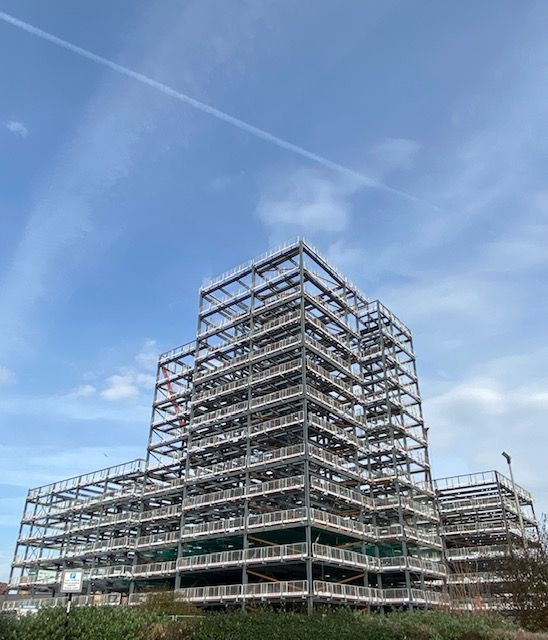
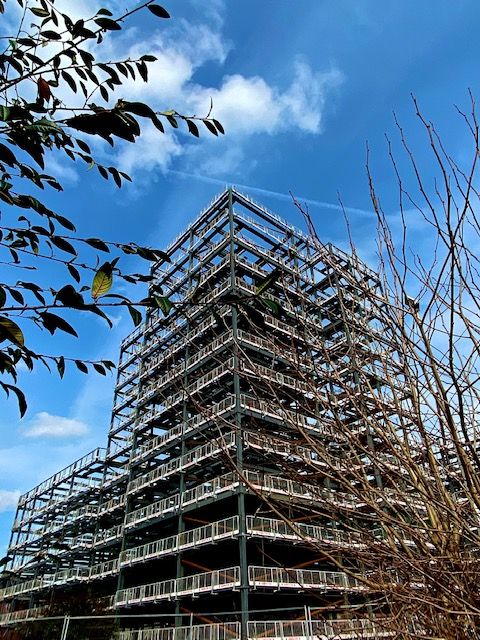
The large steel structure rising above Sylvester Street, on the outskirts of Sheffield city centre, is the latest chapter in the city’s development. A rural idyll, swallowed by the advancing town, used for industry, and when this declined, utilised for residential.
The Sylvester Street development is a £75m plan to construct 335 ‘build to rent’ upmarket apartments alongside Porter Brook.
More importantly, once completed, a stretch of the river will be spruced up and opened to the public.
The developer promises to plant vegetation along the edge and place rocks in the middle to slow down the water’s flow and reintroduce habitats for wildlife. A new pedestrian route will run parallel to the river, with a bridge allowing people to access the new buildings. The brook will remain culverted in places – here open spaces are to be created.
It will be respite for the river that suffered at the hands of Sheffield’s industrial development.
In 1789, a building called Sylvester’s Wheel stood nearby, land to the west was Joseph Broomhead’s garden, and land to the right was owned by Robert Walker. During the 1800s, Porter Brook was used to power industry and larger scale industrial buildings started appearing including Sylvester Works, Thomas Ellin, and the Oak, Stella, and Crown Steel Works.
By the end of the twentieth century, the downturn in Sheffield’s metalworking industry was reflected in the clearance of most of the site. In 1994, a large retail shed was built on the former Crown steel works, occupied by Carpet World and subsequently by Sofa World. This was demolished about 2009 as were most of the remaining industrial works.
And now, this massive residential development rises above this long-lost green space.
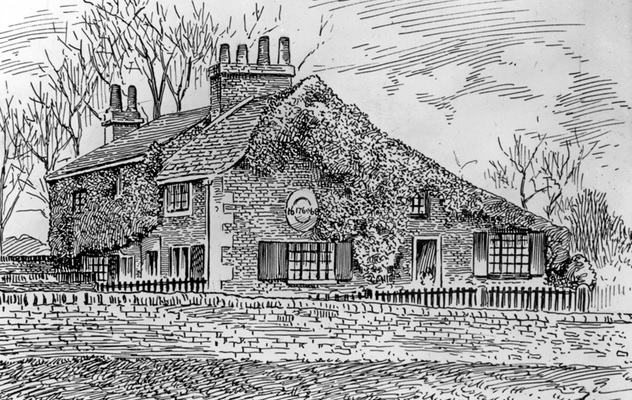
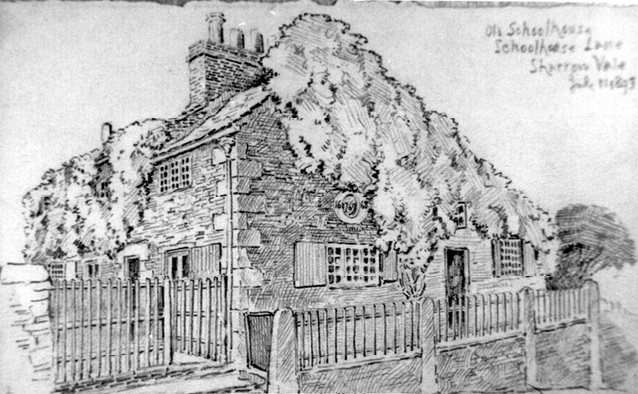
Sharrow Moor Endowed School, also known as Whitehead’s School (after headmaster ‘Daddy’ Whitehead), Bagshot Street, Sharrow Moor. Built 1668, extended 1769. Demolished 1904. Image: Picture Sheffield
“Another bit of old Sheffield has disappeared. Over 200 years ago it stood ’distant, secluded, still’ away on Sharrow moor, with a beautiful rural country all around it, and Sheffield a comparatively long way off. But, like an invading army, Sheffield has been rapidly enveloping it in the last century. The city spread all around it. For a time, the town left it standing while it went on and on, seizing fields and woods, and filling them up with houses. Latterly, however, it has had time to turn back, and look around for spots that might have been passed and left unspoilt by bricks and mortar. And it has discovered quaint, old-fashioned Sharrow Moor School, a picturesque ivy-clad building, with its old-world air of simplicity and quietude, and its still rural surroundings. And down comes one of the few remaining bits of old Sheffield to make room for more of the all-devouring, up-to-date city.”
This expressive piece appeared in a local newspaper in November 1904.
Sharrow Moor School was one of Sheffield’s earliest schools. Originally a farmhouse, when erected in 1668, it subsequently became a charity school, and for many years boys and girls were taught to read and write, and some of them to learn mathematics.
In 1668, few houses dotted the landscape in this lovely valley. Its only neighbours were strewn far and wide across it. Beauchief Hall, Banner Cross, Whirlow Hall, Graystones, Whiteley Wood Hall, Broom Hall, Machon Bank, and Mount Pleasant.
In 1769 the building passed into the hands of the Rev. Thomas Savage, of Cherry Tree Hill, who extended it, and through his will it was destined to become a school.
His trustees were obliged to pay someone “four pounds, eleven shillings, and four pence for the teaching and instructing of eight poor children, born, or residing in or belonging to the parish of Sheffield, at a certain school situated in Sharrow Moor called Sharrow Moor School, to read the English language, two whereof to be taught to write, and account by being taught the first four rules in arithmetic. The sum of nine shillings and eight pence to be paid annually for the purchase of books.”
Sharrow Moor Endowed School, also known as Whitehead’s School (after headmaster ‘Daddy’ Whitehead) in 1893. Image: Picture Sheffield
The school prospered under several masters – Mr Siddle up to 1860, followed by a Frenchman, Mons. Louis Theodore Elile Isensee, until 1865. Afterwards, ‘Daddy’ Whitehead took charge for 25 years until his death (the school referred to as Whitehead’s School) and it briefly closed before reopening in 1890 by Mr Haslam.
Then came the Free Education Act and the arrival of new schools at Hunter’s Bar, Pomona Street, Nether Green and Greystones, and the school closed. The money received from the sale of the land and building, together with its endowment, was transferred by the Charity Commission to find scholarships for children in the parish of Ecclesall, at the Sheffield Central, Technical, and Art Schools.
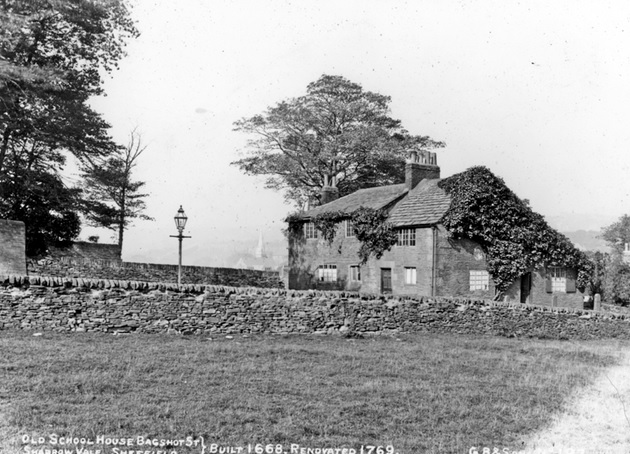
If it had survived, where would this forgotten treasure have been today? The answer is Bagshot Street, at Sharrow Vale.
Old School House Bagshot St., Sharrow Vale Sheffield Built 1668; Renovated 1769. Image: Picture Sheffield
Sheffield Energy Recovery Facility. More than 140 buildings, including leisure centres, hotels, houses, schools and colleges and offices use energy recovered from waste generated by the city. Image: Andy Kelly
It is a landmark on the Sheffield landscape but may not be the most welcome. This is the Sheffield Energy Recovery Facility on Bernard Road, a stone throw from the city centre.
It can treat up to 240,000 tonnes of the city’s household waste per annum, and its incinerator supplies heat to a local district heating scheme. Owned by Sheffield City Council, the plant is operated by Veolia under a 35 year contract.
Waste is tipped into a waste storage bunker and fed into a single incineration unit where it is burned in excess of 850ºc. A large boiler above it is heated to produce superheated steam at 400ºc. A condensing steam turbine uses this steam to generate electricity for the National Grid and produce hot water for the District Energy Network.
Facilities like Ponds Forge, Park Hill Flats, the Lyceum Theatre, Millennium Galleries, Weston Park Hospital, and Sheffield City Hall, all benefit with heating from the system, delivered through more than 44km of underground pipes.
In 2001, Greenpeace declared it the worst incinerator in England, and painted ‘Toxic Crime’ on the chimney. The council had to privatise the plant because it could not afford the cost to upgrade it. The contract passed to Onyx (later Veolia) which replaced it in 2006 with modern plant to meet strict environmental standards.
However, Sheffield Green Party claimed it was still responsible for 31,308 tonnes of harmful greenhouse gas emissions.
Further controversy surfaced in 2017 when Veolia was forced to admit that it was diverting recyclable waste from household waste recycling centres to the incinerator. In addition, it began accepting waste from Derbyshire and Nottinghamshire after difficulty finding enough local waste to feed it.
The controversies appear to have quietened down, and people like me, assume that smoke belching from the large chimney is ‘safe.’
There is a whisper that New River, owner of The Moor, might be in talks with Sheffield City Council about purchasing the Moorfoot building. This ties in with the council’s Strategic Vision document that suggests the area will be targeted at young professionals and promoted as a ‘prime location for city core living’.
“The future of the Moorfoot Building itself (adaptation or replacement) is currently being considered’ due to the emergence of hybrid working.”
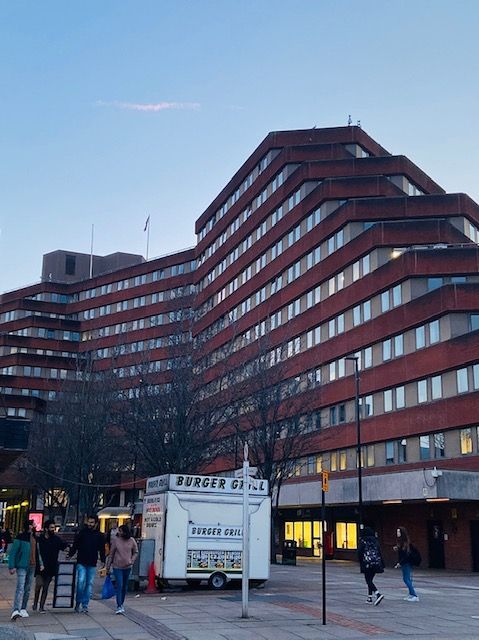
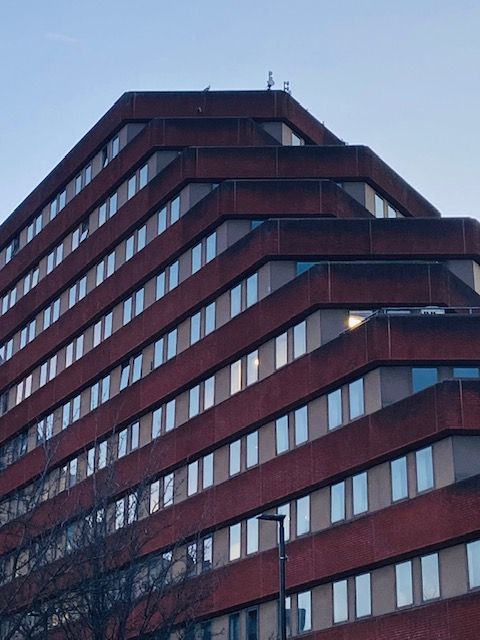
Eleven storeys high, with stepped levels across east, west, and north wings, it was built for the Manpower Services Commission which occupied it from 1981. It was here that the infamous Youth Training Scheme (YTS) was instigated, before being used by other Government agencies. The council bought it in the late 2000s.
Will Moorfoot be demolished and replaced?
I think there will be obstacles in the way of demolition, not least from architectural experts who regard the building as a Brutalist landmark. Don’t be surprised if there is an application to get it listed.
It might also seem a waste of money for Sheffield City Council to spend a fortune buying and renovating Moorfoot, and then spend even more money to relocate departments elsewhere. But stranger things have happened.
I don’t think the Moorfoot building will disappear, although there might be an opportunity to demolish the indoor car park attached to it. Much more likely is that the block of shops, and hospitality venues bordering Moorfoot, Hereford Street, South Lane, and Cumberland Street, will go instead. This would provide an ideal public space, paving the way for the Moorfoot building to be converted to residential (think of The Barbican in London).
And don’t forget that the former Office Outlet/Theatre Deli block is earmarked to be replaced by Lidl.
A lot of speculation and perhaps wide of the mark, but extremely interesting.
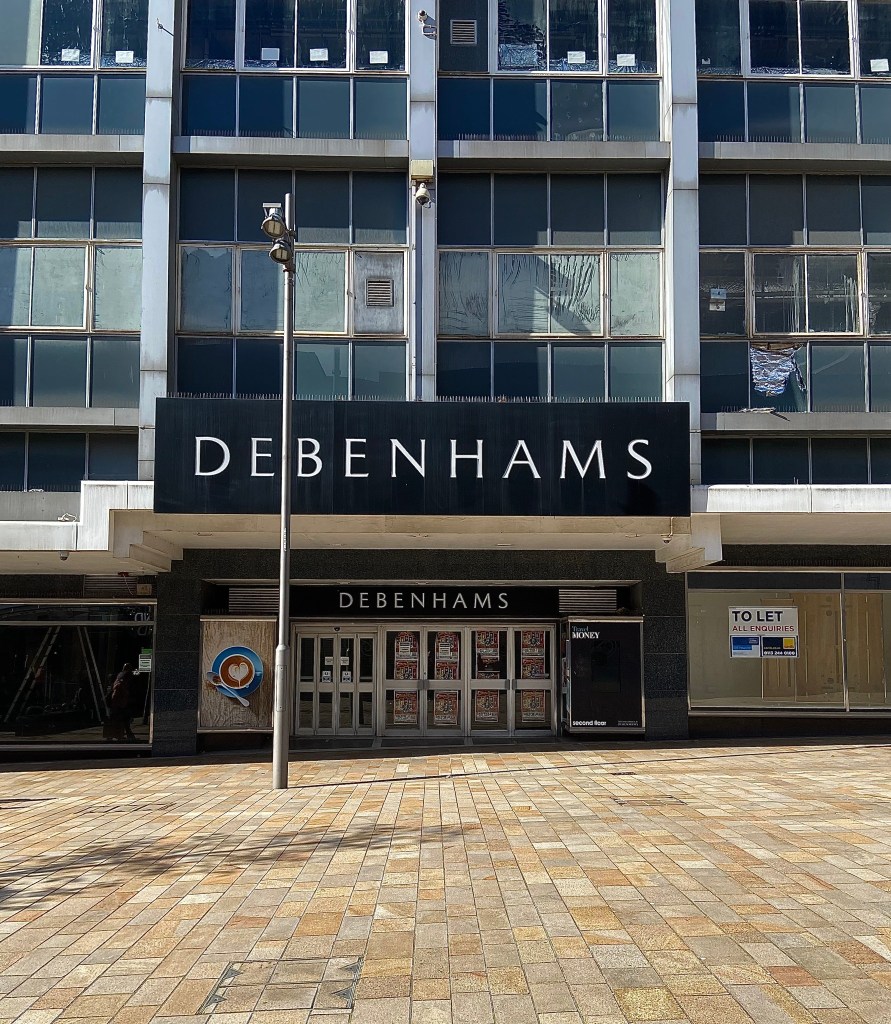
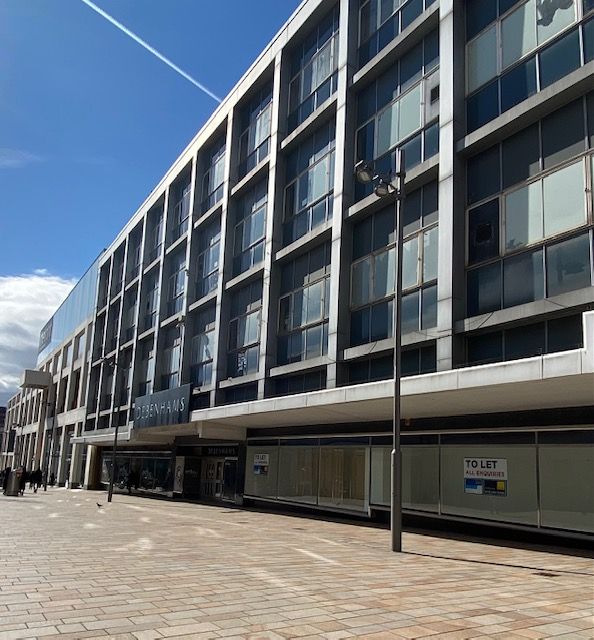
It opened as Pauldens of Sheffield, but was rebranded to Debenhams in 1973. It lasted over 50 years before closing in May 2021. Image: DJP/2022
According to new UK retail data, nearly 90 per cent of former Debenhams stores remain empty almost a year after the department store closed its doors for the last time, in a sign of the challenge to reinvent high streets across the country.
The figures include former Debenhams stores at Meadowhall and on The Moor.
Only last week, MHA London, which bought the city centre building for £1.5m in March 2021, said there was interest but “nothing substantial.”
Since then, property agent Colliers said it was talking to prospective occupiers, thought to be a discount department store company and a leisure operator, both interested in taking space.
Might the discount operator be B&M Retail?
It currently occupies space on Haymarket, also operating Heron Foods at nearby King Street, both in a part of the city centre suffering from declining footfall.
A move to the vibrant Moor shopping area might be considered a good move and could include a B&M and a Heron Foods offering as well.
According to reports, the former Debenhams building might become a discount store or a leisure facility. Image: DJP/2022
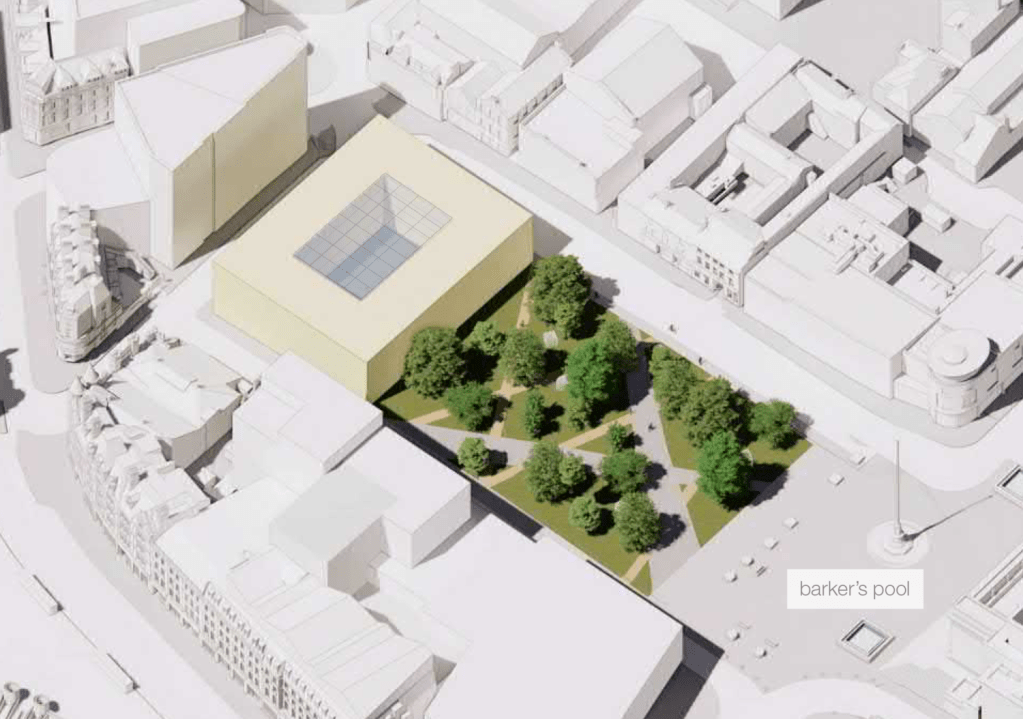
Any new building can be smaller, and more in tune with what current retail, leisure, food and drink or residential developers are looking for. The building would also be designed specifically for its future use. This option can still leave room for new landscaping and public space, plus improves pedestrian and cycling accessibility around the area. Image: Sheffield City Council
Sheffield City Council has full control of the John Lewis building, and this presents the ideal opportunity to create something special on one of the most prominent sites in the city centre.
In summer 2021, the council appointed experts Arup, Fourth Street and Queensberry to look at the condition of the existing building, the carbon impact and how any options would integrate within the Heart of the City and wider city centre.
There are three broad options: Retention and re-use of the building (and a plan for Sheffield Rules, the football museum, falls into this category), or complete removal of the building, creating a large public space, with the third option being complete removal, with public space and a smaller new building developed on the site.
The plans were put out to public consultation, with 1500 respondents, and according to the council, most favoured replacing John Lewis with a smaller building and outside space at a cost of about £40m.
We won’t know the outcome until the end of the summer, and in the meantime, the scruffy old department store should be clad in full building wrap with printed hoardings around the site.
Considering the implications and cost of reusing the building, I suspect that this option will be the eventual outcome.
Somewhere, displayed on a sideboard, or lost in a miserable attic, I would like to believe that an old model of Banner Cross Hall survives.
This was the creation of Jeffry Wyatt (1766-1840), architect of Banner Cross Hall, and used to highlight his magnificent new mansion in 1817-1821.
Shortly afterwards, in 1824, King George IV allowed him to change his surname to Wyatville and knighted him in 1828.
The existence of the model emerged in the 1930s when it was owned by Major Francis Ernest Gisborne Bagshawe, of Ford Hall, Chapel-en-le-Frith, a descendant of the family which once owned Banner Cross Hall.
In 1937, Bagshawe loaned the model to the Graves Art Gallery in Sheffield, which it displayed for three weeks, alongside valuable works of art that once adorned the walls of Banner Cross Hall. By this time, the old mansion was the company headquarters of builders Henry Boot and Son.
A portrait by George Romney was Mary Murray, grand-daughter and heiress of John Bright. Another portrait, of James II, had been painted by Peter Lely. Other paintings included Prince Charles Edward (Bonnie Prince Charlie), Prince Rupert, Queen Elizabeth of Bohemia and George III.
Amongst historic furniture loaned was a Sedan chair used to carry Mrs Murray to Ecclesall Church as late as the 19th century and a needlework picture showing the beauty of an Elizabethan Banner Cross Hall. Several Georgian silver exhibits had the Bagshawe and Murray Arms along with a pair of silver-mounted pistols containing the Murray Coat of Arms.
Major Bagshawe sold Ford Hall in 1957 and lived at Snitterton Hall (Matlock). He died in 1985 and the hall was sold the following year. Where did those cherished artworks go? The art detectives amongst you might have a better idea what happened to them!
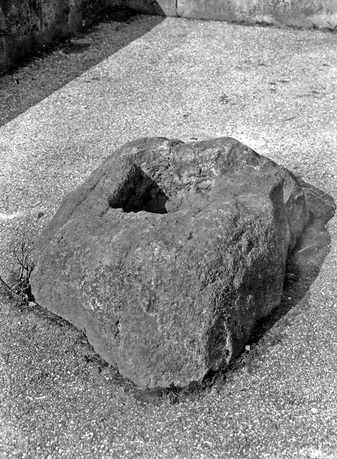
The base of the Banner Cross Stone was photographed in the early 20th century on the terrace of Banner Cross Hall. It had been removed from the gardens. Image: Picture Sheffield
Banner Cross is long associated with Ecclesall Road. It is infamous for being the scene of the murder committed by Charles Peace, the notorious criminal, in 1876.
In the time of Queen Elizabeth, nearby Banner Cross Hall was known as Bannerfield, but referred to as Banner Cross in the times of James I.
There appears to be no clear account of how Banner Cross got its distinctive name. ‘Banner Cross’ seems to suggest battles and campaigns, but the most likely explanation appeared in Hunter’s Hallamshire in 1819.
“This is one of the ancient esquires’ seats in the manor of Ecclesall. It stands near the chapel, and not far from the turnpike road to Manchester, from which however it is shut in by plantations, while its front presents a pleasing feature in the landscape to the traveller on the opposite hill along the road to Chesterfield. The name might tempt an antiquary to wild conjectures, especially when he stands on the base of an old stone cross still remaining, and looks along Salter (perhaps Psalter) Lane, towards Sheffield.”
It refers to an old stone cross that once stood near the previous hall, and quite possibly the ‘Banner Cross Stone.’
In the early part of the twentieth century, William Henry Babington, a Sheffield photographer, took images of a piece of stone, and labelled it as being the ‘Base of the Banner Cross Stone, now on terrace of Banner Cross Hall. Removed from Banner Cross Hall Gardens.’
If this was the original ‘Banner Cross,’ how likely is it that the base is still at Banner Cross Hall?
There was once an old mansion called Bannerfield that stood on a hill. It belonged to a branch of the Bright family, from superior yeomanry, who replaced it about 1616 and referred to it as Banner Cross.
The Bright family became extinct on the death of John Bright of Chesterfield and Banner Cross in 1748.
In 1758, his granddaughter and heiress, Mary Dalton, conveyed the estate to her husband, Lord John Murray, of the well-known Scottish house of Athol. He was Colonel of 42nd or Highland Regiment of Foot (the celebrated ‘Black Watch’) and spent much of his time here.
Lady John Murray died in 1765. Her only daughter married William Foxlowe, a Lieutenant-General, who obtained the Royal licence to use the Murray name. He purchased the Athol interest in the hall and retired here with the intention “of spending within its tranquil shades the evening of an active and honourable life.”
Banner Cross was not in the best condition, unoccupied for some years, and was later described in a poem by Mrs Hofland (Barbara Wreaks, of Sheffield): –
“A gloomy mansion, where in empty state And cob’web’d ruin hangs a goodly list Of pictur’d lords, and many a beauteous dame Of Athol’s princely race; for time has been They grac’d these gloomy walls and e’en of late Hath beauty’s queen here shown her peerless power, And given her mandate from a Murray’s eye, Bereft of these the mouldering mansion wears In every view the signal of decay; Slow whispering wind creeps through the chilling roof The tatter’d hangings shake with every breeze; Through the long passages, and cold dark hall, (So fame reports) the flimsy spirits glide In robes of white, or sweep the narrow stairs In all the shapes of fear-form’d misery.”
Like most shut-up properties, it had fallen into decay, the grounds choked with weeds, the drives, and pathways grass-grown, the ornamental shrubs ragged and broken from the weight of uncleared snow in wintertime. Gates yawned on their rusty hinges, while rotting woodwork and empty window frames marred the handsome façade of the building itself.
According to Rev. William Bagshawe, who spent a night here in 1818, “A side of the house gave way. I was in much danger”.
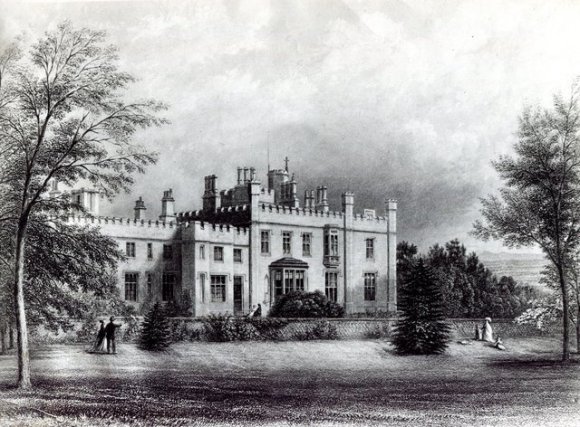
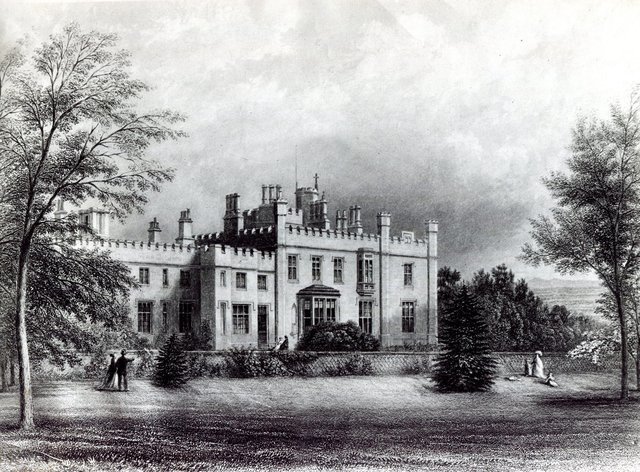
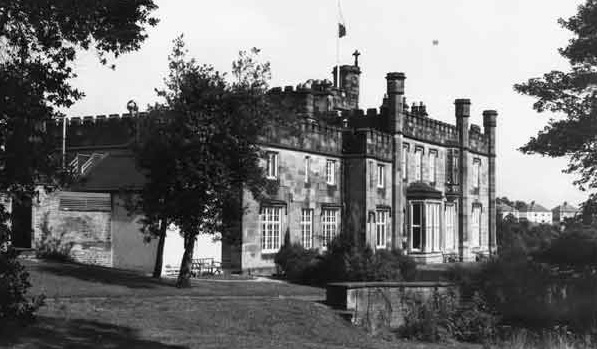
An early print of Banner Cross Hall, Ecclesall Road South, which dates from 1821. The house was in countryside outside Sheffield. Image: Sheffield Star
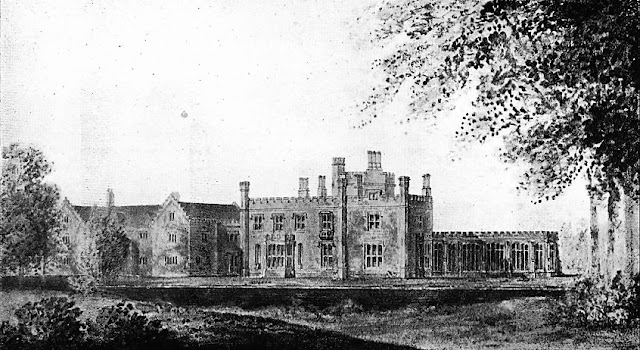
Banner Cross Hall: a perspective view by Jeffry Wyatt, 1817, showing the old house retained on the left, and an unbuilt conservatory on the right. Image: Landed Families
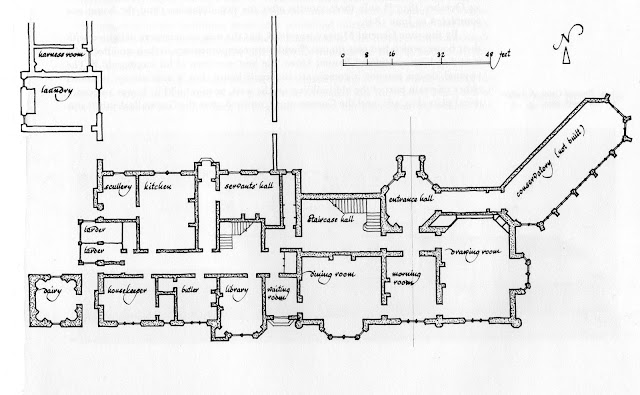
General Murray had already decided to rebuild Banner Cross and in 1817 had appointed Jeffry Wyatt, the distinguished architect of parts of Windsor Castle and the north wing of Chatsworth House. Within three months plans had been chosen and work commenced. The plan was for a Tudor Gothic house composed around a central octagonal porch-tower, with reception rooms along the south front, overlooking views over the grounds.
“And the work proceeded so rapidly under the eye of its master,” says historian Joseph Hunter, “that its pinnacles were seen rising above the woods around it in the summer of next year.”
Banner Cross Hall: plan of the house as rebuilt by Jeffry Wyatt in 1817-21 (main block) and later (service wing). Image: Landed Families
The work, supervised by William Dent, was well underway when General Murray died in 1818. Ownership passed to Rev. William Bagshawe, a younger son of Colonel Samuel Bagshawe of Ford Hall, Chapel-en-le-Frith, and his wife, Anne, who was the general’s sister. The main block was finished by 1821, and the intention had been to incorporate the old house as a service wing. However, the decrepit building was demolished and replaced by 1823 when the family moved in. A plan for a Gothic Conservatory was dropped, to offset the cost of replacing the old house.
Strangely enough, the estate went again with another daughter, Mary, and to her husband, Henry Marwood Greaves, of Hesley Hall, who died at Banner Cross in 1859. His son, William Henry Greaves-Bagshawe assumed the name of Bagshawe in addition to that of Greaves in 1853 and chose to let the property.
The Bagshawe’s never lived at Banner Cross again, although it passed to Henry’s daughter, Frances Alice Devereux, who married Edward Carter (later Bagshawe).
Notable tenants at Banner Cross Hall were Samuel Butcher (of W and S Butcher, Philadelphia Works), Douglas Vickers, also George Wilson, chairman and managing director of Charles Cammell and Co.
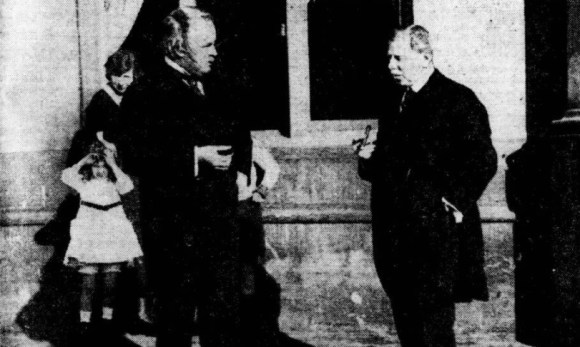
Colonel Henry Kenyon Stephenson, (later Sir Henry), also resided here. He was chairman and managing director of Stephenson, Blake & Co Ltd, later becoming chairman of the Sheffield Gas Company.He became treasurer of the University College of Sheffield, and later the first treasurer of its successor, the University of Sheffield. It was at Banner Cross Hall that Stephenson entertained Prime Minister, Lloyd George, in 1919.
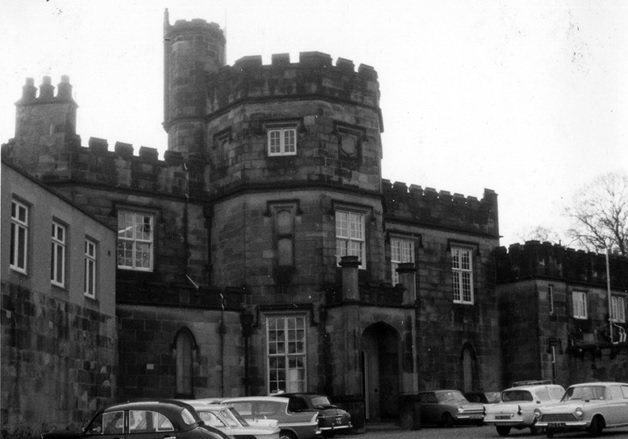
This rather grainy photograph from 1919 shows Lloyd George outside the home of Henry Kenyon Stephenson, Master Cutler, where the Prime Minister had stayed overnight.
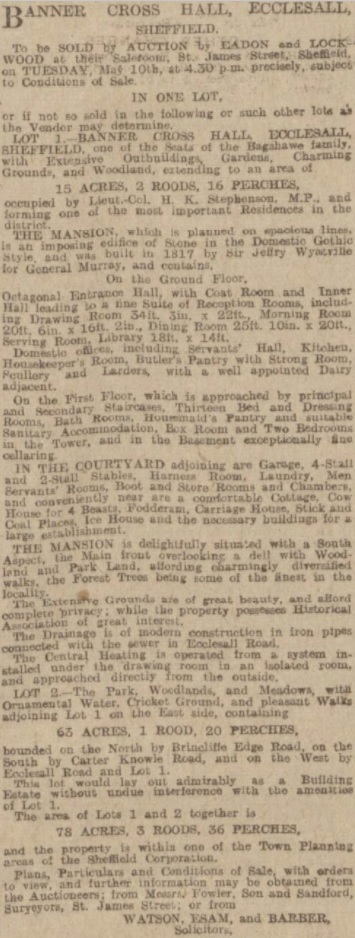
When Colonel Stephenson moved to Hassop Hall in 1921, the Bagshawes put the house and estate on the market. It failed to sell and three years later was tenanted by David Flather, of the firm of W.T. Flather, Standard Steel Works, Tinsley, who moved from Whiston Grange. During his tenure, another Prime Minister visited Banner Cross Hall, Stanley Baldwin in 1928. Flather remained until 1931 when he left for Hooton Levitt Hall, near Maltby.
A detailed sale notice from April 1921. The house failed to sell at auction. Image: British Newspaper Archive
Land immediately adjacent from Ecclesall Road South to Archer Lane was sold for development, and the property once again put on the market.
“The mansion is delightfully situated with a southern aspect, overlooking a dell with woodland and parkland. Included in the sale are the parks and meadows, with ornamental water, cricket ground, and pleasant walks. The total area is over seventy-eight acres.”
In 1932, the house and just over an acre of land was bought by Charles Boot to replace offices for Henry Boot and Son at Moore Street.
“Certain structural alterations to adapt it for office purposes have been started and would be completed within a month,” said Charles Boot. “The front of the Hall will be somewhat altered, but it is not my intention to do anything to destroy the amenities of the district.”
As might have been expected, the interiors were much altered. The Dining Room became the Board Room and was decorated with 17th century carved wood from demolished Hayes Place (Kent) and a fireplace and panelling from RMS Mauretania, scrapped in 1935.
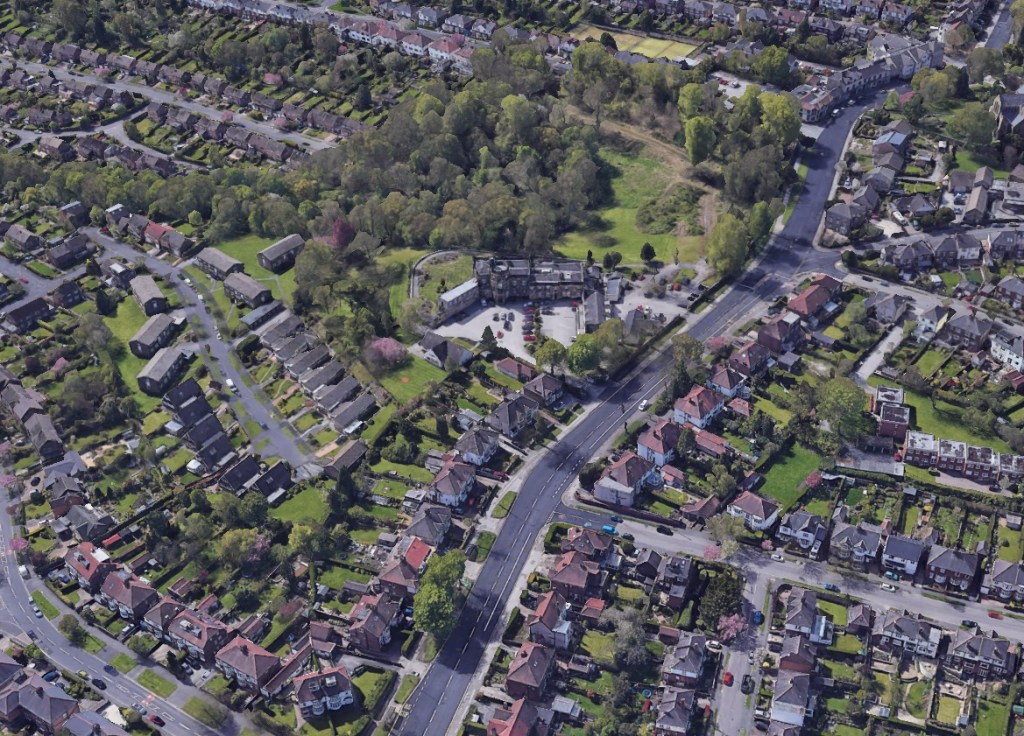
Most of the grounds were lost to development, and the history of Banner Cross Hall and the names of the distinguished families who occupied it are maintained in the naming of roads in the vicinity, including Tullibardine, Murray, Glenalmond, Gisborne, Blair Athol, and Ford roads.
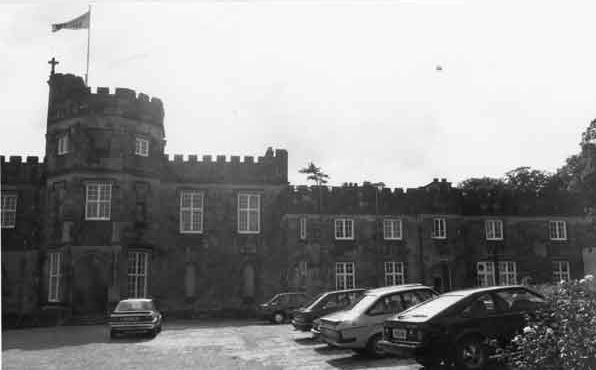
Aerial view of Banner Cross Hall. The house originally stood in countryside but its former lands were sold off for housing. Image: Google



 sheffielder.net