Categories
Buildings

Clergy House – “It was a good thing to shut up a public house and get rid of a licence.”

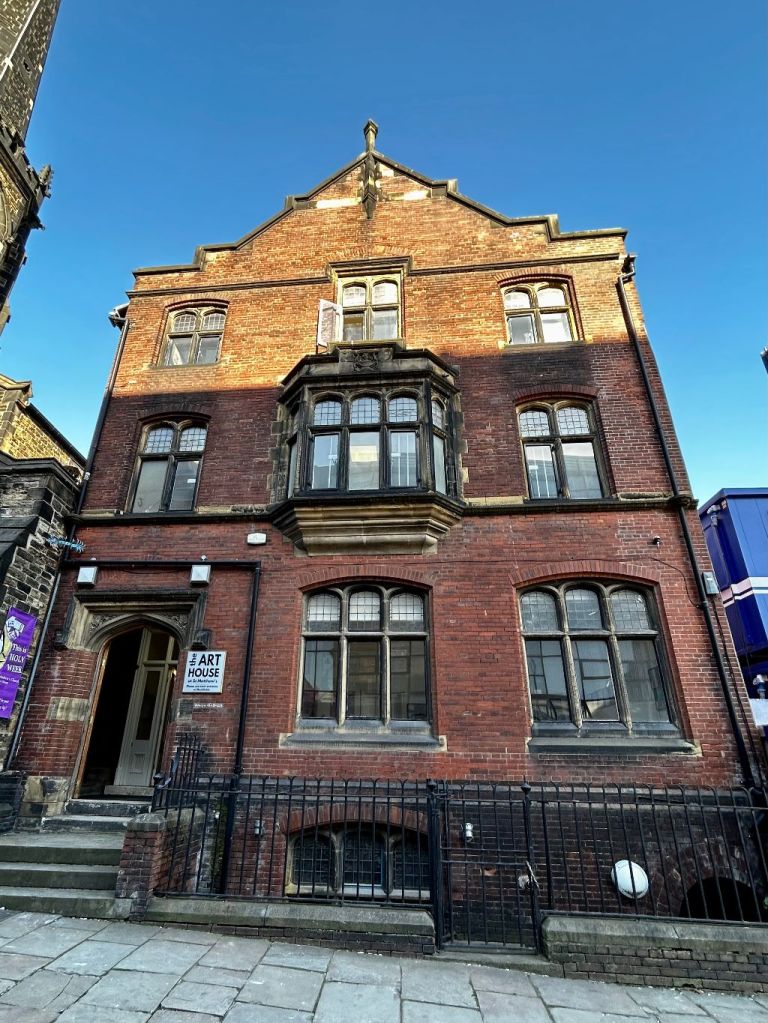
Clergy House, now The Art House. Image: DJP/2023

We recently looked at St. Matthew’s Church on Carver Street that was built in 1854-1855. Next door is an equally important building that is known today as The Art House, a trading name of St Matthew’s House, a charity set up in 2011 to support people with mental health issues and allow them to engage with the creative arts.

It was originally called Clergy House, built in Tudor Gothic style in 1896 as a home and parish rooms for the Rev. George Campbell Ommanney, vicar of St Matthew’s Church between 1882 and 1936, and two assistant priests.

The old vicarage, as far away as Highfield, was sold in 1884, and for several years the vicar and his clergy lived in seedy rented accommodation at No. 71 Carver Street, close to the church.

“A vicar who is willing to make the sacrifice involved in taking up his abode in such a dingy, insalubrious district at that which contains St. Matthew’s ought at least to live in a comfortable house,” wrote the Sheffield and Rotherham Independent in 1896.

At that time, houses beyond those of the very poorest class were scarce in the central parts of Sheffield. All the large ones had been sacrificed to the demands of commerce.

The parishioners sought to remedy the situation, and Rev. Ommanney was able to secure a freehold site adjoining St. Matthew’s Church at a cost of £900. The site had been a public house – the Stag Inn – allowing the vicar to say, “it was a good thing to shut up a public house and get rid of a licence.”

The amount required to build the new Clergy House was £2000 and the vicar used money from the sale of the old vicarage as well as the interest which had accrued against it. The York Diocesan Church Extension Society subscribed £150, and the Sheffield Church Burgesses gave a similar sum. The vicar contributed £450, and two members of the congregation subscribed £100 each. To make up the balance, the vicar intended to borrow £500 from the trustees of Queen Anne’s Bounty, but further subscriptions flooded in and the crowning gift was a grant of £7000 from the Ecclesiastical Commissioners. It allowed the house to be built debt free.
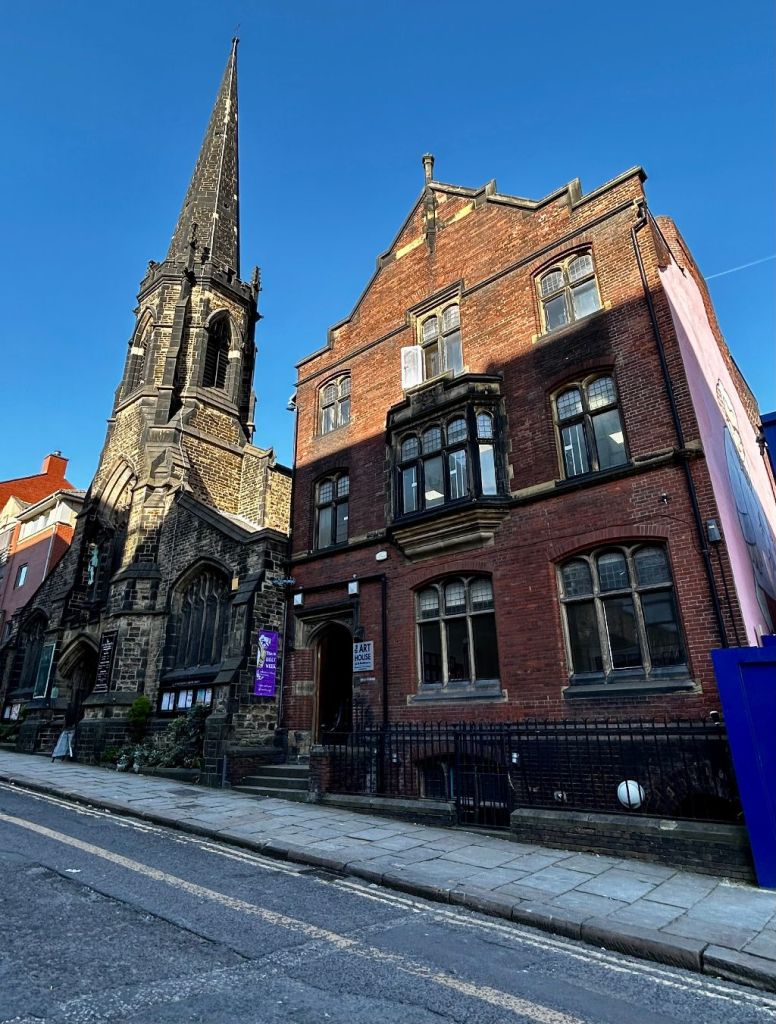
Clergy House was once the site of a public house. “While the public house existed, men frequently came into the church during the Saturday night prayers under the influence of liquor. These visitors joined in the service in such a peculiar fashion and made so much noise, that occasionally Rev. Ommanney had to stop the service, take off his surplice, and eject them.” Image: DJP/2023

The architect was John Dodsley Webster, and it was built in red brick with stone facings. The basement contained the large parish room, on the ground floor were the drawing room, kitchen, and offices, while the first floor contained sitting room, study, bedroom, and bathroom. Five bedrooms occupied the top floor.

Land at the back, on Backfields, was later bought to add parochial buildings, including a Sunday School.

According to the Art House website, time took its toll on the building and the building deteriorated to an extent that a major refurbishment had to be undertaken. A small group of people from the congregation devised a plan to restore St. Matthew’s House to its former glory, and once again play a part in serving the needs of the local community. The Art House Charity was established in 2011 and spent four years raising the £1.5m needed to refurbish the dilapidated building. A modern extension was added to the rear in 2015.

The building is leased to the charity by St. Matthew’s Church at a peppercorn rent.
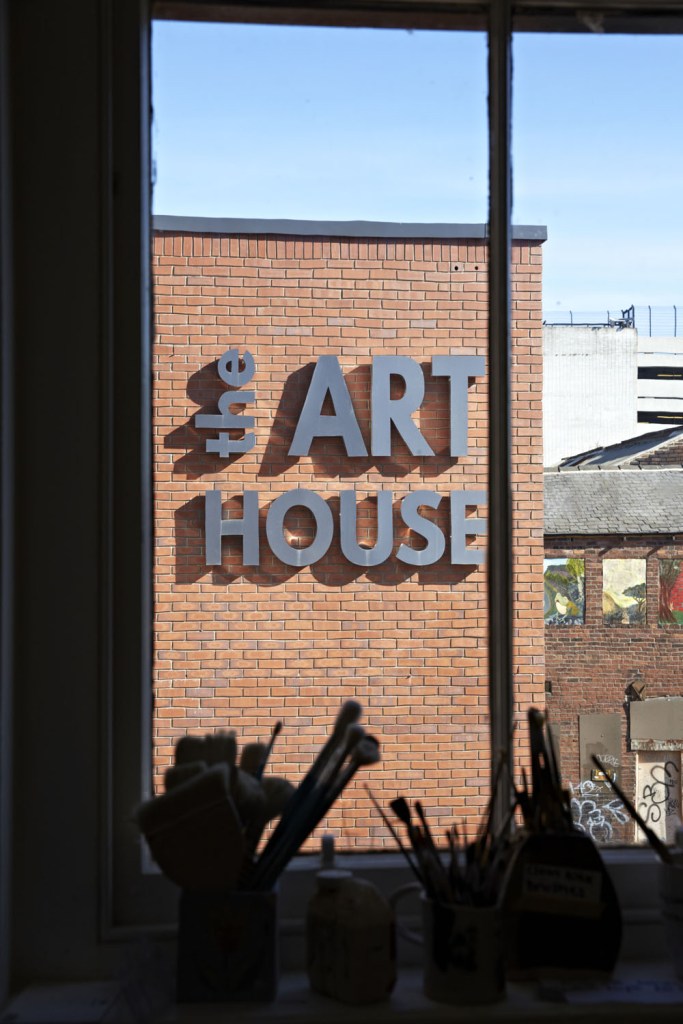
Modern extension for The Art House. Image: Our Favourite Places

©2023 David Poole. All Rights Reserved.
Categories
Buildings Streets

38-40 Fargate – Still here, 140 years after being built

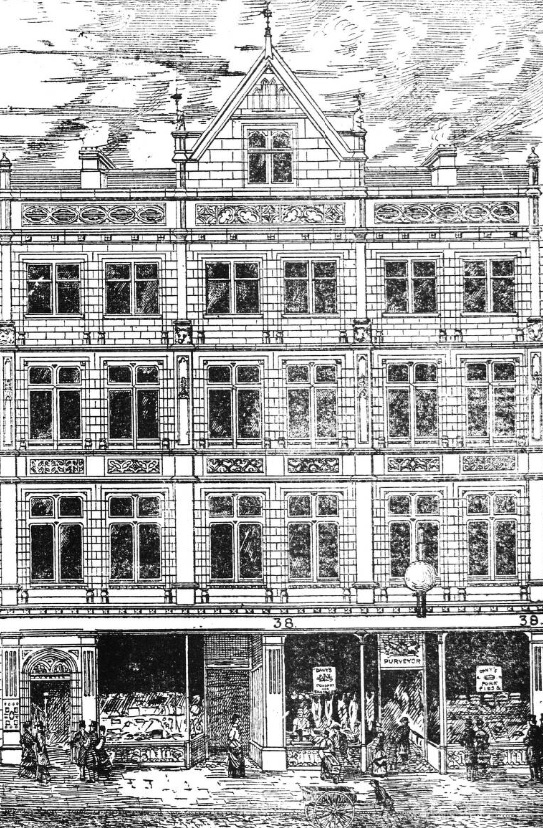
‘Fargate of the present’ declared the Sheffield and Rotherham Independent in 1884. It showed the recently constructed shop for Arthur Davy. Image: British Newspaper Archive.

We have covered this building before, but as always happens, new material surfaces.

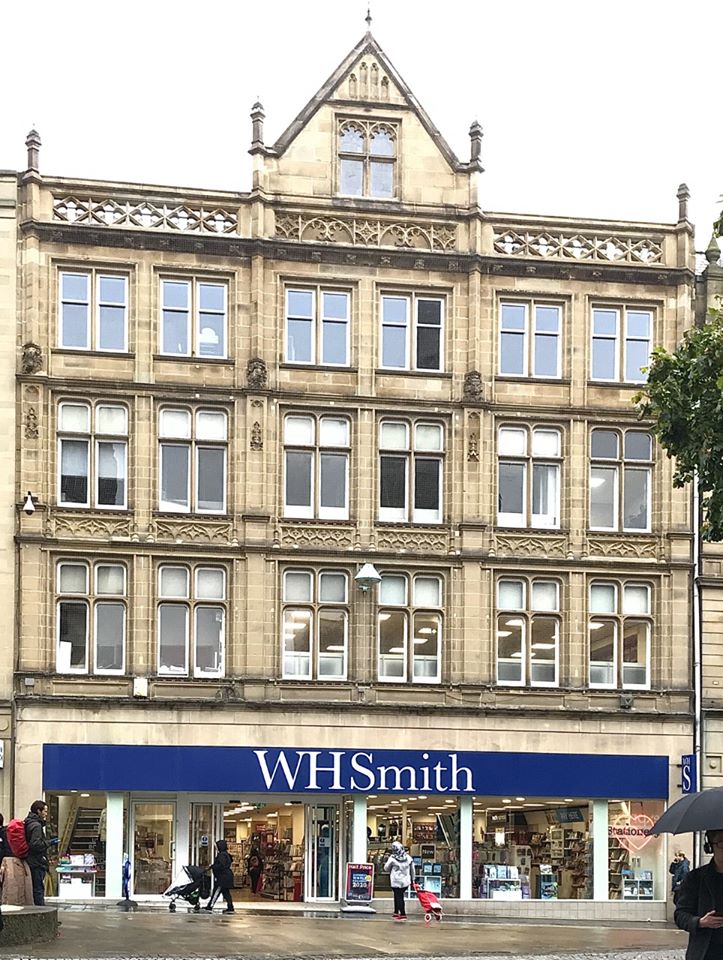
Take a close look at this sketch from 1884. It looks different these days but stands proudly as ever. This is 38-40 Fargate, erected in 1881-1882 for Arthur Davy, and described at the time as the largest retail provision store in Great Britain. Since the 1970s, it has been occupied by WH Smith.

It was erected because of Sheffield Corporation’s Street Widening Programme of the late 1800s that encompassed Pinstone Street, Fargate, and later, High Street. In modern terms, this might be considered to have been Sheffield’s original Heart of the City redevelopment.

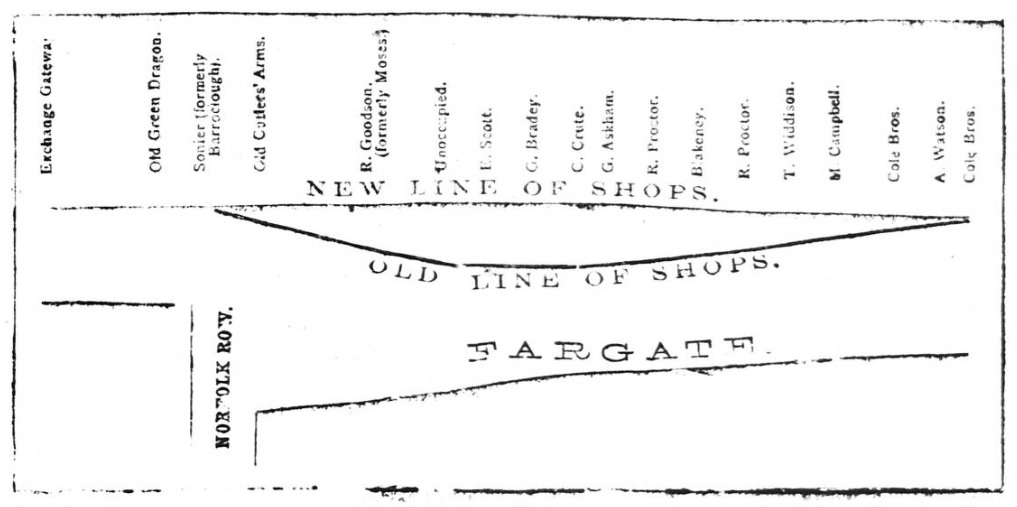
Before this, Fargate was much narrower, the street line on the north side extending much further forward into what is today’s pedestrian precinct.  In fact, there was a ‘pinch-point’ in front of old shops that previously occupied the site. When these were demolished, Arthur Davy’s building was built much further back along a straight line of new buildings, most of which survive.

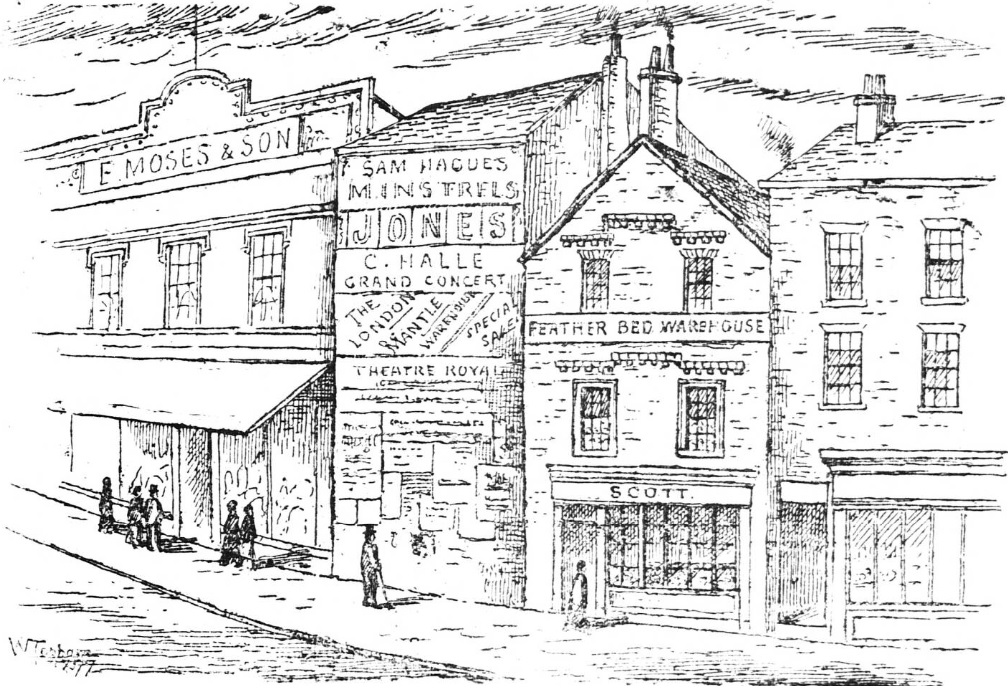
We also know which shops were demolished to make way for the new building. These were R. Goodson, a mantle shop (formerly E. Moses), a vacant unit (they even had empty shops then), E. Scott, feather bed warehouse, and George Bradley, watch and clockmaker.

Former buildings where 38-40 Fargate now stands. The old line of shops was demolished and the street made wider. Note the empty shop that was used for advertising purposes. Image: British Newspaper Archive

Pevsner describes John Dodsley Webster’s design for the new building as ‘economic handling of a late Gothic style, with carved animal heads advertising hams, potted meats and pork pies for which it was famous.’ Look carefully, these are still visible above WH Smith today.

Where stationary, magazines, and books, line the interior today, we must use our imagination as to what it used to look like.

The ground floor sales shop was 75ft long and 40ft wide, lined with Minton’s White Tiles. On the right was a counter for the sale of hams, bacon, butter, cheese, eggs, and tinned goods. On the left was the counter for pork, polonies, sausages, pork, veal and ham pies, brawn, pork, and lard. There was also a room in which to hang 50 pigs, 4000 hams, 2000 sides of bacon, besides a considerable number of polonies and sausages.

An entrance via Exchange Gateway (the small lane that exists to the left) led to a slaughterhouse, where Royal Pigs were killed, the carcases lowered through a trap door into a room below, where they were opened and dressed, and hung upon rails at the back of the shop.

Another room held the bakehouse where the crust for pork pies was made and baked in two Jennison Smokeless 2-Deckers, capable of baking 12cwt of pies per day.

It’s hard to believe, but where many of us remember WH Smith’s record department, this used to be where sausages and polonies were made, as well as the curing of ham and bacon. These were conveyed to the shop above by hydraulic lift.

In later years, the upper floors also became Davy’s Victoria Café, used for light refreshments, luncheons and afternoon teas.

Carved panels above the first-floor windows and open quatrefoils in the parapets either side of the central gable. Carved animal heads advertise hams, potted meats, and pork pies that Arthur Davy was famous for.

Sadly, Davy’s closed in 1972, and converted into WH Smith, complete with a flat canopy outside that has long-since been removed. In recent years, the shop had to close for a significant period, temporarily relocating to Pinstone Street, after roof supports failed and had to be replaced.

See the previous post about Arthur Davy here

©2022 David Poole. All Rights Reserved.
Categories
Buildings

St. John’s Buildings

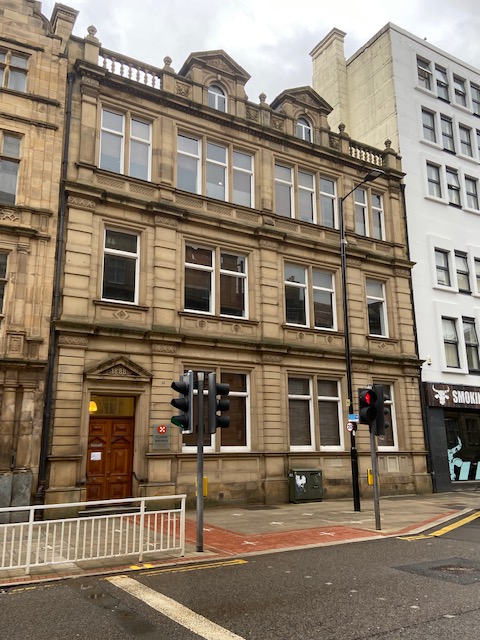
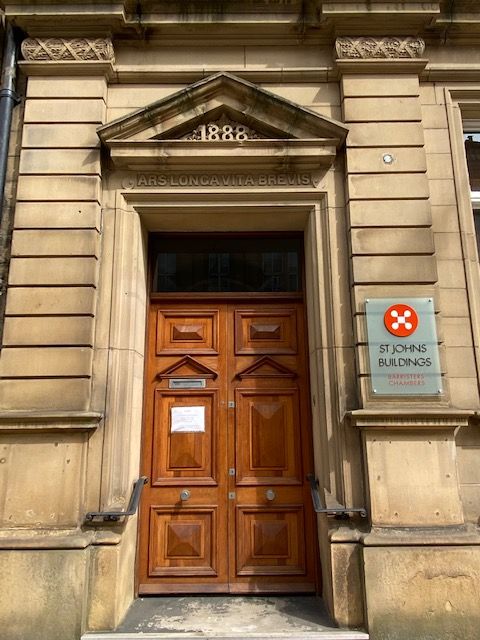
Sheffield Medical School (1888) by J. D. Webster. Northern Renaissance-style. The Institution was the third provincial medical school and could accommodate a hundred students. (DJP/2021)

Here’s a building on Leopold Street with a thought-provoking history. St. John’s Buildings are now used as barristers’ chambers, the interior changed from its former use as the Bank of Scotland. However, a stone inscription (Ars Longa Vita Brevis) above the main entrance provides a clue to its original use.

Somewhere within, lies a foundation stone, and within its cavity is a bottle, a time capsule, containing Sheffield’s morning papers from June 1887, a conjoint prospectus for 1886-1887 for Firth College, Technical School, and School of Medicine, an old photograph, and a parchment engrossed as follows : –

“The Sheffield School of Medicine was built in 1828, at the corner of Surrey Street and Arundel Street, the foundation stone having been laid by Sir A.J. Knight in July 1828. The building having become inadequate to the requirements of the day in 1883, a proposal was made to amalgamate with or become a department of Firth College, the councils of the school and Firth College having met and fully considered points of co-operation, unanimously agreed that the union was likely to be advantageous to both, but before complete incorporation took place a new medical school was necessary.”

The new medical school was this building, the foundation stone laid by Dr Mariano Alejo Martin de Bartolomé, using a specially inscribed silver trowel.

I declare this stone duly laid in the name of the Father, the Son, and the Holy Ghost. From this humble structure may we raise up a structure perfect in all its parts, and creditable to the builders.

“It will, in the course of time, grow as an oak did from the acorn, that it will spread its beneficial shadow over the whole of the town and neighbourhood, and communicate the blessings of true medica and surgical practice.”

Designed by architect John Dodsley Webster and built by W. and A. Forsdyke, of St. Mary’s Road, it was opened with an extravagant soiree, including a special address from Sir Andrew Clark, President of the Royal College of Physicians, in September 1888.

The sum required to build the school was £6,000, of which about £3,000 was raised before an appeal was made to the public. “We venture to ask the help of the people of Sheffield, on the ground that school of medicine is an advantage to them; because it stimulates the members of the medical profession to keep pace with the rapid progress of medicine and surgery.” (DJP/2021)

A site had originally been purchased from the Corporation in Pinfold Street; but at the request of the medical council the Corporation agreed to exchange the land for a plot in Leopold Street, opposite Firth College. The area contained about 550 yards and the price was £5 a yard. There was a frontage of about 50ft on Leopold Street, the main elevation being entirely of stone, and the treatment a sort of classic free renaissance, which caused the building to harmonise well with the surrounding property.

On the ground floor towards Leopold Street was a faculty room and library, a lecturers’ room, with porter’s room, lavatory, main staircase, and entrance hall. Also, on this floor, running towards Orchard Street, was an injection room and lumber room. A hoist connected the ground floor with the first floor.

On the first floor were two classrooms and at the back was a museum. The medical theatre was on the second floor, with circular seats in tiers, alongside a practical physiology and a dissecting room.

The School of Medicine was short-lived here, its entwined relationship with Firth College, and the Technical School, leading them to form University College, Sheffield, in 1897, and the eventual creation of the University of Sheffield in 1905, with the medical school moving to a new building at Western Bank (now Firth Court). In 1973, it moved again, and can still be found on Beech Hill Road.

After the school vacated, the building has been in almost continuous use. It will be recognised by those of a certain age as Sheffield Education Committee’s Central School Clinic, afterwards as a bank, and now St. John’s Buildings.

© 2021 David Poole. All Rights Reserved.