Categories
Buildings

Town Hall Chambers: I bet you didn’t know what it was intended to be

This post was planned as a tribute to one of Sheffield’s most famous shops, Wilson Peck, but research into its origins have proved to be rather complex. That post is imminent, but during the investigation some fascinating facts emerged about one of the buildings that it once occupied.

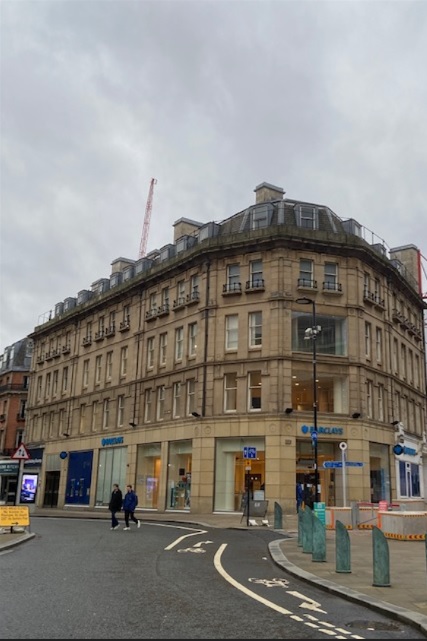
I’m talking about Town Hall Chambers that sits at the corner of Pinstone Street and Barker’s Pool, and now home to the city centre’s last surviving Barclays Bank.

According to Pevsner, it is a ‘worthy, but slightly dull five-storey block of shops and offices’, and like nearby Yorkshire House (another home of Wilson Peck), it has never been listed by Historic England.

The building was designed by Sheffield architect John Brightmore Mitchell-Withers in 1882-85 as part of the street improvement scheme that reinvented Pinstone Lane, a salubrious and narrow thoroughfare, into Pinstone Street, long recognised as one of the city’s most prominent streets.

The site had been an old hostelry called the Norfolk Hotel that was demolished in 1881 as part of the street widening programme. Evidence suggests that J.B. Mitchell-Withers bought the plot of land to build upon, and now I’ve discovered that it was built as a hotel.
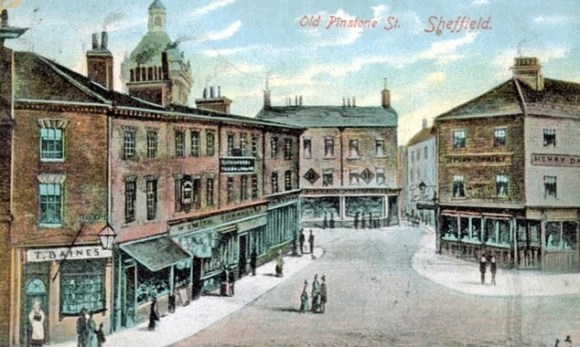
Pinstone Street from Orchard Street, No. 73 Fargate, T. Baines, hairdresser, left, No. 79 Barker’s Pool, Norfolk Hotel (landlord-Henry Darley), right, premises on Pinstone Street include No. 3 Wm Smith, hatter, Nos. 5 – 7 John Richardson, tailor. 1879. Image: Picture Sheffield

In 1884, newspapers advertised that the New Scarborough Hotel was available to let, containing a dining room, commercial room, smoke room, billiard room, refreshments bar and forty bedrooms. It also boasted the best modern appliances for cooking, hydraulic and other lifts, and electric bells.

The following year, it was announced that Lewis’s had ‘acquired the important block of buildings at the corner of Pinstone Street and Barker’s Pool, known as the Scarborough Hotel, and shops below,’ suggesting that the hotel never opened after failing to attract any interested parties.

The name of Lewis’s is famous in the history of UK department stores and the fact that it once had a branch in Sheffield comes as a bit of a surprise.

The first Lewis’s store was opened in 1856 in Liverpool by entrepreneur David Lewis, as a men’s and boys’ clothing store, mostly manufacturing his own stock. In 1864, Lewis’s branched out into women’s clothing, later expanding all its departments, and his motto was ‘Friends of the People’.

The first Lewis’s outside Liverpool opened in Manchester in 1877 followed by Birmingham in 1885. However, it was the Manchester store that it was best known for and later included a full scale ballroom on the fifth floor, which was also used for exhibitions. Its fourth store was in Sheffield, but with stiff local competition from John Atkinson and Cole Brothers, it proved unprofitable, and closed in 1888.

Negotiations quickly took place between the trustees of David Lewis and Joseph Hepworth and Son, a suit manufacturer that had rapidly expanded with over sixty shops across the country.

The premises underwent extensive alterations to accommodate its ready-made clothing, hats, and outfitting departments. The entire building was redecorated and lit with electric lamps, and when plans were submitted for Sheffield Town Hall in 1890, it was proudly referenced as the Hepworth’s Building.

Hepworth’s stay lasted four years, and in 1892 Arthur Wilson, Peck and Co, announced that they were vacating their three premises in Church Street, West Street, and Fargate, and consolidating business in the Hepworth’s Building.

It became known as Beethoven House and lasted until 1905 when it moved to the opposite corner in premises vacated by cabinet makers Appleyards and Johnson, and now known as Yorkshire House.
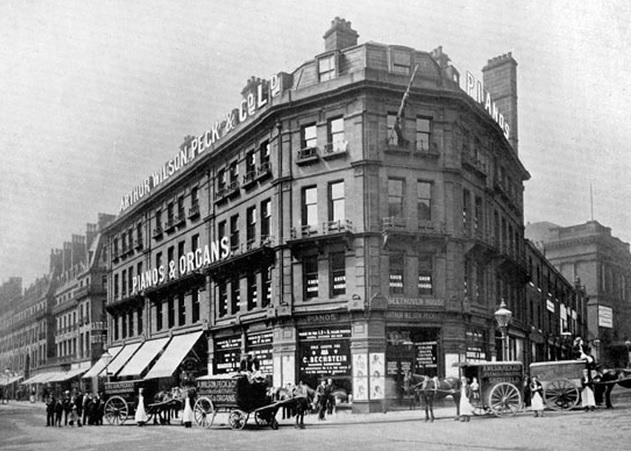
Arthur Wilson, Peck and Co., Ltd., pianoforte, organ, and musical instrument dealers, Beethoven House, Pinstone Street. 1897. Image: Picture Sheffield

At which point the building became known as Town Hall Chambers is uncertain, but by the 1930s, the ground floor had been subdivided into smaller shops, and the floors above converted into offices for numerous insurance companies.

Our generations will remember it as a centrepiece shoe shop for Timpson’s and as a short-lived branch of Gap, before being reinvented as a futuristic Barclays Bank. I’d be grateful if anyone can name any other businesses that might have been located here.

And so, we’ve discovered that Town Hall Chambers started as an ill-fated hotel. The building itself survived two World Wars and managed to escape Heart of the City redevelopment, but the irony is that neighbouring Victorian buildings further along Pinstone Street, also built as part of the 1880s street widening scheme, will soon become the Radisson Blu Hotel.
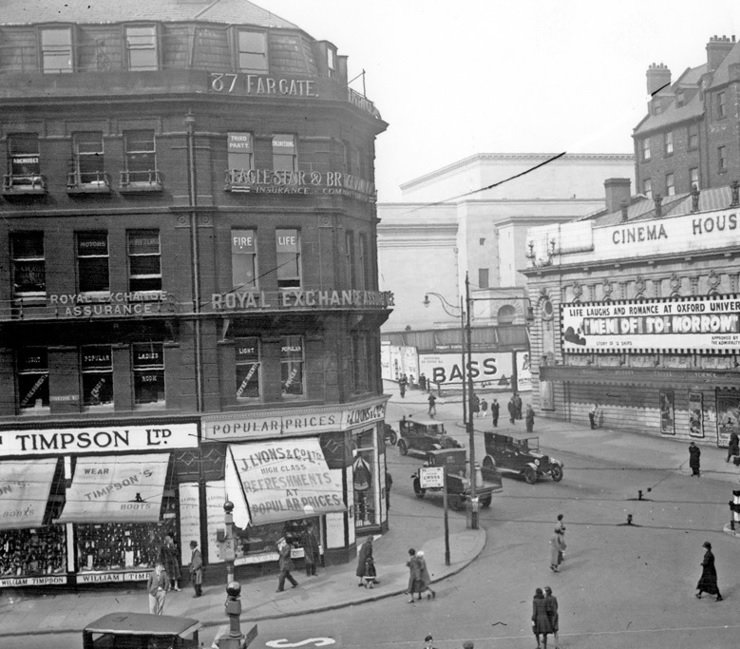
Town Hall Square and Barkers Pool, Town Hall Chambers, William Timpson Ltd., Shoe Shop and J. Lyons and Co. Ltd., Dining and Tea Rooms on left, Cinema House on right. 1935. Image: Picture Sheffield

© 2024 David Poole. All Rights Reserved.
Categories
Buildings

Ban-Thai. Like so many old buildings, its original use is overlooked

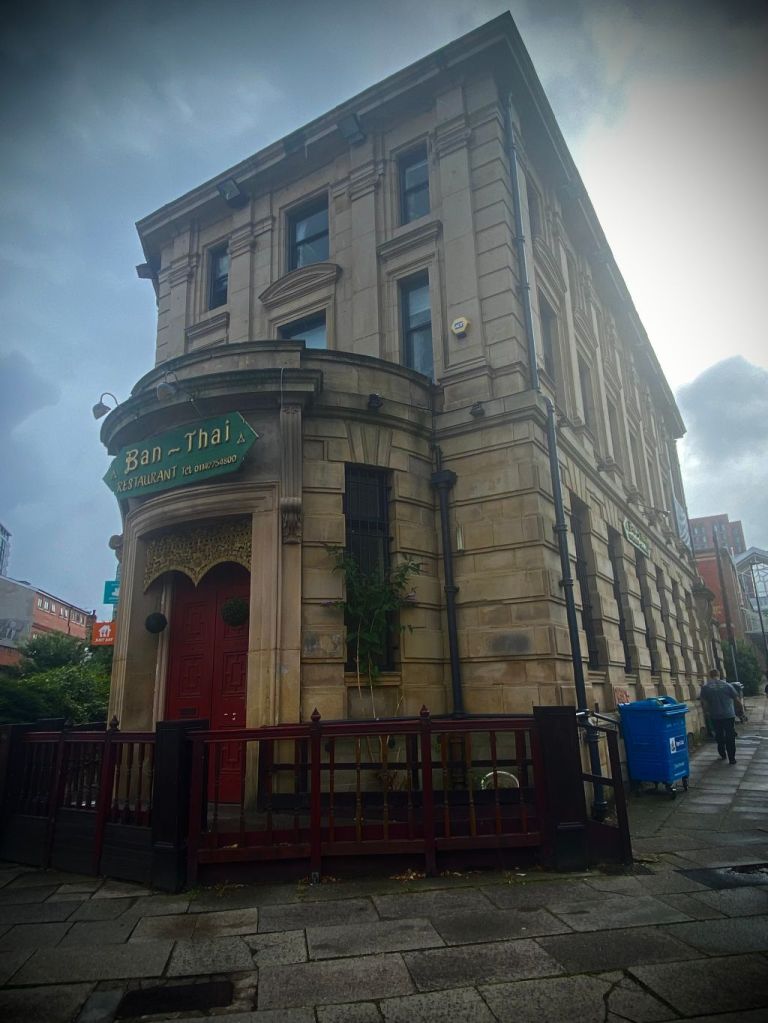
Ban Thai restaurant, on the west side of St. Mary’s Gate, is known to many, but like many old buildings, its original use is overlooked.

It was built in 1894 for the Sheffield Union Bank at the corner of Cemetery Road and Ecclesall Road. The postal address is still No.1 Ecclesall Road and goes back to when it stood adjacent to the Sheffield & Ecclesall Co-op building, demolished to make way for the Safeway (Waitrose) supermarket, and before the widening of St. Mary’s Gate.

Sheffield Union Bank was established in 1843, taking over the business of the Yorkshire District Bank. Its first branch opened in Retford in 1846, and expanded across Sheffield, Rotherham, Penistone, and Chesterfield.

This office was confusingly referred to as the Sheffield Moor branch and after the bank’s amalgamation with the London City & Midland Bank in 1901, it operated as the Midland Bank. The branch was offloaded to the Trustee Savings Bank in the later part of the twentieth century.

When the bank closed, it became Robert Brady, outfitters, before becoming Barbarella’s restaurant and bar and then Ban Thai. The upper floors were converted to provide two storey student accommodation in 1995.

The design of the Grade II listed building was the work of architects J.B. Mitchell-Withers & Son, whose practice was on Surrey Street.

John Brightmore Mitchell-Withers (1838-1894) came from the family of Samuel Mitchell, a name often mentioned in Hunter’s Hallamshire, and the son of W.B. Mitchell. He was educated at Collegiate College, later tutored by architect Samuel Worth, and set up on his own as an architect and surveyor. 

By the will of his aunt, Sarah Withers, he inherited her Sheffield property with the stipulation that he took the name of Withers.

Mitchell-Withers’ work can still be seen across the city. He was responsible for the extension to the Cutlers’ Hall after winning a competition in 1888. There are also Town Hall Chambers on Pinstone Street (1885), Firs Hill Junior School, the Licensed Victuallers’ Association Almhouses, Abbeydale Road South, as well as St John the Baptist Church, Penistone Road, St. Silas Church, Broomhall Street, and restorations to the nave of St. Mary Church at Ecclesfield. He also built his home,  Parkhead House (then called Woodlands) on Ecclesall Road South.

He was an enthusiastic watercolour painter with involvement in the local art scene. He became president of the Sheffield School of Art and the Sheffield Society of Artists and was vice-president and treasurer of Sheffield Society of Architects and Surveyors. The Duke of Devonshire engaged him to supervise the restoration of painted ceilings in the state rooms at Chatsworth House.

This branch of the Sheffield Union Bank was one of his last commissions and he died of a heart attack in the year it was built. Another commission for Union bank on Langsett Road had to be completed by his eldest son, also called John Brightmore Mitchell-Withers in 1895.

John Brightmore Mitchell-Withers (1865-1920) succeeded his father and initiated several distinguished buildings. These included extensions to Central Schools on Orchard Lane between 1893-1895 (now adjacent to Leopold Square), High Court on High Street, John Walsh’s department store (bombed), and Clifford House at Ecclesall Road South.

As a boy, he was educated at Rugby where he won several prizes and gained his cap in rugby football at the school. After joining his father’s practice, he passed the examination of the Royal Institute of British Architects (RIBA) in 1890.

Mitchell-Withers Jnr was a member of Hunter Archaeologist Society and like his father, was involved with the Sheffield Society of Artists and became president of the Sheffield Society of Architects and Surveyors, representing them on the council of RIBA.

He became an honorary lecturer on English Gothic architecture at Sheffield University and a council member with the Sheffield Literary and Philosophical Society.

Mitchell-Withers was also an agent for the Burgoyne estate and the Duke of Devonshire’s land near Dore.

©2022 David Poole. All Rights Reserved.