Categories
Buildings People

Walter Gerard Buck

This influential character is relatively unknown in Sheffield’s history. A modest person, he was responsible for one of the city’s iconic landmarks.

Walter Gerard Buck (1863-1934) was born in Beccles, Suffolk, the youngest son of Edward Buck. He was educated at the Albert Memorial College in Framlingham, and acquired an interest in architecture, joining the practice of Arthur Pells, a reputable Suffolk architect and surveyor, where he learned the techniques to design and build.
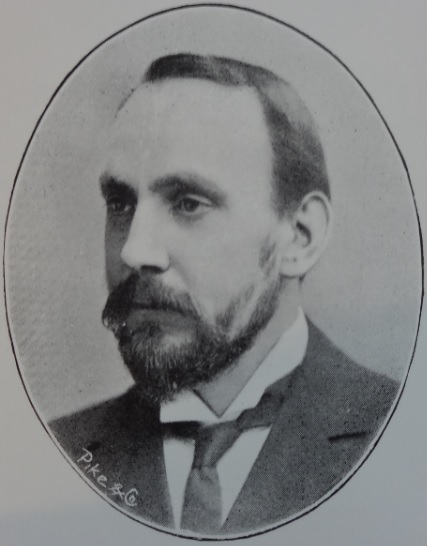
Walter Gerard Buck, architect and surveyor (1863-1934)

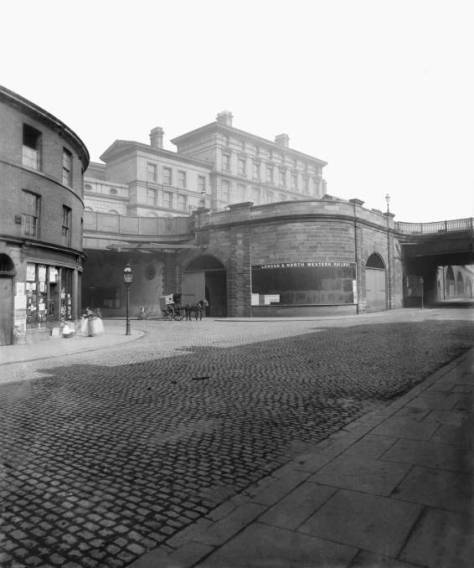
Walter, aged 21, realised there were limitations to this rural outpost and would need to improve his talent elsewhere. This opportunity arose in Manchester, the seat of the industrial revolution, where demand for new commercial buildings was great. It was here where he gained several years’ experience in large civil engineering and architectural works, including the building of the Exchange Station, Manchester, as well as the Exchange Station and Hotel in Liverpool.
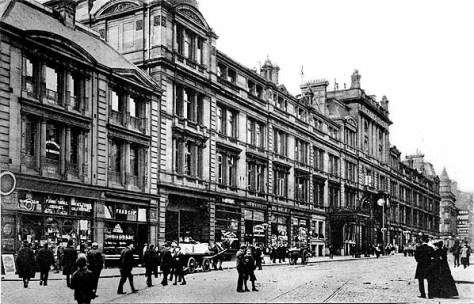
Liverpool Exchange Street Station and Hotel. The frontage remains and in the 1980s was incorporated into the Mercury Court office development. It has recently been converted into 21st century office space called ‘Exchange Station’. (Image: Alan Young)
Manchester Exchange Station was a railway station located in Salford, immediately to the north of Manchester city centre. It served the city between 1884 and 1969. The station was closed on 5 May 1969. (Image: National Railway Museum)

In 1890, his reputation growing, Walter made the move over the Pennines and into the practice of Mr Thomas Henry Jenkinson at 4 East Parade.

Jenkinson had been an architect in Sheffield for over forty years. He had been responsible for several buildings built in the city centre, taking advantage that Sheffield had been one of the last among the big towns to take in hand the improvement of its streets and their architecture.

Buck’s move to Sheffield proved advantageous. Jenkinson had become a partner at Frith Brothers and Jenkinson in 1862, which he continued until 1898, when he retired. He made Walter his chief assistant and allowed him to reorganise the business and control affairs for several years. During this period Walter carried out work on many commercial buildings and factories in Sheffield.

Initially, Walter boarded in lodgings at 307 Shoreham Street, close to the city centre. He married Louisa Moore Kittle in 1892 and, once his reputation had been established, was able to purchase his own house at 4 Ventnor Place in Nether Edge.
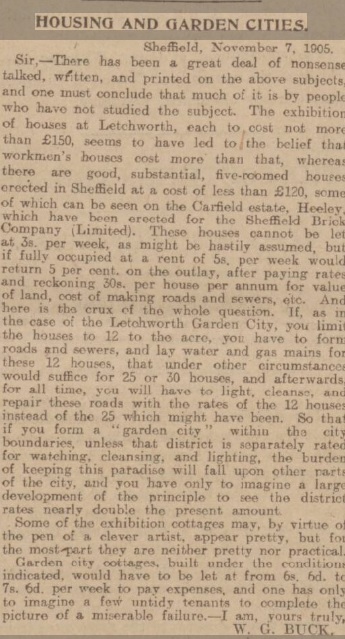
A letter from Walter to the Sheffield Daily Telegraph (8 Nov 1905)

Perhaps Walter Buck’s greatest work also proved to be his most short-lived.

In May 1897, Queen Victoria made her last visit to Sheffield for the official opening of the Town Hall. It also coincided with the 60th year of her reign – Queen Victoria’s Diamond Jubilee Year.

The visit caused considerable excitement in Sheffield and preparations lasted for weeks. Shops and offices advertised rooms that commanded the best positions to see the Queen. Not surprisingly, these views were quickly occupied, but the closest view was promised in the Imperial Grandstand, specially designed for the occasion by Walter Gerard Buck.
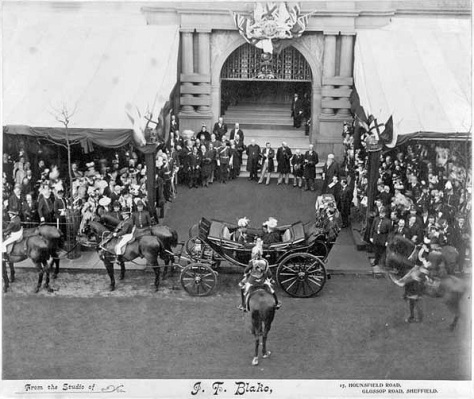
Queen Victoria’s Diamond Jubilee visit to Sheffield in May 1897. The central interest was the newly-built Town Hall where ‘the gilded gates stood closed until her majesty touched the golden key and they flew open’.

This spectacle was built next to the newly-erected Town Hall, opposite Mappin and Webb, on Norfolk Street (in modern terms this would be where the Peace Gardens start at the bottom-end of Cheney Walk across towards Browns brasserie and bar). It was advertised as ‘absolutely the best and most convenient in the city’, with a frontage of nearly 200 feet and ‘beautifully roofed in’. The stand, decorated in an artistic manner by Piggott Brothers and Co, provided hundreds of seats, the first three rows being carpeted with back rests attached to the back. In addition, the stand provided a lavatory, refreshment stalls and even a left luggage office. It was from here that the people of Sheffield saw Queen Victoria as the Royal procession passed within a few feet of the stand along Norfolk Street to Charles Street.

The next day the Imperial Grandstand was dismantled.

The professional relationship between Walter Buck and Thomas Jenkinson matured into a close friendship.

When Jenkinson died in 1900, he left the business to Walter and made him one of his executors. His son, Edward Gerard Buck, eventually joined the business which became known as Buck, Lusby and Buck, moving to larger premises at 34 Campo Lane.

In 1906, Walter was elected to the Council of the Sheffield, South Yorkshire and District Society of Architects and Surveyors and was elected President in 1930. He was also a Fellow of the Royal Institute of British Architects (RIBA) and a member of the council of that body.

Walter also became a member of the council of the Sheffield Chamber of Commerce, a member of the Court of Governors of Sheffield University, a member and director of the Sheffield Athenaeum Club, a member of the Nether Edge Proprietary Bowling Club and vice-president of the Sheffield Rifle Club. It was this last role that he enjoyed best. Walter was a keen swimmer but his passion for rifle shooting kept him busy outside of work.

Apart from architectural work Walter held directorships with the Hepworth Iron Company and the Sheffield Brick Company. These astute positions allowed him to negotiate the best prices for the building materials needed to complete his projects.
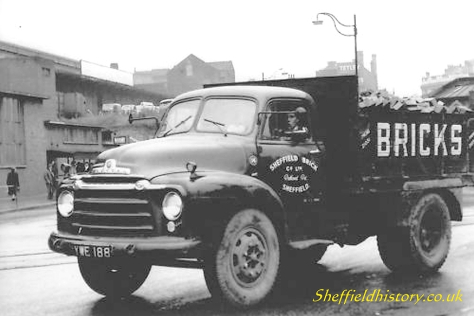
A familiar site on Sheffield’s streets. The Sheffield Brick Company had brickyards situated at Neepsend, Grimesthorpe, Wincobank and Wadsley Bridge. Materials were used in many of the city’s buildings including Sheffield University, the Grand Hotel and the Town Hall. (Image: Sheffield History)

However, as the new century dawned, it was a role outside of architecture that occupied Walter’s time.

In 1892 the French Lumière brothers had devised an early motion-picture camera and projector called the Cinématographe. Their first show came to London in 1896 but the first moving pictures developed on celluloid film were made in Hyde Park in 1889 by William Friese Greene. The ‘new’ technology of silent movies exploded over the next few years and by 1906 the first ‘electric theatres’ had started to open. In London, there were six new cinemas, increasing to 133 by 1909.

Not surprisingly, this new sensation rippled across Britain and Sheffield was no exception. This had been pioneered by the Sheffield Photo Company, run by the Mottershaw family, who displayed films in local halls. They also pioneered the popular ‘chase’ genre in 1903 which proved significant for the British film industry. The Central Hall, in Norfolk Street, was effectively Sheffield’s first cinema opening in 1905, but the films were always supported with ‘tried and tested’ music hall acts. Several theatres started experimenting with silent movies, but it was the opening of the Sheffield Picture Palace in 1910, on Union Street, that caused the most excitement. This was the first purpose built cinema and others were looking on with interest.

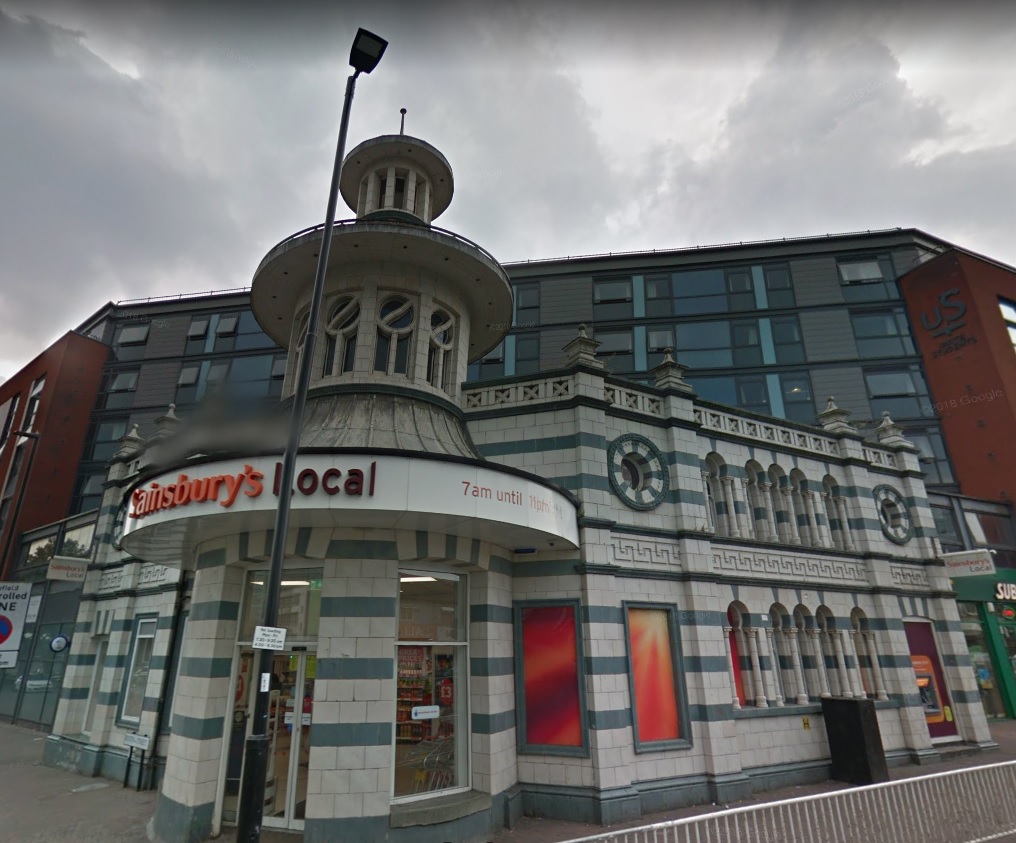
Walter Buck was one such person and saw the opportunity to increase business by designing these new purpose-built cinemas. One of his first commissions was for Lansdowne Pictures Ltd who had secured land on the corner of London Road and Boston Street. The Lansdowne Picture Palace opened in December 1914, built of brick with a marble terracotta façade in white and green, with a Chinese pagoda style entrance. It was a vast building seating 1,250 people. In the same year he designed the Western Picture Palace at Upperthorpe for the Western Picture Palace Ltd.
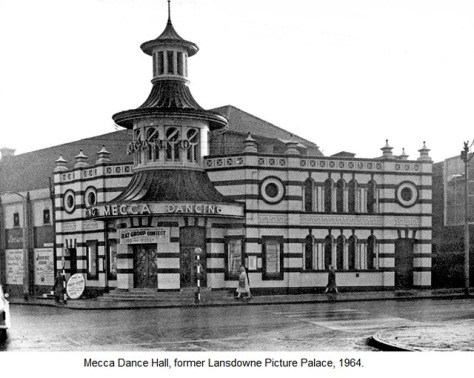
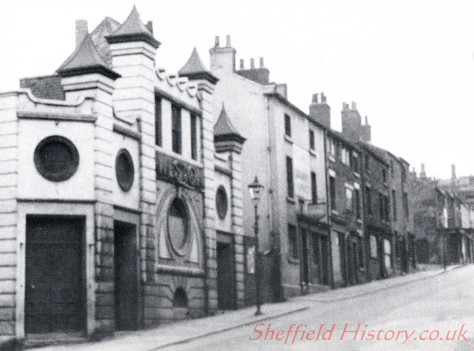
The Lansdowne Picture Palace was designed by architect Walter Gerard Buck of Campo Lane, Sheffield. It stands at the junction of London Road and Boston Street and opened on 18th December 1914.  In 1947 the cinema became a temporary store for Marks & Spencers. In the 1950’s it became a Mecca Dance Hall called the ‘Locarno’ later changing into ‘Tiffany’s Night Club’. It had several more reincarnations as a night club with different names and the frontage was painted black, its last name being ‘Bed’. (Image: Cinema Treasures)
The Weston Picture Palace, designed by Walter Gerard Buck in 1913-14. The cinema was on St Phillip’s Road and Mitchell Street and was demolished. (Image: Sheffield History)

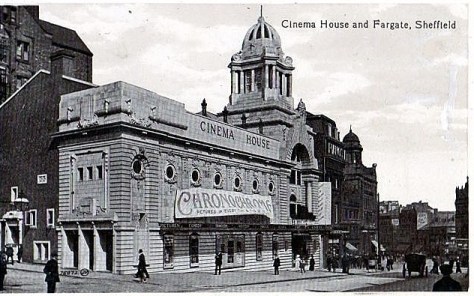
With the knowledge required to build cinemas it was unsurprising that Walter Buck was asked to join several companies as a director. One of these was Sheffield and District Cinematograph Theatres Ltd which was formed in 1910 for ‘the purpose of erecting and equipping in the busiest and most thickly populated parts of the City of Sheffield and district picture theatres on up-to-date lines’. Its first cinema was the Electra Palace Theatre in Fitzalan Square with a seating capacity upwards of 700 with daily continuous shows. Their second cinema was the Cinema House built adjoining the Grand Hotel and adjacent to Beethoven House (belonging to A Wilson & Peck and Co) on Fargate, this part later becoming Barker’s Pool. This was a much grander cinema with a seating capacity of 1,000 together with luxuriously furnished lounge and refreshment, writing and club rooms.

Ironically, Walter Buck did not design either of these picture houses. Instead, they were conceived by John Harry Hickton and Harry E. Farmer from Birmingham and Walsall, but the bricks were supplied by the Sheffield Brick Company, that lucrative business where Walter was a director. It should not go unnoticed that this highly profitable company probably made Walter a wealthy man. It had already supplied bricks for the Grand Hotel, Sheffield University and the Town Hall.
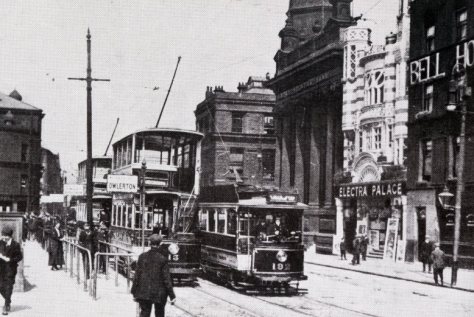
Opened as the Electra Palace on 10th February 1911. It was designed by J.H. Hickton & Harry E. Farmer of Birmingham & Walsall. Constructed by George Longden & Son Ltd. (who built several Sheffield cinemas), the proprietors being Sheffield & District Cinematograph Theatres Ltd. (Image: Sheffield History)
Opened in 1913, the Cinema House seated 800 and was one of the smaller city centre cinemas. Boasting a tea room, it had a narrow auditorium and patrons entered from the screen end of the hall. Being narrow, it’s Cinemascope image size was severely restricted. It closed in 1961 and was subsequently demolished. (Image: Cinema Treasures)

The cinema undertaking was not without risk and Cinema House, which opened six months before the start of World War One, always struggled to break even.

In 1920, far from building new cinemas right across the city, the company bought the Globe Picture House at Attercliffe. The following year they reported losses of £7,000 with Cinema House blamed for the poor performance.

At this stage, it is unclear as to what involvement Walter Buck had with Sheffield and District Cinematograph Theatres. He was also a director of Sunbeam Pictures Ltd, designing the Sunbeam Picture House at Fir Vale in 1922, and the Don Picture Palace at West Bar. He was most certainly a director of the Sheffield and District Cinematograph Company  by the late 1920s, and eventually became its chairman. In 1930, absurdly on hindsight, he was faced with a public backlash as the company made the transfer over to ‘talkie’ pictures.

“It was true that some people preferred the silent pictures, but the difficulty was that the Americans were producing very few silent films, or the directors might probably have kept some of the houses on silent films to see if they could hold their own with the talkie halls.”
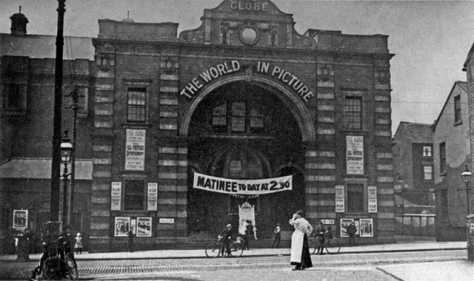
Located on Attercliffe Common at the junction with Fell Road. The Globe Picture Hall was a venture of the Sheffield Picture Palace Co. Ltd. It opened on 10th February 1913 and was, at that time, one of the largest cinemas in Sheffield. The architects were Benton & Roberts. The owning company reformed on 21st March 1914 as the Sheffield & District Cinematograph Theatres Ltd. and remained owners until closure on 29th June 1959. (Image: Cinema Treasures)
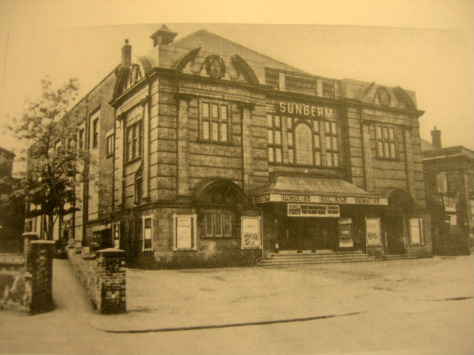
The Sunbeam Picture House was built on Barnsley Road at the junction of Skinnerthorpe Road in the Fir Vale district of Sheffield. The Sunbeam Picture House opened on Saturday 23rd December 1922. It was built set back from the road and was an imposing brick and stucco building, with a large embossed rising sun motif on the facade, set inside an ornamental parapet. A central entrance to the cinema was covered with a canopy. (Image: Sheffield History)
The Don Picture Palace opened on Monday 18th November 1912 with the films “Captain Starlight” and “Monarchs Of The Prairie”. The architect was Henry Patterson and it was situated in what was then one of the main entertainment areas of Sheffield with the old Grand Theatre of Varieties being close by. (Image: Sheffield History)

Walter Buck never retired but died at his home at 19, Montgomery Road, Nether Edge, aged 70, in September 1934. He left a widow, his second wife, Fanny Buck, and three sons – Edward Gerard Buck, William Gerard Buck, a poultry farmer, and Charles Gerard Buck, chartered accountant. Walter Gerard Buck was buried at Ecclesall Church.

It seems the only epitaph to Walter Buck is the Chinese pagoda style entrance of the Lansdowne Picture Palace. The auditorium was demolished to make way for student accommodation, but the frontage was retained for use as a Sainsbury’s ‘Local’ supermarket. Very little information exists about his other work in the city and further research is needed to determine which buildings he designed, and which remain. Any information would be most welcome.
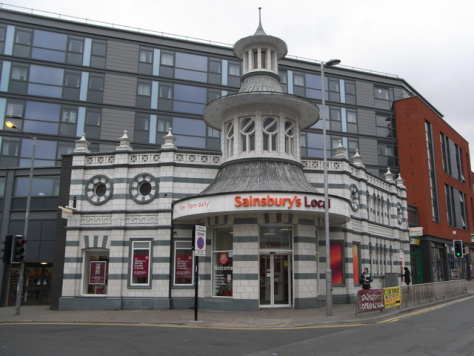
All that remains of the former Lansdowne Picture Palace. The frontage and Chinese-style pagoda were retained for this Sainsbury’s Local supermarket, soon to become Budgens. (Image: Cinema Treasures)
Categories
People

Benjamin Huntsman

Photograph by DSM Stainless Steel Fabrication

It’s sad, that in the 21st century, we refer to Benjamin Huntsman as the purveyor of cheap beer and a night out in Sheffield city centre. It’s equally sad that our only lasting memorial to Benjamin Huntsman is this J.D. Wetherspoon pub on Cambridge Street (aside from the sculpture in Meadowhall, and a block named after him at the Northern General Hospital).

However, Benjamin Huntsman invented a process that gave Sheffield pre-eminence in the production of finished steel and led to the growth of an industry that the city will always be famous for.

Benjamin Huntsman was born in Lincolnshire in 1704. His parents were of German extraction, settling in this country a few years before he was born.

His ingenious mind allowed him to become an expert at repairing clocks, and eventually set up business in Doncaster as a clock maker and mender. Described as being “shrewd, observant, thoughtful and practical,” he was regarded as the “wise man” of the neighbourhood.

His work, however, was hindered by inferior metal supplied from common German steel, material supplied for the springs and pendulums of his clocks.

These circumstances made him turn his attention to making a better kind of steel, his first experiments conducted at Doncaster, but as fuel was difficult to be had, he removed to Sheffield in 1740.

Huntsman settled at Handsworth, then a few miles south of the town, and he pursued his investigations in secret. The task was massive, not only to discover the fuel and flux suitable for the purpose, but to create a furnace that could sustain a heat more intense than had ever been known.

Huntsman’s cottage at Handsworth. Image by The British Newspaper Archive

His experiments lasted years, and it was only after his death that the numerous failures were brought to light, in the shape of many hundredweights of steel, found buried in the earth around his factory.

Benjamin Huntsman sculpture at Meadowhall. Photograph by Budby

At last his perseverance was rewarded, and his invention perfected. The melting was conducted in fire-clay pots, or crucibles, placed in a coke melting-furnace (at temperatures of 1,600°c/2,900°f), high enough to permit the melting of steel for the first time.

After he had perfected the process, Huntsman realised that the new metal might be used for other purposes, other than clock springs and pendulums. He canvased Sheffield’s tools and cutlery trade, but they obstinately refused to work a material much harder than that which they had been accustomed to use.

Foiled in his endeavours to sell steel at home, Huntsman turned his attention to foreign markets, and soon found he could readily sell abroad.

The honour of employing cast-steel for general purposes, belonged to the French, who quickly appreciated the advantages, and for a time the whole of Huntsman’s production was exported to France.

It was only after that Sheffield’s cutlers became alarmed at the reputation cast-steel was acquiring abroad, and formed a deputation to wait upon Sir George Savile, one of the members for the county of York, to use his influence with the Government and prohibit the export of cast-steel.

When Savile found out that Sheffield manufacturers wouldn’t make use of the new steel he positively declined to comply with their request.

Looking back, it was fortunate for Sheffield that he didn’t.

Huntsman had already received favourable offers from Birmingham to relocate his furnaces there, and had he done so, the Sheffield steel industry might never have grown as it did.

Benjamin Huntsman sculpture at Meadowhall. Photograph by Farzeed Rehman

The Sheffield makers eventually realised that they would have to use cast-steel if they were to compete with cutlery from France. And then began the efforts of the Sheffield men to wrest his secret from him.

Because Huntsman hadn’t taken a patent out on the process, his only protection was secrecy.

All his workmen were pledged to silence, strangers carefully excluded from the works, and the whole of the steel melted in the night.

However, it is said that the person who first succeeded in copying Huntsman’s process was an iron founder named Walker who carried on business at Grenoside.

Walker adopted the “ruse” of disguising himself as a tramp, feigned great distress and abject poverty, and appeared shivering at the door of Huntsman’s foundry late one night, asking for admission to warm himself by the furnace fire.

The workmen took pity on him, and they permitted him to enter.

Within months, Walker was also making cast-steel, and others quickly followed, but the demand for Huntsman’s steel steadily increased, and in 1770, he moved to a large factory at Worksop Road, Attercliiffe.

He died in 1776, aged 72, and was buried in the churchyard at Attercliffe. His son, William Huntsman (1733-1809) took over the business and it grew into one of Sheffield’s biggest steel firms, before being swallowed up by larger competitors in the mid-20th century.

Benjamin Huntsman’s grave at Attercliffe
Categories
People

Elliot Kennedy

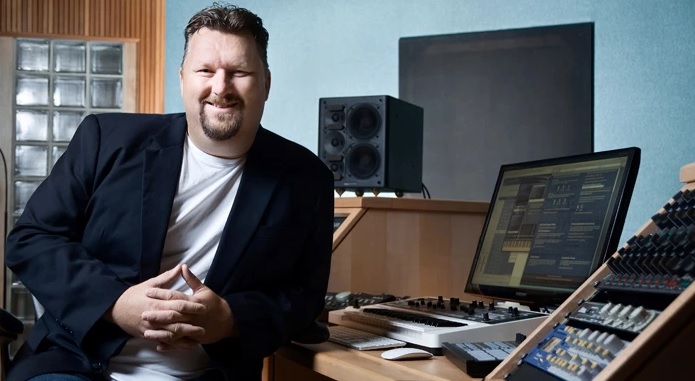
Here’s a man responsible for bringing some of the biggest names in music to the backstreets of Sheffield. Elliot Kennedy, born in 1969, songwriter and record producer, owner of Steelworks Studios on Brown Street.

He started writing songs at 13, formed a band at Dinnington High School and has made million sellers for the stars, including Mary J. Blige, the Spice Girls, Celine Dion, Boyzone, Bryan Adams, S Club 7 and Take That.

Kennedy’s first record that saw the stars align was Take That’s Everything Changes, co-written with Gary Barlow (1993). The next milestone record was Say You’ll Be There – his first global success for the Spice Girls. Kennedy went on to have a hit record in the charts every month for the next five years.

“It became this incredible factory for writing and producing records – S Club, Five, Billy Piper. Then I had a big hit with Boyzone, Picture of You (1996).”

Kennedy wrote Baby When You’re Gone (1998) with Bryan Adams, featuring Mel C, and he also penned the Aretha Franklin and Mary J. Blige song that won a Grammy, Never Gonna Break My Faith written for the 2006 film Bobby, about Robert F. Kennedy.

Still making hits, Kennedy’s branched into musicals – Finding Neverland and Around the World in 80 Days with Gary Barlow and Calendar Girls with Tim Firth.

And I bet if you bumped into him in the street you wouldn’t have a clue who he was.

Categories
People

J.L. Womersley

Photograph by RIBA

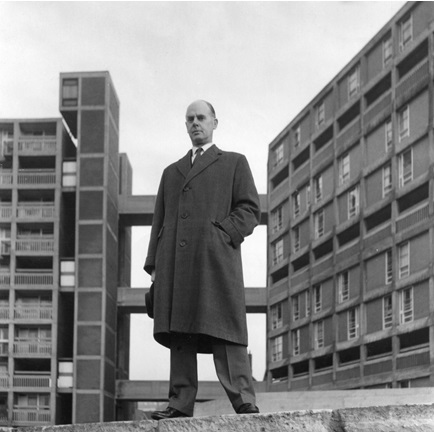
If one man can be held responsible for defining Sheffield’s skyline, then it must be John Lewis Womersley (1909-1989), the City Architect between 1953 and 1964.

During his term, Sheffield’s housing grew upwards with multi-storey flats constructed at Low Edges, Park Hill, Hyde Park, Netherthorpe and Woodside. It was Womersley’s response to 13,000 families on the council’s waiting list and 10,000 condemned properties waiting to be demolished.

Womersley had previously been Borough Architect in Northampton, where he was responsible for the town’s first ten-storey block. In Sheffield, he presented an uncompromising vision of the future, one shared by the Labour council.

According to Ivan Morris, who worked in Sheffield City Council’s planning department until 1979, Womersley was “A blunt no-nonsense Yorkshireman with a burning desire to maintain quality of life by achieving high standards in his work.”

In his eleven years, Sheffield was a hive of building activity, his record perhaps stained by today’s  social problems in surviving tower blocks.

“Time and hindsight must not be allowed to judge too harshly the mark that Lewis Womersley left on the city,” said Morris in 1989. “For he gave his whole-hearted efforts unstintingly against economic restraints.

“Certainly, those who remembered the sordid and degrading conditions of the overcrowded back-to-back slums had cause for acknowledgement.”

His most famous legacy must be Park Hill, the “streets in the sky” claiming international recognition for Sheffield but dividing opinion across the city.

It is now Grade II* listed, the subject of a £100million refurbishment into upmarket apartments, business units and social housing (even though it seems to be taking an age to complete).

“Park Hill was certainly something of a masterpiece and is still relatively popular,” said one of his successors, Andrew Beard, over thirty years ago. “But with Hyde Park I feel he pushed the concept further than it was capable of going.”

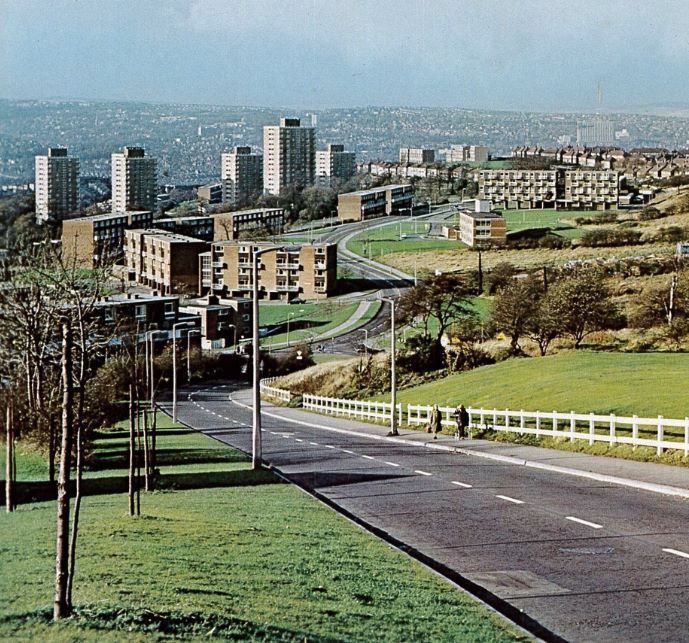
And another of his projects, the Gleadless Valley estate, a mix of urban housing and landscape, described as “Mediterranean in appearance” when it was built between 1955 and 1962, might now be past its best.

But was that the fault of the architect, or simply under-investment in maintaining it properly?

Gleadless Valley estate

Most pronounced in housing, his work also extended to public buildings – schools, colleges, bus garages, fire stations and libraries. Amongst these we must mention Granville College and Castle Market, both demolished, but the former West Bar Police Station survives as the Hampton by Hilton Hotel.

Awarded a CBE in 1962, Womersley left Sheffield two years later, joining the Leslie Hugh Wilson partnership in Manchester, and finally retiring in 1978.

Categories
People Sculpture

Athens – the Sheffield connection

Photograph by Patrick Comerford (2017)

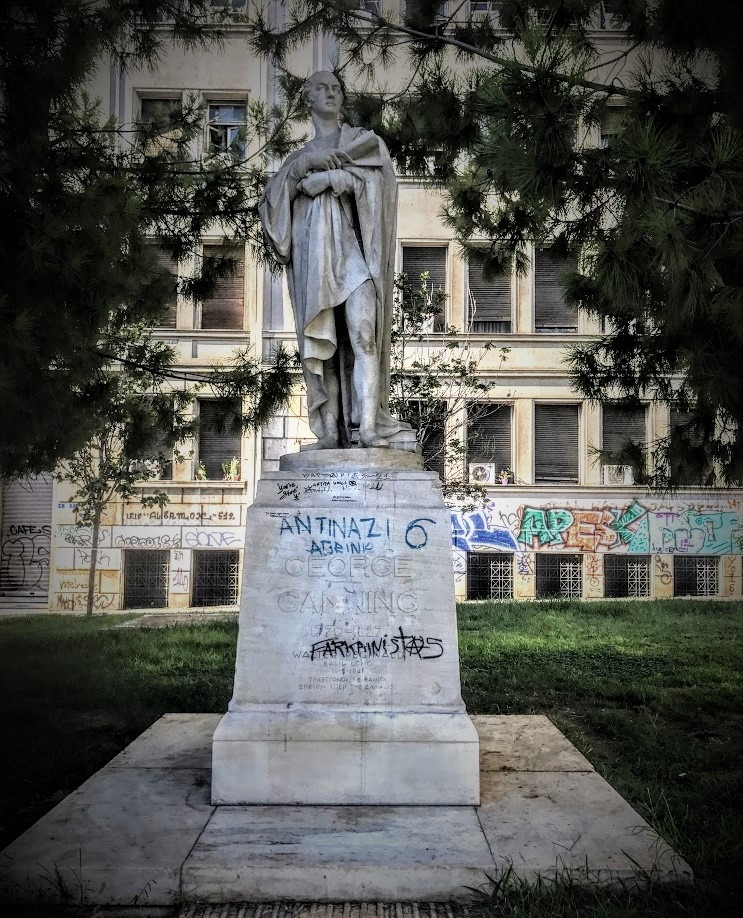
This sorry-looking statue of George Canning, the British Prime Minister who from 1825 to 1827 saved Greece from conquest by the Turks, stands in the George Canning Square in Athens.

But what is its connection to Sheffield?

George Canning, who was Britain’s shortest-serving prime minister, gave diplomatic support to the Greeks in the struggle against the Turks for freedom and ensured the eventual creation of an independent Greek state. In 1827, he signed the Treaty of London with Russia and France, with the object of securing Greek independence.

Canning’s successor as Prime Minister, the Duke of Wellington, tried to undo his work by making a truce with Turkey, but the Treaty of London had secured Greek independence.

The statue of George Canning from 1834 has a simple inscription: ‘George Canning 1770-1827’.

It was unveiled, wrapped in British and Greek flags, by the Greek Prime Minister, Eleftherios Venizelos, on 6 April 1931, at a ceremony attended by Sir Patrick Ramsay, the British ambassador, and the English builder and developer Charles Boot (1874-1945), who donated the statue to the Greek nation.

And here are the Sheffield connections.

Charles Boot was the Sheffield-born son of Henry Boot, the builder, and became a successful businessman and creator of Pinewood Studios.

He acquired the 10ft-high statue when he bought Thornbridge Hall, Great Longstone, near Bakewell, in 1929.

The statue, the work of famous Jordanthorpe-born sculptor, Sir Francis Chantrey (1781-1841), had originally been at Trentham Hall, Staffordshire, the last work commissioned by the Duke of Sutherland.

It was transferred to Thornbridge Hall, and after the death of the Liberal statesman, Chantrey made a replica which was erected at Westminster Abbey.

As a result of big business dealings between his firm, Henry Boot and Sons, with the Greek Government, it occurred to Charles Boot to present the statue to the Greek nation, and has remained here ever since.

Sadly, if you think that Sheffield has a graffiti problem, then I suggest you look at Athens.

Categories
People

James Longden

We owe a lot to James Longden (1847-1907), the Chesterfield-born son of George and Mary Ann Longden. His father trained as a stone mason in Uppermill, on Saddleworth Moor, and James would have been about six when the family moved to Sheffield.

His father founded a building and construction firm on St. Phillip’s Road, a modest success, but one which allowed James to become a partner in 1868.

George Longden and Son relocated to Park Wood Road at Neepsend and by the end of the nineteenth century had grown into one of the best known building firms in the country.

After George Longden retired in 1884, James took over the business, one which went on to build some of Sheffield’s most iconic buildings – reconstruction of the Old City Theatre to become the Lyceum, Montgomery Hall, Sheffield City Hall, Town Hall extensions, the Sheffield Telegraph and Star Building, alterations to Midland Station, the Prudential Assurance Building, extensions to Sheffield Cathedral, Victoria Hall as well as the old Royal Infirmary Hospital.

After World War Two, the company’s fortunes declined, eventually moving into house building, before being liquidated in 1978. The name lived on as Longden Doors, reduced to door-making, until it went into administration earlier this year.

Categories
People

Brian Glover

We’ll never forget that classic scene in the film Kes, where the teacher organises a football match with his pupils, insists on taking part himself, and then fouls and flattens the kids while dashing at the goal and mouthing an imaginary commentary. Brian Glover (1934-1997), actor, writer, wrestler and teacher, born in Sheffield, but better associated with Barnsley, where he grew up. While teaching he met Barry Hines, author of A Kestrel for a Knave, turned into Kes, who introduced him to director Ken Loach. He got the part of Sugden, the PE teacher, his first acting role but which paved the way for over fifty TV and film appearances. “You play to your strengths in this game, and my strength is as a bald-headed, rough-looking Yorkshireman.” Sadly, he died of a brain tumour at the age of 63.

Categories
People

Patrick McGoohan

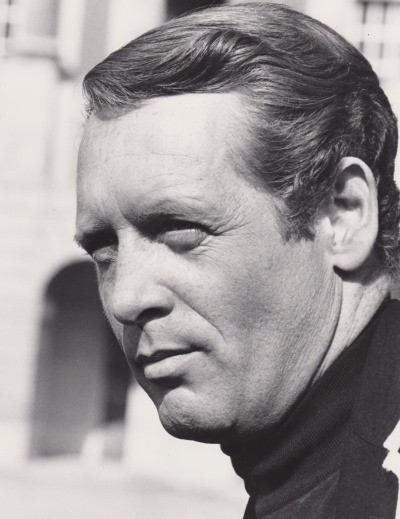
He became a film and TV star, but Patrick McGoohan (1928-2009) always owed his success to Sheffield. The man known to millions as Number Six in the cult TV series The Prisoner (1967-1968) was born in New York, moving months later to his parents’ farm in Ireland. Seven years later the family relocated to Sheffield, living at Clarkehouse Road, on the edge of Broomhill, attending St. Vincent’s School in Solly Street. He was evacuated to Loughborough during World War Two, and later educated at Ratcliff College.

McGoohan left school at 16, returned to Sheffield, and became a stage manager at Sheffield Repertory theatre on Townhead Street in 1947. When an actor fell ill, McGoohan got his chance at acting. In 1955, he signed a contract with the Rank Organisation, but shot to fame in his role as NATO trouble-shooter John Drake in the sixty’s television series Danger Man. Until the end of his days, McGoohan would be best known for his role in The Prisoner – “I am not a number, I am a free man.” – about a former agent trapped inside a mysterious village, a role he reprised in a 2000 episode of The Simpsons.

In the seventies, he settled in the Pacific Palisades district of Los Angeles, and in an interview in 1983 remembered his days on stage at Sheffield Rep.

“It was the happiest time of my life. I met my wife in Sheffield and life was simpler then. I didn’t need a lawyer, an agent and business manager. I just went on stage and played big roles as well as small ones. The last time I was filming in England, which was The Man in the Iron Mask, we had a free day, so I hired a car and didn’t tell Joan where we were going. I parked the car and took her into the city centre and made for Wilson Peck’s music shop. When we were outside the shop, I made her close her eyes, turned her around and asked her to open her eyes again. I then told her we were standing on the very same manhole cover where I proposed to her all those years ago.”

McGoohan died in 2009 at Saint John’s Health Centre in Santa Monica, California, after a brief illness.

Categories
People

Charles Boot

Ask anybody in the street who Charles Boot was, and you’d probably meet with a blank response. But you might be surprised to find that one of his legacies is now world famous.

Born in Sheffield in 1874, Charles joined his father, Henry Boot, as a builder and eventually took over the business in 1919. He married Bertha Andrews in 1897 and lived at Sugworth Hall in Bradfield Dale. She died in 1926 and Charles married a second time, to Kate Hebb, and later bought Thornbridge Hall in Derbyshire.

Charles made Henry Boot and Son one of the largest contracting and housebuilding firms of the time. In 1931, he was credited as having built more houses than any other man or firm (21,644 in total, one thousand of these on Sheffield’s Manor estate), a figure surpassed in the inter-war years by a staggering 80,000 properties.

The company also built airfields for the Government during both World Wars and opened offices in Belfast, Glasgow, London, Athens and Barcelona. In 1927, the Athens office secured a massive £10million contract for land protection and reclamation across Greece, a project finally completed in 1952.

However, Charles Boot should be remembered for another quite remarkable undertaking. In 1934, he bought the Heatherden Hall estate, amongst pine trees at Iver Heath, Buckinghamshire, and embarked on the design and construction of a British film studio. Using techniques from house-building and copying the unit system adopted by Hollywood, he managed to complete construction within twelve months.

The rest, as they say, is history. The site subsequently became part of the J. Arthur Rank Organisation and Pinewood Studios went on to become home to some of the biggest film franchises – James Bond, Carry On, Harry Potter, Star Wars, the Marvel Universe – as well as producing hundreds of other TV series and films. Next year, Walt Disney Studios will move in, taking a ten-year lease.

Charles Boot died at a Sheffield nursing home in 1945, and Henry Boot PLC survives as one of Britain’s biggest land, property, development and construction companies.

Categories
People

Margaret Drabble

Dame Margaret Drabble, Lady Holroyd, was born at Sheffield in 1939. She is, of course, better known as the novelist, Margaret Drabble, author of twenty novels and several biographies. The daughter of novelist John F. Drabble and teacher Kathleen Marie, she is also the sister of novelist A.S. Byatt.

She was educated at Mount School, a Quaker boarding school in York, and read English at Newnham College, Cambridge. Drabble started out as an actress working at the Royal Shakespeare Company and was understudy to both Vanessa Redgrave and Judi Dench.

Her first novel, A Summer Birdcage, the story of a relationship between two sisters, was published in 1963.

She married, firstly, the actor Clive Swift, better known as hen-pecked Richard in Keeping Up Appearances, and had three children, including Joe Swift, the TV gardener. Her second marriage is with the writer Sir Michael Holroyd with whom she lives in Somerset and London.

“When I go back to Sheffield, I feel very close to it – although the whole family has moved away, there’s something about the people, about the manners that I recognise.”