Categories
Buildings

Sheffield Town Hall

Look at this, Sheffield Town Hall, brand new and clean, seen here in May 1897, shortly before the official opening by Queen Victoria. Within weeks the building was already taking on the tone common to Sheffield, smoke being the culprit, and within decades the Stoke Hall stone was almost black in appearance.

Sheffield’s fourth Town Hall was built between 1891-1896 by Edward William Mountford (1855-1908), one of 178 architects to enter a competition with Alfred Waterhouse as judge.

Mountford was successful despite protests from Flockton & Gibbs, who claimed their “patent” design for municipal buildings had been incorporated into instructions for finalists and used in Mountford’s scheme.

“The architect’s aim, of course, was to obtain the dignity essential for the Corporation’s buildings of the fifth provincial city in England, combined with the maximum amount of internal convenience, and abundant light and air!”

The building contract was awarded to Edmund Garbutt of Liverpool, whose tender amounted to £83,945, but the actual cost, including the site, approached £200,000.

Understandably, the Sheffield public were “up in arms” about the cost, and critical of the expensive embellishments inside and out, protesting that ratepayers’ money was better spent on street improvements and housing for the poor.

The Town Hall was built on an almost triangular site, bought by the council as part of a general improvement scheme, and replacing dilapidated properties either side of New Church Street, a road lost beneath the development.

The principal front faced Pinstone Street (200ft long), although the main entrance was at the centre of the Surrey Street front (280ft long). Its crowning glory was the 64ft-high clock tower complete with Mario Raggi’s bronze statue of Vulcan.

Although the Town Hall clock was designed to be capable of working with bells, they were never fitted, and it wasn’t until 2002 that an electronic bell ringing system was installed, giving hourly strikes with Westminster-style quarter chimes.

On the right of the Pinstone Street entrance were the offices of the waterworks; on the left, the City Accountant’s department. The Town Clerk and members of his department had rooms on the first floor, as were the committee rooms.

On this floor were the Mayor’s reception hall, dining-hall and the Mayor’s parlour, as well as the Council Chamber (60ft x 40ft, and reaching a height of 28ft), light being afforded by traceried windows, and with a public gallery seating 60 people.

The main staircase, 10ft wide, leading to the first floor, was supported on columns of red and grey Devonshire marble, with alabaster balustrades and an ornate marble handrail, the walls being lined with polished Hoptonwood stone.

In other parts of the building, the corridors had floors of glass mosaic and a specially designed dado of antique glazed tiles.

The rich decorative scheme of stone carving, both externally and internally, was devised by Mountford and Frederick William Pomeroy (1856-1924), Royal Academy Gold Medallist, and took pride in Sheffield’s history and the art and skill of its workforce.

The foundation stone was laid by Alderman W.J. Clegg in 1891 and the Town Hall should have been opened by Queen Victoria in 1896, but the death of Prince Henry of Battenberg prevented her from doing so.

The Town Hall was opened by Queen Victoria on the afternoon of May 21, 1897, a story worthy of a separate post.

Categories
Buildings

Sheffield Town Hall

Sheffield Town Hall was opened by Queen Victoria on the afternoon of May 21, 1897, postponed from a year earlier, due to the death of Prince Henry of Battenberg, husband to Beatrice, her youngest child.

The story of the grand opening is remarkable because Queen Victoria completed the ceremony, and other duties in the city, without ever leaving her carriage.

On 23 September 1896, Victoria had surpassed George III as the longest-reigning monarch in British history (that distinction now going to our present Queen), but she requested that celebrations be delayed until 1897, to coincide with her Diamond Jubilee.

By this time, she was 77-years-old, much frailer, and her time spent in Sheffield was momentary.

The Town Hall opening was a disruption in her journey from Windsor to Balmoral, where she would celebrate her birthday and spend the summer holidays.

Because of this, she didn’t arrive in Sheffield until late afternoon, arriving at Sheffield Railway Station accompanied by Princess Christian and the Duke of Connaught.

The Royal party were met by the Mayor and Mayoress, the Duke of Norfolk, and his sister, Lady Mary Howard. From the station, a procession was led by the Chief Constable and his mounted police, and a troop of the 17th Lancers.

Thousands of cheering people lined the streets, waving flags, as the parade headed towards the principal entrance of the Town Hall on Pinstone Street, met by the Lord Chamberlain, Lord Lathom, who directed the ceremony.

At 5pm, Victoria remained in her carriage while the Recorder of Sheffield read an address, handed to her in a gold casket, specially made for the occasion by Mappin and Webb.

The Queen handed her reply to the Mayor, after which other addresses were presented by the Duke of Norfolk, on behalf of the Sheffield General Infirmary, by Sir Frederick Mappin, MP, on behalf of the Town Trustees, and by Mr Alexander Wilson, Master Cutler, representing the Cutlers’ Company.

The “golden key” (also by Mappin and Webb) was handed to Victoria, who inserted it into a detached lock, connected by electricity to the gates of the entrance. As she turned the key, the gates swung back as if by magic, and a flourish of trumpets announced that the Town Hall was open.

Afterwards, the Royal procession went to Norfolk Park, where fifty thousand schoolchildren had gathered by invitation of the Duke of Norfolk.

She then went to the Cyclops Steel and Iron Works, belonging to Charles Cammell and Company, where her carriage was drawn into a temporary shed in front of a mighty furnace. Here, the party held glass screens before their eyes, and watched the rolling of armour plate for the new battleship “Ocean”.

By 7.30 in the evening, Queen Victoria was speeding northwards by train to “gain strength for her approaching jubilee.”

Categories
Buildings

Fountain Precinct

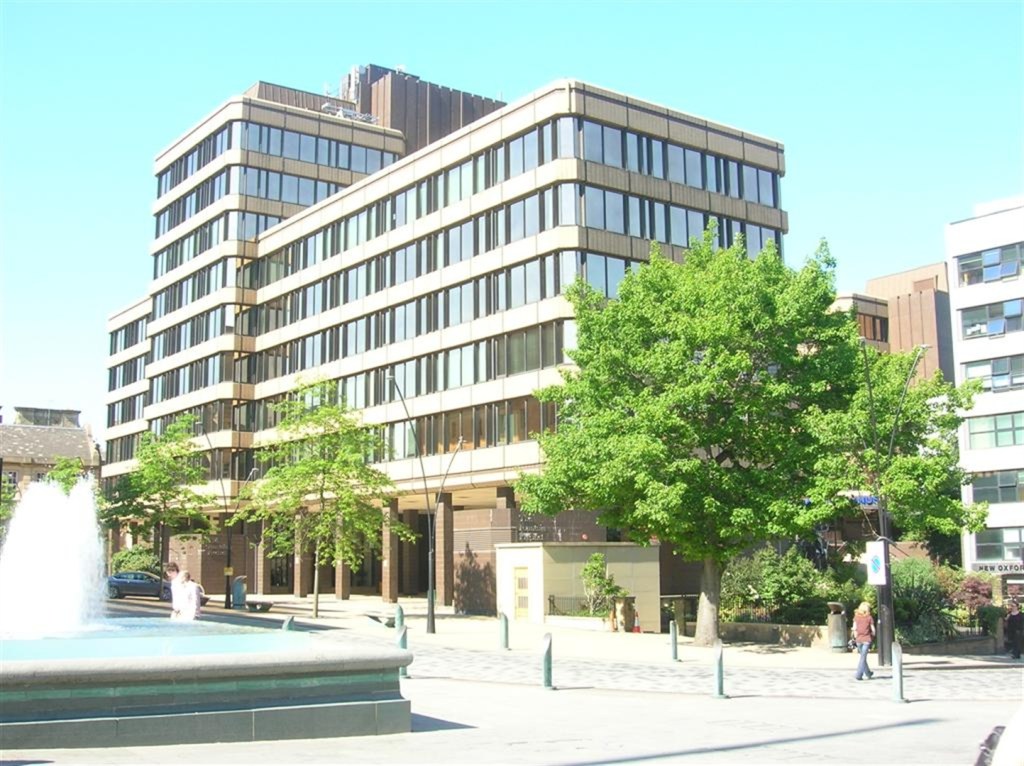
It’s 45-years old and occupies a prime location in Sheffield city centre. The Fountain Precinct, in buff and brown tiles, at Barker’s Pool, is probably one of our best known office blocks, opened in 1974 (or 1976, according to Harman and Minnis) on the site of the demolished Grand Hotel. The eight-storey building was designed by Sidney Kaye, Firmin and Partners, and is owned by Kames Property Income Fund, which has announced a £3.5million modernisation programme complete with a new shop or restaurant on the ground floor. Current Occupiers include Handlesbanken, 7 Legal and Finance, Aon Ltd, Quidco and tech firm 3Squared, but is a third empty.

Categories
Sculpture

City War Memorial

In 2009, when Philip Laing, a university student, got drunk and urinated on Sheffield’s War Memorial in Barker’s Pool, he didn’t realise he’d suffer the wrath of the city, as well as the rest of the country. He was spared jail and ended up quitting his university course.

Enthusiasm is still felt for the City War Memorial, erected in 1925, “to create a sacred centre where the people of Sheffield may meet on Armistice Day, and where the bereaved can lay their wreaths, and see the flag hoisted half-mast to honour their dead.”

In 1923, the Lord Mayor, F.C. Fenton, launched an appeal, aimed at ratepayers, to fund a memorial already designed by architect Emanuel Vincent Harris, an 80-foot high obelisk, to be sited at the junction of Townhead Street and Church Street.

The plan was abandoned due to being “unsuitable in design and location.”

However, the War Memorial Subcommittee was persuaded to consider a new design in front of the proposed City Hall. It launched a competition to select a more suitable design, restricted to artists working, or with practices, in the city. The contest attracted 34 entries; the winning design chosen by E. Vincent Harris.

The final design was by Charles Canus-Wilson, the architect, with George Alexander responsible for the sculptured designs of the figures.

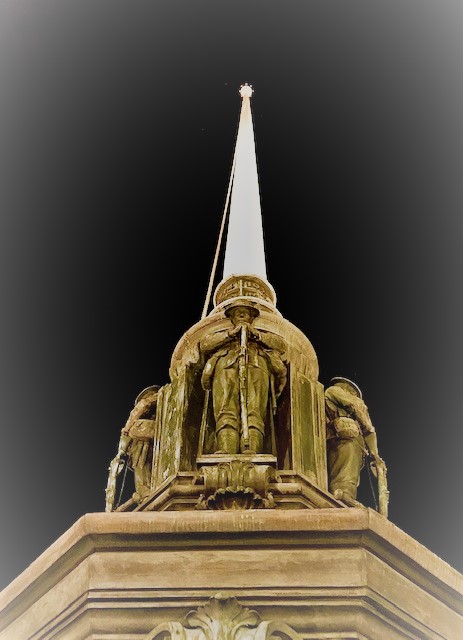
The Grade II-listed City War Memorial is set on a bronze case, with the sculptures on a granite plinth, into which is set a flagpole, over 100 feet in length and weighing nine tons, with a bronze crown.

The panels on the base, near the Sheffield coat-of-arms, shows emblems of the Royal Navy, the Merchant Navy, the Army and the Royal Flying Corps.

Below these, are insignias to commemorate the Yorkshire Dragoons (Queen’s Own) South Africa 1900-1902, the Royal Engineers, the Tanks Corps, the Yorkshire and Lancashire Regiment, the Royal Army Service Corps and the Army Medical Corps.

There are also four figures of four ordinary soldiers, heads bowed, and rifles reversed, standing on a ledge above an octagonal pedestal. It was originally to have had four females standing between the soldiers, but these were lost to save money.

The cost of the memorial was £5,345, funds coming from the Lord Mayor’s Appeal, fund-raising performances at Sheffield’s 44 theatres, music halls and cinemas, collection boxes in shops, the university and schools, a “Flag day” and a contribution from the British War Graves Association.

The bronze was cast by Conrad Parlanty Castings Ltd of Herne Bay, while the flagpole was made by Earle’s Shipbuilders and Engineers, Hull.

The flagpole arrived at The Wicker by rail, occupying six trucks, and was manoeuvred through the streets using steam-tractors during the early hours of the morning. It was designed to be the same height as the City Hall (opened in 1932) and was set 20-feet into the ground for stability.

The City War Memorial was unveiled on 28 October 1925, by Lieutenant-Colonel Sir Charles H. Harington, GBE, KCB, DSO.

During the December Blitz of 1940, a bomb exploded near its base, causing the six-ton bronze base to shift five inches out of position. It was repaired in 1949, parts of the memorial dismantled and taken to Herne Bay at a cost of £680.

In 2005, the memorial was assessed, and a £60,000 programme of essential repairs carried out by Rupert Harris Conservation. The mast was treated for corrosion and repainted, and the crown and ball at the top of the mast re-gilded using 24-carat gold leaf.

Interestingly, the 1940 shrapnel damage remains, kept as a reminder of the memorial’s history and purpose.

Categories
Buildings

Turkish Baths

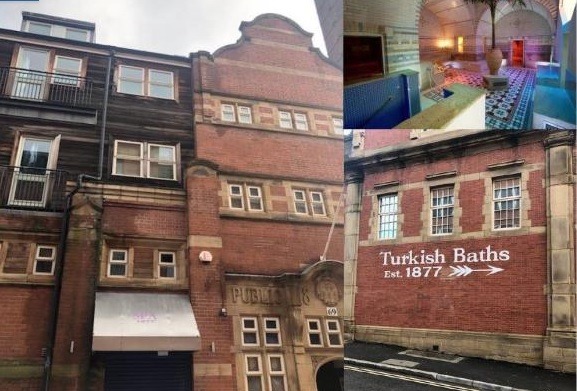
There are a few historic buildings in Sheffield up for sale at present. Just hitting the market are the Turkish Baths on Victoria Street, just off Glossop Road.

These once formed part of Glossop Road baths, the first public baths in the city, built in the aftermath of the cholera epidemic of 1832 and associated with the Public Dispensary (later Royal Hospital).

It was re-built in 1877-1879 by architect Edward Mitchel Gibbs of Change Alley, for the Turkish and Public Bath Company Ltd.

Turkish baths became popular in Victorian times, its proponents arguing that they achieved a degree of cleanliness “unattainable by any other expedient,” and its successes forced the medical profession to take notice.

Gibbs paid a visit to most of the chief Turkish Baths in the country, and his plans were based upon his experiences.

The heating system was installed by Vickers, Son and Company, the invention of Thomas Edward Vickers, and removed sulphur from the heated air and “that even in the hottest room there were none of the unpleasant sensations which were sometimes experienced under such circumstances.”

At the time, the Sheffield Independent wrote: –

“It is not often that Sheffield can boast of excelling other towns; but it may now take credit to itself for having the finest and most complete Turkish baths in the kingdom. Attendants in Turkish costume await his bidding, and while smoking a cigar – never so delightful as after a bath – he can have tea or coffee, or, the cigar finished, he may have light refreshments.”

While the rest of the old baths have been given over to leisure and residential use, only the interiors of the Turkish Baths, reputed to be the oldest in the country, has survived.

These Turkish Baths closed in 1990 after 127 years but were reopened in 2004 after SPA 1877 developers completed a £2million restoration, reviving many of the original features including mosaic flooring, glazed brick walls and arched ceilings.

Offers are invited above £695,000 for the landmark building.

Categories
Buildings

Parade Chambers

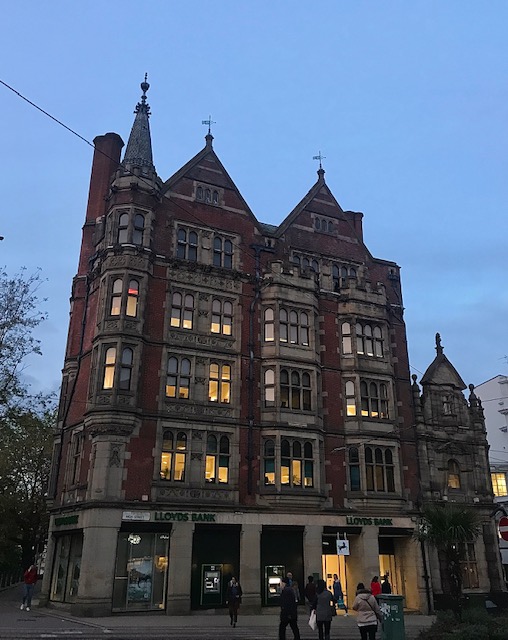
If you have a spare £4.9million then you might want to consider buying Parade Chambers on the corner of East Parade and High Street. The Grade II listed building comes with five tenants, including Lloyds Bank which occupies most of the ground floor.

In 1883, the premises of Pawson and Brailsford, stationers and printers, were demolished as part of the East Parade improvement scheme, the lane widened, and the building line adjusted.

About 11 yards of Pawson & Brailsford’s land was taken, although they were handsomely compensated by the council.

The company had been founded by Henry Pawson and Joseph Brailsford, both former newspaper men. Pawson had joined the reporting staff of the Leeds Intelligencer, moving to the Sheffield Mercury and later becoming editor of the Sheffield Times. Brailsford had been associated with the Sheffield Independent.

The two opened their first printing and stationary shop on Castle Street, later adding manufacturing works on Mulberry Street, and moving to the High Street, near to the Church Gates (now Sheffield Cathedral), taking the premises of Samuel Harrison, Jeweller.

With enough money to build a replacement, Pawson and Brailsford commissioned Charles Hadfield, of M.E. Hadfield & Son, to build a five -storey Tudor Gothic block, built by George Longden & Son between 1883-1885.

In order to erect the building as quickly as possible the builders worked in night relays, using electric light, and made it one of the first buildings in Sheffield to be built this way.

Constructed in Huddersfield stone, with specially made bricks from Fareham, Kent, it was topped with green Westmoreland slate.

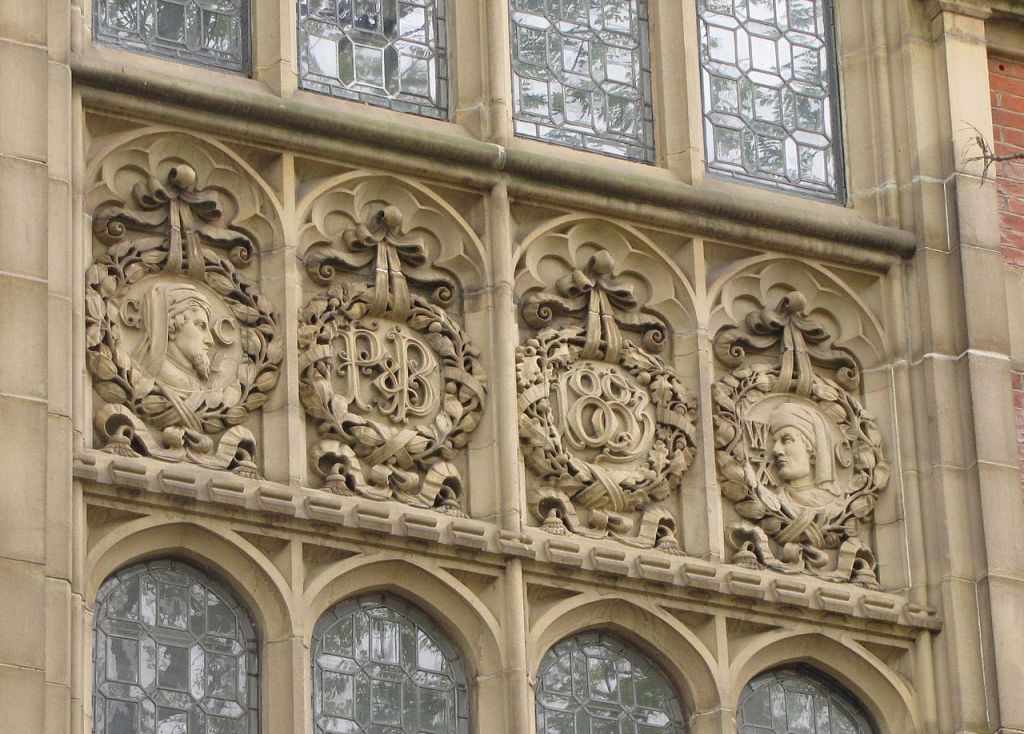
Its two principal elevations were dominated by mullioned and transomed windows. The decorative stonework, with portraits of Chaucer and Caxton and grimacing gargoyles and mythical beasts, was the work of Frank Tory, but the character of the building was emphasised with two picturesque turrets on East Parade.

When completed, Pawson and Brailsford, had a large shop on the corner, with two windows on the High Street and three windows in East Parade. The basement was used for showing mercantile stationary, accounts books, drawing papers, and Milner’s Safes.

Two other shops adjoining the High Street were available to let, soon occupied by the Union of London and Smiths Bank (later to become London and Yorkshire Bank).

Well-lit offices for solicitors, architects and accountants were available on the first and second floors, entered by a handsome entrance on East Parade.

The upper floors were used as store-rooms by Pawson and Brailsford.

The new building set the model for High Street, Church Street and Fargate, the architectural drawings being shown by the Royal Academy in 1885.

Pawson and Brailsford extended their Mulberry Street works at the same time, increasing space for wood and copper engraving, letter-press, lithographic printing, book-binding and photo lithography.

The company remained at Parade Chambers until 1930, before moving to another new building on the corner of Norfolk Street and Mulberry Street. (This building still exists and subject to a future post).

The London and Yorkshire Bank eventually became the National Provincial Bank (later NatWest), subsequently taking over the premises of the London City and Midland Bank, at the corner of High Street and York Street. The ground floor premises are still home to a bank, although now occupied by Lloyds.

While the outside of the building remains unchanged, the same cannot be said for the interior. This was gutted in 1988, with only the stone staircase surviving, the offices above now taking on a very modern look.

Categories
Buildings

Parade Chambers

The changing face of the High Street in Sheffield.

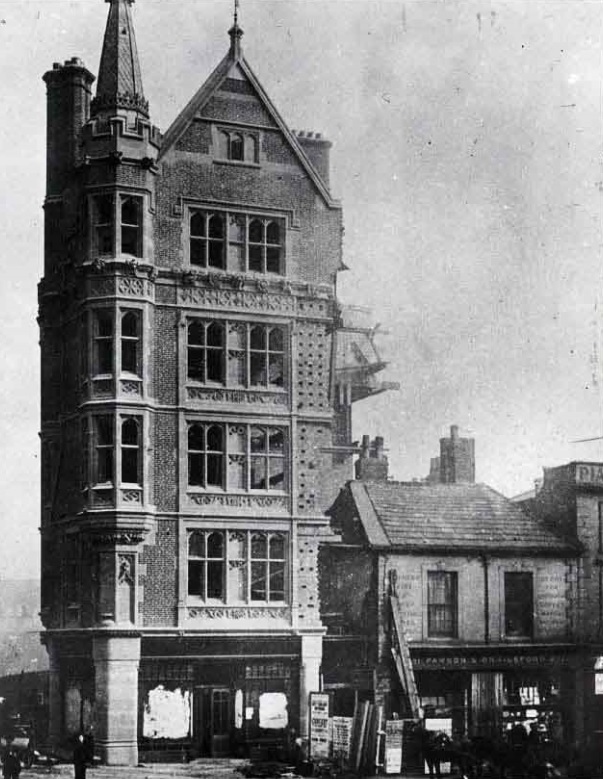
This remarkable photograph shows Pawson and Brailsford’s stationary shop at the Church Gates in 1883. The old shop still traded while their new premises, Parade Chambers, were being built alongside.

Designed by Charles Hadfield, of M.E. Hadfield & Son, the five-storey building was built by George Longden & Son between 1883-1885.

Pawson and Brailsford occupied the ground floor corner unit, pulling in rent from offices constructed above, and the London and Yorkshire Bank next door.

The building is still here, with Lloyds Bank occupying most of the ground floor, although the interiors were gutted in 1988 with only the original main staircase to the offices surviving.

Categories
Buildings

Grosvenor House

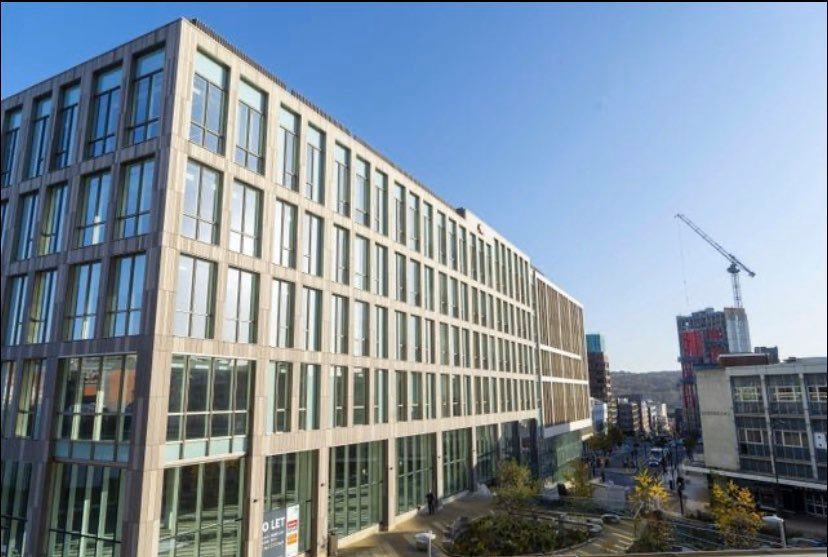
Top 10 global law firm, CMS, is set to become the second anchor tenant in Grosvenor House, the new HSBC building. It is relocating from its current base at Victoria Quays and preserves the firm’s presence as a major employer in the city.

The new office will be entirely self-contained and separate to HSBC, with a bespoke entrance, reception and signage facing onto Wellington Street and connecting to the impressive public realm of Charter Square.

Staff are expected to relocate from offices near Park Square this autumn, coinciding with the firm’s 30-year anniversary in Sheffield.

It means the building, officially called Grosvenor House after the hotel that stood on the site, will be full, delighting council chiefs who are bankrolling the £480million Heart of the City II scheme with taxpayers’ cash.

Categories
Companies

Simpkins Sweets

During World War One, Albert Leslie Simpkin was wounded twice. Afterwards, he was offered liquid glucose after an operation for shrapnel wounds, perhaps the moment he thought it should be offered in sweet form.

Returning to Sheffield, Simpkin opened a grocery shop in 1921, on Sedan Street at Pitsmoor, and devised a machine to produce glucose drops.

This was the start of a business that is still going strong today, exporting sweets to over forty countries.

After deciding to close his shop, Albert bought a burnt-out refrigeration factory at Hillsborough, replacing it with a purpose-built plant producing bulk barley sugar sweets, later converting to powdered sweets in small tins.

The company turned out to be pioneers in glucose medicated confectionery, choosing to sell through chemists to avoid competition from bigger manufacturers. “Simpkins Glucose Products for Health and Vitality,” was a slogan soon to be seen throughout the UK.

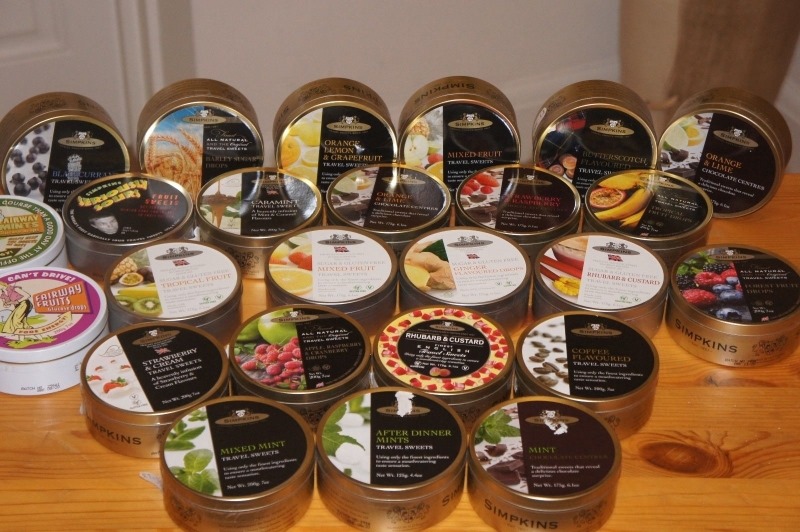
Its biggest seller was barley sugar drops, “to alleviate the symptoms of travel sickness,” leading to a range of other products, ‘Travel Tins’, that are still the backbone of the company’s product range today.

However, after visiting the Leipzig Show in 1939, Simpkins picked up the recipe for a glucose tablet, containing dextrose monohydrate, creating Vita Glucose Tablets, compressed under 15 tons of pressure. These were used by leading athletes, high-altitude flyers and mountaineers, including the first ascent of Mount Everest in 1953.

The range soon extended to other medicated pastilles and tablets, including Glucose Blackcurrant Pastilles, Dilly Duckling Children’s Cough Pastilles, which had a cherry flavour, and even orange-flavoured Halibut Liver Oil Hexagons.

Speaking in 1939, Albert said, “The modern idea of presenting medicine in sweet form might have been gained from a fourteenth century painting in which an apothecary is seen making up a prescription for his royal patron in the form of a confection.”

A.L. Simpkin & Co Ltd, still manufacture on Hunter Road, although its main entrance is on Roselle Street, off Middlewood Road.

These days, the company is run by Albert’s grandchildren, Adrian and Karen Simpkin, producing the ‘Travel Tins’, Juicees Chews, Nipits (said to be a favourite of Margaret Thatcher), ‘Frog in your Throat’ lozenges and pure liquorice sweets. It is also a leading supplier of corporate branded and private label tinned confectionery.

Don’t expect to find Simpkins Sweets in the supermarkets, they’re still to be found in chemists, as well as garage forecourts and high-end sweet shops.

Categories
Companies People Sculpture

Frank Tory and Sons

As we discover the historic buildings of Sheffield, and the intricate sculptors that adorn many, the name of Frank Tory frequently appears.

Frank Tory and Sons were a firm of sculptors that worked on many of the city’s buildings from the early 1880s until the 1950s. Apart from stone, the family also worked in wood, marble, bronze and fibrous plaster.

Frank Tory (1848-1938) was a Londoner who trained at the Lambeth School of Art. He came to Sheffield in 1880 after accepting a commission from the 15th Duke of Norfolk to work on the new Corn Exchange.

The contract brought him into contact with architect Matthew Ellison Hadfield and his son, Charles, who encouraged him to stay in Sheffield and offered him several commissions.

Tory set up a studio amongst terraced houses, and was joined in 1901 by his twin sons Alfred Herbert Tory (1881-1971) and William Frank Tory (1881-1968).

The Corn Exchange was destroyed by fire in 1947 and demolished in 1964. However, some of his finest work can still be found at Parade Chambers (High Street), St. John’s Church (Ranmoor), Cairns Chambers (Church Street), Carmel House (Fargate) and the Cathedral of St. Marie.

Perhaps Frank Tory’s greatest work is on Parade Chambers, with decorative sculptures of Geoffrey Chaucer and William Caxton, created in 1883 for Pawson and Brailsford, printers and stationers (pictured).

Alfred and William were born on Winter Street and attended the Broomhill County School and the Weston Academy for Sons of Gentlemen. They learned their trade from their father, who also taught at the Sheffield School of Art.

While Frank Tory worked on some of the city’s finest Victorian structures, his sons were responsible for sculptures on twentieth century buildings, including Sheffield City Hall, the Central Library, the White Building (Fitzalan Square), Victoria Hall (Norfolk Street) as well as Leeds Civic Hall and Chesterfield Town Hall.

After their father’s death, the firm moved to Ecclesall Road, at a site that is now the Porter Brook pub, eventually retiring in the 1950s after which the firm was wound up.