Categories
Places

Endcliffe Bathing Pool – “The water is almost stagnant, in some parts the floor is quite a foot thick with mud and refuse.”

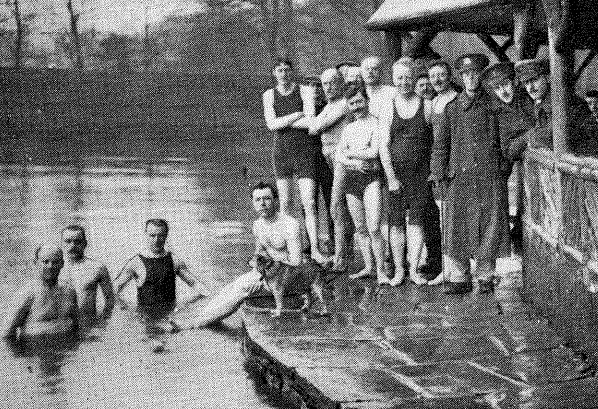
Sheffield Water Rats. In the water – Walpole Hiller, G. Wilson, F.G. Dixon. Seated on bank – W.H. Flint. Standing-rear – A.H. Cooper, C.H. Foster, T. Smith, E. Watson. In front – Albert Flint, M. Parker, W.M. Parker. This photograph appeared in The Swimming Magazine in 1914

During research into the recent story on William Henry Babington, the Sheffield photographer, this grainy image from a copy of The Swimming Magazine in May 1916 came to light.

This intriguing photograph features members of Sheffield Water Rats, an ‘all the year round bathing club’, whose members enjoyed themselves in the “fine open-air pool in Endcliffe Woods, about a couple of miles from the centre of town.”

The Water Rats were an all-male club and to qualify for entry into this select family of ‘rats of the pool’ one had to swim winter and summer in Endcliffe Bathing Pool for a period of six years. The ‘King Rat’ was Mr Walpole Hiller who had started about 1894, although he was surpassed by Mr C Foster who taken his first all-year round dip in 1891.
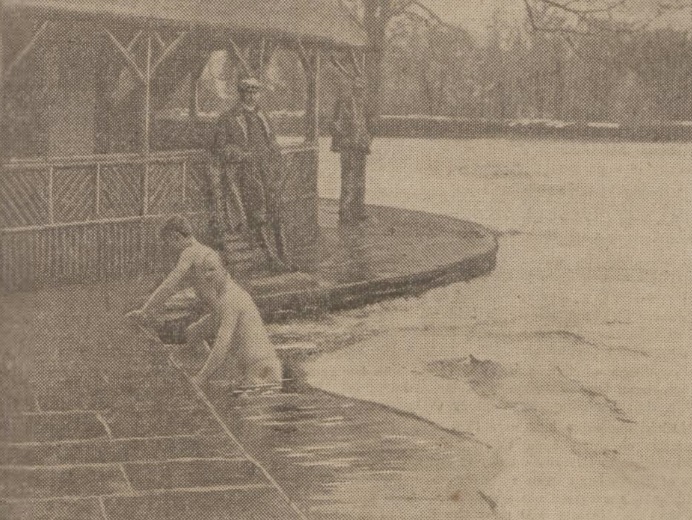
Bathing on New Year’s morn. A cold dip in the Endcliffe Bathing Pool. From the Sheffield Daily Telegraph. 2 January, 1907. Image: British Newspaper Archive

“How many persons would come down to the pool on a foggy autumn morning almost before it was light, plunge into the water, only to find they had a companion in the way of some poor suicide, and yet turn up the next morning as if nothing had happened?”

A tradition for the Water Rats was to take a plunge on Christmas morning, often reported by local newspapers. The custom was to take a dip at 9.30am and afterwards indulge in mince-pies, rum, and coffee.

“They quickly undressed, posed for a ‘snap’ on the edge of the pool, and then plunged in and swam their morning round, coming out glowing with health to dress leisurely and have their customary ‘constitutional ‘swallow.’ There was no shivering or trembling; they behaved with the aplomb of the summer girl basking in the sunshine on some seashore.” – Sheffield Daily Telegraph – 2 January 1923.
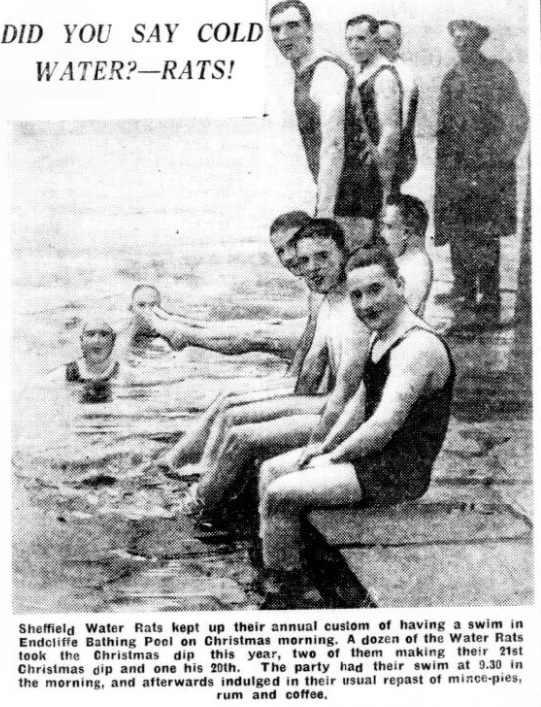
From the Sheffield Daily Independent, 27 December, 1930. Image: British Newspaper Archive

Members became older and more ‘youthful’ ones couldn’t make up the numbers. By 1937, the Water Rats tended to only venture out at Christmas, unlike the newer Spartan Swimming Club that had started taking to the open-air Millhouses Bathing Pool every morning.

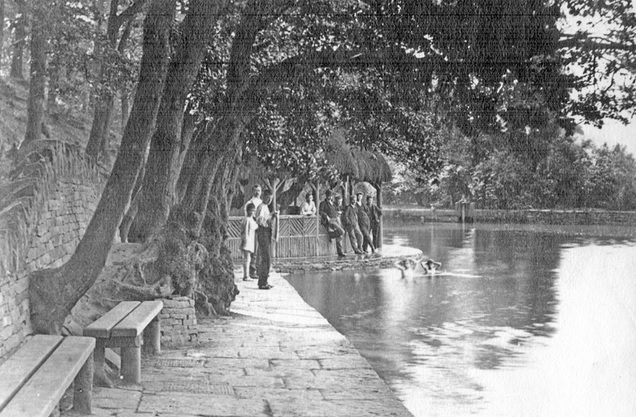
Endcliffe Bathing Pool had opened after Sheffield Corporation purchased 20 acres of Endcliffe Wood from the trustees of Robert Younge of Greystones. William Goldring was commissioned to adapt the land for public use in 1886, part of which was converting Endcliffe Wheel mill dam as a place for boys and men to bathe.
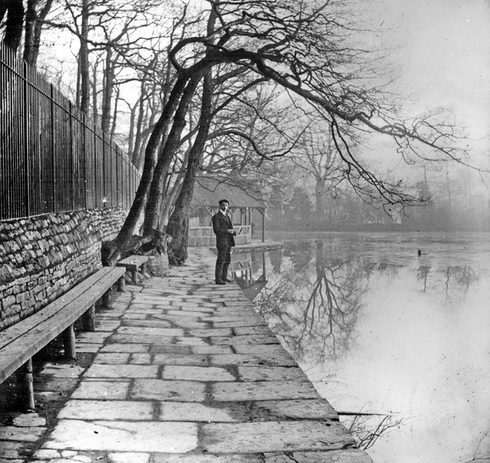
Endcliffe Wheel Bathing Dam, Endcliffe Park. Picture Sheffield
Bathing Dam, previously the dam belonging to Endcliffe Wheel, Endcliffe Woods. Image: Picture Sheffield

However, the bathing pool always attracted unwanted attention due to mud and debris washing into it from the adjacent banking.

“I think it is most disgusting,” said one correspondent in 1896, “the water is almost stagnant, in some parts the floor is quite a foot thick with mud and refuse, whilst in other places there is nothing but glass and stones.”

“This pool would be a source of health-giving pleasure to hundreds of men and boys, were it only made clean and wholesome, and the supply kept free from the rubbish which now pollutes it,” said another in 1904.

“A type of woman, and also girls, whose idea of modesty seems to be at a low ebb, persistently come behind railings on the far bank, and also into the enclosure itself. Many of the men are nearly naked, and some of the boys quite so. A park keeper reports coarse language at times,” reported somebody else in 1909.
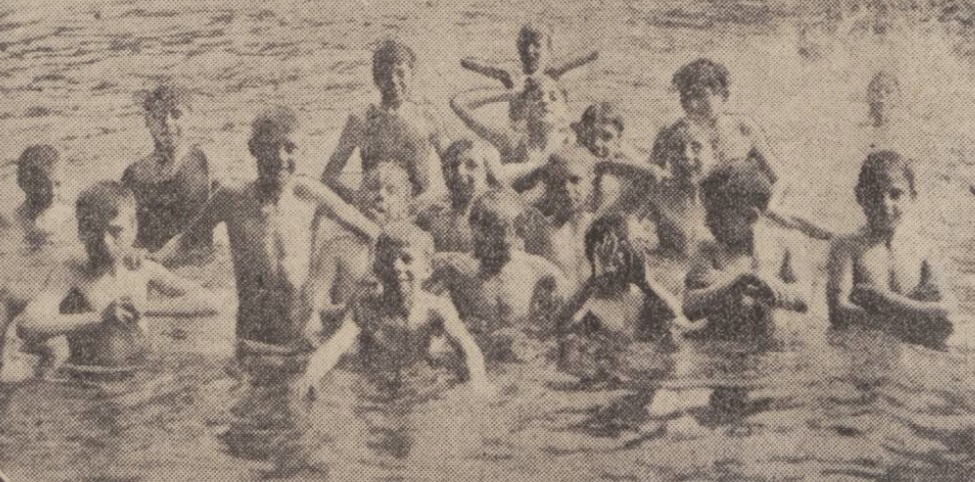
Youths disporting themselves in Endcliffe Bathing Pool. July 1914. Image: British Newspaper Archive

Endcliffe Bathing Pool closed for cleaning in 1938 and appears never to have reopened. It was filled in and today is understood to be the site of the children’s’ playground.
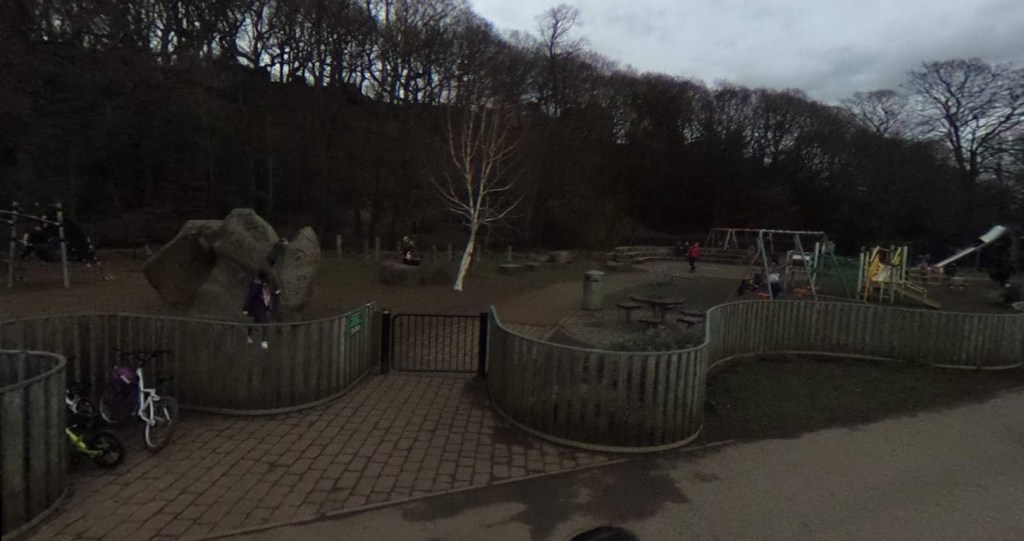
Endcliffe Park playground, once the site of Endcliffe Bathing Pool

© 2022 David Poole. All Rights Reserved.
Categories
Late Night Tales

Late Night Tales #13

Image: DJP/2020

May 1850. Water that flowed down an underground sewer in Howard Street had formerly been derived from springs in the neighbourhood. It ran down the hillside and emptied into the River Sheaf near the Pond tilt. All went well until several properties in Eyre Street, at the top of the hill, started emptying waste into the drain. It might not have been an issue had it not been for Thomas Dewsnap of Arundel Works, who discovered that his father had diverted the sewer to a reservoir at the works and used the water to power a steam engine. The reservoir water started giving-off a foul smell and after numerous complaints from neighbours was deemed to be injurious to the health of the neighbourhood.

© 2022 David Poole. All Rights Reserved.
Categories
Buildings

Urban architects reach for the sky

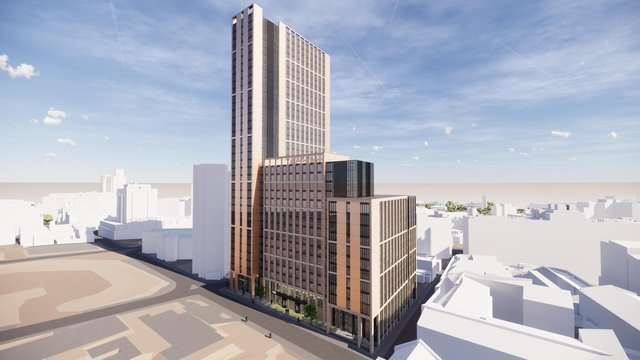
How Code Sheffield will look

A few weeks ago, Sheffield councillor Chris Rosling-Josephs, called on developers to be ‘more creative’ and build a 50 storey tower block so the city can have taller buildings than Leeds.

This might well happen, but for the time being the tallest building in Yorkshire is Altus House in Leeds, at 374ft.  Sheffield’s tallest building is City Lofts, or St Paul’s Tower, at 331ft.

But the tallest building crown will switch to Sheffield soon.

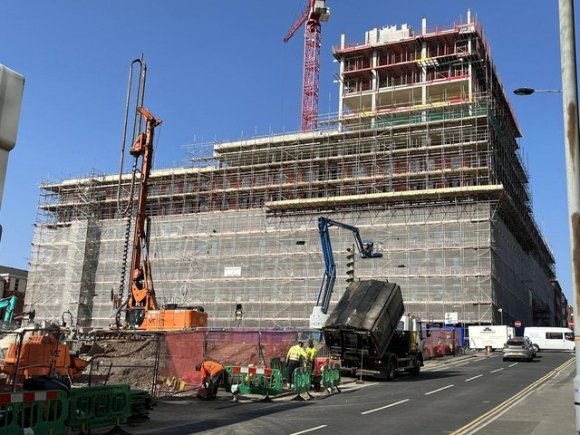
Work has started on Code Sheffield, three blocks of 12, 17 and 38 storeys costing £100m. Foundations are being dug on the site which borders Rockingham Street, Wellington Street, and Trafalgar Street, and adjacent to Kangaroo Works. Once completed it will be 383ft tall.

It is a significant change for this part of the city centre which was once developed with terraced back-to-back housing and small factories.

The site of Code Sheffield is no different, except that the eastern part of the site was once Mount Tabor Chapel, with a small steel works (Foundling Works or Samuel Buckley Styrian Steel Works) to the south-east along Rockingham Street.

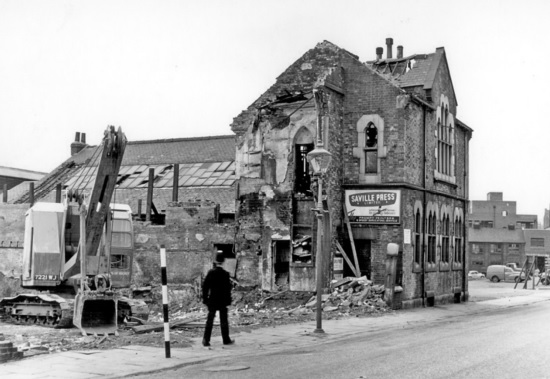
Rockingham Street, demolition of Saville Press Ltd., No 37, Wellington Street (former Mount Tabor Chapel, United Methodist Free Church). Image: Picture Sheffield
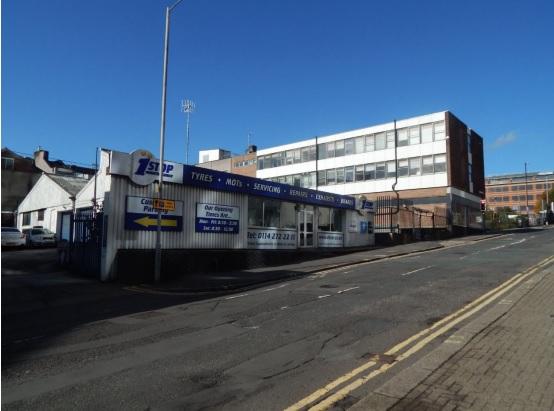
Same place as above. The site from the south-east, showing garage and Wellington House looking north
Same place as above. Recent photograph of excavations for Code Sheffield

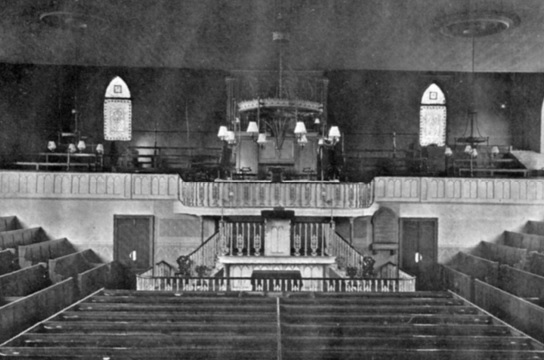
The Chapel was built in 1837-1838 for the Reverend Robert Aitken, a Wesleyan minister. The Wesleyan Reformers purchased the chapel in 1853 and redecorated it as the Mount Tabor Chapel but did not alter the layout. A Sunday School was later built on the land to the west. Both buildings are shown on 1923 and 1935 OS maps and there were plans to improve it in the 1940s, but by the 1950s it had been replaced by the Mount Tabor Printing Works.

Interior of Mount Tabor United Free Methodist Chapel, Wellington Street. Dated 1940-1959. Image: Picture Sheffield
Nos. 37 – 53 Wellington Street at junction with Trafalgar Street, looking towards Rockingham Street junction. Court 4 at rear of back to back properties in foreground. Mount Tabor United Free Methodist Church and Sunday School, in background. Dated 1938. Image: Picture Sheffield

The printing works were recorded in the trade directories of 1948 and 1957 as belonging to Saville Press Ltd and Greeting Card Ltd. This building was demolished in 1962-63.

Later buildings on the site included the telephone exchange, which replaced back to back housing, last occupied by the South Yorkshire Housing Association, and Wellington House, which contained Clark and Partners, providers of mobility aids and services.

The One-Stop garage at 210 Rockingham Street was recorded as a garage in 1968 and later as motor radiator repair shop for W.H. Tyas, subsequently occupied by Marston Radiator Services.

All these buildings were cleared in advance of present building work.

However, there is a further twist as to which city will have the tallest building. Plans have already been approved for a 43-storey tower block in Leeds.

The site from the junction of Wellington Street and Rockingham Street

© 2022 David Poole. All Rights Reserved.
Categories
Late Night Tales

Late Night Tales #12

Image: DJP/2022

July 1885. Henry Bradbury, a boy, living in South Lane, was charged with stealing seven newspapers from the shop of Mrs Pearson. The youngster made a small profit by selling the newspapers to men living in the slum neighbourhood. With this money he bought food for his brothers and sisters. He had previously been convicted of similar thefts and was sentenced to seven days’ imprisonment and hard labour. He cried in court.

© 2022 David Poole. All Rights Reserved.
Categories
People

Mr High Test visits Sheffield in September 1930

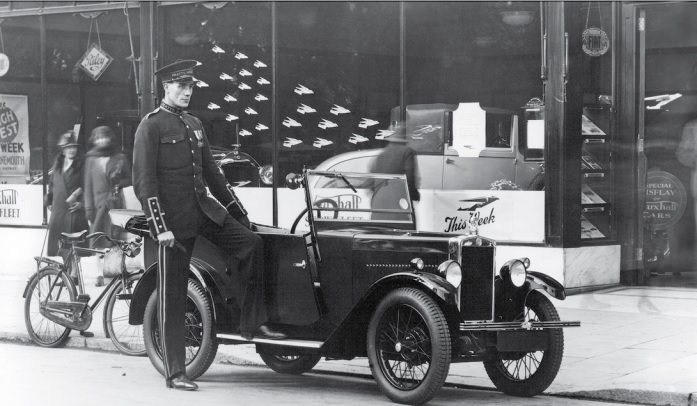
Mr High Test and his Baby Austin. Image: Ken Martin Collection

September 1930. Mr High Test, a giant representative of the Anglo-American Oil Company, proprietors of Pratts High Test Petrol, visited Sheffield on an errand of “personal interest to all motorists in the district,” and make them aware of its new product.

Mr High Test was seven feet high and wore a uniform of orange and gold and had been covering the whole of the country in a 7 h.p. Austin Seven car. His height meant the seat was set a good way back, and he confessed that his biggest problem was finding a bed to sleep in.

He was really Mr R. Ormiston Noble, a Londoner, who at the age of 17 had joined the Army and went to France. Afterwards, he set up his own business before joining Pratts where he remained for several years.

He travelled in the car from Cardiff to Sheffield, and during his stay toured local garages and made appearances at the Hippodrome Theatre on Cambridge Street, where he became the butt of jokes from Frank E. Franks, a comedian, and at the Empire Theatre.

In 1935, a new range of petrol replaced Pratts at filling stations, a petrol so notably advanced that it was sold in all countries under a new name – ESSO – that Mr High Test promoted until being side-lined the following year.

© 2022 David Poole. All Rights Reserved.
Categories
Buildings

A tale of two St Paul’s

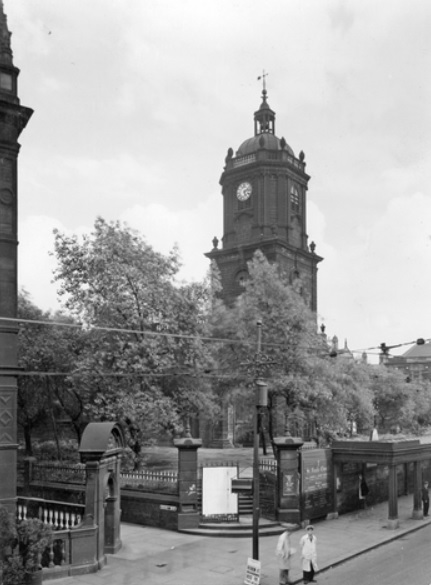
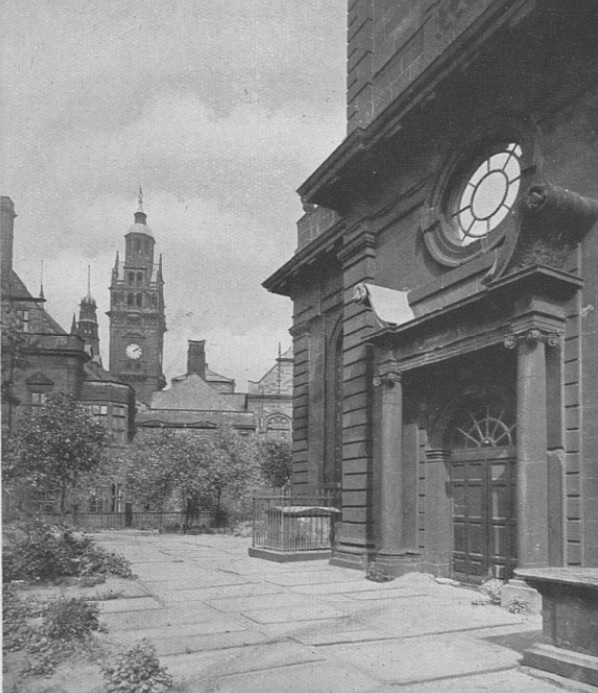
View of St. Paul’s Church from Pinstone Street showing the gateway to the Public Lavatories, Cheney Row and entrance to St. Paul’s Graveyard. Image: Picture Sheffield

It was only recently that I realised that I’d never posted about St Paul’s Church, a Sheffield landmark remembered now by only a few.

If you want to know where it once stood look no further than the Peace Gardens.

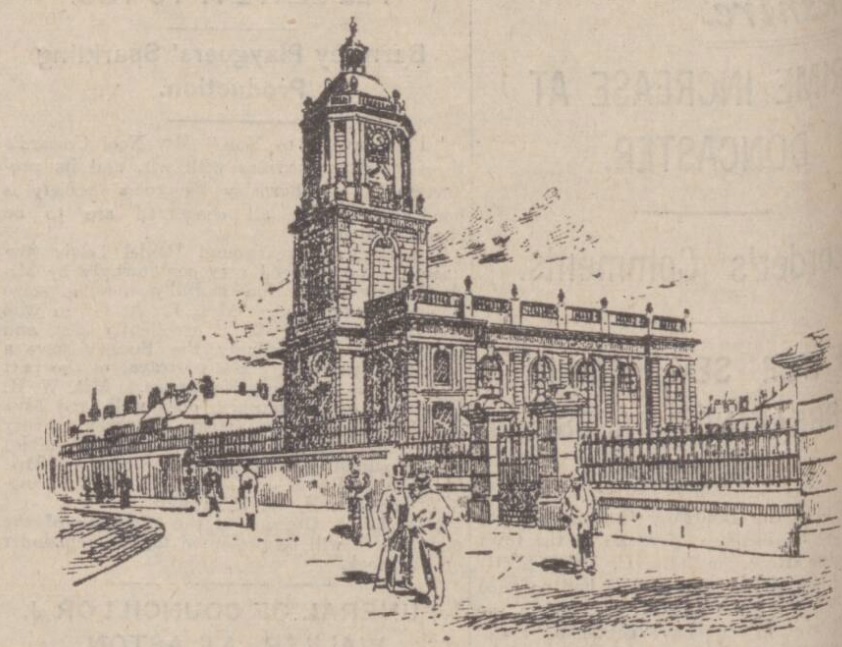
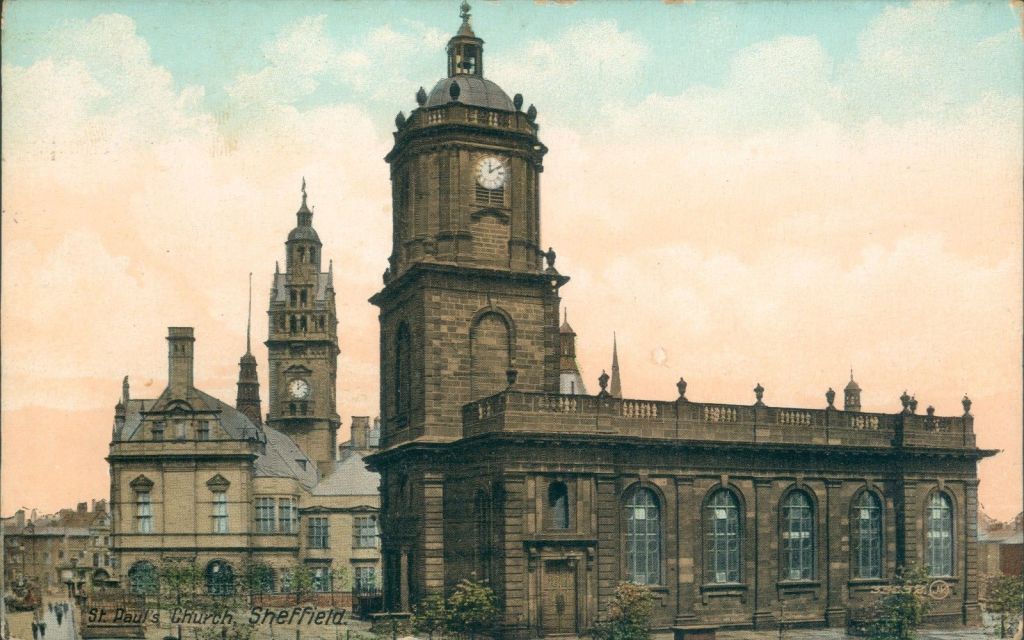
St Paul’s Church stood on the outskirts of Sheffield on land bordered by Pinson Lane (Pinstone Street) and Alsop Fields, called Shaw’s Close or Oxley Croft. Its foundation stone was laid in 1720, the result of public subscription for ‘the new church’.

St Paul’s Church about 1890 and before the Town Hall was constructed. Image: British Newspaper Archive

It was designed by John Platt, architect, statuary mason, potter, and builder, who was active, particularly around Rotherham, in the mid-to-late 18th and early 19th centuries, and most famous for Wortley Hall. Construction was undertaken by John Wastenage of Handsworth.

The building, completed except for the dome, stood empty until 1739 after a dispute over patronage. A John Snetzler organ was installed in 1755 and the dome was added in 1769. Later, in 1824,  St Paul’s was placed in its own parish.

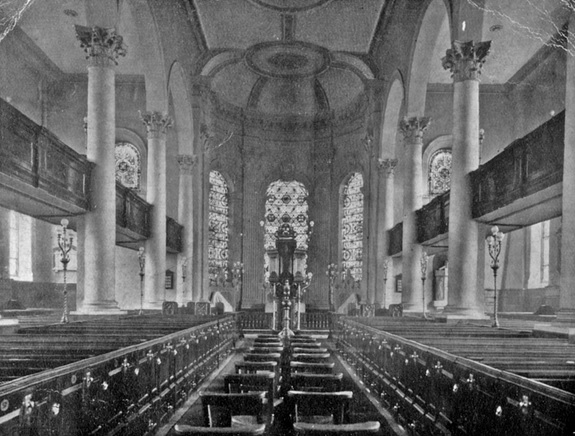
St. Paul’s Church, Pinstone Street, Interior view. Image: Picture Sheffield

The church prospered until the slum clearances of the 1930s in which a large proportion of sub-standard back-to-back houses in the city centre were swept away. The Ecclesiastical Commissioners decided that six city centre churches were surplus to requirement and intended replacing them with ones on the new housing estates. The congregation at St Paul’s had dwindled and was closed in 1937.

St Paul’s Church in 1921, with a glimpse of Sheffield Town Hall behind. Image: British Newspaper Archive

The Society for the Protection of Ancient Buildings (SPAB) took an interest in the rebuilding of the church on East Bank Road, at Arbourthorne.

And found amongst the archives is a letter from Mr John Betjeman, of Ufflington, Berkshire, (yes, THE John Betjeman)  who had visited.

“As a visitor to Sheffield and a student of architecture, I would like to express a hope that your most beautiful classical church of St Paul’s will be rebuilt exactly as it stands on its new site.

“It is appropriate that Sir William Milner, a Yorkshireman, is to save the work of a great Yorkshire architect John Platt II, who designed the tower of St Paul’s and whose father, John Platt I, probably designed the body of the church.”

Betjeman’s pleas were largely ignored.

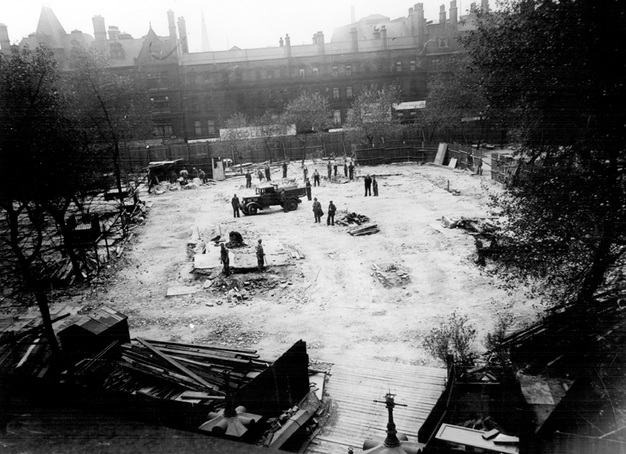
St Paul’s was demolished by Joseph Smith of Denby Street in 1938, the saddest sight being the three ton metal dome of the clock tower that was hoisted on its side before dropping to the ground and smashing into pieces.

“St Paul’s beauty did not save it, and all that can be said of those who pulled it down is that they beat the German bombers to the sordid task.”

Site of St. Paul’s Church and church yard following demolition. Image: Picture Sheffield

Work on the new church costing £20,000 at Arbourthorne started almost immediately and was completed by the end of 1939.

“The original idea, partly through sentiment, was to try and move the old church stone by stone and re-erect it, but this simply could not be done,” said the contractor. “To build an actual replica in stone like the original church would have been prohibitive. The cost would have been considerably more than the actual cost of the new building, and so the decision had to be made to build the new church in brick.”

It is thought that some of the stone was used instead to build houses at Bents Green.

Practically all the interior furnishings, including pews, alters, and plate, were transferred to the new church but missing was the organ which went to All Saints in Wingerworth and the Chantrey Memorial which went to Sheffield Cathedral. Missing also was the famous clock tower which, at £800, was thought too expensive. The contents of the former graveyard were transferred to Abbey Lane cemetery.

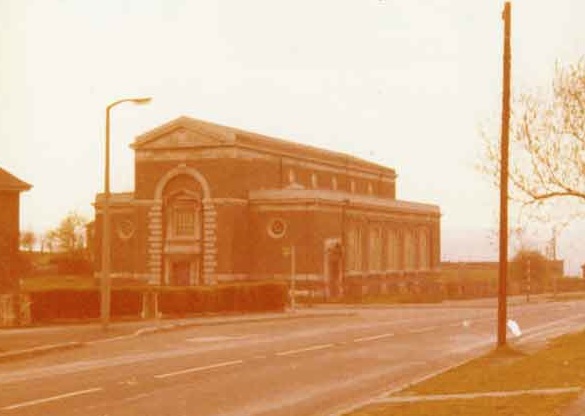
St.Paul’s C.of E. Church (now demolished), corner of East Bank Road and Berners Road. It was a large, austere, building that never did the original church justice. Remarkably, this appears to be the only surviving photograph. Image: Picture Sheffield

The vacant land in the city centre was intended to be used for extensions for the Town Hall, but public opinion swayed Sheffield Corporation to turn it into St. Paul’s Gardens, commonly referred to as the Peace Gardens.

And there was a sad end for the ‘new’ St. Paul’s Church. Dwindling congregations in a draughty big building played a part in its downfall and it was demolished by the end of the 1970s. In its place, a hostel for people with learning difficulties, and a house alongside called The Old Vicarage.

Questions remain unanswered about the original St Paul’s Church. The bell and clock were carefully removed during demolition but not used in the reconstruction at East Bank Road. Does anybody know where these might have ended up?

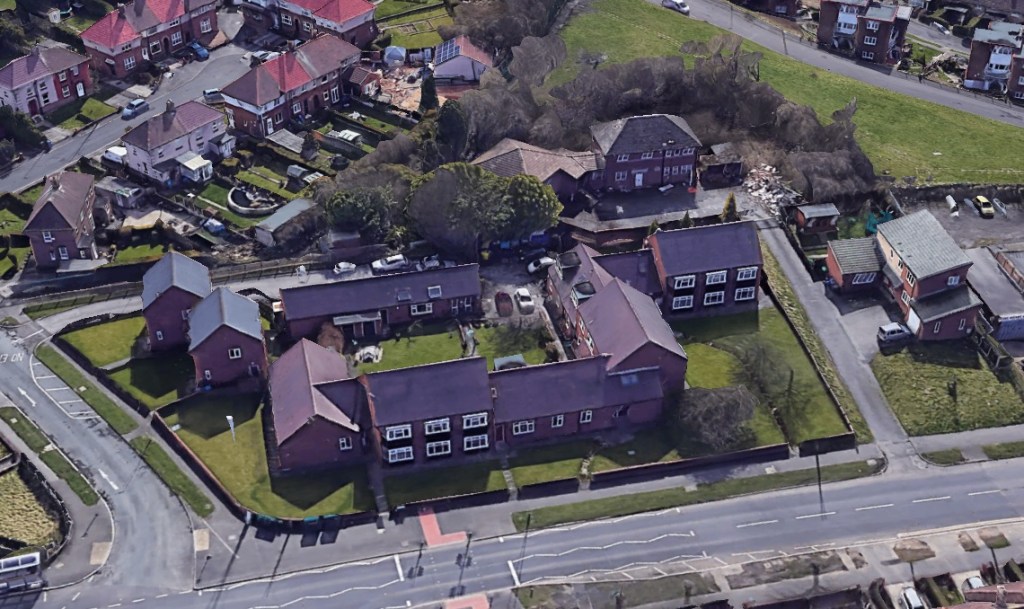
Former site of St Paul’s Church, Arbourthorne, at the corner of East Bank Road with Berners Road. Image: Google
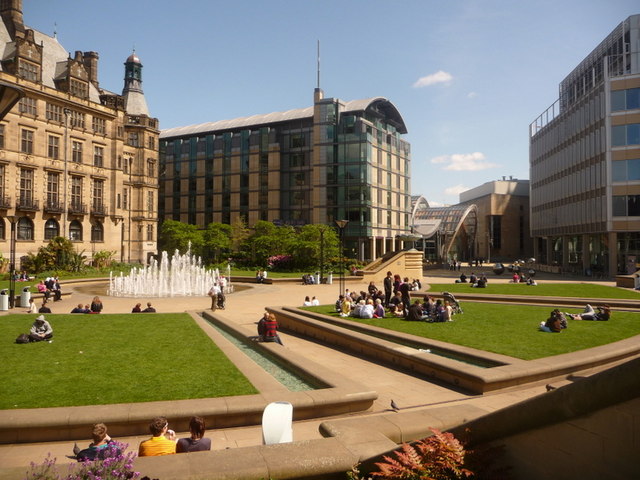
Peace Gardens. The former site of the original St Paul’s Church. The area is now referred to as St Paul’s including the naming of buildings and a hotel.

© 2022 David Poole. All Rights Reserved.
Categories
Late Night Tales

Late Night Tales #11

Image: DJP/2022

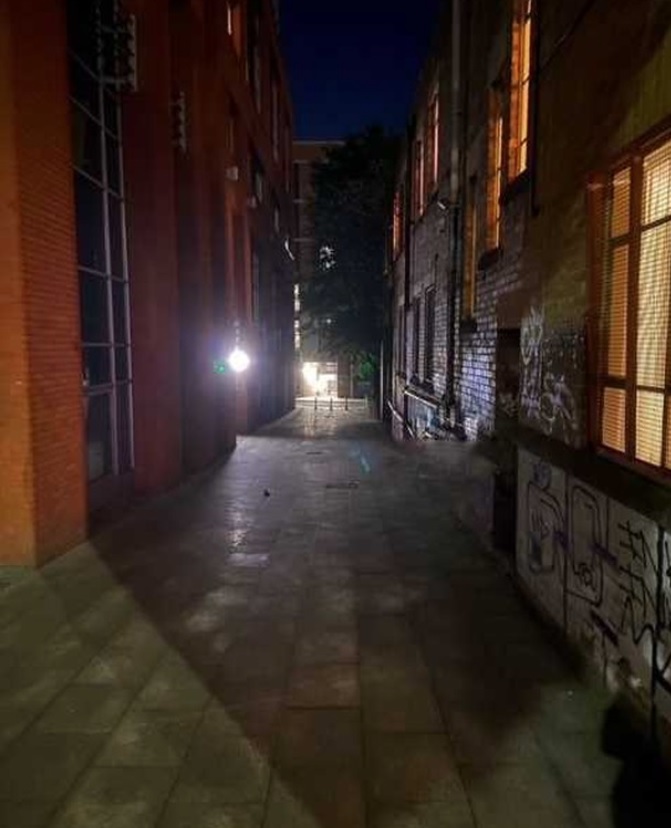
Last night I met the old man with the pipe. He was leaning against a wall. “Good evening again,” he said. “This is a lonely spot,” I commented. “Aye lad, it is that. Duke Lane is not a nice place at night. Just last week, three ruffians went into the Three Legs of Man down yonder, and such a commotion they caused. Police Constable Hobson was called and ordered them to go away.  The poor man was knocked down and kicked. He blew his whistle and they got ‘em, and all three went to prison for hard labour.” I looked at the scene of the crime and when I turned back to the old man he had disappeared.

© 2022 David Poole. All Rights Reserved.
Categories
Streets

The last days of haymaking

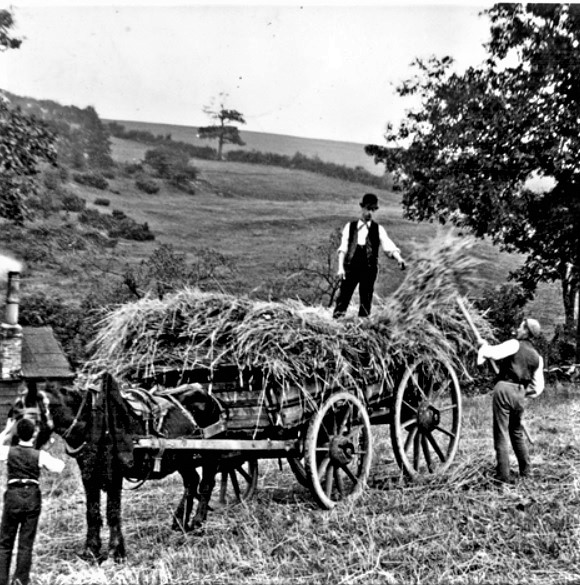
A pastoral scene from 1892. Image: Picture Sheffield

In 1892, a Mr Cunningham captured a scene of haymaking. A farm worker gathers hay by fork and piles it onto the back of a horse-drawn wagon on which a bowler-hatted man stands. Tending the horse is a young boy. In the background, a fire is on the go in an old cottage and smoke rises from the chimney. It is a scene of rural paradise with fields and trees rising-up the hillside behind.

Within fifty years this pastoral scene had disappeared. Sheffield’s growing population needed rehousing, and many were moved from old city centre slums into new housing estates that crept up the hillsides.

This photograph was taken on East Bank Road, and I’m led to believe that the old cottage stood in a glade behind Midhill House, a large country property that became what is now the Earl Marshall pub.

Still countryside but not for long. East Bank Road photographed in 1946. Image: Picture Sheffield

The road itself, then little more than a country lane, climbed the hillside and had once ended at Midhill house before eventually being extended towards the village of Gleadless.

The Arbourthorne estate, at the top of East Bank Road,  was under construction by the mid-1930s and the road  widened, with council houses built on the opposite side to Midhill House. The first bus service between Sheffield and Gleadless came up here from 1937 (and continues as the No. 51 bus route).

East Bank Road seen from from East Road, looking towards, No 291, Midhill Working Men’s Club and Institute Ltd (formerly Midhill House) in 1946. Image: Picture Sheffield

The old cottage disappeared, and farmland became property of Sheffield Corporation, and although housing eventually surrounded this little oasis, the area around Midhill House remained green space. The Norfolk Park estate was built at the top of the hill behind.

Modern day view of East Bank Road. Midhill House, now the Earl Marshall pub, survives. The old cottage in the haymaking photograph is believed to have existed where woodland now stands behind the house. Image: Google

© 2022 David Poole. All Rights Reserved.
Categories
Late Night Tales

Late Night Tales #10

Thursday 29 May 1856. Thousands of people attended a May-day procession to celebrate the fall of Sevastopol, the capital of Crimea, the previous October. “The view from Moor-head along this fine street was lively in the extreme, presenting to the eye at one glance a greater number of flags and banners than perhaps any other part of the town.”

© 2022 David Poole. All Rights Reserved.
Categories
Buildings Companies

Kangaroo Works will honour the site it stands on

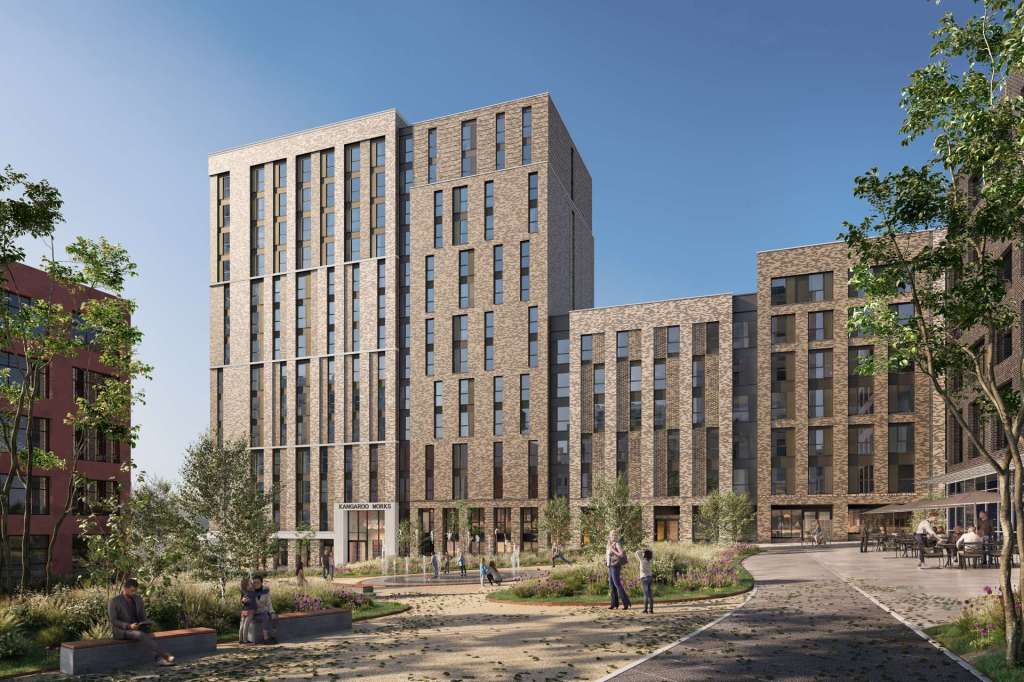
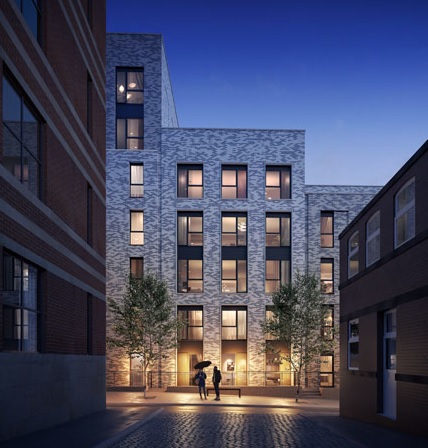
The scheme comprises 364 dwellings with a mix of 1, 2  and 3 bedroom apartments, which will be built and operated under the Build to Rent (BtR) Sector model.  Commercial space will be provided at ground floor levels, providing active frontages to Rockingham and Wellington Streets. Image: Whittam Cox Architects

Next year, people will start moving into a new residential complex in Sheffield City Centre. When they do, the occupants of Kangaroo Works, a 364 apartment development, will have one of the oddest postal addresses in the city.

Designed by Whittam Cox Architects, with construction underway by Henry Boot, Kangaroo Works is the latest building in Sheffield’s Heart of the City II development. The building, with frontages to Rockingham and Wellington Streets, is designed around the vernacular Sheffield courtyard plan, and provides a stepped roofscape, responding to the sloping typology of the site and forming a transition between the formal city centre and more historic Devonshire Quarter.

The block has a peak of 14 storeys whilst a unique brick façade, taking inspiration from Sheffield’s urban heritage, supports the Masterplan palette and industrial heritage of the original Kangaroo Works site, which the development now stands on.

Kangaroo Works was home to Robert Sorby and Sons, makers of edge tools, later becoming a merchant and steel maker, that had set up on Union Street in 1828 and then moved to Carver Street in 1837.

About 1896 it moved a short distance to this site at the corner of Trafalgar and Wellington Streets.

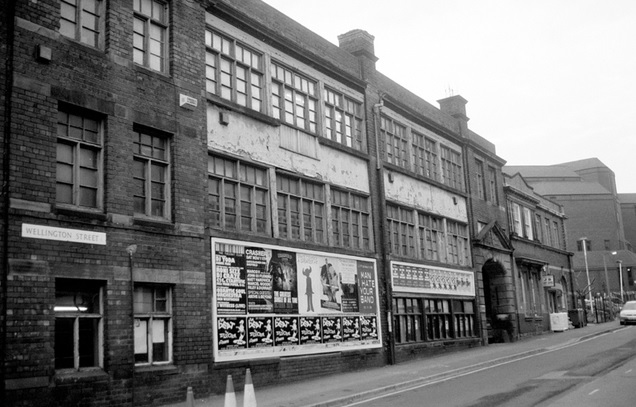
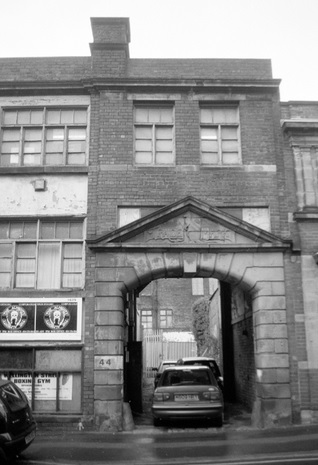
Former premises of Robert Sorby and Son Ltd, edge tool manufacturer, No. 44 Wellington Street, (his trade mark was a kangaroo so was referred to as the Kangaroo Works) with the Fire Station, Wellington Street in the background. Image from 2006 by David Bocking/SLAI/Picture Sheffield

Their products included adzes, axes, augers, edge tools, joiners’ tools, saws, scythes, hooks, sheep shears and crucible steel. The company sought markets worldwide, and the Kangaroo brand, which was used until the 1980s, was adopted to emphasise the company’s interest in Australia.

Former premises of Robert Sorby and Sons, edge tool manufacturer, No. 44 Wellington Street. Image from 2006 by David Bocking/SLAI/Picture Sheffield

Robert Sorby and Sons was acquired by Hattersley and Davidson in 1923, and vacated Kangaroo Works in 1934 to share a site on Chesterfield Road. It still survives in premises on Athol Road at Woodseats.

The former Kangaroo Works became dilapidated and converted for multi-use, and remained so until demolition in 2008, after which it was used as a car-park.

Former Kangaroo Works gateway. Image: The Glasgow Gallivanter

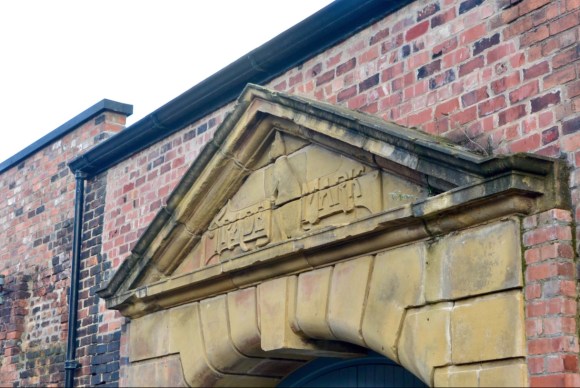
But what happened to the famous stone-carved Kangaroo trademark that once stood over the gateway on Wellington Street?

It was rescued and re-erected at Kelham Island Museum, slightly shorter in height so that it would fit into the restored Russell Works building that houses the Ken Hawley Collection of tools, cutlery and silversmithing made in Sheffield.

And so, the name lives on, and Kangaroo Works will occupy pride of place overlooking Pound’s Park, the new urban green space also under construction.

Located within close proximity to the Cambridge Street Collective and Elshaw House project, Kangaroo Works is a privately funded development forming part of the Heart of the City masterplan. Image: Whittam Cox Architects

© 2022 David Poole. All Rights Reserved.