Categories
Buildings Sculpture

Vulcan: the protector of Sheffield for 128 years

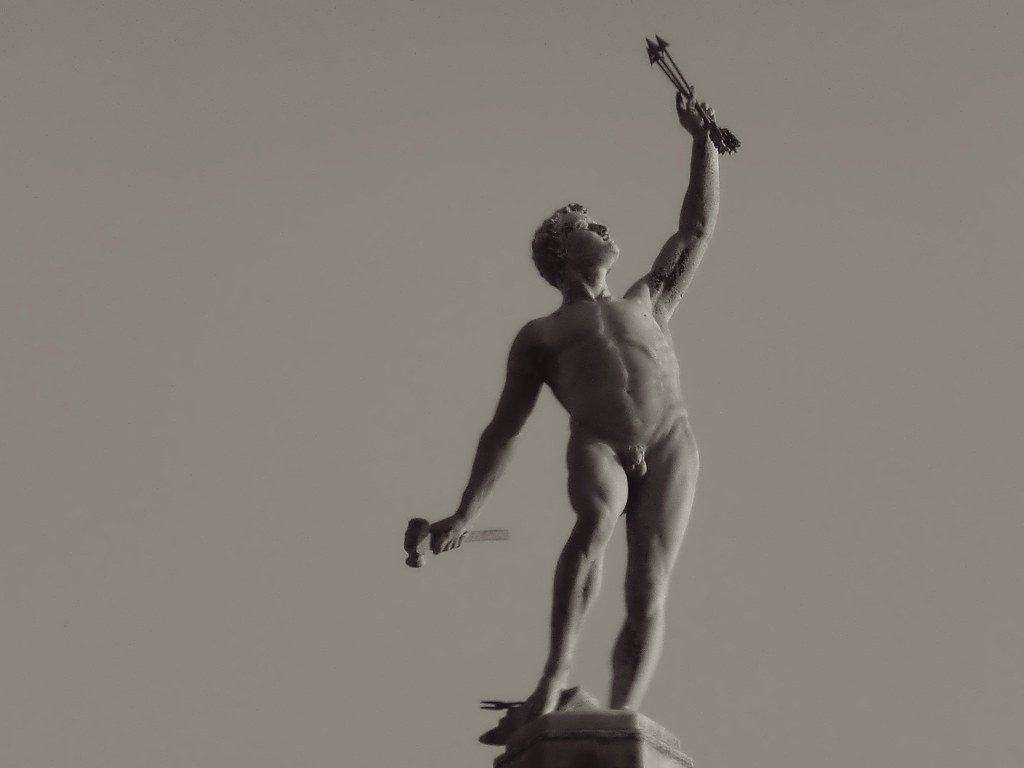
Vulcan stands on top of Sheffield Town Hall. Image: Thawantsshooitin

There is a statue of Vulcan on top of the Town Hall, and the more I look at it, the more I see him as the protector of Sheffield. And he’s been doing this for 128 years, and when bombs destroyed the city centre in December 1940, one of the local newspapers put a drawing of Vulcan on its front page and the words DEFIANT!

The Town Hall was built in Renaissance Revival style by Edward William Mountford, a London architect, who also designed Town Halls at Battersea and Lancaster, as well as the Old Bailey.

Work began in 1890 and finished by September 1896, but it wasn’t until 1897 that Queen Victoria officially opened it.

Mountford had wanted something special to stand on top of the one hundred feet clock tower and chose an Italian, Mario Raggi, to create the Vulcan statue.

Vulcan, the Roman God of the furnace, the patron of all smiths and other craftsmen who depend on fire, was adopted as a symbol of Sheffield in 1843.

Mario Raggi was born in Carrara, in Tuscany, in 1821, notable for marble used since the time of Ancient Rome, and it was no surprise that Raggi became interested in sculpture.

He trained at the local academy, and then studied in Rome under Pietro Tenerani before moving to London in 1850 where he first worked for Raffaelle Monti, and then under Matthew Noble.

Raggi exhibited at the Royal Academy and was famous for memorials to Benjamin Disraeli at Parliament Square and Gladstone at Albert Square, Manchester. He also completed three monumental statues of Queen Victoria in Hong Kong, Toronto, and Kimberley in South Africa.

In 1875, he set up his own workshop at Cumberland market, between London’s Regent’s Park and Euston Railway Station, at 44 Osnaburgh Street.

I have the first possible reference to our Vulcan… and that is in 1892 when Signor Raggi had almost completed a standing statue of Vulcan, ‘with a hammer in his right hand, his right foot resting on an anvil and in his left hand, held aloft, three arrows, and intended for Sheffield Town Hall.’

Vulcan is seven feet in height (although other measurements of nine and eleven feet have been given)… and modelled from a Life-Guardsman. It was cast in bronze at the foundry of Henry Young and Co, Eccleston Works, Pimlico.

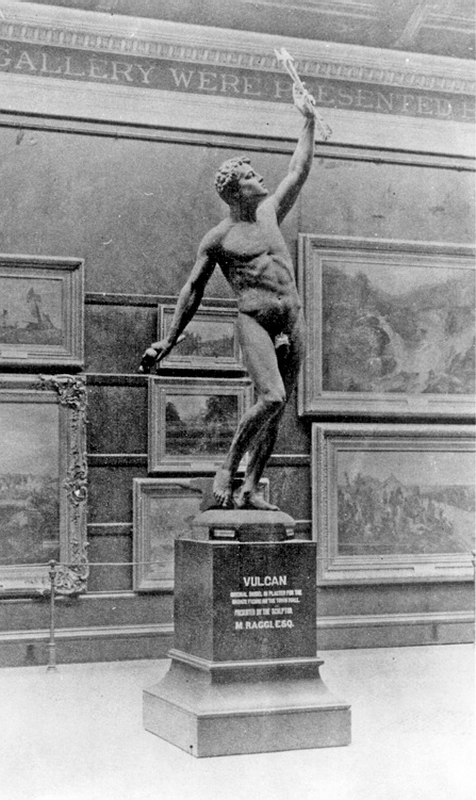
For a long time, the original plaster cast version was on show at the Mappin Art Gallery until it became irreparably damaged, due to frequent moving to avoid air raids during World War Two and was broken up and discarded.
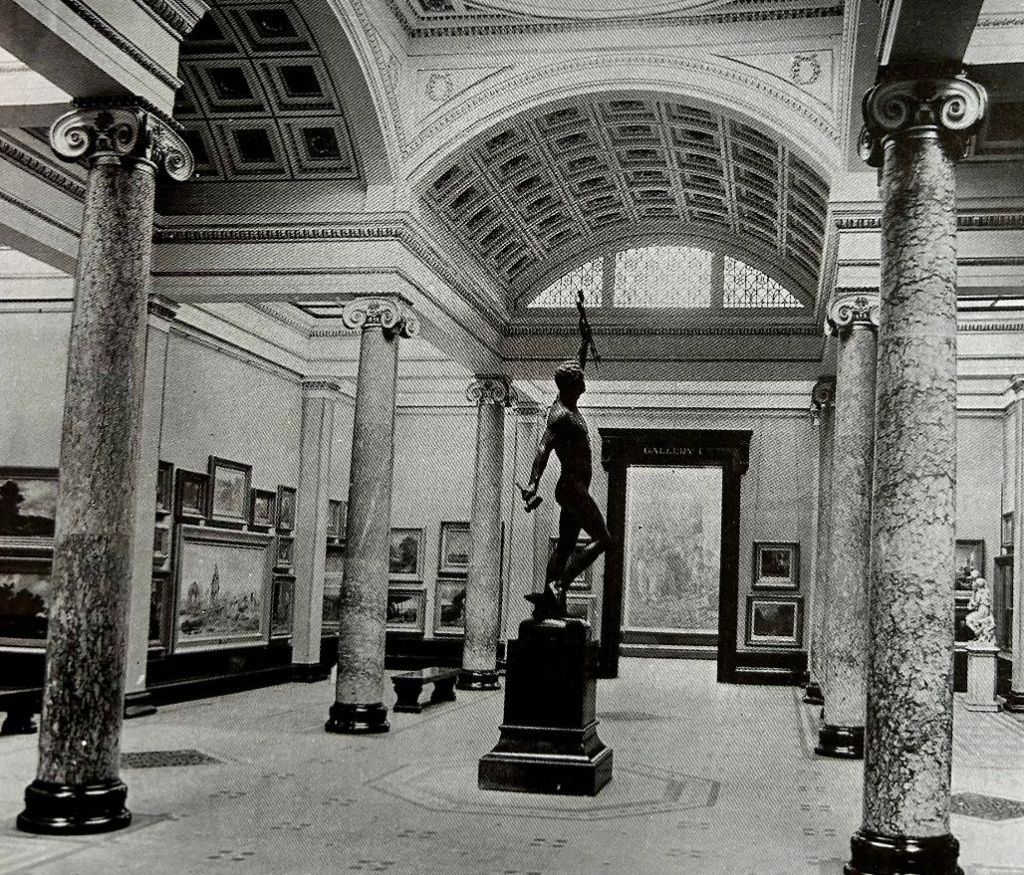
The Special Gallery at Mappin Art Gallery in 1937. In the centre, the ‘lost’ plastercast version of Vulcan by Mario Raggi. Image: Sheffield City Council
The plastercast version of Vulcan seen in 1897

The bronze statue was erected in 1896 by Cromwell Wiley Hartley, a daring Sheffield steeplejack who completed the task in fierce winds that threatened to dislodge him, but he managed to securely bolt Vulcan to its foundation.

The following year, Hartley climbed the tower again, and fixed an electric light in Vulcan’s extended hand to celebrate the visit of Queen Victoria, then stood on the head of the statue earning him the title as the ‘man with the iron nerve.’ A photograph was taken at the time, by Mr Taylor of Norfolk Street showing him in this risky position but appears to be lost.

In 1926, Reginald T Rea, the manager of the Albert Hall, which stood on the site of the former John Lewis building, erected a telescope in Barker’s Pool which focused on the statue of Vulcan. It was intended as a publicity stunt and the one penny proceeds from looking through the telescope went to Sheffield hospitals.

It was an enormous success, with an average 2,500 views a day,  and the suggestion is that it became a permanent attraction. There is reference to a telescope in World War Two, and through this a story emerged that Vulcan had lost his delicate parts during an air raid. (He appears to be intact now).

While Vulcan is made of bronze, he now has a green patina, the result of a slow corrosion process, which I’m told should not affect his future.

Another model of Vulcan was made at the same time, based on Raggi’s Sheffield original, cast by the Gorham Manufacturing Company, Providence, Rhode Island, and placed outside its headquarters in 1894. It differed slightly because while ours was nude, the American version wore a loin cloth. Alas, its whereabouts is unknown.
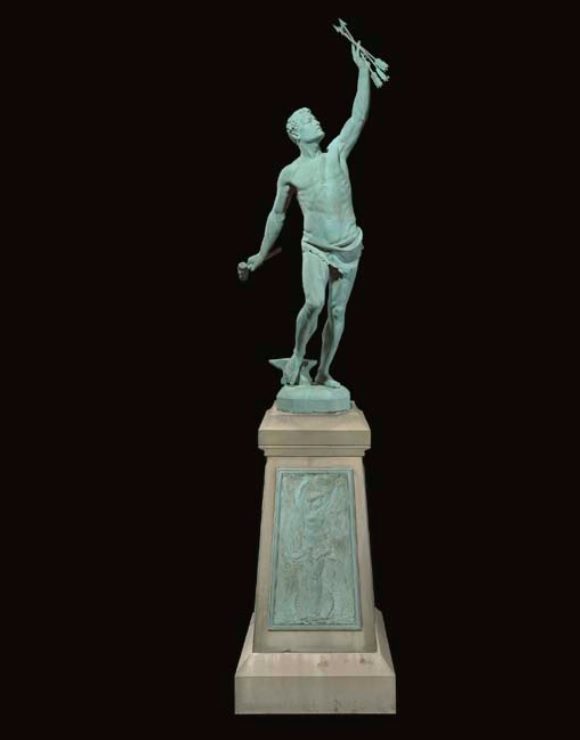
Vulcan. Cast by Gorham, Providence, after the model by Mario Raggi, dated 1893 on a spreading bronze-mounted granite plinth base

© 2024 David Poole. All Rights Reserved.
Categories
Buildings

Sheffield Town Hall: the clock tower that came without a bell

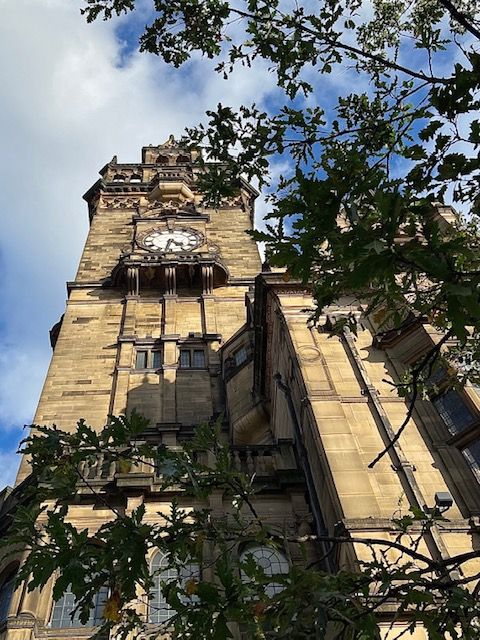
Restoration work this century revealed that stone for the Town Hall clock tower came from a long-disused quarry at Walkley. Photograph: DJP/2021

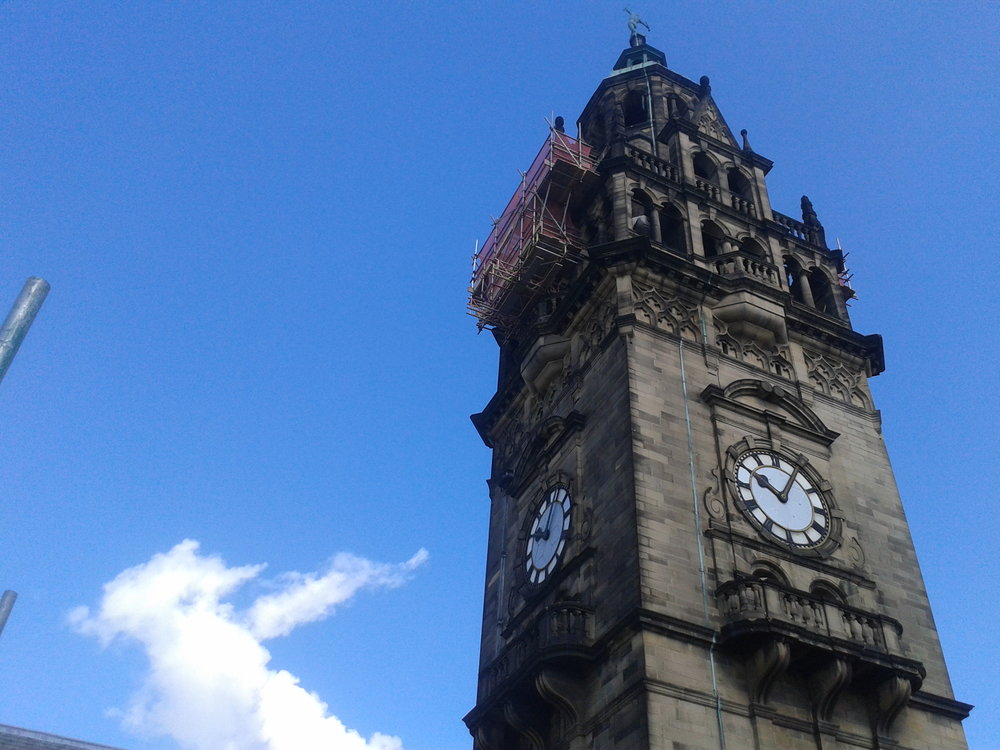
Sheffield’s third Town Hall was designed by Edward William Mountford, a London architect, and opened in 1897. Its clock and tower, the face of our city, stands at the north-east corner, over 100ft high and topped with a statue of Vulcan, the Roman god of fire and metalworking.

The tower is built on a bed of concrete, 30ft square, and 25ft thick; the concrete itself resting on solid rock. At ground level the walls are about five feet thick, and when it was built the strong room for the City Accountant was located here. The dome and spire at the top of the tower are covered with copper.

It was always thought that the tower was made of ‘Stoke’ stone from Stoke Hall Quarry, near Grindleford, but restoration work in 2017 revealed that it was from a long-disused quarry at Walkley.

The Town Hall clock was the work of William Potts and Sons, Leeds, clock makers to Queen Victoria, and was constructed to strike the quarters and hours on heavy bells. However, Sheffield Corporation waited for somebody to show their public spirit and provide the bells – something that never happened – and without it the striking parts of the clock were useless.

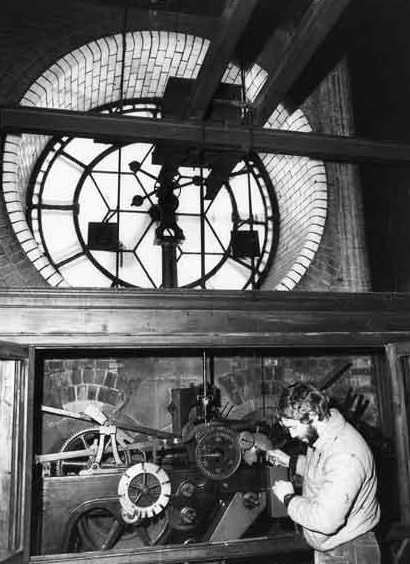
The frame of the clock was in one solid casing, planed perfectly flat on the top and bottom surfaces. It rested upon iron girders, supported by stone corbels built into the tower wall, and provided a rigid foundation for good time-keeping.

The large main wheels for the hour and quarter parts were 22 inches and 20 inches in diameter, respectively. The hour main wheel had ten steel cams attached for lifting the hammer to strike the large bell, with the quarter wheel having suitable cams in readiness for the ‘phantom’ bells. The large gong wheel was 20 inches in diameter.

The workings of the Town Hall clock. Seen here in the 1980s. Photograph: Picture Sheffield

There was special arrangement for accurately discharging both the hour and quarter parts, with set dials showing both seconds and minutes, and was known as the double three-legged gravity, the invention of Edmund Beckett, 1st Baron Grimthorpe, the man behind Big Ben’s clock, with the two seconds pendulum compensated for differences of temperature and heavy cylindrical bob.

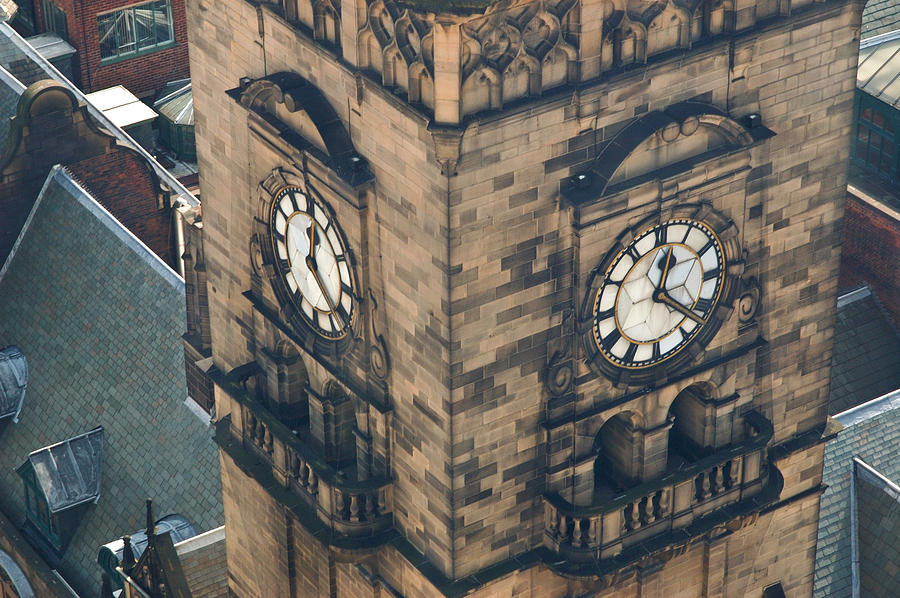
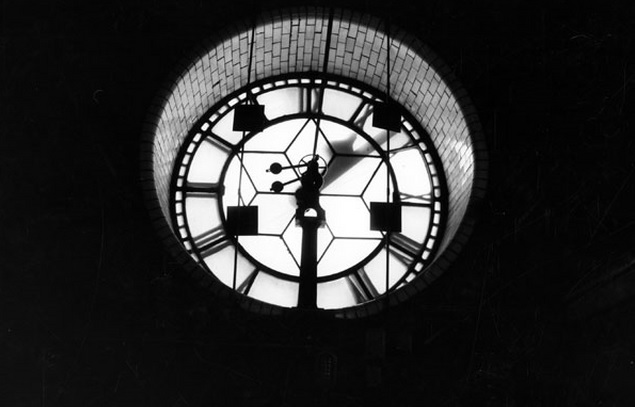
There were four dials, each 8ft, 6 inches in diameter, formed of skeleton iron castings filled in with opal glass, originally illuminated at night by gas, with suitable reflectors behind. The hands were made of stout copper, counterpoised inside, and the motion wheels were made of hard brass, the teeth cut out of it. The bevel work was carried by light iron girders placed across the clock room, and the whole clock was enclosed in a neat wooden case to keep it clean.

The four faces of Sheffield Town Hall’s clocks. Work started in 1890 and wasn’t completed until 1897. Photograph: Rob Huntley

It was not until 2002 that the Town Hall got bells – but nothing as elaborate as once intended. The chimes that now ring out across the city centre comes from an electronic sound-system providing hourly strikes and Westminster-style quarter chimes.

The clock tower was exposed to Sheffield’s pollution and weather for well over a hundred years and had to be restored at a cost of £86,000 in 2017. The original ironwork which had corroded within the structure was exposed and treated and indent repairs were conducted to the ornate carved capitals. Other masonry was repaired and repointed, as necessary. In addition, new rainwater pipes, asphalt floors and gutters were installed. Suitable fine sandstone providing a good match with the original stone was sourced from local suppliers based in Chesterfield.

The clock tower stands at the north corner of the Town Hall, set back slightly in deference to the main façade. This photograph from contractor Maysand shows restoration work in 2017
Sheffield Corporation could not decide whether or not to install a four-ton bell at a cost of £400 before the building of the tower was completed. It was said that if the bell were not put in, but it was decided to put it in later, a great deal money would have to be spent and serious damage done to the tower. Photograph: Picture Sheffield

Picture Sheffield

© 2021 David Poole. All Rights Reserved.
Categories
Buildings Sculpture

The mystery of Mercury

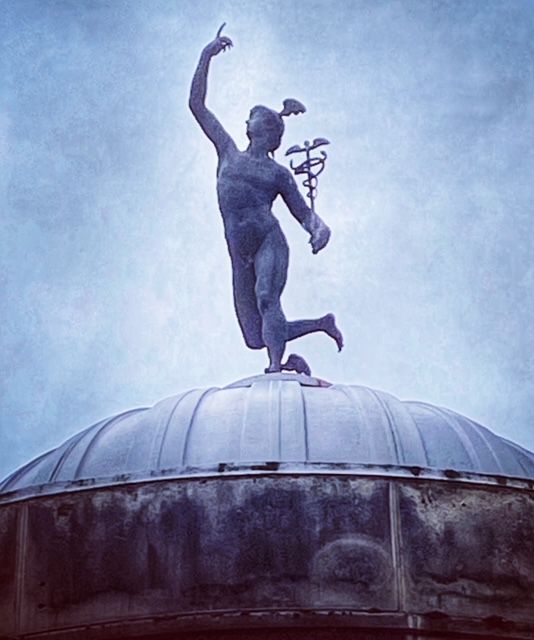
The sculpture of Mercury stands proudly above the portico of the Sheffield Telegraph Building on High Street. It is one of two statues of Mercury in the city centre, the other being on top of the Lyceum Theatre. (Image: David Poole)

Here is a mystery.

This bronze statue of Mercury has stood on top of the portico of the Telegraph Building on High Street since about 1915.

Mercury, Roman god of financial gain, commerce, eloquence, messages, communication (including divination), travellers, boundaries, luck, trickery and thieves, is shown as a nude male figure with wings both side on his hat, and on the outside of his ankles. He carries in his left hand a caduceus, an elaborate winged staff. The statue appears to be about to take off, his toes barely touching the base and his right arm extended with fingers pointing skyward.

But where did the statue come from?

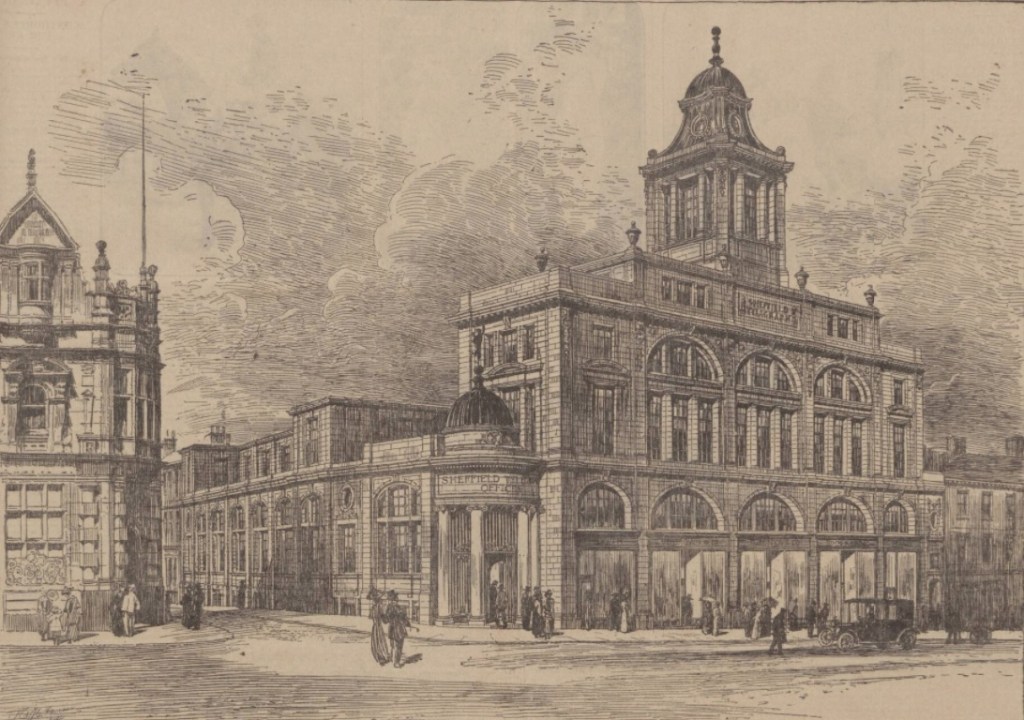
An artist impression from 1913 of the Sheffield Telegraph Building at High Street. The sculpture of Mercury sits above the portico at the corner with York Street. The portico was the entrance to the offices and counting-house which occupied the whole of the ground floor. Most recently occupied by a building society, the corner unit has planning permission to become a restaurant. (Image: British Newspaper Archive)

The bronze statue is said to be much earlier, re-sited here when the Sheffield Telegraph built new offices on High Street between 1913-1915.

A few searches are quite specific that the statue was acquired by the Electric Telegraph Company in 1856 to decorate new premises for the Sheffield Daily Telegraph at the opening to The Shambles. (This is now the site of KFC at the junction of High Street and Haymarket).

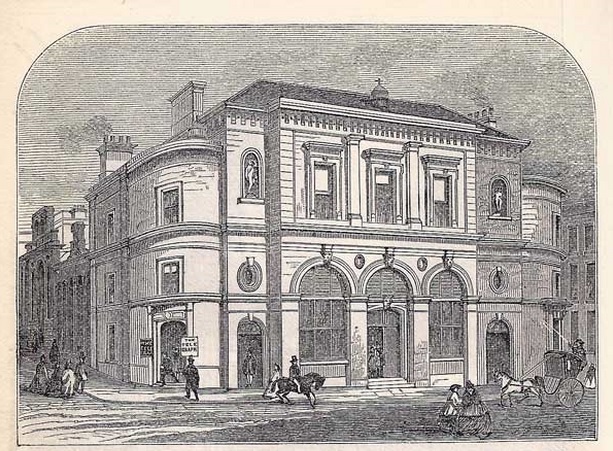
The Electric Telegraph Company office seen about 1856. The statues of Mercury (left) and Vulcan (right) can be seen in the niches at the upper level. (Image: Picture Sheffield)

Furthermore, it is suggested that the bronze sculpture occupied one of two niches, one on either side of the front elevation of the upper story, the figure of Mercury to the left and Vulcan to the right.

It is said that the Mercury sculpture was moved to the Telegraph Building in 1915, while the Vulcan statue was lost.

Old illustrations of the Electric Telegraph Building clearly show the statues, but at this point the authenticity of the sculpture on the 1915 building comes into question.

The Sheffield Daily Telegraph may or may not have had offices at the Shambles, and it is well documented that its early offices were on the site of High Street and Aldine Court, long since vacated by the newspaper.

Further inspection identifies the Electric Telegraph Building on The Shambles as being the Fitzalan Market Hall, that looked up the slopes of High Street and King Street.

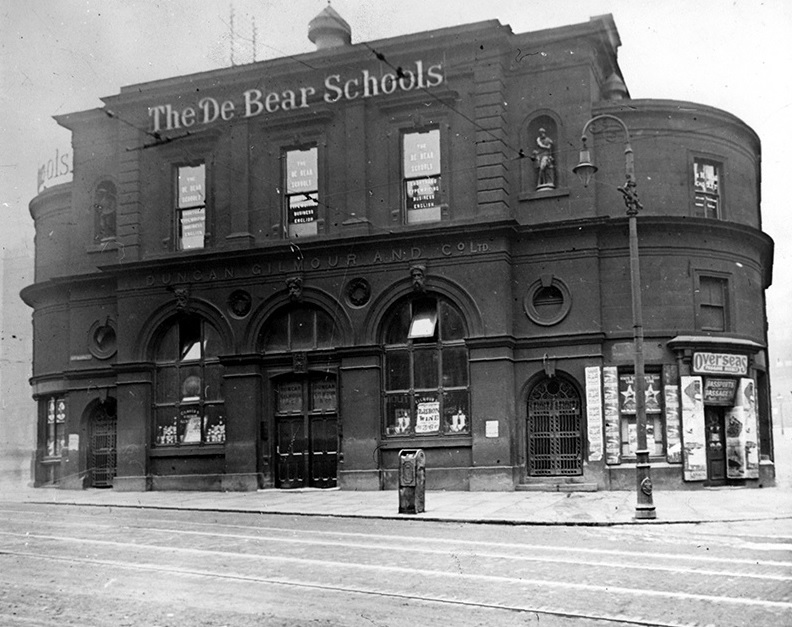
Fitzalan Chambers in 1918. Blackened by Sheffield’s smoky atmosphere, the Mercury and Vulcan statues are clearly evident three years after the construction of the Telegraph Building on High Street. The De Bears Schools specialised in shorthand, typewriting, correspondence, and business training. (Image: Picture Sheffield)

In 1856, an account of the opening of the Exchange, News Room, and Telegraph Office was published in the Sheffield Independent:

“This building which has been erected from the designs of Messrs Weightman, Hadfield, and Goldie, by the Duke of Norfolk, terminate the pile of buildings occupying the façade towards the Old Haymarket. On the ground floor it was necessary to retain the old-established wine vaults of Samuel Younge and Co, and to provide shops for fish salesmen in the lower part of the market. The Exchange Room occupies the first floor. The room is entered by folding doors. At the end of the room opposite the entrance is a small apartment fitted up by the Telegraph Company in which the subscribers may write and dispatch their messages to all parts of the globe accessible to this rapid mode of communication.”

There were lengthy descriptions of the interior and finally “Over the market entrances are two niches with figures carved in stone by Messrs Lane and Lewis of Birmingham representing Mercury and Vulcan – typical at once of the wonder-working telegraph and the staple trade of Sheffield.”

From this account we can identify that both sculptures were made of stone and still present when the Fitzalan Market Hall (or Fitzwilliam Chambers as the offices became known) was demolished in the 1930s.

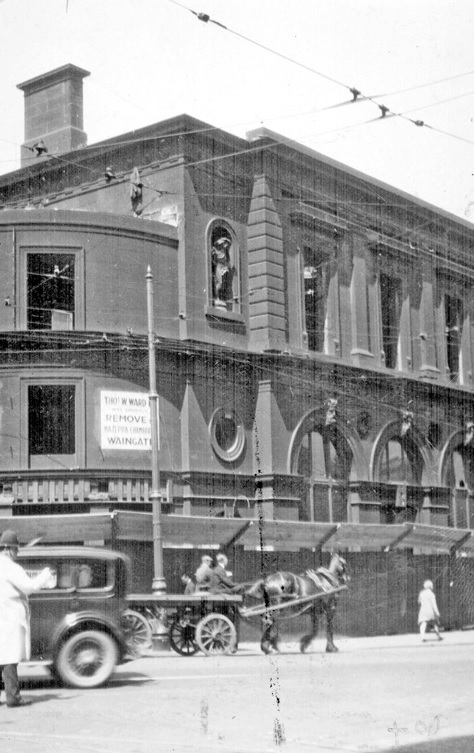
Fitzalan Chambers prior to demolition in the 1930s. The whereabouts of the statues of Mercury and Vulcan is unknown. (Image: Picture Sheffield)

This makes the Mercury atop the Telegraph Building a bit of an unknown.

The design is based on the work of Giovanni da Bologna (1529-1608), better known as Giambologna, noted for his command of sculptural composition, producing figures that were pleasing to view from all positions.

The bronze figure is identical to one on top of the dome above HSBC in Doncaster’s High Street, built in 1896-1897 for the York and County Bank (and according to historians, the sculpture also dating to 1856).

I suspect the origin of the Mercury sculpture on the Telegraph Building lies closer to home and is later in design.

The building was designed by Gibbs, Flockton & Teather and constructed by George Longden and Son in 1915. Both Sheffield firms worked with Frank Tory, responsible for much of the city’s fine stone artwork, but also known to have worked in bronze.

Is it possible that Frank Tory was the man behind the sculpture we see today?

It also leaves another question unanswered.

What happened to the two stone Lane and Lewis statues?

Maybe someone, somewhere, has two fine statues of Mercury and Vulcan in their garden.

© 2021 David Poole. All Rights Reserved.