Categories
Buildings

Sheffield Town Hall

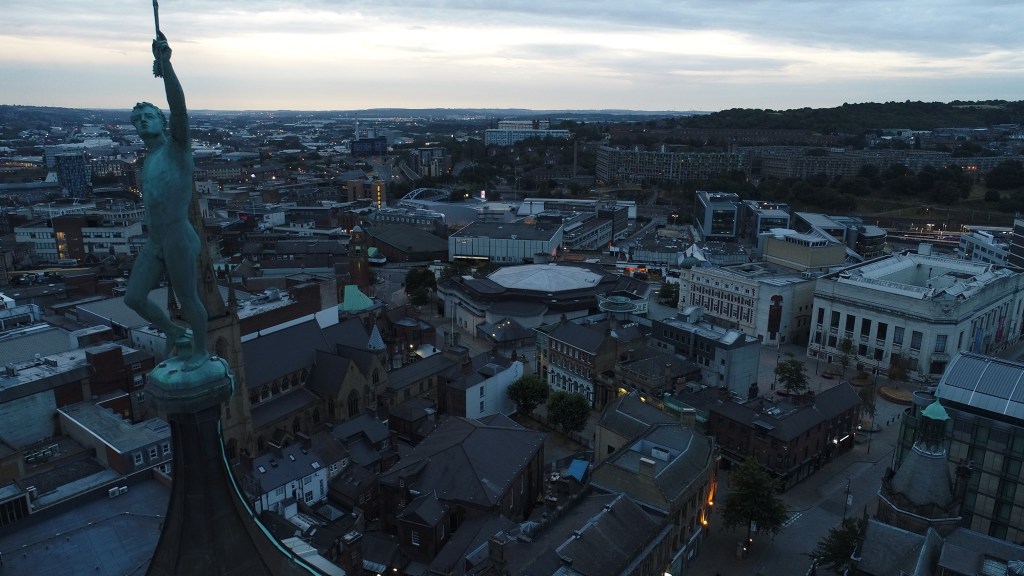
This extraordinary photograph was taken by Paul Stinson of Hovaloft Drone Aerographics. It shows the bronze statue of Vulcan on top of Sheffield Town Hall, created in 1896 by artist Mario Raggi.

This muscular male nude has protected the city for 123 years, seeing us through two World Wars, but almost forgotten by people below.

Darcy White and Elizabeth Norman in Public Sculpture of Sheffield and South Yorkshire provide the life story of this undoubtedly cold naked character.

Vulcan, the symbol of Sheffield, has a hammer in his right hand (not seen here), his right foot rests on an anvil and in his left hand, held aloft, he carries three arrows.

The Roman God of the furnace is the patron of all smiths and other craftsmen who depend on fire. He was adopted as a symbol of the city in 1843 and the idea of including a figure as part of the Town Hall design came from the architect, Edward William Mountford.

The figure was modelled from a Life-guardsman and for a long time the original plaster was on show at the Mappin Gallery until it became too badly damaged, due to frequent moving to avoid air raids during World War Two and was broken up and discarded.

Mario Raggi (1821-1907) was born at Carrara, Italy where he learnt to sculpt, although much of his reputation was made in England, where he first exhibited busts at the Royal Academy in 1878 and continued to do so until 1895. Settling in England in 1880, he set up a workshop at Cumberland Market in north London. He was given some major commissions; memorials to Benjamin Disraeli at Parliament Square and Gladstone at Albert Square, Manchester.

Categories
Buildings

Montgomery Hall

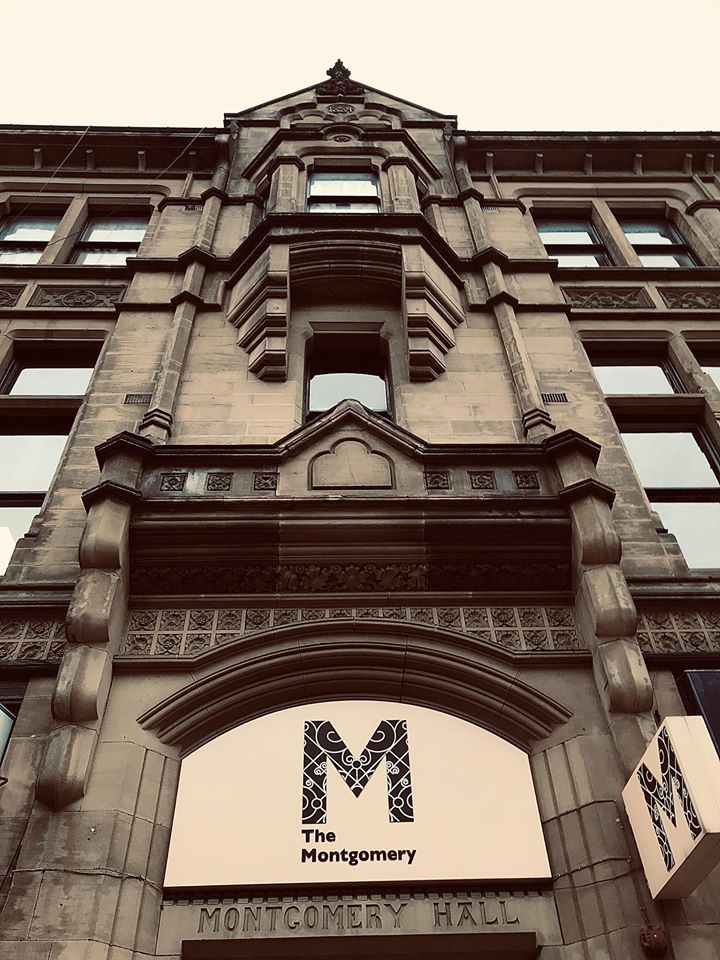
Here’s the Montgomery Hall on Surrey Street, known today as a theatre and arts centre, but its heritage tells a very different story. We must go back to the 1880s and the long running saga of the Sheffield Sunday School Union, which had been looking to build a new hall and rooms in the centre of town.

The union was founded in 1812, with the intention of educating working children on Sundays, especially in literacy, and fighting for child labour laws to keep children out of chimneys. By 1884 the union comprised 108 schools, 3,340 teachers and 27,751 scholars. One of its founders was James Montgomery (1771-1854), local poet, journalist and reformer, and the new hall was to be named in his memory.

After first obtaining a site at (New) Church Street in 1873, the land was sold to Sheffield Corporation. Another site was secured at the bottom of West Street, adjoining Holly Lane, but this was also sold on. In 1883, union trustees bought 892 square yards of land between Fargate and (New) Surrey Street from the Corporation at a cost of £4,700.

The foundation stone for the Montgomery Hall was laid in July 1884 by the Right Hon. Anthony John Mundella (1825-1897), MP for Sheffield and president of the Sunday School Union of England and Wales. No sooner had work started, and it was temporarily abandoned, the building not completed until 1886. Built in Domestic Gothic-style at a cost of £15,000, it was designed by Sheffield architect Charles John Innocent (1839-1901), the union’s honorary secretary, and constructed by George Longden and Son.

Once completed, the Montgomery Hall contained a large galleried hall seating 1,000 people and a smaller hall for 350. The front of the building contained several committee and classrooms, a library, reading rooms, a reception room, ante-rooms, cloakrooms, kitchens and caretaker’s accommodation.

A newspaper described the building at the time.

“The front will be a welcome addition to the street architecture of the town. Built entirely of stone, in the centre of the front is the principal entrance, on either side of which are two shops built as a source of maintenance income. At each end of the front is another entrance. Over the shops are large windows which light the committee rooms and classrooms, the hall is at the back. Over each of the entrances an oriel window, with a slight projection, relieves the front and helps make it more prominent, while immediately over the door is a medallion bust of Montgomery.”

And so, the Montgomery Hall thrived, a home to Sunday schools, rented by other religious institutions, later becoming home to community theatre groups, schools and dance classes.

The union later became the Sheffield Christian Education Council with the hall always being used as a theatre, except during World War Two when it was used by the Government.

It was remodelled as a 427-seat auditorium after a devastating fire in 1971 and continues with an art gallery on the first floor and the old library being used as a space for workshops and rehearsals.

There are now plans for a multi-million pound refurbishment to be completed by 2023, concentrating on front of house, a new main frontage, the main auditorium and backstage facilities. Included in the project is the installation of a lift, a concept unheard of when the building was originally designed.

Categories
Buildings

Montgomery Hall

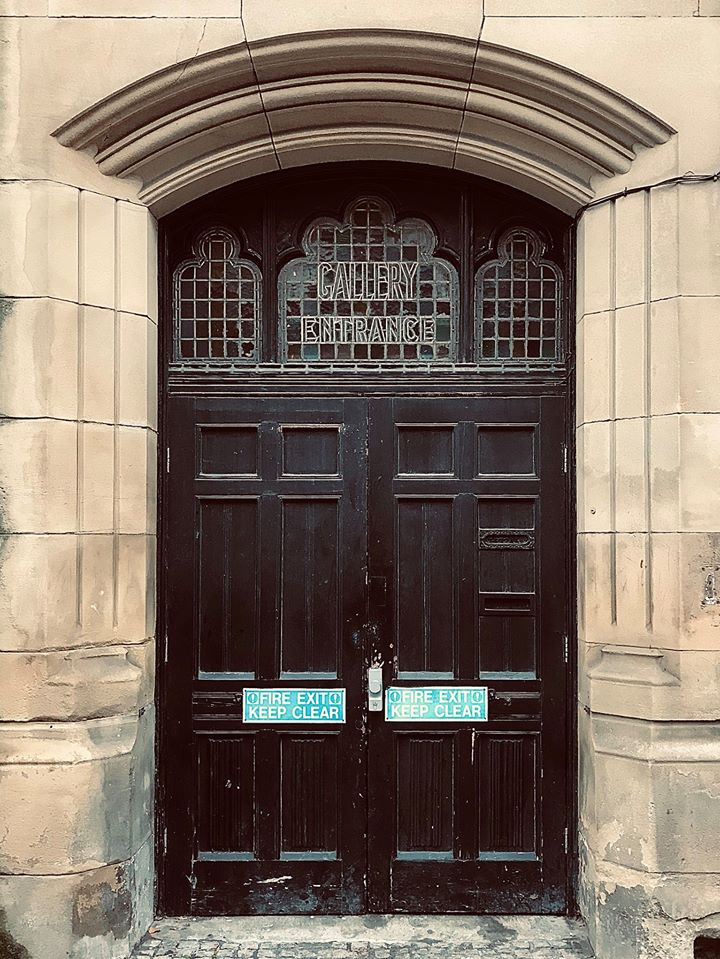
A door that goes unnoticed. This door is to the left of the Montgomery Hall on Surrey Street. The principal entrance is in the centre of the building, on either side of which are two shops, originally built to provide a source of income that could be used to cover maintenance costs for the building. At each end of the front are two doors, this one included, one of five doors leading to staircases to the main hall behind. When the Montgomery Hall was built in 1884-1886, designed by Charles John Innocent, the staircases and corridors were described as being “fireproof”. This is also the entrance to an art gallery on the first floor.

Categories
Streets

Cabbage Alley

Somewhere underneath Sheffield Town Hall there are likely to be the remains of a dark, narrow, cobbled lane with the sweet-sounding name of Cabbage Alley.

Its existence is almost airbrushed from history, partly because those that used it back in the day didn’t even know that it had a name.

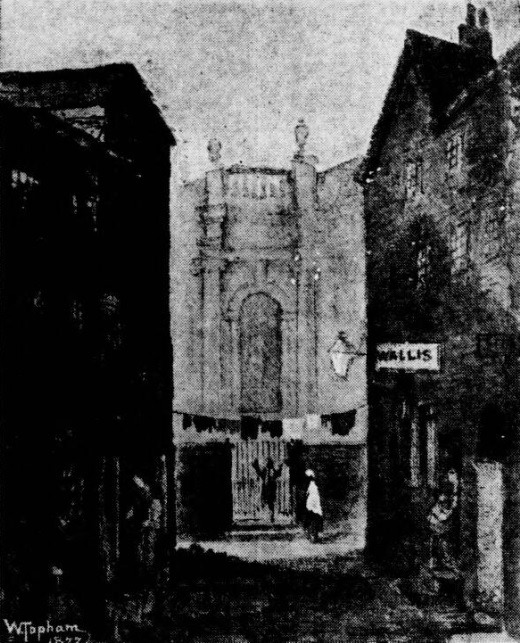
This photograph remains the only image of Cabbage Alley, reproduced in a newspaper in 1931, taken from an old painting by William Topham in 1877, of which its current existence is unknown.

The picture is a view down Cabbage Alley, looking towards the south. In the background can be seen St. Paul’s Church, built in the 1720s and demolished in 1938. In its place we now have the Peace Gardens.

Cabbage Alley ran from New Church Street, both demolished when the Town Hall was built in the 1890s, and Cheney Row, a walkway that survives.

The painting that emerged in 1931 belonged to Mr Ambrose James Wallis, head of Ambrose Wallis and Son, whitesmiths, of Norfolk Lane. His father, who commissioned the artwork, had set up business in Cabbage Alley in 1867 and remained there until about 1889.

“Cabbage Alley was an old-fashioned street even in those days,” he told the Sheffield Daily Independent. “The gutter ran down the centre instead of at the sides.

“A strange thing was that nobody seemed to know its name, and it was not until the notices for us to quit were received, that we learned that we had been living in Cabbage Alley.”

Categories
Buildings Sculpture

Bainbridge Building

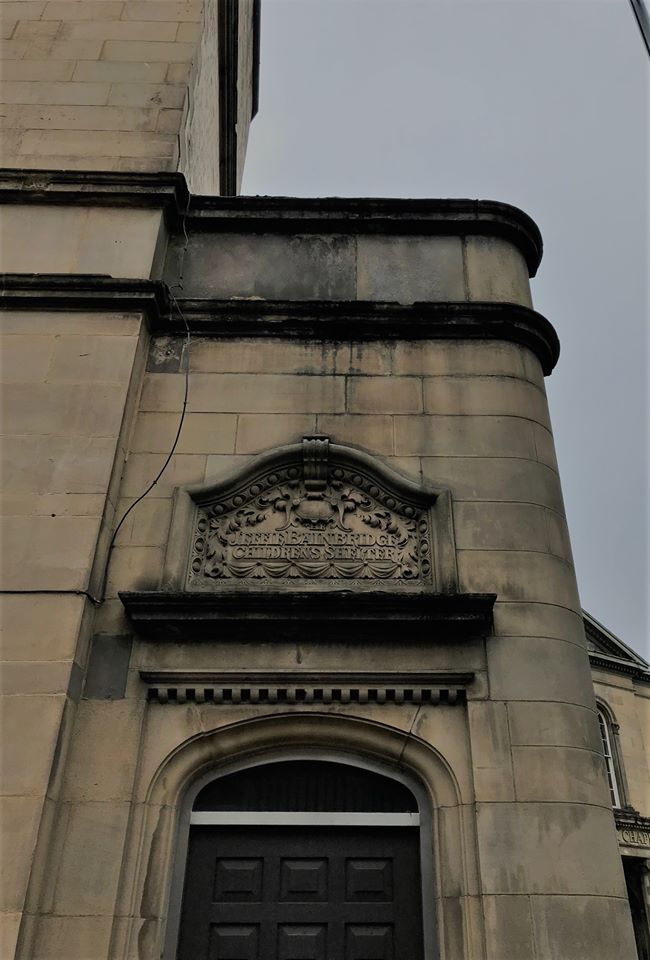
I bet most of you have never noticed this above a door at the top of Norfolk Street. This carved panel is on the old Halifax Bank at the corner of Surrey Street. The building was commissioned by Emerson Bainbridge, a mining engineer consultant and philanthropist, following the death of his wife, Jeffie.

It was erected as a memorial to her and opened by the Duke and Duchess of Portland in 1894.

The first floor formed a shelter for waifs and strays, and a large suite of offices on the second floor were given to the local branch of The Society for the Prevention of Cruelty to Children, of which Bainbridge was a committee member.

The ground floor consisted of shops that were let out to tenants in order to raise revenue to support the rent-free premises above.

The sculptor is unknown, but the architect was John Dodsley Webster, who also designed the Gladstone Buildings next to the Cathedral.

Categories
Buildings

Bainbridge Building

In 1924, the author J.H. Stainton wrote in The Making of Sheffield, “It is fairly safe to say that practically half the citizens of Sheffield at the present time know nothing of Mr Emerson Bainbridge, yet in his day he was assuredly one of Sheffield’s big men.”

Now, it is probably a fair bet that nobody in the city has ever heard of him.
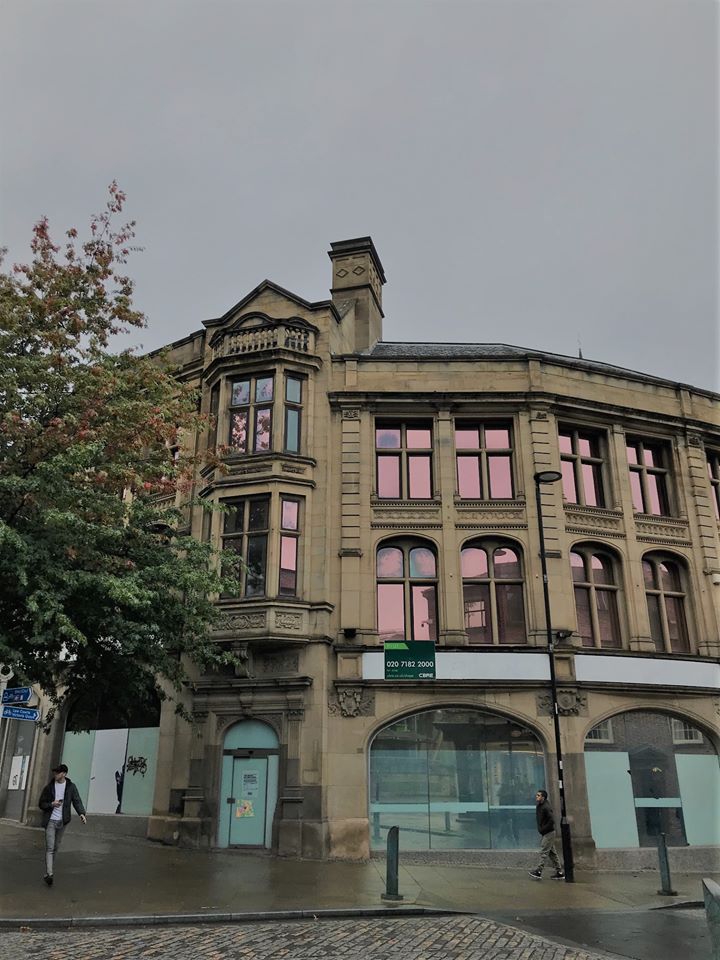
Yet, at the time of his death in 1911, he was called “a striking personality,” and responsible for Bainbridge Building, the resplendent Victorian building that stands on the corner of Surrey Street and Norfolk Street.

Emerson Muschamp Bainbridge (1845-1911) was born at Newcastle-on-Tyne and studied at Edenfield House, Doncaster. Afterwards, he attended Durham University and served time in nearby collieries belonging to the Marquis of Londonderry.

In 1870, Bainbridge became manager of the Sheffield and Tinsley Collieries, later taking charge at Nunnery Colliery on behalf of the Duke of Norfolk, subsequently becoming Managing Director and setting up his own firm of mining consulting engineers.

In 1889, Bainbridge obtained a lease from the Duke of Portland for the “Top Hard”, or “Barnsley Coal”, under land in Derbyshire and Nottinghamshire. He then founded the Bolsover Colliery Company to take the lease and mine the coal, being the man responsible for developing the town that exists today.

Bainbridge also became Liberal MP for Gainsborough between 1895 and 1900, as well as being a JP for Derbyshire and Ross-shire, where he owned a deer forest at Auchnashellach.

Bainbridge provided money to build the YMCA at the junction of Fargate with Norfolk Row, and in the early 1890s spoke of his ambitions to honour his wife, Eliza Jefferson Armstrong Bainbridge, known as Jeffie, who died in 1882.

“I have for some time been struck with the large number of ill-cared for boys and girls in the streets of Sheffield, who, doubtless only represent a small proportion of the large number who are constantly neglected.

“Beyond this, of course, is the great question of neglected training, in consequence of which many of these children are destined to lives of poverty and crime.

“I propose to erect and establish, at some suitable point in the town of Sheffield, a Children’s Refuge, which I would erect in memory of my late wife, and it might be possible to have her name connected to it.”
Bainbridge was a man of his word.

He purchased a plot of land from Sheffield Corporation at the corner of Norfolk Street and Surrey Street, then employed architect John Dodsley Webster to create a spectacular new building that would contain the Jeffie Bainbridge Children’s Shelter.

Construction started in 1893 and was completed in 1894, the total cost being almost £10,000.

The ground floor was utilised for shops and part of the first floor for offices, the rents funding the children’s shelter. The rest of the first floor consisted of a large room capable of accommodating 150 children. Here, ill-clad children suffering from cold and hunger were welcome, and be certain of shelter, warmth and cheap food.

The second floor had been placed, rent free, at the disposal of the local Society for the Prevention of Cruelty to Children. There were dormitories for more than twenty juveniles, also rooms for committee meetings and for caretakers and porters.

The Jeffie Bainbridge Children’s Shelter was officially opened by the Duke and Duchess of Portland on Friday 28 December 1894.

There were five shops underneath, numbered 49-55 Surrey Street, and 104 Norfolk Street. Birds Restaurant, opened by William Bird on a ten-year lease, occupied No.53, although the business collapsed several years later, probably the result of being refused an alcohol licence, something that rankled with the professional men who visited. Next door, Jasper Redfern had a photography shop while William Cole had a piano business at 104 Norfolk Street.

The NSPCC moved upstairs in 1895, but in 1899 Emerson Bainbridge gave them £200 as consideration for removing their shelter to Glossop Road.

The Jeffie Bainbridge Children’s Shelter served over a thousand meals every month to destitute children and appears to have survived until at least 1907. Afterwards, it became a Maternity and Welfare Centre, instigated by the Sheffield Infantile Mortality Committee, where women went for advice and consultations, and to buy dried milk at cost price for bottle-fed babies.

However, the biggest change occurred in 1914, when a portion of the Bainbridge Building was converted into the Halifax Building Society. Most of the shops were taken, with plans created by W.H. Lancashire, Sheffield architects, who clad the exterior in blue and red Aberdeen polished granite, and the interiors with Austrian oak.

In time, the Halifax took the whole building, renting out upper floor offices, culminating in the interior being reconfigured in 1977-1978, when most of Webster’s original features were lost.

The Halifax Bank finally closed in 2017 and the Bainbridge Building has been vacant since.

But let us remember Birds Restaurant, which was unable to serve alcohol to its Victorian customers.

It was recently announced that the pub chain Mitchells & Butlers is opening a branch of its Miller and Carter restaurants, specialising in steaks, in the Bainbridge Building.

There are already Miller and Carter restaurants in the city, off Ecclesall Road South and at Valley Centertainment, the latter of which opened in the summer.
Categories
Buildings

Town Hall Police Box

This landmark has become so familiar that we barely notice it now. But, this police box, next to the Town Hall, on Surrey Street, is the only survivor of a system of 120 boxes that once existed across Sheffield.

Police boxes were introduced in Britain in the 1920s. Chief Constable Frederick James Crawley installed them initially in Sunderland in 1923, and then in Newcastle upon Tyne, after he became Chief Constable there in 1925.

They were designed to increase efficiency by decentralising police constables away from the police station and preventing the necessity to return to base several times during their beat.

Other northern cities then followed suit including Sheffield in 1928.

The Sheffield police box system was introduced by Chief Constable Percy J Sillitoe, subsequently appointed as Chief Constable of Glasgow in 1931, where he also set up a police box system; he was later to receive a knighthood and became Director General of MI5. (Think, Sam Neill’s Major Chester Campbell character in Peaky Blinders).

The Sheffield boxes were sited on police beats all over the city where they provided contact points for both police officers and members of the public, with each box having a direct telephone link with the local police station.

The telephone was in a small compartment accessible from the outside of the box, as was a first aid kit, both intended for public use. They were also used by patrolling officers, who visited the boxes at hourly intervals when information was passed by phone between the officers and supervisory staff at police stations.

Additionally, a ‘blue’ electric lamp was located on the top of each box; the Sheffield boxes originally had bulb lights suspended from curved metal brackets. These were controlled from the local police station and used to indicate when there was an important message to be relayed.

Inside, the boxes had a desk and stool where the patrolling officers could have meal breaks and write reports. The boxes could also be used as temporary lock-ups if necessary, for those arrested and awaiting transport to a police station.

The police boxes remained in regular use until the 1960s when the development of improved communications and increased use of police cars made them obsolete.

This box is the sole survivor and has latterly been used as a public information point by Sheffield’s city centre ambassadors, though it is not presently in regular use.

The police box is well-known as Doctor Who’s Tardis, but the type used on TV is typical of the shallow pyramidical roof boxes, adopted by the Metropolitan Police in 1930.

Categories
Buildings

Sheffield Town Hall

Look at this, Sheffield Town Hall, brand new and clean, seen here in May 1897, shortly before the official opening by Queen Victoria. Within weeks the building was already taking on the tone common to Sheffield, smoke being the culprit, and within decades the Stoke Hall stone was almost black in appearance.

Sheffield’s fourth Town Hall was built between 1891-1896 by Edward William Mountford (1855-1908), one of 178 architects to enter a competition with Alfred Waterhouse as judge.

Mountford was successful despite protests from Flockton & Gibbs, who claimed their “patent” design for municipal buildings had been incorporated into instructions for finalists and used in Mountford’s scheme.

“The architect’s aim, of course, was to obtain the dignity essential for the Corporation’s buildings of the fifth provincial city in England, combined with the maximum amount of internal convenience, and abundant light and air!”

The building contract was awarded to Edmund Garbutt of Liverpool, whose tender amounted to £83,945, but the actual cost, including the site, approached £200,000.

Understandably, the Sheffield public were “up in arms” about the cost, and critical of the expensive embellishments inside and out, protesting that ratepayers’ money was better spent on street improvements and housing for the poor.

The Town Hall was built on an almost triangular site, bought by the council as part of a general improvement scheme, and replacing dilapidated properties either side of New Church Street, a road lost beneath the development.

The principal front faced Pinstone Street (200ft long), although the main entrance was at the centre of the Surrey Street front (280ft long). Its crowning glory was the 64ft-high clock tower complete with Mario Raggi’s bronze statue of Vulcan.

Although the Town Hall clock was designed to be capable of working with bells, they were never fitted, and it wasn’t until 2002 that an electronic bell ringing system was installed, giving hourly strikes with Westminster-style quarter chimes.

On the right of the Pinstone Street entrance were the offices of the waterworks; on the left, the City Accountant’s department. The Town Clerk and members of his department had rooms on the first floor, as were the committee rooms.

On this floor were the Mayor’s reception hall, dining-hall and the Mayor’s parlour, as well as the Council Chamber (60ft x 40ft, and reaching a height of 28ft), light being afforded by traceried windows, and with a public gallery seating 60 people.

The main staircase, 10ft wide, leading to the first floor, was supported on columns of red and grey Devonshire marble, with alabaster balustrades and an ornate marble handrail, the walls being lined with polished Hoptonwood stone.

In other parts of the building, the corridors had floors of glass mosaic and a specially designed dado of antique glazed tiles.

The rich decorative scheme of stone carving, both externally and internally, was devised by Mountford and Frederick William Pomeroy (1856-1924), Royal Academy Gold Medallist, and took pride in Sheffield’s history and the art and skill of its workforce.

The foundation stone was laid by Alderman W.J. Clegg in 1891 and the Town Hall should have been opened by Queen Victoria in 1896, but the death of Prince Henry of Battenberg prevented her from doing so.

The Town Hall was opened by Queen Victoria on the afternoon of May 21, 1897, a story worthy of a separate post.

Categories
Buildings

Sheffield Town Hall

Sheffield Town Hall was opened by Queen Victoria on the afternoon of May 21, 1897, postponed from a year earlier, due to the death of Prince Henry of Battenberg, husband to Beatrice, her youngest child.

The story of the grand opening is remarkable because Queen Victoria completed the ceremony, and other duties in the city, without ever leaving her carriage.

On 23 September 1896, Victoria had surpassed George III as the longest-reigning monarch in British history (that distinction now going to our present Queen), but she requested that celebrations be delayed until 1897, to coincide with her Diamond Jubilee.

By this time, she was 77-years-old, much frailer, and her time spent in Sheffield was momentary.

The Town Hall opening was a disruption in her journey from Windsor to Balmoral, where she would celebrate her birthday and spend the summer holidays.

Because of this, she didn’t arrive in Sheffield until late afternoon, arriving at Sheffield Railway Station accompanied by Princess Christian and the Duke of Connaught.

The Royal party were met by the Mayor and Mayoress, the Duke of Norfolk, and his sister, Lady Mary Howard. From the station, a procession was led by the Chief Constable and his mounted police, and a troop of the 17th Lancers.

Thousands of cheering people lined the streets, waving flags, as the parade headed towards the principal entrance of the Town Hall on Pinstone Street, met by the Lord Chamberlain, Lord Lathom, who directed the ceremony.

At 5pm, Victoria remained in her carriage while the Recorder of Sheffield read an address, handed to her in a gold casket, specially made for the occasion by Mappin and Webb.

The Queen handed her reply to the Mayor, after which other addresses were presented by the Duke of Norfolk, on behalf of the Sheffield General Infirmary, by Sir Frederick Mappin, MP, on behalf of the Town Trustees, and by Mr Alexander Wilson, Master Cutler, representing the Cutlers’ Company.

The “golden key” (also by Mappin and Webb) was handed to Victoria, who inserted it into a detached lock, connected by electricity to the gates of the entrance. As she turned the key, the gates swung back as if by magic, and a flourish of trumpets announced that the Town Hall was open.

Afterwards, the Royal procession went to Norfolk Park, where fifty thousand schoolchildren had gathered by invitation of the Duke of Norfolk.

She then went to the Cyclops Steel and Iron Works, belonging to Charles Cammell and Company, where her carriage was drawn into a temporary shed in front of a mighty furnace. Here, the party held glass screens before their eyes, and watched the rolling of armour plate for the new battleship “Ocean”.

By 7.30 in the evening, Queen Victoria was speeding northwards by train to “gain strength for her approaching jubilee.”

Categories
Buildings

Central Library

It’s 85 years since Sheffield Central Library opened, and it is showing its age.

The building was described as an ‘up-to-date wonder’ when it opened its doors in 1934. Its origins went back to 1853 when the city opened its first public library, the same year that the Libraries Act was adopted. The original library started in two small rooms in the Mechanics Institute, from which it grew until the whole of the building was required. There was a further development in 1910, when the Old Music Hall was purchased to start a lending library and reading room.

The site was a fitting one for a library because for 150 years it had been used by cultural, musical and educational bodies, scientific institutions and local trades. The land was formerly in the ownership of Henry Tudor, who built a house and silver plating works surrounded by an extensive garden about the middle of the 18th century. On his death, the estate was split up, part of it to the shareholders of the Music Hall. part of the land used to build a school and the house taken over by the Mechanics Institute.

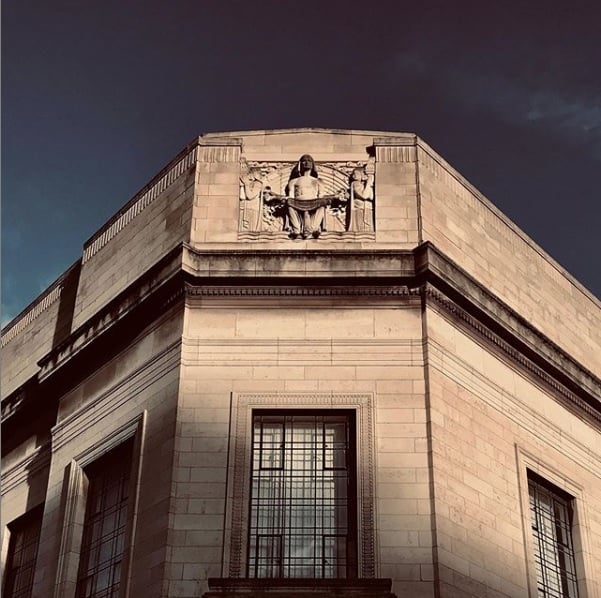
After demolition, work on the new Central Library began in 1929, to a design by W.G. Davies, built with Portland stone around a steel frame, in Art Deco style, and opened in 1934 by the Duchess of York (later the Queen Mother).

The idea was conceived as part of a plan by Patrick Abercrombie to create a civic square. It never materialised, although Tudor Square (named after Henry Tudor) was created alongside in 1991.

The Libraries, Art Galleries and Museums Committee had to spend their entire annual budget of £2,650 on stocking the new library. The total cost of the project was £95,000, including £10,000 from local mail order entrepreneur and philanthropist, J.G. Graves, who also contributed £20,000 for the Graves Art Gallery on the top floor, as well as his art collection.

In the Second World War, a bomb fell on Fitzalan Square nearby and the aftershock caused the library foyer’s marble floor to crack. The crack is still visible today and runs almost the full length of the foyer.

Do we still appreciate the 85-year-old lady?

Probably not. In 2017, Sheffield City Council, horrified at the cost of extensive repairs, announced plans to sell the building to a Chinese developer, which proposed converting the library into a hotel. Thankfully the deal never got off the ground.