Categories
People

Henry Jasper Redfern

It is incredibly difficult to write about Henry Jasper Redfern (1871-1928). Almost forgotten now, his curriculum vitae is almost too long:- optician, photographer, exhibitor, filmmaker, the proprietor of a photographic and lantern business, cinema pioneer, as well as being an x-ray and radiographic innovator.

On reflection, he was a jack-of-all trades, probably master of none, because his business undertakings often ended in financial failure.

Born in Sheffield, Redfern trained as an optician and opened a business on Surrey Street, later opening a photography shop nearby. However, he was more famous in the realms of cinematography, studying the form in its early stages, and became a forerunner in exhibiting moving pictures.

In 1898, Redfern was offering photographic supplies and instruction, Röntgen rays (X-rays), and exhibitions of the Lumière Cinématographe, for which he was one of a number of agents in Britain at this time.

Specialising in ‘locals’, films of interest around Sheffield, Redfern travelled around with Sheffield United during 1899, photographing at least four major matches, climaxing with the Cup Final at Crystal Palace, when Sheffield United played Derby. He entitled the series Football Events. He also filmed local cricket matches.

The following year he seems to have made a tour of Africa (Morocco, Tunisia, Algeria), making travelogues, and eventually went wholeheartedly into the moving picture business with his ‘World Renowned Animated Pictures and Refined Vaudeville Entertainments’.

These package shows eventually led to his owning and operating a seaside summer show at Westcliffe, ‘Jasper Redfern’s Palace by the Sea’, the ‘Grand Theatre of Varieties’ in Manchester, while also operating the Theatre Royal, Windsor, and the Public Hall in Barnsley.

Together with Frank Mottershaw, he made the first outdoor films in Sheffield, producing A Daylight Robbery in 1905.

In the same year, Redfern took over the lease of the Central Hall in Norfolk Street, built in 1899 for the Sheffield Workmen’s Mission. Here, he showed his own work, opening with ‘The Royal Visit to Sheffield in its Entirety.’

Redfern was also famous in x-ray work. In its infancy, he travelled from hospital to hospital around the country with portable apparatus, subsequently joining the Army during the Great War where his expertise was used to treat wounded soldiers.

Afterwards, Redfern was a radiologist at Grange Thorpe Hospital, Manchester, but had lost use of most of his fingers due to x-ray work. He died from cancer, thought to have been accelerated by the effects of radiation poisoning.

Redfern died in comparative poverty and obscurity, aged 56, leaving a widow and four children, and his collection of motion picture memorabilia was presented to the Science Museum.

Categories
People

Marina Lewycka

Not strictly a Sheffielder, but somebody who chose to settle in the city. She is Marina Lewycka, British novelist of Ukrainian descent.

She is the author of A Short History of Tractors in Ukrainian (2005), a million-seller, Two Caravans (2007), We Are All Made of Glue (2009), Various Pets Alive and Dead (2012), The Lubetkin Legacy (2016) and the soon-to-be-published The Good, the Bad and the Little Bit Stupid (2020).

Lewycka was born in 1946 at a displaced persons camp in Schleswig Holstein in Germany. Her family subsequently moved to England, where she attended Gainsborough High School for Girls and Witney Grammar School, Oxfordshire, later graduating from Keele University and the University of York.

In 1985, Lewycka moved to Sheffield with her husband, who worked for the National Union of Mineworkers. She became a teacher and afterwards a lecturer of Media Studies at Sheffield Hallam University, retiring in 2011.

She now splits her time between Sheffield and London and is aware of the north-south divide. “When I get off a train (in Sheffield) you can just see how poor everybody is.”

Categories
Buildings

The Bankers Draft

This building stands in one of Sheffield’s most historic parts and survives in an area that has changed considerably in the past eighty years. Thanks to the Blitz, the Hole-in-the-Road and Supertram, the environs show no resemblance to the day it was constructed.

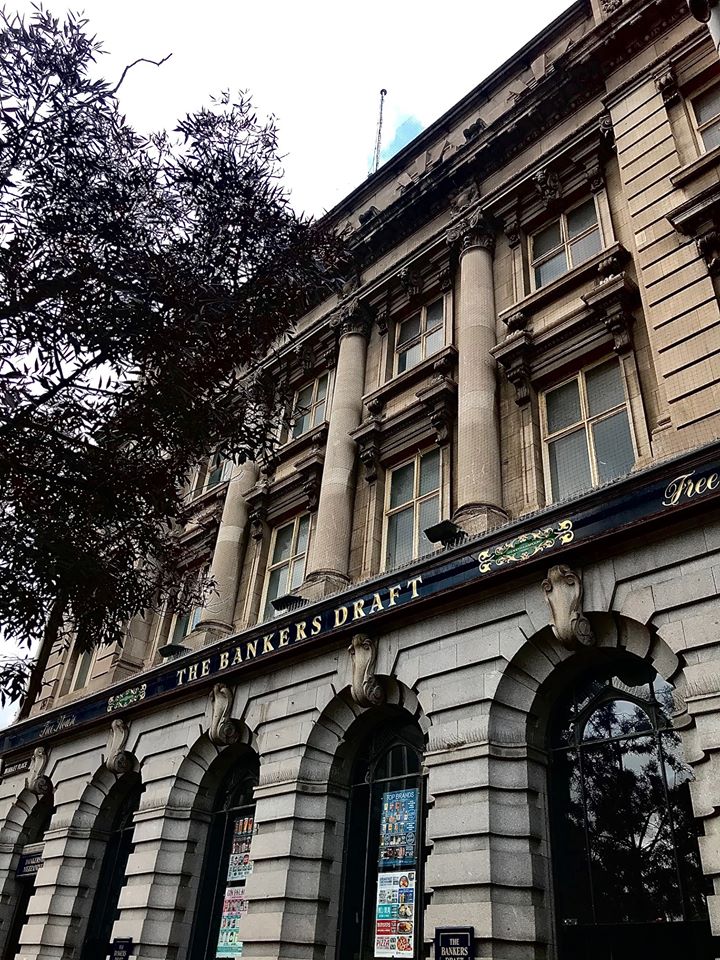
These days we know it as The Banker’s Draft, a Grade II listed building, in Market Place, one of the first J.D. Wetherspoon pubs to open in Sheffield, but its origins goes back to the turn of the twentieth century.

In the old days, the three landmarks of Sheffield were the Castle, the Market Place and the Parish Church. When tradesmen recognised the Castle as less than a means of protection, they started clustering around the Market Place (or The Shambles), a place where they could face anyone proceeding towards the church, by means of High Street.

Markets had been held here since 1296, and its original buildings were replaced with picturesque timbered latticed gabled properties about 1752, and again around 1812.

Once, amidst the atmosphere of drapery, leather, grocery and hats, the place had a banking tradition, one that repeated itself later. Hannah Haslehurst and Son, departing from ancestral grocery, founded The Sheffield Old Bank on this spot, but it collapsed in 1785.

In 1901, the Market Place area was described as ‘an aching void,’ sharing the fate of similar early 19th century buildings, the homes of humble traders, that were demolished to make way for the York City and County Bank.

The bank was designed by Walter Brierley (1862-1926), a York architect, described as being the ‘Yorkshire Lutyens’ or ‘Lutyens of the North.’ He created 300 buildings across the north between 1885 and his death, mainly family mansions, churches, schools and banks. Brierley was also architect for North Riding County Council and the Diocese of York.

Construction started in 1901, the contractor being Sheffield-based George Longden and Son, and was finished in 1904.

Described as being Edwardian Baroque, built in Aberdeen granite and Italian marble, its interiors were lavish. A parquet floor was laid by the Acme Wood Flooring Company of London, with furnishings supplied by Goodall, Lamb & Heighway, manufacturers of high quality furniture, upholsterers and carpet warehousemen from Manchester.

Quite forgotten, is that the York City and County Bank had bought more land than it really needed. It rented out offices on the first, second and third floors, as well as the spacious basement (where remains of old stables can still be seen).

However, it was also proposed to build a first-class hotel next door, also designed by Brierley, that was never erected, probably the result of a long dispute with the council over its alcohol licence.

The York City and County Bank (established 1830) amalgamated with the London Joint Stock Bank in 1909, which itself merged with the London City and Midland Bank in 1919.

Despite the area being mostly destroyed during the Sheffield Blitz, the Midland Bank (as it became) survived unscathed, and remained open until 1989, before relocating to the end of Fargate.

Standing empty for a while, it was bought by J.D. Wetherspoon, operating as The Banker’s Draft ever since.

NOTES: –
Walter Brierley was the architect who designed several buildings in the village of Goathland, North Yorkshire, that were seen during the opening credits of ITV’s Heartbeat (1992-2010).

Market Place is now commonly known as Castle Square. However, Market Place is officially the paved area running in front of The Banker’s Draft, between High Street to Angel Street.

Categories
Buildings

Cairn’s Chambers

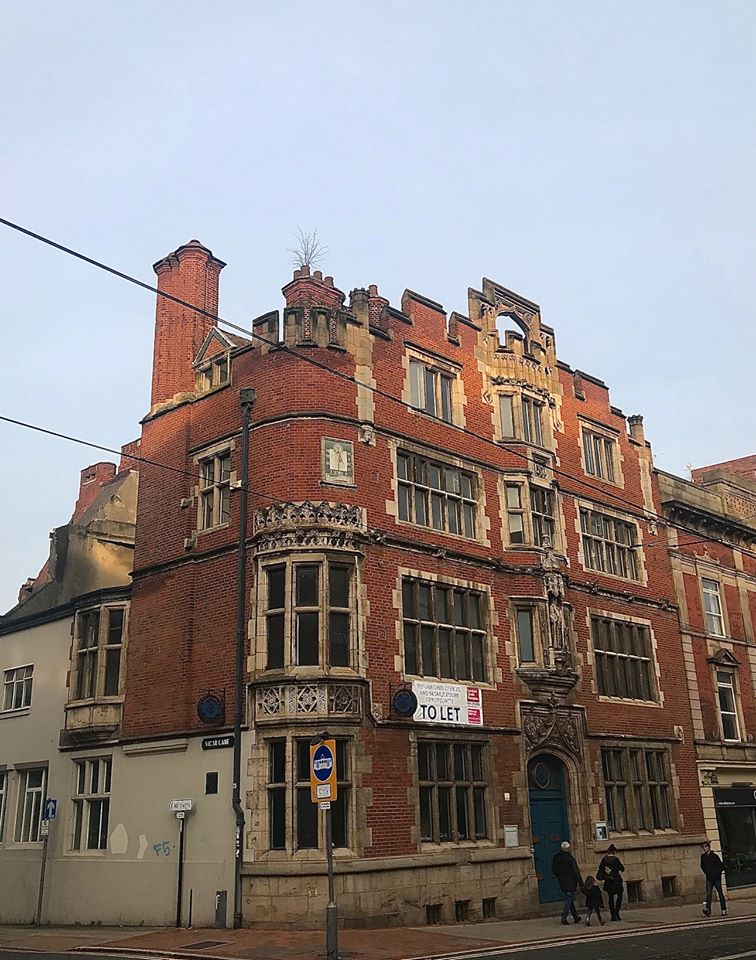
We pass this building on Church Street and probably don’t give it a second glance. This Grade II-listed property is looking unloved these days, its condition deteriorating. Look at the windows left open to the elements, and the tree growing out of the chimney pot. A sad reminder that this was an impressive and important Sheffield building.

Cairn’s Chambers was built between 1894-1896 by Charles Hadfield, of M.E. Hadfield, Son and Garland for Henry and Alfred Maxfield, solicitors. It was built in scholarly Tudor-style, a favourite of Hadfield’s, featuring decorative stonework by Frank Tory Sr.

The structure was described in Builder in 1897, as “very quiet and self-restrained, it also remarked that “this architect’s detail is always markedly good, particularly in the matter of scale.”

In 1916, Wilfrid Randolph, an architectural critic, considered Cairn’s Chambers as being one of Hadfield’s finest pieces. “Its quiet composition and detail, stands as an admirable application of traditional English forms to present day purposes, unspoiled by the straining after effect which mars so much contemporary street architecture.”

Henry and Alfred Maxfield occupied a large suite of offices, but it was also built to accommodate other businesses, a common trait of Victorian entrepreneurship.

The offices were used for almost 40 years by Charles Hadfield’s own company, C & C.M. Hadfield, architects, and later by Hadfield and Cawkwell. It was also where John Dodsley Webster, another Sheffield architect, had his office with an entrance at the back, on St James’s Street. Another long-serving tenant was Septimus Short and Co, a Sheffield agent for the Sun Insurance office.

The Hadfield company remained until World War Two, leaving after the building was damaged by a German bomb in 1940. The rear of the property was almost destroyed, but the decorative front survived.

Afterwards, Cairn’s Chambers became a branch of the District Bank, subsequently becoming NatWest until its closure.

The building stood empty for 15 years before the ground floor was taken over by Eua De Vie Leisure Ltd, which opened it as Cargo Hold in 2018, a seafood restaurant.

Alas, Cargo Hold closed earlier this year, the Cairn’s Building empty once again, and craving for a new occupier.

Categories
Buildings Sculpture

Cairn’s Chambers

We’ve already had a look at the history of Cairn’s Chambers on Church Street, a Grade II-listed building that has been empty for most of the past sixteen years.

Built between 1894-1896 by Charles Hadfield for Henry and Alfred Maxfield, an established Sheffield firm of solicitors.

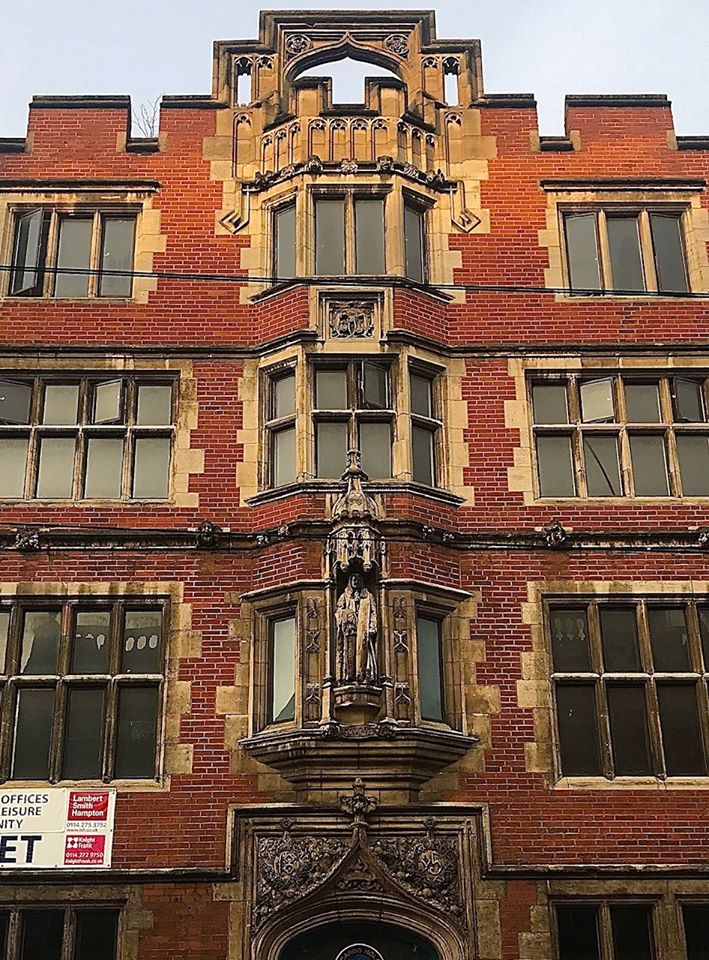
Almost unnoticed these days, are the decorative features that emblazoned the building, and which survived a Second World War German bomb.

The stone carvings, at the front, were the work of Frank Tory and Sons, Sheffield-based architectural sculptors, operating from the early 1880s until the 1950s, consisting of Frank and his twin sons Alfred Herbert and William Frank.

The crowning glory of Cairn’s Chambers was the statue of Hugh McCalmont Cairns (1819-1885), 1st Earl Cairns, an Irish statesman, and Lord Chancellor of Great Britain. He became a Q.C. in 1856, Solicitor-General in 1858, and was knighted in May of the same year, becoming Attorney-General in 1866.

The statue looks extremely miserable these days, weather-beaten, covered with dirt, and with some parts missing.

As well as the statue of Cairns, the building also features a sundial, and the heads of the then Prince and Princess of Wales, later Edward VII and Queen Alexandra.

Categories
Buildings

Gladstone Buildings

Sheffield’s grandest street is in a state of crisis. Once a prosperous hub, the magnificent buildings around Church Street are at midpoint, as the shift in shop and office space moves towards the Moor and the edges of the city centre.

But things are cyclical, and these buildings will most likely prosper again.

One such building, caught in the transition, is 1 St James Row, a Grade II listing building, better known to generations as Gladstone Buildings.

This tall late Gothic block was built in red brick with sandstone dressings by Hemsoll and Smith in 1885.

To understand its history, we must acknowledge William Ewart Gladstone (1809-1898), British statesman and Liberal politician, who served for twelve years as Prime Minister, spread over four terms beginning in 1868, and ending in 1894.

In 1882, it was announced that a new Sheffield company had been formed. The Gladstone Buildings Company Ltd was set up with a share issue of £15,000 (later rising to £25,000), with the purpose of buying land and erecting a “central, inexpensive and convenient club” for Liberal-minded supporters.

The Sheffield Reform Club, as it would be called, would pay an annual rent of £150 to the company, contributing to the upkeep of the building, further supported by office space on its top floors and shops at ground level.

The company bought a plot of land for £5,000 at the corner of the Parish churchyard (now the Cathedral) and requested four designs to be drawn up. The chosen plan was by William Frederick Hemsoll and Joseph Smith, a Sheffield-based architectural partnership between 1881-1891.

Described as being “Domestic Gothic of 15th century-style,” its steep slate roof had a fine arrangement of dormers and spiky turrets with wrought-iron finials and cresting.

There were arcaded ground floor openings for shops, two floors with double-mullioned and transomed windows for the principal club rooms – a dining room for 100 people, reading and writing rooms, a reference library, billiards room and members lounge – with offices above.

One commentator from the time had high expectations:

“Politicians, if my experience goes for anything, are clubbable people; and the discussion of political questions is made none the less interesting when accompanied by creature comforts, and in a well-furnished, well-ventilated and well-lighted room.”

Construction started in 1884 and moved at rapid pace, blighted by the death of John Hodgson, a 17-year-old crane driver, who died when his chain suddenly stopped causing the crane to collapse. He fell onto an iron girder in the cellar, the crane falling on top of him.

Gladstone Buildings was completed in 1885, set back to allow a carriageway from St James’ Row into St James’ Street, and was officially opened by the Earl of Rosebery on Tuesday 20 October.

The Sheffield Reform Club continued until 1942, its demise no doubt putting financial pressure on The Gladstone Buildings Company, which was voluntarily wound up in 1946.

Gladstone Buildings was adapted for additional office space whilst retaining much of the old club and became a listed property in 1973.

It wasn’t enough to save it from threat of demolition three years later, thankfully averted and rebuilt as offices behind the façade by Hadfield Cawkwell Davidson and Partners.

Categories
Buildings

Gladstone Buildings

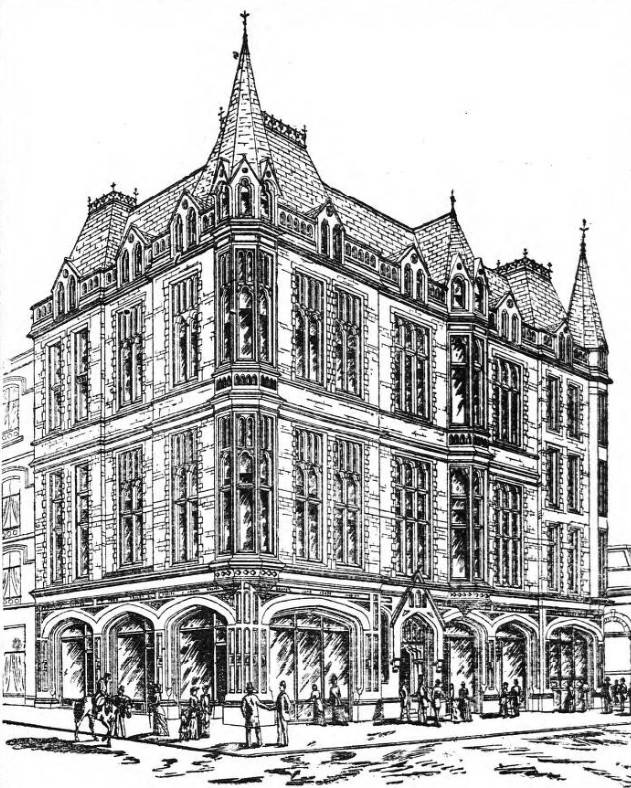
This illustration of the Sheffield Reform Club, forming the greater part of the Gladstone Buildings, is from October 1885, and celebrated an important contribution to the public buildings of Sheffield.

Just completed, the Sheffield Reform Club, for Liberal-minded people, was formally opened by Archibald Primrose (1847-1929), 5th Earl of Rosebery, 1st Earl of Midlothian, on Tuesday 20 October 1885. (He later served as Prime Minister in 1894-1895).

The club was the tenant of the Gladstone Buildings Company, renting from it that portion shown in the drawing – the two frontages facing to St James’ Row (where the entrance was), and to Church Street.

On the ground floor was a range of shops, the first floor was occupied by the club dining, reading and writing rooms; the second floor the billiard and smoke rooms, and higher still were the domestic apartments.

The whole club had been handsomely furnished, and already had a large roll of members, attracted by the accommodation inside.

Life members paid £30 a year, while ordinary members were charged not less than one guinea on entrance, and an annual subscription of the same. Honorary members were admitted free of charge.

Within its rules, it stated that the term “beverages” did not include tea, coffee or cocoa.

Beverages would only be supplied to members and visitors in the coffee or dining room, club billiard room, smoke room and private dining rooms.

The Sheffield Reform Club’s first president was Anthony John Mundella (1825-1897), reformer and Liberal MP for Sheffield, and its treasurer was Samuel Osborn (1826-1891), steel maker and tool manufacturer.

The club closed in the 1940s, the building later converted into offices, and is now known as 1 St James’ Row, at the side of Sheffield Cathedral.

Categories
Buildings

Gladstone Buildings

No. 1 St James’ Row, better known as Gladstone Buildings, near the Cathedral, opened as the Sheffield Reform Club in October 1885. It was designed by Sheffield architects Hemsoll and Smith for the Gladstone Buildings Company.

At the time, a correspondent said that, “The Liberals of Sheffield were entitled to feel proud of the club, for it was in every respect of high-class character.” The club was altogether distinct from the company which it paid rent, though only a small amount.

The Gladstone Buildings Company had been formed in 1882, chiefly through the exertions of Mr Batty Langley, to provide accommodation for a Reform Club, and to be the headquarters of the Liberal Association.

Alas, following the threat of demolition in 1976, much of its original configuration was lost during late twentieth century renovations, with much of the interior converted into office space.

The rooms of the Reform Club were taken over by Mr J.C. Skinner and the association, soon after completion, and formally opened by the Earl of Rosebery.

The catering arrangements were in the hands of Herman Gadje, the steward, with previous experience of leading clubs in Newcastle, Birmingham and Bradford, the cooking in the charge of a capable chef from London.

A tariff was prepared by which members had the choice of dining at the “table d’hote” or ordering whatever they wanted at fixed prices.

The Reform Club was entered from St James’ Row, through a handsome portico, which communicated by folding doors, with the principal porch, lofty and well-lit. Around the walls of the hall was a dado of Cork marble, edged with polished black marble, and the archway which divided the hall, was enriched with marble pillars.

On the left side of the entrance hall was the porter’s room, and on the right the lavatories and cloakrooms, fitted with every convenience, including private lockers for the members. There was also a letter box in the hall, with the club negotiating with the postal authorities to secure all day collections.

The staircase up to the first floor was lit by lantern and windows – with stained glass soon replacing the semi-opaque windows originally installed. The stairs were covered with Brussels carpet, and the balustrade was wrought-iron and Spanish mahogany.

It reached the dining-room (45ft long by 23ft wide), again carpeted, the walls being decorated with a dado picked out in two colours, and able to accommodate about one hundred people. It was well lit with oriel windows and two large Siemens lights hanging from the roof. A serving room adjoined the dining room and was connected by a serving lobby.

The reading room, adjoining the dining room, had an angled oriel window, with sweeps across the whole of Church Street, the Churchyard, High Street and St James’ Row. It had originally been planned that a balcony might be added around the window, from which political addresses might be delivered.

It was fitted in similar style to the dining room, except that the lighting was affected by several gas brackets fixed to the walls, the furniture including easy chairs, armchairs and settees, whilst the tables were covered with Morocco leather.

Both rooms were separated by a “felted” ornamental revolving partition, carved in panels from solid wood, which could be removed to form one grand banqueting room.

A writing room adjoined the reading room, from which it was divided by a glass partition with a door in the centre, and with a separate entrance from the staircase.

To the left of the staircase was a waiting room, and a smaller room used for telephonic purposes.

Passing upstairs, the visitor reached a mezzanine floor (between the first and second floors) containing two rooms that were used as private dining rooms.

The chief features of the second floor were the billiard and smoke rooms, the former being 45ft long by 23ft wide, also with an oriel window at the centre. The original intention had been to place three full-sized billiard tables (made by Cox and Yeman) here, but due to possible overcrowding, the third table was instead sited in the smoke room.

Adjoining the smoke room was a smaller room, to be used for smoking and card purposes, and eventually used as the reference library, supplied with all the leading daily, weekly and monthly newspapers and magazines.

The mezzanine floor also contained a committee and secretary’s room, and a steward’s room, with a safe to store silver plate and valuables.

The third floor contained a bathroom, dressing room, and bedrooms for the use of members; also, steward’s apartments and kitchens.

The kitchens were fitted with ranges of special construction with two large hoists communicating with every floor in the building, with service lifts to the dining and other rooms. The large kitchen , larders and servants’ hall were put on the upper floor, and by a system of ventilation, allowed odours to be eliminated into the open air.

The Reform Club was heated by a high pressure hot water system, together with open fireplaces in the principal rooms, and electric bells fitted throughout.

The furnishings for the club, costing about £2,000, were supplied by Johnson and Appleyard of Leopold Street (as were the carpets), working to special designs submitted by the committee, all being in Gothic design, unvarnished oak, upholstered in hog skin and dark olive green tint, to match the building, including tables, chairs, armchairs and settees.

The building was illuminated with gas lights, provided by Guest and Chrimes, of Rotherham, with exception of the billiard room, where fittings were supplied by the Sheffield Gas Company.

Its members enjoyed the best cutlery, supplied by Brookes and Crookes, glassware by Webb and Sons, Stourbridge, and the dinner and tea service (with monograms of the club) by Doulton and Company of Burslem. Of course, the club enjoyed the best silver plate, manufactured by Otley and Sons, of Meadow Street, Wilkinson and Company, Norfolk Street, and George Warriss, based on Howard Street, providing the spoons and forks.

The Blind Institute fitted the club with mats and brushes, the ironmongery was by Chas Woollen and Company, with fire grates supplied by W.G. Skelton, and the fenders from Thomas Hague, both of Bridge Street. The hot closet in the serving room was made by J. Wright, and the ranges in the kitchen were by Newton Chambers and Company.

The Reform Club’s committee now reads as an historical list of local worthies: –

The Right Hon. A.J. Mundella, MP, was the President. The Vice Presidents were the MPs, Frederick Thorpe Mappin, Francis J.S. Foljambe (East Retford); the Hon. Henry Wentworth-Fitzwilliam, and William Henry Leatham (South West Riding); Lord Edward Cavendish, John Frederick Cheetham (North Derbyshire); the Hon. Francis Egerton, Alfred Barnes (East Derbyshire), and also Cecil Foljambe, of North Nottinghamshire.

The Treasurer was Samuel Osborn, with trustees made up from Thomas Wilson, John William Pye-Smith, Frank Mappin, Henry Ashington, and Robert Renton Eadon. The Honorary Secretary was George Walter Knox.

The club closed in 1942, with the Gladstone Buildings Company wound up in 1946.

It all seems such a long time ago, and today No.1 St James’ Row comprises shops and offices, many available to let, and upper floor apartments.


Categories
Buildings

Odeon Cinema

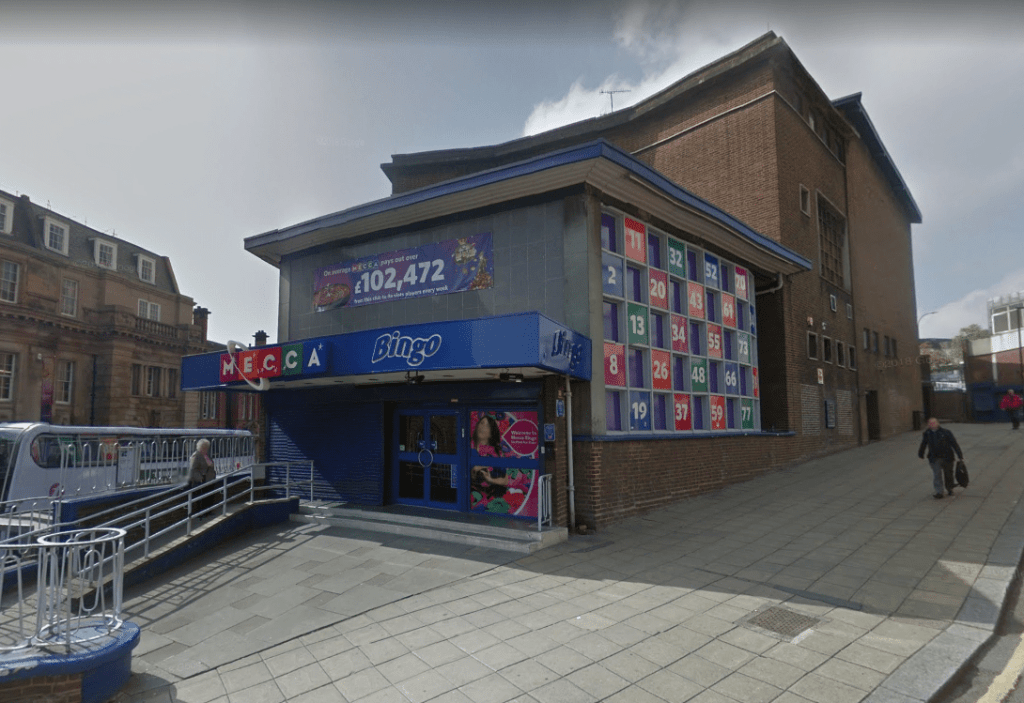
If World War Two hadn’t intervened, then this building might have looked very different. The structure that houses Mecca Bingo, on Flat Street, has stood since 1956, but its foundations and steel structure were put in place in May 1939.

It had been intended to complete the building by April 1940, but war meant construction was halted, and not resumed until 1955.

In 1937, Oscar Deutsch (1893-1941), the founder of Birmingham-based Odeon Cinemas, had his sights on South Yorkshire. New cinemas were to be built in Sheffield, Barnsley, Doncaster and Rotherham.

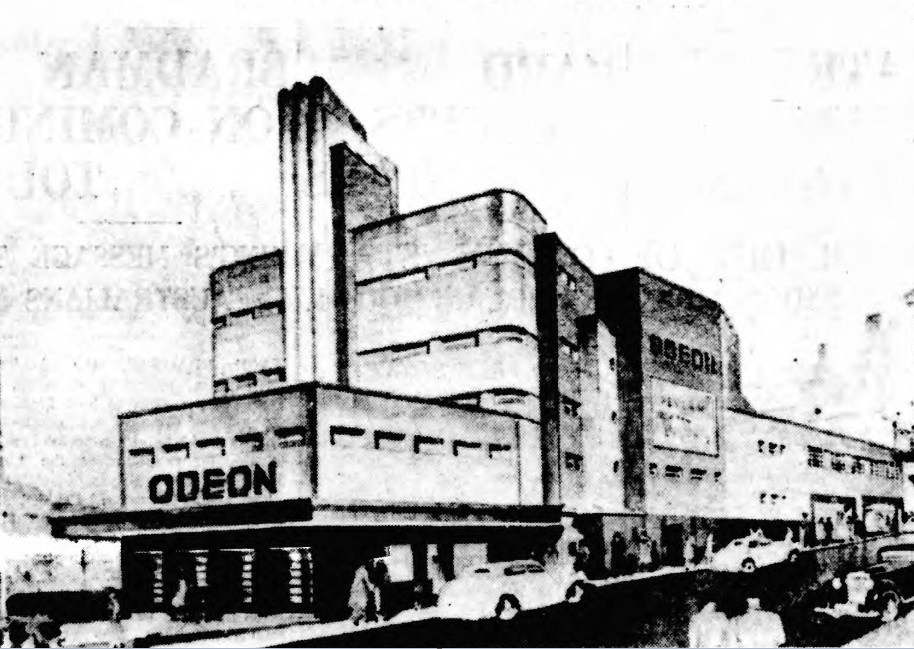
The Sheffield Odeon, on a wedge-shaped strip of land on Flat Street, promised to be an Art Deco masterpiece.

Plans were drawn up by Odeon-architects Harold William ‘Harry’ Weedon and William Calder Robson for a 2,326-seat cinema, containing four shops and a three-storey office block.

When war started in September the main steel frame was already up, but building was immediately halted by the cinema chain.

By November, it announced that work would recommence, but ongoing shortages of building supplies and labour meant it remained a building site for the next seventeen years.

When building recommenced in 1955, the plans had been re-drawn by Harry Weedon and his new partner, Robert Andrew Bullivant, for a 2,319-seat cinema without the shops and office block.

The Odeon Cinema opened in July 1956, by which time the chain had been sold to the Rank Organisation after Oscar Deutsch’s death.

The opening was attended by actress Dinah Sheridan and her husband, Sir John Davis, chairman of the Rank Organisation, the occasion memorable for a guard of honour provided by personnel from RAF Norton. A suitable tribute because the first film shown happened to be Reach for the Sky.

The Odeon might have looked a little less impressive than originally intended, but it was typical of 1950s construction, unusual for having a single-storey wedge-shape glass foyer projecting in front of the brick-clad auditorium.

There were 1,505 seats in the stalls and 814 in the balcony. Lighting was via three rows of light fittings hanging close to the ceiling and from concealed lights in two decorative panels each side of the proscenium opening.

The cinema was equipped with Todd-AO equipment, a widescreen, 70mm format developed by Mike Todd and the American Optical Company in the mid-1950s to compete with Cinerama. The process meant that there were long runs for classic movies like South Pacific and Cleopatra.

By the start of the 1970s, the Rank Organisation had two cinemas in the city centre, the other being the Gaumont in Barker’s Pool. Attendances had fallen, and not for the last time, the company decided to consolidate with one cinema in Sheffield.

The Sound of Music was the last film shown at the Odeon, reputedly ending a phenomenal fourteen month run. It closed in June 1971, and following refurbishment became a Top Rank Bingo Hall that opened three months later.

Later renamed Mecca, the building will soon celebrate fifty years, making it one of the longest surviving bingo halls in the country.

Categories
Buildings

Odeon Cinema

The Odeon Cinema, on Flat Street, was built between 1955-1956, later becoming the Top Rank Bingo Hall in 1971, and subsequently re-branded as Mecca.

However, the building’s history is strange because the structure we see today is a pale imitation of what was originally intended.

In 1938, Oscar Deutsch, the founder of Odeon Cinemas, set up a subsidiary company called Odeon (Sheffield) Ltd, registered at 39, Temple Row, Birmingham, intending to build an extravagant cinema on land bordering Flat Street and Norfolk Street.

Deutsch employed architects Harold ‘Harry’ Weedon and William Calder Robson to design an Art Deco theatre, making use of the unusual shape of land, incorporating four shops and a three-storey office block.

Harry Weedon was responsible for overseeing the Art Deco designs of Odeon Cinemas in the 1930s, and this artist sketch shows that his know-how was going to be applied in Sheffield.

Back then, it was called an “ultra-modern” design, with neon lighting to illuminate the spectacle at night-time. The tower-like device – known by architects as a fin – was to be the centre of the lighting scheme.

The building itself was designed in the shape of a flat iron, the point of which would form the frontage, with luxurious foyers to accommodate patrons who otherwise would have had to queue in the street.

A biscuit-coloured mottled faience was to be used on the Norfolk Street elevation, while the Flat Street side would be partly built in the same material, and partly in 2inch facing bricks.

A black faience was to have been used to form a base, and green and blue faience bands forming a background to the coloured neon tubes.

Inside there were to be 2,326 high-quality seats of the same design – 1,502 in the stalls, 824 in the circle – all divided into three blocks, the only difference in price being governed by the position of the seat.

In addition, there was to be a ladies’ boudoir, as well as several changing rooms.

Plans were made to install a “scientific scheme of acoustic correction,” ensuring perfect sound reproduction as well as a system of B.T.H. earphones for the deaf.

Work started on the cinema in May 1939, the main steelwork in place by the time war was declared in September. Construction was halted, and a shortage of materials and labour meant that it didn’t recommence until 1955.

By this time, the Rank Organisation owned the Odeon chain, and conscious of costs and changing trends, asked Harry Weedon to liaise with architect Robert Bullivant to create another cinema using the original steelwork and footprint.

The result was modern by 1950s standards, less spectacular than the 1930s design, but has stood the test of time, surviving longer as a bingo hall than it did as a cinema.

But, and we may ponder, what a building it would have been had the original design been built.