Categories
Sculpture

Bochum Bell

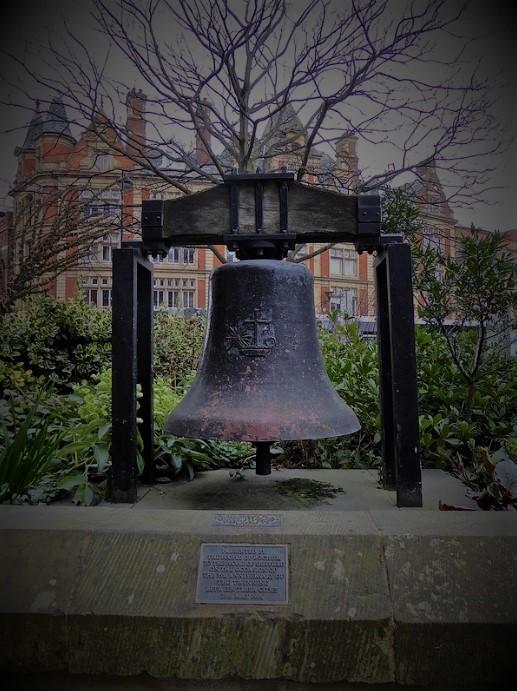
The Bochum Bell, in the Peace Gardens, was presented to the people of Sheffield in 1985 by our twin city of Bochum in Germany to commemorate the 35th anniversary of the link between the two cities. The steel bell was made by apprentices at the Krupp AG Works and reflects the shared heritage of the two cities in the manufacturing of the highest quality steel and steel artefacts. The bell is located in the top flower-bed along Pinstone Street. A Bochum Bell also exists at Donetsk in the Ukraine, another sister city.

Categories
Sculpture

City War Memorial

In 2009, when Philip Laing, a university student, got drunk and urinated on Sheffield’s War Memorial in Barker’s Pool, he didn’t realise he’d suffer the wrath of the city, as well as the rest of the country. He was spared jail and ended up quitting his university course.

Enthusiasm is still felt for the City War Memorial, erected in 1925, “to create a sacred centre where the people of Sheffield may meet on Armistice Day, and where the bereaved can lay their wreaths, and see the flag hoisted half-mast to honour their dead.”

In 1923, the Lord Mayor, F.C. Fenton, launched an appeal, aimed at ratepayers, to fund a memorial already designed by architect Emanuel Vincent Harris, an 80-foot high obelisk, to be sited at the junction of Townhead Street and Church Street.

The plan was abandoned due to being “unsuitable in design and location.”

However, the War Memorial Subcommittee was persuaded to consider a new design in front of the proposed City Hall. It launched a competition to select a more suitable design, restricted to artists working, or with practices, in the city. The contest attracted 34 entries; the winning design chosen by E. Vincent Harris.

The final design was by Charles Canus-Wilson, the architect, with George Alexander responsible for the sculptured designs of the figures.

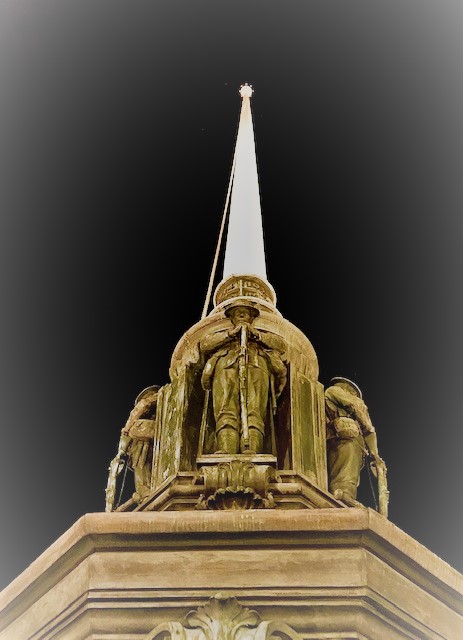
The Grade II-listed City War Memorial is set on a bronze case, with the sculptures on a granite plinth, into which is set a flagpole, over 100 feet in length and weighing nine tons, with a bronze crown.

The panels on the base, near the Sheffield coat-of-arms, shows emblems of the Royal Navy, the Merchant Navy, the Army and the Royal Flying Corps.

Below these, are insignias to commemorate the Yorkshire Dragoons (Queen’s Own) South Africa 1900-1902, the Royal Engineers, the Tanks Corps, the Yorkshire and Lancashire Regiment, the Royal Army Service Corps and the Army Medical Corps.

There are also four figures of four ordinary soldiers, heads bowed, and rifles reversed, standing on a ledge above an octagonal pedestal. It was originally to have had four females standing between the soldiers, but these were lost to save money.

The cost of the memorial was £5,345, funds coming from the Lord Mayor’s Appeal, fund-raising performances at Sheffield’s 44 theatres, music halls and cinemas, collection boxes in shops, the university and schools, a “Flag day” and a contribution from the British War Graves Association.

The bronze was cast by Conrad Parlanty Castings Ltd of Herne Bay, while the flagpole was made by Earle’s Shipbuilders and Engineers, Hull.

The flagpole arrived at The Wicker by rail, occupying six trucks, and was manoeuvred through the streets using steam-tractors during the early hours of the morning. It was designed to be the same height as the City Hall (opened in 1932) and was set 20-feet into the ground for stability.

The City War Memorial was unveiled on 28 October 1925, by Lieutenant-Colonel Sir Charles H. Harington, GBE, KCB, DSO.

During the December Blitz of 1940, a bomb exploded near its base, causing the six-ton bronze base to shift five inches out of position. It was repaired in 1949, parts of the memorial dismantled and taken to Herne Bay at a cost of £680.

In 2005, the memorial was assessed, and a £60,000 programme of essential repairs carried out by Rupert Harris Conservation. The mast was treated for corrosion and repainted, and the crown and ball at the top of the mast re-gilded using 24-carat gold leaf.

Interestingly, the 1940 shrapnel damage remains, kept as a reminder of the memorial’s history and purpose.
Categories
Companies People Sculpture

Frank Tory and Sons

As we discover the historic buildings of Sheffield, and the intricate sculptors that adorn many, the name of Frank Tory frequently appears.

Frank Tory and Sons were a firm of sculptors that worked on many of the city’s buildings from the early 1880s until the 1950s. Apart from stone, the family also worked in wood, marble, bronze and fibrous plaster.

Frank Tory (1848-1938) was a Londoner who trained at the Lambeth School of Art. He came to Sheffield in 1880 after accepting a commission from the 15th Duke of Norfolk to work on the new Corn Exchange.

The contract brought him into contact with architect Matthew Ellison Hadfield and his son, Charles, who encouraged him to stay in Sheffield and offered him several commissions.

Tory set up a studio amongst terraced houses, and was joined in 1901 by his twin sons Alfred Herbert Tory (1881-1971) and William Frank Tory (1881-1968).

The Corn Exchange was destroyed by fire in 1947 and demolished in 1964. However, some of his finest work can still be found at Parade Chambers (High Street), St. John’s Church (Ranmoor), Cairns Chambers (Church Street), Carmel House (Fargate) and the Cathedral of St. Marie.

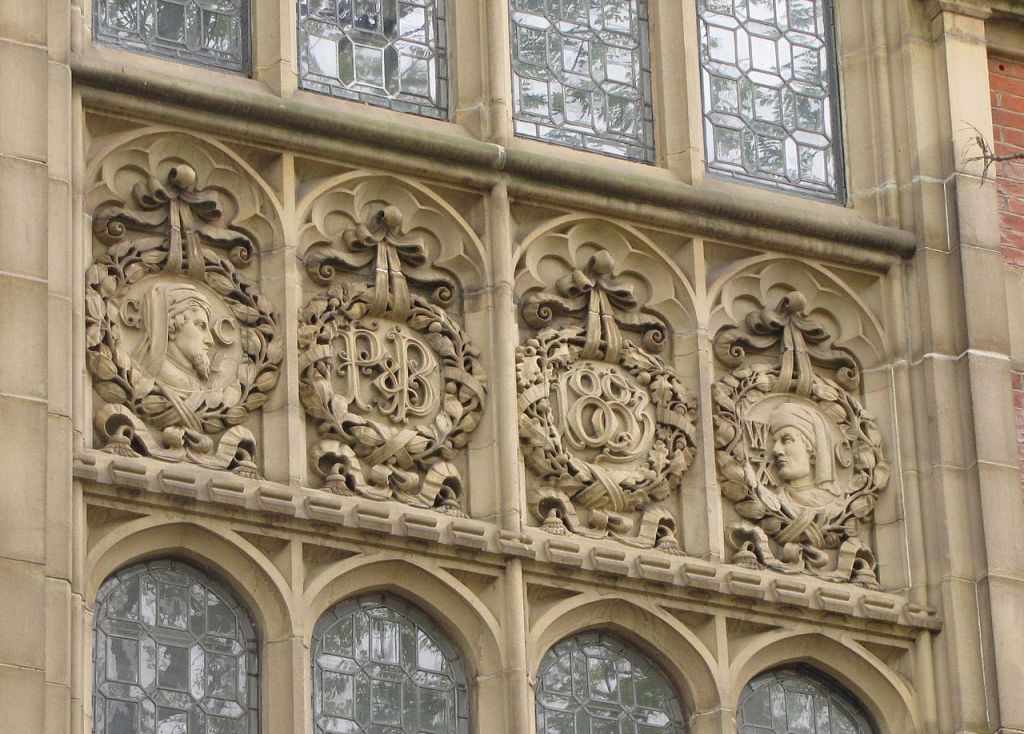
Perhaps Frank Tory’s greatest work is on Parade Chambers, with decorative sculptures of Geoffrey Chaucer and William Caxton, created in 1883 for Pawson and Brailsford, printers and stationers (pictured).

Alfred and William were born on Winter Street and attended the Broomhill County School and the Weston Academy for Sons of Gentlemen. They learned their trade from their father, who also taught at the Sheffield School of Art.

While Frank Tory worked on some of the city’s finest Victorian structures, his sons were responsible for sculptures on twentieth century buildings, including Sheffield City Hall, the Central Library, the White Building (Fitzalan Square), Victoria Hall (Norfolk Street) as well as Leeds Civic Hall and Chesterfield Town Hall.

After their father’s death, the firm moved to Ecclesall Road, at a site that is now the Porter Brook pub, eventually retiring in the 1950s after which the firm was wound up. 

Categories
Buildings Sculpture

Moorfoot

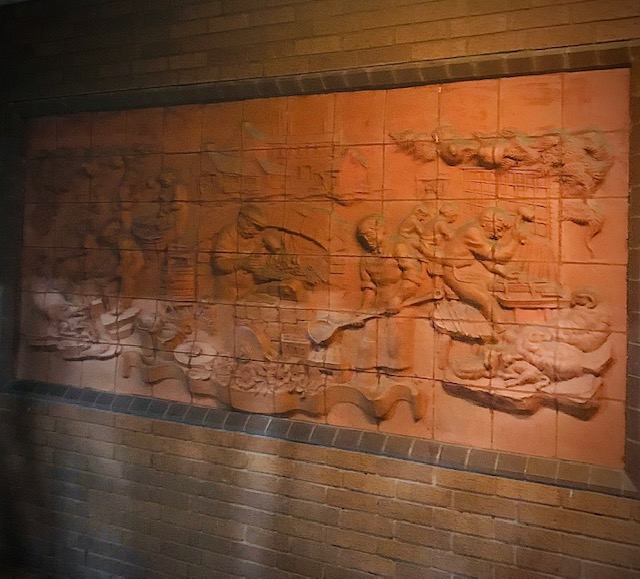
Oh, how happy sculptor Judith Bluck (born 1936) must feel. Thirty-four years after creating a brick wall relief, it now adorns the outside of a boarded-up toilet block at Moorfoot.

The frieze was created for the Manpower Services Commission in 1985, the theme based on different kinds of skills used in the “little mesters” workshops formerly on the site.

Bluck visited Kelham Island Museum for inspiration and made a master in Glass Reinforced Polyester Resin from which a mould was formed. Pan tiles, each 25cm square, were produced by Nori (a subsidiary of Accrington Brick).

Working from her studio in the Yorkshire Dales, Bluck was also responsible for the Crucible Fountain outside the Moorfoot building (covered in another post).

She also created numerous works around the country including Small Workhorse, at Ealing Broadway, Legend of the Iron Gates, Wilmslow, Sheep in Milton Keynes, and a 20ft high relief narrative on security doors at Portsmouth Crown Court.

Categories
Sculpture

Crucible Fountain

It might have seen better days, and quite frankly, it’s at the arse-end of The Moor. But how many people even notice the monument outside the Moorfoot building?

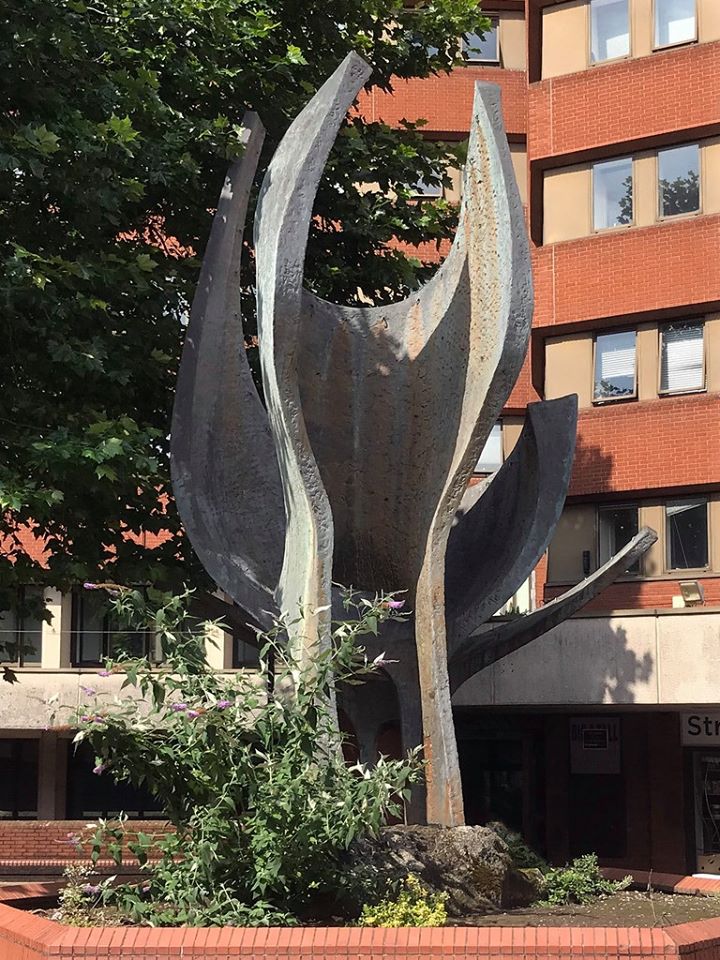
It is called the Crucible (or Crucible Fountain) and was commissioned by the Property Services Agency, Department of the Environment, to stand in front of the former Manpower Services Commission building. It was installed in 1979, the work of sculptor Judith Bluck, and cost £30,000.

Unsurprisingly, the sculptor chose something that was “rooted in Sheffield,” and based the design on a crucible used in the steel industry, along with the shape of a bird with spread-out wings.

After being conceived as a paper and wire-scale model on a turntable, the sculpture was created in Accrington, using a building with lifting gear, to lift a rolled steel joist armature, covered in chicken wire, and then sprayed with Glass Reinforced Polyester Resin.

The surface was created with a coating of “techfil,” made up of recycled fuel ash and crushed coal mixed with resin and applied by trowel. This was then sanded down and stippled with centrifugally atomised bronze.

Brought to Sheffield, the 30ft monument was mounted on two reinforced concrete pads.

Originally, the sculpture included water, supplied by three separate jets, positioned so that water falling off the structure didn’t blow in the wind and soak passers-by.

The surface texture was created to enhance the sound of water and provide a sparkling effect. By night, the monument was illuminated to augment the overall appearance.

A lot has happened to it since then.

The water was switched off in the distant past and the floodlights removed. The raised garden in which it stands was planted with shrubbery that eventually consumed much of the lower part of the monument.

I kid you not when I say that the sculpture provided the perfect safe place for the homeless, hidden from view, in which to sleep overnight.

Most of the overgrowth was removed in early 2016 when this part of The Moor was used in the filming of Brief Encounters, an ITV comedy-drama, detailing the beginning of the Ann Summers company, through four women who sought happiness and fulfilment by selling lingerie and sex toys.

Now in need of much care and attention, this cries out for restoration.

Note: Look out for Bluck’s wall frieze outside the disused toilet block nearby, covered in a separate post.