Categories
Buildings

Gladstone Buildings

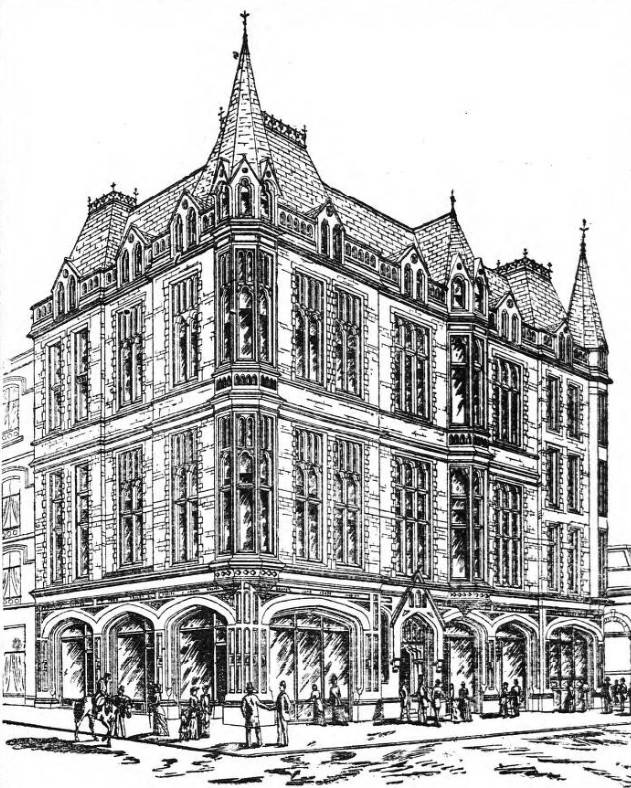
This illustration of the Sheffield Reform Club, forming the greater part of the Gladstone Buildings, is from October 1885, and celebrated an important contribution to the public buildings of Sheffield.

Just completed, the Sheffield Reform Club, for Liberal-minded people, was formally opened by Archibald Primrose (1847-1929), 5th Earl of Rosebery, 1st Earl of Midlothian, on Tuesday 20 October 1885. (He later served as Prime Minister in 1894-1895).

The club was the tenant of the Gladstone Buildings Company, renting from it that portion shown in the drawing – the two frontages facing to St James’ Row (where the entrance was), and to Church Street.

On the ground floor was a range of shops, the first floor was occupied by the club dining, reading and writing rooms; the second floor the billiard and smoke rooms, and higher still were the domestic apartments.

The whole club had been handsomely furnished, and already had a large roll of members, attracted by the accommodation inside.

Life members paid £30 a year, while ordinary members were charged not less than one guinea on entrance, and an annual subscription of the same. Honorary members were admitted free of charge.

Within its rules, it stated that the term “beverages” did not include tea, coffee or cocoa.

Beverages would only be supplied to members and visitors in the coffee or dining room, club billiard room, smoke room and private dining rooms.

The Sheffield Reform Club’s first president was Anthony John Mundella (1825-1897), reformer and Liberal MP for Sheffield, and its treasurer was Samuel Osborn (1826-1891), steel maker and tool manufacturer.

The club closed in the 1940s, the building later converted into offices, and is now known as 1 St James’ Row, at the side of Sheffield Cathedral.

Categories
Buildings

Gladstone Buildings

No. 1 St James’ Row, better known as Gladstone Buildings, near the Cathedral, opened as the Sheffield Reform Club in October 1885. It was designed by Sheffield architects Hemsoll and Smith for the Gladstone Buildings Company.

At the time, a correspondent said that, “The Liberals of Sheffield were entitled to feel proud of the club, for it was in every respect of high-class character.” The club was altogether distinct from the company which it paid rent, though only a small amount.

The Gladstone Buildings Company had been formed in 1882, chiefly through the exertions of Mr Batty Langley, to provide accommodation for a Reform Club, and to be the headquarters of the Liberal Association.

Alas, following the threat of demolition in 1976, much of its original configuration was lost during late twentieth century renovations, with much of the interior converted into office space.

The rooms of the Reform Club were taken over by Mr J.C. Skinner and the association, soon after completion, and formally opened by the Earl of Rosebery.

The catering arrangements were in the hands of Herman Gadje, the steward, with previous experience of leading clubs in Newcastle, Birmingham and Bradford, the cooking in the charge of a capable chef from London.

A tariff was prepared by which members had the choice of dining at the “table d’hote” or ordering whatever they wanted at fixed prices.

The Reform Club was entered from St James’ Row, through a handsome portico, which communicated by folding doors, with the principal porch, lofty and well-lit. Around the walls of the hall was a dado of Cork marble, edged with polished black marble, and the archway which divided the hall, was enriched with marble pillars.

On the left side of the entrance hall was the porter’s room, and on the right the lavatories and cloakrooms, fitted with every convenience, including private lockers for the members. There was also a letter box in the hall, with the club negotiating with the postal authorities to secure all day collections.

The staircase up to the first floor was lit by lantern and windows – with stained glass soon replacing the semi-opaque windows originally installed. The stairs were covered with Brussels carpet, and the balustrade was wrought-iron and Spanish mahogany.

It reached the dining-room (45ft long by 23ft wide), again carpeted, the walls being decorated with a dado picked out in two colours, and able to accommodate about one hundred people. It was well lit with oriel windows and two large Siemens lights hanging from the roof. A serving room adjoined the dining room and was connected by a serving lobby.

The reading room, adjoining the dining room, had an angled oriel window, with sweeps across the whole of Church Street, the Churchyard, High Street and St James’ Row. It had originally been planned that a balcony might be added around the window, from which political addresses might be delivered.

It was fitted in similar style to the dining room, except that the lighting was affected by several gas brackets fixed to the walls, the furniture including easy chairs, armchairs and settees, whilst the tables were covered with Morocco leather.

Both rooms were separated by a “felted” ornamental revolving partition, carved in panels from solid wood, which could be removed to form one grand banqueting room.

A writing room adjoined the reading room, from which it was divided by a glass partition with a door in the centre, and with a separate entrance from the staircase.

To the left of the staircase was a waiting room, and a smaller room used for telephonic purposes.

Passing upstairs, the visitor reached a mezzanine floor (between the first and second floors) containing two rooms that were used as private dining rooms.

The chief features of the second floor were the billiard and smoke rooms, the former being 45ft long by 23ft wide, also with an oriel window at the centre. The original intention had been to place three full-sized billiard tables (made by Cox and Yeman) here, but due to possible overcrowding, the third table was instead sited in the smoke room.

Adjoining the smoke room was a smaller room, to be used for smoking and card purposes, and eventually used as the reference library, supplied with all the leading daily, weekly and monthly newspapers and magazines.

The mezzanine floor also contained a committee and secretary’s room, and a steward’s room, with a safe to store silver plate and valuables.

The third floor contained a bathroom, dressing room, and bedrooms for the use of members; also, steward’s apartments and kitchens.

The kitchens were fitted with ranges of special construction with two large hoists communicating with every floor in the building, with service lifts to the dining and other rooms. The large kitchen , larders and servants’ hall were put on the upper floor, and by a system of ventilation, allowed odours to be eliminated into the open air.

The Reform Club was heated by a high pressure hot water system, together with open fireplaces in the principal rooms, and electric bells fitted throughout.

The furnishings for the club, costing about £2,000, were supplied by Johnson and Appleyard of Leopold Street (as were the carpets), working to special designs submitted by the committee, all being in Gothic design, unvarnished oak, upholstered in hog skin and dark olive green tint, to match the building, including tables, chairs, armchairs and settees.

The building was illuminated with gas lights, provided by Guest and Chrimes, of Rotherham, with exception of the billiard room, where fittings were supplied by the Sheffield Gas Company.

Its members enjoyed the best cutlery, supplied by Brookes and Crookes, glassware by Webb and Sons, Stourbridge, and the dinner and tea service (with monograms of the club) by Doulton and Company of Burslem. Of course, the club enjoyed the best silver plate, manufactured by Otley and Sons, of Meadow Street, Wilkinson and Company, Norfolk Street, and George Warriss, based on Howard Street, providing the spoons and forks.

The Blind Institute fitted the club with mats and brushes, the ironmongery was by Chas Woollen and Company, with fire grates supplied by W.G. Skelton, and the fenders from Thomas Hague, both of Bridge Street. The hot closet in the serving room was made by J. Wright, and the ranges in the kitchen were by Newton Chambers and Company.

The Reform Club’s committee now reads as an historical list of local worthies: –

The Right Hon. A.J. Mundella, MP, was the President. The Vice Presidents were the MPs, Frederick Thorpe Mappin, Francis J.S. Foljambe (East Retford); the Hon. Henry Wentworth-Fitzwilliam, and William Henry Leatham (South West Riding); Lord Edward Cavendish, John Frederick Cheetham (North Derbyshire); the Hon. Francis Egerton, Alfred Barnes (East Derbyshire), and also Cecil Foljambe, of North Nottinghamshire.

The Treasurer was Samuel Osborn, with trustees made up from Thomas Wilson, John William Pye-Smith, Frank Mappin, Henry Ashington, and Robert Renton Eadon. The Honorary Secretary was George Walter Knox.

The club closed in 1942, with the Gladstone Buildings Company wound up in 1946.

It all seems such a long time ago, and today No.1 St James’ Row comprises shops and offices, many available to let, and upper floor apartments.
Categories
Buildings

Odeon Cinema

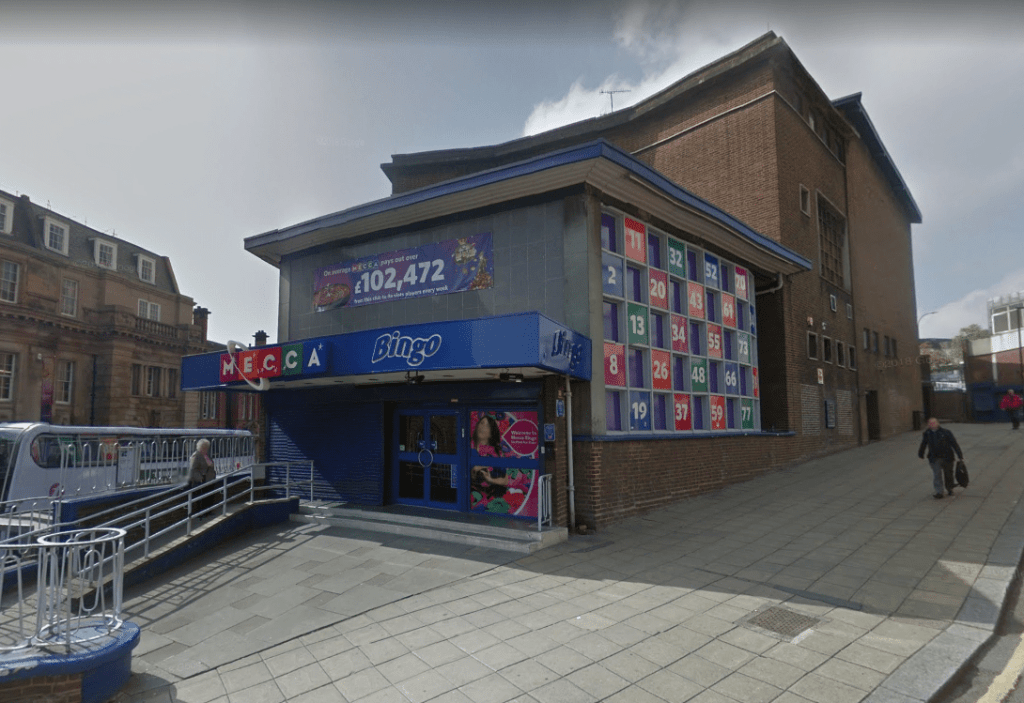
If World War Two hadn’t intervened, then this building might have looked very different. The structure that houses Mecca Bingo, on Flat Street, has stood since 1956, but its foundations and steel structure were put in place in May 1939.

It had been intended to complete the building by April 1940, but war meant construction was halted, and not resumed until 1955.

In 1937, Oscar Deutsch (1893-1941), the founder of Birmingham-based Odeon Cinemas, had his sights on South Yorkshire. New cinemas were to be built in Sheffield, Barnsley, Doncaster and Rotherham.

The Sheffield Odeon, on a wedge-shaped strip of land on Flat Street, promised to be an Art Deco masterpiece.

Plans were drawn up by Odeon-architects Harold William ‘Harry’ Weedon and William Calder Robson for a 2,326-seat cinema, containing four shops and a three-storey office block.

When war started in September the main steel frame was already up, but building was immediately halted by the cinema chain.

By November, it announced that work would recommence, but ongoing shortages of building supplies and labour meant it remained a building site for the next seventeen years.

When building recommenced in 1955, the plans had been re-drawn by Harry Weedon and his new partner, Robert Andrew Bullivant, for a 2,319-seat cinema without the shops and office block.

The Odeon Cinema opened in July 1956, by which time the chain had been sold to the Rank Organisation after Oscar Deutsch’s death.

The opening was attended by actress Dinah Sheridan and her husband, Sir John Davis, chairman of the Rank Organisation, the occasion memorable for a guard of honour provided by personnel from RAF Norton. A suitable tribute because the first film shown happened to be Reach for the Sky.

The Odeon might have looked a little less impressive than originally intended, but it was typical of 1950s construction, unusual for having a single-storey wedge-shape glass foyer projecting in front of the brick-clad auditorium.

There were 1,505 seats in the stalls and 814 in the balcony. Lighting was via three rows of light fittings hanging close to the ceiling and from concealed lights in two decorative panels each side of the proscenium opening.

The cinema was equipped with Todd-AO equipment, a widescreen, 70mm format developed by Mike Todd and the American Optical Company in the mid-1950s to compete with Cinerama. The process meant that there were long runs for classic movies like South Pacific and Cleopatra.

By the start of the 1970s, the Rank Organisation had two cinemas in the city centre, the other being the Gaumont in Barker’s Pool. Attendances had fallen, and not for the last time, the company decided to consolidate with one cinema in Sheffield.

The Sound of Music was the last film shown at the Odeon, reputedly ending a phenomenal fourteen month run. It closed in June 1971, and following refurbishment became a Top Rank Bingo Hall that opened three months later.

Later renamed Mecca, the building will soon celebrate fifty years, making it one of the longest surviving bingo halls in the country.

Categories
Buildings

Odeon Cinema

The Odeon Cinema, on Flat Street, was built between 1955-1956, later becoming the Top Rank Bingo Hall in 1971, and subsequently re-branded as Mecca.

However, the building’s history is strange because the structure we see today is a pale imitation of what was originally intended.

In 1938, Oscar Deutsch, the founder of Odeon Cinemas, set up a subsidiary company called Odeon (Sheffield) Ltd, registered at 39, Temple Row, Birmingham, intending to build an extravagant cinema on land bordering Flat Street and Norfolk Street.

Deutsch employed architects Harold ‘Harry’ Weedon and William Calder Robson to design an Art Deco theatre, making use of the unusual shape of land, incorporating four shops and a three-storey office block.

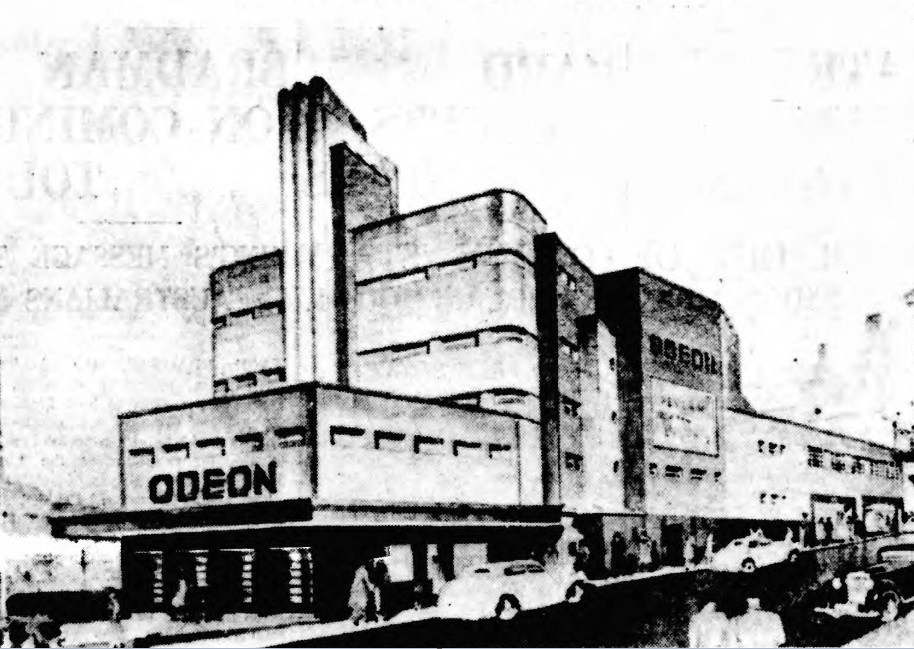
Harry Weedon was responsible for overseeing the Art Deco designs of Odeon Cinemas in the 1930s, and this artist sketch shows that his know-how was going to be applied in Sheffield.

Back then, it was called an “ultra-modern” design, with neon lighting to illuminate the spectacle at night-time. The tower-like device – known by architects as a fin – was to be the centre of the lighting scheme.

The building itself was designed in the shape of a flat iron, the point of which would form the frontage, with luxurious foyers to accommodate patrons who otherwise would have had to queue in the street.

A biscuit-coloured mottled faience was to be used on the Norfolk Street elevation, while the Flat Street side would be partly built in the same material, and partly in 2inch facing bricks.

A black faience was to have been used to form a base, and green and blue faience bands forming a background to the coloured neon tubes.

Inside there were to be 2,326 high-quality seats of the same design – 1,502 in the stalls, 824 in the circle – all divided into three blocks, the only difference in price being governed by the position of the seat.

In addition, there was to be a ladies’ boudoir, as well as several changing rooms.

Plans were made to install a “scientific scheme of acoustic correction,” ensuring perfect sound reproduction as well as a system of B.T.H. earphones for the deaf.

Work started on the cinema in May 1939, the main steelwork in place by the time war was declared in September. Construction was halted, and a shortage of materials and labour meant that it didn’t recommence until 1955.

By this time, the Rank Organisation owned the Odeon chain, and conscious of costs and changing trends, asked Harry Weedon to liaise with architect Robert Bullivant to create another cinema using the original steelwork and footprint.

The result was modern by 1950s standards, less spectacular than the 1930s design, but has stood the test of time, surviving longer as a bingo hall than it did as a cinema.

But, and we may ponder, what a building it would have been had the original design been built.

Categories
Buildings Sculpture

Bainbridge Building

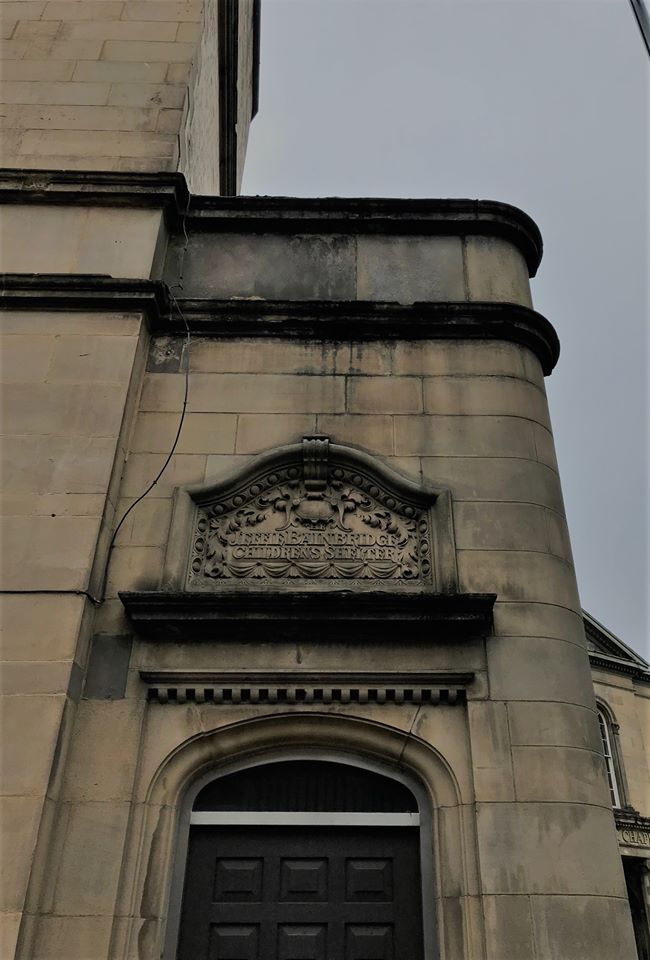
I bet most of you have never noticed this above a door at the top of Norfolk Street. This carved panel is on the old Halifax Bank at the corner of Surrey Street. The building was commissioned by Emerson Bainbridge, a mining engineer consultant and philanthropist, following the death of his wife, Jeffie.

It was erected as a memorial to her and opened by the Duke and Duchess of Portland in 1894.

The first floor formed a shelter for waifs and strays, and a large suite of offices on the second floor were given to the local branch of The Society for the Prevention of Cruelty to Children, of which Bainbridge was a committee member.

The ground floor consisted of shops that were let out to tenants in order to raise revenue to support the rent-free premises above.

The sculptor is unknown, but the architect was John Dodsley Webster, who also designed the Gladstone Buildings next to the Cathedral.

Categories
Buildings

Bainbridge Building

In 1924, the author J.H. Stainton wrote in The Making of Sheffield, “It is fairly safe to say that practically half the citizens of Sheffield at the present time know nothing of Mr Emerson Bainbridge, yet in his day he was assuredly one of Sheffield’s big men.”

Now, it is probably a fair bet that nobody in the city has ever heard of him.
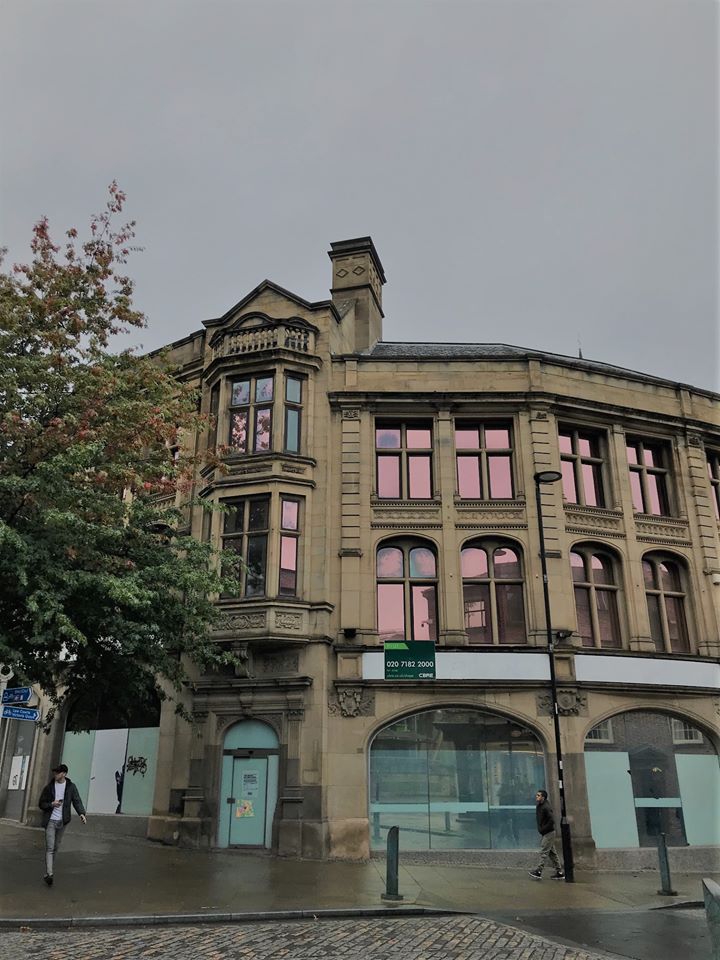
Yet, at the time of his death in 1911, he was called “a striking personality,” and responsible for Bainbridge Building, the resplendent Victorian building that stands on the corner of Surrey Street and Norfolk Street.

Emerson Muschamp Bainbridge (1845-1911) was born at Newcastle-on-Tyne and studied at Edenfield House, Doncaster. Afterwards, he attended Durham University and served time in nearby collieries belonging to the Marquis of Londonderry.

In 1870, Bainbridge became manager of the Sheffield and Tinsley Collieries, later taking charge at Nunnery Colliery on behalf of the Duke of Norfolk, subsequently becoming Managing Director and setting up his own firm of mining consulting engineers.

In 1889, Bainbridge obtained a lease from the Duke of Portland for the “Top Hard”, or “Barnsley Coal”, under land in Derbyshire and Nottinghamshire. He then founded the Bolsover Colliery Company to take the lease and mine the coal, being the man responsible for developing the town that exists today.

Bainbridge also became Liberal MP for Gainsborough between 1895 and 1900, as well as being a JP for Derbyshire and Ross-shire, where he owned a deer forest at Auchnashellach.

Bainbridge provided money to build the YMCA at the junction of Fargate with Norfolk Row, and in the early 1890s spoke of his ambitions to honour his wife, Eliza Jefferson Armstrong Bainbridge, known as Jeffie, who died in 1882.

“I have for some time been struck with the large number of ill-cared for boys and girls in the streets of Sheffield, who, doubtless only represent a small proportion of the large number who are constantly neglected.

“Beyond this, of course, is the great question of neglected training, in consequence of which many of these children are destined to lives of poverty and crime.

“I propose to erect and establish, at some suitable point in the town of Sheffield, a Children’s Refuge, which I would erect in memory of my late wife, and it might be possible to have her name connected to it.”
Bainbridge was a man of his word.

He purchased a plot of land from Sheffield Corporation at the corner of Norfolk Street and Surrey Street, then employed architect John Dodsley Webster to create a spectacular new building that would contain the Jeffie Bainbridge Children’s Shelter.

Construction started in 1893 and was completed in 1894, the total cost being almost £10,000.

The ground floor was utilised for shops and part of the first floor for offices, the rents funding the children’s shelter. The rest of the first floor consisted of a large room capable of accommodating 150 children. Here, ill-clad children suffering from cold and hunger were welcome, and be certain of shelter, warmth and cheap food.

The second floor had been placed, rent free, at the disposal of the local Society for the Prevention of Cruelty to Children. There were dormitories for more than twenty juveniles, also rooms for committee meetings and for caretakers and porters.

The Jeffie Bainbridge Children’s Shelter was officially opened by the Duke and Duchess of Portland on Friday 28 December 1894.

There were five shops underneath, numbered 49-55 Surrey Street, and 104 Norfolk Street. Birds Restaurant, opened by William Bird on a ten-year lease, occupied No.53, although the business collapsed several years later, probably the result of being refused an alcohol licence, something that rankled with the professional men who visited. Next door, Jasper Redfern had a photography shop while William Cole had a piano business at 104 Norfolk Street.

The NSPCC moved upstairs in 1895, but in 1899 Emerson Bainbridge gave them £200 as consideration for removing their shelter to Glossop Road.

The Jeffie Bainbridge Children’s Shelter served over a thousand meals every month to destitute children and appears to have survived until at least 1907. Afterwards, it became a Maternity and Welfare Centre, instigated by the Sheffield Infantile Mortality Committee, where women went for advice and consultations, and to buy dried milk at cost price for bottle-fed babies.

However, the biggest change occurred in 1914, when a portion of the Bainbridge Building was converted into the Halifax Building Society. Most of the shops were taken, with plans created by W.H. Lancashire, Sheffield architects, who clad the exterior in blue and red Aberdeen polished granite, and the interiors with Austrian oak.

In time, the Halifax took the whole building, renting out upper floor offices, culminating in the interior being reconfigured in 1977-1978, when most of Webster’s original features were lost.

The Halifax Bank finally closed in 2017 and the Bainbridge Building has been vacant since.

But let us remember Birds Restaurant, which was unable to serve alcohol to its Victorian customers.

It was recently announced that the pub chain Mitchells & Butlers is opening a branch of its Miller and Carter restaurants, specialising in steaks, in the Bainbridge Building.

There are already Miller and Carter restaurants in the city, off Ecclesall Road South and at Valley Centertainment, the latter of which opened in the summer.

Categories
Buildings

Barker’s Pool House

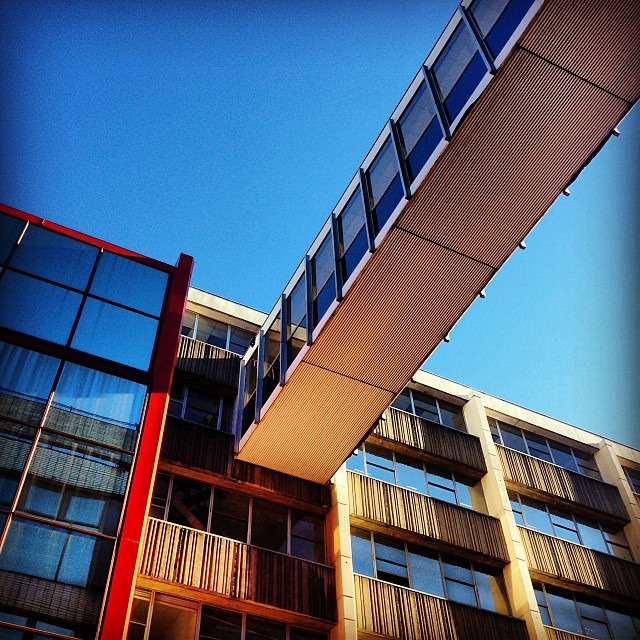
We’re about to lose a city centre landmark, although one we barely notice these days. Planning permission has been submitted to demolish the link bridge between John Lewis and Barker’s Pool House, on Burgess Street.

The bridge was built in 1973, linking Barker’s Pool House, built about 1970, with John Lewis (then Cole brothers), constructed ten years earlier, and serving as office access for the department store.

The link bridge is no longer required, with Barker’s Pool House forming part of Block A in the Heart of the City II project, a new construction, designated for retail and leisure space, a hotel, with residential above.

The link bridge was designed by architect R.D. Cook, and made of primary castellated beams, which carry the floor and roof structure, with glazed cladding. Its deck stands about 12 metres above street level, 16 metres in length, 2.5 metres wide, and a height of 3.4 metres.

Once planning permission is granted, likely to be a formality, the access space from both buildings will be made good.

Categories
Buildings

Town Hall Police Box

This landmark has become so familiar that we barely notice it now. But, this police box, next to the Town Hall, on Surrey Street, is the only survivor of a system of 120 boxes that once existed across Sheffield.

Police boxes were introduced in Britain in the 1920s. Chief Constable Frederick James Crawley installed them initially in Sunderland in 1923, and then in Newcastle upon Tyne, after he became Chief Constable there in 1925.

They were designed to increase efficiency by decentralising police constables away from the police station and preventing the necessity to return to base several times during their beat.

Other northern cities then followed suit including Sheffield in 1928.

The Sheffield police box system was introduced by Chief Constable Percy J Sillitoe, subsequently appointed as Chief Constable of Glasgow in 1931, where he also set up a police box system; he was later to receive a knighthood and became Director General of MI5. (Think, Sam Neill’s Major Chester Campbell character in Peaky Blinders).

The Sheffield boxes were sited on police beats all over the city where they provided contact points for both police officers and members of the public, with each box having a direct telephone link with the local police station.

The telephone was in a small compartment accessible from the outside of the box, as was a first aid kit, both intended for public use. They were also used by patrolling officers, who visited the boxes at hourly intervals when information was passed by phone between the officers and supervisory staff at police stations.

Additionally, a ‘blue’ electric lamp was located on the top of each box; the Sheffield boxes originally had bulb lights suspended from curved metal brackets. These were controlled from the local police station and used to indicate when there was an important message to be relayed.

Inside, the boxes had a desk and stool where the patrolling officers could have meal breaks and write reports. The boxes could also be used as temporary lock-ups if necessary, for those arrested and awaiting transport to a police station.

The police boxes remained in regular use until the 1960s when the development of improved communications and increased use of police cars made them obsolete.

This box is the sole survivor and has latterly been used as a public information point by Sheffield’s city centre ambassadors, though it is not presently in regular use.

The police box is well-known as Doctor Who’s Tardis, but the type used on TV is typical of the shallow pyramidical roof boxes, adopted by the Metropolitan Police in 1930.

Categories
Buildings

Gatecrasher One

When somebody asks you about this building then you realise that history can be more recent than you realise. Especially for those millennials who’ve never seen another century, nor are likely to.

This ordinary looking student accommodation on Matilda Street, at the edge of the city centre, was built in 2016. It takes the name of Gatecrasher, complete with a logo of a vinyl disc.

Our story begins with Henry John Roper and George Wreaks, who set up an engineering company in the nineteenth century, eventually moving to the Oval Works at the corner of Arundel Street and Matilda Street, about 1904.

The two-storey brick building was in use until 1986, and like many former industrial sites, was left empty for several years.

In 1991, an application was made to convert the building into offices, a plan never realised, and then subject to numerous requests for conversion into a nightclub.

The final application succeeded, and after refurbishment, the building opened as The Republic nightclub in 1995.

The building was extended on a sloping topography by Birmingham architects, Mills Beaumont Levy, “in a fragmented style of Gehry-esque fractured geometry with a mono-pitch roof, and varnished timber cladding, not quite vertical with tiny square windows.”

The Republic struggled financially, its rescuer being Gatecrasher, a club night, that started using the building on Saturday nights in 1996.

Gatecrasher, a pioneering trance music event in Birmingham, had been set up by Simon Raine and Scott Bond in the early nineties.

Due to competition in the city, the duo moved the event to Sheffield, originally at The Leadmill, then at The Arches, near The Wicker, and eventually The Adelphi, a disused cinema in Attercliffe.

Gatecrasher eventually bought The Republic for a six-figure sum, afterwards renaming it Gatecrasher One in 2003, the first of ten proposed clubs, although subsequent venues in Leeds, Nottingham, Birmingham and Watford did not get numbered.

The main body of Gatecrasher One was split into five areas – The Foyer, Main Room, Electric Box, Lounge and the VIP Pod. The interior design was by Matt Rawlinson of RAW, and famous for its bespoke Opus sound system.

Gatecrasher One became legendary on the British dance music scene, with resident DJs including the likes of Judge Jules, Paul Van Dyck and Tiesto, and was often over-subscribed, entry only obtained if you were lucky enough.

Its demise came on 18 June 2007, when a fire destroyed it and caused partial collapse of the building. While council officers were keen for it to be repaired, structural engineers claimed it was beyond reparation and it was demolished.

After demolition, it was a vacant site until the six-storey Gatecrasher apartments were built in 2016, the garden feature built in the shape of a record turntable and four wings named after musical terms – Opus, Mezzo, Viva and Accent.

While the signage might be the only reminder of its halcyon days, Gatecrasher arrived back in Sheffield the same year as the apartments opened, taking a lease on the former Kingdom nightclub on Burgess Street, opening as Area, and eventually to be demolished as part of the Heart of the City II scheme.

Categories
Buildings

Sheffield Town Hall

Look at this, Sheffield Town Hall, brand new and clean, seen here in May 1897, shortly before the official opening by Queen Victoria. Within weeks the building was already taking on the tone common to Sheffield, smoke being the culprit, and within decades the Stoke Hall stone was almost black in appearance.

Sheffield’s fourth Town Hall was built between 1891-1896 by Edward William Mountford (1855-1908), one of 178 architects to enter a competition with Alfred Waterhouse as judge.

Mountford was successful despite protests from Flockton & Gibbs, who claimed their “patent” design for municipal buildings had been incorporated into instructions for finalists and used in Mountford’s scheme.

“The architect’s aim, of course, was to obtain the dignity essential for the Corporation’s buildings of the fifth provincial city in England, combined with the maximum amount of internal convenience, and abundant light and air!”

The building contract was awarded to Edmund Garbutt of Liverpool, whose tender amounted to £83,945, but the actual cost, including the site, approached £200,000.

Understandably, the Sheffield public were “up in arms” about the cost, and critical of the expensive embellishments inside and out, protesting that ratepayers’ money was better spent on street improvements and housing for the poor.

The Town Hall was built on an almost triangular site, bought by the council as part of a general improvement scheme, and replacing dilapidated properties either side of New Church Street, a road lost beneath the development.

The principal front faced Pinstone Street (200ft long), although the main entrance was at the centre of the Surrey Street front (280ft long). Its crowning glory was the 64ft-high clock tower complete with Mario Raggi’s bronze statue of Vulcan.

Although the Town Hall clock was designed to be capable of working with bells, they were never fitted, and it wasn’t until 2002 that an electronic bell ringing system was installed, giving hourly strikes with Westminster-style quarter chimes.

On the right of the Pinstone Street entrance were the offices of the waterworks; on the left, the City Accountant’s department. The Town Clerk and members of his department had rooms on the first floor, as were the committee rooms.

On this floor were the Mayor’s reception hall, dining-hall and the Mayor’s parlour, as well as the Council Chamber (60ft x 40ft, and reaching a height of 28ft), light being afforded by traceried windows, and with a public gallery seating 60 people.

The main staircase, 10ft wide, leading to the first floor, was supported on columns of red and grey Devonshire marble, with alabaster balustrades and an ornate marble handrail, the walls being lined with polished Hoptonwood stone.

In other parts of the building, the corridors had floors of glass mosaic and a specially designed dado of antique glazed tiles.

The rich decorative scheme of stone carving, both externally and internally, was devised by Mountford and Frederick William Pomeroy (1856-1924), Royal Academy Gold Medallist, and took pride in Sheffield’s history and the art and skill of its workforce.

The foundation stone was laid by Alderman W.J. Clegg in 1891 and the Town Hall should have been opened by Queen Victoria in 1896, but the death of Prince Henry of Battenberg prevented her from doing so.

The Town Hall was opened by Queen Victoria on the afternoon of May 21, 1897, a story worthy of a separate post.