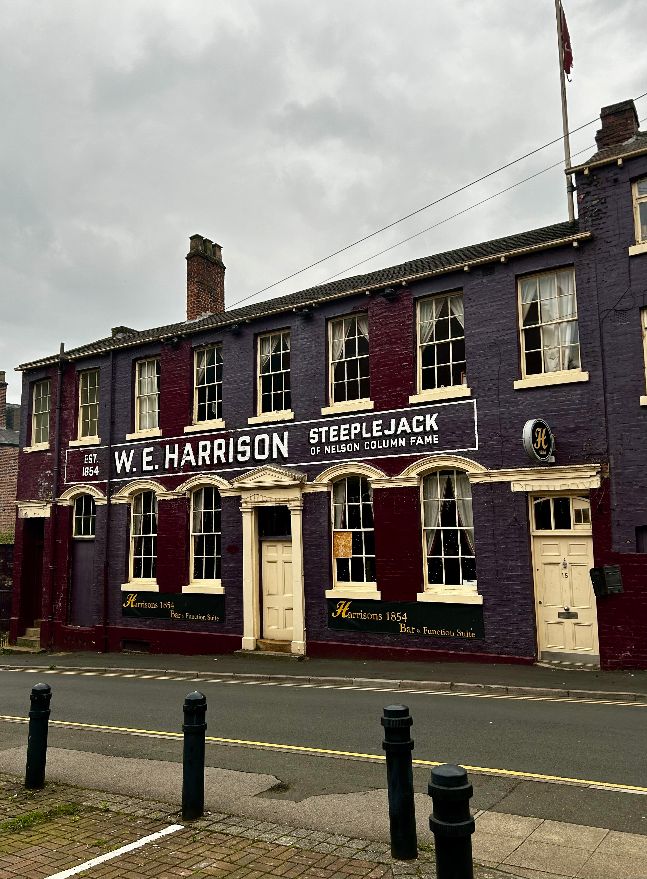
What is the story behind the building on Regent Terrace, off Glossop Road, which tells us that it once belonged to W.E. Harrison, steeplejack, of Nelson Column fame?
I daresay that thousands of Sheffield University students have passed it and wondered about its connection to Nelson’s Column in London’s Trafalgar Square.
Willam Edward Harrison (1858 – 1911), known as Teddy, was well-known across the country as a steeplejack, and was in the public eye when in 1896 he climbed the Nelson Column – the first time any man had done so since it had been erected. The work was in connection with the Trafalgar Day celebrations, and Harrison had been employed to report on the condition of the monument, determine what repairs were necessary, and decorate it with floral arrangements.
Nelson’s Column had been built to commemorate Vice-Admiral Horatio Nelson’s decisive victory at the Battle of Trafalgar over the combined French and Spanish navies, during which he was killed by a French sniper. It was constructed between 1840 and 1843 in Dartmoor granite, to a design by William Railton.
Harrison decorated the monument with one long wreath of laurel, measuring one hundred yards, which encircled the column from top to bottom, and sloped gracefully on the head of one of the lions at the base.
In addition, there were four wreaths, 12 ft in diameter, one for each side of the base. One of the wreaths was worked in with a Maltese cross, which bore the colours and arms of the island.
The decorations had been supplied by William Whiteley, ‘Universal Provider,’ of Westbourne Grove, London, the eponymous department store, which had contemplated scaffolding to install the arrangements, but Harrison dispelled their idea, and assured them that his method could be used with a saving of time and a minimum of risk.
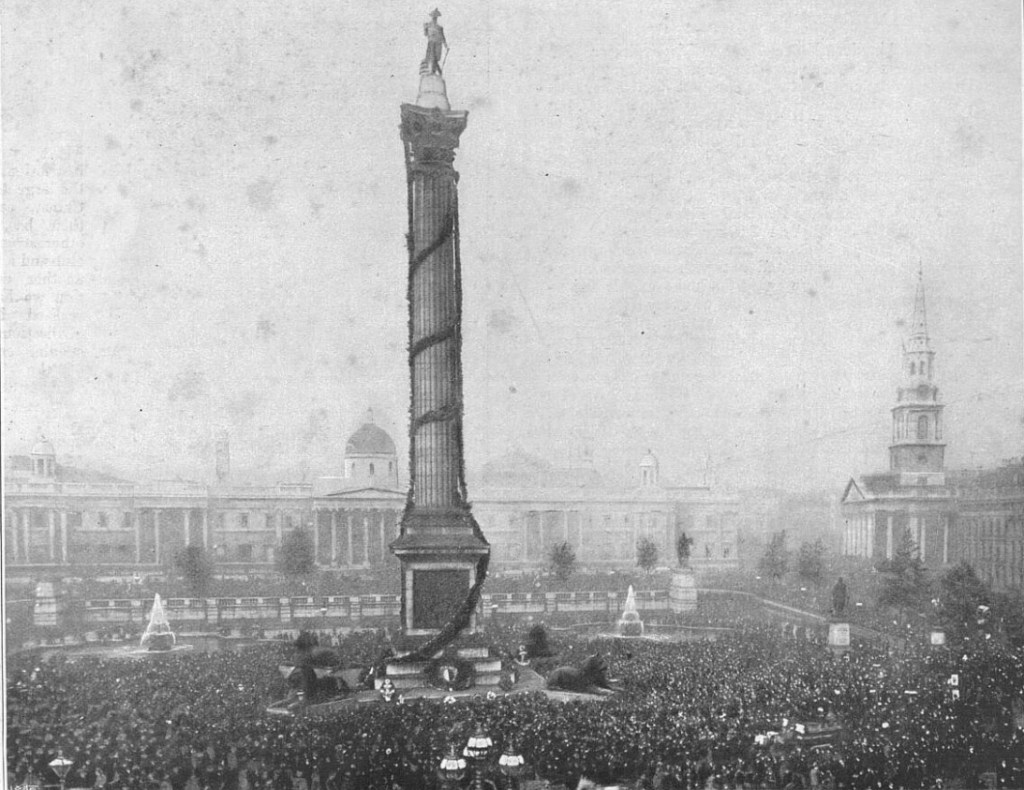
Huge crowds gathered to watch Harrison climb, much to his amusement.
“It was one of my easier jobs,” he’d said. “Of course, a different method has had to be adopted from that which is ordinarily taken; but with the exception of placing a ladder on each side of the column, and not driving in spikes, the work is similar to that of extending an ordinary factory chimney. The latter is far more dangerous, for the chimney oscillates sometimes to an alarming extent, but in the present case, with the exception of the wet, which made it imperative to use the utmost care to prevent slipping, the work was very easy.
“We worked it on the double ladder system. Starting from the bottom of the shaft, we hauled ladder after ladder up by means of a guy rope. Each ladder measured 18ft in length, and they were allowed to overlap each other to the extent of three or four rungs, so that they could be fastened to one another. The two sets of ladders were tightly fastened together round the shaft by a stout rope.”
While he was up there, Harrison was able to decode the legend of Nelson’s hat, which was rumoured to be hollow, and contain silver and pewter vessels, but he found this wasn’t the case.
Of course, Harrison was a familiar sight in Sheffield, and another feat which demanded his resource and skill was when he decorated the spire of the Parish Church (now Sheffield Cathedral) on the visit of Prince Albert Victor (Duke of Clarence) and later in connection with Queen Victoria’s jubilee in 1887.
His father, Samuel Harrison, had also been a steeplejack, and was the first to use a system of climbing ladders instead of the antiquated system of ropes that had formerly been used. By the time W.E. Harrison was thirteen, he had already ascended some of Sheffield’s biggest chimneys and at sixteen was a fully-fledged steeplejack.
Samuel Harrison retired in 1884, handing over his thirty year old business to his son who died in 1911. His death was thought to be related to an accident he’d had several years earlier when he suffered serious internal injuries and was unable to hold himself erect afterwards. Years later, when he was involved in a motor smash and thrown out of the car, the shock cured him, and he was able to walk upright again.

© 2024 David Poole. All Rights Reserved.
 sheffielder.net