Categories
Buildings

Wesleyan Institute Building

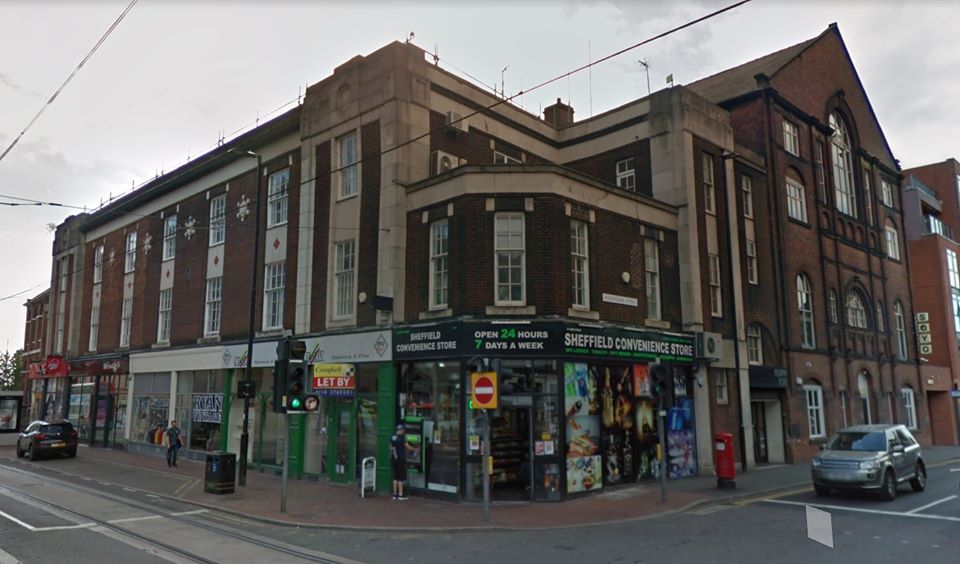
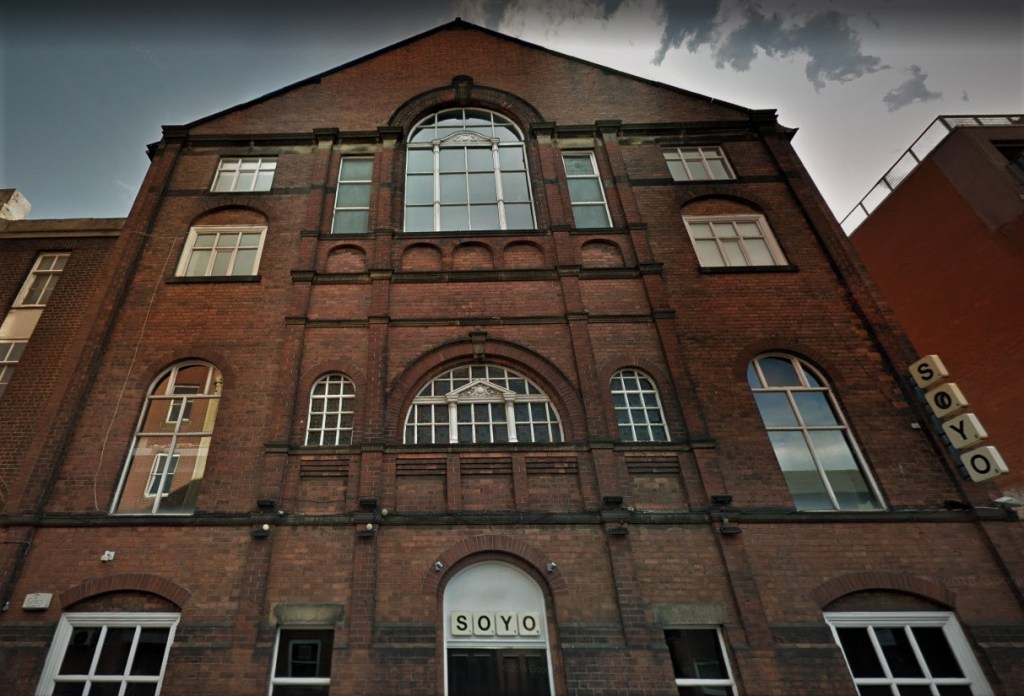
The Carver Street Chapel (now Walkabout) was built on green fields in 1805, with the Sunday School premises of Red Hill constructed in 1812, and 73 years later additional vestries built behind the chapel. In 1897, new schools and classrooms were erected on Rockingham Street (now Soyo), to meet the ever-growing needs of the chapel and district.

In 1912, the centenary of Red Hill Schools, plans were discussed to enlarge its premises at Carver Street, but the outbreak of World War One delayed progress.

By the 1920s, the original scheme had entirely been remodelled and new premises were built on West Street, officially opened in 1929.

Designed by architect W. J. Hale, of St. James’ Row, the large block constituted shops at ground level with rooms above.

It was constructed by the William G. Robson Building Company, of Bamforth Street, a firm that had built cinemas, dance halls, institutes, hospitals, warehouses, showrooms, hotels and houses throughout the country.

Another firm that played an important part in the construction was the Sheffield Brick Company, of Rutland Road, providing an extensive range of plastic stock, “Winco” and rustic facing bricks.

The whole of the precast fireproof concrete flooring was “Armoured” Tubular Patent Flooring, made by John Cooke and Son, Huddersfield, its main advantage being “fireproof, soundproof, warm and well-tempered.”

At this stage, architects were realising the importance of aggregate concrete in building construction. This structure was no exception, with graded sands and gravels provided by the Yorkshire Amalgamated Products company, the largest quarry owner in the county, with offices on Queen Street.

The contract for the whole of the plumbing had been executed by George W. Rusling and Son, at Brook Hill, with a reputation of 40-years standing in plumbing, glazing, gas-fitting, and sanitary work.

The whole of the building was electrically lit, but it was the heating that was a novel feature for the time. Instead of the usual hot water pipes, a new system of tubular electric heaters had been installed, two inches in diameter. All this work had been undertaken by Charles Ross Ltd, of Heeley Bridge.

The decorative scheme inside was executed by W.J. Wollerton, house and church decorators and furnishers, of Stratford House, at Broomhill. Church decoration was a speciality of this firm, using Sanderson Fast-to-Light wallpapers and treating woodwork with “Durolave” paint.

The main entrance to the Institute was in Rockingham Street. On the first floor, at the top of the stairs, a room was set apart for the Deaconess, where young women and girls were able to take their difficulties and hopes and discuss them with Sister Hilda Morris.

To the right was the Girls’ Institute Room, a spacious room with polished floor, carpeted here and there, with beautiful curtains at the windows, the work of “Painted Fabric.” This was a large drawing room, open nightly for girls over 14 years of age. They had their own kitchen and cooking arrangements, with supervision from helpers. A Rest Room, Library and Handicraft Classes were included in the scheme.

Adjoining the Girls’ Room was the Primary – for children from six to eight years of age, a bright square room, and the Beginners’ Room, for tiny tots, aged three to five years.

“There, while watching the fairies on the walls, they will take in the simple stories that form the basis of all true life.”

The top portion of the Institute was the men’s department. One large room running practically the whole length of the building, containing six billiard tables at one end, and the other arranged with tables for chess, draughts and books.

More importantly, voluntary workers used the new Institute for various organisations, including the Lads’ Guild, the Boys’ Brigade and the Reserves, Girl Guides, Brownies, two Bands of Hope, Children’s Play Hour, Gymnasium, Girls’ Club, Men’s Institute, Wesley Guild, Teacher’s Preparation and fellowship Classes.

In every spare room, always tucked in and arranged like a jigsaw puzzle, were committees and working parties.

Many ministers were realising that it was impossible to expect poorer youngsters to spend all their spare time in prayer meetings, therefore it looked to involve them in activities to keep them occupied. These included three football teams, a cricket club, tennis club, and a playing field up at Hagg Lane.

The cost of the building was over £17,000, with £8,500 already raised through fund-raising, and the remainder underwritten by renting out nine shops, fronting West Street.

All the shops were roomy and contained basements that were easily accessible. These were let by W.F. Corker and Son, estate agents, of 19 Figtree Lane. One of the first to take advantage of the shops was F. Wallis and Son, furniture sellers.

The confusingly named Carver Street Wesleyan Institute opened on February 7, 1929.

Times changed, the kids moved on, and as you might have seen from Gordon Mason’s comments on a previous post, the first and second floors eventually became Unemployment Benefit Offices in the 1980s.

The shops below changed hands numerous times, with the largest development about to take place at ground level, with a new German-themed bar, comprising several units, due to open this year.
Categories
Buildings

Rockingham Street Methodist Sunday School

The Wesleyan Methodist Chapel, on Carver Street, was built at Cadman’s Fields in 1804, then green fields and trees, and a meeting place of political demonstrations.

The development of Sheffield westwards proceeded slowly until the end of the century, by which time the Carver Street Chapel was surrounded by housing, factories and shops.

These days we recognise the chapel as Walkabout, a vibrant city centre bar.

This was the biggest chapel in the town, and it expanded to meet the increasing popularity of Methodism.

The Carver Street Chapel built the Red Hill Sunday School on nearby Rockingham Lane in 1812, also adding an extension to the original building in 1885.

The Sunday School was one of 34 Wesleyan schools operating in Sheffield, with 1,096 teachers and 5,694 children across the city.

By the end of the century, the Red Hill Sunday School was considered too small, and in 1896 plans were made to build new facilities adjacent to it, fronting onto Rockingham Street.

Although the chapel had been in debt for most of its existence, it had consolidated its finances through generous donations and fundraising.

In 1898, the Carver Street Chapel was temporarily closed and the outside thoroughly cleaned of industrial grime. It was also the same year that the Methodist Sunday School was opened on Rockingham Street at a cost of £4,000.

Designed by Herbert W. Lockwood, this was a massive end of three-storeys with a tall gable, containing a lecture hall and 24 classrooms.

It proved to be a valuable addition in consolidating and expanding the work of the church.

“The area was indebted in no small measure for its record of successful spiritual work in a crowded district to the ability and zeal of its distinguished ministers and laymen.”

We’ve already seen that the Carver Street Chapel is now a bar, and these old schoolrooms also survive in a similar capacity.

These days the old building is home to Soyo, another trendy bar, making use of the exposed brick, and seemingly a million miles away from its Methodist roots.

Categories
Buildings

Carver Street Methodist Sunday School

In another post we’ve looked at the history of the Wesleyan Methodist Chapel, on Carver Street, better known now as Walkabout, an Australian-themed bar.

The chapel was built in 1804 by Methodist minister-turned-architect, Rev. William Jenkins (1763-1844) and remained in use until the 1980s. It was converted into a bar at the start of this century.

If you take a walk alongside the former chapel, along West Street, and turn left into Rockingham Lane, you will see a brick building on the right with five bays and rounded windows.

Known today as Bishops Lodge, a series of luxury apartments, it was built in 1812 by the Carver Street Chapel for the Red Hill Methodist Sunday School (later extended into Rockingham Street, a building subject to a future post).

The former Sunday School was subsequently occupied by The Samaritans and Grade II-listed in 1995.

Categories
Buildings

Carver Street Methodist Chapel

In this next post we take another look at the Wesleyan Methodist Chapel, on Carver Street, better known now as Walkabout, an Australian-themed bar.

The foundation stone was laid on March 1st, 1804, and once completed was referred to as the Methodist Cathedral of Sheffield. The Rev. William Jenkins, the architect, was also a circuit minister, one of the staff on the Wesleyan “Sheffield Circuit.”

The chapel was opened in 1805, on July 22nd, and a week later the first Sheffield Conference was held here, with 300 preachers assembled in the new building.

The first worshippers looked out on green fields and trees. The site was known as Cadman’s Fields and its selection aroused misgivings and opposition as being too far outside the town.

However, Henry Longden, a Methodist preacher, was quoted as saying that one day the town would spread and swallow up Cadman’s Fields.

And he was correct.

This photograph shows an extension built to the Carver Street Chapel, about 1885, in which band rooms and schoolrooms were built at the rear.

At the back of the Carver Street Chapel, on the opposite side of Rockingham Lane, the Red Hill Sunday School (seen on the right) was built in 1812, and subject of a separate post.

Categories
Buildings

Carver Street Methodist Chapel

For the non-believers, the Methodist movement is a group of denominations of Protestant Christianity which derive their practice and belief from the life and teachings of John Wesley (1703-1791), a minister who sought to challenge religious assumptions of the day.

The movement was particularly strong in the eighteenth and nineteenth centuries, with a significant number of Methodist chapels built across Britain.

This being the case, I’m not sure what the old Methodists would think about the present use for this building, known to most of us as Walkabout, an Australian-themed bar, since the turn of the century.

This was originally the Wesleyan Methodist Chapel, or Carver Street Methodist Chapel, built in 1804 by Methodist minister-turned-architect, Rev. William Jenkins (1763-1844). It was the first chapel designed wholly by him, the five-bay façade derived from Wesley’s Chapel at City Road, in London.

Afterwards, Jenkins designed about thirteen similar chapels, of which only five (including this) survive.

When it was built, the chapel was was surrounded by cornfields, known as Cadman’s Fields. Built in brick, with stone dressings, its spacious interior had a wooden single-span roof, impressively wide for its date, with a round-ended continuous gallery.

The Wesleyan Methodist Chapel opened in 1805 with capacity for 1,100 followers, the biggest of its kind built in Sheffield.

When the chapel was built it was surrounded by cornfields, known as Cadman’s Fields

Few non-conformist chapels in the city had their own burial grounds, but the Carver Street Chapel was an exception. About 1,600 burials took place here between 1805-1855, the gravestones sited in a small front graveyard and on both sides of the building.

By the end of the twentieth century the chapel had closed and was empty for several years.

And now to the shocking part, one that some people will find astonishing.

Some of the graves extended across modern West Street, as well as Rockingham Lane behind.

In 1993, in advance of the Sheffield Supertram project, bodies were exhumed from beneath West Street, long-hidden beneath the road surface.

And if matters couldn’t be worse, the opening of Walkabout inside the Grade II-listed chapel meant that a new beer cellar had to be built outside. This meant that a further 101 individuals were excavated from the old graveyard to allow its construction.

Finally, most modern-day revellers, taking advantage of the external beer garden, will be alarmed to find they are standing on top of old graves.

Categories
Places

History repeating itself

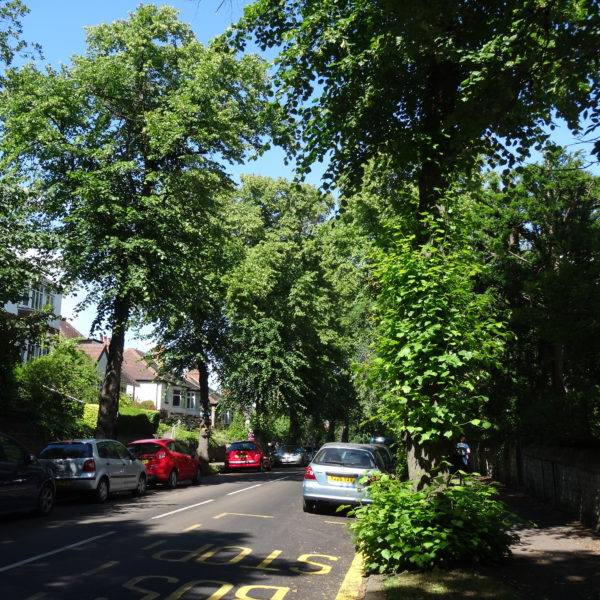
I write this not to spark argument, because I know that a lot of derogatory comments, about tree-felling and Sheffield City Council, will follow. This post is merely to show that history has a nasty habit of repeating itself.

First and foremost, Sheffield has long boasted of being “Europe’s greenest city” – in part because a third of it sits in the Peak District. But it is also due to the sheer number of trees that line the roads.

Some 30,000 of them still arch over highways and footpaths, but according to a correspondent here, nearly six thousand have been felled between 2012-2018.

But let’s go back to 1939, when this letter appeared in the Sheffield Daily Telegraph: –

“A very destructive hand has been at work among Sheffield’s trees. In the Fulwood district, trees apparently have been wantonly mutilated, reduced in some cases to barren stumps as though the ebullience of nature were being regimented to conform with nearby tram standards.

“It is obvious that the authority responsible for this butchering of trees do not understand that trees have a special beauty which depends upon their form and that each tree has its characteristic form which can be eternally ruined by unskilled pruning.

“I should like to recommend anyone who in future may cause a tree to be pruned, to employ a skilled woodsman and not a carpenter, and to arm the Woodsman with the Roads Beautifying Association’s leaflet called ‘Advice on the Pruning of Roadside Trees’.”

As might have been expected, a spokesman for Sheffield Corporation defended the actions.

“The trees were dealt with at the urgent request of the frontagers. Branches of the trees were right over their lawns, and in some cases the roofs, and the nuisance was aggravated by the fact that there were many crows’ nests in the trees.

“In some cases, trees are unsuitable for the street. They were far too big, and residents had neither light nor air.

“Actually, we are contemplating in cases like this removal of the trees altogether, and the planting of really suitable trees.”

But the matter didn’t stop there.

Complaints about unsightly, and in some cases unnecessary, lopping of trees in Sheffield, particularly in the older western suburbs, flared up again in 1945.

A 1946 Annual Report from the Sheffield, Peak District and South Yorkshire Branch of the Council for the Protection of Rural England referred to a “holocaust, when graceful forest trees – perhaps Sheffield’s only remaining beauty – were reduced to mutilated stumps, regardless of their natural history or shape.”

The Branch commissioned a report by Mr A.D.C. La Sueur, consultant forester to the City of London, to inspect the trees and prepare a report. He concluded that in some cases trees had been lopped for no apparent reason and suggested that Sheffield employ a full-time arboriculturist.

A leaflet, “Town Trees,” was published in 1947 emphasising the need for progressive pruning over several years, rather than the Sheffield practice of heavy pruning at long intervals. The leaflet was reviewed in the press, including the Manchester Guardian and The Observer, the resulting backlash encouraging “constructive meetings” with the council about the treatment of the city’s trees.

And then it all died down… until a bigger battle began this century: one which spread across the city, saw mass protests and riot police on suburban streets, and ultimately revealed an astonishing secret plan – hidden within a £2.2billion contract – to cut down almost 20,000 street trees.

Categories
Places

The Green City

Despite Sheffield’s past reputation as a gloomy, dirty industrial city, mercifully no more, it has always enjoyed close proximity to open countryside.

I surprise people in the rest of the country when I tell them that a large proportion of the city lies within the Peak District, designated Britain’s first national park in 1951.

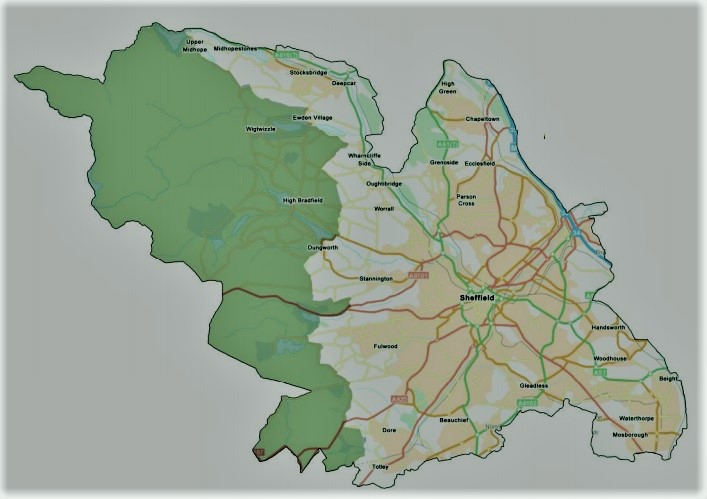
Look at this map, and you’ll see, with the green-shaded area, that a third of the city lies within the park, divided between two planning authorities, Sheffield City Council and the Peak District National Park Authority which covers the western area.

As well as Yorkshire, the park also reaches into four other counties: Derbyshire, Cheshire, Staffordshire, and Greater Manchester.

The park’s name derives from peac, an Old English word meaning hill. The Peak District’s high point is on Kinder Scout, a Derbyshire moorland plateau some 2,088 feet above sea level.

The Peak District is traditionally split into two contrasting areas, essentially defined by their geology.

The White Peak (Derbyshire Dales) is a limestone plateau of green fields with rolling hills and many incised dales (areas around Ashbourne, Dovedale, Matlock, Bakewell, Longnor).

The Dark Peak (or High Peak) is a series of higher, wilder and boggier gritstone plateaux (moorlands) and edges (areas north of Castleton and Hathersage), and in which land in Sheffield falls.

Over 90 percent of Peak District is privately owned land. The National Trust owns 12 percent, and three water companies own another 11 percent. The Peak District National Park Authority owns only 5 percent. About 86 percent of the total is farmland, which is used mostly for grazing sheep or cattle.

The National Parks and Access to the Countryside Act received Royal Assent in December 1949 and received a designation order in December 1950.

After years of debate and argument , the Peak District National Park became a reality in April 1951, announced by Hugh Dalton, Minister of Local Government.

He specified that a Joint Board of 27 members, including people nominated by Sheffield City Council, should be responsible for its management.

Interestingly, Derbyshire County Council had opposed the idea of a joint board and persuaded the County Councils of Staffordshire, Cheshire and the West Riding to join them in opposition. But Sheffield City Council supported the idea of a single planning board.

All these years later, Sheffield City Council is currently represented on the Peak District National Park Authority by Mike Chaplin, Labour Councillor for Southey.

Categories
Streets

West Street

Let’s talk about West Street, a haven for bars, restaurants and takeaways, a road that has changed considerably since the 1990s.

However, a look back in history suggests that there were attempts during the 1920s to make West Street one of the city’s main shopping thoroughfares.

In 1929, the Sheffield Daily Telegraph made the following observation: –

“West Street seems intent upon coming into line with other busy shopping centres in the city, and of acquiring the same prestige. Many new shop premises have opened, and recently the removal of a length of hoarding revealed an array of smart, single-fronted shops.

“Such signs are distinctly encouraging, for although many roads radiate from the hub of Sheffield – High Street and Fargate – yet, West Street, with its width and fine approach, appears to be the natural outlet and extension of the shopping centre of the city.

“There are other reasons why the street should continue to develop. It is the main approach to many important public buildings, such as the Royal Hospital, the Edgar Allen Institute, Jessop Hospital, Children’s Hospital, the Applied Science Department of the University in St. George’s Square, Weston Park, Mappin Art Gallery, Western Bank Buildings of the University, and Glossop Road Baths.

“Hundreds of persons daily pass and repass along West Street, on their way to and from these buildings, and motorists going to Derbyshire also make great use of this route out of the city.

“Despite the fact that West Street is served by an excellent service of Corporation tramcars and motor-buses which run to a number of outlying residential districts, it has to be admitted that the road has not, hitherto, enjoyed the prosperity that would appear to be its right.

“It should always be borne in mind that West Street has been developed by private enterprise, Sheffield Corporation do not now possess a single square yard in this street, but there was a period when they owned a considerable area of freehold land there.

“When this was in their possession, the Corporation did not do anything to encourage traders by building new shops, and otherwise improving the amenities of the highway, but simply erected hoardings around the land, making it an unsightly blot in the neighbourhood.”

An interesting look at the past that also throws up some noteworthy observations.

Take, for instance, the fact that all premises built had to be three storeys, or over, and conform with the adjacent property.

Gone were the days of narrow, mean streets, with high crooked houses, each one with a dark and dismal “basement,” and of low, badly lit shops, with small window space. In their place were wide, low windows and a spaciousness about the new properties.

And we also discover that Sheffield Corporation, at one time, considered building a square in West Street, about 5,200 square yards in size, the plan later abandoned as being too costly.

The shopping centre that was promised never really materialised, although there were several specialist and prestige shops. But West Street did eventually thrive.

As the decades rolled on, the University of Sheffield expanded, with West Street becoming the gateway between the city centre and campus buildings. It soon became obvious that the street’s traditional public houses would become popular with students – once described as the “West Street Run” – a turn of events that eventually created the trendy bars that we see today.

And, of course, city living became popular again, particularly along West Street, with numerous new-build apartments, alas creating conflict between those living in them, and the businesses that brought prosperity in the first place.

Categories
Companies

Binghams

It’s been a long battle, but one seemingly won by a name famous in Sheffield. The potted meat wars dates to the time when every small butcher in the city produced its own version of this very Yorkshire delicacy.

As trends changed, and pre-packaging came to the fore, a handful of Sheffield-based companies survived, though most fell by the wayside, to leave us with Binghams and Sutherlands.

While Sutherlands takes a large chunk of the market, the undoubted winner turned out to be Binghams, producing about 15,000 individual cartons everyday that go out to most of the major supermarkets.

The company’s history starts with the birth of Charles Bingham in 1893, who along with his brother Walter, started trading in yeast and meat, selling products from push bikes during the early 1900s.

In 1914, despite going to fight for the Yorkshire Regiment in World War One, Charles started producing and selling Binghams Beef Spread from his Sheffield home, a recipe still used today.

By 1934, the business had become so successful that Charles built a purpose built factory in Western Road, Crookes, which is still home of the Binghams brand.

Having seen off competitors and fighting for his country again during World War Two, Charles guided the business up until 1969, when he sold the business to Samworth Brothers.

Under the Samworth Brothers wing, Binghams Food became a subsidiary of Pork Farms, although the business maintained its own identity and brand. In the early 1970s, Pork Farms was sold to Northern Dairies, which was to become Northern Foods.

In February 2007, venture capitalist company Vision Capital bought out a significant share of Northern Foods’ business, which included Pork Farms and Binghams Food, and not long after, businessman Peter Moon received a call asking if he would be interested in purchasing the business.

Moon had worked for Binghams Food as general manager in the 1980s, and with his wife Stella, jumped at the opportunity to reacquaint himself with the business.

Despite employing about twenty people, the manufacturing process is geared up for mass production.

The different areas of the factory are dotted around the courtyard where Charles Bingham used to house his stable of cars – the old garage since converted into packaging operations.

The butcher works alone, slicing and cutting the beef according to the production schedule. While there may be a common misconception that potted beef is made from any cut of beef, Binghams Food favours beef flank to ensure quality in their product.

The beef is cooked overnight before it’s removed and sieved into separate pans for stock and meat. Then the meat is transferred to the mincer, along with seasoning, before it’s put through a hydrogenator. The temperature is checked to ensure it is still above 85°C before the product is deposited into pots. The retail cartons then go into the pasteurising oven before moving into the blast chiller to bring the temperature of the cartons down as quickly as possible.

An operator checks every single pot by hand for a correct seal before it is passed on to be sleeved by hand. Due to the space within the factory, a packing machine cannot be installed so all the cartons are sleeved by hand.

These days it’s not just about potted beef spread. Along with the familiar beef and beef and tomato spreads, there are now modern-day favourites like potted pulled pork, BBQ pork spread, and fajita beef spread.

Categories
Buildings

When Sheffield’s black buildings got cleaned

A question often asked. When did Sheffield’s stone buildings suddenly became clean, removing memories of a time when they were gloomy and dark places to look at?

People of the younger generation will probably not understand what I’m on about here. I refer to Sheffield’s black buildings, largely forgotten, and thankfully no more.

Let’s go back to 1859 and find a clue from a newspaper correspondent as to why our old buildings turned black.

“On recently approaching Sheffield by rail, from Rotherham, after an absence of many years, I was forcibly reminded of all that I had ever heard strangers say of ‘black Sheffield’ – so murky seemed the whole atmosphere, so abundantly were tall chimneys belching forth their sooty contents, so thoroughly dyed with smoke were the outer walls of every workshop and factory within view as the train passed along, and even the line of the railway itself so thickly strewn – with the dark ashes from many smithy and furnace.”

During Victorian times, the industrial revolution depended entirely on coal, and the industries that established Sheffield as an important manufacturing hub created a toxic atmosphere. It was said that a hundred tons of soot fell on the town each year, and with it came a sulphurous smog.

Sulphuric and nitric acids in the air attacked everything, the soot steadily turning the town black, and deceiving children into thinking that Sheffield’s buildings had been built with dark granite.

For decades, the town (subsequently a city) achieved a notorious reputation, one that still lingers with our southern neighbours, who couldn’t resist having a dig at “Smoky Sheffield.”

It wasn’t a problem unique to the city.

A 1930 survey revealed those places suffering the worst air pollution, and Sheffield didn’t even feature in the top ten. Newcastle-on-Tyne was the dirtiest town in the kingdom. Liverpool came second and even London fared worse.

However, it didn’t stop George Orwell from writing that “Sheffield, I suppose, could justly claim to be called the ugliest town in the Old World.”

When the City Hall was built in 1932, it was visited by Sir John Martin Harvey, an English stage actor, who wondered whether Sheffield City Council would have an initiative to keep its exterior clean.

“Civic authorities have not always had the imagination to appreciate the beauty of a fine, clean building. I wonder what the Sheffield City Hall will be like in ten years’ time, if the exterior is not kept free from grime. Let Sheffield take the lead in this matter. Liverpool possesses one of Europe’s finest buildings in St. George’s Hall, but nobody looks at it twice, because the outside is dirty.”

The ”Current Topics” column in the Sheffield Daily Telegraph concurred but thought it a hopeless cause.

“We agree entirely with Sir John’s contention that if possible, the exterior of the building should be kept clean, but the question is – how is it to be done?

“One of these days we shall abolish smoke and then it will be easy enough, but alas! One fears that before that day dawns the creamy delicacy of the City Hall will have faded into a dirty grey.

“There was a time when the Town Hall was good to look at, but now it is encrusted with the carbon deposits of forty years.”

That day eventually arrived.

In 1956, the Clean Air Act established “smokeless zones” in which only smokeless fuels could be burned. In less than twenty years the air became cleaner, the sun appeared above Sheffield again, and by 1972 the whole of the city had become a smokeless zone.

However, the damage from 150 years of black soot had left Sheffield a blackened mess, but it meant that at last something might be done to remove the grime.

During the 1970s and 1980s, a programme of stone cleaning occurred across Britain. London was most prominent, but also Liverpool, Manchester, Bristol, Sheffield, Glasgow and Edinburgh, represented the main body of cities tackling the problem.

The clean-up process was an operation that was gradual and therefore unnoticed by Sheffield’s residents.

The surfaces of buildings were sand blasted, the result of a pressurised flow of sand and water that cleaned the surface and restored it to something like its original appearance. Interestingly, when the Bainbridge Building (former Halifax Bank) was being cleaned on Surrey Street, workmen discovered stone carvings that had been lost and forgotten.

Don’t presume that the exercise was simply a case of aesthetics and enhancement of a building’s appearance.

Sand blasting was extremely expensive, and the cost of reviving public buildings had to be met by the council (ensuring that many of Sheffield’s dirty buildings were only cleaned as and when needed, a programme that lasted well into this century).

Other buildings, including banks, offices, shops, theatres and hotels, were cleaned using private funds.

The filth was also removed to protect the building fabric from decay, the cleaning process also identifying faults connected with care and maintenance, but also improving its character for many years to come.

And there we have it.