Categories
People

Matthew Bannister

Richard Matthew Bannister. Born at Sheffield in 1957. Better known to us as plain old Matthew Bannister. Media executive and broadcaster. He grew up around Millhouses and Ecclesall, attending King Edward VII School, and played as a folk musician around the area, also performing on BBC Radio Sheffield.

His mother, Olga, was a paediatric physiotherapist at the Sheffield Children’s Hospital, while his father was a research chemist for British Steel at Orgreave.

In the early 70s, Bannister signed up for a young people’s acting class at the Crucible Theatre, later taking a course with the National Youth Theatre in London, whilst at the same time studying law at the University of Nottingham.

Instead of a theatre career, Bannister joined BBC Radio Nottingham as a trainee reporter, later presenting Morning Report. He moved to Capital Radio as a journalist, before heading to Radio 1 as presenter of Newsbeat (1983-1985).

Bannister moved back to Capital as Head of News and Talks, became Managing Editor of BBC GLR, and was later appointed as the controversial Controller of Radio 1. He sparked the end of the “Smashie and Nicey” era with the likes of Dave Lee Travis, Simon Bates and Alan Freeman jumping before they were pushed.

He was nicknamed the “fat controller” by his most famous hiring, Chris Evans, with whom he would later have a spectacular falling-out over his refusal to let the DJ work a four-day week.

Rising the executive ladder, he lost out to Greg Dyke for the Director General’s job, before deciding that his future was behind the microphone instead.

Presenting shows on BBC Radio Five Live and World Service, notably Outlook, he is known as the ‘Celebrator of Death’, presenter, since 2006, of Last Word, Radio 4’s obituary programme, and Folk on Foot, his own podcast, where he goes for a walk and chat with a folk musician.

Bannister co-owns Wire Free Productions, the company behind a syndicated evening show for the BBC local radio network – think Mark Forrest and Georgey Spanswick – that ended last year.

His proudest achievement?

“Changing Radio 1 from a middle-aged radio station to a champion of new music, particularly the major role it played in the success of Britpop and the UK dance scene in the 1990s.”

Categories
Buildings Sculpture

Bainbridge Building

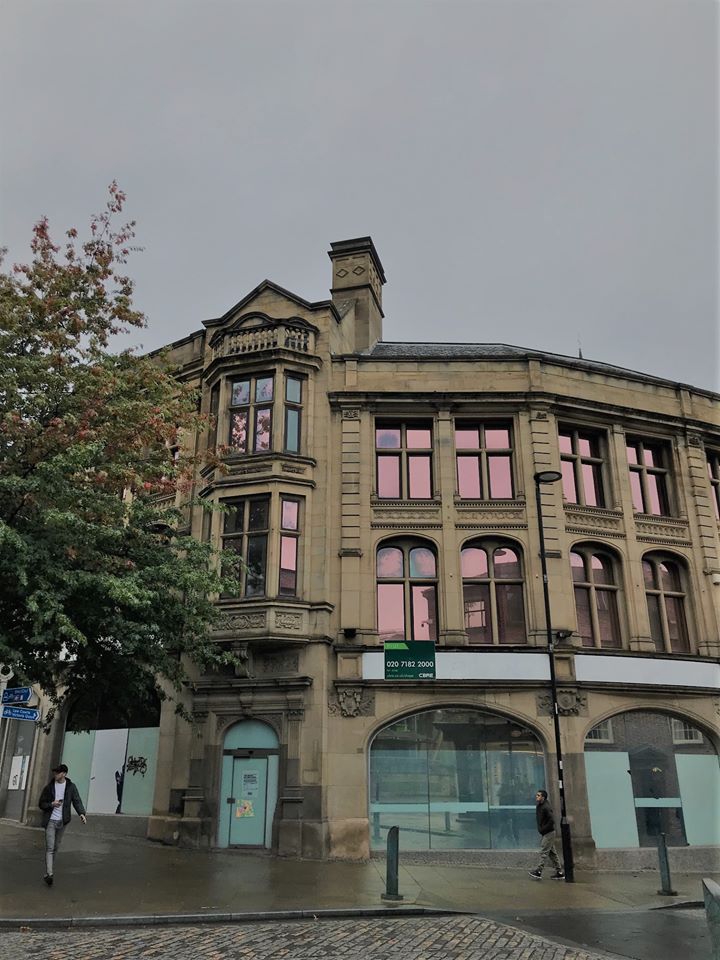
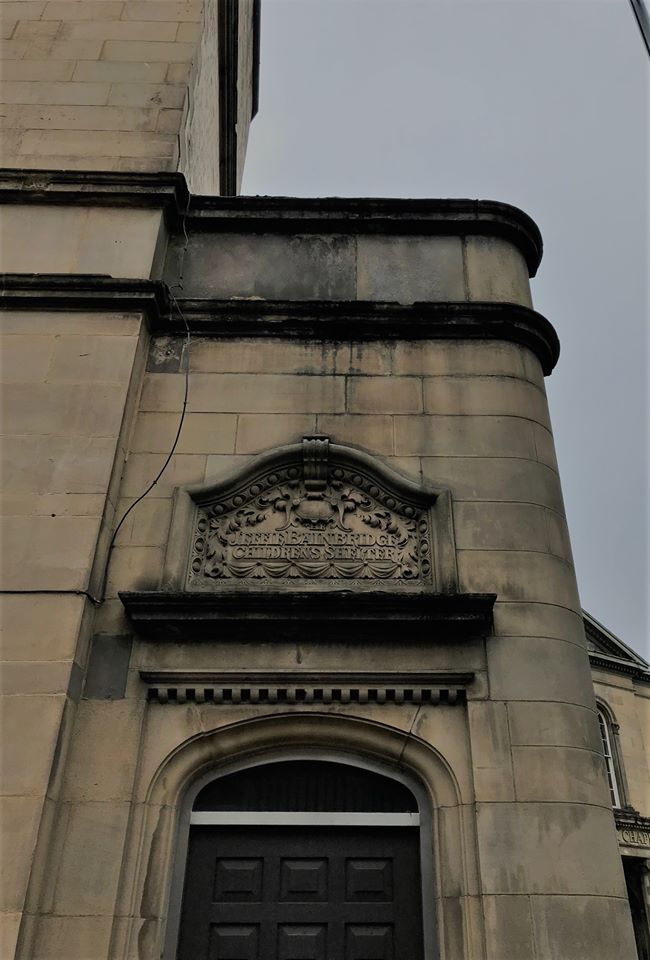
I bet most of you have never noticed this above a door at the top of Norfolk Street. This carved panel is on the old Halifax Bank at the corner of Surrey Street. The building was commissioned by Emerson Bainbridge, a mining engineer consultant and philanthropist, following the death of his wife, Jeffie.

It was erected as a memorial to her and opened by the Duke and Duchess of Portland in 1894.

The first floor formed a shelter for waifs and strays, and a large suite of offices on the second floor were given to the local branch of The Society for the Prevention of Cruelty to Children, of which Bainbridge was a committee member.

The ground floor consisted of shops that were let out to tenants in order to raise revenue to support the rent-free premises above.

The sculptor is unknown, but the architect was John Dodsley Webster, who also designed the Gladstone Buildings next to the Cathedral.

Categories
Buildings

Bainbridge Building

In 1924, the author J.H. Stainton wrote in The Making of Sheffield, “It is fairly safe to say that practically half the citizens of Sheffield at the present time know nothing of Mr Emerson Bainbridge, yet in his day he was assuredly one of Sheffield’s big men.”

Now, it is probably a fair bet that nobody in the city has ever heard of him.
Yet, at the time of his death in 1911, he was called “a striking personality,” and responsible for Bainbridge Building, the resplendent Victorian building that stands on the corner of Surrey Street and Norfolk Street.

Emerson Muschamp Bainbridge (1845-1911) was born at Newcastle-on-Tyne and studied at Edenfield House, Doncaster. Afterwards, he attended Durham University and served time in nearby collieries belonging to the Marquis of Londonderry.

In 1870, Bainbridge became manager of the Sheffield and Tinsley Collieries, later taking charge at Nunnery Colliery on behalf of the Duke of Norfolk, subsequently becoming Managing Director and setting up his own firm of mining consulting engineers.

In 1889, Bainbridge obtained a lease from the Duke of Portland for the “Top Hard”, or “Barnsley Coal”, under land in Derbyshire and Nottinghamshire. He then founded the Bolsover Colliery Company to take the lease and mine the coal, being the man responsible for developing the town that exists today.

Bainbridge also became Liberal MP for Gainsborough between 1895 and 1900, as well as being a JP for Derbyshire and Ross-shire, where he owned a deer forest at Auchnashellach.

Bainbridge provided money to build the YMCA at the junction of Fargate with Norfolk Row, and in the early 1890s spoke of his ambitions to honour his wife, Eliza Jefferson Armstrong Bainbridge, known as Jeffie, who died in 1882.

“I have for some time been struck with the large number of ill-cared for boys and girls in the streets of Sheffield, who, doubtless only represent a small proportion of the large number who are constantly neglected.

“Beyond this, of course, is the great question of neglected training, in consequence of which many of these children are destined to lives of poverty and crime.

“I propose to erect and establish, at some suitable point in the town of Sheffield, a Children’s Refuge, which I would erect in memory of my late wife, and it might be possible to have her name connected to it.”
Bainbridge was a man of his word.

He purchased a plot of land from Sheffield Corporation at the corner of Norfolk Street and Surrey Street, then employed architect John Dodsley Webster to create a spectacular new building that would contain the Jeffie Bainbridge Children’s Shelter.

Construction started in 1893 and was completed in 1894, the total cost being almost £10,000.

The ground floor was utilised for shops and part of the first floor for offices, the rents funding the children’s shelter. The rest of the first floor consisted of a large room capable of accommodating 150 children. Here, ill-clad children suffering from cold and hunger were welcome, and be certain of shelter, warmth and cheap food.

The second floor had been placed, rent free, at the disposal of the local Society for the Prevention of Cruelty to Children. There were dormitories for more than twenty juveniles, also rooms for committee meetings and for caretakers and porters.

The Jeffie Bainbridge Children’s Shelter was officially opened by the Duke and Duchess of Portland on Friday 28 December 1894.

There were five shops underneath, numbered 49-55 Surrey Street, and 104 Norfolk Street. Birds Restaurant, opened by William Bird on a ten-year lease, occupied No.53, although the business collapsed several years later, probably the result of being refused an alcohol licence, something that rankled with the professional men who visited. Next door, Jasper Redfern had a photography shop while William Cole had a piano business at 104 Norfolk Street.

The NSPCC moved upstairs in 1895, but in 1899 Emerson Bainbridge gave them £200 as consideration for removing their shelter to Glossop Road.

The Jeffie Bainbridge Children’s Shelter served over a thousand meals every month to destitute children and appears to have survived until at least 1907. Afterwards, it became a Maternity and Welfare Centre, instigated by the Sheffield Infantile Mortality Committee, where women went for advice and consultations, and to buy dried milk at cost price for bottle-fed babies.

However, the biggest change occurred in 1914, when a portion of the Bainbridge Building was converted into the Halifax Building Society. Most of the shops were taken, with plans created by W.H. Lancashire, Sheffield architects, who clad the exterior in blue and red Aberdeen polished granite, and the interiors with Austrian oak.

In time, the Halifax took the whole building, renting out upper floor offices, culminating in the interior being reconfigured in 1977-1978, when most of Webster’s original features were lost.

The Halifax Bank finally closed in 2017 and the Bainbridge Building has been vacant since.

But let us remember Birds Restaurant, which was unable to serve alcohol to its Victorian customers.

It was recently announced that the pub chain Mitchells & Butlers is opening a branch of its Miller and Carter restaurants, specialising in steaks, in the Bainbridge Building.

There are already Miller and Carter restaurants in the city, off Ecclesall Road South and at Valley Centertainment, the latter of which opened in the summer.

Categories
Buildings

Barker’s Pool House

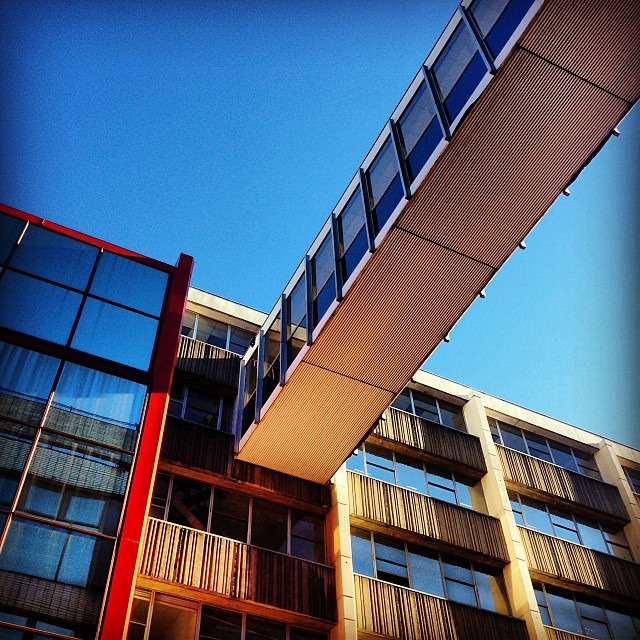
We’re about to lose a city centre landmark, although one we barely notice these days. Planning permission has been submitted to demolish the link bridge between John Lewis and Barker’s Pool House, on Burgess Street.

The bridge was built in 1973, linking Barker’s Pool House, built about 1970, with John Lewis (then Cole brothers), constructed ten years earlier, and serving as office access for the department store.

The link bridge is no longer required, with Barker’s Pool House forming part of Block A in the Heart of the City II project, a new construction, designated for retail and leisure space, a hotel, with residential above.

The link bridge was designed by architect R.D. Cook, and made of primary castellated beams, which carry the floor and roof structure, with glazed cladding. Its deck stands about 12 metres above street level, 16 metres in length, 2.5 metres wide, and a height of 3.4 metres.

Once planning permission is granted, likely to be a formality, the access space from both buildings will be made good.

Categories
Buildings

Town Hall Police Box

This landmark has become so familiar that we barely notice it now. But, this police box, next to the Town Hall, on Surrey Street, is the only survivor of a system of 120 boxes that once existed across Sheffield.

Police boxes were introduced in Britain in the 1920s. Chief Constable Frederick James Crawley installed them initially in Sunderland in 1923, and then in Newcastle upon Tyne, after he became Chief Constable there in 1925.

They were designed to increase efficiency by decentralising police constables away from the police station and preventing the necessity to return to base several times during their beat.

Other northern cities then followed suit including Sheffield in 1928.

The Sheffield police box system was introduced by Chief Constable Percy J Sillitoe, subsequently appointed as Chief Constable of Glasgow in 1931, where he also set up a police box system; he was later to receive a knighthood and became Director General of MI5. (Think, Sam Neill’s Major Chester Campbell character in Peaky Blinders).

The Sheffield boxes were sited on police beats all over the city where they provided contact points for both police officers and members of the public, with each box having a direct telephone link with the local police station.

The telephone was in a small compartment accessible from the outside of the box, as was a first aid kit, both intended for public use. They were also used by patrolling officers, who visited the boxes at hourly intervals when information was passed by phone between the officers and supervisory staff at police stations.

Additionally, a ‘blue’ electric lamp was located on the top of each box; the Sheffield boxes originally had bulb lights suspended from curved metal brackets. These were controlled from the local police station and used to indicate when there was an important message to be relayed.

Inside, the boxes had a desk and stool where the patrolling officers could have meal breaks and write reports. The boxes could also be used as temporary lock-ups if necessary, for those arrested and awaiting transport to a police station.

The police boxes remained in regular use until the 1960s when the development of improved communications and increased use of police cars made them obsolete.

This box is the sole survivor and has latterly been used as a public information point by Sheffield’s city centre ambassadors, though it is not presently in regular use.

The police box is well-known as Doctor Who’s Tardis, but the type used on TV is typical of the shallow pyramidical roof boxes, adopted by the Metropolitan Police in 1930.

Categories
People

The Duke of Darnall

If we’re not careful we’re going to forget about the Duke of Darnall, so for future generations, it’s time to write about one of Sheffield’s great eccentrics.

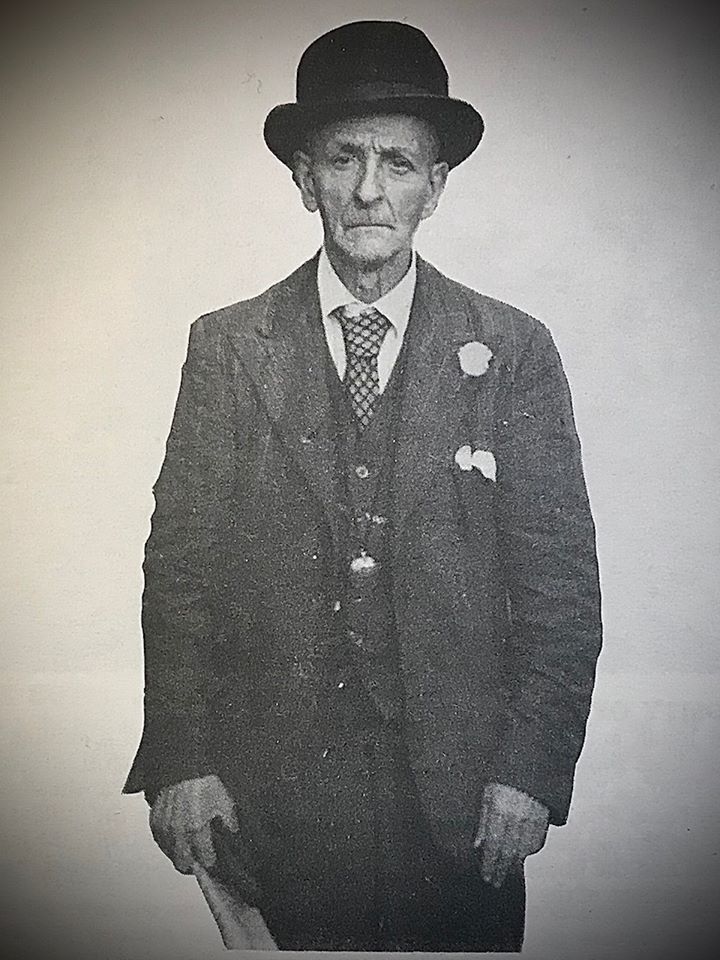
His real name was Harry Taylor, who lived on Darnall Road, and a clue about his daily life appeared in the Daily Mirror in 1939.

“Mr Harry Taylor is out of work and ‘deaf and dumb’, but he’s always immaculately dressed. Usually he takes an airing in black morning coat and striped trousers, with a flower in his buttonhole and carrying gloves. His manners are elegant, in keeping with his appearance.”

It appears that Harry lacked the ability to hear or speak all his life. A sign of our shameful past is that he was sacked as a core-maker at a steel works.

“Being ‘deaf and dumb’ proved a great handicap,” said Mr Antcliffe, a relative, “And he lost his job, but for some time he persevered in trying to talk, in the hopes of getting work.

“He made himself popular in the city and for some years shop managers and businessmen have kept him in clothes.”

As Harry grew older, his style of dress became even more colourful, always well-dressed, and carrying a stick or rolled-up umbrella, with monocle, bright bow-tie, bowler hat and spats.

In the 1940s and 1950s, he became known as the Duke of Darnall, with pretensions of grandeur, habiting the Darnall, Attercliffe and Haymarket areas of Sheffield, often taking over traffic control, much to the amusement of passers-by and annoyance of police, who regularly moved him on.

Harry was also referred to as ‘The Burton’s Dummy’, as he could often be found outside Burton’s on Attercliffe Road, or ‘The Toff of Sheffield’.

According to legend, Harry married a ‘deaf and dumb’ lady, and had a daughter. However, it is also said that one of Sheffield’s other eccentrics, Melanie Birch, known as Russian Edna, lodged with him until her tragic death in 1954, found murdered in a public shelter at High Hazels Park.

The date of his death is uncertain, but stories of his exploits can still be found on social media forums, including the taunts he received from cruel children who found him a figure of fun.

This eccentric old gentleman lived on in name, the Andrew’s Bus Company naming a bus after him, and a canal boat called ‘The Duke of Darnall’. Harry has also been the subject of paintings, brought to life in colour, by artists Brian Wilges and John Firminger.

And so, let us not ever forget The Duke of Darnall, a man once loved by Sheffielders.

Categories
Companies

Batchelor’s

Batchelor’s Cup a Soup, Super Noodles, Garden Peas, Mushy Peas – all recognisable products on supermarket shelves – but how many of you realise that their origins were in Sheffield?

In 1895, William Batchelor, a young tea salesman, set up a small shop and started selling tea in packets, as well as other sundry grocery items.

In an extract from his diary the same year, Batchelor said that he needed £4 by the end of the week to meet his debts, but four years later he was able to write, “What a change in life there has been. What confidence people display in me, both creditors and customers.”

In 1912, he came up with the idea of packing and selling dried peas, which he did in the cellar of a disused Methodist Chapel in Stanley Street, off The Wicker, later moving to an old building in Stanley Lane nearby.

Unfortunately, William Batchelor died on holiday at Bridlington in 1913, leaving a daughter and two sons.

Ella Batchelor, the daughter, aged 22, took over the running of the business, soon joined by her younger brothers, Maurice and Fred.

From being a small family business, Batchelor’s soon grew to national fame, acquiring some of its competitors – Chef Peas, Dinna Peas, and Paull’s of Penrith.

There was rapid progress in the ‘dried pea’ trade with Batchelor’s selling them in 2d and 3d packs, but to the housewife, the preparation of the peas was a lengthy process.

Peas had to be soaked overnight, so when the company devised a ground-breaking new process in 1928, it was an instant success.

Batchelor’s came up with the idea of soaking and canning peas in a factory, henceforth ‘processed peas’ appeared in shops for the first time. Taking a plant near Lady’s Bridge, the company were only able to use small peas in the process, selling them under the Dwarf brand label.

However, in 1932, advances allowed them to use mature peas, extending canning to include Bigga Marrowfat Peas.

In 1935, Batchelor’s needed to increase production and made plans to build a new factory at Wadsley Bridge. In order to finance this the company turned public with an issue of 250,000 one-pound preference shares and 800,000 five-shilling ordinary shares.

The factory was built at a cost of over £100,000 on green-belt land in 1937, opened by the Marquis of Hartington, later to become the Duke of Devonshire. The new works, the largest canning plant in Britain, allowed production to be extended to include canned beans, soups and canned fruits.

At the beginning of World War Two, Batchelor’s was one of the largest suppliers of canned goods to the armed forces – and because there was an embargo on imports of foreign peas, the company set up an agricultural service in the East of England, stretching from the East Riding down to the Weald of Kent, providing about 200,00-acres of land for growing peas. Once cultivated, the peas were sent to new factories in Worksop, Newark or East Bridgford, in Nottinghamshire.

But staff shortages and rationing during the war put a strain on finances, and Batchelor’s was bought by James Van den Bergh of Unilever in 1943, becoming part of Van den Bergh Foods.

Ella Gasking, as she became, retired in 1948 – the same year that Batchelor’s bought Poulton and Noel, a soup manufacturer – and her brother, Maurice, took over the running. A year later, the first dried instant soup was created, chicken noodle flavour, the forerunner to perhaps its biggest success, Batchelor’s Cup a Soup, launched in 1972.

The Sheffield site continued to be Batchelor’s head office, the factory in Worksop was extended, and a plant at Ashford, Kent, was where Vesta dried meals were manufactured.

In 1982, Batchelor’s closed the Wadsley Bridge site, with the loss of 650 jobs, reputedly because the narrow lane and low bridge on its approach restricted heavy goods vehicles going to and from the factory.

Since then, production has remained in Worksop and Ashford, although ownership of the company has changed.

In 2001, Unilever sold Batchelor’s to Campbell’s Soups, with Premier Foods acquiring the UK operations five years later.

Alas, another old Sheffield name that is no longer connected to the city.

Categories
Places

Peace Gardens

The biggest surprise is that it wasn’t until 1985 that the Peace Gardens were formally named. Created in 1938, originally called St. Paul’s Garden, the name was at first suggested, then adopted by the people of Sheffield. It appears that nobody was in any hurry to suggest anything different.

But it wasn’t the case in the beginning.

The gardens stand on the site of St. Paul’s Church, demolished in 1938, when inner city slum clearance resulted in falling attendances. Quickly swept away, Sheffield Council laid out pathways, flower beds and grassed areas within the old churchyard walls.

It was a short-term solution, the council buying the land for £130,000, and designating it for a proposed Town Hall extension.

The name, Peace Garden, was proposed in response to the Munich Agreement.

This was a treaty, concluded at Munich on 30 September 1938, by Nazi Germany, the United Kingdom, France and Italy, that allowed Germany to claim the “Sudeten German territory” of Czechoslovakia. Most of Europe celebrated the agreement, because it prevented the war threatened by Adolf Hitler, who had announced it was his last territorial claim in Europe, the choice seemingly between war and appeasement.

The country thought that war had been averted, a pretence, because hostilities started a year later.

The name was suggested at a formal dinner by Alderman Ernest Rowlinson, the proposal immediately mocked by Mr Slater Willis, who thought it would be taken by many to mean the commemoration of Charles Peace, the Sheffield-born burglar and murderer.

There were critics of the garden scheme, Herbert Oliver, standing as Progressive candidate for Crookesmoor said, “I would rather we built 5,000 homes for old age pensioners than use the money making a garden on St. Paul’s site.”

An offer had already been made that the grounds of Brincliffe Towers at Nether Edge, a gift to the city by Dr Roger Styring, should be used as a Peace Garden instead.

The Sheffield Evening Telegraph was also cynical, writing that, “As for peace, this has never, since the Great War, been in graver danger.” It also suggested a better name – “the Appeasement Garden.”

But the Peace Garden name stuck, and after completion there were congratulatory comments in local newspapers.

“There isn’t much to be proud of in the centre of the city so far, which will render this garden the more surprising and impressive to strangers,” said one correspondent.

Bob Green said that, “The Peace Garden is a boon to old age and workers of the city at dinner hours. I’ve been informed that the garden is only temporary. But I hope the garden will continue and not be built on. I say, ‘Long Live the Peace Garden’.”

Another said, “May I suggest that the garden is illuminated or floodlit at night, also a drinking fountain, and a few more seats would be welcome.”

A year later, the city’s residents seemed satisfied with the Peace Garden, and even the Sheffield Evening Telegraph had changed its tune.

“The suggestion that it should be called the Peace Garden was received with ribald mirth. Whatever its official title may be, it is undoubtedly a delightful and peaceful spot, rich with flowers.”

But there were worrying developments that would blight it for decades to come.

“This morning at 8 o’clock it looked like a battlefield. Seats were overturned and the whole place a disgrace. Last week the gardener put in some thousand bulbs and the next morning most of the beds had been trampled on.”

Another correspondent also expressed concern. “I have occasion to come through this morning before the cleaning process begins and it is not a pretty sight – cigarette ends, empty cigarette boxes, matches, and matchboxes, waste-paper round each seat, and a lot of it blown to the grass.”

And there were still critics of the scheme.

“It may surprise a good many to know that the garden is going to cost this generation, and the next, just about £6,000 a year, quite apart, or rather in addition to upkeep, gardeners’ wages, renewals and the like. That is £16 a day in order that a few people may sit there for about seven or eight weeks in the year.”

The Second World War curtailed any plans for Town Hall expansion, although the ‘Egg Box’ extension appeared nearby in the 1970s.

The Peace Garden, or Peace Gardens as they became, survived the war and became subject of civic pride, all-year round planting schemes, grass to lay on and a place to sit and talk.

However, the garden also attracted undesirable characters – the homeless, drunkards and unruly gangs.

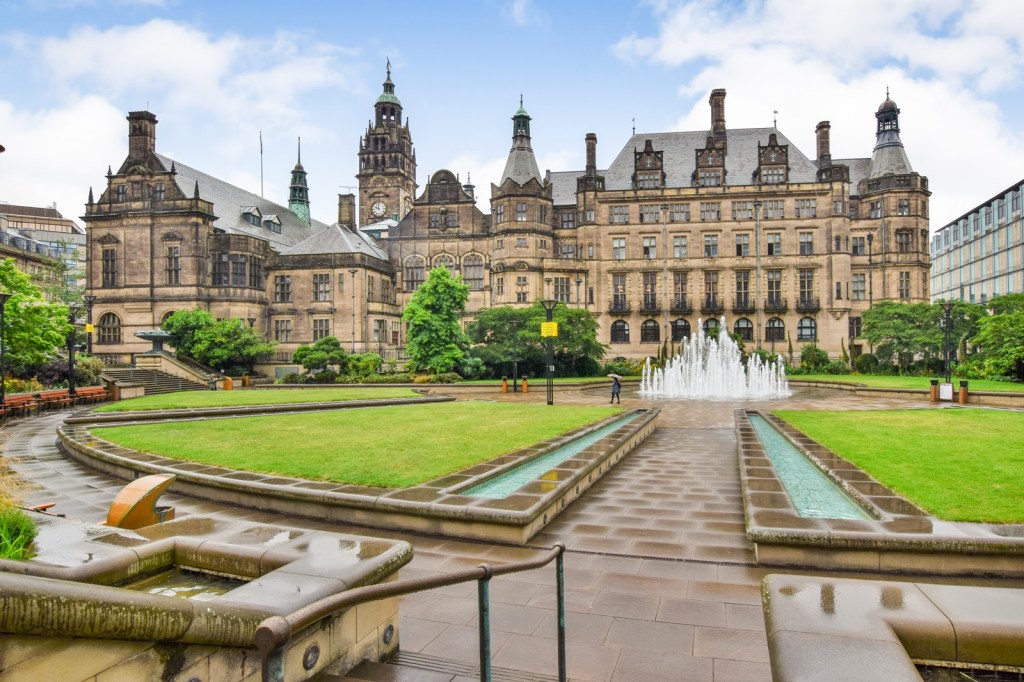
When the Heart of the City project came about during the 1990s the Peace Gardens were at the centre of the scheme. In 1997-1998, they were redesigned by the council’s Design and Property Services, a series of water features, pathways, balustrades and artworks, built in Stoke Hall sandstone, the same material used in the Town Hall.

The new garden, without traditional flower beds and less maintenance, were slightly sunk to mask the noise of buses from Pinstone Street.

Its centrepiece is the Goodwin Fountain, 89 individual jets of water, dedicated to Sir Stuart and Lady Goodwin, and the Holberry Cascades, named after Chartist leader Samuel Holberry, including eight large water features located on either side of the four main entrances.

Categories
Sculpture

Goodwin Fountains

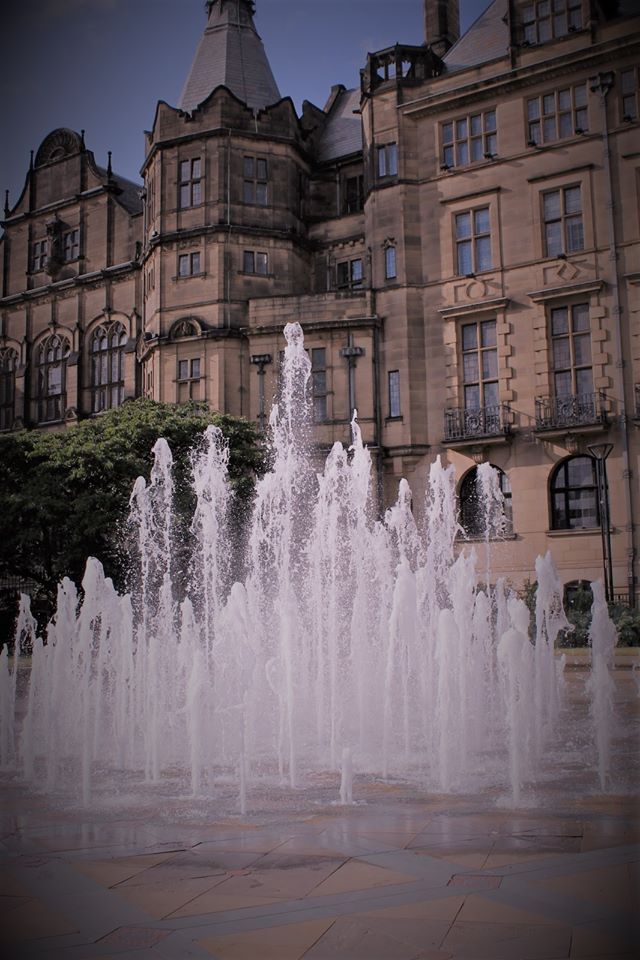
The Goodwin Fountains in the Peace Gardens. Eighty-nine individual jets of water inviting Sheffield’s kids to run through them during the summer and avoid them during winter. These are dedicated to Sir Stuart Goodwin (1886-1969), head of the Neepsend Steel and Tool Corporation. He gave away over £500,000 to charities and was honoured with the original Goodwin Fountain which stood at the top of Fargate between 1961 and 1998.

Categories
Sculpture

Holberry Cascades

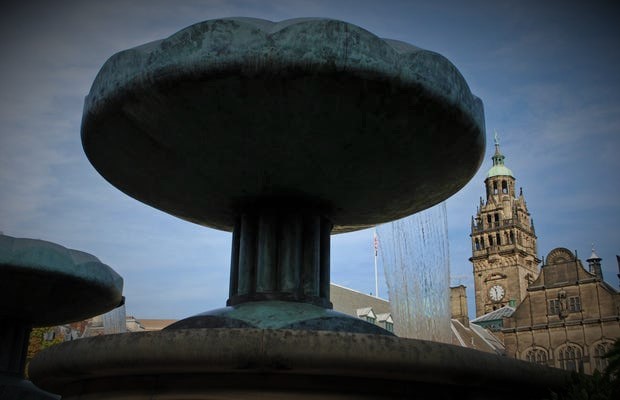
The Holberry Cascades. Named after the Chartist leader Samuel Holberry (1814-1842), they consist of eight large water features located on either side of the four main entrances to the Peace Gardens. The waterfalls from the bronze vessels represent both the pouring of water into Sheffield’s five rivers, and the pouring of molten metal used in the city’s metal industries. 57,000 litres of water are pumped through its water features, the system using a water re-circulation system, and is kept clean using a brine solution rather than chemicals.