Categories
Buildings

2 Haymarket: an exciting future for this important but unloved building

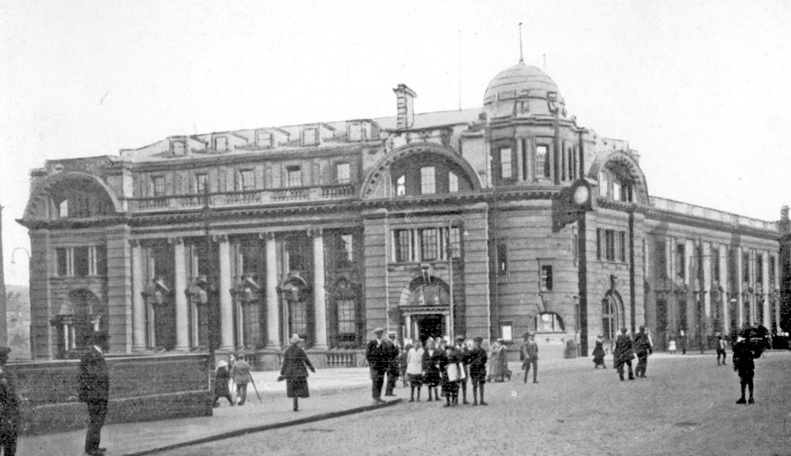
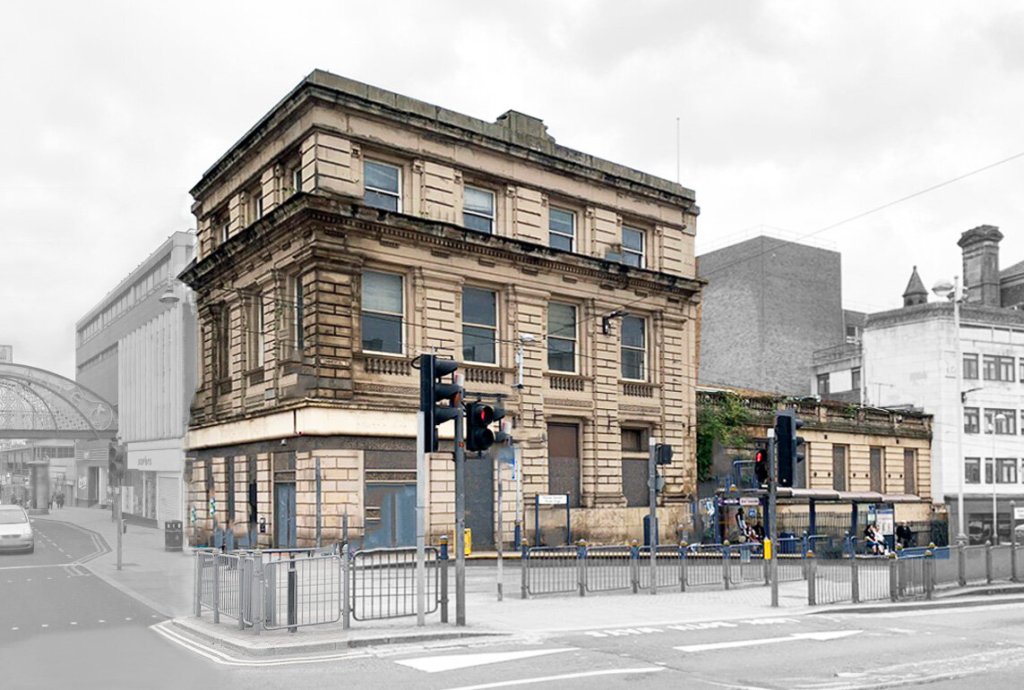
Former Post Office, Stock Exchange, and Bank. Haymarket/Commercial Street, Sheffield. Image: S1 Artspace.

In the early hours of Sunday 19 March 1871, workers at Sheffield Post Office completed an important task. At 1.30 in the morning, business was transferred from its old Market Place site to a new Post Office at Haymarket. Forty-five minutes later, the first mail was despatched south, and moments later, a Sheffield lady posted the first letter here, and its destination was Doncaster.

I wonder what these folk would think about the state of the Post Office now – poor service, scandals, and tarnished reputation. They would also be disheartened at the state of this former branch, decaying and empty since Yorkshire Bank abandoned it over a decade ago.

The good news is that the Grade II listed building has been sold to S1 Artspace to become an arts and cultural venue. Once completed, it will feature spacious public galleries across two floors, artist studios, a community and events space, research centre, shop, and an independent bar. The facility will be a neighbour to Harmony Works at Canada House, which is to be a £14m music education hub.

Until then, we must look back 153 years to the time when it was one of Sheffield’s most desirable properties. Built in a particular class of the Grecian order of architecture known as the Doric, the front Hollington stone elevation rose to three stories. It was designed by James Williams (1824 – 1892), who entered H.M. Office of Works in 1848 and was later appointed the first Surveyor for the construction of Post Offices until 1884. It was built by Neil and Son of Manchester.

“At present it is at its best – clean, and fresh of face. Sheffield smoke will soon set its mark on the refreshingly white freestone and bring it into disagreeable harmony with surrounding blackness. We are afraid that the ‘deeply rusticated’ work will not be so pleasantly conspicuous when the badge of Sheffield industry settles down upon its fair face. In point of external beauty, it is certainly no ‘romance in stone and lime’.” These words from the Sheffield Daily Telegraph on the day after it opened.

The newspaper was less impressed with the diminishing look of the left hand side of the building, but there was a reason behind this, the entrance here leading to upper rooms that were given to the Inland Revenue, its purpose to give the public the idea that it had no connection with the Post Office.

Later alterations hid the designation of the building – ‘Post Office’ – cut into the stone, and the original layout has been obliterated over the decades.

Customers entered from Old Haymarket, ascending stone steps, through a massive door into a vestibule, with their feet upon an iron grating, answering the purpose as a ‘scraper’ to take mud off their boots.

A folding door led into the public office, 33 ft long by 30ft wide, with two mahogany counters carried along the entire length of the room on either side. The floor was made of stone, and close to the counters were hollow conduits, their purpose being for rainy days and in winter, when people brought in wet umbrellas, or were themselves dripping, or shaking the snow off their garments, the water instead of standing in pools on the floor, would find its way into the channels and be carried off.

The walls and ceiling were plain, the only speciality being the plaster dentelli cornice. There were five massive windows – three at the side, and two in front, with glass inserted into the doors. By night, gas light was issued from six pillars fixed on the counter. It was heated by two fireplaces, of which the mantelpiece and supports were in dark Italian marble known as ‘St Ann’s’.

The sorting office was separated by a screen and extended to 80ft long and 30 ft wide, with a lantern-light roof supported on iron columns, running parallel with the ‘new road’ to the Midland Station – this would become Commercial Street.

It contained two stamping tables, with vulcanised India-rubber laid in stone, large mahogany ‘facing’ and ‘sorting’ tables, and compartments covered with kamptulicon and separated by trelliswork in brass. Unheard of now, were ‘bag horses’, brass rings placed on iron pillars, from which bags were suspended, twenty-six to each horse.

It had originally been intended to house the Sheffield Postal Telegraph Department in the rooms above the Post Office, but an oversight meant that the space available would have been smaller than its existing office in The Shambles. The Inland Revenue also found its accommodation too small and moved out a few months later, allowing the telegraph department to finally make the move.

By 1900, the Post Office was itself inadequate, and additional offices were built in Flat Street and all that remained in the Haymarket was public counter work and the telegraphic department. When a new Post office was built in Fitzalan Square in 1909, the building was vacated and served as the Sheffield Stock Exchange from 1911 before becoming a branch of the Yorkshire Bank in 1967.
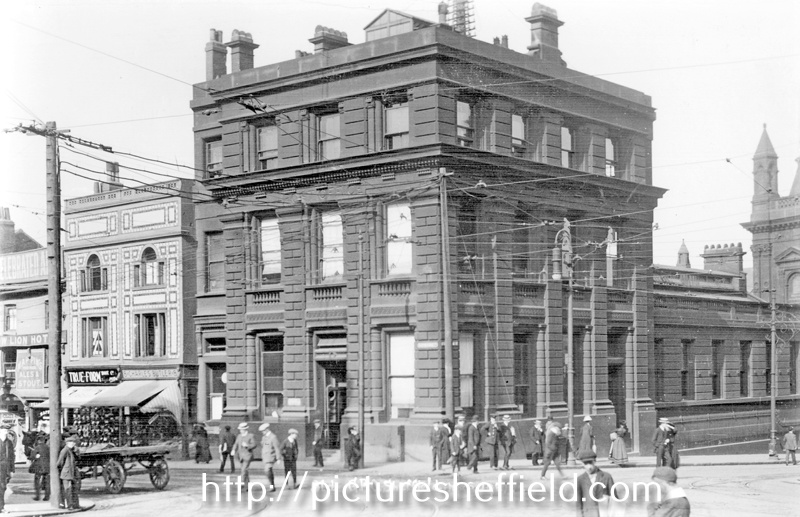
Old General Post Office, Haymarket, from Fitzalan Square with (right) Commercial Street. Image: Picture Sheffield

© 2024 David Poole. All Rights Reserved
Categories
Buildings

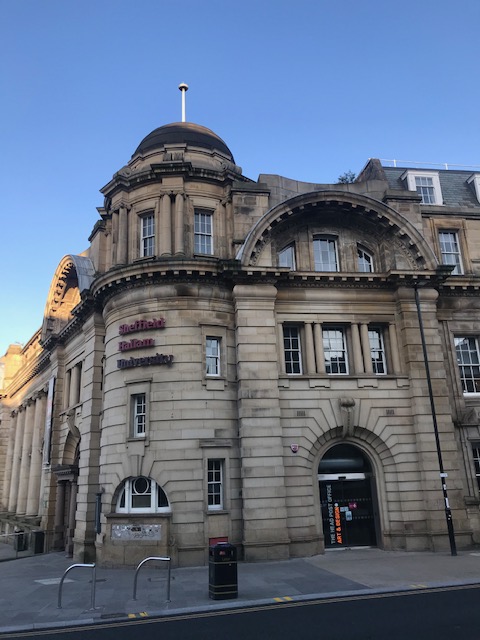
Institute of Arts (Sheffield General Post Office)

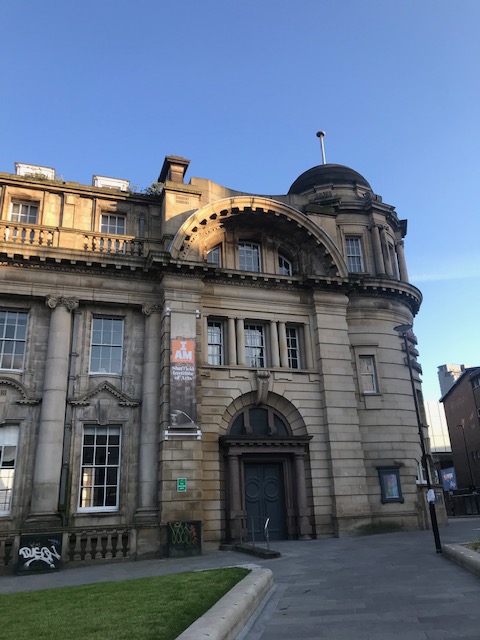
(Image: David Poole)

In a previous post we looked at the history of the General Post Office in Sheffield city centre. From humble beginnings on High Street, via Angel Street, Market Place, and Haymarket, the central post office ended up in Fitzalan Square.

However, the building now occupied by Sheffield Hallam University, was a long time coming.

In the first years of the twentieth century the Post Office acknowledged that facilities at the top of Haymarket had become too small.

By 1897, red-brick offices in Flat Street had opened and by 1900 all that remained at Haymarket was public counter work and the telegraphic department.

In fact, the Post Office had been buying up land around its Flat Street offices. By 1903, it had a triangular piece of land of one acre stretching from Fitzalan Square to Pond Hill.

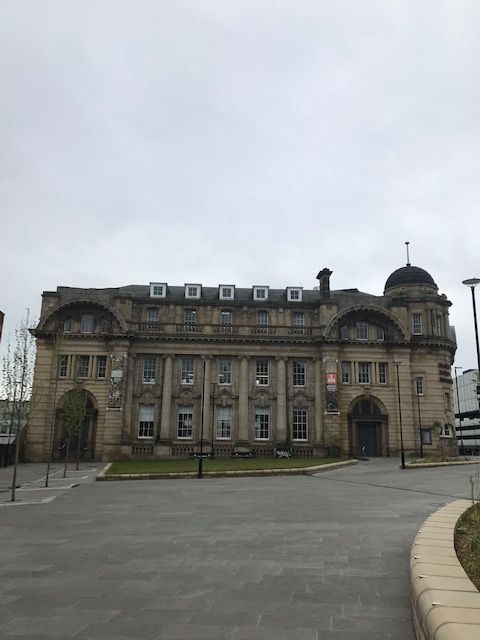
(Image: David Poole)

The Post Office submitted plans to Sheffield Corporation for a building fronting Fitzalan Square, but the councillors were less than impressed. In 1907 it sent a delegation to see Lord Granard, who represented the Post Office in the House of Lords, to ask for a better building, including a finer elevation, than the one proposed.

Newspapers had been full of stories about a new post office and the people of Sheffield had started to think that the building might never get built.

However, the visit to London appeared to work and later that year plans were released by the Post Office for a new building in Fitzalan Square adjoining the existing Flat Street offices.

(Image: David Poole)

Work started in 1908, coinciding with Fitzalan Square improvement works, and an immense crane, 70ft high and with a jib 95ft long, dominated the skyline.

It was designed by Walter Pott, an architect who had started work with HM Office of Works in 1896 working in the London and Leeds offices.

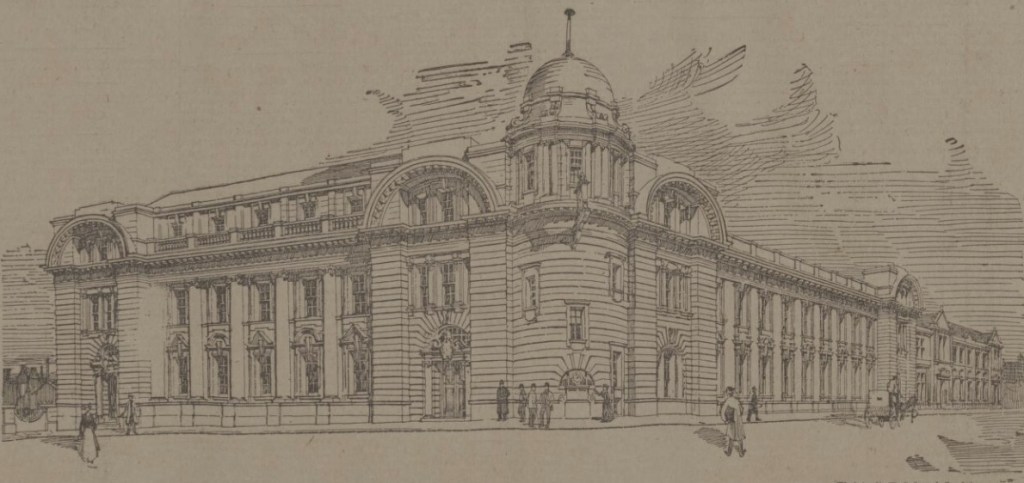
The design was a modern adaptation of the Renaissance and allowed an additional storey over the wing in Flat Street.

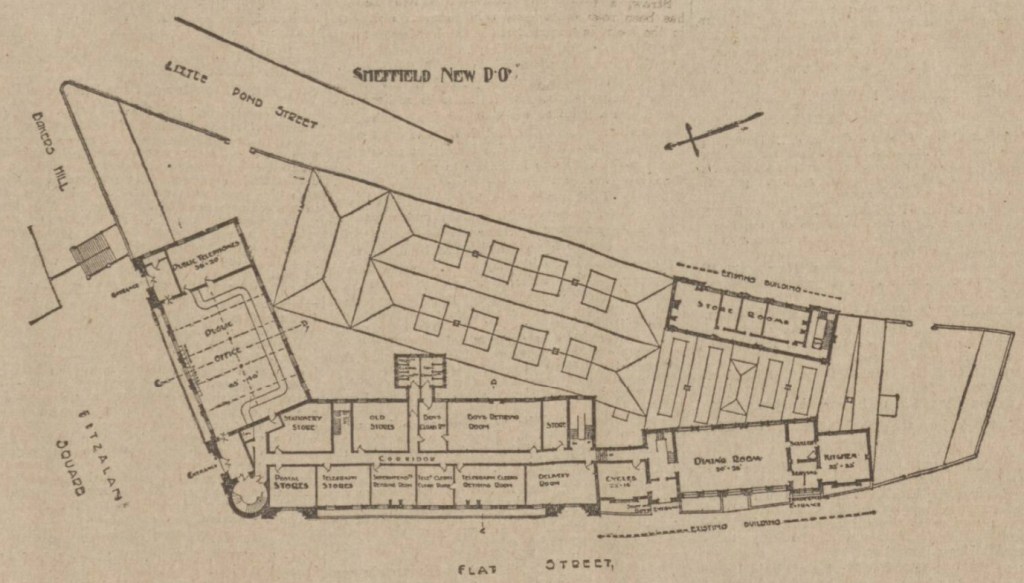
Plan of Sheffield Post Office in 1909. (Image: British Newspaper Archive)

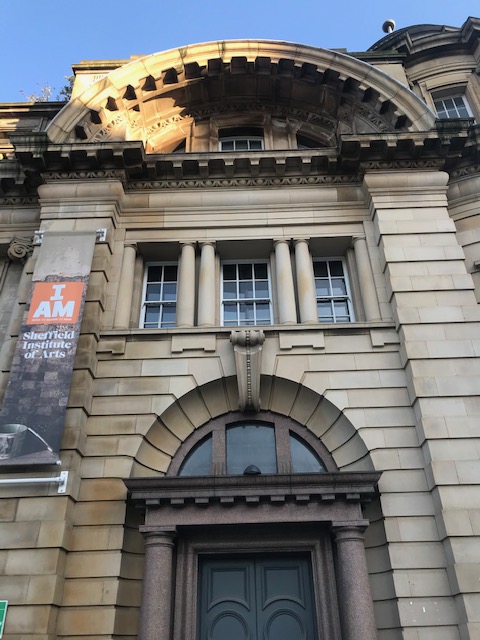
The principal front in Fitzalan Square was three storeys high, with a central portion having columns the full height of the two lower floors, these finished with carved Ionic caps and heavily moulded cornice and balustrade, which continued around the other fronts.

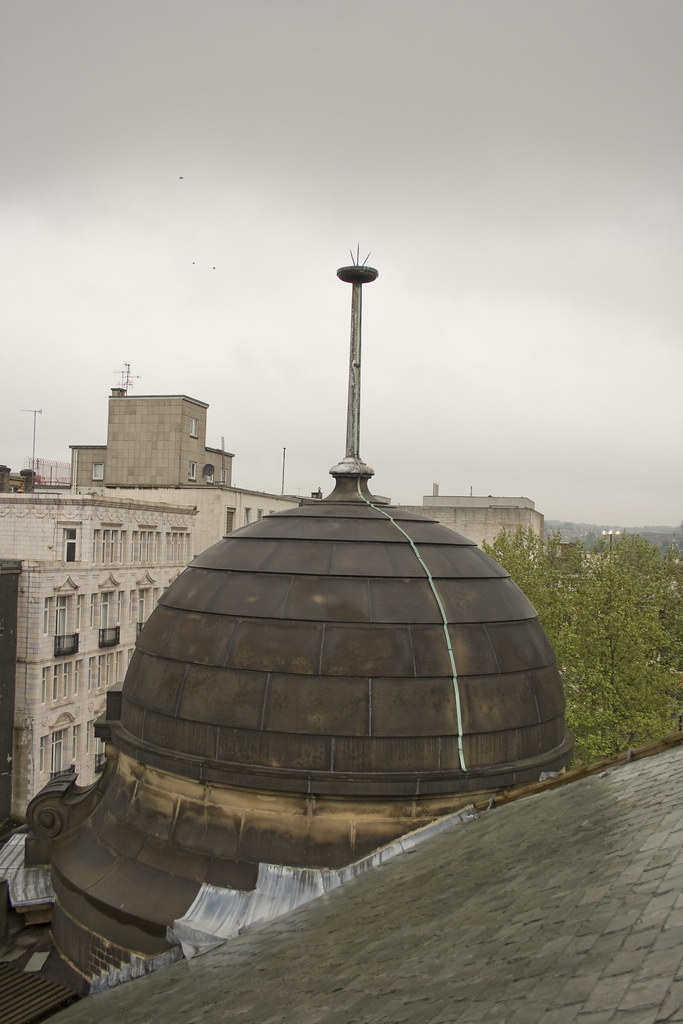
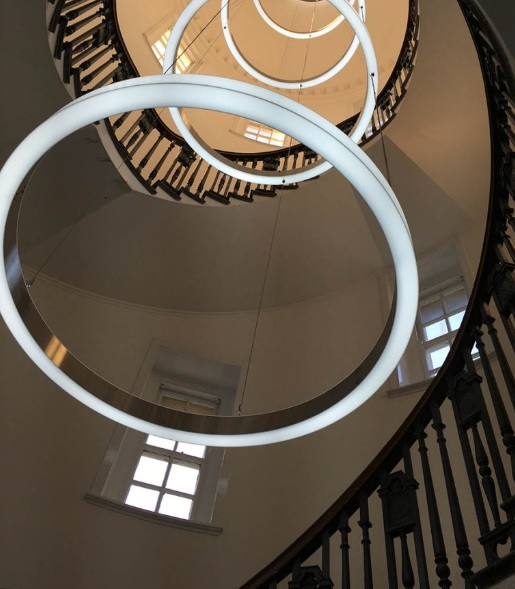
The front of Flat Street was treated in a similar manner but without the columns, and the corner with Fitzalan Square was rounded to accommodate a main staircase leading to the upper floors and finished with a dome.

The two principal entrances were in the wings of this portion, giving access to the public office, inquiry office, and Postmaster’s office. The upper parts of these were finished with heavy pediments.

Post boxes were at the base of the corner, with a large bracket clock (paid for by the council) above.

A sketch by Walter Pott of Sheffield Post Office in 1909. (Image: British Newspaper Archive)

The main post room, for the sale of stamps and postal orders, was 64ft long and 45ft wide, lit with windows back and front, and lined to a height of 8ft with marble, with a mosaic floor. Adjoining was a public telephone office with ‘silence boxes’ to allow messages to be sent without interference or risk of transactions being overheard.

The Postmaster, the Chief Clerk and writing staff, as well as the sectional engineer, were accommodated on the first floor immediately over the public office and front entrances, and on the floor above was the telephone switch-room and message-room. The basement was used for batteries and engineers’ equipment.

(Image: Picture Sheffield)

The Flat Street wing was set apart on the lower floors for retiring rooms for staff, for the messengers’ delivery room, and for storerooms. The first floor was entirely occupied by an instrument room.

The lower part of the site was in Little Pond Street, a much-needed extension to the existing sorting office, and for the provision of yards for loading and unloading mail and the storage of handcarts.

The new post office was designed throughout to meet modern sanitary requirements as regards light and ventilation, and the walls and passages occupied by staff were faced with glazed bricks. Four boilers, 146 radiators, and 1½ miles of heating pipe was installed by the Brightside Foundry and Engineering Co.

The building had been built on a hillside, and the result was that the greater portion was down below street level, and what people saw from Fitzalan Square was only the top.

Although history books give a date of 1910 for the building, it came into use without fuss during the summer of 1909. “The staff simply left their posts in one building and walked over to the incomparably better equipped accommodation across the Square.”

It remained in operation until 1999 and remained empty for several years, a ‘building at risk’, until rescued by Sheffield Hallam University which opened it as the Institute of Arts in 2016.

(Image: AxisArchitecture)
(Image: David Poole)

© 2020 David Poole. All Rights Reserved.